

Submitted:
09 March 2026
Posted:
12 March 2026
You are already at the latest version
Abstract
Introduction: COVID-19 mRNA vaccines are associated with the development of a wide range of autoimmune diseases. Rare autoimmune conditions, such as polymyalgia rheumatica (PMR), have received limited attention in medical literature. The purpose of this study is to review PMR, examine reports of PMR in the government database monitoring vaccine safety, and evaluate the potential association between PMR, COVID-19 vaccination, and spike protein antibody levels.Methods: Data were obtained from the U.S. Centers for Disease Control and Prevention (CDC) and the U.S. Food and Drug Administration (FDA). The CDC/FDA Vaccine Adverse Event Reporting System (VAERS) was queried for reports of polymyalgia rheumatica (PMR) from January 1, 1990, through January 30, 2026. This period encompasses 433 months for all vaccines; however, COVID-19 vaccines were available to the public for only 61 of those 433 months (January 1, 2021, through January 30, 2026). Odds ratios over time (ORt) were calculated by comparing the occurrence of PMR following the administration of specific vaccinations to including COVID-19, influenza, and all other vaccines combined. The CDC/FDA defines a safety signal as a disproportionality measure of ≥ 2. Data are presented as odds ratios over time ORt with corresponding 95% confidence intervals, p-values, and Z statistics. Three cases of PMR from the authors’ recent clinical practices were reviewed. A literature review on PMR was conducted using PubMed, MEDLINE, and Google Scholar.Results: Significant safety signals were observed when comparing reports of PMR following COVID-19 vaccination with those following influenza vaccination. This association persisted when PMR following COVID-19 vaccination was compared with PMR following all other vaccines combined. There were 2,227 reported cases of PMR following COVID-19 vaccination during the 61 months after vaccine rollout. In comparison, 233 cases were reported following influenza vaccination, and 526 cases were reported following all other vaccines combined over a 433-month period. The ORt for COVID-19 vaccination compared with influenza vaccination was 69.4, 95% CI 51.4 - 93.6, p < 0.0001, Z statistic 27.7. When comparing PMR following COVID-19 vaccination with PMR following all other vaccines combined including influenza, a significant safety signal persisted: 30.7, 95% CI 23.1 - 40.8, p < 0.0001, 23.6. Three exemplary cases and a review of the literature are also presented. Conclusions: Strong safety signals were detected when comparing polymyalgia rheumatica (PMR) following COVID-19 vaccination with PMR following influenza vaccination and, when compared to all other vaccines combined. The strength of the signal, its statistical robustness, and its consistency with observed clinical cases and biologically plausible immunoinflammatory mechanisms suggest the need for heightened clinical awareness of PMR occurring temporally following COVID-19 vaccination. These findings corroborate other research documenting the occurrence of PMR after COVID-19 vaccination and the pathophysiological pathway for spike protein-induced autoimmunity. Future research should prioritize validation of direct assays for spike protein detection rather than relying solely on surrogate antibody measurements. Additional investigation is also warranted to clarify the role of COVID-19 vaccinations and spike protein in musculoskeletal pathology and to evaluate preventive and therapeutic strategies.
Keywords:
COVID-19 vaccines
; polymyalgia rheumatica
; spike protein antibody levels
Introduction
The global rollout of COVID-19 mRNA vaccines in December 2020 was unprecedented in scope and speed. These vaccines were based on novel technology incorporating pseudo-uridylated mRNA sequences delivered systemically via lipid nanoparticle carrier systems. Although synthetic mRNA technology had been studied for decades, questions have been raised regarding the extent of preclinical evaluation in areas such as pharmacokinetics, pharmacodynamics, teratogenicity, oncogenicity, genotoxicity, immune toxicity, and autoimmune outcomes.
Synthetic mRNA encoding the spike protein, without an intrinsic, regulatory mechanisms to turn off protein expression results in sustained spike protein production. This has been hypothesized to contribute to spike protein accumulation, persistent elevated antibody levels, and severe inflammation throughout the body with concerning clinical consequences in nearly every organ system. Spike protein is known to be a foreign antigen with homology to dozens of human epitopes—also known as molecular mimicry—risking autoimmunity [1]. Additionally, the spike protein is highly inflammatory [2]. The spike protein encoded by the vaccine possess severe inflammatory effects throughout the body and the capacity to cross physiologic barriers, including the blood–brain barrier, blood–testis and ovarian barriers, and the placental barrier.
Multiple peer-reviewed case studies have documented an association of inflammatory myositis with COVD-19 mRNA vaccination in addition to autoimmune phenomena, and to a lesser extent overt autoimmune disease involving hematological, central nervous system, hepatic, and endocrine tissues. The immunopathogenesis of this, for the most part, remain poorly understood [3]. There is also accumulating evidence that the mRNA vaccines can severely affect mitochondrial function. First documented in tissue culture and animal studies involving the highly pathogenic early viral strains, by 2024 it was realized that spike protein expression could cause major mitochondrial dysfunction and various aberrations in a variety of tissues. These include amplifying inflammation, rewiring energy metabolism with reduced tissue ATP production, altered mitochondrial signaling, multiple alterations in gene expression patterns, modulation of the immune response, cytoskeletal changes, apoptosis induction, and premature cellular senescence [4,5].
In the first 15 months following the rollout of the COVID-19 vaccines, 1,366 studies were published in peer-reviewed medical journals reporting adverse outcomes after COVID-19 vaccination [6]. Of these, more than 10% described autoimmune-related mechanisms.
Polymyalgia rheumatica (PMR) is an autoimmune and inflammatory rheumatic condition that primarily affects individuals aged 50 years and older. The estimated annual incidence of PMR ranges from 18.6 to 96 cases per 100,000 persons in this age group, with a higher prevalence among women and individuals of Northern European ancestry [7,8,9].
Although PMR is often classified within the spectrum of autoimmune disorders, its pathophysiology is more closely associated with autoinflammatory processes driven by innate immune activation. This includes macrophage and dendritic cell infiltration into synovial structures, including the tenosynovium, bursae, and joint synovium [10,11,12]. Proposed contributing factors include genetic susceptibility—particularly certain HLA-DRB1 alleles—as well as environmental triggers such as infectious agents, which may disrupt immune tolerance [13,14]. This immune dysregulation is characterized by altered T-cell homeostasis, including reduced regulatory T-cell populations and increased Th17 cells, culminating in enhanced cytokine production—especially interleukin-6—which sustains systemic inflammation [10,11].
Clinically, PMR presents with debilitating bilateral proximal muscle pain and stiffness, most prominently affecting the shoulders, neck, and pelvic girdle. Symptom onset is insidious and includes prolonged morning stiffness lasting several hours, systemic fatigue, weight loss, and laboratory evidence of inflammation, including elevated erythrocyte sedimentation rate (ESR) and C-reactive protein (CRP) levels [7,8,15].
Despite being a common inflammatory syndrome in the elderly population, important gaps remain in the literature, particularly regarding precise, etiologic mechanisms and long-term prognostic data [13,14]. There is no single confirmatory diagnostic test for PMR; diagnosis relies on careful clinical assessment guided by established criteria from the European Alliance of Associations for Rheumatology and the American College of Rheumatology. These criteria emphasize symptom duration, age at onset, and a rapid response to glucocorticoid therapy, while carefully excluding alternative diagnoses such as giant cell arteritis and inflammatory arthritis [15,17].
Initial treatment typically consists of prednisone at doses of 20–40 mg daily, followed by gradual tapering over 1–2 years to achieve sustained remission [18,19,20]. Relapses are common occurring in approximately 50% of patients during corticosteroid tapering, underscoring the need for close monitoring, including serial CRP measurements [18,19,20,21].
The purpose of this study is to review PMR, examine reports of PMR in a government adverse-event database, and describe the association between PMR, COVID-19 vaccination, and spike protein antibody levels.
Methods
This observational retrospective study utilized the MedAlerts platform [22] to query the CDC/FDA Vaccine Adverse Event Reporting System (VAERS) database. VAERS employs the Medical Dictionary for Regulatory Activities (MedDRA), a clinically validated international medical terminology system used for regulatory and biopharmaceutical purposes. MedDRA is organized into a five-level hierarchical structure of medical terms. The lowest level, referred to as “Lower Level Terms” (LLTs), represents the most granular classification and includes specific diagnoses. VAERS was queried for the period January 1, 1990, through January 30, 2026. The analysis focused exclusively on one LLT: polymyalgia rheumatica (PMR). This timeframe encompasses 433 months for all vaccines; however, COVID-19 vaccines were available for only 61 of those 433 months (January 1, 2021, through January 30, 2026). Odds ratios over time (ORt) were calculated to assess disproportionality by comparing cases of PMR following COVID-19 vaccination with cases following influenza vaccination and with cases following all other vaccines combined—including influenza vaccines.
A recent publication analyzing the VAERS database applied disproportionality testing using three exposure measures: adverse events (AEs) per time, AEs per vaccination dose, and AEs per individual vaccinated [23]. That study used Poisson distributions to perform disproportionality analyses by time, vaccination dose, and number of individuals vaccinated, with Poisson exact tests to calculate p-values. Denominators for COVID-19 vaccine doses administered and the number of individuals vaccinated were obtained from Our World in Data [24]. Denominators for influenza vaccine doses and numbers of vaccinated individuals were derived from historical data supplemented by Monte Carlo simulation modeling. These additional analyses, AEs per vaccine dose and AEs per individual vaccinated, were not repeated in the present study, as AEs per unit time had previously been validated against AEs per dose and AEs per individual vaccinated [23].
The null hypothesis was tested; specifically, that the odds ratio over time (ORt) would be similar, with overlapping 95% confidence intervals and a p-value greater than 0.05, when comparing COVID-19 vaccines with other vaccines [25,26]. ORt values were calculated on a time basis as previously validated [23] and were applied in accordance with the CDC/FDA Vaccine Adverse Event Reporting System (VAERS) Standard Operating Procedures [27]. As described on page 15 of the CDC/FDA Standard Operating Procedures, disproportionality testing compares the proportion of a specific adverse event (AE) following a particular new vaccine with the proportion of the same AE following an established vaccine. The CDC/FDA further states that a disproportionality measure ≥ 2 constitutes a safety signal [27].
Standard statistical methods were used to calculate ORt values, along with 95% confidence intervals, p-values, and Z statistics, using MedCalc® Statistical Software version 23.4.8 (MedCalc Software Ltd., Ostend, Belgium; https://www.medcalc.org; 2026). The Z statistic indicates how many standard deviations a data point lies above or below the mean of a distribution. It may be positive (above the mean) or negative (below the mean) [28]. The Z statistic provides additional information beyond the p-value by quantifying the magnitude of deviation from the expected value within a given distribution. MedCalc® Statistical Software version 23.4.8 reports p-values as < 0.0001 when smaller than this threshold or as an exact value when ≥ 0.0001.
Case descriptions of three exemplary patients diagnosed with PMR after SARS-CoV-2 infection or vaccination in the authors’ recent clinical experience are also reviewed.
Results
Data were obtained from the U.S. Centers for Disease Control and Prevention (CDC) and the U.S. Food and Drug Administration (FDA). The CDC/FDA Vaccine Adverse Event Reporting System (VAERS) was queried for reports of polymyalgia rheumatica (PMR) from January 1, 1990, through January 30, 2026. This period encompasses 433 months for all vaccines; however, COVID-19 vaccines were available to the public for only 61 of those 433 months (January 1, 2021, through January 30, 2026).
The null hypothesis was rejected. Significant safety signals were observed when comparing PMR following COVID-19 vaccination with PMR following influenza vaccination. This association persisted even when PMR following COVID-19 vaccination was compared with PMR following all other vaccines combined including the influenza vaccines.
There were 2,227 reported cases of PMR following COVID-19 vaccination during the 61 months after vaccine rollout. In comparison, 233 cases were reported following influenza vaccination, and 526 cases were reported following all other vaccines combined over a 433-month period.
Data are presented as odds ratios over time (ORt) with corresponding 95% confidence intervals (CI), p-values, and Z statistics, as follows:
- COVID-19 vaccination versus influenza vaccination: 69.4, 51.4–93.6, p < 0.0001, 27.7;
- COVID-19 vaccination versus all other vaccines combined: 30.7, 23.1–40.8, p < 0.0001, 23.6
Case 1
A 51-year-old previously healthy male developed symptoms consistent with severe PMR in late 2025. An extensive evaluation was performed and was unremarkable, except for elevated inflammatory markers including an erythrocyte sedimentation rate (ESR) and C-reactive protein (CRP). He had declined and never received a COVID-19 vaccination but had a documented SARS-CoV-2 infection in 2020. His PMR symptoms responded promptly to a corticosteroid injection. Oral prednisone 20 mg daily was initiated and gradually tapered to 15 mg; he remains in the process of tapering to the lowest effective dose. Adjunctive measures include nutraceutical supplementation, red light therapy, and sauna sessions.
A quantitative spike protein antibody assay (LabCorp) demonstrated a level exceeding 21,000 U/mL. In the absence of COVID-19 vaccination, elevated antibody level may have resulted from prior infection or other exposure. The patient was a physician and reported frequent close contact with recently vaccinated individuals.
Case 2
A 65-year-old previously healthy male received two doses of the Pfizer COVID-19 vaccine in 2021. In 2022, he developed severe PMR symptoms characterized by bilateral shoulder pain and hip muscle pain and stiffness. An extensive evaluation was unremarkable except for elevated ESR and CRP levels. The diagnosis of PMR was confirmed by a rheumatologist. He was treated with oral prednisone 40 mg daily, followed by a gradual taper to 5 mg daily over six months. He remains asymptomatic on a maintenance dose of prednisone 5 mg daily.
Case 3
A 59-year-old previously healthy male physician developed PMR symptoms two weeks after his second COVID-19 vaccine dose, characterized by severe bilateral shoulder pain and hip pain and stiffness. An extensive evaluation was negative except for elevated ESR and CRP levels. Initial treatment included intramuscular glucocorticoids for pain control, followed by oral prednisone therapy. After a two-year course of treatment, the patient achieved remission.
Discussion
We suspect the spike protein from SARS-CoV-2 infection or COVID-19 vaccination can be a trigger for the onset of PMR. Because vaccination did not prevent infection from SARS-CoV-2, it is likely vaccinated individuals also had additional exposure to the spike protein from infection. We identified significant safety signals in the CDC/FDA Vaccine Adverse Event Reporting System (VAERS) associated with COVID-19 vaccination and polymyalgia rheumatica (PMR). The CDC/FDA considers a disproportionality ratio ≥ 2 to constitute a safety signal [27]. After adjusting for the duration of vaccine availability (in months), the odds ratio over time (ORt) for PMR following COVID-19 vaccination compared with influenza vaccination was 69.4 (95% CI, 51.4–93.6), p-value < 0.0001, and Z statistic = 27.7. Similarly, the ORt compared with all other vaccines combined was 30.7 (95% CI, 23.1–40.8), p < 0.0001, and Z statistic = 23.6.
The Z statistics are useful in evaluating disproportionality because it represents the number of standard deviations above the mean. For example, a Z statistic greater than 6 is generally considered statistically improbable, indicating that the disproportionality lies far in the upper tail of the distribution and that the likelihood of the observed association occurring by chance alone is extremely low.
These findings demonstrate a disproportionate increase in reports of PMR following COVID-19 vaccination. However, given the passive nature of VAERS data, such findings indicate a signal rather than establish causation. Prior publications are consistent with our findings [29,30,31,32,33,34,35,36,37,38,39,40,41,42,43,44,45,46,47,48,49,50,51,52,53,54].
Our three case reports and findings are consistent with the 2024 study by Irani and colleagues, which also described three cases of PMR following COVID-19 vaccination [29]. The authors proposed three potential mechanisms:
- Preexisting factors that predispose individuals to PMR following vaccination, such as the HLA-DRB1*13:01 allele, potentially triggered by vaccine adjuvants;
- Autoimmune syndromes induced by vaccine adjuvants; and
- Activation of Toll-like receptors, specifically TLR7 and TLR9, which may contribute to the development of PMR following immunization.
In addition to the mechanisms proposed by Irani et al., other hypotheses include viral infections as potential triggers [30,31,32].
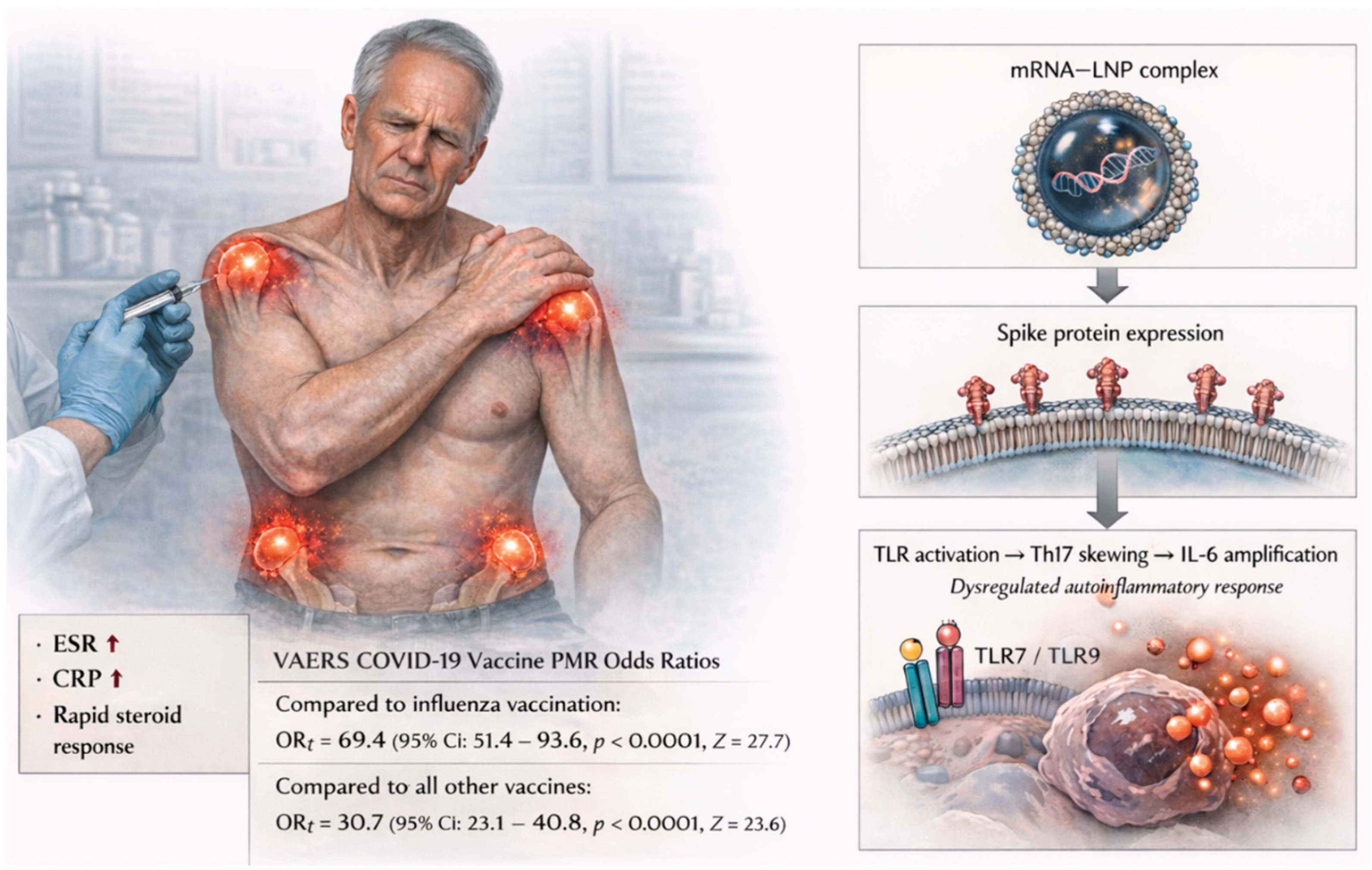
The body of evidence and association versus causation linking COVID-19 infection and vaccination and PMR is extensive and continues to evolve [29,30,31,32,33,34,35,36,37,38,39,40,41,42,43,44,45,46,47,48,49,50,51,52,53,54]. Although a causal relationship between SARS-CoV-2 infection and or COVID-19 vaccination and PMR has not been established, the observed temporal associations may satisfy certain elements of the Bradford Hill criteria for causation [55]. A schematic representation of the clinical phenotype and proposed immunoinflammatory mechanisms underlying COVID-19 vaccine–associated PMR is shown in Figure 1.
As illustrated in Case #1, another potential mechanism could involve elevated spike protein exposure from SARS-CoV-2 infection unrelated to COVID-19 vaccination or other vaccinations. Such elevations may contribute to persistent inflammation through cytokine dysregulation or molecular mimicry, potentially exacerbating innate immune responses in susceptible individuals [56,57]. In the authors’ clinical experience, spike antibody levels as high as those observed in Case #1 (>21,000 U/mL) have not been seen following COVID-19 infection without vaccination, especially five years after the acute COVID-19 infection.
One proposed explanation for the spike protein antibody levels observed in Case #1 is not only infection from SARS-CoV-2 but also exposure to recently vaccinated individuals referred to as shedding. It is conceivable that the patient developed PMR following such an exposure, particularly given that symptom onset occurred approximately five years after his documented COVID-19 infection. This consideration may be relevant because the patient is a physician with frequent close contact with recently vaccinated individuals. Peters and colleagues and others describe the occurrence of post-vaccination shedding, suggesting transmission of spike protein, lipid nanoparticles, or vaccine mRNA via exosomes or other bodily fluids [58,59,60,61,62,63]. A recent study documents the presence of vaccine mRNA and spike protein found in placentas even when vaccination occurred before pregnancy—this contradicting the false narrative that the vaccine mRNA and spike protein are cleared from the body immediately [64]. This study [64] supports many clinicians’ experience documenting the mechanism for the shedding event occurring in some vaccinated individuals: the mRNA and spike protein remain in the blood for an extended period of time and may be shed through exosomes in bodily fluids, sweat, semen, or breathing.
Polymyalgia rheumatica is a systemic inflammatory condition characterized by severe bilateral proximal pain and stiffness involving the shoulders and hips, marked morning stiffness, fatigue, and elevated inflammatory markers such as C-reactive protein (CRP). Symptoms typically respond promptly to glucocorticoid therapy [65]. Pathologically, PMR is associated with bursitis, synovitis, and tenosynovitis, with minimal myositis, distinguishing it from primary myopathic disorders [11]. Genetic susceptibility, including associations with HLA-DR4 alleles, in combination with environmental triggers such as infections, appears to promote macrophage and T-cell infiltration into synovial structures [13].
Beyond rheumatologic manifestations, orthopedic complications have been reported in association with COVID-19 and spike protein exposure, though they may be underrecognized in clinical discussions and the medical literature. It has been hypothesized that spike protein exposure—whether related to viral infection or vaccination—may contribute to endothelial dysfunction and microvascular thrombosis, potentially affecting musculoskeletal tissue integrity and repair mechanisms [66]. It is plausible that the presence of high levels of spike protein contribute not only to acute injuries, but also to delayed healing. McCullough expanded on these concerns reporting on painful osteoporotic microfractures and orthopedic injuries in younger persons after COVID-19 vaccination [67]. The mechanisms lie in spike protein-driven immune dysregulation, RANKL/OPG imbalance, and cytokine-driven bone resorption [66]. McCullough reviews other studies documenting orthopedic injuries after COVID-19 vaccinations [66,67,68].
Ursini reported a spectrum of short-term inflammatory musculoskeletal manifestations after COVID-19 vaccination in a report of 66 cases [68]. Park also has published a retrospective, nationwide cohort study in preprint MedRxiv analyzing the Korean National Health Insurance database [70]. They found that a variety of inflammatory musculoskeletal disorders such as plantar fasciitis, rotator cuff syndrome, adhesive capsulitis, herniated intervertebral disc, spondylosis, bursitis, Achilles tendinitis, and de-Quervain tenosynovitis were more likely to occur in COVID-19 vaccinated versus unvaccinated individuals [71]. Similar hypotheses have been advanced regarding post-vaccination musculoskeletal symptoms, suggesting that inflammatory and oxidative stress mechanisms may contribute to connective tissue disruption [56].
A notable real-world example involves the San Francisco 49ers professional football team, which experienced an increase in soft tissue injuries—including Achilles tendon ruptures and muscle strains—during the 2020–2021 seasons, a period coinciding with widespread COVID-19 exposure among athletes [71]. Some, including the NFL Player Association [72] consider the possibility that these injuries could be related to electromagnetic fields (EMF) from a nearby substation while others dismiss these claims [73,74]. COVID-19 vaccination induced spike protein-driven inflammation is a more plausible explanation [56]. It is possible that COVID-19 vaccine induced spike protein-driven inflammation could be potentiated by EMF and other factors. In 2023 McCullough and colleagues reviewed strategies to reduce the spike protein burden including nutraceutical agents such as nattokinase, bromelain, and curcumin [56,75]. These nutraceuticals mitigate inflammation, oxidative stress, and thrombotic risk [56,75]. However, robust clinical evidence supporting these interventions in this specific context remains limited.
The limitations of this study include its retrospective design. The case reports are anecdotal but are supported by other research studies discussed above. Passive surveillance systems like VAERS may underestimate the true incidence of an adverse outcome. The Harvard Pilgrim Project demonstrated that only about 1% of vaccine injuries were picked up by VAERS, although the exact sensitivity would vary by the specific vaccine injury [76]. In the case of PMR, delayed symptom onset could further reduce reporting rates to far lower than 1%. Given these considerations, there could be more than 250,000 cases of PMR associated with the COVID-19 vaccines.
Conclusions
In this retrospective VAERS analysis, we identified a strong safety signal between COVID-19 vaccination and polymyalgia rheumatica. The strength of the signal, its statistical robustness, and its consistency with observed clinical cases and biologically plausible immunoinflammatory mechanisms suggest the need for heightened clinical awareness of PMR occurring temporally following COVID-19 vaccination. Future research should prioritize validation of direct assays for spike protein detection rather than relying solely on surrogate antibody measurements. Additional investigation is also warranted to clarify the role of COVID-19 vaccinations and spike protein in musculoskeletal pathology and to evaluate preventive or therapeutic strategies that may mitigate the high spike protein burden.
Funding
No funding.
Conflicts of Interest
All the authors declare none.
References
- Nunez-Castilla J, Stebliankin V, Baral P, et al. Potential Autoimmunity Resulting from Molecular Mimicry between SARS-CoV-2 Spike and Human Proteins. Viruses. 2022; 14(7):1415. [CrossRef]
- Mezache, L., Soltisz, A., Tili, E. et al. SARS-CoV-2 spike protein-induced inflammation underlies proarrhythmia in COVID-19. Sci Rep 15, 33991 (2025). [CrossRef]
- Syrmou, V., Liaskos, C., Ntavari, N. et al. COVID-19 vaccine-associated myositis: a comprehensive review of the literature driven by a case report. Immunol Res 71, 537–546 (2023). [CrossRef]
- https://pmc.ncbi.nlm.nih.gov/articles/PMC10018601/.
- Huynh TV, Rethi L, Lee T-W, Higa S, Kao Y-H, Chen Y-J. Spike Protein Impairs Mitochondrial Function in Human Cardiomyocytes: Mechanisms Underlying Cardiac Injury in COVID-19. Cells. 2023; 12(6):877. [CrossRef]
- Rurek M. Mitochondria in COVID-19: from cellular and molecular perspective. Front Physiol. 2024 Jun 21;15:1406635. doi: 10.3389/fphys.2024.1406635. PMID: 38974521; PMCID: PMC11224649. https://pmc.ncbi.nlm.nih.gov/articles/PMC11224649/. [CrossRef]
- Thorp KE, Thorp JA, Thorp EM. COVID-19 and the Unraveling of Experimental Medicine—Part III. G Med Sci. 2022; 3(1):118-158. https://www.doi.org/10.46766/thegms.pubheal.22042302.
- Acharya S, Musa R. Polymyalgia Rheumatica. In: StatPearls [Internet]. Treasure Island (FL): StatPearls Publishing; 2025 Jan. PMID: 30725959. https://pubmed.ncbi.nlm.nih.gov/30725959.
- Mahmood SB, Chohan S, Dasgupta B. Polymyalgia rheumatica: An updated review. Cleve Clin J Med. 2020;87(9):549-556. doi:10.3949/ccjm.87a.20008. PMID: 32868305. https://pubmed.ncbi.nlm.nih.gov/32868305. [CrossRef]
- Espígol-Frigolé G, Danda D, McAdoo SP, Luckie SL, Luqmani SM, Camellino D. Polymyalgia rheumatica. Lancet. 2023;402(10411):1459-1472. doi:10.1016/S0140-6736(23)01310-7. PMID: 37832573. https://pubmed.ncbi.nlm.nih.gov/37832573. [CrossRef]
- Choy EH, Unsworth DJ, Walsh DA, Dasgupta B, Filer A. Understanding the immunopathophysiology of polymyalgia rheumatica: implications for treatment. Ann Rheum Dis. 2026;85(1):6-21. doi:10.1016/j.ard.2025.09.005. PMID: 41107118. https://pubmed.ncbi.nlm.nih.gov/41107118. [CrossRef]
- Hysa E, Sobrero A, Camellino D, Rumi F, Cimmino MA, Cutolo M, Melsens K. Immune system activation in polymyalgia rheumatica: Which balance between autoinflammation and autoimmunity? A systematic review. Autoimmun Rev. 2022;21(2):102995. doi:10.1016/j.autrev.2021.102995. PMID: 34798314. https://pubmed.ncbi.nlm.nih.gov/34798314. [CrossRef]
- Florescu MM, Cinteză D, Sandru F, Gheorghe AG, Pana M, Mușetescu AE. Polymyalgia rheumatica: An update (Review). Exp Ther Med. 2023;26(6):543. doi:10.3892/etm.2023.12242. PMID: 37928511. https://pubmed.ncbi.nlm.nih.gov/37928511. [CrossRef]
- Benlidayi IC. Why is polymyalgia rheumatica a disease of older adults? Explanations through etiology and pathogenesis: a narrative review. Clin Rheumatol. 2024;43(3):851-861. doi:10.1007/s10067-023-06708-3. PMID: 37470883. https://pubmed.ncbi.nlm.nih.gov/37470883. [CrossRef]
- Shah S, Perera S, Deane KD, Dasgupta B. A history of polymyalgia rheumatica: a narrative review. Rheumatology (Oxford). 2025;64(2):470-476. doi:10.1093/rheumatology/keae569. PMID: 39412500. https://pubmed.ncbi.nlm.nih.gov/39412500. [CrossRef]
- Raleigh MF, Wilson JM, Hall RR, Nguyen G, Jump RL. Polymyalgia Rheumatica and Giant Cell Arteritis: Rapid Evidence Review. Am Fam Physician. 2022;106(4):420-426. PMID: 36260899. https://pubmed.ncbi.nlm.nih.gov/36260899.
- Nageswaran P, Unwin S, Adebajo A, Owen CE, Mackie SL, Deane KD, Dasgupta B. Review of phase 2/3 trials in polymyalgia rheumatica and giant cell arteritis. Expert Opin Emerg Drugs. 2024;29(1):5-17. doi:10.1080/14728214.2024.2303093. PMID: 38180809. https://pubmed.ncbi.nlm.nih.gov/38180809. [CrossRef]
- Buttgereit F, Dejaco C, Matteson EL, Dasgupta B. Polymyalgia Rheumatica and Giant Cell Arteritis: A Systematic Review. JAMA. 2016;315(22):2442-2458. doi:10.1001/jama.2016.5444. PMID: 27299619. https://pubmed.ncbi.nlm.nih.gov/27299619. [CrossRef]
- Castañeda S, García-Castañeda N, Prieto-Peña D, Martínez-López D, Gómez-Caverzaschi V, Atienza-Mateo B, Blanco R. Treatment of polymyalgia rheumatica. Biochem Pharmacol. 2019;165:221-229. doi:10.1016/j.bcp.2019.03.027. PMID: 30904473. https://pubmed.ncbi.nlm.nih.gov/30904473. [CrossRef]
- Hernández-Rodríguez J, Cid MC, López-Soto A, Espigol-Frigole G, Bosch X. Treatment of polymyalgia rheumatica: a systematic review. Arch Intern Med. 2009;169(20):1839-1850. doi:10.1001/archinternmed.2009.352. PMID: 19901135. https://pubmed.ncbi.nlm.nih.gov/19901135. [CrossRef]
- Harkins P, Cowley S, Conway R, Kane D, Burke E, Harrington R, Molloy D. Modern Management of Isolated Polymyalgia Rheumatica. Rheumatol Ther. 2025;12(6):1017-1041. doi:10.1007/s40744-025-00797-z. PMID: 41085890. https://pubmed.ncbi.nlm.nih.gov/41085890. [CrossRef]
- Boyadzhieva Z, Ruffer N, Bosch P, Buttgereit F, Dejaco C, Iagnocco A, Schäfer VS, Schmidt WA, Sattler L, Thiel J, Kleyer A, Schett G. Treatment and prognostic factors in PMR: a systematic literature review informing German, Austrian and Swiss guidelines. Rheumatology (Oxford). 2025;64(12):6036-6047. doi:10.1093/rheumatology/keaf418. PMID: 40795053. https://pubmed.ncbi.nlm.nih.gov/40795053. [CrossRef]
- MedAlerts. National Vaccine Information Center. Your Health. Your Family. Your Choice. https://medalerts.org/index.php. Accessed April 5, 2025.
- Thorp JA, Rogers C, Deskevich M, Tankersley S, Benavides A, Redshaw MD, McCullough PA. Covid-19 vaccines: the impact on pregnancy outcomes and menstrual function. J. Am. Phys.Surg. 2023;28(1):28-34. https://www.jpands.org/vol28no1/thorp.pdf.
- Our World in Data. Coronavirus (COVID-19) Vaccinations. https://ourworldindata.org/covid-vaccinations Published in 2020, Revised in 2024. Accessed February 22 2026.
- Norton EC, Dowd BE, Maciejewski ML. Odds Ratios-Cureent Best Practice and Use. JAMA Guide to Statistics and Methods. JAMA July 3, 2018:320(1).
- https://www.feinberg.northwestern.edu/sites/firstdailylife/docs/resources-docs/jama.2018.norton.guidetostatisticsandmedicine.odds-ratioscurrent-best-practice-and-use.pdf?utm_source=chatgpt.com.
- [26] Cash E, Boktor SW. Understanding Biostatistics Interpretation. National Library of Medicine StatPearls. March 13, 2023.
- https://www.ncbi.nlm.nih.gov/sites/books/NBK431056/?utm_source=chatgpt.com.
- CDC VAERS Team. Vaccine Adverse Event Reporting System (VAERS) Standard Operating Procedures for Covid-19. See Page 15. February 2, 2022. https://www.cdc.gov/vaccine-safety-systems/media/pdfs/vaers-covid19-sop-2-feb-2022-508.pdf?CDC_AAref_Val=https://www.cdc.gov/vaccinesafety/pdf/VAERS-COVID19-SOP-02-02-2022-508.pdf This has been accessed and previously referenced multiple times by the second author (JAT) over the past 3 years and published as such. However, the CDC removed this URL from their website in late 2024. Senator Ron Johnson, in a January 10, 2023, letter to CDC Director Rochelle Walensky, specifically points out his concerns for breach in safety signals in VAERS as measured by the disproportionality testing. In this letter Senator Ron Johnson also references this exact same URL in his letter (reference #2) https://www.ronjohnson.senate.gov/services/files/AB68101B-CDA4-49F1-8174-4274DDEB0120 The Wayback Machine archive to the removed URL is available here on November 15, 2024—click on that date. https://web.archive.org/web/20241115170847/https://www.cdc.gov/vaccine-safety-systems/media/pdfs/vaers-covid19-sop-2-feb-2022-508.pdf?CDC_AAref_Val=https://www.cdc.gov/vaccinesafety/pdf/VAERS-COVID19-SOP-02-02-2022-508.pdf.
- [28] Fleiss JS, Levin B, Myunghee CP. Statistical Methods for Rates and Proportions. Third Edition. New Your, NY:. John Wiley & Sons; 2003.
- Irani L, Linthicum M, Koleilat I. Polymyalgia rheumatica following COVID-19 vaccination: Case series of 3 patients and literature review on polymyalgia rheumatica induced by various vaccines. Medicine (Baltimore). 2024;103(44):e40218. doi:10.1097/MD.0000000000040218. https://journals.lww.com/md-journal/fulltext/2024/10250/polymyalgia_rheumatica_following_covid_19.42.aspx. [CrossRef]
- Shahid F, Shahid M, Ahmad M, et al. The Association of Polymyalgia Rheumatica and Giant Cell Arteritis With COVID-19 Vaccination: A Systematic Review. Clin Med Insights Arthritis Musculoskelet Disord. 2026;19:11795441251414673. doi:10.1177/11795441251414673. https://journals.sagepub.com/doi/10.1177/11795441251414673. [CrossRef]
- Trotto N, Tannenbaum C, Glicksman J. Polymyalgia Rheumatica After mRNA COVID-19 Vaccination. Ann Allergy Asthma Immunol. 2022;129(5):S12. doi:10.1016/j.anai.2022.08.546. https://www.annallergy.org/article/S1081-1206(22)01469-7/fulltext. [CrossRef]
- Yokote A, Fujioka S, Takahashi N, Mishima T, Tsuboi Y. Polymyalgia Rheumatica Following COVID-19 Vaccination. Intern Med. 2022;61(11):1777-1779. doi:10.2169/internalmedicine.8803-21. https://pmc.ncbi.nlm.nih.gov/articles/PMC9259323. [CrossRef]
- Mamootil D. New-Onset Polymyalgia Rheumatica Complicated by Giant Cell Arteritis Following COVID-19 Infection. Cureus. 2023 Jul 16;15(7):e41951. doi: 10.7759/cureus.41951. PMID: 37588300; PMCID: PMC10426384. [CrossRef]
- Bandinelli F. Post-COVID-19 and Post-COVID-19 Vaccine Arthritis, Polymyalgia Rheumatica and Horton’s Arteritis: A Single-Center Assessment of Clinical, Serological, Genetic, and Ultrasonographic Biomarkers. J Clin Med. 2023;12(24):7563. doi:10.3390/jcm12247563. PMID: 38137641. https://pubmed.ncbi.nlm.nih.gov/38137641. [CrossRef]
- Manzo C. Polymyalgia rheumatica and polymyalgia-like syndromes as adverse events following COVID-19 vaccines: working notes from a narrative review of published literature. Reumatologia. 2022;60(1):60-67. doi:10.5114/reum.2022.114244. PMID: 35645422. https://pubmed.ncbi.nlm.nih.gov/35645422. [CrossRef]
- Pinto Oliveira C, Ferreira Azevedo S, Vilafanha C, Prata AR, Barcelos A. Polymyalgia Rheumatica After COVID-19 Vaccination: Data from the EudraVigilance Database. Acta Med Port. 2024 May 2;37(5):396-397. doi: 10.20344/amp.20952. Epub 2024 Apr 12. PMID: 38607657. [CrossRef]
- Jarrot PA, Mirouse A, Ottaviani S, et al. Polymyalgia rheumatica and giant cell arteritis following COVID-19 vaccination: Results from a nationwide survey. Hum Vaccin Immunother. 2024 Dec 31;20(1):2334084. doi: 10.1080/21645515.2024.2334084. Epub 2024 Apr 2. PMID: 38563792; PMCID: PMC10989707. [CrossRef]
- Ottaviani S, Juge PA, Forien M, Ebstein E, Palazzo E, Dieudé P. Polymyalgia rheumatica following COVID-19 vaccination: A case-series of ten patients. Joint Bone Spine. 2022 Mar;89(2):105334. doi: 10.1016/j.jbspin.2021.105334. Epub 2021 Dec 22. PMID: 34954076; PMCID: PMC8694785. [CrossRef]
- Irani L, Bou Karroum M, Chehab Y, et al. Polymyalgia rheumatica following COVID-19 vaccination: Case series of 3 patients and literature review on polymyalgia rheumatica induced by various vaccines. Medicine (Baltimore). 2024 Oct 25;103(43):e40204. doi: 10.1097/MD.0000000000040204. PMID: 39470514; PMCID: PMC11521047. [CrossRef]
- Furr T, Garg M. Rare Cases of Polymyalgia Rheumatica After Receiving COVID-19 Vaccinations. Cureus. 2023 Apr 18;15(4):e37782. doi: 10.7759/cureus.37782. PMID: 37091488; PMCID: PMC10115741. [CrossRef]
- Mamootil D. New-Onset Polymyalgia Rheumatica Complicated by Giant Cell Arteritis Following COVID-19 Infection. Cureus. 2023 Jul 16;15(7):e41951. doi: 10.7759/cureus.41951. PMID: 37588300; PMCID: PMC10426384. [CrossRef]
- Arias M, Cacabelos P, Arias-Rivas S. Polymyalgia rheumatica and giant cell arteritis with intracranial involvement postvaccination anti-COVID-19. Med Clin (Engl Ed). 2022 Sep 23;159(6):e43-e44. doi: 10.1016/j.medcle.2022.04.011. Epub 2022 Aug 30. PMID: 36060099; PMCID: PMC9425118. [CrossRef]
- Bandinelli F, Pagano M, Vallecoccia MS. Post-COVID-19 and Post-COVID-19 Vaccine Arthritis, Polymyalgia Rheumatica and Horton’s Arteritis: A Single-Center Assessment of Clinical, Serological, Genetic, and Ultrasonographic Biomarkers. J Clin Med. 2023 Dec 8;12(24):7563. doi: 10.3390/jcm12247563. PMID: 38137631; PMCID: PMC10743539. [CrossRef]
- Osada A, Sakuragi C, Toya C, Mitsuo A. New-onset Polymyalgia Rheumatica Following the Administration of the Pfizer-BioNTech COVID-19 Vaccine. Intern Med. 2022 Mar 1;61(5):749-753. doi: 10.2169/internalmedicine.8651-21. Epub 2021 Dec 11. PMID: 34897152; PMCID: PMC8943385. [CrossRef]
- Manzo C, Castagna A, Nune A, Isetta M. Polymyalgia rheumatica and polymyalgia-like syndromes as adverse events following immunisation with COVID-19 vaccines: a 15 months update. Reumatologia. 2023;61(5):408-409. doi: 10.5114/reum/172508. Epub 2023 Oct 31. PMID: 37970116; PMCID: PMC10634411. [CrossRef]
- Shahid F, Farooq H, Abeer H, et al. The Association of Polymyalgia Rheumatica and Giant Cell Arteritis With COVID-19 Vaccination: A Systematic Review. Clin Med Insights Arthritis Musculoskelet Disord. 2026 Jan 19;19:11795441251414673. doi: 10.1177/11795441251414673. PMID: 41567360; PMCID: PMC12816559. [CrossRef]
- Haruna K, Shirota S, Nishioka H. Polymyalgia Rheumatica (PMR) Lacking Shoulder Pain Following COVID-19 Vaccination. Cureus. 2023 Feb 7;15(2):e34714. doi: 10.7759/cureus.34714. PMID: 36909027; PMCID: PMC9996542. [CrossRef]
- Izuka S, Komai T, Natsumoto B, Shoda H, Fujio K. Self-limited Polymyalgia Rheumatica-like Syndrome Following mRNA-1273 SARS-CoV-2 Vaccination. Intern Med. 2022 Mar 15;61(6):903-906. doi: 10.2169/internalmedicine.8829-21. Epub 2021 Dec 28. PMID: 34980802; PMCID: PMC8987264. [CrossRef]
- Nielsen AW, Hansen IT, Gormsen LC, Hauge EM, Keller KK. Self-limiting reactive disease mimicking polymyalgia rheumatica following Moderna COVID-19 vaccine. Scand J Rheumatol. 2022 Sep;51(5):411-413. doi: 10.1080/03009742.2022.2070959. Epub 2022 Jun 6. PMID: 35658808. [CrossRef]
- Ahmad A, Baker DL. An Unusual Side Effect of the COVID-19 Vaccine: A Possible Trigger of Polymyalgia Rheumatica. Cureus. 2022 Jul 6;14(7):e26617. doi: 10.7759/cureus.26617. PMID: 35949778; PMCID: PMC9356652. [CrossRef]
- Matsuzono K, Fujimoto S. Case report of transient polymyalgia rheumatica after receiving the first dose of the BNT162b2 mRNA COVID-19 vaccine. SAGE Open Med Case Rep. 2024 Mar 4;12:2050313 × 241235830. doi: 10.1177/2050313 × 241235830. PMID: 38444691; PMCID: PMC10913505.
- Lourenço C, Pascoal A, Paiva A, Campos I, Pagaimo J. Polymyalgia Rheumatica After ChAdOx1 nCov-19 Vaccine: A Case Report. Cureus. 2022 May 26;14(5):e25346. doi: 10.7759/cureus.25346. PMID: 35774673; PMCID: PMC9236670. [CrossRef]
- amada S, Yamada K, Nishida H. A Case of Sequential Development of Polymyalgia Rheumatica and Guillain-Barré Syndrome Following Administration of the Pfizer-BioNTech COVID-19 Vaccine. Intern Med. 2022 Oct 1;61(19):2995. doi: 10.2169/internalmedicine.0319-22. Epub 2022 Jul 22. PMID: 35871588; PMCID: PMC9593167. [CrossRef]
- Nahra V, Makandura M, Anthony DD, Mattar M. A Case Series on the COVID-19 Vaccines and Possible Immune-Related Adverse Events: A New Challenge for the Rheumatologists. Cureus. 2022 Sep 27;14(9):e29660. doi: 10.7759/cureus.29660. PMID: 36321010; PMCID: PMC9612893. [CrossRef]
- Hill AB. The environment and disease: association or causation? Proc R Soc Med. 196;58(5):295-300. PMID: 14283879.
- Hulscher N, Hodkinson B, Makris M, et al. Clinical Approach to Post-acute Sequelae After COVID-19 Infection and Vaccination. Cureus. 2023;15(11):e49204. doi:10.7759/cureus.49204. https://pmc.ncbi.nlm.nih.gov/articles/PMC10663976. [CrossRef]
- Lesgards JF, Cerdan D, Perronne C, et al. Toxicity of SARS-CoV-2 Spike Protein from the Virus and Produced from COVID-19 mRNA or Adenoviral DNA Vaccines. J Vaccines Vaccin. 2023;14(4):1000517. https://www.fortunejournals.com/articles/toxicity-of-sarscov2-spike-protein-from-the-virus-and-produced-from-covid19-mrna-or-adenoviral-dna-vaccines.html.
- Peters SE, Newman J, Ray H, Thorp JA, Parotto T, Hooker B, McDyer D, Murphy L, Stricker RB, McDonnell M, Mills PJ, Geick W, Northrup C. Menstrual Abnormalities Strongly Associated with Proximity to COVID-19 Vaccinated Individuals. IJVTPR. International Journal of Vaccine Theory, Practice, and Research. December 7, 2024. 3(2)1435-1461. https://www.ijvtpr.com/index.php/IJVTPR/article/view/113 https://www.ijvtpr.com/index.php/IJVTPR/article/view/113/365.
- Mihalcea AM. Further proof of shedding: detection of Pfizer BioNTech messenger RNA COVID-19 Vaccine in Human Blood, Placenta and semen: detects mRNA in half of unvaccinated women>. December 6, 2025. https://anamihalceamdphd.substack.com/p/further-proof-of-shedding-detection?r=45fey1&triedRedirect=true.
- Mordechay, L., Baum, G., Gabbay-Benziv, R., Weinberger, H., & Frenkel-Morgenstern, M. F. (2025). Detection of Pfizer-BioNTech Messenger RNA COVID-19 Vaccine in Human Blood, Placenta and Semen. Annals of Case Reports, 10, Article 2428. DOI: 10.29011/2574-7754.102428. [CrossRef]
- Wolf N. “Shedding” is real, DNA Harms are real. April 4, 2024. https://naomiwolf.substack.com/p/shedding-is-real-dna-harms-are-real?r=45fey1&triedRedirect=true.
- Kedl RM, Hsieh EWY, Morrison TE, et al. Evidence for Aerosol Transfer of SARS-CoV-2-Specific Humoral Immunity. Immunohorizons. 2023 May 1;7(5):307-309. doi: 10.4049/immunohorizons.2300027. PMID: 37159005; PMCID: PMC10579981. [CrossRef]
- Kory P. Shedding Part 6—Clinical case notes describing shedding phenomena at the leading edge clinic. Nov 1, 2023. https://pierrekorymedicalmusings.com/p/shedding-part-6-clinical-case-notes.
- Bartmann C, Schmidt V, Mörz M, et al. Detection of spike protein in term placentas of COVID-19 vaccinated and/or SARS-CoV-2 infected women. PLoS One. 2026 Mar 5;21(3):e0344185. doi: 10.1371/journal.pone.0344185. PMID: 41785286; PMCID: PMC12962466. https://pmc.ncbi.nlm.nih.gov/articles/PMC12962466/?utm_source=chatgpt.com. [CrossRef]
- Espígol-Frigolé G, Danda D, McAdoo SP, et al. Polymyalgia rheumatica. Lancet. 2023;402(10411):1459-1472. doi:10.1016/S0140-6736(23)01310-7. https://pubmed.ncbi.nlm.nih.gov/37832573. [CrossRef]
- Parry PI, Lefringhausen A, Turni C, et al. ‘Spikeopathy’: COVID-19 Spike Protein Is Pathogenic, from Both Virus and Vaccine mRNA. Biomedicines. 2023;11(8):2287. doi:10.3390/biomedicines11082287. https://pmc.ncbi.nlm.nih.gov/articles/PMC10452662. [CrossRef]
- McCullough PA. Painful Osteoporotic Microfractures in Younger Persons After COVID-19 Vaccination” by Peter A. McCullough, MD, MPH, on Focal Points/Substack, December 31, 2025. https://www.thefocalpoints.com/p/painful-osteoporotic-microfractures?utm_source=chatgpt.com.
- Ursini F, Ruscitti P, Raimondo V, et al. Spectrum of short-term inflammatory musculoskeletal manifestations after COVID-19 vaccine administration: a report of 66 cases. Ann Rheum Dis. 2022 Mar;81(3):440-441. doi: 10.1136/annrheumdis-2021-221587. Epub 2021 Nov 26. PMID: 34836886. [CrossRef]
- Sharma A, Parekh SG. Musculoskeletal sequelae following COVID-19 mRNA vaccination: a case report. J Orthop Rep. 2022;1(3):100044. doi:10.1016/j.jorep.2022.100044. https://doaj.org/article/927b9189708d46d8a995c613adfc4ff9?utm_. [CrossRef]
- Park YH, Kim MH, Choi MG, Chun EM. Correlation between COVID-19 vaccination and inflammatory musculoskeletal disorders. medRxiv preprint November 22, 2023. doi:https://doi.org/10.11012023.11.14.23298544. https://www.medrxiv.org/content/10.1101/2023.11.14.23298544v1.full.pdf?utm_. [CrossRef]
- Kawakami E, Blank A, Smith B. Sport and the coronavirus crisis special issue: An introduction. Int J Sport Commun. 2020;13(3):1-4. doi:10.1123/ijsc.2020-0234. [CrossRef]
- Peter Cowan @living_energy on X formerly Twitter: “David White, interim director of the NFL Player Association, stated: “The NFLPA considers EMFs to be a potential WORKPLACE SAFETY issue”. This was reported on The Mercury News. https://x.com/living_energy/status/2028546275772448889?s=46&t=E3lBa0k6ScUvJ7YwdVqK9w.
- Knoblauch E. For some 49ers, EMF injuries theory no joke: ‘I might pull up with a meter one day’. San Francisco Chronicle. 2026 Jan 23. https://www.sfchronicle.com/sports/49ers/article/49ers-emf-injury-theory-no-joke-might-pull-21311524.php.
- Wang F. NFL leaders monitoring viral EMF conspiracy theory about 49ers injuries that doctors have debunked. ABC7 News. 2026 Feb 4. https://abc7news.com/post/nfl-leaders-monitoring-viral-emf-conspiracy-theory-49ers-injuries-doctors-have-debunked/18541925.
- McCullough PA, Wynn C, Procter BC. Clinical Rationale for SARS-CoV-2 Base Spike Protein Detoxification in Post COVID-19 and Vaccine Injury Syndromes. J Am Phys Surg. 2023;28(3):80-84. https://jpands.org/vol28no3/mccullough.pdf.
- Lazarus R. Eletronic Support for Public Health—Vaccine Adverse Event Reporting System (ES::VAERS)—Final Report. Prepared by Harvard Pilgrim Health Care, Inc. under Grant No. R18 HS017045. Rockville, MD: Agency for Healthcare research and Quality (AHRQ); 2010. https://digital.ahrq.gov/ahrq-funded-projects/electronic-support-public-health-vaccine-adverse-event-reporting-system?utm_.
Figure 1.
COVID-19 vaccine-induced polymyalgia rheumatica. Clinical depiction of bilateral proximal bursitis and synovitis characteristic of polymyalgia rheumatica (PMR) temporally associated with COVID-19 vaccination. Shown are the VAERS odds ratios over time (ORt) for PMR following COVID-19 vaccination compared with influenza vaccination (ORt = 69.4; 95% CI, 51.4–93.6; p < 0.0001; Z = 27.7) and compared with all other vaccines combined (ORt = 30.7; 95% CI, 23.1–40.8; p < 0.0001; Z = 23.6). The schematic panel illustrates proposed mechanisms including lipid nanoparticle–mediated mRNA delivery, spike protein expression, Toll-like receptor (TLR7/9) activation, Th17 skewing, and IL-6–mediated autoinflammatory amplification.
Figure 1.
COVID-19 vaccine-induced polymyalgia rheumatica. Clinical depiction of bilateral proximal bursitis and synovitis characteristic of polymyalgia rheumatica (PMR) temporally associated with COVID-19 vaccination. Shown are the VAERS odds ratios over time (ORt) for PMR following COVID-19 vaccination compared with influenza vaccination (ORt = 69.4; 95% CI, 51.4–93.6; p < 0.0001; Z = 27.7) and compared with all other vaccines combined (ORt = 30.7; 95% CI, 23.1–40.8; p < 0.0001; Z = 23.6). The schematic panel illustrates proposed mechanisms including lipid nanoparticle–mediated mRNA delivery, spike protein expression, Toll-like receptor (TLR7/9) activation, Th17 skewing, and IL-6–mediated autoinflammatory amplification.
Disclaimer/Publisher’s Note: The statements, opinions and data contained in all publications are solely those of the individual author(s) and contributor(s) and not of MDPI and/or the editor(s). MDPI and/or the editor(s) disclaim responsibility for any injury to people or property resulting from any ideas, methods, instructions or products referred to in the content. |
© 2026 by the authors. Licensee MDPI, Basel, Switzerland. This article is an open access article distributed under the terms and conditions of the Creative Commons Attribution (CC BY) license (http://creativecommons.org/licenses/by/4.0/).
Copyright: This open access article is published under a Creative Commons CC BY 4.0 license, which permit the free download, distribution, and reuse, provided that the author and preprint are cited in any reuse.


