

Submitted:
09 March 2026
Posted:
10 March 2026
You are already at the latest version
Abstract
Illyrian helmets represent a key element of Iron Age martial culture in the western Bal-kans, reflecting technological knowledge, workshop traditions, and long-distance cultural exchange. Based on the currently available archaeological record, Illyrian helmets are first attested in contexts dating to the 8th-7th centuries BC, with finds concentrated in Greece and the central and western Balkans, including Macedonia, Albania, Dalmatia, and the wider interior. Over time, the form developed into several variants (Types I-IIIB). This study presents the elemental characterization of the total set of 27 Illyrian helmets exca-vated in Albania and currently preserved in local museum collections, a region where the later types are particularly well attested. As the helmets are intact and exhibited in mu-seums, non-destructive micro-XRF analysis was employed. The main research questions addressed how the alloy composition, including minor and trace elements, reflects local metallurgical practices and distinguishes Illyrian helmets from similar helmets in neigh-boring regions. The results indicate the consistent use of bronze alloys dominated by cop-per (89-95.3%) with low tin contents (3.5-9.9%), consistent with established alloying prac-tices for durable protective equipment. Minor and trace elements, including iron (up to 1.5%), lead (up to 0.76%), arsenic (up to 0.09%), zinc (up to 1.17%), and antimony (up to 2.36%), likely reflect metallurgical choices, recycling practices, or impurities linked to re-gional copper deposits. These elemental signatures, particularly the association of arsenic, antimony, zinc, and iron, suggest regional metallurgical characteristics and offer addi-tional insight into Illyrian bronze production, while helping to distinguish these helmets from contemporaneous finds in other parts of the Balkans and Europe.
Keywords:
Illyrian helmet
; bronze
; Albania
; in-situ XRF
; elemental composition
; copper ore
1. Introduction
Illyrian helmets are a distinctive type of ancient headgear, recognizable by their rectangular face opening, the triangular or elongated cheek guards, and a protective neck guard. They often feature two parallel ridges across the crown for attaching a crest. These helmets have drawn much scholarly attention because of their wide geographical spread across the Balkans and beyond, their numerous stylistic variations, and the fact that new examples continue to appear, sometimes in unexpected regions or with unusual details. Although commonly referred to as “Illyrian,” the helmet form is traditionally associated with Greek contexts of the 8th–7th centuries BC, particularly in the Peloponnese, based on the distribution of surviving examples. Its development is usually divided into three major stages. The earliest form (Type I), with a low crown and no neck guard, appears mainly in Greece, with one notable find in Albania. The middle form (Type II), dating from the late 7th to the mid-6th century BC, became especially prominent in Macedonia, particularly around Thessaloniki and Kozani. This type is considered the most impressive in appearance, with elaborate cheek pieces, ribbed decoration, and ornamental borders. The final stage (Type III), widespread from the second half of the 6th century until the 4th century BC, is the most common and diversified. Its subtypes include helmets with studded edges (IIIA1), those with more freely executed decoration (IIIA2), and simpler smooth-edged versions (IIIA3). Variants sometimes incorporated motifs from other Greek helmet styles, such as the Corinthian or Chalcidian, and a number were richly decorated with precious metals, animal motifs, or floral designs. Type IIIB, with cut-outs for the ears, represents the latest development. [1]
Illyrian helmets were used for nearly five centuries by Greeks, Macedonians, and Illyrians alike. Their significant presence along the Adriatic coast and in the surrounding area suggests a strong regional demand, probably supplied by workshops in centres like Epidamnus and Apollonia. However, production may also have extended to other regions, including Sicily. Their distribution demonstrates the cultural- and military connections across the Balkans and the Mediterranean. The archaeological records confirm that the Illyrian helmet was most prevalent in Greece, where the greatest variety of finds were discovered, spanning the entire typological spectrum. The wide variety of helmets from Olympia, representing all types, highlights the site’s importance as a place of worship. [2] Meanwhile, the extraordinary abundance of specimens, including pieces with exceptional decorations, such as lion iconography or ram’s-head cheekpieces, found at sites like Sindos, Archontiko, and Trebenište, confirms Macedonia’s role as a leading centre for production and artistic innovation. The helmet’s prevalence across Greece, from the Peloponnese to Dodona and Lindos, is further evidenced by its widespread discovery. [3]
Numerous helmets have been recovered in Dalmatia, Herzegovina, and along the Cetina river valley, often associated with burials. Many belong to Types IIIA1 and IIIA2, with a smaller number of earlier Type II examples. Sites such as Budva, Kaptol, Donja Dolina, and Grude produced multiple finds. Ohrid yielded several, including a unique example with ram’s head cheek pieces. Other finds come from Kosovo, Bosnia’s Glasinac necropolises, and sites in Serbia (Ražana, Pećka Banja, Sremska Mitrovica). These show that Illyrian helmets were widely adopted inland, not only along the coast. Several helmets have been found to the north of the Danube, for example at Gavojdia, Gostavaț, Ocna Mureșului, and Jidovin. Most of them belong to the later types (IIIA and IIIB), and some are richly decorated, including one featuring a figural ornament. These finds suggest strong cultural and trade connections between the Balkans and the lower Danube region. [4,5] Italy has produced a handful of finds, mostly of Type IIIB, including examples in Abruzzo. Sicily has yielded a helmet with distinctive wing-like forehead decorations, likely influenced by Corinthian styles. These discoveries suggest the occasional export of helmets across the Adriatic, possibly connected to mercenary service or direct trade. A single remodelled helmet was reported from Kerch, demonstrating how far these helmets could travel, probably via contacts in the Black Sea region. [6]
Albania has produced a rich variety of helmets, particularly of the later variants (Types IIIA and IIIB). Finds come from sites such as Skadar (Shkodra), Tirana, Draj-Rec, Drac, Kukës, and Apollonia. [7,8] While a few early- or transitional pieces exist, such as those of Borove (Type I) and Ungrej (Type II), most of the helmets date to the 5th–4th centuries BC, showing that the Adriatic coast was an important trade region. It is thought that workshops in Epidamnus (modern-day Durrës) and Apollonia produced them locally to supply the demand in the “Illyrian” hinterland. [9,10,11]
Our study examines the technological features of ancient copper artefacts and alloys that were excavated in Albania, situating them within the broader metallurgical tradition of the Balkans and the Mediterranean. Copper ores exploited in antiquity derive primarily from deposits of sulphide (chalcocite Cu2S, covellite CuS, chalcopyrite CuFeS2, bornite Cu5FeS4, tennantite Cu12As4S13, tetrahedrite (Cu,Fe)12Sb4S13) and carbonate (malachite Cu2CO3(OH)2, azurite Cu3(CO3)2(OH)2), with the Mirdita, Rubik (north), and Korçë (southeast) regions of Albania representing key sources of such ores. These deposits are often associated with zinc (sphalerite (Zn,Fe)S) and trace elements such as Ag, Au, Cd, Sb, Sn, Te, As, and Bi, highlighting the complexity of local ore mineralization and its potential role in shaping alloy composition. [12,13,14,15,16] Other comparable early mining centres in the Balkans, such as Rudna Glava (Serbia) and Ai Bunar (Bulgaria), containing mainly carbonate ores, while Cypriot and Greek deposits provided both carbonates and sulphides, which contributed to long-distance trade and technological exchange. [17,18]
In antiquity, the most widespread copper alloys were tin bronzes (Cu-Sn), with low-tin alloys (1-18% Sn) employed for functional tools and weapons due to their balance of hardness and ductility, while high-tin bronzes (18-30% Sn) were harder but more brittle, often linked to decorative or symbolic applications. Arsenical bronzes (Cu-As) were widespread in the Early and Middle Bronze Age but declined in favour of tin bronzes during the Late Bronze Age. One of the main reasons was the toxicity of arsenic. Leaded bronzes (Cu-Sn-Pb) reflect the use of small Pb additions (<0.5%) to enhance casting, though higher Pb contents reduced the workability. The addition of lead results in an immiscible system in which this element segregates as discrete globules within the copper matrix or along grain boundaries. The observed variation in alloy compositions over time, for instance the more frequent use of lead than tin during the Iron Age, reflects changes in resource availability and recycling practices. The addition of iron (Fe), usually at low levels, leads to limited solid solubility in copper (even in alloys containing up to 3% Fe), excess iron separates as iron-rich globules or dendrites. At higher iron contents (around 6% Fe), phase separation becomes pronounced, producing a heterogeneous microstructure that may slightly increase hardness but adversely affects ductility and results in copper alloys that can exhibit ferromagnetic behavior due to residual iron phases. Brass (Cu-Zn), which is produced by co-smelting ores rather than by extracting metallic zinc, appears in later contexts, particularly in Roman coinage, with alloys containing 10-20% Zn valued for their golden colour. [19,20,21] The manufacturing techniques involved casting molten alloys into stone, clay, or bronze moulds to produce dendritic microstructures, whose shape was determined by the cooling rate. These microstructures could be modified using thermal treatments such as annealing to adjust mechanical properties. [22,23]
The 27 helmets included in this study constitute all known Illyrian helmets excavated in Albania. [7,8,24,25] By studying their chemical composition, archaeologists can gain an understanding of ancient production techniques, including alloying practices, ore sources, and metalworking traditions. It also provides insight into trade networks, resource availability, and possible recycling practices, shedding light on the technological and economic aspects of Iron Age societies in the western Balkans. Additionally, chemical analyses inform restoration and conservation strategies by identifying the materials used, thereby ensuring that preservation methods are compatible with the original metal. Finally, our aim is to shed light on the possible copper ores used to produce these helmets and to establish whether they may have originated from regional deposits. Table 1 shows the list of the Illyrian helmets included in this study, along with their excavation site, condition, inventory number, place of exhibition, dimensions, masses, dating, typology, and front and side photographs.
2. Materials and Methods
Due to numerous factors, portable XRF devices can only provide semi-quantitative results when analysing archaeological samples. Such factors include matrix effects, which are known to significantly impact X-ray interactions. Additionally, surface irregularities, such as rough or uneven textures, can cause X-rays to scatter unpredictably, resulting in variations in signal intensity. The limited penetration depth of x-rays (typically 10-100 µm) means that only the uppermost layers are analysed, which may result in the underlying elements being overlooked. Furthermore, elemental interferences occur when elements with overlapping emission lines make precise differentiation challenging. The occurrence of corrosion products further complicates the quantitative analysis due to the presence of oxygen and hydrogen. Similarly, instrument settings, sample heterogeneity, and environmental conditions, such as humidity and temperature, can all affect the measurements. [26,27] Although portable XRF is a valuable, non-destructive tool for rapid elemental analysis and comparative studies, with the advantage of allowing multiple spots to be analysed and either selected individually or averaged, its results often require validation with complementary techniques such as micro-XRF, SEM-EDS, or Raman spectroscopy to achieve precise quantification. [28] Since sample removal was not possible for this study, the complementary techniques mentioned above were not an option.
Measurements of the Illyrian helmets with the portable Explorer 5000 XRF (Figure 1) were conducted using a voltage of 45 kV, a current of 30 µA, a testing time of 20 s and analytical area 12.56 mm2 (2 mm spot diameter). The device used in this study was calibrated using factory-defined parameters based on the Fundamental Parameters (FP) method, which converts measured X-ray fluorescence intensities into elemental concentrations. Calibration accuracy was verified by measuring certified steel reference samples (SS-304 and SS-316) before each measurement session, ensuring instrument stability, correct energy calibration, and reliable quantitative results. The validated calibration was then applied automatically during routine measurements. [29]
All helmets were manufactured from a single piece. For each of them, two to four measurement points were analysed, as permitted by the archaeologists and museum conservators. Prior to XRF analysis, corrosion layers were mechanically removed using a scalpel until the metal surface became visible, resulting in localized destructive sampling. However, all measurement points were deliberately selected on pre-damaged surfaces or on inner areas of the 27 helmets examined, so that the intervention did not affect the visual integrity of the objects. The assurance that corrosion products were removed relied only on visual confirmation, without further analytical control.
3. Results
The mean value of elemental composition was calculated from analyzed points on each helmet (the variation between points on the same helmet was within the standard deviation range; see XRF spectra in Figure 2). The results of the measurements performed on these helmets are shown in Table 2, including the detected chemical elements along with the respective standard deviations (for nonzero concentrations, a standard deviation of 0 means the value is below 0.01%).
Figure 2 shows some of the XRF spectra obtained during measurements and the corresponding points analysed on various helmets.
4. Discussions
Based on the data obtained from XRF analysis, the following graphs and variation were generated. In Figure 3, we show the correlation between Cu-Sn (panel a) and between Cu-Sn-Pb (panel b).
The chemical composition of the helmets shows consistently copper-rich alloys, with percentages ranging from 89% to 95.3%, confirming the use of bronze across all pieces. Tin varies from about 3.5% to 9.9%, indicating the presence of low-tin bronzes within the helmets’ set. Small amounts of lead (<0.76%) are present in Cu-Sn alloys, likely as an unintentional impurity rather than an alloying component. Even these low levels, as seen in Belsh (0.61%), Sofraçan nr. 2 (0.69%), and Nënshat nr. 1 (0.76%), can slightly reduce ductility. Iron, zinc, antimony, and arsenic mostly appear in low concentrations (generally below 1%), though several helmets show notable peaks, such as iron values above 1% in Sofraçan no. 2 (1.5%), Starova (1.2%), Draj-Reç (1.23%) and Karicë (Mat) (1.17%), and antimony values exceeding 1% in Sofraçan no. 2 (1.71%), Apolloni (1.15%), Draj-Reç (1.2%), and Karicë (Mat) (2.36%). Zinc and arsenic remain very low (<0.41%) throughout the dataset, except in the helmet of Dushk, containing 1.17% Zn. Similar chemical element concentrations were observed in both undamaged and damaged or fragmented helmets, suggesting that the preservation state does not affect the elemental composition. Overall, the results demonstrate a predominantly homogeneous bronze technology, with the occasional chemical outlier reflecting variations in alloying or raw material sources.
Pb and Fe contents above 1% typically indicate limited refining control, the use of recycled copper or deliberately added. Lead segregates as discrete Pb-rich phases, enhancing castability but reducing strength and ductility, while iron forms hard, brittle inclusions that increase heterogeneity and lower toughness. Together elevated Pb and Fe generally result in a less homogeneous bronze suitable mainly for low-stress cast alloys with improved workability.
Nevertheless, several helmets in the dataset show chemical patterns that might be consistent with the exploitation of sulphide copper ores, abundant in Albania and the Balkan region. Elevated concentrations of elements typical of polymetallic sulphides, such as Sb, As, Fe, and Zn are visible in specific examples: Sofraçan no. 2 contains 1.5% Fe and 1.71% Sb, Starova is composed of 1.2% Fe, Draj-Reç has 1.23% Fe and 1.20% Sb, Apolloni shows 1.15% Sb, Dushk contains 1.17% Zn and Karicë (Mat) reaches 1.17% Fe and 2.36% Sb. These values might reflect the geochemistry of regional sulphide ores, where antimony, arsenic, iron, and zinc-bearing minerals often accompany copper. Another possible source of these elements could be recycling, i.e., the remelting of older bronze objects to produce new ones. Other helmets show lower trace-element levels, suggesting the use of purer ores, more refined copper extraction techniques, or more selective metal processing. Together, these patterns reveal a metallurgical practice that combined exploitation of sulphide-rich regional ores with occasional remelting (recycling), embedded within a generally consistent bronze-working tradition.
The elemental composition of the helmets was then analysed using the Principal Component Analysis (PCA). This is a dimensionality-reduction technique that transforms a set of potentially correlated variables into a smaller number of orthogonal components, thereby highlighting the dominant sources of variance within the dataset. The commands used in GNU Octave to perform the PCA are shown in Figure 4. Here, X is a 27x7 matrix, with 27 being the ordinal number of the helmet and 7 being the detected element percentage, as listed in Table 2.
Principal Component Analysis (PCA) was performed on the standardized concentrations of seven chemical elements (Cu, Sn, Pb, Fe, Zn, Sb, As) measured in 27 helmets. The first two principal components account for 65.7% of the total variance (PC1: 39.0%; PC2: 26.8%; Table 3), thus capturing a substantial proportion of the compositional variability within the dataset. The eigenvalues decline sharply after the second component, with each subsequent component explaining less than 14% of the variance individually (Table 3). Accordingly, interpretation was restricted to PC1 and PC2, as the remaining components primarily represent minor residual variability.
The loading structure (Table 4) elucidates the compositional significance of the principal axes. PC1 shows positive associations with Cu (0.57), As (0.45), Zn (0.25) and Pb (0.06), and negative associations with Sn (-0.52), Fe (-0.37) and Sb (-0.02) , indicating that higher PC1 scores correspond to alloys enriched in Cu, As, Zn and Pb and relatively depleted in Sn, Fe and Sb. PC2 is dominated by negative loadings for Sb (-0.63), Pb (-0.51), Fe (-0.49), and As (-0.09), together with a positive loading for Sn (0.31), Zn (0.11) and Cu (0.01) suggesting that variation along this axis reflects contrasting Sb-Pb-Fe-As rich versus Sn-Zn-Cu rich compositional tendencies. Projection of the typological groups onto the PC1-PC2 compositional space (Figure 4) reveals a non-linear distribution. The Ib and combinative types exhibit positive mean PC1 values, whereas the Corinthian type and several III subtypes display negative PC1 centroids. In contrast, subtype III/B2 occupies strongly positive PC1 values, indicating marked compositional differentiation within the later typological horizon. The numerical centroids (Table 5) quantify these relationships and demonstrate that the observed variability does not follow a simple early-late dichotomy but instead reflects distinct compositional clusters among specific typological categories.
Along PC2, increased dispersion is observed particularly among certain III/A and III/B subtypes, suggesting greater internal compositional variability during later production phases. Although partial overlap between groups is present, the combined evidence from score distribution, loading structure, and centroid positioning supports the interpretation of shifts in alloying practices across typological categories. These patterns likely reflect variations in metallurgical choices, raw material procurement, or workshop traditions rather than a strictly linear technological progression.
Unfortunately, there are very few studies providing analytical database that specifically address the chemical composition of Illyrian helmets. However, other publications show that Illyrian helmets (8th-4th centuries BC) were technologically sophisticated bronze artefacts whose form and composition reflect both regional Balkan traditions and strong Greek influence. Metallurgical analyses demonstrate that these helmets were primarily produced from copper-tin alloys: the Albanian samples from Nënshat and Krumë contain approximately 88.5-92 wt.% Cu and 7.1-11.1 wt.% Sn, with minor elements such as Fe (0.3-0.7 wt.%), As (0.09-0.13 wt.%), and trace Cr (~0.06 wt.%), likely derived from copper sulphide ores [30] Comparable data from the Harvard open-faced Illyrian helmet indicate a similar alloy, with about 90.7-91.6 wt.% Cu, 7.9-8.0 wt.% Sn, very low Pb (0.05-0.09 wt.%), and traces of Fe, Ni, As, Sb, and Ag (generally <0.3 wt.%), confirming a consistent metallurgical tradition. (https://harvardartmuseums.org/collections/object/304207) Microstructural evidence from both studies indicates casting followed by repeated annealing and cold working, underscoring a shared technological knowledge across workshops and regions. It appears that Illyrian helmets had a relatively standardized composition, consisting of approximately 88-95% Cu and 4-11% Sn, with trace elements that suggest the use of copper derived from sulphide minerals.
5. Conclusions
The 27 helmets included in this study constitute the full collection of Illyrian helmets that have been excavated in Albania to date. Their elemental analysis confirms the consistent use of copper-rich alloys, with low tin content and only minor concentrations of other elements such as lead, zinc, and antimony that may have influenced casting and working properties. In most samples, trace elements such as iron, antimony, zinc, and arsenic generally occur in low concentrations, reflecting the geochemistry of regional sulphide copper ores or the possible recycling of older bronze objects. Overall, the chemical composition is remarkably homogeneous, indicating a broadly standardized bronze-working tradition. However, occasional outliers reveal variations in raw material sources or metallurgical choices.
The PCA results indicate two main compositional trends within the helmets. PC1 primarily reflects variations in the Cu–Sn alloy balance, distinguishing copper-richer compositions from relatively more tin-enriched bronzes. PC2 is mainly controlled by trace elements, particularly Sb, Pb, and Fe in contrast to Sn and Zn, highlighting differences in minor and impurity elements among the samples.
Together, these results suggest that Illyrian bronze production might have combined the exploitation of sulphide-rich regional ores, selective alloying, and occasional recycling, all of which were part of a largely consistent metallurgical practice across different workshops in Albania. At the same time, the PCA indicates subtle compositional variability among typological groups, which may reflect differences in metallurgical choices, raw material procurement, or workshop traditions rather than a strictly uniform technological practice.
Author Contributions
O.Ç. performed the measurements, wrote the main manuscript, and prepared the figures and tables. T.Sh. prepared the XRF spectra and reviewed the manuscript. E.D. and E.Gj. contributed to the measurement process and reviewed the manuscript.
Funding
This research was funded by the Albanian-American Development Foundation (AADF), through the READ (Research Expertise from the Academic Diaspora) program, with a total grant amount of USD 15,000. The funding supported the implementation of the study and the spectral analysis process.
Data Availability Statement
The datasets generated and/or analyzed during the current study are available from the corresponding author upon request.
Acknowledgments
The authors would like to express their sincere gratitude to the Albanian-American Development Foundation (AADF) and the National Agency for Scientific Research and Innovation (NARSI) for supporting this study and the spectral analysis process through the READ (Research Expertise from the Academic Diaspora) program funding. Special thanks are also extended to the National Institute of Cultural Heritage, under the Ministry of Economy, Culture, and Innovation, for facilitating the study of these cultural monuments. Finally, we would like to thank the developers of GNU Octave and IrfanView, the open-source software package used to create the plots and to process the images in this study.
Conflicts of Interest
The authors of this study declare that they have no competing interests, or other interests that could be perceived to influence the results and/or discussion reported in this paper.
Abbreviations
The following abbreviations are used in this manuscript:
| XRF | X ray fluorescence |
| Cu | copper |
| Sn | tin |
| Pb | lead |
| Fe | iron |
| Sb | antimony |
| As | arsenic |
| Zn | zinc |
References
- Vasić, R. Reflecting on Illyrian helmets. Starinar 2010, 60, 37–55. [Google Scholar] [CrossRef]
- Prag, A. J. N. W.; Garner, R.; Pantos, E.; Bennett, S. L.; Mosselmans, J. F. W.; Tobin, M. J.; Kockelmann, W.; Chapon, L. C.; Salvado, N.; Pradell, T.; Paipetis, S. A. How the Greeks Got Ahead: Technological Aspects of Manufacture of a Corinthian Type Hoplite Bronze Helmet from Olympia. In Science and Technology in Homeric Epics. History of Mechanism and Machine Science; Springer: Dordrecht, 2008; pp. 205–220. [Google Scholar] [CrossRef]
- Manti, P.; Watkinson, D.; Paipetis, S. A. From Homer to Hoplite: Scientific Investigations of Greek Copper Alloy Helmets. In Science and Technology in Homeric Epics. History of Mechanism and Machine Science; Springer: Dordrecht, 2008; vol. 6, pp. 167–179. [Google Scholar] [CrossRef]
- Hockey, M.; Johnston, A.; La Niece, S.; Middleton, A.; Swaddling, J. An Illyrian helmet in the British Museum. Annual of the British School at Athens 1992, 87, 281–291. Available online: https://www.jstor.org/stable/30103512. [CrossRef]
- Hudiakov, Y.; Erdene-Ochir, N. Bronze helmet recently discovered in Mongolia. Archaeology, Ethnology and Anthropology of Eurasia 2010, 38(1), 53–60. [Google Scholar] [CrossRef]
- Pantos, E.; Kockelmann, W.; Chapon, L. C.; Lutterotti, L.; Bennet, S. L.; Tobin, M. J.; Mosselmans, J. F. W.; Pradell, T.; Salvado, N.; Butí, S.; Garner, R.; Prag, A. J. N. W. Neutron and X-ray characterisation of the metallurgical properties of a 7th century BC Corinthian-type bronze helmet. Nuclear Instruments and Methods in Physics Research Section B: Beam Interactions with Materials and Atoms 2005, 239(1-2), 16–26. [Google Scholar] [CrossRef]
- Bunguri, A. The Illyrian helmets from Sofraçan (Dibër). Iliria revistë arkeologjike 2018, XLII, 82. [Google Scholar]
- Bunguri, A.; Gashi, Sh. The Illyrian helmets in Albania and Kosovo; Institute of Archeology of Albania and the Archaeological Institute of Kosovo: Prishtinë, Kosovë, 2021; p. 1-44 & 63-97. [Google Scholar]
- Wilkes, J. The Illyrians (the Peoples of Europe); Wiley-Blackwell: Oxford, UK, 1992; ISBN -13: 978-0631146711. [Google Scholar]
- Vickers, M. The Albanians—An ethnic history from prehistoric times to the present; McFarland Publisher: London, UK, 2001; ISBN -13: 978-0786442386. [Google Scholar]
- Shukriu, E. Studime për Dardaninë: Kulti i diellit, përkrenarja ilire, monumentet epigrafike, shandanet paleo-kristiane dhe aspekte të zhvillimeve etnolitike, arkeologjike, letrare dhe të antropologjisë fizike. In Akademia e Shkencave dhe e Arteve e Kosovës; SSHSH: Prishtinë, Kosovë, 2016; ISBN 978-9951-615-71-6. [Google Scholar]
- Çina, A. Gërshetimet ndërmjet mineraleve dhe shkalla e çlirimit të tyre në xeheroret sulfurore të baker-zinkut të disa vendburimeve të vendit tonë. Përmbledhje studimesh 1975, 2, Albania. [Google Scholar]
- Çina, A. Mbi zonalitetin vertical të pjesës veriore të vendburimit kolçedan të bakrit në Rubik. Përmbledhje studimesh 1976, 3, Tiranë, Albania. [Google Scholar]
- Koçi, M. Ndryshimet anësore përreth trupave xeherorë të bakrit në bazë të studimeve mineralogo-petrografike. Përmbledhje studimesh 1977, 2, 37–47. [Google Scholar]
- Osmanlliu, A.; Thanashi, Dh. Antique culture in Albanian mines; Berichte der Geologischen Bundesanstalt, Band 41: Wien, Austria, 1997; ISSN 1017-8880. [Google Scholar]
- Hoxha, L. Compiling of lithologo stratigraphic-tectonic sections, increase substantially resources of Cu-Fe, Cu-Fe, Zn, Au, Ag sulphides hosted by volcanogenic massive sulphide deposits (VMS). In Proceedings of the Geological Society of America Albanian ophiolites, New York, NY, 2014. [Google Scholar]
- Economou-Eliopoulos, M.; Eliopoulos, D. G.; Chryssoulis, S. A comparison of high Au massive sulfide ores hosted in ophiolite complexes of the Balkan Peninsula with modern analogues: Genetic significance. Ore Geology Reviews 2008, 33(1), 81–100. [Google Scholar] [CrossRef]
- Schlagintweit, F.; Gawlick, H.J. The occurrence and role of microencruster frameworks in Late Jurassic to Early Cretaceous platform margin deposits of the Northern Calcareous Alps (Austria). Facies 2008, 54, 207–231. [Google Scholar] [CrossRef]
- Scott, D. A. Metallography and microstructure in ancient and historic metals; Getty Conservation Institute in association with Archetype Books, Marina del Rey: CA, USA, 1992; ISBN 0-89236-195-6. [Google Scholar]
- Hauptmann, A. The archaeometallurgy of copper: evidence from Faynan, Jordan; Springer: Berlin, Germany; eBook, 2007; ISBN 978-3-540-72238-0. [Google Scholar]
- Scott, D. A. Ancient metals: microstructure and metallurgy, Volume I, 2nd ed; Conservation Science Press: Los Angeles, CA, USA, 2012; pp. 137–280. ISBN -13: 978-0982933800. [Google Scholar]
- Davis, J. R. Copper and copper alloys; ASM international: Materials Park: OH, 2001; ISBN 0-87170-726-8. [Google Scholar]
- Campbell, F. C. Elements of metallurgy and engineering alloys; Online; ASM international: Materials Park: OH, 2008; ISBN 978-1-62708-251-8. [Google Scholar]
- Prendi, F.; Boardman, J.; Edwards, I. E. S.; Hammond, N. G. L.; Sollberger, E. Chapter 5: The prehistory of Albania. In The Cambridge Ancient History Vol. III, Part 1: The Prehistory of the Balkans; the Middle East and the Aegean World, X to VIII centuries B.C; Cambridge University Press: Cambridge, 2008; pp. 187–237. ISBN 9780521224963. [Google Scholar]
- Prendi, F. Materiale të kulturës ilire të zbulueme në Shqipërinë e veriut; BUSHT, Albania, 2008. [Google Scholar]
- Lakowicz, J. R. Principles of fluorescence spectroscopy; Springer: New York, USA; eBook, 2006; ISBN 978-0-387-46312-4. [Google Scholar]
- Potts, P. J.; West, M. Portable X-ray fluorescence spectrometry: Capabilities for in situ analysis; Royal Society of Chemistry: Cambridge, UK; Hardback, 2008; ISBN 978-0-85404-552-5. [Google Scholar]
- Artioli, G. Scientific methods and cultural heritage: an introduction to the application of materials science to archaeometry and conservation science; Online; Oxford University Press: Oxford, UK, 2010; ISBN 9780191723308. [Google Scholar]
- Instruction User Manual, Explorer 5000 alloy analyser handheld XRF. Jiangsu Skyray Instrument Co. Ltd. 2014.
- Çakaj, O.; Nikolla, C.; Gert, Sh. Preliminary Study of Two Antique Illyrian Helmets (V-IV B.C.) Excavated in Northwest and Northeast of Albania. Metallurgical and Materials Engineering 2023, 29(1), 1–15. [Google Scholar] [CrossRef]
- Bunguri, A. Përkrenare Ilire nga Shqipëria dhe Kosova—Album; Akademia e Shkencave e Shqipërisë: Tiranë.
Figure 1.
Explorer 5000 handheld XRF device (Skyray Instruments, Inc.) while conducting measurements at the Institute of Archaeology. (photo taken by the authors).
Figure 1.
Explorer 5000 handheld XRF device (Skyray Instruments, Inc.) while conducting measurements at the Institute of Archaeology. (photo taken by the authors).
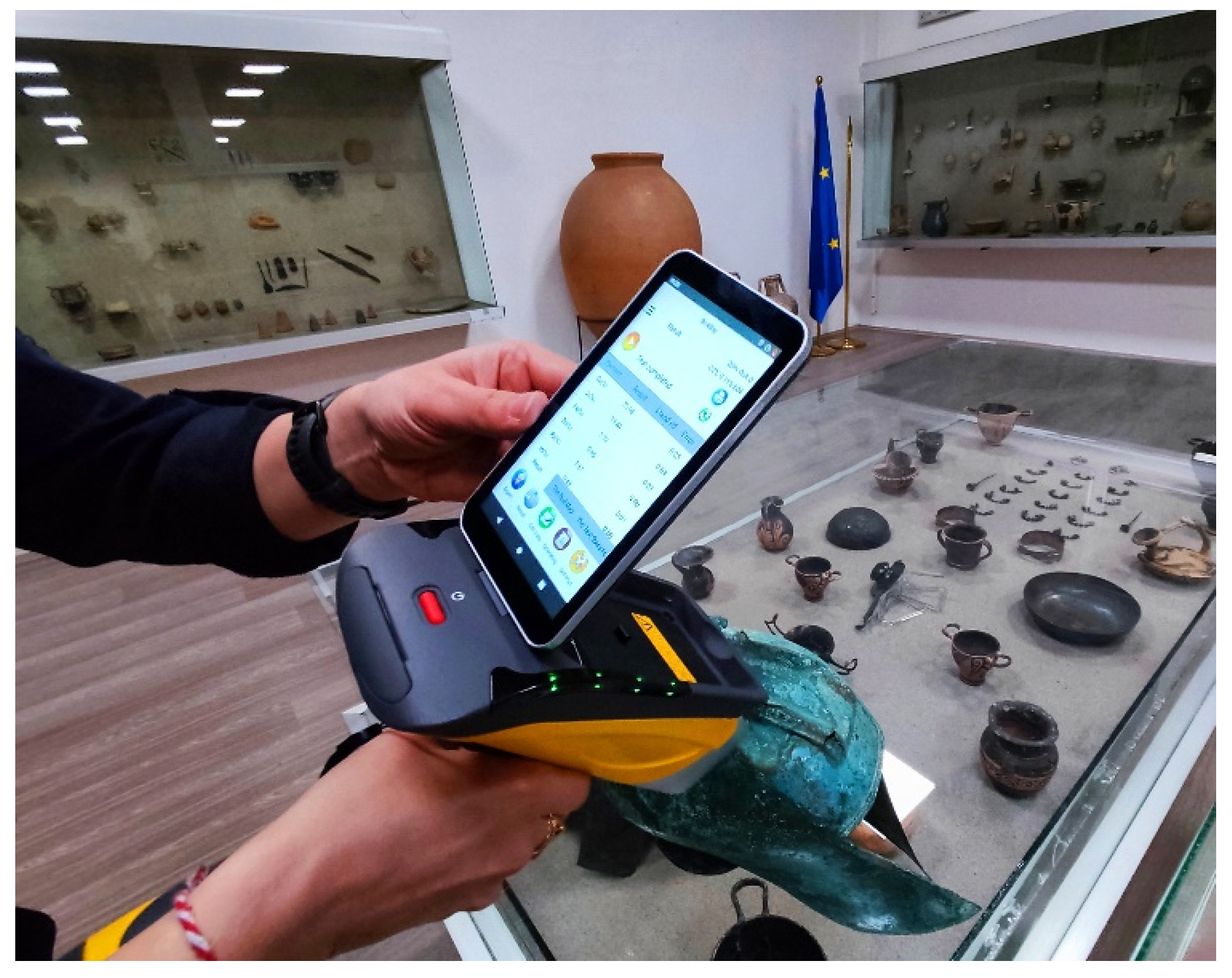
Figure 2.
Helmets excavated from: (a) Mborje (inv. No. 17124), (b) Belsh (inv. No. 11717), (c) Bitinckë (inv. No. 714), and (c) Maliq (inv. No. 3727), together with the examined points selected on damaged surfaces or inner areas. The same procedure was applied to all 27 helmets included in this study. (photos taken by the authors).
Figure 2.
Helmets excavated from: (a) Mborje (inv. No. 17124), (b) Belsh (inv. No. 11717), (c) Bitinckë (inv. No. 714), and (c) Maliq (inv. No. 3727), together with the examined points selected on damaged surfaces or inner areas. The same procedure was applied to all 27 helmets included in this study. (photos taken by the authors).
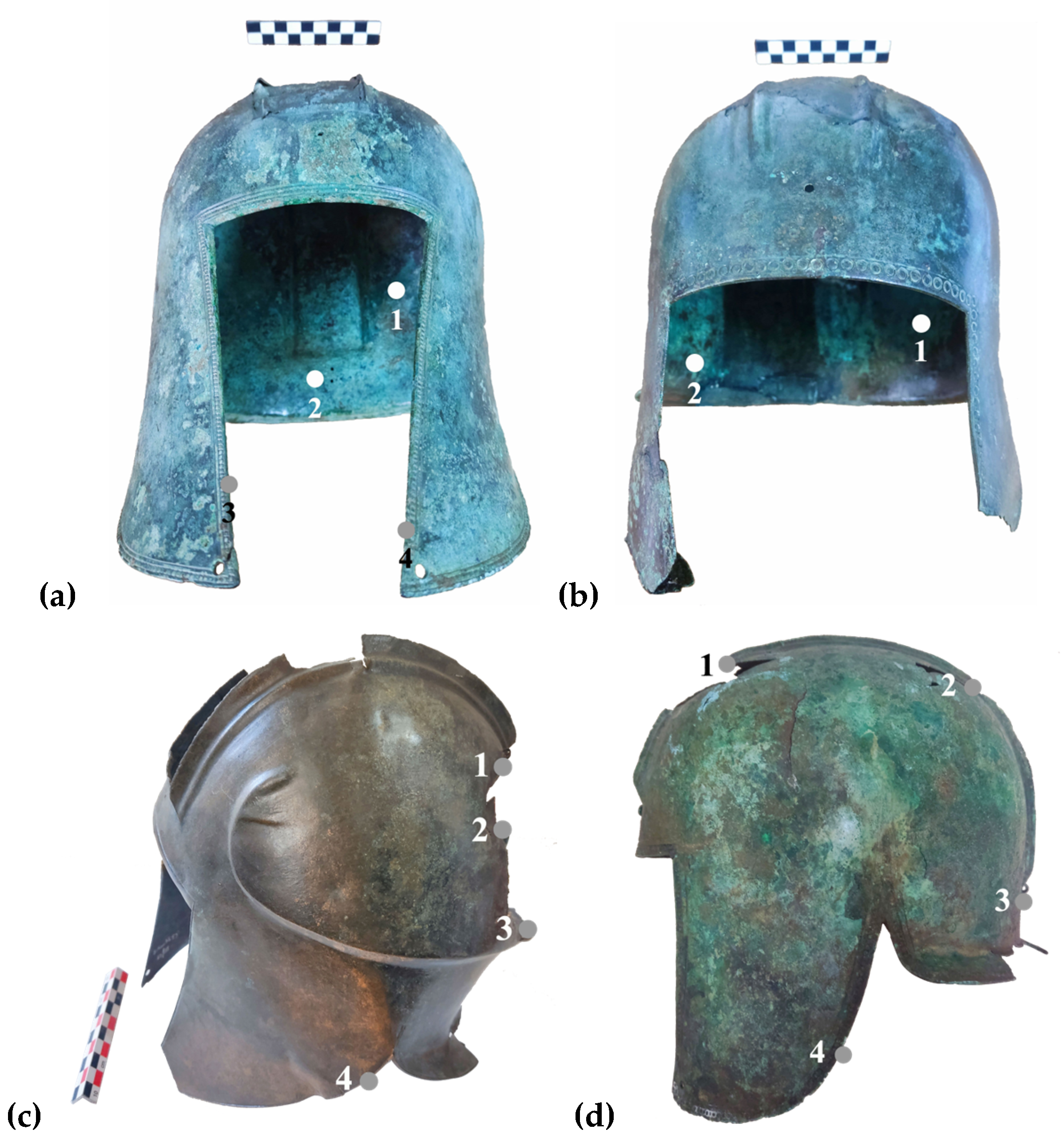
Figure 3.
Variations of the elemental percentages of Cu-Sn (a), Cu-Sn-Pb (b), and Fe-Zn-Sb-As (c) in the various helmets investigated via XRF.
Figure 3.
Variations of the elemental percentages of Cu-Sn (a), Cu-Sn-Pb (b), and Fe-Zn-Sb-As (c) in the various helmets investigated via XRF.
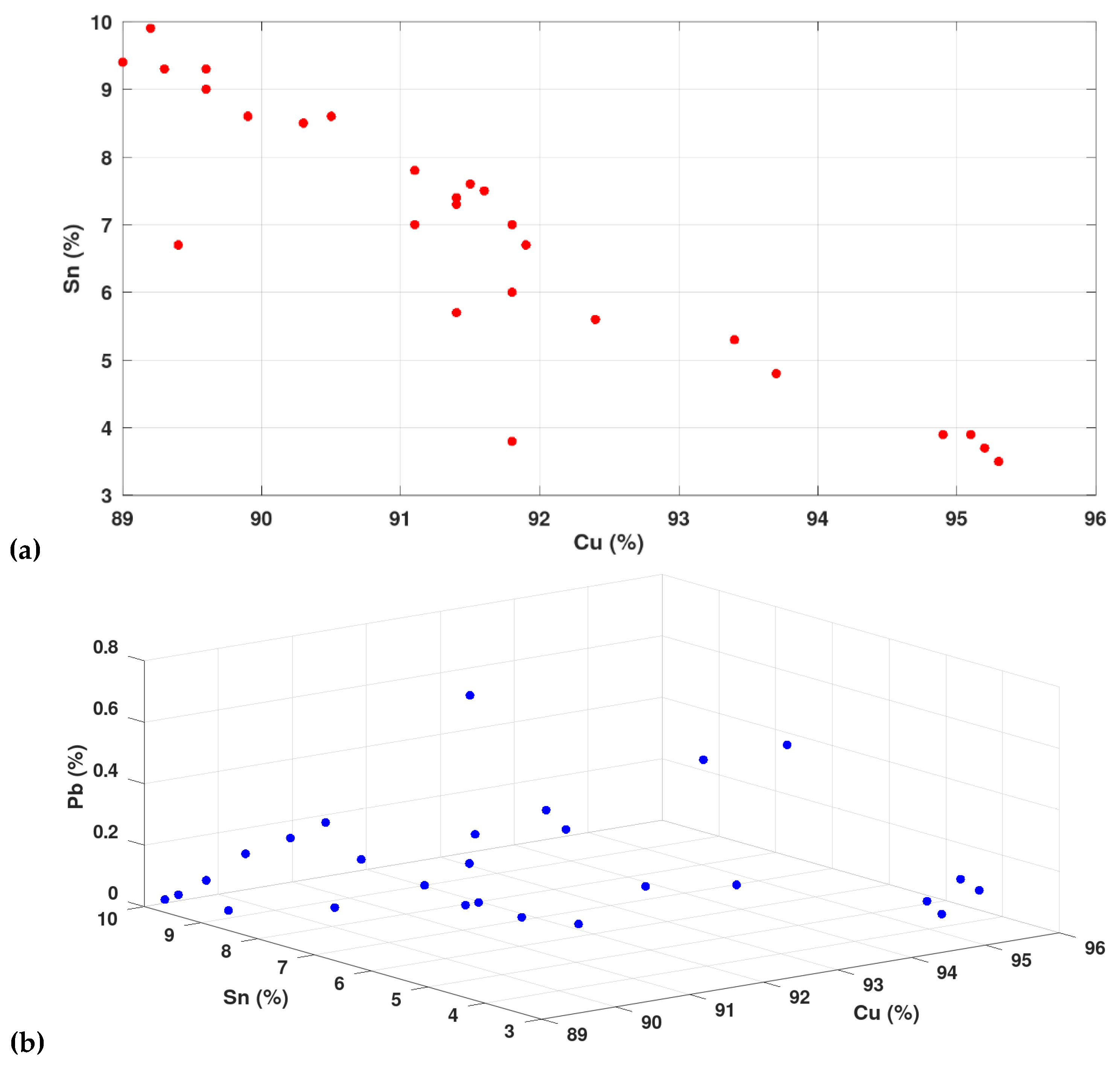
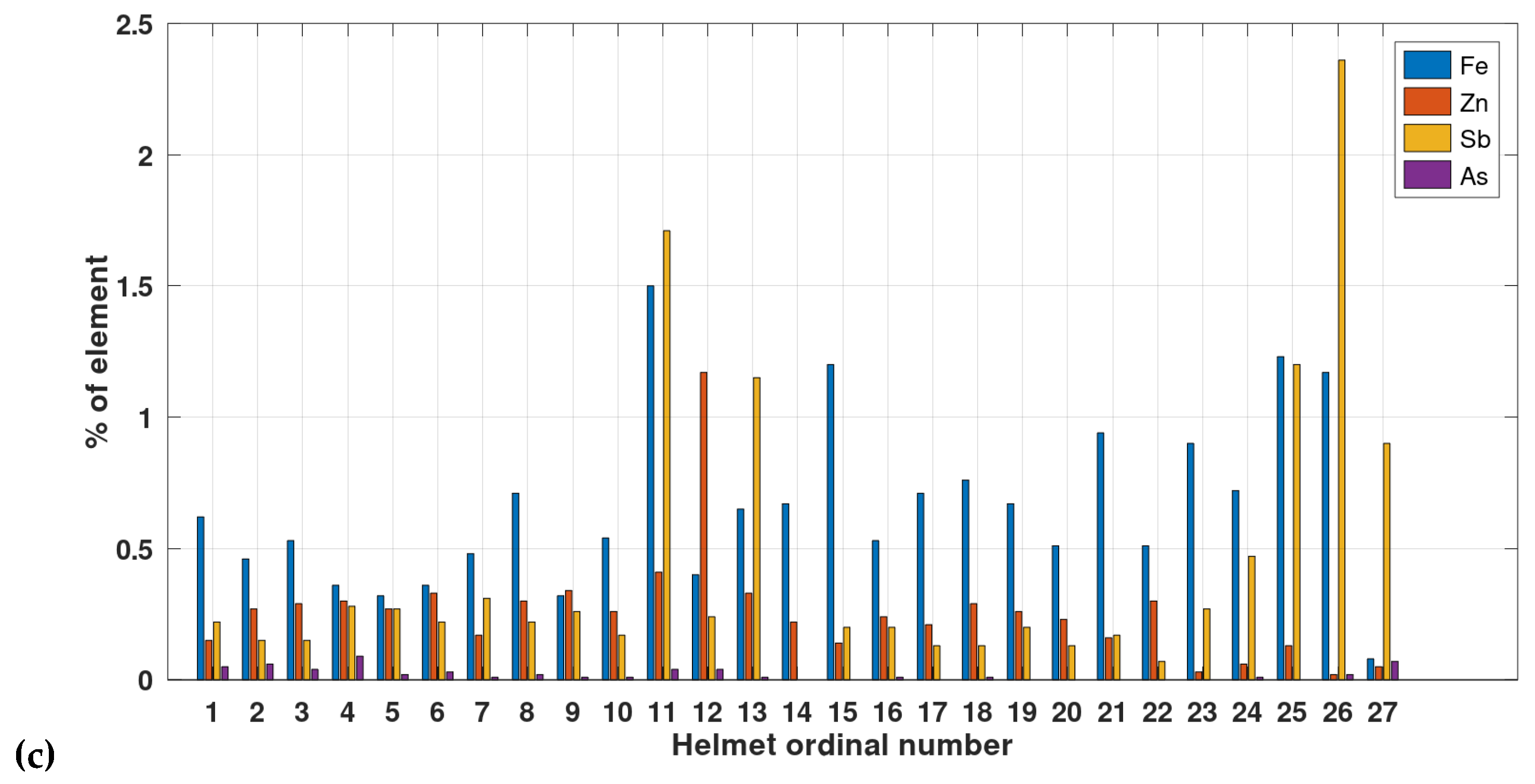
Figure 4.
PCA plot of the analyzed helmets based on the concentrations of Cu, Sn, Pb, Fe, As, Ag, and Ni. The first two principal components explain 65.7% of the total variance (PC1: 39.0%; PC2: 26.8%). Colors represent the different helmet typologies. (com. stands for combinative).
Figure 4.
PCA plot of the analyzed helmets based on the concentrations of Cu, Sn, Pb, Fe, As, Ag, and Ni. The first two principal components explain 65.7% of the total variance (PC1: 39.0%; PC2: 26.8%). Colors represent the different helmet typologies. (com. stands for combinative).
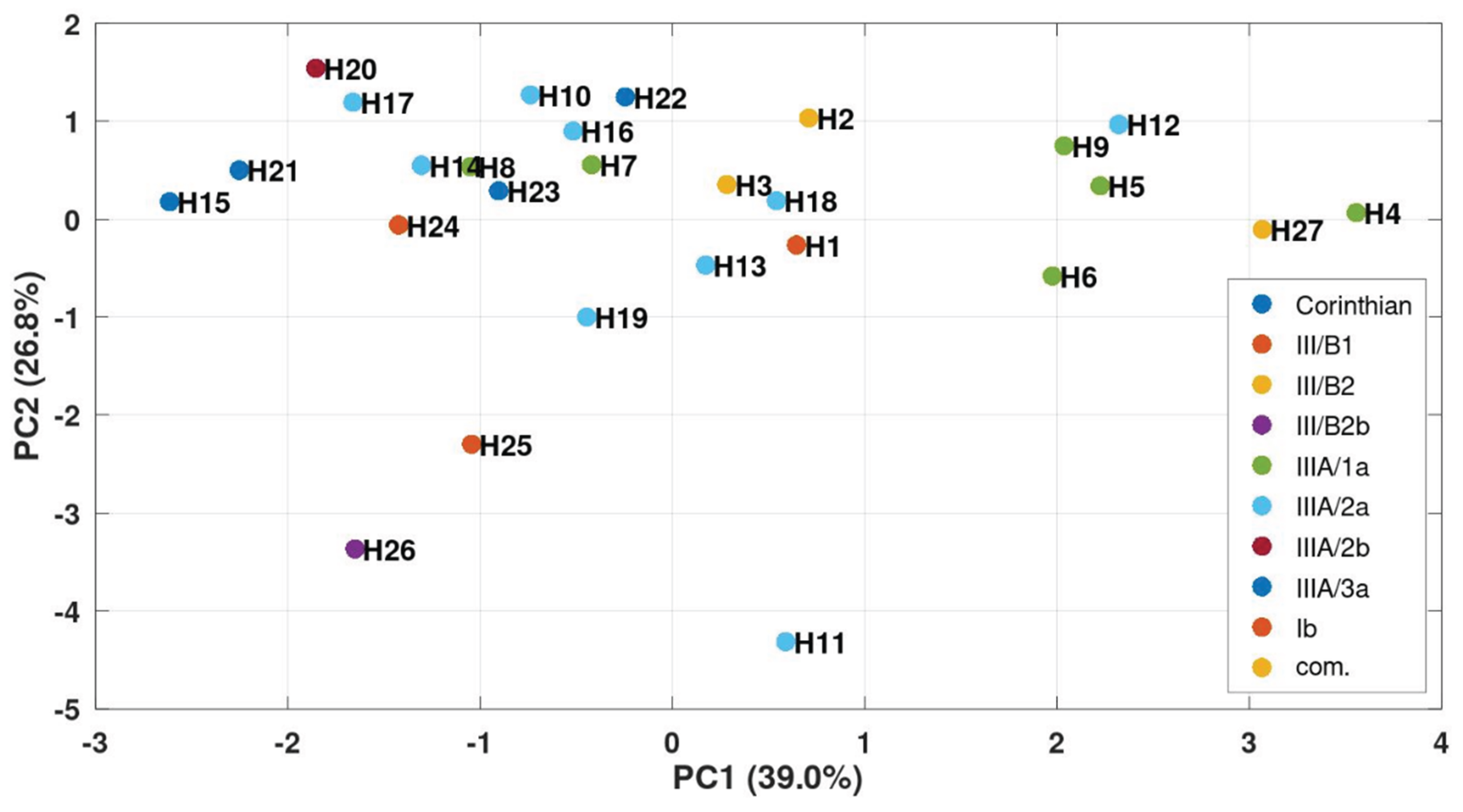

Table 2.
Percentages of the chemical elements along with their standard deviations for the XRF analysis performed on the Illyrian helmets (the absence of the standard deviation in some cases indicates that it is lower than 0.01).
Table 2.
Percentages of the chemical elements along with their standard deviations for the XRF analysis performed on the Illyrian helmets (the absence of the standard deviation in some cases indicates that it is lower than 0.01).
| No | Site (findspot) | Cu (%) | Sn (%) | Fe (%) | Pb (%) | Zn (%) | Sb (%) | As (%) |
| 1 | Borovë | 92 ± 3 | 6.8 ± 0.8 | 0.62 ± 0.02 | 0.37 ± 0.01 | 0.15 ± 0.01 | 0.22 ± 0.01 | 0.05 |
| 2 | Mborje | 91.5 ± 3 | 7.6 ± 1 | 0.46 ± 0.01 | 0.03 | 0.27 ± 0.01 | 0.15 ± 0.01 | 0.06 |
| 3 | Perlat | 91 ± 3 | 7.3 ± 1 | 0.53 ± 0.02 | 0.28 ± 0.01 | 0.29 ± 0.01 | 0.15 ± 0.01 | 0.04 |
| 4 | Rajcë | 95 ± 3 | 3.5 ± 0.5 | 0.36 ± 0.01 | 0.14 ± 0.01 | 0.3 ± 0.01 | 0.28 ± 0.01 | 0.09 |
| 5 | Qukës | 95 ± 3 | 3.7 ± 0.5 | 0.32 ± 0.01 | 0.17 ± 0.01 | 0.27 ± 0.01 | 0.27 ± 0.01 | 0.02 |
| 6 | Belsh | 94 ± 3 | 4.8 ± 0.6 | 0.36 ± 0.01 | 0.61 ± 0.02 | 0.33 ± 0.01 | 0.22 ± 0.01 | 0.03 |
| 7 | Qyteza e Shënlliut | 91 ± 3 | 7.4 ± 1 | 0.48 ± 0.01 | 0.18 ± 0.01 | 0.17 ± 0.01 | 0.31 ± 0.01 | 0.01 |
| 8 | Bastar nr. 1 | 90 ± 3 | 9.0 ± 1 | 0.71 ± 0.03 | 0.2 ± 0.01 | 0.3 ± 0.01 | 0.22 ± 0.01 | 0.02 |
| 9 | Bastar nr. 2 | 95 ± 3 | 3.9 ± 0.4 | 0.32 ± 0.01 | 0.05 | 0.34 ± 0.01 | 0.26 ± 0.01 | 0.01 |
| 10 | Sofraçan nr. 1 | 91 ± 3 | 8.6 ± 1 | 0.54 ± 0.02 | 0.01 | 0.26 ± 0.01 | 0.17 ± 0.01 | 0.01 |
| 11 | Sofraçan nr. 2 | 92 ± 3 | 3.8 ± 0.6 | 1.5 ± 0.1 | 0.69 ± 0.04 | 0.41 ± 0.02 | 1.71 ± 0.1 | 0.04 |
| 12 | Dushk | 92.4 ± 3 | 5.6 ± 0.7 | 0.4 ± 0.02 | 0.16 ± 0.01 | 1.17 ± 0.1 | 0.24 ± 0.01 | 0.04 |
| 13 | Apolloni | 92 ± 3 | 6 ± 0.7 | 0.65 ± 0.03 | 0.04 | 0.33 ± 0.01 | 1.2 ± 0.1 | 0.01 |
| 14 | Petrusha | 90 ± 3 | 8.5 ± 1 | 0.67 ± 0.03 | 0.3 ± 0.01 | 0.22 ± 0.01 | - | - |
| 15 | Starova | 89 ± 3 | 9.4 ± 1.2 | 1.2 ± 0.1 | 0.07 | 0.14 ± 0.01 | 0.2 ± 0.01 | - |
| 16 | Bitinckë | 91 ± 3 | 7.8 ± 1 | 0.53 ± 0.03 | 0.1 ± 0.01 | 0.24 ± 0.01 | 0.2 ± 0.01 | 0.01 |
| 17 | Maliq | 90 ± 3 | 9.3 ± 1.2 | 0.71 ± 0.03 | - | 0.21 ± 0.01 | 0.13 ± 0.01 | - |
| 18 | Kryegjatë | 93 ± 3 | 5.3 ± 0.7 | 0.76 ± 0.03 | 0.14 ± 0.01 | 0.29 ± 0.01 | 0.13 ± 0.01 | 0.01 |
| 19 | Nënshat nr. 1 | 91 ± 3 | 7 ± 1 | 0.67 ± 0.03 | 0.76 ± 0.04 | 0.26 ± 0.01 | 0.2 ± 0.01 | - |
| 20 | Zgërdhesh nr. 1 | 89 ± 3 | 9.9 ± 1.3 | 0.51 ± 0.03 | 0.02 | 0.23 ± 0.01 | 0.13 ± 0.01 | - |
| 21 | Zgërdhesh nr. 2 | 89 ± 3 | 9.3 ± 1.2 | 0.94 ± 0.08 | 0.11 ± 0.01 | 0.16 ± 0.01 | 0.17 ± 0.01 | - |
| 22 | Sofraçan nr. 3 | 92 ± 3 | 7.5 ± 1 | 0.51 ± 0.03 | 0.04 | 0.30 ± 0.01 | 0.07 | - |
| 23 | Krumë | 92 ± 3 | 7 ± 1 | 0.90 ± 0.04 | 0.01 | 0.03 | 0.27 ± 0.01 | - |
| 24 | Nënshat nr. 2 | 90 ± 3 | 8.6 ± 1 | 0.72 ± 0.03 | 0.26 ± 0.01 | 0.06 | 0.47 ± 0.03 | 0.01 |
| 25 | Draj-Reç | 91 ± 3 | 5.7 ± 0.7 | 1.23 ± 0.06 | 0.38 ± 0.02 | 0.13 ± 0.01 | 1.2 ± 0.1 | - |
| 26 | Karicë Mat, (përkrenare) | 89 ± 3 | 6.7 ± 0.8 | 1.17 ± 0.09 | 0.31 ± 0.01 | 0.02 ± 0.01 | 2.4 ± 0.2 | 0.02 |
| 27 | Kosovë, Lushnje | 95 ± 3 | 3.9 ± 0.6 | 0.08 ±0.01 | 0.1 ± 0.01 | 0.05 | 0.9 ± 0.08 | 0.07 |
Table 3.
Eigenvalues, percentage of variance, and cumulative variance explained by the principal components.
Table 3.
Eigenvalues, percentage of variance, and cumulative variance explained by the principal components.
| PC | Eigenvalue | % of Variance | Cumulative % |
| 1 | 2.73 | 39 | 39 |
| 2 | 1.88 | 26.8 | 65.8 |
| 3 | 0.93 | 13.4 | 79.1 |
| 4 | 0.66 | 9.4 | 88.5 |
| 5 | 0.55 | 7.8 | 96.3 |
| 6 | 0.25 | 3.6 | 99.8 |
| 7 | 0.01 | 0.2 | 100 |
Table 4.
Principal component loadings for the analyzed elements (PC1 and PC2).
| Element | PC1 | PC2 |
| Cu | 0.57 | 0.01 |
| Sn | -0.52 | 0.31 |
| Fe | -0.37 | -0.49 |
| Pb | 0.06 | -0.51 |
| Zn | 0.25 | 0.11 |
| Sb | -0.02 | -0.63 |
| As | 0.45 | -0.09 |
Table 5.
Centroids of helmet typologies in the PCA analysis (PC1 and PC2).
| Helmets’ typology | PC1 | PC2 |
| Ib | 0.65 | -0.26 |
| combinative | 0.5 | 0.69 |
| IIIA/1a | 1.39 | 0.28 |
| IIIA/2a | -0.12 | -0.08 |
| Corinthian | -2.61 | 0.18 |
| IIIA/2b | -1.85 | 1.54 |
| IIIA/3a | -1.13 | 0.68 |
| III/B1 | -1.23 | -1.18 |
| III/B2b | -1.65 | -3.37 |
| III/B2 | 3.07 | -0.11 |
Table 1.
The Illyrian helmets examined in this study, along with their excavation site and condition, inventory number, dimensions, masses, dating, typology and place of exhibition . [7,8,24,25,31] Table code: Institute of Archaeology, Tiranë—IA, T; Archaeological Museum of Korça—AMK, The Historical Museum of Shkodra—HMSh; Historical Museum of Peshkopia—HMP; Museum of Weapons in Gjirokastër—MWGj; “Gjergj Kastrioti Skanderbeg” National Historical Museum Kruja—“GjKS” NHMK; National Historical Museum in Tirana—NHMT; Archaeological Museum of Pogradec—AMP; Archaeological Museum of Apolonia—AMA; Sizes—height × length × width; Type combinative—com.
Table 1.
The Illyrian helmets examined in this study, along with their excavation site and condition, inventory number, dimensions, masses, dating, typology and place of exhibition . [7,8,24,25,31] Table code: Institute of Archaeology, Tiranë—IA, T; Archaeological Museum of Korça—AMK, The Historical Museum of Shkodra—HMSh; Historical Museum of Peshkopia—HMP; Museum of Weapons in Gjirokastër—MWGj; “Gjergj Kastrioti Skanderbeg” National Historical Museum Kruja—“GjKS” NHMK; National Historical Museum in Tirana—NHMT; Archaeological Museum of Pogradec—AMP; Archaeological Museum of Apolonia—AMA; Sizes—height × length × width; Type combinative—com.
| No | Site (findspot) | Excavation year | Object excavated condition | Inventory no | Sizes (cm) | Mass (gr) | Exhibited in | Dating | Type |
| 1 | Borovë | 1980 | Undamaged | 11592 | 21.7 x 21.5 x 17.3 | 1282 | IA, T | VII-VI BC | Ib |
| 2 | Bitinckë | 1983 | Damaged | 714 | 26 x 21.5 x 20.5 | 931 | AMK | VII-VI BC | com. |
| 3 | Apolloni | 1983 | Damaged | 17136 | 18 x 18 x 14 | 318 | IA, T | VII-VI BC | com. |
| 4 | Nënshat nr. 1 | 1920 | Fragment | 117 | 15 x 16.5 | 237 | HMSh | VI-V BC | IIIA/1a |
| 5 | Nënshat nr. 2 | 1963 | Fragment | 4064 | 22 x 26 (larger piece) | 586 | IA, T | VII-VI BC | IIIA1a |
| 6 | Karicë | 1955 | Fragment | 4144 | 25.5 x 12 | 370 | IA, T | VI-V BC | IIIA/1a |
| 7 | Mborje | 1979 | Undamaged | 17124 | 26 x 24 x 18.5 | 1638 | IA, T | VI-V BC | IIIA/1a |
| 8 | Kosovë (Lushnje) | 1960 | Undamaged | 2255 | 23.2 x 21.5 x 17 | 1170 | IA, T | VI-V BC | IIIA/1a |
| 9 | Sofraçan nr. 1 | 2008 | Undamaged | 17125 | 28.5 x 23.8 x 15.7 | 1536 | IA, T | VI-V BC | IIIA/1a |
| 10 | Sofraçan nr. 2 | 2008 | Undamaged | 17126 | 28.5 x 19 x 15 | 1233 | IA, T | VI-V BC | IIIA/2a |
| 11 | Sofraçan nr. 3 | 2008 | Fragment | 17127 | 12 x 4.5 | 19 | IA, T | VI-V BC | IIIA/2a |
| 12 | Draj-Reç | 1970 | Undamaged | 134 | 23 x 22 x 18 | 1232 | HMP | VI-V BC | IIIA/2a |
| 13 | Krumë | 1967 | Fragment | 6269 | 9 x 11 (larger piece) | 193 | IA, T | VI-V BC | IIIA/a2 |
| 14 | Bastar nr. 1 | 1955 | Undamaged | 2254 | 28.5 x 21.5 x 19 | 1362 | IA, T | IV BC | IIIA/2a |
| 15 | Bastar nr. 2 | 1966 | Undamaged | 1477 | 28 x 25 x 22 | 1265 | IA, T | VI-V BC | Corithian (import) IIIA/2 a |
| 16 | Qukës | 2002 | Undamaged | 17054 | 27 x 22 x 19 | 1164 | IA, T | V BC | IIIA/2a |
| 17 | Maliq | 1970 | Undamaged | 3727 | 26 x 23 x 18 | 1240 | MWGj | V BC | IIIA/2a |
| 18 | Zgërdhesh nr. 1 | 1971 | Damaged | 102 | 28 x 21.5 x 18 | 1258 | “GjKS” NHMK | V BC | IIIA/2a |
| 19 | Zgërdhesh nr. 2 | 1971 | Fragment | 4061 | 17.5 x 23 | 314 | IA, T | VI-V BC | IIIA/2a |
| 20 | Perlat | 1956 | Undamaged | 1303 | 27.x 24 x 19 | 1324 | NHMT | V BC | IIIA/2b |
| 21 | Belsh | 1975 | Undamaged | 11717 | 28 x 22.5 x 18 | 905 | IA, T | IV BC | IIIA/3a |
| 22 | Qyteza e Shënlliut | 1966 | Damaged | 1-2 | 27 x 19.5 x 18 | 1046 | IA, T | IV BC | IIIA/3a |
| 23 | Rajcë | 1980 | Damaged | 17454 | 28.5 x 23 x 18 | 1498 | IA, T | VI-V BC | IIIA/3a |
| 24 | Starovë | 1967 | Damaged | 189 | 26 x 20 x 18.5 | 798 | AMP | IV BC | III/B1 |
| 25 | Petrushë | 1971 | Damaged | 188 | 874 | 874 | AMP | IV BC | III/B1 |
| 26 | Kryegjatë | 1975 | Damaged | 1337 | 25 x 24 x 17 | 852 | AMA | IV BC | III/B2b |
| 27 | Dushk | 1959 | Undamaged | 2029 | 23 x 21.9 x 17 | 1028 | IA, T | IV BC | III/B2 |
Disclaimer/Publisher’s Note: The statements, opinions and data contained in all publications are solely those of the individual author(s) and contributor(s) and not of MDPI and/or the editor(s). MDPI and/or the editor(s) disclaim responsibility for any injury to people or property resulting from any ideas, methods, instructions or products referred to in the content. |
© 2026 by the authors. Licensee MDPI, Basel, Switzerland. This article is an open access article distributed under the terms and conditions of the Creative Commons Attribution (CC BY) license (http://creativecommons.org/licenses/by/4.0/).
Copyright: This open access article is published under a Creative Commons CC BY 4.0 license, which permit the free download, distribution, and reuse, provided that the author and preprint are cited in any reuse.


