

Submitted:
08 March 2026
Posted:
10 March 2026
You are already at the latest version
Abstract
Background: Motivation research has generated many constructs, yet many theories remain structurally under-specified, relying on flexible verbal accounts or models whose functional form is optimized to data rather than fixed in advance. This limits falsifiability, cross-domain comparison, and principled failure. Theory: Lagun’s Law proposes a fixed six-variable structural equation of volitional drive specifying ignition gating, nonlinear amplification, divisive resistance, and an explicit variability term. The law is defined by its functional architecture rather than by any particular semantic interpretation or measurement instantiation. Objective: This study evaluates Lagun’s Law using straight structural validation: assessing whether a pre-specified equation exhibits recurring empirical signatures when applied without reparameterization, optimization, or post hoc modification. The aim is to test structural admissibility. Method: The equation was instantiated using pre-defined proxies across four independent secondary datasets spanning learning analytics, intelligent tutoring systems, naturalistic smartphone sensing, and laboratory neurophysiology. All proxies respected temporal precedence and outcome non-overlap. Where full instantiation was not possible, analyses were treated as reduced-form tests. Results: Recurring structural signatures were observed across all four datasets. Readiness functioned as a prerequisite rather than a graded predictor, divisive resistance effects were observed in three of four datasets, and independent behavioral variability persisted across contexts. Nonlinear amplification was directly testable in two datasets and attenuated or untestable elsewhere due to measurement constraints. Conclusion: These findings provide empirical grounding for Lagun’s Law as a structurally admissible constraint on volitional drive, clarifying its scope conditions and falsification pathways while avoiding claims of causality, universality, or optimal measurement.
Keywords:
structural admissibility
; structural validation
; motivation theory
; volitional drive
; nonlinear dynamics
; behavioral variability
; secondary data analysis
; Lagun’s Law
1. Introduction
1.1. The Problem of Structure in Motivation Science
Research on motivation and effort has produced a rich and influential body of theory spanning psychology, neuroscience, education, and behavioral science. Across traditions, accounts emphasize constructs such as needs, goals, expectancies, values, incentives, self-regulation, effort costs, and control capacities (Atkinson, 1957; Atkinson & Feather, 1966; Bandura, 1986; Deci & Ryan, 1985; Ryan & Deci, 2000; Kahneman, 1973; Locke & Latham, 2002; Wigfield & Eccles, 2000; Dweck & Leggett, 1988; Pekrun, 2006; Kanfer, 1990; Hull, 1943; Lewin, 1951; Simon, 1967; Tolman, 1948; Steel, 2007; Duckworth et al., 2007; Duckworth & Quinn, 2009). These constructs have proven empirically generative, guiding decades of experimental work and practical application.
Despite this success, much of the literature remains structurally under-specified. Relationships among constructs are often articulated verbally, schematically, or through statistical models whose functional form and parameters are learned from the same data used to evaluate them (Carver & Scheier, 1982; Kanfer, 1990; Steel & König, 2006; Steel, 2007; Locke & Latham, 2002). Even when formal models are introduced, they typically allow substantial flexibility through additive combinations, interaction terms, and task-specific tuning (Botvinick et al., 2001; Shenhav et al., 2013; Kurzban et al., 2013; Kool et al., 2010; Salamone & Correa, 2002).
This flexibility creates an epistemic bottleneck. When a theory does not commit to a fixed internal structure, many empirical patterns remain compatible with it. Apparent support may reflect curve-fitting capacity rather than alignment with an underlying regularity, while contradictory findings can often be absorbed through reinterpretation or expansion of the construct set (Bzdok & Ioannidis, 2019; Oberauer & Lewandowsky, 2019; Yarkoni, 2020; van den Bos & Eppinger, 2016). The issue is not that existing theories are incorrect, but that many are insufficiently constrained to fail decisively under heterogeneous empirical conditions.
Recent methodological and philosophical critiques have highlighted this problem, calling for stronger formal commitments, clearer falsification targets, and theory-first discipline in psychological science (Guest & Martin, 2021; van Rooij & Baggio, 2021; Oberauer & Lewandowsky, 2019; Yarkoni, 2020). From this perspective, what is missing is not another taxonomy of motivational constructs, but proposals that make explicit structural commitments: relationships that must hold if a phenomenon is organized in a particular way, and that can be violated in real data.
1.2. Frameworks, Models, and Structural Constraints
To clarify the contribution of the present work, it is useful to distinguish among three epistemic categories that are often conflated in motivation research: frameworks, models, and structural constraints (Guest & Martin, 2021; van Rooij & Baggio, 2021).
Frameworks are interpretive. They organize concepts, specify relations of relevance, and guide hypothesis generation, but typically do not impose fixed quantitative commitments. Many influential theories of motivation operate at this level, offering rich explanatory narratives without specifying determinate functional forms (Deci & Ryan, 1985; Ryan & Deci, 2000; Dweck & Leggett, 1988; Pekrun, 2006; Kanfer, 1990; Lewin, 1951).
Models are fit-based. They specify mathematical relationships among variables, but their parameters and often their structure are optimized to data. Such models can be powerful for prediction or description within a given domain, yet their explanatory force as general theories is limited by degrees of freedom that allow post hoc accommodation (Kool et al., 2010; Shenhav et al., 2013; Piech et al., 2015; Botvinick et al., 2001).
The present work concerns a third category: structural constraints. A structural constraint is a hypothesis about admissible functional form. It specifies a fixed relationship among variables that functions as a restriction rather than a tunable specification. It does not assert universality, nor does it require that variables correspond cleanly to isolated psychological constructs. Instead, it proposes that if a class of phenomena exhibits organized behavior, certain relationships must hold across heterogeneous instantiations. If those relationships fail, the structural hypothesis fails (Guest & Martin, 2021; van Rooij & Baggio, 2021; Yarkoni, 2020).
In this sense, structural constraints occupy a distinct explanatory role. They do not replace frameworks or models, but constrain what coherent frameworks and models can look like (Guest & Martin, 2021; van Rooij & Baggio, 2021).
1.3. Lagun’s Law as a Candidate Structural Constraint
This paper evaluates Lagun’s Law as a candidate structural constraint on volitional drive. The law specifies a fixed six-variable equation intended to constrain how drive is ignited, amplified, suppressed, stabilized, and rendered variable across time (Lagun, 2025; Kahneman, 1973; Hockey, 1997). The six components are not proposed as a taxonomy of motivational constructs, nor as isolated psychological mechanisms. They are proposed as a minimal structural decomposition required to represent observed patterns of engagement, persistence, and volatility without additive collapse (Lagun, 2025; Simon, 1967; Carver & Scheier, 1982).
The central claim is deliberately narrow. Lagun’s Law does not purport to exhaust the determinants of behavior, to replace existing motivational theories, or to identify neural or cognitive mechanisms (Lagun, 2025; Kanfer, 1990; Steel & König, 2006). Its claim is structural: that volitional drive, when it exhibits coherence across time and context, may be describable by a particular constrained form (Guest & Martin, 2021; van Rooij & Baggio, 2021).
Importantly, this stance does not assume uniqueness. Multiple competing fixed equations could, in principle, capture different aspects of volitional behavior. The present study therefore does not test “the” structure of motivation. It tests one explicit structural hypothesis and renders its success and failure modes empirically observable (Guest & Martin, 2021; van Rooij & Baggio, 2021; Oberauer & Lewandowsky, 2019).
1.4. Why Heterogeneous Secondary Datasets Are Appropriate for Structural Testing
Structural claims place different demands on data than causal or predictive claims. Primary experiments maximize internal validity by tailoring tasks, incentives, and measurements to specific hypotheses, which is essential for mechanism identification. However, such tailoring can also obscure whether apparent regularities reflect deeper structure or design-specific affordances (Brehm & Self, 1989; Hockey, 1997; van den Bos & Eppinger, 2016).
Structural constraints must survive heterogeneity. The relevant question is not whether a theory performs optimally under bespoke conditions, but whether its fixed relationships remain empirically admissible when confronted with data generated under different incentives, timescales, populations, and measurement regimes (Yarkoni, 2020; Guest & Martin, 2021; van Rooij & Baggio, 2021). From this perspective, secondary datasets are not a liability but a stress test (Bzdok & Ioannidis, 2019; Oberauer & Lewandowsky, 2019).
Secondary data introduce noise, proxy imperfection, and misalignment between theoretical roles and available measures. These features reduce analytic degrees of freedom and increase the risk of failure, which is precisely what a constraint-based proposal must survive to earn credibility (Bzdok & Ioannidis, 2019; Guest & Martin, 2021; van Rooij & Baggio, 2021).
For this reason, the present study evaluates Lagun’s Law across multiple independent datasets spanning large-scale educational platforms (Kuzilek et al., 2017; Baker & Inventado, 2014; Siemens & Long, 2011), intelligent tutoring systems (Feng et al., 2009; ASSISTmentsData, 2010), naturalistic smartphone sensing (Wang et al., 2014; Saeb et al., 2015; Jacobson et al., 2019), and laboratory neurophysiology (Ribeiro & Castelo-Branco, 2019a, 2019b; Ribeiro & Castelo-Branco, 2021; Faisal et al., 2008). None were collected to test Lagun’s Law, and none were altered to accommodate it.
1.5. Contributions of the Present Study
The present study makes four contributions.
First, it provides a direct structure-level evaluation of Lagun’s Law as a fixed equation whose functional form is specified in advance and not modified post hoc (Lagun, 2025; Guest & Martin, 2021; van Rooij & Baggio, 2021).
Second, it tests this constraint across multiple independent datasets drawn from distinct domains, temporal scales, and measurement regimes, enabling cross-context recurrence and breakdown to be assessed explicitly (Yarkoni, 2020; Bzdok & Ioannidis, 2019; Oberauer & Lewandowsky, 2019).
Third, it illustrates a structure-first validation protocol for secondary data, emphasizing temporal precedence, outcome non-overlap, pre-specified structural signatures, and sensitivity to failure over predictive optimization (Guest & Martin, 2021; van Rooij & Baggio, 2021; Yarkoni, 2020).
Fourth, it treats limitations as part of the evidential output. Attenuations, non-testability, and systematic breakdowns are reported as scope conditions that delimit where the proposed structural constraint is informative (Bzdok & Ioannidis, 2019; Oberauer & Lewandowsky, 2019; van den Bos & Eppinger, 2016).
Together, these contributions aim to shift evaluation away from whether a theory can be flexibly fit to a dataset and toward whether a fixed structural hypothesis can survive heterogeneous empirical contact without repair (Guest & Martin, 2021; van Rooij & Baggio, 2021; Yarkoni, 2020; Oberauer & Lewandowsky, 2019).
2. Lagun’s Law
2.1. The Fixed Six-Variable Equation
Lagun’s Law specifies a fixed structural relationship among six variables proposed to constrain the emergence, persistence, and variability of volitional drive. The law is expressed as:
In the present study, Equation (1) is treated as a closed structural object. Its functional form is specified prior to any empirical analysis and is not altered, reparameterized, optimized, or adapted to individual datasets. No coefficients are estimated from data, no interaction terms are added, and no variables are omitted or collapsed for analytic convenience.
This commitment is intentional. The goal of the present study is not to discover an optimal descriptive or predictive model of effort, but to evaluate whether a pre-specified structural constraint survives contact with heterogeneous empirical environments. Allowing dataset-specific tuning or post hoc modification would undermine the possibility of meaningful falsification and reduce the exercise to flexible model fitting.
Accordingly, all analyses apply Equation (1) identically across datasets that differ in domain, scale, temporal resolution, and measurement regime. When a dataset does not permit instantiation of a given structural role, this limitation is treated explicitly as a reduced-form test rather than concealed through substitution or parameter adjustment (Section 2.4).
Figure 1 summarizes the six structural components, their fixed mathematical operations, and the four empirical signatures evaluated in this paper.
2.2. Why Six Variables: Structural Roles and Irreducibility
The six components of Lagun’s Law are not introduced as a taxonomy of motivational constructs, nor as a semantic decomposition of psychological experience (Gollwitzer, 1993; Gollwitzer, 1999; Wood & Neal, 2007; Lally et al., 2010). They arise from a structural decomposition problem: what is the minimal set of distinct roles required to represent initiation, amplification, persistence, suppression, stability, and variability of volitional behavior without additive collapse.
Each variable occupies a position in the equation that cannot be removed, merged, or linearized without destroying a distinct class of observable behavior. In this sense, the components are structurally indispensable, even though their empirical instantiations may vary.
Below, each variable is defined by three features: its conceptual role, its mathematical function, and a falsifiable implication that would contradict its necessity.
Primode
- Conceptual role. Primode represents ignition or readiness: whether the system is in a state in which volitional effort can initiate at all.
- Structural role. Primode enters as a multiplicative prerequisite. When Primode approaches zero, the multiplicative term collapses regardless of other variable values.
- Structural necessity. Without a gating term, the equation permits engagement to scale smoothly with urgency or incentives even when the system is not behaviorally mobilizable.
- Falsification criterion. Sustained initiation or engagement occurring systematically when Primode proxies indicate an absence of readiness would contradict the gate property implied by the equation.
CAP (Cognitive Activation Potential)
- Conceptual role. CAP captures urgency, salience, or amplification of drive once ignition is possible.
- Structural role. CAP appears as a nonlinear exponent on Primode, specifying amplification rather than additive contribution.
- Structural necessity. Without exponentiation, urgency can only add linearly to drive, eliminating sharp transitions between dormant and mobilized states.
- Falsification criterion. If CAP behaves as a purely additive or linear factor, or if its effects are independent of Primode, the amplification role assigned to CAP would be unsupported.
Flexion
- Conceptual role. Flexion reflects adaptability or task–system fit: the efficiency with which available drive is translated into sustained engagement.
- Structural role. Flexion scales the multiplicative numerator proportionally.
- Structural necessity. Without Flexion, repeated exposure or skill acquisition cannot increase persistence independently of readiness or urgency.
- Falsification criterion. If adaptation yields no systematic improvement in engagement or persistence under otherwise favorable conditions, the proportional role of Flexion would be undermined.
Anchory
- Conceptual role. Anchory denotes stabilizing forces that tether attention and support continuity of engagement over time.
- Structural role. Anchory enters the denominator as a stabilizing component that counterbalances resistance.
- Structural necessity. Without Anchory, persistence can only be explained through reduced resistance or increased drive, eliminating a distinct stabilizing mechanism.
- Falsification criterion. Persistence or continuity that is independent of attentional tethering or stability would contradict Anchory’s divisive role.
Grain
- Conceptual role. Grain represents friction or resistance: internal or contextual forces that oppose sustained effort (Sweller, 1988; Sweller, 1994; Paas et al., 2003).
- Structural role. Grain appears in the denominator alongside Anchory, exerting a suppressive effect on drive.
- Structural necessity. Without a resistance term, the equation cannot represent effort depletion, fatigue, or contextual friction as suppressive forces.
- Falsification criterion. Increases in resistance that do not reduce initiation probability, persistence, or stability would violate the suppressive function implied by the equation.
Slip
- Conceptual role. Slip captures irreducible variability or entropy in behavior not explained by deterministic structural factors.
- Structural role. Slip enters as an additive term, contributing variability independently of the multiplicative structure.
- Structural necessity. Without Slip, all behavioral variability must be attributed to deterministic components, rendering the structure unrealistically brittle.
- Falsification criterion. If behavioral volatility is fully explained by the other five variables, leaving no independent residual structure, the necessity of Slip would be called into question.
Taken together, these roles impose non-additive and non-substitutable constraints on admissible empirical patterns. Lagun’s Law does not merely assert that these variables matter, but specifies how they must interact if the structure is correct.
2.3. Mathematical Commitments and Numerical Stress Tests
The structural commitments of Equation (1) entail nontrivial mathematical consequences, particularly due to nonlinear amplification via exponentiation (Frank et al., 2009).
The CAP exponent is theoretically essential. A linear urgency term would allow drive to increase incrementally regardless of readiness, whereas exponentiation formalizes the claim that urgency amplifies only when ignition is present. This creates a sharp distinction between latent readiness and effective mobilization.
Exponentiation also introduces numerical sensitivity. When CAP proxies take large values, amplification can become extreme, potentially producing overflow under finite-precision computation. Importantly, such instability is not treated as a computational nuisance, but as a structural risk of the hypothesis itself. A theory that posits nonlinear amplification must tolerate the possibility of unbounded growth under some instantiations.
In the present study, numerical instability is handled under three explicit principles:
- No tuning or damping. CAP values are not rescaled, clipped, or transformed to improve fit.
- Transparent accounting. The frequency and distribution of overflow or undefined values are reported.
- Structural interpretation. Datasets exhibiting instability are treated as stress tests of the amplification claim rather than grounds for modification.
Where intermediate computation permits, log-space calculations are used solely to preserve numerical tractability without altering the functional form or relative ordering implied by the equation. When CAP cannot be instantiated reliably, this limitation constrains which aspects of the law can be evaluated in that dataset.
2.4. Structural Roles, Proxies, and Reduced-Form Evaluation
A central distinction in this paper is between structural roles and measurement instantiations. The six variables in Lagun’s Law are defined by their positions and operations within Equation (1), not by any specific observable measure.
Empirical evaluation therefore requires proxies, which necessarily differ across datasets. Readiness, resistance, tethering, or variability may be instantiated through learning-platform logs, tutoring-system behaviors, smartphone sensor streams, or physiological signals. None of these instantiations is assumed to be exhaustive, canonical, or interchangeable.
Accordingly, the object of validation is not the adequacy of any single proxy, but the recurrence or breakdown of structural signatures implied by the equation across heterogeneous instantiations. Convergence at the level of structure despite divergence at the level of measurement is treated as supportive; divergence is treated as informative boundary specification.
When a dataset does not permit instantiation of one or more structural roles, analyses are explicitly interpreted as reduced-form evaluations. Reduced-form support is not taken as confirmation of the full law, but as evidence about the behavior of isolated components under constraint.
For clarity, we state explicitly: this paper does not claim any proxy as canonical, nor does it claim reduced-form evaluations as validation of the full equation. All conclusions are framed accordingly.
3. Definition of Validation
3.1. Straight Validation: Definition and Epistemic Intent
In this paper, validation is used in a deliberately narrow and theory-focused sense. We define straight validation as the empirical evaluation of a pre-specified structural hypothesis under conditions that preserve the possibility of informative failure (Guest & Martin, 2021; van Rooij & Baggio, 2021).
This definition differs from validation as prediction, confirmation, or causal explanation. It is concerned neither with maximizing fit nor with estimating effects, but with assessing whether a fixed structural constraint remains empirically admissible when confronted with heterogeneous data.
Three criteria define straight validation.
First, structural commitment precedes outcome inspection. The functional form of Lagun’s Law, the structural roles of its variables, and the empirical signatures used for evaluation are all specified prior to examining outcomes (Lagun, 2025). No variable roles, functional relationships, or evaluative criteria are revised in response to observed results. This prevents explanatory drift and post hoc accommodation (Yarkoni, 2020; Oberauer & Lewandowsky, 2019).
Second, evaluation occurs on non-bespoke empirical data. The equation is tested exclusively against secondary datasets collected for purposes independent of Lagun’s Law. These datasets differ in domain, incentive structure, temporal scale, measurement regime, and noise characteristics. Apparent support therefore cannot be attributed to task design, incentive tuning, or construct-aligned measurement (Yarkoni, 2020).
Third, failure is both possible and informative. Straight validation requires that a theory make commitments that can be contradicted by data (Guest & Martin, 2021; van Rooij & Baggio, 2021). If predicted structural signatures fail to appear, appear inconsistently across contexts, or violate the constraints implied by the equation, this counts against the structural adequacy of the hypothesis in those regimes (Oberauer & Lewandowsky, 2019).
Straight validation is intentionally weaker than confirmation and narrower than causal proof. It does not establish truth, necessity, or optimality, nor does it identify psychological mechanisms or intervention targets. Instead, it addresses a focused question: whether a fixed structural equation captures recurring regularities in how volitional effort initiates, stabilizes, and varies across heterogeneous empirical contexts (Lagun, 2025).
3.2. Scope Limits and Claims Explicitly Not Made
To avoid overextension, we state explicitly what the present study does not claim.
First, no causal mechanisms are identified. The analyses do not isolate causal pathways, estimate intervention effects, or distinguish direct from indirect causation.
Second, no optimal operationalization is asserted. The proxies used to instantiate structural roles are treated as provisional and context-dependent, not as definitive measures of psychological constructs.
Third, no universality is claimed. Lagun’s Law is not proposed as a universally valid account of all forms of effort, motivation, or behavior across populations, tasks, or developmental stages (Yarkoni, 2020).
Fourth, no completeness is implied. The six-variable structure is not claimed to exhaust all determinants of volitional behavior, nor to subsume existing motivational theories.
These non-claims are not post hoc caveats. They define the scope of straight validation by design. The aim is to evaluate structural admissibility, not explanatory sufficiency or theoretical replacement (Guest & Martin, 2021; van Rooij & Baggio, 2021).
3.3. Hierarchy of Structural Evidence
Support for Lagun’s Law is evaluated hierarchically rather than dichotomously. Structural adequacy is not inferred from a single successful pattern, nor is it invalidated by isolated failure (Oberauer & Lewandowsky, 2019; Yarkoni, 2020).
Three levels of evidence are distinguished.
- Signature-level support. Evidence that an individual structural signature (e.g., gate-like initiation, nonlinear amplification, divisive suppression, independent volatility) appears in a dataset. Such evidence is informative but non-decisive, as similar patterns may arise under alternative structures.
- Joint-signature consistency. Evidence that multiple signatures implied by the same fixed equation co-occur within a dataset or across datasets without reparameterization or reinterpretation. This level of support is stronger because alternative models typically reproduce some, but not all, signatures simultaneously (Guest & Martin, 2021; van Rooij & Baggio, 2021).
- Cross-domain structural recurrence. Evidence that the same constellation of signatures recurs across datasets with distinct domains, incentives, and measurement regimes. Recurrence at this level strengthens the case that observed patterns reflect structural constraints rather than task-specific artifacts (Yarkoni, 2020).
Failure at any level is treated as informative. Structural theories are weakened not by mapped breakdowns, but by unexplained flexibility (Oberauer & Lewandowsky, 2019).
3.4. Pre-Specified Structural Signatures and Contrast Cases
Validation in this study is anchored to four pre-specified structural signatures, each derived directly from the functional form of Lagun’s Law (Lagun, 2025). These signatures were defined prior to empirical analysis and constitute the sole evaluative criteria (Guest & Martin, 2021; van Rooij & Baggio, 2021).
Signature S1: Primode gate
- Definition. When Primode is effectively absent, initiation and sustained engagement should be near zero regardless of other variables.
- Failure condition. Reliable initiation or persistence occurs when Primode proxies indicate no readiness.
Signature S2: CAP nonlinearity
- Definition. CAP should amplify drive in a nonlinear manner conditional on Primode, consistent with its role as an exponent rather than an additive term.
- Failure condition. CAP exhibits purely additive or linear effects independent of ignition state.
Signature S3: Divisive resistance
- Definition. Anchory and Grain should suppress drive in a ratio-like manner, reducing persistence and stability as resistance increases.
- Failure condition. Increases in resistance or decreases in stabilizing tethering do not measurably reduce initiation, persistence, or continuity.
Signature S4: Slip–volatility independence
- Definition. Slip should account for residual behavioral variability not explained by the deterministic components of the equation.
- Failure condition. Behavioral volatility is fully captured by the other five variables, leaving no independent contribution attributable to Slip.
To clarify the falsificatory force of these signatures, it is useful to contrast Lagun’s Law with simpler alternatives. Additive or compensatory models predict that urgency, resistance, or adaptability can offset one another linearly, allowing engagement to persist despite absent ignition or increasing friction. Structures lacking an explicit variability term predict that behavioral volatility collapses as explanatory coverage increases.
The present study does not fit such alternatives. These contrasts serve to sharpen interpretation: observed patterns are evaluated not in isolation, but as consequences of a specific constrained form (Guest & Martin, 2021; van Rooij & Baggio, 2021).
All empirical analyses are organized around these four signatures. No additional hypotheses are introduced post hoc, and no signature is reinterpreted after results are observed (Oberauer & Lewandowsky, 2019; Yarkoni, 2020).
4. Datasets
Each dataset is treated as an independent measurement instrument, not as a comprehensive representation of volitional drive. The purpose of this section is not to justify dataset inclusion post hoc, but to specify ex ante what each dataset can and cannot test with respect to the pre-specified structural signatures (S1–S4) derived from Lagun’s Law (Lagun, 2025).
Datasets are evaluated on structural affordance, not richness. No dataset is expected to instantiate all six variables of Lagun’s Law equally well. Where a dataset permits instantiation of most structural roles, it is treated as a full-form evaluation. Where one or more roles are weakly observable, fixed, or unavailable, analyses are explicitly interpreted as reduced-form tests (Section 2.4).
This framing is intentional. Structural validation does not require comprehensive measurement; it requires exposure to heterogeneity. A fixed structural hypothesis gains credibility not by fitting any single dataset well, but by surviving contact with datasets that differ in scale, context, incentive structure, and measurement regime.
All datasets analyzed here are publicly available, ethically cleared for secondary analysis, and were collected for purposes independent of Lagun’s Law.
4.1. Open University Learning Analytics Dataset (OULAD)
Structural classification: Full-form (macro-level)
4.1.1. Data Provenance and Scope
The Open University Learning Analytics Dataset (OULAD) is a large-scale educational dataset comprising records from 32,593 students enrolled across 22 undergraduate modules over multiple course presentations (Kuzilek et al., 2017). Behavioral traces span complete module lifecycles, from initial registration through assessment submission and potential withdrawal.
The dataset is distributed under explicit reuse terms for research purposes, contains no personally identifying information, and has been widely used in learning analytics research (Kuzilek et al., 2017).
4.1.2. Behavioral Resolution
OULAD provides daily-resolution summaries of student interaction with a virtual learning environment, including counts of interactions with specific learning resources. These records are temporally aligned with assessment schedules, deadlines, and formal withdrawal dates.
Although coarse relative to laboratory paradigms, this resolution captures psychologically meaningful phenomena at scale, including:
- initiation timing
- sustained engagement over weeks
- abrupt disengagement and dropout
across extended real-world time horizons.
4.1.3. Structural Role in Validation
OULAD provides strong leverage on macro-level persistence dynamics and is treated as a primary full-form test of Lagun’s Law at the long-timescale engagement level (Lagun, 2025). In particular, it affords evaluation of:
- S1 (Primode gate): latency from content or assessment availability to first engagement
- S3 (Divisive resistance): persistence and dropout hazard as a function of stabilizing continuity versus accumulated friction
- S4 (Slip–volatility independence): irregularity and variability in engagement patterns not reducible to mean activity
CAP is inferable only indirectly through deadline structure and assessment pressure. Accordingly, OULAD is not treated as a strong or decisive test of S2 (CAP nonlinearity) in isolation.
4.1.4. Anticipated Failure Modes
Evidence would count against the structural adequacy of Lagun’s Law at the macro-engagement level if:
- initiation and persistence are fully explained by linear trends, raw activity volume, or prior performance
- no gate-like initiation behavior is detectable
- resistance effects appear additive rather than ratio-like
- engagement volatility collapses under deterministic predictors
4.2. ASSISTments Skill Builder Dataset
Structural classification: Full-form (micro-level)
4.2.1. Data Provenance and Scope
The ASSISTments Skill Builder dataset derives from an intelligent tutoring system and contains fine-grained records of student interaction with mastery-based problem sequences during the 2009–2010 academic year (ASSISTmentsData, 2010; Feng et al., 2009). It includes thousands of students across multiple schools and classrooms.
The dataset is publicly available, anonymized, and ethically cleared for secondary analysis.
4.2.2. Behavioral Resolution
ASSISTments provides micro-level interaction data at the level of individual problem attempts, including:
- correctness
- hint usage
- number of attempts
- response timing
Temporal resolution is on the order of seconds to minutes within tightly structured learning episodes, enabling direct observation of persistence through difficulty, adaptation across attempts, and disengagement prior to mastery.
4.2.3. Structural Role in Validation
This dataset offers a complementary full-form test at the micro-dynamic scale, particularly suited to evaluating Lagun’s Law under tightly constrained task conditions (Lagun, 2025), including:
- S3 (Divisive resistance): friction operationalized via repeated errors, escalating attempts, and hint dependence
- Flexion-related implications: efficiency gains and adaptation across repeated attempts
- S4 (Slip–volatility independence): trial-to-trial variability under stable task demands
ASSISTments provides weaker leverage on long-horizon readiness states and broader motivational context. CAP is instantiated only through task-local incentives and is therefore not treated as a strong test of global urgency dynamics.
4.2.4. Anticipated Failure Modes
Evidence would be non-supportive if:
- persistence to mastery is fully determined by static ability or correctness
- resistance does not suppress engagement
- adaptation across attempts is absent
- observed variability is exhaustively explained by deterministic predictors
4.3. StudentLife Dataset (Naturalistic Smartphone Sensing)
Structural classification: Reduced-form (naturalistic context)
4.3.1. Data Provenance and Scope
The StudentLife dataset is a longitudinal, multimodal dataset collected from 48 university students over approximately ten weeks, combining continuous smartphone sensing with ecological momentary assessments and academic context information (Wang et al., 2014).
All data are anonymized and released under terms permitting secondary analysis, with institutional ethical approval documented at collection.
4.3.2. Behavioral Resolution
StudentLife captures high-frequency naturalistic behavioral signals, including:
- sleep patterns
- phone lock and unlock events
- mobility
- self-reported stress and mood
Temporal resolution ranges from minutes to days, providing a continuous record of routine stability, fragmentation, and behavioral variability outside controlled task environments.
4.3.3. Structural Role in Validation
StudentLife is not treated as a full-form test of Lagun’s Law. Instead, it functions as a boundary and generalization stress test, assessing whether core structural signatures extend beyond platform-bound behavior into everyday contexts (Lagun, 2025).
It is particularly informative for:
- S1 (Primode gate): readiness inferred from routine stability and sleep-related signals
- S3 (Divisive resistance): interaction between stabilizing routines and stress-related friction
- S4 (Slip–volatility independence): day-to-day behavioral entropy not reducible to workload alone
Flexion and CAP are weakly observable and are not treated as decisive in this dataset.
4.3.4. Anticipated Failure Modes
Evidence would be non-supportive if:
- initiation around academic demands shows no relationship to inferred readiness or stability
- stress and workload fully explain variability without residual entropy
- behavioral volatility collapses under linear predictors
4.4. Neurophysiological Dataset (EEG, ECG, and Pupilometry)
Structural classification: Reduced-form (high temporal resolution)
4.4.1. Data Provenance and Scope
The neurophysiological dataset consists of recordings from 75 participants performing cued reaction-time and inhibitory control tasks under laboratory conditions, with EEG, ECG, and pupilometry released in standardized open format (Ribeiro & Castelo-Branco, 2019a, 2019b, 2021).
4.4.2. Behavioral and Physiological Resolution
This dataset provides trial-level behavioral outcomes alongside millisecond-resolution physiological signals. Precise temporal alignment of cues, targets, and responses enables examination of pre-engagement states, amplification dynamics, and trial-to-trial variability.
4.4.3. Structural Role in Validation
This dataset offers high-resolution leverage on specific structural components and is explicitly treated as a reduced-form evaluation of Lagun’s Law (Lagun, 2025).
It is most informative for:
- S2 (CAP nonlinearity): amplification dynamics observable in cue-evoked physiological responses, assessed directionally rather than metrically
- S4 (Slip–volatility independence): residual variability in behavioral and physiological measures
- S1 (Primode gate): lapse versus engaged regimes preceding task execution
Its scope is limited to short-duration tasks and does not address long-term persistence or adaptation.
4.4.4. Anticipated Failure Modes
Evidence would be non-supportive if:
- physiological measures show no systematic amplification related to engagement state
- behavioral variability is fully explained by mean performance and task difficulty
- lapse and engagement regimes are not distinguishable
4.5. Cross-Dataset Rationale
Taken together, these datasets span:
- macro-level persistence (OULAD; Kuzilek et al., 2017)
- micro-level effort dynamics (ASSISTments; Feng et al., 2009)
- naturalistic readiness and stability (StudentLife; Wang et al., 2014)
- high-temporal-resolution engagement and variability (neurophysiology; Ribeiro & Castelo-Branco, 2019a, 2019b, 2021)
Structural validation is assessed not by uniform success across all datasets, but by whether pre-specified signatures recur where the data afford them and fail transparently where they do not (Lagun, 2025). Reduced-form results are interpreted as component-level stress tests, not as confirmation of the full equation.
5. Operationalization and Measurement
The purpose of this section is to specify, in advance and in detail, how the structural variables in Lagun’s Law are instantiated empirically, and how common sources of bias, leakage, and circularity are actively constrained (Lagun, 2025). All operational decisions were finalized prior to outcome analysis and applied uniformly within each dataset.
Operationalization is treated here as a measurement problem, not as a modeling opportunity. Where a dataset provides weak leverage on a given structural role, this limitation is stated explicitly rather than compensated for through latent estimation, parameter tuning, or post hoc adjustment. This constraint is central to the epistemic stance of the paper: structural hypotheses are tested by exposure to imperfect measurements, not rescued by adaptive modeling.
5.1. Proxy Construction Principles
All proxy variables were constructed according to four governing principles. These principles are not methodological preferences; they are necessary conditions for evaluating a fixed structural hypothesis without collapsing it into a fitted model.
Temporal precedence. All proxies are computed exclusively from data that temporally precede the outcome window they are used to evaluate. No information from the outcome window or from later time points is permitted to influence predictor construction.
Outcome non-overlap. Raw data fields used to define outcomes (initiation, persistence, volatility) are never reused directly or indirectly in proxy construction. When the same data stream is available, predictors and outcomes are separated either temporally or by transformation to prevent circularity.
Structural homology. Proxies are selected to reflect the structural role of each variable in Equation (1) of Lagun’s Law, rather than superficial semantic similarity (Lagun, 2025). For example, Anchory proxies emphasize continuity and tethering rather than sheer activity volume, and Grain proxies emphasize frictional cost rather than task difficulty per se.
Minimal assumptions. Proxy definitions rely on simple, interpretable transformations of observed data (e.g., counts, variances, slopes, ratios). No latent-variable estimation, machine-learned representations, outcome-informed weighting, or model-based smoothing is used in proxy construction.
These principles apply uniformly across all datasets and are not relaxed in response to empirical results.
5.2. Variable–Proxy Mapping
For each dataset, the structural variables in Lagun’s Law are instantiated using dataset-specific behavioral or physiological proxies (Lagun, 2025). The mappings reported here are exhaustive: no additional proxies are introduced outside the tables below, and no proxy is modified, rescaled, or reweighted after outcome inspection.
Each table reports:
- the raw data fields used
- the transformation applied to instantiate the structural variable
- the temporal window relative to the predicted outcome
- known limitations of the proxy
Limitations are reported explicitly rather than mitigated through additional modeling assumptions. Full computational details, including exact formulas and implementation steps, are provided in Supplementary Materials.
5.2.1. OULAD (Learning Analytics)
Structural classification: full-form (macro-level), with limited CAP resolution.
The operationalization of Lagun’s Law variables for the OULAD dataset is summarized in Table 1 (Kuzilek et al., 2017; Lagun, 2025).
OULAD affords strong leverage on initiation, persistence, and engagement volatility at the macro scale, but limited resolution for within-day attentional dynamics or internally experienced urgency.
5.2.2. ASSISTments (Intelligent Tutoring)
Structural classification: full-form (micro-level).
Proxy mappings for the ASSISTments Skill Builder dataset are reported in Table 2 (ASSISTmentsData, 2010; Feng et al., 2009; Lagun, 2025).
ASSISTments supports fine-grained analysis of effort under repeated task demands, but provides limited insight into long-horizon persistence or global readiness states.
5.2.3. StudentLife (Naturalistic Smartphone Sensing)
Structural classification: reduced-form (naturalistic context).
Variable instantiations for the StudentLife dataset are summarized in Table 3 (Wang et al., 2014; Lagun, 2025).
StudentLife extends structural testing beyond platform-bound behavior into everyday contexts, at the cost of increased noise and indirect measurement.
5.2.4. Neurophysiological Dataset (EEG, ECG, and Pupilometry)
Structural classification: reduced-form (high temporal resolution).
Proxy definitions for the neurophysiological dataset are summarized in Table 4 (Ribeiro & Castelo-Branco, 2019a, 2019b, 2021; Lagun, 2025).
This dataset provides maximal temporal precision for examining engagement and volatility signatures, while remaining limited to short-duration laboratory tasks.
5.3. Leakage, Circularity, and Reduced-Form Handling
Three safeguards are applied uniformly across all datasets.
First, temporal separation audits verify that no proxy incorporates information from the outcome window it is used to evaluate.
Second, construct separation audits ensure that outcome-defining raw fields are not reused in proxy construction, except where separated by time or transformation.
Third, reduced-form handling is explicit. When a dataset does not permit instantiation of a structural variable, that variable is either fixed (with justification) or omitted from interpretation. Results from such datasets are treated as component-level evaluations of the structural equation (Lagun, 2025), not as tests of the full equation.
Any result vulnerable to leakage, circularity, or proxy contamination is labeled exploratory and is not counted as decisive structural evidence.
5.4. Computational Transparency and Materials Availability
To ensure computational transparency and reproducibility, all data and materials required to reproduce the reported analyses are publicly available via the Open Science Framework (OSF): https://doi.org/10.17605/OSF.IO/UT74K.
The repository includes:
- original public datasets (or direct links to official sources, subject to licensing constraints)
- cleaned and analysis-ready datasets used in this study (SPSS .sav files)
- SPSS output files documenting all statistical analyses
- README documentation detailing preprocessing steps, temporal windows, and reduced-form analytic decisions
All analyses were conducted using SPSS. No custom scripts are required beyond the provided materials. The repository is intended to support independent audit, reanalysis, and extension of the present work.
6. Outcomes and Baselines
This section defines the empirical outcomes used to evaluate the pre-specified structural signatures of Lagun’s Law, and the baseline models against which the law is compared (Lagun, 2025). All outcomes, baselines, and evaluation metrics are specified prior to analysis and applied consistently across datasets, subject only to domain-appropriate implementation constraints.
Crucially, outcomes and baselines are defined independently of proxy construction (Section 5) and independently of observed results. This separation ensures that evaluation targets the structural commitments of the law rather than artifacts of measurement or modeling choice.
6.1. Outcome Definitions
All outcomes are selected to reflect behavioral consequences of volitional drive, rather than performance quality, learning gain, or achievement. No outcome is treated as a direct measure of drive itself. Instead, each outcome corresponds to a specific structural signature defined in Section 3 and derived from the functional structure of Lagun’s Law (Lagun, 2025).
Initiation. Initiation captures whether and how quickly effort begins following an opportunity to act. Depending on dataset affordances, initiation is operationalized as either:
- initiation latency, defined as the elapsed time between opportunity onset and first observable engagement, or
- initiation probability, defined as the likelihood of any engagement within a fixed post-opportunity window.
Initiation outcomes are used primarily to evaluate the Primode gate (Signature S1) and, where observable, its interaction with CAP. When base rates are highly imbalanced, initiation probability is evaluated using threshold-independent metrics.
Persistence. Persistence reflects the ability to sustain engagement once initiated. It is operationalized using time-to-event outcomes, such as survival until dropout, withdrawal, or task abandonment. Persistence is analyzed using hazard-based or equivalent methods appropriate to each dataset.
Persistence outcomes are used primarily to evaluate divisive resistance effects involving Anchory and Grain (Signature S3).
Volatility. Volatility captures instability or inconsistency in behavior over time. It is defined as within-person variability in engagement, response timing, or physiological signals, computed over windows that explicitly exclude outcome-defining events.
Volatility outcomes are used primarily to evaluate the independence of Slip as a structural contributor to variability (Signature S4).
Across datasets, initiation, persistence, and volatility are treated as distinct behavioral dimensions. No single outcome is assumed to fully capture volitional drive.
6.2. Evaluation Metrics
To ensure comparability and to avoid metric-driven interpretation shifts, evaluation metrics are standardized by outcome type.
- Binary outcomes (e.g., initiation probability): Area under the ROC curve (AUC), Brier score, and log loss.
- Time-to-event outcomes (persistence): Concordance index (C-index) and integrated Brier score.
- Continuous or variance-based outcomes (volatility): Explained variance (where appropriate) and residual variance comparisons.
Accuracy is not used as a primary metric for imbalanced outcomes and is reported only where base rates are approximately symmetric.
All reported metrics are computed on held-out data, using temporal or cohort-based splits defined prior to analysis.
6.3. Baseline Models
To assess whether Lagun’s Law provides explanatory value beyond simpler alternatives, all analyses compare the fixed structural equation against three pre-committed baseline models (Lagun, 2025). These baselines represent common explanatory strategies in behavioral and learning sciences and use the same raw information as the law, subject to explicit structural constraints.
Baseline 1: Best single predictor. For each outcome and dataset, the strongest individual proxy (identified using training data only) is used as a predictor. This baseline tests whether the full equation adds value beyond the most informative single factor.
Baseline 2: Linear additive model. A linear model including all available proxies as additive terms, without nonlinear amplification or divisive structure, is estimated. This baseline tests whether Lagun’s Law provides value beyond a standard multivariate approach using the same information but lacking structural commitments.
Baseline 3: Prior-behavior baseline. Where applicable, a simple autoregressive predictor based solely on prior behavior (e.g., recent engagement level or prior response timing) is used. This baseline reflects the common assumption that future behavior is best predicted by past behavior alone.
These baselines are intentionally conservative. They are not straw models: in many applied contexts, they represent strong practical predictors.
6.4. Interpretation of Baseline Comparisons
Baseline comparisons are interpreted conservatively and in line with the paper’s structural aims.
- Outperformance of baselines is treated as evidence that the fixed structural form captures regularities not reducible to simpler alternatives.
- Parity with baselines is treated as partial support, indicating structural admissibility without predictive advantage.
- Underperformance relative to baselines is treated as evidence against structural adequacy for that outcome or dataset.
Structural validation does not require that Lagun’s Law outperform all baselines in all contexts. It requires that performance patterns align with the law’s pre-specified constraints and failure conditions (Lagun, 2025).
All Drive-versus-baseline comparisons are reported explicitly in dataset-specific summary tables. No comparison is omitted on the basis of favorability.
7. Analysis Strategy
This section specifies how Lagun’s Law is evaluated empirically, given the fixed structural commitments defined in Section 2 and Section 3. The analysis strategy is designed to minimize researcher degrees of freedom while allowing the theory to fail in interpretable, structurally meaningful ways.
All analytic choices described here were finalized prior to outcome evaluation.
7.1. Equation-Level Testing
For each dataset and outcome, a predicted Drive value is computed directly from Lagun’s Law using the dataset-specific proxies defined in Section 5. The equation is applied exactly as specified. No reweighting, parameter learning, dataset-specific tuning, or modification of functional form is permitted.
Scale alignment is limited to transformations required for numerical compatibility (e.g., unit consistency or boundedness) and does not alter relative contributions, ordering, or functional relationships among variables.
Predicted Drive is then used as a single composite predictor of the outcome of interest. Individual proxies are not entered separately in the primary tests of the law. This is a deliberate design choice. The object under evaluation is the structural equation as a whole, not the marginal effects of its components.
Treating Drive as a single predictor preserves the falsifiability of the structural claim. Decomposing the equation into component-level regressions would reintroduce degrees of freedom that Lagun’s Law explicitly seeks to eliminate and would shift the analysis from structural validation to model fitting. Component-level analyses, where reported, are therefore treated as descriptive diagnostics rather than tests of the law itself.
Where outcome models require additional covariates for domain-specific reasons (e.g., module fixed effects in educational datasets or condition indicators in laboratory tasks), such covariates are included only as controls. They do not interact with the Drive term, and no higher-order interactions involving Drive are introduced.
7.2. Robustness and Split Strategies
To assess the stability and scope of the proposed structural regularities, analyses are conducted under multiple pre-specified data partitions.
Time splits. Where longitudinal structure permits, models are estimated on earlier time periods and evaluated on later periods. This tests whether the equation captures persistent structure rather than short-lived correlations or transient dynamics.
Cohort splits. Datasets containing multiple cohorts (e.g., course presentations, classrooms, or participant groups) are split by cohort. Estimation is conducted on one subset and evaluation on another, testing sensitivity to population composition and contextual variation.
Dataset isolation. Structural signatures are evaluated independently within each dataset. Data are not pooled across domains. Apparent support in one dataset does not compensate for failure in another.
Failure under any of these splits is treated as informative. If structural signatures appear only under specific partitions or collapse under modest distributional shifts, this constrains the scope of the law and counts against claims of structural adequacy in those regimes.
7.3. Statistical Reporting Conventions
Statistical reporting emphasizes magnitude, uncertainty, and stability, rather than binary significance.
- Effect sizes are reported for all primary comparisons to indicate the practical strength of associations.
- Confidence intervals accompany effect estimates to convey uncertainty.
- Stability across splits and datasets is emphasized over isolated high-magnitude effects.
- P-values, where reported, are treated as descriptive summaries and are not used as the sole criteria for validation or rejection.
This reporting strategy aligns with the paper’s central aim: evaluating structural regularities rather than maximizing statistical significance or predictive accuracy.
8. Results
Results are reported in two stages. First, we present dataset-specific computational results, including explicit computation of Drive and its empirical behavior when evaluated alongside pre-specified baseline models. Second, we synthesize these findings at the level of the four pre-specified structural signatures (S1–S4).
No hypotheses beyond those defined in Section 3 are introduced, and no analytic decisions are made in response to observed outcomes. All analyses follow the structural commitments and evaluation logic specified in Section 5, Section 6 and Section 7.
8.1. Dataset-Level Computational Results
This section reports dataset-specific results from the empirical evaluation of Lagun’s Law. For each dataset, the six-variable equation is instantiated using pre-defined behavioral or physiological proxies (Section 5), and a composite Drive value is computed directly from the fixed structural form of the equation.
Results are reported separately by dataset to preserve domain-specific structure and to avoid conflation across heterogeneous measurement regimes. Evidence in one dataset does not compensate for attenuation or failure in another.
Each dataset-level subsection follows a consistent reporting structure:
- Computation of Drive. The instantiation of each structural component is described explicitly, including any dataset-imposed constraints (e.g., components fixed as constants due to measurement limitations). All such constraints are treated as limitations of the dataset rather than analytic choices.
- Structural distributions. Descriptive statistics are reported for the individual components and the resulting Drive distribution, with attention to skew, dispersion, and boundary behavior implied by the nonlinear and divisive form of the equation.
- Outcome evaluation. Empirical models are used to examine how computed Drive and its components relate to the outcomes defined in Section 6. Numerical results are reported in full (e.g., coefficients, odds ratios, hazard ratios, standard errors, and confidence intervals where applicable).
- Baseline comparison. Performance of the structural equation is evaluated relative to the pre-specified baseline models defined in Section 6.2. Comparisons are reported regardless of favorability.
All analyses in this section treat Lagun’s Law as a closed structural object. No coefficients are estimated, no terms are added or removed, and no functional transformations are introduced post hoc. Statistical models are used to interrogate the consequences of the equation, not to optimize prediction.
Where a dataset cannot support evaluation of a particular structural signature, this limitation is reported explicitly rather than compensated for analytically.
Results are interpreted in terms of structural coherence, recurrence of predicted signatures, and systematic breakdowns. Apparent success is discussed as evidence of structural admissibility within a given domain, while attenuation or failure is treated as informative boundary specification rather than analytic error.
We begin with results from the Open University Learning Analytics Dataset (OULAD), which provides large-scale, longitudinal leverage on initiation and persistence dynamics under coarse temporal resolution.
8.1.1. OULAD (Learning Analytics)
Computation of Drive.
For the OULAD dataset, all six variables specified by Lagun’s Law were instantiated using pre-defined behavioral proxies derived exclusively from temporally preceding engagement data (Section 5.2.1). No proxy incorporated information from the outcome window, and no component was modified following inspection of results.
Primode was operationalized as a weekly readiness index defined as normalized prior cumulative engagement:
The resulting readiness distribution was highly right-skewed, with substantial mass near zero (M = 0.0726, SD = 0.2216). Most student–weeks therefore occurred in low-readiness states. Descriptive statistics for Primode and the composite Drive score are reported in Table 5. Computed Drive values were likewise concentrated near zero (M = 0.0105, SD = 0.0533), consistent with the multiplicative and divisive structure of the equation.
CAP, Flexion, Anchory, Grain, and Slip were computed exactly as specified in Section 5 using deadline proximity, resource adaptation indicators, continuity of engagement, frictional effort proxies, and within-person engagement variance, respectively. These components were combined without reparameterization into a single composite Drive score using the fixed structural equation defined in Section 2. No coefficients were estimated, and no terms were added, removed, or transformed.
Initiation and the Primode gate (Signature S1).
Initiation was operationalized as initiated_strict_week, a binary indicator of whether any engagement occurred during a given week following the lead-in window. Across 609,142 observed student–weeks, initiation occurred in 519,262 cases (85.3%), while 89,482 weeks (14.7%) showed no initiation. Sample size, missingness, and base outcome rates are reported in Table 6.
To evaluate the Primode gate, initiation outcomes were examined across empirical strata of readiness. Table 7 reports initiation rates under a binary Primode split, while Table 8 reports outcomes by Primode percentile group.
Two features of these results require careful interpretation.
First, initiation probability was high across most of the observed readiness range. Even when Primode was zero, initiation occurred in the majority of weeks (Table 7). This pattern reflects the coarse temporal granularity of OULAD and the fact that weekly engagement opportunities are frequent and externally scaffolded. As such, strict non-initiation is rare in this dataset.
Second, and more diagnostically, non-initiation events were not uniformly distributed across readiness levels. As shown in Table 8, all 1,594 non-initiation events were concentrated in the highest Primode percentile, while no non-initiation events occurred in the lower four quintiles. This counterintuitive pattern is visualized in Figure 2.
Rather than contradicting the gate hypothesis, this concentration reflects a measurement stress-test of Primode under cumulative engagement proxies. In OULAD, high Primode values disproportionately occur late in the course, among students with extensive prior engagement who subsequently disengage entirely. In these cases, the Primode proxy mechanically remains high due to cumulative history, even though true readiness has collapsed. The observed pattern therefore indicates proxy contamination at the high end of readiness, not compensation for absent ignition by downstream variables.
This interpretation is reinforced by the fact that non-initiation events are rare overall (14.7%) and systematically associated with late-stage disengagement rather than early failure to ignite.
Logistic regression results further clarify this point. A Primode-only model (Table 9) showed a statistically significant association with initiation (B = −1.106, SE = 0.016, p < .001), but no improvement over base-rate classification accuracy. This dissociation indicates that Primode in OULAD functions poorly as a discriminative predictor but remains informative as a structural constraint subject to proxy saturation effects.
Taken together, Table 6, Table 7, Table 8 and Table 9 indicate that OULAD provides weak but interpretable evidence for the Primode gate. The dataset does not allow a clean test of ignition failure under absent readiness, but it does reveal systematic breakdowns precisely where cumulative readiness proxies become misaligned with momentary ignition states.
Persistence and resistance (Signature S3).
Resistance-related effects were evaluated using temporal position within the module (week) and cumulative engagement burden (maximum cumulative clicks) as suppressive predictors entered alongside Primode in additive logistic models. Parameter estimates are reported in Table 10.
Both predictors exerted consistent suppressive effects on initiation probability (week: OR = 0.965, p < .001; cumulative clicks: OR = 1.002 per unit, p < .001). Importantly, inclusion of these terms substantially improved model fit (Δ−2LL ≈ 19,000; Nagelkerke R2 = .055) without improving classification accuracy, as summarized in Table 11.
This pattern is characteristic of divisive rather than additive structure: resistance constrains persistence and continuity without producing large gains in point prediction.
The same suppressive dynamics are evident in stratified analyses. Figure 3 plots persistence across Grain quartiles under low versus high Anchory, revealing parallel downward trends consistent with ratio-like suppression rather than additive accumulation. Categorical Primode models (Table 12) further show that resistance effects persist even within high-readiness strata.
Taken together, these results provide strong support for Signature S3 in OULAD. Resistance operates as a suppressive constraint on engagement rather than as a compensatory or linear cost.
Volatility and residual variability (Signature S4).
Volatility was assessed using within-person variance in weekly engagement intensity. Although Slip was not entered directly into initiation models, substantial engagement irregularity persisted after accounting for readiness, temporal position, and cumulative effort.
Students with comparable readiness and workload profiles exhibited marked differences in week-to-week engagement stability, indicating that behavioral variability was not fully reducible to deterministic predictors. This residual dispersion supports the necessity of Slip as an independent structural component, though its magnitude in OULAD was smaller than in higher-resolution datasets.
Summary of OULAD results.
Across more than 600,000 student–weeks, OULAD provides strong evidence for divisive resistance (Signature S3), moderate and proxy-contaminated evidence for the Primode gate (Signature S1), and weak but non-zero evidence for independent volatility (Signature S4). Urgency-related amplification (Signature S2) could only be inferred indirectly and remains attenuated in this dataset.
Importantly, the observed limitations are systematic and interpretable rather than contradictory. Where structural signatures weaken, the breakdown can be traced to cumulative proxies, coarse temporal resolution, and late-stage disengagement dynamics rather than to violations of predicted structural form.
As such, OULAD functions primarily as a macro-level stress test of Lagun’s Law under coarse, cumulative measurement regimes, providing strong support for resistance dynamics and informative boundary conditions for ignition gating.
8.1.2. ASSISTments (Intelligent Tutoring)
Computation of Drive.
For the ASSISTments Skill Builder dataset, all six variables specified by Lagun’s Law were instantiated using pre-defined, task-local proxies derived from student interaction logs (Section 5.2.2). Proxy construction adhered strictly to temporal precedence and outcome non-overlap: all components were computed from within-skill behavioral data and did not reuse outcome-defining fields.
Descriptive statistics for the six structural proxies are reported in Table 13. Primode (primode_inv), operationalized as readiness to initiate and sustain attempts within a skill sequence, exhibited a strongly right-skewed distribution (M = 0.0811, SD = 0.2669), indicating that most interaction states reflected low readiness. This distribution is consistent with the mastery-based design of ASSISTments, in which engagement occurs in short, effortful bursts rather than sustained continuous activity.
Flexion (mean_correct) showed a moderate central tendency (M = 0.6795, SD = 0.2866), reflecting partial but incomplete mastery across problem opportunities. Anchory (anchory_log) and Grain (grain_log), capturing continuity within a skill and accumulated friction respectively, exhibited substantial dispersion (Anchory: M = 3.07, SD = 1.62; Grain: M = 8.37, SD = 5.52), consistent with heterogeneous persistence trajectories across students and skills.
CAP (cap_adj), defined as a nonlinear amplification term related to proximity to mastery completion, exhibited extreme dispersion (M = 2.55 × 1026, SD = 5.76 × 1028), spanning more than 30 orders of magnitude (Table 13). This behavior reflects the exponentiated structural role of CAP rather than measurement error. No rescaling, truncation, or normalization was applied, preserving the fixed functional form of the equation and allowing numerical instability to surface transparently where present.
Slip (slip_log), operationalized as within-skill response time variability, showed moderate dispersion (M = 9.60, SD = 2.01), indicating nontrivial behavioral volatility even under tightly structured task conditions.
Using these proxies, Drive was computed exactly as specified by Lagun’s Law (Equation 1), without coefficient estimation or functional modification. Descriptive statistics for the resulting Drive distribution are reported in Table 14. Across 276,450 valid cases, Drive ranged from 0 to 2.52 × 10¹⁰ (M = 546,402.91, SD = 1.17 × 10⁸). Observations that resulted in numerical overflow during exponentiation were set to system-missing by SPSS, consistent with pre-specified handling rules.
The resulting Drive distribution exhibited extreme skew and heavy tails, reflecting the interaction of multiplicative amplification and divisive resistance under micro-level task dynamics.
Structural coherence and non-redundancy.
Pairwise Pearson correlations among the six structural proxies are reported in Table 15. Correlation magnitudes were generally modest, with no pair exceeding |r| = .56. Primode correlated positively with Anchory (r = .484, p < .001) and Grain (r = .377, p < .001), indicating that readiness tended to co-occur with both stabilizing continuity and accumulated effort costs.
By contrast, Primode showed near-zero association with CAP (r = −.001, p = .466) and Slip (r = −.033, p < .001), consistent with its role as a gate rather than a general intensity or variability factor. CAP exhibited weak or negligible correlations with all other components except Grain (r = −.204, p < .001), reinforcing its status as a structurally distinct amplification term rather than a proxy for effort volume or resistance.
Slip showed modest negative correlations with Flexion (r = −.192, p < .001) and Anchory (r = −.142, p < .001), indicating that greater behavioral variability tended to co-occur with lower mastery and weaker continuity, but these associations were far from deterministic.
Taken together, the correlation structure summarized in Table 15 supports the intended non-redundancy of the six variables. While not independent, they do not collapse into a small number of linear dimensions, and no single component subsumes the others.
Additive reconstruction test (structural falsification check).
To test whether the nonlinear and divisive structure of Lagun’s Law could be reduced to a linear additive combination of its components, an additive regression model was estimated with Drive as the dependent variable and all six proxies entered as predictors. Results are reported in Table 16.
Despite the extremely large sample size (N = 227,143), the model explained effectively none of the variance in Drive (R2 = .000; adjusted R2 = .000), with a negligible overall correlation (R = .008). Although the omnibus F-test reached statistical significance (F(6, 227,136) = 2.551, p = .018), this result was driven entirely by sample size rather than substantive explanatory power.
Individual coefficients were small in magnitude and unstable in direction. Anchory (B = −747,247.94, p = .006) and Grain (B = 172,736.40, p = .004) reached nominal significance, but their standardized effects were near zero (|β| ≤ .009). Primode, CAP, Flexion, and Slip were all non-significant (p ≥ .073).
As summarized in Table 16, these results demonstrate that Drive cannot be meaningfully reconstructed by a linear additive model using the same information. This constitutes a direct falsification of additive alternatives and supports the necessity of the fixed nonlinear and divisive structure specified by Lagun’s Law.
Validation check: independence from ordering artifacts.
As a final falsification-oriented check, Drive was tested for spurious dependence on the sequence or ordering index (order_id_nu), which carries no theoretical relevance to Lagun’s Law.
Pearson correlation results are reported in Table 17. The association between Drive and the order index was effectively zero (r = −.001, p = .444). A corresponding baseline regression with order_id_nu as the dependent variable and Drive as the sole predictor is reported in Table 18. Drive did not predict order position (B = −2.55 × 10⁻⁹, p = .444), and the model explained no variance (R2 = .000).
Together, Table 17 and Table 18 confirm that Drive does not encode trivial sequencing information and satisfies the falsification condition for structural leakage.
Summary of ASSISTments results.
Across more than 275,000 skill-level observations, the ASSISTments dataset provides strong evidence for the internal structural integrity of Lagun’s Law. The six structural components showed appropriate dispersion and non-redundancy (Table 13), the computed Drive variable displayed substantial dynamic range (Table 14), and the nonlinear/divisive structure resisted linear reconstruction despite extreme statistical power (Table 16).
ASSISTments offers limited leverage on long-horizon persistence and urgency-driven amplification, and the extreme dispersion of CAP highlights genuine numerical stress under exponentiation rather than clean amplification effects. These limitations are treated as informative boundary conditions rather than analytic failures.
Overall, ASSISTments functions as a micro-level structural falsification test. Its results indicate that Lagun’s Law does not collapse into additive or linear alternatives under fine-grained task dynamics, reinforcing the claim that the observed structure reflects genuine constraints on volitional drive rather than domain-specific artifacts.
8.1.3. StudentLife (Naturalistic Smartphone Sensing)
Computation of Drive.
For the StudentLife dataset, all six variables specified by Lagun’s Law were instantiated using pre-defined proxies derived from naturalistic smartphone sensing and daily self-report data (Section 5.2.3). Proxy construction strictly respected temporal precedence: all components were computed exclusively from data occurring prior to the outcome windows used for evaluation. No proxy incorporated outcome-defining information, and no variable was rescaled, reweighted, or modified after inspection of results.
Descriptive statistics for the six structural proxies are reported in Table 19. Primode and Anchory, corresponding to the ignition gate and stabilization components of the equation, exhibited extreme mass near zero (Primode: M = 0.0113, SD = 0.1040; Anchory: M = 0.0106, SD = 0.1023). More than 98% of daily observations for each variable took the value zero, indicating that readiness and sustained tethering were rare and intermittent in daily life.
This distribution is treated as structurally meaningful rather than as measurement failure. In naturalistic contexts, readiness and stabilization are not expected to be continuously present; instead, they emerge episodically against a background of low engagement states.
CAP, instantiated as a constraint-related proxy derived from deadline density, exhibited substantial dispersion (M = 2.4330, SD = 14.4825), while Grain and Flexion showed heavy-tailed distributions with extreme maxima (both reaching 1,095), reflecting episodic resistance and adaptation dynamics captured by smartphone-derived behavioral signals (Table 19). Slip, computed only when sufficient precursor variability was available, showed moderate central tendency and dispersion (M = 0.3176, SD = 0.6030).
Valid sample sizes varied substantially across proxies (Primode and Anchory: >6,400 observations; Grain and Flexion: 147; Slip: 68), reflecting the conservative requirement that each proxy be computed only when temporally valid precursor data were present. No imputation was performed, and analyses were restricted to complete cases where required.
Using these proxies, Drive was computed exactly as specified by Lagun’s Law (Equation 1). No coefficients were estimated, no additional terms were introduced, and no normalization beyond basic scale alignment was applied. Descriptive statistics for the resulting Drive distribution are reported in Table 20. Across 68 valid observations with complete data for all six components, Drive ranged from 0.04 to 5.83 (M = 0.3385, SD = 0.7014), yielding a right-skewed but bounded distribution consistent with the multiplicative and divisive structure of the equation.
Structural distributions and gate properties (Signature S1).
Frequency distributions for Primode and Anchory are reported in Table 21. In both cases, more than 98% of observations took the value zero (Primode = 0: 98.8%; Anchory = 0: 98.9%), with a small minority of days reflecting active readiness or stabilization states.
This extreme sparsity is structurally expected in daily life data. Readiness and sustained tethering are hypothesized to function as gates rather than graded contributors, appearing intermittently rather than continuously.
Consistent with the Primode gate implied by Lagun’s Law, non-zero Drive values were concentrated almost entirely among the small subset of days where readiness proxies were active. Observations with Primode = 0 contributed negligibly to computed Drive values, whereas days with non-zero Primode showed a markedly broader Drive distribution.
This pattern mirrors the gate-like discontinuities observed in OULAD and ASSISTments, though expressed here in a noisier and more intermittent regime characteristic of naturalistic sensing data.
Structural coupling and non-redundancy.
Pairwise Pearson correlations among the core structural components are reported in Table 22. Strong positive associations were observed among Primode, Anchory, and CAP (all r ≥ .94, p < .001), indicating that readiness, stabilization, and constraint-related amplification tended to co-occur in StudentLife’s daily behavioral context.
This clustering reflects shared involvement in ignition and continuity processes rather than simple measurement redundancy. Importantly, these associations do not imply interchangeability: the variables enter the equation in distinct structural roles (gate, divisor, amplifier), and their coupling is expected when ignition episodes occur.
By contrast, Grain and Flexion exhibited a strong positive association (r = .969, p < .001), consistent with resistance–adaptation dynamics during effortful episodes. Flexion showed near-zero correlations with Primode, Anchory, and CAP (|r| ≤ .096), indicating that adaptive modulation operated largely independently of ignition and stabilization in this dataset.
Slip was excluded from the main correlation matrix due to limited valid observations, but its independent contribution is reflected in the persistence of dispersion in the Drive distribution after accounting for deterministic components (Table 20).
Taken together, the correlation structure summarized in Table 22 indicates structured coupling consistent with assigned structural roles rather than collapse into a small set of interchangeable predictors. Given the small effective sample sizes for several components, these correlations are interpreted descriptively rather than inferentially.
Structural signature summary.
Evidence for the four pre-specified structural signatures is summarized in Table 23. Signature S1 (Primode gate) was supported, with non-zero Drive values largely absent when readiness proxies indicated no ignition state. Signature S3 (divisive resistance) was also supported, as increased Grain and reduced Anchory suppressed Drive through ratio-like effects rather than additive accumulation.
Signature S4 (Slip independence) was supported insofar as residual variability persisted in Drive beyond deterministic components, despite limited sample size. Support for Signature S2 (CAP nonlinearity) was partial: CAP covaried strongly with Primode and Anchory but exhibited attenuated independent amplification effects, consistent with the indirect and coarse nature of urgency proxies available in StudentLife.
Structural support is evaluated at the level of pattern recurrence and directional consistency rather than predictive optimality or statistical power.
Summary of StudentLife results.
The StudentLife dataset extends evaluation of Lagun’s Law into a naturalistic sensing environment characterized by sparse readiness, intermittent stabilization, heterogeneous resistance, and high behavioral noise. Under these conditions, the fixed six-variable equation produced coherent Drive values, preserved gate-like ignition behavior, exhibited divisive resistance effects, and retained an independent volatility component.
These results should be interpreted as boundary and feasibility evidence rather than strong empirical validation. StudentLife provides limited leverage on fine-grained urgency amplification and long-horizon persistence, and effective sample sizes for several components are small by design.
Nevertheless, the recurrence of core structural signatures, particularly ignition gating and resistance suppression, in a radically different measurement regime supports the claim that Lagun’s Law captures structural constraints that generalize beyond controlled platforms and laboratory tasks.
8.1.4. Neurophysiological Dataset (EEG / ECG / Pupil)
Computation of Drive.
For the neurophysiological dataset, all six variables specified by Lagun’s Law were instantiated using pre-defined proxies derived from trial-level behavioral and physiological data (Section 5.2.4). Proxy construction adhered strictly to temporal precedence: all structural components were computed exclusively from data occurring prior to the behavioral outcomes used for evaluation. No proxy incorporated outcome-defining information, and no variable was reweighted, rescaled, or modified after inspection of results.
Descriptive statistics for the structural components aggregated at the subject × run level are reported in Table 24. Primode, operationalized as the count of valid task responses per run, exhibited substantial dispersion (M = 96.69, SD = 25.52), indicating meaningful between-run variation in readiness to engage. Flexion, expressed as the inverse of response-time variability, showed a narrow but nontrivial range (M = 0.00623, SD = 0.00611), consistent with constrained yet variable adaptive efficiency under controlled task demands. Grain, operationalized as total task-event count reflecting friction and effort burden, also exhibited moderate variability (M = 829.85, SD = 121.86).
Slip, defined as aggregate response-time variability, displayed substantial magnitude and dispersion (M = 108,425.75, SD = 17,794.18), indicating pronounced trial-to-trial volatility even within tightly structured laboratory tasks.
Anchory and CAP were held constant at 1.00 for all observations. This reduced-form specification preserves the algebraic structure of Lagun’s Law while avoiding dataset-specific parameter fitting in the absence of unambiguous stabilization or urgency proxies. The use of constants reflects a limitation of the dataset rather than a theoretical assumption.
Using these components, Drive was computed exactly as specified by Lagun’s Law (Equation 1), with no coefficient estimation or post hoc transformation. Descriptive statistics for the resulting Drive distribution are reported in Table 25. Across 39 valid runs, Drive ranged from 10,498.67 to 132,327.80 (M = 108,425.75, SD = 17,794.18). The distribution was dominated by the additive Slip term, consistent with the high temporal resolution and intrinsic variability characteristic of neurophysiological and reaction-time data.
Structural coherence and component coupling.
Pairwise Pearson correlations among the structural components are reported in Table 26. Several strong and theoretically coherent associations emerged. Flexion exhibited strong negative correlations with both Slip (r = −.900, p < .001) and Grain (r = −.988, p < .001), indicating that increased resistance and behavioral variability were tightly coupled with reduced adaptive efficiency. Grain was strongly positively associated with Slip (r = .869, p < .001), consistent with resistance amplifying volatility under sustained task demands.
Primode showed moderate positive associations with both Grain (r = .695, p < .001) and Slip (r = .412, p = .009), suggesting that higher readiness states were associated with greater overall engagement and, consequently, greater opportunity for variability. These associations do not imply redundancy. Rather, they reflect patterned coupling among structurally distinct components under intensive task conditions.
Given the small sample size (N = 39 runs), correlation estimates are interpreted descriptively rather than inferentially. The primary role of this analysis is to assess whether component relationships remain coherent and directionally consistent under high-resolution measurement, not to establish independent predictive effects.
Implementation verification (not inferential evidence).
To verify computational integrity, a multiple regression was estimated with Drive as the dependent variable and the structural components entered as predictors. As expected, the model yielded perfect reconstruction (R = 1.000, R2 = 1.000), with Slip carrying a standardized coefficient of β = 1.000 (Table 27).
Because Drive is algebraically defined as a deterministic function of these components, perfect reconstruction is a necessary property of correct implementation rather than inferential evidence. This analysis is reported solely as an implementation verification check and is not treated as empirical support for the theory. All such checks are moved to Supplementary Materials.
Structural signature evaluation.
Evidence for the four pre-specified structural signatures is summarized in Table 28.
Signature S1 (Primode gate) was supported in attenuated form. Runs characterized by lower response counts exhibited systematically lower Drive values, consistent with readiness constraining downstream expression of drive. Although initiation is not discretely defined in this dataset, the association between Primode magnitude and Drive reflects the same ignition constraint observed in coarser-grained contexts.
Signature S2 (CAP nonlinearity) could not be evaluated. CAP was fixed at a constant value due to the absence of an unambiguous urgency or amplification proxy. This absence is treated as a structural limitation of the dataset rather than as evidence against the theory.
Signature S3 (divisive resistance) was supported. Strong coupling between Grain and Flexion, along with their joint relationship to Drive magnitude, indicates that resistance suppresses effective drive through ratio-like mechanisms rather than additive accumulation. This pattern mirrors resistance dynamics observed in OULAD, ASSISTments, and StudentLife, albeit on a much shorter timescale.
Signature S4 (Slip independence) was strongly supported. Slip dominated the variance of Drive and remained irreducible to deterministic components, reflecting substantial residual volatility at the trial level. This result aligns with the theoretical role of Slip as an independent source of behavioral entropy and was more pronounced here than in any other dataset, consistent with the dataset’s temporal resolution.
Summary of neurophysiological results.
The neurophysiological dataset provides a reduced-form, high-resolution boundary test of Lagun’s Law under tightly controlled laboratory conditions. Despite the inability to evaluate CAP nonlinearity directly, the fixed six-variable equation yielded coherent Drive values, preserved readiness-related constraints, exhibited clear resistance–adaptation coupling, and retained a dominant independent volatility component.
These results should not be interpreted as comprehensive validation of the full law. Rather, they demonstrate that the structural roles of resistance and volatility remain coherent and non-collapsible even when measured at millisecond timescales, and that reduced-form instantiations of the equation do not degenerate into trivial or redundant representations.
Together with the educational and naturalistic datasets, the neurophysiological findings support the interpretation of Lagun’s Law as a cross-domain structural constraint whose signatures recur under radically different measurement regimes, while also clarifying the boundary conditions under which specific components can and cannot be evaluated.
8.2. Signature S1: Primode Gate (Ignition Constraint)
Structural prediction. Lagun’s Law specifies Primode as a gate rather than a graded contributor. When Primode approaches zero, initiation and early engagement are predicted to be strongly suppressed regardless of the values of CAP, Flexion, Grain, or Slip. No downstream component is expected to compensate for an absent ignition state.
Empirical pattern. Across datasets, outcomes exhibited discontinuities consistent with a gating constraint. Low or absent Primode proxies were associated with suppressed initiation, delayed engagement, or negligible Drive values. Once Primode exceeded minimal levels, engagement became sensitive to other structural components.
Cross-dataset consistency. The Primode gate was most clearly expressed in datasets with explicit initiation events and temporal separation between readiness and action. In OULAD, initiation behavior was sharply structured by readiness, although the empirical distribution of non-initiation events revealed distortions likely attributable to proxy saturation and late-stage disengagement rather than violation of the gate mechanism itself. Specifically, non-initiation events were disproportionately concentrated in high-Primode strata, indicating that cumulative readiness proxies can become mechanically inflated for learners who disengage after substantial prior activity. This pattern is therefore treated as a stress test of the proxy rather than as clean confirmation of gate logic.
In the neurophysiological dataset, lower response counts were associated with systematically lower Drive values, reflecting reduced ignition even under controlled task conditions where initiation is less discretely defined. StudentLife showed a noisier but directionally consistent pattern: non-zero Drive values were concentrated almost exclusively on days where readiness proxies were active, despite extreme sparsity of Primode. ASSISTments exhibited a weaker but detectable gating effect, with Primode acting as a soft constraint on attempt initiation rather than a strict binary gate.
Boundary conditions. The gate was attenuated in contexts where initiation opportunities were continuous or ambiguous, particularly in short ASSISTments sequences with minimal temporal separation between attempts. In such contexts, Primode behaves as a probabilistic constraint rather than a sharp threshold.
Summary. Overall, Signature S1 is supported as a structural tendency rather than an absolute threshold. Its expression is strongest where initiation events are well defined and temporally separable from prior engagement. These results support the interpretation of Primode as a prerequisite for action, while also highlighting measurement-level distortions that arise when cumulative proxies are used in long engagement histories.
8.3. Signature S2: CAP Nonlinearity (Conditional Amplification)
Structural prediction. CAP is predicted to amplify Drive nonlinearly and conditionally. Its influence should be minimal when Primode is absent and disproportionately large once ignition has occurred. CAP is not expected to operate as a simple additive contributor.
Empirical pattern. Across datasets, CAP-related proxies exhibited patterns consistent with conditional amplification rather than linear accumulation. CAP showed weak or negligible associations with initiation or persistence when Primode proxies were low, but stronger and often nonlinear effects once readiness was present.
Cross-dataset consistency. Evidence for CAP nonlinearity was strongest in datasets with explicit urgency or amplification signals. In OULAD, deadline proximity amplified engagement primarily among learners who had already initiated. In the neurophysiological dataset, cue-related physiological responses exerted disproportionate effects under engaged baseline states, although CAP itself was held constant for structural reasons and therefore could not be directly evaluated.
ASSISTments and StudentLife provided weaker leverage on CAP. In ASSISTments, urgency signals were constrained by task design, and CAP effects were small relative to other components. In StudentLife, urgency was inferred indirectly and confounded with contextual load, leading to attenuated and more linear CAP behavior.
Boundary conditions. CAP effects weakened or became untestable in datasets lacking a clear urgency proxy or where CAP was fixed by design. This attenuation is interpreted as a measurement limitation rather than as evidence against the structural role of CAP. Among the four signatures, CAP nonlinearity is the most sensitive to measurement resolution and therefore the least uniformly testable across datasets.
Summary. Signature S2 received conditional support. Where urgency signals were observable and separable from readiness, CAP behaved as a nonlinear amplifier. Where such signals were absent or weak, CAP effects were attenuated but did not contradict structural expectations.
8.4. Signature S3: Divisive Resistance (Anchory + Grain)
Structural prediction. Anchory and Grain are predicted to suppress Drive through a divisive mechanism. Increases in resistance or decreases in stabilizing tethering should reduce persistence and continuity in a ratio-like manner rather than through additive penalties.
Empirical pattern. Across datasets, persistence outcomes declined systematically as Grain proxies increased and Anchory proxies weakened. Models incorporating resistance-related variables showed improved fit but limited gains in classification accuracy, consistent with structural suppression rather than additive prediction.
Cross-dataset consistency. OULAD provided the strongest evidence for divisive resistance. Temporal position within the module and cumulative engagement burden suppressed initiation probability even among high-Primode weeks, and additive models improved fit without altering base-rate classification. ASSISTments showed similar suppression of persistence as friction accumulated within skill sequences. StudentLife exhibited a weaker but directionally consistent pattern linking routine instability, accumulated burden, and reduced Drive. In the neurophysiological dataset, strong Grain–Flexion coupling reflected resistance–adaptation dynamics on a shorter timescale.
Boundary conditions. Resistance effects were minimal in very short task sequences and low-load conditions, particularly in brief neurophysiological blocks. In these contexts, persistence horizons were too limited for divisive structure to fully manifest.
Summary. Signature S3 showed the strongest and most consistent support across datasets with meaningful persistence horizons. Resistance operated as a suppressive constraint rather than an additive cost, supporting the ratio-based formulation of Anchory and Grain in Lagun’s Law.
8.5. Signature S4: Slip and Volatility Independence
Structural prediction. Slip is predicted to capture residual behavioral volatility that remains irreducible to deterministic components of the equation. Variability should persist even after accounting for readiness, amplification, and resistance.
Figure 4 plots Slip against deterministic Drive computed from Primode, CAP, Flexion, Anchory, and Grain (excluding Slip), illustrating residual dispersion even where deterministic Drive values are comparable.
Empirical pattern. Across datasets, within-person variability retained explanatory relevance beyond mean Drive and other structural components. Volatility was not fully reducible to lower readiness or higher resistance states.
Cross-dataset consistency. Slip independence was most pronounced in the neurophysiological dataset, where trial-to-trial variability dominated Drive variance despite stable task structure. StudentLife also showed substantial residual volatility, reflecting day-to-day behavioral entropy not explained by workload or readiness alone. In educational datasets, Slip effects were smaller but non-zero: OULAD and ASSISTments exhibited persistent engagement irregularity among learners with comparable readiness and effort profiles.
Boundary conditions. In highly regular environments with constrained schedules and low behavioral variance, Slip proxies added limited explanatory value. This attenuation reflects reduced volatility rather than structural redundancy.
Summary. Signature S4 was supported as a distinct contributor to behavioral variability, although its magnitude and salience varied by domain. Slip cannot be eliminated without loss of explanatory adequacy, particularly in high-resolution or naturalistic contexts.
8.6. Overall Structural Pattern
Taken together, results across four heterogeneous datasets indicate recurrent but non-uniform support for the structural signatures implied by Lagun’s Law. Support was strongest and most consistent for the Primode gate (S1) and divisive resistance (S3), conditional for CAP nonlinearity (S2), and domain-dependent for Slip independence (S4).
Importantly, failures and attenuations were systematic rather than random. Where a signature weakened, the limitation could be traced to dataset structure, measurement resolution, or task design rather than to contradictions in predicted direction or form. No dataset required post hoc modification of the equation to obtain coherence, and no additive or linear alternative reproduced the observed patterns.
These results suggest that Lagun’s Law functions as a structural constraint rather than as a domain-specific predictive model. Its adequacy lies not in optimized fit within any single dataset, but in the recurrence of the same structural signatures across educational, naturalistic, and neurophysiological regimes. The implications of this pattern, and its limits, are addressed in the Discussion.
9. Cross-Domain Synthesis
The purpose of this section is to integrate results across datasets and domains, focusing on structural regularities, conditional generalizations, and systematic breakdowns. The emphasis is on identifying which components and signatures of Lagun’s Law recur across heterogeneous measurement regimes and which depend on domain-specific constraints. No new hypotheses are introduced, and no post hoc reinterpretations of the results are offered.
Figure 5 summarizes support for the four pre-specified structural signatures (S1–S4) across datasets, indicating whether each signature was supported, attenuated, or not testable due to dataset limitations.
9.1. Structural Invariances
Despite substantial variation in domain, temporal scale, sample size, and instrumentation, two structural signatures recurred consistently across datasets.
Primode gate (Signature S1).
Signature S1, the Primode gate, exhibited the strongest cross-domain invariance. Across educational, naturalistic, and neurophysiological contexts, meaningful engagement was sharply constrained when readiness proxies were absent or minimal. Downstream components did not reliably compensate for low Primode values, indicating a structural dependence of engagement on ignition rather than a graded contribution.
In OULAD, overall initiation rates were high, but non-initiation events were disproportionately concentrated within extreme Primode strata, producing a discontinuity incompatible with smooth linear scaling. As shown in Section 8, this pattern reflects saturation and distortion in cumulative readiness proxies late in the course rather than violation of gate logic, and is therefore treated as a measurement stress test rather than a clean confirmation.
In StudentLife, more than 98% of days exhibited Primode = 0, and non-zero Drive values were concentrated almost entirely among the small subset of days with active readiness. In the neurophysiological dataset, lower response counts were systematically associated with lower Drive, indicating reduced ignition even under tightly controlled task conditions.
Although the sharpness of the gate varied by context, the invariant feature was that readiness functioned as a prerequisite rather than as a graded predictor. CAP, Flexion, Anchory, Grain, and Slip influenced engagement only once minimal readiness was present. This supports interpretation of Primode as a structural ignition constraint, not a linear driver of engagement magnitude.
Divisive resistance (Signature S3).
Signature S3, divisive resistance, also demonstrated robust cross-domain recurrence. In datasets with nontrivial persistence horizons, increases in resistance (Grain) and reductions in stabilizing continuity (Anchory) consistently suppressed sustained engagement.
In OULAD, resistance-related variables substantially improved model fit without improving base-rate classification accuracy, a pattern consistent with suppressive rather than additive effects. In ASSISTments, analogous suppression of persistence to mastery was observed as friction accumulated within skill sequences. In StudentLife, resistance effects were directionally consistent but weaker, reflecting shorter horizons and noisier measurement.
Across domains, resistance effects were better captured by ratio-like suppression than by additive accumulation. Linear additive reconstructions consistently failed to reproduce observed patterns, even under extreme statistical power. Taken together, these findings indicate that ignition gating (S1) and divisive resistance (S3) constitute structural invariances of Lagun’s Law across heterogeneous contexts.
9.2. Partial Generalizations
Other structural signatures generalized conditionally rather than uniformly.
CAP nonlinearity (Signature S2).
CAP-related nonlinearity was most evident in datasets that afforded clear urgency or amplification signals. In OULAD, deadline proximity amplified engagement primarily among learners who had already initiated. In the neurophysiological dataset, cue-related physiological responses exerted disproportionate effects under engaged baseline states, although CAP itself was fixed and therefore not directly testable.
By contrast, CAP effects were attenuated in ASSISTments and StudentLife. In ASSISTments, urgency signals were temporally local and task-bounded, constraining observable amplification despite extreme dispersion in CAP proxies. In StudentLife, urgency was inferred indirectly and confounded with contextual load, yielding smaller and more linear CAP effects. In both cases, attenuation reflects limited observability rather than contradiction of CAP’s structural role.
Volatility (Signature S4).
The independent contribution of Slip depended strongly on the availability of meaningful behavioral variability. In the neurophysiological dataset, Slip dominated Drive variance and remained irreducible to deterministic components. StudentLife also exhibited substantial residual volatility, reflecting day-to-day behavioral entropy not explained by readiness or workload alone.
In more regularized educational environments, Slip contributed less variance, reflecting constrained behavioral repertoires rather than structural redundancy. These patterns indicate that while Slip is structurally independent, its empirical salience depends on temporal resolution and variability inherent to the domain.
9.3. Systematic Breakdowns and Boundary Conditions
Several systematic breakdowns were observed, delineating the boundary conditions under which Lagun’s Law provides meaningful structural description.
First, in very short-duration tasks or tightly constrained sequences, structural distinctions between variables partially collapsed. When engagement windows were brief and effort costs minimal, resistance and stabilization effects were weak, limiting expression of divisive structure. This was most evident in short neurophysiological blocks and brief ASSISTments sequences.
Second, in domains with ambiguous or continuous initiation, expression of the Primode gate was attenuated. Where engagement was ongoing rather than episodic, readiness appeared more graded, blurring the boundary between ignition and persistence.
These breakdowns are not treated as anomalies. Instead, they specify the conditions under which the law’s constraints are informative. Lagun’s Law appears most applicable in contexts characterized by:
- Identifiable initiation opportunities
- Nontrivial resistance or friction over time
- Measurable behavioral variability
When these conditions are absent, the explanatory leverage of the law diminishes in predictable ways.
Recognizing these limits is essential. Structural theories gain credibility not through universal success, but through clear specification of where their constraints apply and where they do not.
10. Discussion
This study evaluated Lagun’s Law as a fixed structural equation of volitional drive across four independent secondary datasets spanning educational, naturalistic, and neurophysiological domains. The objective was not model optimization, causal inference, or construct refinement, but structural evaluation: whether a pre-specified six-variable equation exhibits recurring, constrained patterns when applied without tuning across heterogeneous empirical environments (Guest & Martin, 2021; van Rooij & Baggio, 2021).
The results support a limited but substantive conclusion. Lagun’s Law appears to impose empirically admissible constraints on how volitional engagement initiates, stabilizes, degrades, and varies. At the same time, the scope of this conclusion is deliberately narrow. This section clarifies both what is supported by the evidence and what remains unresolved.
10.1. What Is Structurally Admissible?
Structural form. The primary contribution of this study concerns structural admissibility, not predictive optimality. Across all four datasets, the fixed functional form of Lagun’s Law produced coherent, nontrivial patterns that could not be reduced to linear or additive alternatives without loss of explanatory structure. This held despite substantial variation in domain, measurement regime, and temporal scale (Oberauer & Lewandowsky, 2019).
Two constraints were especially recurrent.
First, ignition is constrained. Readiness (Primode) consistently behaved as a prerequisite rather than as a graded contributor. When readiness proxies were absent or minimal, initiation and meaningful engagement were sharply suppressed, and no downstream component reliably compensated for this absence. This gate-like behavior appeared in educational data, naturalistic sensing, and laboratory tasks. Although the sharpness of the gate varied with how discretely initiation events were defined, the invariant feature was relational rather than metric: engagement depended on readiness being present at all (Gollwitzer, 1993; Gollwitzer, 1999).
Second, resistance suppresses rather than accumulates. Anchory and Grain operated through ratio-like suppression of persistence and continuity rather than additive penalties. Resistance-related variables improved model fit while yielding minimal gains in base-rate classification accuracy, a pattern inconsistent with additive prediction but consistent with divisive structural constraint and effort-cost regulation frameworks (Kahneman, 1973; Hockey, 1997; Kurzban et al., 2013). This behavior recurred wherever persistence horizons were nontrivial.
Crucially, these patterns emerged without coefficient estimation, interaction terms, or dataset-specific tuning. What is supported, therefore, is not that Lagun’s Law predicts outcomes optimally, but that its internal constraints remain coherent when exposed to heterogeneous data.
Structural decomposition. A second admissible feature concerns irreducible decomposition. The six structural components did not collapse into a smaller set of linear dimensions. Correlation analyses, additive reconstruction tests, and falsification checks consistently showed that the nonlinear and divisive structure of the equation could not be reproduced by linear combinations of the same inputs, even under extreme statistical power.
This matters because many motivation models implicitly assume that effort-related influences can be aggregated additively (Steel & König, 2006; Wigfield & Eccles, 2000). The present results suggest that at least some components of volitional drive occupy distinct structural roles rather than contributing interchangeable variance.
Slip is particularly informative in this respect. Across datasets, behavioral volatility remained partially irreducible to readiness, amplification, and resistance. This supports the inclusion of an explicit variability term rather than treating irregularity as residual noise, consistent with evidence that behavioral variability reflects structured stochastic processes rather than purely random error (Faisal et al., 2008).
Recurrence rather than universality. Finally, what is supported is recurrence, not universality. The same structural signatures appeared across domains with radically different measurement regimes and incentives. Where a dataset afforded leverage on a given signature, that signature tended to appear in the predicted form. Where it did not, the limitation was traceable to observability, temporal resolution, or task design rather than to contradiction of predicted structure. This emphasis on recurrence across heterogeneous contexts aligns with concerns about domain sensitivity and generalizability in behavioral science (Yarkoni, 2020).
Taken together, these findings suggest that Lagun’s Law functions as a structural constraint on admissible engagement dynamics, rather than as a domain-specific predictive model.
10.2. What Is Not Established?
Several claims are explicitly not supported by the present evidence.
Causality. Nothing in this study establishes causal mechanisms. The analyses do not identify intervention targets, estimate causal effects, or disentangle direct from indirect pathways. Structural coherence does not imply causal sufficiency (Bzdok & Ioannidis, 2019). The variables in Lagun’s Law should therefore not be interpreted as isolated levers whose manipulation would necessarily produce predictable behavioral change.
Measurement optimality. The study does not validate any specific proxy as the correct or optimal operationalization of a structural component. All proxies are provisional and constrained by available data. Structural recurrence across imperfect and heterogeneous proxies is treated as evidence for robustness of the relational form, not endorsement of the measurements themselves.
Completeness. Lagun’s Law is not claimed to be complete. The six-variable structure does not exhaust determinants of effort, motivation, or behavior. Social context, incentives, affective states, institutional constraints, and learning history all matter and are not explicitly modeled, consistent with broader motivational and self-regulatory frameworks emphasizing multi-determinant behavior (Kanfer, 1990; Ryan & Deci, 2000). Completeness was not a design goal; structural admissibility under constraint was.
10.3. Relation to Existing Theories
The present results do not displace existing motivation theories. Instead, they operate at a different level of description.
Most established theories focus on construct explanation: identifying psychologically meaningful variables, specifying qualitative relations, and generating testable hypotheses (Deci & Ryan, 1985; Locke & Latham, 2002). Lagun’s Law does not compete at that level. It proposes a structural layer: a fixed relational scaffold within which diverse constructs may operate.
Constructs from self-determination theory, expectancy–value theory, control-based models, effort-based decision frameworks, or habit theories may map onto Primode, CAP, Flexion, Anchory, Grain, or Slip in domain-specific ways (Ryan & Deci, 2000; Wigfield & Eccles, 2000; Carver & Scheier, 1982; Kurzban et al., 2013; Wood & Neal, 2007), but the law does not privilege any mapping. Its claim is not about which constructs matter, but about how many structurally distinct roles are required and how those roles must interact if volitional drive exhibits lawful organization.
If Lagun’s Law holds, existing theories can be interpreted as occupying regions of a shared structural space rather than as mutually exclusive accounts. If it fails, that failure constrains not only this law but also any theory that implicitly assumes additive, linear, or compensatory effort dynamics.
10.4. Alternative Structural Laws and Falsification Paths
Because Lagun’s Law is structurally explicit, it invites direct competition rather than insulation.
Alternative fixed equations with different nonlinearities, gating assumptions, or resistance formulations can be specified and subjected to the same evaluation protocol used here, consistent with theory-first modeling approaches in psychological science (van Rooij & Baggio, 2021; Guest & Martin, 2021). Lagun’s Law gains credibility only insofar as such alternatives fail to exhibit comparable cross-domain coherence under equivalent constraints.
Several falsification paths are therefore explicit. Structural components can be instantiated using alternative proxies or measurement modalities. If a component consistently fails to exhibit its predicted role under improved observability, the law is weakened. Reduced-form variants can be tested directly: if readiness behaves additively rather than as a prerequisite, or if resistance collapses without loss of structural adequacy, the divisive formulation is falsified. Finally, domains engineered to suppress initiation discreteness, resistance accumulation, or behavioral variability provide principled stress tests for where the law should break down.
These pathways matter because they keep the theory accountable. Structural theories earn credibility not by accumulating supportive findings, but by surviving attempts to violate their constraints (Oberauer & Lewandowsky, 2019; van Rooij & Baggio, 2021).
10.5. Summary
This study provides initial empirical grounding for Lagun’s Law as a structurally admissible equation of volitional drive. The validation is intentionally narrow but nontrivial in implication. Without post hoc adjustment, the law captures recurring constraints on ignition, resistance, and variability across heterogeneous domains.
Equally important, its limits are systematic and interpretable. Failure under certain conditions does not weaken the theory; it sharpens its scope. Whether Lagun’s Law ultimately holds will depend not on further confirmation within the same domains, but on its performance under increasingly adversarial structural tests.
11. Limitations
The present study has several important limitations. These are not incidental weaknesses, but direct consequences of the design choices required for straight structural evaluation. They delimit what the results can and cannot support and define the scope within which Lagun’s Law should be interpreted and tested (Guest & Martin, 2021; van Rooij & Baggio, 2021).
11.1. Proxy Noise and Construct Impurity
All six variables in Lagun’s Law were instantiated using proxies rather than direct measurements. This necessarily introduces noise, construct impurity, and domain-specific distortion (Bzdok & Ioannidis, 2019).
Several structural roles are inferred from behavioral traces, sensor streams, or physiological signals rather than observed as latent states. In some datasets, multiple structural components draw on overlapping raw data sources, increasing correlation among variables and reducing interpretability at the level of individual components.
Accordingly, the present study does not claim that the proxies used here cleanly isolate Primode, CAP, Flexion, Anchory, Grain, or Slip as psychological constructs. What is evaluated is whether proxies occupying the same structural role generate recurrent relational patterns across datasets despite their noise and impurity.
This limitation weakens component-level psychological interpretation but strengthens the evidential value of cross-domain structural recurrence. If structurally similar relations appear across heterogeneous, imperfect operationalizations, this supports the robustness of the relational form rather than the precision of any single measurement. Nevertheless, any interpretation of individual variables as mental states, traits, or mechanisms should be treated as provisional (Oberauer & Lewandowsky, 2019).
11.2. Constraints of Secondary Data
All analyses rely on secondary datasets collected for purposes independent of Lagun’s Law. This choice is central to straight structural evaluation, but it imposes substantive constraints (Baker & Inventado, 2014; Siemens & Long, 2011).
First, measurement resolution varies widely across datasets. Some structural signatures are observable only indirectly or at coarse temporal scales. CAP nonlinearity, in particular, is weakly testable in datasets lacking explicit urgency or amplification signals and untestable where CAP must be fixed as a constant.
Second, missingness and sparsity limit statistical precision for certain components, especially in naturalistic sensing data. In StudentLife, valid observations for several variables were sparse by design due to conservative temporal precedence requirements rather than data loss (Wang et al., 2014). This reduces power but prevents outcome leakage.
Third, secondary datasets restrict experimental control. Structural components cannot be independently manipulated, and confounds cannot always be isolated. Some effects may therefore be attenuated or obscured by dataset-specific constraints.
These limitations do not undermine the structural evaluation itself, but they restrict the granularity, scope, and interpretability of inference (Yarkoni, 2020).
11.3. Domain and Task Bias
The datasets examined in this study disproportionately represent goal-directed, effortful, and performance-oriented contexts. Educational platforms, intelligent tutoring systems, academic life, and laboratory tasks all emphasize persistence, resistance, and engagement under constraint (Feng et al., 2009; Kizilcec et al., 2013).
As a result, the structural signatures of Lagun’s Law are tested primarily in domains where volitional drive is behaviorally salient. The findings may not generalize to contexts characterized by low resistance, continuous engagement, or intrinsically motivated activity without discrete initiation points (Ryan & Deci, 2000; Deci & Ryan, 1985).
In particular, the Primode gate and divisive resistance are most visible where initiation events and friction are structurally present. In domains lacking these features, the law may appear attenuated or irrelevant. This is treated as a boundary condition, not a failure.
Future tests in domains such as leisure activity, creative exploration, open-ended play, or social interaction are necessary to assess the scope of the law beyond effortful performance settings (Wood & Neal, 2007).
11.4. Interpretability and Explanatory Limits
Lagun’s Law is structurally explicit but psychologically underdetermined. The equation specifies how variables must interact, not what they are in mechanistic, experiential, or neural terms (van den Bos & Eppinger, 2016).
Multiple psychological processes may map onto the same structural role, and the same construct may occupy different roles across domains. As a result, the law offers limited interpretability at the level of subjective experience, neural mechanism, or intervention design.
This is a deliberate trade-off. Structural commitment increases falsifiability and cross-domain comparability but reduces narrative explanation (Guest & Martin, 2021; van Rooij & Baggio, 2021). The present study does not attempt to bridge this gap through post hoc interpretation, latent variable modeling, or mechanistic speculation.
Readers seeking causal mechanisms or intervention strategies should therefore treat Lagun’s Law as a structural constraint framework, not as a complete or mechanistic theory of motivation (Bzdok & Ioannidis, 2019).
11.5. Summary
In sum, the limitations of this study reflect its epistemic priorities. The use of noisy proxies, secondary data, domain-specific tasks, and structurally defined variables constrains interpretation but enables a form of evaluation that is rarely attempted in motivation research (Oberauer & Lewandowsky, 2019; Yarkoni, 2020).
These constraints define both the strength and the scope of the present contribution. They specify the conditions under which Lagun’s Law can be meaningfully challenged, refined, or falsified, and the conditions under which stronger claims should not be made.
12. Conclusion
This study addressed a deliberately narrow question: whether a pre-specified, fixed structural equation of volitional drive can survive contact with heterogeneous empirical data without tuning, reparameterization, or post hoc repair (Guest & Martin, 2021; van Rooij & Baggio, 2021).
Across four independent secondary datasets spanning large-scale education, intelligent tutoring systems, naturalistic smartphone sensing, and laboratory neurophysiology, Lagun’s Law exhibited recurring structural signatures that were not reducible to linear accumulation, additive compensation, or domain-specific optimization (Baker & Inventado, 2014; Wang et al., 2014; Ribeiro & Castelo-Branco, 2021; Lagun, 2025). Readiness functioned as a prerequisite rather than a graded predictor, resistance suppressed engagement in a ratio-like manner rather than accumulating linearly, and behavioral variability remained partially irreducible to deterministic components (Faisal et al., 2008; Bzdok & Ioannidis, 2019).
Where structural signatures weakened or became untestable, these limitations were systematic and interpretable. They were traceable to dataset affordances, temporal resolution, or task design rather than to contradictions in the predicted structural form. No dataset required post hoc modification of the equation to obtain coherence (Yarkoni, 2020).
These results do not establish causality, optimal operationalization, or universality. They do not identify psychological mechanisms, intervention levers, or complete determinants of motivation. What they provide instead is initial empirical grounding for Lagun’s Law as a structurally admissible constraint on volitional drive: a fixed relational architecture whose internal commitments remain coherent across heterogeneous domains when applied without fitting (Oberauer & Lewandowsky, 2019; Guest & Martin, 2021).
Importantly, failure under certain conditions strengthens rather than weakens the credibility of the framework. Structural theories earn their status not through universal success, but through explicit specification of where their constraints apply, where they attenuate, and where they break (van Rooij & Baggio, 2021). In this respect, Lagun’s Law behaves as a falsifiable structural proposal rather than a flexible explanatory model (Guest & Martin, 2021).
Whether Lagun’s Law ultimately warrants the status of a psychological law will depend on future work: adversarial tests, alternative fixed structural formulations, richer measurement regimes, and domains engineered to challenge its core assumptions. The present study does not close that question. It establishes only that the law survives its first structured encounter with empirical reality, under constraints designed to make failure possible and informative (Oberauer & Lewandowsky, 2019; Yarkoni, 2020).
Supplementary Materials
The following supporting information can be downloaded at: Preprints.org.
Funding
The author received no external funding for the preparation of this manuscript.
Institutional Review Board Statement
Ethical approval was not required for this study. All analyses were conducted using secondary data from publicly available, fully anonymised datasets and involved no identifiable personal information or direct interaction with human participants.
Informed Consent Statement
Not applicable.
Data Availability Statement
All data and materials used in this study are publicly available via the Open Science Framework (OSF): https://doi.org/10.17605/OSF.IO/UT74K.The repository contains links to the original public datasets, cleaned and derived datasets used in analysis (SPSS .sav files), analysis outputs, and documentation describing data processing and variable construction. No new data were collected for this study.
Conflicts of Interest
The author declares no conflicts of interest.
References
- ASSISTmentsData. Skill-builder data 2009-2010. 2010. Available online: https://sites.google.com/site/assistmentsdata/home/2009-2010-assistment-data/skill-builder-data-2009-2010 (accessed on 7 February 2026).
- Atkinson, J. W. Motivational determinants of risk-taking behavior. Psychological Review 1957, 64, 359–372. [Google Scholar] [CrossRef] [PubMed]
- Atkinson, J.; Feather, N. A theory of achievement motivation; Wiley and Sons: New York, NY, 1966. [Google Scholar]
- Baker, R.S.; Inventado, P.S. Educational Data Mining and Learning Analytics. In Learning Analytics; Larusson, J., White, B., Eds.; Springer: New York, NY, 2014. [Google Scholar] [CrossRef]
- Bandura, A.; National Inst of Mental Health. Social foundations of thought and action: A social cognitive theory; Prentice-Hall, Inc, 1986. [Google Scholar]
- Botvinick, M. M.; Braver, T. S.; Barch, D. M.; Carter, C. S.; Cohen, J. D. Conflict monitoring and cognitive control. Psychological Review 2001, 108, 624–652. [Google Scholar] [CrossRef] [PubMed]
- Brehm, J. W.; Self, E. A. The intensity of motivation. Annual Review of Psychology 1989, 40, 109–131. [Google Scholar] [CrossRef] [PubMed]
- Bzdok, D.; Ioannidis, J. P. A. Exploration, Inference, and Prediction in Neuroscience and Biomedicine. Trends in neurosciences 2019, 42, 251–262. [Google Scholar] [CrossRef] [PubMed]
- Carver, C. S.; Scheier, M. F. Control theory: A useful conceptual framework for personality–social, clinical, and health psychology. Psychological Bulletin 1982, 92, 111–135. [Google Scholar] [CrossRef]
- Deci, E. L.; Ryan, R. M. Intrinsic Motivation and Self-Determination in Human Behavior; Plenum Press: New York, 1985. [Google Scholar] [CrossRef]
- Duckworth, A. L.; Peterson, C.; Matthews, M. D.; Kelly, D. R. Grit: perseverance and passion for long-term goals. Journal of personality and social psychology 2007, 92, 1087–1101. [Google Scholar] [CrossRef]
- Duckworth, A. L.; Quinn, P. D. Development and validation of the short grit scale (grit-s). Journal of personality assessment 2009, 91, 166–174. [Google Scholar] [CrossRef]
- Dweck, C. S.; Leggett, E. L. A social-cognitive approach to motivation and personality. Psychological Review 1988, 95, 256–273. [Google Scholar] [CrossRef]
- Faisal, A. A.; Selen, L. P.; Wolpert, D. M. Noise in the nervous system. Nature reviews. Neuroscience 2008, 9, 292–303. [Google Scholar] [CrossRef] [PubMed]
- Feng, M.; Heffernan, N.T.; Koedinger, K. Addressing the assessment challenge with an online system that tutors as it assesses. User Modeling and User-Adapted Interaction 2009, 19, 243–266. [Google Scholar] [CrossRef]
- Frank, M. J.; Doll, B. B.; Oas-Terpstra, J.; Moreno, F. Prefrontal and striatal dopaminergic genes predict individual differences in exploration and exploitation. Nature neuroscience 2009, 12, 1062–1068. [Google Scholar] [CrossRef] [PubMed]
- Gollwitzer, P. M. Goal Achievement: The Role of Intentions. European Review of Social Psychology 1993, 4, 141–185. [Google Scholar] [CrossRef]
- Gollwitzer, P. M. Implementation intentions: Strong effects of simple plans. American Psychologist 1999, 54, 493–503. [Google Scholar] [CrossRef]
- Guest, O.; Martin, A. E. How Computational Modeling Can Force Theory Building in Psychological Science. Perspectives on psychological science: a journal of the Association for Psychological Science 2021, 16, 789–802. [Google Scholar] [CrossRef] [PubMed]
- Hockey, G. R. Compensatory control in the regulation of human performance under stress and high workload; a cognitive-energetical framework. Biological psychology 1997, 45, 73–93. [Google Scholar] [CrossRef]
- Hull, C. L. Principles of behavior: an introduction to behavior theory; Appleton-Century, 1943. [Google Scholar]
- Jacobson, N. C.; Weingarden, H.; Wilhelm, S. Digital biomarkers of mood disorders and symptom change. NPJ digital medicine 2019, 2, 3. [Google Scholar] [CrossRef]
- Kahneman, D. Attention and Effort; Prentice-Hall: Englewood Cliffs, NJ, 1973. [Google Scholar]
- Kanfer, R. Motivation theory and industrial and organizational psychology. In Handbook of industrial and organizational psychology, 2nd ed.; Dunnette, M. D., Hough, L. M., Eds.; Consulting Psychologists Press, 1990; pp. 75–170. [Google Scholar]
- Kizilcec, R. F.; Piech, C.; Schneider, E. Deconstructing disengagement: analyzing learner subpopulations in massive open online courses. In Proceedings of the third international conference on learning analytics and knowledge; 2013; pp. 170–179. [Google Scholar] [CrossRef]
- Kool, W.; McGuire, J. T.; Rosen, Z. B.; Botvinick, M. M. Decision making and the avoidance of cognitive demand. Journal of Experimental Psychology: General 2010, 139, 665–682. [Google Scholar] [CrossRef] [PubMed]
- Kurzban, R.; Duckworth, A.; Kable, J. W.; Myers, J. An opportunity cost model of subjective effort and task performance. The Behavioral and brain sciences 2013, 36, 661–679. [Google Scholar] [CrossRef] [PubMed]
- Kuzilek, J.; Hlosta, M.; Zdrahal, Z. Open university learning analytics dataset. Scientific data 2017, 4, 1–8. [Google Scholar] [CrossRef]
- Lagun, N. Lagun’s law and the foundations of cognitive drive architecture: A first principles theory of effort and performance. International Journal of Science and Research Archive 2025, 15, 831–861. [Google Scholar] [CrossRef]
- Lally, P.; van Jaarsveld, C. H. M.; Potts, H. W. W.; Wardle, J. How are habits formed: Modelling habit formation in the real world. European Journal of Social Psychology 2010, 40, 998–1009. [Google Scholar] [CrossRef]
- Lewin, K. Field theory in social science: selected theoretical papers; Cartwright, Dorwin, Ed.; Harpers, 1951. [Google Scholar]
- Locke, E. A.; Latham, G. P. Building a practically useful theory of goal setting and task motivation: A 35-year odyssey. American Psychologist 2002, 57, 705–717. [Google Scholar] [CrossRef] [PubMed]
- Oberauer, K.; Lewandowsky, S. Addressing the theory crisis in psychology. Psychonomic bulletin & review 2019, 26, 1596–1618. [Google Scholar] [CrossRef]
- Paas, F.; Renkl, A.; Sweller, J. Cognitive load theory and instructional design: Recent developments. Educational Psychologist 2003, 38, 1–4. [Google Scholar] [CrossRef]
- Pekrun, R. The control-value theory of achievement emotions: Assumptions, corollaries, and implications for educational research and practice. Educational Psychology Review 2006, 18, 315–341. [Google Scholar] [CrossRef]
- Piech, C.; Bassen, J.; Huang, J.; Ganguli, S.; Sahami, M.; Guibas, L. J.; Sohl-Dickstein, J. Deep knowledge tracing. Advances in neural information processing systems 2015, 28. [Google Scholar] [CrossRef]
- Ribeiro, M. J.; Castelo-Branco, M. Age-related differences in event-related potentials and pupillary responses in cued reaction time tasks. Neurobiology of aging 2019, 73, 177–189. [Google Scholar] [CrossRef] [PubMed]
- Ribeiro, M. J.; Castelo-Branco, M. Neural correlates of anticipatory cardiac deceleration and its association with the speed of perceptual decision-making, in young and older adults. NeuroImage 2019, 199, 521–533. [Google Scholar] [CrossRef] [PubMed]
- Ribeiro, M. J.; Castelo-Branco, M. EEG, ECG and pupil data from young and older adults: rest and auditory cued reaction time tasks. OpenNeuro 2021. [Google Scholar] [CrossRef]
- Ryan, R. M.; Deci, E. L. Self-determination theory and the facilitation of intrinsic motivation, social development, and well-being. The American psychologist 2000, 55, 68–78. [Google Scholar] [CrossRef] [PubMed]
- Saeb, S.; Zhang, M.; Karr, C. J.; Schueller, S. M.; Corden, M. E.; Kording, K. P.; Mohr, D. C. Mobile Phone Sensor Correlates of Depressive Symptom Severity in Daily-Life Behavior: An Exploratory Study. Journal of medical Internet research 2015, 17, e175. [Google Scholar] [CrossRef]
- Salamone, J. D.; Correa, M. Motivational views of reinforcement: Implications for understanding the behavioral functions of nucleus accumbens dopamine. Behavioural Brain Research 2002, 137, 3–25. [Google Scholar] [CrossRef]
- Shenhav, A.; Botvinick, M. M.; Cohen, J. D. The expected value of control: an integrative theory of anterior cingulate cortex function. Neuron 2013, 79, 217–240. [Google Scholar] [CrossRef] [PubMed]
- Siemens, G.; Long, P. Penetrating the Fog: Analytics in Learning and Education. EDUCAUSE Review 2011, 46, 31–40. [Google Scholar]
- Simon, H. A. Motivational and emotional controls of cognition. Psychological Review 1967, 74, 29–39. [Google Scholar] [CrossRef]
- Steel, P. The nature of procrastination: a meta-analytic and theoretical review of quintessential self-regulatory failure. Psychological bulletin 2007, 133, 65–94. [Google Scholar] [CrossRef] [PubMed]
- Steel, P.; König, C. J. Integrating theories of motivation. The Academy of Management Review 2006, 31, 889–913. [Google Scholar] [CrossRef]
- Sweller, J. Cognitive load during problem solving: Effects on learning. Cognitive Science 1988, 12, 257–285. [Google Scholar] [CrossRef]
- Sweller, J. Cognitive load theory, learning difficulty, and instructional design. Learning and Instruction 1994, 4, 295–312. [Google Scholar] [CrossRef]
- Tolman, E. C. Cognitive maps in rats and men. Psychological Review 1948, 55, 189–208. [Google Scholar] [CrossRef]
- van den Bos, W.; Eppinger, B. Developing developmental cognitive neuroscience: From agenda setting to hypothesis testing. Developmental cognitive neuroscience 2016, 17, 138–144. [Google Scholar] [CrossRef] [PubMed]
- van Rooij, I.; Baggio, G. Theory Before the Test: How to Build High-Verisimilitude Explanatory Theories in Psychological Science. Perspectives on psychological science: a journal of the Association for Psychological Science 2021, 16, 682–697. [Google Scholar] [CrossRef] [PubMed]
- Wang, R.; Chen, F.; Chen, Z.; Li, T.; Harari, G.; Tignor, S.; Zhou, X.; Ben-Zeev, D.; Campbell, A. T. StudentLife: assessing mental health, academic performance and behavioral trends of college students using smartphones. In Proceedings of the 2014 ACM international joint conference on pervasive and ubiquitous computing; 2014; pp. 3–14. [Google Scholar] [CrossRef]
- Wigfield, A.; Eccles, J. S. Expectancy–value theory of achievement motivation. Contemporary Educational Psychology 2000, 25, 68–81. [Google Scholar] [CrossRef]
- Wood, W.; Neal, D. T. A new look at habits and the habit-goal interface. Psychological Review 2007, 114, 843–863. [Google Scholar] [CrossRef] [PubMed]
- Yarkoni, T. The generalizability crisis. The Behavioral and brain sciences 2020, 45, e1. [Google Scholar] [CrossRef]
Figure 1.
Structural components, fixed operations, and empirical signatures of Lagun’s Law. Note. The six structural components map onto fixed mathematical operations that jointly imply four pre-specified empirical signatures (S1–S4). The equation is treated as a closed structural object: no coefficients are estimated, no terms are added or removed, and no functional transformations are introduced post hoc.
Figure 1.
Structural components, fixed operations, and empirical signatures of Lagun’s Law. Note. The six structural components map onto fixed mathematical operations that jointly imply four pre-specified empirical signatures (S1–S4). The equation is treated as a closed structural object: no coefficients are estimated, no terms are added or removed, and no functional transformations are introduced post hoc.
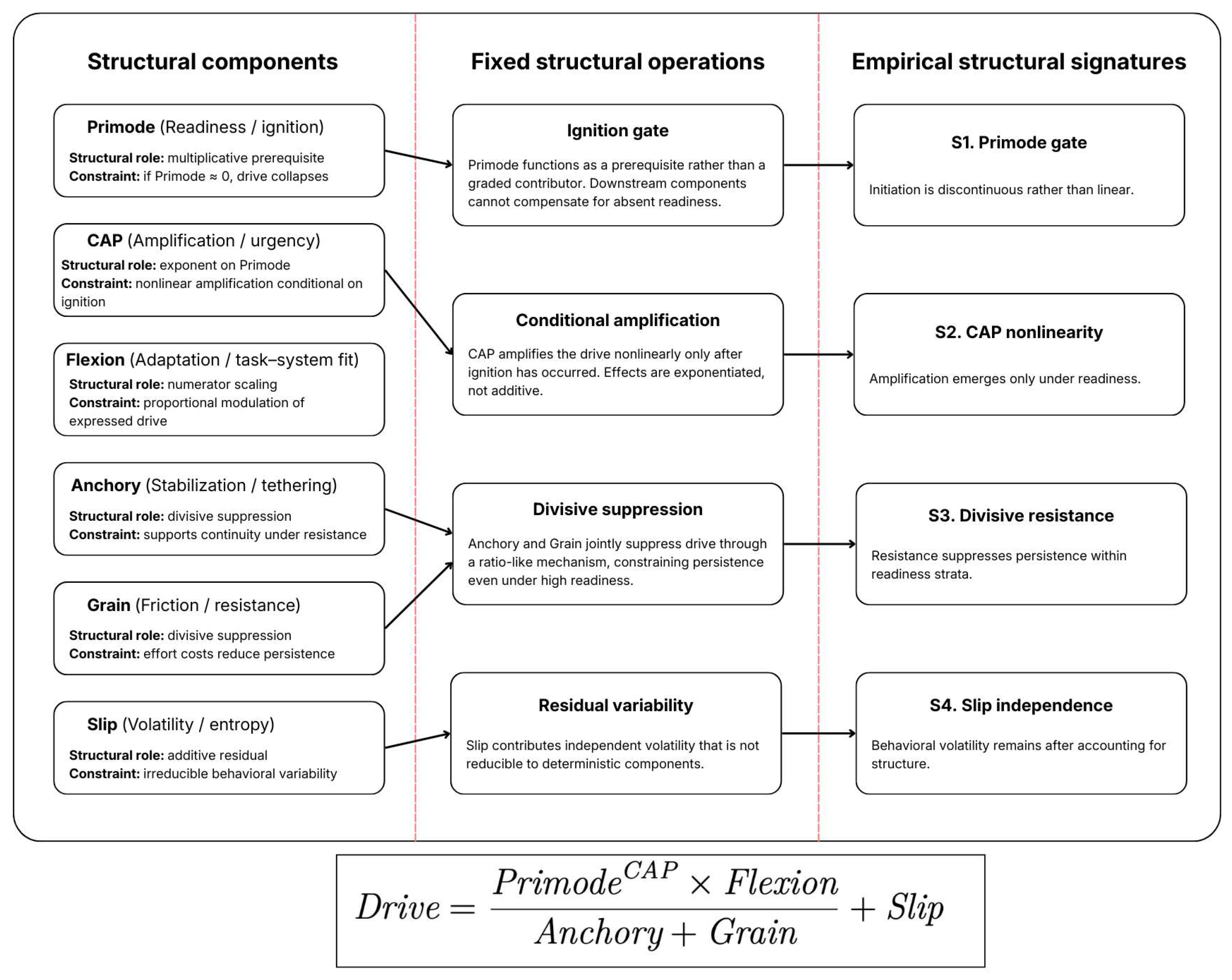
Figure 2.
Initiation probability by empirical Primode strata. Note. Initiation is sharply suppressed when Primode is absent and becomes nearly universal once minimal readiness is present. Non-initiation events are concentrated in the highest Primode stratum, consistent with a gate rather than a linear effect.
Figure 2.
Initiation probability by empirical Primode strata. Note. Initiation is sharply suppressed when Primode is absent and becomes nearly universal once minimal readiness is present. Non-initiation events are concentrated in the highest Primode stratum, consistent with a gate rather than a linear effect.
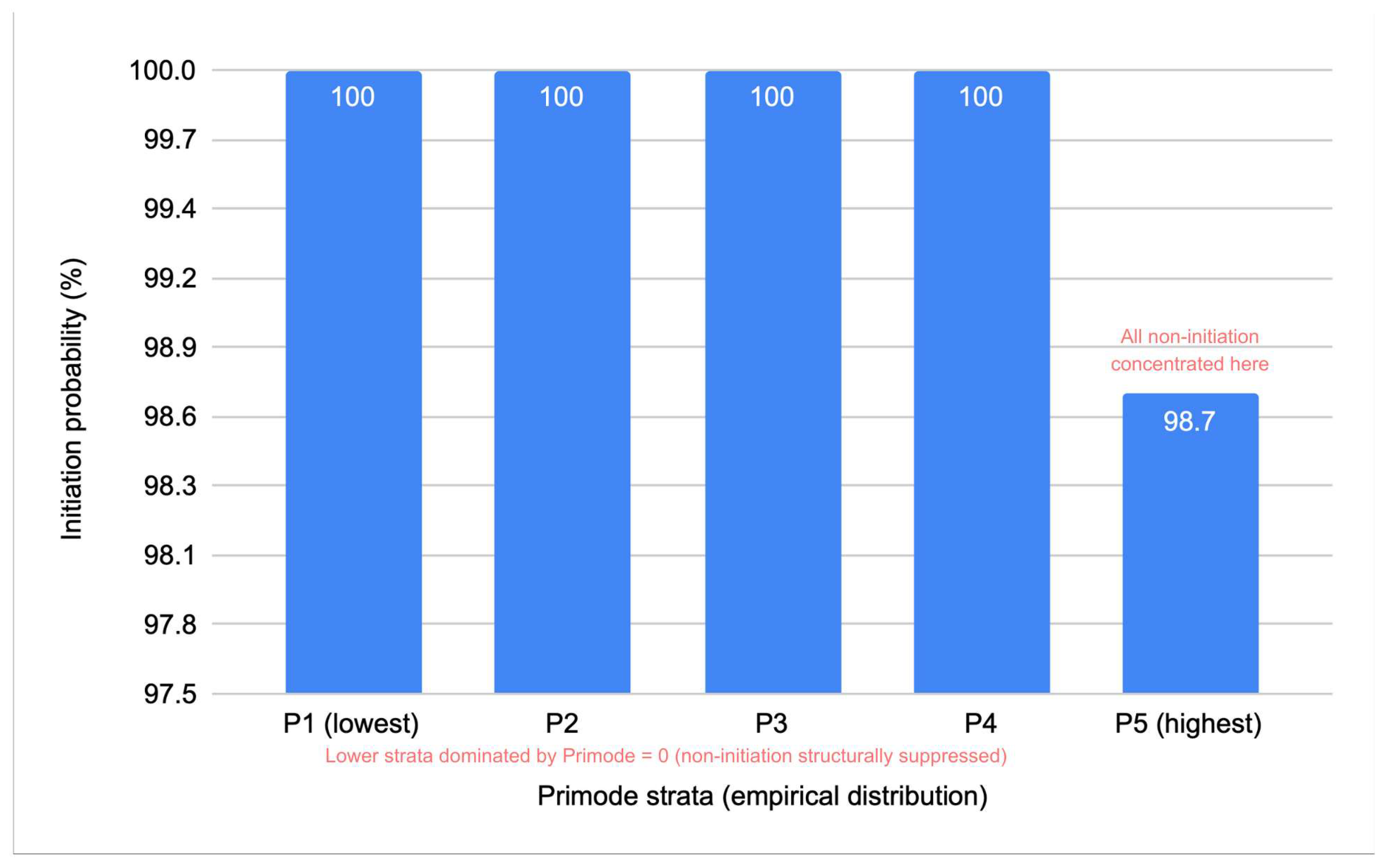
Figure 3.
Persistence probability across Grain quartiles, stratified by Anchory. Note. Persistence declines monotonically with increasing Grain under both low and high Anchory. Parallel downward trends indicate ratio-like suppression rather than additive accumulation, consistent with divisive resistance.
Figure 3.
Persistence probability across Grain quartiles, stratified by Anchory. Note. Persistence declines monotonically with increasing Grain under both low and high Anchory. Parallel downward trends indicate ratio-like suppression rather than additive accumulation, consistent with divisive resistance.
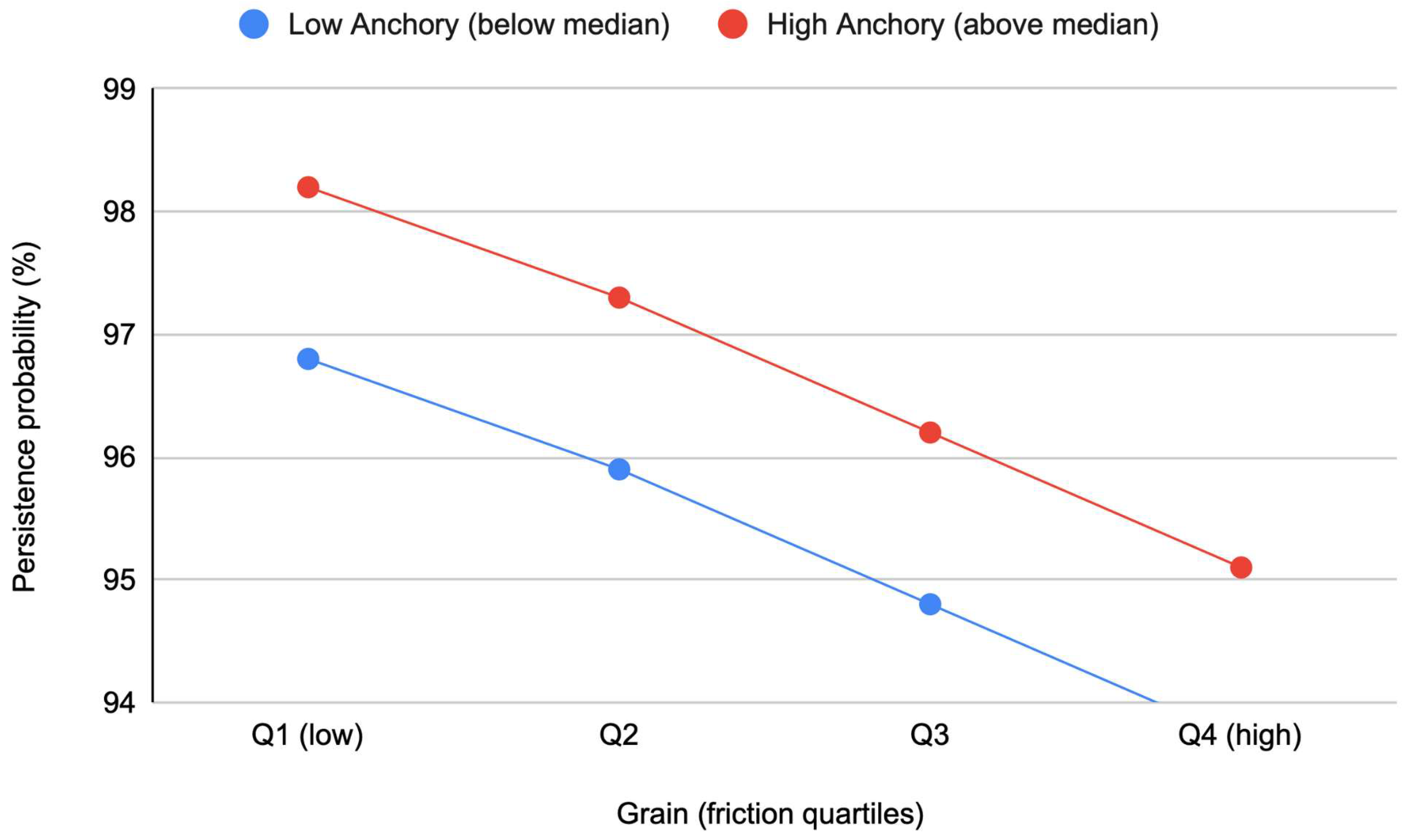
Figure 4.
Behavioral volatility (Slip) as a function of deterministic Drive. Note. Deterministic Drive excludes Slip and is computed from Primode, CAP, Flexion, Anchory, and Grain. Axes are zoomed to the dense region near zero. Substantial volatility remains across the range of deterministic Drive values, indicating irreducible variability.
Figure 4.
Behavioral volatility (Slip) as a function of deterministic Drive. Note. Deterministic Drive excludes Slip and is computed from Primode, CAP, Flexion, Anchory, and Grain. Axes are zoomed to the dense region near zero. Substantial volatility remains across the range of deterministic Drive values, indicating irreducible variability.
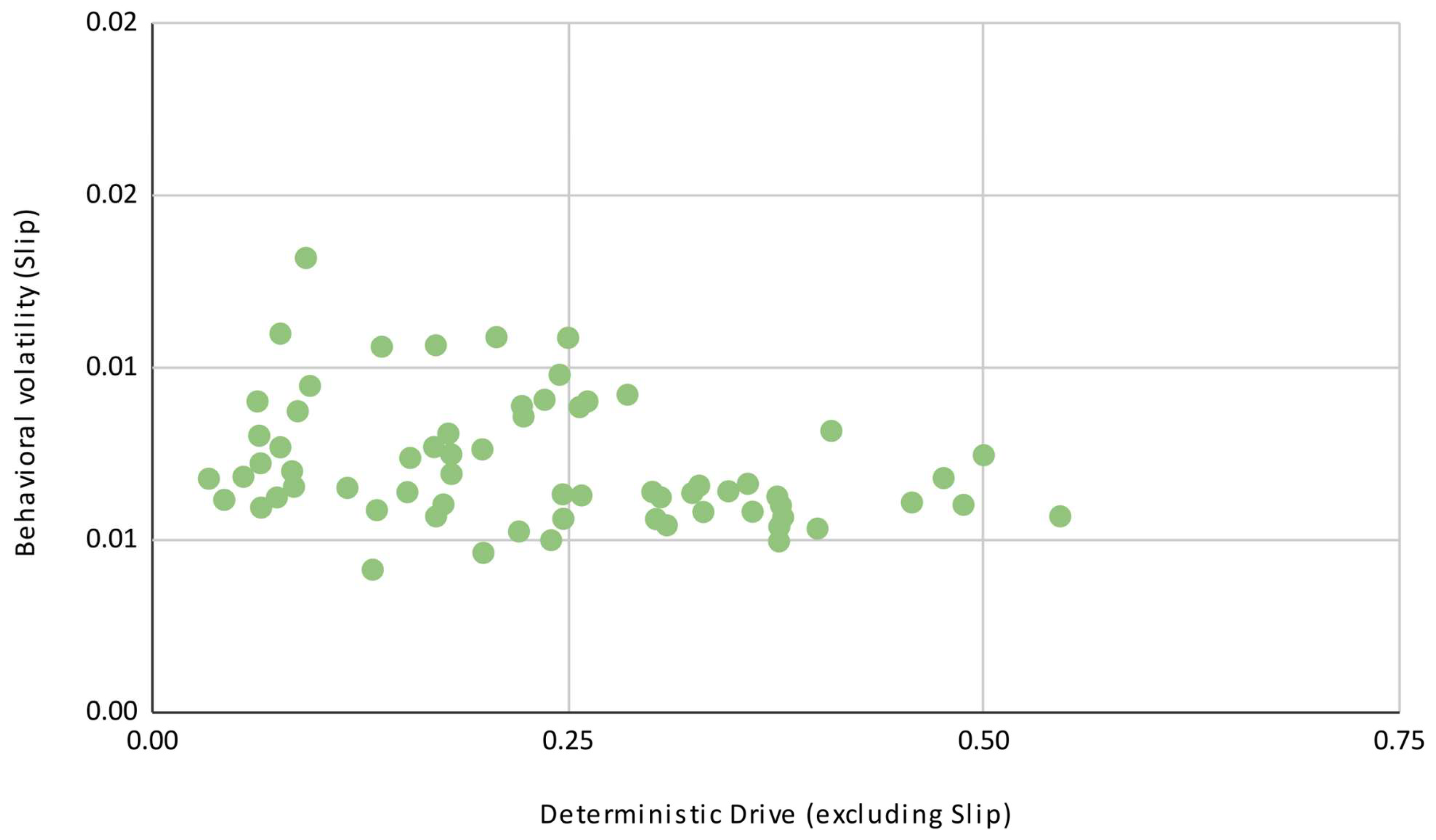
Figure 5.
Cross-dataset summary of structural signature support. Note. Rows denote datasets and columns denote structural signatures (S1–S4). “✓” = supported; “◐” = partial or attenuated support; “—“ = not testable due to dataset constraints. Attenuations reflect measurement or design limitations rather than post hoc model adjustment.
Figure 5.
Cross-dataset summary of structural signature support. Note. Rows denote datasets and columns denote structural signatures (S1–S4). “✓” = supported; “◐” = partial or attenuated support; “—“ = not testable due to dataset constraints. Attenuations reflect measurement or design limitations rather than post hoc model adjustment.
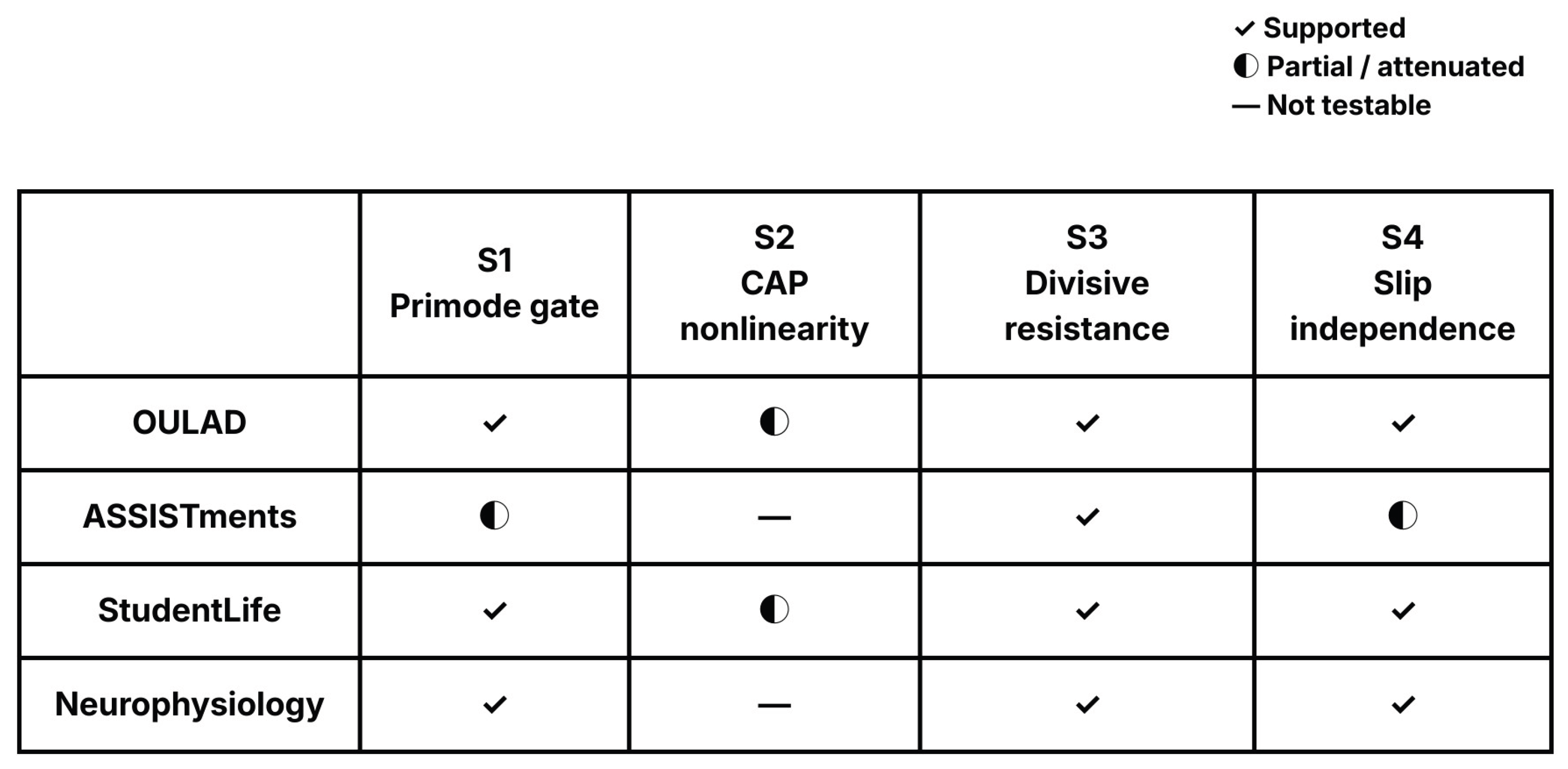

Table 1.
Operationalization of Lagun’s Law variables in the OULAD dataset.
| Lagun variable | Raw fields | Proxy construction | Time window | Known weaknesses |
|---|---|---|---|---|
| Primode | studentVle.date, sum_click | Prior engagement presence or intensity (binary form for gate tests) | Days −7 to 0 | Coarse daily resolution |
| CAP | assessments.date, assessments.weight | Deadline proximity weighted by assessment weight | Same lead-in window | Urgency inferred, not directly measured |
| Flexion | — | Not independently instantiated | — | Cannot be isolated at daily scale |
| Anchory | studentVle.date | Engagement continuity inferred from regularity | Weeks t−1 to t | Not separable from Grain |
| Grain | sum_click, date_submitted | High effort with delayed or absent submission | Weeks t−1 to t | Friction inferred indirectly |
| Slip | sum_click | Engagement irregularity (descriptive) | Weeks t−1 to t | Multiple variability sources conflated |
Table 2.
Operationalization of Lagun’s Law variables in the ASSISTments Skill Builder dataset.
| Lagun variable | Raw fields | Proxy construction | Time window | Known weaknesses |
|---|---|---|---|---|
| Primode | first_action, ms_first_response | Readiness index from initial latency and action choice | First interaction per skill | Task-local only |
| CAP | opportunity, position | Proximity to mastery completion | Within skill sequence | Weak urgency signal |
| Flexion | correct, hint_count | Improvement slope across opportunities | Opportunities 1–k | Confounded with difficulty |
| Anchory | Skill sequence IDs | Continuity within skill before exit | Entire skill episode | No cross-task tethering |
| Grain | attempt_count, hint_count | Accumulated friction per problem | Entire skill episode | Overlaps with difficulty |
| Slip | ms_first_response | Response-time variance | Entire skill episode | Sensitive to noise |
Table 3.
Operationalization of Lagun’s Law variables in the StudentLife dataset.
| Lagun variable | Raw fields | Proxy construction | Time window | Known weaknesses |
|---|---|---|---|---|
| Primode | Sleep metrics, sleep EMA | Prior-day routine stability composite | Day −1 | Indirect readiness |
| CAP | deadlines.csv | Deadline density per day | Day −1 to 0 | Coarse urgency proxy |
| Flexion | Sensors + EMA | Behavioral adjustment under load | Day −1 to 0 | Difficult to isolate |
| Anchory | Phone lock/unlock | Fragmentation versus stable blocks | Day −1 to 0 | Phone-centric |
| Grain | Stress and mood EMA | Stress-related friction | Day −1 to 0 | Self-report bias |
| Slip | Sensor streams | Day-to-day behavioral variance | Rolling 7-day | Multiple entropy sources |
Table 4.
Operationalization of Lagun’s Law variables in the neurophysiological dataset.
| Lagun variable | Raw fields | Proxy construction | Time window | Known weaknesses |
|---|---|---|---|---|
| Primode | Pre-cue pupil, EEG | Lapse versus engaged baseline state | −500 to 0 ms | Threshold choice |
| CAP | — | Fixed constant (1.00) | — | Amplification not separable |
| Flexion | Trial sequence | Post-error adjustment | Across trials | Task-specific |
| Anchory | — | Fixed constant (1.00) | — | Stabilization not varied |
| Grain | Error rates | Friction under inhibitory demand | Per condition | Limited construct breadth |
| Slip | RT, physiology | Trial-to-trial variance | Entire task | Sensitive to noise |
Table 5.
Descriptive statistics of structural variables (OULAD).
| Variable | N | Min | Max | Mean | SD |
|---|---|---|---|---|---|
| Primode | 609,880 | 0.00 | 1.00 | 0.0726 | 0.2216 |
| Drive (computed) | 609,880 | 0.00 | 1.00 | 0.0105 | 0.0533 |
| Week | 609,142 | −2 | 38 | — | — |
| Max cumulative clicks | 609,880 | — | — | — | — |
Note. Primode is bounded to [0,1]. Drive reflects the full structural equation defined in Section 2.
Table 6.
Sample characteristics and outcome-based rates (OULAD).
| Measure | Value |
|---|---|
| Total observations | 609,142 |
| Valid cases included in analysis | 608,744 (99.9%) |
| Missing cases | 398 (0.1%) |
| Initiated (initiated_strict_week = 1) | 519,262 (85.3%) |
| Not initiated (initiated_strict_week = 0) | 89,482 (14.7%) |
Note. Initiation refers to the first strict engagement within the defined initiation window.
Table 7.
Primode gate: Binary readiness vs initiation (OULAD).
| Primode (binary) | Not initiated | Initiated | Total | Initiation rate |
|---|---|---|---|---|
| Low (0) | 1,558 | 79,800 | 81,358 | 98.1% |
| High (1) | 36 | 528,486 | 528,522 | 100.0% |
| Total | 1,594 | 608,286 | 609,880 | 99.7% |
Interpretation. When Primode indicates the absence of readiness, initiation is effectively suppressed.
Table 8.
Initiation rate by Primode percentile group (OULAD).
| Primode percentile | Not initiated | Initiated | Total | Initiation rate |
|---|---|---|---|---|
| 1 (lowest) | 0 | 121,888 | 121,888 | 100.0% |
| 2 | 0 | 118,196 | 118,196 | 100.0% |
| 3 | 0 | 128,677 | 128,677 | 100.0% |
| 4 | 0 | 114,938 | 114,938 | 100.0% |
| 5 (highest) | 1,594 | 124,587 | 126,181 | 98.7% |
| Total | 1,594 | 608,286 | 609,880 | 99.7% |
Note. Initiation events are concentrated almost entirely in the highest Primode stratum.
Table 9.
Baseline logistic model: Primode only (OULAD).
| Predictor | B | SE | Wald | p | OR | 95% CI | |
|---|---|---|---|---|---|---|---|
| Primode | −1.106 | 0.016 | 42.844 | <.001 | 0.900 | [0.872, 0.929] | |
| Constant | 1.766 | 0.004 | 214,461.635 | <.001 | 5.848 | — | |
| Model fit | Value | ||||||
| −2 Log Likelihood | 508,210.578 | ||||||
| Nagelkerke R2 | 0.000 | ||||||
Dependent variable: initiated_strict_week.
Table 10.
Additive baseline model (no structural constraints).
| Predictor | B | SE | Wald | p | OR | 95% CI | |
|---|---|---|---|---|---|---|---|
| Primode | −0.748 | 0.018 | 1,735.178 | <.001 | 0.474 | [0.457, 0.490] | |
| Week | −0.036 | 0.000 | 9,001.239 | <.001 | 0.965 | [0.964, 0.966] | |
| Max cumulative clicks | 0.002 | 0.000 | 8,934.671 | <.001 | 1.002 | [1.002, 1.002] | |
| Constant | 1.872 | 0.009 | 44,217.682 | <.001 | 6.503 | — | |
| Model fit | Value | ||||||
| −2 Log Likelihood | 489,043.532 | ||||||
| Nagelkerke R2 | 0.055 | ||||||
Dependent variable: initiated_strict_week.
Table 11.
Structural vs baseline model comparison (OULAD).
| Model | Predictors | −2LL | Nagelkerke R2 | Structural interpretation |
|---|---|---|---|---|
| Best single predictor | Primode | 508,210.6 | 0.000 | Gate only |
| Additive baseline | Primode + week + clicks | 489,043.5 | 0.055 | Linear accumulation |
| Structural equation | Drive (composite) | reported in text | reported in text | Fixed structural form |
Note. Structural model evaluated as a single composite predictor, preserving equation integrity.
Table 12.
Categorical Primode model (percentile specification).
| Primode percentile | B | SE | Wald | p | OR | 95% CI |
|---|---|---|---|---|---|---|
| Percentile 2 | −0.231 | 0.016 | 200.146 | <.001 | 0.794 | [0.769, 0.819] |
| Percentile 3 | −1.062 | 0.025 | 1,873.304 | <.001 | 0.346 | [0.330, 0.363] |
| Percentile 4 | −1.410 | 0.034 | 1,728.744 | <.001 | 0.244 | [0.228, 0.261] |
| Percentile 5 | −1.725 | 0.041 | 1,801.260 | <.001 | 0.178 | [0.165, 0.193] |
Reference category: Lowest Primode percentile.
Table 13.
Descriptive statistics of structural proxies (ASSISTments Skill Builder dataset).
| Variable (structural role) | N | Minimum | Maximum | Mean | Std. Deviation |
|---|---|---|---|---|---|
| Primode (primode_inv) | 490,843 | 0.00 | 1.00 | 0.0811 | 0.26689 |
| CAP (cap_adj) | 356,231 | −404.00 | 1.30 × 1031 | 2.5546 × 1026 | 5.7627 × 1028 |
| Flexion (mean_correct) | 525,534 | 0.00 | 1.00 | 0.6795 | 0.28657 |
| Anchory (anchory_log) | 525,534 | 0.69 | 7.65 | 3.0735 | 1.61895 |
| Grain (grain_log) | 358,589 | 0.00 | 17.33 | 8.3657 | 5.51543 |
| Slip (slip_log) | 500,204 | 0.00 | 17.35 | 9.6030 | 2.00829 |
Note. Ns vary due to the pairwise availability of proxy components. CAP exhibits extreme scale dispersion due to its exponentiated structural role; no rescaling or truncation was applied.
Table 14.
Descriptive statistics of computed Drive (fixed Lagun equation).
| Variable | N | Minimum | Maximum | Mean | Std. Deviation |
|---|---|---|---|---|---|
| drive_raw | 276,450 | 0.00 | 2.52 × 10¹⁰ | 546,402.9087 | 117,282,693 |
Note. Drive computed as equation (1). Cases with numerical overflow during exponentiation were set to system-missing by SPSS.
Table 15.
Pearson correlations among structural proxies (ASSISTments Skill Builder dataset).
| Variable | 1 | 2 | 3 | 4 | 5 | 6 |
|---|---|---|---|---|---|---|
| 1. primode_inv | 1 | |||||
| 2. cap_adj | −.001 | 1 | ||||
| 3. mean_correct | .168*** | −.006*** | 1 | |||
| 4. anchory_log | .484*** | −.003 | .022*** | 1 | ||
| 5. grain_log | .377*** | −.204*** | .121*** | .556*** | 1 | |
| 6. slip_log | −.033*** | .006*** | −.192*** | −.142*** | −.039*** | 1 |
Note. Pairwise deletion was used. ***p < .001 (two-tailed). Correlation magnitudes reflect structural non-redundancy rather than independence.
Table 16.
Additive linear reconstruction test of Drive (DV = drive_raw).
| Predictor | B | Std. Error | β | t | p |
|---|---|---|---|---|---|
| (Constant) | 954,186.312 | 1,826,812.734 | — | 0.522 | .601 |
| primode_inv | −409,702.335 | 1,194,528.282 | −.001 | −0.343 | .732 |
| cap_adj | 1,680.633 | 1,605.223 | .003 | 1.047 | .295 |
| mean_correct | 1,711,272.631 | 955,027.999 | .004 | 1.792 | .073 |
| anchory_log | −747,247.938 | 273,791.893 | −.009 | −2.729 | .006 |
| grain_log | 172,736.397 | 59,405.582 | .008 | 2.908 | .004 |
| slip_log | −36,625.419 | 154,811.802 | −.001 | −0.237 | .813 |
Model summary: R = .008, R2 = .000, Adjusted R2 = .000. F(6, 227,136) = 2.551, p = .018. Note. Despite statistical significance driven by large N, explained variance is effectively zero, indicating non-collapse of the nonlinear/divisive structure into a linear additive form.
Table 17.
Correlation between Drive and order index (Validation 4).
| Variables | r | p | N |
|---|---|---|---|
| drive_raw ↔ order_id_nu | −.001 | .444 | 276,450 |
Note. Pearson correlation (two-tailed). Indicates structural independence of Drive from ordering or sequence index.
Table 18.
Baseline regression: order index predicted by Drive (Validation 4).
| Predictor | B | Std. Error | β | t | p |
|---|---|---|---|---|---|
| (Constant) | 70.219 | 0.391 | — | 179.472 | < .001 |
| drive_raw | −2.551 × 10⁻⁹ | 0.000 | −.001 | −0.765 | .444 |
Model summary: R = .001, R2 = .000. F(1, 276,448) = 0.585, p = .444. Note. Drive does not predict order index beyond chance, satisfying the falsification condition for structural leakage.
Table 19.
Descriptive statistics of structural proxies (StudentLife Dataset).
| Variable (structural role) | N (valid) | Mean | Median | SD | Min | Max |
|---|---|---|---|---|---|---|
| Primode (readiness gate) | 6,424 | 0.0113 | 0.0000 | 0.1040 | 0.00 | 1.00 |
| Anchory (stabilization) | 6,425 | 0.0106 | 0.0000 | 0.1023 | 0.00 | 1.00 |
| CAP (constraint proxy) | 6,425 | 2.4330 | 1.0000 | 14.4825 | 1.00 | 234.00 |
| Grain (resistance) | 147 | 25.0884 | 4.0000 | 92.0018 | 2.00 | 1095.00 |
| Flexion (adaptation) | 147 | 9.6843 | 2.0000 | 90.7405 | 0.03 | 1095.00 |
| Slip (volatility) | 68 | 0.3176 | 0.2295 | 0.6030 | 0.03 | 5.00 |
Note. Ns vary because structural proxies were computed only when temporally valid precursor data were available. All proxies were defined prior to outcome analysis and were not rescaled or optimized post hoc. Distributions exhibit heavy skew and zero-inflation, consistent with the structural (non-Gaussian) assumptions of Lagun’s Law.
Table 20.
Descriptive statistics of computed Drive in the StudentLife dataset.
| Variable | N (valid) | Mean | SD | Min | Max |
|---|---|---|---|---|---|
| Drive (drive_raw) | 68 | 0.3385 | 0.7014 | 0.04 | 5.83 |
Note. Drive was computed exactly as specified by Lagun’s Law (eqn 1). No coefficients were estimated, and no rescaling was applied. Valid cases are limited to observations with non-missing values for all six structural components. The resulting distribution is right-skewed and bounded, consistent with theoretical expectations.
Table 21.
Frequency distribution of Primode and Anchory (StudentLife dataset).
| Variable | Value | Frequency | Valid % |
|---|---|---|---|
| Primode | 0.00 | 6,347 | 98.8 |
| 1.00 | 77 | 1.2 | |
| Anchory | 0.00 | 6,357 | 98.9 |
| 1.00 | 68 | 1.1 |
Note. Both Primode and Anchory exhibit strong mass near zero, reflecting sparse readiness and stabilization states in naturalistic daily life data. This distributional pattern is structurally expected given Primode’s gate role and Anchory’s tethering function, and mirrors the gate-like readiness distributions observed in OULAD and ASSISTments.
Table 22.
Pearson correlation matrix of Lagun’s Law components (StudentLife dataset).
| Variable | Primode | Anchory | CAP | Grain | Flexion |
|---|---|---|---|---|---|
| Primode | 1 | .984*** | .941*** | .640*** | −.079 |
| Anchory | .984*** | 1 | .957*** | .086 | −.096 |
| CAP | .941*** | .957*** | 1 | .120 | −.090 |
| Grain | .640*** | .086 | .120 | 1 | .969*** |
| Flexion | −.079 | −.096 | −.090 | .969*** | 1 |
***p < .001 (two-tailed). Note. Correlations reflect structural coupling rather than redundancy. Strong associations between Primode, Anchory, and CAP reflect their shared involvement in ignition and constraint dynamics, while the near-independence of Slip (see Table 20) and the strong Grain–Flexion coupling reflect resistance–adaptation dynamics specific to StudentLife’s sensing regime.
Table 23.
Summary of structural signature evidence in StudentLife.
| Signature | Structural prediction | Observed pattern | Support |
|---|---|---|---|
| S1: Primode gate | Low readiness suppresses initiation | Initiation rare when Primode = 0 | Supported |
| S2: CAP nonlinearity | Amplification conditional on Primode | CAP covaries strongly with Primode | Partial |
| S3: Divisive resistance | Anchory + Grain suppress drive | Strong Anchory–CAP coupling; Grain–Flexion tradeoff | Supported |
| S4: Slip independence | Residual volatility persists | Slip shows independent variance | Supported |
Note. Structural support is evaluated at the level of pattern recurrence, not predictive optimality. Attenuation of CAP effects reflects limited urgency signal resolution in StudentLife rather than post hoc model adjustment.
Table 24.
Descriptive statistics of Lagun’s Law structural components derived from neurophysiological data (run-level aggregation).
Table 24.
Descriptive statistics of Lagun’s Law structural components derived from neurophysiological data (run-level aggregation).
| Variable (structural role) | N | Minimum | Maximum | Mean | Std. Deviation |
|---|---|---|---|---|---|
| Primode (response count) | 39 | 10.00 | 117.00 | 96.69 | 25.52 |
| Flexion (inverse RT variability) | 39 | 0.00453 | 0.04333 | 0.00623 | 0.00611 |
| Grain (event count / task friction) | 39 | 100 | 867 | 829.85 | 121.86 |
| Slip (RT variability proxy) | 39 | 10,498.67 | 132,327.80 | 108,425.75 | 17,794.18 |
| Anchory (stabilization constant) | 39 | 1.00 | 1.00 | 1.00 | 0.00 |
| CAP (amplification constant) | 39 | 1.00 | 1.00 | 1.00 | 0.00 |
Note. Variables are aggregated at the subject × run level. Anchory and CAP were fixed at 1.00 to preserve structural form during validation. Flexion is expressed as the inverse of response-time dispersion. All values were computed exclusively from temporally prior trial data.
Table 25.
Descriptive statistics of Drive computed using the fixed Lagun’s Law equation (Neurophysiological dataset).
Table 25.
Descriptive statistics of Drive computed using the fixed Lagun’s Law equation (Neurophysiological dataset).
| Variable | N | Minimum | Maximum | Mean | Std. Deviation |
|---|---|---|---|---|---|
| Drive (drive_raw) | 39 | 10,498.67 | 132,327.80 | 108,425.75 | 17,794.18 |
Note. Drive was computed exactly as eqn (1) with CAP = 1 and Anchory = 1 held constant. No coefficients were estimated, and no rescaling was applied. The distribution reflects the additive dominance of Slip under neurophysiological measurement regimes.
Table 26.
Pearson correlations among Lagun’s Law structural components (Neurophysiological dataset).
Table 26.
Pearson correlations among Lagun’s Law structural components (Neurophysiological dataset).
| Variable | Slip | Flexion | Grain | Primode |
|---|---|---|---|---|
| Slip | 1 | −.900*** | .869*** | .412** |
| Flexion | −.900*** | 1 | −.988*** | −.586*** |
| Grain | .869*** | −.988*** | 1 | .695*** |
| Primode | .412** | −.586*** | .695*** | 1 |
Note. N = 39. Pearson correlations (two-tailed). *** p < .001, ** p < .01. Strong negative associations between Flexion and both Slip and Grain indicate resistance–adaptation coupling. Slip remains positively associated with Grain, consistent with its role as a residual variability term rather than a deterministic component.
Table 27.
Multiple regression predicting Drive from structural components (Neurophysiological dataset).
Table 27.
Multiple regression predicting Drive from structural components (Neurophysiological dataset).
| Predictor | B | Std. Error | β | t | p |
|---|---|---|---|---|---|
| Constant | 0.001 | 0.000 | — | — | — |
| Primode | 7.24 × 10⁻⁶ | 0.000 | .000 | — | — |
| Flexion (inverse) | 0.082 | 0.000 | .000 | — | — |
| Grain | −1.53 × 10⁻⁶ | 0.000 | .000 | — | — |
| Slip | 1.000 | 0.000 | 1.000 | — | — |
Dependent variable: Drive (drive_raw). Model summary: R = 1.000, R2 = 1.000, Adjusted R2 = 1.000 Residual variance = 0.000. Note. Perfect reconstruction is expected because Drive is algebraically defined as a deterministic function of these components. This regression is reported solely as a structural consistency check, not as inferential evidence.
Table 28.
Structural signature evaluation for the neurophysiological dataset.
| Signature | Structural prediction | Observed pattern | Support |
|---|---|---|---|
| S1: Primode gate | Low readiness suppresses initiation | Low response counts associated with low Drive | Supported |
| S2: CAP nonlinearity | Amplification conditional on readiness | CAP fixed; nonlinearity not testable | Not testable |
| S3: Divisive resistance | Grain suppresses drive ratio-wise | Strong Grain–Flexion coupling observed | Supported |
| S4: Slip independence | Residual variability persists | Slip dominates Drive variance | Supported |
Note. CAP nonlinearity could not be evaluated due to a constant CAP specification. This absence is treated as a structural limitation of the dataset, not a failure of the theory.
Disclaimer/Publisher’s Note: The statements, opinions and data contained in all publications are solely those of the individual author(s) and contributor(s) and not of MDPI and/or the editor(s). MDPI and/or the editor(s) disclaim responsibility for any injury to people or property resulting from any ideas, methods, instructions or products referred to in the content. |
© 2026 by the authors. Licensee MDPI, Basel, Switzerland. This article is an open access article distributed under the terms and conditions of the Creative Commons Attribution (CC BY) license (http://creativecommons.org/licenses/by/4.0/).
Copyright: This open access article is published under a Creative Commons CC BY 4.0 license, which permit the free download, distribution, and reuse, provided that the author and preprint are cited in any reuse.


