

Submitted:
31 March 2026
Posted:
31 March 2026
Read the latest preprint version here
Abstract
The axonal membrane is not the seat of nerve conduction: it is the boundary between two osmotic reservoirs whose asymmetry is the thermodynamic engine of the action potential. Voltage-gated ion channels are not the generators of the nerve signal -- they are its osmotic amplifiers, and their spatial distribution along the axon is a geometric necessity, not an arbitrary anatomical feature. The Ionic-Mechano-Hydraulic (IMH) model formalises this principle: intracellular K$^{+}$ adsorbed on the cytoplasmic polyelectrolyte gel triggers an ionic phase transition; extracellular Na$^{+}$ amplifies the resulting hydraulic wave via Nav channels; Kv channels close the osmotic cycle and enforce the refractory period. Conduction velocity is predicted from myelin elastic modulus, not sodium channel density. The model resolves a 75-year-old anomaly that Huxley and St\"{a}mpfli themselves described as impossible in a purely electrical system: positive current enters a node before the membrane potential at the preceding node has reached its maximum. Nine falsifiable predictions are presented -- among them, a graded reduction in conduction distance under partial tetrodotoxin block, a bell-shaped relationship between node length and conduction velocity, and an upper diameter limit for unmyelinated fibres derived from first physical principles. The Hodgkin-Huxley model is not discarded: it is explained.
Keywords:
nerve conduction
; action potential
; hydraulic wave
; polyelectrolyte gel
; Ling associationinduction hypothesis
; Donnan equilibrium
; myelin
; saltatory conduction
; Hofmeister series
; mechanoreceptor
; Umwelt
; Hodgkin-Huxley model
“Simplicity is the ultimate sophistication.”—Leonardo da Vinci
“Everything should be made as simple as possible, but not simpler.”—Albert Einstein
1. Introduction
The Hodgkin-Huxley (HH) equations, published in 1952, provide a quantitative description of the action potential that remains the foundation of computational neuroscience [3]. Their predictive power is not in question. What is in question is their physical interpretation.
Hodgkin and Huxley were explicit on this point:
“We do not wish to suggest that the equations we have used […] necessarily bear any close relationship to the actual physical process involved.”
The equations are a phenomenological fit to data obtained from a specific preparation – the denudated giant squid axon with replaced axoplasm [4]. Baker, Hodgkin, and Shaw demonstrated that action potentials persist after axoplasm replacement with saline, and concluded, without further experimental tests, that the eliminated components were functionally neutral. The IMH model (Ionic-Mechano-Hydraulic: ionic gel phase transition as the primary event, mechanical compression as the trigger, and hydraulic wave propagation as the conduction mechanism) proposes that this conclusion was incorrect and that the cytoplasmic gel, structured water, adsorbed ions, and phase transitions eliminated by the preparation are the primary mechanism of conduction. We hereafter use the acronym IMH to emphasise the causal hierarchy: ionic desorption precedes and causes the mechanical and hydraulic events that follow.
The genealogy of the dominant model contains two earlier assumptions that deserve scrutiny. In 1902, Julius Bernstein applied the Nernst equation to quantify the resting membrane potential [2], on the advice of Wilhelm Ostwald. The Nernst equation is rigorously valid only for a single ion species, an ideal semipermeable membrane, under thermodynamic equilibrium [1] conditions, the axonal cytoplasm does not satisfy. This application was a convenient approximation that was never validated in the biological context; it was adopted and transmitted. The HH model inherits this unverified foundation.
A further structural issue concerns the preparation itself. Young (1936) established that the giant squid axon is not a single axon but a developmental fusion of hundreds of smaller axons [5], with an uncharacterised internal hydraulic architecture. The canonical preparation of twentieth-century electrophysiology was therefore neither structurally representative nor simple.
The need to move beyond HH is now recognised within mainstream modelling.
Peets, Tamm, and Engelbrecht (2023), reviewing the state of mathematical models of nerve signal propagation, explicitly call for the incorporation of the cytoskeleton as a potentially primary actor, citing evidence that its removal alters the response to axoplasmic pressure by an order of magnitude [20]; they conclude that the cytoskeleton could prove “as important for signal propagation in nerves as the cell membrane.”
Drukarch and Wilhelmus (2023) identify the top-down thermodynamic approach, treating the nerve signal as emerging from the collective physico-chemical properties of the axolemma-ectoplasm complex, as the necessary direction for a mechanistically complete account [22].
The IMH model answers both calls by providing the physical account of the medium in which the nerve signal propagates: the axonal membrane is not the seat of conduction but the boundary between two osmotic reservoirs, and voltage-gated channels are not the generators of the action potential but its osmotic amplifiers. The biophysical foundations of this model are developed in Section 2.
The present work does not propose to discard the HH model. It proposes to explain it: to identify the physical substrate from which its equations emerge as a first-order projection, and to provide the mechanistic account its authors called for.
Section 3 presents convergent evidence from independent experimental observations.
Section 4 states falsifiable predictions.
Section 5 places the model in an evolutionary context.
The Discussion and Conclusions assess the relationship between the two frameworks.
2. The IMH Model
2.1. The Cytoplasmic Gel: Ling’s Foundation
Gilbert Ling demonstrated that the cytoplasm is a structured polyelectrolyte gel in which the majority of the intracellular K+ is adsorbed at the protein sites rather than dissolved in a free solution [6]. The resting ionic distribution is a thermodynamically stable Donnan equilibrium, expressed in equation (1), where R is the gas constant, T the absolute temperature, F the Faraday constant, and the ratio in brackets is the K concentration gradient + across the gel boundary:
Equation (1) differs from the Nernst equation in a critical respect: it describes a true thermodynamic equilibrium of the gel system as a whole, not a single-ion diffusion potential across an ideal membrane. This equilibrium is the energetically favourable state of the charged gel; it requires no metabolic pump to be maintained. Tamagawa formalised this framework in rigorous thermodynamic terms and quantitatively demonstrated that observed membrane potentials are consistent with Donnan equilibrium without pump-dependent gradient maintenance [7]. In this sense, the Na+ / K+-ATPase pump performs a regulatory and not a primary electrogenic function.
The Ling polyelectrolyte gel framework is based on colloid science and the thermodynamics of charged polymer networks – a field with rigorous theoretical foundations, a well-established mathematical formalism, and extensive industrial validation in materials science, food science, and polymer physics. Flory-Huggins theory, Donnan equilibrium, and Langmuir adsorption isotherms are not biological hypotheses: they are physical laws whose validity in non-biological systems is uncontested. Ling’s contribution was to recognise that the living cytoplasm satisfies the conditions for these laws to apply, a recognition that has been marginalised within electrophysiology for reasons of disciplinary sociology rather than physical evidence.
The adsorption of K+ at gel sites follows a Langmuir isotherm, with affinity constants ordered by the Hofmeister ion series [8]. In equation (2), N is the total density of the adsorption sites, is the adsorption affinity constant for K+ and is the concentration of unbound K+ in the gel interstitium:
Equation (2) has a direct physical consequence: when mechanical compression increases locally, the isotherm shifts and the adsorption sites become transiently saturated, releasing a pulse of free K+ into the periaxonal space. This pulse is the ionic trigger of the hydraulic wave.
2.2. The Hydraulic Wave
Mechanical compression of the axon triggers the desorption of K+ from the gel sites. Desorbed ions reconstruct their hydration shells, generating a local osmotic pressure gradient and hydraulic flux. A pressure wave propagates in the periaxonal space (12–15 nm width) at a velocity governed by the Korteweg-Moens equation adapted for a fluid-filled elastic tube of small radius:
where is the elastic modulus of the myelin sheath, r is the radius of the periaxonal canal, h is the thickness of the sheath, is the bulk modulus of the periaxonal fluid and is its density. Equation (4) contains the central experimental prediction of the model: the conduction velocity is determined by the elastic modulus of myelin, not by the density of the sodium channel.
The Heimburg-Jackson thermodynamic soliton model established that the lipid membrane near a phase transition supports mechanically reversible wave propagation [9]. The IMH model integrates this as a component of a three-way thermal balance, expressed in equation (5), where the three terms represent respectively the heat absorbed by the membrane lipid phase transition, the heat released by K+ resorption onto gel sites during recovery, and the heat exchanged with the structured water shell surrounding the desorbed ions.
The near-zero net heat exchange measured during the action potential [12] is a thermodynamic constraint. Equation (5) satisfies it by construction, because the three contributions are thermodynamically coupled and partially cancel: what the membrane lipid phase transition absorbs, the gel recovery releases. The HH model, which is irreversible by design, does not account for this constraint.
2.3. The Role of Voltage-Gated Channels: Osmotic Amplifiers of the Hydraulic Wave
The IMH model does not remove voltage-gated ion channels from the description of nerve conduction. It redefines their functional role: the Nav and Kv channels are osmotic amplifiers of the hydraulic wave, not its primary generators.
The distinction between K+ and Na+ as actors in this amplification follows directly from the Hofmeister series and the gel framework of Ling. K+ has a higher adsorption affinity for intracellular protein sites than Na+; Na+ therefore remains predominantly free in the extracellular periaxonal space, where it is present at 145 mM – approximately 29 times the extracellular K+ concentration. This large extracellular Na+ reservoir constitutes an immediately available osmotic energy source that requires no metabolic expenditure to maintain.
When the hydraulic wavefront arrives at a Ranvier node, the mechanical deformation of the nodal membrane opens the Nav channels. The resulting Na+ influx amplifies the local osmotic pressure in the periaxonal canal, recharging the amplitude of the hydraulic wave before it dissipates along the internode. Nav channels thus serve the same amplification function as Ca2+ desorption in the cnidarian nematocyst [14]: an extracellular ion reservoir is mobilised to support the propagating hydraulic event.
The Kv channels open in temporal opposition to the Nav channels, producing an efflux of K+ that reverses the increase in osmotic pressure and restores the periaxonal canal to its resting state. The Nav/Kv opposition is therefore not a competition for membrane potential control but a compression–decompression cycle that maintains the waveform and enforces the refractory period: while Kv remains open and the periaxonal pressure is dissipating, Nav cannot reopen – the osmotic geometry of the canal prevents it. The absolute refractory period corresponds to the Kv-open phase; the relative refractory period corresponds to the partial recovery phase during which a stronger-than-normal hydraulic stimulus can still initiate a wave of reduced amplitude.
This framework unifies the channel distribution across fibre types. In unmyelinated fibres, Nav and Kv are continuously distributed along the axonal membrane, providing distributed osmotic amplification matched to the continuous propagation of the hydraulic wave. In myelinated fibres, Nav are concentrated at the nodes of Ranvier and Kv at the juxtaparanodal regions – precisely the locations where the hydraulic wave requires discrete amplification between internodes and where recovery must be completed before the next node is reached. The spatial segregation of Nav and Kv in myelinated fibres is not an arbitrary anatomical feature: it is the geometric solution to the discrete amplification problem imposed by saltatory hydraulic propagation.
The pharmacological evidence is consistent with this reinterpretation. Tetrodotoxin (TTX), which blocks Nav channels, abolishes the electrically recorded action potential and eventually blocks conduction because without Nav-mediated osmotic amplification, the hydraulic wave attenuates progressively along the axon and fails to reach threshold at successive nodes. Under partial TTX block, the IMH model predicts a graded reduction in conduction distance before complete block, rather than an all-or-nothing threshold effect, a prediction distinguishable from the HH expectation that conduction either succeeds or fails at each node independently.
2.4. The Universal Sigmoid as Gel Thermodynamics
Every known biological sensory receptor—mechanoreceptor, photoreceptor, nociceptor, thermoreceptor, and chemoreceptor—exhibits a sigmoidal stimulus-response curve. In the HH framework, this universality requires a separate molecular justification for each receptor class. In the IMH model, it is a necessary consequence of polyelectrolyte gel thermodynamics, expressed in equation (6), where is the receptor response as a function of stimulus intensity S, is the maximum response, is the activation threshold, and k is the slope parameter governing transition sharpness:
Equation (6) is not fitted to receptor data post-hoc: its three parameters are determined independently by the physical properties of the gel. is the minimum compression for a self-sustaining hydraulic wave (a geometric condition of the periaxonal canal); k is the gel surface-to-volume ratio; and is determined by the total density of the adsorption sites. The sigmoid emerges from gel thermodynamics, not from curve fitting. The diversity of receptors between species reflects the diversity of hydraulic architectures, not the diversity of molecular transduction mechanisms. This reformulates von Uexküll’s Umwelt principle [15] in biophysical terms: the perceptual world of each species is the hydraulic geometry of its peripheral nervous system made accessible to it.
2.5. The Axon-Schwann Cell Couple as Hydraulic Waveguide
The key architectural unit of the IMH model is not the axon in isolation but the axon-Schwann cell couple. Santiago Ramón y Cajal’s neuron doctrine (1906), while correct regarding synaptic connectivity, imposed an analytical separation of the axon from its Schwann cell that made the periaxonal space conceptually invisible. The Schwann cell is not passive support: it provides the elastic wall of the hydraulic tube and contributes to the regulation of periaxonal ionic composition. Pannese documented the structural continuity of this couple in detail [16]. A century of electrophysiology conducted on the isolated axon –with the elastic wall removed, the periaxonal space disrupted, and the gel replaced – was conducted on half of the functional unit, without ever testing whether the other half was neutral.
3. Convergent Evidence
3.1. Huxley and Stämpfli 1949: The Anomaly That Was Named and Left Unexplained
In their study of saltatory conduction in the sciatic nerve of frogs, Huxley and Stämpfli recorded a result they described in their own words as;
“impossible in a resistance and capacity system [10]:
a positive current entered the axis cylinder at node before the membrane potential at node N had reached its maximum. This directly contradicts the temporal logic of any RC-based propagation model, in which the downstream node can only be activated after the upstream node has completed depolarisation.
The arithmetic clarifies the constraint. For a frog sciatic nerve with conduction velocity m/s and internodal length mm:
The duration of the action potential at a single node is approximately 1 ms. Node therefore activates when node N has consumed only:
That is, 1.7% of its duration of action potential. In the electrical model, this requires that node N generates sufficient axial current within 17 s to depolarise node past the threshold, a demand inconsistent with the measured RC time constants of the nodal membrane. In the IMH model, the periaxonal pressure wave arrives at node in 17 s independently of the electrical state of node N, because the wave is the primary event and the electrical response is its consequence. The 1949 anomaly is resolved without modification. This result is not specific to the sciatic nerve of the frog. For any myelinated fibre, the inter-nodal transit time must be compared with the duration of the action potential at a single node.
Whenever node is activated before the action potential at node N is completed. This condition is satisfied by all fast myelinated fibres in vertebrates: for a human motor fibre with m/s, mm, and ms, one obtains ms, well below . More precisely, the fraction of the action potential that elapsed at node N when node is activated is , which means that is triggered during the earliest rising phase of the action potential at N — before any significant depolarisation has propagated axially. The 1949 anomaly is therefore not an exception but the general rule of saltatory conduction. The RC model is structurally incompatible with physiological conduction velocities across the entire class of fast myelinated fibres. In the IMH model, this is not a paradox: the periaxonal pressure wave arrives at independently of the electrical state of N, because the wave is the primary event and the electrical response is its consequence.
3.2. Hodgkin 1937: The Extrinsic Potential as Electromagnetic Shadow
Fifteen years before the HH equations were published, Hodgkin demonstrated that a nerve impulse blocked by cold or pressure produces, in the distal segment of the block, a transient potential that decreases exponentially with a space constant of approximately 2 mm [11]. He named it the extrinsic potential and showed that its spatial distribution is almost identical to that of an electrotonic potential applied artificially through external electrodes. He concluded that this local electric field was the cause of the increase in excitability observed beyond the block and offered this as a foundational support for an electrical theory of nervous transmission.
The IMH model accepts the experimental measurements without modification and proposes a different interpretation.
The cold or pressure block arrests the hydraulic wave in the periaxonal canal: mechanical compression triggers K+ desorption from the gel sites and a pressure wave is initiated, but the elastic tube is interrupted and the wave cannot propagate further. What Hodgkin’s silver-strip electrodes record beyond the block is the passive electrostatic field radiated by the arrested ionic desorption event, the electromagnetic shadow of a hydraulic wave that has been stopped. The exponential spatial decay with mm is precisely what the IMH model predicts for the passive spread of a charge perturbation in a cable-like conductor; it does not require and does not demonstrate that this passive spread is the cause of propagation in the unblocked fibre.
Three features of Hodgkin’s own data are consistent with this reinterpretation. First, the extrinsic potential is not propagated: it declines monotonically with distance and carries no information forward, exactly as expected of a passive electrostatic field rather than an active transmission signal. Second, the near-identity of its spatial distribution with artificially applied electrotonus demonstrates only that the nerve cable conducts electrostatic fields passively, a property the IMH model does not contest. Third, the increase in excitability beyond the block, which Hodgkin attributes to local electric circuits, is equally explained in the IMH framework by sub-threshold mechanical compression transmitted through the periaxonal fluid immediately adjacent to the block face: partial gel deformation lowers the K+ desorption threshold without initiating a full phase transition, reproducing the observed reduction in electrical threshold of 80–90%.
Hodgkin 1937 is therefore not evidence against the IMH model. It is the earliest recorded measurement of the electromagnetic shadow that the IMH framework predicts accompanies every hydraulic wave, blocked or propagating. That this shadow was interpreted as the cause of transmission, rather than its consequence, is the founding interpretive choice from which the HH model subsequently developed.
3.3. The RC Invariance Argument
In classical cable theory, . Both resistance and capacitance scale with internodal length L, as shown in equation (10), where is axoplasm resistivity, r is axon radius, is specific membrane capacitance and L is internodal length:
Equation (10) shows directly that scales as : doubling the internodal length doubles resistance and doubles capacitance, quadrupling the time constant. The apparent velocity gain attributed to increased internodal spacing in myelinated fibres is therefore an arithmetic artefact: the RC reduction from lower capacitance per unit length is exactly cancelled by a proportional resistance increase. Myelination cannot accelerate conduction through the electrical mechanism alone. The hydraulic model does not require such cancellation: the velocity is determined directly by through equations (3) and (4).
3.4. Thermal Signatures of the Action Potential
Ichiji Tasaki documented over six decades a series of observations incompatible with the purely electrical model: longitudinal mechanical displacement of the myelin sheath coincident with the action potential, near-zero net heat exchange and anomalous bidirectional conduction results [12]. These observations were noted and set aside by the field for lack of a theoretical framework capable of integrating them. The IMH model provides this framework: Tasaki’s longitudinal myelin displacement is the macroscopic surface signature of the periaxonal pressure wave. His thermal measurements satisfy equation (5).
Masson and Gallot (2008) provided a more recent and quantitatively rigorous treatment of thermal exchange during the action potential [13], using a statistical physics model of ionic and water effusion through membrane nano-channels. Their model predicts a temperature variation of approximately 22 K for a 10 m radius axon, in good agreement with experimental measurements [12]. Crucially, Masson and Gallot identified coupled water flux as a necessary component of the thermal account—a conclusion that converges independently on the IMH framework. However, their model remains within the interpretive structure of the HH: the effusion is trans-membranous, the channels are the primary actors, and the near-zero net thermal balance expressed in equation (5) is not addressed. The IMH model proposes the missing constraint: the three-way coupling of lipid, gel, and water contributions is the physical reason why the net exchange approaches zero—not a coincidence to be quantified after the fact.
3.5. The Cnidarian Nematocyst as Macroscopic Proof of Principle
The nematocyst of cnidarians demonstrates the ionic-hydraulic coupling mechanism on a directly measurable scale [14]. The organelle withstands an osmotic pressure of 150 bar, discharges in 700 ns, and produces an acceleration of g. The trigger is Ca2+ desorption from a polyanionic capsule matrix, the same ionic-gel phase transition proposed for the periaxonal space in vertebrate axons, operating with measurable parameters. Cnidarians are among the first animals with a nervous system (>500 Myr), which established the ionic-hydraulic mechanism as evolutionarily ancient. The nematocyst is the bottom of the hydraulic fractal: the same principle operating at the nm– m scale in 700 ns operates at the m scale in ms in the axon and at larger scales over longer time constants in the astrocytic syncytium and glymphatic system.
3.6. Axonal Mechanics: The Gel Identity of the Cytoskeleton
Independent biomechanical evidence for the gel nature of the interior of the axon was provided by Dubey et al. (2020), using a strain-controlled optical-fibre force apparatus in chick dorsal root ganglion axons [19]. The authors demonstrate three properties that are diagnostic of a polyelectrolyte gel rather than a simple viscous fluid or a microtubule cable: (i) the axon exhibits a strain softening response in which the steady-state elastic modulus decreases with increasing strain; (ii) the long-time behaviour is that of a viscoelastic solid, with a non-zero steady-state tension and memory of the initial state; (iii) the dominant mechanical contributor is not the microtubule bundle but the actin-spectrin periodic lattice, which buffers tension by reversible unfolding of the repeat domains of the spectrin.
These findings were obtained by researchers working entirely within the framework of biophysics and cytoskeletal mechanics, without reference to the HH model or nerve conduction. Their characterisation of the axonal cortex as a tension-buffering gel with solid-like long-time behaviour and strain-softening is precisely the material description required by the IMH model for the substrate that undergoes an ionic-hydraulic phase transition during the action potential. The convergence is independent and unintentional.
4. Predictions
4.1. Myelin Elastic Modulus and Conduction Velocity
Prediction: Conduction velocity in myelinated axons correlates with the elastic modulus of the myelin sheath (measurable by atomic force microscopy in isolated fibres), independently of the channel density Na+.
The HH model predicts that the velocity is determined by the kinetics and density of the channels. The IMH model predicts that it is determined by myelin rigidity via equations (3)–(4). The two predictions are orthogonal and experimentally separable. Demyelinating conditions that reduce should slow conduction in proportion to , not in proportion to channel loss.
4.2. Mechanoreceptor Adaptation as Hydraulic Geometry
Prediction: Altering the fluid volume or viscosity of sensory corpuscles (Pacinian, Meissner, Krause end bulbs) without modifying receptor channel composition should shift the adaptation rate and frequency selectivity according to hydraulic equilibration time calculations derived from equation (4).
In the HH framework, adaptation is a property of channel kinetics. In the IMH model, it is a property of the hydraulic geometry of the corpuscle. The two models make quantitatively different predictions for the same viscosity manipulation.
4.3. Terminal Arborisations: Slowness as Geometric Amplifier of the Umwelt
Sensory terminal arborisations are the finest and slowest branches of the peripheral nervous system. Within the HH framework, this slowness is a physical limitation of small-diameter unmyelinated fibres. Within the IMH model, it is an evolutionary calibration: the temporal bandwidth of biologically relevant events determines the hydraulic geometry of the terminal arbour.
A punctate mechanical stimulus activates multiple terminal branches at different distances from the integration point of the arborisation, irrespective of fibre type. The resulting delays in arrival between branches encode the spatial geometry of the stimulus as a temporal signature, as expressed in equation (11), where and are the lengths of two terminal branches reaching the same receptive field point through different paths, and is the hydraulic wave velocity in those branches:
Equation (11) establishes the fundamental encoding principle: is the temporal delay between the two hydraulic messages reaching the integration point of the arborisation from the same stimulus point. This delay is a spatial coordinate transformed into a temporal one. Slowness amplifies geometry.
The motor arborisation inverts the principle: synchrony of muscle fibre contraction requires synchrony of hydraulic wave arrival at motor end-plates. Equal branch lengths produce simultaneous arrival and maximal impulsive force; unequal branch lengths produce staggered arrivals and temporally distributed force.
Falsifiable prediction: The spatial resolution of a cutaneous receptor field correlates with the maximum branch length differential of its sensory arborisation, measurable by anatomical reconstruction. For motor units: the temporal profile of the compound EMG reflects terminal branch length distribution, distinguishable from predictions based on fibre conduction velocity alone.
4.4. Motor Tremor as Hydraulic Interference
Smooth motor fusion requires successive hydraulic waves to arrive at terminal arborisations in constructive temporal superposition. The critical firing frequency above which destructive interference produces tremor is given by equation (12), where is the hydraulic wave velocity in the terminal branches and is the length of the longest branch in the motor arborisation:
Equation (12) provides a direct geometric interpretation of pathological tremor: if the firing frequency exceeds , successive hydraulic wavefronts arrive at terminal end-plates before the preceding wave has fully dissipated, producing destructive superposition and loss of smooth force summation. The three types of clinical tremor –Parkinsonian (4–6 Hz), essential (8–12 Hz), cerebellar (variable)—correspond to three distinct hydraulic regimes, each with a characteristic branch length distribution.
4.5. Composite Temporal Decoding and the Libet Latency
The peripheral nerve fibres span a conduction velocity range of 0.5–120 m/s. On a path length of 1 m, arrival delays range from 10 ms (A) to 1000 ms (C fibres). The Libet threshold of approximately 500 ms for conscious sensory perception is, in the IMH model, the minimum temporal integration window required to receive and decode the complete composite message, including its slow affective C-fibre component [17].
Prediction: Selective pharmacological blockade of C-fibre hydraulic transmission should abolish the subjective feel quality of a stimulus while preserving its fast discriminative component. Disruption of astrocytic gap junctions should selectively alter C-fibre signal integration while preserving fast-fibre processing [17].
4.6. Electrical Stimulation as Gel Trigger
The apparent success of external electrical field stimulation has been cited as evidence against purely mechanical models of nerve conduction. In the IMH model, this objection is resolved by the polyelectrolyte gel. An external electric field acts directly on the charged gel matrix and adsorbed ions, triggering the desorption electrically rather than mechanically. The same ionic-hydraulic phase transition is initiated; only the triggering stimulus differs.
Prediction: The threshold electric field for nerve stimulation correlates with the gel adsorption affinity constants (Hofmeister series position of the dominant adsorbed cation), not only with the membrane capacitance. This can be tested with gel-modifying agents that shift the adsorption affinity without altering the membrane electrical properties.
4.7. Non-Contamination Between Adjacent Fibres
Adjacent axons in a nerve bundle transmit distinct signals simultaneously without crosstalk. In the HH framework, the isolation is provided by myelin insulation. In the IMH model, each fibre is a sealed periaxonal canal; hydraulic waves cannot propagate between structurally independent tubes.
Prediction: Selective mechanical disruption of the periaxonal seal between two adjacent fibres—without affecting their electrical insulation—should produce hydraulic crosstalk detectable as correlated mechanical signals in both fibres simultaneously.
4.8. Electromagnetic Dipole Geometry
A propagating hydraulic wavefront generates a moving ion desorption/resorption dipole along the axon, producing a propagating electromagnetic dipole rather than a stationary monopole.
Prediction: High-resolution EEG/MEG source modelling of single-fibre or small-fascicle signals should detect a dipolar electromagnetic signature progressing at hydraulic velocity, quantitatively distinguishable from the monopolar source geometry predicted by HH.
4.9. Axon Diameter Limits: Three Coupled Constraints
The IMH model predicts a set of coupled physical limits on axon diameter that jointly explain an otherwise unaccounted observation: large-diameter unmyelinated fibres do not exist in nature.
4.9.1. The Refractory Constraint in Unmyelinated Fibres
In the IMH model, the refractory zone is the length of the axon occupied by a propagating hydraulic wave that is still undergoing K+ resorption at gel sites. As the axon diameter increases, the wave amplitude, conduction velocity, and refractory zone length all increase proportionally. The critical constraint is not on a single action potential but on the following one: successive impulses must not enter the refractory zone of the preceding wave. The maximum firing frequency is therefore inversely proportional to refractory zone length and, by extension, to axon diameter:
where d is the diameter of the axon. A large-diameter unmyelinated fibre would be structurally limited to very low firing frequencies, rendering it functionally useless for information transmission at the signal bandwidths required by vertebrate nervous systems. The HH model does not offer a principled reason why large unmyelinated fibres should not exist; the IMH model predicts their absence from the energy and information-theoretic first principles.
4.9.2. The Ion Density Constraint
Maintaining a sufficient safety factor for hydraulic wave propagation requires a minimum density of adsorption sites (and, therefore, ion channels as secondary electromagnetic reporters) per unit of membrane area. As diameter increases, the gel volume and ion reservoir available per unit surface scale differently, eventually requiring a channel density that is metabolically and structurally untenable. This is the same constraint identified at the nanoscale in the companion paper [23]: the ionic reservoir is finite and scales unfavourably with the diameter for unmyelinated fibres.
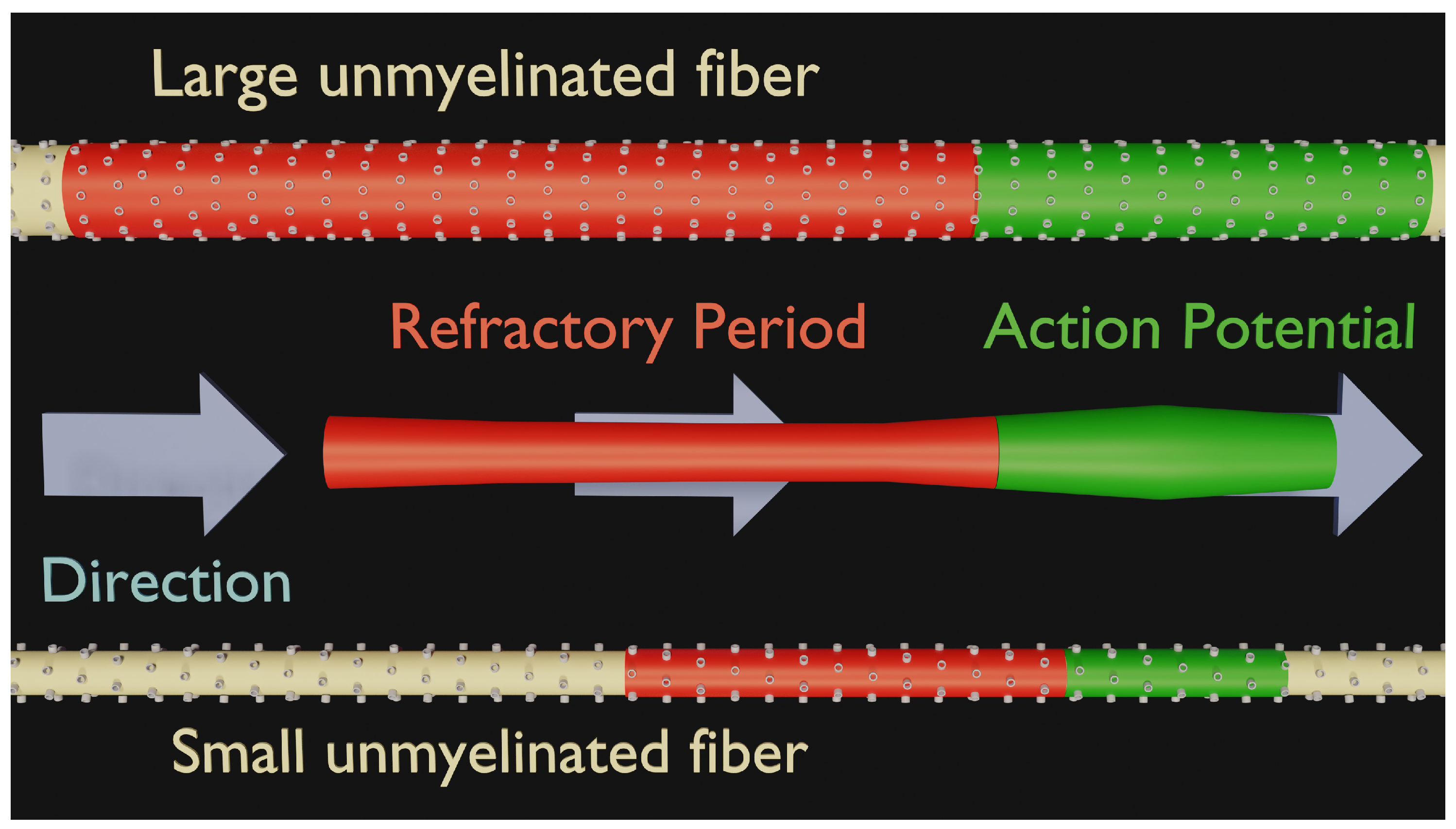
Figure 1.
Refractory constraint and ion density as a function of axonal diameter in unmyelinated fibres. The propagating action potential (green) is followed by a refractory zone (red) in which K+ resorption onto gel sites is still in progress and a second impulse cannot be sustained. Top: In a large-diameter unmyelinated fibre, the refractory zone occupies a proportionally greater length of the axon, severely limiting the maximum firing frequency (, equation 13); simultaneously, the gel volume scales as while the adsorption site density per unit surface area scales unfavourably, imposing the ion density constraint of Section 4.9.2. Bottom: In a small-diameter unmyelinated fibre, both constraints are satisfied: the refractory zone is short relative to axon length and the ion reservoir per unit surface remains adequate. The IMH model predicts that beyond a critical diameter (m), large unmyelinated fibres become simultaneously frequency-limited and ionically inviable—explaining their absence from vertebrate nervous systems on physical, not developmental, grounds. The schematic also illustrates the proportionality between wave amplitude and fibre diameter: the hydraulic wavefront in the large fibre (centre) is broader and more energetically costly, imposing the amplitude–velocity trade-off discussed in Section 4.9.3.
Figure 1.
Refractory constraint and ion density as a function of axonal diameter in unmyelinated fibres. The propagating action potential (green) is followed by a refractory zone (red) in which K+ resorption onto gel sites is still in progress and a second impulse cannot be sustained. Top: In a large-diameter unmyelinated fibre, the refractory zone occupies a proportionally greater length of the axon, severely limiting the maximum firing frequency (, equation 13); simultaneously, the gel volume scales as while the adsorption site density per unit surface area scales unfavourably, imposing the ion density constraint of Section 4.9.2. Bottom: In a small-diameter unmyelinated fibre, both constraints are satisfied: the refractory zone is short relative to axon length and the ion reservoir per unit surface remains adequate. The IMH model predicts that beyond a critical diameter (m), large unmyelinated fibres become simultaneously frequency-limited and ionically inviable—explaining their absence from vertebrate nervous systems on physical, not developmental, grounds. The schematic also illustrates the proportionality between wave amplitude and fibre diameter: the hydraulic wavefront in the large fibre (centre) is broader and more energetically costly, imposing the amplitude–velocity trade-off discussed in Section 4.9.3.
4.9.3. The Amplitude-Velocity Trade-Off and the Engineering Parallel
The biological constraint stands in instructive contrast to digital electronics. In semiconductor technology, the voltage amplitude has been systematically reduced – from 5 V in early microprocessors to below 1 V in modern architectures—because a lower amplitude enables faster switching: less charge to move, lower RC time constant, higher clock frequency. The nerve fibre faces the inverse constraint. In the IMH model, a larger amplitude hydraulic wave (requiring more ionic desorption, more channel activity, and more energy) is required to propagate faster or over a larger diameter. Biology cannot “lower the voltage” without losing propagation. This asymmetry defines a hard architectural ceiling on unmyelinated conduction speed.
4.9.4. Myelination as the Evolutionary Solution
The three above constraints converge on the same conclusion: beyond a critical diameter, unmyelinated fibres become simultaneously frequency-limited, energy-inviable, and amplitude-constrained. Myelination resolves all three by confining the hydraulic wave to the periaxonal canal at the Ranvier node, where the relevant geometry is the diameter and length of the node –not the full diameter of the internode. The node can be small while the internode is large, decoupling the amplitude requirement from the velocity requirement.
For myelinated fibres, two further constraints apply. First, the node length sets a minimum below which the ionic desorption event cannot sustain a self-propagating wave. Second, increasing the diameter of the fibre requires proportionally longer internodes to preserve the hydraulic impedance match at the node, imposing a geometric scaling law between the length of the internode, the geometry of the node and the thickness of the myelin.
Prediction: The upper diameter limit of unmyelinated fibres and the node-to-internode geometry of myelinated fibres should follow quantitative scaling laws derivable from equations (3)–(4) and the ion adsorption isotherm (2). Specifically: (i) the diameter of the unmyelinated fibre should be bounded by a critical value above which falls below the minimum physiological firing rate of the fibre class; (ii) in myelinated fibres, the ratio of node length to internode length should correspond to the elastic modulus in the manner prescribed by equation (4).
4.9.5. The Active Surface as the Unifying Variable
The arguments developed in the preceding sections can be unified by a single geometric quantity: the active surface , defined as the lateral membrane area over which ionic desorption occurs during the propagating hydraulic event. For unmyelinated fibres, is the length of the hydraulic wavefront along the axon; for myelinated fibres, it is the length of the Ranvier node. In both cases, determines the total number of K+ ions desorbed per wave cycle and, therefore, the amplitude of the hydraulic pressure pulse.
For unmyelinated fibres, (the wavefront length scales with diameter because the wave is geometrically self-similar), so:
Both amplitude and conduction velocity increase with d, but not at the same rate: amplitude (from ), while velocity from the Korteweg–Moens equation for an elastic tube without confining myelin, yielding an amplitude-to-velocity ratio that constitutes the energetic ceiling identified above: the energy cost per unit of conduction velocity increases as , making arbitrarily large unmyelinated fibres thermodynamically inviable.
For myelinated fibres, empirical data show that the node length is independent of the diameter of the axon [30]: regression of the node length against the diameter of the node yields a slope not significantly different from zero in a 4 to 8-fold range of node lengths. Therefore:
The active surface of the node scales linearly with diameter, and so does the amplitude of the hydraulic pulse generated at each node. Since the conduction velocity also scales as in myelinated fibres (see Section 4.9.5 below), the amplitude-to-velocity ratio is constant throughout the full diameter range of myelinated fibres.
This constancy is not an accident of design: it is the geometric consequence of confining the active surface to the node, whose length is a free parameter decoupled from diameter. Myelination achieves what unmyelinated architecture cannot achieve – a constant energetic cost per unit of conduction velocity – by separating the two degrees of freedom (r and ) that jointly determine .
A further consequence follows directly. Because is independent of diameter but nonetheless varies substantially between axons (up to 8 times in cortical axons [30]), it constitutes a plastic tuning parameter for conduction velocity that operates independently of myelination thickness and internode length. In the IMH framework, this plasticity is the geometric mechanism by which the nervous system adjusts hydraulic wave amplitude, and therefore signal arrival time, on a fibre-by-fibre basis without altering the axon calibre. The HH model offers no mechanistic account of why node length should influence conduction speed: in a purely electrical framework, a longer node simply exposes more membrane capacitance, which should slow conduction by increasing the charge required to depolarise the downstream node. The IMH model predicts the opposite: a longer node generates a larger hydraulic pressure pulse, which arrives at the next node sooner. The empirical observation that longer nodes conduct faster [30] is a direct falsification of the HH prediction and a direct confirmation of the IMH prediction.
Falsifiable prediction (Pα): the increase in conduction velocity per unit increase in node length should be quantitatively predictable from the Korteweg–Moens equation and the gel adsorption isotherm, without free parameters. Specifically, , where is the active reference surface and is derived from equation (3). This relation can be tested by simultaneous measurement of the length of the node and the single-fibre conduction velocity in identified axons of known diameter.
The projection of onto the propagation axis introduces another constraint that distinguishes myelinated architecture from unmyelinated architecture. In unmyelinated fibres, the desorption event unfolds continuously along : every surface element contributes to the advancing wavefront, and the temporal unfolding of the action potential – the absolute refractory period during desorption, the relative refractory period during resorption – is encoded directly in . In myelinated fibres, is concentrated at the node over a short : the hydraulic pulse is quasi-instantaneous and quasi-punctual, and its projection onto the propagation axis produces a high-amplitude impulsion that traverses the internode before dissipating. The temporal information lost at the node is re-encoded at a higher level in the internodal transit time .
This geometric distinction implies a critical constraint on . As increases toward , the node progressively loses its punctual character: the desorption event spreads axially, the hydraulic pulse loses its impulsive concentration, and the projection onto v decreases. At the limit , the fibre becomes functionally equivalent to a large unmyelinated fibre and encounters the three constraints identified above – the energetic ceiling, the refractory constraint, and the ion density constraint. Below a minimum , the active surface is insufficient to generate a pulse capable of traversing the internode: the wave becomes stationary. The conduction velocity is therefore a bell-shaped function of at constant diameter and internode length:
The descending branch of this function – where the conduction velocity decreases as increases beyond – has never been experimentally sought, because the HH model predicts no such optimum: in a purely electrical framework, the length of the node affects only the membrane capacitance, and the relationship between the length of the node and the conduction velocity is monotone. The IMH model predicts a non-monotone relationship with a well-defined optimum determined by the ratio and the hydraulic impedance of the internode.
Falsifiable prediction (Pβ): In myelinated axons of fixed diameter and fixed internode length, conduction velocity as a function of node length should follow a bell-shaped curve with a maximum at , and should decrease – eventually reaching a stationary wave condition – for node lengths approaching . This prediction is testable by combining the node length manipulation methodology of Arancibia-Cárcamo et al. [30] with single-fibre conduction velocity measurement throughout the observed range of node lengths, including the longest nodes currently documented.
Involuntary experimental support for the descending branch is provided by pathological observations reviewed by Arancibia-Cárcamo and Attwell (2014) [31]. In multiple sclerosis, spinal cord injury, cerebral hypoperfusion, ageing, and glutamate excitotoxicity, the Ranvier node undergoes lengthening, an increase in beyond its physiological value, accompanied by redistribution of Kv1 channels from the juxtaparanode toward the node and paranode, and by a reduction in conduction velocity or conduction failure. In the HH framework, the lengthening of the nodes slows conduction because it increases the capacitance of the nodes, requiring more charge from the Nav channels to depolarise the next node – an explanation that predicts a monotonous relationship between and conduction slowing. In the IMH framework, the lengthening of the node moves beyond to the descending branch of the bell-shaped curve: the hydraulic pulse loses its impulsive concentration, the osmotic amplification by the Nav channels becomes spatially dispersed, and the wave amplitude at the next node falls below the desorption threshold. The two frameworks make the same qualitative prediction for the direction of the effect, but differ in their mechanistic account and in their quantitative predictions: the HH framework predicts a monotone slowing proportional to the added capacitance, while the IMH framework predicts an accelerating decline as approaches , with a sharp transition to the conduction block. The redistribution of Kv channels observed in these pathologies is, in the IMH framework, a secondary consequence of loss of integrity of the osmotic cycle rather than a primary cause of conduction failure.
4.9.6. Quantitative Velocity-Diameter Scaling and the Collapse Exponent
The three constraints above generate a characteristic velocity-diameter profile whose shape is quantitatively derivable from equations (3)–(4). Within the biologically viable range, myelinated fibres follow the empirically established linear relation [24,25]. This linearity is a direct consequence of the Korteweg-Moens equation under the anatomical constraint that myelin thickness scales proportionally with the diameter of the fibre (ratio , constant across the fibre classes [26]): since and the elastic modulus of a laminated cylindrical shell scales as , equations (3) – (4) yield exactly. The parabolic relation predicted by cable theory [26] and empirically validated only by extrapolation to the giant squid axon, a composite fusion of hundreds of smaller axons [5] whose hydraulic architecture is uncharacterised, is not a prediction of the IMH model.
Beyond the anatomical limits (m for myelinated fibres; m for unmyelinated fibres), the IMH model predicts that effective conduction velocity does not continue to increase but collapses, following a power law with exponent :
The exponent is not fitted but is derived from two independent physical contributions that combine multiplicatively. For myelinated fibres beyond : (i) the cost of ionic desorption scales as (gel volume), while (ii) the hydraulic driving pressure scales as by the Laplace relation ; therefore, the ratio of available energy to required pressure decreases as , and since the velocity scales as the square root of this ratio in the Korteweg-Moens framework, the effective velocity declines as . For unmyelinated fibres beyond : without a confining myelin sheath, the hydraulic wave radiates cylindrically; the amplitude of a cylindrical wave decays as , and the wave can no longer sustain propagation when the amplitude falls below the gel desorption threshold. The combined effect of amplitude decay and increased gel volume again yields an effective velocity that decreases as .
The lower end of the myelinated range is provided by Waxman and Bennett [24], who demonstrated that in the central nervous system, myelinated fibres with diameters as small as m conduct faster than unmyelinated fibres of the same diameter–directly contradicting the Rushton critical-diameter argument (which predicts that myelination ceases to accelerate conduction below m) and confirming the linear relation at the small-diameter end. Within the IMH framework, this observation is explained by the noise properties of the CNS environment: the periaxonal space is hydraulically better confined (blood-brain barrier, glial envelope, cerebrospinal fluid cushion) than the peripheral nerve, so the minimum wave amplitude required for reliable propagation is lower, and the linear regime extends to smaller diameters. The minimum myelinated fibre diameter is not a universal constant, but an environmental noise floor.
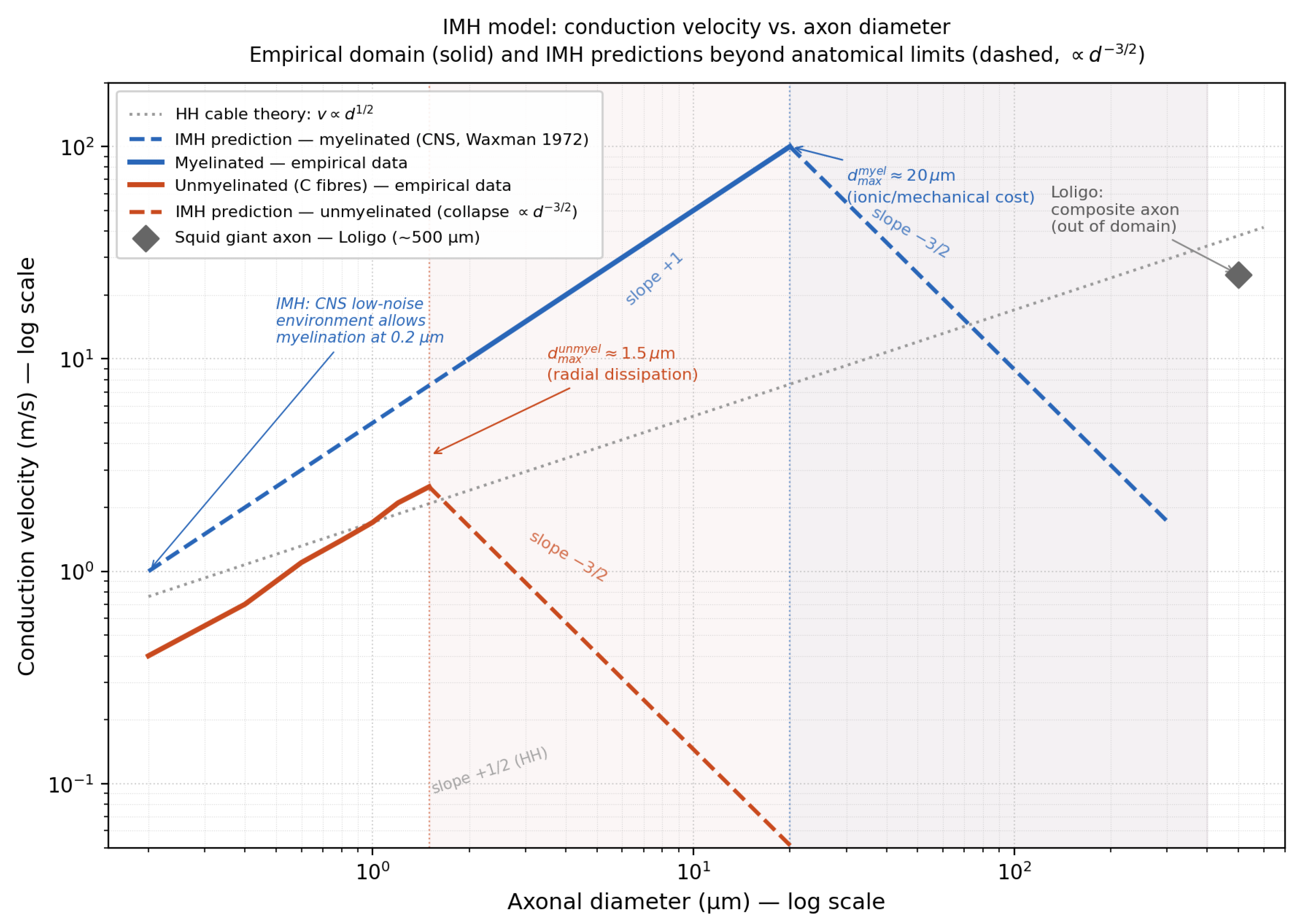
Figure 2.
Conduction velocity as a function of axonal diameter: empirical data and IMH predictions (log–log scale). Solid lines show the empirically established velocity–diameter relations for myelinated fibres (blue, Hursh 1939; Waxman and Bennett 1972 [24]) and unmyelinated C fibres (red). Dashed lines extend each relation beyond the respective anatomical limits (m; m) according to the IMH collapse law (equation 18, exponent , derived from Korteweg–Moens mechanics). In log–log coordinates, the empirical linear relation (slope , blue solid) is a straight line, as is the collapse (, slope , blue and red dashed). The dotted grey line shows the Hodgkin–Huxley cable-theory prediction (slope , Rushton 1951), which continues to rise without bound and predicts conduction in arbitrarily large unmyelinated fibres—a prediction contradicted by anatomy. The diamond marker indicates the squid giant axon (Loligo, m, m/s), which lies far outside the biological domain of individual axons and whose inclusion by Rushton to validate the relation is critiqued in Section 6. The two models diverge maximally in the zone 2–m for unmyelinated fibres, where the IMH predicts collapse and HH predicts continued acceleration—a range directly accessible to experiment.
Figure 2.
Conduction velocity as a function of axonal diameter: empirical data and IMH predictions (log–log scale). Solid lines show the empirically established velocity–diameter relations for myelinated fibres (blue, Hursh 1939; Waxman and Bennett 1972 [24]) and unmyelinated C fibres (red). Dashed lines extend each relation beyond the respective anatomical limits (m; m) according to the IMH collapse law (equation 18, exponent , derived from Korteweg–Moens mechanics). In log–log coordinates, the empirical linear relation (slope , blue solid) is a straight line, as is the collapse (, slope , blue and red dashed). The dotted grey line shows the Hodgkin–Huxley cable-theory prediction (slope , Rushton 1951), which continues to rise without bound and predicts conduction in arbitrarily large unmyelinated fibres—a prediction contradicted by anatomy. The diamond marker indicates the squid giant axon (Loligo, m, m/s), which lies far outside the biological domain of individual axons and whose inclusion by Rushton to validate the relation is critiqued in Section 6. The two models diverge maximally in the zone 2–m for unmyelinated fibres, where the IMH predicts collapse and HH predicts continued acceleration—a range directly accessible to experiment.
5. Evolutionary Perspective
The gel generating hydraulic pressure in a confined space operates recursively across at least five biological scales: nematocyst (nm–m, ns) [14], periaxonal axonal space (m, ms), dendritic arborisations (mm, tens of ms), astrocytic syncytium (cm, s) and glymphatic system (organ, circadian). The fractal geometry of neural arbours, from terminal arborisations to dendritic trees to cortical columns, may be the spatial imprint of this temporal recursion.
The Heimburg-Jackson soliton model [9] converges to the IMH framework from membrane thermodynamics: both models require reversible mechanical wave propagation and near-zero net heat exchange. The two frameworks are complementary, addressing different physical levels of the same phenomenon.
Damasio’s identification of C fibres as the primary substrate of felt experience [17] provides an independent clinical convergence: the slow peripheral hydraulic message arriving last is the affective dimension of perception, not noise. Descartes attributed neural function to hydraulic spirits; Damasio rediscovered the role of slow peripheral signals through clinical observation; the IMH model provides the biophysical substrate.
6. Discussion
The IMH model does not falsify the HH equations. It explains them. The HH model accurately describes the electrical correlates of the action potential in a preparation that has removed the gel, the periaxonal space, the Schwann cell, and mechanical coupling from the measurement. In those conditions, the electrical description is correct and complete. The IMH claim is that these conditions do not describe physiological nerve conduction and that the physical process in the intact fibre has a hydraulic primary layer that the HH electrical measurements capture only as a projection.
A further limitation of the HH preparation concerns the site of stimulation. In the HH voltage-clamp protocol, a section of isolated axon is stimulated at an arbitrary point along its length, a site that has no physiological counterpart. Nerve conduction in the intact organism is initiated at one of two geometrically specialised locations: the axon initial segment (AIS), where the density of the Nav channel is maximal, the intracellular gel reservoir is at its largest, and the geometry is optimised to initiate the ionic phase transition; or the fine terminal arborisations of the sensory fibres, where the active surface is minimal and the hydraulic wave self-amplifies progressively as it propagates towards larger-diameter branches. In both cases, the IMH model provides a natural account of threshold, directionality, and wave initiation that the HH model cannot offer, because HH was calibrated on a preparation that eliminates both initiation sites by design.
A unifying principle underlies the entire ionic architecture of the IMH model: the axonal membrane is not the seat of conduction but the boundary between two osmotic reservoirs whose asymmetry is the energy source of the hydraulic wave. Nature does not design; it exploits what exists on each side of every boundary. K+ is the dominant intracellular cation, adsorbed at gel sites, available as the primary trigger of the phase transition. Na+ is the dominant extracellular cation, free in solution at 145 mM, available as the osmotic amplifier of the wave. Extracellular K+ released by Kv channels closes the cycle on the outside. The Donnan asymmetry that HH treats as a static boundary condition is, in the IMH framework, the thermodynamic engine of propagation. This asymmetry was not engineered; it is the equilibrium state of a polyelectrolyte gel in contact with a saline medium, and the nervous system propagates signals by periodically and locally disturbing it.
A direct consequence of this architecture is the near-universal constancy of spike duration across fibre types. In the HH framework, the duration of the spike is determined by the kinetic parameters of Nav and Kv gating, parameters fitted to the experimental data without a physical account of why they should be conserved. In the IMH framework, the duration of the spike is the period of the osmotic cycle: K+ desorption of the gel, Na+ influx through Nav, K+ efflux through Kv, K+ resorption onto the gel. This cycle is governed by the adsorption/desorption kinetics of the polyelectrolyte gel and the geometry of the periaxonal canal, material properties that are quasi-invariant across fibre types of the same class, because the material is the same. The constancy of spike duration is therefore not a coincidence to be fitted: it is the constancy of the natural period of a physical oscillator whose restoring force is the thermodynamic drive toward gel equilibrium. The period of a pendulum is fixed by its length and gravity, rather than by the details of how it was set in motion, and the duration of the action potential is fixed by the kinetics of the gel cycle, rather than by the amplitude or geometry of the triggering stimulus.
Barz et al. (2013) proposed a purely mechanical pressure-wave model in which ion channels are pressure-gated rather than voltage-gated [18]. That model correctly identified the wave as primary but lacked ionic-gel coupling: it had no threshold mechanism, no sigmoid, no ionic selectivity, and no account of electrical stimulation. The IMH model provides the missing components through the Ling-Tamagawa polyelectrolyte gel framework. The elementary molecular mechanism by which a single membrane protein converts ion binding energy into hydraulic work is formalised in a companion paper [32], which proposes the V→U membrane actuator as the evolutionarily ancestral motor underlying the ionic-hydraulic phase transition and identifies Ca2+ as the orchestrator of the reset cycle that defines both the absolute and relative refractory periods.
The need for such an extension is recognised within mainstream modelling, as noted in the Introduction. The theoretical positioning of the present model within the broader landscape of non-HH frameworks is clarified by Drukarch and Wilhelmus (2023), who distinguish two approaches to the multi-physics of the nerve signal: a bottom-up mechanistic approach that retains HH as the driving layer and adds mechanical coupling as an epiphenomenon, and a top-down thermodynamic approach that treats the nerve signal as emerging from the collective physics-chemical properties of the axolemma-ectoplasm complex [22]. The IMH model belongs unambiguously to the second category. Drukarch and Wilhelmus, moreover, provide an extensive treatment of Tasaki’s gel phase transition framework — the bistable Ca2+/Na+ ectoplasmic gel, volume phase transition, cooperative ion exchange, and refractory period as re-compaction kinetics — which constitutes the direct conceptual precursor of the ionic-gel layer of the present model. Their conclusion, that neuroscience “should welcome and be open to different perspectives on modelling and explanatory understanding of the physics of the nerve signal,” applies directly to the present work, and their publication in a mainstream peer-reviewed venue signals that this openness is no longer confined to the margins of the field.
Independent philosophical support for this positioning is provided by Carrillo (2024), whose survey of models of the nerve impulse in the Routledge Handbook of Philosophy of Scientific Modeling explicitly frames the contrast between the Hodgkin–Huxley model and thermodynamic alternatives in terms of Einstein’s distinction between constructive (bottom-up) and first-principle (top-down) theories [21]. Carrillo notes that “very little philosophical discussion has appeared” on the implications of this controversy—a lacuna that the present work addresses from the mechanistic side. Notably, Carrillo’s survey covers Tasaki’s macromolecular model and the Heimburg–Jackson soliton framework but does not include the polyelectrolyte gel layer (Ling–Tamagawa–Matveev), which constitutes the ionic substrate common to both. The absence of this framework from the philosophical literature reflects its marginalisation within mainstream electrophysiology rather than any evidence deficiency and points to a gap that the IMH model is positioned to fill.
An additional convergence deserves explicit recognition. Manoj and Jaeken (2023), proposing the murburn concept as a unifying framework for cellular bioenergetics, situate Ling’s association-induction hypothesis as a foundational precursor shared by several non-classical schools, and cite Tamagawa and Matveev directly as contemporary representatives of this tradition [27]. Tamagawa is himself a co-author of two murburn electrophysiology papers, one providing a critical comparative analysis of the membrane-pump and association-induction frameworks [28], and one repositioning Na+ / K+-ATPase as a thermodynamic equilibrium facilitator rather than an active electrogenic pump [29]—a conclusion that directly corroborates the regulatory, non-primary role assigned to the pump in Section 2.1 of the present work. The murburn framework, centred on diffusible reactive species (DRS) as primary agents of ATP synthesis and cellular coherence, addresses the bioenergetic layer that the present model does not treat explicitly. The two frameworks are complementary rather than competing: the IMH model describes the propagation physics of the nerve signal, while the murburn framework addresses the metabolic resetting that restores the gel to its adsorption-competent state between impulses. In this reading, the refractory period acquires a biochemical correlate, DRS–mediated gel recompaction, that is absent from both HH and purely mechanical wave models. Ling’s polyelectrolyte gel thus serves as a common substrate linking bioenergetics (murburn), resting potential (Donnan-Tamagawa) and propagation (the present model): three aspects of a single physical object seen from three disciplinary vantage points.
The principal limitation of the present work is theoretical: the model has not yet been subjected to systematic quantitative fitting against the full HH dataset. Equations (3) – (4) yield numerical predictions for conduction velocity as a function of measurable mechanical parameters (, r, h), but these predictions have not yet been quantitatively compared with the extensive velocity-diameter data set available for vertebrate nerve fibres. This comparison is a necessary next step.
A second limitation concerns the preparation of the giant squid axon. Because this axon is a fusion of hundreds of smaller axons [5], its hydraulic architecture is unknown. The HH data set, obtained on this preparation, cannot straightforwardly constrain a hydraulic model designed for single-axon geometry. A purpose-designed experimental protocol is required on single myelinated mammalian fibres with intact periaxonal space.
7. Conclusions
The IMH model proposes that the action potential is a coupled ionic-hydraulic phase transition in which mechanical compression triggers K+ desorption from cytoplasmic gel sites, generating a pressure wave in the periaxonal space. Electrical events are the measurable consequence of this wave, not its cause. The model resolves, without post-hoc adjustment, the 75-year anomaly of Huxley and Stämpfli (1949) [10], accounts for the nearly zero net heat exchange of the action potential [12], and provides a unified physical basis for the universal sigmoidal stimulus-response curve of biological sensors.
Nine falsifiable predictions are presented, each testable with existing or near-existing experimental methods. The model is falsified if the conduction velocity in the myelinated fibres is found to be independent of the elastic modulus of myelin, if the adaptation rates of mechanoreceptors are not affected by corpuscle fluid manipulation, if the lengths of the terminal arborization branch are not correlated with the spatial resolution of the receptor field, or if the velocity-diameter relation departs from (rather than the cable prediction ) when measured in intact fibres with preserved periaxonal space.
The Hodgkin-Huxley model served seven decades with distinction. The IMH model does not request its rejection.
It asks for the experiment.
Author Contributions
Conceptualisation: B.D., H.T., V.M. Theoretical framework and formal analysis: B.D. and V.M. (polyelectrolyte gel foundations), B.D. and H.T. (hydraulic wave mechanics). Writing—original draft: B.D. Writing—review and editing: H.T. and V.M. All authors have read and agreed to the submitted version of the manuscript.
Funding
This research did not receive external funding.
Acknowledgments
The intellectual genealogy of this work begins with SomaSimple, a forum created by the first author where clinicians and researchers daily faced the dissonance between classical electrophysiology and living patients. SomaSimple was the space in which the question was first posed clearly: if the HH model is correct, why does clinical neuroscience fail so consistently to predict the behaviour of the living nervous system? It was on ResearchGate, however, that the exchanges proved most scientifically fertile: Vladimir Matveev deposited his work on Ling’s gel theory there, introducing the first author to a framework capable of answering the question SomaSimple had raised. ResearchGate also provided the channel through which the connection with Hirohisa Tamagawa was established and through which sustained exchanges with Ennio Pannese (1928–2025) and Thomas Heimburg enriched the model’s anatomical and thermodynamic foundations. The authors thank Ennio Pannese in particular, whose meticulous neurocytological documentation of the axon-Schwann cell couple informed Section 2.4, and who responded to detailed anatomical queries with generosity and precision up to the end of his life.
Public Involvement Statement
This manuscript extends and contextualises an earlier study by the same authors: Delalande, B.; Tamagawa, H.; Matveev, V. From Nernst to Bernstein and Beyond. Preprints 2020, 2020080529. doi:10.20944/preprints202008.0529.v2
Use of Artificial Intelligence
The authors used large language model (LLM) assistants (Claude, Anthropic) during the preparation of this manuscript for tasks that included literature search, LATEX editing, and paragraph writing. All scientific content, theoretical claims, and conclusions are the sole responsibility of the authors. The authors have reviewed and verified all AI-assisted content.
Conflicts of Interest
The authors declare no conflicts of interest.
References
- Nernst, W. Zur Kinetik der in Lösung befindlichen Körper. Z. Phys. Chem. 1888, 2, 613–637. [Google Scholar] [CrossRef]
- Bernstein, J. Untersuchungen zur Thermodynamik der bioelektrischen Ströme. Pflügers Arch. 1902, 92, 521–562. [Google Scholar] [CrossRef]
- Hodgkin, A.L.; Huxley, A.F. A quantitative description of membrane current and its application to conduction and excitation in nerve. J. Physiol. 1952, 117, 500–544. [Google Scholar] [CrossRef] [PubMed]
- Baker, P.F.; Hodgkin, A.L.; Shaw, T.I. Replacement of the axoplasm of giant nerve fibres with artificial solutions. J. Physiol. 1962, 164, 330–354. [Google Scholar] [CrossRef]
- Young, J.Z. Structure of nerve fibres and synapses in some invertebrates. Cold Spring Harb. Symp. Quant. Biol. 1936, 4, 1–6. [Google Scholar] [CrossRef]
- Ling, G.N. A Physical Theory of the Living State; Blaisdell: New York, NY, USA, 1962. [Google Scholar]
- Tamagawa, H.; Morita, S. Membrane potential generated by ion adsorption. Membranes 2014, 4, 257–274. [Google Scholar] [CrossRef]
- Hofmeister, F. Zur Lehre von der Wirkung der Salze. Arch. Exp. Pathol. Pharmakol. 1888, 24, 247–260. [Google Scholar] [CrossRef]
- Heimburg, T.; Jackson, A.D. On soliton propagation in biomembranes and nerves. Proc. Natl. Acad. Sci. USA 2005, 102, 9790–9795. [Google Scholar] [CrossRef]
- Huxley, A.F.; Stämpfli, R. Evidence for saltatory conduction in peripheral myelinated nerve fibres. J. Physiol. 1949, 108, 315–339. [Google Scholar] [CrossRef]
- Hodgkin, A.L. Evidence for electrical transmission in nerve. Part I. J. Physiol. 1937, 90, 183–210. [Google Scholar] [CrossRef]
- Tasaki, I.; Iwasa, K. Rapid mechanical and thermal changes in the garfish olfactory nerve associated with a propagated impulse. Biophys. J. 1982, 36, 1–10. [Google Scholar] [CrossRef] [PubMed]
- Masson, J.-B.; Gallot, G. A model for thermal exchange in axons during action potential propagation. Eur. Biophys. J. 2008, 37, 1001–1006. [Google Scholar] [CrossRef] [PubMed]
- Özbek, S.; Balasubramanian, P.G.; Holstein, T.W. Cnidocyst structure and the biomechanics of discharge. Toxicon 2009, 54, 1038–1045. [Google Scholar] [CrossRef] [PubMed]
- von Uexküll, J. Umwelt und Innenwelt der Tiere; Springer: Berlin, Germany, 1909. [Google Scholar]
- Pannese, E. Neurocytology: Fine Structure of Neurons, Nerve Processes and Neuroglial Cells; Thieme: Stuttgart, Germany, 1994. [Google Scholar]
- Damasio, A. Feeling and Knowing; Pantheon Books: New York, NY, USA, 2021. [Google Scholar]
- Barz, H.; Schreiber, A.; Barz, U. Impulses and pressure waves cause excitement and conduction in the nervous system. Med. Hypotheses 2013. [Google Scholar] [CrossRef] [PubMed]
- Dubey, S.; Bhembre, N.; Bodas, S.; Ghose, A.; Callan-Jones, A.; Pullarkat, P.A. The axonal actin-spectrin lattice acts as a tension buffering shock absorber. eLife 2020, 9, e51772. [Google Scholar] [CrossRef]
- Peets, T.; Tamm, K.; Engelbrecht, J. On mathematical modeling of the propagation of a wave ensemble within an individual axon. Front. Cell. Neurosci. 2023, 17, 1222785. [Google Scholar] [CrossRef]
- Carrillo, N. Models of the nerve impulse. In The Routledge Handbook of Philosophy of Scientific Modeling; Routledge: London, UK, 2024; pp. 549–560. [Google Scholar] [CrossRef]
- Drukarch, B.; Wilhelmus, M.M.M. Thinking about the action potential: the nerve signal as a window to the physical principles guiding neuronal excitability. Front. Cell. Neurosci. 2023, 17, 1232020. [Google Scholar] [CrossRef]
- Delalande, B.; Tamagawa, H.; Matveev, V. Physical inconsistencies in the Hodgkin-Huxley model at the nanoscale. Preprints 2026, 2026030870. [Google Scholar] [CrossRef]
- Waxman, S.G.; Bennett, M.V.L. Relative conduction velocities of small myelinated and non-myelinated fibres in the central nervous system. Nature New Biol. 1972, 238, 217–219. [Google Scholar] [CrossRef]
- Hursh, J.B. Conduction velocity and diameter of nerve fibers. Am. J. Physiol. 1939, 127, 131–139. [Google Scholar] [CrossRef]
- Rushton, W.A.H. A theory of the effects of fibre size in medullated nerve. J. Physiol. 1951, 115, 101–122. [Google Scholar] [CrossRef]
- Manoj, K.M.; Jaeken, L. Synthesis of theories on cellular powering, coherence, homeostasis and electro-mechanics: Murburn concept & evolutionary perspectives. J. Cell. Physiol. 2023, 238, 931–953. [Google Scholar] [CrossRef]
- Manoj, K.M.; Tamagawa, H. Critical analysis of explanations for cellular homeostasis and electrophysiology from murburn perspective. J. Cell. Physiol. 2021, 237, 421–435. [Google Scholar] [CrossRef]
- Manoj, K.M.; Gideon, D.A.; Bazhin, N.M.; Tamagawa, H.; Nirusimhan, V.; Kavdia, M.; Jaeken, L. Na,K-ATPase: A murzyme facilitating thermodynamic equilibriums at the membrane-interface. J. Cell. Physiol. 2023, 238, 109–136. [Google Scholar] [CrossRef]
- Arancibia-Cárcamo, I.L.; Ford, M.C.; Cossell, L.; Ishida, K.; Tohyama, K.; Attwell, D. Node of Ranvier length as a potential regulator of myelinated axon conduction speed. eLife 2017, 6, e23329. [Google Scholar] [CrossRef]
- Arancibia-Cárcamo, I.L.; Attwell, D. The node of Ranvier in CNS pathology. Acta Neuropathol. 2014, 128, 161–175. [Google Scholar] [CrossRef]
- Delalande, B.; Tamagawa, H.; Matveev, V. Molecular Foundations of the IMH Model: The V→U Membrane Actuator. Preprint 2026. [Google Scholar] [CrossRef]
Disclaimer/Publisher’s Note: The statements, opinions and data contained in all publications are solely those of the individual author(s) and contributor(s) and not of MDPI and/or the editor(s). MDPI and/or the editor(s) disclaim responsibility for any injury to people or property resulting from any ideas, methods, instructions or products referred to in the content. |
© 2026 by the authors. Licensee MDPI, Basel, Switzerland. This article is an open access article distributed under the terms and conditions of the Creative Commons Attribution (CC BY) license (http://creativecommons.org/licenses/by/4.0/).
Copyright: This open access article is published under a Creative Commons CC BY 4.0 license, which permit the free download, distribution, and reuse, provided that the author and preprint are cited in any reuse.


