
Submitted:
09 March 2026
Posted:
09 March 2026
You are already at the latest version
Abstract
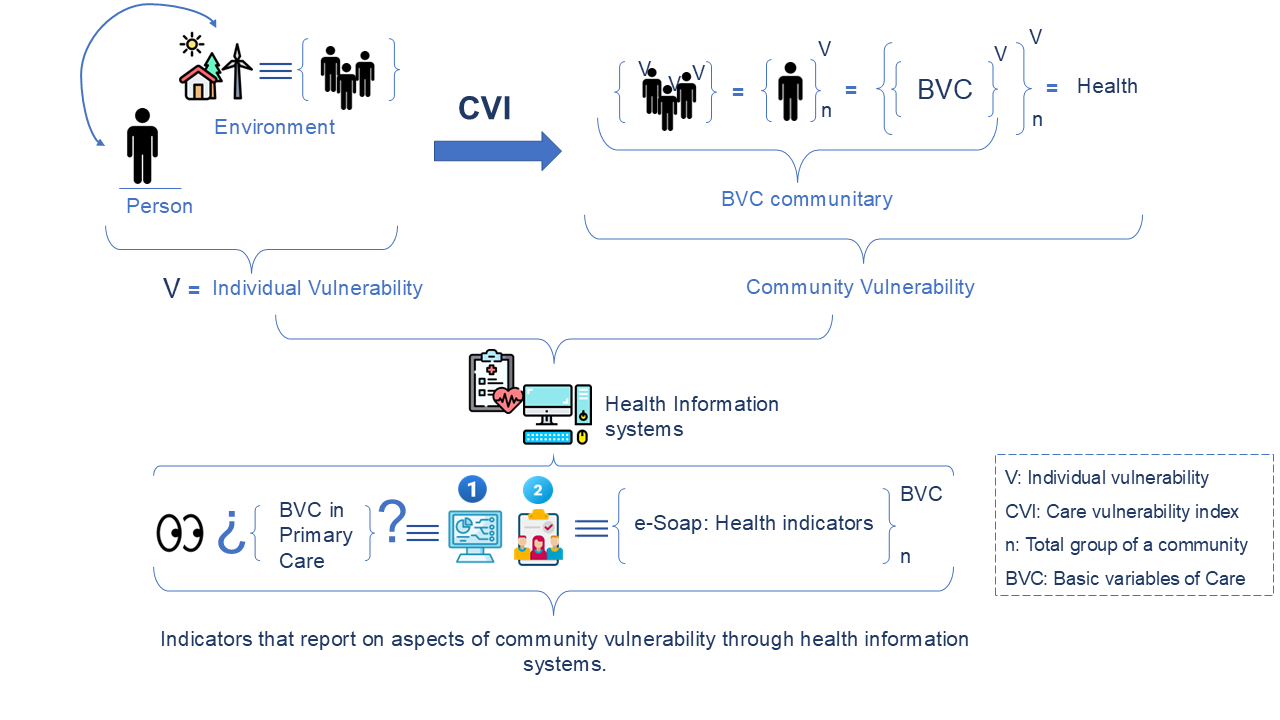
Background: Knowledge management in global health is essential in response to ageing populations, increasing morbidity, and rising expectations of care. The Knowledge Model about Person Care promotes health systems organized around individuals rather than diseases. Within this framework, vulnerability—understood as the risk of physical or moral harm—can be assessed through Basic Care Variables (BVC) that determine individuals’ need and capacity for self-care. Primary care health information systems provide an opportunity to operationalize these variables at the population level. Methods: This study applies Deductive Methodology to extrapolate community-level health indicator data to population-level vulnerability measures. Using the electronic Primary Care Objective Monitoring tool (e-SOAP) from the Community of Madrid, we analyzed health and social care indicators derived from primary care clinical information systems. The mathematical architecture of selected indicators was used as an approximation to Model-Based Systems Engineering. Results: Primary care indicators enabled the identification and aggregation of community-level data reflecting BCV. The system supports multi-level analysis (regional, managerial, institutional, and professional), facilitating grouped and anonymized data extraction for future vulnerability assessment. Conclusion: A minimum set of primary care indicators can effectively estimate community vulnerability, supporting person-centred health system management and informed decision-making.
Keywords:
health information systems
; systems
; communities
; community health status indicators
; primary healthcare
Copyright: This open access article is published under a Creative Commons CC BY 4.0 license, which permit the free download, distribution, and reuse, provided that the author and preprint are cited in any reuse.


