

Submitted:
09 March 2026
Posted:
10 March 2026
You are already at the latest version
Abstract
The effect of high-gravity fields, generated by rapid rotation, on CO2 adsorption in activated carbon beds is examined. Adsorption-desorption kinetics is monitored before, during, and after short rotation periods at up to 5,000rpm. Rotation induced a reproducible transient bump in headspace pressure, quantitatively attributed to a centrifugal free energy shift (~12.2 J/mol) that overfilled weak adsorption sites beyond their static equilibrium. The bump mechanism is described by fold catastrophe theory, with a critical angular velocity (ωc=3,500rpm) triggering a sudden transition to a high-occupancy branch. Post-rotation, constant-rate zero-order desorption from shallow sites overlapped with a slower pseudo-first-order adsorption process as deep, previously inaccessible pores became available, increasing CO2 capacity by 18.4%. Kinetic modelling produced an apparent diffusivity of 1.2x10⁻⁵m2/s and a structural accessibility time constant of ~25h. Thermodynamic analysis showed that rotation improved the overall free energy of adsorption and altered entropy in a manner consistent with the observed adsorption-desorption sequence. These results demonstrate that rotational fields can enhance CO2 uptake, modify kinetic pathways, and trigger threshold phenomena in porous adsorbents.
Keywords:
direct air capture
; rotation
; CO2 adsorption
; activated carbon
Introduction
The accelerating pace of climate change, driven predominantly by anthropogenic carbon dioxide (CO2) emissions, has prompted an urgent search for scalable, efficient carbon management strategies [1,2,3,4]. Among these, direct air capture (DAC) technologies have emerged as a promising solution for the active removal of CO2 directly from ambient air, thereby addressing emissions that are diffuse or historically accumulated [5]. Direct air capture systems typically operate by passing large volumes of atmospheric air through a material. Once saturated, the material undergoes a regeneration step to release the concentrated CO2 for sequestration or utilization, enabling reuse of the capture medium [6,7]. This process, though conceptually simple, is technologically challenging due to the low concentration of CO2 in air (c.a. 420ppm), which imposes stringent requirements on the selectivity, capacity, and kinetics of the adsorbent materials used [8,9].
Current DAC technologies primarily fall into two categories [10,11]: solvent-based systems and sorbent-based systems. The first utilize alkaline solutions (e.g., NaOH, KOH) to chemically capture CO2 [12,13].These systems often require high-temperature regeneration, leading to significant energy demands [14]. The second relies on solid materials [15,16], such as amine-functionalized supports [17] , metal-organic frameworks (MOFs) [18], or activated carbons (AC) that capture CO2 via physisorption or chemisorption [19,20], offering potential for lower energy regeneration cycles.
In the case of gas storage in solids there are certain challenges to be addressed: a) sufficient adsorption capacity, b) controllable delivery rates, c) suitable lifetimes, and d) recharging characteristics [21,22]. Ongoing research in both industry and academia is firmly centered on overcoming these limitations [21,23,24]. The drive for faster adsorption and controlled desorption kinetics and higher CO2 capacity is at the heart of advancing DAC technology. Faster adsorption-desorption kinetics not only reduce the contact time required per cycle but also allow for smaller equipment footprints and more compact system design; an essential feature for decentralized or modular deployment [25,26,27]. Similarly, increased adsorption capacity can directly translate to higher CO2 capture per unit mass of material, improving the economic and energetic feasibility of the technology.
Activated carbon (AC) is a well-established adsorbent for CO2 capture due to its high surface area, tunable pore size distribution, and chemical stability [28,29]. However, under static conditions, adsorption kinetics can be hindered by pore tortuosity, limited accessibility of internal sites, and slow intraparticle diffusion. These limitations reduce the overall utilization of the adsorbent’s capacity, especially for deep or weakly accessible sites [30].
High-gravity fields generated by rotation offer a unique means to alter this balance by introducing centrifugal forces that enhance radial mass transfer, modify local pressure profiles, and transiently shift adsorption equilibria [31,32,33,34]. Such dynamic perturbations can enable the selective activation of otherwise inaccessible adsorption sites, leading to higher working capacities and potentially novel kinetic pathways [35].
In this work, we have investigated CO2 adsorption kinetics in an AC bed under a rotational field. In particular, we have examined whether or not rotation contributes to greater adsorption capacity, faster kinetics, and controllable delivery rates.
Experimental Part
A specially design sample cell that allows adsorption in conjunction with rotation is used in this study. The device is consisted from the rotating sample chamber of radius rmax=4.5cm and height L=1mm, a low vibration rotating motor of maximum speed ω=5,000rpm, a three digits pressure transducer connected to a rotary slip ring, input/output valves, and an O-ring to secure sealing of the chamber; more details are given elsewhere [36].
A rotary pump is used to achieve vacuum conditions (10-3mbar) and the isothermal temperature at 20oC±0.1oC is maintain by air conditioning monitored by a digital thermometer.
Commercially available activated carbon (AC), in grains with size range of 90 μm to 120 μm, is used in this study. The BET area is estimated equal to 1,110 m2/g and the average pore size, based on the BJH method, equal to 16.3Å. The volume of liquid-N2 which corresponds to the saturation point of the isotherm is taken to be equal to the intra-pore volume Vintra=0.632 cm3/g. By considering skeletal density of AC ρs=2g/cm3 [37,38], the bulk density of the AC grains is ρgr=0.883 g/cm3. The intra-porosity is then found as:
where ρg is the gas density within pores; for empty pores ρg=0 g/cm3. Inter-porosity of the rotating bed is calculated from the geometrical volume of the rotating cell, Vcell=6.36 cm3, and the volume of AC grains of mass 3.6 g that used to fill the rotating chamber, Vgr= 4.08 cm3:
The result indicates a random close packing for RPB with an overall porosity equal to 72%.
Carbon dioxide of high purity (99%) is used for the rotation experiment that may be divided in three phases: 1) before rotation, 2) during rotation, and 3) after rotation. Preliminary actions such as He-calibration, vacuum outgassing, CO2 input, etc, are conducted before phase-1. On phase-1, pressure drop (ΔP) data are collected per second for 40h in order to ensure equilibration. After that, a rotating run of 60s is conducted (phase-2) and then ΔP/s data are collected for another 24h (phase-3). The whole experiment results to 237,000 data points, pressure vs. time and a similar amount of points for possible temperature fluctuations. More details are given elsewhere [39].
Results and Discussion
For a gas at pressure P, the Gibbs free energy change ΔG relative to a reference pressure Pref is given as [40]:
where R is the gas constant, T is the absolute temperature, and Pref=1bar. For adsorption prior to rotation:
Figure 1.
Adsorption kinetics of CO2 on activated carbon: a) The real data (black dots) and the fit lines (red) of various models to different sections of the curve; the cyan dots indicate where rotation started and ended. b) The fit lines for each section; orange the first PFO before rotation, blue during rotation, magenta after rotation followed by a green line indicating desorption, and cyan the second PFO adsorption kinetics.
Figure 1.
Adsorption kinetics of CO2 on activated carbon: a) The real data (black dots) and the fit lines (red) of various models to different sections of the curve; the cyan dots indicate where rotation started and ended. b) The fit lines for each section; orange the first PFO before rotation, blue during rotation, magenta after rotation followed by a green line indicating desorption, and cyan the second PFO adsorption kinetics.
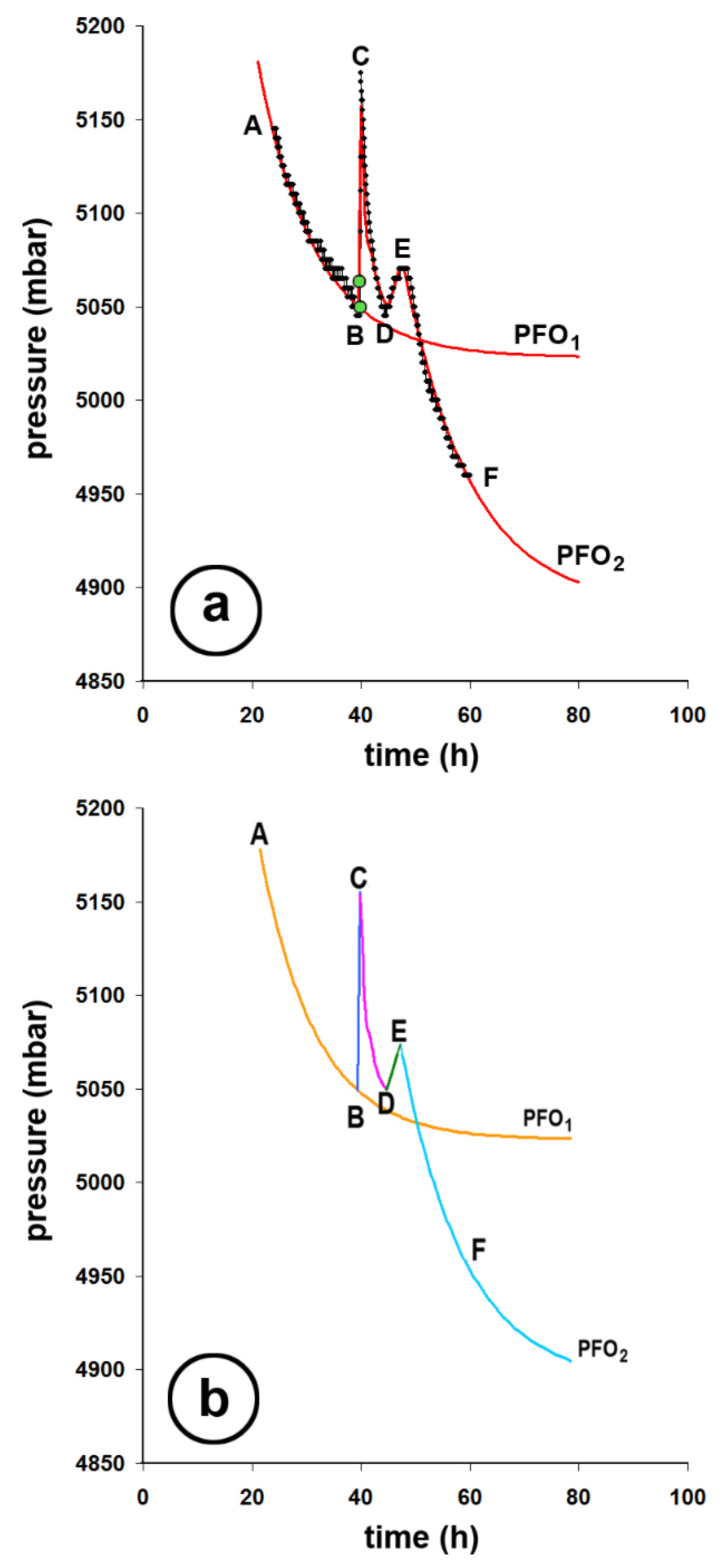
Plugging initial and equilibrium pressures for each section of Fig.1a, ΔG is obtained. Table 1 summarizes the result.
In section AB the adsorption process is strong with spontaneous uptake; ΔG<<0. In section BC gas is expelled, due to rotation, form the AC particles (desorption); ΔG>0. After that (section CD) the system takes a journey back to equilibrium (diffusion) with a partial uptake into AC (re-adsorption ΔG<0), followed by a small internal redistribution release (section DE, ΔG≥0). At section EF the system seeks global equilibrium (further adsorption); ΔG<0. Overall rotation benefits the free energy of the adsorption process by -42.12J/mol or 8.3%. Besides(Choudhary, 1996):
where ΔH is the enthalpy change and ΔS is the entropy change. From adsorption isotherms (reported elsewhere) of CO2 on the given AC, at various temperature, the isosteric heat of adsorption was found to be ΔHst=±24,300 J/mol. Last column in Table 1 shows the calculated values for ΔS. In section AB the entropy decreases due to gas condensation, in BC it increases due desorption due to rotation, in CD there is entropy loss due to re-adsorption, in DE there is a small entropy gain due to local desorption, and in section EF the entropy decreases due to further adsorption [41].
We have modeled the section AB with an equation for pseudo first order (PFO) kinetics [42]:
where Pth is the theoretical pressure to be compared with the experimental one, Po is the initial pressure, Peq is the equilibrium pressure, k1 is the PFO constant, and t is the time. Fitting parameters are found to be: Po=6,190 mbar, Peq=5,023 mbar, and k1=10.5 h-1. In Fig.1b the orange line shows this fit.
During rotation a sudden increase in pressure takes place. In Fig.1a the two cyan points indicate where rotation starts and where it stops. However, the pressure kept to increase even after rotation had ceased. Tortuosity τ and porosity ε of the system interplays with the spinning gas [43]:
where P(r) and P(0) are the pressures at distance r from the rotating axis and at the origin (r=0), respectively, M is the molecular weight of the gas, and ω is the angular velocity. The factor A(q) takes care for the partial desorption of gas from the porous particles of AC.
where no and n are the gas concentration before and after rotation, respectively. Fitting parameters for Eq.7 are found to be: τ=2.3, ε=0.43, and A(q)=1.007.
For radial diffusion in a porous medium Fick’s second law is given as [44]:
where C(r,t) is the gas concentration in pores and Deff is the effective porosity accounting for τ and ε [45]:
where Dm is the molecular diffusion in free air. During rotation higher gas concentration occurs near the outer edge of the cell. We have modified Fick’s second law in order to include a sink term due to adsorption:
where q(r,t) is the adsorbed-phase concentration on AC surface. By assuming for simplicity a linear isotherm (i.e. Henry’s law) and a linear driving force model [46] for adsorption kinetics we get:
where kα is the adsorption rate constant and K is the adsorption equilibrium constant. For the initial conditions:
where C(0) is the baseline concentration and α>0 describes the strength of the non-uniformity due to rotation. Assuming no flux at center and edge of the cell (closed system) the boundary conditions will be: at r=0 ∂C/∂r=0 and at r=rmax ∂C/∂r=0. Solving Eq.14 for q(r,t) yields:
If the adsorption compare to diffusion is fast kα→∞, then q(r,t)~KC(r,t). This quasi steady approximation simplifies the coupled equations 9 and 10 to:
By defining an effective storage factor φ=[1+(1-ε)Κ/ε]:
where Dapp=Deff/φ is the apparent diffusivity reduced by adsorption. A general solution for Eq.18 is:
where Jo is the Bessel function of the first kind, λn are the roots of J1(λn)=0 to satisfy Neumann (no-flux) boundary condition at r=rmax, and An are coefficients determine from the initial profile.
For the data presented in Fig.1a Eq.20 is further approximated to:
with fitting parameters P(0)=5,045mbar and A1=1.3x10¹²mbar the amplitude of the primary diffusion mode, λ12Dapp=0.61h-1, and t in h. The first positive root of J1(λ)=0 is λ1=3.8. Therefore Dapp=0.0422h-1 or 1.2x10⁻⁵m2/s. From Eq.12 it was concluded that τ/ε=1.36.
We model the bump as a zero-order kinetics which means that the desorption rate is independent of coverage. This process produces a linear increase in pressure.
where ko is the desorption rate and Vhead the headspace volume. From the geometry of the cell and the porosity of the bed Vhead=2.7x10⁻³m3 and from the slope dP(t)/dt=10mbar/h; ko=3x10⁻⁷mol/s. The result indicates that the nature of the bump is originated from shallow or external surface sites. These sites are saturated after rotation and initial adsorption. Weakly bound CO2 desorbs slowly, not depending on how much is left. These sites behave like a constant-rate gas source for a few hours. After the bump, adsorption kinetics of the PFO are followed. Fitting parameters for Fg.1a and Eq.8 are P΄o=5,650 mbar, P΄eq=4,000 mbar, k΄1=0.11h-1 and C΄=925 mbar.
From Table 1 it is noted that for section DE, ΔG is equal to the rotation potential for 1 mole of CO2:
That is, Δμrot=12.2J/mol. This potential is instantaneous; i.e., it only exists while gas is spinning. In that period the local equilibrium shifts by:
Therefore, Prot/Prest~0.49% and since global pressure Prest~5bar, rotation adds about 25mbar to the system; exactly the size of the bump. This potential is the free-energy uphill for CO2 that was left in shallow/external sites after the spin. Rotation prepared a slightly overfilled, metastable population of weak sites. When it stops, the centrifugal term vanishes but that overfilled population remains. The system then relaxes slowly by zero-order desorption kinetics and the observable pressure rises by ~25 mbar over ~3h. This numerical match is not a coincidence. Centrifugal potential populate those weak sites above their resting equilibrium and the bump reflects releasing that excess.
This picture indicates a fold catastrophe type. Figure 2 shows this type. All curves represent stable equilibria, except for the middle one (dashed line). If a system is close to a fold bifurcation point (points F1 or F2) a tiny change can cause a large transition. In the absence of bifurcations, small perturbations can also cause large changes. The adsorption-desorption landscape has two branches; low μ indicates weak sites partly empty whereas slightly higher μ indicates weak sites more occupied. Rotation shifts μ upward by just enough (12.2 J/mol) to push the system across the fold point into the high-occupancy branch. When rotation stops, μ drops instantly, but the system cannot jump back to the low-occupancy branch instantly because desorption is kinetically limited. Instead, the pressure shows a delayed release; i.e., a bump. This is the hysteresis loop predicted by the fold catastrophe; once the fold point is crossed in one direction, the system returns by a different path.
The catastrophe potential is given as:
where x is the coverage of the weak sites, δ is a stiffness parameter, linked to μ and adsorption enthalpy and b is a bias term from gas-phase pressure. At equilibrium:
When δ and b cross certain combinations the number of real equilibria changes causing a sudden jump in x. Before rotation parameters δ and b, place system on the lower stable branch. During rotation, μ-shift changes just enough to pass the bifurcation and the system snaps to high-occupancy branch. After rotation μ drops, but diffusion limits how fast can return; this time-lag gives the slow bump before settling. Figure 3 shows this model. At low ω (rpm) no bump appears.
A sharp onset around a critical (threshold) ωc occurs. The observed 25 mbar at 5,000 rpm is already on the steep part of the curve; i.e., the system operates close to the fold point. By inspecting the Peq from the two PFO kinetic curves it is found that for stage AB Peq=5,023 mbar and for stage EF P΄eq=4,100 mbar. This difference corresponds to about 18.4% extra capacity. However, the bump by itself can’t fully explain this number.
During rotation the centrifugal term μ-shift by 12.2 J/mol at the rim. Although tiny in absolute energy, it is big enough to change the state of the solid by increasing the fraction of accessible pores. That is, some inaccessible sites deep inside AC particles become accessible. This does not have an immediate pressure effect but appears later. Meanwhile, shallow and external sites that were overfilled during the spin, bleed off at constant rate; hence, the bump. In other words the bump is announcing that the system operates near catastrophe, into a regime that may accept more CO2. Then the system settles to a new PFO2 branch with lower P΄eq [47,48].
where Peq(θ) is the equilibrium headspace pressure and θ(t)∈[0,1] is the accessibility of deep sites (0=blocked, 1=fully accessible) [39].
where θ∞(ω) is set by the catastrophe control (centrifugal shift) and t θ is a structural transport relaxation time (slow). A simple monotone mapping from accessibility to equilibrium pressure is:
As θ(t) grows from 0 to 1, the pressure slides from 5,023 mbar to 4,100 mbar (ΔPmax=923 mbar). Post-spin with ko>0 lifts a bump, while θ(t) increases slowly as P(θ) drifts downward. Once kads(P-Peq(θ)) dominates over the small ko, the curve turns to a new PFO2 toward P΄eq.
Let the accessibility attractor θ∞(ω) come from a fold x3-δ(ω)x-b=0 where δ(ω)=δoω2 and map the stable-branch solution xst(ω) to θ∞(ω)=σ(xst(ω)) where σ is a rescaling factor to [0,1]. Threshold behaviour (no deep sites below ωc, rapid onset above) drops straight out of the fold. A fit to the data from 40.02-65.9h is shown as:
Conclusions
This study demonstrates that high-gravity fields generated by rapid rotation can significantly influence CO2 adsorption-desorption dynamics in activated carbon beds. By coupling experimental data with kinetic and thermodynamic modelling, several important findings emerge.
First, rotation induces a measurable and reproducible bump in pressure, which is directly linked to centrifugal effects on gas distribution within the porous structure. This bump is quantitatively explained by a rotational free energy shift of ~12.2J/mol at the cell rim, sufficient to alter adsorption equilibria. The experimental match between this predicted energy shift and the measured ~25mbar transient increase strongly supports the proposed mechanism. The bump is interpreted as a fold catastrophe phenomenon: rotation pushes the system across a bifurcation threshold where weak adsorption sites transition from partially occupied to highly occupied states. When rotation ceases, these sites remain overfilled, releasing gas at a constant rate via zero-order desorption kinetics until equilibrium is re-established.
The sharp onset at a critical angular velocity (ωc=3,500rpm) confirms the threshold behaviour predicted by catastrophe theory. Beyond the transient bump, rotation produces a lasting enhancement in adsorption capacity. Comparison of equilibrium pressures before and after rotation indicates an ~18.4% increase in CO2 uptake, suggesting that centrifugal forces render previously inaccessible deep pores available for adsorption. These newly accessible sites fill slowly (time constant tθ=25h), explaining the delayed pressure decay toward a lower post-rotation equilibrium. Kinetic modelling reveals two distinct regimes: a PFO1 adsorption governing initial uptake before rotation and a slow structural accessibility growth controlling post-rotation equilibration, superimposed with the bump’s constant-rate desorption phase (PFO2).
Thermodynamic analysis shows that rotation improves the overall free energy change for adsorption. Entropy variations across experimental phases reflect the interplay between condensation during adsorption, disorder increase during desorption, and partial ordering upon re-adsorption. The effective diffusivity (Dapp=1.2×10⁻⁵m²/s) calculated from radial diffusion modelling under rotation is consistent with an enhancement in gas transport, likely due to reduced tortuosity and increased accessibility of internal adsorption sites. The observed τ/ε ratio (1.36) indicates a moderate restriction in diffusion compared to free molecular motion, which rotation partially alleviates.
Overall, this work establishes that high-gravity operation can: a) activate weakly bound and deep adsorption sites, increasing total CO2 capacity, b) induce threshold phenomena consistent with fold catastrophe theory, enabling abrupt state changes in adsorption behaviour, c) enhance mass transfer through reduced tortuosity and modified local pressure gradients and c) allow controllable desorption profiles, potentially valuable for tuned gas delivery applications. These findings open a pathway toward rotationally enhanced DAC designs where centrifugal fields are deliberately exploited to surpass static adsorption limits. The combined mechanistic insight linking centrifugal thermodynamics, catastrophe theory, and adsorption kinetics, provides a framework for optimizing such systems.
Future work should investigate scale-up potential, energy cost-benefit analysis of rotation, and the applicability of these effects to other sorbents, especially those with hierarchical pore architectures or tailored surface chemistries.
References
- A. Sodiq et al., “A review on progress made in direct air capture of CO2,” Environ. Technol. Innov., vol. 29, p. 102991, 2023, . [CrossRef]
- M. Fasihi, O. Efimova, and C. Breyer, “Techno-economic assessment of CO2 direct air capture plants,” J. Clean. Prod., vol. 224, pp. 957–980, 2019, . [CrossRef]
- C. Breyer, M. Fasihi, C. Bajamundi, and F. Creutzig, “Direct Air Capture of CO2: A Key Technology for Ambitious Climate Change Mitigation,” Joule, vol. 3, no. 9, pp. 2053–2057, 2019, . [CrossRef]
- D. W. Keith, G. Holmes, D. St. Angelo, and K. Heidel, “A Process for Capturing CO2 from the Atmosphere,” Joule, vol. 2, no. 8, pp. 1573–1594, 2018, . [CrossRef]
- X. Zhu et al., “Recent advances in direct air capture by adsorption,” Chem. Soc. Rev., vol. 51, no. 15, pp. 6574–6651, 2022, doi: 10.1039/D1CS00970B.
- L. Jiang et al., “Sorption direct air capture with CO2 utilization,” Prog. Energy Combust. Sci., vol. 95, p. 101069, 2023, . [CrossRef]
- Y.-M. Wei et al., “Unlocking the economic potential of Direct Air Capture technology: Insights from a component-based learning curve,” Technol. Forecast. Soc. Change, vol. 215, p. 124109, 2025, . [CrossRef]
- L. A. Darunte, K. S. Walton, D. S. Sholl, and C. W. Jones, “CO2 capture via adsorption in amine-functionalized sorbents,” Curr. Opin. Chem. Eng., vol. 12, pp. 82–90, 2016, . [CrossRef]
- R. Navik, E. Wang, X. Ding, H. Yunyi, Y. Liu, and J. Li, “Enhanced post-combustion CO2 capture and direct air capture by plasma surface functionalization of graphene adsorbent,” J. Energy Chem., vol. 100, pp. 653–664, 2025, . [CrossRef]
- Y. Zhao, B. Zheng, J. Zhang, and H. Xu, “Research on Direct Air Capture: A Review,” 2025. doi: 10.3390/en18246632.
- N. McQueen, K. Gomes, C. McCormick, K. Blumanthal, M. Pisciotta, and J. Wilcox, “A review of direct air capture (DAC): scaling up commercial technologies and innovating for the future,” Prog. Energy, vol. 3, Apr. 2021, . [CrossRef]
- C. Dhoke, A. Zaabout, S. Cloete, and S. Amini, “Review on Reactor Configurations for Adsorption-Based CO2 Capture,” Ind. Eng. Chem. Res., vol. 60, no. 10, pp. 3779–3798, Mar. 2021, . [CrossRef]
- L. Liu, F. Gong, and R. Xiao, “Direct Air Carbon Capture and Recovery Utilizing Alkaline Solution Circulation,” Energy & Fuels, vol. 37, no. 13, pp. 9339–9346, Jul. 2023, . [CrossRef]
- F. Ghadyanlou, A. Azari, and A. Vatani, “Experimental Investigation of Mass Transfer Intensification for CO2 Capture by Environment-Friendly Water Based Nanofluid Solvents in a Rotating Packed Bed,” 2022. [CrossRef]
- J. F. Wiegner, A. Grimm, L. Weimann, and M. Gazzani, “Optimal Design and Operation of Solid Sorbent Direct Air Capture Processes at Varying Ambient Conditions,” Ind. Eng. Chem. Res., vol. 61, no. 34, pp. 12649–12667, Aug. 2022, . [CrossRef]
- R. Mennitto, R. Blom, M. Dörr, M. Rosental, and N. Rettenmaier, “Solid sorbents for direct air capture: a technological and environmental perspective,” Curr. Opin. Chem. Eng., vol. 50, p. 101195, 2025, . [CrossRef]
- M. C. Davis, W. J. M. Kort-Kamp, I. Matanovic, P. Zelenay, and E. F. Holby, “Design of active sites for amine-functionalized direct air capture materials using integrated high-throughput calculations and machine learning,” Commun. Chem., vol. 9, no. 1, p. 12, 2025, . [CrossRef]
- X. Zhang, H. Zhao, Q. Yang, M. Yao, Y. Wu, and Y. Gu, “Direct air capture of CO2 in designed metal-organic frameworks at lab and pilot scale,” Carbon Capture Sci. Technol., vol. 9, p. 100145, 2023, . [CrossRef]
- C. Zhang, S. Sun, S. He, and C. Wu, “Direct air capture of CO2 by KOH-activated bamboo biochar,” J. Energy Inst., vol. 105, pp. 399–405, 2022, . [CrossRef]
- S. Hashmi, M. Rasool, W. H., and H. Moiz, “Activated Carbons for Direct Air Capture: Adsorption Mechanisms, Material Design and Performance Optimization,” Feb. 2025.
- S. Acevedo, L. Giraldo, and J. C. Moreno-Piraján, “Adsorption of CO2 on Activated Carbons Prepared by Chemical Activation with Cupric Nitrate,” ACS Omega, vol. 5, no. 18, pp. 10423–10432, May 2020, . [CrossRef]
- N. S. Mohamed Hatta, M. K. Aroua, F. Hussin, and L. T. Gew, “A Systematic Review of Amino Acid-Based Adsorbents for CO2 Capture,” 2022. [CrossRef]
- D. Barker-Rothschild et al., “Lignin-based porous carbon adsorbents for CO2 capture,” Chem. Soc. Rev., vol. 54, no. 2, pp. 623–652, 2025, . [CrossRef]
- H. E. Holmes, S. Banerjee, A. Vallace, R. P. Lively, C. W. Jones, and M. J. Realff, “Tuning sorbent properties to reduce the cost of direct air capture,” Energy Environ. Sci., vol. 17, no. 13, pp. 4544–4559, 2024, . [CrossRef]
- S. A. Khan, S. Ahmed, S. Ali, and F. Altaf, “Advances in CO2 Capture Materials: From Strategies to CO2-Based Fertilizers for a Sustainable Future,” Carbon Neutralization, vol. 4, no. 6, p. e70063, Nov. 2025, . [CrossRef]
- A. I. Hadi et al., “A comprehensive review of carbon capture: From conventional to emerging electrochemical technologies,” Next Energy, vol. 9, p. 100415, 2025, . [CrossRef]
- M. Zanatta, “Materials for Direct Air Capture and Integrated CO2 Conversion: Advancement, Challenges, and Prospects,” ACS Mater. Au, vol. 3, no. 6, pp. 576–583, Nov. 2023, . [CrossRef]
- M. B. Ahmed et al., “Activated carbon preparation from biomass feedstock: Clean production and carbon dioxide adsorption,” J. Clean. Prod., vol. 225, pp. 405–413, 2019, . [CrossRef]
- H. Jedli, M. Almonnef, R. Rabhi, M. Mbarek, J. Abdessalem, and K. Slimi, “Activated Carbon as an Adsorbent for CO2 Capture: Adsorption, Kinetics, and RSM Modeling,” ACS Omega, vol. 9, no. 2, pp. 2080–2087, Jan. 2024, . [CrossRef]
- N. A. Rashidi and S. Yusup, “An overview of activated carbons utilization for the post-combustion carbon dioxide capture,” J. CO2 Util., vol. 13, pp. 1–16, 2016, . [CrossRef]
- W. Jiao, S. Luo, Z. He, and Y. Liu, “Applications of high gravity technologies for wastewater treatment: A review,” Chem. Eng. J., vol. 313, pp. 912–927, 2017, . [CrossRef]
- K. Neumann et al., “A guide on the industrial application of rotating packed beds,” Chem. Eng. Res. Des., vol. 134, pp. 443–462, 2018, . [CrossRef]
- M. P. Singh, A. M. Alatyar, A. S. Berrouk, and M. Saeed, “Numerical modelling of rotating packed beds used for CO2 capture processes: A review,” Can. J. Chem. Eng., vol. 101, no. 11, pp. 6170–6202, Nov. 2023, . [CrossRef]
- D. P. Rao, A. Bhowal, and P. S. Goswami, “Process Intensification in Rotating Packed Beds (HIGEE): An Appraisal,” Ind. Eng. Chem. Res., vol. 43, no. 4, pp. 1150–1162, Feb. 2004, . [CrossRef]
- A. C. Mitropoulos, R. I. Kosheleva, M. Kostoglou, and T. D. Karapantsios, “The Effect of Rotation on Gas Storage in Nanoporous Materials,” Separations, vol. 11, no. 3, 2024, . [CrossRef]
- R. I. Kosheleva, T. D. Karapantsios, M. Kostoglou, and A. C. Mitropoulos, “A novel device for in situ study of gas adsorption under rotation,” Rev. Sci. Instrum., vol. 92, no. 4, p. 45106, Apr. 2021, . [CrossRef]
- S. Bulbul and M. Ergün, “Production and characterization of activated carbon from Black Poplar (Populus Nigra) wood waste with different chemical activation methods,” Int. Adv. Res. Eng. J., vol. 6, Nov. 2022, . [CrossRef]
- C. P. Bonaventura, S. Bartucci, G. Conte, G. Desiderio, R. G. Agostino, and A. Policicchio, “Optimizing CO2 and CH4 storage: The role of high skeletal density activated carbon in adsorption processes,” Colloids Surfaces A Physicochem. Eng. Asp., vol. 721, p. 137209, 2025, . [CrossRef]
- R. I. Kosheleva, T. D. Karapantsios, M. Kostoglou, and A. C. Mitropoulos, “Thermodynamic analysis of the effect of rotation on gas adsorption,” J. Non-Equilibrium Thermodyn., vol. 48, no. 4, 2023, doi: doi:10.1515/jnet-2022-0086.
- V. R. Choudhary and S. Mayadevi, “Adsorption of methane, ethane, ethylene, and carbon dioxide on silicalite-l,” Zeolites, vol. 17, no. 5–6, pp. 501–507, 1996.
- V. K. Singh and E. A. Kumar, “Experimental investigation and thermodynamic analysis of CO2 adsorption on activated carbons for cooling system,” J. CO2 Util., vol. 17, pp. 290–304, 2017, . [CrossRef]
- K. L. Tan and B. H. Hameed, “Insight into the adsorption kinetics models for the removal of contaminants from aqueous solutions,” J. Taiwan Inst. Chem. Eng., vol. 74, pp. 25–48, 2017, . [CrossRef]
- V. I. Geyko and N. J. Fisch, “Reduced Compressibility and an Inverse Problem for a Spinning Gas,” Phys. Rev. Lett., vol. 110, no. 15, p. 150604, Apr. 2013, . [CrossRef]
- S. Shi, “Diffusion model based on Fick’s second law for the moisture absorption process in wood fiber-based composites: Is it suitable or not?,” Wood Sci. Technol., vol. 41, pp. 645–658, Dec. 2007, . [CrossRef]
- Y. Kim and J. T. Gostick, “Measuring effective diffusivity in porous media with a gasket-free, radial arrangement,” Int. J. Heat Mass Transf., vol. 129, pp. 1023–1030, 2019, . [CrossRef]
- H. Naidu and A. P. Mathews, “Linear driving force analysis of adsorption dynamics in stratified fixed-bed adsorbers,” Sep. Purif. Technol., vol. 257, p. 117955, 2021, . [CrossRef]
- E. D. Revellame, D. L. Fortela, W. Sharp, R. Hernandez, and M. E. Zappi, “Adsorption kinetic modeling using pseudo-first order and pseudo-second order rate laws: A review,” Clean. Eng. Technol., vol. 1, p. 100032, 2020.
- Y. S. Ho and G. McKay, “Pseudo-second order model for sorption processes,” Process Biochem., vol. 34, no. 5, pp. 451–465, 1999, . [CrossRef]
Figure 2.
Fold catastrophe: the black lines represent stable paths, the broken line unstable path, F1 and F2 are the bifurcation points where the system jumps from one stable to another stable path without passing the unstable path.
Figure 2.
Fold catastrophe: the black lines represent stable paths, the broken line unstable path, F1 and F2 are the bifurcation points where the system jumps from one stable to another stable path without passing the unstable path.
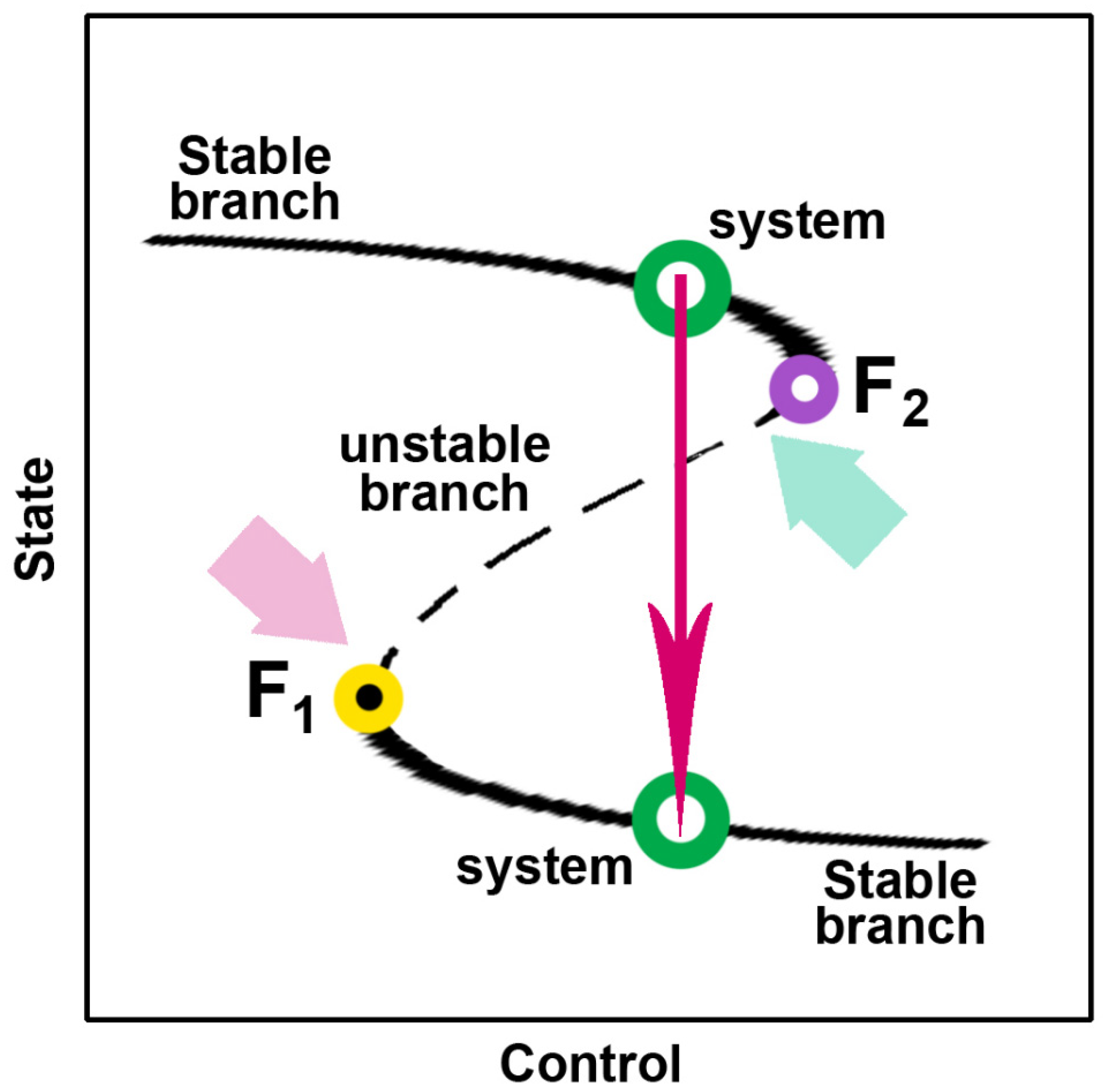
Figure 3.
Fold catastrophe for the bump: orange line shows the model. The critical angular velocity is ωc=3,500 rpm. The size of the bump is 25 mbar in the steep part of the model curve.
Figure 3.
Fold catastrophe for the bump: orange line shows the model. The critical angular velocity is ωc=3,500 rpm. The size of the bump is 25 mbar in the steep part of the model curve.
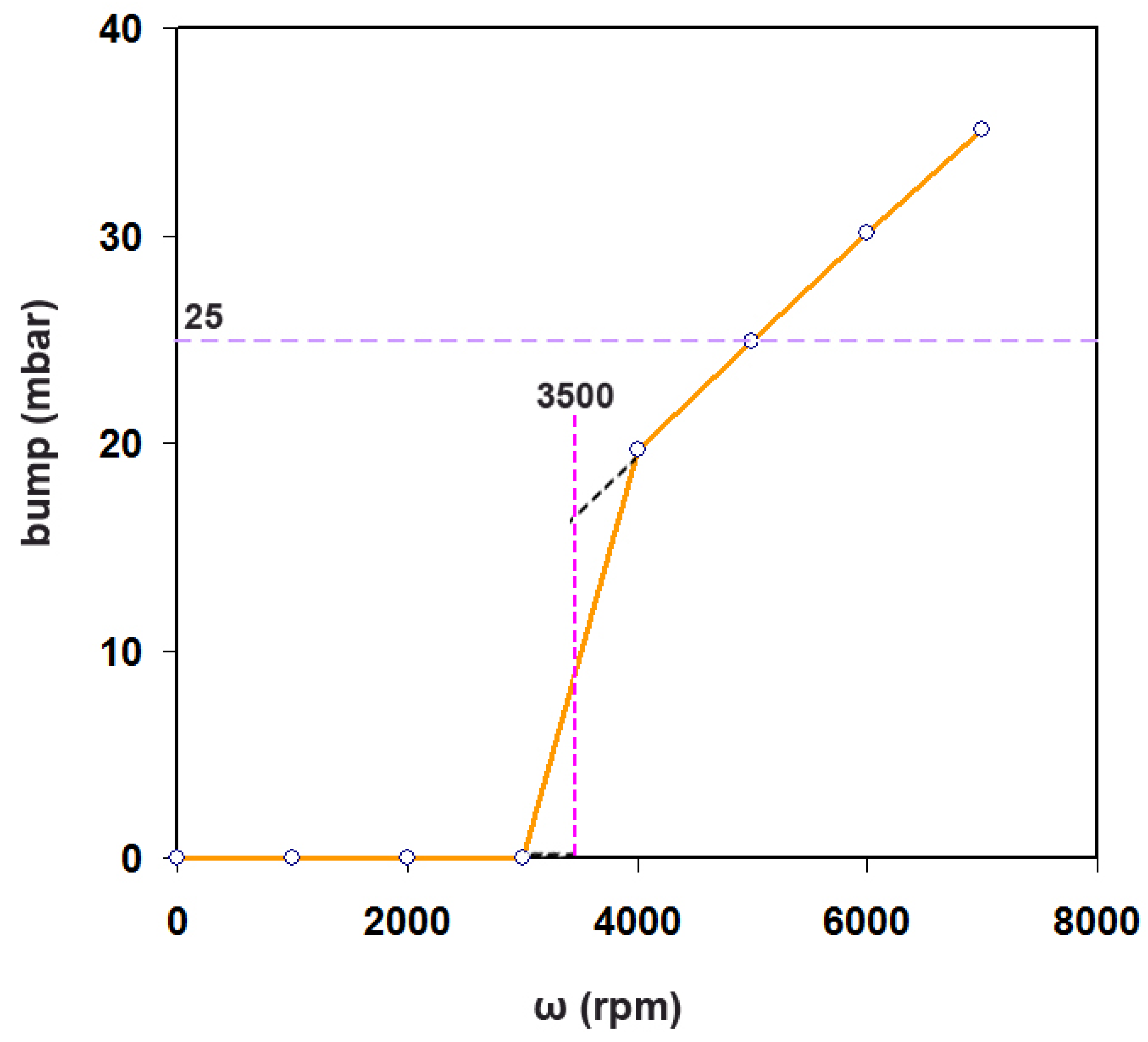
Figure 4.
Simulation of the bump (cyan/black point) based on attractor from fold catastrophe (magenta line). The orange hatched section shows the fit.
Figure 4.
Simulation of the bump (cyan/black point) based on attractor from fold catastrophe (magenta line). The orange hatched section shows the fit.
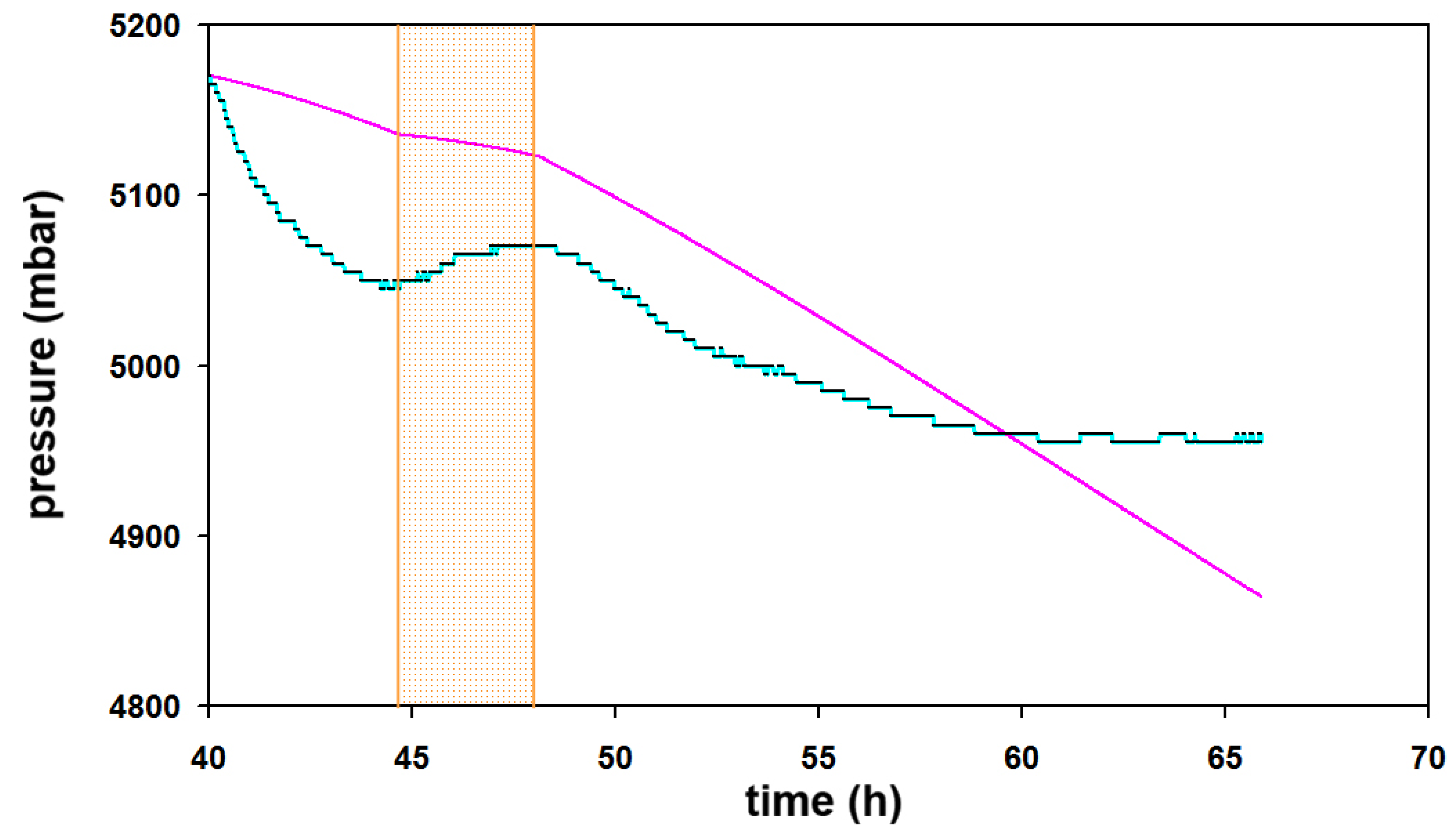

Table 1.
Free energy of sections.
|
Section |
Transition (mbar) |
ΔG (J/mol) |
ΔS (J/mol.K) |
| AB | 6.190 to 5,045 | -507.01 | -79.80 |
| BC | 5,045 to 5,175 | +63,07 | +81.29 |
| CD | 5,175 to 5,045 | -63,07 | -81.29 |
| DE | 5,045 to 5,070 | +12.25 | +81.46 |
| EF | 5,070 to 4,960 | -54.37 | -81.32 |
Disclaimer/Publisher’s Note: The statements, opinions and data contained in all publications are solely those of the individual author(s) and contributor(s) and not of MDPI and/or the editor(s). MDPI and/or the editor(s) disclaim responsibility for any injury to people or property resulting from any ideas, methods, instructions or products referred to in the content. |
© 2026 by the authors. Licensee MDPI, Basel, Switzerland. This article is an open access article distributed under the terms and conditions of the Creative Commons Attribution (CC BY) license (http://creativecommons.org/licenses/by/4.0/).
Copyright: This open access article is published under a Creative Commons CC BY 4.0 license, which permit the free download, distribution, and reuse, provided that the author and preprint are cited in any reuse.


