

Submitted:
08 March 2026
Posted:
12 March 2026
You are already at the latest version
Abstract
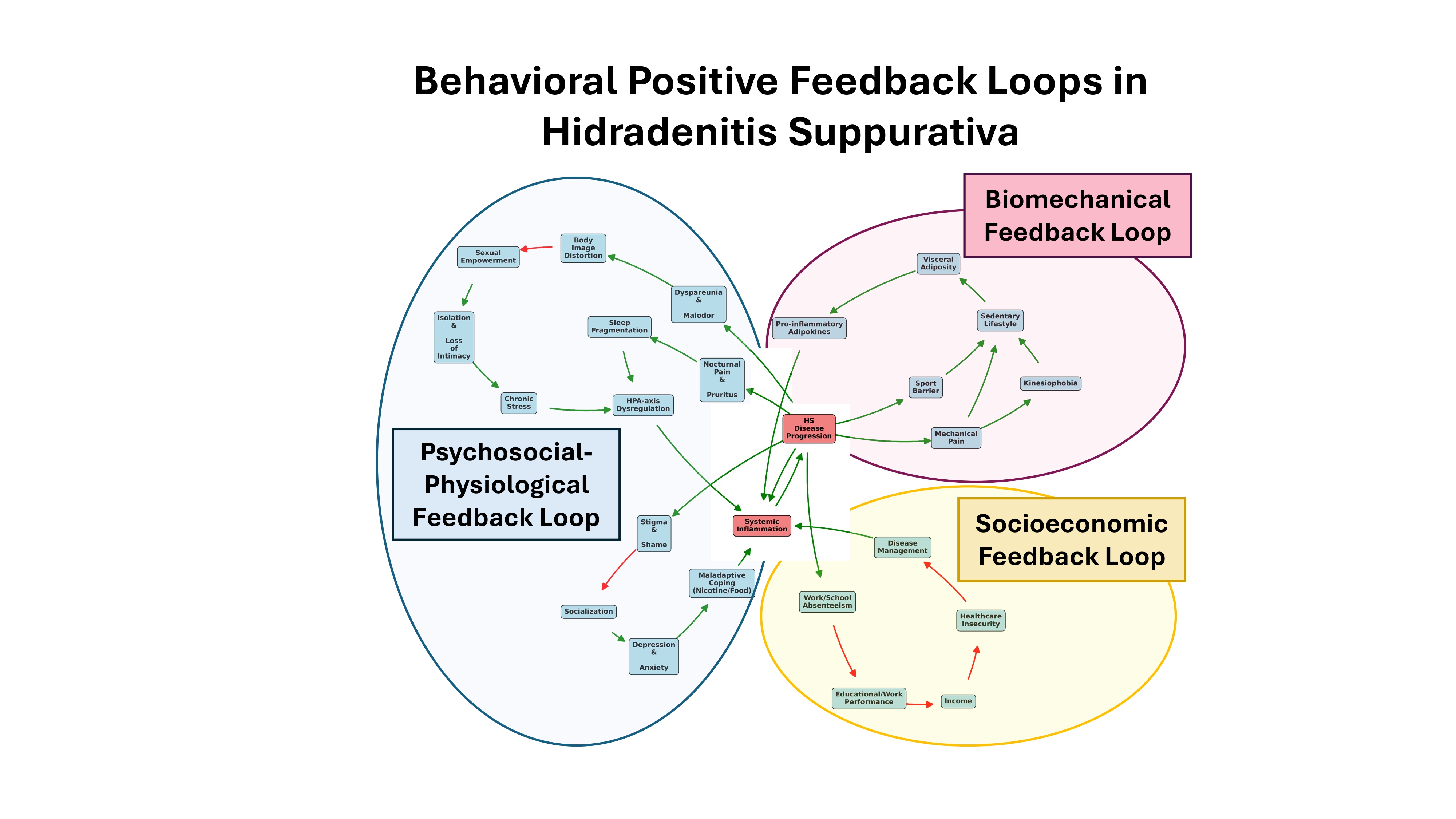
Hidradenitis suppurativa (HS) is a severe inflammatory dermatosis characterized by profound localized pain. While current pathophysiological feedback loops (vicious cycles) focus on microscopic molecular networks and microbiological dysbiosis, the psychosocial and behavioral burdens of HS are individually well-documented. However, these behavioral maladaptations have not been integrated into a unified macroscopic model. This self-sustaining system operates across three interacting domains: (1) a biomechanical-metabolic loop, where sustained immobility accelerates visceral adiposity and insulin resistance; (2) a psychosocial-physiological loop, where pain-induced sleep disruption and chronic stress drive neuroendocrine dysregulation and maladaptive coping behaviors; and (3) a socioeconomic loop, where economic instability decreases healthcare security. Consequently, these behavioral, psychological, and socioeconomic burdens structurally feed back into the systemic inflammatory core, perpetuating disease chronicity. Moreover, this review explores kinesiophobia (the anticipatory fear of movement) as a potentially critical and overlooked component of the biomechanical-metabolic feedback loop. Currently, there is a notable absence of primary psychometric data quantifying kinesiophobia in the HS population. Future research must first measure this phenomenon to establish its prevalence and role. On a macroscopic level, clinicians should aim to systematically break the broader interconnected behavioral feedback loops through multidisciplinary interventions, including cognitive-behavioral therapy and structured patient education. Ultimately, dismantling these psychological and behavioral barriers may prove biologically imperative to halt systemic inflammatory amplification and improve long-term clinical outcomes.
Keywords:
Hidradenitis suppurativa
; kinesiophobia
; positive feedback loop systemic inflammation
; fear-avoidance model
; insulin resistance
; lifestyle
; sleep
; maladaptive coping
; socioeconomic burden
; psychological burden
Copyright: This open access article is published under a Creative Commons CC BY 4.0 license, which permit the free download, distribution, and reuse, provided that the author and preprint are cited in any reuse.


