
Submitted:
09 March 2026
Posted:
09 March 2026
You are already at the latest version
Abstract
Introduction: Multimorbidity, the coexistence of two or more chronic conditions, is a major global public health challenge and exists on a continuum from non-complex to highly complex, with increasing complexity and multi-system involvement linked to greater instrumental activities of daily living (IADL) disability, frailty, and mortality. Objectives: This study aims (1) to assess chronic condition complexity (CCC) levels by distinguishing multiple chronic conditions (MCCs) from multimorbidity (MM) among older adults in Albania; (2) evaluate their prevalence and impact on care needs, medication adherence, and quality of life; and (3) examine associations between MM and sociodemographic factors, including age, gender, educational level, and medication burden. Methods: An observational, descriptive, cross-sectional, multicenter study with analytical approach was conducted among older adults aged 65 years and older with 2 or more chronic conditions in Albania. Data were collected from participants attending six Primary Health Care Centers located in South of Albania, between March and December 2024. Data were collected using the Simplified Medication Adherence Questionnaire (SMAQ) and the Older People's Quality of Life Questionnaire (OPQOL-35), both of which are validated and reliable tools for the Albanian population. Results: Diagnosis status was significantly associated with age, educational attainment, and medication burden, with older adults experiencing MM more likely to be older, have lower education, use multiple medications, rely on family for care, and exhibit lower medication adherence, underscoring the influence of sociodemographic factors and treatment burden on the health outcomes of older adults.
Keywords:
older adults
; multiple chronic conditions
; multimorbidity
; self-care
; medication adherence
; quality of life
; Albania
1. Introduction
Multimorbidity (MM), defined as the coexistence of two or more chronic conditions in an individual, represents one of the greatest global public health challenges facing contemporary health systems [1,2]. The number of people living with multiple chronic conditions (MCCs) continues to rise worldwide, placing increasing strain on clinical management and the organization of healthcare services [2,3]. MM exists along a continuum from non-complex (≥2 conditions affecting ≤2 body systems) to complex, which may be classified as moderately complex (3–4 conditions) or highly complex (≥5 conditions); greater complexity and multi-system involvement are associated with worse instrumental activities of daily living (IADL) disability, increased frailty, and higher mortality [4]. Consistent with this framework, Klinedinst et al. (2021) categorize MCCs as no MCC (0–1 condition), low MCC (2–4 conditions), and MM (multi-system morbidity with ≥5 conditions) to reflect increasing disease burden and functional outcomes [5].
MM is frequently accompanied by polypharmacy, as individuals with MCCs commonly require multiple medications, further increasing treatment complexity [6]. Polypharmacy is defined as the regular use of five or more medications, while hyper-polypharmacy refers to the concurrent use of more than ten medications [7]. These patterns are associated with adverse physical and cognitive outcomes, drug-drug interactions, medication nonadherence, and adverse health outcomes (eg, increased risks of falls, cognitive impairment, hospitalization, and mortality) [8].
Globally, MM is particularly prevalent among older adults, affecting an estimated 55–98% of individuals aged 65 years and older [1,9,10]. As age increases, individuals are more likely to accumulate MCCs [11], and rising life expectancy together with global population aging has further amplified the burden of MM on individuals, healthcare systems, and societies [12]. Consequently, MM is associated with poorer quality of life, greater disability and functional impairment, increased health care utilization, fragmented care, complex treatment regimens, and higher mortality [13].
The burden of MM is especially concerning in low- and middle-income countries (LMICs), where health systems are often less equipped to manage complex chronic care. Although data remain limited, evidence suggests that approximately half of middle-aged and older adults in LMICs experience at least two chronic conditions, with a substantial proportion living with three or more conditions [12]. MM in these settings poses major challenges for governments and health systems and has been consistently associated with poorer quality of life [14].
In Albania, MM is increasingly recognized as a growing health concern, particularly among older adults and women, with several demographic and socioeconomic factors contributing to its prevalence [15]. However, despite this growing burden, empirical evidence on MCCs among older adults in Albania remains scarce, and existing studies have largely focused on broader population groups or specific clinical contexts.
Given the rapid population aging and the rising burden of chronic diseases in Albania, there is a clear need for well-designed studies that assess the occurrence of MCCs among older adults and examine their associations with sociodemographic characteristics, medication use, and health-related outcomes. Addressing this gap is essential to inform health policy, improve care planning, and support the development of integrated, patient-centered approaches for managing MM in the Albanian context. Therefore, this study aims (1) to assess chronic condition complexity (CCC) levels by distinguishing multiple chronic conditions (MCCs) from multimorbidity (MM) among older adults in Albania; (2) evaluate their respective prevalence and impact on care needs, medication adherence, and quality of life; and (3) examine associations between MM and sociodemographic factors, including age, gender, educational level, and medication burden.
2. Materials and Methods
2.1. Study Design
An observational, descriptive, cross-sectional, multicenter study with analytical approach was conducted to assess older adults aged 65 years and above with two or more chronic conditions in Albania. Data were collected from participants attending six Primary Health Care Centers located in Vlora, and Orikum, between March and December 2024.
2.2. Sample and Population
A total of 727 participants aged 65 years and above with MCCs (≥2 chronic conditions), agreed to participate in the study.
A facility-based consecutive sampling strategy was used to efficiently recruit older adults with MCCs from primary healthcare centers. This strategy was considered appropriate given limited population registries in Albania and allowed timely recruitment of eligible participants. Although generalizability may be limited, inclusion of multiple primary healthcare centers and a large sample size enhanced the robustness and precision of the findings.
The inclusion criteria were: (a) age 65 years or older, (b) a diagnosis of two or more chronic diseases, and (c) residence in urban areas. Participants were excluded if they: (a) were younger than 65 years, (b) had only one chronic condition, (c) had significant cognitive, visual, or auditory impairments that could interfere with reliable participation in the study.
Sample size calculation: The required sample size was calculated using the formula for estimating a population proportion, assuming a 95% confidence level, a 5% margin of error, and an expected prevalence of 70% for MCCs among older adults. Based on this calculation, the minimum required sample size was 323 participants, which was increased to 359 to account for an anticipated 10% non-response rate (Figure 1).
Statistical power and precision: Although the minimum required sample size was 323-359 participants, the final sample of 727 older adults were included to increase the precision of prevalence estimates, improve the reliability of subgroup analyses, and enhance the statistical power to detect associations with sociodemographic and clinical variables.
Categorization of the sample and definition of subgroups: Participants were stratified into three age categories: 65-74 years, 75-84 years, and 85 years and older.
Instruments used: The instruments used in this study were Simplified Medication Adherence Questionnaire (SMAQ), which comprises 7 items, and the Older People’s Quality of Life Questionnaire (OPQOL-35), which comprises 35 items. Both instruments have been validated and demonstrated to be reliable in the Albanian population.
The main outcome variable was the presence of MCCs or MM. The independent variables included sociodemographic factors (age, gender, education, and number of medications) and health-related factors: type of care provider, medication adherence (SMAQ), and quality of life (OPQOL-35).
2.3. Institutional Approval and Study Authorization
The study was conducted in accordance with the principles of the Declaration of Helsinki. Ethical and administrative approval for study implementation and use of the research instruments in six Primary Health Care Centers in the cities of Vlora and Orikum was granted by the Regional Directorate of the Vlora Healthcare Services Operator (protocol code no. 358/1, approval date 28 February 2024). Information is presented in Appendix A.1.
2.4. Participant Information and Informed Consent
Informed consent was obtained from all participants prior to study participation. All information collected was treated with strict confidentiality and used exclusively for scientific purposes, in accordance with the principles of the Declaration of Helsinki.
Before providing informed consent, participants received two documents: (1) a Participant Information Sheet and (2) a Participant Informed Consent Form. The Participant Information Sheet described the study’s purpose, participant selection criteria, study procedures, the importance of participation, and potential benefits (Appendix A.2). The Participant Informed Consent Form documented participants’ voluntary agreement to participate after confirming their understanding of the study objectives, procedures, and their rights, including the right to withdraw at any time without consequences or the need to provide justification (Appendix A.3). Participant anonymity and data confidentiality were fully assured, and all information was used solely for research purposes.
2.5. Data Collection
Data were collected using the Simplified Medication Adherence Questionnaire (SMAQ) and the Older People’s Quality of Life (OPQOL-35), administered via Google Forms. Data collection was conducted by previously trained personnel.
2.6. Data Analysis
Data were analyzed using SPSS version 22 and Jamovi version 2.3.28. Descriptive and bivariate analysis were performed using measures of central tendency and dispersion for quantitative variables, absolute and relative frequencies for qualitative variables. Bivariate analyses were conducted using the chi-square test, as appropriate. A p-value < 0.05 was considered statistically significant.
3. Results
3.1. Characteristics of the Sample
The characteristics of the study sample included age category, gender, educational level, living arrangement (living alone), type of care provider, number of chronic conditions, number of medications, number of hospitalizations in the previous year, and primary healthcare center. Detailed information is presented in Table 1.
Table 1 presents the sociodemographic and clinical characteristics of the study sample. Most participants were youngest-old adults (65.9%), and female (56.3%). Nearly half had had secondary education (45.5%), and the majority did not live alone (83.3%). Slightly more than half of participants received care from family (53.9%), while 46.1% reported self-care.
Regarding clinical characteristics, most participants with (96.3%) were classified as having MCCs (2-4 chronic conditions), while a small proportion (3.7%) met the criteria for MM (≥5 chronic conditions). The majority had 2 chronic conditions (65.1%), followed by 3 chronic conditions (23.2%). Most participants (80.3%) used <5 medications, with 4 medication being the most common regimen (29.3%). The mean number of medications was 3.43 ± 1.31, and 19.7% of participants met criteria for polypharmacy (≥5 medications). More than half of participants (56.1%) reported no hospitalizations in the previous year. Participants were recruited from multiple healthcare centers, with the largest proportion attending Healthcare Center no. 1 (30,0%), and similar proportions from the other centers.
3.2. Logistic Regression of Predictors Associated with Chronic Condition Complexity (MCC vs. MM)
Participants with multiple chronic conditions were categorized based on the total number of conditions following Klinedinst et al. (2021), who classify MCCs as (a) no MCC (0–1 condition), (b) low MCC (2–4 conditions), and (c) multi-system morbidity (MM ≥5 conditions). This approach aligns with common methods in multimorbidity research to capture differences in complexity and health outcomes [5].
We examined the association of CCC with age, gender, educational level, number of medications, type of care provider, medication adherence and quality of life. Due to the limited number of MM cases (n=27), the multivariable analysis was restricted to a small number of theoretically relevant predictors (2-3 key predictors) to maintain an acceptable events-per-variable ration and minimize overfitting. Additional variables were examined in univariable analyses. Detailed information is presented in Table 2.
Table 2 presents the associations between selected predictors and the odds of multimorbidity (MM) versus multiple chronic conditions (MCC), along with model stability assessed using the Events-Per-Variable (EPV) ratio.
In the reduced multivariable model (3 predictors; EPV = 9, acceptable stability), oldest-old participants had significantly higher odds of MM compared with the youngest-old (OR = 4.73, 95% CI 1.71–13.07, p = 0.003). Taking ≥5 medications was strongly associated with MM (OR = 6.15, 95% CI 2.97–14.60, p < 0.001), and medication non-adherence was also significantly associated with increased odds of MM (OR = 4.86, 95% CI 1.22–19.28, p = 0.025).
In univariable analyzes (EPV = 27, very stable models), female gender was associated with higher odds of MM, although not statistically significant (OR = 1.89, p = 0.138). Higher education was significantly associated with lower odds of MM compared with basic education (OR = 0.19, p = 0.031), while secondary education showed a non-significant protective trend (OR = 0.47, p = 0.068). Receiving care from family (OR = 2.52, p = 0.038) and low quality of life (OR = 2.99, p = 0.023) were both significantly associated with higher odds of MM.
Overall, the table shows that advanced age, polypharmacy, and medication non-adherence were the strongest independent predictors of MM, while several sociodemographic and care-related factors were significant in univariable models, with all models demonstrating acceptable to very strong statistical stability based on EPV.
4. Discussion
In this facility-based sample of older adults with complex chronic conditions (CCCs) from Vlora and Orikum, multimorbidity (MM) was relatively uncommon, affecting only 3.7% of participants, whereas multiple chronic conditions (MCCs) were highly prevalent, with 96.3% of participants having at least two chronic conditions. Although the study is facility-based, these findings likely reflect broader patterns in Albania, as chronic disease prevalence is consistently high in other urban areas and systematic reviews show similar MCC rates internationally. This suggests that the substantial burden observed in Vlora and Orikum may be indicative of the challenges faced by older adults across the country, highlighting MCCs as a major health issue in aging populations. Consistently, other systematic reviews have reported MCC prevalence frequently exceeding 50%, and in some populations reaching over 90% when similar criteria (≥2 chronic conditions) are applied [16,17], indicating that MCCs are a dominant health challenge in aging populations.
Consistent with previous studies, increasing age was strongly associated with MM in this sample. Oldest-old participants had 4.73 times higher odds of MM compared with the youngest-old (95% CI 1.71–13.07), indicating a statistically significant age effect. The accumulation of chronic diseases over time is well documented and reflects both biological aging and prolonged exposure to health risk factors. Similar age-related gradients in MM have been reported across European and international studies, underscoring age as one of the most robust predictors of MCCs [16,17,18].
Although secondary education compared with basic education was non statistically significant in our study, higher education was significantly associated with lower odds of MM. Compared with basic education, secondary education was associated with 53% lower odds of MM (OR = 0.47), though this was not statistically significant, whereas higher education was associated with 81% lower odds (OR = 0.19), indicating a significant protective effect. This finding supports a growing body of evidence demonstrating educational and socioeconomic gradients in MM. Individuals with lower education may experience reduced health literacy, limited access to preventive services, and higher exposure to adverse social determinants of health, contributing to a greater burden of chronic disease. Comparable associations have been observed in European studies and national analyzes from China, suggesting that educational disparities in MM are consistent across diverse contexts [7,19].
Polypharmacy was significantly more common among participants with MM, reflecting the complexity of managing multiple coexisting conditions. Participants taking ≥5 medications had 6.15 times higher odds of MM compared with those taking fewer medications, representing the strongest association observed in the model. This association is well documented in the literature, with numerous studies reporting high levels of polypharmacy among older adults with MM in both community and hospital settings [16,20,21]. While polypharmacy is often clinically necessary, it increases the risk of adverse drug events and complicates clinical management, highlighting the importance of regular medication review and integrated care approaches.
Consistent with previous research, participants with MM were more likely to rely on family for care, highlighting the functional limitations and social implications associated with MM. Receiving care from family was associated with 2.52 times higher odds of MM compared with self-care. Evidence from other populations similarly indicates that individuals with MCCs are more likely to require informal or formal caregiving due to functional decline and reduced independence, reinforcing the need for caregiver support and coordinated health and social care services [22].
Our findings indicate a significant association between medication adherence and MM, where non-adherent individuals having 4.86 times higher odds of MM compared with adherent participants, suggesting that medication adherence plays an important role in the management of CCCs. This aligns with previous research suggesting that polypharmacy may negatively influence medication adherence and, consequently, clinical outcomes [21]. This pattern may reflect challenges in medication management or inadequate adherence support mechanisms within this population, highlighting the need for targeted interventions to optimize treatment and improve health outcomes among older adults with MM.
Our findings indicate a significant association between low QoL and MM. Participants with low QoL had 2.99 times higher odds of MM compared with those reporting high QoL. Systematic reviews and observational studies have shown that an increasing number of chronic conditions is associated with worse health-related quality of life (HRQoL), particularly when accompanied by polypharmacy or inappropriate medication use [17,21,23,24]. The cumulative burden of symptoms, complex treatment regimens, and functional limitations likely explains this decline in perceived quality of life.
In contrast to several European studies reporting a higher prevalence of MM among women, our study found no significant association between gender and MM, although there was a trend toward higher odds among females, who had 1.89 times higher odds of MM compared with males. [2].
In the facility-based sample from Vlora and Orikum, older adults exhibited a high burden of CCCs, with multimorbidity relatively uncommon but strongly associated with advanced age, polypharmacy, medication non-adherence, and higher education. Additional factors, including reliance on family care and lower QoL, were also linked to higher odds of MM, whereas gender and secondary education showed non-significant trends, highlighting the functional and social challenges faced by this population. These findings highlight the complex interplay of clinical, social, and behavioral factors in older adults with MM in southern Albania and emphasize the need for integrated, person-centered strategies that address clinical complexity, functional limitations, and social support across both urban and semi-urban settings. Overall, they underscore the multifactorial nature of MM in this population. Integrated care approaches that address medical complexity, social support needs, and functional capacity are essential for improving health outcomes and quality of life among older adults living with MCCs [21].
Evidence on MM among older adults in Albania remains limited, with existing studies largely focused on conceptual discussions, clinical settings, or the general adult population rather than detailed population-based analyzes of older individuals. Literature reviews by Collaku and colleagues highlighted the clinical complexity of MM and the need for integrated care but did not provide prevalence estimates or examine sociodemographic correlates [25]. Population-level data have mainly come from national studies on non-communicable diseases (NCDs), such as the study by Kraja et al., which identified key risk factors of NCDs in adults (≥35 years old) but did not specifically address MM or its broader impacts [26]. Although, a hospital-based study conducted in adult patients (≥45 years) suggests a higher MM burden among women, findings remain inconsistent [15]. In this context, the present study provides the first comprehensive assessment of the prevalence of CCC (MCCs and MM) among older adults aged 65 years and above in Albania. It examines associations between MM and sociodemographic factors, including age, gender, educational level, and medication burden, and evaluates the relationship between MM and key health outcomes, including type of care provider, medication adherence, and quality of life, among older adults. This study therefore extends the national evidence base to encompass both clinical and patient-centered outcomes.
5. Conclusions
In this sample of older adults with CCCs, MCCs were highly prevalent, affecting the vast majority of participants, while the occurrence of MM was relatively uncommon, affecting only a small proportion of the sample. MM in southern Albania is shaped by a complex interplay of clinical, social, and behavioral factors, highlighting the need for integrated, person-centered approaches that address disease management, clinical complexity, functional limitations, social support, medication burden, and overall quality of life.
6. Implication for Future Research
Future research should explore MM in broader, population-based samples across Albania to validate these findings and capture regional variability. Longitudinal studies are needed to examine causal pathways linking clinical, social, and behavioral factors to MM, including polypharmacy, functional limitations, and quality of life, and to evaluate interventions that improve medication adherence, self-management, and overall care. Investigating the effectiveness of integrated, person-centered care models across urban and semi-urban settings could inform policy and improve outcomes for this high-risk population. These findings also underscore the importance of routine assessment of CCCs, polypharmacy, care needs, and adherence in clinical practice, along with tailored patient education and coordinated care across nursing, primary care, pharmacy, and social support services.
Supplementary Materials
The following supporting information can be downloaded at the website of this paper posted on Preprints.org.
Author Contributions
All authors have read and agreed to the published version of the manuscript.
Funding
This research received no external funding.
Institutional Review Board Statement
The study was conducted in accordance with the Declara-tion of Helsinki, and was approved by the Regional Directorate of the Vlora Healthcare Services Operator, approved under protocol code no. 358/1, approval date 28. 02. 2024.
Informed Consent Statement
Informed consent was obtained from all subjects involved in the study. Written informed consent has been obtained from the patient(s) to publish this paper.
Data Availability Statement
Suggested Data Availability Statements are available in section “MDPI Research Data Policies” at https://www.mdpi.com/ethics.
Acknowledgments
The authors have reviewed and edited the output and take full responsibility for the content of this publication.
Conflicts of Interest
The authors declare no conflicts of interest.
Abbreviations
The following abbreviations are used in this manuscript:
| NCDs | Non-Communicable Diseases |
| CCCs | Complex Chronic Conditions/ Chronic Conditions Complexity |
| MCCs | Multiple Chronic Conditions |
| MM | Multimorbidity |
References
- Piotrowicz, K., Ryś, M., Perera, I., Gryglewska, B., Fedyk-Łukasik, M., Michel, J. P., ... & Gąsowski, J. (2022). Factors associated with mortality in hospitalised, non-severe, older COVID-19 patients–the role of sarcopenia and frailty assessment. BMC geriatrics, 22(1), 941. [CrossRef]
- Porter, T., Ong, B. N., & Sanders, T. (2020). Living with multimorbidity? The lived experience of multiple chronic conditions in later life. Health, 24(6), 701-718. [CrossRef]
- Kudesia, P., Salimarouny, B., Stanley, M., Fortin, M., Stewart, M., Terry, A., & Ryan, B. L. (2021). The incidence of multimorbidity and patterns in accumulation of chronic conditions: A systematic review. Journal of Multimorbidity and Comorbidity, 11, 26335565211032880. [CrossRef]
- Pilot, C., Usmani, W., Way, K., Duggan, M., de Courten, M., & Calder, R. (2025). Enhanced Primary Care for Healthy Ageing: Literature Review. [CrossRef]
- Klinedinst, T. C., Terhorst, L., & Rodakowski, J. (2022). Multimorbidity groups based on numbers of chronic conditions are associated with daily activity. Chronic illness, 18(3), 634-642. [CrossRef]
- Muth, C., Blom, J. W., Smith, S. M., Johnell, K., Gonzalez-Gonzalez, A. I., Nguyen, T. S., ... & Valderas, J. M. (2019). Evidence supporting the best clinical management of patients with multimorbidity and polypharmacy: a systematic guideline review and expert consensus. Journal of internal medicine, 285(3), 272-288 Digital Object Identifier (DOI). [CrossRef]
- Zhao, Y., Wang, J., Zhu, X., Zhang, X., Zhang, Y., Zhang, W., & Dong, Y. (2023). Multimorbidity and polypharmacy in hospitalized older patients: a cross-sectional study. BMC geriatrics, 23(1), 423. [CrossRef]
- Ali, M. U., Sherifali, D., Fitzpatrick-Lewis, D., Kenny, M., Lamarche, L., Raina, P., & Mangin, D. (2022). Interventions to address polypharmacy in older adults living with multimorbidity: Review of reviews. Canadian Family Physician, 68(7), e215-e226. [CrossRef]
- Kabir, A., Tran, A., Ansari, S., Conway, D. P., & Barr, M. (2022). Impact of multimorbidity and complex multimorbidity on mortality among older Australians aged 45 years and over: a large population-based record linkage study. BMJ open, 12(7), e060001. [CrossRef]
- Rudnicka, E., Napierała, P., Podfigurna, A., Męczekalski, B., Smolarczyk, R., & Grymowicz, M. (2020). The World Health Organization (WHO) approach to healthy ageing. Maturitas, 139, 6-11. [CrossRef]
- Karthika, M., Abraham, J., Kodali, P. B., & Mathews, E. (2025). Emerging trends of chronic diseases and their care among older persons globally. Handbook of aging, health and public policy: perspectives from Asia, 641-664. [CrossRef]
- Vancampfort, D., Stubbs, B., & Koyanagi, A. (2017). Physical chronic conditions, multimorbidity and sedentary behavior amongst middle-aged and older adults in six low-and middle-income countries. International Journal of Behavioral Nutrition and Physical Activity, 14(1), 147. [CrossRef]
- Alvarez-Galvez, J., & Vegas-Lozano, E. (2022). Discovery and classification of complex multimorbidity patterns: unravelling chronicity networks and their social profiles. Scientific Reports, 12(1), 20004. [CrossRef]
- Olanrewaju, O., Trott, M., Smith, L., Lopez Sanchez, G. F., Carmichael, C., Oh, H., ... & Koyanagi, A. (2023). Chronic physical conditions, physical multimorbidity, and quality of life among adults aged≥ 50 years from six low-and middle-income countries. Quality of Life Research, 32(4), 1031-1041. [CrossRef]
- Collaku, Ledio, Margarita Resuli, Ilir Gjermeni, and Mihal Tase. “Evidence of a higher burden of multimorbidity among female patients in Albania.” South Eastern European Journal of Public Health 9, no. 370 (2018): 1-8. [CrossRef]
- Nicholson, K., Liu, W., Fitzpatrick, D., Hardacre, K. A., Roberts, S., Salerno, J., ... & Mangin, D. (2024). Prevalence of multimorbidity and polypharmacy among adults and older adults: a systematic review. The Lancet Healthy Longevity, 5(4), e287-e296. [CrossRef]
- Rodrigues, L. P., de Oliveira Rezende, A. T., Delpino, F. M., Mendonça, C. R., Noll, M., Nunes, B. P., ... & Silveira, E. A. (2022). Association between multimorbidity and hospitalization in older adults: systematic review and meta-analysis. Age and ageing, 51(7), afac155. [CrossRef]
- Forslund, T., Carlsson, A. C., Ljunggren, G., Ärnlöv, J., & Wachtler, C. (2021). Patterns of multimorbidity and pharmacotherapy: a total population cross-sectional study. Family practice, 38(2), 132-139. [CrossRef]
- Wagner, C., Jackisch, J., Ortega, N., Chiolero, A., Cullati, S., & Carmeli, C. (2024). Educational inequalities in multimorbidity at older ages: a multi-generational population-based study. European Journal of Public Health, 34(4), 704-709. [CrossRef]
- Zhao, Y., Zhao, S., Zhang, L., Haregu, T. N., & Wang, H. (2021). Impacts of multimorbidity on medication treatment, primary healthcare and hospitalization among middle-aged and older adults in China: evidence from a nationwide longitudinal study. BMC public Health, 21(1), 1380. [CrossRef]
- Akkala, S., Iqbal, M., Hansen, R., & Akkula, J. (2025). Association of Polypharmacy and Health-Related Quality of Life Among US Adults: A Cross-Sectional Analysis of the 2022 MEPS Data. Journal of Ageing and Longevity, 5(4), 52. [CrossRef]
- Marcinkowska, U. M., Kiełtyka-Słowik, A., & Myrcik, D. (2025). Is polypharmacy an everyday occurrence for older adults with multiple diseases?. Journal of Public Health, 1-8. [CrossRef]
- Ruiz-Baena, J. M., Moreno-Juste, A., Poblador-Plou, B., Castillo-Jimena, M., Calderón-Larrañaga, A., Lozano-Hernández, C., ... & MULTIPAP GROUP. (2024). Influence of social determinants of health on quality of life in patients with multimorbidity and polypharmacy. PLoS One, 19(9), e0297702. [CrossRef]
- Shirdozham, M., Feizi, A., & Rahimi, M. (2025). Potentially inappropriate medication use and comorbidity in association with quality of life in community-dwelling older people: a cross-sectional study in Iran. BMC Primary Care, 26(1), 175. [CrossRef]
- Collaku, L., Resuli, M., Gjermeni, I., & Tase, M. (2017). Comorbidity and multimorbidity in the medical practice: A literature review. Alban Med J, 4, 55-59.
- Kraja, F., Kraja, B., Mone, I., Harizi, I., Babameto, A., & Burazeri, G. (2016). Self-reported prevalence and risk factors of non-communicable diseases in the Albanian adult population. Medical Archives, 70(3), 208. [CrossRef]
Figure 1.
Sample size calculation.
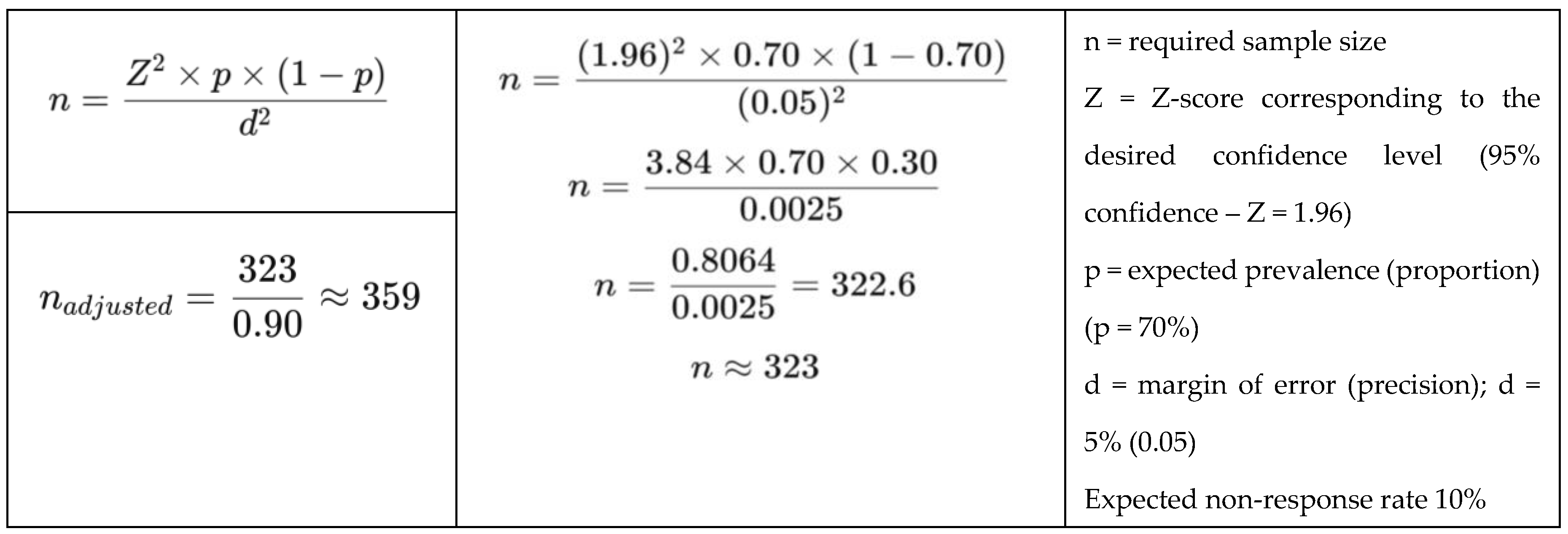

Table 1.
Demographic variables.
| Descriptives | Counts | % of Total | |
| Age category | Youngest-old | 479 | 65.9 |
| Middle-old | 199 | 27.4 | |
| Oldest-old | 49 | 6.7 | |
| Gender | Female | 409 | 56.3 |
| Male | 318 | 43.7 | |
| Education level | Basic education | 240 | 33.0 |
| Secondary education | 331 | 45.5 | |
| Higher education | 156 | 21.5 | |
| Living alone | Yes | 121 | 16.7 |
| No | 605 | 83.3 | |
| Type of care provider | Self-care | 335 | 46.1 |
| Care from family | 392 | 53.9 | |
| Number of chronic conditions | MCC | 700 | 96.3 |
| MM | 27 | 3.7 | |
| Number of medications | < 5 medications | 584 | 80.3 |
| ≥ 5 medications | 143 | 19.7 | |
| Number of hospitalizations in previous year | 0 | 408 | 56.1 |
| 1-2 | 265 | 36.5 | |
| 3-4 | 54 | 7.4 | |
| 4+ | 0 | 0.0 | |
|
Healthcare center |
HCC no 1 | 218 | 30.0 |
| HCC no 2 | 102 | 14 | |
| HCC no 3 | 105 | 14.4 | |
| HCC no 4 | 101 | 13.9 | |
| HCC no 5 | 101 | 13.9 | |
| HCC no 6 | 100 | 13.8 | |
| Note: MCC – Multiple Chronic Condition MM – Multimorbidity HCC – Healthcare Center | |||
Table 2.
Logistic Regression Analysis of Predictors associated with MM (n=27).
| Predictor(s) | OR (95% CI) | p-value | Model type | Predictors | EPV | Stability |
| Age | ||||||
| Oldest-old – Youngest-old | 4.73 (1.71-13.07) | 0.003 | Multivariable (reduced) | 3 | 9 | Acceptable |
| Number of medications | ||||||
| ≥ 5 medications – < 5 medications | 6.15 (2.97-14.60) | <0.001 | Multivariable (reduced) | 3 | 9 | Acceptable |
| Medication adherence | ||||||
| Non-adherent – Adherent | 4.86 (1.22-19.28) | 0.025 | Multivariable (reduced) | 3 | 9 | Acceptable |
| Gender | ||||||
| Female – Male | 1.89 (0.82-4.34) | 0.138 | Univariable | 1 | 27 | Very stable |
| Education | ||||||
| Secondary education – Basic education | 0.47 (0.21-1.06) | 0.068 | Univariable | 1 | 27 | Very stable |
| Higher education – Basic education | 0.19 (0.04-0.86) | 0.031 | Univariable | 1 | 27 | Very stable |
| Type of care provider | ||||||
| Care from family – Self-care | 2.52 (1.05-6.05) | 0.038 | Univariable | 1 | 27 | Very stable |
| Quality of life | ||||||
| Low QoL – High QoL | 2.99 (1.16-7.69) | 0.023 | Univariable | 1 | 27 | Very stable |
| Note. Estimates represent the log odds of “MCC vs MM = MM” vs. “MCC vs MM = MCC” | ||||||
Disclaimer/Publisher’s Note: The statements, opinions and data contained in all publications are solely those of the individual author(s) and contributor(s) and not of MDPI and/or the editor(s). MDPI and/or the editor(s) disclaim responsibility for any injury to people or property resulting from any ideas, methods, instructions or products referred to in the content. |
© 2026 by the authors. Licensee MDPI, Basel, Switzerland. This article is an open access article distributed under the terms and conditions of the Creative Commons Attribution (CC BY) license (http://creativecommons.org/licenses/by/4.0/).
Copyright: This open access article is published under a Creative Commons CC BY 4.0 license, which permit the free download, distribution, and reuse, provided that the author and preprint are cited in any reuse.


