

Submitted:
13 April 2026
Posted:
15 April 2026
You are already at the latest version
Abstract
The growing worldwide need for sustainable, high-quality protein sources has intensified interest in single-cell protein (SCP) production, particularly mycoproteins derived from filamentous fungi. This shift is further driven by global sustainability priorities articulated by regulatory bodies, which promote resource efficiency, waste valorization, and sustainable food systems. Despite their high carbohydrate potential, the agricultural sector generates vast quantities of starch-rich by-products. Examples include broken rice, cassava peels, potato waste and cereal processing residues, that remain largely underutilized, thereby contributing substantially to environmental pollution. This literature review examines the potential of starch‑based agricultural by‑products as low‑cost, renewable feedstocks for mycoprotein production in support of the Sustainable Development Goals (SDGs). These by‑products include broken rice, cassava peels, potato waste, and cereal processing residues, which remain largely underutilized despite their high carbohydrate content. Key topics include pretreatment and enzymatic hydrolysis strategies, fungal fermentation using Neurospora and Fusarium spp., and process optimization to maximize biomass yield and feedstock valorization. Life cycle assessments indicate reduced greenhouse gas emissions compared with conventional protein sources, highlighting the potential of starch residues in circular bioeconomy systems. Furthermore, considerations related to process design, environmental benefits and techno-economic feasibility are evaluated in the context of converting starch residues into fungal protein. In summary, the evidence suggests that valorizing starch by-products for mycoprotein fermentation, used as a protein alternative and as an ingredient, represents a promising strategy to reduce waste management costs, lower production costs and support global food sustainability.
Keywords:
mycoprotein
; starch by-products
; valorization
; sustainability
; circular bioeconomy
1. Introduction
Global population growth has become one of the most pressing challenges of the 21st century, affecting economic, environmental, and social systems worldwide. Over the last decade, the world population has increased rapidly, reaching 8 billion in 2022 and is expected to exceed 9.7 billion by 2050 [1]. This rapid expansion has highlighted the need for sustainable and efficient food production methods to meet the growing demand for protein and other essential nutrients. Animal husbandry has historically served as the primary source of dietary protein for humans, with global meat production reaching approximately 371 million tons in 2023 and projected to rise to nearly 500 million tons annually by 2050 [2]. Despite its importance, meat production is associated with substantial environmental impacts, including significant contributions to greenhouse gas emissions, degradation of land and water resources, and ecological toxicity arising from pesticide use in feed production [3].
This demographic pressure, projected to increase protein requirements by 30–50% in developing regions, has catalyzed innovations in plant-based proteins like pea and soy products, which mimic meat textures in products from companies such as Beyond Meat and Impossible Foods, offering complete amino acid profiles with lower environmental footprints [4,5]. Similarly, alternative protein platforms have emerged to address sustainability and nutritional challenges associated with conventional animal proteins. Mycoprotein, a single-cell protein derived from filamentous fungi such as Fusarium venenatum used in Quorn products, provides high protein content and dietary fiber while enabling scalable production from low-cost agricultural substrates, which remains insufficiently explored for commercial-scale applications [6]. Moreover, valorization of these low-cost agricultural substrates contributes to Sustainable Development Goal 12 (Responsible Consumption and Production) and Sustainable Development Goal 2 (Zero Hunger) [7]. In parallel, cultivated meat technologies aim to replicate animal proteins at the cellular level with substantially lower greenhouse gas emissions while insect- and algae-based proteins offer protein-rich, nutrient-dense options that are increasingly adopted in global food and feed markets to meet rising future protein demands [8,9,10]. These alternatives, if produced in a sustainable manner from starch-rich or cereal by-products, can collectively help mitigate the protein gap by diversifying protein sources, reducing reliance on land-intensive farming, and enhancing nutritional equity. However, scalability, cost and consumer acceptance remain key hurdles [11].
Agricultural and agro-industrial by-products, including crop residues, bran, spent grains, and fruit processing wastes, remain largely underutilized despite their abundance and nutritional potential, often being diverted to low-value uses or disposal [12]. This inefficiency, driven by factors such as high moisture content, lignocellulosic recalcitrance, and contamination risks, results in significant environmental burdens and economic losses, while representing a missed opportunity for sustainable valorization within the circular bioeconomy [13,14]. However, recent literature highlights their substantial potential as feedstocks for mycoprotein production, where filamentous fungi can ferment residues like date, pineapple peel and soy wastes into protein-rich biomass via solid-state or submerged fermentation. Nevertheless, comprehensive studies focusing on the valorization of specific agricultural by-products, particularly starch-rich grains, for single-cell protein production remain limited, especially with respect to their potential contributions to sustainability goals [15].
This review examines the potential use of cereal by-products (brewers’ spent grains and broken rice kernels) as well as starch-rich agro-industrial by-products (potato peel waste and cassava bagasse) substrates for single-cell protein production and considers the broader implications of this utilization for the development of sustainable food systems.
1.1. Method
The literature for this review was identified through a systematic and reproducible search strategy designed to ensure comprehensive coverage of studies on the use of cereal and starch-rich byproducts for fungal mycoprotein production. The search was conducted across Scopus, Web of Science, PubMed, and Google Scholar. Publications were covered from 1866 to 2025. Keywords combined Boolean operators and included terms such as “mycoprotein,” “fungal fermentation,” “single cell protein”, “cereal byproducts,” “starch-rich waste,” and “Neurospora crassa” or “Fusarium venenatum.” Studies were included if they were peer-reviewed and focused on fungal biomass or mycoprotein production using agricultural or agro-industrial substrates. Articles were excluded if they did not involve fermentation systems, focused solely on lignocellulosic substrates, or lacked sufficient methodological detail. Only English-language publications were considered. Following duplicate removal, titles and abstracts were screened for relevance, and eligible studies underwent full-text review based on the predefined criteria. Data were systematically extracted, including substrate type, fungal species, fermentation method, process conditions, and biomass yield. Study quality was assessed based on experimental rigor, clarity of methods, and completeness of reported data, with reduced weight assigned to studies with limited methodological transparency. This approach improved the transparency, consistency, and reproducibility of the review.
1.2. Production and Consumption of Animal Proteins
Animal-derived protein has traditionally been a central component of human diets, providing a rich supply of essential amino acids, vitamins, and minerals. In the food industry, animal-derived proteins like meat, dairy and eggs play pivotal roles in both traditional and processed foods due to their nutritional value, taste and functional properties. Traditional meat proteins are obtained from livestock and poultry production systems, including poultry, cattle, pigs, and sheep, as well as seafood sources [16]. According to the Food and Agriculture Organization [2] and data compiled by OurWorldinData [17] (Table 1), livestock production and consumption have skyrocketed in recent decades.
Yearly production of meat increased from 70.563 million tons in 1961 to 355 million tons in 2022 with the Asian region emerging as the leading region in meat production, accounting for a substantial portion of the total global output. In 2023, China was the world’s largest meat producer, generating approximately 96.41 million metric tons, with pork dominating output at 57.94 million tons (about 60%), followed by poultry at 24.31 million tons (20%), and beef and veal at 8.62 million tons (8.9%) [18]. The United States ranked second overall and remained the leading poultry producer globally, producing around 48 million metric tons of meat in 2023. Poultry accounted for 21 million tons (44%), with pork, beef, and turkey contributing 26%, 25%, and 4%, respectively, while lamb and mutton made up less than 1% [2,18]. This production expansion aligns with sustained increases in global meat consumption, which has risen markedly since 1961 across all major categories, including beef and buffalo, pork, poultry, and sheep and goat meat. Future projections indicate continued growth, with consumption expected to increase by 36% for beef and buffalo, 21% for pork, 40% for poultry, and 44% for sheep and goat by 2050 [17].
1.3. Nutritional, Functional, Sensory and Religious Reasons of Meat Consumption
Humans consume meat for various nutritional, functional, and cultural reasons [19]. For instance, consumers accept and enjoy the flavor and roasted aroma of meat seasoned with sugars. This characteristic meat-like flavor arises from Maillard reactions between amino acids and reducing sugars, a process that is further enhanced by lipid degradation during cooking, leading to the formation of brown coloration and desirable flavor compounds [20]. Thermal degradation of lipids, present as triglycerides, phospholipids, and free fatty acids, via oxidation, pyrolysis, and Maillard-related pathways generates reactive carbonyls and heterocyclic volatiles responsible for roasted, meaty, and caramelized aromas, while saturated fatty acids such as palmitic and stearic acids decompose into aldehydes, ketones, and alcohols that contribute fatty and waxy flavor notes [20,21].
Conversely, unsaturated fatty acids, particularly polyunsaturated acids such as linoleic and arachidonic acids, are essential for meat flavor [22]. They oxidize into a more complex array of aromatic volatile compounds like hexanal, nonanal, and other volatiles, contributing to green, grassy or fatty notes. However, the oxidation of omega-3 fatty acids, prevalent in fish or grass-fed beef, can introduce flavors described as fishy or metallic, which are often not preferred [23]. Lipid profiles vary among meat species, influencing the flavor compounds produced. Beef, which is rich in oleic acid and saturated fats, generates compounds such as 2,3-octanedione and 2-methyl-3-furanthiol, contributing to its roasted, beefy aroma. Pork, with its higher linoleic acid content, produces more hexanal and pentanal, which creates its distinctive 'porky' flavor. Poultry, due to its unique fatty acid composition, develops milder grilled or savory flavors attributed to the presence of arachidonic and linoleic acids. Lamb's flavor is characterized by branched-chain fatty acids, such as 4-methyloctanoic acid, which impart its signature ‘sheep-like’ notes [24,25].
The texture of meat is widely regarded as a critical determinant of product quality and a key factor influencing consumer acceptance and purchasing decisions. Tenderness, juiciness, and chewiness, the three principal textural attributes, depend significantly on muscle composition, the degree of connective tissue, and the meat's water-holding capacity (WHC). Myofibrillar proteins and collagen are two key protein components responsible for meat texture. Collagen transforms into gelatin upon heating, contributing to the gelling properties required for products like sausages, pâtés, and gelatin-based items. This gelling effect not only affects mouthfeel and firmness but also helps bind meat particles, creating a cohesive structure in processed meats. Proteins such as actomyosin form a matrix that holds other ingredients together, ensuring product integrity [26,27].
Myofibrillar proteins also play a vital role in water retention, with WHC being influenced by factors such as pH, ionic strength, and muscle structure integrity. High WHC reduces cooking loss, preserving meat's moisture and sensory qualities, while also impacting economic factors by minimizing weight loss during processing [27]. The emulsification of meat products is facilitated by the amphiphilic nature of muscle proteins, which stabilize fat and water. Pork and poultry proteins are particularly effective at this, enabling even dispersion of fat in products such as emulsified sausages. This not only enhances sensory qualities but also extends shelf life by preventing fat separation. Maintaining stable emulsions is essential for ensuring consistent texture and flavor [28].
Beyond these technical attributes, the consumption of meat has deep cultural roots. Throughout human history, meat has been more than sustenance; it has served as a symbol of status, celebration, and cultural identity. In many cultures, meat consumption is intertwined with religious rituals, social interactions, and economic prosperity. For instance, lamb is central to the celebration of Easter in many Christian cultures, while pork plays a significant role in the Chinese New Year celebrations. Additionally, the act of sharing meat can strengthen social bonds, symbolizing hospitality and prosperity. Meat’s role in cultural traditions further emphasizes its importance beyond just its nutritional and functional properties [29].
1.4. Meat Production Environmental Impact
Despite the functional and nutritional benefits of meat, production and consumption have significant impacts on the environment, notably contributing to the greenhouse effect and other ecological challenges. The greenhouse gases (GHG) emitted through livestock farming include methane (CH4), primarily from enteric fermentation in ruminants like cattle; nitrous oxide from manure management and fertilizer use for feed crops; and carbon dioxide (CO2) from deforestation and land use changes [30]. Methane, although short-lived compared to CO2, has a high global warming potential, with estimates suggesting it is 28 to 36 times more effective at trapping heat than CO2, over a 100-year period [31].
Although comparing the environmental impact of traditional meat across studies is challenging due to differences in functional units and country of evaluation, beef/cattle production has been identified as one of the largest contributors to the livestock sector's environmental footprint, with emissions ranging from 80 to 99.48 kg CO₂-eq per kilogram of meat produced. This can be attributed to methane emissions from enteric fermentation, extensive land use, and the long maturation period of cattle. Additionally, cattle ranching has been established as a primary driver of deforestation, particularly in the Amazon region [30,32]. Greenhouse gas emissions from pork production are lower than those associated with beef but higher than those from poultry, with estimated emissions ranging from 10 to 12.31 kg CO₂-equivalent per kilogram of meat. These emissions primarily arise from feed production, manure management practices, and energy consumption during farming and processing operations [5]. Although pigs do not produce methane at the same level as ruminants, their concentrated waste systems still pose environmental risks. Poultry has the lowest GHG emissions of the three, with about 6 kg CO₂-eq per kilogram of chicken meat [33,34]. The shorter life cycle to slaughter and efficient feed conversion reduces emissions, but the scale of production can lead to substantial environmental impacts, particularly in terms of water and air pollution from concentrated animal feeding operations [35].
In conclusion, these environmental and cultural consequences associated with meat consumption, alongside the functional properties that define its quality, underscore the complex role of meat in contemporary food systems. This necessitates the development of sustainable systems for meat and protein production, as well as the exploration of alternative protein sources that can effectively balance nutritional requirements, cultural preferences, and environmental sustainability. This review will explore mainly fungal SCPs as one potential solution, examining their fermentation from Neurospora crassa and Fusarium venenatum using starch-rich by-products as a carbon source.
2. Single-Cell Protein
Single-cell protein (SCP) refers to protein-rich biomass derived from microorganisms such as bacteria, yeasts, fungi, and algae, cultivated on various carbon sources for use as nutritional supplements in human food, animal feed, and aquaculture [36]. First introduced in 1966 by Carroll Wilson to replace less appealing terms like “microbial protein,” SCP, also known as microbial biomass, typically contains more than 300 g/kg protein (dry weight) and is distinguished from single-cell oils (SCO), which can contain up to 800 g/kg lipids [37,38]. While the intentional use of microorganisms in food dates back millennia, modern single-cell protein (SCP) production emerged during the World Wars, when yeasts such as Saccharomyces cerevisiae and Candida utilis were produced at scale to address protein shortages. Commercial development advanced in the 1970s with products like Pruteen and more notably with Quorn mycoprotein, produced via submerged fermentation since 1985 [39,40]. SCPs offer several advantages over conventional protein sources, including balanced amino acid profiles, low fat content, high protein-to-carbohydrate ratios, rapid microbial growth, and independence from agricultural land, climate conditions, or seasonal variability [41]. Table 2 below shows major nutritional composition of SCPs from different sources.
SCP systems may be produced as first generation or second generation, depending on the carbon source. First-generation SCP systems rely on microorganisms converting food-grade substrates such as starch, sugars and raw food crops into biomass, whereas second-generation approaches incorporate lignocellulosic agricultural residues (co-products or by-products) and other nonfood feedstocks, along with genetically engineered strains and advanced bioreactor designs, to improve yields and reduce production costs [42,43]. These innovations also enable the exploration of specialty proteins such as bioactive peptides. SCP production differs from cultured meat in that it focuses on microbial protein rather than animal cell proliferation; inactivated microbial cells may be fed directly to animals, while SCP intended for human consumption typically undergoes additional purification [36,44]. Moreover, SCP production has the capability to degrade cyanogenic glycosides, present in cassava wastes, as well as anti-nutritional and toxic compounds (solanine) present in potato wastes [45,46]. By leveraging low-cost substrates, including agro-wastes such as fruit peels or sugarcane bagasse, SCP contributes to sustainable protein production and aligns with global efforts to reduce food loss and waste under the United Nations SDG12 [47].
Single-cell proteins contain essential vitamins, amino acids, minerals, nucleic acids, and lipids, enabling their use not only in food and feed applications but also in broader industrial sectors such as paper manufacturing [48]. Their production draws from a wide variety of carbon sources, including sugars and starches, as well as side streams and waste substrates such as fruit residues, molasses, methane, methanol, ethanol, and other combustible by-products [49]. In particular, SCP generated through gas fermentation has gained significant interest, as syngas (CO/H₂) and biogas (CH₄) can be derived from numerous waste biomass streams, while H₂/CO₂ systems enable the direct recycling of carbon dioxide from industrial emissions or atmospheric capture [49,50]. The ability to convert low-cost or waste-derived inputs into high-value protein-rich biomass offers considerable environmental and economic advantages, reducing reliance on conventional agricultural resources while mitigating waste accumulation and greenhouse gas emissions. However, despite the growth of SCP in the market (6.8% CAGR and projected growth of 7.4% CAGR by 2033), greater adoption among older adults is still required [51,52].
2.1. Fungal SCP as Alternative Protein
Alternative proteins are proteins derived from non-traditional sources of proteins. They can be classified based on their source such as plants, microbial, cultured and algae. In recent times, several of these proteins have been studied and developed for commercial use, employing modern extraction methods that highlight their potential as sustainable replacements for animal-based proteins, with plant-based proteins currently leading the food industry as most utilized [53]. Non-traditional proteins sources such as soybean, almonds, and rice-based milk alternatives, extracted using novel extraction techniques like high-pressure processing, microwave-assisted extraction and ultrasound-assisted extraction, have gained popularity among consumers seeking healthier, environmentally friendly options. However, issues concerning sensory characteristics, potential allergenicity, and functional performance have constrained their wider acceptance [54]. Boye et al. [55] evaluated the functional properties of protein concentrates derived from yellow pea, chickpea, and lentil following extraction via ultrafiltration and isoelectric precipitation. While these pulse-based proteins exhibited high protein yields and improvements in several functional attributes (except for water-holding capacity), their performance varied depending on the specific pulse source. Nonetheless, both the functional characteristics and protein profiles of these concentrates were found to be inferior to those of animal-derived and soy proteins. Consumers tend to regard alternative proteins as suitable when they effectively mimic the sensory and functional attributes of conventional meat while accommodating dietary preferences and restrictions. Soy protein, widely used in plant-based meat analogues, is particularly valued for its high protein quality, reflected by a Protein Digestibility Corrected Amino Acid Score (PDCAAS) of 1, and its functional versatility in developing meat-like textures [56]. Similarly, pea protein blended with wheat gluten has gained prominence due to the wheat gluten’s ability to enhance flavor and sensory qualities in meat analogues. However, concerns regarding allergenicity and sensitivities linked to these meat analogues have restricted their widespread adoption. Several studies have examined the protein digestibility of meat analogues compared to animal meat. Zhou et al. [57] and colleagues performed an in-vitro assessment of the protein digestibility and gastrointestinal behavior of meat analogues with that of beef and reported that beef proteins were more easily digested in the stomach than those in soy-based meat analogues. Similarly, Reynaud et al. [58] evaluated the digestible indispensable amino acid score (DIAAS) and true ileal amino acid digestibility (TID) of plant-based proteins in both gel and emulsion forms. The study concluded that protein significantly digestibility is influenced by both the protein source and processing methods. These variations can be attributed to the structural properties of plant-based meat analogues. Mycoprotein, a protein-rich biomass derived from the fungal fermentation of the filamentous fungus Neurospora crassa, has gained notable attention in recent years as an attractive alternative protein source due to its nutritional profile and environmental sustainability. Although mycoprotein has a lower immediate protein digestibility compared to whey protein isolate, it has an amino acid profile comparable to meat and a higher essential amino acid content than plant-based proteins [59,60].
2.2. Evolution of Mycoprotein as Alternative Protein
The use of Neurospora crassa as a mycoprotein source for meat alternatives can be traced back to its natural occurrence and historical use in food. Commonly referred to as red bread mold, N. crassa has long been incorporated into traditional diets, particularly in Southeast Asia, where it is utilized in the production of “oncom,” a fermented food comparable to tempeh. Oncom is typically produced from agro-industrial by-products such as peanut press cake or okara (soybean residue), demonstrating the organism’s capacity to bioconvert agricultural waste into nutritionally valuable food products [61].
N. crassa initially attracted scientific interest not for its applications in food production, but for its value in genetic research. Its simple life cycle, ease of cultivation, and well-characterized genome established it as a model organism for genetic studies from the mid-20th century onward. The work of George Beadle and Edward Tatum on N. crassa in the 1940s, which earned them a Nobel Prize, highlighted its role in understanding gene function, laying the groundwork for its later exploration in food science.
The recognition of N. crassa as a potential source of mycoprotein for food applications emerged alongside growing interest in sustainable protein alternatives, driven by increasing concerns over the environmental impacts of conventional meat production. Unlike Fusarium venenatum, the fungus behind the well-known mycoprotein Quorn, N. crassa has a broader historical use in food and has not been widely reported to produce mycotoxins under stress conditions, which might ease regulatory approval and consumer acceptance [62,63]. Early studies into N. crassa mycoprotein primarily examined its safety and nutritional characteristics. These studies validated its longstanding safe use in Asian culinary practices and highlighted its high protein content (up to 45% dry weight), a well-balanced essential amino acid profile comparable to that of animal proteins, and its contribution of beneficial nutrients, including dietary fiber, vitamins, and minerals [64]. Moreover, the use of biotechnological approaches, including submerged and solid-state fermentation, has been crucial in enabling the large-scale production of N. crassa. These techniques facilitate high biomass yields with controllable nutritional profiles, thereby adapting traditional fermentation processes to meet modern industrial requirements [65].
Mycoprotein derived from Fusarium venenatum was developed in the 1960s in response to growing concerns about global food security and the need for efficient alternative protein sources. Early work by British researchers on fungal fermentation led to the development of the commercial product Quorn, introduced in the UK in the 1980s [66]. Since then, advances in fermentation technology have enabled scalable production under controlled conditions. Compared to conventional livestock systems, mycoprotein production requires substantially fewer natural resources, including land, water, and energy, making it a more environmentally sustainable protein alternative [6]. Consumer acceptance has been crucial to the evolution of mycoprotein. Initially, its availability was limited to the UK. However, as global demand for sustainable proteins has increased, Quorn and other mycoprotein-based products have expanded into markets across the United States, Europe, and Asia. Currently, mycoprotein is among the leading single-cell protein sources, appealing to vegetarians, flexitarians, and individuals concerned with the environmental impact of conventional meat production, with its health and nutritional benefits being primary factors in consumer choice [67]. Further research is required to optimize mycoprotein production with the aim of improving its texture, flavor, and nutritional profile. In addition, advances in genetic and metabolic engineering may enable the development of enhanced strains with improved nutrient density and digestibility. However, several challenges remain, including the need to reduce production costs to improve accessibility and to address regulatory barriers in emerging markets.
3. Fermentation
Fermentation has been a fundamental process in the food industry for thousands of years, transforming the culinary landscape and preserving food long before the advent of modern food processing and preservation techniques. The earliest evidence of fermentation dates to around 7000 BCE in the Fertile Crescent (crescent-shaped region in the middle east), where archeological findings suggest that fermented beverages like beer and wine were produced [68]. These practices were not only used for creating alcohol but also for preserving grains and fruits that would otherwise spoil quickly. In Asia, fermentation was pivotal in producing foods like soy sauce, miso and various fermented vegetables such as kimchi. Also, sauerkraut originated from the preservation of cabbage by Germanic tribes around 1000 BCE [69]. These foods not only extended shelf life but also enhanced flavor, nutrition and digestibility. By the Middle Ages in Europe, fermentation had become central to bread making, with yeast fermentation enabling the production of leavened bread. The Industrial Revolution in the 19th century marked a significant shift toward understanding fermentation at a scientific level, as Louis Pasteur’s work in the 1850s established the role of microorganisms in fermentation processes [70]. This breakthrough laid the foundation for controlled fermentation in food production, leading to the development of modern fermented dairy products such as cheese and yogurt. In the 20th century, fermentation expanded into industrial applications, including the production of antibiotics like penicillin, demonstrating its role beyond food preservation to include health benefits [71]. Today, fermentation is widely used in the production of various foods, from traditional items like beer, wine, cheese, and bread to emerging applications in alternative proteins, probiotics and meat substitutes.
Mycoprotein, commonly produced through the fermentation of Fusarium venenatum, has been extensively described in literature, with few modifications by Edwards [72], followed by comprehensive process analyses by Trinci [39]. Industrial manufacture is based on submerged, continuous, aerobic fermentation conducted in large, aseptic stainless-steel airlift bioreactors, typically pressure-cycle vessels with volumes above 130,000 L. In this system, F. venenatum is cultivated under nutrient-excess conditions with a continuous supply of glucose as the primary carbon source and ammonium as the nitrogen source, supplemented with essential vitamins and minerals, while critical operational parameters, including temperature (28–30 °C), pH (~6.0), and carbon dioxide evolution, are tightly regulated to sustain rapid growth, ensure process stability, and maintain high productivity. Under these optimized conditions, the fungus attains specific growth rates of 0.17–0.20 h⁻¹, generating approximately 300–350 kg of dry biomass per hour, while continuous withdrawal and replacement of the culture medium every 5–6 hours maintain a constant fermenter volume [39,66]. Figure 1 shows a flowchart of the production of Quorn mycoprotein.
After fermentation, the harvested culture is subjected to an RNA reduction step, which is essential due to the inherently high RNA content of fungal biomass (approximately 10% on a dry weight basis). This step aims to lower purine intake and reduce the risk of hyperuricemia-related diseases, by applying controlled thermal treatment to activate endogenous ribonucleases [73]. Traditional protocols involve heating the biomass to 64–65 °C for 20–30 minutes; however, more recent approaches use rapid heating above 68 °C, optimally at 72–74 °C, which enhances protein retention and decreases biomass losses from roughly 35–38% to 30–33% [66]. The process subsequently includes heating to 90 °C, centrifugation to remove liberated nucleotides, and concentration of the mycelium into a paste containing more than 20% solids. This concentrated biomass is then combined with binding agents, such as egg albumen, and mechanically aligned to produce a fibrous texture analogous to meat, facilitating the manufacture of a wide range of food products, including mince, chunks, fillets and steaks [66,73].
3.1. Types of Fermentation and Its Uses in the Food Industry
Fermentation can be broadly classified into two main types: solid-state fermentation (SSF) and submerged fermentation (SMF) [74]. Solid-state fermentation involves the growth of microorganisms on solid substrates with low moisture content. SSF is widely used in Asia for producing traditional foods such as koji, which is essential for soy sauce and sake production, as well as tempeh. This method offers several advantages, including lower water requirements, reduced energy costs, and the ability to utilize agricultural by-products [65].
SSF closely mimics the natural growth conditions of many fungi and bacteria involved in food fermentation and depending on the substrate and intended product, can be an economically viable alternative. For this reason, it is commonly employed in propionic fermentation, which is essential for Swiss cheese production. In this process, propionibacteria convert lactic acid into propionic acid and carbon dioxide, creating the characteristic holes and distinctive flavor of Swiss cheese [75]. Conversely, submerged fermentation (SMF) involves the growth of microorganisms in a liquid medium and is commonly used in the production of antibiotics and metabolites. This method allows for better control of key conditions such as oxygenation, temperature, and pH, making it more efficient for large-scale biomass or metabolite production [76]. However, SSF has been observed to yield higher levels of enzymes and β-glucans from hulled barley compared with submerged fermentation SMF [77]
In the food industry, SMF is utilized in various fermentation processes, including lactic acid, alcoholic, and acetic acid fermentation. Lactic acid fermentation involves lactic acid bacteria converting sugars into lactic acid, as seen in foods like sauerkraut, kimchi, and yogurt. This process improves the nutritional value and shelf life of the product by inhibiting microbial spoilage and improving food safety [78]. Alcoholic fermentation, driven by yeasts, converts sugars into alcohol and carbon dioxide, playing a crucial role in brewing beer, making wine, and leavening bread, thereby enhancing both preservation and flavor [79]. Acetic fermentation, carried out by bacteria such as Acetobacter, converts ethanol into acetic acid, a vital process in vinegar production that contributes to both preservation and taste [80].
3.2. Limitations and Drawbacks of Fermentation
Despite many benefits, fermentation faces several challenges. One significant challenge is the risk of contamination by unwanted organisms, which can spoil the fermented product, alter its taste or even pose health risks. This is common in various types of fermentation, as noted by Hutkins [78], who discussed the importance of hygiene in preventing contamination in lactic acid fermentation. Additionally, Stanbury et al. [76] highlighted that fermentation can be time-consuming, requires high energy inputs and lacks precise control over factors such as temperature, pH and oxygen, particularly in large-scale production. Scalability challenges in large fermenters (>10,000 L), arising from reduced oxygen transfer efficiency and thermal limitations, can introduce variability in both solid-state and submerged fermentation processes, potentially leading to inconsistencies in product quality [65]. Lastly, consumer acceptance remains a challenge, as novel fermented products may face resistance due to unfamiliar flavors or misconceptions about fermentation and genetically modified organisms (GMOs), similar to perception issues in synthetic biology applications [81].
Recent technological advances have significantly improved the efficiency of fermentation processes despite their drawbacks. The advent of precision fermentation, also known as cell factory engineering, has revolutionized microbial production by leveraging molecular biology and metabolic engineering techniques to construct microorganisms optimized for high-yield production of specific target compounds. This approach allows for more controlled, predictable and scalable fermentation, while expanding the ability to produce a wider range of products beyond the natural capabilities of microbes. One key advantage of precision fermentation is its ability to produce high-value, specific proteins without relying on animal sources, thereby reducing environmental impact. However, high production costs, consumer skepticism and regulatory complexities associated with this emerging technology remain significant hurdles for large-scale commercial adoption [82]. Numerous studies have explored the potential of precision fermentation techniques to enhance traditional food fermentation processes. Augustin et al. [83] reviewed several of these advancements, highlighting the patent prospects as well as the business and market potential for major fermentation-derived food ingredients.
Similarly, high-throughput screening (HTS) has enabled the rapid identification and optimization of microbial strains. Like precision fermentation, HTS aims to optimize biological processes, though this optimization may come at a high equipment cost. Despite this, HTS accelerates product development and enables the screening of a vast number of strains. However, its cost and complexity make it less feasible as a routine production tool for smaller-scale operations. Several studies have explored the potential of HTS in identifying beneficial microbial strains. For example, Wang et al. [84] used HTS for identifying mutant strain of Saccharomyces cerevisiae with enhanced ethanol production. Their research reported a 20.5% increase in ethanol yield and an 81.6% increase in sucrose utilization using the optimized strain [84].
Furthermore, metabolic engineering represents a significant advancement in fermentation technology. This technique involves modifying microbial pathways, gene editing, or enzyme enhancement to improve efficiency and increase the yield of desired compounds. Substantial efforts have been made to engineer Saccharomyces cerevisiae to co-ferment D-xylose and L-arabinose, two prevalent sugars in lignocellulosic hydrolysate, thereby boosting ethanol yields by 20–40%. Similarly, considerable efforts have been made to minimize glycerol formation during bioethanol production using S. cerevisiae. Glycerol accumulation can be reduced by deleting the genes encoding cytosolic NADH-dependent glycerol-3-phosphate dehydrogenases, GPD1 and GPD2. However, this modification has been observed to impact both growth and ethanol productivity [85].
Lastly, advanced bioreactors (fermenters) provide better mixing and aeration, improving performance and consistency of both SSF and SMF. Automated monitoring systems and advanced control algorithms also enable tighter regulation of crucial fermentation parameters like pH, temperature and dissolved oxygen levels of bioreactors. These enhanced control and monitoring capabilities improve scalability, efficiency and versatility in various fermentation processes over time. However, like precision fermentation and HTS, the high costs associated with complex bioreactor setups remain a significant barrier to adoption, particularly for smaller producers. Several studies have demonstrated the benefits of advanced bioreactor designs in food fermentation. For instance, Fink et al. [86] investigated the use of Biolector micro-bioreactors as a high-throughput screening platform for E. coli clones producing recombinant proteins for biopharmaceutical applications. Their findings show strong transferability between micro-bioreactor screening data and performance observed in fully controlled fed-batch bioreactors, with consistent clone growth, expression profiles, and ranking. Figure 2 shows examples of airlift and stirred tank bioreactors used in fungal biomass production.
4. Acid and Enzymatic Hydrolysis of Substrates for Fermentation
Starch to be used as feedstock for fermentation usually undergoes enzymatic or acid modification. These chemical and enzymatic hydrolysis methods serve as central pretreatment strategies for converting starch-rich agricultural residues into fermentable substrates suitable for fermentation. Chemical hydrolysis of substrates for fermentation typically employs dilute mineral acids such as hydrochloric or sulfuric acid, operating at elevated temperatures to disrupt the granular structure of starch and rapidly cleave α-1,4 and α-1,6 glycosidic linkages [87] This process, which involves a series of liquefaction and saccharification reactions using thermostable enzymes, yields glucose, maltose, and short-chain dextrins, with maximum glucose conversion yield of about 60%. However, it requires careful optimization to prevent excessive degradation that can result in the formation of fermentation inhibitory compounds such as hydroxymethylfurfural (HMF) and furfural, by-products known to impair fungal growth, enzyme secretion, and biomass accumulation [88]. Despite these challenges, acid hydrolysis remains attractive for industrial applications due to its rapid reaction kinetics and compatibility with high-solids processing. Nonetheless, challenges with environmental concerns and downstream processing remain significant drawbacks [89].
In contrast, enzymatic hydrolysis utilizes highly specific amylolytic enzymes to catalyze the controlled depolymerization of starch under mild conditions. α-amylase facilitates endo-hydrolysis of α-1,4 linkages, decreasing starch viscosity and producing linear and branched dextrins; glucoamylase subsequently cleaves both α-1,4 and α-1,6 bonds to generate high-purity glucose suitable for microbial fermentation [90]. Debranching enzymes, such as pullulanase and isoamylase, are used to enhance saccharification efficiency by removing α-1,6 linkages that restrict enzyme accessibility, improving overall conversion yields up to 98% [91,92]. Enzymatic pretreatment offers several advantages over chemical methods, including reduced inhibitor formation, improved selectivity, lower energy input, and enhanced compatibility with fungal species that prefer consistent and gradual glucose release. Although the cost of enzymes remains relatively high compared to acid hydrolysis, ongoing advances in enzyme engineering, process optimization, and recycling strategies continue to improve their economic feasibility and scalability [93]. Table 3 below shows a summary of substrates, pretreatment methods and yields obtained from hydrolysis of various substrates. Recent studies demonstrate that optimized enzymatic hydrolysis can significantly increase substrate digestibility and support higher fungal biomass productivity, particularly for strains of Neurospora intermedia, Fusarium venenatum, and Rhizopus oryzae, which exhibit strong amylolytic and carbohydrate-utilization capacities [42,90].
5. Agricultural and Agro-Industrial Byproducts
Agro-industrial waste, also referred to as agro-waste, is broadly defined as the unwanted or unsalable materials generated from agro-industrial processing activities, encompassing residues from food manufacturing, beverage production, and related operations [99]. These waste streams are commonly underutilized and are often disposed of through landfilling, incineration, or low-value applications, contributing to environmental pollution and resource inefficiency [100]. However, for the purpose of this review, we would be limiting our analysis to some agricultural/agro-industrial co-products and by products.
Many of these materials, whether co-products or by-products, contain valuable carbohydrates, lipids, proteins, vitamins, and minerals that can be repurposed to mitigate the environmental and economic impacts associated with their disposal [101].
Cereal by-products are generated during the industrial processing of grains such as wheat, corn, and barley, including milling, brewing, and starch or ethanol production. During these processes, valuable components such as the nutrient-rich germ, fiber-dense bran, hulls, and gluten are separated from the starchy endosperm, which serves as the primary source of flour and starch [102]. Upcycling byproducts are dependent on the nature of these byproducts and yield of useful compounds to be obtained responsibly. This approach provides an opportunity to convert underutilized biomass into high-value microbial proteins, thereby addressing food waste and supporting a circular bioeconomy [103,104].
5.1. Starch
Starch, a polymeric carbohydrate composed of numerous glucose units linked by glycosidic bonds, serves as the primary energy storage molecule in plants and a crucial dietary component for humans, supplying significant nutritional sustenance [105]. Similarly, animals store glucose as glycogen, a structurally analogous but more highly branched polysaccharide that fulfills the same role as starch in plants. This highly branched glucose homopolymer is densely packed and serves as a temporary or long-term energy reserve, produced by plants because of photosynthesis [106].
Starch, a major dietary carbohydrate widely present in cereal grains (e.g., maize, wheat, rice, sorghum, and barley) and tuber crops (e.g., potato, cassava, yam, and sweet potato), consists primarily of two polysaccharides: amylose, a predominantly linear α-1,4-linked glucan, and amylopectin, a highly branched polymer containing α-1,6 linkages. Variations in the proportion and molecular architecture of these components influence key physicochemical properties, such as gelatinization, retrogradation, and rheological behavior, which in turn determine starch functionality in food systems, including its roles as a thickener, stabilizer, gelling agent, emulsifier, and fat replacer [105,107]. Table 4 presents the percentages of total starch, amylose, amylopectin, and relative crystallinity across various cereals, roots, and tubers, thereby illustrating the functional diversity of starch and its varied applications within the food industry.
Starch-derived materials are widely used in numerous sectors, such as food, textiles, plastic, cosmetics, adhesives, and pharmaceutical industries. However, native starch performs poorly in processing, often requiring modification to enhance its functional properties for specific applications [117,118]. Several methods are employed to modify native starch, aiming to enhance or suppress its intrinsic attributes or confer specific properties to align with industrial needs. These modifications are broadly divided into four main categories: physical, chemical, enzymatic, and genetic alterations, each imparting distinct changes to the starch granule structure and functional characteristics [119].
5.1.1. Brewers’ Spent Grain
Brewers’ spent grain (BSG) is the principal by-product of the brewing industry, generated as the insoluble residue remaining after malted barley undergoes mashing and lautering, during which enzymes convert starches into fermentable sugars and the resulting wort is separated from the solid grain fraction [120]. Representing approximately 85% of total brewing by-products, BSG is produced at an estimated rate of 20 kg per hectoliter of beer, contributing to a global annual output of 36–40 million metric tons, with the European Union alone generating about 10 million metric tons [121]. Its composition, derived largely from the husk, pericarp, and seed coat layers of barley along with residual endosperm, consists of lignocellulosic material rich in cellulose (20–25%), hemicellulose (20–40%), lignin (12–28%), protein (15–30%), lipids (5–10%), and minor levels of β-glucan (approximately 1%) [122,123]. Although its precise chemical profile varies with barley variety, malting conditions, mashing efficiency, and brewery practices, BSG consistently exhibits a high dietary fiber content (25-50%) [123], significantly exceeding that of many cereals and legumes. Hemicellulose, particularly arabinoxylan, is its predominant fiber component and has been associated with potential health benefits such as prebiotic effects, improved glycemic regulation, and antioxidant activity [124,125]. Despite its abundance, BSG’s high moisture content and susceptibility to microbial spoilage limit its shelf life and contribute to its predominant use as low-value animal feed or, in some regions, disposal via landfill, practices that are environmentally burdensome, with each metric ton of landfilled BSG emitting approximately 513 kg CO₂-equivalent greenhouse gases [13,126]. Although drying can extend its usability and facilitate incorporation into food systems, the inclusion of BSG may negatively affect product techno-functional and sensory properties, highlighting the need for value-added applications that can capitalize on its rich nutritional and lignocellulosic profile [123].
BSG contains approximately 30% protein and 30% residual starch on a dry weight basis [120], exceeding the protein content of most cereals, including wheat, barley, and oat, and aligning with levels observed in several legume sources such as lentils, chickpeas, peas, and faba beans. Although its protein concentration is lower than that of high-protein legumes like soybeans, BSG exhibits an essential amino acid profile typical of cereal proteins, with essential amino acids comprising up to 38% of total protein and lysine contributing as much as 87% of the recommended requirement per gram of protein [126]. In addition to its protein composition, BSG offers functional advantages, such as enhanced foaming and gelation, and a notably high dietary fiber content (up to 50%), characteristics that frequently surpass those observed in conventional cereals and legumes and expand its applicability in food systems. This makes BSG a raw material of interest for both food and non-food applications, as it contains bioactive constituents such as arabinoxylans and ferulic acid, which have been associated with improved gut health and antioxidant activity. However, its lignocellulosic structure often necessitates pretreatment to enhance digestibility, as protein bioavailability is generally lower than that of legume proteins [128,129,130].
Protein quality indicates that a BSG-derived barley–rice protein isolate exhibits a DIAAS of approximately 51%, comparable to that of other cereal proteins but lower than the values reported for pea and faba bean proteins (64–76%) and soy protein (98–103%) [131,132]. Nevertheless, the complementary amino acid profiles of BSG and legumes, particularly the combination of BSG’s sulfur-containing amino acids with the lysine-rich nature of legume proteins, present a strategic opportunity to improve overall DIAAS and enhance protein quality in blended formulations. Although the protein and fiber composition of brewers’ spent grain has been extensively documented, systematic investigations into its residual starch and overall carbohydrate profile relevant to fermentation processes remain limited, underscoring the need for further research to clarify effective valorization of these fractions in microbial bioprocesses for sustainable protein production
As a fermentation feedstock, BSG’s favorable nutrient profile, rich in fermentable carbohydrates, proteins, and minerals, supports microbial bioconversion into value-added products and aligns with circular economy strategies in the food sector. However, its carbohydrates and proteins are largely embedded within complex biopolymeric matrices, necessitating chemical or enzymatic depolymerization to release fermentable sugars and bioavailable nutrients to achieve sustainable production goals [125,133].
The chemical cleavage of brewers’ spent grain (BSG) biopolymer units typically involves hydrolytic processes aimed at depolymerizing cellulose and hemicellulose into fermentable sugars suitable for downstream bioprocessing, such as ethanol, biomass and other fermentation-derived products. Acid pretreatments, including the use of dilute phosphoric acid, have been shown to enhance carbohydrate solubilization [96]. Sequential alkaline–acid treatments, for example sodium hydroxide followed by sulfuric acid, further improve delignification efficiency, achieving up to 80% lignin removal and increasing cellulose accessibility, with reported glucose concentrations of up to 75 g/L in resulting hydrolysates for ethanol fermentation [134]. In addition, physical approaches such as subcritical water hydrolysis (200–250 °C, 12–25 MPa) offer a comparatively green alternative, enabling the cleavage of hemicellulose into xylooligosaccharides and glucose without the use of chemical reagents, and yielding approximately 40–60% total sugars [135]. Despite these advantages, such pretreatment strategies are associated with notable limitations, including the formation of inhibitory compounds (e.g., furfurals), high energy requirements, and variability in BSG composition, all of which can adversely affect process efficiency and yield consistency [125].
Enzymatic hydrolysis, employing cellulases and hemicellulases, offers a milder approach, often yielding higher sugar concentrations and fewer inhibitory compounds, though enzyme costs can be substantial [136]. Several studies have documented BSG’s use in fermentation. In lactic acid fermentation, BSG functions as a self-sufficient substrate for producing optically pure L-lactic acid by Lactobacillus strains, achieving yields of 5.4 g/L following enzymatic pretreatment to hydrolyze its polysaccharides [123]. In bioethanol production, its hemicellulose and residual starch fractions can be efficiently fermented by Fusarium oxysporum, generating ethanol concentrations of approximately 109g per kg of dry BG after enzymatic hydrolysis and offering a sustainable alternative to first-generation biofuel substrates [137].
Brewers’ spent grain (BSG) can serve as an effective substrate for the cultivation of edible filamentous fungi, such as Rhizopus oligosporus, and shows potential as a growth substrate for Fusarium venenatum, enhancing amino acid profiles, citric acid production and nutritional values, thereby supporting its application in meat analog formulations [138]. Similarly, fermentation with Rhizopus oryzae has yielded a protein content of 23.3%, demonstrating improved protein solubility and the formation of protein structures that enhance surface bonding within the fermented matrix compared to untreated BSG [139]. Furthermore, in the energy sector, BSG is also utilized in anaerobic digestion, where its organic matter is converted into biogas with methane yields ranging from 10.53 L CH4/ kg, thereby integrating food waste valorization with renewable energy production [140].
Despite these advantages, several limitations constrain the utilization of BSG. Its high moisture content (70–80%) promotes rapid microbial spoilage and increases transportation and storage costs, while its lignocellulosic structure necessitates energy-intensive pretreatment processes to release fermentable sugars. Potential contaminants, including mycotoxins and heavy metals originating from barley cultivation, pose additional safety concerns and require stringent quality control measures [127,141].
5.1.2. Rice Byproducts
Rice by-products refer to the secondary materials generated during rice processing, primarily including husks (also known as hulls), bran, and straw, which are lignocellulosic residues rich in cellulose, hemicellulose, lignin, and minor nutrients, as well as broken rice kernels [142]. These by-products arise from the rice milling process in the food industry, where paddy rice undergoes hulling to remove the outer husks (20–22% of paddy weight), followed by polishing to separate the bran layer (5–8% of paddy weight), resulting in white rice as the primary product and by-products as waste streams [143]. Annually, global rice production for 2025/26 is projected at approximately 313.4 million cwt (hundredweight), generating substantial by-products: rice husks/hulls at 130–170 MMT and bran at 40–50 MMT, with total residues (including straw) exceeding 750 MMT when accounting for field wastes [144,145]. This derivation occurs in rice mills worldwide, particularly in Asia (e.g., China and India, producing over 50% of global rice), where mechanical dehulling and abrasive polishing minimize losses but produce nutrient-dense wastes often underutilized or discarded [146].
Rice straw and husk are the most frequently upcycled rice by-products. These by-products are primarily composed of cellulose, hemicellulose, and lignin, providing substantial carbon sources with fixed carbon contents of approximately 15.9% and 16.2%, respectively, that can be transformed into value-added products through microbial processes [147]. Bioconversion strategies, commonly demonstrated with Saccharomyces cerevisiae, typically require physicochemical pretreatment to disrupt the recalcitrant lignocellulosic matrix, followed by enzymatic hydrolysis and subsequent fermentation with an appropriate nitrogen source, often yeast extract, ammonium phosphate and urea. For instance, microwave–acid–alkali pretreatment of rice straw has been reported to yield a 55-65% bioethanol [148]. Nevertheless, strong cross-linking among lignin, cellulose, and hemicellulose necessitates energy-intensive and costly pretreatment steps, constraining process efficiency. In contrast, rice bran exhibits a comparatively nutrient-dense profile, containing 12–17.5% protein, 13.1% lipids, 50–52.3% carbohydrates, substantial dietary fiber, and antioxidant compounds [149,150], and has been applied in alcoholic fermentation for bioethanol production and in solid-state fermentation to enhance bioactive properties [151,152]. Despite these demonstrated applications and the low cost and global availability of rice by-products, their use as substrates for single-cell protein production remains underexplored, highlighting a significant opportunity for future research into sustainable microbial protein bioprocesses [153,154,155].
Broken and immature rice kernels, which account for 10–25% of milled rice, with even higher proportions in small mills due to moisture-related breakage or grain chalkiness, present strong potential as fermentation feedstocks because of their high starch content (70–80%) and minimal pretreatment requirements [143,145]. In industrial applications, these milling by-products have been used for bioethanol production, yielding 449–483 L/MT through simultaneous saccharification and fermentation using granular starch–hydrolyzing enzymes and yeast, as demonstrated in no-cook ethanol processes employing Indian broken rice [156]. Low-quality rice fractions, including immature kernels often classified under broken kernels, can also be effectively valorized through microbial fermentation, capitalizing on their readily accessible carbohydrates and proteins for biomass and metabolite synthesis [157]. Despite this demonstrated utility, further research is necessary to assess their suitability as substrates for fermented foods, including single-cell protein production, where rice kernels may generate protein-enriched biomass and provide cost-effective alternatives to whole grains while mitigating food waste.
5.1.3. Cassava Bagasse
Cassava bagasse, the fibrous residue remaining after starch extraction from cassava roots (Manihot esculenta), is a major agro-industrial by-product in tropical regions where cassava is a staple crop. Derived in the food industry during wet milling processes, where roots are peeled, grated, pressed, and sieved to separate starch, bagasse comprises 15–20% of the root weight and consists of cellulose (30–50%), hemicellulose (20–30%), residual starch (10–20%), and minor proteins and lipids [158]. Globally, cassava production exceeds 300 million metric tons annually, yielding approximately 45–60 million metric tons of bagasse, primarily in Africa, Asia, and Latin America, where it is often discarded or used as low-value fuel [159]. This derivation generates a starch-rich waste stream suitable for bioconversion, though its high moisture (60–80%) lignocellulosic structure and cyanide content pose processing challenges [160].
As a substrate for fermentation and single-cell protein (SCP) production, cassava bagasse generally requires physicochemical pretreatment, such as acid hydrolysis or steam explosion, to disrupt its lignocellulosic matrix and liberate fermentable monosaccharides, mainly glucose and mannose, that are readily assimilated by microorganisms. Empirical studies have demonstrated the feasibility of utilizing pretreated cassava bagasse in submerged fermentation systems with Candida utilis, resulting in SCP biomass yields with protein contents of approximately 40–50% and volumetric concentrations ranging from 8 to 12 g/L [161]. In parallel, solid-state fermentation approaches employing Trichoderma pseudokoningii have been reported to substantially enrich the protein content of cassava bagasse to levels of 36.9–48.1%, thereby improving its nutritional quality and suitability for animal feed applications [162]. In general, the integration of cassava bagasse into biorefinery-based processing frameworks represents a promising strategy for the concurrent production of single-cell protein and bioethanol, enabling the efficient valorization of up to 70–80% of its lignocellulosic fraction while contributing to sustainable protein production and improved nutritional security in resource-limited regions [163].
5.1.4. Potato Peel Waste
Potato peel, a starchy waste from potato processing, is generated during peeling and cutting in the food industry for products like chips and fries, comprising 15–40% of the tuber weight with cellulose (20–30%), starch (10–20%), and minor proteins (5–10%) [164]. Annual global potato production of ~383 million metric tons yields 50–150 million metric tons of peels, primarily in Europe, Asia, and North America, often landfilled or composted [159]. This derivation produces a nutrient-dense residue suitable for valorization, though its high phenolic content can inhibit microbial activity [165].
Potato peel, similar to its use in bioethanol processes, typically undergoes chemical or enzymatic pretreatment to liberate fermentable sugars; however, enzymatic hydrolysis is generally preferred due to its operation under mild conditions, biodegradability, improved sugar yields, and reduced energy, water consumption, and by-product formation compared with acidic treatments [166]. Following pretreatment, submerged fermentation with Saccharomyces cerevisiae has been reported to yield SCP biomass containing approximately 12.5–21.9% protein [167], while solid-state fermentation with Aspergillus parasiticus can enrich potato peel substrates to protein levels of up to 51.1%, enhancing digestibility for feed applications [168]. More recently, integrated multi-waste fermentation strategies, including co-fermentation with fruit peels, have been proposed to further enhance SCP yields to up to 50% protein, thereby reducing waste streams in potato-processing industries and supporting circular economy objectives [169].
6. Life Cycle Assessment
The objectives of a circular bioeconomy cannot be fully realized without the application of Life Cycle Assessment (LCA). LCA is a critical methodological framework for evaluating the environmental sustainability of products and processes within a circular bioeconomy, providing a comprehensive analysis of impacts across the entire life cycle (from raw material extraction to end-of-life). Life cycle assessment (LCA) originated in the late 1960s as a resource and energy analysis tool and was formalized in the 1990s through the efforts of SETAC and subsequent standardization by ISO (ISO 14040/14044), establishing it as a globally recognized methodology [170] Over time, its scope expanded to include broader environmental indicators such as greenhouse gas emissions, water and land use, and resource depletion, supported by advances in analytical tools and databases. LCA is now widely applied across sectors to inform sustainability decisions, although challenges related to data quality, regional specificity, and socio-economic integration remain [171].
Several Life Cycle Impact Assessment (LCIA) methodologies have been developed to evaluate environmental impact within LCA, with several frameworks gaining widespread adoption due to their scientific rigor, comprehensive coverage, and regulatory relevance. Common life cycle impact assessment methods include ReCiPe and IMPACT 2002+, which integrate midpoint and endpoint indicators for both detailed and holistic analyses, as well as CML and TRACI, which focus on midpoint categories, with TRACI specifically tailored to the U.S. context; together, these frameworks provide structured approaches for evaluating environmental impacts across multiple domains [172,173].
6.1. LCA on Mycoprotein
Numerous LCA studies have evaluated the environmental burdens associated with conventional livestock-based food systems, including beef, pork, and poultry, and have compared these impacts with those of meat alternatives [174]. Traditional livestock production exerts substantial environmental pressure, contributing approximately 27–34% of anthropogenic greenhouse gas emissions, accounting for nearly 45% of global land use, and consuming around 70% of freshwater resources [4]. However, relatively few studies have comprehensively evaluated the environmental footprint of emerging alternative protein sources, particularly mycoprotein-based single-cell proteins derived from agricultural by-products, including detailed comparisons of land-use requirements and water scarcity impacts [175].
Upcraft et al. [176] evaluated the cultivation of F. venenatum on lignocellulosic agricultural residues, including rice straw, and demonstrated its potential as a low-carbon alternative to conventional animal- and plant-based proteins. Life cycle assessment indicated that mycoprotein derived from these substrates can be produced at competitive costs, with greenhouse gas emissions reduced to less than 14% of those associated with beef protein. This result underscores the potential of lignocellulosic-derived mycoprotein as a sustainable alternative protein source. [176]. Similarly, economic modeling analysis of continuous mycoprotein production using airlift bioreactors, incorporating extensive process and cost inputs, indicated that mycoprotein has the potential to be cost-competitive with beef when evaluated on a price-per-protein basis. Sensitivity analyses further identified key process parameters influencing economic feasibility and supported the development of customizable production scenario tools for industry stakeholders. However, despite these advantages, mycoprotein may remain less economically competitive relative to lower-cost animal protein sources, such as chicken or meat by-product streams commonly used in pet food, highlighting both its commercial promise and current market limitations [177]. Further optimization in saccharification yields and feedstock utilization, particularly using high-cellulose feedstocks, could significantly reduce production costs, making mycoprotein a more viable and sustainable protein alternative.
7. Conclusions
This review highlights the substantial potential of cereal and starch-rich agricultural by-products as sustainable substrates for the production of fungal single-cell protein, particularly mycoprotein derived from filamentous fungi. Available evidence indicates that these residues contain substantial carbohydrate content that can potentially be converted into fermentable sugars through appropriate pretreatment and enzymatic saccharification strategies. When combined with optimized submerged or solid-state fermentation systems, these substrates effectively support fungal growth, biomass production, and the generation of nutritionally valuable protein-rich products
Advances in fermentation process engineering, strain selection, and biorefinery integration have enhanced the feasibility of converting low-value starch-rich residues into functional protein ingredients for food and feed applications. Substrates such as brewer’s spent grain, rice bran, broken rice, and husks represent promising, low-cost feedstocks that can be valorized into high-quality mycoprotein through tailored bioconversion strategies. Life cycle analyses indicate that such valorization can reduce raw material costs, minimize waste streams, and lower the environmental burdens associated with conventional meat production systems. However, challenges remain, including feedstock variability, energy demands during pretreatment, scalability limitations, and the need for standardized downstream processing to ensure product safety and consistent quality. To fully realize this potential, comprehensive LCAs are required to evaluate the environmental and economic impacts of utilizing diverse substrates at scale, thereby guiding sustainable process development and supporting alignment with global sustainability goals, including the United Nations Sustainable Development Goals (Agenda 2030).
Overall, the integration of starch-based agro-industrial residues into mycoprotein production frameworks represents a viable pathway toward circular bioeconomy objectives by transforming underutilized agricultural residues into high-value protein resources. Continued research focused on process optimization, strain improvement, and comprehensive sustainability assessment will be critical to advancing industrial adoption and ensuring that fungal SCP contributes meaningfully to future resilient, resource-efficient, and environmentally responsible protein supply systems.
References
- United Nations. World population to reach 8 billion on 15 November 2022 | United Nations. https://www.un.org/en/desa/world-population-reach-8-billion-15-november-2022 (accessed on 1 Nov 2024).
- FAO. Meat Market Review: Overview of global market developments in 2023.
- Röös, E.; Sundberg, C.; Tidåker, P.; Strid, I.; Hansson, P. A. Can Carbon Footprint Serve as an Indicator of the Environmental Impact of Meat Production? Ecol. Indic. 2013, 24, 573–581. [Google Scholar] [CrossRef]
- GFI. State of Alternative Protein: A Global Glimpse at the State of the Industry. 2024. [Google Scholar]
- Poore, J.; Nemecek, T. Reducing Food’s Environmental Impacts through Producers and Consumers. Science (1979). 2018, 360(6392), 987–992. [Google Scholar] [CrossRef]
- Finnigan, T. J. A.; Wall, B. T.; Wilde, P. J.; Stephens, F. B.; Taylor, S. L.; Freedman, M. R. Mycoprotein: The Future of Nutritious Nonmeat Protein, a Symposium Review. In Current Developments in Nutrition; Oxford University Press, 2019; Vol. 3. [Google Scholar] [CrossRef]
- United Nations. Transforming our world: The 2030 agenda for sustainable development. https://sdgs.un.org/2030agenda (accessed on 6 Apr 2026).
- Caporgno, M. P.; Mathys, A. Trends in Microalgae Incorporation Into Innovative Food Products With Potential Health Benefits. Frontiers in Nutrition. Frontiers Media S.A. July 31, 2018. [CrossRef]
- van Huis, A. Nutrition and Health of Edible Insects. Current Opinion in Clinical Nutrition and Metabolic Car 2020, 22(3), 228–231. [Google Scholar] [CrossRef]
- Tuomisto, H. L.; Teixeira De Mattos, M. J. Environmental Impacts of Cultured Meat Production. Environ. Sci. Technol. 2011, 45(14), 6117–6123. [Google Scholar] [CrossRef] [PubMed]
- Santo, R. E.; Kim, B. F.; Goldman, S. E.; Dutkiewicz, J.; Biehl, E. M. B.; Bloem, M. W.; Neff, R. A.; Nachman, K. E. Considering Plant-Based Meat Substitutes and Cell-Based Meats: A Public Health and Food Systems Perspective. Frontiers in Sustainable Food Systems. Frontiers Media S.A. August 31, 2020. [CrossRef]
- Ayoo, C.; Bonti-Ankomah, S.; Aryee, A. N. A. Byproducts from Agriculture and Fisheries: Adding Value for Food, Feed, Pharma, and Fuels, 2020.
- Lynch, K. M.; Steffen, E. J.; Arendt, E. K. Brewers’ Spent Grain: A Review with an Emphasis on Food and Health. Journal of the Institute of Brewing 2016, 122(4), 553–568. [Google Scholar] [CrossRef]
- Ravindran, R.; Jaiswal, A. K. Exploitation of Food Industry Waste for High-Value Products. Trends in Biotechnology. Elsevier Ltd January 1, 2016, pp 58–69. [CrossRef]
- Betoret, N.; Betoret, E.; Glicerina, V. T. Valorization and Utilization of Food Wastes and By-Products: Recent Trends, Innovative Technologies and Sustainability Challenges. Foods. Multidisciplinary Digital Publishing Institute (MDPI) January 1, 2024. [CrossRef]
- Adejumo, I. O.; Adebiyi, O. a. Risky Benefits and Beneficial Risks of Animal Protein. 2024. [Google Scholar] [CrossRef]
- FAO. Meat and Dairy Production. https://ourworldindata.org/meat-production (accessed on 28 Jan 2026).
- Statista. Global Meat Production Forecast. https://www.statista.com/statistics/237632/production-of-meat-worldwide-since-1990/?srsltid=AfmBOoopwekf182lxfHttTaZFvvxv0EB04KBXbr1IkUlvR1E1BRyVO2L (accessed on 28 Jan 2026).
- Leroy, F.; Smith, N. W.; Adesogan, A. T.; Beal, T.; Iannotti, L.; Moughan, P. J.; Mann, N. The Role of Meat in the Human Diet: Evolutionary Aspects and Nutritional Value. Anim. Front. 2023, 13(2), 11. [Google Scholar] [CrossRef] [PubMed]
- Mottram, D. S. Flavour Formation in Meat and Meat a Review Products; 1998; Vol. 62. [Google Scholar]
- Li, L.; Belloch, C.; Flores, M. The Maillard Reaction as Source of Meat Flavor Compounds in Dry Cured Meat Model Systems under Mild Temperature Conditions. Molecules 2021, 26(1), 223. [Google Scholar] [CrossRef]
- Wang, L.; Huang, Y.; Wang, Y.; Shan, T. Effects of Polyunsaturated Fatty Acids Supplementation on the Meat Quality of Pigs: A Meta-Analysis. Front. Nutr. 2021, 8, 746765. [Google Scholar] [CrossRef]
- Shahidi, F.; Pegg, R. B. Hexanal as an Indicator of the Flavor Deterioration of Meat and Meat Products, 1994.
- Elmore, J. S.; Cooper, S. L.; Enser, M.; Mottram, D. S.; Sinclair, L. A.; Wilkinson, R. G.; Wood, J. D. Dietary Manipulation of Fatty Acid Composition in Lamb Meat and Its Effect on the Volatile Aroma Compounds of Grilled Lamb. Meat Sci. 2005, 69(2), 233–242. [Google Scholar] [CrossRef]
- Jones, D. T.; Woods, D. R. Acetone-Butanol Fermentation Revisited; 1986; Vol. 50. [Google Scholar]
- Chang, H.; Wang, Q.; Xu, X.; Li, C.; Huang, M.; Zhou, G.; Dai, Y. Effect of Heat-Induced Changes of Connective Tissue and Collagen on Meat Texture Properties of Beef Semitendinosus Muscle. Int. J. Food Prop. 2011, 14(2), 381–396. [Google Scholar] [CrossRef]
- Huff-Lonergan, E.; Lonergan, S. M. Mechanisms of Water-Holding Capacity of Meat: The Role of Postmortem Biochemical and Structural Changes. Meat Sci. 2005, 71(1), 194–204. [Google Scholar] [CrossRef]
- Jimenez-Colmenero, F.; Carballo, J.; Cofrades, S. Healthier Meat and Meat Products: Their Role as Functional Foods.
- Fiddes, N. Meat: A Natural Symbol, 1st ed.; Routledge, 2004. [Google Scholar] [CrossRef]
- Gerber, P. J. Tackling Climate Change through Livestock: A Global Assessment of Emissions and Mitigation Opportunities; Food and Agriculture Organization of the United Nations, 2013. [Google Scholar]
- Shindell, D.; Bréon, F.; Collins, W.; Fuglestvedt, J.; Huang, J.; Koch, D.; Lamarque, J.; Lee, D.; Mendoza, B.; Nakajima, T.; et al. Anthropogenic and Natural Radiative Forc-Ing. In Climate Change 2013: The Physical Science Basis. Contribution of Working Group I; 2013. [Google Scholar]
- Strassburg, B. B. N.; Latawiec, A. E.; Barioni, L. G.; Nobre, C. A.; da Silva, V. P.; Valentim, J. F.; Vianna, M.; Assad, E. D. When Enough Should Be Enough: Improving the Use of Current Agricultural Lands Could Meet Production Demands and Spare Natural Habitats in Brazil. Global Environmental Change 2014, 28(1), 84–97. [Google Scholar] [CrossRef]
- Leip, A. Evaluation of the Livestock Sector’s Contribution to the EU Greenhouse Gas Emissions (GGELS)-Final Report. 2010. [Google Scholar]
- de Vries, M.; de Boer, I. J. M. Comparing Environmental Impacts for Livestock Products: A Review of Life Cycle Assessments. Livest. Sci. 2010, 128(1–3), 1–11. [Google Scholar] [CrossRef]
- Walker, P.; Rhubart-Berg, P.; McKenzie, S.; Kelling, K.; Lawrence, R. S. Public Health Implications of Meat Production and Consumption. Public Health Nutr. 2005, 8(4), 348–356. [Google Scholar] [CrossRef]
- Ugalde, U. O.; Castrillo, J. I. Single Cell Proteins from Fungi and Yeasts. Applied Mycology and Biotechnology 2002, 2 (C), 123–149. [Google Scholar] [CrossRef]
- Galán, B.; Santos-Merino, M.; Nogales, J.; de la Cruz, F.; García, J. Microbial Oils as Nutraceuticals and Animal Feeds. https://scholar.google.com/scholar?hl=en&as_sdt=0%2C4&q=Gal%C3%A1n%2C+Beatriz%2C+et+al.+%22Microbial+oils+as+nutraceuticals+and+animal+feeds.%22+Health+consequences+of+microbial+interactions+with+hydrocarbons%2C+oils%2C+and+lipids.+Cham%3A+Springer+International+Publishing%2C+2020.+401-445.&btnG= (accessed on 9 Dec 2025).
- Chamodi, K. K. D.; Vu, N. T.; Domingos, J. A.; Loh, J. Y. Cellular Solutions: Evaluating Single-Cell Proteins as Sustainable Feed Alternatives in Aquaculture. Biology (Basel). 2025, 14(7), 764. [Google Scholar] [CrossRef] [PubMed]
- Trinci, A. P. J. Evolution of the Quorn® Myco-Protein Fungus, Fusarium Graminearum A3/5. Microbiology (N. Y). 1994, 140(9), 2181–2188. [Google Scholar] [CrossRef]
- Ye, L.; Bogicevic, B.; Bolten, C. J.; Wittmann, C. Single-Cell Protein: Overcoming Technological and Biological Challenges towards Improved Industrialization. Curr. Opin. Biotechnol. 2024, 88, 103171. [Google Scholar] [CrossRef]
- Sharif, M.; Zafar, M. H.; Aqib, A. I.; Saeed, M.; Farag, M. R.; Alagawany, M. Single Cell Protein: Sources, Mechanism of Production, Nutritional Value and Its Uses in Aquaculture Nutrition. Aquaculture 2021, 531, 735885. [Google Scholar] [CrossRef]
- Al-Mudhafr, A. Microbiological Sources and Nutritional Value of Single Cell Protein (SCP). Nutrition and Food Processing 2019, 2(2), 01–02. [Google Scholar] [CrossRef] [PubMed]
- Braho, V.; Sar, T.; Taherzadeh, M. J. Cultivation of Edible Filamentous Fungi on Pomegranate By-Products as Feedstocks to Produce Mycoprotein. Systems Microbiology and Biomanufacturing 2024, 4(2), 675–686. [Google Scholar] [CrossRef]
- Abdul Manan, M.; Webb, C. Design Aspects of Solid State Fermentation as Applied to Microbial Bioprocessing. 2017. [Google Scholar] [CrossRef]
- Post, M. J. Cultured Meat from Stem Cells: Challenges and Prospects. Meat Science. November 2012, pp 297–301. [CrossRef]
- Arsov, A.; Tsigoriyna, L.; Batovska, D.; Armenova, N.; Mu, W.; Zhang, W.; Petrov, K.; Petrova, P. Bacterial Degradation of Antinutrients in Foods: The Genomic Insight. Foods 2024, Vol. 13 2024, 13(15). [Google Scholar] [CrossRef]
- Wei, Z.; Wang, H.; Zhong, R.; Chen, L.; Vigors, S.; Zhang, H. Biodegradation of α-Solanine and α-Chaconine: Insights into Microbial Detoxification and Enzymatic Deglycosylation Pathways. Food Chem. X 2025, 31, 102968. [Google Scholar] [CrossRef]
- United Nations. Goals 12: Ensure sustainable consumption and production patterns.
- Khumchai, J.; Wongchai, A.; On-uma, R.; Sabour, A.; Alshiekheid, M.; Narayanan, M.; Karuppusamy, I.; Pugazhendhi, A.; Brindhadevi, K.; Lan Chi, N. T. A Viable Bioremediation Strategy for Treating Paper and Pulp Industry Effluents and Assessing the Prospect of Resulted Bacterial Biomass as Single Cell Protein (SCP) Using Indigenous Bacterial Species. Chemosphere 2022, 304. [Google Scholar] [CrossRef]
- Rodero, M. del R.; Magdalena, J. A.; Steyer, J. P.; Escudié, R.; Capson-Tojo, G. Potential of Enriched Phototrophic Purple Bacteria for H2 Bioconversion into Single Cell Protein. Science of The Total Environment 2024, 908, 168471. [Google Scholar] [CrossRef] [PubMed]
- Jiang, Y.; Yang, X.; Zeng, D.; Su, Y.; Zhang, Y. Microbial Conversion of Syngas to Single Cell Protein: The Role of Carbon Monoxide. Chemical Engineering Journal 2022, 450, 138041. [Google Scholar] [CrossRef]
- Persistence Market Research. Single Cell Protein Market Thrives with a Robust 6.8% CAGR, Set to Reach US$ 6,963.0 Million by 2033 | According to Persistence Market Research. https://finance.yahoo.com/news/single-cell-protein-market-thrives-180100370.html?guccounter=1&guce_referrer=aHR0cHM6Ly93d3cuZ29vZ2xlLmNvbS8&guce_referrer_sig=AQAAAK4KqKwKC04eyWUYpllc5McrKwMOH0rXTIlYOycINiqSUQjOk1STSIhnh3pAJ7o8NQHB94IgXURrozgAsD9NDQ7Sr9LDBlggYJ04_sYlys_Ko7krMLLqlpf_k7PkRDvgqWnFJ9OtcwUoi8lKljUAP0qj_ZqwkaRKUwcw3fcTIDhU (accessed on 7 Apr 2026).
- Grasso, A. C.; Hung, Y.; Olthof, M. R.; Verbeke, W.; Brouwer, I. A. Older Consumers’ Readiness to Accept Alternative, More Sustainable Protein Sources in the European Union. 2019. [CrossRef]
- Pojić, M.; Mišan, A.; Tiwari, B. Eco-Innovative Technologies for Extraction of Proteins for Human Consumption from Renewable Protein Sources of Plant Origin. Trends in Food Science and Technology. Elsevier Ltd May 1, 2018, pp 93–104. [CrossRef]
- Jeske, S.; Zannini, E.; Arendt, E. K. Past, Present and Future: The Strength of Plant-Based Dairy Substitutes Based on Gluten-Free Raw Materials. Food Research International 2018, 110, 42–51. [Google Scholar] [CrossRef]
- Boye, J. I.; Aksay, S.; Roufik, S.; Ribéreau, S.; Mondor, M.; Farnworth, E.; Rajamohamed, S. H. Comparison of the Functional Properties of Pea, Chickpea and Lentil Protein Concentrates Processed Using Ultrafiltration and Isoelectric Precipitation Techniques. Food Research International 2010, 43(2), 537–546. [Google Scholar] [CrossRef]
- Hertzler, S. R.; Lieblein-Boff, J. C.; Weiler, M.; Allgeier, C. Plant Proteins: Assessing Their Nutritional Quality and Effects on Health and Physical Function. Nutrients. MDPI AG December 1, 2020, pp 1–27. [CrossRef]
- Zhou, H.; Hu, Y.; Tan, Y.; Zhang, Z.; McClements, D. J. Digestibility and Gastrointestinal Fate of Meat versus Plant-Based Meat Analogs: An in Vitro Comparison. Food Chem. 2021, 364. [Google Scholar] [CrossRef] [PubMed]
- Reynaud, Y.; Buffière, C.; Cohade, B.; Vauris, M.; Liebermann, K.; Hafnaoui, N.; Lopez, M.; Souchon, I.; Dupont, D.; Rémond, D. True Ileal Amino Acid Digestibility and Digestible Indispensable Amino Acid Scores (DIAASs) of Plant-Based Protein Foods. Food Chem. 2021, 338. [Google Scholar] [CrossRef] [PubMed]
- You, X. Y.; Ding, Y.; Bu, Q. Y.; Wang, Q. H.; Zhao, G. P. Nutritional, Textural, and Sensory Attributes of Protein Bars Formulated with Mycoproteins. Foods 2024, 13(5). [Google Scholar] [CrossRef]
- Zahra Ahangi; Seyed Shojaosadati; Houshang Nikoopour. Study of Mycoprotein Production Using Fusarium Oxysporum and Reduction of RNA Content. Pakistan Journal of Nutrition 2008, 7(2), 240–243. [CrossRef]
- Perkins, D. D.; Davis, R. H. GUEST COMMENTARY Evidence for Safety of Neurospora Species for Academic and Commercial Uses; 2000; Vol. 66.
- FDA. GRAS Notice 1117, Mycelial Biomass from Neurospora Crassa. 2025. [Google Scholar]
- Wang, Z.; Lopez-Giraldez, F.; Slot, J.; Yarden, O.; Trail, F.; Townsend, J. P.; Hug, L. A. Secondary Metabolism Gene Clusters Exhibit Increasingly Dynamic and Differential Expression during Asexual Growth, Conidiation, and Sexual Development in Neurospora Crassa. mSystems 2022, 7(3). [Google Scholar] [CrossRef]
- Perkins, D. D. Neurospora: The Organism behind the Molecular Revolution. Genetics 1992, 130(4), 687–701. [Google Scholar] [CrossRef]
- Singh Nee Nigam, P.; Pandey, A. Biotechnology for Agro-Industrial Residues Utilisation: Utilisation of Agro-Residues; Springer Netherlands, 2009. [Google Scholar] [CrossRef]
- Wiebe, M. Myco-Protein from Fusarium Venenatum: A Well-Established Product for Human Consumption. Applied Microbiology and Biotechnology 2002, 421–427. [Google Scholar] [CrossRef]
- Dean, D.; Rombach, M.; de Koning, W.; Vriesekoop, F.; Satyajaya, W.; Yuliandari, P.; Anderson, M.; Mongondry, P.; Urbano, B.; Luciano, C. A. G.; et al. Understanding Key Factors Influencing Consumers’ Willingness to Try, Buy, and Pay a Price Premium for Mycoproteins. Nutrients 2022, 14(16). [Google Scholar] [CrossRef] [PubMed]
- PATRICK E. McGOVERN. THE NEAR EASTERN CHALLENGE. Uncorking the Past, 2009, 60.
- Steinkraus, K. H. Use of Lactobacillus from Pulque in Sourdough. Handbook of Indigenous Fermented Foods. 1996, 52–72. [Google Scholar]
- Pasteur (1866) Études Sur Le Vi.
- Chain, E.; Florey, H. W.; Gardener, A. D.; Heatley, N.; Jennings, M. A. THE CLASSIC: Penicillin as a Chemotherapeutic Agent. Clin Orthop Relat Res. 1940, 439, 23–26. [Google Scholar] [CrossRef]
- Edwards, G. Myco-Protein - the Development of a New Food [Fusarium Graminearum]. Food Laboratory Newsletter 1986, No. 6, 21–24. [Google Scholar]
- Denny, A.; Aisbitt, B.; Lunn, J. Mycoprotein and Health. Nutrition Bulletin. December 2008, pp 298–310. [CrossRef]
- Cedeno, F. R. P.; Olubiyo, O. J.; Ferreira, S. From Microbial Proteins to Cultivated Meat for Alternative Meat-like Products: A Review on Sustainable Fermentation Approaches. Journal of Biological Engineering 2025 19:1 2025, 19(1), 44. [Google Scholar] [CrossRef] [PubMed]
- Fox, P. F.; Guineee, T. P.; Cogann, T. M.; Mcsweeney, P. L. H. Fundamentals of Cheese Science Second Edition.
- Stanbury, P. F.; Whitaker, Allan.; Hall, S. J. Principles of Fermentation Technology; Pergamon, 2008. [Google Scholar]
- Lee, S. Y.; Ra, C. H. Comparison of Liquid and Solid-State Fermentation Processes for the Production of Enzymes and Beta-Glucan from Hulled Barley. J. Microbiol. Biotechnol. 2021, 32(3), 317. [Google Scholar] [CrossRef]
- Hutkins, R. W. Microbiology and Technology of Fermented Foods. Microbiology and Technology of Fermented Foods 2007, 1–473. [Google Scholar] [CrossRef]
- Boulton, R. B.; Singleton, V. L.; Bisson, L. F.; Kunkee, R. E. Principles and Practices of Winemaking. Principles and Practices of Winemaking 1999. [Google Scholar] [CrossRef]
- Soibam, H.; Ayam, V. S.; Chakraborty, I.; Chandra, B.; Viswavidyalaya, K. Natural Resource Utilization by Acetic Acid Fermentation: A Method for Post Harvest Management. Article in Advances in Bioresearch 2014. [Google Scholar] [CrossRef]
- Paddon, C. J.; Westfall, P. J.; Pitera, D. J.; Benjamin, K.; Fisher, K.; McPhee, D.; Leavell, M. D.; Tai, A.; Main, A.; Eng, D.; et al. High-Level Semi-Synthetic Production of the Potent Antimalarial Artemisinin. Nature 2013, 496(7446), 528–532. [Google Scholar] [CrossRef]
- Chai, K. F.; Ng, K. R.; Samarasiri, M.; Chen, W. N. Precision Fermentation to Advance Fungal Food Fermentations. Current Opinion in Food Science. Elsevier Ltd October 1, 2022. [CrossRef]
- Augustin, M. A.; Hartley, C. J.; Maloney, G.; Tyndall, S. Innovation in Precision Fermentation for Food Ingredients. Critical Reviews in Food Science and Nutrition. Taylor and Francis Ltd. 2024, pp 6218–6238. [CrossRef]
- Wang, W. Y.; Wu, S. H.; Xie, Y. H.; Zhong, M.; Wei, M. L.; Li, Z. Y.; Long, X. F.; Niu, F. X. A High-Throughput Screening Procedure (Py-Fe3+) for Enhancing Ethanol Production by Saccharomyces Cerevisiae Using ARTP Random Mutagenesis. Processes 2022, 10(11). [Google Scholar] [CrossRef]
- Nielsen, J.; Larsson, C.; van Maris, A.; Pronk, J. Metabolic Engineering of Yeast for Production of Fuels and Chemicals. Current Opinion in Biotechnology. June 2013, pp 398–404. [CrossRef]
- Fink, M.; Cserjan-Puschmann, M.; Reinisch, D.; Striedner, G. High-Throughput Microbioreactor Provides a Capable Tool for Early Stage Bioprocess Development. Scientific Reports 2021 11:1 2021, 11(1), 2056. [Google Scholar] [CrossRef]
- Wang, S.; Copeland, L. Effect of Acid Hydrolysis on Starch Structure and Functionality: A Review. Crit. Rev. Food Sci. Nutr. 2015, 55(8), 1081–1097, REQUESTEDJOURNAL:JOURNAL:BFSN20. [Google Scholar] [CrossRef] [PubMed]
- Feldman, D.; Kowbel, D. J.; Cohen, A.; Glass, N. L.; Hadar, Y.; Yarden, O. Identification and Manipulation of Neurospora Crassa Genes Involved in Sensitivity to Furfural. Biotechnol. Biofuels 2019, 12(1). [Google Scholar] [CrossRef] [PubMed]
- Cabeza, C.; Ahmed, A. E. G.; Minauf, M.; Wieland, K.; Harasek, M. Starch Hydrolysates, Their Impurities and the Role of Membrane-Based Technologies as a Promising Sustainable Purification Method at Industrial Scale. Food Research International 2025, 209, 116300. [Google Scholar] [CrossRef] [PubMed]
- Liu, P.; Ma, L.; Duan, W.; Gao, W.; Fang, Y.; Guo, L.; Yuan, C.; Wu, Z.; Cui, B. Maltogenic Amylase: Its Structure, Molecular Modification, and Effects on Starch and Starch-Based Products. Carbohydr. Polym. 2023, 319, 121183. [Google Scholar] [CrossRef]
- Hii, S. L.; Tan, J. S.; Ling, T. C.; Ariff, A. Bin. Pullulanase: Role in Starch Hydrolysis and Potential Industrial Applications. Enzyme Res. 2012, 2012, 921362. [Google Scholar] [CrossRef] [PubMed]
- Collares, R. M.; Miklasevicius, L. V. S.; Bassaco, M. M.; Salau, N. P. G.; Mazutti, M. A.; Bisognin, D. A.; Terra, L. M. Optimization of Enzymatic Hydrolysis of Cassava to Obtain Fermentable Sugars. J. Zhejiang Univ. Sci. B 2012, 13(7), 579. [Google Scholar] [CrossRef]
- Ghinea, C.; Ungureanu-Comăniță, E. D.; Țâbuleac, R. M.; Oprea, P. S.; Coșbuc, E. D.; Gavrilescu, M. Cost-Benefit Analysis of Enzymatic Hydrolysis Alternatives for Food Waste Management. Foods 2025, 14(3), 488. [Google Scholar] [CrossRef]
- Vieira, B. F.; Bueno, L. C. G.; Ferrari, L. D.; Masarin, F.; de Paula, A. V.; Andrade, G. S. S. A Novel Pre-Treatment of Brewery Spent Grains Using Mycelium-Bound Cellulase from Aspergillus Oryzae for Biogas Production. Biomass Bioenergy 2025, 194, 107691. [Google Scholar] [CrossRef]
- Rojas-Chamorro, J. A.; Romero, I.; López-Linares, J. C.; Castro, E. Brewer’s Spent Grain as a Source of Renewable Fuel through Optimized Dilute Acid Pretreatment. Renew. Energy 2020, 148, 81–90. [Google Scholar] [CrossRef]
- Ozer Uyar, G. E.; Uyar, B. Potato Peel Waste Fermentation by Rhizopus Oryzae to Produce Lactic Acid and Ethanol. Food Sci. Nutr. 2023, 11(10), 5908. [Google Scholar] [CrossRef]
- Tadesse, H. M.; Atnafu, T.; Kassahun, E.; Tessema, I.; Abewaa, M.; Tibebu, S. Optimization of Bioethanol Production from a Brewers’ Spent Grain and Sugarcane Molasses Mixture Utilizing Saccharomyces Cerevisiae. Biomass Conversion and Biorefinery 2025 15:14 2025, 15(14), 20765–20788. [Google Scholar] [CrossRef]
- Punia, S.; Sandhu, K. S.; Grasso, S.; Purewal, S. S.; Kaur, M.; Siroha, A. K.; Kumar, K.; Kumar, V.; Kumar, M. Aspergillus Oryzae Fermented Rice Bran: A Byproduct with Enhanced Bioactive Compounds and Antioxidant Potential. Foods 2021, Vol. 10 2020, 10(1). [Google Scholar] [CrossRef]
- Zhang, B.; Zhan, B.; Bao, J. Reframing Biorefinery Processing Chain of Corn Fiber for Cellulosic Ethanol Production. Ind. Crops Prod. 2021, 170, 113791. [Google Scholar] [CrossRef]
- Solanki, A.; Kumar, D.; Sharma, P. A Mini-Review on Agro Waste Mediated Technologies Used for Landfill Leachate Treatment. Journal of Water Process Engineering 2024, 57(1), 104685. [Google Scholar] [CrossRef]
- Megavitry, R.; Silamat, E. Utilisation of Agricultural Wastes as Alternative Raw Materials in Fermented Food Production. West Science Agro 2024, 2(03), 109–122. [Google Scholar] [CrossRef]
- Bamigbade, G. B.; Oyelami, O. I.; Babalola, O. O.; Adewolu, A.; Omemu, A. M.; Ogunsanya, T. F.; Sanusi, J. O. F.; Daniel, O. M. An Updated Comprehensive Review on Waste Valorization: Informetric Analysis, Current Insights and Future Perspectives on Cereal Waste and Byproduct Utilization for Sustainable Industrial Applications. Bioresour. Technol. 2025, 418, 131868. [Google Scholar] [CrossRef]
- Rasool, K.; Hussain, S.; Shahzad, A.; Miran, W.; Mahmoud, K. A.; Ali, N.; Almomani, F.; Rasool, K.; Mahmoud, K. A.; Hussain, S.; et al. Comprehensive Insights into Sustainable Conversion of Agricultural and Food Waste into Microbial Protein for Animal Feed Production. Reviews in Environmental Science and Bio/Technology 2023 22:2 2023, 22(2), 527–562. [Google Scholar] [CrossRef]
- Koukoumaki, D. I.; Tsouko, E.; Papanikolaou, S.; Ioannou, Z.; Diamantopoulou, P.; Sarris, D. Recent Advances in the Production of Single Cell Protein from Renewable Resources and Applications. Carbon Resources Conversion 2024, 7(2), 100195. [Google Scholar] [CrossRef]
- Rashwan, A. K.; Younis, H. A.; Abdelshafy, A. M.; Osman, A. I.; Eletmany, M. R.; Hafouda, M. A.; Chen, W. Plant Starch Extraction, Modification, and Green Applications: A Review. Environmental Chemistry Letters 2024 22:5 2024, 22(5), 2483–2530. [Google Scholar] [CrossRef]
- Junejo, S. A.; Flanagan, B. M.; Zhang, B.; Dhital, S. Starch Structure and Nutritional Functionality – Past Revelations and Future Prospects. Carbohydr. Polym. 2022, 277. [Google Scholar] [CrossRef]
- Wang, Y.; Ou, X.; Al-Maqtari, Q. A.; He, H. J.; Othman, N. Evaluation of Amylose Content: Structural and Functional Properties, Analytical Techniques, and Future Prospects. Food Chem. X 2024, 24, 101830. [Google Scholar] [CrossRef]
- Prückler, M.; Siebenhandl-Ehn, S.; Apprich, S.; Höltinger, S.; Haas, C.; Schmid, E.; Kneifel, W. Wheat Bran-Based Biorefinery 1: Composition of Wheat Bran and Strategies of Functionalization. LWT - Food Science and Technology 2014, 56(2), 211–221. [Google Scholar] [CrossRef]
- Zhang, C.; Xue, W.; Li, T.; Wang, L. Understanding the Relationship between the Molecular Structure and Physicochemical Properties of Soft Rice Starch. Foods 2023, 12(19), 3611. [Google Scholar] [CrossRef]
- Waterschoot, J.; Gomand, S. V.; Fierens, E.; Delcour, J. A. Production, Structure, Physicochemical and Functional Properties of Maize, Cassava, Wheat, Potato and Rice Starches. Starch - Stärke 2015, 67(1–2), 14–29. [Google Scholar] [CrossRef]
- Ranum, P.; Peña-Rosas, J. P.; Garcia-Casal, M. N. Global Maize Production, Utilization, and Consumption. Ann. N. Y. Acad. Sci. 2014, 1312(1), 105–112. [Google Scholar] [CrossRef] [PubMed]
- Li, L.; Jiang, H.; Campbell, M.; Blanco, M.; Jane, J. lin. Characterization of Maize Amylose-Extender (Ae) Mutant Starches. Part I: Relationship between Resistant Starch Contents and Molecular Structures. Carbohydr. Polym. 2008, 74(3), 396–404. [Google Scholar] [CrossRef]
- Singh, N.; Singh, J.; Kaur, L.; Sodhi, N. S.; Gill, B. S. Morphological, Thermal and Rheological Properties of Starches from Different Botanical Sources. Food Chem. 2003, 81(2), 219–231. [Google Scholar] [CrossRef]
- Pulido Diaz, A.; Lourdin, D.; Della Valle, G.; Fernandez Quintero, A.; Ceballos, H.; Tran, T.; Dufour, D. Thermomechanical Characterization of an Amylose-Free Starch Extracted from Cassava (Manihot Esculenta, Crantz). 2016. [Google Scholar] [CrossRef] [PubMed]
- Riley, C. K.; Wheatley, A. O.; Asemota, H. N. Isolation and Characterization of Starches from Eight Dioscorea Alata Cultivars Grown in Jamaica. Afr. J. Biotechnol. 2006, 5(17), 1528–1536. [Google Scholar]
- Buléon, A.; Colonna, P.; Planchot, V.; Ball, S. Starch Granules: Structure and Biosynthesis. Int. J. Biol. Macromol. 1998, 23(2), 85–112. [Google Scholar] [CrossRef]
- Dar, M. Z.; Deepika, K.; Jan, K.; Swer, T. L.; Kumar, P.; Verma, R.; Verma, K.; Prakash, K. S.; Jan, S.; Bashir, K. Modification of Structure and Physicochemical Properties of Buckwheat and Oat Starch by γ-Irradiation. Int J Biol Macromol 2018, 108, 1348–1356. [Google Scholar] [CrossRef]
- Bashir, K.; Aggarwal, M. Physicochemical, Structural and Functional Properties of Native and Irradiated Starch: A Review. Journal of Food Science and Technology 2019 56:2 2019, 56(2), 513–523. [Google Scholar] [CrossRef]
- El Farkhani, M.; Dadou, S.; El Miz, Y.; Elyoussfi, A.; El Miz, M.; Salhi, A.; Koudad, M.; Benchat, N. A Review of the Chemical Modification and Applications of Starch. In BIO Web of Conferences; EDP Sciences, 2024; Vol. 109. [CrossRef]
- Mussatto, S. I. Brewer’s Spent Grain: A Valuable Feedstock for Industrial Applications. J. Sci. Food Agric. 2014, 94(7), 1264–1275. [Google Scholar] [CrossRef]
- Wilkinson, S.; Smart, K. A.; James, S.; Cook, D. J. Bioethanol Production from Brewers Spent Grains Using a Fungal Consolidated Bioprocessing (CBP) Approach. BioEnergy Research 2016 10:1 2016, 10(1), 146–157. [Google Scholar] [CrossRef]
- Mussatto, S. I.; Fernandes, M.; Dragone, G.; Mancilha, I. M.; Roberto, I. C. Brewer’s Spent Grain as Raw Material for Lactic Acid Production by Lactobacillus Delbrueckii. Biotechnology Letters 2007 29:12 2007, 29(12), 1973–1976. [Google Scholar] [CrossRef]
- Waters, D. M.; Jacob, F.; Titze, J.; Arendt, E. K.; Zannini, E. Fibre, Protein and Mineral Fortification of Wheat Bread through Milled and Fermented Brewer’s Spent Grain Enrichment. European Food Research and Technology 2012 235:5 2012, 235(5), 767–778. [Google Scholar] [CrossRef]
- Mitri, S.; Salameh, S.-J.; Khelfa, A.; Léonard, E.; Maroun, R.; Louka, N.; Koubaa, M.; Veeravalli, S.; Leonard, E.; Maroun, R. G. Valorization of Brewers’ Spent Grains: Pretreatments and Fermentation, a Review Fermentation Valorization of Brewers’ Spent Grains: Pretreatments and Fermentation, a Review. 2022. [Google Scholar] [CrossRef]
- Nyhan, L.; Sahin, A. W.; Schmitz, H. H.; Siegel, J. B.; Arendt, E. K. Brewers’ Spent Grain: An Unprecedented Opportunity to Develop Sustainable Plant-Based Nutrition Ingredients Addressing Global Malnutrition Challenges. J. Agric. Food Chem. 2023, 71(28), 10543–10564. [Google Scholar] [CrossRef]
- Kavalopoulos, M.; Stoumpou, V.; Christofi, A.; Mai, S.; Barampouti, E. M.; Moustakas, K.; Malamis, D.; Loizidou, M. Sustainable Valorisation Pathways Mitigating Environmental Pollution from Brewers’ Spent Grains. Environmental Pollution 2021, 270, 116069. [Google Scholar] [CrossRef]
- Celus, I.; Brijs, K.; Delcour, J. A. Enzymatic Hydrolysis of Brewers’ Spent Grain Proteins and Technofunctional Properties of the Resulting Hydrolysates. J. Agric. Food Chem. 2007, 55(21), 8703–8710. [Google Scholar] [CrossRef] [PubMed]
- Jaeger, A.; Sahin, A. W.; Nyhan, L.; Zannini, E.; Arendt, E. K.; Casanova, F.; Jaeger, A.; Sahin, A. W.; Nyhan, L.; Zannini, E.; et al. Functional Properties of Brewer’s Spent Grain Protein Isolate: The Missing Piece in the Plant Protein Portfolio. Foods 2023, Vol. 12, Page 798 2023, 12(4), 798. [Google Scholar] [CrossRef] [PubMed]
- Vogelsang-O’Dwyer, M.; Bez, J.; Petersen, I. L.; Joehnke, M. S.; Detzel, A.; Busch, M.; Krueger, M.; Ispiryan, L.; O’Mahony, J. A.; Arendt, E. K.; et al. Techno-Functional, Nutritional and Environmental Performance of Protein Isolates from Blue Lupin and White Lupin. Foods 2020, Vol. 9, Page 230 2020, 9(2), 230. [Google Scholar] [CrossRef] [PubMed]
- Herreman, L.; Nommensen, P.; Pennings, B.; Laus, M. C. Comprehensive Overview of the Quality of Plant- And Animal-Sourced Proteins Based on the Digestible Indispensable Amino Acid Score. Food Sci. Nutr. 2020, 8(10), 5379–5391. [Google Scholar] [CrossRef]
- Mathai, J. K.; Liu, Y.; Stein, H. H. Values for Digestible Indispensable Amino Acid Scores (DIAAS) for Some Dairy and Plant Proteins May Better Describe Protein Quality than Values Calculated Using the Concept for Protein Digestibility-Corrected Amino Acid Scores (PDCAAS). British Journal of Nutrition 2017, 117(4), 490–499. [Google Scholar] [CrossRef]
- Su, Y.; Du, R.; Guo, H.; Cao, M.; Wu, Q.; Su, R.; Qi, W.; He, Z. Fractional Pretreatment of Lignocellulose by Alkaline Hydrogen Peroxide: Characterization of Its Major Components. Food and Bioproducts Processing 2015, 94, 322–330. [Google Scholar] [CrossRef]
- Liguori, R.; Soccol, C. R.; de Souza Vandenberghe, L. P.; Woiciechowski, A. L.; Faraco, V. Second Generation Ethanol Production from Brewers’ Spent Grain. Energies 2015, Vol. 8, Pages 2575-2586 2015, 8(4), 2575–2586. [Google Scholar] [CrossRef]
- Nunes, L. F.; Ugalde, G. A.; Anschau, K. F.; Müller, E. I.; Tres, M. V.; Zabot, G. L.; Kuhn, R. C. Clean Production of Sugars from Brewer’s Spent Grains Using Subcritical Water Hydrolysis and Steam Explosion. Sustainable Chemistry 2024, 5(4), 308–323. [Google Scholar] [CrossRef]
- Paz, A.; Outeiriño, D.; Pérez Guerra, N.; Domínguez, J. M. Enzymatic Hydrolysis of Brewer’s Spent Grain to Obtain Fermentable Sugars. Bioresour. Technol. 2019, 275, 402–409. [Google Scholar] [CrossRef] [PubMed]
- Xiros, C.; Christakopoulos, P. Enhanced Ethanol Production from Brewer’s Spent Grain by a Fusarium Oxysporum Consolidated System. Biotechnol. Biofuels 2009, 2. [Google Scholar] [CrossRef]
- Cooray, S. T.; Chen, W. N. Valorization of Brewer’s Spent Grain Using Fungi Solid-State Fermentation to Enhance Nutritional Value. J. Funct. Foods 2018, 42, 85–94. [Google Scholar] [CrossRef]
- Rusbjerg-Weberskov, C. E.; Foley, J. D.; Yang, L.; Terp, M.; Gregersen Echers, S.; Orlien, V.; Lübeck, M. Combined Rhizopus Oryzae Fermentation and Protein Extraction of Brewer’s Spent Grain Improves Protein Functionality. Food and Bioprocess Technology 2025 18:11 2025, 18(11), 9574–9593. [Google Scholar] [CrossRef]
- Sganzerla, W. G.; Costa, J. M.; Tena-Villares, M.; Buller, L. S.; Mussatto, S. I.; Forster-Carneiro, T. Dry Anaerobic Digestion of Brewer’s Spent Grains toward a More Sustainable Brewery: Operational Performance, Kinetic Analysis, and Bioenergy Potential. Fermentation 2023, 9(1). [Google Scholar] [CrossRef]
- Drakopoulos, D.; Sulyok, M.; Krska, R.; Logrieco, A. F.; Vogelgsang, S. Raised Concerns about the Safety of Barley Grains and Straw: A Swiss Survey Reveals a High Diversity of Mycotoxins and Other Fungal Metabolites. Food Control 2021, 125, 107919. [Google Scholar] [CrossRef]
- Sharif, M. K.; Butt, M. S.; Anjum, F. M.; Khan, S. H. Rice Bran: A Novel Functional Ingredient. Crit. Rev. Food Sci. Nutr., 2014, 54 (6), 807–816; JOURNAL:JOURNAL:BFSN18;WGROUP:STRING:PUBLICATION. [CrossRef]
- Muthayya, S.; Sugimoto, J. D.; Montgomery, S.; Maberly, G. F. An Overview of Global Rice Production, Supply, Trade, and Consumption. Ann. N. Y. Acad. Sci. 2014, 1324(1), 7–14. [Google Scholar] [CrossRef]
- Research Nester Rice Husk Ash Market Outlook. 2025. https://www.researchnester.com/reports/rice-husk-ash-market/3376 (accessed on 11 Dec 2025).
- USDA. Rice - Rice Sector at a Glance. https://www.ers.usda.gov/topics/crops/rice/rice-sector-at-a-glance (accessed on 11 Dec 2025).
- FAO. FAO Rice Price Update. https://www.fao.org/markets-and-trade/commodities/rice/fao-rice-price-update/en (accessed on 11 Dec 2025).
- Jenkins, B. M.; Baxter, L. L.; Miles, T. R.; Miles, T. R. Combustion Properties of Biomass. Fuel Processing Technology 1998, 54(1–3), 17–46. [Google Scholar] [CrossRef]
- Yoswathana, N.; Phuriphipat, P.; Treyawutthiwat, P.; Eshtiaghi, M. N. Bioethanol Production from Rice Straw. Energy Research Journal 2010, 1(1), 26–31. [Google Scholar] [CrossRef]
- Manzoor, A.; Pandey, V. K.; Dar, A. H.; Fayaz, U.; Dash, K. K.; Shams, R.; Ahmad, S.; Bashir, I.; Fayaz, J.; Singh, P.; et al. Rice Bran: Nutritional, Phytochemical, and Pharmacological Profile and Its Contribution to Human Health Promotion. Food Chemistry Advances 2023, 2, 100296. [Google Scholar] [CrossRef]
- Faria, S. A. dos S. C.; Bassinello, P. Z.; Penteado, M. de V. C. Nutritional Composition of Rice Bran Submitted to Different Stabilization Procedures. Brazilian Journal of Pharmaceutical Sciences 2012, 48(4), 651–657. [Google Scholar] [CrossRef]
- Siepmann, F. B.; Kalschne, D. L.; Zabotti, C.; de Moraes Flores, E. L.; Canan, C.; Colla, E. Feasibility of Bioethanol Production from Rice Bran. Semina:Ciencias Agrarias 2020, 41(6), 2951–2966. [Google Scholar] [CrossRef]
- Oliveira, M. dos S.; Cipolatti, E. P.; Furlong, E. B.; Soares, L. de S. Compostos Fenólicos e Atividade Antioxidante Em Farelo de Arroz (Oryza Sativa) Fermentado. Ciencia e Tecnologia de Alimentos 2012, 32(3), 531–537. [Google Scholar] [CrossRef]
- Ghosh, S.; Chowdhury, R.; Bhattacharya, P. Sustainability of Cereal Straws for the Fermentative Production of Second Generation Biofuels: A Review of the Efficiency and Economics of Biochemical Pretreatment Processes. Appl. Energy 2017, 198, 284–298. [Google Scholar] [CrossRef]
- Morya, R.; Andrianantenaina, F. H.; Singh, S.; Pandey, A. K.; Kim, G. B.; Verma, J. P.; Kumar, G.; Raj, T.; Kim, S. H. Exploring Rice Straw as Substrate for Hydrogen Production: Critical Challenges and Opportunities. Environ. Technol. Innov. 2023, 31, 103153. [Google Scholar] [CrossRef]
- Zhang, W.; Xu, X.; Yuan, Y.; Wang, Z. Sustainable Application of Rice-Waste for Fuels and Valuable Chemicals-a Mini Review. Front. Chem. 2023, 11, 1225073. [Google Scholar] [CrossRef]
- Gohel, V.; Duan, G. No-Cook Process for Ethanol Production Using Indian Broken Rice and Pearl Millet. Int. J. Microbiol. 2012, 2012(1), 680232. [Google Scholar] [CrossRef]
- Babini, E.; Taneyo-Saa, D. L.; Tassoni, A.; Ferri, M.; Kraft, A.; Grän-Heedfeld, J.; Bretz, K.; Roda, A.; Michelini, E.; Calabretta, M. M.; et al. Microbial Fermentation of Industrial Rice-Starch Byproduct as Valuable Source of Peptide Fractions with Health-Related Activity. Microorganisms 2020, 8(7), 986. [Google Scholar] [CrossRef]
- Pandey, A.; Soccol, C. R.; Nigam, P.; Soccol, V. T. Biotechnological Potential of Agro-Industrial Residues. I: Sugarcane Bagasse. Bioresour. Technol. 2000, 74(1), 69–80. [Google Scholar] [CrossRef]
- FAOSTAT. Data on yield of crops and area harvested. https://www.fao.org/faostat/en/#data/QCL/visualize (accessed on 28 Jan 2026).
- Mukhtar, A.; Latif, S.; Barati, Z.; Müller, J. Valorization of Cassava By-Products: Cyanide Content and Quality Characteristics of Leaves and Peel. Applied Sciences 2023, Vol. 13 2023, 13(10). [Google Scholar] [CrossRef]
- Ezekiel, O. O.; Aworh, O. C.; Du Preez, J. C.; Steyn, L. Cultivation of Candida Utilis on Cassava Peel Hydrolysates for Single-Cell Protein Production. J. Food Sci. Eng. 2012, 2, 452–461. [Google Scholar] [CrossRef]
- Bayitse, R.; Hou, X.; Laryea, G.; Bjerre, A. B. Protein Enrichment of Cassava Residue Using Trichoderma Pseudokoningii (ATCC 26801). AMB Express 2015 5:1 2015, 5(1), 80. [Google Scholar] [CrossRef]
- Pandey, A.; Soccol, C. R.; Nigam, P.; Soccol, V. T.; Vandenberghe, L. P. S.; Mohan, R. Biotechnological Potential of Agro-Industrial Residues. II: Cassava Bagasse. Bioresour. Technol. 2000, 74(1), 81–87. [Google Scholar] [CrossRef]
- Arapoglou, D.; Varzakas, T.; Vlyssides, A.; Israilides, C. Ethanol Production from Potato Peel Waste (PPW). Waste Management 2010, 30(10), 1898–1902. [Google Scholar] [CrossRef]
- Gebrechristos, H. Y.; Ma, X.; Xiao, F.; He, Y.; Zheng, S.; Oyungerel, G.; Chen, W. Potato Peel Extracts as an Antimicrobial and Potential Antioxidant in Active Edible Film. Food Sci. Nutr. 2020, 8(12), 6338. [Google Scholar] [CrossRef]
- Arapoglou, D.; Varzakas, T.; Vlyssides, A.; Israilides, C. Ethanol Production from Potato Peel Waste (PPW). Waste Management 2010, 30(10), 1898–1902. [Google Scholar] [CrossRef]
- Maxwell, O. I.; Chinwuba, U. B.; Onyebuchukwu, M. G.; Maxwell, O. I.; Chinwuba, U. B.; Onyebuchukwu, M. G. Protein Enrichment of Potato Peels Using Saccharomyces Cerevisiae via Solid-State Fermentation Process. Advances in Chemical Engineering and Science 2019, 9(1), 99–108. [Google Scholar] [CrossRef]
- Khan, A. R.; Ahmad, B.; Khan, S. A.; Sultana, K.; Hassan, S. Utilization of Potato and Cucumber Peels in Producing Single-Cell Protein by Aspergillus Parasiticus Nrrl 21369. BIOSCIENCE RESEARCH 2021, 18(4), 2845–2850. [Google Scholar]
- Tropea, A.; Ferracane, A.; Albergamo, A.; Potortì, A. G.; Turco, V. Lo; Di Bella, G. Single Cell Protein Production through Multi Food-Waste Substrate Fermentation. Fermentation 2022, Vol. 8 2022, 8(3). [Google Scholar] [CrossRef]
- ISO. ISO 14040:2006 - Environmental management — Life cycle assessment — Principles and framework. https://www.iso.org/standard/37456.html (accessed on 7 Feb 2026).
- Hauschild, M. Z.; Rosenbaum, R. K.; Olsen, S. I. Life Cycle Assessment: Theory and Practice. Life Cycle Assessment: Theory and Practice 2017, 1–1216. [Google Scholar] [CrossRef]
- Jolliet, O.; Margni, M.; Charles, R.; Humbert, S.; Payet, J.; Rebitzer, G.; Rosenbaum, R. IMPACT 2002+: A New Life Cycle Impact Assessment Methodology; 2003. [Google Scholar]
- Bare, J. C.; Norris, G. A.; Pennington, D. W.; McKone, T. TRACI: The Tool for the Reduction and Assessment of Chemical and Other Environmental Impacts. Journal of Industrial Ecology. MIT Press Journals 2003, pp 49–78. [CrossRef]
- Smetana, S.; Mathys, A.; Knoch, A.; Heinz, V. Meat Alternatives: Life Cycle Assessment of Most Known Meat Substitutes. International Journal of Life Cycle Assessment 2015, 20(9), 1254–1267. [Google Scholar] [CrossRef]
- Fernández-López, L.; González-García, P.; Fernández-Ríos, A.; Aldaco, R.; Laso, J.; Martínez-Ibáñez, E.; Gutiérrez-Fernández, D.; Pérez-Martínez, M. M.; Marchisio, V.; Figueroa, M.; et al. Life Cycle Assessment of Single Cell Protein Production–A Review of Current Technologies and Emerging Challenges. Cleaner and Circular Bioeconomy 2024, 8, 100079. [Google Scholar] [CrossRef]
- Upcraft, T.; Tu, W. C.; Johnson, R.; Finnigan, T.; Van Hung, N.; Hallett, J.; Guo, M. Protein from Renewable Resources: Mycoprotein Production from Agricultural Residues. Green Chemistry 2021, 23(14), 5150–5165. [Google Scholar] [CrossRef]
- Risner, D.; McDonald, K. A.; Jones, C.; Spang, E. S. A Techno-Economic Model of Mycoprotein Production: Achieving Price Parity with Beef Protein. Front. Sustain. Food Syst. 2023, 7. [Google Scholar] [CrossRef]
Figure 1.
Flowchart of Fusarium venenatum mycoprotein production.
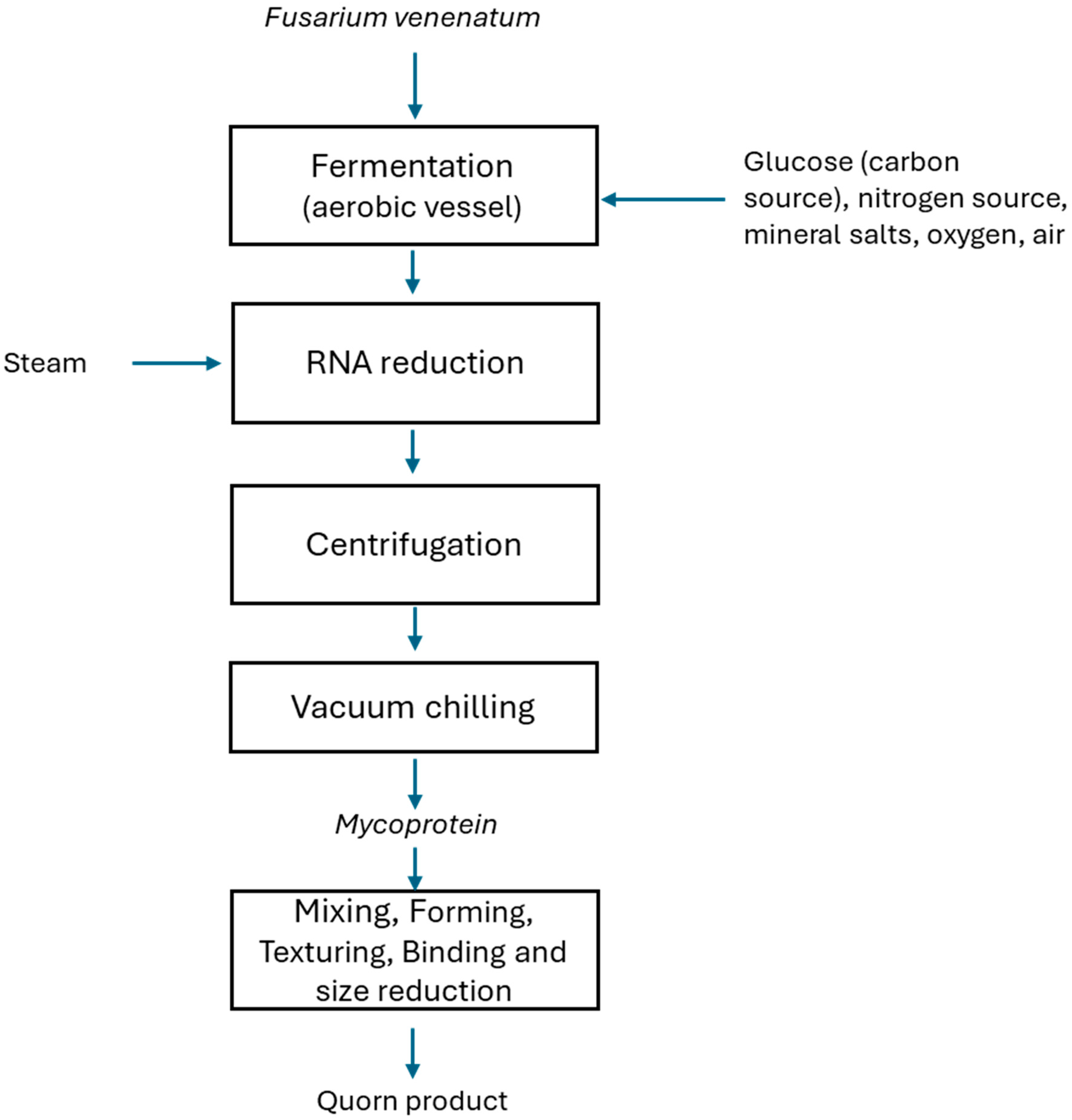
Figure 2.
Examples of bioreactor designs: a. Stirred tank and b. Airlift bioreactors.
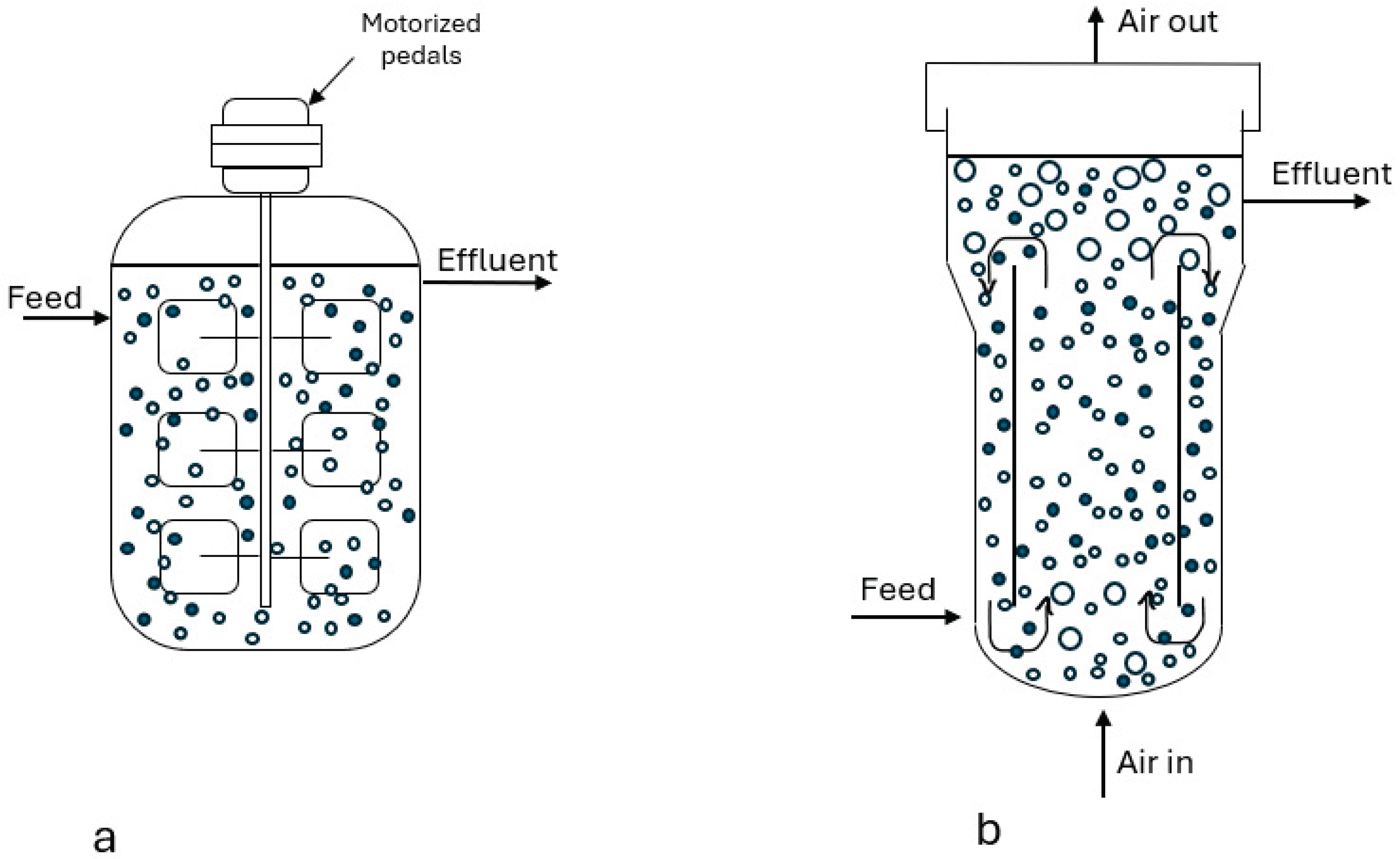

Table 1.
Global meat production between 1960 and 2022.
| Region | Production per year | ||
| 1961 (million tons) | 2022 (million tons) | Relative change | |
| Africa | 3.681 | 22.742 | +518% |
| Asia | 9.034 | 155.082 | +1617% |
| Europe | 29.454 | 59.082 | +101% |
| North America | 19.582 | 63.992 | +227% |
| Oceania | 2.296 | 6.537 | +185% |
| South America | 6.516 | 48.023 | +637% |
Source: Data obtained from [17].
Table 2.
Nutrient composition of SCP from different sources.
| Protein | Fat | Ash | Nucleic acid | |
| Fungi | 50-55 | 2-8 | 4-19 | 7-10 |
| Macroalgae | 40-60 | 7-20 | 8-10 | 3-8 |
| Yeast | 55-60 | 2-6 | 5-10 | 6-12 |
| Bacteria | 72-85 | 1-3 | 3-7 | 8-12 |
Source: [42].
Table 3.
Some starch-rich substrates used for yeast and fungal fermentation.
| Waste | Fungi | Fermentation type | Results | References |
| BSG | Aspergillus oryzae | SmF + enzymatic hydrolysis | Increased methane yield and COD removal of 85.2% | [94] |
| BSG | Saccharomyces cerevisiae | SmF +Dilute phosphoric acid | 92% total sugar recovery | [95] |
| Potato peel waste | Rhizopus oryzae | SmF + enzymatic hydrolysis | Increase ethanol and lactic acid yield | [96] |
| BSG and sugarcane molasses | Saccharomyces cerevisae | Dilute acid hydrolysis +SmF | Increased reducing sugar, ethanol yield and 67.1% lignin removal | [97] |
| RB | Aspergillus oryzae | SSF | Increased Total phenolic content, condensed tannin content | [98] |
Table 4.
Total starch, amylose, amylopectin and relative crystallinity of some cereal, roots and tubers.
Table 4.
Total starch, amylose, amylopectin and relative crystallinity of some cereal, roots and tubers.
| Starch Source |
Amylose (%) | Amylopectin (%) | Amylose:Amylopectin | Relative crystallinity | References |
| Wheat | 20-30 | 70-80 | 20:80 to 30:70 | 27-30 | [108] |
| Rice | 15-35 | 65-85 | 15:85 to 35:65 | 34 | [109] |
| Rice (waxy) | <1 | >99 | <1:99 | 30-35 | [110] |
| Maize (corn) | 25-30 | 70-75 | 25:75 to 30:70 | 32-33 | [111] |
| Maize (high) | >50 | <50 | >50:<50 | 20-25 | [112] |
| Potato | 20-30 | 70-80 | 20:80 to 30:70 | 37-38 | [110] |
| Sweet potato | 15-25 | 75-85 | 15:85 to 25:75 | 33 | [113] |
| Cassava | 15-25 | 75-85 | 15:85 to 25:75 | 38-40 | [114] |
| Yam | 20-30 | 70-80 | 20:80 to 30:70 | 25-35 | [115] |
| Maize (waxy) | <1 | >99 | <1:99 | 35-40 | [116] |
Disclaimer/Publisher’s Note: The statements, opinions and data contained in all publications are solely those of the individual author(s) and contributor(s) and not of MDPI and/or the editor(s). MDPI and/or the editor(s) disclaim responsibility for any injury to people or property resulting from any ideas, methods, instructions or products referred to in the content. |
© 2026 by the authors. Licensee MDPI, Basel, Switzerland. This article is an open access article distributed under the terms and conditions of the Creative Commons Attribution (CC BY) license (http://creativecommons.org/licenses/by/4.0/).
Copyright: This open access article is published under a Creative Commons CC BY 4.0 license, which permit the free download, distribution, and reuse, provided that the author and preprint are cited in any reuse.


