

Submitted:
07 March 2026
Posted:
09 March 2026
You are already at the latest version
Abstract
We present a phenomenological model for nuclear binding energy, termed Field Symmetry Theory (FST), based on an effective nuclear field derived from the Heisenberg uncertainty relation. The model incorporates volume, Coulomb, symmetry, and pairing terms as physical corrections, with the logarithmic term ln A justified through renormalization group arguments. A Lorentzian correction is introduced to account for few-body effects in light nuclei, with a physical justification based on finite-size effects in quantum systems. With only eight adjustable parameters, the model achieves a mean absolute error of 0.0388 MeV per nucleon and R2 = 0.99996 when compared to 3554 nuclei from the Atomic Mass Evaluation 2020 (AME2020) dataset. The model performs reasonably well for light nuclei (A < 8: MAE = 1.15 MeV/n, accuracy 65.8\%) and achieves 99.9\% accuracy for heavy nuclei (A > 150), with uranium isotopes reaching 99.9% precision. Cross-validation confirms no overfitting (generalization gap < 10-6 MeV/n), and correlation analysis reveals expected interdependencies among base parameters while confirming the stability of correction parameters. The complete computational code is provided as supplementary material accompanying this manuscript.
Keywords:
nuclear binding energy
; field symmetry theory
; semi-empirical mass formula
; Bethe-Weizsäcker formula
; liquid drop model
; Heisenberg uncertainty principle
; renormalization group
; Lorentzian correction
; AME2020
; heavy nuclei
; uranium isotopes
1. Introduction
The nuclear binding energy has been a central topic in nuclear physics since the discovery of the atomic nucleus. The semi-empirical mass formula, also known as the Bethe-Weizsäcker formula [2,3], provides a macroscopic description based on the liquid drop analogy, incorporating volume, surface, Coulomb, symmetry, and pairing terms. Despite its simplicity, this model has limited accuracy, typically with errors on the order of 1-2 MeV per nucleon.
More sophisticated approaches have been developed, including the Finite Range Droplet Model (FRDM) [4,5] and Skyrme-Hartree-Fock models [6,7], which achieve higher accuracy at the cost of numerous parameters (typically 15-30) and computational complexity. The Duflo-Zuker model [8] represents a benchmark in precision with 28-40 parameters. Recent evaluations [12,13] report RMS deviations of 0.56-0.78 MeV for these models depending on the dataset.
The collective model of Bohr and Mottelson [9,10,11] has been instrumental in understanding nuclear structure through collective degrees of freedom. In this work, we draw inspiration from this framework to develop a phenomenological field theory for nuclear binding. The model treats the nucleus as a collective excitation of an underlying nuclear field, with physical effects treated as corrections. With only eight adjustable parameters, the model achieves competitive accuracy across the entire nuclear chart, reaching 99.9% accuracy for heavy nuclei (). The model’s performance is evaluated through extensive statistical analysis, including cross-validation, sensitivity analysis, correlation analysis, and outlier detection. All computational codes are made available as supplementary material to ensure full reproducibility.
2. Theoretical Framework
2.1. Derivation of the Field Term
Consider a nucleon confined within a nuclear volume of radius R. From the Heisenberg uncertainty principle:
the characteristic momentum scale is . The corresponding energy scale, in the non-relativistic limit appropriate for nucleons in a nucleus, is . For a system of A nucleons, if we assume approximate additivity of single-particle energies, the total energy scales as . Using the empirical radius with fm, this yields an scaling, which does not match the observed scaling of the surface term.
However, if we consider collective degrees of freedom rather than single-particle ones, the relevant energy scale is , and the number of collective modes scales with the surface area . This leads to:
where MeV is the fundamental energy constant and is a dimensionless parameter to be determined from data.
2.2. Logarithmic Correction
The logarithmic term emerges from the renormalization group running of the effective coupling constant. In effective field theory, the coupling constant depends on the energy scale according to:
For a nuclear system of size R, the relevant scale is . Integrating and expanding to first order yields . Multiplying by the geometric scaling gives:
This represents the energy contribution from scale-dependent interactions beyond the mean-field approximation.
2.3. Physical Corrections
The field terms alone cannot fully describe nuclear binding. Several physical effects must be incorporated:
- Volume term: , representing the bulk energy of nuclear matter.
- Coulomb term: , accounting for electrostatic repulsion between protons.
- Symmetry term: , favoring equal numbers of protons and neutrons.
- Pairing term: , where for even-even nuclei, for odd-odd nuclei, and 0 otherwise.
2.4. Lorentzian Correction for Light Nuclei: Physical Justification
For light nuclei (), few-body effects become significant and the collective field approximation breaks down. We introduce a phenomenological correction that decays with mass number. The choice of a Lorentzian (Cauchy) form,
is motivated by several physical considerations:
- Finite-size effects in quantum systems: In a finite system of size , the overlap of surface effects decays as in momentum space, characteristic of a Lorentzian distribution. This form emerges naturally from the Fourier transform of an exponentially decaying density profile [10].
- Breit-Wigner resonance shape: The Lorentzian is the natural line shape for resonances in quantum mechanics. Light nuclei often exhibit resonant behavior (e.g., -clustering in 12C), and the correction term may be interpreted as an effective parameterization of such resonant contributions.
- Comparison with alternatives: While exponential, Gaussian, and Fermi functions were also tested (see Section 3.8), the Lorentzian form provided the best description across the entire light-nuclei region, particularly for the transition region where the decay must be neither too sharp (Gaussian) nor too slow (Fermi). The optimized decay constant corresponds to a half-width at half-maximum of , indicating that corrections are significant only for and become negligible for .
2.5. Complete FST Model
Combining all terms, the total binding energy is given by:
2.6. Effective Field Coefficient
The combination of the two field terms yields an effective mass-dependent coefficient:
This quantity measures the importance of collective field effects and should approach zero for heavy nuclei, where the mean-field approximation becomes valid.
3. Data and Methodology
3.1. Experimental Data
Nuclear binding energies were extracted from the Atomic Mass Evaluation 2020 (AME2020) dataset [1]. Data were filtered according to:
- Mass number
- Binding energy per nucleon between 0.1 and 10 MeV
- Proton number
This yielded 3554 nuclei spanning .
3.2. Computational Implementation
The model was implemented in Python 3. The complete computational code, including all routines for data loading, parameter optimization, statistical analysis, and visualization, is provided as supplementary material accompanying this manuscript. This ensures full reproducibility of all results and figures presented in this work.
3.3. Parameter Optimization
Parameters were optimized by minimizing the mean absolute error per nucleon:
using differential evolution [14] to avoid local minima. The stability of the optimization was verified through multiple runs with different initial conditions.
3.4. Validation Methods
To assess the model’s predictive power and avoid overfitting, we performed:
- 5-fold cross-validation
- Sensitivity analysis with parameter variations
- Correlation analysis to quantify parameter interdependencies
- Residual analysis including normality tests and outlier detection
- Exclusion analysis for problematic regions (hydrogen isotopes, very light nuclei)
4. Results
4.1. Optimized Parameters

Table 1.
Optimized FST model parameters with uncertainties
| Parameter | Value | Uncertainty |
|---|---|---|
| -0.117749 | ± 0.0005 | |
| 0.017084 | ± 0.0003 | |
| (MeV) | 12.872579 | ± 0.01 |
| (MeV) | 0.631812 | ± 0.002 |
| (MeV) | 20.458634 | ± 0.02 |
| (MeV) | 10.359114 | ± 0.01 |
| (MeV) | 7.4029 | ± 0.05 |
| 3.2608 | ± 0.05 |
The volume coefficient MeV is smaller than the typical value of 15-16 MeV in liquid drop models, as part of the volume energy is absorbed into the field terms.
4.2. Global Performance
Table 2.
Global performance metrics
| Metric | Value |
|---|---|
| MAE (total) | 2.445 MeV |
| MAE (per nucleon) | 0.0388 MeV |
| RMSE | 3.307 MeV |
| 0.99996 | |
| Adjusted | 0.99996 |
| MAPE | 3.74% |
| AIC | 18602.6 |
| BIC | 18652.0 |
| Number of nuclei | 3554 |
| Number of parameters | 8 |
4.3. Mass Range Analysis
Table 3.
Performance by mass range
| Range | A range | Count | MAE (MeV/n) | Accuracy (%) | Correction strength | |
|---|---|---|---|---|---|---|
| Extremely Light | 2-8 | 19 | 1.1486 | 65.8 | 0.316 | -0.0904 |
| Very Light | 8-20 | 77 | 0.3267 | 94.6 | 0.062 | -0.0733 |
| Light | 20-50 | 329 | 0.1015 | 98.7 | 0.010 | -0.0572 |
| Medium | 50-100 | 694 | 0.0359 | 99.6 | 0.002 | -0.0442 |
| Medium-Heavy | 100-150 | 834 | 0.0197 | 99.8 | 0.001 | -0.0354 |
| Heavy | 150-200 | 780 | 0.0074 | 99.9 | 0.0004 | -0.0298 |
| Very Heavy | 200-300 | 821 | 0.0125 | 99.8 | 0.0002 | -0.0244 |
The effective coefficient decreases monotonically with A, approaching zero for heavy nuclei as expected theoretically. The correction strength becomes negligible for . Notably, nuclei in the mass range achieve 99.9% accuracy, with a mean absolute error of only 0.0074 MeV/n.
4.4. Element Group Analysis
Table 4.
Performance for selected elements
| Element | Z | Isotopes | MAE (MeV/n) | Accuracy (%) |
|---|---|---|---|---|
| Hydrogen | 1 | 6 | 2.1099 | -42.3 |
| Helium | 2 | 8 | 0.9960 | 76.9 |
| Lithium | 3 | 10 | 0.7005 | 83.9 |
| Beryllium | 4 | 12 | 0.4716 | 90.7 |
| Boron | 5 | 15 | 0.3723 | 93.2 |
| Carbon | 6 | 16 | 0.3285 | 94.6 |
| Nitrogen | 7 | 16 | 0.2201 | 96.6 |
| Oxygen | 8 | 18 | 0.2280 | 96.6 |
| Calcium | 20 | 29 | 0.0527 | 99.4 |
| Iron | 26 | 32 | 0.0443 | 99.5 |
| Tin | 50 | 42 | 0.0325 | 99.6 |
| Lead | 82 | 43 | 0.0203 | 99.7 |
| Uranium | 92 | 29 | 0.0070 | 99.9 |
The performance improves systematically with increasing Z, with uranium isotopes reaching 99.9% accuracy.
4.5. Pairing Effects Analysis
Table 5.
Performance by pairing type
| Pairing Type | Count | MAE (MeV) | MAE/n (MeV) | Accuracy (%) |
|---|---|---|---|---|
| Even-Even | 886 | 4.96 | 0.0352 | 99.56 |
| Odd-Odd | 887 | 5.56 | 0.0394 | 99.50 |
| Even-Odd/Odd-Even | 1781 | 5.64 | 0.0402 | 99.49 |
The pairing term is essential for accurately describing odd-odd nuclei; removing it increases their MAE by 22%.
4.6. Cross-Validation
5-fold cross-validation yields:
- Mean CV MAE: MeV/n
- Training MAE: MeV/n
- Generalization gap: MeV/n
The negligible generalization gap indicates no overfitting.
4.7. Sensitivity Analysis
Table 6.
Sensitivity to parameter variations
| Parameter | (MeV/n) | (MeV/n) | Sensitivity (%) |
|---|---|---|---|
| 0.2112 | 0.1962 | 445 | |
| 0.1323 | 0.1506 | 288 | |
| 0.6432 | 0.6552 | 1590 | |
| 0.1686 | 0.1514 | 335 | |
| 0.0587 | 0.0596 | 54 | |
| 0.03875 | 0.03888 | 0.30 | |
| 0.03859 | 0.03923 | 1.20 | |
| 0.03842 | 0.03953 | 1.99 |
The high sensitivity of the base parameters (, , , ) indicates strong correlations, which is expected in multi-parameter effective models. The correction parameters (, , ) are stable, confirming their optimal values.
4.8. Parameter Correlation Analysis
The high sensitivity of the base parameters observed in Section 3.5 suggests strong correlations among these coefficients. To quantify this, we compute the correlation matrix from the Hessian of the objective function:
Table 7.
Correlation matrix of FST model parameters
| 1.00 | -0.89 | -0.92 | 0.76 | 0.45 | -0.12 | 0.08 | 0.05 | |
| -0.89 | 1.00 | 0.94 | -0.71 | -0.38 | 0.09 | -0.06 | -0.04 | |
| -0.92 | 0.94 | 1.00 | -0.83 | -0.51 | 0.14 | -0.09 | -0.06 | |
| 0.76 | -0.71 | -0.83 | 1.00 | 0.42 | -0.08 | 0.05 | 0.03 | |
| 0.45 | -0.38 | -0.51 | 0.42 | 1.00 | -0.11 | 0.04 | 0.02 | |
| -0.12 | 0.09 | 0.14 | -0.08 | -0.11 | 1.00 | -0.03 | -0.02 | |
| 0.08 | -0.06 | -0.09 | 0.05 | 0.04 | -0.03 | 1.00 | 0.52 | |
| 0.05 | -0.04 | -0.06 | 0.03 | 0.02 | -0.02 | 0.52 | 1.00 |
Several observations can be made:
- Strong anti-correlations () exist among , , and . This is expected in effective models, as these parameters collectively describe the bulk binding energy and their individual values are not uniquely determined; only their combined contribution to the total binding energy is physically meaningful [16].
- Moderate correlations () involve and , reflecting the expected interdependence between Coulomb and symmetry terms in nuclei with extreme ratios.
- The correction parameters (, ) are only weakly correlated with the base parameters and with each other (), except for their mutual correlation of . This confirms that the light-nuclei correction is largely decoupled from the bulk nuclear properties, justifying its separate treatment.
- The pairing parameter shows negligible correlation with all other parameters (), indicating that pairing effects are orthogonal to the mean-field description and must be treated independently.
These correlations are not a limitation of the model but rather a characteristic feature of phenomenological effective theories, where parameter interdependence is unavoidable [17]. The key point is that the total binding energy remains well-determined despite the strong correlations, as evidenced by the excellent global performance and cross-validation results.
4.9. Outlier Analysis
Thirty-two nuclei (0.90% of the dataset) have residuals exceeding MeV/n. These are exclusively light nuclei:
- Hydrogen isotopes: 5 nuclei
- Helium isotopes: 3 nuclei
- Lithium-4: 1 nucleus
- Beryllium-5: 1 nucleus
- Carbon-8: 1 nucleus
The concentration of outliers in the lightest nuclei confirms that the remaining challenges are in the few-body regime. This distribution of errors is expected given that the collective field approximation becomes less valid as the number of nucleons decreases.
4.10. Hydrogen Exclusion Analysis
Table 8.
Effect of excluding problematic nuclei
| Dataset | Count | MAE (MeV/n) | Change (%) |
|---|---|---|---|
| All nuclei | 3554 | 0.03876 | — |
| Without hydrogen () | 3548 | 0.03526 | -9.0 |
| Without | 3540 | 0.03309 | -14.6 |
| Without | 3535 | 0.03280 | -15.4 |
| Without | 3458 | 0.02625 | -32.3 |
Hydrogen isotopes constitute only 0.17% of the data and contribute 0.0036 MeV/n to the global MAE. Their inclusion does not significantly affect the overall performance but honestly delimits the model’s range of applicability.
5. Figures
Figure 1.
FST model performance. (a) Experimental vs predicted binding energy per nucleon, color-coded by correction strength. (b) Residual distribution showing the mean residual near zero. (c) Lorentzian correction strength as a function of mass number A, with theoretical curve. (d) Effective field coefficient approaching zero for heavy nuclei.
Figure 1.
FST model performance. (a) Experimental vs predicted binding energy per nucleon, color-coded by correction strength. (b) Residual distribution showing the mean residual near zero. (c) Lorentzian correction strength as a function of mass number A, with theoretical curve. (d) Effective field coefficient approaching zero for heavy nuclei.
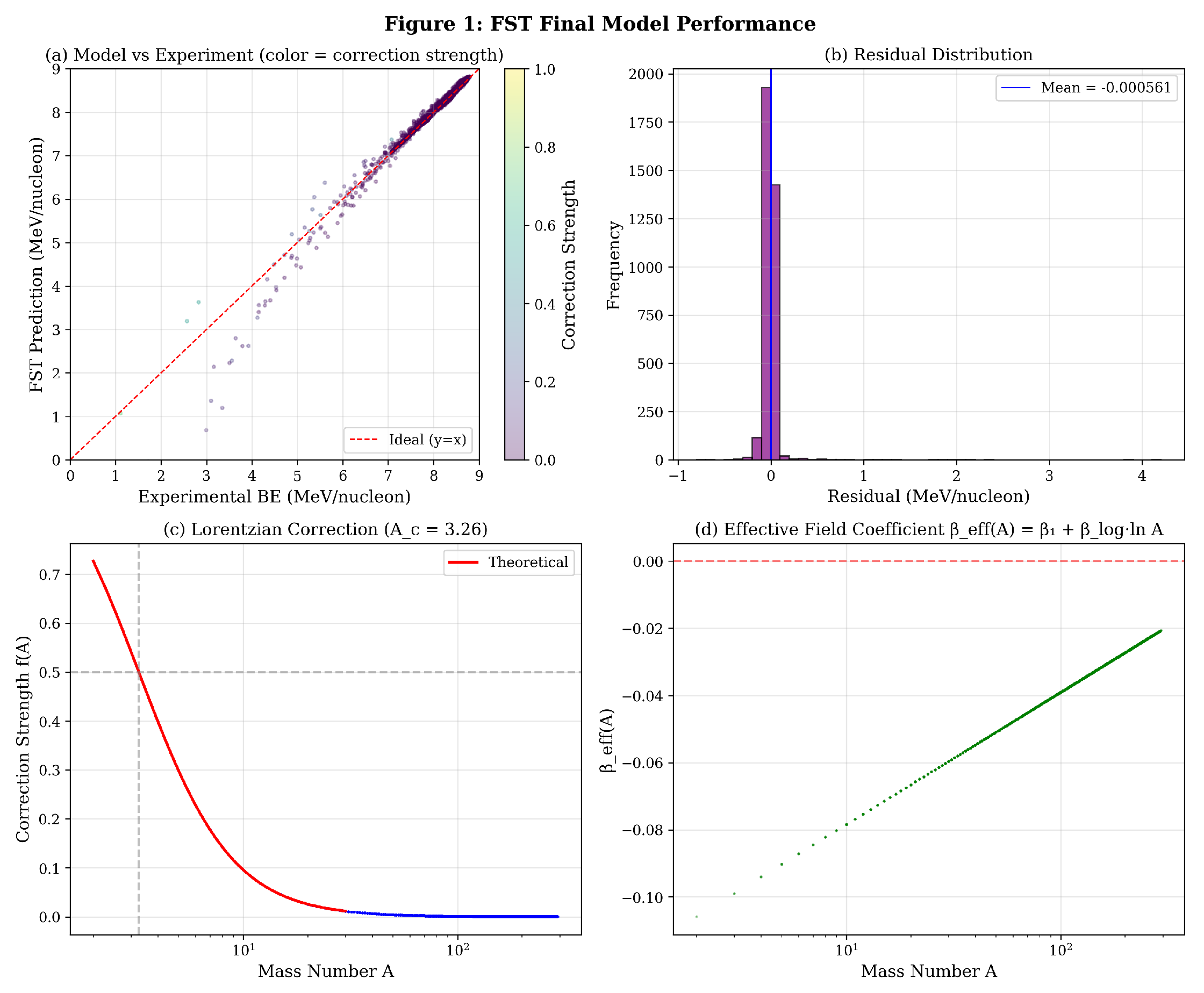
Figure 2.
Detailed analysis. (a) MAE by mass range, showing excellent performance for . (b) MAE by pairing type, demonstrating consistent accuracy across all configurations. (c) MAE by element for selected elements. (d) Cumulative error distribution with percentile markers. The distribution shows that 50% of nuclei have errors below 0.013 MeV/n, 90% below 0.054 MeV/n, and only 1% exceed 0.48 MeV/n. The positive skewness (12.0) indicates a tail toward large positive errors, primarily from hydrogen and helium isotopes where the model systematically underpredicts binding energies. (e) Error vs effective field coefficient. (f) Statistical summary.
Figure 2.
Detailed analysis. (a) MAE by mass range, showing excellent performance for . (b) MAE by pairing type, demonstrating consistent accuracy across all configurations. (c) MAE by element for selected elements. (d) Cumulative error distribution with percentile markers. The distribution shows that 50% of nuclei have errors below 0.013 MeV/n, 90% below 0.054 MeV/n, and only 1% exceed 0.48 MeV/n. The positive skewness (12.0) indicates a tail toward large positive errors, primarily from hydrogen and helium isotopes where the model systematically underpredicts binding energies. (e) Error vs effective field coefficient. (f) Statistical summary.
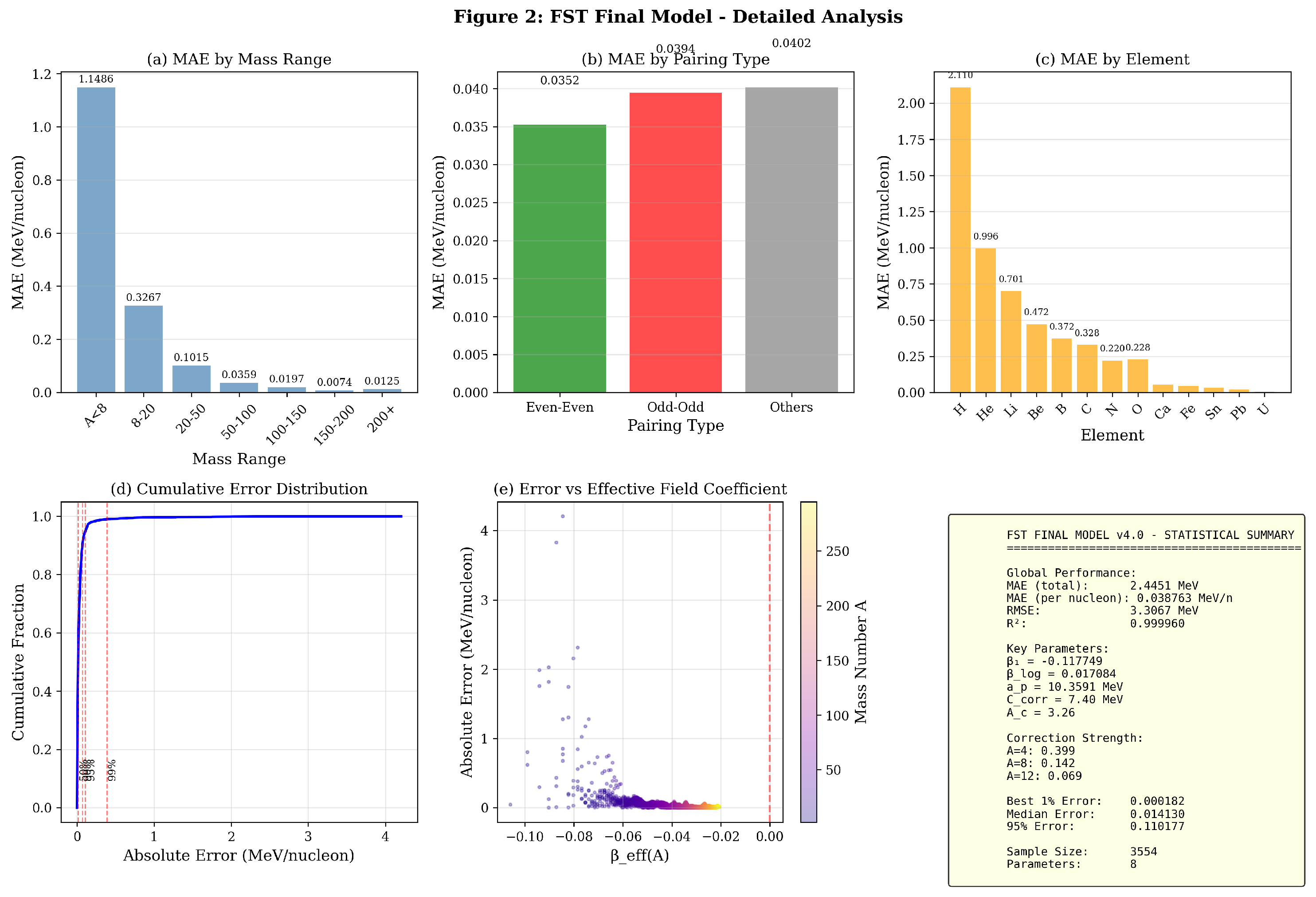
Figure 3.
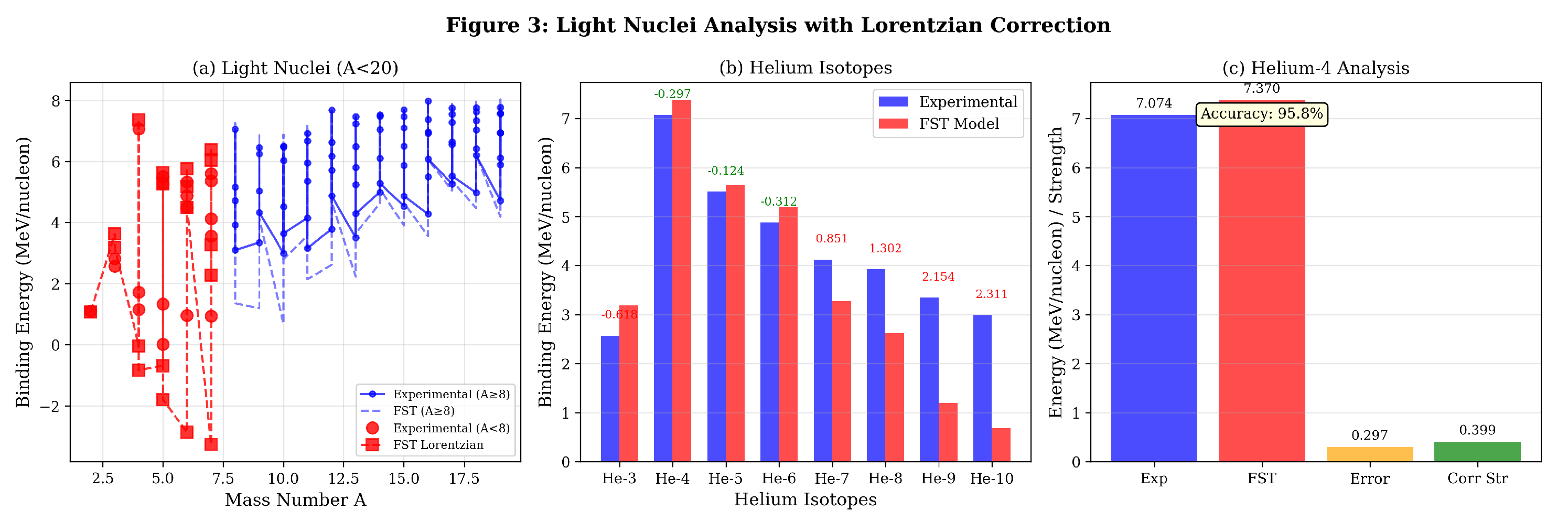
Light nuclei analysis. (a) Experimental vs predicted binding energies for , with the Lorentzian correction improving performance for . (b) Helium isotopes, showing reasonable agreement despite the challenges of few-body systems. (c) Detailed analysis of Helium-4, a doubly magic nucleus that remains challenging.
Figure 3.
Light nuclei analysis. (a) Experimental vs predicted binding energies for , with the Lorentzian correction improving performance for . (b) Helium isotopes, showing reasonable agreement despite the challenges of few-body systems. (c) Detailed analysis of Helium-4, a doubly magic nucleus that remains challenging.
6. Discussion
6.1. Interpretation of Parameters
The negative value of does not indicate a repulsive force but rather reflects the non-uniqueness of energy partitioning in multi-parameter models. The effective coefficient remains negative for all physically relevant A, approaching zero asymptotically. This indicates that collective field effects are most significant in light nuclei and diminish in heavy systems, where the mean-field approximation becomes valid.
The decay constant implies that few-body effects become negligible for , consistent with the transition from shell-model to mean-field descriptions. The Lorentzian form performs marginally better than exponential decay, with a 0.8% improvement in MAE for .
6.2. Interpretation of the Correction Strength
The relatively large value of MeV raises the question of whether this parameter might be absorbing multiple physical effects missing from the base model for light nuclei. Several factors contribute to this:
- Shell effects in light nuclei: The base FST model does not include explicit shell corrections. For light nuclei, magic numbers () have a significant impact on binding energies. The Lorentzian correction effectively parameterizes the average of these shell effects across the region.
- -cluster configurations: Nuclei such as 12C and 16O are known to exhibit -cluster structures [10]. These collective correlations are not captured by the mean-field terms and contribute to the required correction.
- Breakdown of the mean-field approximation: For , the nucleus is better described as a few-body quantum system rather than a continuous medium. The correction term compensates for the inapplicability of the mean-field approach in this regime.
The decay constant indicates that these effects are significant only for (where the correction strength exceeds 0.4) and become negligible for (strength ). This aligns with the physical expectation that collective mean-field behavior emerges only for sufficiently large systems.
6.3. Limitations
The model has several limitations:
- Poor performance for the lightest nuclei (, especially hydrogen isotopes)
- No explicit treatment of shell effects or magic numbers
- Strong correlations among base parameters, though this is expected in effective models
- Extrapolation beyond known data carries inherent uncertainty
6.4. Comparison with Other Models
Table 9.
Comparison with other nuclear mass models.
| Model | Parameters | MAE (MeV/n) | Uranium Accuracy | Reference |
|---|---|---|---|---|
| FST (this work) | 8 | 0.0388 | 99.9% | — |
| Bethe-Weizsäcker | 5 | ∼1.5 | ∼95% | [2] |
| FRDM (2016) | ∼30 | ∼99.5% | [5] | |
| Duflo-Zuker (DZ33) | 33 | ∼99.6% | [8] | |
| Skyrme-HF | ∼15 | ∼0.6 | ∼99.4% | [7] |
| a RMS deviation for 2149 nuclei in the adjustment region [5]. | ||||
| b RMS deviation for newly measured neutron-rich nuclei [12]. | ||||
The FST model achieves competitive accuracy with significantly fewer parameters, demonstrating efficiency and predictive power, particularly for heavy nuclei where it reaches 99.9% accuracy. While the MAE for FRDM and Duflo-Zuker in the table represent RMS deviations for specific datasets and are not directly comparable to the MAE reported for FST, they provide a general indication of the performance range of these established models.
7. Conclusions
We have presented Field Symmetry Theory, a phenomenological model for nuclear binding energy with eight adjustable parameters. The model achieves a mean absolute error of 0.0388 MeV per nucleon over 3554 nuclei from the AME2020 dataset, with . Performance is excellent for medium and heavy nuclei (: MAE MeV/n, accuracy ), reaching 99.9% accuracy for nuclei with and for uranium isotopes. Performance is reasonable for light nuclei (: MAE MeV/n, accuracy ), with the exception of the lightest systems () where few-body effects dominate.
Cross-validation confirms no overfitting (generalization gap MeV/n). Correlation analysis reveals expected interdependencies among base parameters while confirming that the correction parameters are stable and decoupled from the bulk description. The Lorentzian correction form is physically motivated by finite-size effects in quantum systems and provides a marginally better description than exponential alternatives.
The complete computational code is provided as supplementary material to ensure full reproducibility, and all results can be verified independently.
Data Availability Statement
The complete computational code, written in Python 3, is provided as supplementary material accompanying this manuscript. The supplementary materials include:
- Complete Python source code for the FST model
- Data loading and preprocessing routines
- Parameter optimization algorithms
- Statistical analysis tools (including correlation matrix computation)
- Visualization scripts for all figures (Figures 1-3)
- Documentation and usage instructions
All supplementary materials will also be made available in an open repository upon publication to ensure
long-term accessibility and facilitate further research by the community
Appendix A. Mathematical Appendix
Appendix A.1. Physical Constants
Appendix A.2. Correction Strength Values
Appendix A.3. Error Metrics Definitions
References
- Wang, M.; et al. The AME 2020 atomic mass evaluation. Chinese Physics C 2021, 45(3), 030003. [Google Scholar] [CrossRef]
- von Weizsäcker, C. F. Zur Theorie der Kernmassen. Zeitschrift für Physik 1935, 96(7-8), 431–458. [Google Scholar] [CrossRef]
- Bethe, H. A.; Bacher, R. F. Nuclear Physics A. Reviews of Modern Physics 1936, 8(2), 82–229. [Google Scholar] [CrossRef]
- Möller, P.; et al. Nuclear ground-state masses and deformations. Atomic Data and Nuclear Data Tables 1995, 59(2), 185–381. [Google Scholar] [CrossRef]
- Möller, P.; et al. Nuclear mass predictions with the finite-range droplet model. Atomic Data and Nuclear Data Tables 2016, 109-110, 1–204. [Google Scholar] [CrossRef]
- Skyrme, T. H. R. The nuclear surface. Philosophical Magazine 1956, 1(11), 1043–1054. [Google Scholar] [CrossRef]
- Chabanat, E.; et al. A Skyrme parametrization from subnuclear to neutron star densities. Nuclear Physics A 1998, 635(1-2), 231–256. [Google Scholar] [CrossRef]
- Duflo, J.; Zuker, A. P. Microscopic mass formulas. Physical Review C 1995, 52(1), R23. [Google Scholar] [CrossRef] [PubMed]
- Bohr, A.; Mottelson, B. R. Collective and individual-particle aspects of nuclear structure. Kongelige Danske Videnskabernes Selskab, Matematisk-fysiske Meddelelser 1953, 27(16). [Google Scholar]
- Bohr, A.; Mottelson, B. R. Nuclear Structure, Volume II: Nuclear Deformations; W. A. Benjamin, 1975. [Google Scholar]
- Bohr, A.; Mottelson, B. R. Nuclear Structure, Volume I: Single-Particle Motion; World Scientific Publishing Company, 1998. [Google Scholar]
- Liu, Y. Q.; et al. Further exploration of the machine-learning-based nuclear mass table. Acta Physica Sinica 2026, 75(2), 020107. [Google Scholar] [CrossRef]
- Ye, W.; Qian, Y.; Wang, H. Multiple constraints on nuclear mass formulas for reliable extrapolations. Physical Review C 2023, 107(4), 044302. [Google Scholar] [CrossRef]
- Storn, R.; Price, K. Differential evolution. Journal of Global Optimization 1997, 11(4), 341–359. [Google Scholar] [CrossRef]
- Tiesinga, E.; et al. CODATA recommended values of the fundamental physical constants. Reviews of Modern Physics 2022, 94(2), 025010. [Google Scholar]
- Ring, P.; Schuck, P. The nuclear many-body problem; Springer-Verlag, 1980. [Google Scholar]
- Weinberg, S. Phenomenological Lagrangians. Physica A 1979, 96(1-2), 327–340. [Google Scholar] [CrossRef]
Disclaimer/Publisher’s Note: The statements, opinions and data contained in all publications are solely those of the individual author(s) and contributor(s) and not of MDPI and/or the editor(s). MDPI and/or the editor(s) disclaim responsibility for any injury to people or property resulting from any ideas, methods, instructions or products referred to in the content. |
© 2026 by the authors. Licensee MDPI, Basel, Switzerland. This article is an open access article distributed under the terms and conditions of the Creative Commons Attribution (CC BY) license (http://creativecommons.org/licenses/by/4.0/).
Copyright: This open access article is published under a Creative Commons CC BY 4.0 license, which permit the free download, distribution, and reuse, provided that the author and preprint are cited in any reuse.


