

Submitted:
03 March 2026
Posted:
09 March 2026
You are already at the latest version
Abstract
Artificial intelligence (AI) is increasingly embedded in development systems, enabling new capabilities for poverty prediction, social protection targeting, and service delivery optimisation across sectors such as finance, agriculture, health and education, yet its implications for poverty governance in low- and middle-income settings remain fragmented. This study conducted a systematic literature review of South Africa’s DHET peer-reviewed journal articles and scholarly book chapters published within the last decade, screening studies for relevance to AI-enabled poverty reduction applications including predictive analytics, high-resolution poverty mapping, digital financial inclusion, precision agriculture, health diagnostics, educational personalisation, and public-sector digital transformation. A thematic synthesis was applied to identify cross-cutting patterns related to system performance, implementation processes, governance considerations, and contextual constraints. The reviewed evidence indicates that AI can improve poverty governance through multimodal data integration, enhanced targeting accuracy, automated administrative processes, expanded access to financial and basic services, and strengthened rural livelihood systems. However, persistent challenges include biased or incomplete datasets, infrastructural and computational limitations, weak interoperability, regulatory gaps, and ethical risks regarding privacy, accountability and exclusion, which may reinforce structural inequalities through misclassification and unequal access. The review contributes an integrated evidence base and highlights that developmental gains from AI depend on robust data governance, inclusive digital infrastructure, context-sensitive design, algorithmic transparency, and institutional capacity, while future research should prioritise impact evaluation, fairness-aware and explainable AI, participatory design, and scalable approaches for low-resource environments.
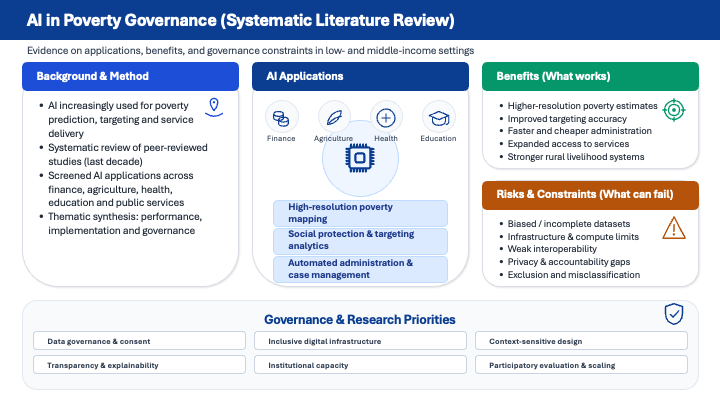
Keywords:
artificial intelligence
; poverty reduction
; machine learning
; predictive analytics
; social protection
; financial inclusion
; rural livelihoods
; digital development
; data governance
; sustainable development goals
1. Introduction
The emergence of artificial intelligence as a general-purpose technology has coincided with renewed global efforts to tackle persistent and multidimensional poverty. Over the past decade, AI systems have been progressively integrated into the infrastructures that govern social protection, agriculture, health, education, financial services and public administration. This convergence has stimulated an expanding body of research on whether and how AI can meaningfully contribute to poverty reduction and inclusive development (Goralski and Tan, 2022; Thanyawatpornkul, 2024; Ogbuju et al., 2025). At the same time, there is growing concern that AI may exacerbate existing inequalities through biased decision making, exclusion of data poor populations and the deepening of digital divides (Nemorin et al., 2023; Sinanan and McNamara, 2021; Gerlich, 2023).
Conventional poverty reduction strategies remain constrained by limitations in data, institutional capacity and responsiveness. Household surveys, census exercises and administrative records are typically collected at long intervals and are often incomplete or outdated by the time they are used for programme design. These limitations reduce the effectiveness of targeted interventions, weaken early warning systems and slow responses to shocks such as pandemics, climate extremes or economic crises. AI based methods offer a potential remedy by enabling the analysis of large, heterogeneous and frequently updated datasets, ranging from satellite imagery and geospatial data to mobile phone records, digital payments, health information systems and social media traces (McBride et al., 2022; Hall et al., 2023; Usmanova et al., 2022).
Across multiple sectors, AI is now used to generate fine grained poverty maps, predict vulnerability to shocks, identify eligible beneficiaries, optimise the allocation of scarce resources and monitor programme performance in near real time. AI enabled credit scoring models built on alternative data sources expand access to microfinance and digital financial services for populations excluded from formal banking due to lack of collateral or credit histories (Mhlanga, 2021; Del Sarto and Ozili, 2025; Adjei et al., 2022). In agriculture, AI supports yield prediction, disease detection, climate smart decision making and supply chain optimisation, which are vital for rural livelihoods and food security (Etuk and Ayuk, 2021; Bahn et al., 2021; Onyeaka et al., 2023; Miani et al., 2023; Munguti et al., 2022). In health systems, AI models improve disease surveillance, triage and remote diagnostics, while AI enhanced telemedicine helps to overcome spatial barriers to care in low income regions (Guru Basava Aradhya et al., 2025; Arnold, 2025; Ogbuju et al., 2025). AI also has emerging applications in education, through adaptive learning platforms and intelligent tutoring systems aimed at improving educational access and learning outcomes for disadvantaged learners (Nemorin et al., 2023; Thanyawatpornkul, 2024).
Yet the same technologies that make AI powerful for development raise complex risks. Studies highlight problems of biased training data, opaque model behaviour, weak regulatory safeguards and limited public understanding of AI systems (Liang et al., 2022; Gerlich, 2023; Raman et al., 2025). In many low resource environments, limited connectivity, energy constraints and insufficient digital infrastructure impede AI deployment (Avordeh et al., 2024; Jejeniwa and Mhlongo, 2024). Concerns have also been raised about surveillance, the erosion of privacy and the potential for AI based social welfare systems to deepen control over marginalised groups rather than empower them (Sinanan and McNamara, 2021; Nemorin et al., 2023). These tensions underscore the need to understand AI not only as a technical innovation but also as a socio political and ethical phenomenon.
Given rapid growth in the literature, there is now a fragmented but substantial body of work scattered across multiple disciplines, including development economics, information systems, agricultural sciences, public health, public administration and political science. While several reviews examine specific subdomains such as AI for poverty prediction (Usmanova et al., 2022; Hall et al., 2023), AI for sustainable development (Thanyawatpornkul, 2024; Liengpunsakul, 2021; Raman et al., 2025) or AI and digitalisation in particular sectors (Bahn et al., 2021; Mishra et al., 2025; Harmanpreet et al., 2025), there remains a need for an integrative synthesis focused explicitly on the intersection between AI and poverty reduction. Such a synthesis should bridge technological, social and governance perspectives and should span both conceptual and empirical contributions.
The objective of this article is therefore to conduct a systematic review of the literature on artificial intelligence and poverty reduction, with three interrelated objectives.
- To map the main domains in which AI is currently applied to poverty related challenges, including poverty mapping, predictive targeting, social protection, financial inclusion, agriculture, health, education, basic services, livelihoods and economic opportunities.
- To synthesise evidence on the benefits, constraints and risks associated with these applications, paying particular attention to issues of inclusion, equity and sustainability.
- To identify cross cutting trends, conceptual gaps and methodological limitations that can inform a forward looking research agenda.
To achieve these objectives, the article applies a structured review methodology, drawing on principles used in systematic reviews in the social sciences and in technology and society research. The review is not restricted to a single world region, although particular attention is given to low and middle income countries where both poverty and digital transformation are actively evolving (Sampene et al., 2022; Ogbuju et al., 2025; Adjei et al., 2022). The timeframe for inclusion emphasises recent work, capturing the acceleration of AI deployment in the context of the Sustainable Development Goals, the Fourth Industrial Revolution and post COVID recovery efforts (Béland et al., 2022; Simon and Khambule, 2022; Wang et al., 2023).
The remainder of the article is structured as follows. The next section presents the conceptual and theoretical foundations that link artificial intelligence to multidimensional poverty, digital development and complex systems dynamics. The methodology section then explains the search strategy, inclusion and exclusion criteria, screening process and data extraction procedures. The results section synthesises the literature into a set of thematic clusters corresponding to key domains of AI application in poverty reduction. This is followed by a discussion that draws together cross cutting issues relating to ethics, governance, equity and capacity. The article concludes by outlining implications for policy and practice and by proposing directions for future research.
2. Theoretical Framework
Understanding how artificial intelligence interacts with poverty requires an integrated conceptual lens that spans technological, developmental and ethical dimensions. AI is best understood as a socio technical system rather than a purely computational artefact. Its performance and impact are co-produced by algorithms, data infrastructures, institutional logics, regulatory regimes and the social contexts in which systems are designed and used (Liang et al., 2022; Nemorin et al., 2023; Sinanan and McNamara, 2021). This view is especially important in low income settings, where structural inequalities and institutional weaknesses can shape both who is visible in data and who benefits from digital innovation.
The literature on multidimensional poverty provides a first pillar for this conceptual framing. Poverty is conceptualised as a deprivation in multiple domains, including income, nutrition, education, health, housing, access to basic services, security and voice. These dimensions interact in complex ways, generating cumulative disadvantage across the life course. AI is particularly relevant to multidimensional poverty because it can process diverse and high dimensional datasets to capture patterns that conventional indicators might miss. Studies using machine learning and satellite imagery demonstrate that remote sensing data can serve as a proxy for local economic conditions and infrastructure levels, thereby enabling high resolution poverty mapping in data poor environments (McBride et al., 2022; Hall et al., 2023; Usmanova et al., 2022). Similar approaches are evident in the analysis of digital footprints such as mobile phone usage or transaction data.
The capability approach provides a complementary normative framework that emphasises human freedoms and the substantive opportunities people have to lead the kind of life they value. In this perspective, AI applications in development should be evaluated based on whether they expand or constrain capabilities. For example, AI based health diagnostics and telemedicine can enhance the capability for health by providing early detection and more timely care to populations in remote or underserved regions (Guru Basava Aradhya et al., 2025; Arnold, 2025). AI enabled adaptive learning platforms can expand educational capabilities by tailoring content to the needs and pace of disadvantaged learners, including those in resource strained systems (Nemorin et al., 2023; Thanyawatpornkul, 2024). AI supported financial inclusion and precision agriculture can enhance economic capabilities by allowing poor households to invest in productive activities, manage risk and build assets (Mhlanga, 2021; Del Sarto and Ozili, 2025; Etuk and Ayuk, 2021; Bahn et al., 2021; Miani et al., 2023).
Digital development and ICT for development scholarship offer further conceptual tools. They highlight that technology adoption and impact are mediated by existing power structures, institutional capacities, regulatory frameworks and cultural practices (Liengpunsakul, 2021; Raman et al., 2025). These literatures caution against technologically deterministic narratives and emphasise the importance of local adaptation, sustained capacity building and participatory design. Empirical work on AI and digitalisation in public sector entities, for instance, shows that bureaucratic processes, organisational cultures and legacy systems significantly influence whether AI contributes to greater accountability and service quality or simply reproduces existing inefficiencies (Harmanpreet et al., 2025; Mishra et al., 2025). Studies of AI and energy systems similarly demonstrate that digital innovation can either alleviate or intensify energy poverty depending on broader policy environments and financing models (Wang et al., 2023).
Complexity theory provides a further layer of insight by framing poverty as a product of interactions between economic, social, environmental and institutional subsystems. These interactions are nonlinear, path dependent and subject to feedback loops, which makes prediction and control challenging. AI aligns well with complexity informed perspectives because its models can capture nonlinear relationships, incorporate multiple scales and update as new data emerge. This is evident in work on early warning systems for climate hazards, disease outbreaks and food insecurity, where AI models integrate climatic, geographic, health and economic data to anticipate shocks and inform anticipatory action (Etuk and Ayuk, 2021; McBride et al., 2022; Hall et al., 2023; Ogbuju et al., 2025).
Finally, the literature on AI ethics, data justice and responsible innovation is central to any theoretical framing of AI and poverty. Concerns about fairness, transparency, accountability and privacy cut across almost all reviewed domains (Liang et al., 2022; Gerlich, 2023; Al Emran and Griffy Brown, 2023). Algorithmic bias can arise from skewed training data or modelling choices and can lead to systematic exclusion of marginalised groups from social protection, credit or services. Data justice perspectives ask who is visible in data, who controls data infrastructures and how benefits and harms are distributed (Nemorin et al., 2023; Sinanan and McNamara, 2021). These approaches argue that AI for poverty reduction must be embedded in governance frameworks that ensure participatory oversight, clear lines of accountability and meaningful opportunities for affected communities to challenge decisions.
Together, these conceptual strands underpin the analytical lens of this review. AI is treated as a socio technical system that is deeply entangled with multidimensional poverty, human capabilities, digital development trajectories, complex systems dynamics and ethical governance. The methodology and results sections that follow are informed by this integrated framework.
3. Materials and Methods
This article adopts a systematic literature review methodology designed to provide a comprehensive and transparent synthesis of peer reviewed research on artificial intelligence and poverty reduction. The review procedure was informed by established guidance for systematic reviews in the social sciences and in technology and society research, adapted to the interdisciplinary and emergent nature of the AI and development field.
The first step consisted of defining the scope and guiding questions. The central research question was framed as follows. In what ways is artificial intelligence being applied to poverty reduction and what evidence exists regarding its impacts, challenges and emerging trajectories across key sectors such as social protection, financial inclusion, agriculture, health, education and public governance? This overarching question was complemented by subsidiary questions about the types of AI techniques used, the kinds of data on which they rely, the geographical and institutional contexts of application, the benefits and risks identified, and the conceptual perspectives employed.
The second step involved the development of a search strategy. Major academic databases (approved on South Africa’s DHET list) were targeted, including multidisciplinary and specialist indexes in the social sciences, economics, public policy, information systems and computer science. Search terms combined variants of “artificial intelligence”, “machine learning”, “deep learning”, “predictive analytics” and “algorithmic systems” with terms related to “poverty”, “poverty reduction”, “livelihoods”, “social protection”, “financial inclusion”, “basic services”, “rural development”, “sustainable development” and “low income” or “developing” contexts. Studies identified through previous reviews on AI and sustainable development, AI and poverty prediction or AI and digitalisation (McBride et al., 2022; Usmanova et al., 2022; Thanyawatpornkul, 2024; Raman et al., 2025; Goralski and Tan, 2022) were also used as seeds to refine search strings and identify additional sources through backward and forward citation tracking.
Inclusion and exclusion criteria were defined to ensure relevance and quality. Peer reviewed journal articles and book chapters were included where they presented empirical or conceptual analysis directly engaging with AI and some dimension of poverty or poverty related outcomes. The review considered work that examined AI’s impact on income, livelihoods, food security, access to services, social protection, human development indicators and multidimensional poverty metrics. Studies were excluded if they discussed digital technologies in general without a substantive AI component, or if AI was applied in ways unrelated to poverty or development outcomes. Conceptual and review papers were included when they provided significant insights into the relationship between AI, development and poverty, as in the case of horizon scanning and systematic overviews (Nemorin et al., 2023; Usmanova et al., 2022; Thanyawatpornkul, 2024).
The temporal scope focused primarily on literature published from 2015 onwards, reflecting the period during which AI applications in development and poverty reduction expanded significantly in line with advances in machine learning and the prominence of the Sustainable Development Goals. Earlier foundational work on digitalisation, energy poverty and social policy was considered where relevant to contextual trends (Bahn et al., 2021; Béland et al., 2022; Liengpunsakul, 2021). No geographical restrictions were imposed at the search stage, although the thematic synthesis highlights differences between high income and low and middle income settings where these are discussed in the literature.
Retrieved records were first screened at the title and abstract level to exclude clearly irrelevant items. Full texts were then reviewed to confirm eligibility. For each included study, key characteristics were extracted, including the country or region, sector, type of AI method, data sources used, main poverty related outcomes addressed, evaluation methods and identified benefits and risks. Attention was also given to the conceptual frameworks and ethical considerations explicitly discussed by authors, following the emphasis on socio technical perspectives outlined earlier (Liang et al., 2022; Al Emran and Griffy Brown, 2023; Nemorin et al., 2023).
Given the heterogeneity of the literature in terms of methods, sectors and outcome measures, a narrative synthesis approach was adopted rather than a quantitative meta-analysis. The narrative synthesis proceeded through iterative coding and thematic grouping. Studies were clustered into broad domains such as poverty prediction and targeting, social protection and resource allocation, financial inclusion and economic opportunities, agriculture and rural livelihoods, health and education, basic services and infrastructure, and cross cutting trends and governance. Within each domain, findings were compared and contrasted to identify common patterns, points of divergence and contextual nuances. Cross cutting themes relating to data, ethics, infrastructure, institutional capacity and governance were then developed by triangulating insights across domains.
To support transparency and replicability, an indicative summary of the distribution of studies across thematic domains and world regions was compiled. Table 1 illustrates the main clusters of AI applications identified in the review and the core poverty related functions associated with each. This table is not exhaustive but serves to orient the reader to the structure of the subsequent results section.
Source: Researchers own work created for this manuscript (2025).
The next section presents the results of the thematic synthesis, structured around these domains and integrating evidence from the recent studies on AI for humanitarianism, digital transformation and sustainable livelihoods (Ogbuju et al., 2025; Raman et al., 2025; Sampene et al., 2022; Guru Basava Aradhya et al., 2025; Wang et al., 2023).
4. Results
The systematic synthesis revealed a wide range of empirical and conceptual contributions demonstrating how AI applications are reshaping poverty reduction strategies across multiple sectors. The findings are presented through six interconnected thematic domains that emerged consistently across the reviewed literature:
- AI for poverty prediction and targeting,
- AI in social protection and resource allocation
- AI for financial inclusion and economic empowerment
- AI for agriculture and rural livelihoods
- AI in health, education and basic services, and
- emerging cross-cutting trends, innovations and governance concerns.
These domains reflect both the breadth of AI applications and the core multidimensional nature of poverty addressed in the reviewed studies.
4.1. AI for Poverty Prediction and Targeting
Across the reviewed literature, one of the strongest and most consistently documented applications of AI relates to predictive poverty analytics and high-resolution poverty mapping. These contributions demonstrate the capacity of machine learning models to process diverse datasets—such as satellite imagery, mobile phone metadata, demographic information, and digital transaction traces—to generate granular, dynamic and spatially explicit poverty estimates that far exceed the capabilities of traditional survey-based approaches.
A substantial body of work highlights the use of satellite imagery combined with machine learning for poverty prediction. Studies such as McBride et al. (2022) and Hall et al. (2023) demonstrate that convolutional neural networks trained on nighttime light emissions, building density, land surface patterns and geospatial features can approximate local income levels, asset ownership, food security, or malnutrition with considerable accuracy. Usmanova et al. (2022) similarly note that integrating remote sensing with socioeconomic indicators allows development agencies to update poverty maps more frequently, monitor change over time, and detect emerging vulnerabilities in near real-time.
Complementing these geospatial approaches, several studies examine digital trace data, including mobile phone usage, mobile money transactions, call detail records, and online behaviour, to infer economic well-being and classify household vulnerability. These models capture behavioural patterns associated with income volatility, consumption shocks, migration flows or seasonality effects. Simon and Khambule (2022) show how such AI models were crucial in monitoring the dynamic impact of the COVID-19 pandemic on household livelihoods, especially in contexts where data collection was disrupted. Dorgbefu (2024) similarly demonstrates how advanced predictive modelling and alternative datasets can be applied to identify underserved or “data-poor” populations in broader development interventions.
The reviewed literature consistently reports that AI-enabled poverty prediction improves the ability of governments and NGOs to target social programmes. Predictive models enable early identification of high-risk regions, allowing for anticipatory allocation of food aid, cash transfers or emergency support before conditions deteriorate (Etuk and Ayuk, 2021; Ogbuju et al., 2025). They also support beneficiary validation, reducing leakage and ensuring that scarce social protection resources reach those most in need.
Across the empirical studies analysed, a recurring emphasis is placed on the contrast between traditional survey-based identification mechanisms—slow, expensive and often outdated—and AI-enhanced targeting systems that provide continuously updated insights. This theme aligns with broader digital transformation trajectories documented in work on public sector digitisation (Harmanpreet et al., 2025; Mishra et al., 2025), where predictive analytics is increasingly embedded into decision-making systems.
4.2. AI in Social Protection and Resource Allocation
A second major domain in the literature concerns the use of AI to optimise the design, targeting and delivery of social protection programmes, including subsidies, welfare payments, food distribution, and public service access. These studies highlight how AI-enabled systems help governments and humanitarian organisations allocate scarce resources with greater precision and efficiency.
Machine learning tools are widely used to determine eligibility for means-tested benefits, combining administrative records, geospatial data, financial transactions, and household surveys into integrated models. Several studies, including Usmanova et al. (2022) and McBride et al. (2022), indicate that such models reduce inclusion and exclusion errors and streamline programme registration processes. The literature further shows that AI can support dynamic updates to beneficiary lists, ensuring that social protection systems remain responsive to sudden shocks, such as climate events or market disruptions.
Predictive analytics also strengthens anticipatory social protection, enabling governments to deploy support before crises escalate. For instance, Etuk and Ayuk (2021) and Hall et al. (2023) document how poverty-related early warning systems integrate climate signals, crop forecasts, or macroeconomic risks to forecast periods of heightened vulnerability. Raman et al. (2025) similarly demonstrate how AI, when embedded in public sector digital transformation strategies, enhances situational awareness and resource planning, producing more adaptive and resilient service delivery systems.
Another significant finding relates to the use of AI to improve administrative efficiency. By automating eligibility checks, fraud detection, payment scheduling, and compliance verification, AI can reduce operational costs, limit corruption and strengthen accountability. Such innovations are particularly impactful in countries with fragmented information systems or limited administrative capacities, where manual processes historically constrained social protection outcomes (Harmanpreet et al., 2025; Mishra et al., 2025; Al Emran and Griffy Brown, 2023).
Studies focusing on digital public infrastructure emphasise the potential of AI to integrate multiple data ecosystems, including identity systems, health records, land registries, and welfare databases, to form a unified poverty intelligence framework. Such system-level consolidation supports holistic social interventions, although it also introduces governance and privacy concerns that are addressed later in the findings.
4.3. AI for Financial Inclusion and Economic Empowerment
Financial inclusion, particularly access to credit, insurance, savings and digital payments, was one of the most widely reported pathways through which AI contributes to poverty reduction. The literature consistently finds that conventional financial institutions marginalise low-income populations due to the absence of credit histories, limited collateral, or informal employment patterns (Adjei et al., 2022; Del Sarto and Ozili, 2025). AI addresses these barriers by leveraging alternative data for credit scoring, thereby expanding access to financial services for previously excluded groups.
Several studies highlight the role of machine learning in analysing mobile money transactions, mobile phone metadata, utility payments, and digital marketplace behaviour to generate creditworthiness profiles. Mhlanga (2021) emphasises that such AI-enabled credit scoring reduces information asymmetry and unlocks micro-entrepreneurship and household investment. Jejeniwa and Mhlongo (2024) similarly argue that AI-enabled fintech systems foster economic participation by allowing low-income users to access microloans, savings products, insurance schemes and peer-to-peer financial platforms.
The literature also identifies AI as a driver of small enterprise development. AI-powered business analytics tools help micro-entrepreneurs forecast demand, set prices, assess operational risks, and optimise supply chains. Studies such as Miani et al. (2023) and Wang et al. (2023) demonstrate that improved access to financial and market intelligence strengthens livelihoods and economic resilience, particularly in volatile contexts subject to environmental or economic shocks.
Work on digital supply chains (Nirupama et al., 2025) shows that AI-enhanced logistics and gamified decision-making tools improve resource efficiency and help enterprises operate more sustainably, an outcome closely linked to poverty alleviation in both rural and urban contexts. Charan et al. (2025) further highlight how generative AI and human-AI collaboration can unlock new income opportunities, especially in nascent digital economies.
Studies examining the macro-level impacts of fintech and AI (Wang et al., 2023; Del Sarto and Ozili, 2025) show that financial access can drive improvements not only in individual incomes but also in energy access, consumption smoothing, agricultural investment, and local economic development.
4.4. AI for Agriculture and Rural Livelihoods
The agricultural sector features prominently in the literature because of its direct relationship with rural poverty. The reviewed studies emphasise that AI is transforming agriculture through precision farming, crop yield forecasting, pest and disease detection, soil and irrigation optimisation, and climate-smart advisory systems.
AI-enabled precision agriculture is consistently associated with improvements in farm productivity, income stability and resilience. Etuk and Ayuk (2021) show that machine learning improves decision-making in crop selection, input use and market engagement, particularly within commercialising agricultural systems. Bahn et al. (2021) argue that digitalisation of agrifood systems has the potential to reduce inefficiencies and enhance sustainability, although they highlight structural risks and the need for governance safeguards.
Machine learning models, applied to soil data, weather patterns or crop health imagery, support farmers in mitigating environmental risks. Miani et al. (2023) demonstrate that AI contributes to rural livelihood diversification and enhances adaptive capacity, while Munguti et al. (2022) provide evidence from aquaculture showing that AI-enabled production systems can improve food security and household incomes. Studies like Onyeaka et al. (2023) also highlight the use of AI to reduce food waste, thereby strengthening supply chain efficiency and nutritional resilience.
In multiple contexts, AI improves market access by providing farmers with price forecasts, demand projections and digital marketplaces. These innovations strengthen bargaining power and help rural producers navigate market fluctuations, reducing income volatility.
4.5. AI in Health, Education and Basic Services
A substantial segment of the literature documents the role of AI in enhancing access to healthcare, education, water, energy, and other essential services. These domains are central to multidimensional poverty and strongly influence livelihood outcomes.
a) Healthcare
AI-driven diagnostic tools, such as image recognition systems for tuberculosis, malaria or maternal health risk, are widely reported to improve diagnostic accuracy in low-resource settings (Guru Basava Aradhya et al., 2025). Arnold (2025) emphasises that AI can overcome service delivery constraints by empowering community health workers, improving triage systems, and enabling early detection of outbreaks. AI also enables remote health service delivery, with telemedicine platforms supporting populations in geographically isolated or underserved areas (Ogbuju et al., 2025).
b) Education
In education, AI supports adaptive learning systems, language translation, intelligent tutoring and personalised instruction. Nemorin et al. (2023) show that debates on AI in education and development have increasingly focused on inclusion, literacy support and equitable learning models. Thanyawatpornkul (2024) documents how AI helps align education interventions with Sustainable Development Goals by improving access and learning outcomes among disadvantaged learners.
c) Basic Services and Infrastructure
AI tools are also deployed in water and energy systems, using remote sensing and sensor-based monitoring to detect leakages, predict demand, and optimise distribution (Onyeaka et al., 2023; Wang et al., 2023). Raman et al. (2025) show how integrated AI–IoT systems in public infrastructures improve service delivery efficiency and sustainability. These improvements directly affect poverty indicators by reducing time burdens, lowering household expenditure on basic services and improving well-being.
4.6. Cross-Cutting Trends, Innovations and Governance Challenges
Across all domains, the literature highlights important emerging trends, including:
4.6.1. Increasing Integration of Geospatial and Administrative Data
Multiple studies show a convergence between satellite imagery, administrative records and digital trace datasets, yielding more holistic poverty intelligence systems (Hall et al., 2023; McBride et al., 2022).
4.6.2. Diffusion of Mobile-First and Low-Resource AI
AI applications are increasingly optimised for deployment in low-connectivity environments, including via edge computing or mobile-based platforms (Wang et al., 2023; Raman et al., 2025).
4.6.3. Growth of Generative and Conversational AI for Development
Charan et al. (2025) identify emerging uses of conversational agents, generative AI and collaborative systems for service provision, micro-enterprise support and public sector functions.
4.6.4. Ethical, Social and Governance Concerns
The literature documents persistent risks related to:
- Bias and exclusion in training datasets (Liang et al., 2022; Gerlich, 2023).
- Privacy and surveillance concerns in social protection systems (Nemorin et al., 2023; Sinanan and McNamara, 2021).
- Infrastructure gaps and unequal digital access (Avordeh et al., 2024; Jejeniwa and Mhlongo, 2024).
- Weak regulatory frameworks and fragmented governance (Al Emran and Griffy Brown, 2023).
These concerns recur across almost every application domain reviewed.
5. Discussion
This review set out to examine how artificial intelligence contributes to poverty reduction across multiple domains, the mechanisms through which these effects materialise, and the governance risks that accompany AI deployment in low and middle income settings. The findings point to a rapidly expanding but uneven landscape in which AI is increasingly embedded into core instruments of poverty policy, social protection, financial inclusion, agriculture, health, education and basic service delivery. At the same time, the evidence highlights structural constraints and ethical dilemmas that will shape whether AI becomes an instrument of inclusive development or a vector for deepening digital divides.
5.1. AI as an Enabling Infrastructure for Multidimensional Poverty Reduction
Across the literature, AI is not presented as a stand-alone solution, but rather as an enabling infrastructure that strengthens the intelligence, targeting and adaptiveness of existing development systems. In predictive poverty mapping and early warning, AI models augment and partially substitute conventional survey and census-based mechanisms that are costly, infrequent and often outdated in rapidly changing contexts (McBride et al., 2022; Hall et al., 2023; Usmanova et al., 2022). The shift from static household registers toward dynamic, data driven poverty profiles alters the temporal rhythm of social policy. Instead of reacting to crises, states and development agencies can anticipate climatic, economic or epidemiological shocks and deploy anticipatory social protection or emergency assistance (Etuk and Ayuk, 2021; Simon and Khambule, 2022; Ogbuju et al., 2025).
In social protection and resource allocation, AI systems serve as decision support layers that integrate administrative records, geospatial data, financial transactions and service delivery metrics into unified targeting and monitoring architectures (Harmanpreet et al., 2025; Mishra et al., 2025). Evidence shows improved accuracy in beneficiary identification, reduced fraud, and lower administrative costs, thereby increasing the poverty reduction return on limited fiscal resources (Usmanova et al., 2022; McBride et al., 2022). These developments resonate with broader digital transformation agendas in the public sector in which AI is tightly coupled to performance management, transparency and accountability reforms (Al Emran and Griffy Brown, 2023; Raman et al., 2025).
In addition, AI strengthens key production and livelihood systems. Precision agriculture and AI driven extension services improve resource use efficiency, yields, and resilience to climate variability for smallholder farmers and aquaculture producers (Etuk and Ayuk, 2021; Bahn et al., 2021; Munguti et al., 2022; Miani et al., 2023; Onyeaka et al., 2023). AI supported health and education technologies expand service access for geographically and socially excluded populations through telemedicine, remote diagnostics, adaptive learning and language support systems (Guru Basava Aradhya et al., 2025; Arnold, 2025; Nemorin et al., 2023; Thanyawatpornkul, 2024). Taken together, these sectoral applications illustrate that AI operates as a cross cutting infrastructural layer that enhances the precision, timeliness and reach of interventions that target multiple dimensions of poverty as conceptualised in contemporary development frameworks (Goralski and Tan, 2022; Thanyawatpornkul, 2024).
5.2. Economic Empowerment, Financial Inclusion and Livelihood Transformation
A second key theme is the role of AI in unlocking new forms of economic opportunity for low-income populations through financial inclusion, entrepreneurship and labour market integration. Traditional financial systems systematically exclude households without credit histories, formal employment, collateral or stable addresses, creating a structural barrier to enterprise growth and asset accumulation (Adjei et al., 2022; Del Sarto and Ozili, 2025). AI enabled credit scoring based on mobile transactions, digital footprints and behavioural data opens new channels of access to microloans, savings mechanisms and insurance for these groups (Mhlanga, 2021; Jejeniwa and Mhlongo, 2024).
The reviewed studies show that financial inclusion is not an end in itself, but rather a means to productive investment, business expansion and risk management. Micro entrepreneurs, small farmers and informal sector workers use AI mediated financial tools to purchase inputs, invest in productive assets, smooth consumption, cope with shocks and diversify livelihoods (Miani et al., 2023; Wang et al., 2023; Nirupama et al., 2025). Over time, such dynamics can shift households from survivalist activity toward more stable trajectories of income growth and accumulation, particularly when combined with AI supported advisory services, market intelligence and supply chain analytics (Bahn et al., 2021; Miani et al., 2023; Wang et al., 2023).
At the meso and macro levels, the interaction between AI, fintech and supply chain digitalisation shapes local economic structures. AI enabled platforms can reduce transaction costs, lower information asymmetries and increase efficiency in agri food systems, yet they may also consolidate market power in the hands of dominant platforms if regulatory frameworks lag behind (Bahn et al., 2021; Wang et al., 2023; Sinanan and McNamara, 2021). This dual potential underscore the importance of complementary policies such as consumer protection, competition regulation and support for inclusive platform governance.
5.3. Governance, Legitimacy and the Politics of AI for Poverty Strategies
The findings show that AI for poverty reduction is as much a question of governance and politics as of technical design. Several studies caution that the narratives surrounding AI may become over optimistic and obscure structural determinants of poverty such as labour market precarity, unequal land distribution or energy insecurity (Sinanan and McNamara, 2021; Nemorin et al., 2023; Sampene et al., 2022). There is a risk that AI is framed as a neutral technical fix, when in practice its deployment redistributes power over data, decision making and resource allocation.
The literature on public sector digital transformation emphasises that AI based reforms can reinforce or challenge prevailing political settlements depending on how transparency, accountability and participation are institutionalised (Harmanpreet et al., 2025; Mishra et al., 2025; Raman et al., 2025). If algorithmic models are proprietary, opaque or controlled by narrow coalitions, AI driven targeting and resource allocation may reduce democratic oversight and limit avenues for contestation, particularly for marginalised groups. Conversely, if AI systems are embedded in participatory governance structures, subject to independent audit, and coupled with rights based legal safeguards, they can enhance the legitimacy and fairness of poverty reduction strategies (Al Emran and Griffy Brown, 2023; Jejeniwa and Mhlongo, 2024).
Béland et al. (2022) remind us that crisis responses, such as those during COVID nineteen, are shaped by partisan politics and welfare state traditions. AI based poverty interventions emerge within these existing institutional architectures. As such, their distributive consequences, and their alignment with long term social policy goals, depend on how political elites, bureaucrats and civil society actors negotiate the role of algorithmic tools in welfare systems.
5.4. Data, Bias, Ethics and the Risk of Deepening Inequalities
Across the reviewed work there is strong convergence around ethical and equity concerns. AI systems require large datasets for training and validation. However, in many low income settings, data infrastructures are incomplete, outdated or biased toward more visible populations (Liang et al., 2022; Raman et al., 2025). This can translate into skewed model performance that reproduces or exacerbates existing inequalities, for example by systematically underestimating vulnerability in informal settlements, remote rural communities or politically marginalised regions (Gerlich, 2023; Nemorin et al., 2023).
Algorithmic bias is particularly problematic when AI tools are used for eligibility determination or risk scoring in social protection, credit allocation or law enforcement. Exclusion errors in these systems may deny support precisely to those groups that development strategies intend to prioritise, while inclusion errors may generate backlash and erode public trust (Usmanova et al., 2022; Jejeniwa and Mhlongo, 2024). Studies also highlight the risk of function creep, where data collected for social protection may be reused for unrelated surveillance or commercial purposes, thereby undermining privacy and autonomy (Nemorin et al., 2023; Sinanan and McNamara, 2021).
The reviewed literature therefore stresses the need for strong data governance frameworks that include privacy protection, purpose limitation, informed consent and independent oversight, especially in humanitarian or highly unequal contexts (Al Emran and Griffy Brown, 2023; Jejeniwa and Mhlongo, 2024). It also points to the importance of inclusive design processes that involve affected communities in defining objectives, variables and success metrics for AI systems, in line with participation-oriented approaches to sustainable digitalisation (Goralski and Tan, 2022; Sampene et al., 2022).
5.5. Infrastructure, Capacity and Context Specificity
The evidence base makes clear that AI cannot simply be transplanted into low resource settings without attention to infrastructure, skills and institutional readiness. Many of the case studies reviewed underline constraints such as limited connectivity, unreliable electricity supply, scarcity of computing resources and shortages of local technical expertise (Avordeh et al., 2024; Mhlanga, 2021; Jejeniwa and Mhlongo, 2024). These factors affect not only the feasibility of AI deployment but also the resilience and sustainability of systems once external project support ends.
Emerging work on edge AI and low resource deployment offers promising avenues to reduce dependency on high bandwidth cloud infrastructures and to enable analytics on local devices (Wang et al., 2023; Raman et al., 2025). However, hardware solutions must be complemented by investments in human capacity, including training of public servants, community organisations and local enterprises in AI literacy, data interpretation and model stewardship (Goralski and Tan, 2022; Sampene et al., 2022).
Several studies warn against replicating models developed in high income contexts without proper adaptation to local social, cultural and institutional conditions (Avordeh et al., 2024; Liengpunsakul, 2021). Context insensitive systems may produce misleading outputs, undermine local practices, or collide with prevailing norms around solidarity, reciprocity and informal safety nets. The most promising interventions in the literature are those where AI is co designed with local stakeholders, aligned with existing policy instruments, and calibrated to specific environmental and socio-economic realities.
5.6. Limitations of the Current Evidence Base and Implications for Future Research
The review also reveals important gaps and biases in the existing literature. First, there is a strong concentration of empirical studies in particular countries and regions that have more developed digital infrastructures and research capacity, while evidence from fragile, conflict affected or very low-income contexts remains sparse (Hall et al., 2023; McBride et al., 2022). Second, many contributions report technical performance metrics but provide limited analysis of long term social and political impacts. Few studies systematically track distributional outcomes, gender differentials, or intersectional dynamics over extended time horizons (Liang et al., 2022; Nemorin et al., 2023).
Third, there is relatively little comparative work that examines when and why AI interventions succeed or fail across different institutional environments, welfare regimes or governance models (Béland et al., 2022; Al Emran and Griffy Brown, 2023). Finally, several sectors central to multidimensional poverty, such as informal urban livelihoods or care work, remain under explored in AI for development scholarship.
Future research would benefit from more longitudinal, mixed methods and participatory designs that combine quantitative impact measurement with qualitative inquiry into power relations, lived experiences and unintended consequences (McBride et al., 2022; Hall et al., 2023; Goralski and Tan, 2022). There is also a need for stronger engagement with African, Asian and Latin American epistemologies that interrogate the assumptions embedded in AI systems and foreground local conceptions of wellbeing and development (Sampene et al., 2022; Liengpunsakul, 2021).
6. Conclusions
This review has examined how artificial intelligence is being mobilised in contemporary poverty reduction strategies, the channels through which it affects multidimensional deprivation, and the risks and governance challenges that accompany its deployment. The evidence shows that AI is already reshaping key domains of development practice, including poverty prediction and targeting, social protection, financial inclusion, agriculture, health, education and basic services.
Across these domains, AI functions as a powerful amplifier of information and coordination capacity. It enables high resolution poverty mapping and early warning systems that support anticipatory and more finely targeted interventions (McBride et al., 2022; Hall et al., 2023; Usmanova et al., 2022). It improves the efficiency and responsiveness of social protection and public sector service delivery by automating eligibility checks, fraud detection, and performance monitoring (Harmanpreet et al., 2025; Mishra et al., 2025; Raman et al., 2025). It expands financial inclusion and economic opportunity through alternative credit scoring, digital payments and data informed microenterprise support (Mhlanga, 2021; Jejeniwa and Mhlongo, 2024; Adjei et al., 2022; Del Sarto and Ozili, 2025). It strengthens rural livelihoods, health systems and education by providing data driven insights, adaptive learning tools and remote service delivery channels (Etuk and Ayuk, 2021; Bahn et al., 2021; Munguti et al., 2022; Guru Basava Aradhya et al., 2025; Arnold, 2025; Nemorin et al., 2023; Thanyawatpornkul, 2024).
At the same time, the review makes clear that AI is not a neutral or risk free instrument. It operates within existing political economies, data infrastructures and institutional arrangements, and its benefits are unequally distributed. Without robust safeguards, AI systems can replicate and magnify historical patterns of exclusion, subject vulnerable populations to opaque forms of surveillance or scoring and centralise power in ways that weaken democratic oversight (Liang et al., 2022; Gerlich, 2023; Nemorin et al., 2023; Sinanan and McNamara, 2021).
Harnessing AI for sustainable poverty reduction therefore requires a deliberate governance agenda. Key elements include investment in inclusive digital and data infrastructures, development of strong privacy and data protection frameworks, establishment of standards for transparency, auditability and fairness in algorithmic systems, and creation of participatory mechanisms through which affected communities can shape the design, deployment and evaluation of AI interventions (Al Emran and Griffy Brown, 2023; Jejeniwa and Mhlongo, 2024; Goralski and Tan, 2022; Sampene et al., 2022). Equally important are long term capacity building programmes that equip public officials, civil society and local enterprises with the skills required to steward AI technologies in line with social justice and human rights principles (Raman et al., 2025; Wang et al., 2023).
The overall conclusion is that AI can play a meaningful role in advancing the global agenda for poverty eradication and sustainable development, but only if it is embedded within comprehensive strategies that address structural drivers of deprivation and that foreground equity, accountability and context sensitivity. When aligned with inclusive governance, strong institutions and locally grounded development visions, AI can support a transition from reactive, short term poverty responses toward more proactive, resilient and transformative pathways that expand capabilities, enhance livelihoods and strengthen the agency of people living in poverty.
Author Contributions
removed for peer-review.
Funding
This research received no external funding.
Institutional Review Board Statement
Not applicable.
Informed Consent Statement
Not applicable.
Data Availability Statement
Data sharing is not applicable to this article as no datasets were generated or analyzed during the current study. This study is based exclusively on a systematic review and synthesis of published peer-reviewed journal articles and scholarly book chapters that are publicly available and cited in the reference list.
Acknowledgments
During the preparation of this manuscript, the authors used Grammarly for the purposes of ensuring appropriate diction. The authors have reviewed and edited the output and take full responsibility for the content of this publication.
Conflicts of Interest
The authors declare no conflicts of interest.
Abbreviations
The following abbreviations are used in this manuscript:
| Algorithm 1 xxx | |
| AI | Artificial Intelligence |
| DHET | Department of Higher Education and Training |
| ML | Machine Learning |
References
- Adekunle, B I; Chukwuma-Eke, E C; Balogun, E D; Ogunsola, K O. Developing a digital operations dashboard for real-time financial compliance monitoring in multinational corporations. International Journal of Scientific Research in Computer Science, Engineering and Information Technology 2023, 9(3), 728–746. Available online: https://ijsrcseit.com/CSEIT23112546.
- Adjei, E A; Amoabeng, K O; Ayetor, G K K; Obeng, G Y. Assessing the impact of hydro energy project on poverty alleviation: The case of Bui Dam in Ghana. Energy Policy 2022, 164, 112889. [Google Scholar] [CrossRef]
- Al-Emran, M; Griffy-Brown, C. The role of technology adoption in sustainable development: Overview, opportunities, challenges, and future research agendas. Technology in Society 2023, 75, 102420. [Google Scholar] [CrossRef]
- Arnold, C. “Can AI help to beat poverty? Researchers test ways to aid the poorest people”. Nature, News Feature 2025. [Google Scholar] [CrossRef]
- Avordeh, T K; Salifu, A; Quaidoo, C; Opare-Boateng, R. Impact of power outages: Unveiling their influence on micro, small, and medium-sized enterprises and poverty in Sub-Saharan Africa-An in-depth literature review. Heliyon 2024, 10(2), e20120. [Google Scholar] [CrossRef]
- Bahn, R A; Yehya, A A K; Zurayk, R. Digitalization for sustainable agri-food systems: potential, status, and risks for the MENA region. Sustainability 2021, 13(22), 12760. [Google Scholar] [CrossRef]
- Béland, D; Dinan, S; Rocco, P; Waddan, A. COVID-19, poverty reduction, and partisanship in Canada and the United States. Policy and Society 2022, 41(1), 27–45. [Google Scholar] [CrossRef]
- Charan, J K; Chandra, S; Vaissnave, V; Ragupathi, T; Satyanarayana, P; Selvakumar, P; Manjunath, T C. Impact of generative AI on industries and organizations. In Humans and Generative AI Tools for Collaborative Intelligence; Zhao, J, Kumar, V, Katina, P, Richards, J, Eds.; IGI Global Scientific Publishing, mar 2025; pp. 509–528. [Google Scholar] [CrossRef]
- Charan, J K; Meera, K L; Sudheer, P; Gopalakrishnan, G; Sharma, M; Selvakumar, P; Manjunath, T C. Applications of generative AI and human-AI collaboration. In Humans and Generative AI Tools for Collaborative Intelligence; Zhao, J, Kumar, V, Katina, P, Richards, J, Eds.; IGI Global Scientific Publishing, mar 2025; pp. 423–440. [Google Scholar] [CrossRef]
- Del Sarto, N; Ozili, P K. FinTech and financial inclusion in emerging markets: a bibliometric analysis and future research agenda. International Journal of Emerging Markets 2025, 20(13), 270–290. [Google Scholar] [CrossRef]
- Dorgbefu, E A. Advanced predictive modeling for targeting underserved populations in US manufactured housing marketing strategies. International Journal of Advanced Research Publications Review 2024, 1(4), 131–154. [Google Scholar] [CrossRef]
- Etuk, E A; Ayuk, J O. Agricultural commercialisation, poverty reduction and pro-poor growth: evidence from commercial agricultural development project in Nigeria. Heliyon 2021, 7(6), e07391. [Google Scholar] [CrossRef]
- Gerlich, M. Perceptions and acceptance of artificial intelligence: A multi-dimensional study. Social Sciences 2023, 12(1), 99–115. [Google Scholar] [CrossRef]
- Goralski, M A; Tan, T K. Artificial intelligence and poverty alleviation: Emerging innovations and their implications for management education and sustainable development. The International Journal of Management Education 2022, 20(1), 100634. [Google Scholar] [CrossRef]
- Guru Basava Aradhya, S; Chithambar Gupta, V; Selvakumar, P; Raman, M S; Singh, J; Manjunath, T C; Sharma, M. Health crises and digitalization: Digital health. In Sustainable Digitalization Strategies in Business and Healthcare; Yıldırım, D, Yıldırım, S, Kandpal, V, Eds.; IGI Global Scientific Publishing, 2025; pp. 171–198. [Google Scholar] [CrossRef]
- Hall, O; Dompae, F; Wahab, I; & Dzanku, F. A review of machine learning and satellite imagery for poverty prediction: Implications for development research and applications. Journal of International Development 2023, 35(8), 1753–1768. [Google Scholar] [CrossRef]
- Harmanpreet; Selvakumar, P; Chandra, S; Kalshetti, P; Satyanarayana, P; Sharma, M; Manjunath, T C. Digital transformation in the public sector entities. In Enhancing Public Sector Accountability and Services Through Digital Innovation; Santos Ferreira, A, Lourenço dos Santos, C, Eds.; IGI Global Scientific Publishing, 2025; pp. 353–380. [Google Scholar] [CrossRef]
- Jejeniwa, T O; Mhlongo, N Z. AI solutions for developmental economics: opportunities and challenges in financial inclusion and poverty alleviation. International Journal of Advanced Economics 2024, 6(4), 108–123. [Google Scholar] [CrossRef]
- Liang, W; Tadesse, G A; Ho, D; Fei-Fei, L. Advances, challenges and opportunities in creating data for trustworthy AI. Nature Machine Intelligence 2022, 4(2), 108–128. Available online: https://www.emse.fr/~xie/Advances,%20challenges%20and%20opportunities%20in%20creating%20data%20for%20trustworthy%20AI%20_%20Nature%20Machine%20Intelligence.pdf. [CrossRef]
- Liengpunsakul, S. Artificial intelligence and sustainable development in China. The Chinese Economy 2021, 54(5), 457–471. [Google Scholar] [CrossRef]
- McBride, L; Barrett, C B; Browne, C; Hu, L; Wen, J. Predicting poverty and malnutrition for targeting, mapping, monitoring, and early warning. Applied Economic Perspectives and Policy 2022, 44(3), 895–915. Available online: https://barrett.dyson.cornell.edu/files/papers/predict_aepp2021.pdf. [CrossRef]
- Mhlanga, D. Artificial intelligence in the industry 4.0, and its impact on poverty, innovation, infrastructure development, and the sustainable development goals: Lessons from emerging economies. Sustainability 2021, 13(12), 6789. [Google Scholar] [CrossRef]
- Miani, A M; Dehkordi, M K; Siamian, N; Lassois, L; Tan, R; Azadi, H. Toward sustainable rural livelihoods approach: Application of grounded theory in Ghazni province, Afghanistan. Applied Geography 2023, 154, 102915. [Google Scholar] [CrossRef]
- Mishra, B R; Selvakumar, P; Kaur, R; Kalshetti, P; Mishra, K K; Sharma, M; Manjunath, T C. Innovation and digital transformation in the public sector entities. In Enhancing Public Sector Accountability and Services Through Digital Innovation; Santos Ferreira, A, Lourenço dos Santos, C, Eds.; IGI Global Scientific Publishing, 2025; pp. 409–436. [Google Scholar] [CrossRef]
- Munguti, J M; Nairuti, R; Iteba, J O; Kipkemboi, J; Opiyo, M. Nile tilapia (Oreochromis niloticus Linnaeus, 1758) culture in Kenya: Emerging production technologies and socio-economic impacts on local livelihoods. Fish and Fisheries 2022, 23(2), 250–267. [Google Scholar] [CrossRef]
- Nemorin, S; Vlachidis, A; Ayerakwa, H M. AI hyped? A horizon scan of discourse on artificial intelligence in education (AIED) and development. Learning, Media and Technology 2023, 48(1), 61–78. [Google Scholar] [CrossRef]
- Nirupama, E; Seenivasan, S; Bhardwaj, K; Karunakaran, N B; Basava Aradhya, S G; Selvakumar, P; Manjunath, T C. Transforming digital supply chains with gamification and metaverse integration. In Addressing Practical Problems Through the Metaverse and Game-Inspired Mechanics; Malik, G, Singh, D, Bansal, R, Eds.; IGI Global Scientific Publishing, 2025; pp. 123–152. [Google Scholar] [CrossRef]
- Ogbuju, E; Abdullahi, B E; Umar, H. The role of artificial intelligence in poverty alleviation during the Fourth Industrial Revolution. In AI for Humanitarianism; Oladipo, F, Kasum, Y K, Abiodun, T, Raheem, B D, Umar, H, Eds.; CRC Press, 2025; pp. 13–32. [Google Scholar] [CrossRef]
- Onyeaka, H; Tamasiga, P; Nwauzoma, U M; Miri, T. Using artificial intelligence to tackle food waste and enhance the circular economy: Maximising resource efficiency and minimising environmental impact: A review. Sustainability 2023, 15(3), 2050. [Google Scholar] [CrossRef]
- Raman, M S; Koppa, K B; Chithambar Gupta, V; Bhat, V A; Guru Basava Aradhya, S; Selvakumar, P. Digital transformation and sustainability: Artificial intelligence and sustainable development. In Effects of Digitalization and Circular Economy on Sustainable Policy and Climate Change Prevention; Yıldırım, D, Yıldırım, S, Kandpal, V, Eds.; IGI Global Scientific Publishing, 2025; pp. 69–96. [Google Scholar] [CrossRef]
- Sampene, A K; Agyeman, F O; Robert, B. Artificial intelligence as a path way to Africa’s transformations. In Journal of Artificial Intelligence; ResearchGate Preprint, 2022; pp. 1–18. [Google Scholar]
- Simon, B A; Khambule, I. Modelling the impact of the COVID-19 pandemic on South African livelihoods. International Journal of Sociology and Social Policy 2022, 42(7/8), 587–604. [Google Scholar] [CrossRef]
- Sinanan, J; McNamara, T. Great AI divides? Automated decision-making technologies and dreams of development. Continuum 2021, 35(5), 711–726. [Google Scholar] [CrossRef]
- Thanyawatpornkul, R. Artificial intelligence-driven solution for global challenges: A systematic review from Sustainable Development Goals perspectives. International Journal of Business Management and Economic Research 2024, 15(1), 2301–2317. [Google Scholar]
- Usmanova, A; Aziz, A; Rakhmonov, D; Osamy, W. Utilities of artificial intelligence in poverty prediction: a review. Sustainability 2022, 14(2), 1190. [Google Scholar] [CrossRef]
- Wang, L; Gu, Y; Sha, L; Guo, F. How does Fintech affect green innovation of Chinese heavily polluting enterprises? The mediating role of energy poverty. Environmental Science and Pollution Research 2023, 30, 12345–12358. [Google Scholar] [CrossRef] [PubMed]
- Warale, P N; Limbore, N V; Anute, N; Ahluwalia, G K; Raut, A; Selvakumar, P. AI-enhanced customer engagement and experience: Chatbots, virtual assistants, and AI-powered customer interactions. In Impacts of AI-Generated Content on Brand Reputation; Hussain, Z, Khan, A, Uzir, M, Sharipudin, M, Shaheen, A, Eds.; IGI Global Scientific Publishing, 2025; pp. 335–362. [Google Scholar] [CrossRef]
- Zeng, Y; Lu, E; Huangfu, C. Linking artificial intelligence principles. In Proceedings of the AAAI/ACM Conference on AI, Ethics, and Society; 2019; pp. 341–347. [Google Scholar] [CrossRef]

Table 1.
Indicative thematic clusters of AI applications in poverty reduction.
| Thematic domain | Typical AI functions | Illustrative poverty related focus |
| Poverty prediction and targeting | Machine learning on satellite, geospatial and digital trace data | High resolution poverty mapping, early warning, beneficiary identification |
| Social protection and resource allocation | Predictive analytics on administrative and survey data | Targeted cash transfers, subsidy allocation, programme monitoring |
| Financial inclusion and economic opportunities | Alternative data credit scoring, risk models, recommender systems | Access to credit, savings and insurance, microenterprise support |
| Agriculture and rural livelihoods | Precision agriculture, yield prediction, climate and pest models | Farm productivity, food security, rural income stability |
| Health, education and basic services | Diagnostic models, adaptive learning systems, service optimisation | Access to care, learning outcomes, water and energy reliability |
| Cross cutting governance and trends | System level analytics, ethical and policy frameworks | Digital transformation, regulation, fairness and accountability |
Disclaimer/Publisher’s Note: The statements, opinions and data contained in all publications are solely those of the individual author(s) and contributor(s) and not of MDPI and/or the editor(s). MDPI and/or the editor(s) disclaim responsibility for any injury to people or property resulting from any ideas, methods, instructions or products referred to in the content. |
© 2026 by the authors. Licensee MDPI, Basel, Switzerland. This article is an open access article distributed under the terms and conditions of the Creative Commons Attribution (CC BY) license (http://creativecommons.org/licenses/by/4.0/).
Copyright: This open access article is published under a Creative Commons CC BY 4.0 license, which permit the free download, distribution, and reuse, provided that the author and preprint are cited in any reuse.


