

Submitted:
08 March 2026
Posted:
12 March 2026
You are already at the latest version
Abstract
This paper proposes Scheme M, a new presidential design that evolves the American model by introducing flexibility in election timing while preserving executive stability. Its flexible elements draw inspiration from the post-2017 Turkish presidential system, where variable terms are enabled by early general elections. However, unlike Türkiye—where the Assembly can also trigger early presidential elections, creating perceived insecurity—Scheme M removes this reciprocal power, assigning sole responsibility to the president to identify, assess, and resolve executive-legislative deadlocks. The scheme adapts the established American practice of midterm elections by adding contingent, flexible-timing elements: the mechanism is triggered exclusively by presidential decree, limited to once per five-year term and only within the first three years. It keeps the president's fixed term secure while allowing strategic timing—or avoidance—of midterm legislative elections to refresh or realign parliament at low personal cost. Additional safeguards include a mixed SMDP-PR electoral system to prevent chronic presidential majorities, parliamentary confirmation for the vice-presidential nominee, narrowly defined decree powers, and robust term limits. The scheme has two variants: Scheme FM and Scheme VM. Scheme FM features fixed-time general elections, enhancing predictability, cost efficiency, and campaign depth. Scheme VM introduces variable terms, ensuring near-certain same-party succession, empowering a lame-duck president to renew both branches—avoiding paralysis or premature resignation—and allowing strategic general election timing akin to Westminster practices. Scheme M therefore offers a viable blueprint for stable yet responsive presidential governance.
Keywords:
American presidentialism
; Turkish-style presidentialism
; midterm election
; partisan continuity
1. Introduction
All existing presidential regimes – with the notable exception of Türkiye – utilize fixed terms for both the executive and the legislature. When examining the ratio of presidential term length to that of the legislative lower house, two prevalent schools of thought emerge. The first school, exemplified by the United States, Mexico, and the Philippines, utilizes a 2:1 ratio. The second school, including Brazil, Chile, and Indonesia, favors a 1:1 ratio, where both branches are elected simultaneously for identical durations. A resulting difference between the two schools is the presence (or absence) of midterm legislative elections.
While political science has yet to produce a definitive, authoritative verdict on which is superior, the world’s most enduring presidential democracy – the United States – operates precisely on the 2:1 model. The present author contends that this 2:1 ratio is fundamentally superior to the 1:1 model for two primary reasons.
- Presidential Stability vs. Legislative Refresh: Frequent executive turnover tends to generate public unrest, as the president embodies national leadership and policy continuity. Conversely, frequent legislative refreshes do not trigger the same systemic shock among the public.
- Avoiding Frozen Mandates: The 1:1 ratio often results in a “frozen mandate”, where a political deadlock between the executive and the legislature remains unresolved for the entire duration of the presidency.
However, directly copying the existing 2:1 models may also be unsuitable for most other countries.
- Overly Short Two-Year Legislative Term: The U.S. House’s two-year term requires near-constant campaigning, which fits America’s professionalized, high-funding political culture but would overburden legislators and fatigue voters elsewhere.
- Non-Integer Legislative Duration for Five-Year Presidential Term: If a five-year presidential term is used, the midterm election would fall 2.5 years after the general election, producing a non-integer legislative term that complicates scheduling, voter predictability, and institutional synchronization.
- Excessive Six-Year Tenure: Extending the presidential term to six years for integer alignment creates two problems: (1) Executive Entrenchment – A six-year term keeps the president in power too long, weakening responsiveness to the public. (2) Timing Mismatch – Gridlock or failures often arise unpredictably – such as in year two or five – rather than at a three-year midpoint. Consequently, a fixed midterm check may arrive too late or too early to resolve an actual crisis.
The preceding discussion highlights the cumbersomeness of a strictly fixed midpoint for midterm elections, as seen in the American model, and thereby underscores the value of flexible timing for such elections. Once flexible timing is feasible, contingency becomes a natural next step – and equally important. Given the substantial costs of midterm elections (financial, administrative, and political), they should be optional rather than mandatory when governance remains stable and no major impasse exists.
We therefore seek a new presidential model that features flexible-timed and contingent midterm election. This design yields an executive-legislative term ratio that falls between the rigid 1:1 and 2:1 models.
In developing such a model, we draw inspirations from non-conventional presidential systems. A prominent example is the current Turkish constitution. The 2018 transition to Turkish-style presidentialism marked a significant evolution in presidential design: it departed from the traditional mutual independence of the executive and legislative branches, introducing concurrent yet variable terms for both, while retaining a strict 1:1 ratio. The author’s earlier proposal, Scheme T (Cheng 2026), adhered to this Turkish-inspired philosophy and preserved the 1:1 ratio.
We borrow the 2:1 ratio from the American model for midterm legislative refresh, and the ideas of flexible timing and variable terms from the Turkish models. By drawing on inspirations from these two sources, and incorporating our own innovations, we believe we have developed a new and viable institutional design, which is presented in this paper for consideration and potential adoption.
The paper is organized as follows. Section 2 provides a brief literature review. For maximum clarity, the design itself is presented in two parts: Section 3 (Background and Core Principles) and Section 4 (Main Provisions). Comparative analyses appear in Section 5. The paper concludes with Section 6.
2. Literature Review
2.1. Advantages of Staggered (2:1) vs. Concurrent (1:1) Electoral Cycles
The relative performance of staggered versus concurrent executive-legislative elections remains a foundational topic in the study of presidential systems. Shugart and Carey (1992) argue that the 2:1 ratio – most notably utilized in the United States – functions as an essential “midterm reflex”. This mechanism allows the electorate to provide a corrective signal to the executive without the destabilizing effects of a full government collapse. Building on this, Mainwaring and Shugart (1997) suggest that staggered cycles act as a safety valve, facilitating policy adjustments and voter feedback while preserving presidential continuity. This balance is further explored by Samuels and Shugart (2010), who observe that staggered elections reduce the perception of institutional fragility by providing a structured interval for executive accountability.
Conversely, the 1:1 concurrent model is often criticized for its inherent rigidity. Linz (1990) contends that synchronizing full renewals can amplify political polarization and lead to "frozen mandates," where the executive and legislature remain in a state of terminal deadlock. Cheibub (2007) notes that the absence of built-in resolution tools in concurrent systems increases their vulnerability to breakdown, particularly under conditions of divided government or minority presidents.
2.2. Flexible Timing of Midterm Elections
The timing of midterm elections is traditionally fixed at the biennial mark, but this can create synchronization difficulties. Shugart and Carey (1992) point out that strict 2:1 ratios can produce non-integer legislative terms when presidential durations are non-standard. To mitigate this, Mainwaring and Shugart (1997) propose introducing slight flexibility around the nominal midpoint. This adaptation allows the system to retain the accountability benefits of a midterm while accommodating diverse constitutional term lengths.
2.3. Contingent Midterm Elections
Electoral schedules that are contingent – triggered by specific conditions rather than a calendar – are rare in pure presidentialism. Shugart and Carey (1992) observe that automatic midterm schedules are the global norm. While Mainwaring and Shugart (1997) identify related concepts in semi-presidential systems as efficiency mechanisms or enhanced safety valves, there remains a lack of direct exploration into midterms that are explicitly tied to executive or institutional performance needs.
2.4. Variable Presidential Terms
Variable presidential tenure is generally underexplored, as fixed terms are usually prioritized to ensure democratic stability. Shugart and Carey (1992) maintain that fixed durations prevent the executive from manipulating the electoral calendar for partisan gain. However, Cheibub (2007) suggests that adaptive durations could potentially address crises more effectively than rigid terms, though such features are rarely developed as a deliberate design element in current presidential models.
2.5. Turkish-Style Presidentialism
The 2018 Turkish presidential reform introduced concurrent yet variable terms, retaining a strict 1:1 ratio. Scheme T (Cheng 2026) builds on this framework, preserving 1:1 synchronization, where a survey of the framework is also provided. These designs provide key inspiration for the present study. The relationship between Turkish-style presidentialism and the Westminster model is also explored in Cheng (2026).
3. Scheme M: Background Rules and Core Principles
The institutional design proposed in this study is designated as “Scheme M”, where the letter “M” signifies both the inclusion of a Midterm mechanism and the scheme’s conceptual inheritance from the AMerican and Mexican presidential models.
Together, Section 3 and Section 4 provide a comprehensive description of Scheme M. This section outlines background rules that are characteristic of presidential systems in general, many of which provide a consolidated overview of the institutional foundations established in the author’s previous work Cheng (2026). To ensure clarity while minimizing redundancy, the specific operational details common to both frameworks are referenced accordingly, while the unique core principles of Scheme M are developed here in full.
Recognizing that presidential systems function in both unicameral and bicameral forms, Scheme M is designed for compatibility with either structure. To maintain terminological consistency, the following naming conventions are adopted:
- Unicameral Case: The legislature is designated as the National Assembly.
-
Bicameral Case: The legislature is collectively termed the Parliament, consisting of two chambers:
- The lower house, named the National Assembly;
- The upper house, named the Senate.
In less formal contexts, “Assembly” is used as a shorthand for the “National Assembly”.
3.1. Elections of the President and the Legislature
3.2. Establishment of the Vice Presidency
The structure of the Vice Presidency, including its role in executive succession, remains largely consistent with the typical presidential features outlined in Section 3 of Cheng (2026). However, the specific protocols governing the confirmation and removal of the Vice President are subject to distinct modifications in Scheme M, as detailed in the subsequent section.
3.3. Organization of the Executive Branch
3.4. Institutional Relationship between the President and the Assembly
Scheme M departs most significantly from the classic American model of presidentialism in the institutional relationship between the executive and legislative branches. In conventional presidentialism, the president and legislature enjoy mutual independence: each derives its legitimacy directly from the electorate, with no formal mechanism for one branch to dissolve or remove the other outside of extraordinary processes.
By contrast, Turkish-style presidentialism establishes a highly coupled and potentially mutually destructive relationship: the president and Assembly can both trigger early election of both branches, creating a dynamic akin to a presidentialized version of the Westminster parliamentary model (Cheng 2026).
Scheme M occupies a middle ground on this structural spectrum: it introduces greater institutional interdependence than the American model to resolve potential deadlocks, yet stops short of the strongly coupling characteristic of the Turkish system, thereby remaining closer to the classical presidential tradition.
3.4.1. Midterm Elections Primarily for Impasse Resolution
In conventional presidential systems, midterm legislative elections serve two main functions: resolving executive-legislative deadlocks and providing mid-cycle voter feedback or corrective pressure on governance performance.
Scheme M retains only the first function as the primary and expected purpose. Midterm elections are triggered at the president’s discretion and are intended chiefly to break impasses or secure a stronger mandate for advancing significant policy initiatives.
While a president could, in principle, call a midterm election to gauge or respond to public sentiment on specific policies, this would require an unusually selfless leader willing to risk electoral backlash when unpopular. In practice, a typical, self-interested president is unlikely to do so. Instead, informal mechanisms – such as opinion polls, focus groups, or public consultations – offer lower-cost and less risky ways to assess voter feedback without exposing the administration to a potentially unfavorable election outcome.
Consequently, under Scheme M, midterm elections are expected to occur predominantly when deadlock or governance paralysis necessitates resolution, rather than as routine accountability checks.
3.4.2. The President’s Options in Response to Impasse
Scheme M has two variants: Scheme FM (fixed-time general elections) and Scheme VM (variable-time general elections). When an executive-legislative impasse arises, the president has two options under Scheme FM and three under Scheme VM. All options are discretionary, with the president bearing full political responsibility and consequences for the outcome. There is no guarantee of achieving the preferred result.
- No Formal Action: The president refrains from calling any election and instead relies on informal mechanisms – such as negotiation, public persuasion, or political bargaining—to resolve the deadlock.
- Midterm Legislative Election: Available in both variants during the first three years of the president’s five-year term, and exercisable at most once. This triggers an election for the Assembly only (without affecting the presidency). The newly elected Assembly serves only the remainder of the previous Assembly’s term.
- Early General Election (Scheme VM only): This triggers simultaneous renewal of both the presidency and the Assembly, shortening both terms. It is available exclusively in the last two years of the original term. Early general elections are unavailable in the first three years, as the president can instead choose a midterm legislative election – which is more advantageous to the president and their party – thereby avoiding unnecessary complexity.
In both variants, the president’s fixed term remains secure unless they voluntarily opt for early renewal under Scheme VM. The design empowers the president to address deadlocks unilaterally while limiting disruption to the system and preserving executive stability.
3.4.3. The Relatively Passive Role of the Assembly
As previously outlined, Scheme M grants the president the conditional authorities to call a midterm legislative election and to call an early general election (in Scheme VM). But, under Scheme M, the Assembly has no reciprocal power to force early renewal of both branches. This asymmetry distinguishes Scheme M from Turkish-style presidentialism (including the author’s earlier Scheme T Cheng (2026)), where mutual dissolution powers apply.
The design choice aligns Scheme M more closely with conventional American presidentialism, which maintains strict separation of powers and mutual independence. In contrast, Turkish-style models introduce strong interdependence: the legislature can remove or threaten the president at any time, increasing executive accountability but also generating constant anxiety and strategic insecurity for the president.
Critics may argue that this asymmetry grants the president excessive leverage through strategic timing or avoidance of midterm elections. While Scheme M does confer greater tactical flexibility on the president than the American model, this advantage is limited in practice. First, the benefit derived from timing or evading a midterm election is marginal at best – rarely decisive for long-term political control. Second, the early general election option is not primarily a tool for personal gain: voluntarily shortening one’s own term seldom aligns with individual self-interest and is far more likely to be invoked for broader national purposes (e.g., resolving a severe crisis) or partisan advantage (e.g., seizing a moment of favorable political conditions).
Although Turkish-style mutual renewal powers appear symmetrical on paper, their practical effects are asymmetric. Legislative renewal typically produces only incremental shifts in seat distribution among parties, with limited transformative impact. Presidential renewal, by contrast, is binary and winner-take-all: a change in the presidency can produce dramatic policy and power realignments. Thus, when the Assembly (with a 3/5 supermajority) triggers renewal, it incurs a relatively small cost but stands to gain a potentially large return – making its dissolution authority disproportionately weighty compared to the president’s.
In sum, Scheme M’s one-sided renewal power vested in the president is intended to preserve executive stability and decisiveness while avoiding the mutual vulnerability and anxiety inherent in Turkish-style designs. This design establishes the principle that the president bears sole responsibility for identifying, assessing, and resolving any executive-legislative impasse. The Assembly is deliberately relieved of any corresponding obligation or authority in this regard.
By the way, critics often label Turkish-style presidentialism as super-presidential or near-authoritarian. However, the mutual dissolution mechanism – allowing either branch to trigger early renewal – does not contribute to this characterization. On the contrary, it imposes a real constraint on the president by creating the possibility of legislative retaliation. The authoritarian elements of the Turkish system stem primarily from other constitutional features: the president’s broad unilateral decree powers, unrestricted appointment authority over ministers and high officials, significant influence over judicial appointments and independence, and limited checks on emergency declarations.
4. Scheme M: The Main Provisions
This section details the principal institutional innovations of Scheme M. Building on the foundational descriptions in Section 3, the scheme is here presented as a unified, consecutively numbered sequence of constitutional articles. Articles common to both variants are prefixed with “M”; those unique to Scheme FM are prefixed with “FM”; and those unique to Scheme VM are prefixed with “VM” (e.g., Article M1, Article FM3, Article VM7). Each article is accompanied by explanatory commentary to facilitate functional interpretation and provide theoretical justification.
4.1. Structural Variations and Baseline Configuration
Scheme M is designed to accommodate both the “initially-elected” and “initially-vacant” vice-presidential models, as well as both unicameral and bicameral legislative structures. This flexibility results in four possible institutional combinations, and presenting each variant in full would result in excessive redundancy.
Consequently, the following text presents the initially-elected vice-presidency combined with a bicameral legislature – the configuration considered the baseline and most representative case for this study. The remaining three variants can be derived from this baseline through minor, mechanical modifications, following the methodology described in Section 4 of Cheng (2026).
4.2. General Elections and Term Lengths
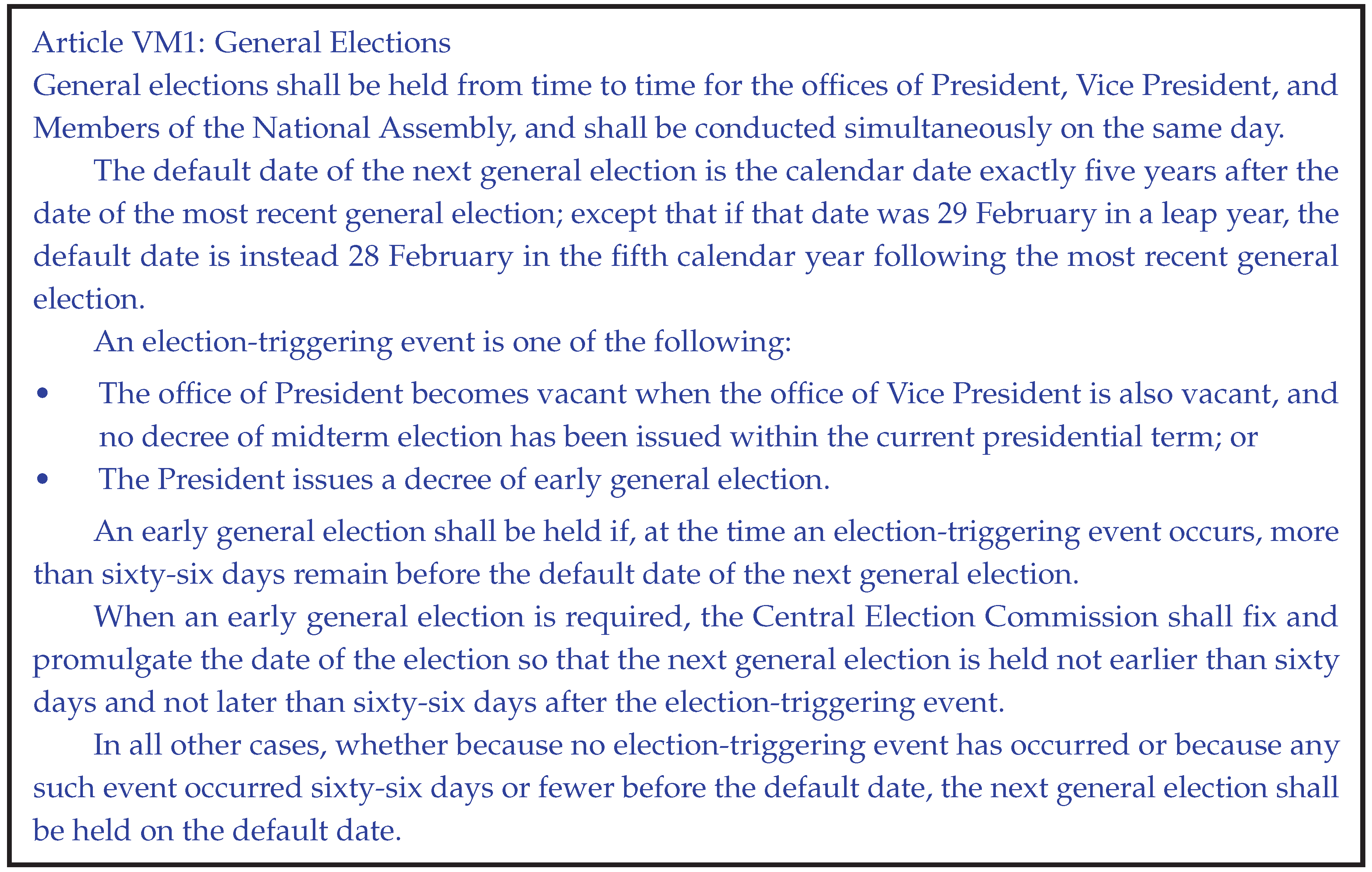
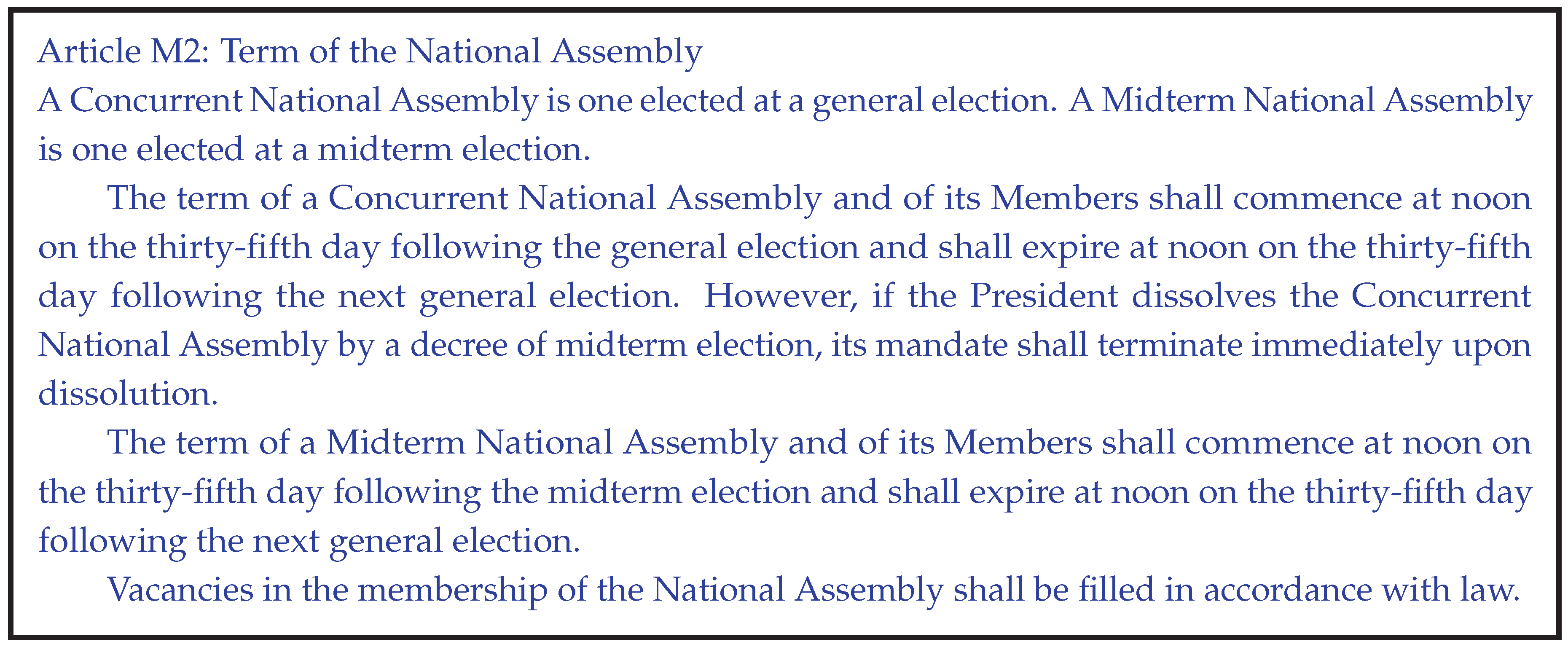
Scheme M distinguishes two fundamental types of elections: general elections and midterm elections. General elections simultaneously renew both the executive branch (president and vice president) and the lower house of the legislative branch (National Assembly). They serve as the primary mechanism for establishing the term lengths of these offices, with the Assembly’s term aligned to the concurrent presidential cycle.

The timing of elections in turn determines the exact terms of the offices.
4.2.1. Establishment of the Five-Year Term
In Scheme FM – or, absent any early-election trigger, in Scheme VM – general elections occur at five-year intervals, establishing a standard five-year presidential term. This duration aligns with several contemporary presidential systems, including those of Indonesia, Kenya, and Türkiye. A five-year term is considered optimal for the following reasons:
- Under normal conditions, the president serves the full five years. This duration strikes an effective balance: long enough to allow meaningful implementation of policy agendas and executive leadership, yet short enough to prevent excessive entrenchment or detachment from public accountability.
- Even when the term is curtailed, it will typically not fall below four years. A four-year duration remains reasonable and sufficient for effective presidential governance.
4.2.2. Scheme VM: Election Scheduling From Discrete to Continuous
In Scheme T, an earlier proposal by the present author, election dates were restricted to a predefined set of days each year – effectively limiting possible election days to just two per calendar year. This discrete schedule was designed to complement the mutual dissolution mechanism: by confining no-confidence votes and dissolution triggers to specific windows, the president enjoyed relative security outside those periods, reducing the risk of perpetual instability or surprise attacks on the executive.
Scheme M eliminates the Assembly’s power to force early renewal or dissolution, thereby removing the primary source of mutual vulnerability that necessitated such restrictions. With the legislature now in a relatively passive role, the rationale for constraining election timing disappears. Accordingly, Scheme VM adopts a continuous election schedule, permitting almost any calendar day to serve as an election day.
This shift from discrete to continuous scheduling enhances institutional flexibility and responsiveness. It ensures equal latency regardless of when a triggering event occurs – a benefit made possible only by removing the rigid calendar constraints that were necessary in Scheme T to contain potential legislative threats.
4.2.3. Scheme VM: Gap between the Election-Triggering Event and the General Election
A minimum of 60 days is guaranteed between an election-triggering event and the ensuing general election. This interval allows adequate preparation time, including candidate registration for the Assembly, selection of presidential candidates by political parties, campaigning, ballot printing and distribution, and logistical arrangements for polling stations. Presidential elections, due to their national scope, candidate vetting requirements, and need for party coordination, demand substantially more time than Assembly elections alone. Sixty days represents a balanced minimum that safeguards fairness and credibility without causing undue delay.
The 60–66 day window is intentionally short to minimize opportunities for political manipulation or undue influence. At the same time, the 7-day flexibility ensures that polling day can fall on any weekday, accommodating religious observances, cultural holidays, or other practical considerations while maintaining the overall urgency of the process.
4.2.4. Gap between the General Election and Inauguration
The intervals between the general election and the commencement of terms are designed to balance prompt renewal of democratic mandates with sufficient preparation time. The key considerations are as follows:
- The 35-day gap before the Assembly convenes provides a realistic transition period. It allows adequate time for certification of results, resolution of electoral disputes, and logistical preparations for the first sitting, while preventing the outgoing Assembly from remaining in power excessively long.
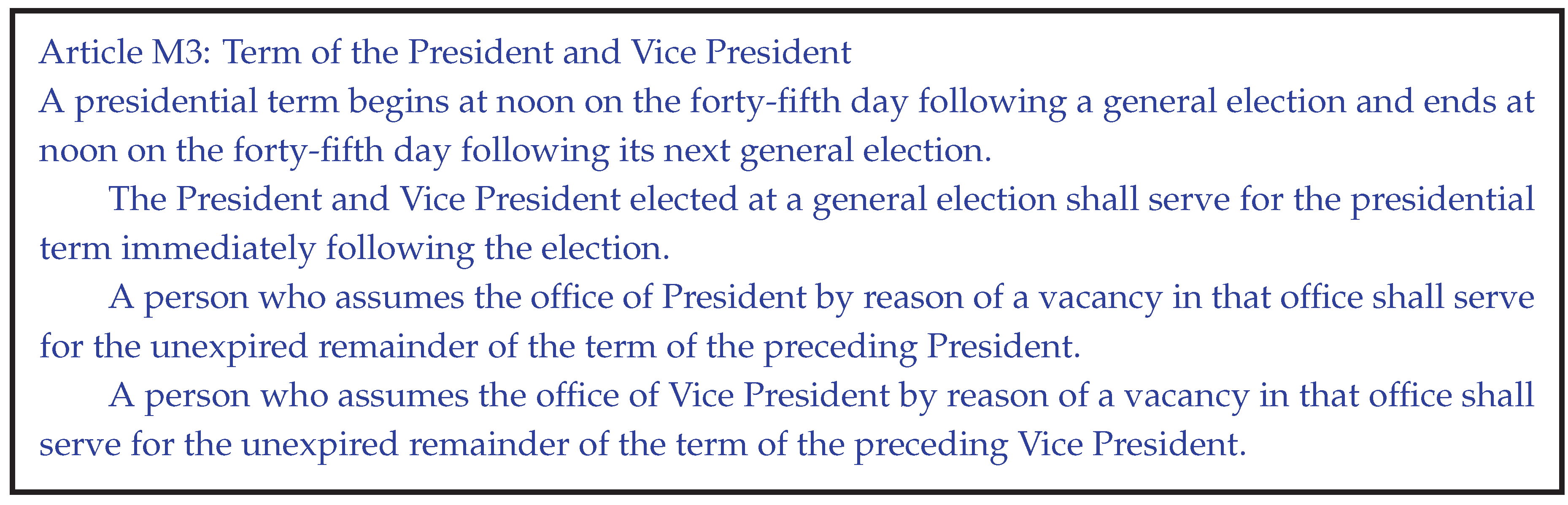
- The 45-day gap before the president takes office affords the incoming executive sufficient time for cabinet formation, security briefings, and an orderly transfer of executive responsibilities. This also creates a deliberate 10-day buffer after the Assembly convenes, reinforcing the legislature’s role during the handover and enabling a structured transition of power.
4.2.5. Dissolution Before Midterm Election vs. Nondissolution Before General Election
Before a general election – whether regular or early – the Assembly is not dissolved. The rationale for this rule has been explained in the author’s earlier work (Cheng 2026, Section 4). In contrast, before a midterm election the Assembly is dissolved. This difference is justified for the following reasons:
- As discussed later, the interval between the announcement of a midterm election and the election itself is substantially shorter than for a general election. This compressed timeline makes it even less feasible for the Assembly to continue functioning effectively with an imminent electoral event.
- The presidency remains unaffected by a midterm election. This asymmetry raises a genuine risk of retaliatory or vengeful legislation by Assembly members, who may seek to hinder or punish the president before their own mandate ends.
- By holding a midterm election, the mandate of the concurrent Assembly is abruptly terminated before its term expires. Its term is regarded as unchanged. This differs from an early general election, where the Assembly’s term (which is variable) is shortened. The legal basis for this dissolution is the same as that for parliamentary dissolution in parliamentary or semi-presidential systems.
This scenario – dissolution of the Assembly prior to a midterm election – has no direct counterpart in existing presidential regimes, where midterm legislative elections (when they exist) are always unconditional, non-contingent, and follow fixed terms and predetermined schedules. The situation is therefore unique to Scheme M.
4.2.6. Scheme FM: Double Vacancy Does Not Trigger Election
Under Scheme FM, since general elections are fixed, when a double vacancy (simultaneous vacancy in the offices of President and Vice President) occurs, the Speaker of the Assembly succeeds to the presidency. We will discuss this issue later.
4.2.7. Scheme VM: Double Vacancy Triggers Early General Election Only Absent a Prior Midterm Decree
Under Scheme VM, a double vacancy triggers an early general election only if it occurs when no decree of midterm election has yet been issued. This rule is justified by the following considerations:
- If the double vacancy arises after the decree has been issued but before the midterm election takes place, converting the already-scheduled midterm election into a general election (with presidential contest) would be impractical. The remaining time is insufficient for the far more complex preparations, candidate nomination processes, and logistical arrangements required for a presidential election.
- If the double vacancy occurs after the midterm election has already been held, calling an early general election would be undesirable. It would drastically shorten the term of the newly elected Assembly to an unreasonably brief period and would likely cause voter fatigue from two major nationwide elections held in close succession. An alternative method for filling a presidential vacancy in this situation is described later.
4.3. Presidential Authorities on Midterm Elections and Early General Elections
The president enjoys the conditional powers to call midterm elections (in both variants) and to call early general elections (only in Scheme VM).
4.3.1. Timing Issues for Midterm Elections
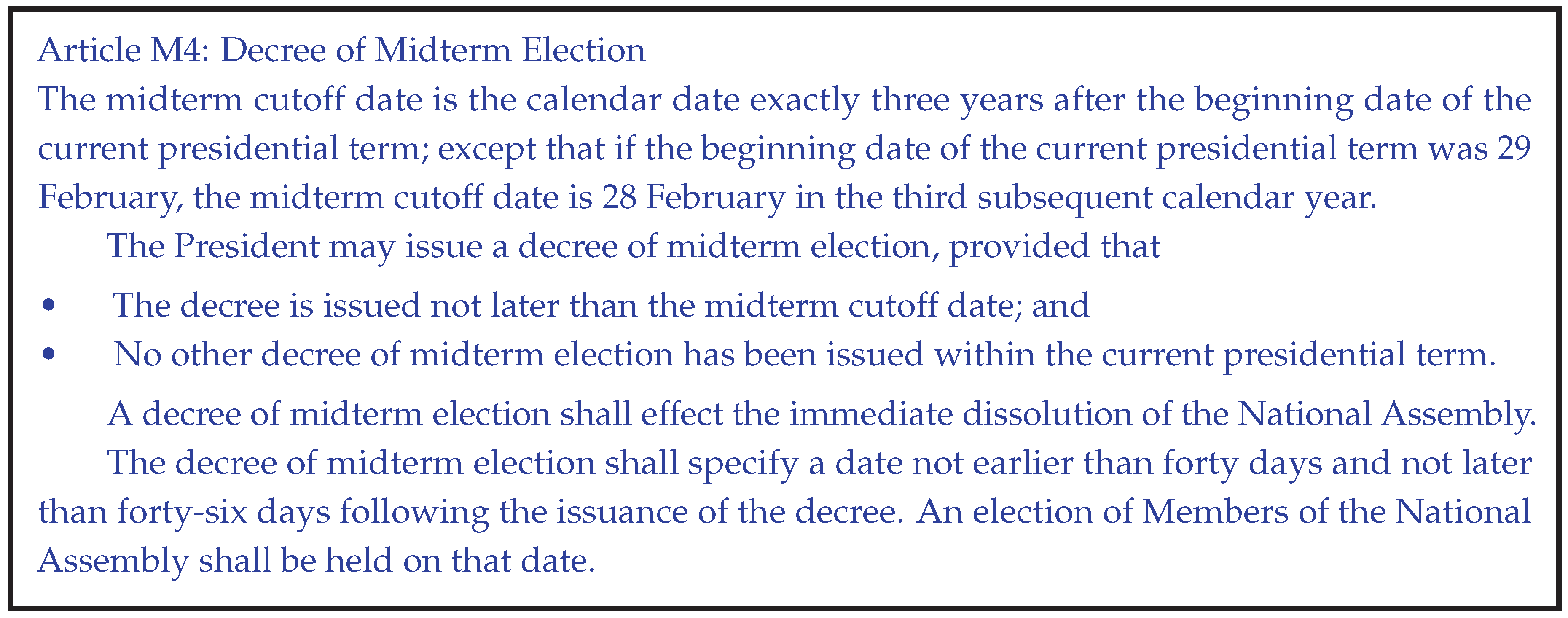
Article M4 imposes no lower bound on the timing of a midterm election decree (i.e., no “too early” restriction), only an upper bound (the midterm cutoff date). Adding a constitutional minimum would unnecessarily complicate the system’s logic. Although no formal constraint prevents an excessively early midterm election, a strong political constraint exists: issuing the decree too early to resolve a potentially minor deadlock would likely cost the president the opportunity to call a midterm election later, when a major deadlock arises.
If no early general election is held, the following sequences of elections are possible within a presidential term:
- Only one general election at the end of the five-year term;
- One midterm election (during the first three years) and one regular general election at the end of the five-year term.
4.3.2. Scheme VM: Timing Issues for Early General Elections
In Scheme VM only, early general elections introduce the following additional possibilities within a presidential term:
- One early general election (during the last two years);
- One midterm election (during the first three years) and one early general election (during the last two years).
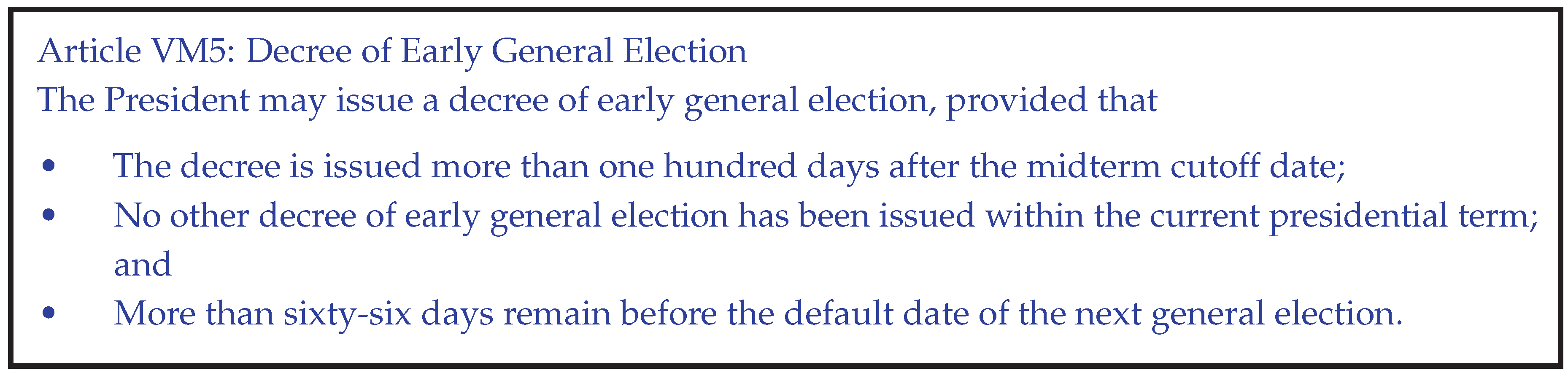
Early general elections may be called only after more than 100 days have elapsed since the midterm cutoff date. This requirement ensures that, even if a midterm election decree is issued on the very last day of the allowable window, the early general election will take place only after the midterm election has been held and the newly elected midterm Assembly has convened. Without this buffer, the sequence of events would become absurd and administratively incoherent.
Early general elections are highly unlikely in practice. They require either a double vacancy (which is rare) or the president to voluntarily shorten their own term – typically for strategic election timing – but this remains rare even when motivated by political advantage. As a result, the first two possibilities listed above are expected to be the most common outcomes.
4.3.3. Scheme VM: Comparison of Midterm and Early General Election Decrees
Article VM5 (Decree of Early General Election) is significantly cleaner than Article M4 (Decree of Midterm Election). This results from the fact that its consequences, mainly election arrangements, have already been addressed in Article VM1 (General Elections).
Under Articles VM5 and VM1, the date of an early general election is fixed by the Central Election Commission. In contrast, Article M4 assigns the task of fixing the midterm election date to the president. This difference is a minor technical detail rather than a substantive distinction. Midterm elections are purely discretionary initiatives of the president, so it is natural and administratively smoother for the president to determine the date directly. Early general elections, however, may be triggered by double-vacancy scenarios in which no president is in office. For consistency and neutrality in such cases, the task of fixing the date is assigned to the independent Central Election Commission.
The interval between the issuance of a midterm election decree and the election itself is set at 40–46 days, which is 20 days shorter than the corresponding gap for an early general election (60–66 days). This difference is reasonable and deliberate, reflecting the significantly greater complexity of a general election compared to a midterm legislative election.
4.4. Presidential Succession and Acting
Presidential succession is straightforward when a vice president is in office: the vice president immediately assumes the presidency upon a vacancy. The real difficulty arises in the case of a double vacancy (simultaneous vacancy in both the presidency and the vice presidency).
In Scheme FM, a double vacancy is resolved by the Speaker of the Assembly succeeding to the presidency. This arrangement may potentially violate the same-party succession principle, but no alternative is feasible under a system of fixed-term elections. This is a well-known challenge in presidential systems that prohibit early general elections.
In Scheme VM, the handling of double vacancy depends on timing: If no midterm election decree has yet been issued, an early general election is triggered (as explained in SubSection 4.2.7). This resolves the succession issue entirely and upholds the same-party succession principle by allowing the electorate to choose a new president. If a double vacancy occurs after a midterm election decree has already been issued, the presidency is filled by the Speaker of the newly elected midterm Assembly. This rule avoids the high cost and disruption of holding a second nationwide election so soon after the midterm vote.
This arrangement may violate the same-party succession principle, as the Speaker could belong to a different party – or even an opposition party – from the original president. Nevertheless, this is a deliberate and balanced trade-off. Real-world precedent exists: the Philippines’ 1987 Constitution deliberately separates presidential and vice-presidential elections and provides no guarantee of same-party succession, yet the system has functioned stably for decades. Finally, after all, such potential violation of same-party succession occurs only during the final stage of the presidential term. Scheme M has prioritized same-party succession to the greatest extent feasible.
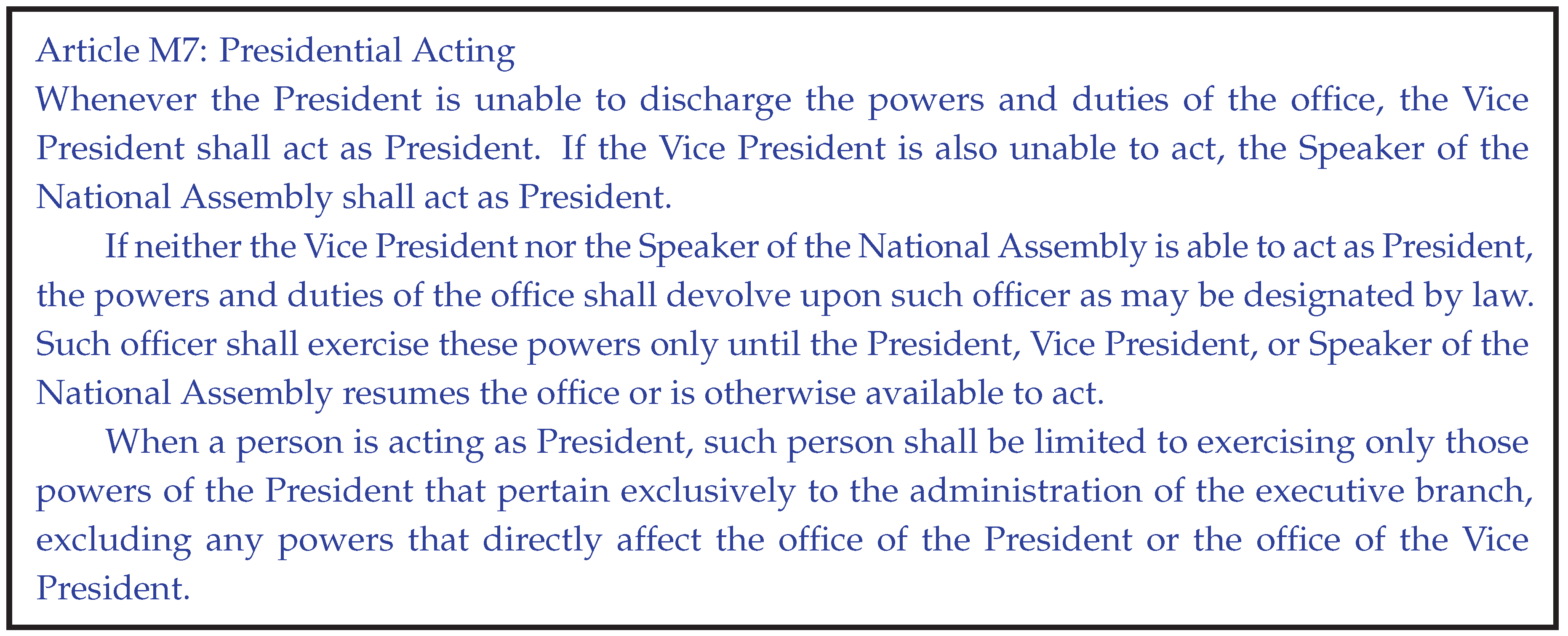
For temporary inability of the president, the officers in the line of succession shall assume the powers and duties of the presidency in accordance with the established order. If all such officers are also unable or vacant, the designation of an acting president shall be governed by ordinary law. This approach provides flexibility for future legislatures to adapt temporary arrangements to changing circumstances without requiring constitutional amendment, while preserving the fixed constitutional framework for permanent presidential succession.
The above considerations are reflected in the following articles.


4.4.1. Why Not Elect a New President by the Assembly?
One conceivable alternative to designating the Speaker as successor in a double vacancy would be for the Assembly to elect a new president. This option is deliberately rejected, however, as it would unnecessarily complicate the constitutional framework.
The mechanism required for such an Assembly-elected presidency would be essentially identical to the existing procedure for electing the Speaker: a majority vote among members. Adding a separate article to duplicate this process would introduce redundant complexity without any meaningful benefit.
This arrangement has a partial precedent in the United States, where the Speaker of the House of Representatives is second in line to the presidency (after the Vice President) under the Presidential Succession Act of 1947. In extreme cases of double vacancy, the Speaker would act as President for the remainder of the term after resigning from the House and the speakership, without an election by Congress.
4.4.2. Line of Succession Stops at the Vice President or Speaker
In Scheme M, the line of succession is deliberately kept extremely short. It normally ends with the vice president. Only in the rare event of a double vacancy does it extend further – to the Speaker of the Assembly. This extension occurs in all double-vacancy subcases under Scheme FM, and (under Scheme VM) only after a midterm election has already taken place.
In the first case – when the line of succession is exhausted (both the presidency and vice presidency are vacant) – a general election is triggered and a new president is elected directly by the people. Therefore, there is no need to extend the line of succession further in this scenario.
In the second case – when the line of succession is exhausted (both the presidency and vice presidency are vacant and the Speaker of the Assembly is also unavailable) – the Assembly can promptly elect a new Speaker. This waiting period is even shorter than the time required for a general election. Therefore, there is also no need to extend the line of succession in this case.
A major difference between Scheme M and the U.S. model is that, in Scheme M, both the Vice President and the Speaker of the Assembly can formally ascend to the presidency (i.e., hold the full title and office of President). By contrast, in the U.S. model, only the Vice President can formally become President. The Speaker and all officers below them in the line of succession can only act as President, without bearing the formal title.
Moreover, in Scheme M, the acting period has a clear upper limit of 111 (66 + 45) days. This enables us to impose meaningful restrictions on the powers of the acting president, as set out in the last paragraph of Article M7. By contrast, in the U.S. model, a Speaker (or other successor) may act as President for years, making it infeasible to impose significant restrictions on acting powers. For example, the appointment of judges cannot reasonably be postponed for years when a vacancy arises.
4.4.3. Sheme VM: Speaker of the Concurrent Assembly: No Permanent Succession but Eligible to Act
In Scheme VM, the Speaker of a concurrent Assembly is not entitled to permanent succession to the presidency. In the event of double vacancy:
- If it occurs when no decree of midterm election has yet been issued, an early general election shall be triggered, and a new president shall be elected by the people.
- If it occurs after such a decree has been issued, the Speaker of the newly elected midterm Assembly shall succeed to the presidency once available.
In either case, the Speaker of the concurrent Assembly is excluded from permanent succession.
However, the Speaker of the concurrent Assembly remains eligible to act as President during temporary inability. As provided in Article M7, the acting role is assigned to the Speaker of the Assembly without distinction between concurrent and midterm status.
4.5. Confirmation of Vice President
The confirmation of a vice president follows the conventional American model.

In Scheme M, we opt not to use the “dual-path” confirmation procedure used in Scheme T (Cheng 2026). In that design, the confirmation process could serve as leverage in bargaining between the branches (e.g., trading approval for presidential resignation or other concessions). That mechanism is unnecessary here. The Assembly has no power of self-dissolution or no-confidence to threaten the president, so there is no realistic basis for using vice presidential confirmation as a bargaining chip. A straightforward, bicameral simple-majority confirmation therefore suffices and avoids needless complexity.
4.6. Removal of Vice President
Removal of the Vice President is not a standard feature in presidential systems. In Scheme M, we tentatively include it as a potential deterrent against frivolous or poorly timed calls for midterm elections.
As previously discussed, the U.S. House’s two-year term is often criticized as excessively short. In Scheme M, if a midterm election occurs in every presidential term, the average effective Assembly term would fall to approximately 2.5 years – still undesirably brief. Given that the president has a three-year window to issue a midterm decree, it is relatively easy to select a favorable moment, raising a realistic concern that midterm elections could become routine. Therefore, to mitigate this concern, we need to find a deterrent mechanism.
The rule that the Speaker of the midterm Assembly succeeds to the presidency in the event of a double vacancy is not a reliable deterrent against calling a midterm election.
This is because there remains a substantial probability that the president’s party will retain or win a majority in the newly elected midterm Assembly. If that occurs, a double vacancy would still result in a successor from the same party (the new Speaker), and the president’s side would avoid the uncertainty and risk of facing a general election (this latter scenario only applies to Scheme VM). In other words, the rule has both favorable and unfavorable implications for the ruling party: it may impose a cost when the opposition gains control, but it provides a safety net when the ruling party maintains dominance.
The following article is then proposed as a potential deterrent.

This power is reserved exclusively to the midterm Assembly. If the president misjudges and calls a midterm election that results in an opposition-majority midterm Assembly, the vice president faces genuine risk of removal. This creates a credible disincentive against casual or opportunistic midterm decrees.
Aside from this deterrent consideration, this article has an elegant interpretation. One might imagine that the office of Vice President is also put to election alongside the Assembly in the midterm election (although actually it is not). So let us permit the newly elected midterm Assembly to potentially replace the vice president. A mechanism resembling a constructive vote of no-confidence is ruled out, as it excludes presidential participation and is redundant – the winner of such a vote would typically be the Speaker, who is already in the line of succession. Therefore, the most appropriate approach is to allow the midterm Assembly, by supermajority vote, to first remove the vice president if warranted, with the resulting vacancy filled through the standard confirmation procedure.
The deterrent remains limited and does not threaten the president directly. Assuming the president maintains good health and faces no impeachment risk, their own position remains secure. The overall effectiveness of this mechanism is difficult to predict without real-world application. Accordingly, Article M9 is presented as optional. If adopted, its parameters (e.g., the required majority threshold) can be calibrated to achieve the intended deterrent effect without excessive disruption.
4.7. Election Methods Suitable for Scheme M
Scheme M deliberately avoids making midterm elections routine, but also prevents the opposite extreme: a situation in which the president nearly always enjoys a comfortable parliamentary majority, and therefore constantly lacks any incentive to call a midterm election.
For this reason, PLAR (as proposed in the author’s previous work Cheng (2026)) is not recommended for presidential elections under Scheme M. PLAR tends to produce highly aligned presidential and legislative election outcomes, significantly increasing the likelihood of the president securing a comfortable legislative majority, which is suitable for Scheme T (an essentially Westminster model), but not for Scheme M. In contrast, methods such as Two-Round Absolute Majority and the US-style Electoral College avoid this alignment problem and are therefore suitable for Scheme M. Of course, other innovative methods remain worth exploring.
For legislative elections, proportional representation (PR) is indispensable. By allocating seats roughly in proportion to vote shares (rather than through winner-take-all districts), PR makes it much harder for any single party to routinely secure an outright majority. This fosters multi-party representation, fluid coalitions, diverse political voices in the legislature, and negotiation across party lines – key elements that help maintain the incentives Scheme M seeks to preserve.
Pure PR weakens local and regional representation. A fully majoritarian system risks executive dominance. A mixed system is ideal: combining single-member district plurality (SMDP) seats with a proportional tier. The SMDP:PR ratio has been extensively discussed in the comparative literature, with various proposals and real-world implementations analyzed for their effects on proportionality, local representation, and governability.
4.8. Term Limit of the President
Under Scheme M, the powers of the president closely mirror those of the American model, with the principal addition being the flexibility to call elections. This change does not significantly alter the balance of power among the branches. Accordingly, the present author recommends adopting a two-term limit similar to that established by the Twenty-Second Amendment to the United States Constitution.
Article M10: Term Limit of the President
No person who has been elected to the office of President twice shall thereafter be eligible to be elected President or Vice President. No person who has held the office of President for more than two years of a term to which some other person was elected President shall be eligible to be elected President for more than one consecutive term thereafter.
In the author’s view, the more serious threat of prolonged entrenchment arises not from prior service as President through non-electoral means (e.g., succession), but from the potential loophole that would allow a twice-elected President to later run for Vice President. Such a path could enable a de facto third (or further) term as President via succession, thereby undermining the purpose of term limits. The proposed wording of Article M10 explicitly closes this loophole by barring eligibility for Vice President after two successful presidential elections.
The additional clause barring more than one consecutive election after more than two years of serving as President via succession addresses a similar vulnerability to that covered by the Twenty-Second Amendment. However, our restriction is less stringent: it permits up to two nonconsecutive elected terms thereafter, whereas the Twenty-Second Amendment allows only one additional elected term in such cases.
While a twice-elected former president could theoretically still be nominated for Vice President (with potential subsequent ascension via succession), this residual pathway is not barred. In practice, the threat remains very small: a self-interested president would rarely nominate or support a charismatic vice president capable of posing a genuine long-term challenge to their position or enabling such indirect service.
While even more remote pathways exist – such as a twice-elected former president serving as Speaker of a midterm Assembly and ascending via succession in a double-vacancy crisis – these remain purely theoretical and pose negligible risk.
5. Comparative Analysis
5.1. Comparison between Scheme FM and Scheme VM
Scheme FM features fixed election schedules without provisions for early general elections. This stability allows general elections to be synchronized with Senate and local elections, substantially reducing administrative and logistical costs while enabling longer, more policy-focused campaigns.
In contrast, Scheme VM permits early general elections. This flexibility offers several advantages: it facilitates near-certain same-party succession; it gives a lame-duck president the option to trigger renewal of both the executive and legislative branches – avoiding governmental paralysis or premature resignation; and it enables the president to strategically time the general election to optimize reelection prospects, much as prime ministers do in Westminster-style parliamentary systems.
The primary drawback of Scheme VM is the potential compression of presidential campaign timelines. In the current U.S. system, presidential campaigns typically unfold over 18–24 months, allowing extensive preparation, fundraising, policy development, and voter outreach. Under Scheme VM, however, early general elections can be called on short notice, making such extended preparatory periods difficult or impossible in many cases.
Nevertheless, this need not be fatal. Many European parliamentary democracies routinely accommodate early dissolutions without fixed timetables, yet parties there adapt by maintaining continuous readiness and organization rather than depending on long, predictable campaign windows. Political actors can therefore shift toward a similar model of ongoing preparation. If extended presidential campaigns are considered essential, Scheme FM remains the preferable choice, as it fully preserves the feasibility of multi-year campaign cycles.
This trade-off ultimately hinges on whether one prioritizes institutional stability, cost efficiency, and campaign depth (favoring Scheme FM) or executive flexibility, succession reliability, and strategic timing (favoring Scheme VM).
5.2. Comparison with the American Presidential Model
Scheme M retains the core features of the American presidential system: a strict separation of powers and the direct popular election of both the president and the Assembly, ensuring mutual independence between the branches. Unlike the U.S. model, however, Scheme M introduces flexibility in election timing and eliminates mandatory midterm elections. This addresses two significant limitations of the fixed U.S. schedule.
First, the U.S. House’s short two-year term compels near-continuous campaigning, diverting legislators’ attention from substantive policymaking toward perpetual electoral considerations. Second, rigidly scheduled midterms rarely align with moments of genuine governmental deadlock or crisis that might benefit from a fresh electoral mandate to resolve impasse.
Critics might contend that Scheme M disproportionately enhances executive power by granting the president discretion over midterm timing – including the ability to forgo them altogether – potentially allowing strategic manipulation. Yet the ultimate safeguard remains voter accountability at the general election, when both the presidency and the Assembly face simultaneous renewal. Any opportunistic behavior or perceived abuse must withstand the electorate’s judgment, creating a powerful deterrent. Rational presidents, aware of the risks of backlash and electoral defeat, are thus incentivized to exercise this discretion judiciously. In this way, Scheme M trades rigid procedural constraints for robust democratic oversight, arguably yielding a more responsive system.
A shared limitation of both Scheme M variants is the incompatibility with prolonged midterm legislative campaigns. As noted earlier in the European context, short-notice or flexibly timed elections favor parties that maintain continuous readiness rather than relying on extended, predictable campaign cycles. Parties may therefore adopt divergent strategies: emulating the U.S. model for general legislative elections (with their longer preparatory windows) while shifting to a more European-style approach of ongoing organization for midterms.
In summary, Scheme M constitutes an evolution of the American presidential model rather than a radical departure. By introducing adaptive timing while preserving direct elections, separation of powers, and ultimate voter sovereignty, it seeks to remedy rigidities in the U.S. framework – such as perpetual campaigning and mismatched crisis resolution—without undermining its foundational democratic principles.
5.3. Comparison with the Turkish Presidential System
Among real-world presidential regimes, Türkiye’s system (established by the 2017 constitutional amendments) stands out as one of the few that features concurrent yet variable terms for both the executive and the legislature. This allows synchronized renewal of the presidency and the Grand National Assembly, with provisions for early elections to resolve potential deadlocks.
Scheme M adopts this core structural innovation—variable and concurrent terms—but significantly rebalances the inter-branch dynamics in favor of greater executive stability. In Türkiye, mutual dissolution powers create reciprocal vulnerability: the president may unilaterally dissolve the Assembly (triggering simultaneous presidential and parliamentary elections), while the Assembly, by a three-fifths majority, can force an early presidential election (likewise renewing both branches). This symmetry risks prolonged inter-branch conflict or instability if majorities shift.
Scheme M eliminates this mutual exposure. The president retains a limited unilateral authority to call early general elections (renewing both branches), but the Assembly has no reciprocal power to dissolve or force a presidential election. This asymmetry draws from the American model’s emphasis on executive durability while incorporating Turkish-style adaptability to break deadlocks, refresh mandates, or seize strategic opportunities—without inviting perpetual confrontation between branches.
Scheme M further diverges by providing a targeted mechanism for midterm legislative elections (via presidential decree), enabling a selective refresh of the Assembly without renewing the presidency. This offers flexibility absent in the Turkish framework.
Structurally, the president under Scheme M enjoys a markedly more secure position than in Türkiye. At the same time, Scheme M imposes far stricter constraints on presidential authority in other domains:
- Much narrower appointment powers (no broad unilateral control over the cabinet or senior administration);
- A directly elected vice president, with any vacancy nomination requiring parliamentary confirmation;
- A more rigorous term-limit regime that closes potential loopholes and more effectively prevents extended tenure (in contrast to Türkiye’s rules, which permit a third term under certain renewal scenarios);
- Severely restricted decree powers, lacking the broad quasi-legislative scope granted to the Turkish president under Article 104 of the Constitution.
In summary, Scheme VM (with its allowance for early general elections) offers the most compelling parallel to the Turkish presidential system, sharing the emphasis on concurrent, variable terms and deadlock-breaking renewal mechanisms. Yet Scheme M as a whole refines this model by prioritizing executive stability, reducing inter-branch vulnerability, and tightening limits on presidential overreach – producing a more balanced and restrained adaptation of the Turkish innovation.
6. Conclusions
This work builds on the author’s earlier proposal, Scheme T, which featured mutual dissolution powers between the president and the Assembly – a mechanism also present in the Turkish presidential system introduced by the 2017 amendments. Upon reflection, the author felt that the constant insecurity this imposed on the president – where the Assembly could at any time force an early presidential election – pushed the system too far from the classic presidential model of executive stability and independence. A new institutional design, Scheme M, therefore began to take shape, in which the Assembly’s dissolution power is removed entirely.
By eliminating reciprocal dissolution, Scheme M places sole responsibility on the president to identify, assess, and resolve any executive-legislative impasse. In the Turkish presidential system, the president’s only tool in such situations is the early general election – an all-or-nothing measure that simultaneously renews both branches and shortens the president’s own term, resembling a form of political suicide attack. To provide a more calibrated and less drastic instrument, Scheme M draws on the established American practice of midterm legislative elections but introduces contingent, flexible-timing elements: the mechanism is triggered exclusively by presidential decree, limited to once per term and only within the first three years. This creates a flexible-timed version of the American presidential model. It keeps the president’s fixed term secure while allowing strategic timing – or avoidance – of midterm elections to refresh or realign parliament at low personal cost.
Scheme M retains the foundational strengths of classic presidentialism – direct election of the president, clear separation of powers, executive stability, and final accountability through general elections – while addressing the rigidity that can produce prolonged deadlock or unresponsiveness in the U.S. system. The limited midterm power offers adaptability without mutual vulnerability, the stricter safeguards (narrow decree scope, parliamentary confirmation of the vice president, robust term-limit closure) prevent executive overreach, and the mixed electoral system for the Assembly ensures legislative pluralism and guards against chronic presidential majorities.
In essence, Scheme M offers a middle path: it evolves the American framework by incorporating carefully bounded flexibility inspired by real-world variable-term systems, yet avoids the destabilizing interdependence and excessive executive dominance that have drawn criticism elsewhere. The design ultimately trusts the electorate: every exercise of presidential discretion – whether to call or refrain from a midterm – must eventually face the judgment of voters in the decisive general election.
Scheme M comprises two variants: Scheme FM, with fixed-time general elections, and Scheme VM, which permits flexible timing for general elections. Scheme FM delivers greater institutional predictability, administrative cost savings, and superior conditions for high-quality, extended campaigns – making it a more conservative adaptation particularly well suited to contexts that prioritize maximum stability and continuity above all else.
For countries seeking a presidential system that is stable yet capable of escaping gridlock, democratic yet not paralyzed by institutional deadlock, Scheme M provides a viable and principled option worthy of serious consideration for constitutional adoption.
References
- Cheibub, José Antonio. 2007. Presidentialism, Parliamentarism, and Democracy. Cambridge University Press. [Google Scholar] [CrossRef]
- Cheng, Yiping. 2026. Embedding Westminster-style no-confidence in Turkish-style presidentialism. Preprint. [CrossRef]
- Linz, Juan J. 1990. The perils of presidentialism. Journal of Democracy 1, 1: 51–69. [Google Scholar] [CrossRef]
- Presidentialism and Democracy in Latin America. 1997. Mainwaring, Scott, and Matthew Soberg Shugart, eds. Cambridge University Press. [Google Scholar] [CrossRef]
- Samuels, David J., and Matthew Soberg Shugart. 2010. Presidents, Parties, and Prime Ministers: How the Separation of Powers Affects Party Organization and Behavior. Cambridge University Press. [Google Scholar] [CrossRef]
- Shugart, Matthew Soberg, and John M. Carey. 1992. Presidents and Assemblies: Constitutional Design and Electoral Dynamics. Cambridge University Press. [Google Scholar] [CrossRef]
Disclaimer/Publisher’s Note: The statements, opinions and data contained in all publications are solely those of the individual author(s) and contributor(s) and not of MDPI and/or the editor(s). MDPI and/or the editor(s) disclaim responsibility for any injury to people or property resulting from any ideas, methods, instructions or products referred to in the content. |
© 2026 by the authors. Licensee MDPI, Basel, Switzerland. This article is an open access article distributed under the terms and conditions of the Creative Commons Attribution (CC BY) license (http://creativecommons.org/licenses/by/4.0/).
Copyright: This open access article is published under a Creative Commons CC BY 4.0 license, which permit the free download, distribution, and reuse, provided that the author and preprint are cited in any reuse.


