

Submitted:
07 March 2026
Posted:
09 March 2026
You are already at the latest version
Abstract
This study evaluates the technical feasibility of deploying containerized oxy-combustion power modules with integrated CO₂ capture in remote Ecuadorian Amazon oil fields. Associated petroleum gas is conditioned with a 35 wt.% diethano-lamine (DEA) sweetening stage specifically implemented to remove H₂S and reduce acid-gas loading prior to combustion, improving fuel quality and protecting down-stream equipment while increasing methane mole fraction for combustion. System ef-ficiency is governed by stoichiometric oxygen demand, with methane requiring 2 mol O₂/mol fuel and hexane requiring 11 mol O₂/mol fuel; favoring methane-rich streams reduces ASU energy demand, enhances combustion performance, and lowers separa-tion costs. The combined oxy-combustion cycle attains a thermal efficiency of 33.10% and an exergetic efficiency of 39.98%. Major energy penalties arise from the cryogenic air separation unit and the CCS train, yet operational tuning of CO₂ recirculation and steam flow could raise thermal efficiency by up to 2%. The ASU produces oxygen at 96.67% purity with an energy consumption of 0.385 kWh/kg O₂, while the CCS achieves 99.99% CO₂ capture at 0.41 kWh/kg CO₂. Sourcing gas from three production blocks provides flexibility to accommodate supply variability. The modular 272 MW unit demonstrates viability for off-grid power supply, routine flaring reduction, and scalable acid-gas valorization in frontier oilfields.
Keywords:
global APG context
; associated gas flaring
; oxy-combustion
; CO₂ capture
; feasibility technical analysis
; modular power generation
; Ecuadorian Amazon
1. Introduction
Global Flaring Practices and Regulatory Gaps in Developing Regions
Routine flaring of associated petroleum gas (APG) remains a significant and ongoing issue in oil-producing regions worldwide. [1,2] Countries like Russia, Iraq, Iran, the US, Algeria, Venezuela, and Nigeria produce about 40% of the world’s oil annually, and they account for nearly two-thirds (65%) of the world’s gas flaring. [3] On the other hand, strict permitting and prohibition clearly specify that flaring and venting must be solely for safety reasons and require explicit permits in Norway, the United Kingdom, and Canada [4,5]. Globally, despite regulatory efforts and technological advances, [6,7] large amounts of APG are still flared, [8] causing environmental, economic, and health issues. The challenge is worsened by infrastructure, financial, and policy barriers, [9] particularly in developing countries with limited technology or regulatory enforcement. [10,11,12] The World Bank reports that in 2023, global gas flaring volumes reached 148 billion cubic meters (bcm) according to satellite-based estimates. This represents a 7% increase from 139 bcm in 2022. [13] This results in over 500 million tonnes of CO₂ equivalent emissions (CO₂eq). While industrialized nations have seen reductions due to regulatory and market-driven incentives, [14] in many developing countries — including those in sub-Saharan Africa, the Middle East, and Latin America — gas flaring and venting have become the cheapest solution without economic incentives and control policies. [15]
In regions like the Niger Delta [16], Venezuela, and the Ecuadorian Amazon [17], flaring is frequently concentrated near vulnerable indigenous and rural communities. The combustion of APG produces harmful byproducts, including black carbon (BC), nitrogen oxides (NOx), sulfur gases, and volatile organic compounds (VOCs). [18,19,20] These byproducts contribute to localized air quality degradation, respiratory illnesses, and ecosystem disruption. A study conducted between 2003 and 2012 in the northeastern Ecuadorian Amazon, a region rich in biodiversity and cultural significance, revealed that a total of 7.6 (Gm³) of gas was flared. This translates to an average of 782 million cubic meters (Mm³) per year, which is equivalent to 3.7 to 4.5 kilotonnes (kt) of BC annually. [21,22]
Primarily, weak enforcement, limited institutional capacity, and inadequate monitoring systems lead to the ineffective implementation of anti-flaring laws in developing countries.[23,24] Outdated or fragmented legal frameworks, coupled with policy instability, undermine long-term compliance and investment.[25] Infrastructure constraints, such as insufficient pipelines and processing facilities, often make flaring the default option, while weak economic incentives discourage the utilization of gas.[26,27] Additionally, poor data transparency, corruption, and lack of political will further erode regulatory effectiveness, perpetuating high flaring volumes compared to the more coherent and enforced systems in developed nations.[28]
Energy Waste and Underutilization of Associated Gas Resources
From both a thermodynamic and economic perspective, the routine flaring of APG results in a significant loss of high-calorific-value hydrocarbons.[18,19] APG typically contains substantial amounts of methane, ethane, propane, and heavier hydrocarbons, making it a valuable resource for electricity generation, chemical feedstock, or hydrogen production via steam methane reforming (SMR). [29,30] However, in isolated oilfields, such as those in the Ecuadorian Amazon, logistical challenges and limited capital create barriers to commercializing gas via pipelines or liquefied natural gas (LNG) infrastructure. [31] Consequently, the energy that could be used to power operations, electrify nearby communities, or supply hydrogen value chains is wasted. This not only increases the carbon and energy intensity of the oil production cycle but also contradicts the objectives of the Sustainable Development Goals (SDG 7 and SDG 13) and Ecuador’s National Climate Change Mitigation Plan. [32] These initiatives aim to reduce GHG emissions in the energy sector from 20321 kt CO₂eq in 2018 to 19039 kt CO₂eq by 2035 and 16808 kt CO₂eq by 2050.
Environmental Risks of Incomplete Combustion in Flaring Systems
Beyond energy loss, a significant environmental liability stems from the incomplete combustion of CH₄, the primary constituent of APG. CH₄ has a global warming potential (GWP) approximately 28–36 times greater, when averaged over 100 years, than that of CO₂. In poorly maintained or improperly operated flare systems—common in remote or informal sites—combustion efficiencies can fall below 90%, allowing substantial quantities of unburned CH₄, sulfur compounds, and VOCs to escape directly into the atmosphere. [33] Complex modeling has demonstrated that incomplete combustion also results in the emission of carbon monoxide (CO), BC, and partially oxidized hydrocarbons. These emissions exacerbate the radiative forcing effect and increase health risks for nearby populations. [34] The combined effect of CH₄ leakage and BC deposition on sensitive climate systems, such as the Andean glacier, could cause up to 22% of albedo reduction and make flaring a complex environmental threat. [35] Moreover, these emissions are often not accounted for in national inventories, making mitigation strategies ineffective or misaligned with the actual atmospheric burden.[32]
Policy Initiatives and Innovation Pathways for Decentralized Gas Utilization
Global initiatives like “Zero Routine Flaring by 2030” (ZRF2030) are crucial efforts aimed at reducing associated gas flaring. The World Bank leads this program and has been endorsed by over 80 governments, including Ecuador, as well as various oil companies. It sets clear reduction targets and transparency frameworks for APG flaring. While these initiatives have yielded measurable progress in regions with robust regulatory systems, their effectiveness in Ecuador is hindered by weak enforcement, fragmented governance, and institutional inertia. Importantly, APG flaring in frontier areas is connected to the pace of upstream oil expansion. As new wells are drilled in ecologically sensitive or logistically challenging locations, the likelihood of stranded gas and subsequent flaring increases unless modular valorization solutions are implemented near the source.
Ecuador APG Flaring Situation and Challenges
In Ecuador, the routine venting and flaring of associated gas remains a persistent challenge, particularly in the remote production fields of the Amazon region. [36] Ecuador’s oil production averaged ≈ 485000 bbl per day in 2022, 85% of which was located in the remote north-eastern Amazon (Sucumbíos, Orellana, and Pastaza). [37] Roughly 94% of those wells are gas-constrained: either the flow lines are too short (≲3 MMscf per day) [38] to justify dedicated gathering, or the gas quality is too sour to meet National Interconnected System (SIN) pipeline specifications (CO₂ < 2 mol%, H₂S < 4 ppm). [39] Typically, APG wells have H₂S content that ranges from moderate (sweetening advisable): H₂S ≈ 4–1000 ppm (0.0004–0.1 vol%) to high (sweetening required): H₂S > 1000 ppm (≥0.1 vol%). In this case, removing H₂S is compulsory to meet turbine/pipeline specs and to avoid corrosion and catalyst poisoning. Consequently, operators default to venting or flaring.

Table 1.
Gas flaring reports in Ecuador.
| Year | Oil production (kbbl/d) | Gas flared (Million m3/yr) | Flaring intensity (m3/bbl) | |
|---|---|---|---|---|
| 2015 | 80630 | 145639 | 4.95 | |
| 2018 | 82833 | 145000 | 4.80 | |
| 2022 | 80547 | 138539 | 4.71 | |
| 2024 | 81825 | 150999 | 5.06 | |
Source: [40] These values of gas represent approximately 400 kt CO₂eq, or the equivalent of burning around 16 PJ of lower-heating-value energy—enough to power every household in Pichincha Province (the second most populous) for a year. This information ranks Ecuador 17th out of 98 countries considered in this indicator. It means Ecuador is in a better position than Russia, Iraq, Iran, the US, Algeria, Venezuela, and Nigeria based on this metric; however, it is not compared to countries with strict permits and prohibitions, such as Norway, the United Kingdom, and Canada.
Among the chemical challenges, typical associated gas streams from the Amazon contain 12–18 mol% CO₂, 600–2500 ppm H₂S, and 45–60 g/m³ of C₅+ condensate (at 45 °C and 1 bar pressure). Treating this gas to meet sales quality standards may require a complex setup that includes a series of three-phase separators, TEG dehydration, DEA sweetening, and often involves a molecular-sieve polishing bed. The cost of such equipment can range from $ 15 to $ 25 million USD, even at a micro-scale of 5 MMscf per day. Operating expenses are primarily driven by chemical usage and energy consumption, estimated at approximately 0.9 kWh per Nm³ of sweet gas.[41] Regarding environmental concerns, 65% of flaring clusters are located within or near IUCN Category II reserves. Linear infrastructure projects necessitate ecological impact statements, prior consultations with 11 Kichwa-speaking communities, [42,43] and a presidential decree if they intersect national parks. Current policies also present a challenge; for example, Executive Decree 1215 (2012) limits flaring to 3% of produced gas yet does not provide effective price signals or penalties. Enforcement audits cover less than 40% of active flares, and carbon tax proposals, such as Proyecto 138/2021, have stalled in the National Congress. [44] Monitoring satellite data (TROPOMI NO₂ columns) has revealed gas plumes extending up to 60 km downwind from the Shushufindi-56 and Ishpingo-B stations. Measurements of PM2.5 at the Limoncocha Biological Reserve have peaked at 38 µg/m³ during periods of high flaring, which is three times higher than the World Health Organization’s guideline. Additionally, PM10 measurements have shown elevated levels of barium, cadmium, chromium, and molybdenum in soils, crops, water, and air. These findings correlate with a 27% increase in acute respiratory consultations at the Lago Agrio Hospital from 2016 to 2021.[44] Regarding H₂S content, there is documented acute and chronic health risks from hydrogen sulfide and evidence of plume-driven community exposure near oilfield operations; therefore, we include DEA-based sweetening for APG streams with H₂S concentrations exceeding 2500 ppm to protect downstream equipment and minimize public-health impacts in adjacent communities.
To harness energy and reduce environmental and social impacts, we propose evaluating technological advancements in micro-scale gas processing with a binary power generation cycle. [45] These include containerized oxy-combustion (OXC) units with integrated carbon capture (CC), field-deployable liquefaction systems, and low-footprint amine sweetening modules. In this study, amine-based sweetening upstream of combustion is mainly proposed to remove H₂S and to meet pipeline or engine fuel specifications; the primary drivers are safety, corrosion control, and combustion quality rather than reducing the downstream CO₂ capture burden.
The goal is to identify viable opportunities for decentralized gas valorization in regions lacking infrastructure. When configured properly, these systems can convert chemically degraded APG into dispatchable power or thermal energy while significantly decreasing GHG emissions. Key challenges to address include parasitic energy loads, oxygen supply logistics, sour gas content, maintenance in high-humidity environments, and the trade-offs between CO₂ capture efficiency and energy return on investment (EROI).[46] This study aims to fill that gap by assessing the feasibility and carbon mitigation potential of containerized oxy-combustion and CO₂ capture modules deployed in the Ecuadorian Amazon, considering site-specific gas compositions, climatic variables, and techno-economic constraints.
2. Materials and Methods
The methodology starts with the systematic collection of data and advances through data processing. It includes multi-criteria analysis to assess the potential for APG, selecting suitable locations for the power plant, and finally conducting a detailed evaluation of the integrated processes necessary for power generation and CO₂ compression for capture. This system is designed for implementation within selected operational blocks managed by E.P. PETROECUADOR (National Hydrocarbons Company) in the Ecuadorian Amazon.
Information Collection and Systematization
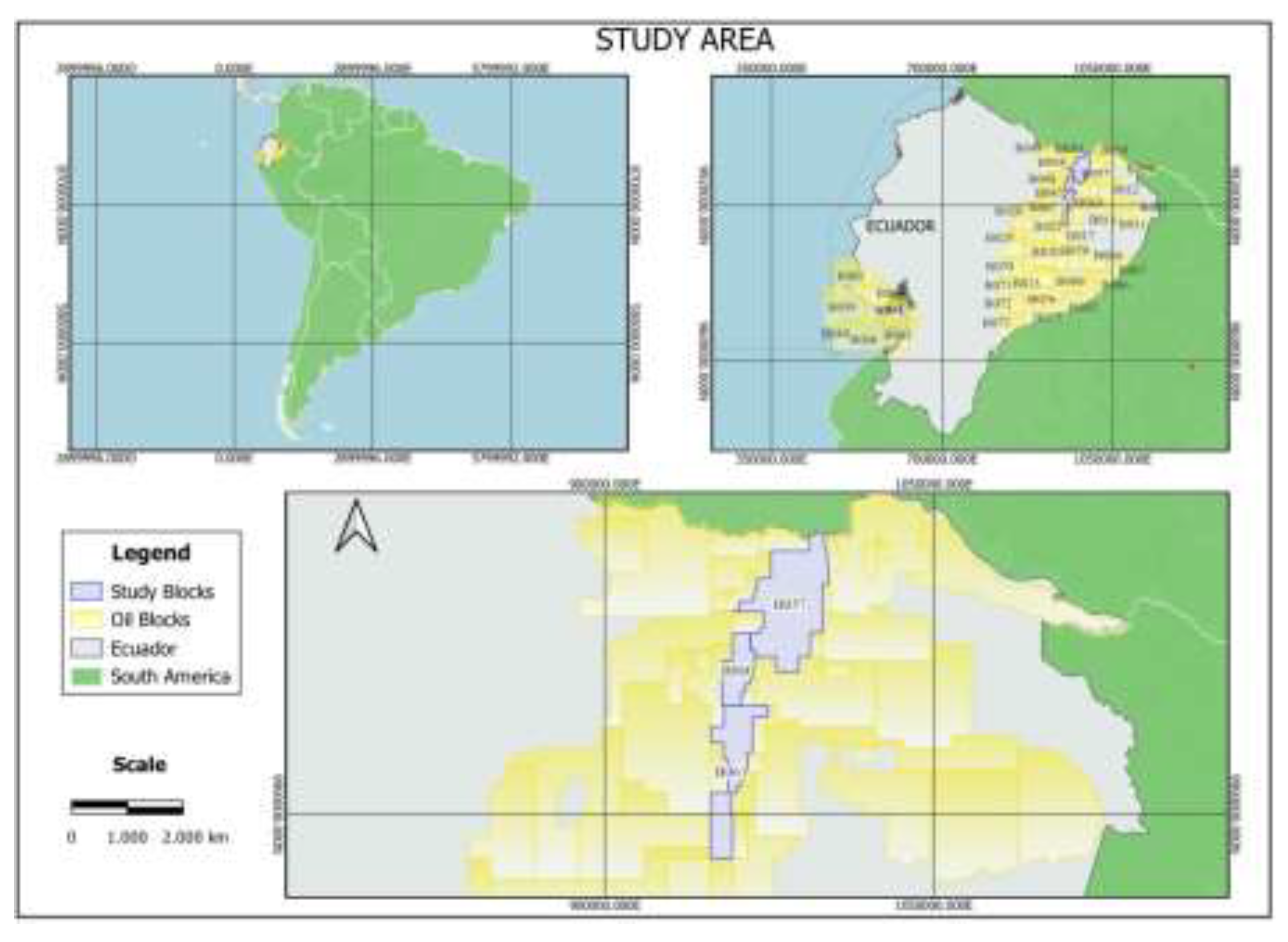
This composite map illustrates the spatial scope of an APG harnessing study in Ecuador. The top-left panel situates Ecuador within South America, while the top-right zooms into national oil block distribution, highlighting blocks B1 through B17 across the Amazon region. The bottom panel focuses on study-specific zones, distinguishing purple “Study Blocks” from yellow “Oil Blocks”—suggesting a targeted assessment of APG recovery potential. The map’s layered design enables baseline definition, site prioritization, and regulatory traceability, serving as a strategic tool for environmental planning, infrastructure logistics, and audit compliance.
Location of Oil Fields: The APG data was derived from nine production blocks: B18, B12, B43, B56, B60, B61, B07, B15, and B57. This data includes geographic coordinates, access constraints related to topography, and proximity to protected areas. The information was obtained from E.P. PETROECUADOR’s exploration and production maps for the years 2021 to 2024. It has been validated using GIS overlays with IDE Ecuador and satellite imagery from Sentinel-2, which has a 10-meter resolution.
Figure 1.
Geospatial Distribution of Selected Oil Blocks for Oxy-Combustion with CCS Integration in the Ecuadorian Amazon.
Figure 1.
Geospatial Distribution of Selected Oil Blocks for Oxy-Combustion with CCS Integration in the Ecuadorian Amazon.
Composition and Physicochemical Properties of APG: The gas composition parameters include molar fractions of CH₄–C₆⁺, CO₂, H₂S, N₂, and water vapor, as provided by E.P. PETROECUADOR Tables S1 and S2. We directly estimate the gross calorific value (GCV), dew point, specific gravity, and Wobbe index.
Gas Availability: Daily flaring volumes (MMscfd) and utilization ratios were sourced from E.P. PETROECUADOR and were validated against World Bank GGFR VIIRS satellite flaring estimates for 2022. The analysis includes variability due to seasonal flooding and maintenance outages, which are factored into the uncertainty bounds.
Associated Gas Treatment Technologies: This stage includes three-phase separators, dehydration units (TEG), amine-based sweetening (DEA), and hydrocarbon liquid knockout modules. H₂S removal is the primary objective; however, as a side effect, CO₂ levels will also decrease. This step can be skipped if the inlet sulfur content drops below 4 ppm of H₂S. Standard practice for oxy-combustion involves burning fuel with its native carbon content, and CO₂ is removed downstream from the flue gas. Therefore, pre-removal of CO₂ from the fuel is not a typical design goal.
Power Generation Technologies: A variety of technologies compatible with low- to medium-BTU gas were screened, including gas engines, turbines, and Rankine-cycle combined modules.
CO₂ Capture Technologies: Evaluated technologies include chemical absorption (DEA), pressure swing adsorption (PSA), membrane-based separation, and cryogenic distillation. We considered capture efficiency (greater than 90%), purity (at least 95% mol CO₂), energy demand (kWh per ton of CO₂), and operational robustness in high-humidity conditions.
System Integration: Layouts for containerized OXC and CO₂ capture skids were modeled using Aspen HYSYS v12.1. This analysis encompassed combustion stoichiometry, heat recovery, auxiliary power requirements, and dynamic responses to variations in gas flow. Mass and energy balances were validated using vendor performance data.
Rules and Regulations: Legal and regulatory constraints were extracted from national technical standards (NTE INEN 2261:2013 and NTE INEN 2489:2009), Executive Decrees (e.g., Decreto 1215/2012), and the draft Reglamento de Eliminación Progresiva de Quemas de Gas (MAATE, 2024). Environmental licensing procedures and flaring fee structures were also reviewed.
Process Flow Diagrams (PFD): A conceptual PFD was developed to illustrate the interconnections between components. This includes APG inlet conditioning, oxygen supply modules, combustion and energy conversion subsystems, CO₂ compression units, and off-take points for electricity and CO₂.
Information Processing and Nominal Capacity
The processing enabled us to develop an initial framework for converting APG into electricity while incorporating a CO₂ capture system. First, we define operational parameters (temperatures, pressures, and flow rates) for each component (e.g., separators, mixers, and absorbers) using material and energy balances. Next, we conduct preliminary thermodynamic analyses with Engineering Equation Solver ® to determine the sound energy output and estimate the amount of CO₂ that will be reinjected into the wells. Finally, we establish baseline calculations for energy production, setting the foundation for further design optimization.
Evaluation of Associated Gas Potential Using Multi-Criteria Analysis (MCA)
This subsection allowed us to select the most suitable APG stream for electricity production by evaluating its energetic potential against defined technical criteria. The chosen criteria comprise 1) Composition and Quality: Emphasizing high methane content and low levels of impurities (CO₂, H₂S, and heavy hydrocarbons), which ensures efficient combustion and minimizes equipment fouling. 2) Lower Heating Value (LHV): Higher LHV results in increased energy output per unit of gas. 3) Daily Production Volume: Ensures a steady and adequate gas supply.
We used the Analytic Hierarchy Process (AHP) to rank production blocks for APG valorization. Two stakeholders participated: the operator E.P. PETROECUADOR and the university project team (process and systems experts). Each stakeholder group completed independent pairwise comparisons of the three primary criteria. Pairwise comparison matrices from all respondents were aggregated using the geometric mean of individual judgments to produce a single group comparison matrix. Local priorities were derived from the principal eigenvector of the aggregated matrix and normalized to a unit sum, yielding final criterion weights: Composition and quality = 0.40; Heating value = 0.30; Volume per day = 0.30. The aggregated matrix passed the consistency test with a consistency ratio = 0.07, confirming acceptable internal consistency. The selected criteria are grounded in thermodynamic and operational theory: a higher methane-rich composition improves combustion stoichiometry and reduces ASU energy demand; a higher LHV increases plant output per unit of feed; and a sufficient daily volume ensures economic and operational continuity for containerized OXC+CCS modules. (Table S3). As a result, we selected production blocks 57, 60, and 61 due to their combined high LHV and production volume, with overall scores exceeding six on the evaluation scale.
Power Plant Location
To determine the best location for the plant installation, we focused on gas quality, logistical efficiency, and regulatory compliance. The geospatial analysis used GIS tools, including QGIS and Google Earth, to assess the proximity of blocks 57, 60, and 61. This evaluation aimed to minimize pipeline routing distances and avoid environmentally sensitive areas. The chosen site prioritizes shorter transportation distances and enhances plant safety by avoiding areas prone to flooding or landslides.
Analysis and Processes Definition for the Integrated Power Generation System
The design of the integrated system includes natural gas treatment, power generation, and CO₂ capture to maximize efficiency and minimize emissions Tables S13–S32. The proposed scheme combines OXC with a combined cycle unit, an ASU, and natural gas sweetening processes. We created detailed flow diagrams to illustrate the interconnected steps, from gas pre-conditioning to final energy conversion and CO₂ compression. The design was validated through thermodynamic simulations using Aspen HYSYS to establish mass and energy balances across the system modules, ensuring that the overall performance meets the required specifications.
Natural Gas Sweetening Process
The primary objective of the sweetening stage is to remove acid gases—chiefly hydrogen sulfide (H₂S, measured between 600 and 2500 ppm in the sampled APG) together with water and condensable hydrocarbons, to meet fuel-quality requirements for combustion, protect cryogenic and compression equipment, and reduce public-health risks to nearby communities. H₂S removal increases operational safety and equipment lifetime far more than it affects the CO₂ mass balance of the oxy-combustion train; therefore, pre-treatment is driven by impurity control rather than bulk CO₂ removal. Chemical absorption with 35 wt.% DEA was selected for its proven performance in efficiently capturing H₂S at the moderate–high concentrations observed in the feeds, its manageable regeneration energy requirements, and its lower corrosivity relative to alternatives. Typical targets for this unit are reducing H₂S to single-digit ppm levels and removing free water and C5+ condensates that can foul heat-exchange surfaces and impair cryogenic separation. Literature and simulation studies report DEA removal efficiencies above 80% for combined acid gases under comparable conditions. [47,48,49,50,51,52] The sweetening sequence implemented in the flowsheet comprises inlet conditioning and liquid knockout, amine contactor absorption, and a regeneration (desorption) column to recover solvent and strip absorbed H₂S and CO₂.
Solvent makeup, reboiler duty, stage efficiencies, and pressure-drop assumptions used in the DEA model are provided in the Supplementary Material (Tables S4–S12). Stream targets and verification checks (post-sweetening H₂S, water dew point, and hydrocarbon condensate content) are reported to ensure compatibility with downstream ASU, turbine combustion requirements, and CO₂ compression.
Power Generation and CO₂ Capture System (OXC)
Using high-purity oxygen eliminates nitrogen from the combustion process, thus producing a flue gas stream rich in CO₂ and steam. This simplification enhances the efficiency of downstream CO₂ separation. Table 2 benchmarks the proposed OXC system against selected gas turbines and combined cycle configurations, including a natural gas combined cycle (NGCC) without capture, a semi-closed OXC combined cycle (SCOC-CC), the NET Power cycle, a modified S-Graz cycle, and the CES supercritical system. The comparison includes net electrical output, specific CO₂ capture rate per unit of electricity generated, LHV-based thermal efficiency, and efficiency reduction relative to the NGCC reference Tables S33–S52.
The integrated system utilizes two-stage gas expansion, heat recovery steam generators (HRSG), and recirculation loops. Detailed equipment lists and operational parameters thoroughly document the system configuration.
CO₂ Compression and Liquefaction for Storage
We employed a multistage compression scheme with inter-stage, followed by liquefaction. Complementary, we use diaphragm pumps to achieve the required pipe pressure. The process is optimized to minimize energy consumption and reduce the risk of equipment corrosion.
Oxygen Production via Cryogenic Distillation
We have designed a system to generate high-purity oxygen (approximately 99.5%) needed for the OXC process using ambient air. Our proposed method involves cryogenic distillation, comprising several key stages: air compression, cooling, flow splitting, and distillation in two columns (high- and low-pressure).
Details of the energy and mass balances, as well as conditions, are provided in the supplementary material, which includes 53 tables and three flow diagrams with unique identifiers for each equipment. The supplementary material offers information on the performance of compressors, heat exchangers, distillation columns, and valves. This data shows that the plant can produce up to 4,000 tonnes of oxygen per day, ensuring continuous operation. Finally, the high-purity oxygen stream is seamlessly integrated into the OXC system to maintain optimal combustion conditions and reduce emissions.
3. Results
Blocks with a total score greater than six will be selected, as outlined in Table S3. This includes blocks 57, 60, and 61 for electric power generation. The selection process is based on an MCA analysis, which facilitates complex decision-making by considering multiple criteria with specific weights.
Table 3.
Comparative results of MCA among all the blocks.
| Block | Volume (MSCFD) |
LHV (BTU/lbm) | Mf CH4 (-) | Score |
|---|---|---|---|---|
| Weight | 0,40 | 0,30 | 0,30 | 10.0 |
| B18 | 6240.96 | 18707 | 0,043 | 2,96 |
| B12 | 4381.15 | 18168 | 0,247 | 2,13 |
| B43 | 2053.74 | 19298 | 0,558 | 5,43 |
| B56 | 1003.30 | 19171 | 0,401 | 4,55 |
| B60 | 18696.64 | 19369 | 0,297 | 6,56 |
| B61 | 9806.84 | 19314 | 0,562 | 6,29 |
| B07 | 704.70 | 18330 | 0,473 | 2,79 |
| B15 | 3459.79 | 19085 | 0,389 | 4,58 |
| B57 | 29240.52 | 19466 | 0,383 | 8,15 |
The proposed plant location leverages the proximity of the highly productive oil blocks 57, 60, and 61, which helps minimize infrastructure needs. This clustering decreases both construction and maintenance costs related to long gas transport pipelines. For example, Block 57 (Shushufindi – Libertador) is strategically situated just 28.79 km from Block 60 and 55.70 km from Block 61, ensuring that the available gas resources remain closely grouped.
Block 60 (Sacha) in Orellana offers a good balance of high productivity and manageable safety risks. Conversely, while Block 61 has higher safety risks, it benefits from strong transportation infrastructure and pipeline links to key facilities. The proximity of these blocks enables more efficient collection and use of associated gas, while also easing the logistical and operational challenges typically faced in remote field development.
Table 4 below shows that the DEA-based gas sweetening process is effective at removing H₂S and, to some extent, other impurities. As a result, this process produces a higher-quality fuel stream with increased methane concentration and a significant reduction in acid gases. These improvements are crucial for efficient combustion and for extending the equipment’s lifespan.
Following, we summarize the composition changes of three principal air components (N₂, O₂, and Ar) across two consecutive distillation stages.
Table 5.
Criogenic distillation unit parameters.
| Compound | Yi high-pressure distillation | Yi low-pressure distillation | ||||
|---|---|---|---|---|---|---|
| Inlet | Outlet N2 rich | Outlet O2 rich | Inlet | Outlet N2 rich | Outlet O2 rich | |
| N2 | 0.78 | 0.94 | 0.58 | 0.58 | 0.99 | 0.00 |
| O2 | 0.21 | 0.06 | 0.41 | 0.41 | 0.00 | 0.97 |
| Ar | 0.01 | 0.00 | 0.00 | 0.01 | 0.00 | 0.03 |
The high-pressure stage of the process achieves initial fractionation, isolating a moderately enriched oxygen stream containing 41% O₂ from a nitrogen-rich stream composed of 94% N₂. The subsequent low-pressure stage further purifies the oxygen, resulting in a stream with 97% purity and a complementary nitrogen stream with 96.7% purity. These results demonstrate the process’s capability of producing streams with nearly ideal compositional purity, which is essential for OXC. The following table summarizes the composition of the inlet streams and the final flue gas in an OXC process that uses Associated Petroleum Gas (APG) as fuel. Three fed streams are involved:
APG Inlet: This stream is rich in hydrocarbons, consisting of 50.3% CH₄, 10.2% C₂H₆, 16.9% C₃H₈, and other heavier hydrocarbons. It also contains minor amounts of inert nitrogen (4.2%), CO₂ (1.7%), and water (0.1%). These values represent the unrefined fuel mixture, which typically possesses a significant hydrocarbon fraction that drives the combustion process.
Oxygen Inlet: A nearly pure oxygen stream enters the reactor, containing 96.7% O₂ and 3.3% argon. The use of a high-purity oxygen inlet eliminates atmospheric nitrogen from the combustion zone, facilitating easier management of CO₂ production, minimizing the formation of NOₓ, and allowing for better control over flame temperature.
CO₂ Recirculation: A stream of pure CO₂ is recirculated. This recirculation is a strategic element in OXC, as it helps moderate flame temperatures, stabilize combustion, and enrich the final flue gas with CO₂, making it easier to capture. This structured approach ensures a proper combustion process while addressing environmental concerns.
| Compound | APG inlet | Oxygen inlet | CO₂recirculation | Flue gas |
| N2 | 0.042 | - | - | 0 |
| CO₂ | 0.017 | - | 1 | 0.75 |
| CH4 | 0.503 | - | - | - |
| C2H6 | 0.102 | - | - | - |
| C3H8 | 0.169 | - | - | - |
| iC4H10 | 0.04 | - | - | - |
| nC4H10 | 0.079 | - | - | - |
| iC5H12 | 0.028 | - | - | - |
| nC5H12 | 0.015 | - | - | - |
| nC7H14 | 0.004 | - | - | - |
| iC7H14 | 0.001 | - | - | - |
| H₂O | 0.001 | - | - | 0.13 |
| O2 | - | 0.967 | - | 0.10 |
| Ar | - | 0.033 | - | 0.01 |
Summary Results
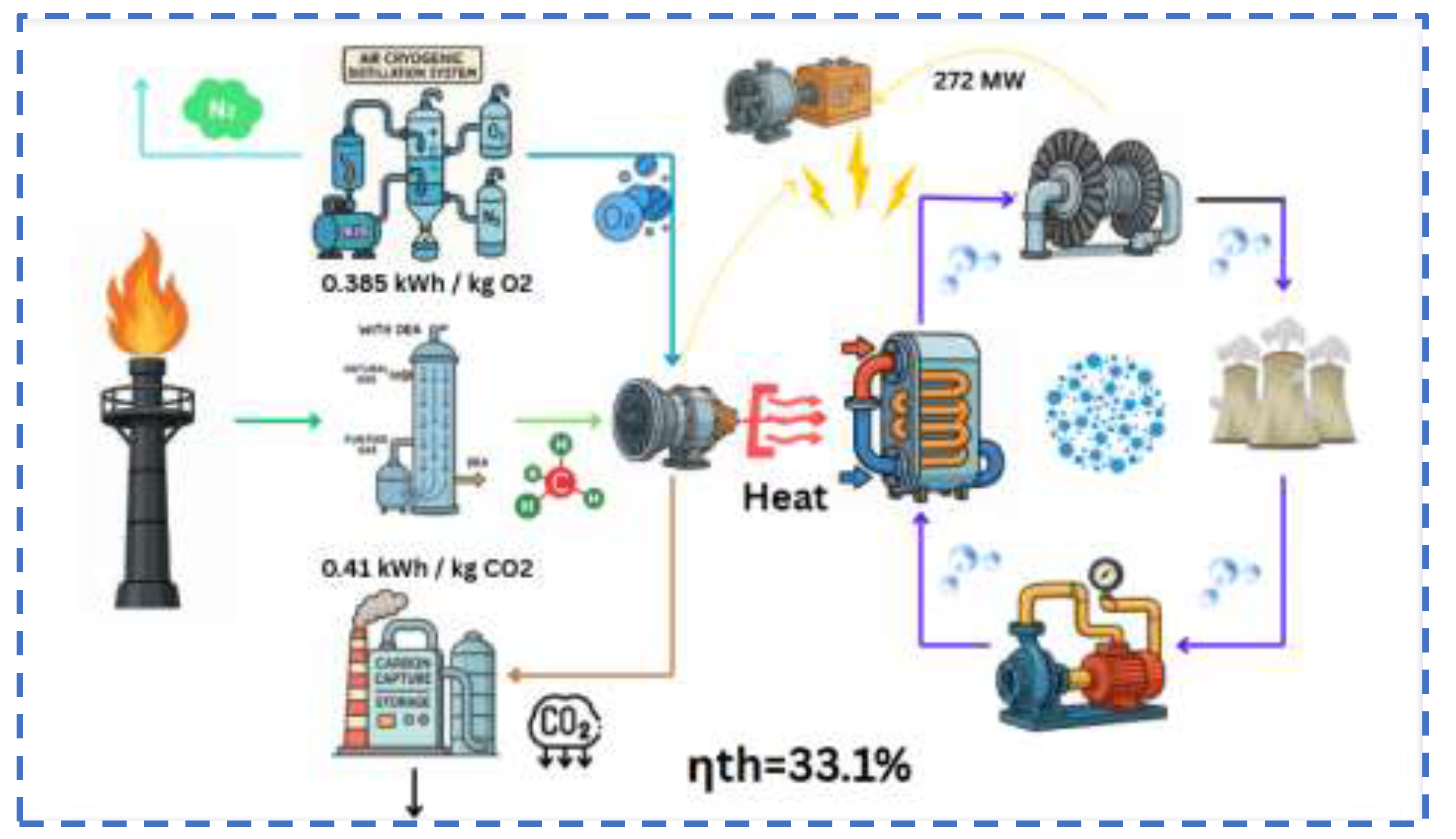
- Containerized 272 MW oxy-combustion + CCS module achieves 33.1% thermal and 39.98% exergetic efficiency.
- Air separation unit produces 96.67% O₂ at 0.385 kWh/kg, cutting energy demand by ~20% and lowering costs.
- CO₂ capture system sequesters 99.99% CO₂ at 0.41 kWh/kg, matching top benchmarks and minimizing emissions.
- Modular 272 MW units deliver off-grid power, scalable through multi-block sourcing and 2% efficiency gains.
- Global scale: 220 modules valorize 148 bcm APG, producing ~520 TWh electricity and sequestering 381 Mt CO₂.
A containerized 272 MW oxy-combustion module integrates a low-energy ASU (0.385 kWh/kg O₂) and near-total CO₂ capture (99.99% at 0.41 kWh/kg), achieving 33.1% thermal efficiency and 39.98% exergetic efficiency. Scalable multi-block deployment enables off-grid power generation, valorizes associated petroleum gas, and supports global decarbonization—up to 220 modules can supply ~520 TWh/year while sequestering 381 Mt of CO₂.
Figure 2.
System schematic representation: 272 MW Modular Oxy-Combustion Power Block With Integrated CO₂ Capture and ASU Optimization.
Figure 2.
System schematic representation: 272 MW Modular Oxy-Combustion Power Block With Integrated CO₂ Capture and ASU Optimization.
4. Discussion
Technical Implications
The system is designed to generate electricity using OxyC integrated with CC, an ASU, and a DEA-based gas sweetening system. This integrated approach aims to efficiently convert APG, a fuel typically vented or flared in remote oil fields, into a low-carbon power source. The system’s design was developed by evaluating multiple technologies under various operational conditions (such as pressure and temperature, for details see Complementary Material), always within the ranges documented for industrial plants. Through a series of simulations, the most efficient and feasible configuration was identified.
MCA is a valuable tool for identifying suitable locations for industrial activities. The analysis revealed three blocks—Block 57 (score: 8.15), Block 60 (score: 6.56), and Block 61 (score: 6.29)—that exceeded the cutoff value of 6, making them the most promising candidates for gas valorization. Block 57 emerged as the leader due to its outstanding combination of the highest heating value (10.00) and maximum available volume (10.00), compensating for a slightly lower, yet still favorable, composition score. Block 60 ranked second, primarily because of its excellent heating value (9.25) and substantial daily volume (6.31), despite having a moderate composition score. Block 61 demonstrated a balanced performance across all three criteria, with high scores in composition (6.71) and heating value (8.83), although its volume (3.19) was lower than that of Block 60. In contrast, the remaining blocks scored below six due to significant deficiencies in at least one category. These included low volumes in Blocks 43, 56, and 15; poor heating values in Blocks 12 and 07; and inadequate composition in Block 18. These findings highlight that sustained gas availability and high calorific content are crucial factors for assessing the feasibility of OXC and CO₂ capture applications. Blocks with insufficient volumes or poor gas quality are unsuitable for practical use. This careful selection process ensures a consistent gas supply aligned with energy demand, providing operational flexibility and resilience against disruptions [54,55]. Notably, Block 60 (Sacha), situated in Orellana province, represents a strategic site due to its high associated gas production and well-developed hydrocarbon infrastructure. It also boasts advantageous access to the National Interconnected System (SNI) and geological formations suitable for CO₂ storage in saline aquifers and depleted reservoirs.
The gas sweetening process using 35 wt.% DEA was proposed to improve the quality of associated gas by removing H₂S. The process achieved an H₂S removal efficiency of 90.62% [56,57,58] (from 0.0015 to ~ 0.0001%vol), well within the expected range of 85–95% reported for amine-based absorption systems [59,60,61]. Compared to monoethanolamine, DEA has lower corrosivity, which helps extend equipment lifespan and enhances operational sustainability. Additionally, the process showed an outstanding solvent regeneration efficiency of 99.99%, [62] a vital factor for ensuring long-term process viability, energy efficiency, and economic competitiveness in large-scale gas treatment operations.
The developed ASU exhibited excellent performance, achieving an oxygen recovery of 99.79%, a molar purity of 96.67%, and a specific energy consumption of 0.385 kWh/kg O₂. These values demonstrate a highly efficient and competitive operation when compared with benchmark data reported in the literature. It is important to note that increasing oxygen purity beyond 99.5% mol would substantially raise energy consumption due to the additional separation required to remove argon, negatively impacting the system’s net power output, which is currently sustained at 272 MW reported specific energy requirements in the range of 0.400–0.580 kWh/kg O₂ to achieve purities up to 99.99%, underscoring the efficiency of the present system. More recent studies highlight the potential of next-generation ASUs [63], reporting energy consumptions as low as 0.160 kWh/kg O₂, reflecting the progress in advanced cryogenic and process-integration designs. Oxygen production at 95% mol purity typically requires 0.200–0.240 kWh/kg O₂ under moderate operating pressures (~17 bar). In contrast, natural gas processing plants operating at higher pressures (up to 40 bar) can reach energy consumptions of 0.320 kWh/kg O₂, a value comparable to that observed in the present work. ASU emerged as the most energy-intensive component, accounting for 52.8% of the net input work demand. However, the adoption of next-generation ASU technologies is expected to reduce this energy burden, potentially increasing the net cycle efficiency to around 40%. The value of 272 MW is not sufficient to meet the power demands of Pichincha province, but it is important for increasing Ecuador’s power generation and diversifying the energy mix.
The developed system includes a CO₂ liquefaction unit for geological storage, achieving a specific energy consumption of 0.4148 kWh/kg CO₂ and a recovery efficiency of 99.99%. These results are in close agreement with the previous findings, [64]that reported specific consumptions ranging from 0.378 kWh/kg CO₂ at 80% capture rates up to 0.48 kWh/kg CO₂ for capture rates above 97.5%, similarly, semi-closed OXC cycles (SCOC-CC), which employ high-purity oxygen, can demand up to 0.467 kWh/kg CO₂ when targeting capture efficiencies near 100%, primarily influenced by the oxygen purity in the combustion process.
Moreover, the high capture efficiency aligns the system with stringent climate policy requirements, positioning Ecuador to move beyond passive compliance toward active leadership in emissions reduction. By deploying such technologies, the country can not only meet its commitments under the Paris Agreement and the World Bank’s “Zero Routine Flaring by 2030” initiative but also strengthen its regulatory credibility. Rather than being a subject of international concern due to persistent flaring, Ecuador could leverage this technology to demonstrate tangible progress in decarbonizing its oil and gas sector. This would enhance its capacity to advocate for stronger global climate governance and access to climate finance mechanisms, such as carbon credits or Just Energy Transition Partnerships (JETPs), while setting a precedent for sustainable hydrocarbon development in ecologically sensitive regions like the Amazon.
The OXC efficiency accounts for a combined Brayton–Rankine cycle (Tables S14–S30). It corresponds to 53.79%, excluding the energy demand of the ASU, the CCS unit, and the gas sweetening process. This figure aligns well with literature reports for combined OXC cycles[53], typically ranging between 50% and 55%. When accounting for the integrated energy demands of all units, the system’s thermal efficiency decreased to 33.10%, a decline consistent with the expected energy penalties of 6–12% reported for OXC systems with CCS. From an exergy perspective, the developed system achieved an exergetic efficiency of 40% [65], which is competitive compared to conventional technologies such as IGCC (27%) and Rankine cycles (32%). Nevertheless, it remains below more advanced technologies, including SOFCs (56%) and electrolysis systems (78%)[65,66]. Despite this, the system demonstrates a favorable balance between sustainability and energy utilization by transforming associated gas—traditionally flared—into an efficient source of electricity with integrated carbon capture. A particularly relevant reference is the pilot oxycombustion plant in Schwarze Pumpe[67,68] in Germany, which has provided a performance benchmark for these technologies. In that installation, CO₂ capture rates near 90% were achieved, and energy penalties remained within the margins expected for contemporary systems—yielding a cycle efficiency of approximately 33% when accounting for the energy demands of the ASU and the CCS unit [69,70].
The use of OXC offers significant benefits over traditional cycles by removing nitrogen from the combustion process, which reduces irreversibilities and allows for more effective CO₂ capture. These features align the system with Ecuador’s NDCs, emphasizing reductions in GHG emissions, especially in the energy sector, which is responsible for 46.63% of the country’s emissions[32]. By supporting both associated gas utilization and carbon capture, the project directly aids Ecuador’s climate targets, contributing to the unconditional 9% and conditional 20.9% emission reductions by 2025. Moreover, the system supports international efforts such as the Paris Agreement and the World Bank’s “Zero Routine Flaring by 2030” initiative.
Finally, the use of geospatial tools such as QGIS and Google Earth was critical for identifying the most suitable plant locations, minimizing risks from natural hazards, and ensuring geological stability. The integration of geospatial data into decision-making reflects best practices in large-scale energy projects, ensuring that the proposed system is both geologically and logistically robust.
Global Implications APG
The World Bank’s 2024 report reveals a troubling reversal in the trend of flaring reductions. In 2023, global gas flaring at upstream oil and gas facilities increased by 7%, reaching 148 bcm, the highest level in five years. This increase occurred despite a 1% rise in global oil production, which pushed flaring intensity up by 5% to 5.0 m³ per barrel of oil produced. The flared gas represents a lost market value of $9–48 billion, resulting in 381 million tonnes of CO₂ equivalent emissions annually, including 45 million tonnes from unburned methane. Nine countries —Russia, Iran, Iraq, the U.S., Venezuela, Algeria, Libya, Nigeria, and Mexico —accounted for 75% of global flaring but only 46% of oil production. Russia remains the top flaring country, with a 2.9 bcm increase in 2023 despite declining oil output, suggesting systemic infrastructure deterioration. Iran and Libya experienced a rise in flaring intensities to 15.4 and 15.2 m³/bbl, respectively, driven by increased oil production without corresponding investment in gas recovery. The U.S. experienced a 21% increase in flaring, primarily concentrated in the Permian and Eagle Ford basins, which was attributed mainly to grid stress and midstream infrastructure failures during extreme heat events. Conversely, Algeria and Venezuela achieved modest reductions in flaring volumes and intensity, reflecting targeted efforts to recover. However, Venezuela still ranks among the highest in flaring intensity globally. The Imported Flare Gas Index highlights how crude oil imports expose countries—especially in Europe—to embedded flaring emissions. This metric is becoming increasingly relevant in the context of emerging carbon border adjustment mechanisms (CBAM) and methane regulations, such as those adopted by the EU. Technically, satellite-based VIIRS Nightfire data and methane detection systems (Carbon Mapper, UNEP IMEO) quantify flaring and identify unlit flares. A novel methodology is presented to attribute methane emissions to these events, offering early warning capabilities and enhancing transparency. The findings underscore the urgent need for integrated flaring reduction strategies, especially as the 2030 Zero Routine Flaring target approaches. The World Bank’s Global Flaring and Methane Reduction (GFMR) Partnership expands support across the oil and gas value chain, aiming to help countries monetize associated gas, reduce emissions, and improve energy access. In this sense, let’s walk through the numbers: if a module produces 272 MW and reduces emissions by 0.4 Mt of CO₂ per year, we can use global flaring data. With 148 bcm yielding 381 Mt CO₂, the system could capture 99.99% of that, translating to 520 TWh of energy, worth approximately $52 billion annually. However, here’s the thing: deploying these modules would avoid roughly 381 million tons of CO₂eq emissions annually, nearly 10% of global power sector emissions. That’s massive. We’ll also acknowledge that engineering cannot work in isolation, so we propose policies like feed-in tariffs, mandatory flaring reduction laws, tax credits for MWh, and even international standards.
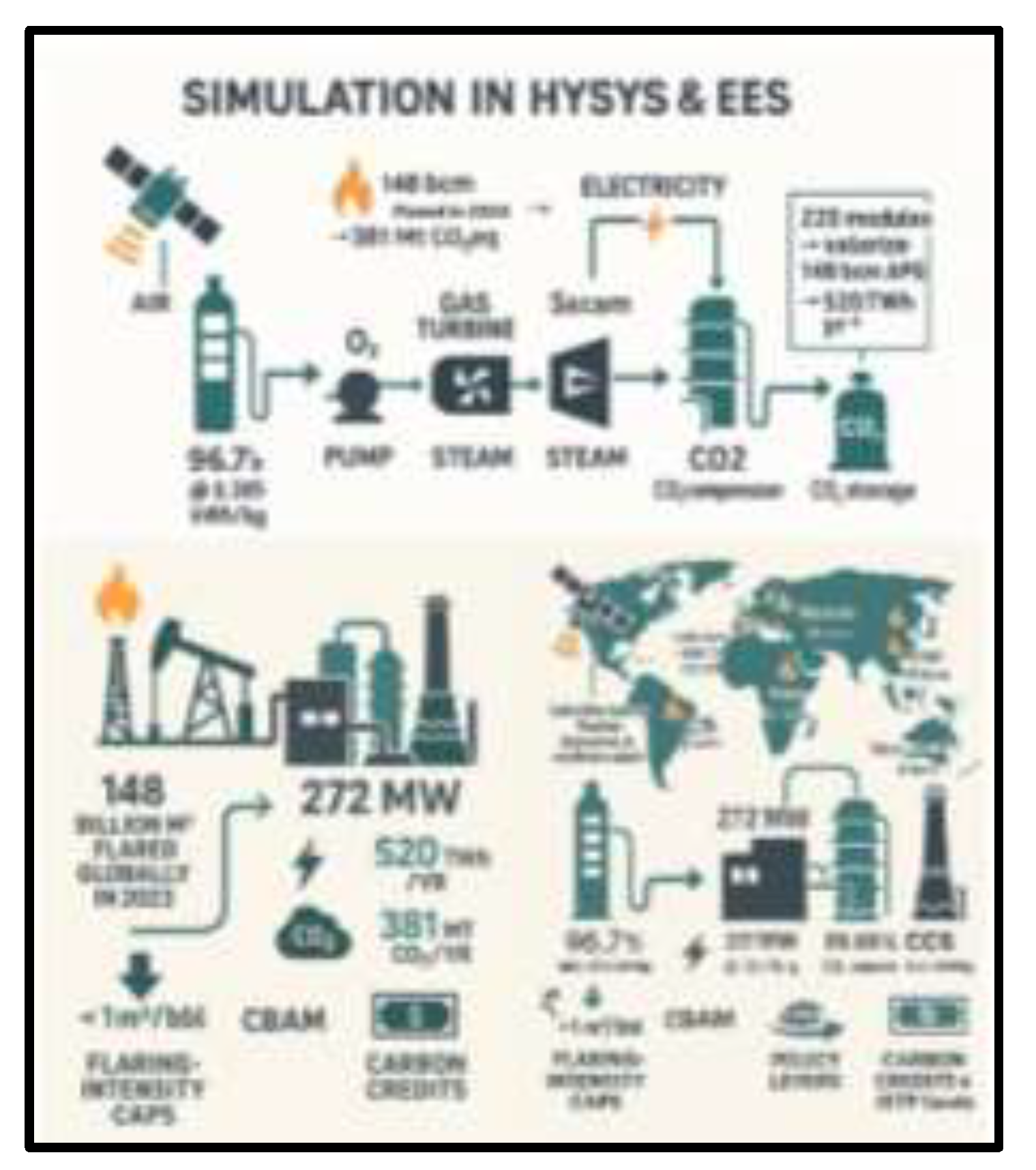
Deploying modular oxy-combustion and CCS units, like the one we modeled in Ecuador, could transform global flaring into a dispatchable clean-energy resource. In 2023, upstream operators flared 148 billion m³ of associated gas—equivalent to about 1570 TWh of gross thermal energy, or 520 TWh of electricity at our cycle’s 33.1% thermal efficiency. Each 272 MW module, running 8760 hours per year, can generate ~2.38 TWh, so roughly 220 such units could valorize the entire global flared volume. At a CO₂ capture rate of 99.99% and an energy penalty of 0.41 kWh/kg CO₂, the system would sequester ~381 million tons of CO₂—eliminating a significant source of emissions while delivering clean power. Scaling this concept globally hinges on three enablers. First, financial incentives: feed-in tariffs or auctions that award premium prices for electricity from captured-gas modules, paired with carbon credits for each tonne of CO₂ sequestered. Second, regulation: updating oil-field permits to mandate zero routine flaring, with exemptions only when modular recovery units are deployed within a defined timeline. Third, international climate finance: channeling World Bank GFMR and Just Energy Transition Partnership (JETP) funds toward capital-cost subsidies for containerized APG valorization in frontier basins (e.g., Nigeria, Venezuela, Kazakhstan). Three policy measures could catalyze adoption: 1. Mandatory Flaring Intensity Caps. Require operators to reduce flaring intensity below 1 m³/barrel by 2027 or face escalating penalties. This drives uptake of modular gas-to-power systems in fields where pipeline build-out is uneconomic. 2. Carbon Border Adjustment Mechanisms (CBAM). Tie crude-import levies to embedded flaring emissions (the report’s Imported Flare Gas Index). Nations that supply “low-flaring” barrels—verified by satellite and module telemetry—could access lower CBAM rates, incentivizing upstream investment in APG recovery. 3. Gas Monetization Credits. Under Article 6, carbon markets or national carbon taxes award credits for each MWh generated and each t CO₂ captured from associated gas. At $50–100/t CO₂, capturing 381 Mt/year yields $19–38 billion in potential credits—enough to underwrite multiple module rollouts.
Figure 3.
Integrated simulation framework and global APG valorization strategy. Top panel: Process flow diagram of a containerized oxy-combustion + CCS module as modeled in Aspen HYSYS and EES, showing key unit operations—air separation (ASU), oxy-combustion chamber, 2-stage gas turbine, HRSG/steam turbine, and multi-stage CO₂ compression and liquefaction. Flared APG (148 bcm yr⁻¹) and high-purity O₂ (96.7% @ 0.385 kWh kg⁻¹) feed the module to produce 272 MW (33.1% η_th) and compress 220 Mt CO₂ yr⁻¹ (99.99% capture @ 0.41 kWh kg⁻¹). Bottom panel: Global flaring context for 2023 (148 bcm → ~381 Mt CO₂ eq; potential 520 TWh yr⁻¹), the 220-module requirement to fully valorize that volume, and three policy levers—mandatory flaring-intensity caps (<1 m³ bbl⁻¹), CBAM-linked import levies, and $50–100 t⁻¹ CO₂ credits—to accelerate deployment.
Figure 3.
Integrated simulation framework and global APG valorization strategy. Top panel: Process flow diagram of a containerized oxy-combustion + CCS module as modeled in Aspen HYSYS and EES, showing key unit operations—air separation (ASU), oxy-combustion chamber, 2-stage gas turbine, HRSG/steam turbine, and multi-stage CO₂ compression and liquefaction. Flared APG (148 bcm yr⁻¹) and high-purity O₂ (96.7% @ 0.385 kWh kg⁻¹) feed the module to produce 272 MW (33.1% η_th) and compress 220 Mt CO₂ yr⁻¹ (99.99% capture @ 0.41 kWh kg⁻¹). Bottom panel: Global flaring context for 2023 (148 bcm → ~381 Mt CO₂ eq; potential 520 TWh yr⁻¹), the 220-module requirement to fully valorize that volume, and three policy levers—mandatory flaring-intensity caps (<1 m³ bbl⁻¹), CBAM-linked import levies, and $50–100 t⁻¹ CO₂ credits—to accelerate deployment.
By reframing flaring as a resource rather than a disposal problem, these policies align operator economics with climate goals. They can spur decentralized, off-grid power for local communities, reduce black-carbon and methane hazards, and leverage existing petroleum infrastructure. When combined with rigorous MRV—using satellite Nightfire data alongside plant SCADA streams—this framework would ensure transparency and accelerate progress toward the “Zero Routine Flaring by 2030” target. Ultimately, modular APG valorization could become a global standard, cutting CO₂ emissions by hundreds of millions of tonnes and unlocking over half a petawatt-hour of clean energy annually.
5. Conclusions
This study demonstrates the technical feasibility and energy performance of an OXC power cycle combined with carbon capture and an air separation unit. Results show that fuel composition significantly influences oxygen demand: lighter hydrocarbons, especially methane, not only reduce the amount of oxygen needed but also lessen the operational burden of air separation, enhancing system efficiency. The resulting thermal efficiency (33.10%) and exergetic efficiency (39.98%) fall within expected ranges, though they are constrained by the parasitic energy consumption of both the ASU and CCS systems. Process simulations indicate that minor adjustments in CO₂ recirculation and turbine steam distribution could boost thermal efficiency by roughly 2%, emphasizing the potential for operational improvements.
The ASU operated at an oxygen purity of 96.67% with a specific energy consumption of 0.385 kWh/kg O₂, while the CCS achieved 99.99% capture efficiency at 0.41 kWh/kg CO₂. These values align with benchmarks reported in the literature, confirming the validity of the integrated system design. However, the disproportionate energy penalty of CCS—nearly half of the total auxiliary demand—poses a significant bottleneck for efficiency improvements.
If APG H₂S concentrations are confirmed below 4 ppm, upstream DEA sweetening can be omitted; before removing the amine train, implement continuous H₂S monitoring, revise the process basis and control logic, and retune the CO2 recirculation loop to maintain combustor temperature, residence time, and flue-gas CO2 composition within validated limits; update ASU loading and cold-box duty to reflect the higher hydrocarbon mole fraction, recompute mass-energy and exergy balances to quantify changes in net output and parasitic loads, and retain contingency procedures and periodic sulfur sampling to protect equipment integrity and ensure rapid reinstatement of sweetening should H₂S excursions occur.
The flexibility gained from operating three separate gas blocks proved valuable in adapting to changing energy needs and supports sustainable design principles. The integrated system, which combines gas sweetening, air separation, OXC, and CO₂ capture, not only improves energy efficiency but also extends equipment lifespan by removing acidic and inert impurities. Additionally, the multigeneration scheme enables the simultaneous production of electricity and compressed CO₂, offering options for both decarbonized power generation and resource utilization.
Overall, the system shows promise for use in Ecuador’s Amazon region, where utilizing locally available associated gas can enhance energy security, environmental compliance, and climate mitigation goals. Future research should focus on reducing CCS energy needs, exploring advanced ASU configurations, and evaluating scalability under real operational conditions.
Supplementary Materials
The following supporting information can be downloaded at: Preprints.org. Attached supplementary materials showing the main results, balance, and energy mass.
Author Contributions
Conceptualization, GC and BN; methodology, GC and BN; software, BN and CG; validation, CM, CG and CA; formal analysis, GC and CM; investigation, BN, CM and CG; resources, CA and MV; data curation, BN and CG; writing—original draft preparation, GC and BN; writing—review and editing, CM, CA, and MV; visualization, GCC; supervision, GC; project administration, GC; funding acquisition, GC. All authors have read and agreed to the published version of the manuscript.
Funding
The authors received funding from the Direction of Investigation from the Central University of Ecuador under the CODE: DI-CONV-2023-026 “Economía Circular en los Reservorios Hidroeléctricos del Ecuador”.
Data Availability Statement
Gonzalo, C. (2026). Calculation and Simulation Data for Modular Oxy-Combustion and Carbon Capture in Associated Petroleum Gas Valorization [Data set]. Zenodo. https://doi.org/10.5281/zenodo.18806107.
Acknowledgments
The authors express their sincere gratitude to the Faculty of Chemical Engineering of the Central University of Ecuador for the academic, technical, and logistical support provided throughout the development of this study. The collaborative environment, TICs laboratory assistance, and analytical capabilities offered by the faculty were essential for the methodological development, simulation validation, and multidisciplinary integration required for the modeling of the oxy-combustion, air separation, and CO₂ capture systems. The authors also gratefully acknowledge the Directorate of Research of the Central University of Ecuador for the financial support provided under the project code DI-CONV-2023-026, which enabled access to specialized software, computational resources, and complementary analytical tools that were indispensable for conducting high-fidelity thermodynamic simulations and multi-criteria analyses. Additionally, the authors extend deep appreciation to EP Petroecuador for its valuable technical collaboration, particularly for granting access to operational data from the Amazonian production blocks, supplying gas composition and flaring information, and facilitating geospatial and logistical insights essential for the assessment of associated petroleum gas valorization potential. The cooperation of EP Petroecuador was fundamental to grounding the study in realistic operational conditions and ensuring the applicability of the proposed modular oxy-combustion and CO₂ capture strategy within the Ecuadorian Amazon.
Conflicts of Interest
The authors declare no conflicts of interest. The funders had no role in the design of the study, in the collection, analysis, or interpretation of data, in the writing of the manuscript, or in the decision to publish the results.
Abbreviations
The following abbreviations are used in this manuscript:
| AHP — Analytic Hierarchy Process. APG — Associated Petroleum Gas. ASU — Air Separation Unit. BC — Black Carbon. bcm — Billion cubic meters (gas volume). CBAM — Carbon Border Adjustment Mechanism. CC — Carbon Capture CCS — Carbon Capture and Storage. CES — Clean Energy Systems. DEA — Diethanolamine (amine solvent used for sweetening). EES — Engineering Equation Solver. EROI — Energy Return on Investment. GCV — Gross Calorific Value. GFMR / GGFR — Global Flaring and Methane Reduction / Global Gas Flaring Reduction. GHG — Greenhouse Gas. GIS — Geographic Information System. GWP — Global Warming Potential. HRSG — Heat Recovery Steam Generator. IGCC — Integrated Gasification Combined Cycle. JETP — Just Energy Transition Partnership. LHV — Lower Heating Value. MAATE — Ministerio del Ambiente, Agua y Transición Ecológica (Ecuador). MCA — Multi-Criteria Analysis. MRV — Monitoring, Reporting, and Verification. NDCs — Nationally Determined Contributions. NGCC — Natural Gas Combined Cycle. OXC / OxyC — Oxy-Combustion (term used for the power cycle). PSA — Pressure Swing Adsorption. SCOC-CC — Semi-Closed Oxy-Combustion Combined Cycle. SIN — Sistema Nacional Interconectado. SMR — Steam Methane Reforming. SOFC — Solid Oxide Fuel Cell. TEG — Triethylene Glycol (dehydration unit). TROPOMI — TROPOspheric Monitoring Instrument (Sentinel-5P). VIIRS — Visible Infrared Imaging Radiometer Suite. VOC(s) — Volatile Organic Compounds. WI — Wobbe Index. |
References
- Franklin, M.; Chau, K.; Cushing, L.J.; Johnston, J.E. Characterizing Flaring from Unconventional Oil and Gas Operations in South Texas Using Satellite Observations. Environ. Sci. Technol. 2019, 53, 2220–2228. [Google Scholar] [CrossRef]
- Heim, I.; Vigneau, A.C.; Kalyuzhnova, Y. Environmental and Socio-Economic Policies in Oil and Gas Regions: Triple Bottom Line Approach. Reg. Stud. 2023, 57, 181–195. [Google Scholar] [CrossRef]
- Al-Rubaye, A.H.; Jasim, D.J.; Jassam, S.A.; Jasim, H.M.; Ameen, H.F.M.; Khoshnaw, F.A. Associated Petroleum Gas: Environmental, Utilization, and Economic Rationale. IOP Conf. Ser. Earth Environ. Sci. 2023, 1262, 022026. [Google Scholar] [CrossRef]
- Olujobi, O. Analysis of the Legal Framework Governing Gas Flaring in Nigeria’s Upstream Petroleum Sector and the Need for Overhauling. Soc. Sci. 2020, 9, 132. [Google Scholar] [CrossRef]
- Banet, C. Regulation of Flaring and Venting of Natural Gas from Petroleum Activities in Norway. SSRN Electronic Journal 2025. [Google Scholar] [CrossRef]
- Wen, Y.; Xiao, J.; Peng, J. The Effects of the “Zero Routine Flaring by 2030” Initiative: International Comparisons Based on Generalized Synthetic Control Method. Environ. Impact Assess. Rev. 2023, 100, 107095. [Google Scholar] [CrossRef]
- Calel, R.; Mahdavi, P. The Unintended Consequences of Antiflaring Policies—and Measures for Mitigation. Proceedings of the National Academy of Sciences 2020, 117, 12503–12507. [Google Scholar] [CrossRef]
- Blundell, W.; Kokoza, A. Natural Gas Flaring, Respiratory Health, and Distributional Effects. J. Public Econ. 2022, 208, 104601. [Google Scholar] [CrossRef]
- Hamidzadeh, Z.; Sattari, S.; Soltanieh, M.; Vatani, A. Development of a Multi-Objective Decision-Making Model to Recover Flare Gases in a Multi Flare Gases Zone. Energy 2020, 203, 117815. [Google Scholar] [CrossRef]
- Crowley-Vigneau, A. The Global Norm on Combatting Flaring and Russian Decrees 7 and 1148; 2022; pp. 141–196. [Google Scholar]
- Babalola, A.A.; Olawuyi, D.S. Overcoming Regulatory Failure in the Design and Implementation of Gas Flaring Policies: The Potential and Promise of an Energy Justice Approach. Sustainability 2022, 14, 6800. [Google Scholar] [CrossRef]
- Vorobev, A.; Shchesnyak, E. Associated Petroleum Gas Flaring: The Problem and Possible Solution 2019, 227–230.
- World Bank Global Gas Flaring Data. Available online: https://www.worldbank.org/en/programs/gasflaringreduction/global-flaring-data (accessed on 7 June 2025).
- Alola, A.A.; Onifade, S.T.; Magazzino, C.; Obekpa, H.O. The Effects of Gas Flaring as Moderated by Government Quality in Leading Natural Gas Flaring Economies. Sci. Rep. 2023, 13, 14394. [Google Scholar] [CrossRef] [PubMed]
- Beltrán-Jiménez, K.; Chávez-Rodríguez, M.F.; Szklo, A. Associated Natural Gas Flare in the Integrated Market of the Southern Cone. Energy Strategy Reviews 2018, 22, 337–347. [Google Scholar] [CrossRef]
- Osuoha, C.A.; Fakutiju, M.A. Gas Flaring in Niger Delta Region of Nigeria: Cost, Ecological and Human Health Implications. Environmental Management and Sustainable Development 2017, 6, 390. [Google Scholar] [CrossRef]
- Rodrigues, A.C.C. Decreasing Natural Gas Flaring in Brazilian Oil and Gas Industry. Resources Policy 2022, 77, 102776. [Google Scholar] [CrossRef]
- Faruolo, M.; Caseiro, A.; Lacava, T.; Kaiser, J.W. Gas Flaring: A Review Focused On Its Analysis From Space. IEEE Geosci. Remote Sens. Mag. 2021, 9, 258–281. [Google Scholar] [CrossRef]
- Davoudi, M.; Rahimpour, M.R.; Jokar, S.M.; Nikbakht, F.; Abbasfard, H. The Major Sources of Gas Flaring and Air Contamination in the Natural Gas Processing Plants: A Case Study. J. Nat. Gas Sci. Eng. 2013, 13, 7–19. [Google Scholar] [CrossRef]
- Weyant, C.L.; Shepson, P.B.; Subramanian, R.; Cambaliza, M.O.L.; Heimburger, A.; McCabe, D.; Baum, E.; Stirm, B.H.; Bond, T.C. Black Carbon Emissions from Associated Natural Gas Flaring. Environ. Sci. Technol. 2016, 50, 2075–2081. [Google Scholar] [CrossRef] [PubMed]
- Facchinelli, F.; Pappalardo, S.E.; Codato, D.; Diantini, A.; Della Fera, G.; Crescini, E.; De Marchi, M. Unburnable and Unleakable Carbon in Western Amazon: Using VIIRS Nightfire Data to Map Gas Flaring and Policy Compliance in the Yasuní Biosphere Reserve. Sustainability 2019, 12, 58. [Google Scholar] [CrossRef]
- Durango-Cordero, J.; Saqalli, M.; Parra, R.; Elger, A. Spatial Inventory of Selected Atmospheric Emissions from Oil Industry in Ecuadorian Amazon: Insights from Comparisons among Satellite and Institutional Datasets. Saf. Sci. 2019, 120, 107–116. [Google Scholar] [CrossRef]
- Nwaogu, D.C.; Akpoghome, T.U. Ending Gas Flaring in the Nigerian Oil and Gas Industry: The Need for Strict Regulatory Enforcement. Journal of Environmental Law & Policy 2022, 02, 79–101. [Google Scholar] [CrossRef]
- Olawuyi, D.S. Overcoming Regulatory Failure in the Design and Implementation of Gas Flaring Policies: The Potential and Promise of an Energy Justice Approach. SSRN Electronic Journal 2022. [Google Scholar] [CrossRef]
- Duren, R.; Gordon, D. Tackling Unlit and Inefficient Gas Flaring. Science 2022, 377, 1486–1487. [Google Scholar] [CrossRef]
- Aoun, A.E.; Rasouli, V.; Khetib, Y. Assessment of Advanced Technologies to Capture Gas Flaring in North Dakota. Arab. J. Sci. Eng. 2023, 48, 16507–16525. [Google Scholar] [CrossRef]
- Omobolanle, O.C.; Ikiensikimama, S.S. Gas Flaring: Technicalities, Challenges, and the Economic Potentials. Environmental Science and Pollution Research 2024, 31, 40838–40850. [Google Scholar] [CrossRef]
- Duren, R.; Gordon, D. Tackling Unlit and Inefficient Gas Flaring. Science 2022, 377, 1486–1487. [Google Scholar] [CrossRef]
- Tavallaei, M.; Farzaneh-Gord, M.; Moghadam, A.J. 4E Analysis and Thermodynamic Optimization of Flaring Associated Gas Recovery Using External Firing Recuperative Gas Turbine. Energy Convers. Manag. 2022, 266, 115836. [Google Scholar] [CrossRef]
- Ilyin, V.B.; Yakovenko, R.E.; Belashov, D.M.; Zemlyakov, N.D.; Savost’yanov, A.P. Thermodynamic Study of Associated Petroleum Gas Reforming to Methane. Petroleum Chemistry 2019, 59, 641–649. [Google Scholar] [CrossRef]
- Wilcox, A. Flaring Issues, Solutions & Technologies - 2019; Pittsburgh, PA, and Morgantown, WV (United States), 2019. [Google Scholar]
- MAATE Plan Nacional de Mitigación del Cambio Climático Ecuador 2024-2070; Quito, 2024.
- Mansoor, R.; Tahir, M. Recent Developments in Natural Gas Flaring Reduction and Reformation to Energy-Efficient Fuels: A Review. Energy & Fuels 2021, 35, 3675–3714. [Google Scholar] [CrossRef]
- Burtt, D.C.; Corbin, D.J.; Armitage, J.R.; Crosland, B.M.; Jefferson, A.M.; Kopp, G.A.; Kostiuk, L.W.; Johnson, M.R. A Methodology for Quantifying Combustion Efficiencies and Species Emission Rates of Flares Subjected to Crosswind. Journal of the Energy Institute 2022, 104, 124–132. [Google Scholar] [CrossRef]
- Gilardoni, S.; Di Mauro, B.; Bonasoni, P. Black Carbon, Organic Carbon, and Mineral Dust in South American Tropical Glaciers: A Review. Glob. Planet. Change 2022, 213, 103837. [Google Scholar] [CrossRef]
- Facchinelli, F.; Pappalardo, S.E.; Codato, D.; Diantini, A.; Della Fera, G.; Crescini, E.; De Marchi, M. Unburnable and Unleakable Carbon in Western Amazon: Using VIIRS Nightfire Data to Map Gas Flaring and Policy Compliance in the Yasuní Biosphere Reserve. Sustainability 2019, 12, 58. [Google Scholar] [CrossRef]
- Trading Economics Ecuador Crude Oil Production. Available online: https://tradingeconomics.com/ecuador/crude-oil-production (accessed on 11 June 2025).
- GGFR GGFR Technology Overview – Utilization of Small-Scale Associated Gas. 2021.
- INEN NTE 2261 Primera revisión - Quito – Ecuador Norma Técnica Ecuatoriana NTE INEN 2261 Primera. Quito, 2013.
- World Bank Global Gas Flaring Data. Available online: https://www.worldbank.org/en/programs/gasflaringreduction/global-flaring-data (accessed on 11 June 2025).
- Aspen Technology; Inc. Aspen HYSYS (Version 14) [Computer Software]. 2024. Available online: https://www.aspentech.com.
- Maldonado-Erazo, C.P.; Tierra-Tierra, N.P.; del Río-Rama, M. de la C.; Álvarez-García, J. Safeguarding Intangible Cultural Heritage: The Amazonian Kichwa People. Land (Basel). 2021, 10, 1395. [Google Scholar] [CrossRef]
- Etchart, L. Biodiversity, Global Governance of the Environment, and Indigenous Peoples; 2022; pp. 157–183. [Google Scholar]
- Douros, J.; Eskes, H.; van Geffen, J.; Boersma, K.F.; Compernolle, S.; Pinardi, G.; Blechschmidt, A.-M.; Peuch, V.-H.; Colette, A.; Veefkind, P. Comparing Sentinel-5P TROPOMI NO2 Column Observations with the CAMS Regional Air Quality Ensemble. Geosci. Model Dev. 2023, 16, 509–534. [Google Scholar] [CrossRef]
- Morenov, V.; Leusheva, E.; Buslaev, G.; Gudmestad, O.T. System of Comprehensive Energy-Efficient Utilization of Associated Petroleum Gas with Reduced Carbon Footprint in the Field Conditions. Energies (Basel). 2020, 13, 4921. [Google Scholar] [CrossRef]
- Hall, C.A.S.; Powers, R.; Schoenberg, W. Peak Oil, EROI, Investments and the Economy in an Uncertain Future. In Biofuels, Solar and Wind as Renewable Energy Systems; Springer Netherlands: Dordrecht, 2008; pp. 109–132. [Google Scholar]
- Abdulrahman, R.K.; Zangana, M.H.S.; Ali, K.S.; Slagle, J.C. Utilizing Mixed Amines in Gas Sweetening Process: A Kirkuk Field Case Study and Simulation. In Proceedings of the 2017 International Conference on Environmental Impacts of the Oil and Gas Industries: Kurdistan Region of Iraq as a Case Study (EIOGI), April 2017; IEEE; pp. 5–8. [Google Scholar]
- Naji, S.Z.; Abd, A.A. Sensitivity Analysis of Using Diethanolamine Instead of Methyldiethanolamine Solution for GASCO’S Habshan Acid Gases Removal Plant. Frontiers in Energy 2019, 13, 317–324. [Google Scholar] [CrossRef]
- Ferreira, A.F.B.; Da Silva, J.A.P.; Da Silva, M.R.; De Matos, O.B.; Freitas Filho, A. de S.; Dantas, B.C.; Oliveira, K.B.; Amorim, N. de S. Absorption of the Acid Gases CO2 and H2S from a Natural Gas Stream Using the Aspen Plus® Simulator. OBSERVATÓRIO DE LA ECONOMÍA LATINOAMERICANA 2024, 22, e3113. [Google Scholar] [CrossRef]
- Darani, N.S.; Behbahani, R.M.; Shahebrahimi, Y.; Asadi, A.; Mohammadi, A.H. Simulation and Optimization of the Acid Gas Absorption Process by an Aqueous Diethanolamine Solution in a Natural Gas Sweetening Unit. ACS Omega 2021, 6, 12072–12080. [Google Scholar] [CrossRef] [PubMed]
- Babakhani Samani, M.H.; Toghraie, D.; Mehmandoust, B.; Niknejadi, M.; Fazilati, M.A. Investigating the Effect of Absorbent Material and Heat Flux in Natural Gas Sweetening Process Using Molecular Dynamics Simulation. Case Studies in Thermal Engineering 2024, 61, 105081. [Google Scholar] [CrossRef]
- Darani, N.S.; Behbahani, R.M.; Shahebrahimi, Y.; Asadi, A.; Mohammadi, A.H. Simulation and Optimization of the Acid Gas Absorption Process by an Aqueous Diethanolamine Solution in a Natural Gas Sweetening Unit. ACS Omega 2021, 6, 12072–12080. [Google Scholar] [CrossRef]
- Ferrari, N.; Mancuso, L.; Davison, J.; Chiesa, P.; Martelli, E.; Romano, M.C. Oxy-Turbine for Power Plant with CO2 Capture. Energy Procedia 2017, 114, 471–480. [Google Scholar] [CrossRef]
- Bhattacharyya, S.C. Energy Data and Energy Balance. In Energy Economics; Springer London: London, 2019; pp. 7–40. [Google Scholar]
- Bhattacharyya, S.C. Energy Access Programmes and Sustainable Development: A Critical Review and Analysis. Energy for Sustainable Development 2012, 16, 260–271. [Google Scholar] [CrossRef]
- Eletta, O.A.A.; Awotoye, D.T.; Zubairu, A.A. Investigation of Alkanol-Amine Solvents and Their Blends for CO2 Removal from Natural Gas Using Aspen-Hysys. Nigerian Journal of Technological Development 2022, 18, 268–278. [Google Scholar] [CrossRef]
- Babakhani Samani, M.H.; Toghraie, D.; Mehmandoust, B.; Niknejadi, M.; Fazilati, M.A. Investigating the Effect of Absorbent Material and Heat Flux in Natural Gas Sweetening Process Using Molecular Dynamics Simulation. Case Studies in Thermal Engineering 2024, 61, 105081. [Google Scholar] [CrossRef]
- Darani, N.S.; Behbahani, R.M.; Shahebrahimi, Y.; Asadi, A.; Mohammadi, A.H. Simulation and Optimization of the Acid Gas Absorption Process by an Aqueous Diethanolamine Solution in a Natural Gas Sweetening Unit. ACS Omega 2021, 6, 12072–12080. [Google Scholar] [CrossRef]
- Mushtaq, F.; Alam, N.; Ullah, A. Performance Analysis of Natural Gas Sweetening Unit with Amine Solution and Blends. Mehran University Research Journal of Engineering and Technology 2022, 41, 100–108. [Google Scholar] [CrossRef]
- Eletta, O.A.A.; Awotoye, D.T.; Zubairu, A.A. Investigation of Alkanol-Amine Solvents and Their Blends for CO2 Removal from Natural Gas Using Aspen-Hysys. Nigerian Journal of Technological Development 2022, 18, 268–278. [Google Scholar] [CrossRef]
- Darani, N.S.; Behbahani, R.M.; Shahebrahimi, Y.; Asadi, A.; Mohammadi, A.H. Simulation and Optimization of the Acid Gas Absorption Process by an Aqueous Diethanolamine Solution in a Natural Gas Sweetening Unit. ACS Omega 2021, 6, 12072–12080. [Google Scholar] [CrossRef]
- Soo, X.Y.D.; Lee, J.J.C.; Wu, W.-Y.; Tao, L.; Wang, C.; Zhu, Q.; Bu, J. Advancements in CO2 Capture by Absorption and Adsorption: A Comprehensive Review. Journal of CO2 Utilization 2024, 81, 102727. [Google Scholar] [CrossRef]
- Leiva, C.A.; Poblete, D.A.; Aguilera, T.L.; Acuña, C.A.; Quintero, F.J. Air Separation Units (ASUs) Simulation Using Aspen Hysys at Oxinor I of Air Liquid Chile S.A Plant. Polish Journal of Chemical Technology 2020, 22, 10–17. [Google Scholar] [CrossRef]
- Mletzko, J.; Ehlers, S.; Kather, A. Comparison of Natural Gas Combined Cycle Power Plants with Post Combustion and Oxyfuel Technology at Different CO2 Capture Rates. Energy Procedia 2016, 86, 2–11. [Google Scholar] [CrossRef]
- Dincer, I.; Bicer, Y. Energy, Environment and Sustainable Development. In Integrated Energy Systems for Multigeneration; Elsevier, 2020; pp. 1–31. [Google Scholar]
- Dincer, I. The Role of Exergy in Energy Policy Making. Energy Policy 2002, 30, 137–149. [Google Scholar] [CrossRef]
- Strömberg, L.; Lindgren, G.; Jacoby, J.; Giering, R.; Anheden, M.; Burchhardt, U.; Altmann, H.; Kluger, F.; Stamatelopoulos, G.-N. Update on Vattenfall’s 30 MWth Oxyfuel Pilot Plant in Schwarze Pumpe. Energy Procedia 2009, 1, 581–589. [Google Scholar] [CrossRef]
- Liu, Z.; Zhang, T. Pilot and Industrial Demonstration of Oxy-Fuel Combustion. In Oxy-Fuel Combustion; Elsevier, 2018; pp. 209–222. [Google Scholar]
- Buhre, B.J.P.; Elliott, L.K.; Sheng, C.D.; Gupta, R.P.; Wall, T.F. Oxy-Fuel Combustion Technology for Coal-Fired Power Generation. Prog. Energy Combust. Sci. 2005, 31, 283–307. [Google Scholar] [CrossRef]
- White, V.; Wright, A.; Tappe, S.; Yan, J. The Air Products Vattenfall Oxyfuel CO2 Compression and Purification Pilot Plant at Schwarze Pumpe. Energy Procedia 2013, 37, 1490–1499. [Google Scholar] [CrossRef]
Table 2.
Comparative Performance of Oxy-Combustion and Conventional Power Cycles with and without CO₂ Capture.
Table 2.
Comparative Performance of Oxy-Combustion and Conventional Power Cycles with and without CO₂ Capture.
| Technology | Net Power (MWe) | CO₂ captured (kg/MWh) | Efficiency (LHV based%) | Efficiency reduction due to capture% |
|---|---|---|---|---|
| NGCC reference | 904 | - | 58.8 | - |
| SCOC-CC | 757 | 377 | 49.3 | 9.5 |
| NET Power | 846 | 336 | 55.1 | 3.7 |
| S-Graz Modified | 756 | 375 | 49.2 | 9.6 |
| CES Supercritical | 751 | 379 | 18.9 | 9.9 |
Source: [53]. Among the plants utilizing a cryogenic air separation unit, the SCOC-CC and NET Power cycles use recycled CO₂ as a temperature moderator. In contrast, the S-Graz and CES cycles use water.
Table 4.
Sweetening gas process parameters.
| Compound | DEA inlet Xi | APG inlet yi | APG outlet yi |
|---|---|---|---|
| N2 | - | 0.032 | 0.042 |
| CO₂ | 0.002 | 0.185 | 0.017 |
| CH4 | - | 0.385 | 0.503 |
| C2H6 | - | 0.078 | 0.102 |
| C3H8 | - | 0.129 | 0.169 |
| iC4H10 | - | 0.031 | 0.040 |
| nC4H10 | - | 0.061 | 0.079 |
| iC5H12 | - | 0.022 | 0.028 |
| nC5H12 | - | 0.012 | 0.015 |
| nC6H14 | - | 0.003 | 0.004 |
| nC7H14 | - | 0.000 | 0.001 |
| H₂O | 0.648 | 0.060 | 0.001 |
| H₂S | - | 0.002 | 0.000 |
| DEA | 0.35 | - | - |
Sour gas characterization = Mass flow = 93216.156 kg h-1, Molar flow = 2876.22 kmol h-1, and Molecular weight = 32.41 kg kmol-1. An average H₂S percentage of 0.15% vol. is used (range 0.25 – 0.25). This APG applies to selected blocks 57, 60, and 61.
Disclaimer/Publisher’s Note: The statements, opinions and data contained in all publications are solely those of the individual author(s) and contributor(s) and not of MDPI and/or the editor(s). MDPI and/or the editor(s) disclaim responsibility for any injury to people or property resulting from any ideas, methods, instructions or products referred to in the content. |
© 2026 by the authors. Licensee MDPI, Basel, Switzerland. This article is an open access article distributed under the terms and conditions of the Creative Commons Attribution (CC BY) license.
Copyright: This open access article is published under a Creative Commons CC BY 4.0 license, which permit the free download, distribution, and reuse, provided that the author and preprint are cited in any reuse.


