

Submitted:
07 March 2026
Posted:
09 March 2026
You are already at the latest version
Abstract
The major share of available fresh water in India, almost 80 percent, is used for agricultural irrigation. The country is already facing water scarcity. Therefore, it is necessary to utilize and conserve water used for irrigation effectively so as to improve water productivity and achieve the objective of ‘more crop per drop’. Farmers are using seeds, fertilizers and pesticides in measured quantity but not the water which is an important and scarce resource. The main reason for this is lack of simple farmer’s friendly irrigation scheduling tools. In this context, adoption of scientific irrigation scheduling techniques can assist the farmers in effective utilization of the available water resource. In this study efforts were made to develop simple irrigation scheduling method and tool to optimize water use. A study carried out on a farmer’s field for irrigation of wheat crop for two years showed that there was 18 to 22 percent saving of water and 25 to 30 percent increase in water use efficiency in terms of yield per unit of water if measured quantity of water is supplied based on evaporative demand of crop as against traditional method of adhoc supply. In this study, crop irrigation requirement based on Cumulative Pan Evaporation (CPE) is used to apply irrigation water (IW). In addition to this IoT-based soil moisture sensor is installed in the root zone of the crop to monitor and give alert for scheduling irrigation at management allowable depletion (MAD) of soil moisture to avoid water stress. Based on the study, Data driven irrigation scheduling APP is developed which is easy to use by the farmers.
Keywords:
irrigation management
; irrigation scheduling
; pan evaporation
; evapotranspiration
; IW/CPE
; water saving
; water use efficiency
1. Introduction
Water, a critical resource for agriculture, necessitates careful and responsible management to support productive and sustainable farming activities. Freshwater is becoming a scarce resource in many areas of the world. Agriculture is the largest user of global freshwater, accounting for around 70% of the total water withdrawals [3,11]. Increasing the water use efficiency in agriculture, especially in irrigation systems, is important in order to ensure a sustained supply of water for agriculture production, municipal and industrial purposes and ecosystem functions. It is estimated that reducing irrigation use by one tenth, would free up enough water to roughly double domestic water use worldwide [9].The average overall irrigation efficiency of irrigation projects worldwide based on study of 31 irrigation projects by International Land Research Institute (ILRI), Netherlands ranges from 23% to 42% [13]. This shows that farmers are over irrigating their farms without equivalent returns. The water saved through use of optimized irrigation methods and level can be used to irrigate additional lands, thus achieving a rational use of land and water resources [5].
Now-a-days, modern high-tech irrigation systems like sprinkle and drip are being used for irrigating crops worldwide including India. However, considering the capital cost and energy requirements for operation, they are used on limited scale. For example, of the total net irrigated area of 79 million ha in India, only about 21% is covered by drip and sprinkler irrigation [6]. Rest of the area is irrigated using conventional surface (gravity) irrigation methods like Border, Furrow and Basin without taking into account the actual crop water requirement. If not managed properly, especially without knowing the crop water requirement, a significant amount of water is lost as deep percolation and runoff. Under this scenario, if simple, easy to adopt and less expensive irrigation scheduling method which involves applying measured quantity of water based on actual crop water needs is adopted, a lot of water can be saved. The present study was carried out on farmer’s field consecutively for 2 years to develop a low cost, farmers’ friendly tool and methodology for irrigation scheduling.
2. Irrigation Scheduling
Irrigation scheduling is a decision-making process that occurs throughout the growing season to determine when and how much water should be applied. It helps a farmer in deciding the proper time and the optimum quantity of water for each irrigation to optimize crop yields with maximum water use efficiency, and at the same time, ensuring minimum damage to the soil properties. Traditionally irrigation scheduling is performed based on the irrigator’s personal experience, plant appearance, watching the neighbor, or just simply irrigating whenever water is available. It results into over irrigation. Over the years a number of irrigation scheduling techniques based on soil water plant relationship are developed.
Evapo-Transpiration (ET) is the combination of evaporation and transpiration. Evaporation is water loss from surrounding soil surface. Transpiration is the natural process by which water is extracted from the soil by the root system and moves through the plant carrying nutrients and is eventually changed to water vapor escaping to the atmosphere through the stomata in the plant leaves. This is the total amount of water needed for plants to grow. ET is used in scheduling the irrigation water requirement for plants.
Following methods are generally used to estimate the Evapotranspiration:
(A). Use of Empirical Models based on analysis of Agro-Meteorological Data e.g., Blaney-Criddle, Thornthwaite, Hargreaves, Modified Penman, FAO-Penman-Monteith, Penman- Kimberly [4]. Empirical models require lot of meteorological data and analysis. In many areas, especially in developing countries, the required meteorological data are lacking or if available it is beyond the reach of farmers thereby limiting the application of empirical models.
(B). Use of Evaporation Pan
Considering the limitations in application of empirical models, simpler techniques are being used. One of the most common, and simple techniques for estimating Evapotranspiration is the use of Pan Evaporimeter such as developed by the United States Weather Bureau (USWB) Class A pan. Because of its simplicity and ease of use and data interpretation as well as the high adjustment to climate changes, pan evaporimeter has become very important in irrigation scheduling [2]. However, the high cost of such standard pans has limited their adoption and use in farmers’ fields. Therefore, Small Pan Evaporimeters with diameter ranging from 25 to 30 cm and 15 cm height are also being used to measure evaporation. The Small Evaporation Pan showed a good performance for measuring evaporation and eventually estimating Evapotranspiration [2,8,14].
3. Irrigation Water to Cumulative Pan Evaporation (IW/CPE) Approach of Irrigation Scheduling
In IW/CPE approach, known amount of irrigation water is applied when cumulative pan evaporation reaches predetermined level. This approach has been tested for different crops at different locations by various Agriculture Universities in India. Based on these studies National Institute of Open Schooling (NIOS) have recommended optimum IW/CPE ratios for different crops. These standardized ratios are used in this study. Accordingly, the IW/CPE ratio of 1 is found to be the most optimum for wheat crop [1,7,10,12]. Therefore, this ratio of 1 is considered for the present study.
4. Experimental Set-up
The study was conducted at Village Madsangvi in Nashik District of Maharashtra, India during the winter (Rabi) season 2023-24 and 2024-25. The farm is located 15 km away from Nashik city at 20.009 Latitude, 73.864 Longitude and about 563 meter above the mean sea level. The total area under study was 2016 Sqm. The area was divided into two equal plots of 1008 Sqm each. Small Pan Evaporimeter of 30 cm. diameter and 15 cm. heights made up of galvanized iron was installed to record daily evaporation in mm. (Figure 1). The standard Cut-Throat flume of 20cm. X 90 cm. size was used to measure the flow rate of water (liters/second) in the open channel carrying water (Figure 2). Border method of surface irrigation as practiced by the farmers in this region was used (Figure 3). Each plot was divided into 12 borders of 2m. width and 42 m. length. Half of the area is demarcated for irrigation with traditional method of supplying water on adhoc basis (Plot A) and other half area for applying measured quantity of water based on cumulative pan evaporation (Plot B).
5. Methodology
The evaporation taking place from pan in mm was recorded at 8 a.m. daily throughout the winter season for both the years. The volume of water used during each irrigation was computed using flow rate through Cut-Throat and time of supply for each plot as shown below:
Volume of Water(m3) = Flow rate (lit/sec) × time of supply (hours) × 3.6
The irrigation water supply to plot A was based on traditional practice of applying uncontrolled volume of water on ad-hoc basis. On the contrary, the plot B was irrigated with controlled volume of water based on the time of irrigation computed using cumulative pan evaporation between two irrigations (mm), area of the plot (m2)and the measured flow rate (lit/sec) as given below:
Time of Irrigation = (Area of Plot B × Cumulative Pan Evaporation) ÷ (Flow Rate × 3600)
(hours) (m2) (mm) (lit/sec)
Thus, required volume of water is applied to plot B during each rotation based on actual evaporative demand of the crop. Total 7 irrigations including pre-sowing at 14 days interval were applied in each season. The volume of water supplied during each irrigation was measured and recorded. The yield of wheat after harvesting was measured separately for each plot.
6. Results and Discussion
6.1. Findings
The data of cumulative pan evaporation, volume of water supplied, yield of crop for each plot in each season was recorded and presented in Table 1. The analysis of data on water supply with respect to water saving and water use efficiency i.e., yield per unit of water has been done. The results are also shown in Table 1. The study carried out for wheat crop for two years has shown that there is substantial saving of water and increase in water use efficiency if measured quantity of water is applied based on actual irrigation requirement as given below:
- (A)
- Saving of water:
Year 1: 18.5%
Year 2: 21.7%
- (B)
- Increase in Water Use Efficiency:
Year 1: 25%
Year 2: 30%
This is farmer friendly technique because it utilizes locally made less expensive devices and provides ease of measurement.
7. Data Driven Irrigation Scheduling App
The study is further taken to include IoT component in Irrigation scheduling to make decision about “when to irrigate and how much water to apply”. The IoT-based soil moisture sensor (Sensartics Make) is installed in the root zone of crop to sense the available soil moisture and give alert for scheduling next irrigation (Figure 4). The alert is based on the soil moisture depletion level considering standardized Management Allowable Depletion (MAD) as recommended by National Institute of Open Schooling (NIOS). The soil moisture sensor gives alert when soil moisture level depletes at pre-determined level. Based on this study, Data-driven irrigation scheduling model in the form of easy-to-use App for all winter crops in this region has been developed. It is not necessary to use Pan to measure daily evaporation if this App is used. In order to incorporate daily evaporation, 20 years historical data of daily pan evaporation from the nearby Government operated meteorology station is used. This data is analyzed to find out daily pan evaporation of 75% probability of non-exceedance and incorporated in the App. The Algorithm consists of processing of the inputs by the farmer as given below:
Inputs by the farmer:
- (i)
- Type of crop
- (ii)
- Area to be irrigated in acres
- (iii)
- Available water flow rate in lit/sec
- (iv)
- Date of last irrigation
- (v)
- Date of current irrigation
Based on the input by the farmer the model computes cumulative pan evaporation between two irrigation dates and gives total time of irrigation in hours and minutes. The App is useful for winter crops like Wheat, Gram, Maize, Fodder, Sorghum, Vegetables, Cotton covering 3260 sq. km. (326000 ha.) area of three Tehsils of Nashik District having similar climate.
At present, the App uses historical pan evaporation data because real time data is not available. However, scheduling can be more accurate if real time data is made available in future.
8. Conclusion
Farmers are using seeds, fertilizers and pesticides in measured quantity but not the water which is an important and scarce resource. The main reason for this is lack of simple farmer’s friendly irrigation scheduling tools. In this study efforts were made to use simple tool and technique of irrigation scheduling based on pan evaporation. Data Driven App for irrigation scheduling is also developed which is easy to use by the farmers. The study shows that using such a simple technique about 20% water can be saved, which can be used to irrigate additional area as well as increase in total production. This will also help for environmental sustainability.
9. Social Impact
Adjoining farmers were very curious about this study. They used to gather while measuring pan evaporation and flow through the flume. Motivated by the simple technique, few more neighboring farmers also started using this data to irrigate their wheat crop. In order to increase social impact, it is necessary to educate the farmers as far as water literacy is concerned. All Government Institutions, NGOs and Social Groups concerned with Water Resources Development and Management shall make sustainable efforts to educate farmers through awareness and training programmes with field demonstrations.
Funding
This research received no external funding.
Informed Consent Statement
Not applicable.
Acknowledgments
We are very much thankful and indebted to Dr. D. H. Pawar, Ex professor of Agriculture Sciences, Water & Land Management Institute, Aurangabad and Dr. S.A. Kulkarni, Formerly, Secretary, Maharashtra Water Resources Regulatory Authority, Mumbai, Executive Secretary, International Commission on Irrigation and Drainage, New Delhi, Associate Professor (Irrigation Engg.), Water & Land Management Institute, Aurangabad for their valuable input and guidance.
Conflicts of Interest
The authors declare no conflict of interest.
References
- Anil Kumar Singhet.al. (2024) Effect of Irrigation Scheduling and Different Sowing Dates on Growth and Yield of Wheat (Triticum aestivum L.) International Journal of Environment and Climate Change.
- Awe Gabriel Oladele et.el, Efficiency of small pan evaporimeter in monitoring evapotranspiration under poly-covered house and open-field conditions in a hot, tropical region of Nigeria, ELSEVIER Journal of Hydrology, 2020.
- FAO, 2017, Water for Sustainable Food and Agriculture, A report produced for the G20 Presidency of Germany.
- FAO 24, Crop Water Requirements, Food and Agriculture Organization of the United States, 1977.
- G. Lal et.al., Study on Irrigation Levels Based on IW/CPE Ratio and Irrigation Methods on Growth and Yield of Fenugreek (Trigonella foenium graecum L.), Agricultural Research Communication Centre, 2019.
- GoI, Government of India 2023. Agricultural Statistics at a Glance, Ministry of Agriculture & Farmers Welfare Department of Agriculture & Farmers Welfare Economics & Statistics Division.
- 7. Available online: https://desagri.gov.in/wp-content/uploads/2025/01/2023_Agricultural-Statistics-at-a-Glance-2023.pdf.
- Mrinali Gajbhiye et.al, International Journal of Plant & Soil Science, Issue: 2023 - Volume 35 [Issue 22].
- M.R.Iruthayarajet et.al., Relationship between evaporation from different evaporimeters, Science Direct Jr. of Agricultural Meteorology, March, 1978.
- Sandra Postal, Last Oasis: Facing Water Scarcity, W.W. Norton Publication, 1997.
- Sudhir Pal et.al, Effect of scheduling irrigation based on IW/CPE ratio on dry matter accumulation, yield attributes, yield and Economics of Wheat crop (Treiticum aestivum L.), Journal of Pharmacognosy and Phytochemistry 2020; 9(4).
- 12. UNUEHS, UN’s University Institute for Environment and Human Security, Iner-Connected Disaster Risk Report. 2023.
- Verma H.P et.al., Growth and yield of wheat (Triticum aestivum) as influenced by irrigation scheduling and organic manures under Semi-arid Eastern Plain Zone of Rajasthan, Indian Journal of Agronomy, Year : 2017, Volume : 62, Issue : 1.
- Wolters, Influences on the Efficiency of Irrigation Water Use, International Land Research Institute (ILRI), Netherlands, Publication No. 51, 1992.
- Yasuo Noguchi, Observation of Evaporation by Unconventional Methods in Hawaii: Small Cans and Piche Evaporimeters.
Figure 1.
Small Pan Evaporimeter.
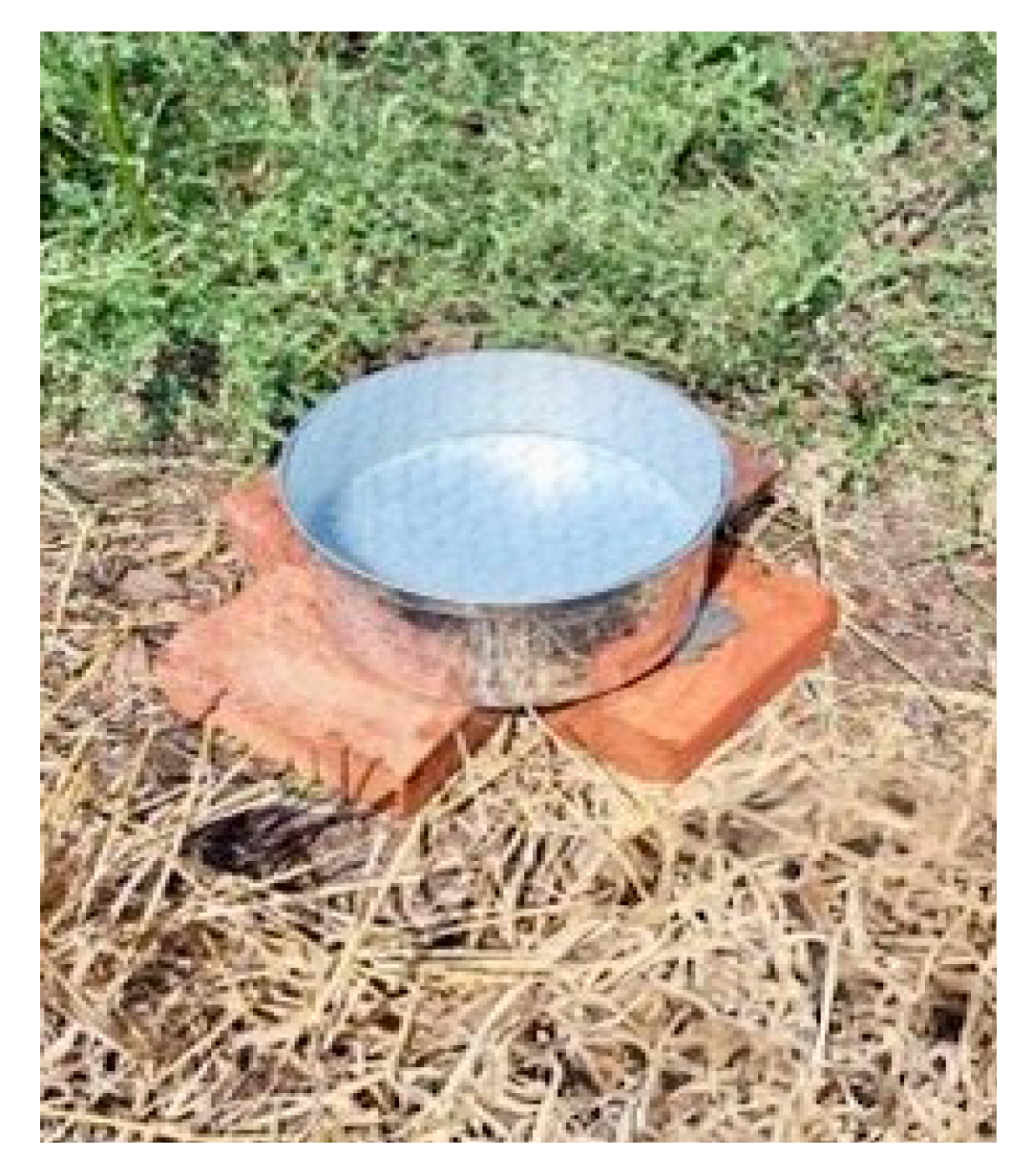
Figure 2.
Cut-Throat Flume.
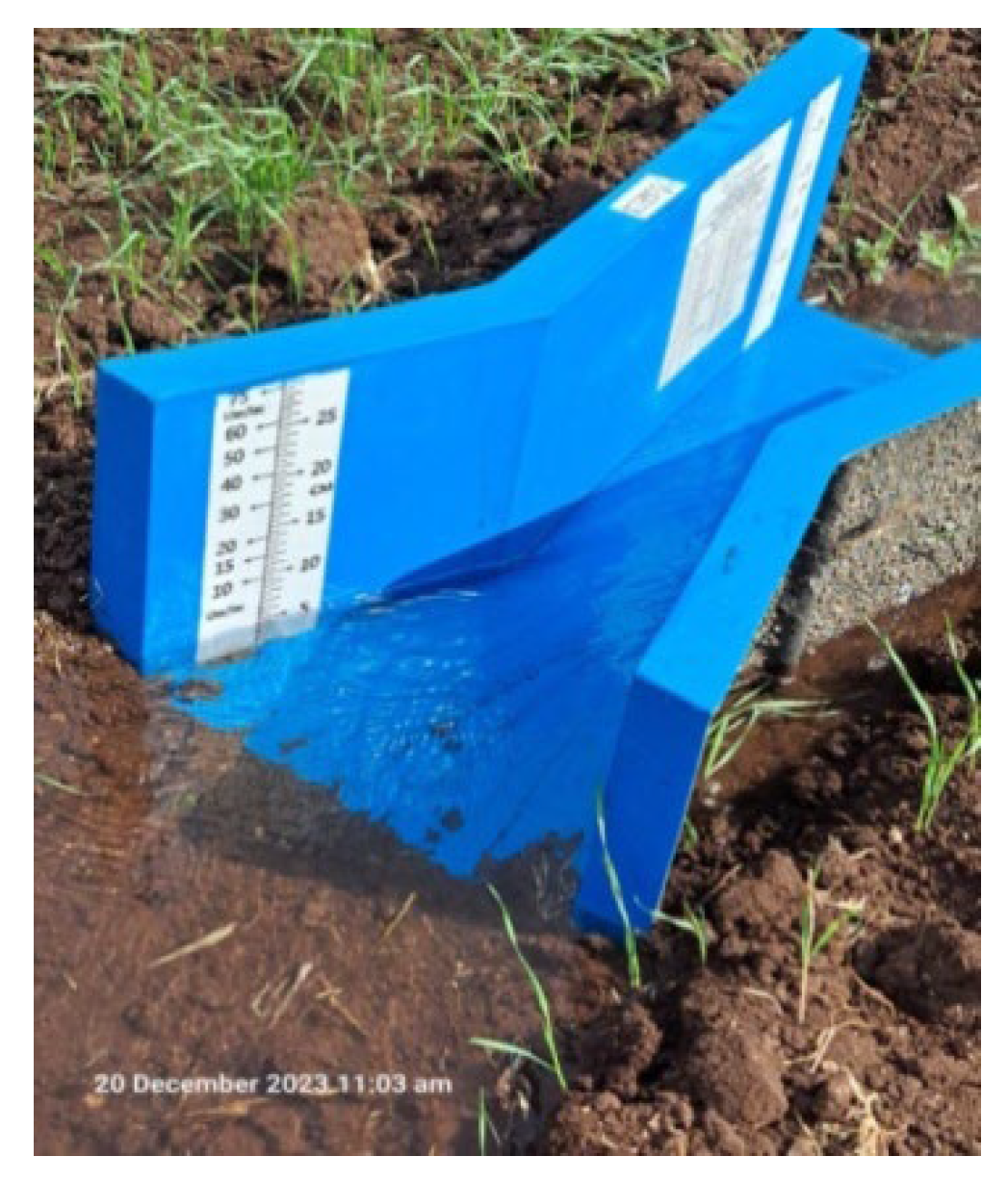
Figure 3.
Border Irrigation Method.
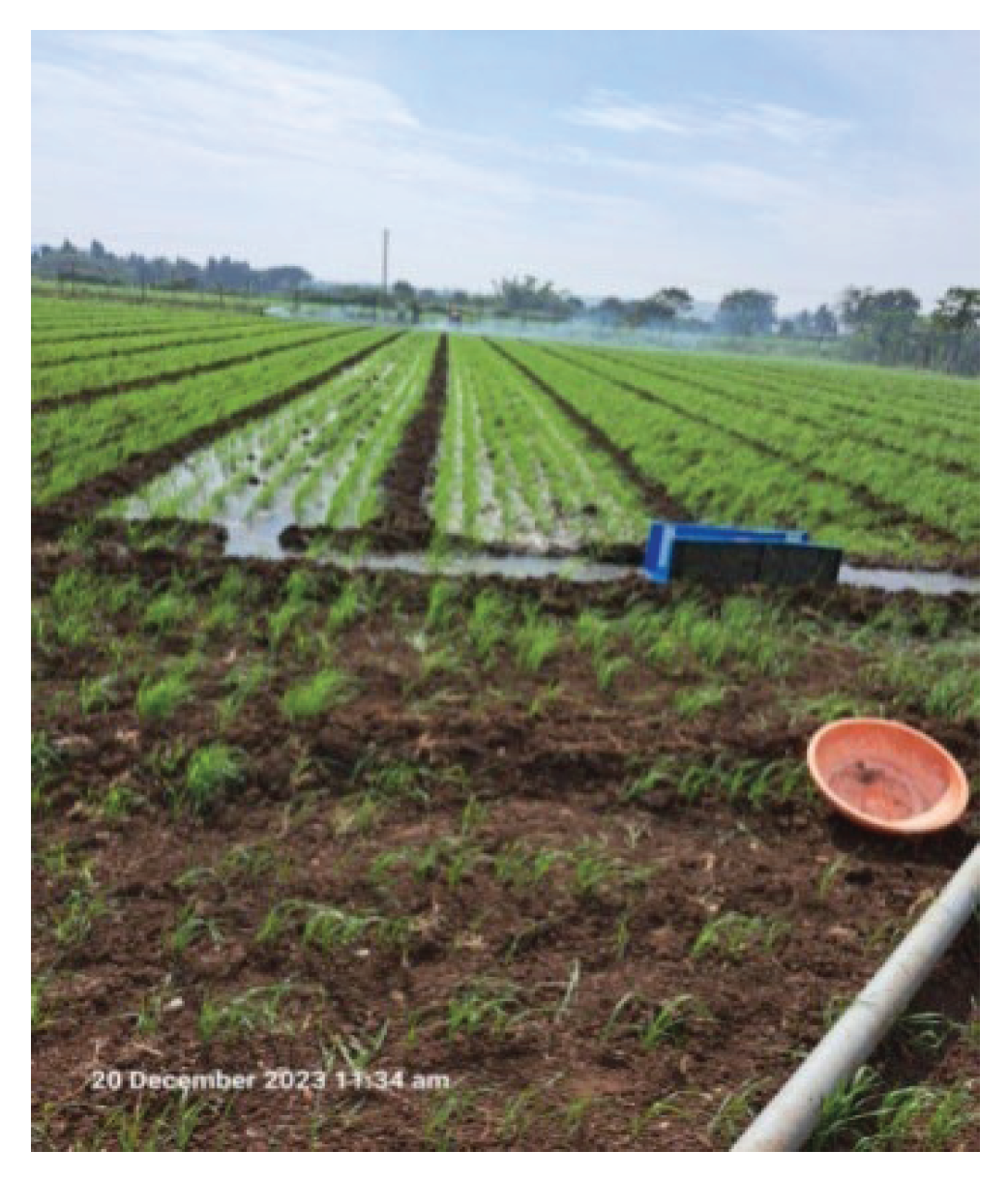
Figure 4.
Soil Moisture Sensor.
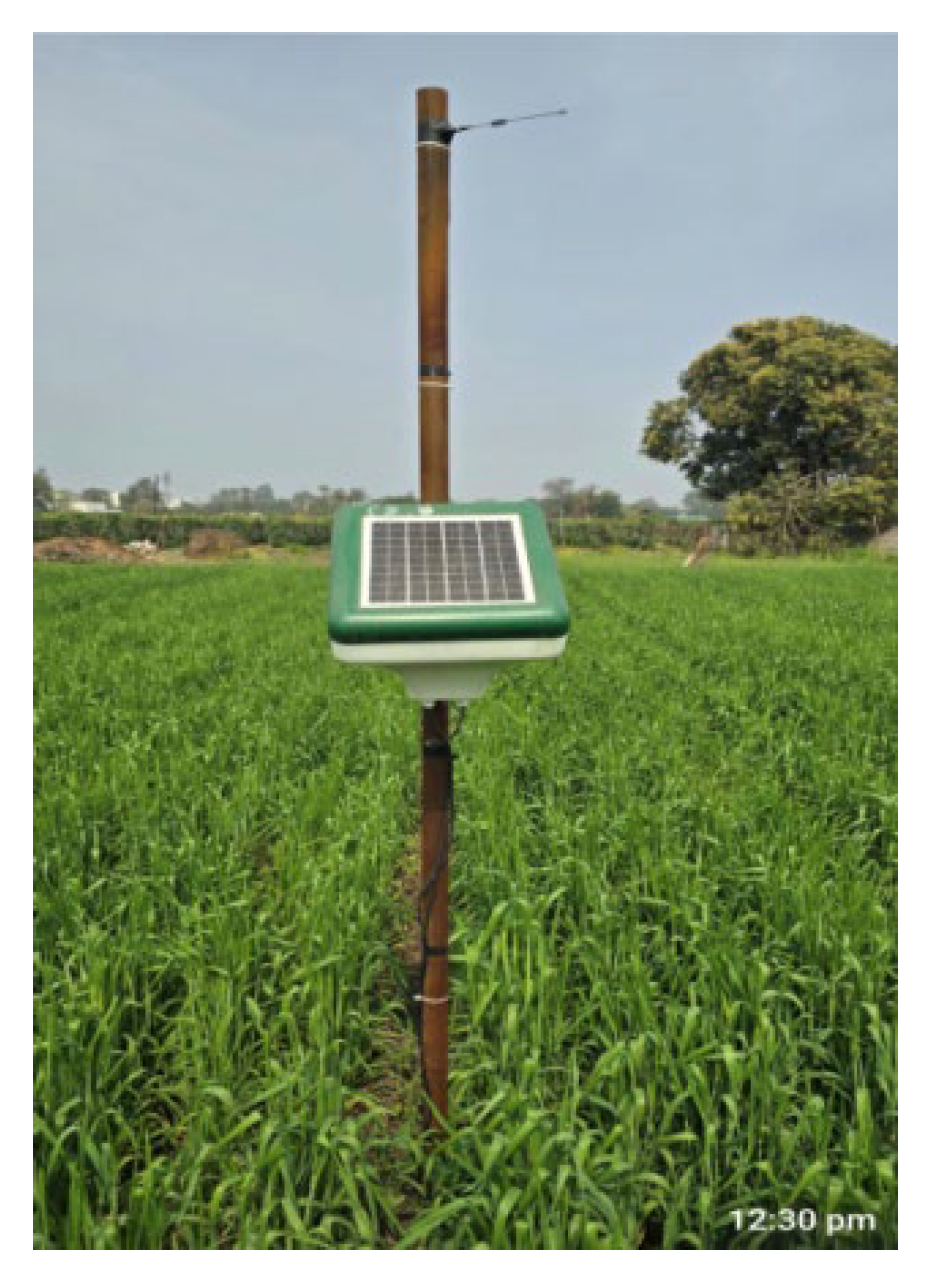

Table 1.
Water Supply, Saving and Water Use Efficiency.
| Particulars | 2023-24 | 2024-25 | ||
|---|---|---|---|---|
| Traditional | Measured | Traditional | Measured | |
| (Plot A) | (Plot B) | (Plot A) | (Plot B) | |
| Crop | Wheat | Wheat | ||
| Area under study, m2 | 1008 | 1008 | ||
| Date of sowing | 3/12/2023 | 14/12/2024 | ||
| Last Irrigation | 1/3/2024 | 18/03/2025 | ||
| Total CAN Evaporation, mm | 510 | 482 | ||
| Presowing Irrigation, mm | 50 | 50 | 50 | 50 |
| Total requirement, mm | 560 | 532 | ||
| Water applied, m3 | 700 | 570 | 690 | 540 |
| Water saving, m3 | 130 | 150 | ||
| Water Saving, (%) | 18.5 | 21.7 | ||
| Yield, kg | 521 | 528 | 472 | 481 |
| Water Use Efficiency (WUE), Kg/m3 | 0.74 | 0.93 | 0.68 | 0.89 |
| Increase in WUE, (%) | 25 | 30 | ||
Disclaimer/Publisher’s Note: The statements, opinions and data contained in all publications are solely those of the individual author(s) and contributor(s) and not of MDPI and/or the editor(s). MDPI and/or the editor(s) disclaim responsibility for any injury to people or property resulting from any ideas, methods, instructions or products referred to in the content. |
© 2026 by the authors. Licensee MDPI, Basel, Switzerland. This article is an open access article distributed under the terms and conditions of the Creative Commons Attribution (CC BY) license.
Copyright: This open access article is published under a Creative Commons CC BY 4.0 license, which permit the free download, distribution, and reuse, provided that the author and preprint are cited in any reuse.


