

Submitted:
06 March 2026
Posted:
09 March 2026
You are already at the latest version
Abstract
Background/Objectives: Motor competence is a multidimensional indicator of developmental health, yet most studies treat it as a single composite outcome and ignore the contextual class-level structure of school-based data. This cross-sectional study examined motor competence across three domains, manual dexterity, aiming-catching, and balance, in 312 Greek primary school children aged 6–12 years (156 girls) using the Movement Assessment Battery for Children–Second Edition (MABC-2). Methods: Standard scores were analyzed using a linear mixed-effects model with correlated domain-specific random slopes at both the class and student levels, partitioning inter-individual variability in overall motor level, intra-individual variability in domain profiles, and contextual class-level contributions. Post-hoc power analysis via parametric bootstrap confirmed adequate power for the primary outcome and indicated that non-significant age and sex main effects were negligibly small rather than undetected. Results: Balance yielded the highest standard scores, followed by aiming-catching and manual dexterity, with all three domains differing significantly. Neither age nor sex produced significant main effects. A significant component × sex interaction revealed domain-specific sex differences: boys outperformed girls on aiming-catching, while balance exceeded aiming-catching among girls but not boys. However, the observed interaction effect fell below the minimum detectable effect size threshold, suggesting potential upward bias and warranting cautious interpretation pending replication in larger samples. Approximately 13% of children were classified as at risk and 9% showed scores consistent with severe coordination difficulties. Contextual class-level sources accounted for 23.4% of total variance, with 52% of classes deviating significantly from the population mean. Conclusions: These findings highlight manual dexterity as a curricular priority in Greek primary physical education and underscore the importance of contextually sensitive, domain-specific approaches to motor competence monitoring and intervention.
Keywords:
motor competence
; inter-individual variability
; contextual environment
; multilevel modelling
1. Introduction
Motor competence, defined as the capacity to combine and scale fundamental movement skills to task and environmental demands with adequate proficiency, is a core indicator of developmental health in childhood [1,2]. Early proficiency in fundamental movement skills establishes the foundation for the specialized movement phase. Insufficient mastery during the fundamental movement phase constrains this developmental progression and is associated with lower physical activity participation, reduced psychosocial well-being, and poorer health outcomes across the lifespan [3,4,5]. These properties have positioned motor competence centrally within global developmental frameworks. SDG Indicator 4.2.1 identifies motor competence as a primary index of children's developmental readiness, while UNESCO and UNICEF designate it as a foundational component of health and well-being education [6,7,8].
Motor competence is a latent construct [1]. Standardized assessments distinguish at minimum three functionally distinct domains – manual dexterity, object control, and balance – that recruit partially dissociable neural substrates and show non-parallel developmental trajectories [1,9,10,11]. Chronological age is the strongest overall correlate of motor competence during the elementary school years, yet substantial inter-individual variability in motor competence scores reflects diverse developmental trajectories that are neither uniform across children nor equivalent across domains [1,10,12]. This inter-individual variability arises from interactions among genetic, epigenetic, cultural, and contextual factors, and is compounded by intra-individual variability in domain-specific profiles, i.e., children who excel in one motor domain do not necessarily show comparable proficiency in others [2,13,14]. Sex differences in motor competence may also be domain-specific, although current evidence is inconclusive. Some studies report advantages for boys in object control tasks and for girls in tasks requiring balance, but these patterns vary across samples and may reflect non-linear developmental changes across childhood rather than stable sex-specific effects [10,15,16,17]. Analyses that treat motor competence as a single composite score obscure domain-specific variation and may lead to misleading conclusions about developmental risk profiles.
Beyond biological factors, children’s school environments may shape motor competence through differential access to physical education, equipment, instructional quality, and curriculum emphasis [18,19]. These contextual influences are unlikely to operate uniformly across motor domains [17]. A teacher with a specific sports background may produce stronger object control outcomes, while another teacher may produce more homogeneous profiles across domains. Children within the same class or school therefore share not only an overall motor environment but potentially a domain-specific instructional context, making class and school membership a theoretically motivated source of both inter-individual and intra-individual profile variation in motor competence. Ignoring this contextual structure inflates the apparent precision of individual-level estimates and risks misattributing class-level compositional effects to developmental or biological predictors [20,21]. Evidence from Greek primary schools underscores the relevance of these contextual considerations. Greek children show below-average motor competence relative to peers in countries with dissimilar school-based physical education provision, with domain-specific sex differences and age-related trajectories that vary across studies and settings [22,23,24,25,26].
The present study assessed motor competence across the three domains of manual dexterity, aiming-catching, and balance in Greek primary school children aged 6–12 years. To account for the nested data structure and the theoretically motivated expectation that contextual class-level influences operate differentially across motor domains, a linear mixed-effects model was employed, with correlated domain-specific random slopes at both the class and student levels, enabling unbiased estimation of fixed effects and explicit quantification of contextual class-level contributions to motor competence profiles [20,27,28,29]. Domain-specific random slopes at the student level further captured intra-individual variability in motor profiles (i.e., the degree to which individual children's relative strengths and weaknesses across domains deviate from the population average), while student-level random intercepts captured inter-individual variability in overall motor competence. Three hypotheses were tested: (a) motor competence profiles differ across the three domains and this pattern varies by sex; (b) age is associated with motor competence but its effect is not uniform across domains; and (c) the contextual class environment contributes meaningfully and differentially to motor competence profiles across domains, reflecting heterogeneity in instructional emphasis across classrooms.
2. Materials and Methods
This cross–sectional, comparative study recruited children using a stratified convenience sampling approach by age and gender from 14 elementary schools in western and central Macedonia, Greece. Initially, five regions of Macedonia were randomly selected. Within each region, five elementary schools in urban areas (population > 30K) and five in semi–urban areas (population < 10K) were randomly chosen, resulting in a preliminary list of 50 schools. Schools were required to have at least six classes and a minimum of 100 enrolled students to ensure sufficient sample size and classroom diversity. Some schools declined to participate, resulting in a final sample of 14 schools that met all criteria. These schools represented both urban and semi–urban areas, capturing geographical and social diversity.
Within each participating class, four boys and four girls were randomly selected using a computer–generated random number list applied to the class register. Each student was assigned a unique identifier, and random numbers corresponding to eligible students were generated to select participants. Classes that could not provide the full quota of participants were excluded from the sampling frame to preserve intended stratification. This process ensures objectivity, reduces selection bias, and maintains proportional representation of both sexes. Eligible participants were children aged six to 12 years with no diagnosed intellectual, neurological, sensory, or developmental disorders, specific learning difficulties, attention deficit hyperactivity disorder, or chronic illnesses. Children referred to clinical assessment by their schoolteachers were excluded, regardless of formal diagnosis. Written informed consent was obtained from parents or guardians prior to participation. The final sample comprised 312 children (156 girls). The target sample of eight children per class (four boys, four girls) was determined by conventional sample size considerations for multilevel designs, with a minimum of 30 higher-level units (classes) recommended to obtain stable variance component estimates [21]. The final sample of 312 children across 31 classes met this criterion. Post-hoc minimum detectable effect sizes at 80% power, estimated via full parametric bootstrap accounting for the two-level random effects structure, confirmed adequate power for the primary outcome (MDES η²p = .058 for the component main effect) and indicated that non-significant effects were negligibly small rather than undetected (see Statistical Analysis). The study was approved by the Aristotle University of Thessaloniki Research Ethics Committee and conducted in accordance with the Declaration of Helsinki. Procedures adhered to STROBE guidelines.
Motor competence was assessed by four trained members of the Adapted Physical Education Laboratory using the Greek adaptation of the Movement Assessment Battery for Children—Second Edition (MABC–2) to identify children performing significantly below age–matched peers [30,31]. The MABC–2 is a norm–referenced test for children aged 3–16 years, comprising eight tasks per age band (3–6, 7–10, 11–16 years), organized into three domains: manual dexterity (three items), aiming–catching (two items), and balance (three items assessing static and dynamic balance). Consistent with the study hypotheses, a product–oriented assessment of both fine and motor movement skills was employed rather than a process–oriented test to provide descriptive profiles of developmental changes in motor competence among typically developing children [32]. Compared to other product–oriented tests, the MABC–2 offers the advantage of clearly defined age bands, allowing age–appropriate assessment and interpretation of fine and gross motor competence. Raw scores were converted into age–adjusted standard scores, and percentiles were calculated for each domain and for the total score. Pre–established cut–offs were used: standard scores above the 15th percentile were classified as typical performance (green zone); scores between the 6th and 15th percentiles were classified as “at risk” (amber zone); and scores at or below the 5th percentile were classified as significant motor difficulties (red zone). United Kingdom norms of the test as reported in the published manual were used for the purposes of the present study. Assessments followed the MABC–2 manual and were administered in the school setting. Interrater reliability among the four assessors was monitored using an intraclass correlation coefficient, which for the total score was 0.83 indicating good agreement across raters (ICC; thresholds: < 0.50 poor, < 0.75 moderate, < 0.90 good, > 0.90 excellent) [33]. The MABC–2 seems to be a reliable instrument [30,31,34,35]. Regarding its validity and according to the manual, the MABC–2 covers enough of the validity conditions. Moreover, the manual supports the view that the motor test is “culture free” [31]. Its cross–cultural validity has also been supported by many studies, showing that the MABC–2 is considered a reliable and useful tool in identifying children with motor deficiencies [36].
Standard scores from the MABC-2 were analyzed using a linear mixed-effects model fitted by Restricted Maximum Likelihood (REML), implemented in the nlme package [37]. The model accounted for the hierarchical structure of the data: component scores (Level 1) nested within students (Level 2), nested within classes (Level 3), comprising 936 observations from 312 students across 31 classes. Fixed effects included component (manual dexterity, aiming-catching, balance), grand mean-centering age, sex, and the component × sex interaction; categorical predictors were sum-coded to support Type III inference. Model selection proceeded sequentially via likelihood ratio testing using maximum likelihood (ML) refits: a model with class-level domain-specific random slopes fitted significantly better than one with class-level random intercepts only (LRT χ²(5) = 112.04, p < .001); a school-level random intercept did not improve fit (LRT χ²(1) = 0.03, p = .859) and was excluded; the three-way component × age × sex interaction and non-significant two-way terms were dropped without significant loss of fit (LRT χ²(3) = 1.57, p = .667); and the component × age interaction was subsequently excluded (LRT χ²(2) = 4.26, p = .119). The final parsimonious model retained component, age, sex, and component × sex as fixed effects.
To capture intra-individual variability in domain-specific motor profiles, correlated domain-specific random slopes were modelled at the student level under a general positive-definite covariance structure (Log-Cholesky parametrization), allowing students to differ both in overall motor competence (random intercept) and in the shape of their domain profiles across aiming-catching and balance (random slopes). To capture contextual variability at the class level, correlated domain-specific random slopes were similarly modelled at the class level, allowing classes to differ both in overall motor level and in their domain-specific profiles, reflecting heterogeneity in the instructional emphasis of individual classrooms. This two-level random slope structure, at both the student and class levels, was supported by likelihood ratio testing and by the theoretical expectation that contextual class-level effects operate differentially across motor domains.
Residual homoscedasticity was confirmed using the Breusch-Pagan test (p = .892; performance package), and multicollinearity was assessed via generalized Variance Inflation Factors, with all values ≤ 1.02, indicating negligible collinearity among predictors. Fixed effects were tested using Type III Wald F-tests (α = .05). Effect sizes were quantified as partial η² (η²p), computed via the effectsize package and interpreted per Cohen’s benchmarks [38]. Post-hoc pairwise contrasts were conducted as general linear hypotheses via the multcomp package, with familywise error rate controlled using the Westfall correction [39]. Effect sizes for pairwise contrasts were expressed as Cohen's d, standardized against the model residual standard deviation (σ = 0.96). Post-hoc power analysis was conducted via full parametric bootstrap (200 iterations per effect size) using custom simulation code. At each iteration, new response data were generated from the fitted model by sampling class-level and student-level random effects from their estimated multivariate normal distributions (3×3 covariance matrices at each level), computing the fixed-effect prediction under a specified effect size, and adding residual noise. The model was refit and the p-value and η²p extracted at each iteration. This procedure was repeated across a range of fixed-effect coefficient values to generate power curves for each fixed effect, from which the minimum detectable effect size (MDES) at 80% power was interpolated as the median η²p across significant iterations at the 80% power threshold. This procedure additionally served as a sensitivity analysis for statistical power: by comparing observed effect sizes against their MDES, it was possible to determine whether non-significant findings reflected genuine negligible effects or insufficient power to detect effects of meaningful magnitude, and whether significant findings exceeded or fell below the detectable threshold, indicating possible upward bias. No missing data were present in the dataset analyzed. All 312 enrolled participants contributed complete data across all three MABC-2 component scores, age, and sex, yielding 936 observations for analysis. All analyses were performed in R version 4.5.2 [40]. Anthropic’s Claude AI Sonnet 4.6 has been used in this paper to assist in code generation and result interpretation.
3. Results
All 312 enrolled participants provided complete data; no missing values were present for any study variable. For the whole sample, approximately 13% were classified as “at risk” for movement difficulties (≤ 16th percentile), with 9% at or below the 5th percentile indicating severe motor coordination difficulties. The percentages of boys and girls across MABC-2 percentile ranges for manual dexterity, aiming-catching, balance, and total scores are presented in Figure 1. Overall, 10.3% of boys and 15.4% of girls were classified as “at risk” (amber zone), while 11.5% of boys and 7.1% of girls were classified in the red zone (at or below the 5th percentile), reflecting marked inter-individual variability in motor competence risk profiles across sex. Figure 2 shows percentile distributions for manual dexterity, aiming-catching, and balance across ages six to 12 years. Descriptively, manual dexterity showed the lowest percentile scores across all age groups. Figure 3A shows age-specific mastery in none, one, two, or all three MABC-2 components. The proportion of children achieving competence in all three components was 38.5% at age six and 34.6% at age eight. Conversely, the proportion failing to achieve competence in any component was 5.1% at age seven, 7.7% at age eight, 1.7% at age nine, and 3.9% at age eleven, reflecting substantial inter-individual variability in overall motor competence across the age range. Figure 3B shows the distribution of boys and girls achieving competence in none, one, two, or all three MABC-2 components. Table 1 shows mean MABC-2 scores and component scores across sex and age.
Component scores differed substantially across manual dexterity, aiming-catching, and balance (F(2, 620) = 48.86, p < .001, η²p = .14 [.09, .19], MDES = .058), confirming adequate power for the primary outcome. Neither age (F(1, 279) = 0.015, p = .901, η²p < .001) nor sex (F(1, 279) = 0.183, p = .669, η²p < .001) produced significant main effects, with observed effects far below their respective MDES thresholds (age: observed η²p < .001 vs MDES η²p = .037; sex: observed η²p < .001 vs MDES η²p = .026), indicating that global age and sex effects on motor competence, if present, are negligibly small in this population rather than undetected due to insufficient power. A significant component × sex interaction was found (F(2, 620) = 9.47, p < .001, η²p = .03 [.01, .06], MDES = .094), indicating that sex differences in motor competence were domain-specific. However, the observed effect fell 3.2 times below its MDES threshold, suggesting upward bias in this estimate (Type M error [41]) and warranting cautious interpretation pending replication in larger samples. The component × age interaction was not retained in the final model (LRT χ²(2) = 4.26, p = .119). Once contextual class-level component profiles were properly accounted for, differential age trajectories across domains were no longer statistically supported, suggesting the apparent interaction in simpler model specifications reflected contextual class-level compositional variation rather than genuine intra-individual developmental differentiation across domains. Hypothesis (b) was therefore not supported: age was not significantly associated with motor competence, and domain-specific age trajectories could not be distinguished from contextual class-level effects.
Pairwise comparisons of component estimated marginal means, collapsed across sex, confirmed that all three components differed significantly (all padj ≤ .044), with balance yielding the highest scores, followed by aiming-catching and manual dexterity. The contrasts involving manual dexterity were very large in magnitude (balance vs manual dexterity: d = 3.74; aiming-catching vs manual dexterity: d = 3.06), while balance exceeded aiming-catching by a smaller but significant margin (d = 0.67, padj = .044). Stratified by sex at mean age, the balance superiority over manual dexterity was preserved for both boys (d = 3.87) and girls (d = 3.60), as was the aiming-catching superiority over manual dexterity (boys: d = 3.80; girls: d = 2.33), all very large effects consistent with the overall inter-individual ordering of domains. One critical sex-specific difference emerged in the inter-individual profile: balance and aiming-catching did not differ among boys (t(620) = 0.18, padj = .860, d = 0.07 [−0.68, 0.81]) but differed substantially among girls (t(620) = 3.35, padj = .001, d = 1.27 [0.53, 2.02]), with girls showing balance superiority over aiming-catching that was absent in boys. Examining sex differences within each component at mean age revealed that inter-individual sex differences were domain-specific: boys scored significantly higher than girls only on aiming-catching (t(279) = 3.16, padj = .002, d = 0.99 [0.37, 1.60]), a large effect. No significant sex differences emerged for balance (t(279) = −0.72, padj = .473, d = −0.22 [−0.83, 0.39]) or manual dexterity (t(279) = −1.83, padj = .068, d = −0.49 [−1.02, 0.04]). Hypothesis (a) was partially supported: boys’ advantage on aiming-catching was confirmed, while the predicted female advantage on manual dexterity did not reach significance (padj = .068), consistent with the non-significant sex main effect (η²p < .001). Given that the omnibus component × sex interaction fell below its MDES threshold (η²p = .03, MDES = .094), all component × sex contrasts should be interpreted cautiously as potentially subject to upward bias (Type M error).
The progressive model comparison confirmed that both the class-level random intercept and class-level domain-specific random slopes were statistically justified (Table 2). Adding a class-level random intercept to a student-only model significantly improved fit (LRT χ²(1) = 28.02, p < .001), and further allowing classes to differ in their domain-specific profiles improved fit substantially beyond a class intercept-only specification (LRT χ²(5) = 112.04, p < .001), confirming that contextual class-level influences shape not only the overall level of motor competence but its domain-specific structure. The overall model fitted significantly better than a null model with the same random effects structure (LRT χ²(6) = 63.37, p < .001, Nagelkerke pseudo-R² = .07), where the modest Nagelkerke value reflects the incremental contribution of fixed effects over and above the domain-specific profiles already captured by the random effects. Fixed effects alone explained 23% of total variance (R²marginal = .23), while the full model accounted for 92% (R²conditional = .92) [42], with the difference (~69%) attributable to systematic inter-individual and contextual between-class variability in domain-specific motor profiles. The variance partition coefficient at the grand mean was .22, indicating that 22% of the variability in motor competence scores was attributable to contextual class membership net of fixed effects. Across all variance components, contextual class-level sources collectively accounted for 23.4% of total variance, comprising between-class differences in overall motor level (9.3%), aiming-catching profiles (7.8%), and balance profiles (6.3%). The dominant source of variance was inter-individual variability at the student level (68.7%), reflecting large differences in overall motor performance (25.5%), aiming-catching profiles (21.0%), and balance profiles (22.2%), with residual within-student variance contributing 7.8% (σ = 0.96). The substantial intra-individual variability in domain-specific profiles – reflected in the large student-level slope variances – confirms that individual children's relative strengths and weaknesses across motor domains vary considerably around the population average. Empirical Bayes (BLUP) class-level estimates revealed that 16 of 31 classes (52%) deviated significantly from the grand mean on the overall motor intercept (|intercept| > 1.96 × SE), underscoring the extent of contextual between-class heterogeneity.
Class intercept deviations ranged from −1.72 to +1.79 standard score points (Figure 4). Contextual domain-specific slope deviations at the class level ranged from −1.63 to +1.80 for aiming-catching and from −1.57 to +2.31 for balance, indicating substantial heterogeneity in domain profiles across classrooms beyond what was explained by fixed effects. Class-level intercepts were positively correlated with both domain slopes (aiming-catching: r = .44; balance: r = .42), indicating that contextually higher-performing classes tended to show uniformly elevated profiles across all domains. A mild negative correlation between domain slopes (r = −.26) suggested a weak contextual trade-off between aiming-catching and balance emphasis at the class level. At the student level, a strong negative correlation between domain slopes (r = −.60) reflected pronounced intra-individual specialization: students with stronger aiming-catching profiles consistently showed comparatively flatter balance profiles, a pattern substantially more pronounced than the corresponding contextual class-level trade-off (r = −.26), suggesting that intra-individual domain specialization operates primarily within rather than across classrooms. Collectively, these findings supported hypothesis (c): the contextual class environment contributed meaningfully and differentially to motor competence profiles, with classes differing in both overall motor level and domain-specific profiles.
4. Discussion
The present cross-sectional study examined motor competence across the three functionally distinct domains of manual dexterity, aiming-catching, and balance, in Greek primary school children aged 6–12 years, using a linear mixed-effects model that explicitly partitioned inter-individual and contextual class-level sources of variability. Three principal findings emerged. First, motor competence profiles were domain-specific, with balance yielding the highest standard scores, followed by aiming-catching and manual dexterity, a pattern that held across both sexes and all age groups. Second, sex differences were domain-specific rather than global, confined to aiming-catching, where boys outperformed girls by a large margin, while no significant overall sex or age effects were detected. Third, the contextual class environment accounted for 23.4% of total variance in motor competence, with classes differing not only in overall motor level but in their domain-specific profiles, confirming that motor competence is meaningfully shaped by the educational context in which children develop.
The finding that balance yielded the highest standard scores and manual dexterity the lowest, with all three domains differing significantly, is consistent with the multidimensional structure of motor competence as assessed by the MABC-2 [31] and with evidence that the three domains recruit partially dissociable neural substrates and show non-parallel developmental trajectories. The relative weakness in manual dexterity observed in this sample is notable. Approximately 13% of children were classified as “at risk” (≤16th percentile) and 9% showed scores consistent with severe coordination difficulties (≤5th percentile), proportions broadly comparable to international prevalence estimates for developmental coordination disorder of 5–8% [43] but elevated above those reported in some European contexts. Greek children’s performance on combined fine and gross motor assessments has previously been found to be lower than Norwegian peers, with reduced physical education exposure proposed as a contributing contextual factor [23]. The present findings extend this literature by demonstrating that within-sample domain differences are large (the contrast between balance and manual dexterity was very large (d = 3.74)) and that manual dexterity specifically emerges as the most consistently low-performing domain across the sample. From a public health perspective, this pattern is directly relevant to SDG Indicator 4.2.1: children performing below age expectations on fine motor tasks may face constraints not only in sport and physical activity but in the acquisition of academic skills dependent on fine motor precision, including writing and tool use [44].
Hypothesis (a) was partially supported. Boys showed a significantly higher aiming-catching performance than girls (d = 0.99), a large effect consistent with the well-established sex-by-domain interaction in motor competence literature, where boys reliably outperform girls on object control tasks [10,16]. This sex difference in aiming-catching is typically attributed to differential exposure to ball-sport activities during leisure time and physical education, as well as to sociocultural expectations that differentially channel boys and girls toward object control versus rhythmic or balance-focused activities [45,46]. The predicted female advantage on manual dexterity did not reach statistical significance (padj = .068, d = −0.49), consistent with the non-significant sex main effect (η²p < .001), suggesting that any female advantage in fine motor performance in this population, if present, was too small to detect with the current sample size or was obscured by the large inter-individual variability in manual dexterity scores within both sexes.
A particularly informative finding was the sex-specific pattern within the balance vs. aiming-catching contrast: balance substantially exceeded aiming-catching among girls (d = 1.27) but not among boys (d = 0.07), indicating that the domain ordering of scores differed qualitatively by sex. Girls showed the theoretically expected balance superiority over aiming-catching that reflects girls’ relative advantage in dynamic balance tasks and relative disadvantage in object control [10], whereas boys’ balance and aiming-catching performance were statistically indistinguishable. This finding suggests that the intra-individual motor profile is sex-differentiated in ways that aggregate comparisons of overall motor competence would conceal. These results reinforce the methodological importance of analyzing motor competence at the domain level rather than as a single composite. However, because the component × sex interaction fell below its MDES threshold it should be interpreted as preliminary patterns requiring replication in larger samples before informing targeted sex-specific interventions. The absence of a significant sex main effect indicates that global sex differences in overall motor competence were negligibly small in this population. This finding is consistent with studies emphasizing that sex differences in motor competence are domain-specific rather than reflecting a generalized advantage for either sex [10,16] and argues against educational practices that treat boys and girls as categorically different in overall motor ability.
Hypothesis (c) was fully supported. The class context accounted for 23.4% of total variance in motor competence, with the class-level random intercept and domain-specific random slopes both statistically justified by likelihood ratio testing. This finding is consistent with ecological systems theory [47] and with multilevel evidence from educational research demonstrating that the classroom, as a proximal contextual environment, exerts meaningful and specific influences on developmental outcomes beyond individual-level biological and sociodemographic factors [20,28]. Critically, classes differed not only in overall motor level (class intercept variance = 9.3% of total) but in their domain-specific profiles, i.e., the relative emphasis on aiming-catching vs. balance varied substantially across classrooms (class slope variance = 7.8% and 6.3% respectively). The positive correlation between class-level intercepts and domain slopes (aiming-catching: r = .44; balance: r = .42) indicates that contextually higher-performing classes tended to show uniformly elevated profiles across all domains, suggesting that the contextual factors that promote overall motor competence, such as experienced teachers, adequate facilities, and structured physical education time, may operate relatively domain-generically at the class level. In contrast, the negative correlation between domain slopes at the class level (r = −.26), though modest, suggests that some contextual specialization in instructional emphasis may also exist, with classes showing relatively stronger aiming-catching profiles tending toward comparatively flatter balance profiles and vice versa.
The finding that 16 of 31 classes (52%) deviated significantly from the grand mean on the overall motor intercept underscores the practical significance of contextual between-class heterogeneity: a child's motor competence is meaningfully associated with which class they attend, above and beyond their individual biological characteristics. This has direct implications for school-based motor competence screening and intervention. In contexts where class-level clustering of low performance is substantial (e.g., classes 01 and 02, which deviated by more than 1.5 standard score points below the grand mean) whole-class or school-level interventions targeting physical education quality and exposure may be warranted alongside individually targeted support. Consistent with UNESCO and UNICEF guidelines designating physical education as a foundational component of health and well-being education [7,8], the present findings suggest that contextual investment in the quality and domain-breadth of physical education across classrooms may reduce between-class heterogeneity in motor competence profiles and support more equitable developmental trajectories.
The dominant source of variance in motor competence was inter-individual variability at the student level (68.7%), comprising large individual differences in overall motor level (25.5%), aiming-catching profiles (21.0%), and balance profiles (22.2%). These magnitudes are consistent with dynamical systems accounts of motor development, which emphasize that motor competence emerges and stabilizes through exploration, practice, and the continuous interaction of organismic, environmental, and task constraints rather than as a hardwired neuromaturational outcome [48,49]. From this perspective, the large inter-individual variability in overall motor level reflects heterogeneous developmental histories (i.e., differences in prior movement experience, practice opportunities, and exposure to action-scaled affordances) rather than fixed biological endowment [13,14]. The large intra-individual variability in domain-specific profiles (reflected in the student-level slope variances for aiming-catching (21.0%) and balance (22.2%) and their strong negative correlation (r = −.60)) further indicates that individual children’s relative strengths and weaknesses across motor domains vary considerably around the population average. This strong negative intra-individual correlation between aiming-catching and balance slopes suggests a domain specialization pattern: children who perform relatively well on aiming-catching relative to their own overall motor level tend to show comparatively flatter balance profiles, and vice versa. This specialization was substantially more pronounced at the individual level (r = −.60) than at the class level (r = −.26), suggesting it reflects individual-level developmental history and practice exposure rather than contextual instructional emphasis. A dynamical systems interpretation is that children’s motor competence profiles represent attractor states that emerge from the specific constellation of affordances, practice opportunities, and task demands they have encountered [48,50]. Children with greater exposure to object control activities may develop more stable aiming–catching coordination patterns, whereas children with greater exposure to postural or locomotor tasks may show stronger balance profiles.
The proportion of children failing to achieve competence in any of the three MABC-2 components ranged from 1.7% to 7.7% across age groups, while between 34.6% and 38.5% achieved competence in all three at ages six and eight, respectively, reflecting the substantial inter-individual variability in overall developmental readiness within each age cohort. These figures are relevant to SDG Indicator 4.2.1 monitoring, as they indicate that a meaningful minority of children in Greek primary schools are not developmentally on track in the health domain of motor competence, with potential downstream implications for physical activity participation and health-related outcomes across the lifespan [5].
Several limitations constrain the interpretation of these findings. The cross-sectional design prevents causal inference and precludes tracking of intra-individual developmental trajectories across the elementary school years; the observed domain profiles and between-class differences reflect a single time point and may not generalize to other cohorts or contexts. To the extent that selection bias was introduced by excluding classes unable to provide the full quota of eight children, this would most plausibly affect the class-level variance estimates: if excluded classes were systematically lower-performing or more homogeneous, for example because they had fewer enrolled students, the observed between-class heterogeneity (.22) may be a conservative underestimate of true contextual variability in the population. Conversely, if excluded classes were atypically high-performing, the prevalence of at-risk classification (13%) could be overestimated. The direction of this bias cannot be determined without data from excluded classes and should be acknowledged when interpreting the class-level findings. The absence of contextual covariates, including socioeconomic status, school resources, physical education curriculum content, teacher qualifications, and detailed urban-rural classification, means that the mechanisms underlying the observed class-level heterogeneity cannot be identified; the variance attributed to the class level represents the net effect of all unmeasured contextual factors that classes share, and residual confounding by these factors cannot be excluded. To the extent that unmeasured socioeconomic or resource variables are associated with both class assignment and motor competence, the fixed effects for age and sex may be subject to omitted variable bias. However, given that both effects were negligibly small (η²p < .001) and far below their MDES thresholds, this is unlikely to alter the substantive conclusion that global age and sex effects are negligible in this population. Interrater reliability was reported as an overall agreement metric (ICC = .83). Future work should report domain-specific reliability using weighted Kappa or absolute ICC with confidence intervals to determine whether reliability varies across motor domains. Finally, MABC-2 standard scores are referenced against United Kingdom norms, which may not fully reflect the developmental expectations of the Greek educational context; any systematic cultural difference in normative performance would shift prevalence estimates uniformly across the sample without affecting the relative domain ordering or variance partition results.
5. Conclusions
In a cross-sectional sample of Greek primary school children, motor competence profiles were domain-specific, with balance exceeding aiming-catching and manual dexterity emerging as the weakest domain. Sex differences were confined to aiming-catching, with boys outperforming girls, while no significant overall sex or age effects were detected. The contextual class environment accounted for 23.4% of total variance and shaped not only the overall level but the domain-specific structure of children's motor competence profiles, with 52% of classes deviating significantly from the population average. These findings highlight manual dexterity as a potential curricular target in Greek primary school physical education, underscore the importance of modelling motor competence at the domain level rather than as a single composite, and emphasize the need for contextually sensitive school-based interventions that address between-class heterogeneity in physical education quality and domain-breadth. Longitudinal designs incorporating contextual covariates are required to distinguish transient low performance from persistent developmental motor difficulties and to clarify the mechanisms underlying the observed class-level specialization in domain profiles.
Author Contributions
Conceptualization, C.E. and D.D.; methodology, A.S., D.D. and C.E.; software, A.S.; formal analysis, A.S.; investigation, D.D., T.E. and E.K.; resources, C.E. and T.E.; data curation, D.D.; writing—original draft preparation, A.S.; writing—review and editing, D.D., T.E., E.K., A.S. and C.E; visualization, A.S.; supervision, C.E.; project administration, D.D., T.E. and E.K.; funding acquisition, A.S. All authors have read and agreed to the published version of the manuscript.
Funding
This research was funded by the “Acquiring Academic Teaching Experience for Young Scientists with PhD at the Aristotle University of Thessaloniki” Program No 12469.
Institutional Review Board Statement
The study was conducted in accordance with the Declaration of Helsinki and approved by the Ethics Committee of Aristotle University of Thessaloniki.
Informed Consent Statement
Informed consent was obtained from all subjects involved in the study.
Data Availability Statement
https://figshare.com/s/2e3a808ebad56446a963 (private link only for the review).
Acknowledgments
During the preparation of this manuscript, the authors used Anthropic’s Claude AI Sonnet 4.6 for the purposes of code generation and result interpretation. The authors have reviewed and edited the output and take full responsibility for the content of this publication.
Conflicts of Interest
The authors declare no conflicts of interest. The funders had no role in the design of the study; in the collection, analyses, or interpretation of data; in the writing of the manuscript; or in the decision to publish the results.
Abbreviations
The following abbreviations are used in this manuscript:
| MABC-2 | Movement Assessment Battery for Children—Second Edition |
| MDES | Minimum detectable effect size |
References
- Martins, C.; Valentini, N.C.; Sääkslahti, A.; Africa, E.K.; Webster, E.K.; Nobre, G.; Robinson, L.E.; Duncan, M.; Tortella, P.; Bandeira, P.F.; et al. Motor Competence as Key to Support Healthy Development of 3- to 5-Year-Old Children: An Expert Statement on Behalf of the International Motor Development Research Consortium. J. Mot. Learn. Dev. 2024, 12, 437–454. [Google Scholar] [CrossRef]
- Utesch, T.; Bardid, F. Motor Competence. In Dict. Sport Psychol. Sport Exerc. Perform. Arts; 2019. [Google Scholar]
- Brian, A.; Getchell, N.; True, L.; De Meester, A.; Stodden, D.F. Reconceptualizing and Operationalizing Seefeldt’s Proficiency Barrier: Applications and Future Directions. Sports Med. 2020, 50, 1889–1900. [Google Scholar] [CrossRef]
- Clark, J.E.; Metcalfe, J.S. The Mountain of Motor Development: A Metaphor; NASPE Publications: Reston, Va, 2002; Vol. 2, pp. 163–190. ISBN 978-0-88314-743-6. [Google Scholar]
- Stodden, D.F.; Pesce, C.; Zarrett, N.; Tomporowski, P.; Ben-Soussan, T.D.; Brian, A.; Abrams, T.C.; Weist, M.D. Holistic Functioning from a Developmental Perspective: A New Synthesis with a Focus on a Multi-Tiered System Support Structure. Clin. Child Fam. Psychol. Rev. 2023, 26, 343–361. [Google Scholar] [CrossRef] [PubMed]
- UNICEF The Early Childhood Development Index 2030: A New Measure of Early Childhood Development; UNICEF: New York, 2023.
- UNESCO. UNICEF Building Strong Foundations: What to Teach for Foundational Education for Health and Well-Being; UNESCO: New York, NY, USA, 2024; ISBN 978-92-3-100677-7. [Google Scholar]
- UNESCO. UNICEF Building Strong Foundations: What Is Foundational Education for Health and Well-Being? Education 2030. Brief 1; UNICEF. 3 United Nations Plaza, New York, NY 10017. Tel: 212-326-7000; Fax: 212-887-7465, 2024; Available online: http://www.unicef.org/educationISBN 978-92-3-100676-0.
- Assaiante, C. Development of Locomotor Balance Control in Healthy Children. Neurosci. Biobehav. Rev. 1998, 22, 527–532. [Google Scholar] [CrossRef] [PubMed]
- Barnett, L.M.; Lai, S.K.; Veldman, S.L.C.; Hardy, L.L.; Cliff, D.P.; Morgan, P.J.; Zask, A.; Lubans, D.R.; Shultz, S.P.; Ridgers, N.D.; et al. Correlates of Gross Motor Competence in Children and Adolescents: A Systematic Review and Meta-Analysis. Sports Med. 2016, 46, 1663–1688. [Google Scholar] [CrossRef] [PubMed]
- Sobinov, A.R.; Bensmaia, S.J. The Neural Mechanisms of Manual Dexterity. Nat. Rev. Neurosci. 2021, 22, 741–757. [Google Scholar] [CrossRef]
- Palmer, K.K.; Stodden, D.F.; Terlizzi, B.M.; Pennell, A.; Nunu, M.A.; Robinson, L.E. Motor Development in Early Childhood (3–5 Year Olds): Investigating Longitudinal Changes in Children’s Movement Patterns and Outcome Performance. J. Mot. Learn. Dev. 2025, 13, 389–410. [Google Scholar] [CrossRef] [PubMed]
- Draper, C.E.; Yousafzai, A.K.; McCoy, D.C.; Cuartas, J.; Obradović, J.; Bhopal, S.; Fisher, J.; Jeong, J.; Klingberg, S.; Milner, K.; et al. The next 1000 Days: Building on Early Investments for the Health and Development of Young Children. The Lancet 2024, 404, 2094–2116. [Google Scholar] [CrossRef]
- Lake, A.; Chan, M. Putting Science into Practice for Early Child Development. The Lancet 2015, 385, 1816–1817. [Google Scholar] [CrossRef]
- Hill, P.J.; Mcnarry, M.A.; Mackintosh, K.A.; Murray, M.A.; Pesce, C.; Valentini, N.C.; Getchell, N.; Tomporowski, P.D.; Robinson, L.E.; Barnett, L.M. The Influence of Motor Competence on Broader Aspects of Health: A Systematic Review of the Longitudinal Associations Between Motor Competence and Cognitive and Social-Emotional Outcomes. Sports Med. 2024, 54, 375–427. [Google Scholar] [CrossRef]
- Kokštejn, J.; Musálek, M.; Tufano, J.J. Are Sex Differences in Fundamental Motor Skills Uniform throughout the Entire Preschool Period? PLOS ONE 2017, 12, e0176556. [Google Scholar] [CrossRef]
- Ribeiro Bandeira, P.F.; Estevan, I.; Duncan, M.; Lenoir, M.; Lemos, L.; Romo-Perez, V.; Valentini, N.; Martins, C. A Multilayer Network Model for Motor Competence from the View of the Science of Complexity. Sports Med. 2025, 55, 245–254. [Google Scholar] [CrossRef]
- Langford, R.; Bonell, C.P.; Jones, H.E.; Pouliou, T.; Murphy, S.M.; Waters, E.; Komro, K.A.; Gibbs, L.F.; Magnus, D.; Campbell, R. The WHO Health Promoting School Framework for Improving the Health and Well-being of Students and Their Academic Achievement. Cochrane Database Syst. Rev. 2014, 4. [Google Scholar] [CrossRef]
- WHO Physical Activity for Health. In Global Recommendations on Physical Activity for Health; World Health Organization: Geneva, 2010.
- Goldstein, H.; Burgess, S.; McConnell, B. Modelling the Effect of Pupil Mobility on School Differences in Educational Achievement. J. R. Stat. Soc. Ser. A Stat. Soc. 2007, 170, 941–954. [Google Scholar] [CrossRef]
- Maas, C.J.M.; Hox, J.J. Sufficient Sample Sizes for Multilevel Modeling. Methodology 2005, 1, 86–92. [Google Scholar] [CrossRef]
- D’Hondt, E.; Venetsanou, F.; Kambas, A.; Lenoir, M. Motor Competence Levels in Young Children: A Cross-Cultural Comparison Between Belgium and Greece. J. Mot. Learn. Dev. 2019, 7, 289–306. [Google Scholar] [CrossRef]
- Haga, M.; Tortella, P.; Asonitou, K.; Charitou, S.; Koutsouki, D.; Fumagalli, G.; Sigmundsson, H. Cross-Cultural Aspects: Exploring Motor Competence Among 7- to 8-Year-Old Children From Greece, Italy, and Norway. Sage Open 2018, 8, 2158244018768381. [Google Scholar] [CrossRef]
- Kaioglou, V.; Dania, A.; Venetsanou, F. How Physically Literate Are Children Today? A Baseline Assessment of Greek Children 8-12 Years of Age. J. Sports Sci. 2020, 38, 741–750. [Google Scholar] [CrossRef]
- Kechagia, O.; Katartzi, E.; Fotiadou, E.; Giagazoglou, P. Prevalence of Motor Difficulties in Greek Preschoolers: The Effect of Gender, Age, BMI, Place of Residence, and Hand Preference. Alta. J. Educ. Res. 2024, 70, 328–352. [Google Scholar] [CrossRef]
- Li, M.H.; Kaioglou, V.; Ma, R.S.; Choi, S.M.; Venetsanou, F.; Sum, R.K.W. Exploring Physical Literacy in Children Aged 8 to 12 Years Old: A Cross-Cultural Comparison between China and Greece. BMC Public Health 2022, 22, 2102. [Google Scholar] [CrossRef]
- Corkins, C.M.; Harrist, A.W.; Washburn, I.J.; Hubbs-Tait, L.; Topham, G.L.; Swindle, T. Context Matters: The Importance of Investigating Random Effects in Hierarchical Models for Early Childhood Education Researchers. Early Child. Res. Q. 2025, 70, 178–186. [Google Scholar] [CrossRef]
- Raudenbush, S.W.; Willms, J.D. The Estimation of School Effects. J. Educ. Behav. Stat. 1995, 20, 307–335. [Google Scholar] [CrossRef]
- Schielzeth, H.; Nakagawa, S. Nested by Design: Model Fitting and Interpretation in a Mixed Model Era. Methods Ecol. Evol. 2013, 4, 14–24. [Google Scholar] [CrossRef]
- Ellinoudis, T.; Evaggelinou, C.; Kourtessis, T.; Konstantinidou, Z.; Venetsanou, F.; Kambas, A. Reliability and Validity of Age Band 1 of the Movement Assessment Battery for Children – Second Edition. Res. Dev. Disabil. 2011, 32, 1046–1051. [Google Scholar] [CrossRef]
- Henderson, S.E.; Sugden, D.; Barnett, A.L. Movement Assessment Battery for Children-2; The Psychological Corporation: London, United Kingdom, 2007. [Google Scholar]
- Goodway, J.D.; Ozmun, J.C.; Gallahue, D.L. Motor Development in Young Children. In Handbook of research on the education of young children; Saracho, O.N., Spodek, B., Eds.; Routledge: New York, NY, 2013; pp. 89–101. ISBN 978-0-415-88435-8. [Google Scholar]
- Koo, T.K.; Li, M.Y. A Guideline of Selecting and Reporting Intraclass Correlation Coefficients for Reliability Research. J. Chiropr. Med. 2016, 15, 155–163. [Google Scholar] [CrossRef]
- Wuang, Y.-P.; Su, J.-H.; Su, C.-Y. Reliability and Responsiveness of the Movement Assessment Battery for Children–Second Edition Test in Children with Developmental Coordination Disorder. Dev. Med. Child Neurol. 2012, 54, 160–165. [Google Scholar] [CrossRef]
- Hua, J.; Gu, G.; Meng, W.; Wu, Z. Age Band 1 of the Movement Assessment Battery for Children-Second Edition: Exploring Its Usefulness in Mainland China. Res. Dev. Disabil. 2013, 34, 801–808. [Google Scholar] [CrossRef]
- Cools, W.; Martelaer, K.D.; Samaey, C.; Andries, C. Movement Skill Assessment of Typically Developing Preschool Children: A Review of Seven Movement Skill Assessment Tools. J. Sports Sci. Med. 2009, 8, 154–168. [Google Scholar] [PubMed]
- Pinheiro, J.C.; Bates, D.M. Mixed-Effects Models in S and S-PLUS; Statistics and computing; Springer-Verlag New York: New York, NY, USA, 2000; ISBN 978-1-4419-0317-4. [Google Scholar]
- Cohen, J. A Power Primer. Psychol. Bull. 1992, 112, 155–159. [Google Scholar] [CrossRef]
- Hothorn, T.; Bretz, F.; Westfall, P. Simultaneous Inference in General Parametric Models. Biom. J. Biom. Z. 2008, 50, 346–363. [Google Scholar] [CrossRef]
- R Core Team R: A Language and Environment for Statistical Computing. 2025.
- Gelman, A.; Carlin, J. Beyond Power Calculations: Assessing Type S (Sign) and Type M (Magnitude) Errors. Perspect. Psychol. Sci. 2014, 9, 641–651. [Google Scholar] [CrossRef]
- Nakagawa, S.; Schielzeth, H. A General and Simple Method for Obtaining R2 from Generalized Linear Mixed-Effects Models. Methods Ecol. Evol. 2013, 4, 133–142. [Google Scholar] [CrossRef]
- Blank, R.; Barnett, A.L.; Cairney, J.; Green, D.; Kirby, A.; Polatajko, H.; Rosenblum, S.; Smits-Engelsman, B.; Sugden, D.; Wilson, P.; et al. International Clinical Practice Recommendations on the Definition, Diagnosis, Assessment, Intervention, and Psychosocial Aspects of Developmental Coordination Disorder. Dev. Med. Child Neurol. 2019, 61, 242–285. [Google Scholar] [CrossRef]
- Piek, J.P.; Dawson, L.; Smith, L.M.; Gasson, N. The Role of Early Fine and Gross Motor Development on Later Motor and Cognitive Ability. Hum. Mov. Sci. 2008, 27, 668–681. [Google Scholar] [CrossRef]
- Barnett, L.M.; van Beurden, Eric; Morgan, Philip J.; Brooks, Lyndon O.; Beard, J.R. Gender Differences in Motor Skill Proficiency From Childhood to Adolescence: A Longitudinal Study. Res. Q. Exerc. Sport 2010, 81, 162–170. [Google Scholar] [CrossRef]
- Barnett, L.M.; Telford, R.M.; Strugnell, C.; Rudd, J.; Olive, L.S.; Telford, R.D. Impact of Cultural Background on Fundamental Movement Skill and Its Correlates. J. Sports Sci. 2019, 37, 492–499. [Google Scholar] [CrossRef]
- Bronfenbrenner, U.; Morris, P.A. The Bioecological Model of Human Development. In Handbook of Child Psychology; John Wiley & Sons, Ltd, 2007; ISBN 978-0-470-14765-8. [Google Scholar]
- Newell, K.M.; Liu, Y.-T.; Mayer-Kress, G. Time Scales in Motor Learning and Development. Psychol. Rev. 2001, 108, 57–82. [Google Scholar] [CrossRef] [PubMed]
- Smith, L.B.; Thelen, E. Development as a Dynamic System. Trends Cogn. Sci. 2003, 7, 343–348. [Google Scholar] [CrossRef] [PubMed]
- Davids, K.; Glazier, P.; Araújo, D.; Bartlett, R. Movement Systems as Dynamical Systems. Sports Med. 2003, 33, 245–260. [Google Scholar] [CrossRef] [PubMed]
Figure 1.
Percentage of boys and girls classified by MABC-2 percentile ranges across domains (manual dexterity, aiming–catching, balance) and total score. Percentile ranges shown correspond to typical performance (>15th percentile; green), at risk (6th–15th percentile; amber), and severe (≤5th percentile; red).
Figure 1.
Percentage of boys and girls classified by MABC-2 percentile ranges across domains (manual dexterity, aiming–catching, balance) and total score. Percentile ranges shown correspond to typical performance (>15th percentile; green), at risk (6th–15th percentile; amber), and severe (≤5th percentile; red).
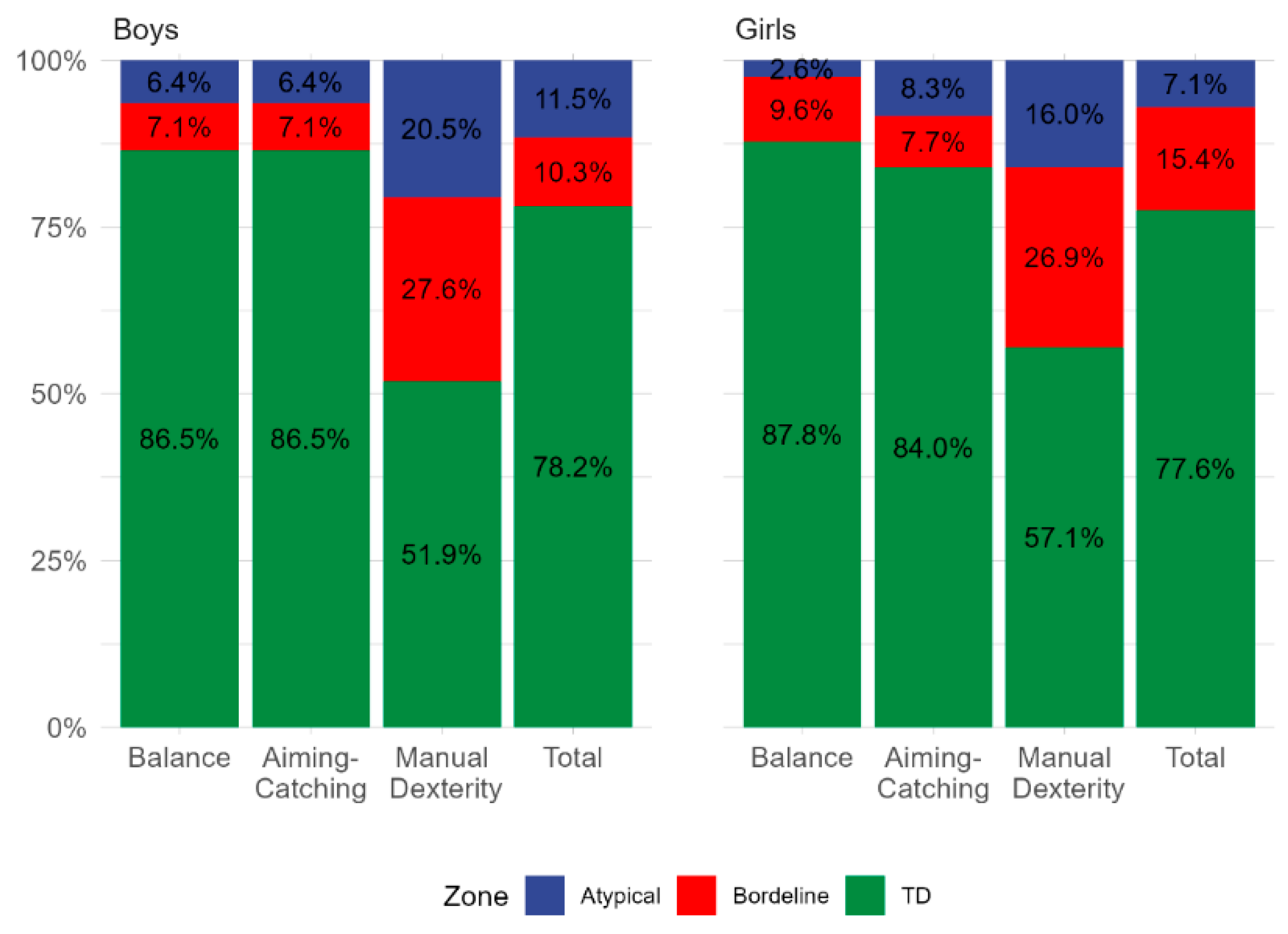
Figure 2.
Age-specific percentile distributions for manual dexterity, aiming–catching, and balance (ages 6–12). Percentiles are plotted on the y-axis; sample counts per age are shown in the figure inset.
Figure 2.
Age-specific percentile distributions for manual dexterity, aiming–catching, and balance (ages 6–12). Percentiles are plotted on the y-axis; sample counts per age are shown in the figure inset.
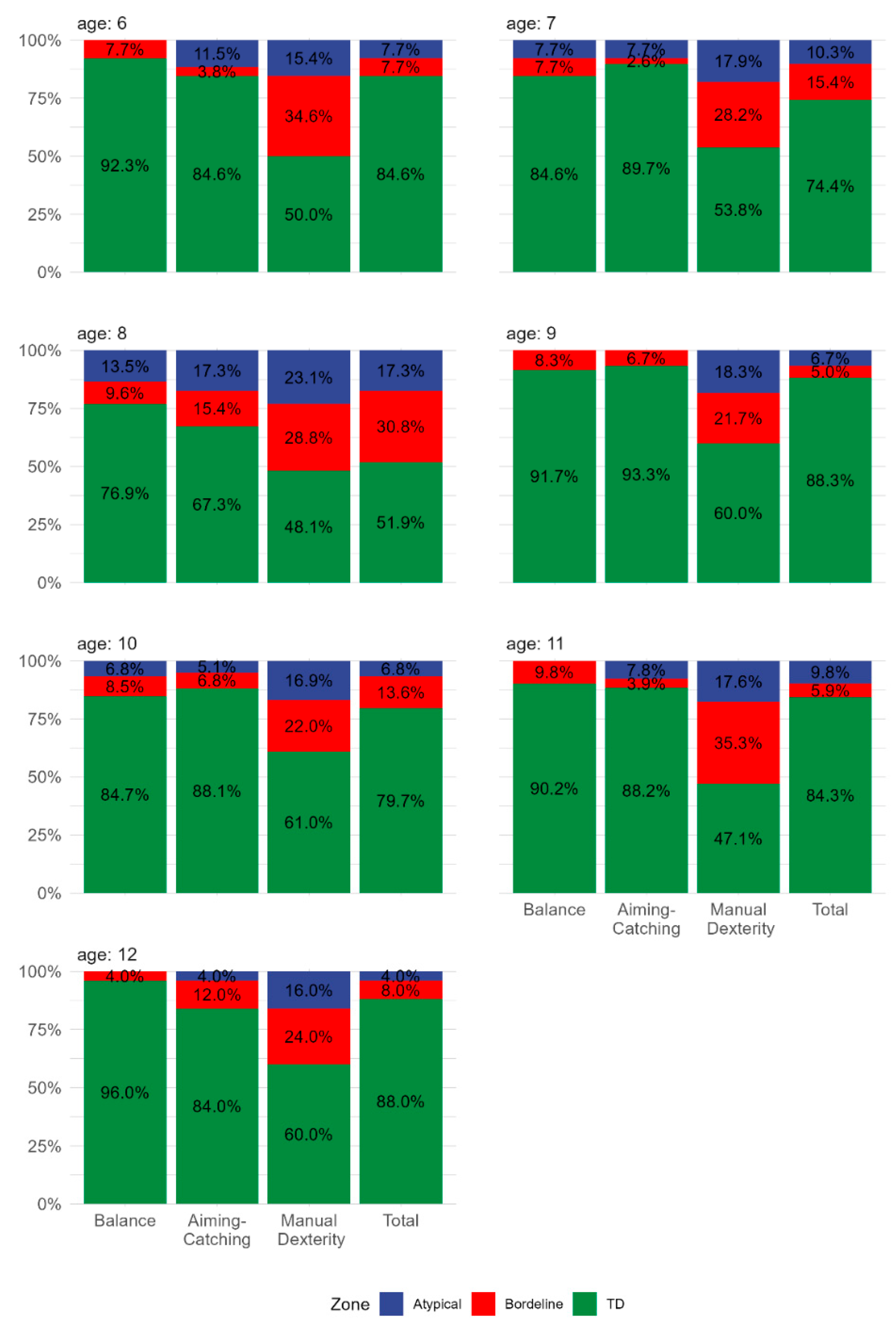
Figure 3.
(A) Proportion of children achieving competence in none, one, two, or all three MABC–2 components by age. (B) Distribution of boys and girls achieving competence in none, one, two, or all three components.
Figure 3.
(A) Proportion of children achieving competence in none, one, two, or all three MABC–2 components by age. (B) Distribution of boys and girls achieving competence in none, one, two, or all three components.
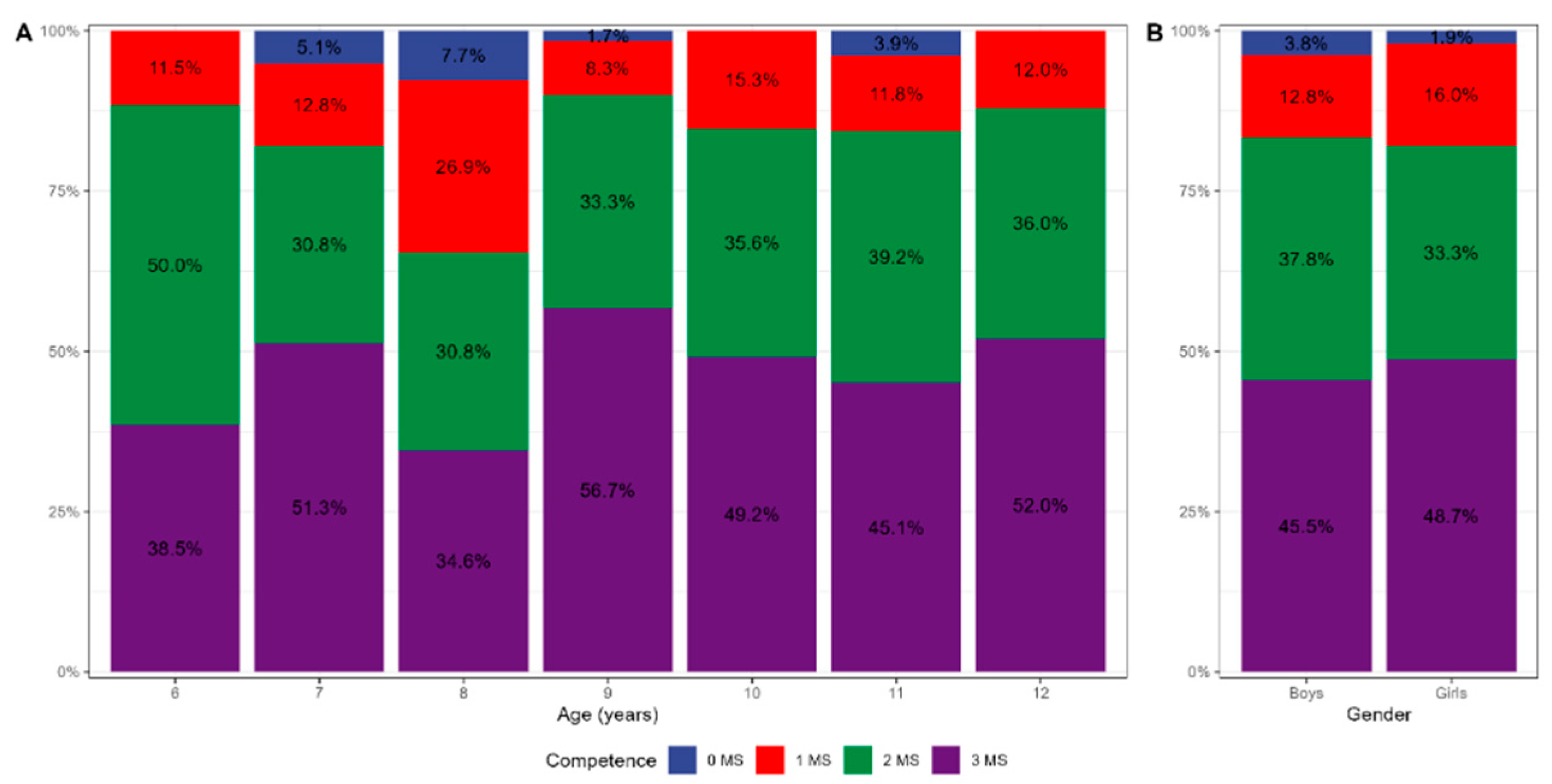
Figure 4.
Caterpillar plot of the random effects. Horizontal lines indicate 95% prediction intervals for classes.
Figure 4.
Caterpillar plot of the random effects. Horizontal lines indicate 95% prediction intervals for classes.
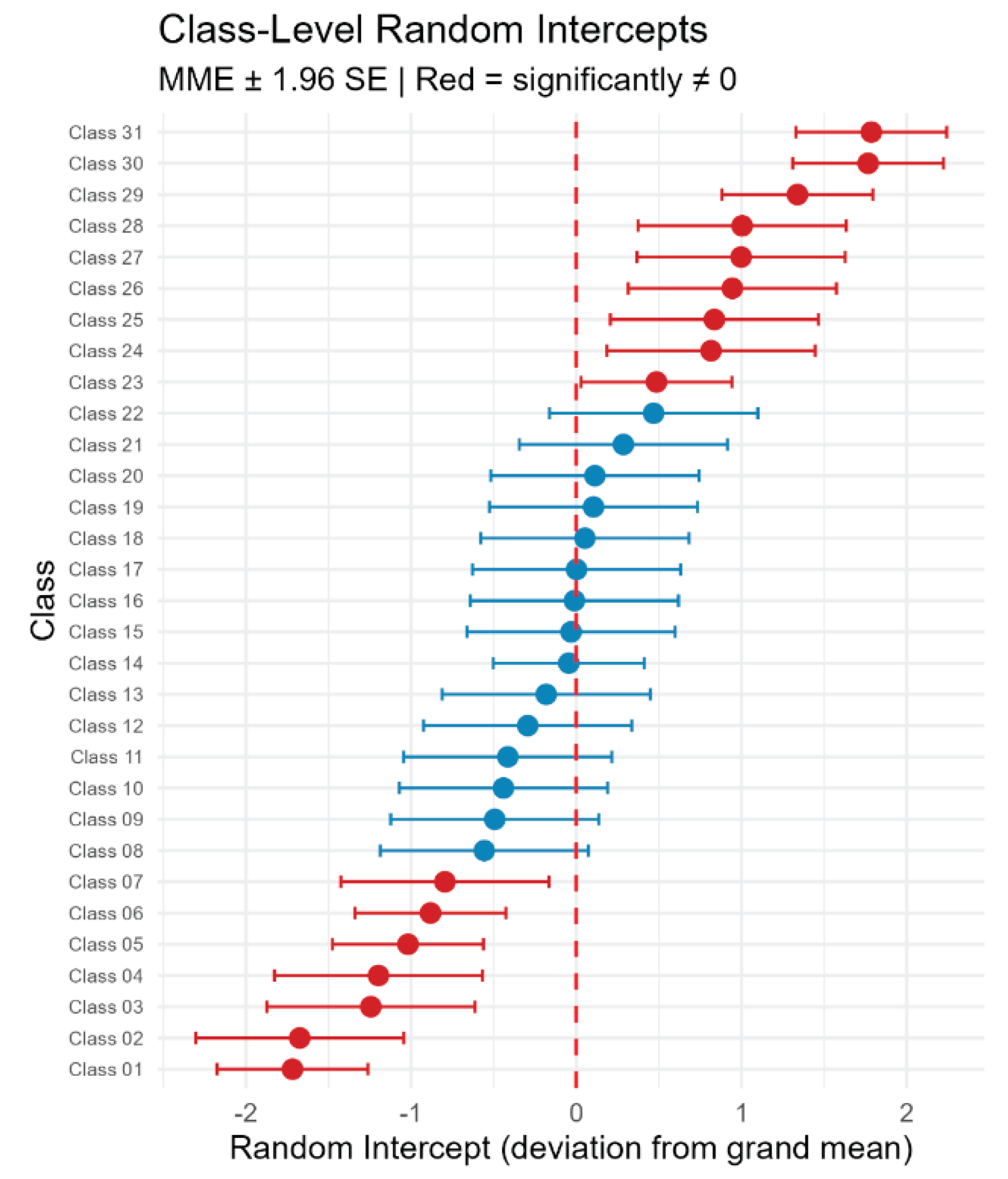

Table 1.
Mean (standard deviation, SD) MABC–2 total and component standardized scores by age and gender.
Table 1.
Mean (standard deviation, SD) MABC–2 total and component standardized scores by age and gender.
| 6 years | 7 years | 8 years | 9 years | 10 years | 11 years | 12 years | ||||||||||||||||
| n = 26 | n = 39 | n = 52 | n = 60 | n = 59 | n = 51 | n = 25 | ||||||||||||||||
| M±SD | Md | CI | M±SD | Md | CI | M±SD | Md | CI | M±SD | Md | CI | M±SD | Md | CI | M±SD | Md | CI | M±SD | Md | CI | ||
| C1 | B | 11.7±1.9 | 11 | 10.5-12.5 | 12.6±4.7 | 16 | 10.5-16 | 9.4±4.1 | 9 | 8-11 | 10.8±2.7 | 11 | 10-11.5 | 11.0±2.7 | 12 | 11-12.5 | 12.2±2.7 | 14 | 11-14 | 10.6±2.9 | 10 | 8.5-12.5 |
| G | 11.9±2.9 | 14 | 10-14 | 11.9±4.1 | 12 | 9.5-14 | 10.0±2.7 | 10 | 8.5-11 | 12.5±2.0 | 14 | 11.5-14 | 10.8±3.4 | 12 | 9.5-12.5 | 11.6±2.8 | 12 | 10.5-12.5 | 11.3±2.2 | 10 | 10-12 | |
| C2 | B | 10.3±3.5 | 11 | 8-12.5 | 11.1±3.5 | 12 | 9.5-13 | 9.7±3.5 | 10 | 8.5-11 | 11.3±2.2 | 11 | 10.5-12 | 11.4±3.2 | 12 | 10-13 | 12.5±2.9 | 13 | 11.5-13.5 | 11.8±2.4 | 12 | 10–13.5 |
| G | 9.7±3.1 | 10 | 8-11.5 | 10.5±2.0 | 11 | 9-12 | 8.2±3.2 | 9 | 7-10 | 10.9±2.3 | 11 | 10-12 | 10.0±2.1 | 10 | 9-10.5 | 11.0±4.0 | 10 | 9-13 | 11.3±3.9 | 11 | 9-13.5 | |
| C3 | B | 8.0±2.5 | 7 | 6.5-10 | 7.1±2.4 | 8 | 6-8 | 6.9±2.2 | 7 | 6-8 | 7.4±2.7 | 8 | 6.5-8.5 | 7.7±2.6 | 8 | 6.5-8.5 | 7.3±2.5 | 7 | 6.5-8.5 | 7.1±2.9 | 8 | 5-9 |
| G | 7.8±2.5 | 8 | 6-9 | 7.8±2.7 | 8 | 6.5-9 | 6.9±2.2 | 7 | 6-8 | 8.4±1.7 | 9 | 7.5-9 | 8.0±2.3 | 8 | 7-9 | 7.5±2.6 | 7 | 6.5-8.5 | 7.9±2.1 | 8 | 6.5-9 | |
Note. Effect sizes (η²p, Cohen’s d) and degrees of freedom are reported in–text. C1: Balance; C2: Aiming-catching; C3: Manual dexterity.
Table 2.
Random effects models comparison.
| df | AIC | BIC | logLik | Test | L.Ratio | p-value | |
| Model 1 | 14 | 4574.8 | 4642.6 | -2273.4 | |||
| Model 2 | 15 | 4548.8 | 4621.4 | -2259.4 | 1 vs 2 | 28.02 | <.0001 |
| Model 3 | 20 | 4446.8 | 4543.6 | -2203.4 | 2 vs 3 | 112.04 | <.0001 |
1 nlme structure: Model 1: random = list(students = ~ components); Model 2: random = list(class = ~ 1, students = ~ components); Model 3: random = list(class = ~ components, students = ~ components); df = degrees of freedom; AIC = Akaike Information Criterion; BIC = Bayesian Information Criterion; logLik = Log-likelihood; L.Ratio = Log-Likelihood Ratio.
Disclaimer/Publisher’s Note: The statements, opinions and data contained in all publications are solely those of the individual author(s) and contributor(s) and not of MDPI and/or the editor(s). MDPI and/or the editor(s) disclaim responsibility for any injury to people or property resulting from any ideas, methods, instructions or products referred to in the content. |
© 2026 by the authors. Licensee MDPI, Basel, Switzerland. This article is an open access article distributed under the terms and conditions of the Creative Commons Attribution (CC BY) license (http://creativecommons.org/licenses/by/4.0/).
Copyright: This open access article is published under a Creative Commons CC BY 4.0 license, which permit the free download, distribution, and reuse, provided that the author and preprint are cited in any reuse.


