

Submitted:
05 March 2026
Posted:
06 March 2026
You are already at the latest version
Abstract
In a series of recent papers, Haug and Tatum have suggested a way to resolve the Hubbletension within RH = ct cosmology. Based on the full distance ladder of Type Ia supernovae(SNe Ia), they find that the Hubble constant must be H0 = 66.8943±0.0287 km/s/Mpc. Thisvalue is close to the Planck Collaboration’s CMB-based estimate of 67.4 ±0.5 km/s/Mpc,except that their solution yields a much smaller uncertainty in the Hubble constant. TheSH0ES study by Riess et al., based on SNe Ia observations, gives a significantly higher value:H0 = 73.04 ±1.04 km/s/Mpc. The Hubble tension refers to the large discrepancy betweenthe H0 estimates obtained from the CMB method and those from SNe Ia data. Interestingly,recent JWST observations, when tied to SNe Ia, find H0 = 68.81 ±1.79. Thus, the JWSTresults lower the Hubble constant relative to the Riess study and appear to support the Haugand Tatum solution to the Hubble tension, a topic we discuss in this short note.
Keywords:
hubble tension
; hubble constant
; CMB
; SNe Ia
; JWST observations
1. A Brief Hubble tension Background
The Hubble tension problem is a result of the inability of proponents of -CDM, the current standard model of cosmology, to adequately explain why two entirely different approaches to measuring the Hubble constant are statistically incompatible with one another [1,2,3,4,5,6,7]. We will herein refer to these approaches as the “CMB approach”, which relies upon measurements of the Cosmic Microwave Background anisotropy, and the “local universe approach”, which relies upon accurate measurements of the full distance ladder of Cepheid variables, galaxies and their supernovae.
From the CMB data, the 2018 Planck Collaboration [1] finds a value of the Hubble constant of . On the other hand, from SNe Ia observations, Riess et al. [2] find a Hubble constant of . Thus, two datasets based on different types of observations yield significantly different values of the Hubble constant. Despite many proposed explanations, there is still no consensus solution within the standard model as to why this discrepancy exists (see, e.g., Valentino et al. [3]). Krishnan et al. [8] have suggested that the Hubble tension could signal a breakdown of FLRW cosmology, a possibility we also consider. If one instead adopts cosmology, both the CMB and SNe Ia observations lead to a consistent estimate of .
In 2015 Tatum et al [9] heuristically suggested the following relation between the evolving CMB temperature and the evolving Hubble parameter.
where is the Boltzmann constant, ℏ is the reduced Planck constant, is the Planck length [10,11] and is the Hubble radius at time t, where .
Haug and Wojnow [12,13] derived from the Stefan-Boltzmann law:
that they also demonstrated could be re-written to the result given by Tatum et al. Haug and Tatum have also demonstrated that the relationship between the evolving CMB temperature and Hubble parameter also can be derived from geometric mean principles [14,15,16].
Tatum et al [17] demonstrated that, using only the CMB temperature observation (and some constants), one obtains an estimate of . This is well within the Planck collaboration estimate of , but importantly their new estimate is much more precise than that of the Planck collaboration. Still, this alone does not provide a solution to the Hubble tension. Already in 2015, Tatum et al. [9] predicted , but it was not until 2024 that Tatum et al. extended the method to also take into account the uncertainty in all input variables to obtain the uncertainty in under this method.
Haug and Tatum [18,19] derived the cosmological redshift for a black hole type cosmology wherein , which meant that they could match their model almost perfectly to the full distance ladder of SNe Ia; see Figure 1. The only free parameter is then , and by obtaining an almost perfect match to the SNe Ia ladder they find when the CMB temperature is [20]. In addition, they take into account the uncertainty in G. Therefore, there is very little statistical uncertainty, since their underlying model leads to a closed-form mathematical solution that perfectly fits the observed SNe Ia; see [21].
2. Comparison of Values from JWST, DESI and the HTC Model
Effectively, within the HTC model there is no Hubble tension, because the same precise estimate results, no matter if one uses the 2009 Fixsen CMB temperature or the full distance ladder of SNe Ia in the context of the same temperature. The recent JWST-assisted observations study by Freedman et al [22] also implies that this could be correct, since their estimate is , which suggests that the Riess et al estimate is an outlier. Despite recent trending study results (see, for example, Table 1), further investigation is needed.
3. Conclusions
The recent JWST-assisted study of by Friedmann et al. appears consistent with the Haug and Tatum Hubble tension solution. Using their HTC model, they have carefully demonstrated that both the CMB temperature–only method as well as the full distance ladder of SNe Ia, in the context of the 2009 Fixsen CMB temperature, yield the same precise value of . Since recent varied methods are becoming more and more precise, we expect that there will eventually be agreement around this value. In the meantime, more aspects of the HTC model will be investigated. It is our humble opinion that it would be a mistake for the astrophysics community to demand that a new model such as ours should, very soon after its introduction, be able to explain everything in the cosmos, given that the standard model has gradually evolved over decades of improving observations.
Data Availability Statement
No new data has been generated in this study.
Conflicts of Interest
The authors declare no conflicts of interest.
References
- Aghanim, et al. Planck Collaboration; Aghanim. Planck 2018 results. VI. cosmological parameters. Astronomy & Astrophysics 2021, 652. [Google Scholar] [CrossRef]
- Riess, A. G. A comprehensive measurement of the local value of the Hubble constant with 1 km s-1 Mpc-1 uncertainty from the Hubble Space Telescope and the SH0ES team. The Astrophysical Journal 2021, 934. [Google Scholar] [CrossRef]
- Valentino, E. In the realm of the Hubble tension – a review of solutions. Classical and Quantum Gravity 2021, 38, 153001. [Google Scholar] [CrossRef]
- Geiger, J. Measurement quantization. Resolving the Hubble tension 68.261 and 73.510 kms-1Mpc-1 2025, 20, 075134. [Google Scholar] [CrossRef]
- Jia, X. D.; et al. The Hubble tension resolved by the DESI Baryon Acoustic Oscillations measurements. The Astrophysical Journal Letters 994, 2025. [CrossRef]
- Simpson, Bolejko K.G.; Walters, S. Beyond Λ-CDM: how the Hubble tension challenges early universe physics. Classical and Quantum Gravity 42, 143001, 2025. [CrossRef]
- Cook, D.; A Benetti, M.; Carneiro, S. Can cosmic rotation resolve the Hubble tension? constraints from CMB and large-scale structure. Journal of Cosmology and Astroparticle Physics 2026, 043, 2026. [Google Scholar] [CrossRef]
- Krishnan, C.; Mohayaee, R.; Colgáin, E. O.; Sheikh-Jabbari, M. M.; Yin, L. Does Hubble tension signal a breakdown in FLRW cosmology? Classical and Quantum Gravity 2021, 38, 184001. [Google Scholar] [CrossRef]
- Tatum, E. T.; Seshavatharam, U. V. S.; Lakshminarayana, S. The basics of flat space cosmology. International Journal of Astronomy and Astrophysics 2015, 5, 116. [Google Scholar] [CrossRef]
- Planck, M. Natuerliche Masseinheiten; Der Königlich Preussischen Akademie Der Wissenschaften: Berlin, Germany.
- Planck, M. Vorlesungen über die Theorie der Wärmestrahlung; see also the English translation “The Theory of Radiation" (1959); J.A. Barth: Leipzig; Dover, 1906; p. 163. [Google Scholar]
- Haug, E. G. CMB, Hawking, Planck, and Hubble scale relations consistent with recent quantization of general relativity theory. International Journal of Theoretical Physics 2024, 63(57). [Google Scholar] [CrossRef]
- Haug, E. G.; Wojnow, S. How to predict the temperature of the CMB directly using the Hubble parameter and the Planck scale using the Stefan-Boltzman law. Journal of Applied Mathematics and Physics 2024, 12, 3552. [Google Scholar] [CrossRef]
- Haug, E. G.; Tatum, E. T. The Hawking Hubble temperature as a minimum temperature, the Planck temperature as a maximum temperature and the CMB temperature as their geometric mean temperature. Journal of Applied Mathematics and Physics 2024, 12, 3328. [Google Scholar] [CrossRef]
- Haug, E. G.. The CMB temperature is simply the geometric mean: Tcmb=TminTmax of the minimum and maximum temperature in the Hubble sphere. Journal of Applied Mathematics and Physics 13, 1085, 2025a. [CrossRef]
- Haug, E. G.; Tatum, E. T. Friedmann type equations in thermodynamical form lead to much tighter constraints on the energy density of the universe. Discover Space 2025a, 129:6. [Google Scholar] [CrossRef]
- Tatum, E. T.; Haug, E. G.; Wojnow, S. Predicting high precision hubble constant determinations based upon a new theoretical relationship between CMB temperature and H0. Journal of Modern Physics 2024, 15, 1708. [Google Scholar] [CrossRef]
- Haug, E. G.; Tatum, E. T. Solving the Hubble tension using the PantheonPlusSH0ES supernova database. Journal of Applied Mathematics and Physics 13, 593, 2025b. [CrossRef]
- Haug, E. G.; Tatum, E. T. A newly-derived cosmological redshift formula which solves the Hubble tension and yet maintains consistency with Tt=T0(1+z), the Rh=ct principle and the Stefan-Boltzmann law. European Journal of Applied Physics 2025c, 7, 48. [Google Scholar] [CrossRef]
- Fixsen, D. J. The temperature of the cosmic microwave background. The Astrophysical Journal 2009, 707, 916. [Google Scholar] [CrossRef]
- Haug, E. G. Closed form solution to the Hubble tension based on Rh=ct cosmology for generalized cosmological redshift scaling of the form: z=(rh/rt)x-1 tested against the full distance ladder of observed SN Ia redshift. Journal of Applied Mathematics and Physics 13, 3293, 2025b. [CrossRef]
- Freedman, W. L.; et al. Status report on the Chicago-Carnegie Hubble program (CCHP): Measurement of the Hubble constant using the Hubble and James Webb space telescopes. The Astrophysical Journal 985, 203, 2025. [CrossRef]
- Zaborowski, E. A.; et al. A sound horizon-free measurement of H0 in DESI 2024. Journal of Cosmology and Astroparticle Physics 2025, 020, 2025. [Google Scholar] [CrossRef]
- Haug, E. G.; Tatum, E. T. Finding the Planck length from the Union2 supernova database in a way that appears to resolve the Hubble tension. Journal of Applied Mathematics and Physics 13, 2063, 2025d. [CrossRef]
Figure 1.
Figure 1 is copied from [18] and shows how well the HTC predictions match the PantheonPlusSH0ES observations.
Figure 1.
Figure 1 is copied from [18] and shows how well the HTC predictions match the PantheonPlusSH0ES observations.
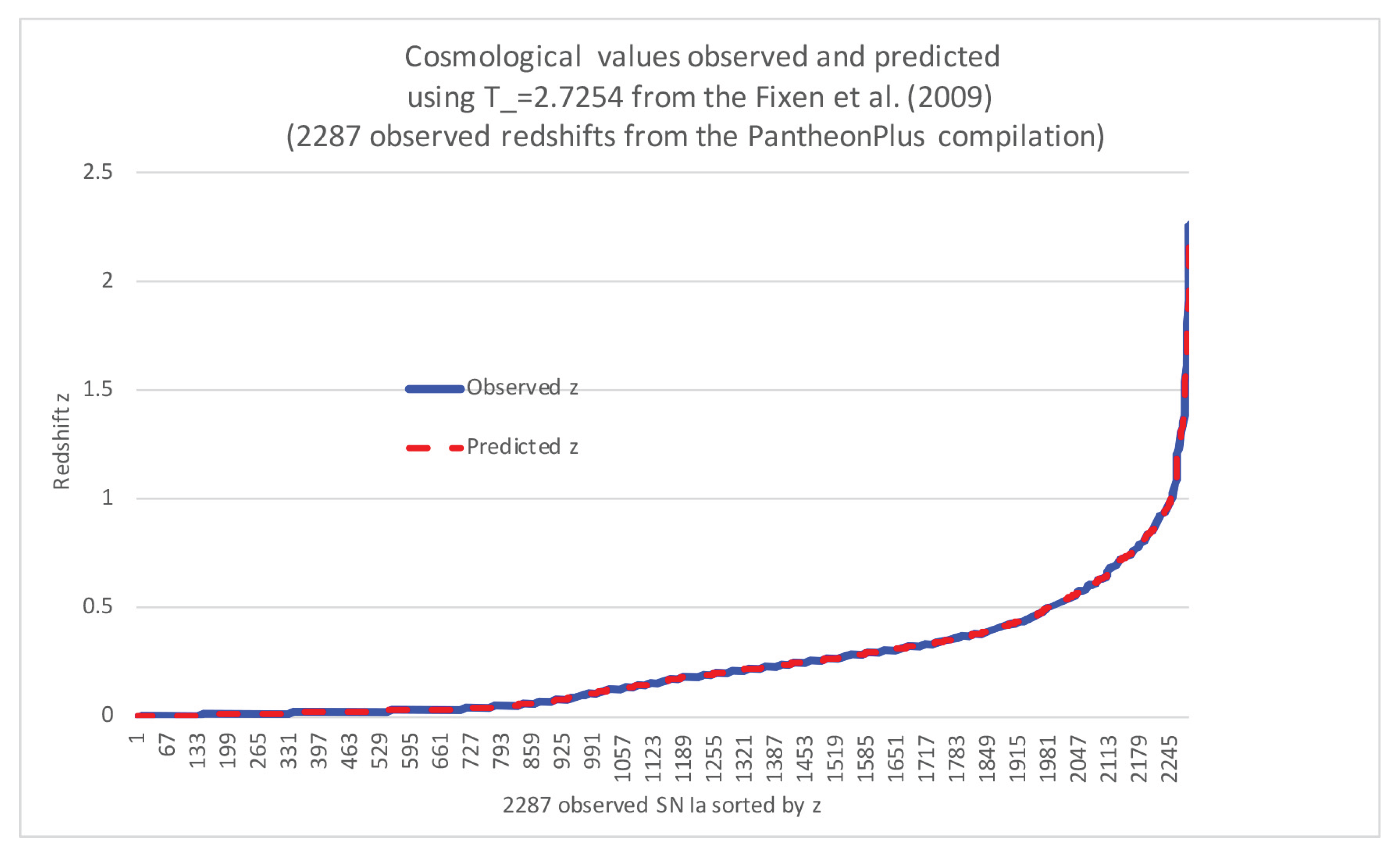

Table 1.
This table shows values from CMB and SNe Ia from different studies.
| From: | Hubble Parameter: | Study |
|---|---|---|
| SNe Ia JWST | JWST data only, Friedmann et al [22] | |
| DESI + CMB + Pantheon+ | Zaborowski et al [23] | |
| CMB | Planck Collobration [1] | |
| CMB | Tatum et al [17] | |
| SNe Ia Pantheon+ | Tatum and Haug [18,21,24] | |
| Cepheid–SNe Ia | Riess [2] |
Disclaimer/Publisher’s Note: The statements, opinions and data contained in all publications are solely those of the individual author(s) and contributor(s) and not of MDPI and/or the editor(s). MDPI and/or the editor(s) disclaim responsibility for any injury to people or property resulting from any ideas, methods, instructions or products referred to in the content. |
© 2026 by the authors. Licensee MDPI, Basel, Switzerland. This article is an open access article distributed under the terms and conditions of the Creative Commons Attribution (CC BY) license (http://creativecommons.org/licenses/by/4.0/).
Copyright: This open access article is published under a Creative Commons CC BY 4.0 license, which permit the free download, distribution, and reuse, provided that the author and preprint are cited in any reuse.


