
Submitted:
05 March 2026
Posted:
06 March 2026
You are already at the latest version
Abstract
Efficient irrigation management is critical for increasing water production and providing high-quality planting material in fruit tree nurseries. This study looked at how four different irrigation depths (0, 10, 20, and 30 mm each irrigation event) affected graft establishment, nursery survival rate, total water consumption, and irrigation water productivity in peach (Prunus persica (L.) Batsch). Field studies were carried out in a commercial nursery in northeastern Romania over two consecutive growth seasons, with two cultivars ('Redhaven' and 'Cresthaven') and four fertilization levels in a factorial design. Irrigation considerably increased graft take and the number of marketable nursery trees compared to rainfed circumstances. Moderate irrigation (20 mm per irrigation event) resulted in the highest nursery survival rate and water efficiency. Higher irrigation inputs increased total water use, but reduced irrigation water productivity. Regression analysis revealed nonlinear connections between water consumption and nursery performance, implying that productivity advantages drop with increasing irrigation levels. The findings suggest that moderate watering can boost nursery yield while conserving water. These findings offer practical recommendations for irrigation management in commercial peach nursery production systems.
Keywords:
peach nursery
; irrigation management
; graft establishment
; nursery survival rate
; irrigation water productivity
; water use efficiency
1. Introduction
Water availability is one of the biggest constraints on agricultural productivity in many parts of the world. Increasing climate variability and competition for water resources necessitate better irrigation management systems that maximize water efficiency while preserving crop output [1,2,3]. In perennial agricultural systems, effective irrigation management is especially crucial since water availability has a direct impact on plant establishment, vegetative growth, and long-term production [4,5,6].
Fruit tree nurseries are an important stage in horticultural production systems because they supply planting material for orchard establishment. Nursery systems differ from mature orchards in that they have higher planting density, faster vegetative development, and smaller root systems, making young plants more sensitive to changes in soil moisture conditions [7,8,9]. Adequate water supply during the early stages of development is essential for optimal graft establishment and subsequent plant growth.
Grafting is the process of creating a functional union between rootstock and scion by active cell division, callus development, and vascular reconnection. These physiological processes are heavily regulated by plant water status and external factors [10,11]. Insufficient soil moisture can impair graft success and slow vegetative growth, but too much irrigation can reduce water-use efficiency and increase nutrient losses from the soil [12,13]. As a result, determining proper irrigation levels during the nursery stage is critical to obtaining good survival rates while also conserving water.
Most recent research on irrigation management in fruit crops has concentrated on mature orchards, where irrigation tactics are designed to maximize fruit yield and quality [14]. In contrast, despite the importance of the nursery stage in producing high-quality planting material, less research have been conducted to investigate irrigation requirements. Irrigation strategies in nurseries are frequently based on general orchard recommendations, which may not sufficiently reflect the unique physiological and management characteristics of nursery production systems [15].
Peach (Prunus persica (L.) Batsch) is readily propagated by grafting and is one of the most important fruit tree species in commercial nursery production. The effectiveness of graft establishment and the generation of marketable nursery trees are heavily influenced by environmental variables, notably soil moisture availability during the early stages of plant development [16,17]. Determining irrigation levels that allow high graft survival while preserving efficient water usage is thus critical for increasing nursery productivity, particularly in times of growing water shortage.
Despite the increased interest in increasing irrigation efficiency in fruit cropping systems, there is little information available on irrigation optimization during the nursery stage, particularly in terms of graft establishment and early plant growth. Furthermore, most research have concentrated on yield and fruit quality in mature orchards, while irrigation water productivity during nursery production has gotten far less attention. As a result, determining irrigation levels that enable high graft survival while conserving water is critical for increasing the sustainability and resource efficiency of nursery production systems. Furthermore, whereas irrigation and fertilizer are important agronomic elements in plant growth, their combined impacts on graft establishment and nursery survival have rarely been studied in fruit tree propagation systems. Understanding these connections may help improve irrigation management and resource efficiency in nursery output. Therefore, the purpose of this study was to determine the effects of various irrigation depths on graft establishment, nursery survival rate, and irrigation water productivity in peach nursery production. Field studies were carried out under commercial nursery circumstances to determine the irrigation levels that enhance plant establishment and improve water efficiency.
2. Materials and Methods
2.1. Experimental Site and Climatic Conditions
The field experiment was carried out over two growth seasons (2024-2025) in a commercial peach nursery in northeastern Romania. The region has a temperate continental climate, with warm summers and moderate precipitation throughout the growing season.
Meteorological data, such as air temperature and rainfall, were gathered from the nearest meteorological station to the experimental site. Rainfall reported over the growth seasons contributed to the total amount of water available to nursery plants.
2.2. Soil Characteristics
The soil was characterized as loamy, with a modest water retention capacity. Soil samples were obtained from the 0-30 cm layer prior to the start of the experiment to determine the most important soil parameters for irrigation management.
Laboratory tests revealed slightly alkaline soil conditions and moderate organic matter content, which are characteristic of agricultural soils utilized in nursery production systems throughout the region. These soil properties provided ideal circumstances for studying irrigation management options in the field.
2.3. Plant Material
The trial comprised two peach (Prunus persica (L.) Batsch) cultivars typically used in commercial nursery production: ‘Redhaven’ and ‘Cresthaven’. Grafting was carried out using normal nursery propagation techniques on suitable rootstocks commonly employed in peach growth.
Grafting operations were performed in accordance with conventional nursery methods. Following grafting, plants were kept in the field and managed using commercial nurseries’ standard agronomic procedures, such as weed control and pest management.
2.4. Experimental Design and Treatments
The experiment was designed as a factorial with three experimental factors: irrigation depth, fertilization level, and cultivar. Four irrigation depths were used during the growing season to assess different water supply conditions for nursery plant development. The irrigation treatments included a rainfed control treatment with no irrigation and three irrigation depths (10 mm, 20 mm, and 30 mm) applied every irrigation event.
In addition to irrigation treatments, various fertilization levels were assessed in accordance with the nursery production system’s fertilization scheme. The fertilization treatments were added to investigate the impact of irrigation management and nutrient availability on graft establishment and nursery viability. The trial comprised two peach cultivars, ‘Redhaven’ and ‘Cresthaven’, which are commonly used in commercial nursery production.
Each treatment combination was duplicated in the experimental field to guarantee the statistical validity of the results. The experimental plots were designed to provide consistent growing conditions across treatments while minimizing the effect of environmental variability on plant development.
2.5. Irrigation Management
Irrigation was carried out according to the experimental timetable utilizing a regulated irrigation system. The irrigation treatments were intended to imitate various water supply situations during the nursery production phase.
Water was sprayed at predetermined irrigation depths based on the treatment level. Irrigation events were carried out during the growing season to maintain soil moisture conditions appropriate for the experimental treatments.
2.6. Total Water Consumption
Total water consumption during the growing season was computed by adding the irrigation water applied and the effective rainfall reported during the experiment.
The equation used to compute total water consumption (TWC) is as follows [18]:
where TWC is total water consumption (m³ ha⁻¹), I is cumulative irrigation input (m³ ha⁻¹), and Pe is effective precipitation during the growing season (m³ ha⁻¹). Effective pre-cipitation was assessed using FAO techniques, accounting for rainfall distribution and the fraction of precipitation that contributed to soil water availability.
This parameter was used to assess the overall water supply available to nursery plants under various irrigation treatments.
2.7. Measurements and Data Collection
Graft establishment success was expressed as graft take percentage (GT), computed as follows [19]:
where Ns is the number of successful grafts and Nt is the overall number of grafted plants per plot.
Nursery productivity was evaluated as the number of marketable grafted trees per hectare (NT), computed as follows [19]:
where N m is the number of marketable trees in the plot, and A is the plot area in hectares. Only trees that met commercial nursery requirements were considered in the final count.
Water use coefficient was assessed using graft take and nursery survival rate factors. The water utilization coefficient for graft take was determined as follows [20]:
where TWC is total water consumption (m³ ha⁻¹) and GT is graft take (%).
The water use coefficient for nursery survival rate was estimated as follows [20]:
where NT is nursery survival rate (trees per hectare). Lower coefficient values indicate more efficient water use.
2.8. Irrigation Water Productivity
Irrigation water productivity (IWP) measures the increase in graft take (%) or nursery survival rate (trees ha⁻¹) per unit of irrigation water (m³ ha⁻¹) [20]:
where Y reflects nursery productivity (either as the number of marketable plants or the survival rate), I represents the irrigation water used throughout the growing season (m³ ha⁻¹). The IWP was calculated as % m⁻³ for graft take, nursery trees m⁻³.
2.9. Statistical Analysis
Statistical analyses were carried out using PAST version 4.10. Analysis of variance (ANOVA) was used to determine the effects of irrigation depth, fertilization amount, cultivar, and their interactions on graft take, nursery survival rate, and water use indicators. When significant treatment effects were found, means were compared using the least significant difference (LSD) test at p < 0.05.
Correlation and regression studies were used to investigate the correlations between total water consumption, graft take, and nursery survival rate. We employed coefficients of determination (R²) to assess the correlations between irrigation levels and nursery performance.
3. Results
3.1. Effects of Irrigation on Graft Take
The irrigation regime had a statistically significant impact on graft establishment in both peach cultivars (Table 1). Under non-irrigated conditions, graft take topped 85% in both ‘Redhaven’ and ‘Cresthaven’, indicating a rather high baseline grafting success under natural rainfall. This suggests that the climatic circumstances throughout the experimental seasons were generally conducive to graft union formation.
These findings indicate that irrigation thresholds exist in nursery production systems, beyond which additional water inputs yield limited agronomic benefits.
Supplemental watering resulted in continuous improvements in graft take as irrigation parameters increased. Graft take values exceeded 90% in irrigated treatments and neared 99% at the maximum irrigation standard (30 mm). The greatest advantages were seen when irrigation was increased from rainfed circumstances to moderate irrigation levels (10-20 mm), while an increase from 20 to 30 mm resulted in comparatively lesser improvements. This pattern indicates that modest irrigation was sufficient to meet the physiological water requirements for callus development and vascular reconnection during graft installation. Water usage grew gradually from 3780 m³ ha⁻¹ in non-irrigated settings to 4497 m³ ha⁻¹ in the maximum irrigation standard. Although graft taking increased with increasing water input, the relative improvement per unit of extra water decreased at higher irrigation levels. This pattern is also evident in the water use coefficient data, which did not decrease correspondingly with increasing irrigation depth. In fact, slightly larger coefficients at higher irrigation standards imply less efficient water consumption during graft establishment when too much water was provided.
The reaction patterns were highly comparable between cultivars. Differences in graft take between ‘Redhaven’ and ‘Cresthaven’ remained minor across all irrigation treatments, and no unique cultivar-specific irrigation response was detected. This similarity indicates that both cultivars are equally sensitive to soil moisture conditions during the early grafting phase.
While supplemental irrigation improves graft establishment, increasing irrigation depth above modest levels gives little additional advantage in terms of overall water usage. These findings emphasize the significance of adjusting irrigation input during nursery propagation to increase water efficiency while maintaining graft survival.
3.2. Water Use and Water Productivity During Graft Establishment
Irrigation water productivity (IWP) for graft establishment varies with irrigation norm (Table 2). The maximum productivity values were recorded at low to moderate irrigation levels, but increasing irrigation depth resulted in lower productivity per unit of applied water.
In ‘Redhaven’, irrigation water productivity increased from 0.0133% m⁻³ at 10 mm to 0.0146% m⁻³ at 20 mm, with a little decrease at 30 mm (0.0139% m⁻³). A similar trend was found in ‘Cresthaven’, where productivity increased gradually from 10 to 30 mm, but absolute values remained lower than those reported in ‘Redhaven’. These findings show that moderate irrigation levels improve the conversion of applied water into effective graft establishment.
Although graft take increased with higher irrigation input, the proportionate gain compared to water applied decreased beyond moderate irrigation standards. This pattern indicates that additional water delivered at greater irrigation depths contributed less effectively to graft success than moderate levels.
Cultivar-related changes in irrigation water productivity were minor, with ‘Redhaven’ consistently demonstrating slightly higher efficiency values across irrigation regimens. Nonetheless, both cultivars showed similar response patterns, with increased water output under moderate irrigation and decreased efficiency at the highest irrigation norm.
3.3. Effects of Irrigation and Fertilization on Nursery Survival Rate
The irrigation regime had a significant impact on nursery survival rate in both cultivars (Table 3). Compared to non-irrigated circumstances, all irrigated treatments resulted in significant increases in the number of marketable grafted trees per hectare, demonstrating the importance of adequate soil moisture during vegetative and canopy development.
The most pronounced reaction was seen under moderate irrigation (20 mm), where nursery survival rate peaked, particularly in ‘Redhaven’. Increased irrigation from 10 mm to 20 mm resulted in a significant increase in nursery survival rate in both cultivars. However, increasing irrigation to 30 mm did not produce proportional gains. In ‘Redhaven’, production fell at the maximum irrigation level, however in ‘Cresthaven’ survival rate remained reasonably consistent between 20 and 30 mm, demonstrating small cultivar-specific variances in response to increased water availability.
Water consumption increased gradually with irrigation depth, from 3780 m³ ha⁻¹ under rainfed conditions to 4497 m³ ha⁻¹ at 30 mm. Although higher irrigation inputs improved total water availability, the efficiency with which water was turned into marketable trees differed greatly between treatments.
This variance is reflected in the water utilization coefficients. The lowest coefficient, indicating the maximum water-use efficiency, was measured under the 20 mm irrigation norm in ‘Redhaven’ (0.0611 m³ tree⁻¹). In contrast, greater coefficients were seen in both rainfed and excessive irrigation circumstances, implying that both water scarcity and excess water supply lowered productivity. A similar pattern was observed at ‘Cresthaven’, but absolute coefficient values were consistently larger than those in ‘Redhaven’, indicating slightly lower water-use efficiency.
3.4. Irrigation Water Productivity for Nursery Survival Rate
Water productivity for nursery survival rate varies significantly among irrigation norms (Table 4). Irrigation significantly reduced the water use coefficient (m³ tree⁻¹), reaching its lowest value with moderate irrigation (20 mm), especially in ‘Redhaven’. This suggests a more efficient conversion of overall water use into marketable nursery trees with a moderate water supply.
Irrigation water productivity (IWP), measured as the number of new grafted trees generated per cubic meter of irrigation water delivered, exhibited a nonlinear response to increasing irrigation depth. In ‘Redhaven’, IWP increased from 51.67 trees m⁻³ at 10 mm to 78.34 trees m⁻³ at 20 mm, followed by a significant decrease to 28.07 trees m⁻³ at 30 mm. This pattern indicates that moderate irrigation maximized return per unit of applied water, while higher irrigation inputs reduced marginal gains. In ‘Cresthaven’, the response was slightly different. The highest irrigation water productivity (95.48 trees m⁻³) was reported at 10 mm, followed by a progressive reduction at 20 mm (59.26 trees m⁻³) and 30 mm (42.25). Although overall nursery production remained reasonably high at higher irrigation settings, efficiency per unit of applied water fell.
These cultivar-specific trends suggest that, while supplemental watering increases total nursery production, the optimal irrigation levels for maximizing productivity per unit of applied water may vary slightly between cultivars. In both situations, heavy irrigation reduced water-use efficiency, even when total production remained quite high.
3.5. Relationships Between Water Consumption and Nursery Performance
Regression analysis found strong and statistically significant positive relationships between total water consumption and nursery survival rate during the graft establishment stage in both peach cultivars (Figure 1 and Figure 2). In ‘Redhaven’, total water consumption explained a significant percentage of the variability in graft establishment success, as evidenced by a high coefficient of determination (R²). A similar positive link was discovered in ‘Cresthaven’, however the intensity of the relationship was slightly lower than in ‘Redhaven’. Graft establishment success is represented graphically in Figure 1 and Figure 2, as a survival rate (%).
The fitted quadratic models reveal that as overall water consumption increases across all irrigation regimes, so does the survival rate. However, the curvature of the regression lines shows that the pace of growth in survival rate decreased as water consumption increased. Although more irrigation continued to boost survival, the proportional benefit declined as total water input increased, showing diminishing marginal advantages at greater irrigation levels.
Under both fertilizing regimes, nursery survival rate correlated strongly with total water consumption (Figure 3). Increasing water input boosted survival, especially at low and moderate irrigation levels; however, the rate of improvement slowed as total water intake increased, indicating a nonlinear response.
At lower and intermediate levels of overall water usage, irrigation increased nursery survival rate significantly. In this range, the regression curves were rather steep, indicating a high response of vegetative growth and plant survival to increased soil moisture availability. These findings indicate that water supply during the early phases of vegetative development is critical in influencing final nursery survival rate, especially when transitioning from rainfed or low irrigation settings to moderate irrigation levels.
As overall water input exceeded mild irrigation norms, the slopes of the regression functions gradually decreased. Although nursery production continued to climb or stayed quite high, the rate of improvement per additional unit of water decreased. The curvature of the quadratic models indicates a nonlinear production response, in which further irrigation contributes proportionally less to output once physiological water requirements are mostly met. In practice, the system moves from a water-limited phase—in which irrigation significantly boosts growth—to one in which water supply is no longer the key limiting factor.
The observed response pattern is consistent with the water utilization coefficient values, which were most favorable under moderate irrigation but rose at higher irrigation levels. This suggests that excessive water application did not significantly increase nursery survival rate and may have impaired the efficiency with which applied water was turned into marketable plants. Even though total nursery survival rate remained high at elevated irrigation levels, water-use efficiency decreased.
The regression studies show that increasing overall water consumption has a beneficial effect on both graft take and nursery survival rate. However, the quadratic response patterns show that productivity gains gradually diminish as irrigation input increases. These findings emphasize the need to determine irrigation levels that offer adequate moisture availability for maximum vegetative development while staying within the range where extra water produces decreasing returns. From a management standpoint, managing irrigation depth during early-stage peach nursery development is critical for sustaining high output while protecting water-use efficiency in times of growing water shortages.
4. Discussion
Efficient irrigation management is critical for successful plant establishment and increased water productivity in nursery production systems. The current study found that moderate irrigation depths provided the best circumstances for graft establishment and nursery survival while retaining relatively high irrigation water output. with contrast, increasing irrigation inputs above moderate levels resulted with increased total water use with no commensurate gain in nursery performance. Similar results have been documented in fruit cropping systems, where moderate irrigation regimes outperformed heavy irrigation in terms of plant performance and resource efficiency [21,22].
The physiological requirements of the graft union formation process can explain why moderate irrigation has a good effect on graft establishment. Adequate soil moisture promotes callus formation, vascular reconnection, and the development of effective transport channels between rootstock and scion. However, excessive irrigation can diminish oxygen availability in the root zone, resulting in less efficient water usage by the plant. Previous research has also shown that irrigation management has a considerable influence on vegetative growth and physiological activity in fruit crops, especially during the early stages of plant development [23,24].
Water productivity is an important criterion for evaluating irrigation solutions in agricultural systems. In the current study, moderate irrigation depths allowed for optimal use of water resources while retaining good nursery survival rates. These findings are consistent with earlier research, which has shown that optimal irrigation management can greatly improve water production in fruit cropping systems [25,26]. Furthermore, proper irrigation scheduling can help to reduce production costs and minimize water losses caused by excessive irrigation.
Regression analysis revealed nonlinear connections between total water usage and nursery performance markers, implying diminishing returns when irrigation inputs reach acceptable levels. Similar patterns have been observed in other studies analyzing crop responses to irrigation regimes, where increases in irrigation above a specific threshold resulted in progressively decreasing productivity gains [27,28]. Identifying these thresholds is critical for creating irrigation management systems that maximize crop output while saving water resources.
From a practical standpoint, the findings of this study emphasize the significance of tailoring irrigation levels to the individual needs of nursery production systems. In many agricultural locations, growing water scarcity necessitates more effective irrigation systems that balance crop output and water conservation. Previous research has shown that optimal irrigation management can play an essential role in enhancing the sustainability of agricultural production systems in areas with restricted water availability [29,30]. As a result, implementing moderate irrigation levels during nursery production may be an effective technique for increasing both plant establishment and irrigation water output.
5. Conclusions
This study evaluated the effects of various irrigation depths on graft establishment, nursery survival rate, and irrigation water productivity in peach nursery production. The findings revealed that moderate irrigation levels created the best circumstances for effective graft establishment and plant survival. Increasing irrigation above moderate levels increased total water use but did not significantly improve nursery performance, resulting in decreased irrigation water yield.
The regression studies revealed nonlinear connections between water consumption and nursery performance, implying the existence of irrigation thresholds beyond which further water inputs yield limited agronomic benefits. These findings emphasize the need of optimizing irrigation management in nursery production systems to achieve a balance between plant performance and water efficiency.
From a practical standpoint, using moderate irrigation depths can help nurseries survive while reducing water consumption. Such irrigation solutions may help to improve the sustainability and resource efficiency of commercial peach nursery production during times of increasing water constraint. Future research should evaluate irrigation optimization in various soil and climatic conditions in order to increase nursery production efficiency.
Author Contributions
Conceptualization, A.V.; methodology, A.V..; software, A.V.; validation, A.V.; formal analysis, A.V.; investigation, A.V.; resources, A.V.; data curation, A.V.; writing—original draft preparation, A.V.; writing—review and editing, A.V.; visualization, A.V.; supervision, A.V.; project administration, A.V.; funding acquisition, A.V. All authors have read and agreed to the published version of the manuscript.
Funding
The APC was funded by the University of Oradea.
Data Availability Statement
Data are contained within the article or supplementary material.
Conflicts of Interest
The author declare no conflicts of interest.
References
- Vadez, V.; Kholová, J.; Medina, S.; Kakkera, A.; Anderberg, H. Water use efficiency as a key determinant of crop productivity under drought conditions. Frontiers in Plant Science 2023, 14, 1170137. [Google Scholar]
- Wang, T.; Li, X.; Zhang, Y.; Chen, Y. Evaluation methods and research progress of crop water use efficiency: A review. Agricultural Water Management 2024, 291, 108692. [Google Scholar]
- Lakhiar, I.A.; Gao, J.; Syed, T.N.; Chandio, F.A.; Buttar, N.A. Modern precision irrigation technologies and their role in sustainable agriculture: A review. Agriculture 2024, 14, 1141. [Google Scholar]
- Bwire, D.; Tusiime, F.; Kiggundu, N. Improving irrigation water use efficiency under modern irrigation systems. Water 2024, 16, 3458. [Google Scholar]
- Xue, R.; Zhang, H.; Li, J.; Wang, Y. Enhancing crop water productivity through optimized irrigation management strategies. Agricultural Water Management 2025, 305, 109148. [Google Scholar]
- Chang, M.; Liu, Y.; Wang, L.; Zhang, S. Agricultural water use efficiency and irrigation management strategies under climate variability. Agricultural Water Management 2025, 298, 108857. [Google Scholar]
- Ali, N.; Dong, Y.; Lavely, E. Irrigation scheduling effects on yield and water use efficiency of fruit crops: A global meta-analysis. Agricultural Water Management 2024, 306, 109148. [Google Scholar] [CrossRef]
- Yang, L.; Xu, H.; Yang, Y.; Li, Y. Grafting enhances drought tolerance and water use efficiency in horticultural crops. Frontiers in Plant Science 2022, 13, 1015317. [Google Scholar]
- Banik, S.; Kumar, R.; Singh, A. Drip irrigation and crop water productivity: Recent advances and perspectives. Agricultural Water Management 2023, 276, 108072. [Google Scholar]
- Jumintono, J.; Kurniawan, A.; Setyawan, A. Precision irrigation technologies for improving water productivity in crop systems. Journal of Water and Land Development 2024, 61, 15–24. [Google Scholar]
- Farag, A.A.; El-Metwally, I.; Abd El-Rahman, M. Irrigation management practices and their influence on crop productivity and water efficiency. Scientific Reports 2025, 15, 19575. [Google Scholar]
- Monamodi, P.; Chiboola, H.; Kiggundu, N. Innovative irrigation technologies and their impact on agricultural productivity and water use efficiency. Agriculture 2025, 15, 1755. [Google Scholar]
- Kundu, A.; Rahman, M.; Hasan, M. Precision irrigation systems for sustainable water management in agriculture. Sustainability 2024, 16, 4591. [Google Scholar]
- Septar, L.; Bunea, A.; Popescu, M.; Călina, J. Effects of irrigation management on growth and productivity of peach under semi-arid conditions. Horticulturae 2024, 10, 450. [Google Scholar]
- Iglesias, I.; Echeverría, G.; Soria, Y. Fruit growth, yield and quality responses of peach cultivars to irrigation management. Scientia Horticulturae 2020, 272, 109585. [Google Scholar]
- Girona, J.; Marsal, J.; Mata, M.; del Campo, J. Irrigation management strategies for improving water productivity in fruit tree orchards. Agricultural Water Management 2019, 221, 561–570. [Google Scholar]
- Melnyk, C.W. Plant grafting: Insights into the mechanisms of graft formation and compatibility. Plant Cell Reports 2019, 38, 113–122. [Google Scholar]
- Pereira, L.S.; Paredes, P.; Rodrigues, G.C.; Neves, M. Water use efficiency and water productivity in agricultural systems. Agricultural Water Management 2020, 236, 106174. [Google Scholar]
- Steduto, P.; Hsiao, T.C.; Fereres, E.; Raes, D. Crop Yield Response to Water; FAO Irrigation and Drainage Paper No. 66; Food and Agriculture Organization of the United Nations: Rome, Italy, 2012. [Google Scholar]
- Hartmann, H.T.; Kester, D.E.; Davies, F.T.; Geneve, R.L. Plant Propagation: Principles and Practices, 9th ed.; Pearson Education: Boston, MA, USA, 2021. [Google Scholar]
- Pereira, L.S.; Cordery, I.; Iacovides, I. Improved indicators of water use performance and productivity for sustainable water conservation and saving. Agric. Water Manag. 2012, 108, 39–51. [Google Scholar] [CrossRef]
- García-Tejero, I.F.; Durán-Zuazo, V.H. Water management strategies in Mediterranean fruit orchards: Recent advances and future perspectives. Agricultural Water Management 2021, 245, 106629. [Google Scholar]
- Romero, P.; Botía, P.; García, F. Effects of regulated deficit irrigation on yield and fruit quality in peach trees. Agricultural Water Management 2019, 213, 737–746. [Google Scholar]
- Intrigliolo, D.S.; Pérez, D.; Bonet, L. Evaluation of irrigation strategies in fruit crops under water scarcity conditions. Scientia Horticulturae 2020, 261, 108972. [Google Scholar]
- Sánchez, E.; Torrecillas, A.; Domingo, R. Deficit irrigation and water productivity in fruit trees: A review. Irrigation Science 2020, 38, 1–15. [Google Scholar]
- Camposeo, S.; Vivaldi, G.A.; Gattullo, C.E.; Boari, F. Water use efficiency and crop productivity in fruit orchards under different irrigation regimes. Agricultural Water Management 2021, 248, 106771. [Google Scholar]
- Costa, J.M.; Ortuño, M.F.; Chaves, M.M. Deficit irrigation as a strategy to save water in agriculture: Physiological and agronomic implications. Agronomy 2019, 9, 393. [Google Scholar]
- Lovelli, S.; Perniola, M.; Di Tommaso, T. Crop responses to irrigation regimes and implications for water productivity. Agronomy 2021, 11, 1140. [Google Scholar]
- Fereres, E.; Orgaz, F.; González-Dugo, V. Reflections on food security under water scarcity. Journal of Experimental Botany 2020, 71, 589–595. [Google Scholar] [CrossRef]
- Zhang, H.; Oweis, T. Water-yield relationships and optimal irrigation scheduling in water-limited environments. Agricultural Water Management 2019, 219, 164–172. [Google Scholar]
Figure 1.
Relationship between graft survival rate (%) and total water consumption in Redhaven.
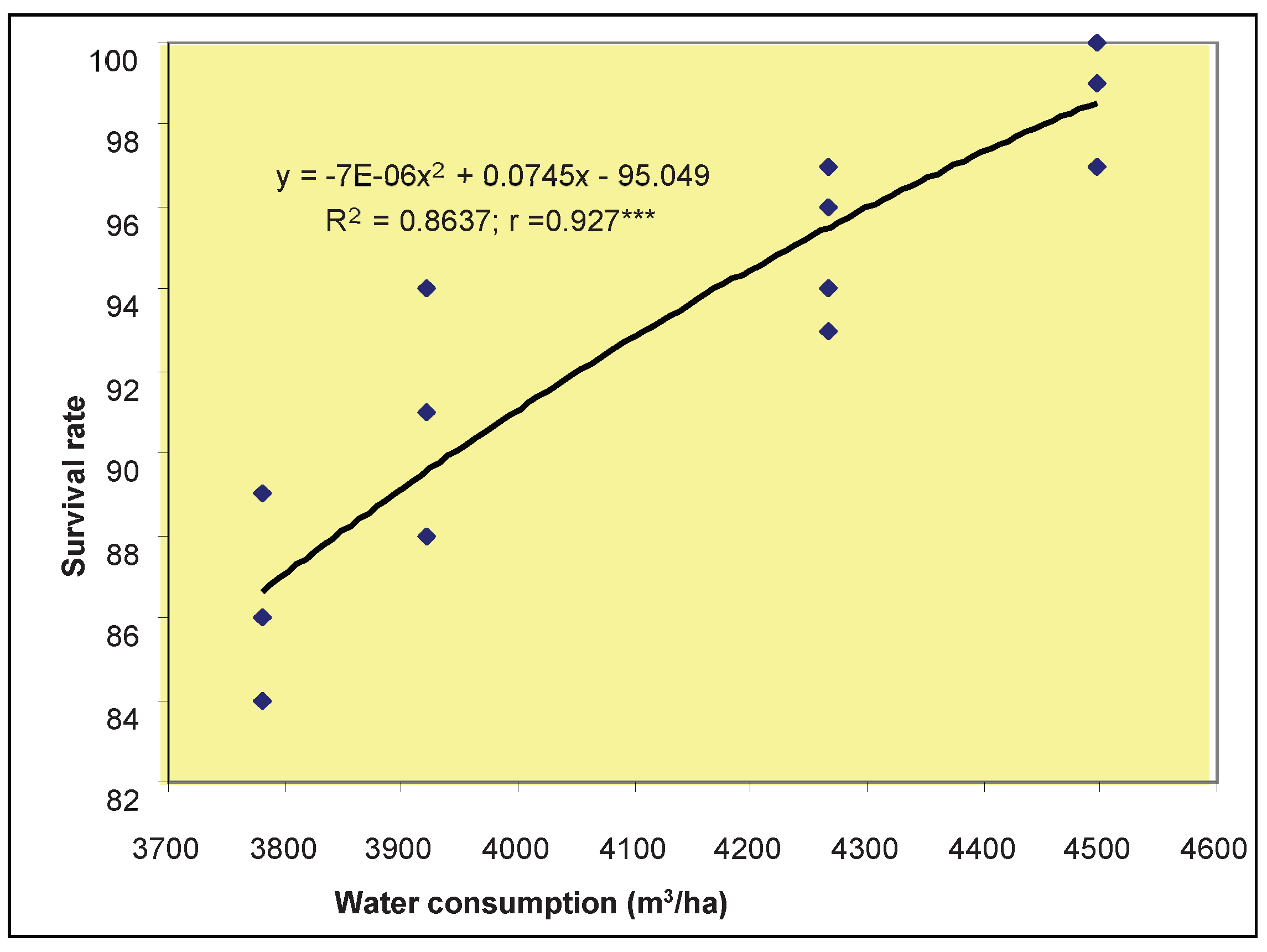
Figure 2.
Relationship between graft survival rate (%) and total water consumption in Cresthaven.
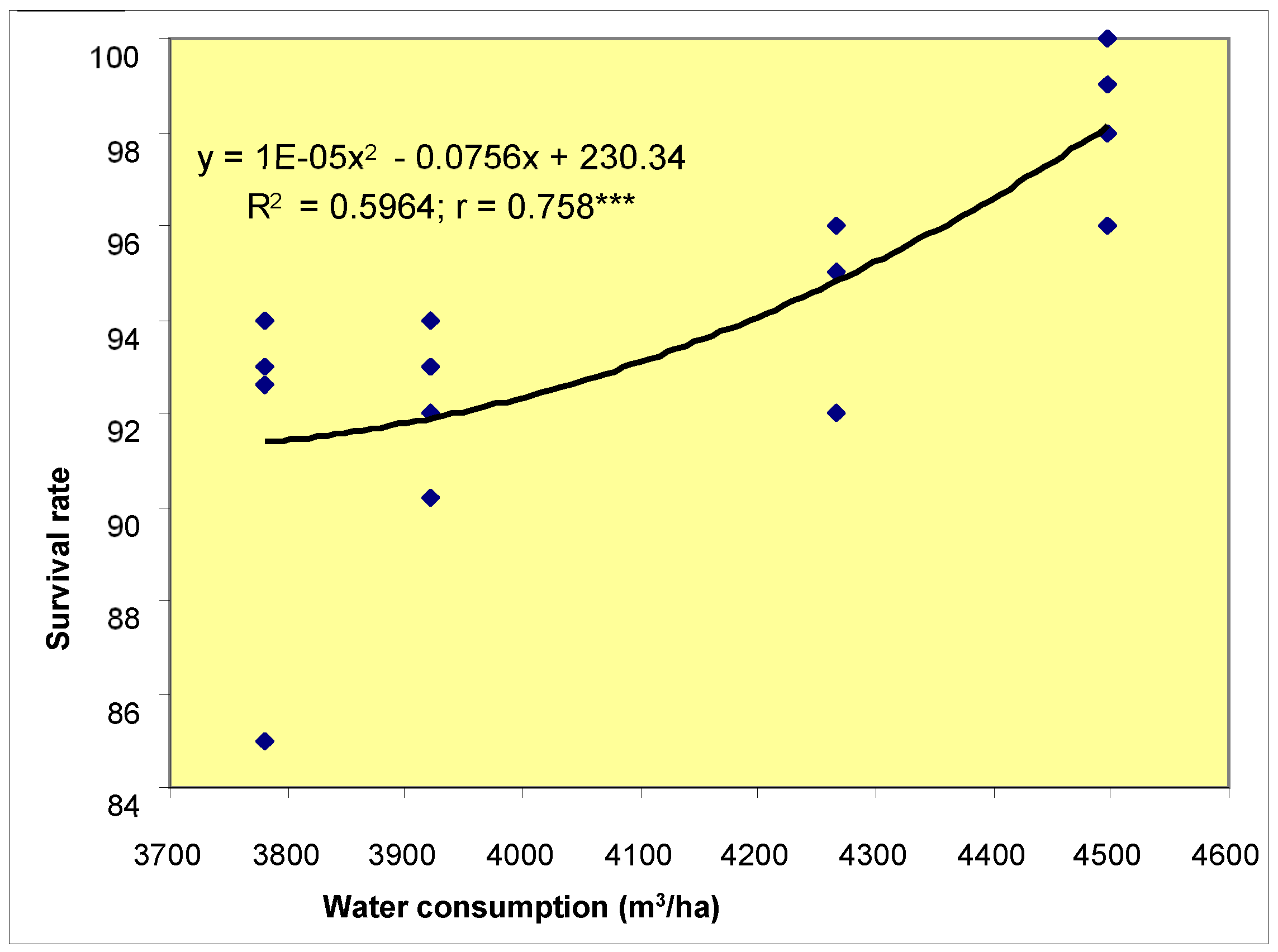
Figure 3.
A comparison of nursery survival rates (%) and total water usage (m³ ha⁻¹) under two fertilization regimes (N0P0K0 and N8P8K8) in ‘Redhaven’ and ‘Cresthaven’. Quadratic regression curves are displayed for each fertilization regime.
Figure 3.
A comparison of nursery survival rates (%) and total water usage (m³ ha⁻¹) under two fertilization regimes (N0P0K0 and N8P8K8) in ‘Redhaven’ and ‘Cresthaven’. Quadratic regression curves are displayed for each fertilization regime.
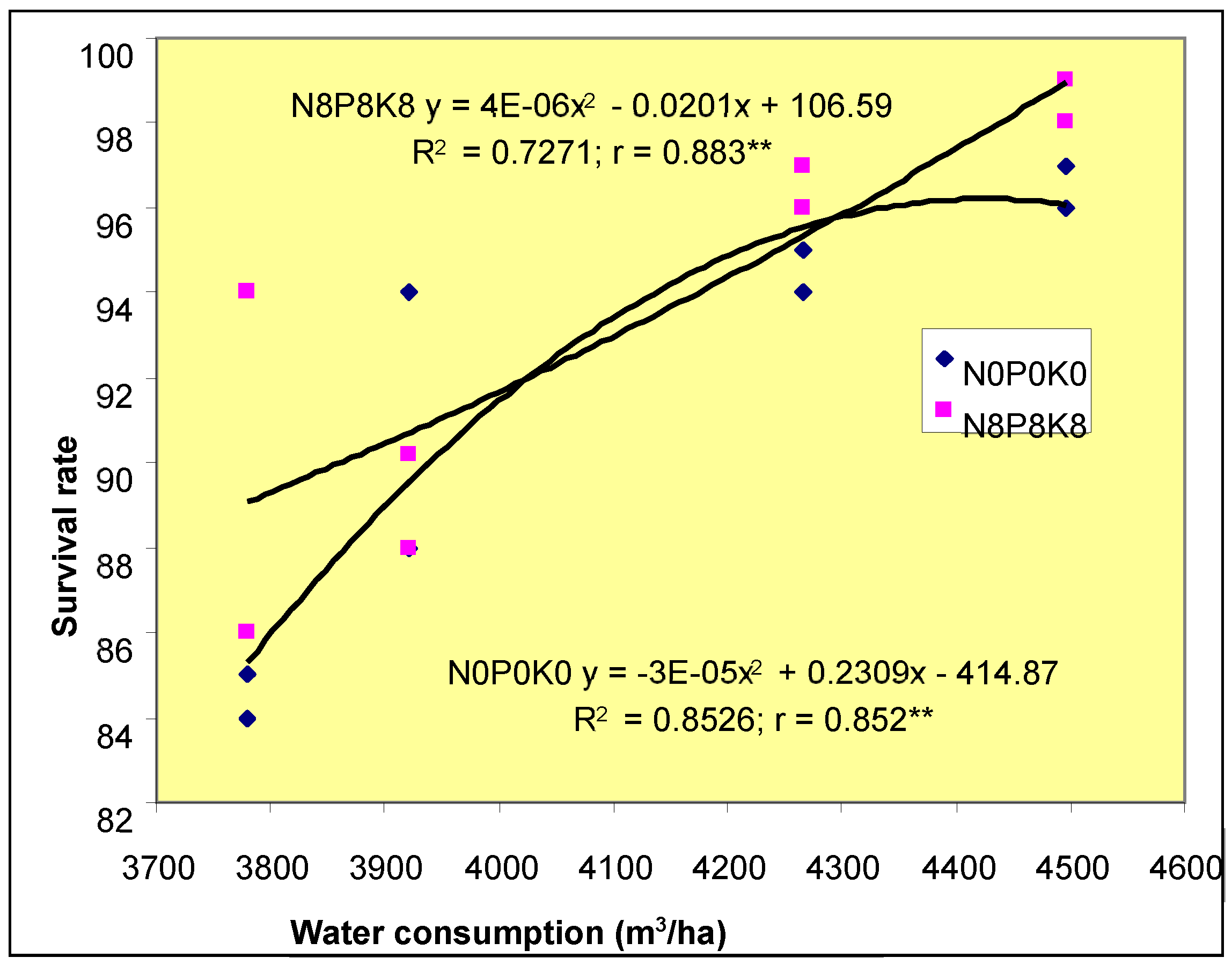

Table 1.
Graft take and water use parameters of peach cultivars under different irrigation norms.
| Irrigation norm (mm) | Cultivar | Total water consumption (m³ ha⁻¹) | Graft take (%) | Water use coefficient (m³ %⁻¹) |
|---|---|---|---|---|
| 0 | Redhaven | 3780 | 86.25 | 43.84 |
| Cresthaven | 3780 | 91.15 | 41.54 | |
| 10 | Redhaven | 3922 | 90.25 | 43.49 |
| Cresthaven | 3922 | 92.30 | 42.50 | |
| 20 | Redhaven | 4266 | 95.00 | 44.92 |
| Cresthaven | 4266 | 94.50 | 45.15 | |
| 30 | Redhaven | 4497 | 98.75 | 45.54 |
| Cresthaven | 4497 | 98.25 | 45.78 |
The values show the mean ± standard error. The LSD test revealed significant differences between treatments at p < 0.05, indicated by different letters.
Table 2.
Irrigation water productivity for graft establishment of peach cultivars.
| Irrigation norm (mm) | Cultivar | Increase due to irrigation (%) | Irrigation rate (m³ ha⁻¹) |
Irrigation water productivity (% m⁻³) |
|---|---|---|---|---|
| 10 | Redhaven | 4.00 | 300 | 0.0133 |
| 10 | Cresthaven | 1.15 | 300 | 0.0038 |
| 20 | Redhaven | 8.75 | 600 | 0.0146 |
| 20 | Cresthaven | 3.35 | 600 | 0.0056 |
| 30 | Redhaven | 12.50 | 900 | 0.0139 |
| 30 | Cresthaven | 7.10 | 900 | 0.0079 |
The values show the mean ± standard error. The LSD test revealed significant differences between treatments at p < 0.05, indicated by different letters.
Table 3.
Nursery survival rate and water use parameters of peach cultivars under different irrigation norms.
Table 3.
Nursery survival rate and water use parameters of peach cultivars under different irrigation norms.
| Irrigation norm (mm) | Cultivar | Total water consumption (m³ ha⁻¹) |
Grafted trees (ha⁻¹) | Water use coefficient (m³ tree⁻¹) |
|---|---|---|---|---|
| 0 | Redhaven | 3780 | 22,855 | 0.1654 |
| 0 | Cresthaven | 3780 | 17,046 | 0.2218 |
| 10 | Redhaven | 3922 | 38,357 | 0.1023 |
| 10 | Cresthaven | 3922 | 45,690 | 0.0858 |
| 20 | Redhaven | 4266 | 69,857 | 0.0611 |
| 20 | Cresthaven | 4266 | 52,603 | 0.0811 |
| 30 | Redhaven | 4497 | 48,118 | 0.0935 |
| 30 | Cresthaven | 4497 | 55,070 | 0.0817 |
The values show the mean ± standard error. The LSD test revealed significant differences between treatments at p < 0.05, indicated by different letters.
Table 4.
Irrigation water productivity for nursery survival rate of peach cultivars under different irrigation norms.
Table 4.
Irrigation water productivity for nursery survival rate of peach cultivars under different irrigation norms.
| Irrigation norm (mm) | Cultivar | Increase due to irrigation (trees ha⁻¹) | Irrigation rate (m³ ha⁻¹) | Irrigation water productivity (trees m⁻³) |
|---|---|---|---|---|
| 10 | Redhaven | 15,502 | 300 | 51.67 |
| Cresthaven | 28,644 | 300 | 95.48 | |
| 20 | Redhaven | 47,002 | 600 | 78.34 |
| Cresthaven | 35,557 | 600 | 59.26 | |
| 30 | Redhaven | 25,263 | 900 | 28.07 |
| Cresthaven | 38,024 | 900 | 42.25 |
The values show the mean ± standard error. The LSD test revealed significant differences between treatments at p < 0.05, indicated by different letters.
Disclaimer/Publisher’s Note: The statements, opinions and data contained in all publications are solely those of the individual author(s) and contributor(s) and not of MDPI and/or the editor(s). MDPI and/or the editor(s) disclaim responsibility for any injury to people or property resulting from any ideas, methods, instructions or products referred to in the content. |
© 2026 by the authors. Licensee MDPI, Basel, Switzerland. This article is an open access article distributed under the terms and conditions of the Creative Commons Attribution (CC BY) license (http://creativecommons.org/licenses/by/4.0/).
Copyright: This open access article is published under a Creative Commons CC BY 4.0 license, which permit the free download, distribution, and reuse, provided that the author and preprint are cited in any reuse.


