

Submitted:
01 March 2026
Posted:
06 March 2026
You are already at the latest version
Abstract
Wave–particle duality in interferometric systems is commonly formulated through complementarity relations linking fringe visibility and path distinguishability. In realistic experiments, interference suppression arises not only from unitary which-path marking but also from environment-induced decoherence. We derive an angle-dependent pure-dephasing model from a microscopic system–bath Hamiltonian, obtaining a Lindblad master equation with geometric coupling dependence. Moving beyond the Markovian limit, we utilize a second- order time-convolutionless (TCL2) expansion with a structured spectral density to show that geometric scaling persists in non-Markovian regimes, potentially leading to geometry-dependent coherence revivals. Furthermore, we explicitly derive the entropy production rate, demonstrating that the transition toward classicality is quantitatively governed by directional entropy flow. The framework remains fully within standard quantum mechanics, introducing no modifications to the Schr¨odinger equation. Experimental falsifiability criteria, including early-time scaling and coherence revivals, are presented.
Keywords:
wave–particle duality
; decoherence
; open quantum systems
; Lindblad equation
; thermodynamic dephasing
; quantum eraser
; delayed choice
; entropy production
; pure dephasing
; Born-Markov approximation
; secular approximation
; fluctuation-dissipation theorem
; non-Markovian dynamics
; structured spectral density
; coherence revivals
; quantum-to-classical transition
; completely positive trace-preserving
; second law of thermodynamics
1. Introduction
In purely unitary models the inequality is saturated. Real interferometers are open systems interacting with detectors and environments [2,3]. We investigate the geometric origin of anisotropic decoherence, first under standard Markovian assumptions, and subsequently by extending the formalism to non-Markovian structured environments to explicitly quantify geometric entropy production.
2. Unitary Complementarity Review
3. Microscopic Derivation of Directional Dephasing
3.1. System–Bath Hamiltonian
We model the pointer as a qubit with the interaction Hamiltonian defined in Eq. (4):
with the geometric coupling formulated in Eq. (5):
Physically, this geometric dependence arises when the pointer qubit interacts with a vector boson bath, such as the vacuum electromagnetic field or phonon modes within a detector crystal. The interaction strength is governed strictly by the projection of the local bath field modes onto the fixed axis of the polarization analyzer, naturally yielding the amplitude.
3.2. Markovian Lindblad Master Equation
Under Born–Markov and secular approximations [2], the system evolves according to Eq. (6):
where the dephasing rate is established in Eq. (7):
To establish the thermodynamic origin of this dephasing, we relate the characteristic decay rate to the bath spectral density . Using the fluctuation-dissipation theorem, the pure dephasing rate in the low-frequency limit is presented in Eq. (8):
In the high-temperature Ohmic limit, this simplifies to , connecting the microscopic dephasing to macroscopic temperature.
Off-diagonal decay is dictated by Eq. (9):
We define a dimensionless interaction parameter in Eq. (10):
Substituting this yields the thermodynamic dephasing visibility in Eq. (11):
4. Non-Markovian Extension with Structured Spectral Density
The Markovian result of Eqs. (6)–(11) assumes weak coupling and a short bath correlation time. To assess robustness beyond this limit, we consider a structured bosonic environment characterized by the spectral density in Eq. (13):
where is a dimensionless coupling and a cutoff frequency.
The interaction Hamiltonian retains the geometric form previously introduced, restated for clarity in Eq. (14):
Under a second-order time-convolutionless (TCL2) expansion [2], the reduced dynamics obey Eq. (15):
where the time-dependent dephasing rate is defined by Eq. (16):
with the bath correlation function given in Eq. (17):
4.1. Early-Time and Long-Time Behavior
4.2. Possible Coherence Revivals
For structured or sub-Ohmic baths, may transiently become negative, producing coherence revivals. In such cases, visibility is governed by Eq. (21):
allowing experimentally distinguishable deviations from simple exponential decay. Observation of revival amplitude scaling as would constitute strong evidence for geometry-controlled non-Markovian dephasing.
5. Entropy Production and Geometric Scaling
For pure dephasing dynamics, the density matrix retains fixed populations while coherences decay, represented in Eq. (22):
The von Neumann entropy is defined in Eq. (23):
For small coherence , expansion yields Eq. (24):
Using , the entropy production rate becomes Eq. (25):
Thus, entropy production is geometrically modulated. The transition toward classicality is quantitatively governed by directional entropy flow. Importantly, this does not imply resolution of the measurement problem; it specifies the geometric structure of decoherence-induced entropy generation within standard quantum mechanics.
6. Numerical Simulations
We simulate the visibility degradation modeled in Eq. (11). A conceptual schematic of the interferometer interacting with a thermal bath is shown in Figure 1.
7. Experimental Falsifiability
The model presents several quantitative scaling criteria that allow for rigorous experimental falsification. In the Markovian long-time limit, the angular scaling obeys a strict linear derivative, shown in Eq. (27):
Temperature scaling, derived from the fluctuation-dissipation relation, is presented in Eq. (28):
Interaction-time scaling in the long-time limit directly follows as Eq. (29):
Additionally, the non-Markovian extension provides testable early-time dynamics. Deviation from the expected quadratic decay () at , or observation of coherence revivals that fail to scale with , would falsify the geometric projection hypothesis.
8. Discussion
The apparent transition from wave-like to particle-like behavior in open interferometric systems is intrinsically linked to the geometry of entropy production. Extending the model to structured spectral densities confirms that while non-Markovian memory effects alter temporal decay profiles, the underlying directional nature of the dephasing persists. This establishes a robust foundation for understanding coherence suppression completely within standard physical frameworks, explicitly driven by thermodynamic irreversibility.
9. Conclusion
Directional thermodynamic dephasing modifies complementarity without altering quantum mechanics. Whether in memoryless Markovian limits or structured non-Markovian environments, the quantum–classical boundary is determined by irreversible entropy production dictated by geometric interaction constraints.
Acknowledgments
The author acknowledges valuable discussions in quantum thermodynamics and decoherence theory.
Statement Regarding Artificial Intelligence
An artificial intelligence language model was used to assist with structural organization, LaTeX formatting, and clarity of exposition. All physical derivations and conceptual content are the author’s original work.
References
- Englert, B.-G. Phys. Rev. Lett. 1996, 77, 2154. [CrossRef] [PubMed]
- Breuer, H.-P.; Petruccione, F. The Theory of Open Quantum Systems; Oxford, 2002. [Google Scholar]
- M. Schlosshauer, Decoherence and the Quantum-to-Classical Transition (Springer, 2007).
- Scully, M. O.; Drühl, K. Phys. Rev. A 1982, 25, 2208. [CrossRef]
- Walborn, S. P. Phys. Rev. A 2002, 65, 033818. [CrossRef]
Figure 1.
Mach–Zehnder interferometer schematic demonstrating geometric interaction with a thermal bath.
Figure 1.
Mach–Zehnder interferometer schematic demonstrating geometric interaction with a thermal bath.
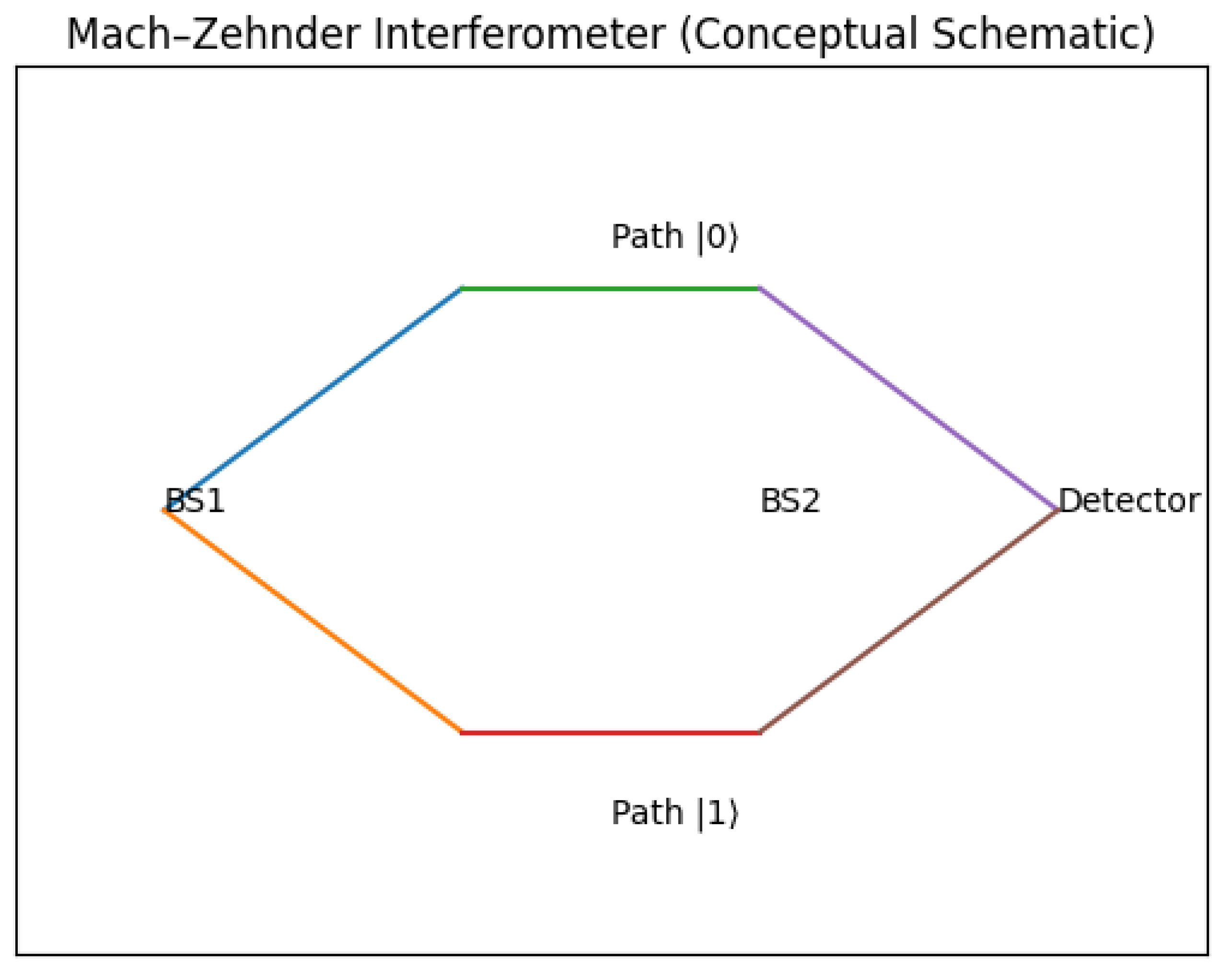
Figure 2.
Visibility evaluated for coupling strength .
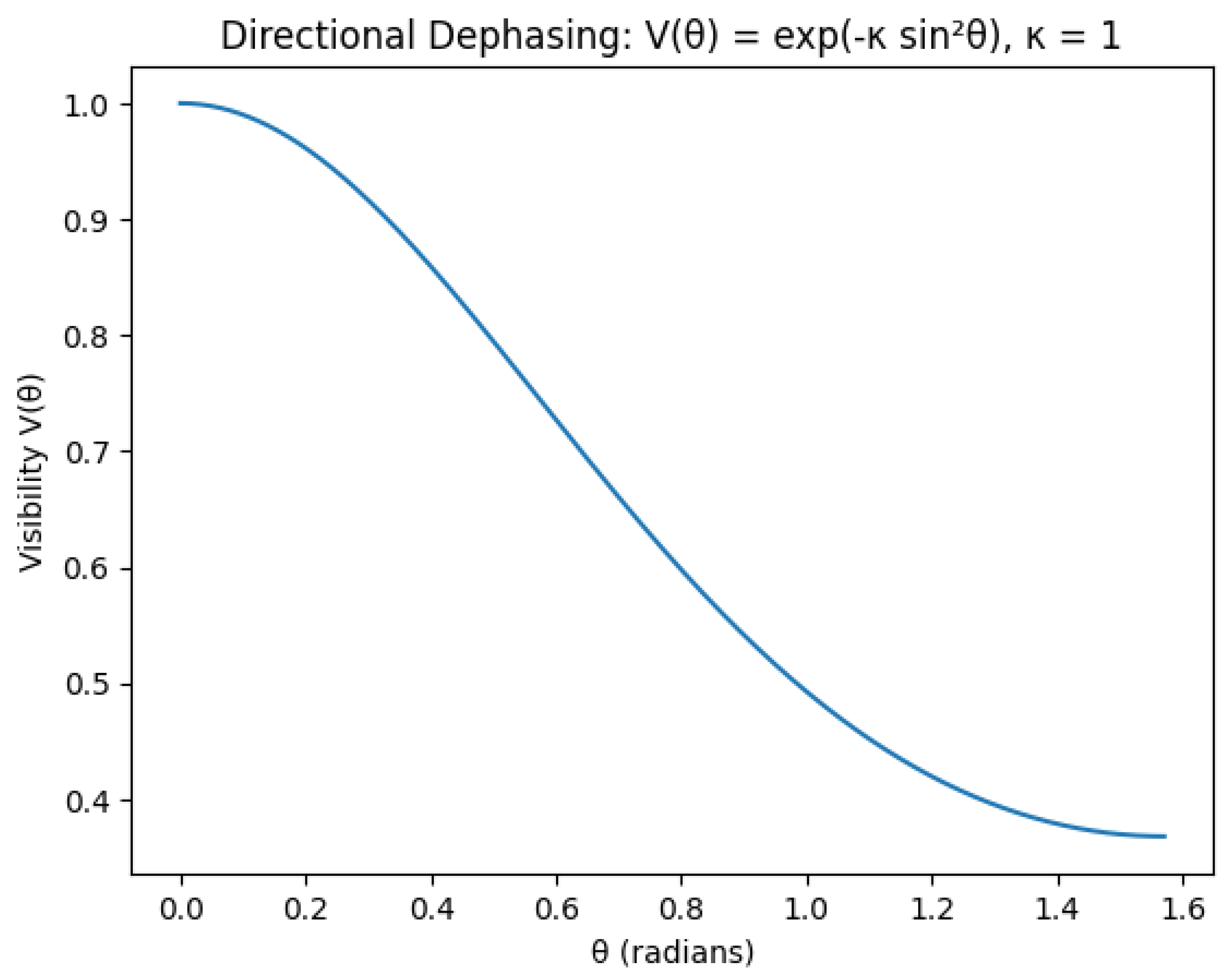
Figure 3.
Visibility evaluated for coupling strength .
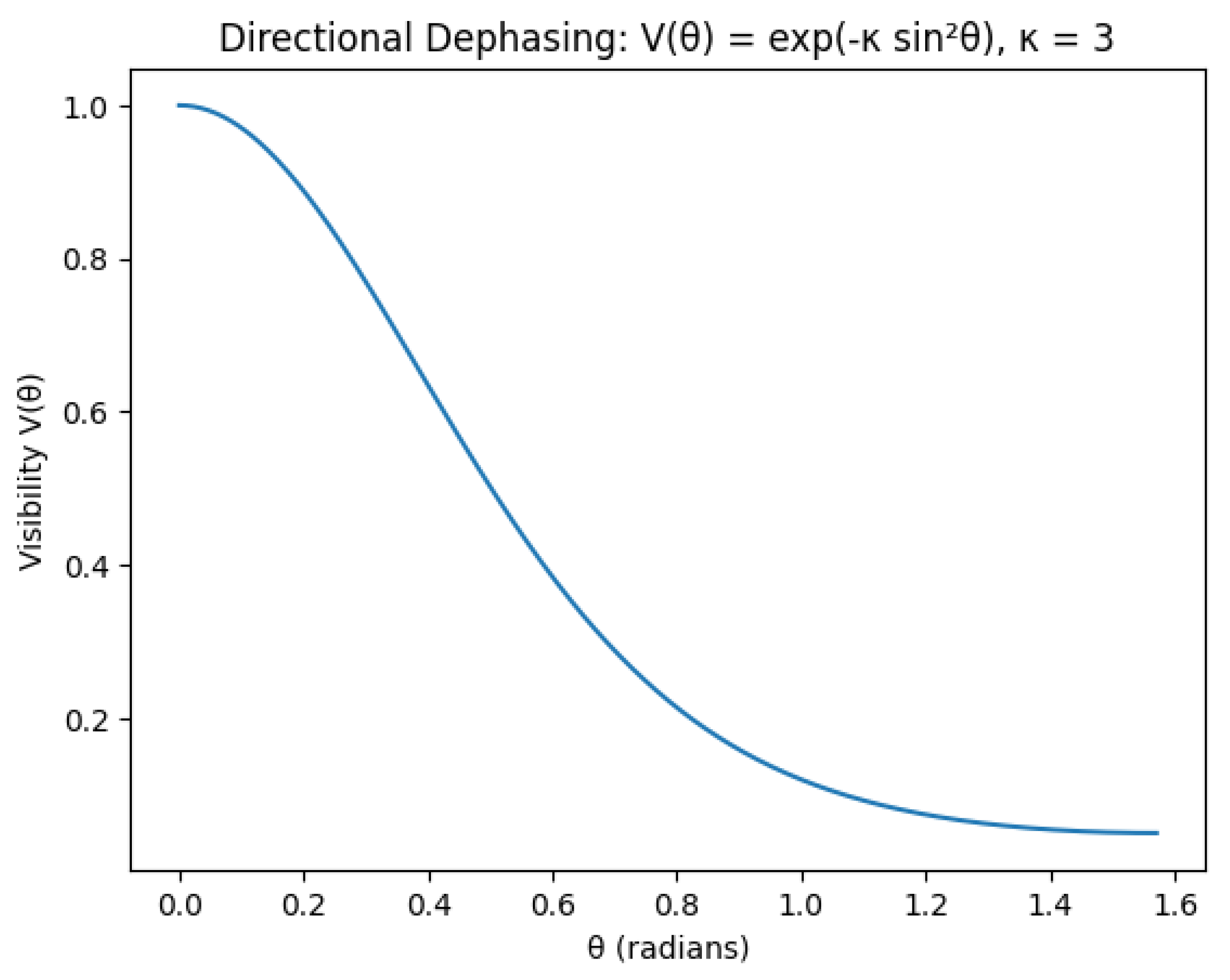
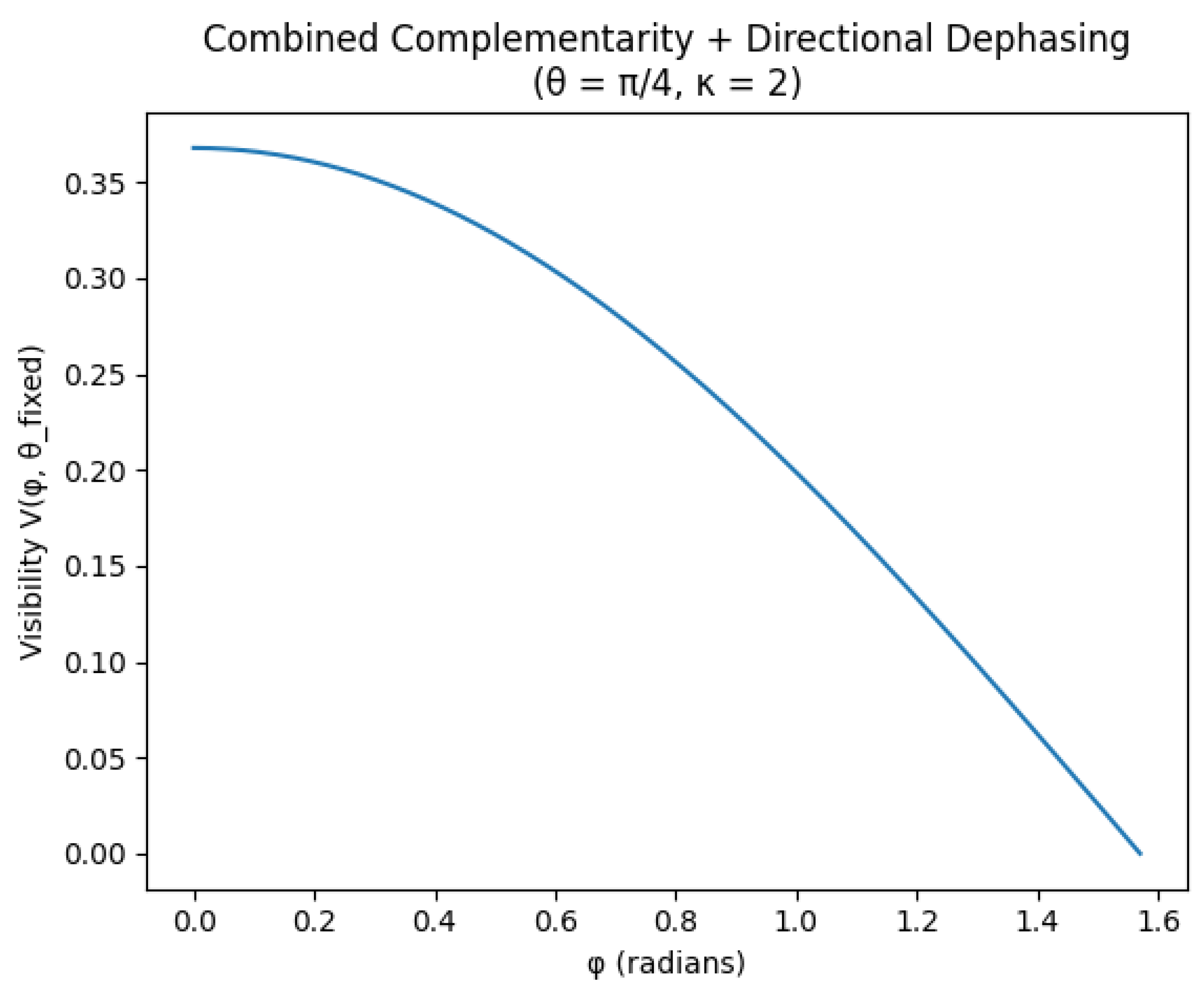
Figure 4.
Combined visibility from Eq. (12) modeled for fixed and .
Figure 4.
Combined visibility from Eq. (12) modeled for fixed and .
Disclaimer/Publisher’s Note: The statements, opinions and data contained in all publications are solely those of the individual author(s) and contributor(s) and not of MDPI and/or the editor(s). MDPI and/or the editor(s) disclaim responsibility for any injury to people or property resulting from any ideas, methods, instructions or products referred to in the content. |
© 2026 by the authors. Licensee MDPI, Basel, Switzerland. This article is an open access article distributed under the terms and conditions of the Creative Commons Attribution (CC BY) license (http://creativecommons.org/licenses/by/4.0/).
Copyright: This open access article is published under a Creative Commons CC BY 4.0 license, which permit the free download, distribution, and reuse, provided that the author and preprint are cited in any reuse.


