

Submitted:
05 March 2026
Posted:
05 March 2026
You are already at the latest version
Abstract
Technological innovation is changing virtually every aspect of business practices and operational procedures. Regardless if we talk about simple automation of paper inputs, or complex multi-step processing of large data sets, we can see that there is one common thing – the pace of innovation increases and so do the efforts and resources needed to stay in line with the latest developments. Introduction of large language models and various types of intelligent processing, commonly referred to as artificial intelligence presents an even bigger change request to cope with. In this paper we analyze the impact of intelligent data modelling on corporate finance practices and suggest an approach to assess its full impact. We develop an estimation technique, based on real option analysis (ROA) in an attempt to quantify various implementation details and build a more robust way for analyzing various effects from using AI-driven solutions in support for corporate finance decisions and analyses.
Keywords:
AI-drive decision making
; intelligent data processing methods
; adaptive machine learning
; flexible methods for analyzing financial data
1. Introduction
While digitalization can take many paths and forms, one can summarize and narrow it to the various technologies that replace manual labor and automate various tasks, speeding them up and reducing the time required to process inputs and transform them into reasonable decisions. Even though such view is appealing in many ways – by being simple to understand and explain, there are many side and long-term effects that may go unaccounted for. Therefore, it is necessary to use a more solid approach when analyzing the impact of innovative data processing and decision supporting tools. In their bibliometric study (Rihab, Ayoub, Meryem, & Mohamed, 2025) highlight that research is often focused around specific technologies and their influence on financial practices. White specific tools and analytical algorithms are very important for the success of such innovations, we can argue that their true impact has to be considered with regard to the broader changes they will eventually trigger in the organizations. In addition to the most popular ways of approaching intelligent methods applications in corporate finance, we suggest another criterion – based on how they enhance or limit the flexibility of companies to adjust to ever changing market conditions and new restrictions (that could be in the form of new regulations or even novel competitive advantage – as is the care of AI usage).
Table 1 summarizes why flexibility-centric approach is different and how it compares to other ways of addressing financial data processing.
In order to bring together advantages of various approaches discussed in Table 1, without sacrificing the specific implementation context, we suggest a different approach toward uses of intelligent data processing. If one considers every new technology and its respective tools as a new opportunity of the companies and individuals that are in the analyzed businesses, then adoption and long-term impact can be modelled as if a specific option on use of the methods and tools is present.
Unlike their financial market counterparts, these options cannot be separated from the normal business processes of the respective economic agents. This effectively turns the application of various intelligent data processing methods and tools into exercising a real option. Real options analysis (ROA) has already been used to support strategic decisions in (Kabaivanov, Markovska, & Milev, 2013) and evaluate the benefits of flexibility in (de Mello-Sampayo, 2023). Advantages of the ROA can also fit well in assessment of intelligent data processing for corporate finance, due to the fact that real options favor flexibility which is a central part of the suggested assessment approach.
Figure 1 highlight typical application of areas of AI and intelligent data processing in general, used to support existing corporate finance tasks. It is worth noting that as we move to the higher application levels, the invisible side impact of intelligent solutions increase – as they influence a larger number of corporate finance tasks and their use affects the organization for longer periods. For example, a strategic decision suggested and resulting from AI support system reasoning will have much bigger effect on the whole organization, compared to a mere next period forecast. While both can be good or bad, the impact of the first one will be left for much longer.
With regard to technical complexity, it is not necessary that higher level solutions are more complex or technically demanding. Even though they intend to solve tasks that are more impactful, this does not imply they need to be more sophisticated. Layering on the figure is mainly focused on the scale of application consequences and time effects, and not on technical side.
With regard to this argument, we can assume that more elaborate applications will also bring with them higher uncertainty for the future. While this is true for any strategic decision, our claim is linked to the use of AI and intelligent data analysis, since their application can most likely trigger a different outcome, compared to traditionally used methods.
2. Methods and Analytical Tools
Estimating the impact of a new technology or data processing solution is a complex task that relies on various assumptions. This is even more relevant, when the technology itself is yet to be proven and under very active development – as is the case of large language models and intelligent data processing. To address this problem, we suggest a three-step approach, presented on Figure 2.
The first step in the process is to classify the type of intelligent data processing solution. The purpose is twofold – first to identify what are the appropriate estimation techniques and the second one is to make sure if there is an indirect impact from introducing the respective solution on other business processes. For example, a simple solution that automates financial documents scanning and verification is expected to have an important but highly localized impact on the way a typical company would continue to operate. On the other hand, a decision support system that deploys a large language model with business-specific reasoning will influence not only its direct users, but virtually everyone the company.
It would be naïve to consider that the impact of both presented cases can be assessed with the same analytical methods, sharing the same assumptions and limitations. Therefore, the initial classification step aims at putting a specific solution under predefined category and then select appropriate valuation method. Table 2 provides a summary of the suggested assessment techniques based on inherent features of the analyzed solution.
Effects on flexibility of the analyzed organization are crucial, as they highlight the benefits of using ROA over other assessment techniques like simple ROI, efficiency and speed KPI to name a few. Option-based assessment has two additional advantages, which are important for application of intelligent solutions:
- -
- real option valuations allow to have more than source of uncertainty. When corporate finance analysis relies on intelligent processing methods this is especially valuable since one needs to account for market uncertainty in addition to technological complexity and potential risks related to the use of new solutions.
- -
- option analysis fits very well into step-by-step introduction of new methods and support tools. Even though reports (KPMG, 2024) indicate that adoption rate for AI tools for example is high, it is worth pointing out that covered use cases are different and of various maturity.
As applications of intelligent data handling progress in terms of process coverage and complexity, real options are better capable of encapsulating different stages and decisions that follow them, based on success of failure of the experiments.
Quantification of the impact is the third step and includes evaluation of already identified opportunities. While in many situations it is sufficient to have just one real option, there are cases where a portfolio of options can be built – depending on the complexity of the implementation scenario. Table 3 summarizes the inputs required to complete the evaluation.
Actual valuation of the real options can be done with one of the commonly used methods, like:
- -
- with various solutions for the Black-Scholes equation, as in (1)
As the typical model application is for European calls that are not paying-dividends, one can use well-known extensions and approximations for American options (better suited to map decisions that could be taken at any point in time) (Barone-Adesi, 2005), (Alghalith, 2018) and for situations with intermediate benefits or cash flows (resembling the dividend payment model extensions as in (Lioui, 2006)).
- -
- variations of binomial option pricing models, as in (2)
As (1) and (2) suggest the use of either closed-formula solution or the binomial tree variant, would allow us to model the uncertainty and consider that introducing an intelligent data processing is not a one-way street with possibilities to adapt to intermediate results. Thus, if solution proves to be more promising than the initial expectations, its application can be extended or scaled up (thus exercising an expansion option). On the contrary – if the output is not satisfactory, then it could be either completely abandoned (e.g. exercising termination option), replaced by a different method (e.g. a switching mode/type option), temporary put on hold, or scaled down.
- -
- use of higher order trees to model complex scenarios, which typically have to deal with more than one major source of uncertainty (Kabaivanov, Markovska, & Milev, 2013).
Typically, these sources of uncertainty may be the technological risks, associated with new intelligent solutions, as well as the economic impact from their use – which we can expect could be improved competitiveness.
- -
- use of Monte Carlo simulations for evaluation of complex options.
Binomial trees offer a powerful and relatively easy to use way to evaluate real options. Yet there are situations where we need to account for more than two important factors, in order to present complex scenarios. In this case Monte Carlo can support our evaluation in two distinct ways:
- o
- estimation of variance, needed for closed form solutions, like Black-Scholes for example;
This use case assumes that we can create a supplementary model for the changes of the underlying asset value (in this case this would be a company value change as a result of strategic-level applications or savings/costs for a process in case of more localized applications). This estimate can then be fed into one of the assessment methods mentioned before – in order to arrive at a valuation of the respective real option.
- o
- estimation of option value directly, with the use of certain company development projections;
This use case is built upon the assumption once can model with sufficient precision the way that underlying asset value changes. Then with such knowledge in hand, it is possible to generate a large number of scenarios and estimate what will be the impact of the respective intelligent data processing solution. With large number of simulated scenarios, it then becomes possible to assess the most probable outcome, as well as in what range it will most likely be.
3. Applications and Results
We discuss two typical ROA valuation applications, as we consider these to represent important cases in practice.
3.1. Numerical Example 1
For a simple demonstration of real option, let us assume a company wants to experiment by introducing a new intelligent agent to scan through financial documents, scan them through and give simply summary feedback. To avoid large investment costs, a subscription model is chosen with a total yearly cost of 2748 EUR. The agent implementation is expected to introduce savings in terms of freeing up at least 10% of the time of a typical junior department employee which at the time of planning amounts of 2400 EUR per year. Should the experiment results prove to be not satisfactory, the company expects it can switch the application to simple invoice scanning that is expected to give a solid saving of half of the initial amount (e.g. 1200 EUR).
It is expected that the agent introduction will also have a positive impact on other processes in the financial department – leading to faster decision making and better understanding of the ongoing processes, which may actually boost the benefits further and the estimate is that the actual savings may be different with their volatility estimated at 35% per year. Taking out a sample risk free rate of 2.222%, using as reference recent 12-month EURIBOR rates, this can lead to a simple valuation of the available option.
Table 4 contains a summary of the numeric example inputs. Being able to cancel the test and switch to an alternative with fixed result (even if the outcome there is not fixed, we can still evaluate the option but constant value makes it easier) is in effect exercising a put option. Since this decision can be taken at any time, we evaluate an American put with Crank-Nicolson method at 4.408327 EUR and with Barone-Adesi-Whaley method at 4.540619 EUR.
If we allow for the volatility to change, then Monte Carlo simulation can be done with volatility fluctuating over the estimated value of 35%. In this case (assuming the volatility itself follows lognormal distribution, as it cannot be negative) the output of sample simulation is presented at Figure 3. Mean estimate from the 10 000 samples is 6.405283 EUR with Crank-Nicolson method (left) and 6.405209 EUR with Barone-Adesi-Whaley method (right).
Depending on the specific business case, numerical example can be further extended to account for any intermediate positive (or negative) effects of integrating the new intelligent solution. This may be done by introducing a dividend yield in the valuation, that represents these effects.
3.2. Estimation of Indirect Impact with the Use of Real Options
Real options have much in common with their financial counterparts. However, there are some subtle variations that should be taken into consideration, even if they are not explicitly visible from the closed-form valuation methods (as these are frequently adapted from financial option valuations). We focus on two important differences that affect impact assessment of new technologies and in particular the intelligent data processing:
- -
- with the option valuation methods, we have talked about, the option value is considered to be for calls and for put variants, which implies the option intrinsic value should be 0 or positive;
With real options used for new technology assessment, there is a significant investment (which we also denoted as sunk cost). Its expected payoff does not simply constitute the immediate cash flows that follow the project start, but also includes improvements in competitiveness of the business. Therefore, it is possible that we observe situations where the costs of obtaining and maintaining a new technology are higher (and potentially not only as initial investment but also as subsequent maintenance spending) than the immediate benefits but the solution is still introduced and tested.
As a result, we can see options being held and the reasons behind it is that decision makers are either trying to minimize a loss, or they want to maintain a specific technology in light of its future benefits. It should also be noted that in some cases a fear of falling behind the competition (which uses similar technology) can be a strong driving factor for using it – even if the calculations are not fully supporting the economic benefits of such decision.
With traditional valuation methods such arguments are not easy to quantify and justify, but we think that ROA can help in improving the situation. In situations where we are facing a seemingly “non-rational” behavior – like maintaining and not abandoning solutions that are at first glance not profitable, we can use the calculated negative value as a (rough but still more objective) estimate of these concerns. It was also be used to measure the indirect impact – provided that financial analysts are rational, maintaining such a solution would mean that the negative value is at least offset by these positive side effects.
- -
- in line with traditional option use, an opportunity that is not paying off is not considered to be of use, when its maturity is reached.
The same thoughts apply for situation where options are kept open and specific implementations are not abandoned, even though they seem to indicate a negative value. In this situation the negative value calculated can also be used as an estimate (lower end) of the external benefits and positive side effects that management observes.
In situations where its possible to estimate the additional (indirect) impact more clearly, it can be incorporated in the existing analysis through the dividend yield factor. Going back to the numerical example, if we assume that introducing the intelligent technology will help with other activities, these benefits can be represented with a positive dividend yield. Figure 4 demonstrates the same simulation scenario as before, but this time with 2% dividend yield.
In this case the mean option value from the simulation 7.168668 EUR (Crank-Nicolson, left) and 7.168093 EUR (Barone-Adesi-Whaley, right). Clearly the positive side effects will increase the option value, thus also bringing additional arguments for introduction of the new intelligent processing methods. As expected, the value of the option increases and that would also explain the hope and stimuli that new technologies hold. The larger the positive side effects are, the higher the option value – thus containing more incentives to increase investment in it. This fits well into what we observe, where companies are betting on use of artificial intelligence tools and intelligent data processing in order not only to cut immediate costs, but also introduce positive side effects through the organization.
4. Discussion
Intelligent data processing methods and large language models aim to be not just a new technology but to present a radical change in the way we interact with algorithms and analyze available data. Their applications have important consequences not only for the immediately affected processes but also for the respective organization as a whole. We have suggested an approach to evaluate both the immediate and indirect impact of intelligent data processing that is based on real option analysis. While there are other means to estimate the importance of new technologies for organizational development, we argue that the ROA analysis can provide an easy to understand and compare assessment. By yielding a result that is directly comparable with other monetary indicators, company management can plan better for future development and proactively consider changes in the organizational competitiveness and market position.
The research in this direction can be extended further, by accounting for and quantifying the following effects:
- -
- while there are many appealing characteristics of automated and intelligent data processing, there are also drawbacks related to the transparency in argumentation and reasoning.
This is particularly important for decision support systems and complex analytical flows, where small errors or inconsistencies can be crucial for future success. To properly include this effect in our analysis it would be possible to consider the “loss of skills” or “lack of transparency” penalty factor, that will also influence the option value.
- -
- with suggested ROA approach indirect impact assessment is estimated as a whole, which does not give full feedback where the changes are most relevant and empowering.
To assess in details the indirect impact, it would be necessary to consider the changes as a portfolio of options, which will increase the complexity of the solved problem, but also provide more specific information that is relevant to individual processes in the organization. Depending on the requirements and goals of the actual evaluation, either a single option or portfolio of options approach may be applied, though we have limited this paper to demonstrating only the first one.
5. Conclusions
Intelligent data processing and native language interaction with complex models is reasonably expected to revolutionize the way we do business and take decisions. Leaving aside the appeal of the technology itself, we still need a way to estimate the impact of its application to our existing processes and way of work. As a step that claims to be a revolutionary one, intelligent processing needs time to reveal its full potential and also triggers changes that are strongly affecting business organizations – far beyond the scope of immediate application.
Under these conditions, traditionally used KPIs and success indicators, like for example simple ROI, may not be able to completely capture the impact of the new technology. We suggest to improve existing assessment by introducing real option analysis in the process. ROA has a long and successful history of correctly evaluating complex investment scenarios that span over large time periods and involve important intermediate decisions.
We have demonstrated that these strengths can be deployed to estimate not only the immediate impact of modern artificial intelligence solutions, but also to capture the side effects. Building upon existing option valuation models, we have demonstrated how new technology impact can be assessed with either closed-form solutions, binomial (or multinomial) trees, Monte Carlo or combination of these. ROA approach gives us an opportunity to evaluate (or in worst case estimate a lower boundary) of the indirect impact of new technology under investigation. This is not strictly bound to intelligent data processing, as the same idea could be applied to any novel technological solution. But it is particularly useful when analyzing artificial intelligence and autonomous agents, as they are expected to trigger a more significant overall change – thus generating positive side effects of large magnitude. The second part of the numerical example that was made contained a demonstration of how side effects can be included in the analysis. If there has been no estimate of the indirect impact, ROA approach can be used to implicitly evaluate it – based on options kept open and exercised.
ROA approach is not limited to estimating the impact of AI and intelligent data processing solutions, as it can enhance our corporate finance toolset to study various other new technologies. But we believe that these recent developments are especially good example on the strengths of option-based approach, because intelligent tools are expected to trigger very large positive side effects. This makes valuation with traditional corporate finance methods hard and subject to very strict assumptions. Real options on the other hand can better fit in and provide more adequate and precise assessments.
Author Contributions
Conceptualization, Stanimir Kabaivanov and Veneta Markovska; methodology, Stanimir Kabaivanov; software, Stanimir Kabaivanov and Veneta Markovska; validation, Stanimir Kabaivanov and Veneta Markovska; Stanimir Kabaivanov and Veneta Markovska; writing—original draft preparation, Stanimir Kabaivanov; writing—review and editing, Veneta Markovska; visualization. All authors have read and agreed to the published version of the manuscript.
Funding
This research received no external funding.
Data Availability Statement
The original contributions presented in this study are included in the article. Further inquiries can be directed to the corresponding author(s).
Conflicts of Interest
The authors declare no conflicts of interest.
Abbreviations
The following abbreviations are used in this manuscript:
| AI | Artificial intelligence |
| ROA | Real options analysis |
References
- Adorm-Takyi, C.; Asare, A. F. Intelligent Robo-advisors and Personalized Financial Planning. In Foundations of Artificial Intelligence in Finance (p. 10); Chapman and Hall/CRC, 2026. [Google Scholar]
- Alghalith, M. Pricing the American options using the Black–Scholes pricing. Physica A 507 2018, 443–445. [Google Scholar] [CrossRef]
- Barone-Adesi, G. The saga of the American put. Journal of Banking & Finance 29 2005, 2909–2918. [Google Scholar]
- Barry, M.; Haitham, Y. A Study of Digital Transformation for Banking and Finance Industry. In Lecture Notes in Networks and Systems: Information System Design: Sustainable Computing; ISDIA 2025, 2026; pp. 1–19. [Google Scholar]
- Bhati, I.; Joshi, A.; Mishra, V.; Jain, R. Impact of Augmented and Virtual Reality on the Financial Landscape. In The Metaverse Era: Reinventing Customer Engagement and Digital Marketing; Bentham Science Publisher, 2025; pp. 143–161. [Google Scholar]
- Chaplygina, E. I.; Kruglova, L. V.; Glavina, S. G. The Role of Intelligent Data Processing in Optimizing Companies’ Financial Efficiency. RUDN Journal of Engineering Research 2025, 26(4), 481–490. [Google Scholar] [CrossRef]
- de Mello-Sampayo, F. Strategic flexibility in healthcare: an exploration of real options. ISCTE-Instituto Universitario de Lisboa 2023, 1–23. [Google Scholar] [CrossRef]
- Gary, G.; Tahir, M. N.; Guru, P.; Royston, M.; Sadia, M. Chatbots in customer service within banking and finance: Do chatbots herald the start of an AI revolution in the corporate world? Computers in Human Behavior 165 2025, 1–15. [Google Scholar] [CrossRef]
- Kabaivanov, S.; Markovska, V.; Milev, M. Using real options analysis to support strategic management decisions. In AIP Conf. Proc.; Sozopol; AIP, 2013; pp. 87–96. [Google Scholar]
- KPMG. KPMG Survey: AI Adoption Across US Finance Functions Reaches Highest Levels, with ROI Exceeding Expectations.; KPMG, 2024; Available online: https://kpmg.com/us/en/media/news/ai-adoption-across-us-finance-functions-reaches-highest-levels.html.
- Lioui, A. Black-Scholes-Merton revisited under stochastic dividend yields. Journal of Futures Markets: Futures, Options, and Other Derivative Products 2006, 26(7), 703–732. [Google Scholar] [CrossRef]
- Ouyang, J. AI Based Financial Text Classification Optimizing Annual Report Risk Identification with BERT Model. Proceedings of 2025 International Symposium on Machine Learning and Social Computing, MLSC 2025; 2025; pp. 277–280. [Google Scholar] [CrossRef]
- Qiang, W.; Siqi, Z.; Rongrong, L. Artificial intelligence in the renewable energy transition: The critical role of financial development. Renewable and Sustainable Energy Reviews 2026, 226(A). [Google Scholar] [CrossRef]
- Qidi, Y.; Chen, X.; Yanjing, H.; Sunghee, A.; Hyung, J. N. Intelligent Information Processing for Corporate Performance Prediction: A Hybrid Natural Language Processing (NLP) and Deep Learning Approach. Electronics 2026, 15(2), 443. [Google Scholar] [CrossRef]
- Rihab, N.; Ayoub, B.; Meryem, F. A.; Mohamed, T. Advanced AI and big data techniques in E-finance: a comprehensive survey. Discov Artif Intell 2025, 5(102), 1–42. [Google Scholar] [CrossRef]
- Yao-Yang, L.; Zhen, Z.; Feng, Z.; Jin-Cheng, F.; Yi-Yang, F.; Ji-Dong, Z.; Xiao-Yong, D. A comprehensive taxonomy of prompt engineering techniques for large language models. Frontiers of Computer Science 20 2025, 1–25. [Google Scholar] [CrossRef]
Figure 1.
Typical application areas of intelligent data processing in corporate finance.
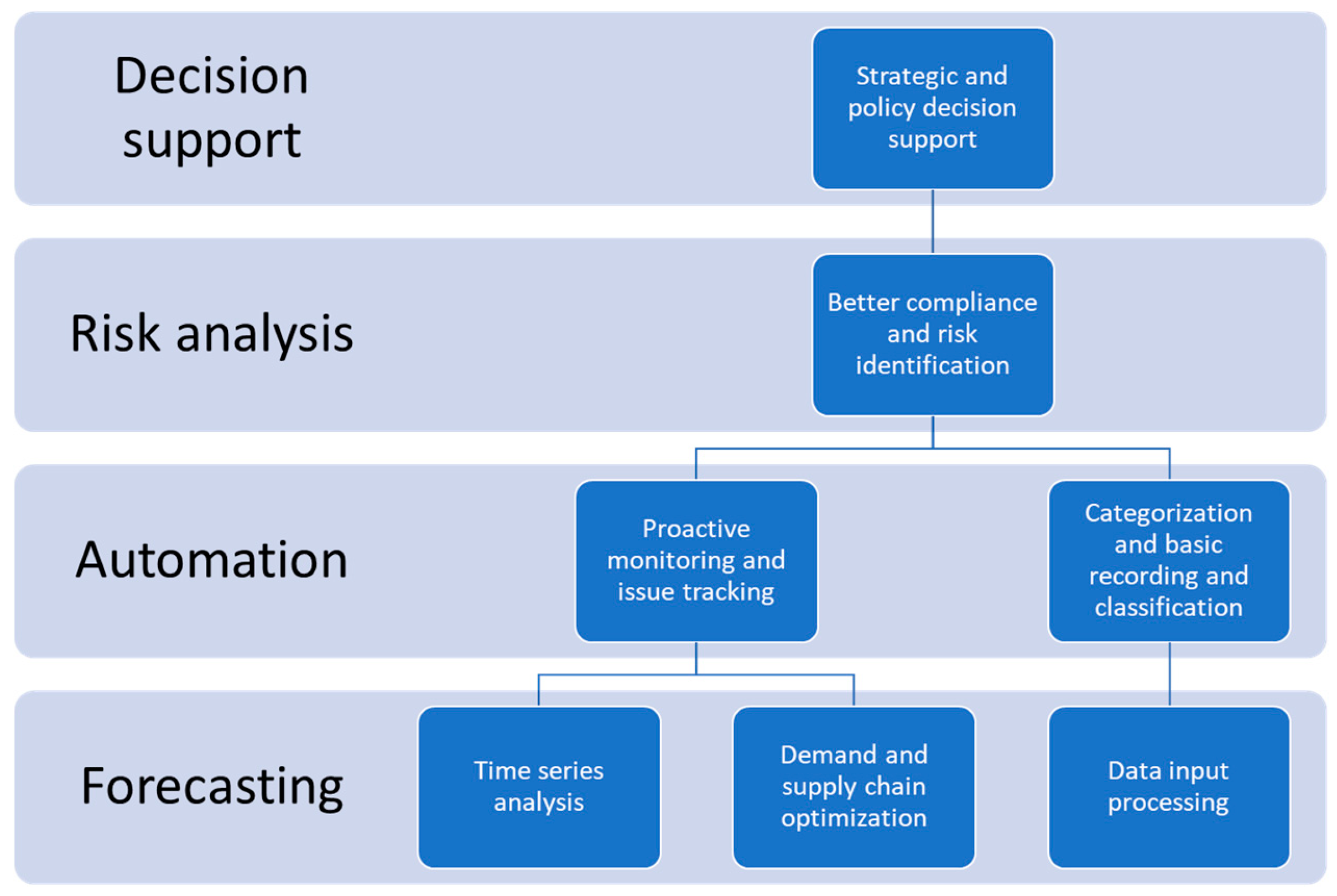
Figure 2.
Three-step impact estimation approach of introducing intelligent data processing solutions.
Figure 2.
Three-step impact estimation approach of introducing intelligent data processing solutions.
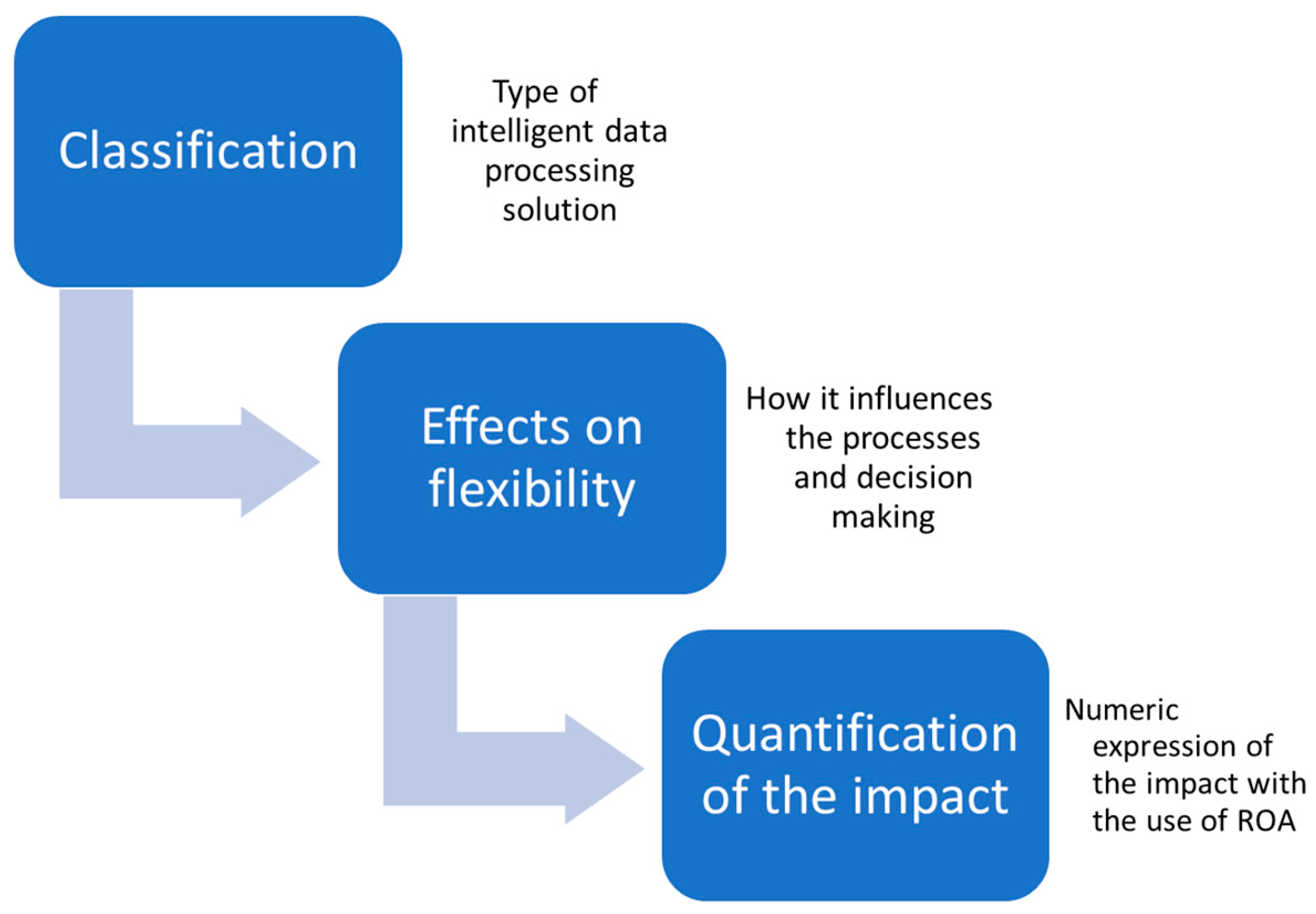
Figure 3.
Monte Carlo simulation with similar conditions as in the numerical example but changing volatility.
Figure 3.
Monte Carlo simulation with similar conditions as in the numerical example but changing volatility.
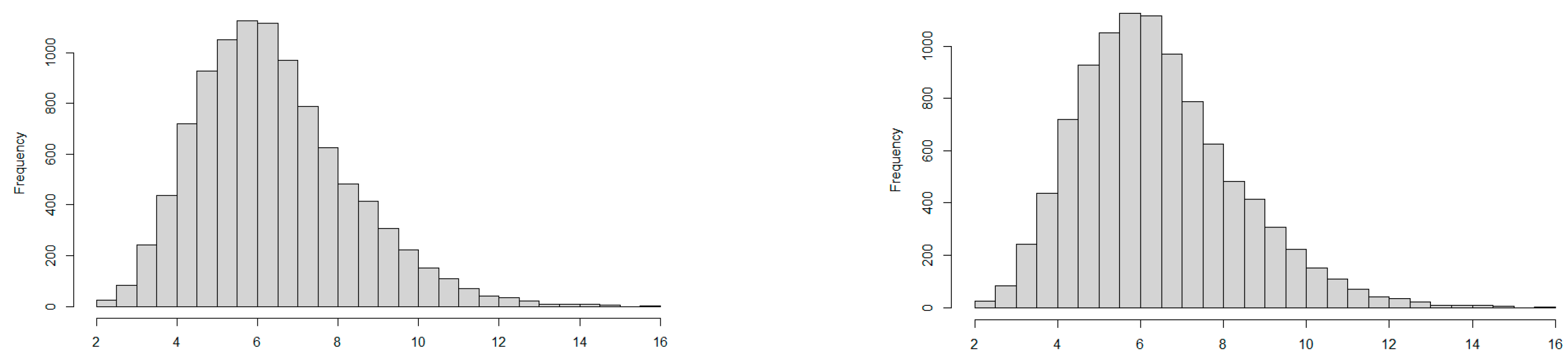
Figure 4.
Monte Carlo simulation with numerical example inputs, but assuming a positive side impact, represented through the dividend yield of 2%.
Figure 4.
Monte Carlo simulation with numerical example inputs, but assuming a positive side impact, represented through the dividend yield of 2%.
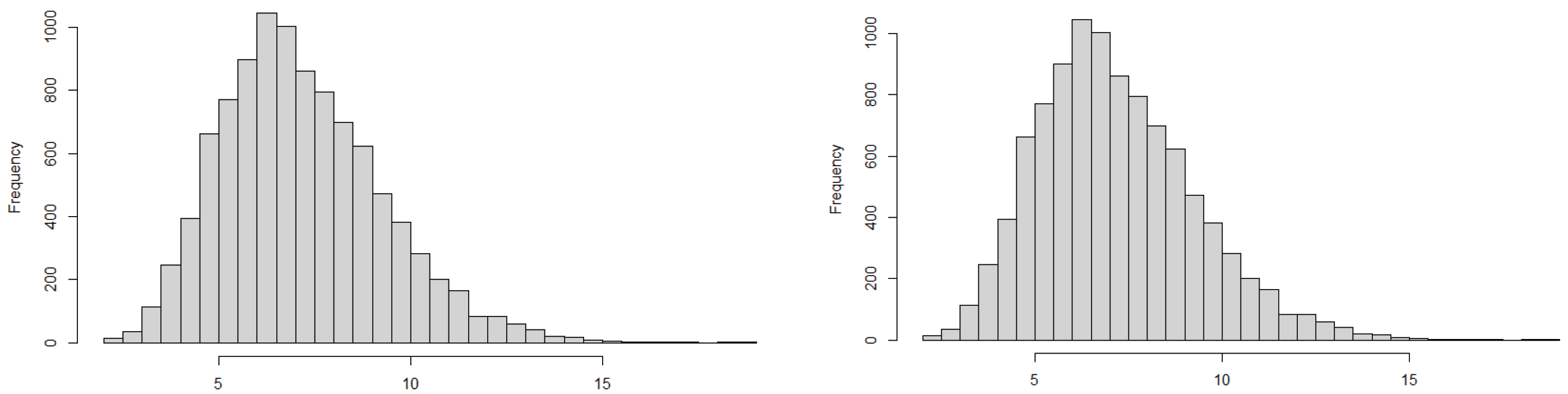

Table 1.
Common ways to address impact of intelligent data processing for corporate finance problems.
Table 1.
Common ways to address impact of intelligent data processing for corporate finance problems.
| Approach for addressing the impact | Remarks and special characteristics |
| Technology based | This is one the most frequently used approaches, like for example in (Yao-Yang, et al., 2025), (Adorm-Takyi & Asare, 2026), (Chaplygina, Kruglova, & Glavina, 2025) and (Bhati, Joshi, Mishra, & Jain, 2025). Such approach may very be well justified when it is necessary to account for a special case or individual implementation, where technology plays a crucial role and the major source of uncertainty and risk can be attributed to such implementation details. However, focusing on instruments is rarely sufficient to understand game changing innovations that influence various aspects of the processes in the organization. |
| Algorithm and/or area of application | Due to the large number of possible applications, algorithm or implementation area approach is very useful when addressing highly specialized improvements – as in (Qidi, Chen, Yanjing, Sunghee, & Hyung, 2026), (Ouyang, 2025) and (Gary, Tahir, Guru, Royston, & Sadia, 2025). As the approach name suggests, these research efforts are focused mostly on the implementation and improvement of existing solutions – thus their relevance is highest with regard to the specific algorithm or area use cases. When it comes to estimating the overall impact of intelligent methods on the organization behavior and company development, assessment goes through the importance of the respective application and method. |
| Market and competitiveness | Impact on market share and competitiveness approach brings sound financial logic in estimating the impact of innovative technologies and intelligent data processing – as in (Qiang, Siqi, & Rongrong, 2026), (Barry & Haitham, 2026). Due to the fact that focus is set on the overall results, it is less probable to be caught in addressing a local maximization and missing the whole picture. Yet, the same big picture focus can be hard to link to specific decisions, as there are multiple factors influencing the market positioning and competitiveness. Application of intelligent data processing for financial data is for sure contributing to future company growth, but such estimates are typically forward-looking and very uncertain. Also due to the fact that new methods and technologies are changing fast, assessment of their influence may be highly speculative. For example, forecasts on artificial intelligence applications vary from “total transformation of workforce and economy” to much more modest estimates for “increasing productivity by 1.5% by 2035”. |
Table 2.
Suggested techniques to assess intelligent data processing solutions for corporate finance.
Table 2.
Suggested techniques to assess intelligent data processing solutions for corporate finance.
| Solution characteristics | Suggested techniques | Remarks |
| Limited in scope solutions, that target an individual step or analytical operation. Typically, such solutions would map to either forecasting and/or Automation level in Figure 1. |
ROI, KPI and physical time savings (speed improvements) | Due to their localized impact, such solutions can be evaluated and monitored with standard financial success indicators and performance metrics. |
| Intelligent data processing that affect multiple aspects of corporate finance practices. Such solutions can aim at risk analysis support as well as at automation of complex tasks and workflows. |
ROI and ROA analysis | As the number of affected processes grows, so does the number of possible outcomes. |
| Data processing solutions that have long term impact and side effects across organizations. Typically, these belong to the strategic decision support systems and complex risk analysis. | ROA with limited application of standard metrics. | With the increased uncertainty and spreading additional effects on the whole organization, the ROA is better able to capture uncertainly and results from future decisions. |
Table 3.
Suggested techniques to assess intelligent data processing solutions for corporate finance.
Table 3.
Suggested techniques to assess intelligent data processing solutions for corporate finance.
| Option parameter | AI / Intelligent processing parameter | Financial option counterpart |
| Underlying asset value | Present value of the cash flows generated by the implementation or estimate of the savings generated with it. | Value of the underlying asset – for example a security. |
| Exercise/strike price | Financial resources required to back up the implementation of the respective solution. | Exercise price |
| Time to maturity | Planned testing period (in case a decision is expected whether to keep the solution or not) or time span till next step in the implementation. | Time to maturity of the option |
| Volatility of the underlying asset value/price | Uncertainty about the overall impact of the solution and the cash flows/savings it will lead to. | Volatility of the underlying asset |
| Additional cash flows | Additional in/out cash flows associated with implementation lifetime. | Dividends paid |
Table 4.
Simple valuation of new technology option – introduction of intelligent agent.
| Option parameter | Parameter value |
| Underlying asset value | Underlying asset value is the estimated savings from introducing the technology, initially set at 2400 EUR. |
| Exercise/strike price | With initial investment of 2748 EUR (which we treat as a sunk cost) and termination option for the experiment (switching to another use) we have an exercise price of 1200 EUR. |
| Time to maturity | Assuming 1-year test period. |
| Volatility of the underlying asset value/price | Volatility set at 35% (0.35) at the initial experiment. For the Monte Carlo simulation we allow the volatility to change with log-normal distribution ~ Lognormal(0.35, 0.1). |
| Additional cash flows | No additional cash flows have been included in the example |
Disclaimer/Publisher’s Note: The statements, opinions and data contained in all publications are solely those of the individual author(s) and contributor(s) and not of MDPI and/or the editor(s). MDPI and/or the editor(s) disclaim responsibility for any injury to people or property resulting from any ideas, methods, instructions or products referred to in the content. |
© 2026 by the authors. Licensee MDPI, Basel, Switzerland. This article is an open access article distributed under the terms and conditions of the Creative Commons Attribution (CC BY) license (http://creativecommons.org/licenses/by/4.0/).
Copyright: This open access article is published under a Creative Commons CC BY 4.0 license, which permit the free download, distribution, and reuse, provided that the author and preprint are cited in any reuse.


