

Submitted:
04 March 2026
Posted:
05 March 2026
You are already at the latest version
Abstract
Bioeconomy policy requires timely, economy-wide evidence; however, two persistent measurement constraints remain: official input–output (IO) tables are published with substantial time lags, novel start-up and novel prospective or hybrid bio-based activities are rarely identified as separate sectors in national accounts. This paper develops an applied methodology that addresses both limitations by combining IO nowcasting with a reduced-dimensional sector-embedding procedure. Using Ireland’s national IO system and an existing bioeconomy IO framework as the accounting backbone, we update the 2015 table to 2022 through calibration to macroeconomic control totals, providing a timely structural baseline. We then introduce a transparent method for constructing new bioeconomy sectors based on dominant input shares, import intensity, and output allocation, while preserving national accounting identities. The approach is demonstrated for aquaculture systems, anaerobic digestion scenarios, and plant-based protein value chains. Demand-driven Leontief multipliers reveal substantial heterogeneity in domestic propagation effects across activities and development stages. The framework offers a resource-efficient and replicable tool for evaluating bioeconomy strategies under real-world data constraints.
Keywords:
bioeconomy
; input–output analysis
; Leontief multiplier
; nowcasting
1. Introduction
The bioeconomy has become central to EU climate-neutrality and circular-economy strategies, as it seeks to reduce dependence on fossil resources by substituting renewable biological materials for fossil-based inputs (McCormick and Kautto, 2013; Loiseau et al., 2016). The European Commission defines the bioeconomy as “all sectors and systems that rely on biological resources, their functions and principles” (European Commission, 2018). This definition highlights that the bioeconomy is not a single sector but a system-wide transformation that reshapes material and energy flows, restructures value chains, and alters production patterns across the economy (Cristóbal et al., 2016; Ramcilovic-Suominen and Pülzl, 2018; Ronzon and M’Barek, 2018; D’Adamo et al., 2021; Näyhä, 2019).
Despite its policy prominence, measuring the economic size and structure of the bioeconomy remains challenging. Bio-based production is dispersed across industries, embedded within supply chains, and frequently combined with fossil-based activities within the same sectors. Because industrial classifications are organised by production process rather than biological input content, standard statistical systems capture only part of the bioeconomy and tend to obscure emerging or hybrid activities (Philippidis et al., 2014; Robert et al., 2020). Assessing whether bioeconomy strategies genuinely reduce fossil dependence—rather than shifting environmental or economic pressures—therefore requires accounting systems capable of tracing inter-industry linkages and value-chain effects.
Input–output (IO) analysis provides such a system-wide accounting framework. By representing the structural interdependence of production activities, IO tables link intermediate inputs, value added, and final demand within a coherent accounting structure (Leontief, 1986; Miller and Blair, 2009). This enables the quantification of both direct and indirect effects, making IO particularly suitable for analysing bio-based technologies whose impacts propagate through upstream biomass supply, processing, logistics, and downstream substitution channels. IO methods thus allow consistent evaluation of spillovers, import leakages, and value-added distribution across bioeconomy value chains (Cazcarro et al., 2013; Wood et al., 2014).
However, applying IO frameworks to the bioeconomy presents two persistent constraints. First, official IO tables are published with substantial time lags and may not reflect current production structures (Leontief, 1986; Miller and Blair, 2009). Second, novel or hybrid bio-based activities are rarely identified as separate sectors within national accounts. Although detailed disaggregation or satellite accounts can improve visibility, these approaches are typically data- and resource-intensive (Suh, 2009; Lenzen, 2011). As a result, a gap persists between methodological best practice and practical policy needs: comprehensive structural accounting is required, yet statistical infrastructures adapt slowly.
Existing IO applications illustrate both the potential and the limitations of current approaches. Cross-country IO studies quantify upstream and downstream bioeconomy linkages (Cingiz et al., 2021), while scenario-based analyses allocate bio-based shares under alternative assumptions (Lazorcakova et al., 2022). Other contributions extend IO tables to incorporate specific emerging technologies, such as green hydrogen (Gupta et al., 2023) or advanced biofuels within environmentally extended models (Azuero-Pedraza et al., 2022). Although informative, these approaches typically rely on benchmark IO tables combined with bespoke disaggregation or strong allocation assumptions, limiting their adaptability for timely, economy-wide assessment under constrained data conditions.
This paper addresses this methodological gap by developing a practical and accounting-consistent framework for integrating bioeconomy sectors into an updated national IO system. The framework is implemented for Ireland, using the IO system published by the Central Statistics Office and an existing Bio-economic Input–Output (BIO) model covering traditional bioeconomy sectors. To overcome temporal mismatch, the 2015 Irish IO table is nowcast by calibrating it to external macroeconomic control totals, extending the production structure to 2022.The contribution is threefold. First, we implement a nowcasting procedure that updates Ireland’s benchmark IO table to provide a timely structural baseline consistent with macroeconomic control totals. Second, we introduce a reduced-dimensional sector-construction method that enables new or statistically invisible bioeconomy activities to be embedded using information on dominant input shares, import intensity, and output allocation. Third, we demonstrate the framework across heterogeneous case sectors traditional (aquaculture), operational (anaerobic digestion), and prospective (plant-based protein) and compare their economy-wide propagation effects using demand-driven Leontief multipliers. Their significance contribution lies in improving the timeliness, flexibility, and policy relevance of input–output–based sustainability modelling.
By combining IO nowcasting with structured sector construction, the study provides a transparent and adaptable methodology for analysing bioeconomy size, structure, and value-chain effects under real-world data constraints. The remainder of the paper presents the methodological framework, empirical results, and policy implications.
2. Methodology
Bioeconomy policies aim to transform entire value chains, requiring economy-wide evidence on spillovers, leakages, and value creation. Measurement is challenging because bio-based activities are dispersed across industries, embedded in supply chains, and often combined with fossil-based production within the same sectors. Standard industrial classifications therefore capture only part of the bioeconomy and obscure emerging or hybrid activities (Philippidis et al., 2014; Ronzon and Barek 2018). This complicates assessment of whether bioeconomy strategies reduce fossil dependence or shift pressures elsewhere.
To address these challenges, this study applies an input–output (IO) framework to analyse the structure and demand-driven propagation effects of the Irish bioeconomy. IO analysis provides an accounting-consistent system for tracing inter-industry relationships and quantifying how changes in final demand transmit through production networks (Leontief, 1986; Miller & Blair, 2009; Viaggi, 2012). It is particularly suited to bioeconomy analysis, where activities span primary production, processing, energy, and services and are not observed as a single sector in national accounts (Wesseler & von Braun, 2017). In bio–input–output (bio-IO) models specifically, disaggregation is crucial because biomass-based production may have different import intensities compared to fossil-based sectors, the value-added structure may vary substantially, and upstream linkages can significantly influence the size of output and employment multipliers. By separating these components, researchers can better capture structural differences and produce more accurate economic and environmental impact assessments. It provides a practical and scalable method for integrating emerging green activities into national accounts, while strengthening the evidence base for industrial policy and sustainability transitions
Disaggregation refers to the process of breaking aggregated sectors into more detailed subsectors in order to improve analytical precision, particularly when examining environmental impacts such as those related to the bioeconomy, emissions, or energy use. It becomes necessary when a sector is too heterogeneous—for example, when “manufacturing” includes both bio-based and fossil-based production processes that differ significantly in their input structures and environmental intensities. Disaggregation is also important when environmental performance varies within sectors, when policy analysis requires product-level detail, or when multiplier effects differ across subsectors. The methodology integrates three components: (i) a standard IO framework used to compute output shares, input shares, and Tier I Leontief multipliers; (ii) an inter-temporal nowcasting procedure that updates the benchmark bioeconomy table to a recent year using macroeconomic control totals; and (iii) a sector-embedding algorithm that incorporates new bioeconomy activities not separately identified in official classifications using external information (official statistics, targeted data collection, or structured expert judgement), while preserving accounting identities. The analysis builds on the Irish Bioeconomy IO framework developed in earlier work (Gemmell, 2000; Grealis and O’Donoghue 2015; Stankova et al., 2025), which disaggregates the national IO table to explicitly represent bio-based activities. The present study extends this framework by updating the benchmark bioeconomy table over time and using it to compute output shares, input shares, and Tier I Leontief multipliers for aggregated bioeconomy groupings and selected case sectorsThe section first introduces the IO framework and structural indicators, then describes sector aggregation and multiplier construction, before outlining the nowcasting procedure and the algorithm for sector incorporation.
2.1. Input–Output Modelling Framework
At the core of the IO framework is the national input–output table, a matrix of inter-sectoral flows that records intermediate transactions between producing sectors, final demand components, and primary inputs (Sirkin, 1959; Henry, 1972). Each sector’s gross output can be represented equivalently from the expenditure side and the input side. The full accounting structure of the input–output table, including the treatment of intermediate flows, final demand components, taxes, imports, and value added.
In order to create sectoral components of GDP, we start with a theoretical description of an input-output table in in Table 1. In terms of outputs the gross output of sector can be defined ignoring change in stocks and in terms of household inter-industry trade across other sectors , consumption , capital , government consumption and exports
On the expenditure side:
where denotes deliveries from sector to sector , and denotes final demand for sector ’s output. Framing in terms of inputs, the gross output of sector can be defined in terms of intermediate consumption, , imports , taxes , wages , profits , and depreciation :
On the input side:
where is value added and denotes imports. These identities ensure consistency between production, income, and expenditure accounts and form the accounting backbone of IO analysis (Miller & Blair, 2009).
Summing we then produce total gross output:
As gross output under both inputs and expenditures are equivalent, combining
Swapping, we highlight the classic textbook equivalence between the three definitions of GDP, respectively expenditure, income and production (at factor cost):
Value added is inferred as . To allocate intermediate inputs across supplying sectors, we use the domestic technical shares from the 1956 table:
We compute sectoral value added as:
For inter-temporal analysis, consistent benchmark tables are essential so that changes in indicators reflect genuine structural evolution rather than differences in table construction (Keogh & Quill, 2009). In the present study, this consistency is ensured by starting from a detailed bioeconomy benchmark (BIO2015) (Grealis and O’Donoghue, 2015) and updating it to a later year using a nowcasting approach described in the subsequent subsection. The methodological framework outlined here applies identically across benchmark years, allowing meaningful comparison of structural indicators and multipliers over time.
To characterise the economic structure of bioeconomy activities, the analysis reports output shares and input shares for sectors and aggregated sectoral groupings. Output shares describe how a sector’s gross output is allocated across final demand components and intermediate uses. For each sector or group, output is decomposed into domestic intermediate sales, exports, and final demand categories, expressed as shares of total output. These indicators provide insight into market orientation and the degree of external demand exposure (Curtis & Fitz Gerald, 1993).
2.2. Technical Coefficients Are Defined as
and the demand-driven Leontief system is:
Tier I output multipliers are computed as the column sums of the Leontief inverse and interpreted as structural propagation indicators. They quantify the total domestic output required (directly and indirectly) to satisfy a one-euro increase in final demand for a sector’s output. Imports are treated as leakages and excluded from endogenous propagation. To characterise production structure, the analysis reports output shares, decomposing each sector’s gross output across intermediate sales, exports, and domestic final demand components; and input shares, decomposing gross output into domestic intermediate inputs, imports, and value added. All shares are computed from balanced IO tables and sum to unity.
Understanding both multipliers and production structure is particularly important in the bioeconomy because bio-based activities are highly heterogeneous in their supply-chain integration and import dependence. A high output multiplier may indicate strong domestic inter-industry linkages, but it may also reflect input-intensive production with limited domestic value creation. Without examining input and output shares, it is not possible to distinguish whether a sector’s expansion strengthens local biomass supply chains, increases reliance on imported intermediates, or primarily redistributes value within existing industries.
2.3. Aggregation of Bioeconomy Sectors
Traditional sectors are fully represented in official IO classifications; novel start-up sectors are operational but statistically embedded within existing categories; and novel prospective sectors refer to emerging technologies not yet commercially established, requiring structured parameterisation for integration into the IO framework. The BIO framework used in this study comprises 168 production sectors, reflecting a high level of disaggregation across agriculture, forestry, food processing, energy, manufacturing, and services. While this detail is essential for model construction, it is not suitable for presentation or interpretation in figures and comparative analysis.
To ensure analytical clarity and visual coherence, sectors are aggregated into five mutually exclusive classes:
- Primary bioeconomy – agriculture, forestry, fishing, and other primary biomass-producing activities;
- Secondary bioeconomy – food processing, wood products, bio-based manufacturing, and related processing industries;
- Industry (non-bio) – manufacturing activities not primarily based on biological inputs;
- Services – market and non-market services supporting production and consumption;
- Energy – energy production and supply activities, including bioenergy and non-bio energy carriers.
This aggregation follows the logic used in applied bioeconomy IO studies, including Tsakiridis et al. (2020), where bioeconomy activities are grouped according to their position in the production system rather than treated as a single homogeneous sector. Each of the 168 sectors is uniquely assigned to one class based on its dominant production function and input structure. The aggregation is applied consistently across all benchmark years.
2.4. Class-Level Multipliers and Weighting
To quantify economy-wide propagation effects, the study computes Tier I Leontief multiplier on a domestic basis, treating imports as exogenous to the inter-industry system (Geary, 1964; Henry, 1977).
The Leontief demand-driven model captures how an exogenous change in final demand propagates through upstream production linkages. Let denote the domestic technical coefficients matrix and the vector of final demand. Total output is given by:
The Tier I Leontief multiplier for sector is defined as the column sum of the -th column of the Leontief inverse . It measures the total direct and indirect output generated across the economy by a one-euro increase in final demand for sector ’s output (Curtis & Fitz Gerald, 1993; Miller & Blair, 2009).
Because the analysis focuses on aggregated sectoral classes rather than individual sectors, class-level multipliers are computed as final-demand-weighted averages of sectoral multipliers. Specifically, the multiplier for class is calculated as:
where is the sectoral multiplier and is the share of sector in total final demand of class . This weighting ensures that class-level multipliers reflect both technological linkage strength and the relative economic importance of sectors within each class, consistent with applied IO practice (Tsakiridis et al., 2020).
This approach avoids dominance by small sectors with extreme coefficients and provides economically meaningful summary indicators for comparative analysis across bioeconomy classes and benchmark years.
2.5. Nowcasting Input Output Tables
The objective of the nowcasting procedure is to update the benchmark BIO2015 Input–Output (IO) table to represent the structure of the Irish bioeconomy in 2022, while preserving consistency with national accounting identities. Because an official BIO2022 IO table is not available, the update is implemented under conditions of incomplete sector-to-sector flow information. Three broad strategies can be considered when updating IO tables to a more recent year. The first involves full structural updating using complete inter-industry transaction data for the target year. Although such data may exist within institutional statistical systems, complete flow matrices are not publicly accessible for research purposes, rendering this approach infeasible.
The second strategy relies exclusively on macroeconomic control totals; such as gross output, value added, intermediate consumption, and final demand aggregates, while maintaining the technical coefficients of the benchmark table unchanged. Although this approach ensures accounting consistency, it implicitly assumes fixed production technologies and therefore cannot capture sector-specific structural adjustments over time.
The third strategy, adopted in this study, combines fixed technical coefficients from BIO2015 with partial sector-level flow information and macroeconomic scaling constraints. Under this hybrid approach, updated information is incorporated selectively for sectors where new data are available, while the remaining structure is scaled using official macroeconomic aggregates. This allows targeted structural adjustments without compromising overall accounting balance.
This hybrid approach represents a pragmatic compromise between data availability and structural realism. It preserves the accounting coherence of the original IO framework while allowing selective updating where new information exists, providing a resource-efficient and transparent method for nowcasting the BIO2022 table under real-world data constraints.
2.6. Nowcasting Data Requirements
To obtain these sector-specific flow data, we rely on several data sources. Teagasc Farm Surveys provide data on agricultural production, inputs, and sectoral linkages. Specifically, we use flow data that tracks agricultural inputs (e.g., seeds, fertilisers, and feed) to agricultural production and the supply of these inputs to downstream bioeconomy sectors like aquaculture, bioenergy, and organic value chains. This information is essential for updating the intermediate consumption and final demand components within the IO framework. In addition, Teagasc’s surveys provide economic metrics on the scale of agricultural output, allowing for an accurate estimation of sectoral linkages and value-added components for agriculture-based industries.
Central Statistics Office (CSO) provides macro-level control totals for output by industry, intermediate consumption, and final demand categories (household, government, capital formation, etc.). While we do not use the CSO control totals for direct sector-level updates, the macroeconomic aggregates they provide allow us to scale the sectoral data appropriately. The CSO data also include imports and exports, which are critical for adjusting intermediate consumption in the updated BIO2022 table.
2.7. Nowcasting Process
The nowcasting process begins by identifying the key sectoral flow data that will be used to update the IO table. These flows are critical for maintaining the consistency of the IO framework and ensuring that sectoral interdependencies are accurately represented in the updated table. The next step in the nowcasting methodology is updating the sector-specific intermediate consumption (IC) and value-added (VA) components for each sector. This involves adjusting the original BIO2015 table based on the updated sector-specific flow data.
We update the IC components by adjusting the sectoral purchases of intermediate goods and services based on the new flow data from Teagasc and CSO surveys. For example, if the data indicates an increase in feed consumption in aquaculture or bioenergy sectors, the flow from the agriculture sector to these bio-based industries will be updated accordingly. Additionally, the sectoral import data from Teagasc and CSO are incorporated into the intermediate consumption flows, allowing us to account for imports that are part of the production process in sectors like aquaculture and bioenergy.
Where sector-to-sector flows are not directly observed for 2022, the nowcasting approach preserves the relative structure of intermediate input use from the BIO2015 benchmark. Specifically, domestic technical coefficients from the 2015 base year are defined as:
These coefficients are applied to updated estimates of sectoral intermediate consumption to distribute inputs across supplying sectors in a manner consistent with the observed production technology in BIO2015. This approach preserves the input-output structure of BIO2015 while integrating newer data.
Value-added components (labour, capital returns, depreciation) are updated to reflect the changes in output and sectoral production. Using the updated intermediate consumption data, we can estimate how much labour and capital are employed in each sector and adjust the value-added shares accordingly. These adjustments are informed by sector-specific estimates from Teagasc and expert judgment.
Once the intermediate consumption (IC) and value-added (VA) components have been updated, we proceed to rebalance the IO table. Rebalancing ensures that the relationships between output, intermediate consumption, value added, and final demand remain consistent across all sectors. The steps involved in rebalancing are as follows:
The key accounting identity in input-output analysis is:
This identity must hold for every sector. If any discrepancies arise between updated components, adjustments are made to ensure the table is balanced.
Formally, for each sector , gross output must satisfy both the expenditure-side and input-side definitions of an input–output system. On the expenditure side:
where denotes intermediate deliveries from sector to sector , and denotes final demand for sector ’s output.
On the input side, gross output is defined as:
where denotes intermediate inputs used by sector , is value added, and represents imports.
The nowcasting procedure enforces consistency between these two representations for all sectors, ensuring that updated intermediate flows, value added, imports, and final demand jointly satisfy the fundamental accounting identity of the IO framework.
Once the updated BIO2022 IO table is constructed, we proceed to calculate the Leontief multipliers. These multipliers help quantify the broader economic impact of sectoral expansion, including the indirect effects that propagate through the economy.
The nowcasting methodology for updating BIO2022 effectively uses available data from farm surveys, national accounts, and expert judgment to adjust sectoral flows in a resource-efficient manner. By updating the intermediate consumption, value added, and final demand components, the nowcasted BIO2022 table provides a timely and accurate representation of the Irish bioeconomy for 2022. This methodology is crucial for advancing economic policy analysis and decision-making, particularly for the bioeconomy sectors.
2.8. Incorporating a New Sector
Once the IO table has been updated to the simulation year, new bioeconomy activities can be incorporated to evaluate their structural position and multiplier effects. For emerging or pilot-stage technologies, however, it is typically infeasible to obtain a complete 168-sector cost structure consistent with the granularity of the IO system. While developers and technical experts can often identify major cost components, detailed allocations across numerous minor input categories are rarely available.
To incorporate new bioeconomy activities under limited data availability, we apply a reduced-dimensional data collection strategy focusing on the key determinants of the domestic Tier I multiplier: import share (leakage), labour and capital shares (value-added intensity), and the dominant domestic intermediate inputs (upstream linkages). A structured questionnaire (Appendix A) collects the shares of the top five domestic input categories, alongside aggregate shares for imports, labour, and capital, ensuring total inputs sum to unity. Output allocation is similarly specified by identifying the main domestic B2B destinations and the overall distribution across domestic B2B, exports, and B2C sales.
A structurally comparable reference sector is used to complete minor input and output categories and to calibrate profit and tax shares. The new sector is then inserted into the IO matrix and the system rebalanced to preserve accounting identities. This approach enables transparent and consistent integration of emerging bioeconomy activities while keeping data requirements proportionate to multiplier relevance.
The goal is to source the input shares and the output shares at 4 different stages. Inputs are broken up into (1) purchased goods and services (excluding imports, labour, capital) and (2) total purchases (including imports, labour, capital). In both cases we ignore profit and taxes. For purchased goods and services, we look for data on the share of inputs for the top 5 input products, naming each product and putting other expenditures into rest. Providing approximate shares is sufficient for our exercise, with total inputs summing to 1. In the next block detail the share of domestic purchases, labour, capital and imported products. Again, these sum to 1. We classify inputs into 4 phases R&D, Development, Growth, Mature. It is likely that the labour share and the purchased share will go down as processes becoming more efficient. We ask our questionnaire respondents to use their best judgement.
We do the same for sales, detailing business to business sales (B2B), again listing the top 5 domestic sectoral destinations (don’t worry if there are fewer) (excluding exports and business to consumer B2C). In next block, we list the share of domestic B2B, exports and B2C. Lastly itemise the potential market size to get a sense of scale. However, as the multiplier is independent of this, it is less important.
In order to incorporate a new sector or product into the input output model from the supplier questionnaire, we create a Visual Basic Macro to automate. The first thing we must do is to find the most similar existing sector within the model. We use this to get an approximate starting position for the components that are missing, including, profit share, tax rate, the distribution of other purchased goods and services and the distribution of other sales sectors. Aggregating purchased goods and services into 12 NACE Aggregate Sectors plus top 5 Inputs/Outputs, we consult with R&D engineers to get a sense check of the full input–output structure as well as profit and tax shares and adjust as necessary based upon their feedback. The VBA algorithm adds a new column and a new row to the sector. In order an approximation of the total output, applying taxes and profit to the cost based starting sales.
2.9. Assumptions and Limitations
The analysis is subject to several assumptions and limitations that are standard in Input–Output (IO)–based structural analysis and are explicitly acknowledged here. First, the IO framework is accounting-based and represents production relationships through proportional flows within each benchmark table. BIO2015 is used as the most recent fully reconciled benchmark capturing a normal production structure of the Irish bioeconomy. The BIO2022 table is constructed by integrating detailed 2022 sectoral information for bioeconomy activities from national farm surveys and related sources with updated national accounts aggregates. Where sectoral totals derived from 2022 data must be allocated across inter-industry transactions to restore full accounting consistency, the BIO2015 structure is used as a structural reference to guide the reconciliation process. This procedure does not impose fixed technology across time; instead, it ensures that updated output, intermediate consumption, value added, and trade data are jointly consistent within a balanced IO framework, following established practice in IO table harmonisation (Henry, 1977; Curtis & Fitz Gerald, 1993).
Third, aggregation is required to ensure interpretability. The BIO framework includes 168 sectors, which is too granular for comparative graphical analysis. Sectors are therefore grouped into five broad categories: primary bioeconomy, secondary bioeconomy, industry, services, and energy following classification principles consistent with bioeconomy IO studies (Tsakiridis et al., 2020).
Finally, multipliers are computed on a domestic basis and are weighted by sectoral final demand when aggregated to category level. As with all IO multipliers, results should be interpreted as indicative of structural linkages rather than causal impact estimates. Despite these limitations, the framework provides a transparent and policy-relevant representation of bioeconomy structure and interdependencies, suitable for comparative analysis and strategic assessment.
3. Results I: Nowcast of Input-Output Table
This section compares the structural composition and economy-wide propagation effects of the Irish bioeconomy between the benchmark BIO2015 table and the nowcasted BIO2022 table. The analysis uses three complementary input–output indicators: input shares, output shares, and Tier I Leontief multipliers. Input shares describe production structure and the balance between domestic intermediates, imports, and value added; output shares show how production is distributed across intermediate uses, final demand, and exports; and Leontief multipliers quantify changes in inter-industry linkages and system-wide spillovers over time within a consistent framework.
3.1. Bioeconomy Class Composition
Figure 1 presents the class composition of output within the BIO input–output framework for 2015 and 2022, based on five aggregated classes: primary bioeconomy, secondary bioeconomy, industry, services, and energy. Primary bioeconomy activities account for a small proportion of total output, declining marginally from 1.29% in 2015 to 1.23% in 2022. Secondary bioeconomy activities show similarly limited variation, decreasing slightly from 2.55% to 2.52%. The small magnitude of these changes indicates stability in the relative contribution of directly bio-based production and processing activities within the aggregated system.
Energy represents the smallest class but shows the most noticeable proportional increase, rising from 1.81% in 2015 to 1.97% in 2022. Although modest in absolute terms, this increase distinguishes energy from the other bio-related categories, which remain largely stable. Industry constitutes a substantial share of output, increasing slightly from 26.36% in 2015 to 26.84% in 2022. The modest rise suggests limited reallocation toward industrial activities over the period.
Within the aggregated BIO production system, services represent the largest supporting class, accounting for 68.00% in 2015 and 67.44% in 2022. The marginal decline of 0.56 percentage points indicates overall stability rather than structural change. The dominance of services reflects the structure of the aggregated BIO IO system within which bioeconomy activities are represented.
3.2. Input Structure of the Bioeconomy
This subsection analyses the input structure of the Irish bioeconomy by decomposing total output into domestic intermediate inputs, imports, and value added. The objective is to evaluate how production is generated and how the balance between domestic linkages, external sourcing, and value creation has changed between 2015 and 2022. Figure 2 presents the aggregate input composition for both benchmark years, illustrating shifts in sourcing patterns and value generation over time.
The intermediate input share increased from 0.10 in 2015 to 0.18 in 2022, representing a rise of 0.08. This indicates that a larger proportion of bioeconomy output is absorbed as intermediate consumption in 2022 relative to 2015. In accounting terms, this reflects a higher intensity of inter-industry input use within the production structure. The import share remains the dominant component of total output in both years, accounting for 0.57 in 2015 and 0.56 in 2022. Although the change is small (-0.01), the consistently high import share indicates substantial reliance on imported inputs in the bioeconomy production system. The marginal reduction in 2022 does not materially alter this pattern.
The value-added share declines from 0.33 in 2015 to 0.26 in 2022, a decrease of 0.07. This indicates that a smaller proportion of gross output is retained as domestic primary income (labour compensation, capital returns, and depreciation) in 2022. The reduction in value added corresponds mechanically to the combined increase in intermediate consumption and the persistently high import share.
3.3. Input Structure by Bioeconomy Class: Input Shares
This sub-section extends the aggregate input analysis by examining how production technologies vary across five aggregated classes: primary bioeconomy, secondary bioeconomy, industry, services, and energy, consistent with applied bioeconomy IO studies (e.g. Tsakiridis et al., 2020). Primary and secondary bioeconomy represent bio-based production stages, while industry, services, and energy reflect the broader production environment interacting with bioeconomy activities. Figure 5 reports input shares for 2015 and 2022, decomposing output into intermediate inputs, imports, and value added, thereby highlighting differences in production intensity, import dependence, and domestic value generation.
Energy shows a marked compositional shift. Value added declines from 46% in 2015 to 35% in 2022, while intermediate inputs increase from 24% to 37%; imports fall slightly from 30% to 28%. Secondary bioeconomy follows a similar pattern: value added decreases from 45% to 37%, intermediate inputs rise from 30% to 39%, and imports remain broadly stable (25% to 24%). In both classes, a larger share of output is absorbed by intermediate requirements in 2022 relative to 2015.
Figure 3.
Evolution of Bioeconomy classes. Input shares 2015, 2022. Note: Industry, services, and energy represent supporting sectors within the aggregated BIO input–output system and include both bio-based and non-bio activities interacting with bioeconomy production.
Figure 3.
Evolution of Bioeconomy classes. Input shares 2015, 2022. Note: Industry, services, and energy represent supporting sectors within the aggregated BIO input–output system and include both bio-based and non-bio activities interacting with bioeconomy production.
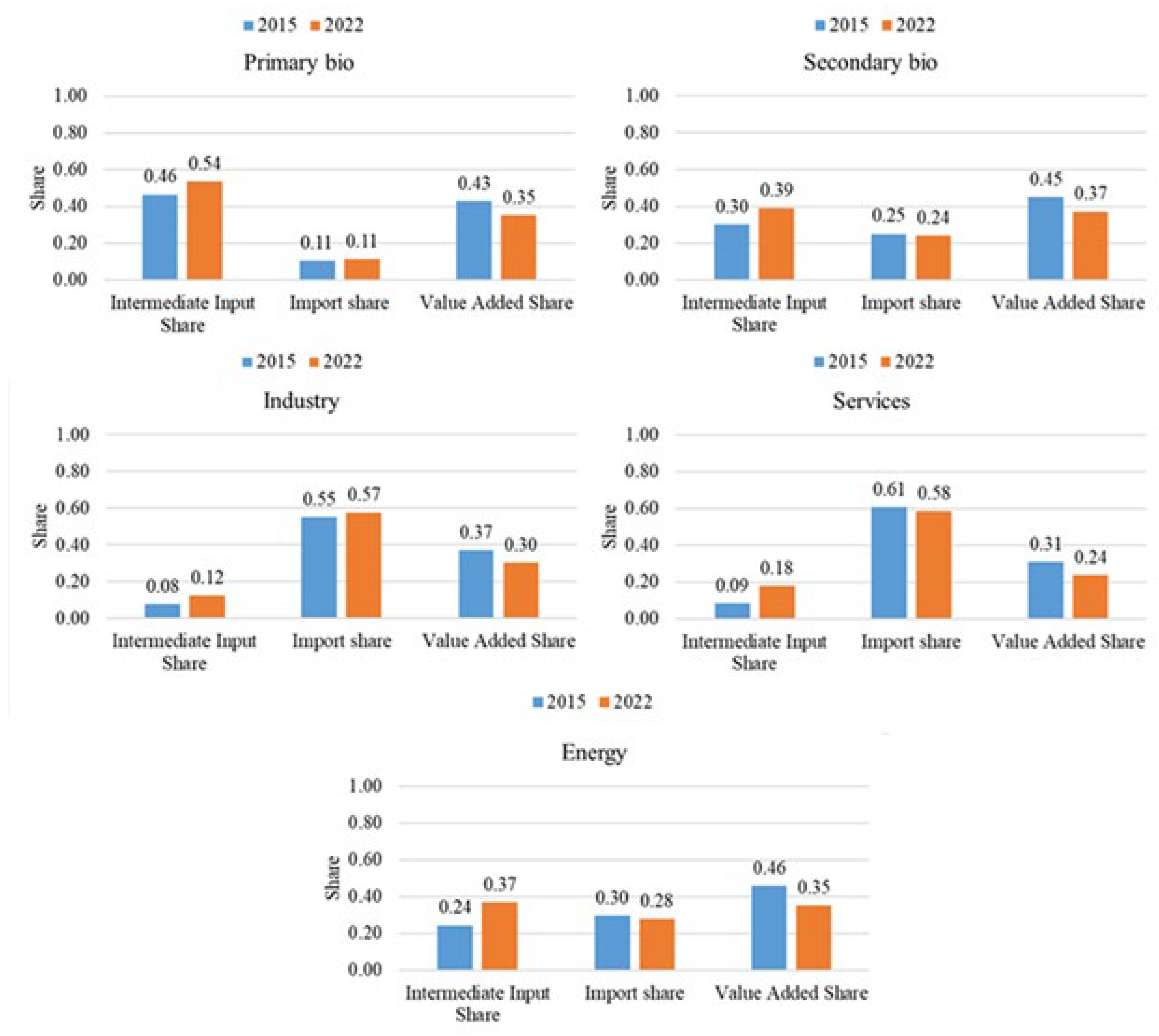
Primary bioeconomy maintains a constant import share of 11%, but value added falls from 43% to 35% and intermediate inputs rise from 46% to 54%, indicating a higher input intensity within production. Industry records an increase in intermediate inputs from 8% to 12%, alongside persistently high import shares (55% to 57%), reflecting high import intensity within the Industry class as represented in the BIO IO framework.Services exhibit a doubling of intermediate input share from 9% to 18%, while value added declines from 31% to 24% and imports remain high (61% to 58%). As this class includes broad service activities interacting with bioeconomy production, its input structure reflects the role of Services class within the aggregated BIO production system.
3.4. Output Structure of the Bioeconomy
This sub-section analyses the output structure of the Irish bioeconomy by decomposing total output into intermediate demand, final domestic demand, and exports for 2015 and 2022. Output shares provide an accounting-consistent view of market orientation and demand composition, establishing a baseline for subsequent class-based analysis presented in Figure 4.
Between 2015 and 2022, the export share of total bioeconomy output increased from 0.63 to 0.69. This indicates that a larger proportion of bioeconomy production was directed toward external markets in 2022 compared with 2015. Over the same period, the share of output absorbed as intermediate consumption declined from 0.22 to 0.18, while the final domestic demand share decreased from 0.15 to 0.13.
These changes reflect an increase in the relative weight of exports within total bioeconomy output, accompanied by a reduction in the shares allocated to domestic intermediate and final uses. The magnitude of the shifts is moderate, indicating a gradual adjustment in output composition rather than a discontinuous change in production allocation.
3.5. Output Structure by Bioeconomy Class: Output Shares
To examine how demand composition differs across stages of production within the bioeconomy framework, this sub-section extends the aggregate analysis by presenting output shares aggregated into five classes. Sectors are grouped into primary bioeconomy, secondary bioeconomy, industry, services, and energy, following established practice in applied bioeconomy input–output studies (e.g. Tsakiridis et al., 2020). Figure 5 reports output shares for each class in 2015 and 2022, decomposing production into intermediate demand, final domestic demand, and exports.
Secondary bioeconomy and Industry display strongly export-oriented structures in both years. In secondary bioeconomy, exports account for 78% of output in 2015, rising to 82% in 2022. Intermediate use remains limited (15% to 14%), while final domestic demand declines from 7% to 4%. Industry follows a similar pattern: export shares increase from 85% to 87%, intermediate consumption falls from 10% to 8%, and final demand remains small at 5–6%. In both classes, exports clearly dominate output allocation and the overall structure remains stable across benchmark years.
Primary bioeconomy and Energy are characterised by high intermediate-use shares. In primary bioeconomy, intermediate consumption accounts for 88% of output in 2015 and 84% in 2022. Exports increase from 8% to 13%, while final demand remains marginal (4% to 3%). Energy shows a comparable configuration: intermediate use rises from 78% to 82%, exports increase from 3% to 5%, and final demand declines from 19% to 13%. Services present a more balanced structure. In 2015, output is divided between exports (55%), intermediate use (24%), and final demand (21%). By 2022, exports increase to 65%, while intermediate use and final demand decline to 19% and 17%, respectively.
3.6. Inter-Industry
This sub-section focuses on the demand-side propagation within BIO production network, analysing backward linkages and their role in shaping Ireland’s production structure. Backward linkages describe how final demand in one sector stimulates production across its network of suppliers, reflecting the degree of domestic reliance on intermediate goods. Using Leontief multipliers (Leontief, 1986; Henry, 1980), we assess each bioeconomy class’s dependence on domestic intermediate inputs and explore how these relationships evolved between 2015 and 2022 in Figure 6.
3.7. Classes with Strong Backward Linkages
Figure 6 shows primary bioeconomy continues to exhibit the highest Tier I Leontief multipliers in both 2015 and 2022, although it shows a slight decline from 1.70 to 1.60. This decline coincides with an increase in intermediate input intensity from 0.46 to 0.54, while the import share remains constant at 0.11. The reduction in the multiplier appears to reflect a shift in the composition of inputs rather than an increase in import leakage.
Secondary bioeconomy maintains strong backward linkages, with a slight increase in its multiplier from 1.69 to 1.71. This change corresponds with an increase in intermediate input intensity from 0.30 to 0.39, while the import share remains largely unchanged (from 0.25 to 0.24). The stability of the import share, combined with the rise in intermediate input use, suggests a marginally stronger propagation of demand-driven activity domestically.
Energy also demonstrates strong backward linkages, but its multiplier declines from 1.63 in 2015 to 1.51 in 2022. This decline corresponds with a noticeable increase in intermediate input share from 0.24 to 0.37, while the import share slightly decreases from 0.30 to 0.28. Despite the increase in intermediate input intensity, the decline in the multiplier indicates that the overall demand-driven propagation has weakened.
3.8. Classes with Weaker Backward Linkages
Services shows moderate backward linkages, with its multiplier declining from 1.26 in 2015 to 1.21 in 2022. This decline is accompanied by an increase in intermediate input share from 0.09 to 0.18, while the import share remains high but decreases slightly (from 0.61 to 0.58). The combination of relatively low-to-moderate intermediate input intensity and persistent high import leakage likely contributes to the constrained domestic multiplier effects observed in Services.
Industry records the lowest Tier I Leontief multipliers in both years, with a modest increase from 1.11 in 2015 to 1.14 in 2022. This small increase aligns with a rise in intermediate input share from 0.08 to 0.12, while import dependence remains high, increasing from 0.55 to 0.57. The high import share limits the extent to which increases in final demand translate into increased domestic upstream output, which helps explain the modest increase in Industry’s multiplier.
4. Results II – Novel Sector Multipliers Sectors Modelled
In order to test our algorithm we pilot the analysis for sectors and products with different degrees of technology readiness level.
- Traditional bioeconomy sectors – mainly national accounts information. In this case we disaggregate our existing aquaculture sector into aquaculture sectors which have different economic footprints
- Novel start-up sectors – these are novel bio-economy sectors that are in operation, perhaps at a lower scale. In this paper we shall explore the economic impact of bio-energy, (anaerobic digestors and biomass based bio-energy)
- Novel prospective sectors – these are novel bio-economy sectors or products that are at development stage and perhaps haven’t had sales yet.
4.1. Aquaculture
Aquaculture is a key sector in sustainable food systems, contributing to protein diversification and, in many production systems, offering relatively low-carbon protein compared with conventional terrestrial livestock, thereby alleviating pressures on capture fisheries (Blanchard et al., 2017; Krause et al., 2022; Shen et al., 2024; Chan et al., 2024). In BIO2022, aquaculture is represented as a single sector encompassing marine and land-based systems, including salmon, oysters, mussels, and other finfish categories. In this benchmark representation, the production technology reflects an average input structure across aquaculture systems rather than distinguishing between specific production types (Stankova & O’Donoghue, 2026; Bostock et al., 2016). This aggregated structure provides the observed technological base from which species-level disaggregation is subsequently implemented as an extension to the BIO2022 framework.
Consequently, the representation captures the prevailing economic footprint of the industry but does not differentiate between intensive finfish, shellfish, or recirculating aquaculture systems. Within the input-output framework, aquaculture exhibits a relatively high degree of intermediate-input intensity. Intermediate consumption accounts for 48.48% of total output, while value added represents 35.86%, indicating substantial upstream input dependence alongside a moderate contribution from primary factors. Imports comprise 15.66% of output, reflecting structural import leakage, particularly through specialised feed and input components not fully supplied domestically. As such, the sector demonstrates partial dependence on international supply chains, moderating the domestic retention of expenditure shocks.
Upstream demand is concentrated in prepared animal feeds, gasoil (diesel/derv), repair and installation services, and manufacturing activities. This composition highlights strong linkages to agricultural feed supply chains and industrial service providers, embedding aquaculture within both primary and secondary production networks. The concentration of inputs in feed and energy-related categories underscores the biological and energy requirements of production, while repair and manufacturing inputs reflect capital maintenance and operational intensity.
From a demand-driven perspective, the Tier-1 Leontief output multiplier is 1.64, implying that a €1 increase in final demand for aquaculture generates €1.64 in total economy-wide output. The multiplier is supported by relatively strong domestic upstream linkages, particularly through feed and service inputs. However, the magnitude of the effect is moderated by import dependence within key intermediate categories. Aquaculture represents a structurally embedded and moderately import-dependent bioeconomy sector, with measurable indirect effects across agricultural and industrial supply chains.
4.2. Anaerobic Digestion
Anaerobic digestion (AD) is increasingly recognised as a key bioeconomy sector in Ireland, integrating waste management with renewable energy and circular economy objectives. AD biologically breaks down organic substrates such as agricultural residues, food waste and manure to produce biogas, predominantly methane, and nutrient-rich digestate that can displace fossil fuels and synthetic fertilisers, thereby contributing to greenhouse gas mitigation and resource efficiency (Appels et al., 2011;Martínez-Arce et al., 2025; Teagasc, 2025, O’Connor et al., 2020; Tisocco et al., 2025). Technically, Ireland’s National Biomethane Strategy aims to deliver up to 5.7 TWh of indigenous biomethane by 2030, requiring substantial scaling of AD infrastructure to valorise organic feedstocks for energy and bio-products (Department of Climate, Energy and the Environment & DAFM, 2024). Recent life cycle and scenario analyses indicate that large-scale AD can maximise climate benefits when coupled with targeted land-use and policy frameworks, though deployment must be aligned with agricultural transitions and strategic incentives (Vousoughi et al., 2026). Moreover, integrated AD-based biorefineries offer pathways to diversify rural incomes and enhance circular bioeconomy outcomes, but economic viability remains contingent on technological innovation and supportive policies (Shinde et al., 2025).
4.3. Bio-Energy
Bio-energy, a start-up technology, faces similar challenges with sparse data and limited sectoral representation. Sectoral data are often derived from proxies or engineering estimates (Ronzon et al., 2022). Like other renewable sectors (Faaji, 2006; Smeets, 2007; Többen et al., 2022, Geoghegan & O'Donoghue, 2023), bio-energy is underrepresented in IO tables, requiring adaptation and approximation, making it an essential test case for the framework's capacity to integrate early-stage technologies. Anaerobic digestion is modelled as a constructed operational bioeconomy sector because it is not separately identified in standard accounts but can be parameterised using techno-economic evidence. We use a 40 GWh plant supplied by a 50:50 grass silage and cattle manure mix. The sector’s structure is upstream demand dominated by agriculture (feedstocks), finance/professional services (project and risk-related costs), and manufacturing (construction, equipment, O&M). On the output side, revenues are concentrated in energy-related sales (biomethane/electricity), with smaller flows to transport (distribution/logistics) and agriculture (digestate). This input concentration supports strong indirect effects through biomass and capital-service supply chains; results are reported as Leontief (demand-driven) multipliers.
4.4. Plant-Based Protein Products (Novel Developing Value Chain)
Plant-based protein products are not separately identified in national accounts, so we construct new sectors by parameterising production technology. We draw upon novel protein products from two research projects. The FUNGITECH project, led by University College Dublin, funded by Research Ireland, has developed an innovative high-protein, high-fibre fungal food ingredient intended for use by food manufacturers in further product formulation. The project is embedded within a broader research agenda focused on advancing circular bioeconomy solutions by valorising low-value agri-food by-products, notably spent brewers’ grain, into nutritionally valuable food ingredients. The production process involves a series of input stages, including cleaning, rolling and milling of raw materials, controlled drying, fermentation in bioreactors with selected fungal strains, and subsequent drying, milling, and heat treatment to ensure product stability and food safety. The final output is a shelf-stable powdered ingredient, packaged using minimal material inputs. Additional inputs include energy, transport and storage logistics, labour, and regulatory safety testing. Overall, FUNGITECH demonstrates the technical and economic potential of fungal biotechnology to support sustainable protein production and waste reduction.
The Protein-I portfolio comprises four domestically oriented food products based on locally sourced cereals and pulses, each occupying distinct market segments and cost structures. The rolled oat porridge, produced from Irish-grown oats, is a minimally processed cereal product yielding one tonne of retail output from approximately 1.10 tonnes of raw grain; raw materials and processing each account for roughly 30% of unit costs, with packaging representing about 25%, reflecting its positioning as a premium domestically sourced offering. The oat drink, a plant-based beverage containing 10–11% oats supplemented with functional ingredients, involves capital- and energy-intensive processes, including enzymatic conversion, homogenisation, thermal treatment, and aseptic packaging, such that processing and packaging together exceed 65% of total costs, consistent with its placement in the expanding dairy-alternative market. The pea burger, manufactured through protein fractionation, formulation, structuring, and chilled or frozen distribution, exhibits the highest processing intensity, with manufacturing accounting for approximately 38% of costs alongside additional cold-chain logistics, and is positioned within the alternative protein segment as a competitively priced domestic product. Finally, the dried wheat pasta, produced via conventional extrusion and drying technologies, displays a more balanced cost distribution across raw materials, processing, and packaging (each 20–30%), benefiting from technological maturity and economies of scale while competing across standard and premium cereal markets. Collectively, these products illustrate varying degrees of processing complexity, value addition, and market differentiation within domestically embedded agri-food supply chains. Different types of sectors and products have different data availability, depending upon data sources.
4.5. Level of Aggregation Possible
In our analysis we wish to model the value chain economic impact of multiplier for bioeconomy sub-sectors. However, for analytical tractability and efficiency, we need to reduce the dimensionality of the data collection approach. Examining existing domestic flows within the BIO, figure 7 provides an empirical justification for a reduced-dimensional sector-embedding approach. The figure reports, for each of the 168 sectors in the BIO framework, the cumulative share of domestic intermediate inputs accounted for by the top three, four, five, and six supplying sectors. Sectors are ranked along the horizontal axis according to their share in nationally purchased domestic business-to-business (B2B) inputs.
The results show that intermediate input structures are typically concentrated. For the majority of sectors, a small number of upstream suppliers account for most domestic intermediate inputs. While the most input-diverse sectors; primarily service activities; exhibit lower concentration (with the top three inputs accounting for roughly 30–45% of total intermediate inputs), sectors outside this lower tail display substantially stronger concentration. In particular, for most sectors beyond the bottom quintile, the top five supplying sectors account for at least half of total intermediate inputs, and often considerably more.
The relatively small gap between the “top five” and “top six” curves further indicates diminishing incremental contribution from additional minor input categories. Since demand-driven multipliers in the Leontief framework are primarily driven by dominant technical coefficients, capturing the largest input relationships is sufficient to approximate a sector’s structural propagation effects. On this basis, the sector-embedding procedure focuses on collecting information on the top five intermediate inputs, supplemented by import and value-added shares.
The multiplier of a particular sector will depend directly upon the share of domestically sourced intermediate inputs and the multiplier of these inputs and inversely on the import share and value-added share of the inputs. As an aid to understanding the drivers of bioeconomy sectoral multipliers, Table 2 reports sectoral Tier I output multipliers and the decomposition of gross output into domestic intermediate consumption, value added, and imports. The Tier I multiplier measures the direct and first-round domestic indirect effects of a one-unit increase in final demand, capturing the strength of domestic backward linkages. Considerable heterogeneity emerges across sectors. Agriculture exhibits the largest multiplier (1.756), followed by Construction (1.378) and Transport (1.257), indicating relatively strong domestic production linkages. In contrast, Finance and Professional Services (1.068) and Wholesale and Retail Trade (1.095) display weaker first-round spillovers. These differences are consistent with the structure of intermediate inputs. Agriculture (0.464) and Construction (0.304) rely more heavily on domestic intermediates, whereas Finance and Professional Services (0.063) and Manufacturing (0.081) exhibit limited domestic input dependence. Import intensity is particularly high in Manufacturing (0.511), Accommodation (0.627), Finance and Professional Services (0.651), and Public Administration (0.578), suggesting substantial foreign input reliance. Overall, sectors with stronger domestic intermediate linkages generate larger first-round spillover effects, while import-intensive or value-added–dominant sectors display weaker domestic multipliers, with implications for the transmission of demand shocks across the economy.
Table 3 summarizes the upstream principle input composition of bioeconomy sectors considered at different levels of technology readiness. Drawing upon the level of aggregation identified as possible in figure 7, we report here (a) the domestic input share of the principal inputs and the composition of high-level inputs (excepting profit and tax). Across aquaculture activities, intermediate inputs are relatively dispersed, with a substantial share captured by the residual “Other” category (47–76%), suggesting a broad domestic supply base. Among the identified input sectors, Sector 1 is particularly relevant for penned salmon and land-based fin-fish aquaculture, whereas Sector 2 plays a more prominent role in shellfish production. In contrast, plant-based products such as pea burger, oat drink, and dried wheat pasta exhibit a more even distribution of inputs across the main supplying sectors. The high-level input structure further highlights important differences. Aquaculture production combines labour (20–37%), capital (8–13%), imported inputs (15–21%), and purchased goods and services (30–67%), with shellfish activities relatively more labour-intensive. By comparison, plant-based products are characterized by markedly higher import shares (approximately 61%), moderate labour intensity (around one-third of total inputs), and negligible capital shares. Taken together, the evidence indicates that aquaculture activities maintain broader domestic production linkages, whereas plant-based processed foods rely more heavily on imported inputs, implying different exposure to international supply chains and domestic multiplier effects.
Table 4 illustrates marked differences in upstream input structures across the bioeconomy sectors (aquaculture, bioenergies, alternative protein food products). Aquaculture production is strongly transport-intensive, with transport services accounting for 42–71% of total intermediate inputs, reflecting the logistical demands of feed supply, live handling, and distribution. Manufacturing inputs constitute the second-largest component (16–31%), while agricultural inputs are particularly relevant for penned salmon and land-based fin-fish aquaculture. Other service categories contribute only marginally. By contrast, alternative protein technologies and plant-based foods are predominantly manufacturing-driven. Manufacturing accounts for 60–71% of inputs in alternative technologies and around 36% in plant-based products, while agricultural inputs represent 25–30% in the latter. Transport plays a comparatively smaller role.
These findings carry direct implications for Irish bioeconomy strategy. Many proposed sectors aim to utilise indigenous biomass to create domestic value added. However, economic incentives do not automatically align with resource nationalism. Evidence shows that imported biomass or biomaterials can be cheaper than domestic alternatives (O’Mahoney et al., 2013), a pattern observable in practice through biomass imports for electricity generation and Ireland’s reliance on imported high-protein feed while specialising in comparatively lower-cost grass-based systems. Thus, comparative advantage and cost competitiveness may favour import-intensive configurations, even within a bioeconomy framework.
Combining the informations from tables 2-4, we calculate the Tier I multipliers. Figure 8 compares Tier I Leontief multipliers across selected bioeconomy activities, revealing substantial variation in domestic propagation effects. The highest multipliers are observed for FUNGITECH in its start-up and development phases, exceeding 2.0, indicating strong upstream linkages and limited import leakage at early stages of scale-up. Multipliers decline modestly in the mature phase, suggesting structural stabilization and potentially higher efficiency or import content over time. Anaerobic digestion scenarios (AD1–AD40GW) display moderate multipliers clustered around 1.6–1.7, reflecting stable but less intensive domestic inter-industry linkages. Aquaculture activities exhibit more heterogeneous outcomes: land-based finfish and penned salmon show multipliers around 1.5, while mussel and oyster production are lower, closer to 1.2–1.4, indicating comparatively weaker upstream domestic integration. Protein-i occupies an intermediate position. Overall, the results highlight that emerging and technology-intensive bio-based activities can generate stronger domestic production spillovers than more traditional primary production systems, underscoring the importance of structural composition in assessing bioeconomy development strategies.
While it is common place to report economic multipliers of value chain economic impact assessment, it is interesting to ask how does a multiplier analysis tally with actual industrial strategies. Figure 9 drawing upon the analysis of Stankova et al., (2025), shows a clear long-term decline in sectoral output multipliers across the Irish economy from the mid-1950s to 2020 during a period of significant economic change and development. Multipliers were highest in the 1960s, peaking above 6 in sectors such as food and AFF, reflecting strong domestic inter-industry linkages. From the 1970s onward, multipliers fell sharply across nearly all sectors, reaching troughs in the early 1980s. Although there was a partial recovery during the late 1980s and early 1990s, the overall trend remained downward. By the 2000s and especially after 2010, multipliers converged at significantly lower levels, generally between 2 and 3, indicating weaker domestic production spillovers. This pattern suggests increasing import penetration, structural transformation toward higher value-added and internationally integrated sectors, and a gradual reduction in domestic intermediate intensity across the economy. These trends highlight that Ireland’s economic growth strategy has focused on exploiting comparative advantage, moving away from import substitution towards participation in vertically integrated global value chains, moving up the value added distribution. While bioeconomy sectors provide useful lower carbon opportunities for bio-materials, long run economic delivery will depend upon following these trajectories and integrating in international value chains. This may have the impact occasionally of the bio-processing sectors using important raw materials rather than domestic raw materials where imported materials are cheaper, a trend visible in bio-energy based electricity production (O’Mahoney et al., 2013).
5. Conclusions
This paper develops and applies a methodological framework to provide timely and economy-wide measurement of Ireland’s bioeconomy under conditions of data constraints. By integrating a nowcasting procedure with a reduced-dimensional sector-embedding approach, the study addresses two persistent limitations in bioeconomy analysis: the publication lag of official input–output tables and the absence of newly emerging bio-based activities in standard industrial classifications.
The nowcasting procedure updates the benchmark bioeconomy IO table to 2022 using macroeconomic control totals and partial sectoral information while preserving accounting consistency. This enables structural indicators and multipliers to reflect recent developments rather than relying on outdated benchmark years. The sector-embedding method further allows new or hybrid bioeconomy activities to be incorporated using limited but high-value information on dominant input shares, import intensity, and output allocation. Empirical evidence on input concentration supports the reduced-dimensional specification, demonstrating that a small number of upstream linkages typically drive demand-driven propagation effects. Taken together, the framework bridges timely macroeconomic modelling with sector-specific bioeconomy analysis.
The results highlight substantial heterogeneity across bioeconomy activities in terms of intermediate intensity, import leakage, and domestic multiplier effects. Aquaculture is strongly transport-intensive and service-linked, anaerobic digestion is manufacturing-oriented, and plant-based protein production combines agricultural and industrial inputs with relatively high import shares. Reporting domestic input shares by NACE provides transparency on domestic value retention and foreign supply-chain dependence, reinforcing the view that the bioeconomy represents a structurally diverse system rather than a single sector (Ronzon and M’Barek, 2018; Näyhä, 2019). These findings underscore that the bioeconomy is not structurally homogeneous and that policy assessments must account for differences in value-chain integration and domestic sourcing patterns.
Aggregate multipliers further reinforce this structural interpretation. While certain bio-based activities generate measurable first-round spillovers, multiplier strength is closely tied to domestic intermediate intensity. Import-heavy production models exhibit weaker domestic propagation. Importantly, the trend evidence indicates that as the Irish economy expanded and became more internationally integrated, aggregate multipliers declined rather than increased. This reflects structural transformation toward higher value-added, vertically integrated sectors operating within global supply chains, where substitution effects and domestic inter-industry intensity are lower.
Understanding sector-specific input structures and multiplier dynamics therefore matters for policy design. Promoting bio-based activities without considering domestic linkage strength may overstate local value creation. Conversely, prioritising sectors with stronger domestic integration can enhance regional spillovers but may face cost constraints in open markets. A credible bioeconomy strategy must therefore balance environmental objectives, competitiveness, and domestic value retention within the realities of international trade and evolving comparative advantage.
Several limitations should be acknowledged. The analysis relies on fixed technical coefficients and does not incorporate price effects or behavioural adjustments. The sector-embedding procedure uses reference-sector calibration and expert-informed estimates where detailed data are unavailable. Future research could extend the framework to multi-regional IO models, incorporate environmental satellite accounts, or explore dynamic updating of technical coefficients as technologies mature.
Funding
This paper has been funded by the Department of Agriculture, Food and the Marine (BioValue, Protein-I), the Environmental Protection Agency (LandingZones), Research Ireland (FUNGITECH) and the Sustainable Energy Authority of Ireland (BioAssess, Bioeconomy Renewable Energy). We appreciate input data from Shivali Sahorta, Claire Duffy, Aoife O’Gorman, Cathal Geoghegan, Fiona Doohan, Lorraine Brennan and Ghassan Al Masbhi.
Appendix A: Input Questionnaire
| Sector Name | |||||
| Nature of Product (Describe) | |||||
| Top 5 Inputs | |||||
| Phase: | R&D | Development | Growth | Mature | |
| No. | Name of Purchase | Share Of Purchases (sums to 1) | |||
| 1 | |||||
| 2 | |||||
| 4 | |||||
| 5 | |||||
| Other | |||||
| Total | 1 | 1 | 1 | 1 | |
| Share of Total Pre-Tax and Pre-Profit Expenditure (sums to 1) | |||||
| Labour | |||||
| Capital | |||||
| Imported Goods and Services | |||||
| Purchased Goods and Services | |||||
| 1 | 1 | 1 | 1 | ||
| Phase: | R&D | Development | Growth | Mature | |
| No. | Name of Sale Sector | Share Of B2B Sales (sums to 1) | |||
| 1 | |||||
| 2 | |||||
| 4 | |||||
| 5 | |||||
| Other | |||||
| Total | 1 | 1 | 1 | 1 | |
| Share of Total Sales (sums to 1) | |||||
| Consumer (Household or Government) | |||||
| Exports | |||||
| B2B | |||||
| 1 | 1 | 1 | 1 | ||
| Market Size €m | |||||
References
- Azuero-Pedraza, C. G., Thomas, V. M., & Ingwersen, W. W. (2022). Incorporating new technologies in EEIO models. Applied Sciences, 12(14), 7016.
- Appels, L., Lauwers, J., Degrève, J., Helsen, L., Lievens, B., Willems, K., ... & Dewil, R. (2011). Anaerobic digestion in global bio-energy production: potential and research challenges. Renewable and Sustainable Energy Reviews, 15(9), 4295-4301.
- Blanchard, J. L., Watson, R. A., Fulton, E. A., Cottrell, R. S., Nash, K. L., Bryndum-Buchholz, A., ... & Jennings, S. (2017). Linked sustainability challenges and trade-offs among fisheries, aquaculture and agriculture. Nature ecology & evolution, 1(9), 1240-1249.
- Bostock, J., Lane, A., Hough, C., & Yamamoto, K. (2016). An assessment of the economic contribution of EU aquaculture production and the influence of policies for its sustainable development. Aquaculture International, 24(3), 699-733.
- Cazcarro, I., Duarte, R., & Sanchez Choliz, J. (2013). Multiregional input–output model for the evaluation of Spanish water flows. Environmental science & technology, 47(21), 12275-12283.
- Chan, H. L., Cai, J., & Leung, P. (2024). Aquaculture production and diversification: What causes what?. Aquaculture, 583, 740626.
- Cingiz, K., Gonzalez-Hermoso, H., Heijman, W., & Wesseler, J. H. (2021). A cross-country measurement of the EU bioeconomy: An input–output approach. Sustainability, 13(6), 3033.
- Sirkin, G. (1959). The theory of the regional economic base. The Review of Economics and Statistics, 41(4), 426-429.
- Cristóbal, J., Matos, C. T., Aurambout, J. P., Manfredi, S., & Kavalov, B. (2016). Environmental sustainability assessment of bioeconomy value chains. Biomass and Bioenergy, 89, 159-171.
- Curtis, J., & FitzGerald, J. D. (1993). The Changing Structure of the Irish Economy: As Reflected in the 1985 Input-Output Table. Economic and Social Research Institute.
- D’Adamo, I., Gastaldi, M., Morone, P., Rosa, P., Sassanelli, C., Settembre-Blundo, D., & Shen, Y. (2022). Bioeconomy of sustainability: Drivers, opportunities and policy implications. Sustainability, 14(1), 200.
- Department of Climate, Energy and the Environment & Department of Agriculture, Food and the Marine (2024) National Biomethane Strategy. Government of Ireland. Available at: https://www.gov.ie/en/publication/d115e-national-biomethane-strategy/.
- European Commission (2018). A sustainable bioeconomy for Europe: Strengthening the connection between economy, society and the environment. Brussels.
- Faaij, A. P. (2006). Bio-energy in Europe: changing technology choices. Energy policy, 34(3), 322-342.
- Geary, R. C. (1964). Towards an input-output decision model for Ireland. Journal of the Statistical and Social Inquiry Society of Ireland, Vol. XXI Part II, 1963/1964, pp. 67-119.
- Geoghegan, C., & O'Donoghue, C. (2023). An analysis of the social and private return to land use change from agriculture to renewable energy production in Ireland. Journal of Cleaner Production, 385, 135698.
- Grealis, E., & O’Donoghue, C. (2015). The economic impact of the Irish bio-economy: Development and uses.
- Grealis, E., Hynes, S., O’Donoghue, C., Vega, A., Van Osch, S., & Twomey, C. (2017). The economic impact of aquaculture expansion: An input-output approach. Marine Policy, 81, 29-36.
- Gupta, R., Guibentif, T. M., Friedl, M., Parra, D., & Patel, M. K. (2023). Macroeconomic analysis of a new green hydrogen industry using Input-Output analysis: The case of Switzerland. Energy Policy, 183, 113768.
- Henry, E. W. (1972). Input-output Studies on the Irish Economy and Their Application to Model Building: Medium Test (Doctoral dissertation, University College Dublin).
- Henry, E. W. & Scott, Susan, 1977. "A National Model of Fuel Allocation - A Prototype," Research Series, Economic and Social Research Institute (ESRI), number GRS90.
- Henry, E. W. (1980). Irish Input-Output Structures, 1976. Economic and Social Research Institute.
- Hienuki, S., Oshita, Y., Nishijima, D., Kanematsu, Y., & Kikuchi, Y. (2025). Integrating input–output and material flow analyses to assess the socioeconomic impacts of CNF-based material introduction. Journal of Cleaner Production, 522, 146138.
- Keogh, G., & Quill, P. (2009). The construction and analysis of a consistent set of input–output tables for the Irish economy. Journal of the Royal Statistical Society Series A: Statistics in Society, 172(4), 771-788.
- Krause, G., Le Vay, L., Buck, B. H., Costa-Pierce, B. A., Dewhurst, T., Heasman, K. G., ... & Strand, Å. (2022). Prospects of low trophic marine aquaculture contributing to food security in a net zero-carbon world. Frontiers in Sustainable Food Systems, 6, 875509.
- Lazorcakova, E., Dries, L., Peerlings, J., & Pokrivcak, J. (2022). Potential of the bioeconomy in Visegrad countries: An input-output approach. Biomass and Bioenergy, 158, 106366.
- Leavy, S., Allegretti, G., Presotto, E., Montoya, M. A., & Talamini, E. (2024). Measuring the bioeconomy economically: Exploring the connections between concepts, methods, data, indicators and their limitations. Sustainability, 16(20), 8727.
- Lenzen, M. (2011). Aggregation versus disaggregation in input–output analysis of the environment. Economic Systems Research, 23(1), 73-89.
- Leontief, W. (1986). Input–Output Economics (2nd ed.). Oxford University Press.
- Loiseau, E., Saikku, L., Antikainen, R., Droste, N., Hansjürgens, B., Pitkänen, K., ... & Thomsen, M. (2016). Green economy and related concepts: An overview. Journal of cleaner production, 139, 361-371.
- Viaggi, D., Mantino, F., Mazzocchi, M., Moro, D., & Stefani, G. (2012). From agricultural to bio-based economics? Context, state of the art and challenges. Bio-based and Applied Economics, 1(1), 3-11.
- Martínez-Arce, A., Kargupta, W., Domínguez, C. G., Odey, E. A., McMahon, H., Huerta, J. D., ... & Styles, D. (2025). An integrated technoeconomic and environmental assessment of biomethane production via anaerobic digestion of food waste in Ireland: Updated insights under market volatility. Sustainable Energy Technologies and Assessments, 82, 104563.
- Gemmell, N., Lloyd, T. A., & Mathew, M. (2000). Agricultural growth and inter-sectoral linkages in a developing economy. Journal of Agricultural Economics, 51(3), 353-370.
- McCormick, K., & Kautto, N. (2013). The bioeconomy in Europe: An overview. Sustainability, 5(6), 2589–2608.
- Miller, R. E., & Blair, P. D. (2009). Input–Output Analysis: Foundations and Extensions (2nd ed.). Cambridge University Press.
- National Accounts - CSO - Central Statistics Office https://www.cso.ie [Accessed 30 Jsanuary 2026].
- Näyhä, A. (2019). Transition in the Finnish forest-based sector: Company perspectives on the bioeconomy, circular economy and sustainability. Journal of Cleaner Production, 209, 1294-1306.
- O’Connor, S., Ehimen, E., Pillai, S. C., Lyons, G., & Bartlett, J. (2020). Economic and environmental analysis of small-scale anaerobic digestion plants on Irish dairy farms. Energies, 13(3), 637.
- O’Mahoney, A., Thorne, F., & Denny, E. (2013). A cost-benefit analysis of generating electricity from biomass. Energy Policy, 57, 347-354.
- Philippidis, G., Sanjuán, A. I., & Ferrari, E. (2014). Assessing the impacts of CAP reforms: A CGE analysis. Economic Modelling, 40, 271–289.
- Ramcilovic-Suominen, S., & Pülzl, H. (2018). Sustainable development – A ‘selling point’ of the emerging EU bioeconomy policy framework? Journal of Cleaner Production, 172, 4170–4180.
- Ronzon, T., & M’Barek, R. (2018). Socioeconomic indicators to monitor the EU’s bioeconomy in transition. Sustainability, 10(6), 1745.
- Ronzon, T., Iost, S., Philippidis, G. (2022). An output-based measurement of EU bioeconomy services: Marrying statistics with policy insight. Structural Change and Economic Dynamics, 60, 290-301. [CrossRef]
- Robert, N., Giuntoli, J., Araujo, R., Avraamides, M., Balzi, E., Barredo, J. I., ... & Mubareka, S. (2020). Development of a bioeconomy monitoring framework for the European Union: An integrative and collaborative approach. New biotechnology, 59, 10-19.
- Shinde, R. et al. (2025) ‘Dynamic anaerobic digestion-based biorefineries for on-demand renewable energy and bioproducts in a circular bioeconomy’, Trends in Biotechnology, 43(5), pp. 1140–1165. [CrossRef]
- Smeets, E. M., Faaij, A. P., Lewandowski, I. M., & Turkenburg, W. C. (2007). A bottom-up assessment and review of global bio-energy potentials to 2050. Progress in Energy and combustion science, 33(1), 56-106.
- Stankova, A., & O'Donoghue, C. (2026). The value chain impact of a major aquaculture and agri-food strategy. (under review).
- Stankova, A., O'Donoghue, C., Can, Z.G., Kinsella, S. (2025). Structural changes in the Irish Economy 1926-2020, (under review).
- Suh, S. (Ed.). (2009). Handbook of input-output economics in industrial ecology (Vol. 23). Springer Science & Business Media.
- Teagasc (2025) The bioeconomy explained. Available at: https://teagasc.ie/about/research--innovation/research-publications/tresearch-articles/the-bioeconomy-explained/ (Accessed: date).
- Tisocco, S., Lenehan, J., Zhan, X., & Crosson, P. (2025). Financial assessment of integrating cattle farming with anaerobic digestion for biomethane production. Animal-Science proceedings, 16(1), 72-74.
- Többen, F., Distelkamp, M., Stöver, B., Reuschel, S., Ahmann, L. Lutz, C. (2022). Global Land Use Impacts of Bioeconomy: An Econometric Input-Output Approach. Sustainability, 14(4), 1976. [CrossRef]
- Tsakiridis, A., O'Donoghue, C., & Hynes, S. (2020). A comparison of environmental and economic sustainability across seafood and livestock product value chains. Marine Policy, 117, 103968. [CrossRef]
- Vandermeulen, V., Prins, W., Nolte, S., & Van Huylenbroeck, G. (2011). How to measure the size of a bio-based economy: Evidence from Flanders. Biomass and Bioenergy, 35(10), 4368-4375.
- Vousoughi, P., Arce, A. M., Bishop, G., Henn, D., Duffy, C., Styles, D., & Byrne, K. A. (2026). Environmental assessment of anaerobic digestion within net-zero and policy-aligned AFOLU sector futures. Journal of Cleaner Production, 540, 147363.
- Wesseler, J., & von Braun, J. (2017). Measuring the bioeconomy: Economics and policies. Annual review of resource economics, 9, 275-298.
- Wood, R., Stadler, K., Bulavskaya, T., Lutter, S., Giljum, S., De Koning, A., ... & Tukker, A. (2014). Global sustainability accounting—developing EXIOBASE for multi-regional footprint analysis. Sustainability, 7(1), 138-163.
- Shen, L., Wu, L., Wei, W., Yang, Y., MacLeod, M. J., Lin, J., ... & Zhuang, M. (2024). Marine aquaculture can deliver 40% lower carbon footprints than freshwater aquaculture based on feed, energy and biogeochemical cycles. Nature Food, 5(7), 615-624.
Figure 1.
Bioeconomy class output shares 2015, 2022. Note: Industry, services, and energy represent supporting sectors within the aggregated BIO input–output system and include both bio-based and non-bio activities interacting with bioeconomy production.
Figure 1.
Bioeconomy class output shares 2015, 2022. Note: Industry, services, and energy represent supporting sectors within the aggregated BIO input–output system and include both bio-based and non-bio activities interacting with bioeconomy production.
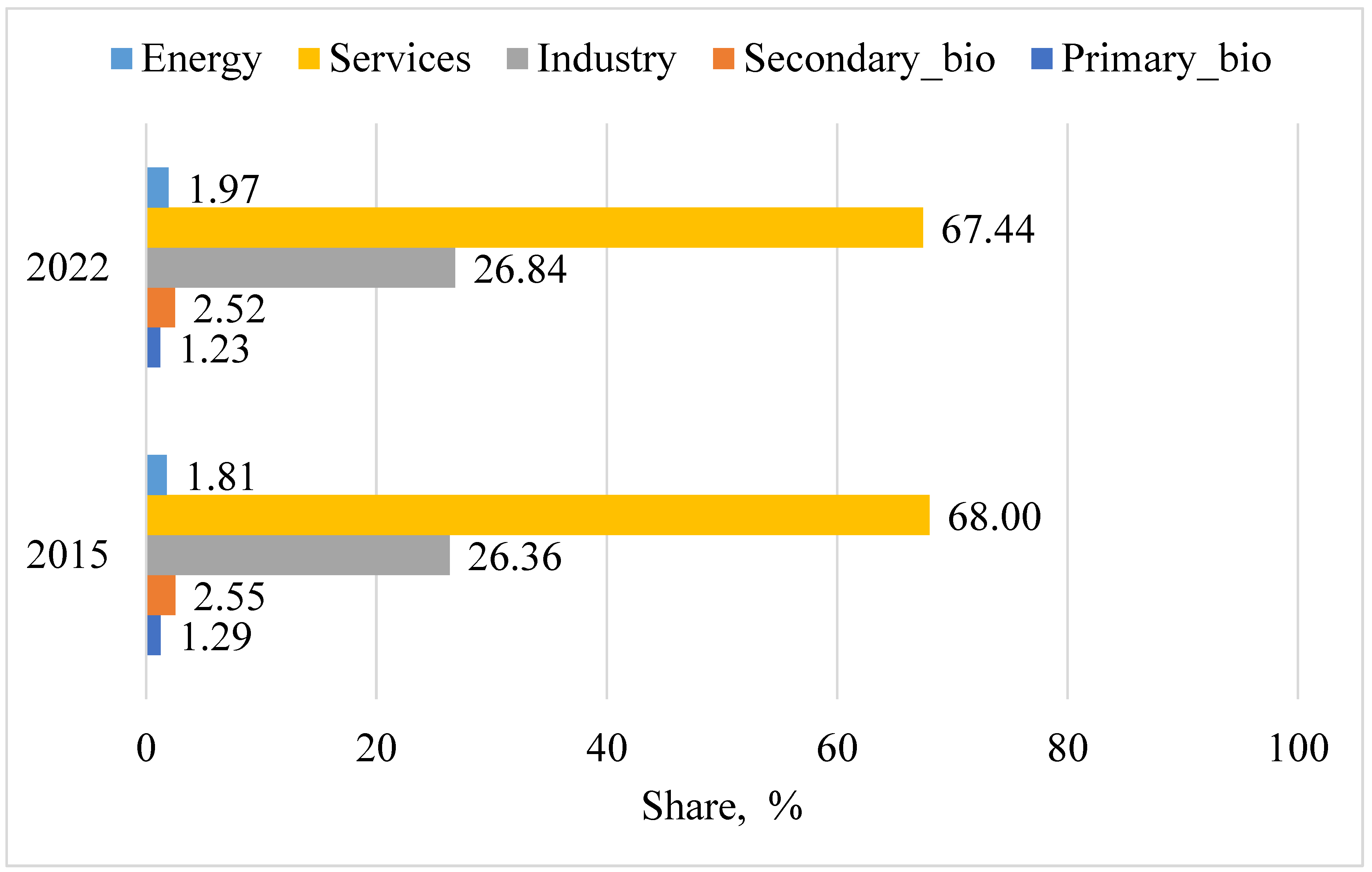
Figure 2.
Input shares 2015, 2022.
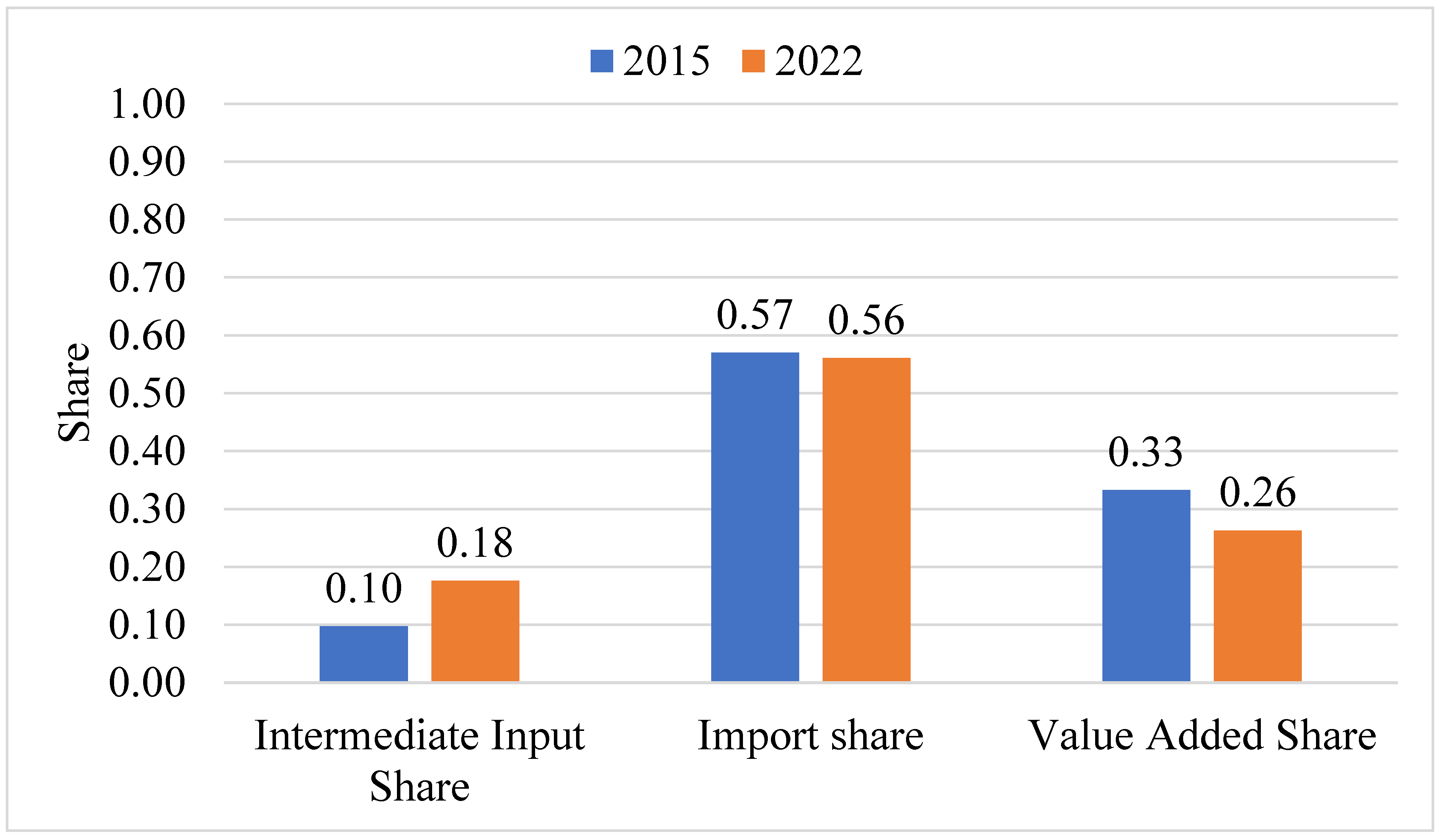
Figure 4.
Output share 2015, 2022.
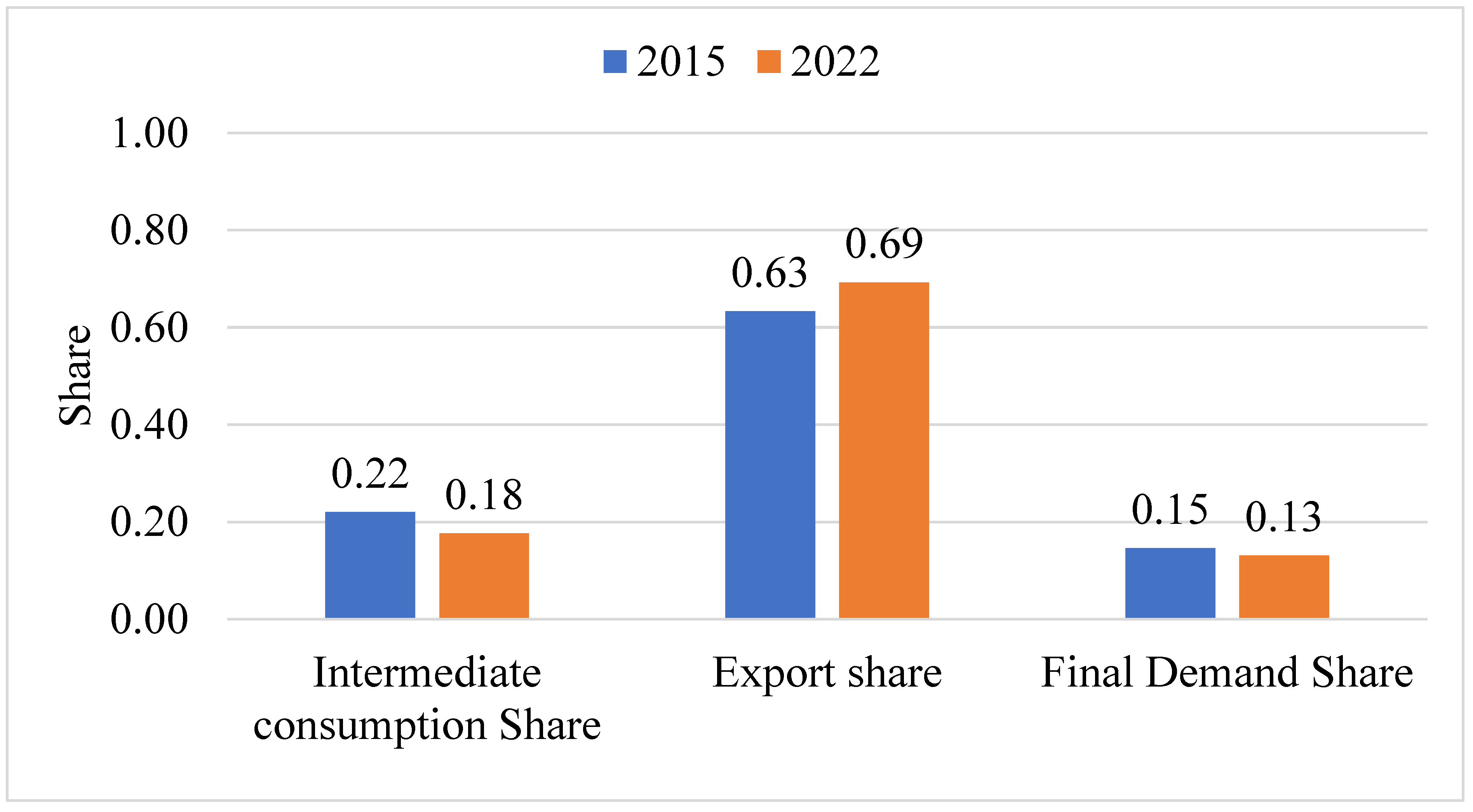
Figure 5.
Structural Evolution of Bioeconomy classes|. Output shares 2015, 2020, 2022. Note: Industry, services, and energy represent supporting sectors within the aggregated BIO input–output system and include both bio-based and non-bio activities interacting with bioeconomy production.
Figure 5.
Structural Evolution of Bioeconomy classes|. Output shares 2015, 2020, 2022. Note: Industry, services, and energy represent supporting sectors within the aggregated BIO input–output system and include both bio-based and non-bio activities interacting with bioeconomy production.
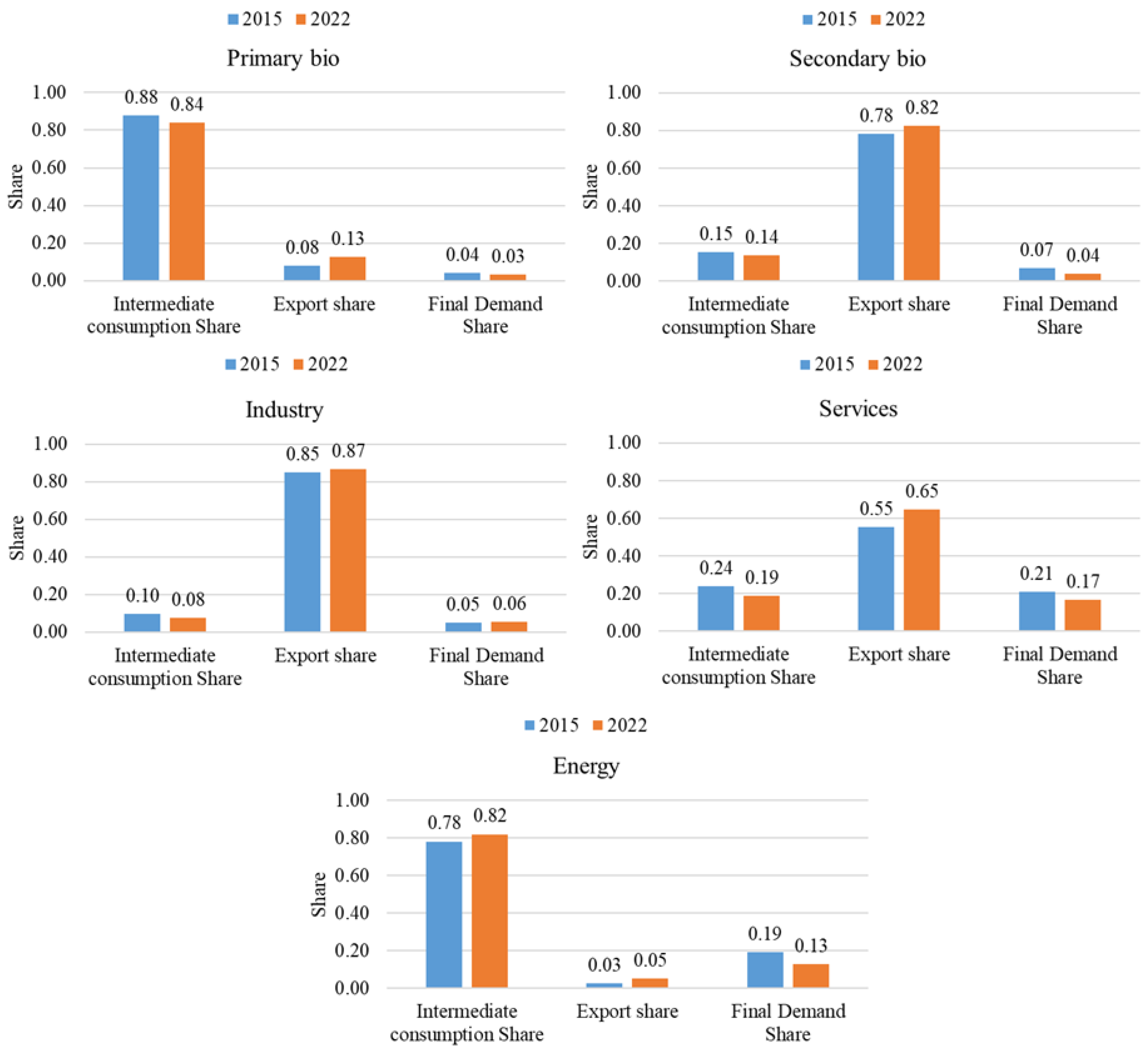
Figure 6.
Leontief, Tier I Multiplier 2015, 2022. Note: Industry, services, and energy represent supporting sectors within the aggregated BIO input–output system and include both bio-based and non-bio activities interacting with bioeconomy production.
Figure 6.
Leontief, Tier I Multiplier 2015, 2022. Note: Industry, services, and energy represent supporting sectors within the aggregated BIO input–output system and include both bio-based and non-bio activities interacting with bioeconomy production.
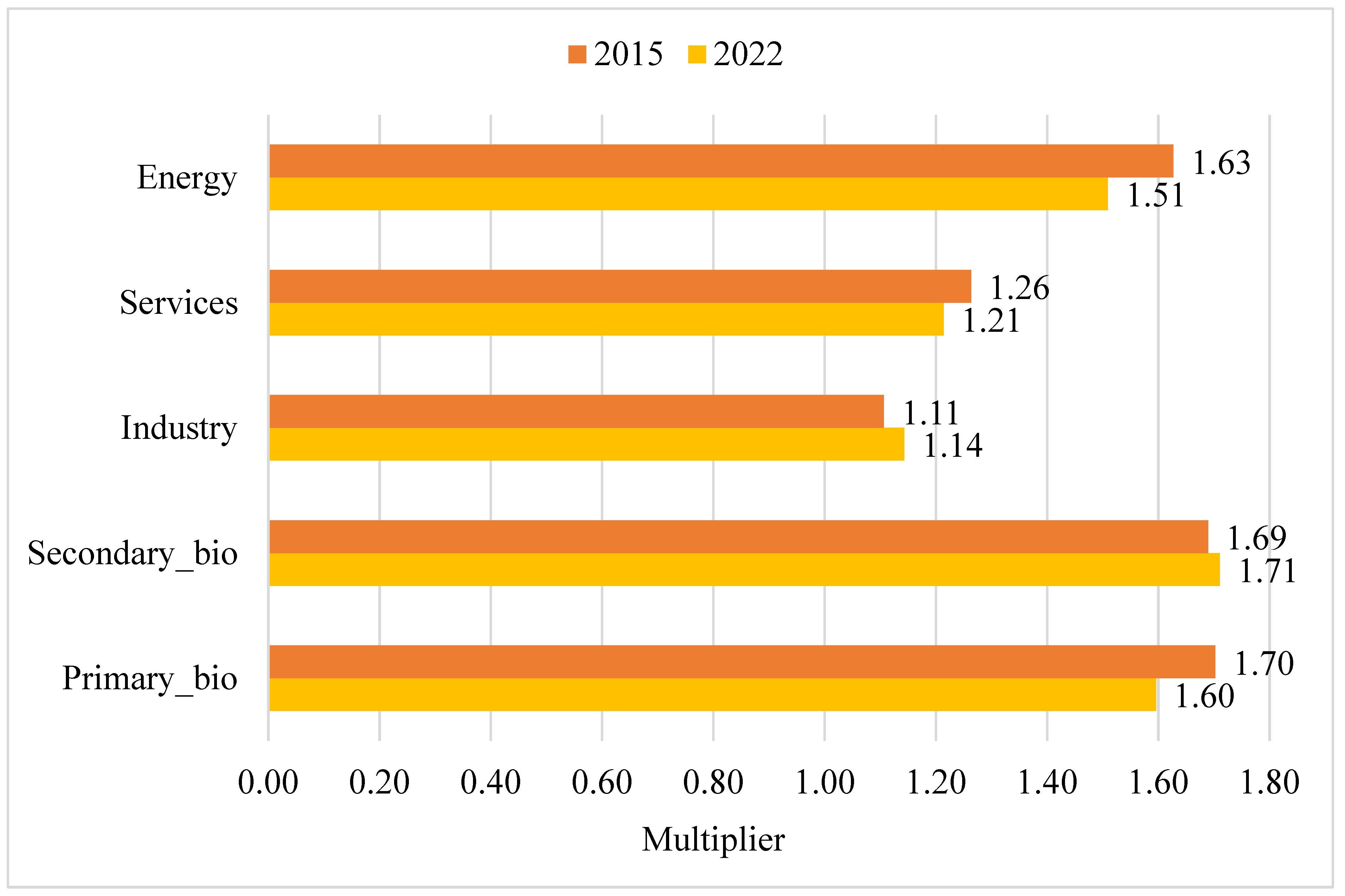
Figure 7.
Share of Sectoral Domestic B2B Inputs for top (3,4,5,6) Inputs, Ranked from Lowest to Highest expressed as the share of Nationally Purchased Domestic B2B inputs. Source: BIO.
Figure 7.
Share of Sectoral Domestic B2B Inputs for top (3,4,5,6) Inputs, Ranked from Lowest to Highest expressed as the share of Nationally Purchased Domestic B2B inputs. Source: BIO.
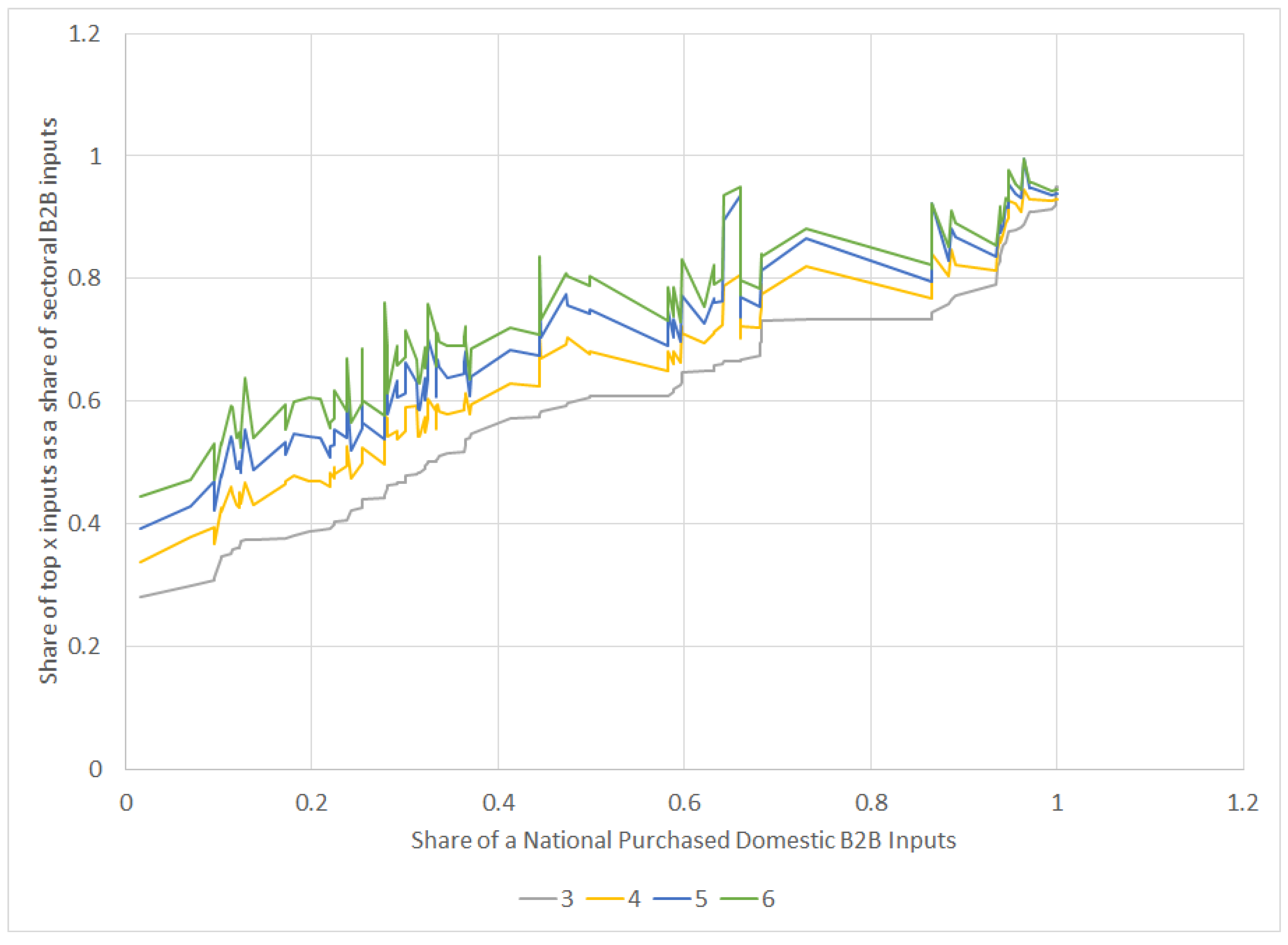
Figure 8.
Tier I Leontief Multipliers.
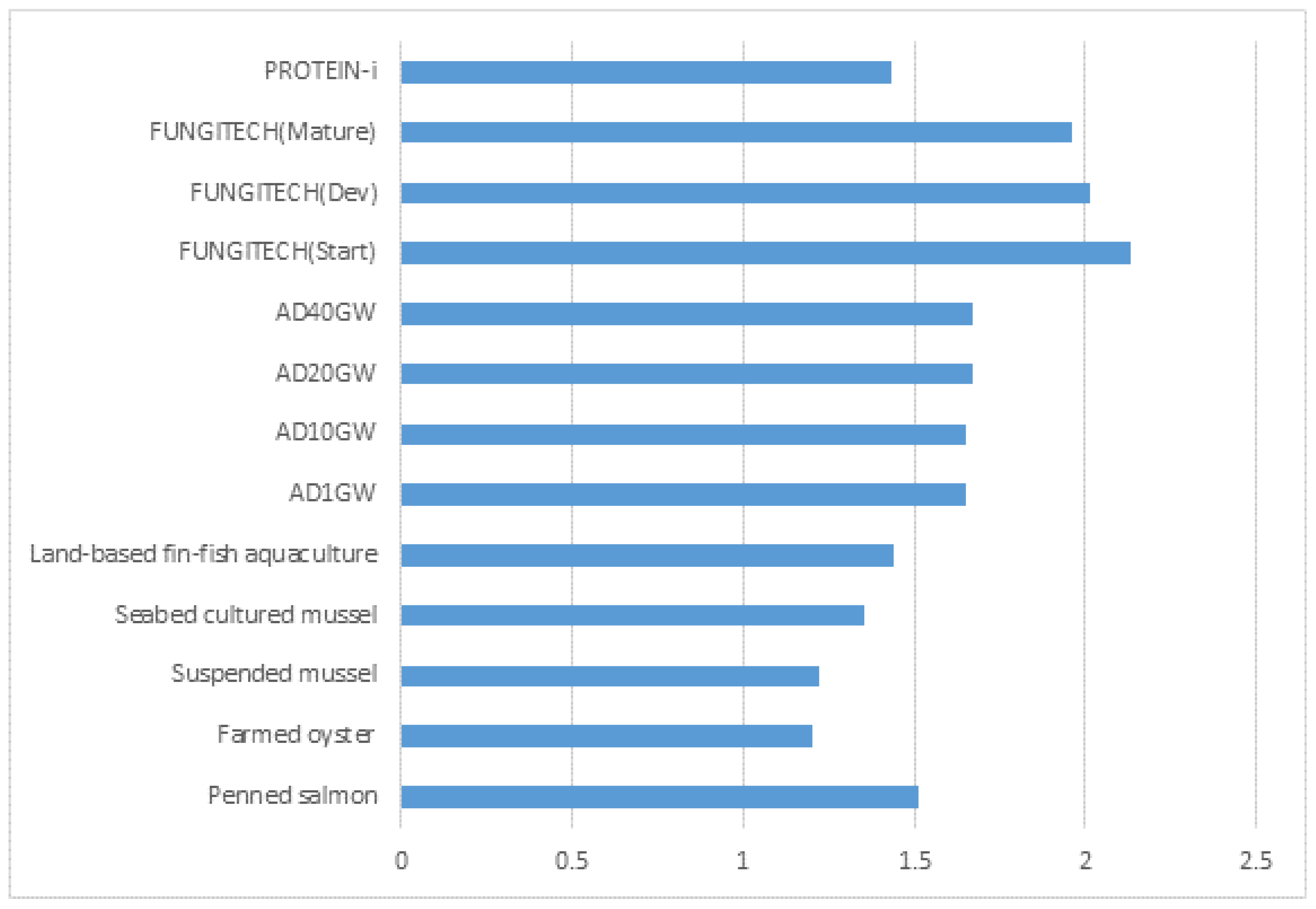
Figure 9.
Trend in Multipliers. Source: Stankova et al., (2025).
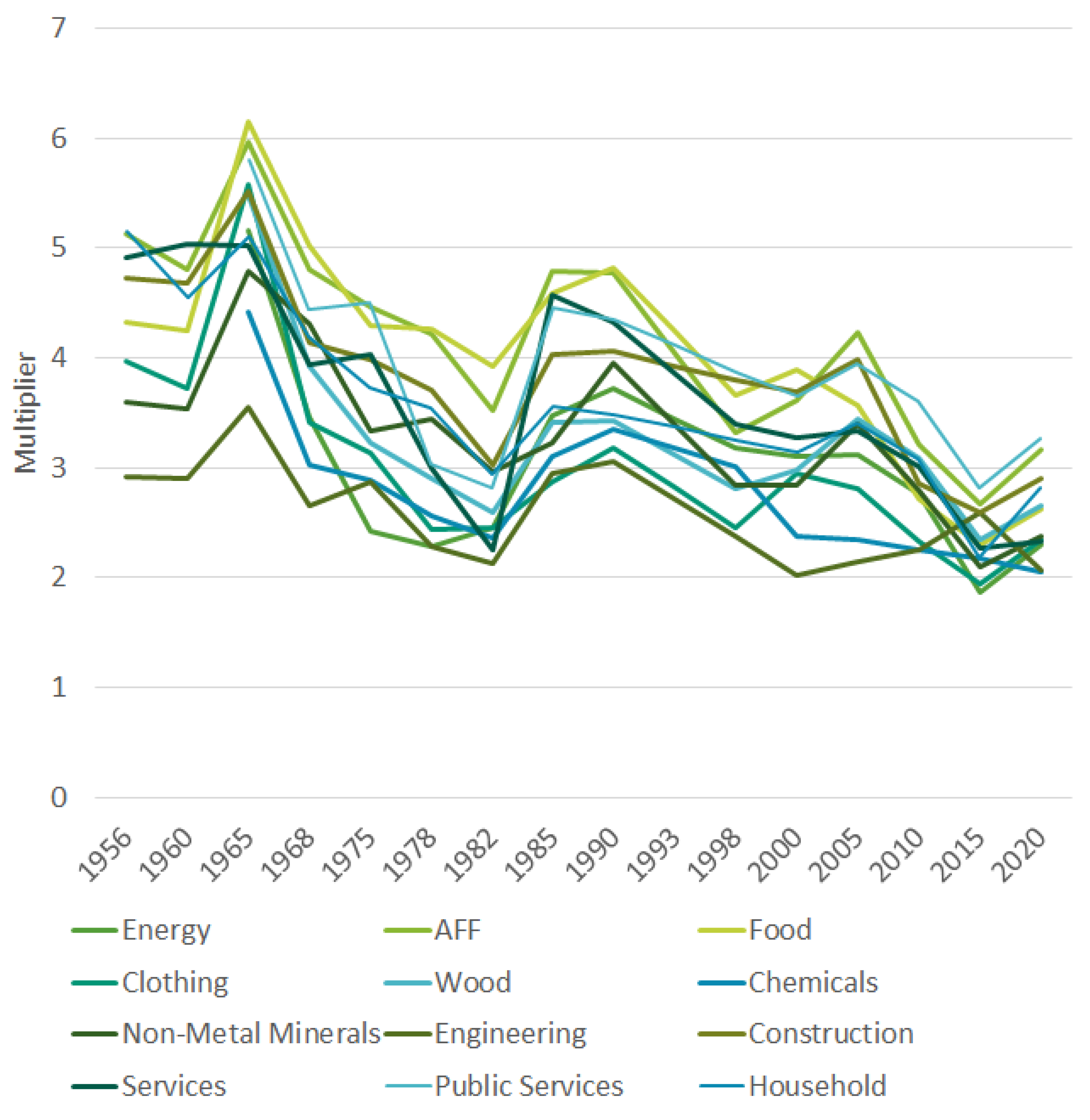

Table 1.
Input Output Table Structure
| Manu | Non-Manu | HH | G | Capital formation | Final Demand | Exports | Outputs | |
|---|---|---|---|---|---|---|---|---|
| Manu | ||||||||
| Non-Manu | ||||||||
| Taxes | ||||||||
| Imports | ||||||||
| Wages | ||||||||
| Profit | ||||||||
| Depreciation | ||||||||
| Value Added | ||||||||
Table 2.
Tier I Multiplier and Share of Domestic Intermediate Consumption.
| Agri | Manuf | Construct | Whole&Retail | Transp | Accomm | Commun | Finance&Prof | Admin | PubAdmin | Educ | Social | |
|---|---|---|---|---|---|---|---|---|---|---|---|---|
| Domestic IC Share | 0.464 | 0.081 | 0.304 | 0.084 | 0.222 | 0.132 | 0.124 | 0.063 | 0.099 | 0.129 | 0.148 | 0.121 |
| Value Added | 0.424 | 0.408 | 0.445 | 0.380 | 0.516 | 0.240 | 0.813 | 0.286 | 0.399 | 0.292 | 0.469 | 0.328 |
| Imports | 0.112 | 0.511 | 0.251 | 0.536 | 0.262 | 0.627 | 0.063 | 0.651 | 0.501 | 0.578 | 0.383 | 0.551 |
| Tier I Multiplier | 1.756 | 1.102 | 1.378 | 1.095 | 1.257 | 1.152 | 1.138 | 1.068 | 1.110 | 1.148 | 1.175 | 1.138 |
Table 3.
Top Input Sectors.
| Penned salmon | Farmed oyster | Suspended mussel | Seabed cultured mussel | Land-based fin-fish aquaculture | AD1GW | FUNGITECH(Start) | Porridge oats | Pea burger | Oat drink | Dried wheat pasta | |
|---|---|---|---|---|---|---|---|---|---|---|---|
| 1 | 0.247 | 0.000 | 0.000 | 0.000 | 0.172 | 0.709 | 0.150 | 0.300 | 0.300 | 0.250 | 0.300 |
| 2 | 0.107 | 0.121 | 0.184 | 0.262 | 0.273 | 0.101 | 0.450 | 0.300 | 0.380 | 0.350 | 0.300 |
| 3 | 0.053 | 0.055 | 0.132 | 0.095 | 0.048 | 0.070 | 0.150 | 0.250 | 0.200 | 0.300 | 0.200 |
| 4 | 0.051 | 0.060 | 0.042 | 0.050 | 0.034 | 0.000 | 0.120 | 0.070 | 0.060 | 0.050 | 0.100 |
| Other | 0.542 | 0.764 | 0.642 | 0.592 | 0.473 | 0.120 | 0.130 | 0.080 | 0.060 | 0.050 | 0.100 |
| Total | 1.000 | 1.000 | 1.000 | 1.000 | 1.000 | 1.000 | 1.000 | 1.000 | 1.000 | 1.000 | 1.000 |
| High Level Inputs | |||||||||||
| Labour | 0.107 | 0.358 | 0.368 | 0.318 | 0.206 | 0.160 | 0.550 | 0.330 | 0.330 | 0.330 | 0.330 |
| Capital | 0.079 | 0.131 | 0.133 | 0.087 | 0.107 | 0.206 | 0.074 | 0.000 | 0.000 | 0.000 | 0.000 |
| Imported Goods and Services | 0.147 | 0.206 | 0.203 | 0.151 | 0.171 | 0.014 | 0.000 | 0.609 | 0.609 | 0.609 | 0.609 |
| Purchased Goods and Services | 0.667 | 0.305 | 0.296 | 0.443 | 0.517 | 0.634 | 0.376 | 0.083 | 0.083 | 0.083 | 0.083 |
| Total | 1.000 | 1.000 | 1.000 | 1.000 | 1.000 | 1.000 | 1.000 | 1.000 | 1.000 | 1.000 | 0.000 |
Table 4.
Intermediate Input Share – NACE categories.
| Penned salmon | Farmed oyster | Suspended mussel | Seabed cultured mussel | Land-based fin-fish aquaculture | AD1GW | FUNGITECH(Start) | Porridge oats | Pea burger | Oat drink | Dried wheat pasta | |
|---|---|---|---|---|---|---|---|---|---|---|---|
| agri | 0.247 | 0.000 | 0.000 | 0.000 | 0.172 | 0.167 | 0.085 | 0.300 | 0.300 | 0.250 | 0.300 |
| manuf | 0.158 | 0.180 | 0.226 | 0.313 | 0.307 | 0.709 | 0.600 | 0.356 | 0.356 | 0.356 | 0.356 |
| construction | 0.053 | 0.055 | 0.132 | 0.095 | 0.048 | 0.009 | 0.005 | 0.004 | 0.006 | 0.004 | 0.006 |
| whole&ret | 0.017 | 0.017 | 0.017 | 0.017 | 0.017 | 0.001 | 0.006 | 0.029 | 0.045 | 0.029 | 0.045 |
| transp | 0.491 | 0.713 | 0.591 | 0.541 | 0.422 | 0.017 | 0.270 | 0.250 | 0.200 | 0.300 | 0.200 |
| accom | 0.001 | 0.001 | 0.001 | 0.001 | 0.001 | 0.003 | 0.001 | 0.001 | 0.002 | 0.001 | 0.002 |
| commun | 0.006 | 0.006 | 0.006 | 0.006 | 0.006 | 0.016 | 0.010 | 0.010 | 0.015 | 0.010 | 0.015 |
| finance&Prof | 0.026 | 0.026 | 0.026 | 0.026 | 0.026 | 0.070 | 0.019 | 0.045 | 0.070 | 0.045 | 0.070 |
| admin | 0.002 | 0.002 | 0.002 | 0.002 | 0.002 | 0.005 | 0.003 | 0.003 | 0.005 | 0.003 | 0.005 |
| pubadmin | 0.000 | 0.000 | 0.000 | 0.000 | 0.000 | 0.000 | 0.000 | 0.000 | 0.000 | 0.000 | 0.000 |
| educ | 0.000 | 0.000 | 0.000 | 0.000 | 0.000 | 0.000 | 0.000 | 0.000 | 0.000 | 0.000 | 0.000 |
| social | 0.001 | 0.001 | 0.001 | 0.001 | 0.001 | 0.003 | 0.001 | 0.001 | 0.002 | 0.001 | 0.002 |
Disclaimer/Publisher’s Note: The statements, opinions and data contained in all publications are solely those of the individual author(s) and contributor(s) and not of MDPI and/or the editor(s). MDPI and/or the editor(s) disclaim responsibility for any injury to people or property resulting from any ideas, methods, instructions or products referred to in the content. |
© 2026 by the authors. Licensee MDPI, Basel, Switzerland. This article is an open access article distributed under the terms and conditions of the Creative Commons Attribution (CC BY) license (http://creativecommons.org/licenses/by/4.0/).
Copyright: This open access article is published under a Creative Commons CC BY 4.0 license, which permit the free download, distribution, and reuse, provided that the author and preprint are cited in any reuse.


