

Submitted:
05 March 2026
Posted:
06 March 2026
You are already at the latest version
Abstract
9-Mesitylacridinium salts are widely recognized as efficient organic photoredox catalysts owing to their strong excited-state oxidizing power and stability under visible-light ir-radiation. In this study, a new mesityl acridinium derivative bearing a di-tert-butylphenyl substituent on the nitrogen atom was synthesized. The introduction of tert-butyl groups on the N-aryl moiety was primarily aimed at improving solubility and chemical stability of the acridinium salt. The target compound was obtained in high overall yield starting from a 9(10H)-acridinone precursor through a concise synthetic sequence. The synthesis consists of a copper-catalyzed C–N coupling reaction to install the aryl substituent on the nitrogen atom, followed by a Grignard reaction and subsequent acid treatment to afford the corresponding acridinium salt. All transformations proceeded smoothly, providing efficient access to the desired novel acridinium derivative. This work presents a practical example of structural modification of mesitylacridinium derivatives directed toward enhanced solubility and stability, and provides a useful synthetic plat-form for the preparation of structurally diverse acridinium salts.
Keywords:
acridinium
; acridinone
; organic catalyst
; grignard reaction
; photoredox catalyst
1. Introduction
Organic photoredox catalysis has emerged as a powerful strategy for promoting synthetically valuable transformations under mild reaction conditions, enabling access to reactive radical intermediates with high chemoselectivity and functional group tolerance [1,2,3,4,5,6]. Among the diverse classes of organic photocatalysts, acridinium salts have attracted sustained attention owing to their exceptionally effficient photoredox ability and modular structural tunability [7,8,9,10,11]. In particular, 9-mesityl-substituted acridinium catalysts, exemplified by N-methyl mesityl acridinium, display a nearly orthogonal arrangement between the acridinium core and the mesityl substituent [12]. Upon photoexcitation of the acridinium chromophore, rapid intramolecular electron transfer from the mesityl donor to the acridinium acceptor generates a long-lived charge-separated state [12,13]. This unique donor–acceptor electronic architecture suppresses rapid back-electron transfer and endows the catalyst with remarkable oxidative power in the excited state. As a consequence, mesitylacridinium derivatives have been extensively developed and applied to a wide range of oxidative C–H functionalizations, dehydrogenative couplings, and atom-transfer processes [14,15,16,17,18,19,20,21].
Despite these advances, structural variation at the nitrogen position has remained comparatively less explored, particularly with sterically demanding aryl substituents. We envisioned that incorporation of an aryl group bearing two tert-butyl substituents at the nitrogen atom would provide additional steric protection and increase solubility in organic media, especially in systems involving π-extension or multiple aryl substitutions on the acridinium framework. Guided by this design concept, we report herein the synthesis of 10-(3,5-di-tert-butylphenyl)-9-mesitylacridinium tetrafluoroborate as a novel N-aryl-substituted mesitylacridinium derivative.
2. Results and Discussion
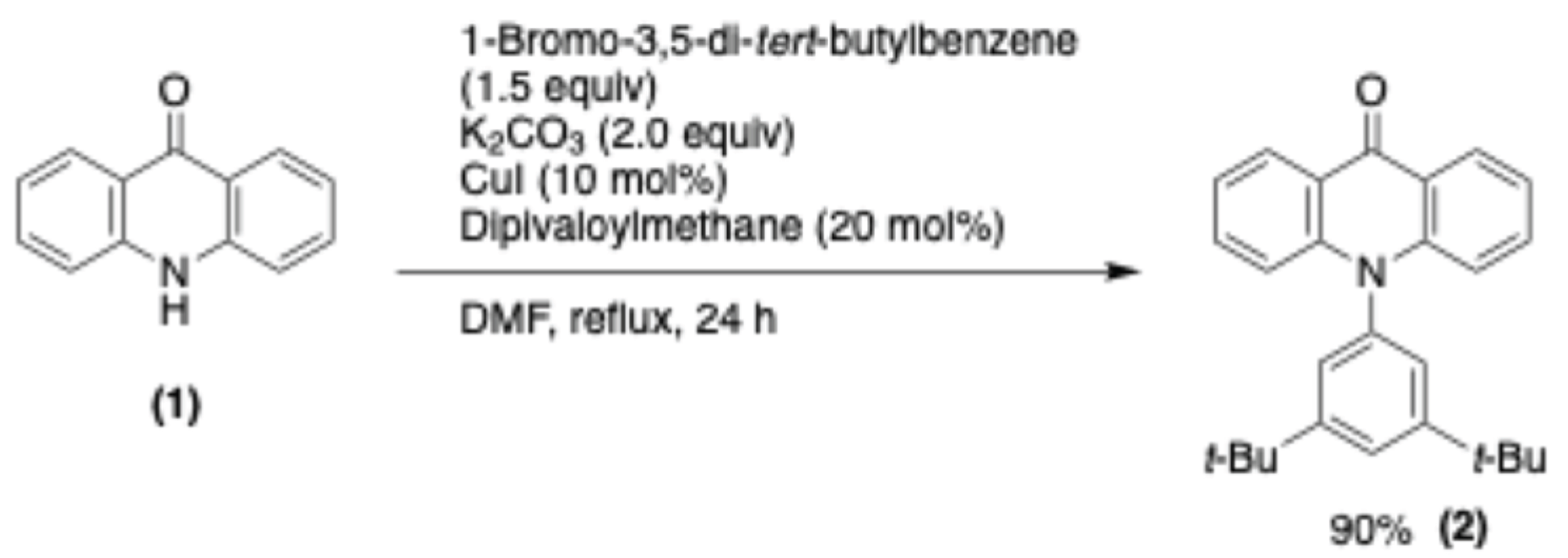
Commercially available 9(10H)-acridinone (1) was selected as the starting material, and N-arylation was accomplished via an Ullmann–Goldberg coupling strategy (Scheme 1) [2][27]. The aryl group was introduced using 1-bromo-3,5-di-tert-butylbenzene as the coupling partner in the presence of CuI and a β-diketone ligand, dipivaloylmethane [28], which is well established to promote efficient C–N bond formation under Ullmann–Goldberg coupling conditions. The reaction proceeded smoothly in DMF with potassium carbonate as the base under an inert atmosphere, delivering the desired N-aryl 9(10H)-acridinone in high yield. After aqueous workup and purification, 10-(3,5-di-tert-butylphenyl)-9(10H)-acridinone (2) was obtained as a pale yellow solid in 90% yield.
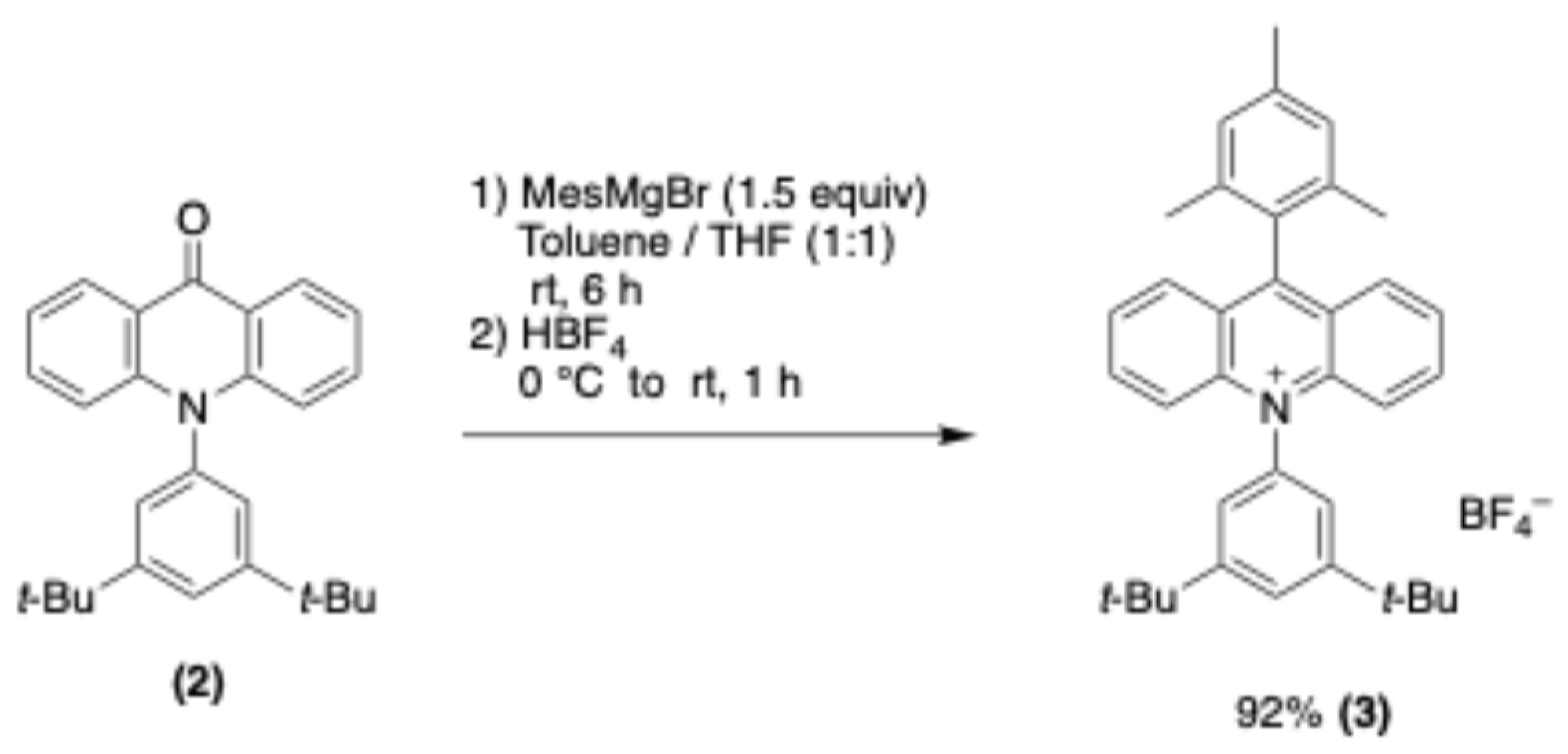
9-Mesityl substitution was introduced by a Grignard reaction followed by acid treatment of 10-(3,5-di-tert-butylphenyl)-9(10H)-acridinone (2) (Scheme 2). To a solution of 10-(3,5-di-tert-butylphenyl)-9(10H)-acridinone (2) in toluene was slowly added, via syringe, a separately prepared ca. 1.0 M THF solution of mesitylmagnesium bromide (MesMgBr, 1.5 equiv). During the addition, the reaction mixture gradually turned red. After stirring at room temperature for 6 h, the reaction mixture was cooled to 0 °C using an ice–water bath, and an excess amount of 48 wt% aqueous tetrafluoroboric acid (HBF4) was added, resulting in a color change to yellow.
The mixture was extracted with chloroform, and NaBF₄ was added to remove residual water from the organic phase. After filtration and concentration, the residue was dissolved in a small amount of dichloromethane, and diethyl ether was slowly added dropwise with stirring. A yellow precipitate formed, and diethyl ether was further added until no additional precipitate was observed. The resulting solid was collected by filtration to afford 10-(3,5-di-tert-butylphenyl)-9-mesitylacridinium tetrafluoroborate (3) as a yellow solid in 92% yield.
Figure 1.
Kohn–Sham HOMO and LUMO of 3 obtained from DFT calculations. Isosurfaces are plotted at 0.04 a.u.
Figure 1.
Kohn–Sham HOMO and LUMO of 3 obtained from DFT calculations. Isosurfaces are plotted at 0.04 a.u.
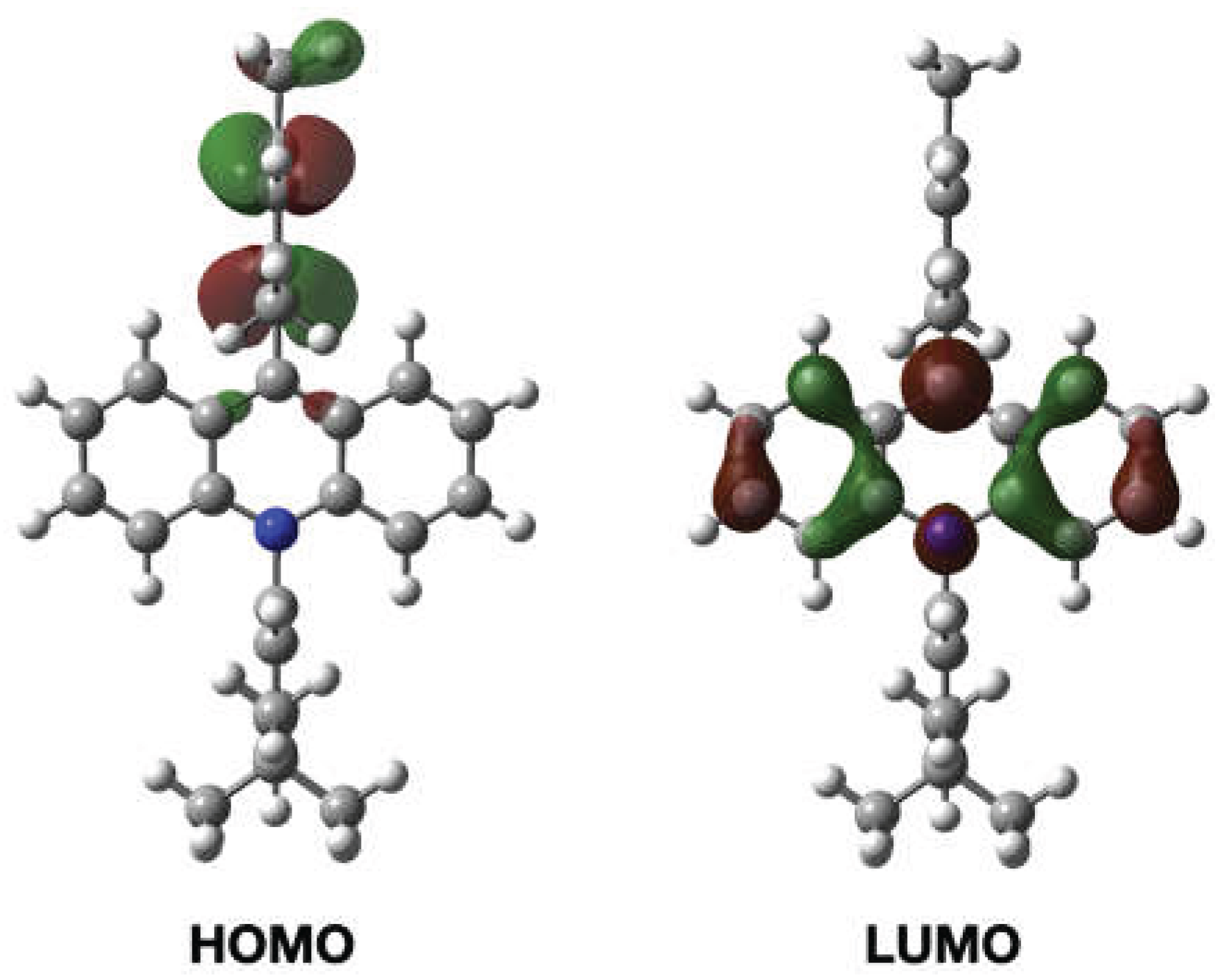
Computational studies were conducted at the CAM-B3LYP/6-311+G(d,p) level of theory to elucidate the electronic structure of the acridinium derivative. Geometry optimization revealed that the acridinium core and the mesityl substituent at the 9-position adopt an almost perfectly orthogonal conformation, with a calculated dihedral angle of 89.86°, effectively suppressing π-conjugative interaction between the two π-systems. This geometric decoupling is directly reflected in the Kohn–Sham frontier molecular orbitals: the HOMO is predominantly localized on the mesityl moiety, whereas the LUMO is primarily distributed over the acridinium framework. The corresponding orbital energies were calculated to be −5.12 eV (HOMO) and −10.67 eV (LUMO). Notably, this pronounced spatial separation of the frontier orbitals, together with the associated energy alignment, closely parallels the electronic structure reported for 10-methyl-9-mesitylacridinium, a prototypical organic photoredox catalyst. These results demonstrate that the present system preserves the characteristic donor–acceptor electronic architecture underlying efficient photoredox reactivity.
3. Materials and Methods
3.1. Materials
9(10H)-Acridinone (1), 1-bromo-3,5-di-tert-butylbenzene, and mesityl bromide were purchased from TCI (Tokyo, Japan). 48 wt% aqueous tetrafluoroboric acid was purchased from Sigma-Aldrich Co. LLC (St. Louis, MO, USA). All the other reagents were commercially available (reagent grade from TCI (Tokyo, Japan), FUJIFILM Wako Pure Chemical Corporation (Osaka, Japan), KISHIDA Chemical Co., Ltd. (Osaka, Japan), Kanto Chemical Co., Inc. (Tokyo, Japan), and Sigma-Aldrich Co. LLC (St. Louis, MO, USA)) and used as received. Flash column chromatography was performed with 40-50 mm Silica Gel 60 N (Kanto Chemical Co., Inc.). Nuclear magnetic resonance (NMR) spectra were recorded using a JEOL JMN-ECS-400 (1H: 400 MHz, 13C: 100 MHz) (Tokyo, Japan), with chemical shifts calibrated using tetramethylsilane (0 ppm for 1H NMR) or residual undeuterated solvent (CHCl3 at 77.16 ppm for 13C NMR). The abbreviations for multiplicities are as follows: s (singlet), d (doublet), t (triplet), q (quartet), m (multiplet), and br (broad). High-resolution mass spectra were acquired with a JEOL JMS-T100LP (Tokyo, Japan).
3.2. Synthetic Procedures
A flame-dried Schlenk tube equipped with a magnetic stir bar was charged with 9(10H)-acridinone (1, 390 mg, 2.0 mmol), CuI (38 mg, 0.20 mmol, 10 mol %), K₂CO₃ (553 mg, 4.0 mmol, 2.0 equiv), and 1-bromo-3,5-di-tert-butylbenzene (808 mg, 3.0 mmol, 1.5 equiv). The tube was evacuated and backfilled with argon (three cycles). Dipivaloylmethane (74 mg, 0.40 mmol, 20 mol %, 82 μL) and DMF (2 mL) were then added under an argon atmosphere. The reaction mixture was heated at reflux with stirring for 24 h.
After cooling to room temperature, an aqueous solution of NH₄Cl was added, and the mixture was stirred for 1 h. The reaction mixture was diluted with CHCl₃ and transferred to a separatory funnel. The organic layer was separated, washed with brine, dried over anhydrous Na₂SO₄, filtered, and concentrated under reduced pressure. Reprecipitation from CHCl₃/MeOH afforded the crude solid, which was collected by filtration and dried under vacuum to give 10-(3,5-di-tert-butylphenyl)-9(10H)-acridinone (2) as a pale yellow solid (690 mg, 90%). 1H-NMR (400 MHz, chloroform-d) δ 8.61 (dd, J = 8.0, 1.6 Hz, 2H), 7.67 (t, J = 1.8 Hz, 1H), 7.54-7.50 (m, 2H), 7.31-7.29 (m, 2H), 7.17 (d, J = 1.8 Hz, 2H), 6.78 (d, J = 8.2 Hz, 2H), 1.38 (s, 18H). The spectrum is shown in Figure S1.
A flame-dried Schlenk tube equipped with a magnetic stir bar was charged with 10-(3,5-di-tert-butylphenyl)-9(10H)-acridinone (2, 384 mg, 1.0 mmol) under an argon atmosphere. Toluene (1.5 mL) was added, and the resulting suspension was stirred. A 1.0 M solution of mesitylmagnesium bromide in THF (1.5 mL, 1.5 mmol, 1.5 equiv), prepared from mesityl bromide and magnesium, was added dropwise at room temperature. The reaction mixture was stirred for 6 h at room temperature. The reaction was then cooled in an ice–water bath, and 48 wt% aqueous tetrafluoroboric acid (1.0 mL) was added slowly dropwise with stirring. After stirring for 1 hour at 0 °C to room temperature, water and CHCl₃ were added, and the layers were separated. The organic phase was treated with NaBF₄ to remove residual water, filtered, and concentrated under reduced pressure. Reprecipitation from CH₂Cl₂/diethyl ether afforded 10-(3,5-di-tert-butylphenyl)-9-mesitylacridinium tetrafluoroborate (3) as a yellow solid (448 mg, 92%). 1H-NMR (400 MHz, chloroform-d) δ 8.17 (ddd, J = 9.2, 6.9, 1.4 Hz, 2H), 7.93 (dd, J = 8.7, 0.9 Hz, 2H), 7.89 (t, J = 1.6 Hz, 1H), 7.81 (ddd, J = 8.7, 6.9, 0.9 Hz, 2H), 7.60 (d, J = 9.2 Hz, 2H), 7.51 (d, J = 1.4 Hz, 2H), 7.18 (s, 2H), 2.50 (s, 3H), 1.87 (s, 6H), 1.44 (s, 18H). The spectrum is shown in Figure S2. 13C{1H}-NMR (101 MHz, chloroform-d) δ 164.3, 155.3, 142.2, 140.5, 139.0, 136.8, 136.4, 129.4, 129.2, 128.9, 128.7, 126.2, 125.6, 122.2, 120.3, 35.7, 31.5, 21.4, 20.3. The spectrum is shown in Figure S3. HRMS (ESI) m/z ([M]+) calcd for C36H40N: 486.31553, found: 486.31518. The spectrum is shown in Figure S4. FT-IR (ATR) νmax (cm−1): 2957, 2884, 1607, 1577, 1539, 1463, 1436, 1384, 1362, 1048, 1033. The spectrum is shown in Figure S5.
3.3. Calculations
DFT calculations were carried out with Gaussian 16 (Revision C.02, Gaussian, Inc., Wallingford, CT, USA) [29]. Geometry optimization for ground-state species was performed using the CAM-B3LYP functional [30] in combination with the 6-311+G(d,p) basis set. Vibrational frequency analysis was conducted at the same level of theory to characterize each stationary point: minimum was confirmed to have no imaginary frequencies. Cartesian coordinate of the optimized structure is shown in Table 1.
4. Conclusions
In summary, we have designed and synthesized 10-(3,5-di-tert-butylphenyl)-9-mesitylacridinium tetrafluoroborate (3) through sequential N-arylation of 9(10H)-acridinone (1) followed by mesityl Grignard addition and acid-mediated cyclization. The target acridinium salt was obtained in high overall yield under operationally straightforward conditions. Computational analysis at the CAM-B3LYP/6-311+G(d,p) level revealed an almost perfectly orthogonal arrangement between the acridinium core and the mesityl substituent (dihedral angle = 89.86°), leading to pronounced spatial separation of the Kohn–Sham frontier orbitals. The HOMO–LUMO distribution and energy profile closely parallel those of established mesitylacridinium systems, indicating preservation of the characteristic donor–acceptor electronic architecture. The present study provides a new N-aryl-substituted mesitylacridinium framework and contributes to the structural diversification of acridinium-based photocatalysts.
Supplementary Materials
The following supporting information can be downloaded at the website of this paper posted on Preprints.org, Figure S1-S3: 1H and 13C NMR spectra; Figure S4-S5, MS and IR spectra; Table S1: cartesian coordinate.
Author Contributions
Conceptualization, Y.I., and K.O.; methodology, Y.I., and K.O.; validation, Y.I., and K.O.; formal analysis, Y.I.; investigation, Y.I.; resources, K.O.; writing—review and editing, Y.I., and K.O.; supervision, Y.I., and K.O. All authors have read and agreed to the published version of the manuscript.
Funding
This work was supported by JSPS KAKENHI Grants (JP23K13709 to Y.I., and JP24K21770 to K.O.).
Data Availability Statement
The Supplementary Materials are available free of charge on the website.
Acknowledgments
The authors thank the Faculty of Pharmaceutical Sciences, The University of Osaka, for assistance with high-resolution mass spectrometry (HRMS) measurements. The authors also thank Ms. Kei Umino for assistance with the synthesis.
Conflicts of Interest
The authors declare no conflicts of interest.
References
- Fukuzumi, S.; Ohkubo, K. Organic Synthetic Transformations using Organic Dyes as Photoredox Catalysts. Org. Biomol. Chem. 2014, 12, 6059–6071. [Google Scholar] [CrossRef] [PubMed]
- Fukuzumi, S.; Ohkubo, K. Selective Photocatalytic Reactions with Organic Photocatalysts. Chem. Sci. 2013, 4, 561–574. [Google Scholar] [CrossRef]
- Shaw, M.H.; Twilton, J.; MacMillan, D.W.C. Photoredox Catalysis in Organic Chemistry. J. Org. Chem. 2016, 81, 6898–6926. [Google Scholar] [CrossRef]
- Fukuzumi, S.; Lee, Y.-M.; Nam, W. Bioinspired artificial photosynthesis systems. Tetrahedron 2020, 76, 131024. [Google Scholar] [CrossRef]
- Lee, Y.-M.; Nam, W.; Fukuzumi, S. Redox catalysis via photoinduced electron transfer. Chem. Sci. 2023, 14, 4205–4218. [Google Scholar] [CrossRef] [PubMed]
- Yoshimi, Y. Organic Photoredox Reactions in Two-Molecule Photoredox System. Chem. Rec. 2024, 24, e202300326. [Google Scholar] [CrossRef] [PubMed]
- Fukuzumi, S.; Kuroda, S.; Tanaka, T. Selective Photoalkylation of 10-Methylacridinium Ion with Tetra-alkylstannanes or Diethylmercury Using Visible Irradiation. J. Chem. Soc., Chem. Commun. 1986, 1553–1554. [Google Scholar] [CrossRef]
- Fukuzumi, S.; Kuroda, S.; Tanaka, T. Substrate-Selective Photo-Oxidation of Benzyl Alcohol Derivatives with Oxygen, Catalysed by an NAD⁺ Model Compound. J. Chem. Soc., Chem. Commun. 1987, 120–122. [Google Scholar] [CrossRef]
- Fukuzumi, S.; Kitano, T.; Tanaka, T. Reduction of 10-Methylacridinium Ion with Fatty Acids by Photoinduced Electron-Transfer Reactions. Chem. Lett. 1989, 18, 1231–1234. [Google Scholar] [CrossRef]
- Fukuzumi, S.; Kitano, T.; Mochida, K. Photo-Induced One-Electron Reduction of 10-Methylacridinium Ion with Group 14 Dimetallic Compounds Using Visible Irradiation. J. Chem. Soc., Chem. Commun. 1990, 1236–1237. [Google Scholar] [CrossRef]
- Fukuzumi, S.; Yorisue, T. 10,10′-Dimethyl-9,9′-biacridine Acting as a Unique Electron Source Compared with the Corresponding Monomer for the Efficient Reduction of Dioxygen, Catalysed by a Cobalt Porphyrin in the Presence of Perchloric Acid. J. Chem. Soc., Perkin Trans. 2 1991, 1607–1611.
- Fukuzumi, S.; Kotani, H.; Ohkubo, K.; Ogo, S.; Tkachenko, N.V.; Lemmetyinen, H. Electron-Transfer State of 9-Mesityl-10-methylacridinium Ion with a Much Longer Lifetime and Higher Energy Than That of the Natural Photosynthetic Reaction Center. J. Am. Chem. Soc. 2004, 126, 1600–1601. [Google Scholar] [CrossRef] [PubMed]
- Hoshino, M.; Uekusa, H.; Tomita, A.; Koshihara, S.; Sato, T.; Nozawa, S.; Adachi, S.; Ohkubo, K.; Kotani, H.; Fukuzumi, S. Determination of the Structural Features of a Long-Lived Electron-Transfer State of 9-Mesityl-10-methylacridinium Ion. J. Am. Chem. Soc. 2012, 134, 4569–4572. [Google Scholar] [CrossRef]
- Ohkubo, K.; Fujimoto, A.; Fukuzumi, S. Metal-free Oxygenation of Cyclohexane with Oxygen Catalyzed by 9-Mesityl-10-methylacridinium and Hydrogen Chloride under Visible Light Irradiation. Chem. Commun. 2011, 47, 8515–8517. [Google Scholar] [CrossRef] [PubMed]
- Joshi-Pangu, A.; Lévesque, F.; Roth, H.G.; Oliver, S.F.; Campeau, L.-C.; Nicewicz, D.; DiRocco, D.A. Acridinium-Based Photocatalysts: A Sustainable Option in Photoredox Catalysis. J. Org. Chem. 2016, 81, 7244–7249. [Google Scholar] [CrossRef]
- White, A.R.; Wang, L.; Nicewicz, D.A. Synthesis and Characterization of Acridinium Dyes for Photoredox Catalysis. Synlett 2019, 30, 827–832. [Google Scholar] [CrossRef]
- Lakhdar, S. Acridinium Salts and Cyanoarenes as Powerful Photocatalysts: Opportunities in Organic Synthesis. Chem. Rev. 2021, 121, 19526–19549. [Google Scholar]
- Itabashi, Y.; Asahara, H.; Ohkubo, K. Chlorine-Radical-Mediated C–H Oxygenation Reaction under Light Irradiation. Chem. Commun. 2023, 59, 7506–7517. [Google Scholar] [CrossRef] [PubMed]
- Tanabe, S.; Mitsunuma, H.; Kanai, M. Catalytic Allylation of Aldehydes Using Unactivated Alkenes. J. Am. Chem. Soc. 2020, 142, 12374–12381. [Google Scholar] [CrossRef] [PubMed]
- Matsuda, M.; Uchiyama, M.; Itabashi, Y.; Ohkubo, K.; Kamigaito, M. Acridinium Salts as Photoredox Organocatalysts for Photomediated Cationic RAFT and DT Polymerizations of Vinyl Ethers. Polym. Chem. 2022, 13, 1031–1039. [Google Scholar] [CrossRef]
- Ohkubo, K.; Matsumoto, S.; Asahara, H.; Fukuzumi, S. 9-(4-Halo-2,6-xylyl)-10-methylacridinium Ion as an Effective Photoredox Catalyst for Oxygenation and Trifluoromethylation of Toluene Derivatives. ACS Catal. 2024, 14, 2671–2684. [Google Scholar] [CrossRef]
- Ullmann, F. Ueber eine neue Bildungsweise von Diphenylaminderivaten. Ber. Dtsch. Chem. Ges. 1903, 36, 2382–2384. [Google Scholar] [CrossRef]
- Ullmann, F. Ueber eine neue Darstellungsweise von Phenyläthersalicylsäure. Ber. Dtsch. Chem. Ges. 1904, 37, 853–854. [Google Scholar] [CrossRef]
- Goldberg, I. Ueber Phenylirungen bei Gegenwart von Kupfer als Katalysator. Ber. Dtsch. Chem. Ges. 1906, 39, 1691–1692. [Google Scholar] [CrossRef]
- Ley, S. V.; Thomas, A. W. Modern Synthetic Methods for Copper-Mediated C(aryl)–O, C(aryl)–N, and C(aryl)–S Bond Formation. Angew. Chem. Int. Ed. 2003, 42, 5400–5449. [Google Scholar] [CrossRef] [PubMed]
- Kunz, K.; Scholz, U.; Ganzer, D. Renaissance of Ullmann and Goldberg Reactions—Progress in Copper-Catalyzed C–N-, C–O-, and C–S-Coupling. Synlett 2003, 15, 2428–2439. [Google Scholar] [CrossRef]
- Seifinoferest, B.; Tanbakouchian, A.; Larijani, B.; Mahdavi, M. Ullmann–Goldberg and Buchwald–Hartwig C–N Cross Couplings: Synthetic Methods to Pharmaceutically Potential N-Heterocycles. Asian J. Org. Chem. 2021, 10, 1319–1344. [Google Scholar] [CrossRef]
- Buck, E.; Song, Z. J.; Tschaen, D.; Dormer, P. G.; Volante, R. P.; Reider, P. J. Ullmann Diaryl Ether Synthesis: Rate Acceleration by 2,2,6,6-Tetramethylheptane-3,5-dione. Org. Lett. 2002, 4, 1623–1626. [Google Scholar] [CrossRef]
- Gaussian 16, Revision C.02, M. J. Frisch, G. W. Trucks, H. B. Schlegel, G. E. Scuseria, M. A. Robb, J. R. Cheeseman, G. Scalmani, V. Barone, G. A. Petersson, H. Nakatsuji, X. Li, M. Caricato, A. V. Marenich, J. Bloino, B. G. Janesko, R. Gomperts, B. Mennucci, H. P. Hratchian, J. V. Ortiz, A. F. Izmaylov, J. L. Sonnenberg, D. Williams-Young, F. Ding, F. Lipparini, F. Egidi, J. Goings, B. Peng, A. Petrone, T. Henderson, D. Ranasinghe, V. G. Zakrzewski, J. Gao, N. Rega, G. Zheng, W. Liang, M. Hada, M. Ehara, K. Toyota, R. Fukuda, J. Hasegawa, M. Ishida, T. Nakajima, Y. Honda, O. Kitao, H. Nakai, T. Vreven, K. Throssell, J. A. Montgomery, Jr., J. E. Peralta, F. Ogliaro, M. J. Bearpark, J. J. Heyd, E. N. Brothers, K. N. Kudin, V. N. Staroverov, T. A. Keith, R. Kobayashi, J. Normand, K. Raghavachari, A. P. Rendell, J. C. Burant, S. S. Iyengar, J. Tomasi, M. Cossi, J. M. Millam, M. Klene, C. Adamo, R. Cammi, J. W. Ochterski, R. L. Martin, K. Morokuma, O. Farkas, J. B. Foresman, D. J. Fox, Gaussian, Inc. Wallingford CT, 2019.
- Yanai, T.; Tew, D.; Handy, N. A new hybrid exchange-correlation functional using the Coulomb-attenuating method (CAM-B3LYP). Chem. Phys. Lett. 2004, 393, 51–57. [Google Scholar] [CrossRef]
Scheme 1.
Ullmann–Goldberg coupling reaction for N-arylation.
Scheme 2.
Grignard reaction for mesityl substitution.
Disclaimer/Publisher’s Note: The statements, opinions and data contained in all publications are solely those of the individual author(s) and contributor(s) and not of MDPI and/or the editor(s). MDPI and/or the editor(s) disclaim responsibility for any injury to people or property resulting from any ideas, methods, instructions or products referred to in the content. |
© 2026 by the authors. Licensee MDPI, Basel, Switzerland. This article is an open access article distributed under the terms and conditions of the Creative Commons Attribution (CC BY) license (http://creativecommons.org/licenses/by/4.0/).
Copyright: This open access article is published under a Creative Commons CC BY 4.0 license, which permit the free download, distribution, and reuse, provided that the author and preprint are cited in any reuse.


