

Submitted:
04 March 2026
Posted:
06 March 2026
You are already at the latest version
Abstract
Nerolidol (NER) is a sesquiterpene alcohol with recognized antimicrobial potential, whose applications as pure substance are limited by hydrophobicity, instability, and cytotoxicity. Invasomes, i.e. liposomes with terpene ingredients, offer a strategy to improve its delivery; however, the NER loading limits compatible with vesicle integrity are still unclear. Here, Nerolidol-loaded invasomes were produced using a controlled simil-microfluidic coaxial injection process. As a preliminary step, unloaded liposomes were fabricated to consolidate operating conditions and ensure their reproducible colloidal properties. Thereafter, formulations with progressively decreasing nominal NER loads were investigated to evaluate vesicle size, polydispersity, ζ-potential, encapsulation efficiency, effective loading, and stability. High nominal loads promoted turbidity, size increase (by agglomeration coalescence phenomena), and structural instability, whereas formulations containing approximately 1–2% NER achieved nearly complete encapsulation, Z-average ≈ 300 nm, |ζ| > 30 mV, and satisfactory physical stability. Antimicrobial and cytotoxic profiles of representative formulations, previously evaluated in an independent study, confirmed biological activity. Overall, this work identifies a realistic loading window for Nerolidol invasomes and highlights the suitability of the simil-microfluidic approach to obtain scalable, well-controlled formulations, providing a rational basis for their future biological assessment. Nerolidol invasomes systems indeed can be considered a promising versatile platform for antimicrobial applications, including prospective use in animal feed.
Keywords:
nanoliposomes
; invasome
; Nerolidol
; simil-microfluidic technology
; antimicrobic activity
1. Introduction
Natural resources represent an invaluable reservoir of wealth for human needs, their respect and effective utilization is a key challenge in promoting sustainable consumption and production models [1,2]. These models form the foundation of global political and economic strategies aimed at securing the well-being of both current and future generations (as outlined in Goals 3 and 12 of the United Nations Agenda 2030) [3,4]. To address these challenges, advanced technologies are required to transform natural resources into products with broad applications, while to face continually the process intensification paradigms (better process, responsible use of materials and energy sources, reduced environmental impact) [5].
One of the most important areas for harnessing natural resources is the pharmaceutical and nutraceutical sectors, as evidenced by the millennia-long use of plants and herbs in traditional medicine [3]. Among the main limitations of using natural products are biodegradability and the safe dosing of compounds that can exert therapeutic / functional effects. For these reasons, the production of suitable delivery systems is, as appropriate active / useful ingredients, a key step in the development of new, effective and safe pharmaceutical-nutraceutical products. Nanotechnology, by its various implementation forms, represents the most recent response to the need for preparing highly efficient dosage forms [6,7,8,9].
Drawing on previous experiences in producing nanoliposomal carriers via microfluidic nanotechnology [8,10,11,12], this study focused on developing lipid vesicles to encapsulate Nerolidol, a natural compound with powerful recognized healthcare features [13]. As widely shown in scientific literature, lipid vesicles, i.e. phospholipid-based colloidal particles featuring lipid bilayers enclosing a central aqueous or hydroalcoholic compartment [14,15], were purposely designed to leverage Nerolidol and other terpenes significant antimicrobial, anti-inflammatory, antiparasitic, antifungal, antioxidant, and cancer-preventative properties [6,16,17,18,19,20].
Nerolidol is, in its natural form, also commonly used as fragrant ingredient in the food industry (classified as a flavoring agent by the EU Food Improvement Agents and the Joint FAO/WHO Expert Committee on Food Additives - JECFA number 1646) and in cosmetics formulations such as fine fragrances, shampoos, toilet soaps, and other toiletries [18,21,22]. Moreover, Nerolidol in essential oil of plant derivatives, is used also as feed additives (PFAs) in animal nutrition [23].
From a chemical standpoint, Nerolidol is a sesquiterpene alcohol and, biologically, is a secondary metabolite of many plants spread throughout the World with growing adapted at different climate. Commonly it can find in different species of lavender, tea tree, neroli, ginger, jasmine, lemon grass and as abundant component, in essential oil (EO), of species such as Cannabis sativa, Brassavola nodosa and Dalbergia parviflora [13,24]. Nerolidol, therefore, can be obtained very easily, in particular from various parts of plants such as leaves, flowers, seeds, fruits, resins, twigs and wood. Based on literature references, leaves are the most common source for Nerolidol extraction. Seasonal variation is one of the main factors influencing the composition of essential oils in plants, including the concentration of Nerolidol [13].
Among the wide fields of scientific interest and applications, in this study, Nerolidol was selected to produce and test liposomal loaded systems for its antimicrobial features. Many researches in the literature considers nanoliposomes (NLPs) as excellent vehicles for encapsulating antibacterial agents for different purposes: food and agriculture, cosmeceutics, pharmaceutics [16,19,25,26,27]. Encapsulation overcomes the drawbacks of direct applications of antibacterial compounds such as low stability and solubility; possible unwanted interactions with surrounding agents/ingredients which allow possible side effects such as intolerances, decrease in antimicrobial efficiency, physical and chemical alterations (integrity, consistence, color, taste) [19,25]. Moreover, nanocarriers ensure, thanks to their high surface/volume ratio, an increase in solubility, dispersibility and bioavailability, while at the same time improving the controlled release of nanoencapsulated antimicrobial agents. Nanoliposomes, in particular, represent suitable vehicles due to their composition and structure: they are able to incorporate lipophilic, hydrophilic and amphiphilic compounds and their similarity of the external structure to that of bacterial cells leads them to more easily target bacteria [19]. Furthermore, the encapsulation of Nerolidol (and terpenes in general) in liposomal vesicles, which formulation starting from use of ethanol, also leads to an extraordinary potential of the resulting structures: an extreme flexibility of the liposomal architecture. The terminology “invasome” is used to indicate this kind of carriers, extraordinary vehicles since characterized by marked permeability throughout biological barriers including animal mucosae and skin. For this reason, invasomes are particularly suitable for transdermal administration with all the innumerable advantages that this entails [28]. In many studies it is highlighted the exploitation of terpenes in liposomes as drug permeability enhancers, especially in formulation of transdermal drug delivery systems [26]. Indeed, terpenes also when not used for their direct functional properties (antibacterial, pharmacological etc...) they also are specifically introduced into formulations to improve the therapeutic profile of other ingredients. In Table 1, in particular, uses of Nerolidol as permeability enhancer in drug control release, are summarized.
In this work we investigated the fabrication of Nerolidol-loaded invasomes by means of a controlled simil-microfluidic coaxial injection process. As a preliminary step, unloaded liposomes were produced and characterized to consolidate the operating conditions and formulation parameters that ensure reproducible vesicle formation and long colloidal stability. In parallel, the antimicrobial and cytotoxic properties of the obtained formulations were assessed confirming both their biological activity and the feasibility of a sterile-compatible production workflow. These obtained results have been already published [31]. Building on previously validated operating conditions, we first explored high nominal Nerolidol loads to assess their impact on vesicles formation, colloidal stability and payload retention. Based on these observations, the loading strategy was progressively refined with the aim of identifying a realistic formulation window in which encapsulation efficiency, vesicle integrity and physical stability can be simultaneously preserved. The combined process–formulation analysis presented here provides quantitative insights into the actual loading limits of Nerolidol in invasomes and establishes a robust basis for subsequent biological applications.
2. Materials and Methods
2.1. Materials
Nerolidol liposomal. Cholesterol (CHOL) (CAS no. 57-88-5), L-α-Phosphatidylcholine (PC) from soybean, type II-S, with a choline basis of 14–23% (CAS no. 8002-43-5), analytical grade ethanol (CAS no. 64-17-5), and Nerolidol (NER) (CAS no. 7212-44-4) were purchased from Sigma Aldrich (Milan, Italy) and used without further processing (in structure and main properties are summarized in Figure 1 and Table 2, respectively). Acetonitrile (CAS number: 75-05-8) for HPLC analytic control was supplied by Carlo Erba Reagents, DASIT Group Spa (Cornareto, Milan – Italy). Deionized water was produced using a laboratory deionizer.
Chemically, Nerolidol belongs to the class of sesquiterpenoids, a type of terpene comprising three consecutive isoprene units. As illustrated in Figure 1, its structure features methyl groups at positions 3, 7, and 11, along with a hydroxyl group at position 3. Nerolidol exists as two geometric isomers: cis and trans, depending on the orientation around the central bond. It exhibits solubility in ethanol and low solubility in water.
2.2. Setup and Fluido Dynamic Conditions for Invasomes Fabrication
2.2.1. Setup and Fluid Dynamic Insights
To overcome the challenges associated with traditional nanoliposome productions, such as harsh operating conditions, use of toxic solvents, multiple post-processing steps, poorly controlled environments, low output volumes, and the high costs of microfluidic devices, the new technology, called 'simil-microfluidic', has been exploited. This technology provides precise fluid dynamics control and eliminates the mentioned limits making it a promising solution for high-throughput nanovesicles manufacturing. It enables the production of homogeneous lipid vesicles in a single step at room temperature, directly at the nanoscale, by controlling the interaction of two phases through a coaxial insertion system where pumps deliver the lipid and the hydration solution. The fabricated simil-microfluidic apparatus was presented in details in previous works [11,32]; an update piping diagram representation is proposed Figure 2.
Under the operative conditions tested and used in this study, i.e. volumetric flow rates of 7.5 10-7 m3/s for the aqueous phase (Vhs) and 0.75 10-7 m3/s for the ethanolic phase (Vls), a laminar regime is maintained for the resulting hydroalcoholic suspensions (NRe = 240; and 8.25 10-7 m3/s mixing flow rate). At these conditions, the mixing between the two phases is predominantly driven by diffusion mechanisms [10]; the interdiffusion of water and the organic solvent phenomenon reduces lipid solubility, and this reduction, coupled with the thermodynamic instability of the phospholipid bilayer fragments edges, promotes curvature and closure of the bilayer fragments, leading to the formation of liposomal vesicles [33].
2.2.2. Invasomes Fabrication
The simil-microfluidic system is capable of continuous operation at high throughput by maintaining a constant ratio between the volumetric flow rates of the two phases. In this study, Nerolidol-loaded liposomes were produced using a 10:1 ratio of hydration solution volumetric flow rate (Vhs) to lipid solution volumetric flow rate (Vls). The operating conditions were set with a lecithin/cholesterol ratio of 5:1 w/w (theoretical PC:CHOL 2.35 g: 0.47 g in 50 mL - ethanolic phase – minimum used volume to each production batch) and a variable Nerolidol concentrations. The load of Nerolidol was increased based on our previous researches and literature evidences [11,32] exploring different theoretical load from 1% up to 15% w/w.
Theoretical Load is calculated using the Equation (1):
Details on the prepared production batches are reported in Table 3. The unloaded first batch (#Prod. 1, unloaded liposomes. Unl. LIP), was prepared as reference system (control).
A second series of productions was then carried out, focusing solely on lower loads for reasons discussed in the following. Production at 1% was repeated and batch at 2% theoretical load was explored. Details on this second group of batches are reported in Table 4.
2.3. Characterization Methods
2.3.1. Separation Steps
After fabrication procedure, to separate the pellet from the supernatant, a tangential flow filtration (TFF) step was performed. This process resulted in a retentate (concentrated pellet) and a permeate (supernatant or filtrate). The TFF membrane (MinimateTM TFF Capsule 300KdOmega - PALL Laboratory, Port Washington, NY) was installed in a custom-designed filtration loop equipped with two plungers moving in opposite directions, as one plunger fills, the other empties, ensuring continuous flow, as explained in [34].
As previously discussed in [11], tangential flow filtration was preferred over traditional ultracentrifugation due to its gentler impact on vesicles structures and its ability to minimize the risk of pellet resuspension in the supernatant. Centrifugation, moreover, causes a massive collection of all particulates making difficult to distinguish between individual particles or larger aggregates, such as those of NER in aqueous bulk, which can lead to inaccurate encapsulation yield determinations. Finally, tangential flow filtration was preferred over cross-flow filtration because the latter can quickly saturate the membrane and increase pressure, potentially causing vesicle rupture.
2.3.2. Vesicles Size, Superficial Charge and Morphology Inspections
The Z-average size, defined as the average hydrodynamic diameter, of the nanolipid vesicles were determined by dynamic light scattering (DLS). DLS measurements were performed under room conditions after diluting (with distilled water in ratios ranging from 1:3 to 1:4) and sonicating the samples suspensions. Each sample was measured at least three times, and the results are reported as average values.
Along with the Z-average size, measurements of the zeta potential were performed. Zeta potential is the primary force governing the interactions (repulsion/attraction) between particles and is highly sensitive to the composition of the species in the dispersion. A high zeta potential value (typically > ?30? mV) ensures that suspended particles are well-dispersed, reducing the probability of agglomeration and making the solution stable over time.
Macroscopic evaluations of the samples, assessing transparency and the presence of precipitates, were performed through visual inspection and subsequently quantified by a turbidimetric method (PCE-TUM 20 turbidimeter, supplied by PCE).
Morphological observation was performed by transmission electron microscopy (TEM). TEM images were acquired using a Philips EM 208 instrument, fitted with an Olympus Quemesa camera (EMSIS GmbH) and RADIUS software. Approximately 10 μL of the washed pellet sample were diluted with distilled water and placed onto a carbon-coated copper specimen grid (200 mesh, Electron Microscopy Sciences). Finally, the sample was negatively stained with a 1% (w/v) uranyl acetate solution.
2.3.3. Encapsulation Efficiency and Effective Load
Encapsulation efficiency (EE) is defined as the ratio of the amount of Nerolidol encapsulated within the liposomes to the total amount of Nerolidol used.
EE is calculated using the Equation (2):
Effective load (EL) is defined as the amount of Nerolidol encapsulated within liposomes relative to the total mass of lipids and Nerolidol.
Effective Load is calculated using the Equation (3):
To assay entrapped Nerolidol in liposomal vesicles and in supernatants phase, High-Performance Liquid Chromatography (HPLC) technique was used (Agilent Technologies 1260 Infinity instrumentation, Agilent Technologies Italia SpA Cernusco sul Naviglio Milan, Italy). At first, a calibration curve was defined for the analyte of interest in an appropriate solvent (ethanol) using solutions of known concentration (calibration standards). The applied analytical method was derived from similar analytical protocols reported in scientific literature [35,36]. In details, an isocratic mixture of acetonitrile: water (60:40) was used as the mobile phase, and the commercial Kinetex® 2.6 µm XB-C18 100 Å column was used as the stationary phase. For the determination of Nerolidol, a wavelength of 210 nm was used, due to its maximum absorption wavelength. The calibration curve obtained by using standards solutions gave a linear fitting (y = 34.709 x, with x as NER concentration, and a Pearson coefficient R² of 0.9998). The samples subjected to chromatographic analysis were, when necessary, diluted and/or sonicated. All analytical determinations were performed in triplicate.
2.3.4. Short- and Long-Term Stability
2.3.5. Sterile Productions Control and Antimicrobial Assays
To evaluate the antimicrobial activity of liposomal Nerolidol, sterile formulations were developed. After identifying the formulations of greatest interest (1% Nerolidol loading), a preparatory procedure was established through iterative testing.
Literature studies have widely highlighted that for obtaining sterile liposomal systems the best production strategy is aseptic production rather than the application of terminal processes. This is because the presence of sterilizing agents, whether physical or chemical, can compromise the stability of vesicles due to phenomena of oxidative degradation of lipids or bilayer disruptions by the formation of free radicals [37,38,39]. Thus, ethanolic phase was prepared in a controlled environment (laminar flow hood with UV light exposure), and sterile water was used as the aqueous phase. The bench-scale simil-microfluidic setup was positioned within a laminar flow hood equipped with a UV lamp to sterilize the work area and prevent cross-contamination. All containers used (for storing feed phases and production batches) were washed with a 3.8% sodium hypochlorite solution followed by sterile water rinsing. Finally, the production plant (piping) underwent sodium hypochlorite flushes (with overnight exposure to the oxidizing agent) and was subsequently rinsed with sterile water.
Sterile productions control. Microbiological controls were performed using standard procedures for the detection of contaminants with non-selective culture media. In details, 250 μL aliquots of each sample were inoculated onto Plate Count Agar (PCA) and incubated at two different temperatures: 25°C and 37°C. Additionally, 1 mL aliquots of the same samples were incubated in 9 mL of Mueller Hinton Broth (MHB) at 37°C for 24 hours. Subsequently, 250 μL of the resulting broth were plated onto PCA and incubated at 25°C and 37°C. The results, indicating microbial growth, were recorded as a positive or negative observation (qualitative assessment) of colony formation on the third day post-incubation.
Antimicrobial assays. The antimicrobial activity of the formulations against reference bacterial strains was previously assessed using a Time–Kill assay at different contact times as reported by Mezzasalma, et al. [31]. In the mentioned study, all antimicrobial evaluations were performed following Clinical Laboratory Standard Institute Method [40]. Specifically, all reference strains were cultured in Mueller–Hinton Broth at 37 ◦C under aerobic conditions for 24 h, except for the E. faecium and L. acidophilus, which were incubated in microaerophilic conditions. Subsequently, bacterial suspensions were centrifuged and resuspended in phosphate buffer; the suspensions were then standardized spectrophotometrically (OD600 = 0.08–0.13) to obtain approximately 10⁸ CFU/mL and subsequently diluted to reach a final inoculum of 5 × 10⁵ CFU/mL in the assays.
Time–kill assays were conducted by incubating bacterial suspensions with free nerolidol, unloaded liposomes, or nerolidol-loaded invasomes at various concentrations. Free nerolidol was tested at concentrations ranging from 4000 to 7.81 μg/mL. Nerolidol-loaded nanoliposomes were evaluated at concentrations ranging from 2500 to 9.77 μg/mL of total formulation, corresponding to nerolidol concentrations from 25 to 0.097 μg/mL. Unloaded nanoliposomes were tested at the same concentration range as the loaded formulations (2500 to 9.77 μg/mL).
For each reference strain, bacterial growth was assessed after 2, 4, 6, and 24 hours of incubation at 37 °C under aerobic or microaerophilic conditions, depending on the bacterial species. At each time point, 10 μL aliquots were plated onto Mueller–Hinton agar (MHA), and the plates were incubated under appropriate conditions. Following incubation, colony-forming units (CFUs) were counted for each concentration and time point.
All assays were performed in triplicate, and each experiment was independently repeated three times. Growth controls and sterility controls were included in every experimental set.
Time–kill experiments were performed by incubating the bacterial suspensions with free Nerolidol, unloaded liposomes, or Nerolidol-loaded invasomes at different concentrations for Free-Nerolidol (from 4000 to 7.81 μg/mL), Loaded Nanoliposome (from 2,500 to 9.77μg, containing from 25 to 0.097 μg/mL of Nerolidol) and Unloaded Nanoliposome (from 2,500 to 9.77μg). For each reference strains bacterial growth was quantified after 2, 4, 6 and 24 h of incubation at 37°C in aerobic/microaerophilic conditions based on the bacteria. Ten microliters were plated on Mueller–Hinton Agar (MHA) and the plates were incubated. After incubation, for each experimental point and tested concentrations, colonies were counted. For each assay, three experiments, each comprised of three replicates, were performed including growth (GC) and sterility controls.
2.3. Statistical Analysis
The T-test was used to compare the results of fresh and aged batches 1% and 2%. The sets of measured data (Z-average, PDI, Z-potential, and effective loading ratio) were normalized dividing the quantities by their initial values.
The p-value is the probability that the difference between the two considered series is casual, so if p < 0.05, there is a difference between the two series (i.e. between "as prepared" and "aged"); in contrast, if p > 0.05, the two series are similar.
Microbiological investigations. For the verification of aseptic production conditions, culture media suitable for sterility controls were employed. In particular, Plate Count Agar (PCA) and Mueller–Hinton Broth (MHB) were used as non-selective substrates to detect possible microbial contamination during the production and storage steps, in agreement with the sterile-production protocol optimized in this work. Sodium hypochlorite (NaOCl) and UV light were used for piping, containers and materials sanitization, with the aim of minimizing microbial burden while preserving vesicle integrity.
For the evaluation of the antimicrobial properties of Nerolidol-loaded invasomes, materials consistent with the reference study were adopted [31]. Mueller–Hinton Broth (MHB) and Mueller–Hinton Agar (MHA) were used for bacterial growth and quantitative assays, while a phosphate buffer solution (10 mM, pH 7.0) was employed for washing and standardization of the inocula. Antimicrobial tests were carried out on reference bacterial strains of veterinary relevance, selected because of their interest in potential applications in the animal-feed sector: Staphylococcus aureus (methicillin-resistant, ATCC 43300), Escherichia coli (ATCC 25922), Salmonella enterica serovar Typhimurium (ATCC 14028), Enterococcus faecium (ATCC 19434) and Lactobacillus acidophilus (ATCC 4356). These strains allow simultaneous assessment of both pathogenic bacteria and beneficial gut commensals, providing a biologically meaningful screening framework.
3. Results and Discussion
3.1. Fabrication of Unloaded Liposomes: Effect of Constituents
As introduced in the Materials and Methods section, an initial production was carried out on unloaded liposomes (# Unload. Lip. in Table 5) with the dual purpose of checking the reproducibility of vesicular production by the simil-microfluidic apparatus and to establish a reference system for comparison with liposomal suspensions containing a terpenes’ load.
Achieved unloaded liposomes have shown the following characteristics: Z-average [nm] (305.8 ± 24.2), PDI (0.33 ± 0.028) and Zeta Potential [mV] (-41.3 ± 12.1) (Table 5). The results obtained are consistent with the experimental results of previous research using the same apparatus and operational conditions, confirming the reproducibility of liposomal suspensions produced with the developed methodology: [9,12] (Z-average 260 ± 1.0 nm, PDI 0.40 ± 0.01 and Zeta potential -40 ± 1 mV), [8] (Z-Average 252.8 ± 2.1 nm, PDI 0.38 ± 0.02 and Zeta potential -35.4 ± 0.8 mV), [32] (Z-Average 246.3 ± 1.10 nm, PDI 0.37 ± 0.04 and Zeta potential -35.2 ± 0.83 mV).
The variation in Zeta potential and vesicle size is likely attributed to the soy lecithin (food grade E322), which consists of a blend of phospholipids along with triglycerides, fatty acids, and carbohydrates. The phosphatidylcholine (PC) content fluctuates across production batches, typically ranging from 18-25%, and this variability can influence both the size and Zeta potential of the liposomal vesicles.
The formulation used for the liposomal production is based on previous research work, as mentioned before. Specifically, following the prior work, the decision was made to incorporate cholesterol into the recipe. Cholesterol is a steroid with a rigid structure and amphiphilic characteristics. It has a hydrophilic, polar part composed of hydroxyl groups and a hydrophobic, non-polar part made up of the tetracyclic ring system and a flexible side chain. Cholesterol is located near the polar groups but also fits within the membrane, where it interacts with the phospholipid acyl tails, limiting their movement.
This accommodation of cholesterol into the membrane affects various membrane properties including fluidity, permeability, elasticity, lipid transition temperature, phospholipid packing and plasma stability [17].
It has been observed that the effect of cholesterol on membrane rigidity (by increasing the microviscosity of the lipid membrane) and vesicle stability during storage is concentration-dependent [41]. At cholesterol concentrations lower than 10% w/w relative to membrane phospholipids (PC: CHOL 5:0.5), added cholesterol does not significantly increase membrane rigidity. However, at higher concentrations, an increase in rigidity is observed [17]. In this study, the PC: CHOL ratio was set to 5:1 (17% w/w).
Ethanol, unlike cholesterol, preferentially accommodates near the polar head of phospholipids, causing disruptions in their polar domain. Furthermore, its potential presence in the phospholipid bilayer leads to the formation of zones with micropolarity, resulting in increased hydration of the membrane. These effects lead to an increased exposure of phospholipids to oxidation and hydrolysis processes, making the vesicles more deformable and less stable. The characteristic flexibility (deformability and elasticity) of the vesicles makes them suitable for use in transdermal delivery. However, this flexibility simultaneously reduces their structural stability, leading to aggregation and the formation of giant lamellar structures, and decreases their shelf life over time even due to mild thermal effects. Ethanol also contributes to the determination of the Zeta potential of lipid membranes [17].
In this work, summarizing, nanometric unloaded vesicles are achieved, with negative surface charge, mainly attributed to the phospholipid nature of the membrane constituent (PC), which has phosphate groups at the end of the chain rather than the ethanol effect (due its low content 9% v/v). Morphology of vesicles, observed by TEM investigation (Figure 3), appears spherical with a fair smooth structure confirming a well complete self-assembly of the basic constituents (PC, CHOL).
3.2. Invasomes Production
3.3.1. Effects of Theoretical High Load
As explained in the introduction, the production of liposomal vesicles with terpenes, in the presence of ethanol, leads to the formation of delivery systems called invasomes [6,15,17,18,30]. More precisely, as sketched in Figure 4, depending on the presence or absence of terpenes and the ethanol concentration (as % w/v or % v/v), different terms are used for the liposomal-based vesicles: invasomes (3% w/v – [20]; 4% v/v – [42]; 10% v/v – [14]) and ethosomes (up to 50% w/w ethanol or other volatile alcohol). The scientific literature reports various formulations and technical processes to fabricate invasomes [15,17,18,20]. In particular, in addition to the different membrane lipids and the presence of ethanol, formulations differences include cholesterol presence [17,20], or cholesterol absence [26]; terpenes as active ingredients [20]; and terpenes and other active ingredients (terpenes are added for their enhancer function) [18]. The main objective of the mentioned researches has been the preparation of more efficient drug delivery systems for the topical delivery of active molecules (invasomes are more flexible structures capable of penetrating the stratum corneum compared to classical liposomes) or added substances for beverages, food, or packaging materials to exploit the antimicrobial properties of terpenes [24,25].
In this work, ethanol and water are mixed in a 1:10 ratio, which corresponds to a 9% v/v ethanol concentration. Regarding the lipidic and terpene composition, different batches are considered, with the only difference being the theoretical load of Nerolidol (the lipid composition is the same for all the batches prepared), as reported in Table 3. The objective was to investigate the impact of Nerolidol load on liposomal architectures fabricated by the simil-microfluidic techniques, aiming to achieve the highest load in stable structures. The goal was to assess how the composition of Nerolidol affected the system, while keeping the base ingredient ratio (PC: CHOL 5:1) constant. Based on existing scientific literature (as previously mentioned, Nerolidol is utilized as a functional agent and enhancer), a Nerolidol load range of 1% to 15% was selected. This range aligns with typical loads used to harness its enhancer properties [15,18,26], or for its antimicrobial effects [24] and provides a basis for comparison with similar preparation methods and lipid compositions in liposomal systems containing functional lipophilic molecules [8,32].
Thus, immediately after preparation, for all the prepared batches, qualitative and quantitative observations were made. Batches with higher Nerolidol loads showed the presence of aggregates and precipitates, as well as uneven colors, with the trend becoming more pronounced as the quantity of terpenes increased. To quantify these observations DLS (in terms of Z-Average and PDI) and turbidimetry measurements were performed. Results are summarized in Table 5.
Moreover, all batches prepared with variable loads were examined via HPLC to determine effective load and encapsulation efficiency. Results are reported in Table 6.
Dimensional and turbidity data (Table 5) highlight that both the dimensions of the vesicles and the polydispersity index increase with the theoretical load of Nerolidol, in line with observed and measured turbidity. These results were consistent, at first glance, with the scientific literature (even though they refer to lower loads than 15% - [15,17]): invasomes dimensions increase with the load of terpenes, and the morphology, typically spherical, becomes oval and eventually leads to malformed vesicles.
The action of the included molecules, specifically the ability of Nerolidol to interact with the phospholipid bilayer due to its hydrophobic nature (log PNER: 5 in the BASF technical sheet, 5.32 in [28]; 5.68 in [13]), and the increasing concentration, led to the speculation that formulation and thermodynamic factors, related to the prepared batches, do not contribute to the formation of stable vesicles. High loads result in the dispersion of lipid fragments (rupture or vesicle malformation) in the hydroalcoholic bulk (with a polar character), causing terpene sequestration, not encapsulated. This explains the misleading data of encapsulation efficiency (see Table 6).
The TEM investigations, conducted specifically to explore the morphology of the dispersed particulate matter, confirmed the presence of both aggregated systems of undefined shape and varying sizes, as well as structures with a rounded morphology typical of lipid vesicles. The following figures show TEM images related to the observation of samples with a theoretical load of 15% Nerolidol (Figure 5 and Figure 6). As can be inferred from the images, the electron microscopy examination confirms the results of turbidimetry and DLS investigations, highlighting the presence of many structures classifiable as lipid fragments and aggregates of varying sizes (Figure 5), and well-formed liposomal vesicles in Figure 6. This latter image is captured after tangential filtration of the sample to remove larger aggregates.
Due to its lipophilic nature (but also the possessing of local amphiphilic properties attributed to the -OH group - [18]), Nerolidol interacted with the lipids used in a more or less stable manner (as will be discussed further) according to a sort of "threshold" ratio. While the lipid-terpene interaction can be considered regardless of whether the bilayer-organized fragments close into vesicles, the formation and stability of the latter depend on the terpene load.
At low Nerolidol loads, a higher lipid/terpene ratio favors the interaction of Nerolidol with the hydrophobic tails of the phosphatidylcholine (noting that cholesterol also competes for these acyl chains). Subsequently, with the interdiffusion of water into the ethanolic phase (the medium containing both Nerolidol and lipids), lipid solubility decreases. This reduction, combined with the thermodynamic instability of the edges of the bilayer fragments, induces curvature and the closure of the fragments to form vesicles. Nerolidol thus remains incorporated within the lipid bilayer; due to its chemical and structural nature, it orients and accommodates itself parallel to the lipid lamellae, reducing their compactness [18]. Despite exerting a lipid rearrangement effect (spacer activity), the overall architecture of the vesicles remains stable.
Conversely, at higher Nerolidol loads, the lipid/terpene ratio decreases, leading to greater competition for interaction with the hydrophobic tails. The increased polar character of the microenvironment surrounding the bilayers — driven by water interdiffusion — promotes the formation of anomalous vesicles or aggregates. These structures represent the thermodynamic stabilization response of the highly heterogeneous lipid/lipophilic formations created by the sequestration of Nerolidol, equivalent to the process that leads to fragment closure at low loads. However, unlike standard vesicular formations, these structures are less stable due to both the higher terpene content and their physical conformation, resulting in continuous structural breakdown and the subsequent formation of precipitates. This hypothesis stems from observations conducted on batches stored for 6 months at 4°C [18,19,20,42]. In the presence of well-formed vesicles, no statistically significant changes in size or PDI were expected. In fact, new DLS measurements on production batches showed a significant variation in mean size values only for those lots prepared with a high quantity of Nerolidol, as shown in the following Table 7.
The Z-average values for the batches with a load higher than 5% all significantly decreased, with a notable increase in size heterogeneity (high SD values; higher polydispersity), clear signs of structural reorganization, possibly due to fragmentation, of the larger aggregates produced.
Ethanol, also present in the formulations used in all production batches, contributes to the structural breakdown effects by fluidizing the lipid layers, as widely reported in the literature [17] and mentioned in the previous paragraphs. However, its action should always be considered in relation to the type of terpene used and its concentration. The concentration used in this study (1:10 ethanol: water, 9% v/v) is considered reasonably less significant (considering the stability of the liposomes without load), compared to that exerted by Nerolidol, especially for high-load preparations. In ethosomes, for example, the presence of high ethanol (or other volatile alcohols) concentrations (<50% w/w, optimal values between 20 and 30% w/w), in the absence of terpenes, provides the lipid structure with stability and, above all, extraordinary elasticity, making them highly effective for transdermal delivery [14,15]. The maintaining stability of vesicles is due to a modification of the net surface charge (although in many cases other ingredients are added for stabilization purposes); but over 45% the excessive permeability of the membrane causes its destabilization [44].
Considering the results obtained, which confirm findings in the most recent scientific literature, it can be concluded that the fluidizing effect of Nerolidol on phospholipid bilayers does not allow the production of invasomes with very high effective loads. The presence of cholesterol or the different nature of the phospholipid, while playing a role in the stability of the vesicles, does not mitigate its fluidizing action.
3.3.2. Invasomes with Suitable Load
Following the experimentation with higher Nerolidol loads, research activities shifted focus to the production with lower Nerolidol loads (1% and 2%), defined as effective load productions. “Effective load production” means that Nerolidol is successfully encapsulated, stable, and potentially usable for therapeutic and antimicrobial activities. The characteristics (size – PDI - Z potential PDI - effective load - encapsulation efficiency) of fresh and aged batches are reported in Table 8.
The fresh batches displayed homogeneous appearances. The turbidimetric analysis (data not shown) was consistent with low load previous productions, and the dimensions had an average of 300 nm with a moderately polydisperse distribution. Zeta potential analysis confirmed a very good stability and, finally effective loads and encapsulation efficiency showed a high-performance process. Aged products, as reported in Table 8, showed a slight increase in size and dimensional inhomogeneity, a low variation in Nerolidol content for the batch of 1% and a more pronounced decrease in Nerolidol for the 2% lot. In conclusion, these productions of invasomes can be considered globally stable, in agreement with literature data. Although the studies refer to different terpenes (and lipid compositions), they all agree on the production of stable systems with good to excellent encapsulation efficiencies, but only for low effective loads (below 2%).
3.3.3. Fabrication Sterility Control
As previously reported, liposomes are structurally fragile and sensitive to standard operational processes. Conventional terminal sterilization (heat, radiation, chemicals) often causes lipid degradation, cargo leakage, and changes in particle size or charge. To preserve their integrity, aseptic manufacturing is the most reliable alternative, ensuring sterility through controlled environments throughout the entire production cycle [37,38,39,45].
To simulate an aseptic environment during the production of liposomal Nerolidol, controls on batches (1% in Nerolidol) were performed with the aim of observing any microbiological activity (by PCA and MHB described incubation procedures). The results showed the absence of microbial growth confirming the effectiveness of the sodium hypochlorite solution in the cleaning of pipes and production environments, and of UV treatment of ingredients.
Moreover, the produced invasomes have been once again characterized in order to observe any impact of UV exposure on the vesicular structures (Z Average, loading, encapsulation efficiency) [39]. Upon visual examination, the suspensions appeared free of precipitates, with the very slight opalescent coloration typical of all the productions carried out. Sterile productions exhibited vesicles with comparable size and characteristics to those produced without UV irradiation. In detail, the vesicles exhibited a size average of 307 nm, a PDI of 0.34, a 1% loading, and 99.41% as encapsulation efficiency. Thus, although the measurements refer to macroscopic characteristics, no alterations due to UV exposure are discernible. It is reasonable to assume that the limited exposure times (20 minutes) and the diluted environment (hydroalcoholic bulk) do not allow the establishment of degradative processes such as, for example, lipid peroxidation (oxidative degradation of lipids) or an increase in the permeability character of the lipid bilayer due to the formation of free radicals [38]. This kind of product was used to perform the antimicrobial assays.
3.3.4. Antimicrobial Assays
The antimicrobial activity of the nanoliposome formulation, prepared according to Section 3.1, i.e. without Nerolidol, designated as Unloaded Nanoliposomes (UN) and those obtained as described in Section 3.2, containing Nerolidol, referred to as Loaded Nanoliposomes (LN, or liposomal Nerolidol), where investigated by Mezzasalma et al [31]. In both cases, the stock suspensions had a lipid concentration of 5 g/L, corresponding to 5,000 μg/mL. In LN, Nerolidol represented approximately 1% (w/w) of the lipid content, yielding a Nerolidol concentration of 50 μg/mL. In the cited study, these suspensions were subjected to sequential 1:1 dilution prior to antimicrobial testing. The first dilution step therefore resulted in suspensions containing 2,500 μg/mL of lipids and 25 μg/mL of Nerolidol, indicated using the shorthand notation 2500/25.0. Subsequent dilutions (e.g., 1250/12.5, 625/6.25, etc.) retained this notation, which simultaneously reports lipid and Nerolidol concentrations (μg/mL) for LN, while indicating only lipid concentration for UN. In the same work, both liposomal suspensions (at the different dilutions) and free Nerolidol solutions were tested against five bacterial strains of veterinary relevance, and viable counts were determined as CFU/mL over time. The results are reported in the Supplementary Tables (S1–S8) in [31], whereas in the present work the data of the time-to-kill assay are expressed as “average inhibition” versus time. Average inhibition is defined as ; because the Supplementary data are reported as , the CFU values must first be back-calculated.
For the purpose of the present work, those datasets were considered, for each strain and treatment, the inhibition observed at 2 h [31]. The data considered interesting for this study were synthesized in Figure 7 and Table 9. Specifically, for free Nerolidol, the concentration of 31.25 μg/mL was considered, as this represents the lowest level at which measurable effects could be detected on the three Gram-positive strains, while no appreciable inhibition was observed on Gram-negative strains at any dose. For UN and LN, the analysis focused on the three highest concentrations (2500/25.0, 1250/12.5 and 625/6.25), which were those consistently associated with measurable effects across all strains. A first clear observation is that free Nerolidol exhibits activity primarily against Gram-positive bacteria, where measurable inhibition appears already at relatively low concentrations. However, this effect is not observed against Gram-negative species, confirming the protective role of the outer membrane in these organisms.
The behavior of unloaded liposomes is particularly instructive. Although devoid of Nerolidol, UN still produce detectable inhibition at the highest lipid concentrations, and in some cases in a slightly dose-dependent fashion. This confirms that part of the antimicrobial response may derive from physical interactions between lipid vesicles and bacterial envelopes, rather than from the active compound itself. Importantly, when lipid concentration decreases, this effect is attenuated or disappears, indicating that it is a concentration-driven phenomenon.
When Nerolidol is encapsulated (LN), the picture becomes more complex. In Gram-positive strains, LN often retain the inhibitory capacity observed for free Nerolidol, and in some cases inhibition appears at concentrations where the corresponding free NER already shows measurable effects. Moreover, since LN combines both lipid-related effects and Nerolidol activity, the interpretation necessarily requires comparison with UN at the same lipid level. When this comparison is made, it becomes evident that the presence of Nerolidol does not uniformly “enhance” antimicrobial action but rather modulates it in a strain- and concentration-dependent way.
- (i)
- antimicrobial responses are threshold-driven rather than linearly dose-dependent;
- (ii)
- meaningful interpretation requires separating the contribution of the lipid matrix from that of Nerolidol; and
- (iii)
- Nerolidol-loaded liposomes should be regarded as delivery platforms whose microbiological behavior depends on both components, rather than as inherently more potent antimicrobial agents. This perspective is essential for rationally designing future applications, particularly in contexts such as animal nutrition, where selectivity toward target microorganisms is critical.
4. Conclusions
In this work, we addressed the fabrication and characterization of liposomal systems containing Nerolidol, with particular emphasis on the relationship between loading level, vesicle structure and colloidal stability, within a manufacturing framework based on the simil-microfluidic coaxial injection technique.
The investigation was deliberately developed in progressive stages. As a preliminary step, unloaded liposomes were produced under different operating conditions, with the specific objective of “crystallizing” a reliable set of parameters able to guarantee reproducible vesicle formation. These experiments allowed the identification of process conditions that yielded liposomes characterized by Z-average values around 300 nm, acceptable polydispersity, and ζ-potential values indicative of good electrostatic stabilization. This step provided the technological baseline upon which subsequent loading trials could be rationally designed.
Starting from this reference system, Nerolidol was introduced in increasing amounts, moving from relatively high nominal loads down to lower values. This strategy clearly demonstrated that excessive Nerolidol incorporation progressively perturbs the structure of the phospholipid bilayer. High nominal loads were systematically associated with increased turbidity, vesicle enlargement, worsening of polydispersity, and signs of colloidal instability, consistent with excessive bilayer fluidization and loss of structural integrity. At the same time, encapsulation efficiency did not increase proportionally, indicating that simply forcing more Nerolidol into the ethanolic phase does not translate into higher effective payloads.
By progressively reducing the Nerolidol amount, a different scenario emerged. Formulations containing Nerolidol at approximately 1–2% of the lipid mass showed almost complete encapsulation, preserved vesicle morphology, Z-average values around 300 nm, and ζ-potential values exceeding the conventional stability threshold. These systems also exhibited more favorable stability over storage, suggesting that, within this loading window, Nerolidol can be accommodated in the bilayer without compromising its structural organization. The use of tangential flow filtration further contributed to obtaining purified suspensions while preserving vesicle integrity, confirming the compatibility of the process with downstream operations.
Taken together, these results indicate that the limiting factor in the development of Nerolidol-loaded invasomes is not the manufacturing approach itself, but rather the physicochemical compatibility between Nerolidol and the lipid bilayer. From a formulation standpoint, the realistic target is therefore not the maximization of the absolute loading, but the identification of a balanced composition in which encapsulation efficiency, colloidal stability, and structural robustness coexist. The production process, including the sterile-oriented procedures adopted here, is compatible with applications requiring microbiological quality assurance. These findings provide external validation of the technological path followed in this study and strengthen its translational relevance.
An equally important dimension of the present work is the integration of microbiological evidence. The antimicrobial datasets, previously obtained on representative formulations, show that the biological response is threshold-driven and cannot be interpreted solely in terms of nominal lipid concentration. Free Nerolidol displayed activity mainly against Gram-positive bacteria, whereas Gram-negative species were poorly affected. Unloaded nanoliposomes exhibited modest, concentration-dependent effects at the highest lipid levels, attributable to physical membrane–membrane interactions. Nerolidol-loaded invasomes combined both contributions: in several cases they reproduced the activity of free Nerolidol, but did not systematically extend the antibacterial spectrum nor produce enhancements independent of lipid concentration. These findings emphasize that Nerolidol-loaded invasomes should be considered delivery platforms with dual behavior—where the active component and the carrier both contribute—rather than intrinsically more potent antimicrobials.
In conclusion, the present study demonstrates that the simil-microfluidic coaxial injection technique is suitable for the scalable preparation of Nerolidol-loaded invasomes, provided that the active loading remains within well-defined limits. The work clarifies the structural consequences of exceeding those limits and identifies a formulation range in which high encapsulation, acceptable polydispersity, and good stability can be simultaneously achieved. Within this framework, Nerolidol-loaded invasomes emerge not only as a scientifically interesting model system, but also as a potentially versatile platform for future antimicrobial strategies, including applications of interest in the animal nutrition field. Further in vitro and in vivo studies will be required to translate these findings into practical scenarios.
Author Contributions
A.A.B. and G.L. Conceptualization; D.C., R.D.P and S.B. methodology; S.G., R.D.P., S.B., C.S., N.M., D.G. and L.B. investigation; A.A.B. resources; R.D.P., S.G., D.C., C.S.C., F.R., M.S. and A.A.B. data curation; A.A.B., R.D.P., D.C. and G.L. writing—original draft preparation; A.A.B., R.D.P., S.G., D.C., S.B., L.B., D.G. C.S.C., F.R., M.S., C.S., N.M. and G.L. writing—review and editing; A.A.B. and G.L. supervision. All authors have read and agreed to the published version of the manuscript.
Conflicts of Interest
All the authors declare no conflict of interest.
References
- Rabiee, N.; Ahmadi, S.; Iravani, S.; Varma, R.S. Natural resources for sustainable synthesis of nanomaterials with anticancer applications: A move toward green nanomedicine. Environmental Research 2023, 216, 114803. [Google Scholar] [CrossRef]
- Wang, X.; Izzo, A.A.; Papapetropoulos, A.; Alexander, S.P.H.; Cortese-Krott, M.; Kendall, D.A.; Martemyanov, K.A.; Mauro, C.; Panettieri, R.A., Jr.; Patel, H.H.; et al. Natural product pharmacology: the British Journal of Pharmacology perspective. British Journal of Pharmacology 2024, 181, 3547–3555. [Google Scholar] [CrossRef]
- Theodoridis, S.; Drakou, E.G.; Hickler, T.; Thines, M.; Nogues-Bravo, D. Evaluating natural medicinal resources and their exposure to global change. The Lancet Planetary Health 2023, 7, e155–e163. [Google Scholar] [CrossRef]
- United Nations. THE 17 GOALS. Available online: https://sdgs.un.org/goals (accessed on 03/01/2026).
- Tian, Y.; Demirel, S.E.; Hasan, M.M.F.; Pistikopoulos, E.N. An overview of process systems engineering approaches for process intensification: State of the art. Chemical Engineering and Processing - Process Intensification 2018, 133, 160–210. [Google Scholar] [CrossRef]
- Jain, S.; Tripathi, S.; Tripathi, P.K. Invasomes: Potential vesicular systems for transdermal delivery of drug molecules. Journal of Drug Delivery Science and Technology 2021, 61, 102166. [Google Scholar] [CrossRef]
- Tripathy, S.; Verma, D.K.; Gupta, A.K.; Srivastav, P.P.; Patel, A.R.; Chávez González, M.L.; Utama, G.L.; Aguilar, C.N. Nanoencapsulation of biofunctional components as a burgeoning nanotechnology-based approach for functional food development: A review. Biocatalysis and Agricultural Biotechnology 2023, 53, 102890. [Google Scholar] [CrossRef]
- Dalmoro, A.; Bochicchio, S.; Lamberti, G.; Bertoncin, P.; Janssens, B.; Barba, A.A. Micronutrients encapsulation in enhanced nanoliposomal carriers by a novel preparative technology. RSC Advances 2019, 9, 19800–19812. [Google Scholar] [CrossRef]
- Bochicchio, S.; Dalmoro, A.; Bertoncin, P.; Lamberti, G.; Moustafine, R.I.; Barba, A.A. Design and production of hybrid nanoparticles with polymeric-lipid shell–core structures: conventional and next-generation approaches. RSC Advances 2018, 8, 34614–34624. [Google Scholar] [CrossRef]
- Caccavo, D.; Lamberti, G.; Barba, A.A. Coaxial Injection Mixer for the Continuous Production of Nanoparticles. Chemical Engineering Transactions 2023, 100, 301–306. [Google Scholar] [CrossRef]
- De Piano, R.; Caccavo, D.; Lamberti, G.; Remaut, K.; Seynaeve, H.; Barba, A.A. A New Productive Approach and Formulative Optimization for Curcumin Nanoliposomal Delivery Systems. Pharmaceutics 2023, 15, 959. [Google Scholar] [CrossRef]
- Bochicchio, S.; Dalmoro, A.; Recupido, F.; Lamberti, G.; Barba, A.A. Nanoliposomes Production by a Protocol Based on a Simil-Microfluidic Approach. In Advances in Bionanomaterials: Selected Papers from the 2nd Workshop in Bionanomaterials, BIONAM 2016, October 4-7, 2016; Salerno, Italy, Piotto, S., Rossi, F., Concilio, S., Reverchon, E., Cattaneo, G., Eds.; Springer International Publishing: Cham, 2018; pp. 3–10. [Google Scholar]
- Chan, W.-K.; Tan, L.T.; Chan, K.-G.; Lee, L.-H.; Goh, B.-H. Nerolidol: A Sesquiterpene Alcohol with Multi-Faceted Pharmacological and Biological Activities. Molecules 2016, 21, 529. [Google Scholar] [CrossRef]
- Guillot, A.J.; Martínez-Navarrete, M.; Garrigues, T.M.; Melero, A. Skin drug delivery using lipid vesicles: A starting guideline for their development. Journal of Controlled Release 2023, 355, 624–654. [Google Scholar] [CrossRef]
- Babaie, S.; Bakhshayesh, A.R.D.; Ha, J.W.; Hamishehkar, H.; Kim, K.H. Invasome: A Novel Nanocarrier for Transdermal Drug Delivery. Nanomaterials 2020, 10, 341. [Google Scholar] [CrossRef]
- Gonçalves, O.; Pereira, R.; Gonçalves, F.; Mendo, S.; Coimbra, M.A.; Rocha, S.M. Evaluation of the mutagenicity of sesquiterpenic compounds and their influence on the susceptibility towards antibiotics of two clinically relevant bacterial strains. Mutation Research/Genetic Toxicology and Environmental Mutagenesis 2011, 723, 18–25. [Google Scholar] [CrossRef] [PubMed]
- Vieira Nunes Cunha, I.; Machado Campos, A.; Passarella Gerola, A.; Caon, T. Effect of invasome composition on membrane fluidity, vesicle stability and skin interactions. International Journal of Pharmaceutics 2023, 646, 123472. [Google Scholar] [CrossRef] [PubMed]
- Kumar, B.; Pandey, M.; Aggarwal, R.; Sahoo, P.K. A comprehensive review on invasomal carriers incorporating natural terpenes for augmented transdermal delivery. Future Journal of Pharmaceutical Sciences 2022, 8, 50. [Google Scholar] [CrossRef]
- Kaltschmidt, B.P.; Ennen, I.; Greiner, J.F.W.; Dietsch, R.; Patel, A.; Kaltschmidt, B.; Kaltschmidt, C.; Hütten, A. Preparation of Terpenoid-Invasomes with Selective Activity against S. aureus and Characterization by Cryo Transmission Electron Microscopy. Biomedicines 2020, 8, 105. [Google Scholar] [CrossRef]
- Amnuaikit, T.; Limsuwan, T.; Khongkow, P.; Boonme, P. Vesicular carriers containing phenylethyl resorcinol for topical delivery system; liposomes, transfersomes and invasomes. Asian Journal of Pharmaceutical Sciences 2018, 13, 472–484. [Google Scholar] [CrossRef]
- Parvez, S.; Karole, A.; Mudavath, S.L. Fabrication, physicochemical characterization and In vitro anticancer activity of nerolidol encapsulated solid lipid nanoparticles in human colorectal cell line. Colloids and Surfaces B: Biointerfaces 2022, 215, 112520. [Google Scholar] [CrossRef] [PubMed]
- de Moura, D.F.; Rocha, T.A.; de Melo Barros, D.; da Silva, M.M.; dos Santos Santana, M.; Neta, B.M.; Cavalcanti, I.M.F.; Martins, R.D.; da Silva, M.V. Evaluation of the antioxidant, antibacterial, and antibiofilm activity of the sesquiterpene nerolidol. Archives of Microbiology 2021, 203, 4303–4311. [Google Scholar] [CrossRef]
- European Commission. Commission Implementing Regulation (EU) 2017/58 of 14 December 2016 concerning the authorisation of alpha-terpineol, nerolidol, 2-(4-methylphenyl) propan-2-ol, terpineol and linalyl acetate as feed additives for all animal species. 2017.
- Ephrem, E.; Najjar, A.; Charcosset, C.; Greige-Gerges, H. Use of free and encapsulated nerolidol to inhibit the survival of Lactobacillus fermentum in fresh orange juice. Food and Chemical Toxicology 2019, 133, 110795. [Google Scholar] [CrossRef] [PubMed]
- Yousefi, S.; Weisany, W.; Hosseini, S.E.; Ghasemlou, M. Mechanisms of nanoencapsulation to boost the antimicrobial efficacy of essential oils: A review. Food Hydrocolloids 2024, 150, 109655. [Google Scholar] [CrossRef]
- Babaie, S.; Taghvimi, A.; Charkhpour, M.; Zarebkohan, A.; Keyhanvar, P.; Hamishehkar, H. Optimization of Influential Variables in the Development of Buprenorphine and Bupivacaine Loaded Invasome for Dermal Delivery. Adv Pharm Bull 2021, 11, 522–529. [Google Scholar] [CrossRef]
- Liu, P.; Chen, G.; Zhang, J. A Review of Liposomes as a Drug Delivery System: Current Status of Approved Products, Regulatory Environments, and Future Perspectives. Molecules 2022, 27, 1372. [Google Scholar] [CrossRef]
- Chen, J.; Jiang, Q.-D.; Chai, Y.-P.; Zhang, H.; Peng, P.; Yang, X.-X. Natural Terpenes as Penetration Enhancers for Transdermal Drug Delivery. Molecules 2016, 21, 1709. [Google Scholar] [CrossRef]
- El-Kattan, A.F.; Asbill, C.S.; Kim, N.; Michniak, B.B. The effects of terpene enhancers on the percutaneous permeation of drugs with different lipophilicities. International Journal of Pharmaceutics 2001, 215, 229–240. [Google Scholar] [CrossRef]
- Zhou, X.; Hao, Y.; Yuan, L.; Pradhan, S.; Shrestha, K.; Pradhan, O.; Liu, H.; Li, W. Nano-formulations for transdermal drug delivery: A review. Chinese Chemical Letters 2018, 29, 1713–1724. [Google Scholar] [CrossRef]
- Mezzasalma, N.; Spadini, C.; Righi, F.; Simoni, M.; Lamberti, G.; Barba, A.A.; Greco, D.; Merelli, A.; Bosio, L.; Cupola, A.; et al. Evaluation of the antimicrobial and cytotoxic activity of nerolidol encapsulated in a nanoliposome system. Frontiers in Veterinary Science 2025, 12–2025. [Google Scholar] [CrossRef]
- Bochicchio, S.; Dalmoro, A.; De Simone, V.; Bertoncin, P.; Lamberti, G.; Barba, A.A. Simil-Microfluidic Nanotechnology in Manufacturing of Liposomes as Hydrophobic Antioxidants Skin Release Systems. Cosmetics 2020, 7, 22. [Google Scholar] [CrossRef]
- Lasic, D.D. Novel applications of liposomes. Trends in Biotechnology 1998, 16, 307–321. [Google Scholar] [CrossRef] [PubMed]
- Iannone, M.; Caccavo, D.; Barba, A.A.; Lamberti, G. A low-cost push–pull syringe pump for continuous flow applications. HardwareX 2022, 11. [Google Scholar] [CrossRef]
- Lu, J.; Frank, E.L. Rapid HPLC Measurement of Thiamine and Its Phosphate Esters in Whole Blood. Clinical Chemistry 2008, 54, 901–906. [Google Scholar] [CrossRef]
- Pavan, B.; Dalpiaz, A.; Marani, L.; Beggiato, S.; Ferraro, L.; Canistro, D.; Paolini, M.; Vivarelli, F.; Valerii, M.C.; Comparone, A.; et al. Geraniol Pharmacokinetics, Bioavailability and Its Multiple Effects on the Liver Antioxidant and Xenobiotic-Metabolizing Enzymes. Frontiers in Pharmacology 2018, 9–2018. [Google Scholar] [CrossRef]
- Mazhar, A.; El-Hansi, N.S.; Shafaa, M.W.; Shalaby, M.S. Radiation sterilization of liposomes: A literature review. Radiation Physics and Chemistry 2024, 218, 111592. [Google Scholar] [CrossRef]
- Delma, K.L.; Lechanteur, A.; Evrard, B.; Semdé, R.; Piel, G. Sterilization methods of liposomes: Drawbacks of conventional methods and perspectives. International Journal of Pharmaceutics 2021, 597, 120271. [Google Scholar] [CrossRef]
- Mineart, K.P.; Kelley, E.G. Chapter 19 - Size reduction, purification, sterilization and storage/packaging of liposomes. In Liposomes in Drug Delivery; Antimisiaris, S.G., Ed.; Academic Press, 2024; pp. 489–515. [Google Scholar]
- Dubraska V. Diaz-Campos, D., PhD; Brian V. Lubbers, D., PhD, DACVCP; Stefan Schwarz, D.; Robert Bowden, B.; Claire R. Burbick, D., PhD, DACVM; Merran Govendir, P., BVSc, FHERDSA, MANZCVSc; Scott B. Killian, B.; Sara D. Lawhon, D., PhD, DACVM; Xian-Zhi Li, P.; Kelli Maddock, M., MLS(ASCP)M; et al. CLSI VET01S. Performance Standards for Antimicrobial Disk and Dilution Susceptibility Tests for Bacteria Isolated From Animals. 2024.
- Kaddah, S.; Khreich, N.; Kaddah, F.; Charcosset, C.; Greige-Gerges, H. Cholesterol modulates the liposome membrane fluidity and permeability for a hydrophilic molecule. Food and Chemical Toxicology 2018, 113, 40–48. [Google Scholar] [CrossRef]
- Lakshmi, P.K.K., B.; Prasanthi, D. Invasomes-novel Vesicular Carriers for Enhanced Skin Permeation. Systematic Reviews in Pharmacy 2013, 4, 26–30. [Google Scholar] [CrossRef]
- Emanet, M.; Ciofani, G. Ethosomes as Promising Transdermal Delivery Systems of Natural-Derived Active Compounds. Advanced NanoBiomed Research 2023, 3, 2300020. [Google Scholar] [CrossRef]
- Verma, P.; Pathak, K. Therapeutic and cosmeceutical potential of ethosomes: An overview. Journal of Advanced Pharmaceutical Technology & Research 2010, 1. [Google Scholar] [CrossRef]
- Bernal-Chávez, S.A.; Del Prado-Audelo, M.L.; Caballero-Florán, I.H.; Giraldo-Gomez, D.M.; Figueroa-Gonzalez, G.; Reyes-Hernandez, O.D.; González-Del Carmen, M.; González-Torres, M.; Cortés, H.; Leyva-Gómez, G. Insights into Terminal Sterilization Processes of Nanoparticles for Biomedical Applications. Molecules 2021, 26, 2068. [Google Scholar] [CrossRef]
Figure 1.
Nerolidol chemical structure: it features methyl groups at positions 3, 7, and 11, along with a hydroxyl group at position 3. Nerolidol exists as two geometric isomers: cis and trans, depending on the orientation around the central bond (https://pubchem.ncbi.nlm.nih.gov/compound/5284507#section=2D-Structure).
Figure 1.
Nerolidol chemical structure: it features methyl groups at positions 3, 7, and 11, along with a hydroxyl group at position 3. Nerolidol exists as two geometric isomers: cis and trans, depending on the orientation around the central bond (https://pubchem.ncbi.nlm.nih.gov/compound/5284507#section=2D-Structure).
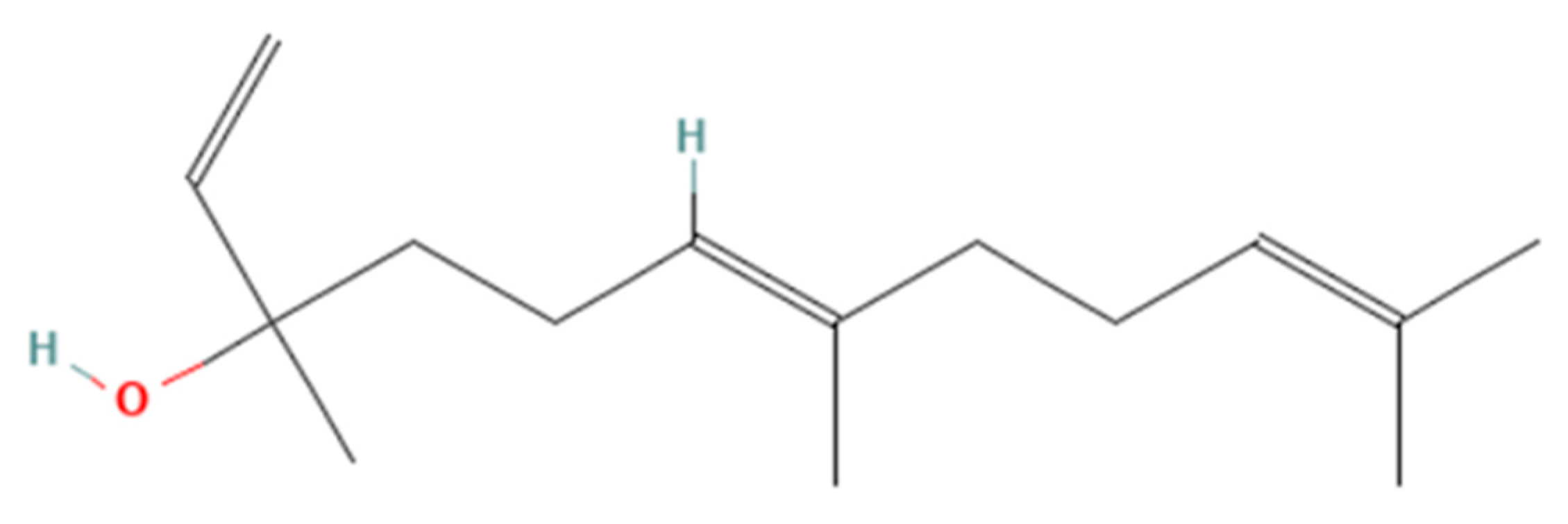
Figure 2.
Simil-microfluidic piping schematization adapted from [11]. From upper left: (1–2–3) lipids/ethanol feed line; (4–5–6) water feed line; (D-1 and D-2) feed tanks; (G-1 and G-2) peristaltic pump-dampener groups; (I-1) coaxial flows insertion (particular of the used device: made in AISI 304 stainless steel -shaft- and in chrome and zinc plated brass -hub-; size: Gauge 23 - SKe Research Equipment); (7) water/ethanol vesicular suspension.
Figure 2.
Simil-microfluidic piping schematization adapted from [11]. From upper left: (1–2–3) lipids/ethanol feed line; (4–5–6) water feed line; (D-1 and D-2) feed tanks; (G-1 and G-2) peristaltic pump-dampener groups; (I-1) coaxial flows insertion (particular of the used device: made in AISI 304 stainless steel -shaft- and in chrome and zinc plated brass -hub-; size: Gauge 23 - SKe Research Equipment); (7) water/ethanol vesicular suspension.
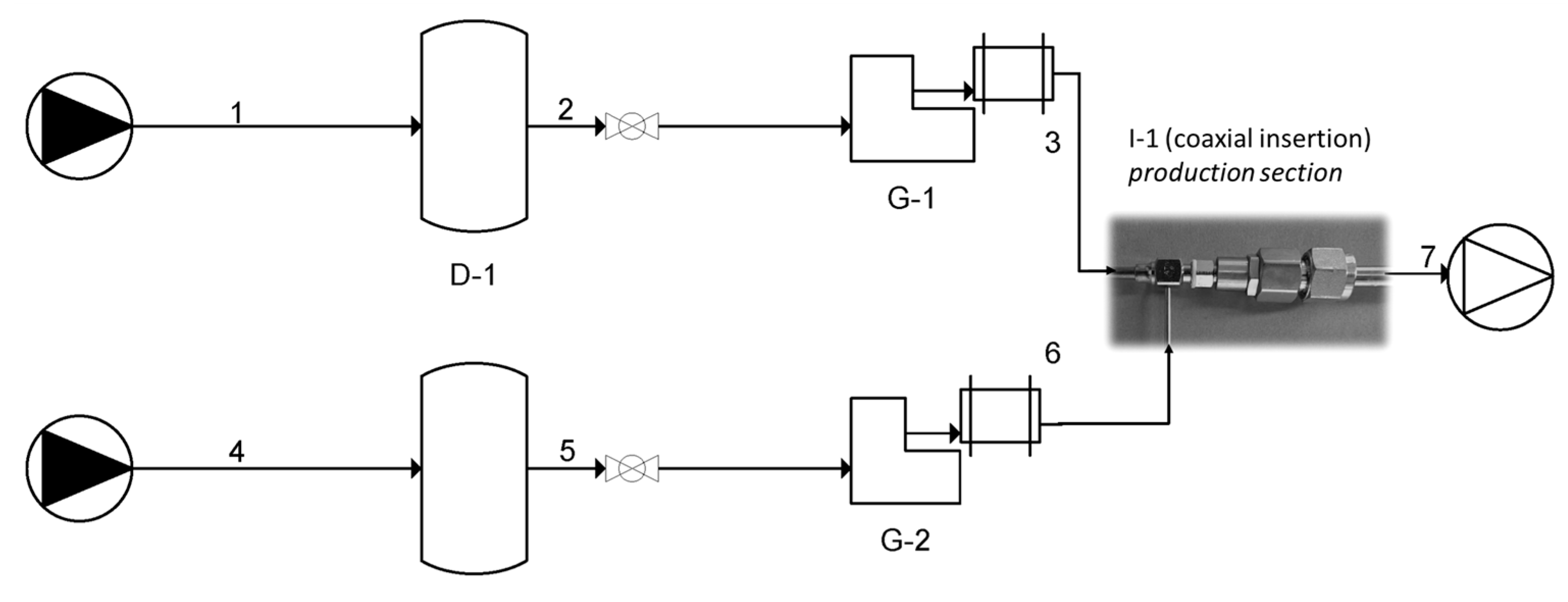
Figure 3.
TEM immage of unloaded liposomal vesicles, (bar 20 nm).
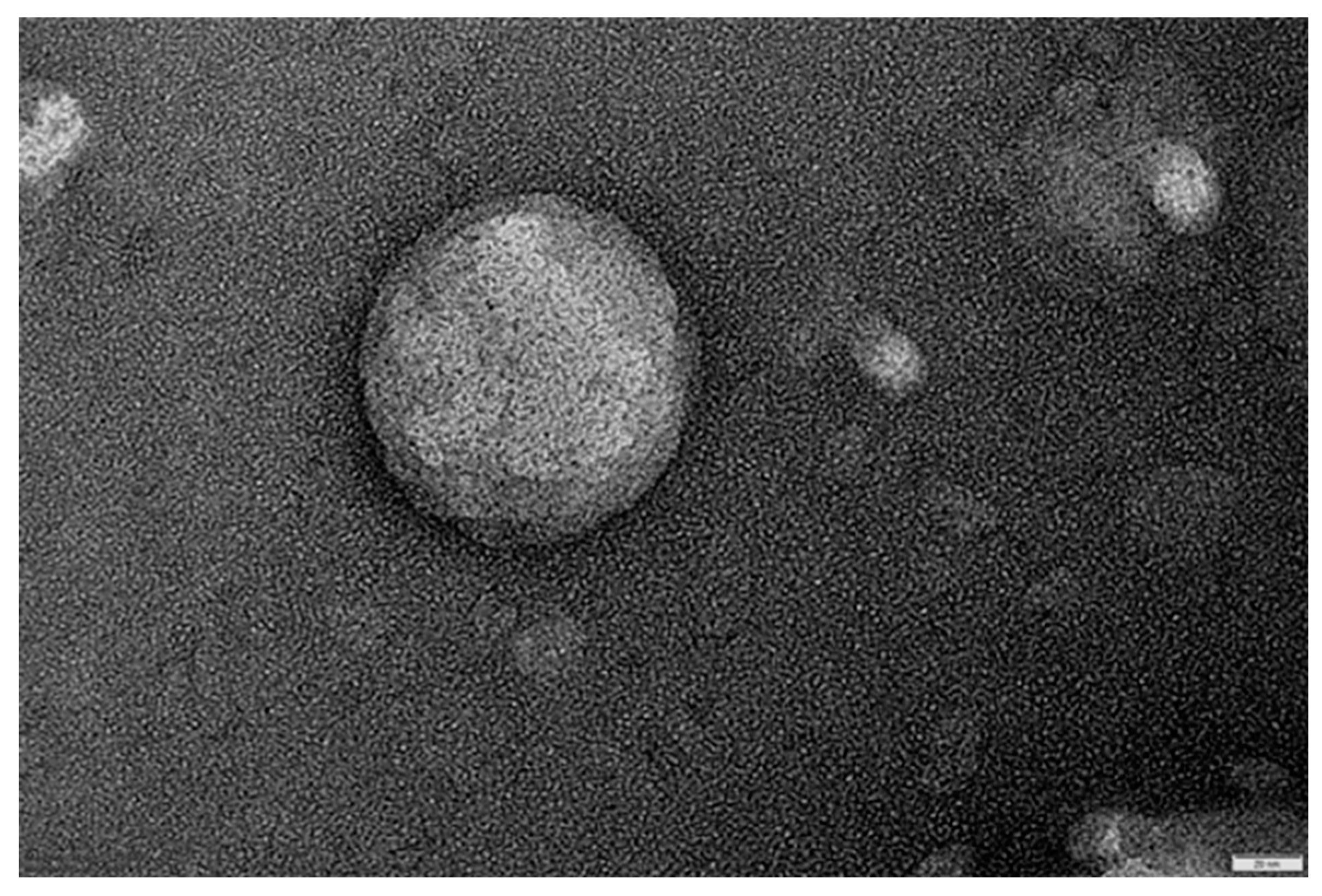
Figure 4.
Denominations of liposomal vesicles based on their composition (redrawn from Emanet and Ciofani [43]).
Figure 4.
Denominations of liposomal vesicles based on their composition (redrawn from Emanet and Ciofani [43]).
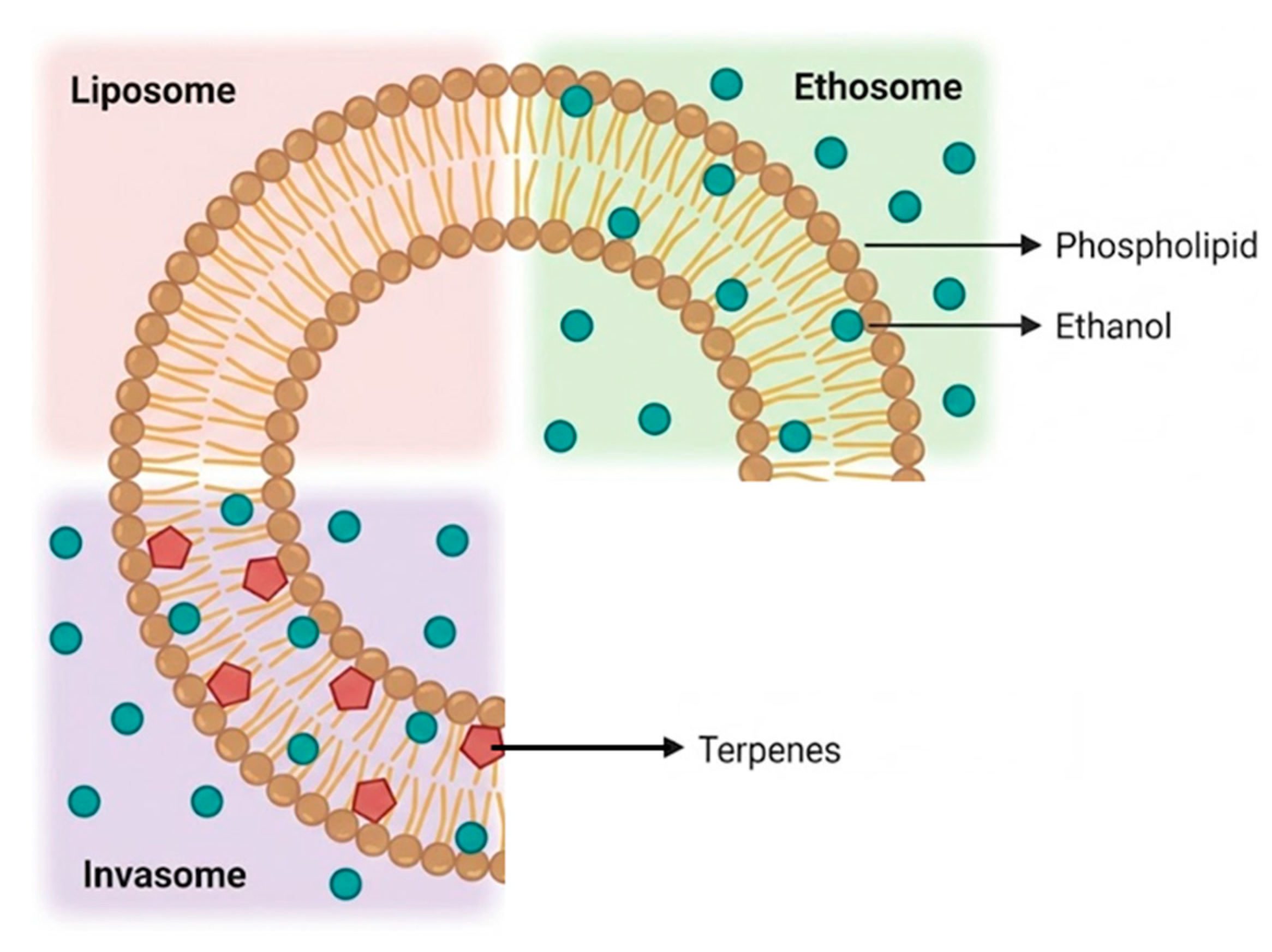
Figure 5.
TEM image of batch INV. NER 15% (bar 200 nm).
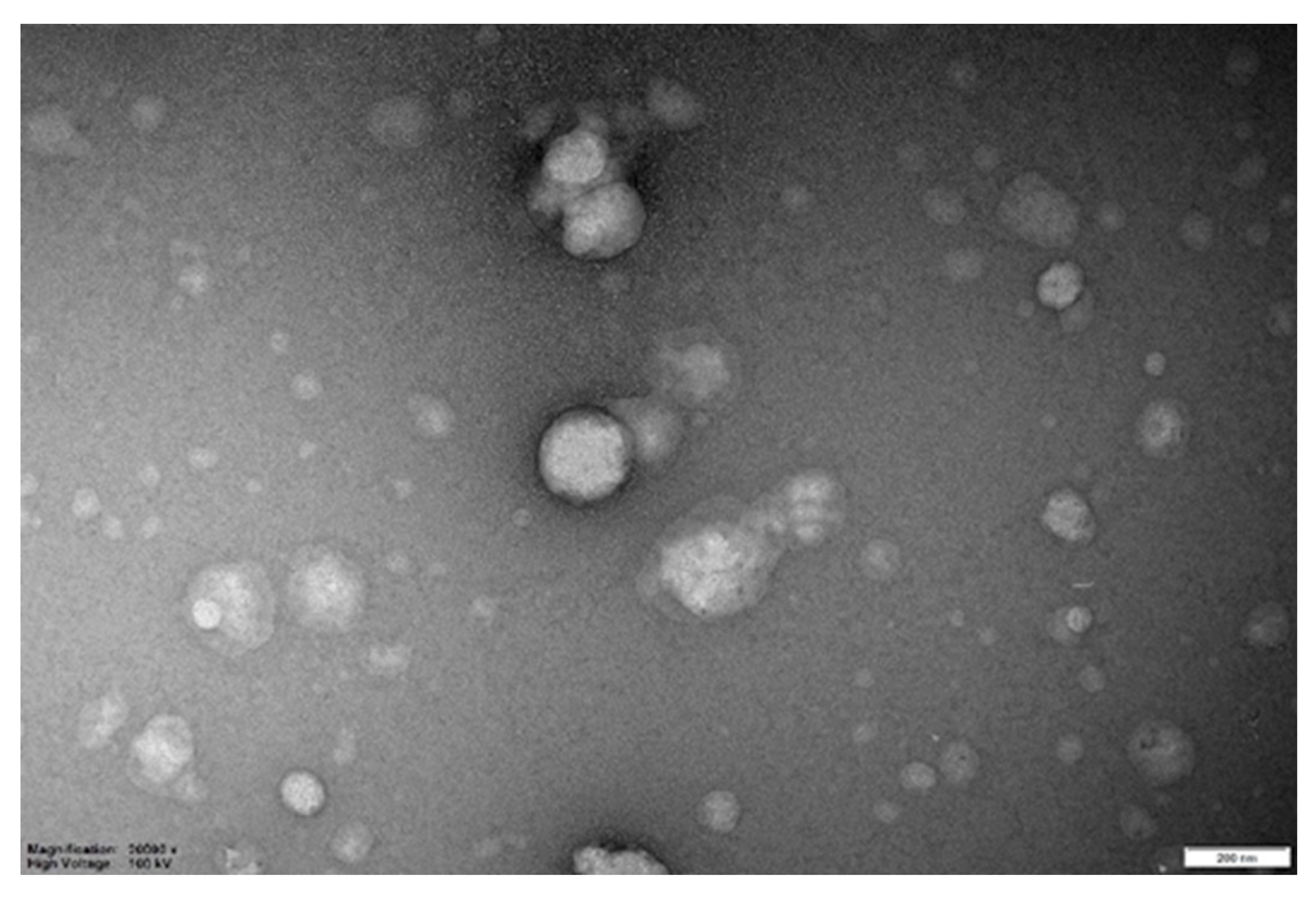
Figure 6.
TEM image of batch INV. NER 15% after removal of larger aggretates (bar 200 nm).
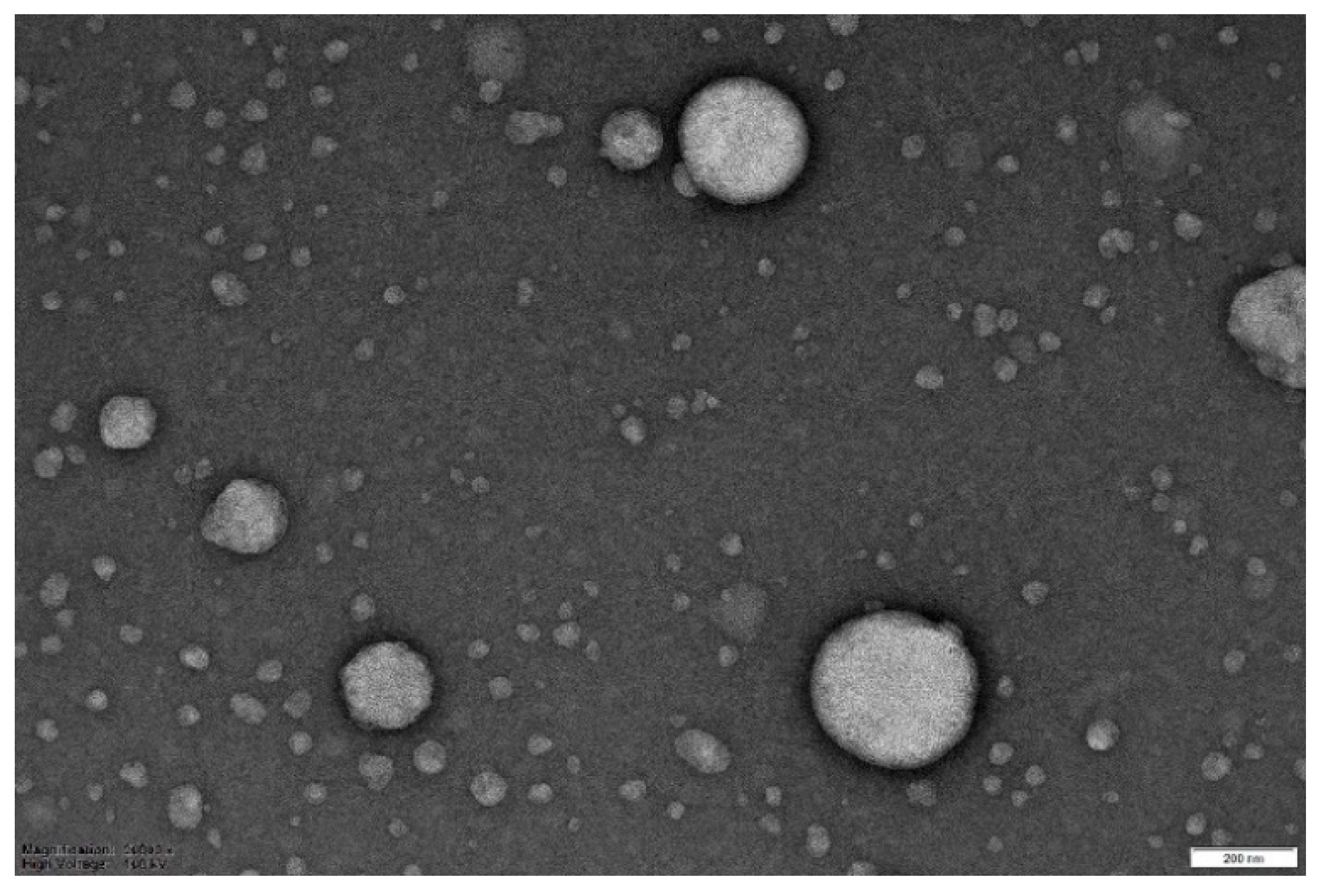
Figure 7.
Summary of antimicrobial effects of free Nerolidol (NER), unloaded nanoliposomes (UN) and Nerolidol-loaded nanoliposomes (LN) against five bacterial strains of veterinary interest. Graphs were built based on calculations performed on the data reported in the Supplementary tables in [31], considering the average inhibition at 2 h for selected concentrations (free NER: 31.25 μg/mL; UN and LN: 2500/25.0, 1250/12.5 and 625/6.25). The figure highlights the onset of measurable CFU reduction for each treatment and microorganism, allowing comparison between the effects attributable to Nerolidol and those associated with the liposomal matrix alone.
Figure 7.
Summary of antimicrobial effects of free Nerolidol (NER), unloaded nanoliposomes (UN) and Nerolidol-loaded nanoliposomes (LN) against five bacterial strains of veterinary interest. Graphs were built based on calculations performed on the data reported in the Supplementary tables in [31], considering the average inhibition at 2 h for selected concentrations (free NER: 31.25 μg/mL; UN and LN: 2500/25.0, 1250/12.5 and 625/6.25). The figure highlights the onset of measurable CFU reduction for each treatment and microorganism, allowing comparison between the effects attributable to Nerolidol and those associated with the liposomal matrix alone.
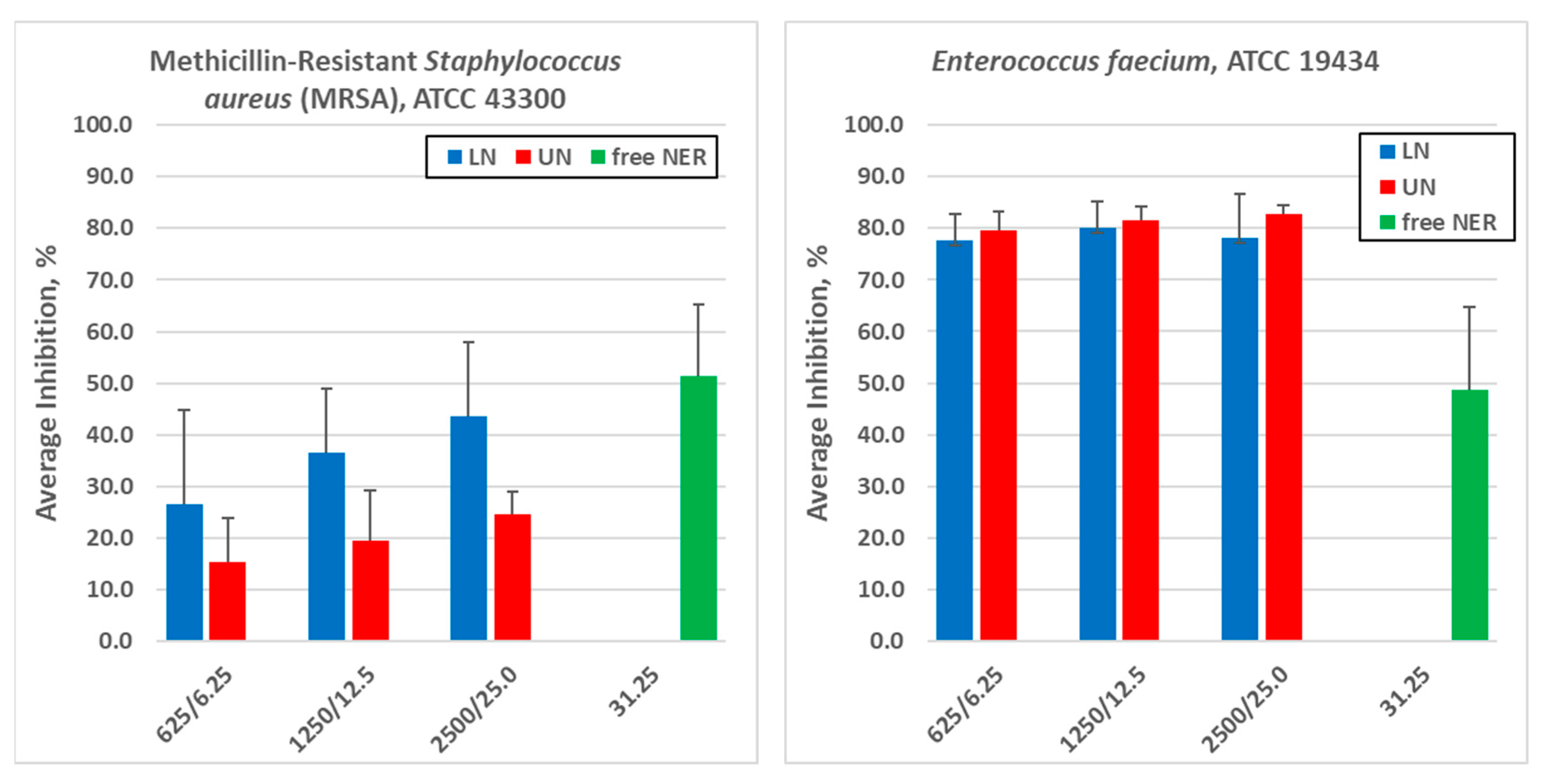
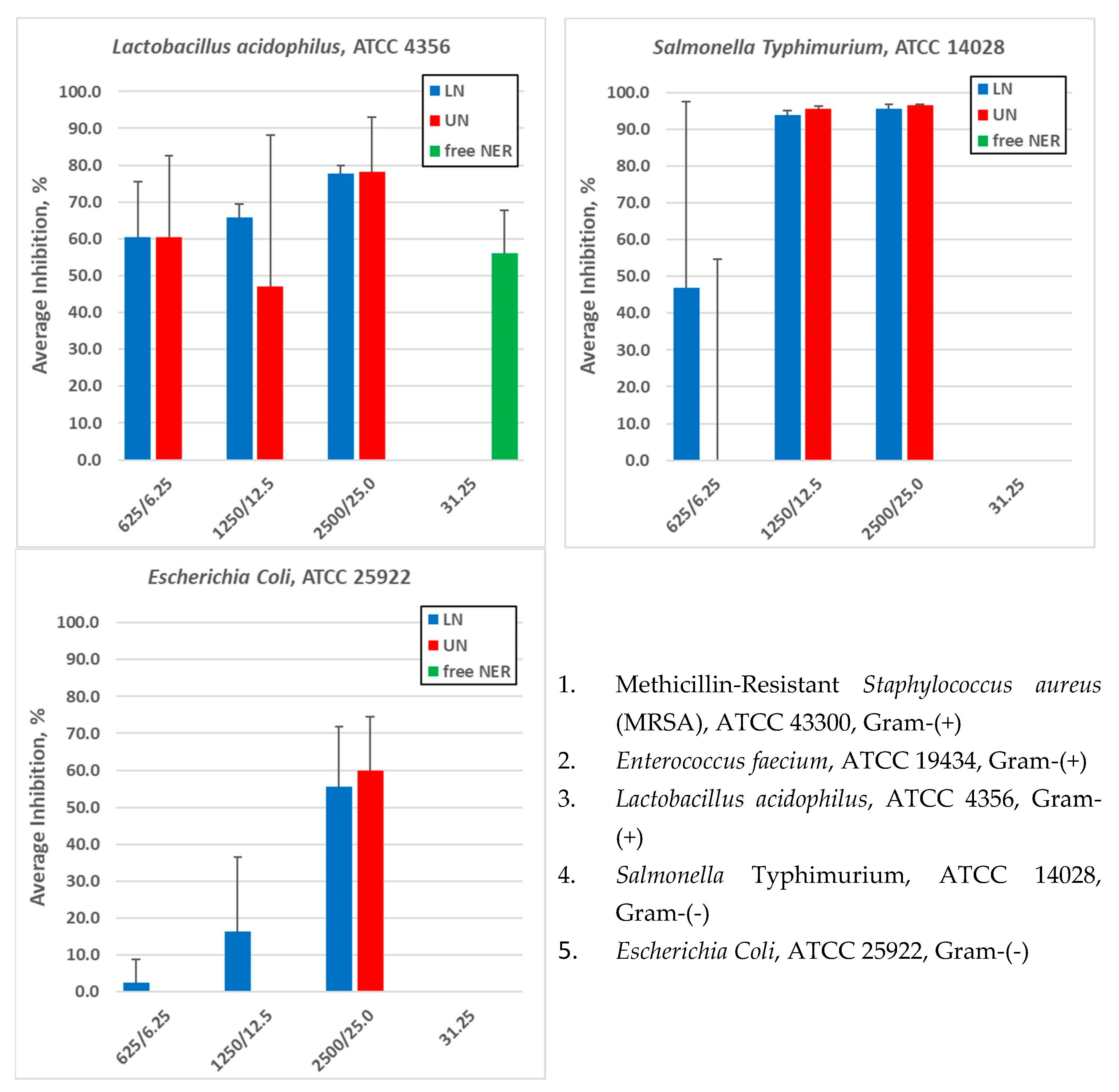

Table 1.
Examples of Nerolidol used as penetration enhancer.
| Used delivery system | NER enhancer to active ingredient | References |
|---|---|---|
| Hydrogel | Curcumin | [6] |
| Hydrogel | Hydrocortisone Hydrochloride Carbamazepine Tamoxifen |
[18,29] |
| Hydrogel | Selegiline hydrochloride | [18] |
| Hydrogel | Terbinafine | [28] |
| Chitosan gel | Ondansetron hydrochloride | [28] |
| Invasome | Buprenorphine hydrochloride Bupivacaine |
[26] |
| Hydrogel | Hydrocortisone | [28] |
| Hydrogel | Propanolol hydrochloride | [28,30] |
| PG gel | Lomerizine dihydrochloride | [28] |
Table 2.
Main properties of Nerolidol (BASF Safety Data Sheet).
| Property | Value |
|---|---|
| Molecular Formula | C15H26O |
| State | Liquid |
| Molecular weight (g/mol) | 222.37 |
| CAS number | 7212-44-4 |
| Water solubility (mg/L) (20°C) | 14.1* [BASF Safety Data Sheet] |
| Melting Point (°C) (1 bar) | -90 [BASF Safety Data Sheet] |
| Boiling Point (°C) (1 bar) | 276 [BASF Safety Data Sheet] |
| Log P | 4.68 [BASF Safety Data Sheet] |
| Solubility | high in ethanol - low in water |
| Topological surface area (Å) | 20.23 |
| Van der Waals Molecular volume (Å3/molecule) | 268.93 |
| *1.532 (25°C) Experimental (https://hmdb.ca/metabolites/HMDB0035662) | |
Table 3.
Theoretical concentrations in Nerolidol of prepared batches.
| Batch # | NER, (g) | Theoretical Load, % |
|---|---|---|
| Prod. 1 (Unl. LIP) | 0 | 0 |
| INV. NER, 1% | 0.0285 | 1 |
| INV. NER, 5% | 0.1480 | 5 |
| INV. NER, 10% | 0.3133 | 10 |
| INV. NER, 15% | 0.4980 | 15 |
Table 4.
Batches at low theoretical concentrations of Nerolidol.
| Batch # | NER, (g) | Theoretical Load, % |
|---|---|---|
| INV. NER, 1% | 0.0285 | 1 |
| INV. NER, 2% | 0.0576 | 2 |
Table 5.
Dimensional and turbidimetric characterization of different batches of invasomes produced with varying loading.
Table 5.
Dimensional and turbidimetric characterization of different batches of invasomes produced with varying loading.
| Produced batch, # | Z-Average [nm] | PDI | Turbidity [NTU] |
|---|---|---|---|
| Prod. 1 (Unl. LIP) | 305.08 ± 24.2 | 0.33 ± 0.03 | 318 |
| INV. NER, 1% | 309.99 ± 9.0 | 0.34 ± 0.00 | 238 |
| INV. NER, 5% | 604.00 ± 55.2 | 0.6 ± 0.07 | 589 |
| INV. NER, 10% | 697.00 ± 32.4 | 0.62 ± 0.04 | 912 |
| INV. NER, 15% | 981.00 ± 196.6 | 0.59 ± 0.04 | 1238 |
Table 6.
Effective load and encapsulation efficiency of invasomes batches.
| Produced batch | Effective load [%] | Efficiency [%] |
|---|---|---|
| INV. NER, 1% | 1.00 ± 0.01 | 99.70 ± 0.42 |
| INV. NER, 5% | 4.93 ± 0.02 | 99.09 ± 1.00 |
| INV. NER, 10% | 9.92 ± 0.08 | 99.27 ± 0.90 |
| INV. NER, 15% | 14.98 ± 0.007 | 99.76 ± 0.27 |
Table 7.
Dimensional characterization of the four different production batches with variable loading immediately after production and after 6 months of storage (asterisked data refered to long-term stability).
Table 7.
Dimensional characterization of the four different production batches with variable loading immediately after production and after 6 months of storage (asterisked data refered to long-term stability).
| Produced Batch | Z-Average [nm] | PDI | Z-Average [nm]* | PDI* |
|---|---|---|---|---|
| INV. NER, 1% | 309.99 ± 9.03 | 0.34 ± 0.00 | 329.6 ± 8.99 | 0.69 ± 0.13 |
| INV. NER, 5% | 604.10 ± 55.0 | 0.60 ± 0.07 | 467.7 ± 6.58 | 0.59 ± 0.07 |
| INV. NER, 10% | 697.05 ± 32.5 | 0.62 ± 0.04 | 372.0 ± 20.55 | 0.87 ± 0.03 |
| INV. NER, 15% | 981.00 ± 196.6 | 0.59 ± 0.04 | 477.9 ± 75.56 | 0.84 ± 0.05 |
Table 8.
Size, Z-potential, effective loading, and encapsulation efficiency for invasomes immediately after the production and after 45 days of storage.
Table 8.
Size, Z-potential, effective loading, and encapsulation efficiency for invasomes immediately after the production and after 45 days of storage.
| Produced Batch* | Z-Average, [nm] | PDI | Z-Potential, [mV] | Effective Load, [%] | Efficiency [%] |
|---|---|---|---|---|---|
| INV. NER, 1% |
298.8 ± 9.84 | 0.489 ± 0.097 | -42.36 ± 5.4 | 1.190 | 100 |
| INV. NER, 2% |
301.8 ± 19.99 | 0.605 ± 0.106 | -52.18 ± 6.4 | 2.02 | 99.34 |
| INV. NER, 1% Aged | 341.7 ± 9.98 | 0.64 ± 0.04 | -49.81 ± 0.8 | 1.08 ± 0.05 | 90.7 |
| INV. NER, 2% Aged |
342.8 ± 8.22 | 0.60 ± 0.11 | -51.41 ± 0.89 | 1.44 ± 0.11 | 71.1 |
| *Since for both the loading ratio the p-values are larger than 0.05, the aging process does not produce any statistical change. | |||||
Table 9.
Qualitative interpretation of antimicrobial responses for each bacterial strain exposed to free Nerolidol (NER), unloaded nanoliposomes (UN) and Nerolidol-loaded nanoliposomes (LN). The table synthesizes whether inhibition is present and whether it displays a dose-dependent pattern, based on the re-evaluation of the Supplementary time–kill data from [31].
Table 9.
Qualitative interpretation of antimicrobial responses for each bacterial strain exposed to free Nerolidol (NER), unloaded nanoliposomes (UN) and Nerolidol-loaded nanoliposomes (LN). The table synthesizes whether inhibition is present and whether it displays a dose-dependent pattern, based on the re-evaluation of the Supplementary time–kill data from [31].
| Strain | ATCC | Gram | Killing effects | ||
|---|---|---|---|---|---|
| LN | UN | free NER | |||
| Staphylococcus aureus (MRSA) | 43300 | (+) | Yes, dose dependent | Yes, dose dependent | Yes |
| Enterococcus faecium | 19434 | (+) | Yes, slightly dose dependent | Yes, slightly dose dependent | Yes |
| Lactobacillus acidophilus | 4356 | (+) | Yes, dose independent | Yes, dose independent | Yes |
| Salmonella Typhimurium | 14028 | (-) | Yes, slightly dose dependent | Not for all concentrations | No |
| Escherichia Coli | 25922 | (-) | Yes, dose dependent | Not for all concentrations | No |
Disclaimer/Publisher’s Note: The statements, opinions and data contained in all publications are solely those of the individual author(s) and contributor(s) and not of MDPI and/or the editor(s). MDPI and/or the editor(s) disclaim responsibility for any injury to people or property resulting from any ideas, methods, instructions or products referred to in the content. |
© 2026 by the authors. Licensee MDPI, Basel, Switzerland. This article is an open access article distributed under the terms and conditions of the Creative Commons Attribution (CC BY) license.
Copyright: This open access article is published under a Creative Commons CC BY 4.0 license, which permit the free download, distribution, and reuse, provided that the author and preprint are cited in any reuse.


