

Submitted:
04 March 2026
Posted:
05 March 2026
You are already at the latest version
Abstract
The city of Baghdad is witnessing a continuous increase in traffic and urbanization, which has led to frequent traffic jams and deterioration of the urban environment and quality of life due to pollution and the waste of time and energy. Hence, it has become necessary to adopt integrated planning concepts that regulate land uses, promote transport efficiency, and support sustainable urban development. This research aims to investigate the concept of transport-oriented development (TOD) and explore its applicability in the city of Baghdad, focusing on identifying obstacles and challenges that may face the implementation of this concept in the local context, whether related to transport infrastructure, urban planning, or community participation, to provide an analytical framework that can be relied upon in the development of effective strategies to promote sustainable transport and integrated urban development. The BRT bus rapid transit system is an essential part of the Comprehensive Development Plan for Baghdad 2030, aiming to improve mass transit and reduce congestion on major streets such as Palestine Street by providing fast, efficient transportation that connects the city's neighborhoods and encourages walking and the use of sustainable transport. The project supports sustainable urban development by integrating the principles of TOD, increasing residential and commercial density around the stations, and adopting an integrative methodology that analyzes the relationships among transport, land uses, and urban density to provide a scientific framework to support planning and future decision-making.
Keywords:
transit-oriented development (TOD)
; indicators analysis
; public transit station area development
; integrated planning
; challenges and limitations
1. Introduction
As a result of the continuous increase in traffic and the accelerated urban expansion witnessed by the city of Baghdad, many daily traffic problems have emerged, especially frequent bottlenecks on the main streets and major signalized intersections, which negatively reflected on the urban environment through high levels of air and noise pollution, as well as the decline in the quality of urban life and increased waste of time and energy. In light of these challenges, it has become necessary to reconsider traditional planning methods and move towards adopting integrated planning concepts that contribute to regulating land uses, enhancing the efficiency of transport systems, and achieving a better balance between urban development and the requirements of environmental and social sustainability.
The concept of transport-oriented development (TOD) is one of these contemporary planning methods, as it is based on achieving integration between transport network planning and land use planning, which contributes to the creation of coherent and livable urban environments efficiently, encourages the use of public transport, and reduces dependence on private vehicles, which supports the achievement of more sustainable urban development.
The Comprehensive Development Plan for the city of Baghdad, especially in the aspect of mass transit infrastructure represented by existing and proposed rapid bus routes (BRT), can be supported by adopting the concept of transport-oriented development (TOD) as an integrated planning framework that coordinates transport planning and land uses. However, the city of Baghdad in particular, and Iraq in general, lacks the adoption and application of such modern planning concepts, which has created a clear gap at the theoretical and practical levels. Based on this, this research seeks to bridge this gap by proposing an analytical framework that explains the mechanisms for adopting and implementing the TOD concept, developing approaches and strategies appropriate to the local context, as well as identifying the most important planning and transportation indicators necessary to assess the possibilities of application and measure its effectiveness in supporting sustainable urban development.
2. Understanding the Basic Principles of Transit-Oriented Development
In general, transport-oriented development (TOD) is an urban planning approach that aims to create sustainable urban growth around public transportation terminals and transportation corridors by integrating land uses with transportation planning. This concept focuses on condensing urban neighborhoods and reducing dependence on private cars, promoting walking, cycling, and the use of public transport, to improve accessibility and reduce congestion (Knowles et al., 2020). This integration of land use and transport infrastructure can reduce the distances and time taken for car trips, increase the proportion of non-motorized mobility, and reduce car ownership in some households, thereby reducing overall transport costs and enhancing the quality of life in the community. TOD is considered a tool for planning cities in a way that supports livable and sustainable communities, by creating integrated and diverse neighborhoods that are walkable and meet the daily needs of residents within proximity to transport stops.
Although there are many definitions of TOD as mentioned earlier, it can be illustrated that the essence of the concept definition is to direct urban development to be centered around public transport, while creating a dense and diverse urban environment that supports sustainable mobility and reduces dependence on cars.
The benefits of transport-oriented development (TOD) can be illustrated as follows (Endangsih et al. 2022), (Pozoukidou and Chatziyiannaki, 2021) and (Alias et al. ,2023):
- Reduce dependence on private cars: by promoting the use of public transport and non-mechanical means of transportation such as walking and cycling.
- Improving land use efficiency: through high-density and mixed-use development, reducing random urbanization.
- Increased accessibility: facilitate mobility and access to services and facilities in urban areas.
- Improving the quality of urban life: creating walkable and livable neighborhoods, with a healthier and safer environment.
- Reducing environmental impacts: reduce air pollution and greenhouse gas emissions as a result of reduced dependence on cars.
- Revitalizing urban areas and promoting social justice: improve old urban areas and provide equal access to transport and services.
- Reduce overall transportation costs: as a result of reducing the distances and time taken for trips and increasing dependence on sustainable transport.
The enhancement of transportation accessibility and minimizing the reliance on private cars can be achieved by the implementation of TOD. It also reduces the vehicle travel miles (VMT) that affect CO2 emissions and urban pollution. TOD has a significant impact on social livability, equity, and environmental improvement (Newman & J. Kenworthy, 2015), (Habitat, 2022).
Peter Calthorpe (1993) first put the concept of public transit-oriented development (TOD) in the early nineties of the last century. He advocated the design of high-density, mixed-use, walkable neighborhoods, centered on the high capacity of public transportation systems such as the metro, Bus Rapid Transit (BRT), and passenger railways. Rather than traditional car-based urban development patterns, thereby causes urban sprawl and poor infrastructure exploitation. The TOD is targeted at compact growth, pedestrian accessibility, and improved connectivity with public transportation.
3. Exploring the Indicators for Applying Transit-Oriented Development
Lund et al. (2004) focused on development-oriented mobility (TOD) in California, where travel behaviors in TOD zones were analyzed in 2003 to compare the impact of this model on the use of public transport, walking, and cycling compared to traditional zones. The results indicate that the proximity of public transport stops, the density of construction, and the diversity of land use increase the likelihood of residents' dependence on sustainable means of transportation and reduce dependence on private cars. The study also collected detailed data on location and neighborhood characteristics, as well as their impact on the mobility behaviors of individuals and enterprises, comparing changes in behavior since 1990. The study aims to provide a comprehensive understanding of mobility decisions within TODs and to promote the development of urban policies and solutions that support sustainable transport and reduce traffic congestion, while improving the integration of urban planning and public transport. They focused on the following indicators:
- 8.
- Access to public transport: distance to the public transport stop, frequency of service
- 9.
- Use of public transport versus private cars.
- 10.
- The ratio of walking and cycling.
- 11.
- Density and land use: population density and construction around the stations, land use diversity (residential, commercial, recreational).
- 12.
- Integration of urban planning and transport: distribution of stations for urban centers and suburban areas.
- 13.
- Easy access to jobs and services and reduced dependence on cars.
Critique: There was a lack of economic indicators: the study did not focus on the economic impact of TOD, such as real estate prices, impact on local business activities, or the feasibility of investments in transportation. Ignoring deeper social dimensions: the indicators focused on accessibility and walking, but did not address social aspects such as equity of access, different age groups, or the impact of TOD on low-income populations.
Dong's (2021) addressed the impact of public transit-oriented development (TOD) on transportation expenses for households in California. The results indicate that housing in TOD areas, close to public transport stops, reduces dependence on private cars and thus reduces fuel, maintenance, and transport costs in general. The study is based on a quantitative analysis of field data and highlights how TOD planning can contribute to improving the efficiency of urban transport and reducing transport-related household expenses. The study also provides important lessons for policymakers on integrating urban planning with transport cost management, enhancing the economic and social sustainability of cities.
Based on the Dong (2021) study on the impact of TOD on family transportation expenses, the indicators used can be summarized as follows:
- 14.
- Indicators related to location and transportation: proximity to public transport stops (transit accessibility), Availability of public transport, rail, and bus services.
- 15.
- Indicators related to the family behavior of transport: family dependence on private cars, the number of daily trips using various modes of transport, and monthly or annual expenditure on transportation (fuel, maintenance, and alternative means of transportation).
- 16.
- Economic and social indicators: financial savings resulting from living in a TOD area, distribution of expenses on different types of transport.
Critique: While the indicators provide a good understanding of the economic impact of TOD on households, they need to be expanded to include the social, environmental, and quality dimensions of transportation services to obtain a more comprehensive and realistic assessment of TOD's application in various urban contexts.
Song et al. (2021) relied on institutional, planning, financial, and governance indicators to assess the success of TOD in China, focusing on how to overcome institutional constraints and integrate transport with urban development through land value recovery. Transit-Oriented Development (TOD) is based on a set of key indicators that are used to assess the success of its application, primarily including the institutional and governance framework that determines the flexibility of planning systems, land uses and the ability of stakeholders to coordinate and make decisions, in addition to the degree of integration of transport with land uses in terms of urban density, mixed uses, and functional proximity to public transport stations. Financing and land value recovery mechanisms are also key indicators to measure the sustainability of TOD projects and their ability to reduce dependence on the sale of land as the sole source of revenue. In addition, it evaluates the type of TOD model applied and its suitability for the local context, as well as the urban results achieved, such as improving urban connectivity, pedestrian support, and raising the efficiency of land use.
Critique: Financing and land value recovery indicators are effective indicators of economic sustainability, but they may reinforce market logic at the expense of social goals, such as providing affordable housing and preventing social exclusion around transport terminals. Most TOD indicators focus on short-or medium-term spatial and urban outcomes, while fewer studies measure long-term behavioral impact, such as a change in travel patterns or reduced dependence on the private car. Therefore, relying on these indicators without combining them with more accurate social, environmental, and behavioral indicators may lead to a formal application of the concept of TOD, achieving an apparent integration of transport and development without reaching its essence as a tool for achieving comprehensive urban sustainability.
AlKhereibi, et al. (2022) focused on the integration of transport and urban infrastructure, improving the pedestrian experience, diversifying uses, promoting economic and social sustainability, with a flexible institutional framework to ensure the effective application of TOD principles.
Critique: The presented indicators are effective in terms of providing a comprehensive vision of transport integration and sustainable urban development, but they need to enhance quantification, integrate behavioral and social factors, and take into account institutional and applied challenges to be more realistic and generalizable in different contexts.
4. An Approach to Measuring and Identifying Indicators of Transport–Oriented Development (Tod)
The TOD index is a composite measure that estimates the level of public transport-oriented development around transport nodes such as stations, hubs, and major interfaces. This index aims to assess the extent to which the region supports TOD principles, such as density, diversity of uses, accessibility, interconnectedness, and socio-economic integration, in addition to guiding planning and prioritization.
TOD characteristics need to be identified and measured via specific indicators. Many researchers argue that TOD planning needs two complementary approaches, since TOD focuses on the integration of transport (T) and Development (D), as suggested by (Singh et al. ,2014):
- 17.
- Identify areas that are characterized by urban development oriented towards public transport but possess low levels of TOD.
- 18.
- Identify potential locations for transport networks that are characterized by high levels of TOD but suffer from poor connectivity to public transport.
It is believed that measuring existing TOD levels is a prerequisite for planning TOD projects, and this can be achieved using the TOD indicator proposed in (Singh et al., 2014). The TOD index measures several spatial indicators and combines them within the framework of multi-criteria spatial analysis (SMCA) to arrive at a comprehensive value reflecting the existing TOD level in a particular location or area.
Using the TOD index, the levels of transport-oriented development in the entire urban area spanning about 1000 km2 were assessed. The results indicate that the high levels of the TOD index reflect that the characteristics of urban development in those locations are suitable for the use of public transport, and such high levels were observed, as expected, in the urban areas of Arnhem and Nijmegen. The analysis of hotspots (Hot-Spot Analysis) through the TOD indicator also showed that there are sites characterized by high levels of TOD but suffer from poor connectivity to public transport networks. Accordingly, the study recommends working on improving public transport connectivity in these areas. As part of future work, it is planned to use the TOD indicator to raise the levels of transport-oriented development around existing nodes and stations (Singh et al., 2014).
Cervero and kukelman (1997) introduced three-dimensional criteria for transport-oriented development (TOD), encompassing density, diversity, and design. Based on this, five-dimensional criteria have been developed that include density, diversity, design, accessibility of destinations, and proximity to transport (Ewing and Cervero, 2010).
Zhou et al. (2019) applied three-dimensional criteria to assess the suitability of stations for the concept of transport-oriented development. Density indicators are measured across population and job density as well as density gradient, while diversity indicators include the density of shops on the ground floor, land use multiplicity, and bus routes.
The Land Use Diversity Index is used to assess the number of different types of land use in a particular region and how representative each of them is. It also measures the degree of spatial variability by the ratio of each type of land use within an area that is easy to navigate on foot. The diversity of land uses contributes to the satisfaction of various needs of the population, which directly affects the generation of their flights (Singh et al., 2014), (Fard, 2013) and (Cervero and Kockelman, 1997)
Ibrahim et al. (2023) identified and prioritized areas with high potential for Transport-oriented development in the city of Alexandria, Egypt. This was done through the use of spatial statistical analysis using combined models combining Geographic Information System (GIS) and multi-criteria spatial analysis (SMCA), which made it possible to obtain a comprehensive value reflecting existing TOD levels at the regional level, through what is known as the "TOD Potential Index". Based on this indicator, TOD levels were assessed in 6 neighborhoods and 109 sheikhs, covering an area of approximately 340 km2. Based on nine potential indicators, scores were determined for the TOD Potential Index, which reflects the suitability of bus stations to become potential areas for Transport-oriented development. The results showed that some areas have a high suitability for transport-based development and have great potential for redevelopment.
Basic indicators of transport-based development (TOD), such as development intensity, walkability, and diversity, into a unified indicator were used for assessing TOD performance. However, the application of TOD in large cities requires a more thorough selection of indicators, an accurate calculation methodology, as well as the availability of the necessary data for calculating the indicators.
Chen et al. (2024) presented a methodology based on TOD performance assessment using multiple indicators derived from multi-source large urban data, with the use of the city of Shanghai as a case study to analyze the impact of site characteristics on performance. The method generates a "comprehensive socio-economic development index" (CSEDI) based on four key indicators associated with the operations of TOD sites, and a multivariate regression model is built using the analysis of the main components to extract 22 key indicators out of 71 indicators associated with transport-based development. Within the sample of 77 transport-based development sites in the Shanghai railway network, the CSEDI showed a strong correlation with independent variables. The results of the evaluation of the case study demonstrate the compatibility of the methodology with the characteristics of the development of the city and sites, highlighting its ability to guide the renovation of existing sites and the planning of new sites.
Ibrahim et al. (2022) emphasize, according to a review, the importance of developing a comprehensive quantitative index to measure the degree of transport-based development (TOD-ness), because of its role in diagnosing deficiencies and identifying appropriate development interventions according to the potential of sites. The literature also shows the dependence of many studies on a combination of spatial and non-spatial indicators, with some indicators sometimes excluded due to data or time constraints. However, some studies have emphasized the importance of incorporating key indicators, such as the three dimensions (3Ds) and economic development, while also considering the time dimension. It turns out that these studies represent a supporting tool for urban planning, TOD planning, and decision-making by directing efforts towards priority sites.
Based on the review, recent studies have turned to the use of multidimensional composite quantitative indicators, employing GIS with multi-criteria spatial analysis, relying on big data and advanced statistical models, in addition to developing assessment frameworks that take into account the specificity of the urban context of different cities.
5. Constraints to Transit-Oriented Development (Tod) in Baghdad
The implementation of transport-oriented development (TOD) in Baghdad constitutes a promising framework for promoting urban sustainability and enhancing public transportation services. However, despite the theoretical benefits of this approach, its effectiveness faces several major challenges, most notably the weak integration of multimodal transport systems, the lack of pedestrian infrastructure, and the complexities of urban planning that do not fully take into account the principles of compact city development. Transport-Oriented development (TOD) in the city of Baghdad aims to reduce dependence on private vehicles, encourage the use of public transport, walking, and non-motorized means of transport, and promote optimal land use through the development of dense and mixed-use areas. These principles contribute to improving the accessibility of services and facilities, enhancing the quality of urban life, and reducing negative environmental impacts such as air pollution and greenhouse gas emissions in the city.
Baghdad, the capital of Iraq and one of the largest cities in the Middle East, is a clear example of the urban pressures resulting from rapid and uncoordinated growth. Over the past decades, the city has experienced indiscriminate urbanization, excessive dependence on cars, and sporadic land use patterns, which have led to significant problems with traffic congestion, environmental stresses, poor efficiency of transport networks, and a decline in the quality of life of residents.
Baghdad, like other cities, faces significant challenges in implementing transport-based development (TOD) in accordance with the local context and Iraqi culture. The most prominent of these challenges are:
- The need to develop a local model of TOD that corresponds to the cultural and social specificity of Iraq.
- Weak interest in integrating public transport projects into national housing and urban planning strategies.
- The presence of overlapping or parallel institutions, the lack of adequate tools and plans to ensure effective urban planning.
Addressing these challenges will enable the development of policies commensurate with the reality of Baghdad and enhance the success of TOD projects in improving public transport and reducing traffic congestion problems.
The city is also facing institutional fragmentation, as the responsibilities of transport, housing, land use, and urban planning are distributed among multiple agencies such as the Baghdad municipality, the Ministry of municipalities and housing, and local municipalities in different neighborhoods. This distribution often leads to inconsistent planning, conflicting priorities, and poor integration between transport and urban infrastructure projects, making it more difficult to effectively implement transport-oriented development (TOD).
The absence of an integrated land use strategy that complies with the principles of TOD may lead to indiscriminate urbanization. This can be illustrated as follows:
- This expansion goes against TOD's goals of reducing reliance on private cars and promoting public transportation.
- High population density may cause: overpopulation، lack of green spaces, and increased pollution levels.
- Ineffective management of intensity-induced stressors may deplete natural resources and reduce sustainable benefits.
Hence, a need to design a balanced mix between increasing density and usable areas to ensure the sustainability of resources and the environment, and improve the quality of urban life.
The city of Baghdad is facing shortcomings in urban planning that hinder the optimal use of land, especially around public transport stations, due to the weak adoption of integrated development principles, fragmentation of institutions, and lack of integration between transport projects and urban infrastructure. To successfully implement transport-based development (TOD) in Baghdad, it is necessary to adopt a comprehensive approach that includes:
- Improving public transport infrastructure and urban amenities.
- Sustainable resource management.
- Taking into account environmental and social considerations to ensure the quality of life and improve mobility in the city.
6. Challenges in Transit-Oriented Development Implementation in Baghdad
The impact zone includes a variety of land uses, including commercial, residential, and educational and health activities, reflecting a mixed character that supports the principles of transport-oriented development (TOD) and promotes accessibility and movement on foot. Current urban laws and regulations pose an additional obstacle to the application of TOD principles, as they often do not include the basic elements for creating multifunctional areas. Thus, these legal and regulatory frameworks limit the ability of policies to effectively support and implement TOD projects.
This largely applies to the urban laws and regulations of the city of Baghdad. Current legislation often focuses on traditional zoning and single-function uses, with no clear provisions supporting multifunctional areas, high density, or integrated connectivity with public transport. This deficiency makes it difficult to fully and effectively implement the TOD principles and necessitates the modification of policies and regulations to facilitate the development of walk-friendly urban hubs and the integration of transport with land uses. Integration of the BRT rapid bus system with the principles of transit-oriented development (TOD) in Baghdad. These challenges impose the need to reform public policies and strengthen land-use planning, as well as coordinate efforts between the public and private sectors to develop more flexible urban planning systems that support the application of TOD principles. In addition, the adoption of a "one-size-fits-all" approach in the implementation of TOD often overlooks the socio-economic specifics varying between regions, which can lead to ineffective planning results. One of the main challenges in implementing TOD is the poor awareness of the public and the limited participation of the local community, where the lack of information about the benefits of these projects leads to opposition and weak support. Therefore, it becomes necessary to involve the local community in planning to ensure that projects correspond to their needs and win their approval through feedback and suggestions.
7. The Possibility of Applying Tod Concepts in the Development of Brt in Baghdad
This exploratory analysis is a preliminary methodological step to provide planning recommendations based on urban data and indicators, supporting the study of the possibility of applying TOD in Baghdad. Despite the absence of actual TOD applications on Palestine Street in Baghdad, this research explored the theoretical analysis to investigate the possibilities of applying these concepts. The analysis focuses on linking the improvement of public transport services, such as suggested high-capacity buses and BRT routes (BCCDP 2030) [23], with the principles of TOD to create dense, versatile, and easily accessible urban environments on foot.
Transport-oriented development (TOD) represents an urgent solution to transport problems in Baghdad. The research reviews the Urban Development Plan 2030 and evaluates it across multiple indicators, pointing to a clear lack of employing TOD to improve future urban mobility (Abdelwehab and Al Ani, 2016).
The bus rapid transit BRT system is one of the main projects included in the Comprehensive Development Plan of the city of Baghdad for the year 2030 (BCCDP 2030), as part of the strategy for the development of mass transport in the capital, which aims to meet the increasing traffic and transport challenges as a result of population growth and continuous urbanization, see Figure 1. This system aims to improve accessibility by providing fast and efficient public transport means that connect the various neighborhoods of the city and vital areas, thus contributing to enhancing multi-modal mobility and reducing dependence on private vehicles.
The role of BRT is manifested in alleviating traffic congestion on main streets and arterials, such as Palestine Street, by creating dedicated routes for fast buses that ensure smooth movement and shorten journey times. The project also seeks to enhance the efficiency of public transport by reducing waiting times and improving the regularity of bus schedules, with the inclusion of SMART stations and advanced facilities to facilitate the boarding and alighting of passengers.
In addition to operational aspects, the BRT system seeks to offer a sustainable model of urban development, as it can be integrated with the principles of transit-oriented development (TOD), by encouraging urban density around stations, stimulating residential, commercial, and service development within the scope of daily walks. This strategy contributes to the creation of more vibrant urban neighborhoods, supports pedestrians and sustainable means of transportation, and reduces the need to travel by private car, which has a positive impact on the environment and reduces carbon emissions.
A Comprehensive Integrative methodology has been adopted that combines spatial characteristics, transport system characteristics, and land use patterns to provide an integrated analytical framework that can be relied upon in future practical applications. This methodology is based on the analysis of the interrelationships between the distribution of urban activities, the density and continuity of the urban fabric, and the levels of accessibility and connectivity to public transportation networks, allowing for a more accurate understanding of how each element affects the others. This approach also allows for an extensive study that includes calculating all the quantitative and qualitative indicators mentioned in detail, such as density, diversity of uses, accessibility, network connectivity, and efficiency of transport service, which enhances the accuracy of the assessment and reliability of the results, and provides a scientific basis on which to support urban planning decisions and the development of sustainable transport projects in the future, Table 1 illustrated the station characteristics, walking distance, land uses, density, accessibility, and redevelopment.
Figure 2 shows the range of spatial influence of nodes and stations of transport-oriented development (TOD) around the public transport route, where two main distances have been adopted to represent accessibility on foot. The first range with a range of 400 meters refers to the basic walking access area, which represents the average distance that can be covered in 5-7 minutes on foot, and is the most influential in promoting the use of public transport, due to its direct proximity to the station and the high probability of relying on walking as the main means of access.
The second 800-meter band represents the expanded Walking Access Zone, which reflects accessibility within a 10-12-minute walk, and is used to assess the broader urban impact of the TOD node, especially in terms of land use diversity, activity intensity, and opportunities for Urban Redevelopment. This scale allows for analyzing the extent to which the station's influence extends beyond the immediate vicinity and its role in shaping an urban environment supportive of sustainable transport. This spatial division is used as a basis for analyzing various TOD indicators, such as urban density, land use diversity, level of accessibility, and redevelopment ability, as well as classifying TOD centers according to the Node–Place model, supporting scientifically based planning decisions.
This methodological framework also provides a supporting analytical tool for both researchers and decision makers, by identifying and estimating a suitable set of approved TOD indicators, in particular the node Index, place Index, indicators of urban density, land use diversity, and walking accessibility within the specified impact ranges (400-800 m). This contributes to the systematic evaluation and comparison of the candidate areas along Palestine Street, and the identification of the most likely locations for the successful application of TOD. Table 2 presents the goal, indicator, and strategy for connecting BRT routes with TOD in Baghdad.
Palestine Street is known as an active hub with mixed land uses, including residential and commercial areas, in addition to educational and health institutions. This diversity makes it a suitable location for applying the principles of transport-oriented development (TOD), especially within a walking distance of 400-800 meters around transport stations, as these diverse uses enhance accessibility and reduce dependence on cars.
8. Conclusions
The BRT Bus Rapid Transit System (BRT) is a major project within the Comprehensive Development Plan of Baghdad 2030, which aims to improve the efficiency of mass transit and reduce traffic congestion on major streets such as Palestine Street, by providing fast and efficient means of transportation connecting the different neighborhoods of the city, encouraging multimodal mobility and reliance on walking and sustainable means of transportation instead of private vehicles. The project also seeks to enhance the efficiency of public transport by reducing waiting times and improving the regularity of schedules, while providing smart stations and advanced facilities for passengers. The system supports sustainable urban development by incorporating the principles of transport-oriented development (TOD), encouraging residential and commercial density around stations, and stimulating Urban Redevelopment. A Comprehensive Integrative methodology has been adopted that links the characteristics of the transport system, land uses, and urban density, with an analysis of the two walking access ranges (400 and 800 meters) to assess the urban impact of the stations, providing an integrated scientific framework to support urban planning and future decision-making.
Acknowledgments
The author would like to thank Mustansiriyah University (www.uomustansiriyah.edu.iq) in Baghdad, Iraq, for supporting this work.
Conflicts Of Interest
The research work receives no funding.
References
- Abdelwehab A. Al Ani M. (2016). “Urban Optimization of Transit Oriented Development in Baghdad City”. Civil and Environmental Research, ISSN 2224-5790, Vol.8, No.4.
- AlKhereibi, A. H., Onat, N., Furlan, R., Grosvald, M., & Awwaad, R. Y. (2022). “Underlying Mechanisms of Transit-Oriented Development: A Conceptual System Dynamics Model in Qatar”. Designs, 6(5), 1–21. [CrossRef]
- Alkaissi Z. A. (2023). “The Effect of One-Way Urban Street on Traffic Operation Performance,” E3S Web of Conferences, vol. 427, p. 03018. [CrossRef]
- Alias A., Asmawi Noor Saarani, Azlan Amran, M. A. Abbasi, and Morteza Ghobakhloo. (2023). “The road to carbon trading in Malaysia: Unpacking knowledge and experience through scoping review and in-depth interviews,” Journal of Infrastructure Policy and Development, vol. 8, no. 2. [CrossRef]
- Baghdad Municipality. (2023). Baghdad Comprehensive City Development Plan (BCCDP 2030). Baghdad: Baghdad Municipality.
- Calthorpe, P. (1993). “The Next American Metropolis: Ecology, Community, and the American Dream”. Princeton Architectural Press.
- Cervero R., Kockelman K. (1997). “Travel Demand and the 3Ds: Density, Diversity, and Design”. Transportation Research Part D: Transport and Environment 1997; 2:199–219. [CrossRef]
- Chen H., Zhao K., Zhang Z., Zhang H., and Lu L. (2024). “Methods for the Performance Evaluation and Design Optimization of Metro Transit-Oriented Development Sites Based on Urban Big Data,” Land, vol. 13, no. 8, p. 1233. [CrossRef]
- Dong, H. (2021). “Evaluating the impacts of transit-oriented developments (TODs) on household transportation expenditures in California”. Journal of Transport Geography, 90, 102946. [CrossRef]
- Ewing R, Cervero R (2010). “Travel and the built environment”. J Am Plan Assoc 76:265–294. [CrossRef]
- Endangsih T., Prayitno B., and Kusumawanto A. (2022). “Assessment of Green Open Space in the Transit-Oriented Development Area in Jakarta,” Civil Engineering and Architecture, vol. 10, no. 1, pp. 1–11. [CrossRef]
- Fard P. (2013). “Measuring Transit Oriented Development (TOD): Implementing a GIS-based analytical tool for measuring existing (TOD) levels”. University of Twente, University of Twente, Faculty of Geo-Information Science and Earth Observation (ITC), Netherlands. Available at: http://essay.utwente.nl/84747/1/fard.pdf.
- Ibrahim S. M., Ayad H. M., and Saadallah D. M. (2022). “Planning Transit-Oriented Development (TOD): A Systematic Literature Review of Measuring the Transit-Oriented Development Levels,” International Journal of Transport Development and Integration, vol. 6, no. 4, pp. 378–398. [CrossRef]
- Ibrahim S. M. , Ayad H. M. ,Turki E. A. , and Saadallah D. M. (2023). “Measuring Transit-Oriented Development (TOD) levels: Prioritize potential areas for TOD in Alexandria, Egypt using GIS-Spatial Multi-Criteria based model”, Alexandria Engineering Journal, vol. 67, pp. 241–255. [CrossRef]
- Knowles R. D, Ferbrache F., and Nikitas A. (2020). “Transport’s historical, contemporary and future role in shaping urban development: Re-evaluating transit oriented development,” Cities, vol. 99, p. 102607. [CrossRef]
- Lund, H. M., Cervero, R., & Wilson, R. (2004). “Travel characteristics of transit-oriented development in California”. Sacramento CA, 5313, 132.
- Newman P. & Kenworthy J. (2015). “The End of Automobile Dependence: How Cities are Moving Beyond Car-Based Planning”. Island Press.
- Pozoukidou G. and Chatziyiannaki Z. (2021). “15-Minute City: Decomposing the New Urban Planning Eutopia,” Sustainability, vol. 13, no. 2, p. 928. [CrossRef]
- Singh, Y. J., Fard, P., Zuidgeest, M., Brussel, M., & Maarseveen, M. van. (2014). “Measuring Transit-Oriented Development: A Spatial Multi Criteria Assessment Approach for the City Region Arnhem and Nijmegen”. Journal of Transport Geography, 35, 130–143. [CrossRef]
- Singh YJ., He P, Flacke J, Maarseveen M V (2014). “Measuring Transit-Oriented Development (TOD) over a Region using an Index”. 12th Annual Transport Practitioners Meeting, London, UK. Available.https://www.researchgate.net/profile/MFAM_Maarseveen/publication/290433256_Measuring_Transit_Oriented_Development_over_a_region_using_an_index/links/5697ad0008ae1c4279050f14.pdf.
- Singh Y., He P., Flacke J., Maarseveen M. van (2015). “Measuring (TOD) over a region using GIS based Multiple-Criteria Assessment Tools”, SPA Journal of School of Planning and Architecture 19, 1–22. Available at: https://research.utwente.nl/en/publications/measuring-tod-over-a-region-using-gis-based-multiple-criteria-ass.
- Song, Y., de Jong, M., & Stead, D. (2021). “Bypassing institutional barriers: New types of transit-oriented development in China”. Cities, 113. [CrossRef]
- UN-Habitat. (2022). World Cities Report: Envisaging the Future of Cities.
- Zhou J, Yang Y, Gu P et al. (2019). “Can TODness improve (expected) performances of TODs? An exploration facilitated by non-traditional data”. Transp Res D Transp Environ 74:28–47. [CrossRef]
- Zainab Ahmed Alkaissi (2023). “Effect of Signal Coordination on the Traffic Operation of Urban Corridor,” Tikrit Journal of Engineering Science, vol. 30, no. 1, pp. 12–24. [CrossRef]
Figure 1.
Current and Proposed Mass Transit Network in Baghdad, (BCCDP 2030), Qateb and Alame (2014) [23].
Figure 1.
Current and Proposed Mass Transit Network in Baghdad, (BCCDP 2030), Qateb and Alame (2014) [23].
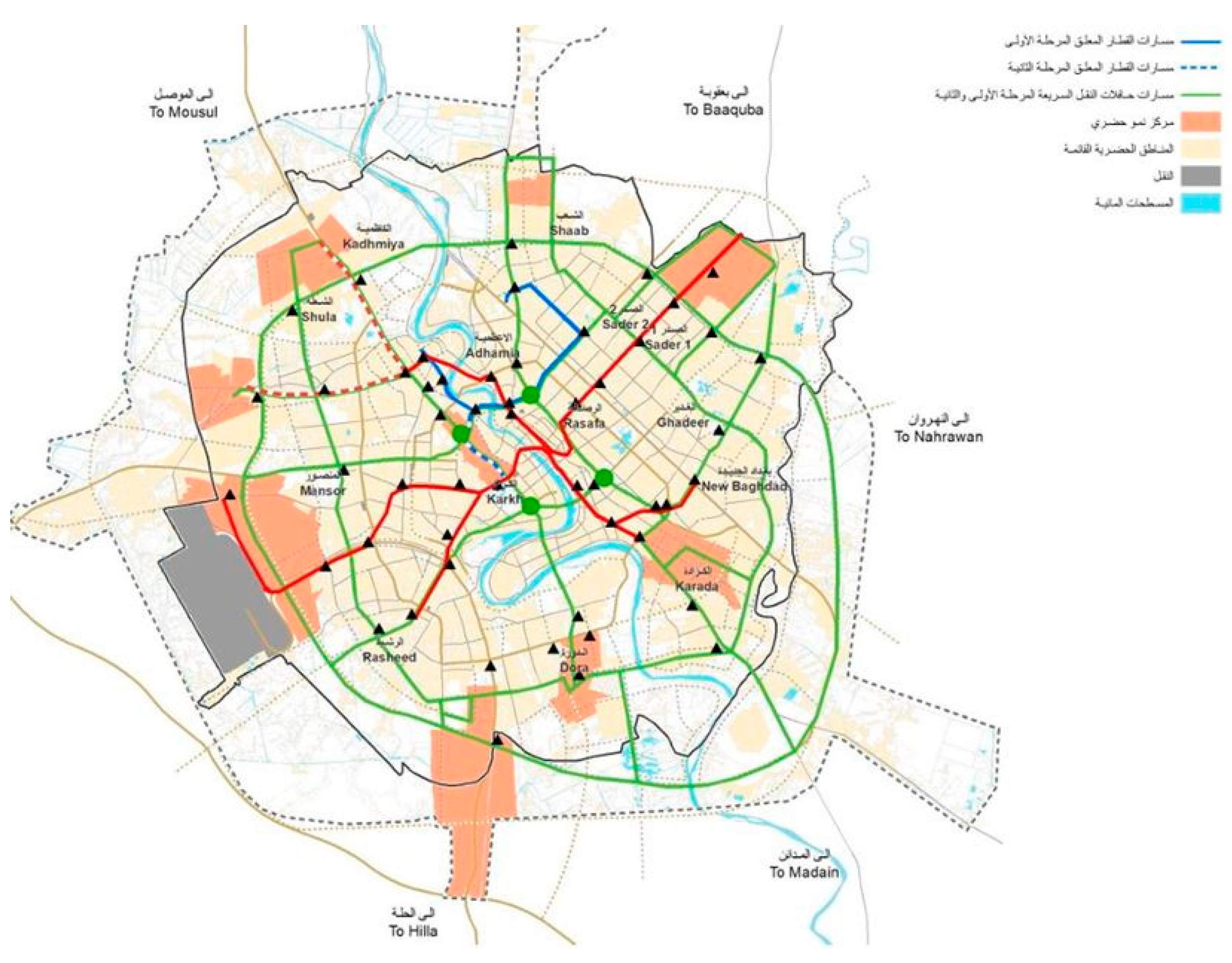
Figure 2.
presents the range of spatial influence (400-800 m) around the node and station of transport-oriented development (TOD).
Figure 2.
presents the range of spatial influence (400-800 m) around the node and station of transport-oriented development (TOD).
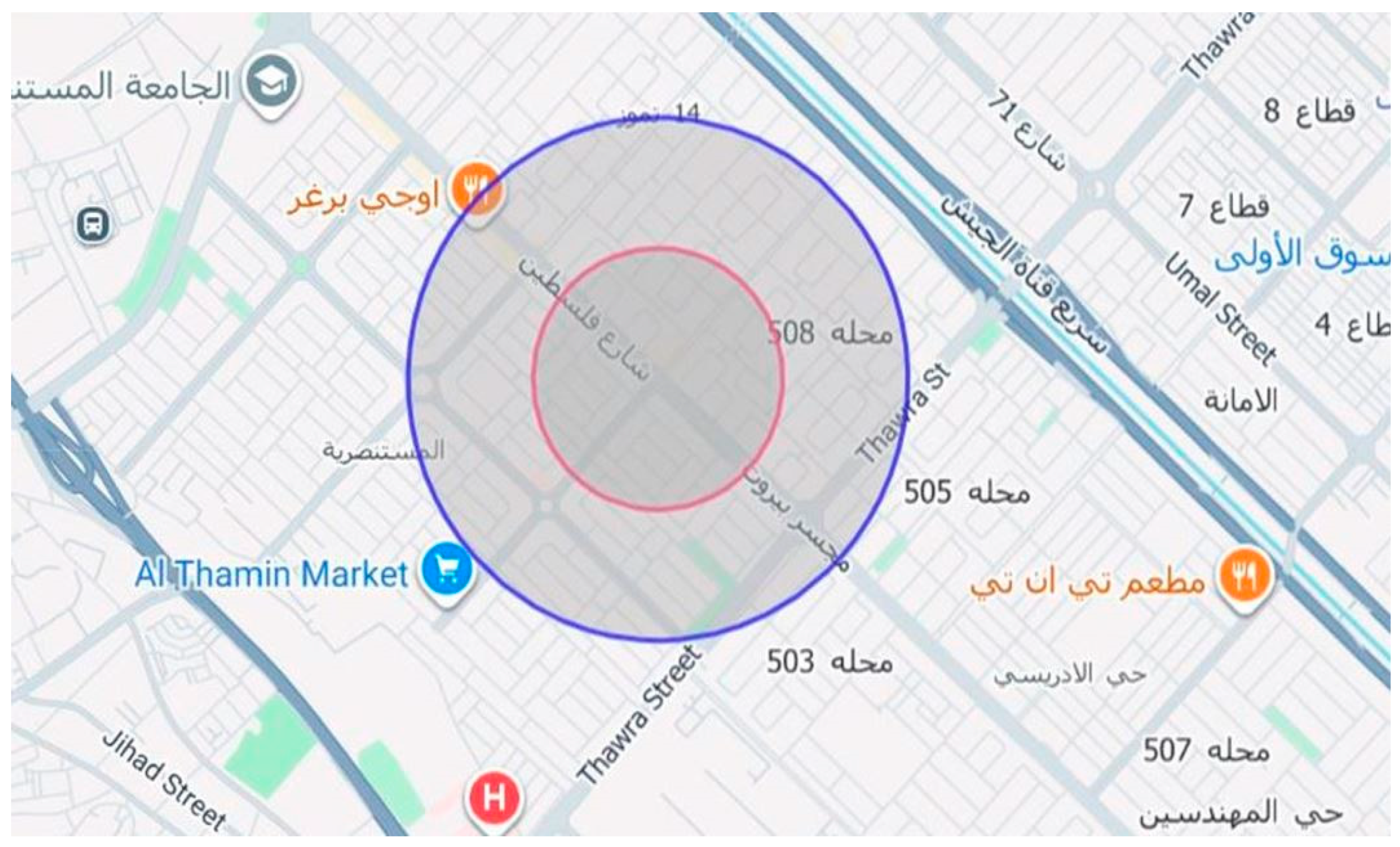

Table 1.
Methodology for the Selection of TOD Nodes Associated with the Bus Rapid Transit (BRT).
| Phase | What is being analyzed | Objective |
| BRT station | Boarding and disembarking volumes, an interchange station, and an intersection with major roads | Identification of candidate stations as TOD nodes |
| Influence zone | 0-400 m (basic walking), 800 m (extended) using the road network | Determining the spatial area of the TOD node (catchment area) |
| Land uses | Residential, commercial, service, educational, mixed-use | Measuring usage support for the TOD concept |
| Built density | Floor area ratio, number of floors, land availability, and population density. | Evaluation of density upgrade |
| Accessibility | Pedestrian and bicycle routes, park and ride. | Ensure easy access to the station |
| Urban environment | Public square and reduce barriers | Creating an effective urban center |
| Node Classification | Urban Neighborhood Specialized Emerging TOD |
Determine the role of each Center on the route |
| Assessment tools | GIS، TOD Index، Node–Place Model | Planning and Research decision support |
Table 2.
Strategies for connecting the BRT rapid bus system with the principles of transit-oriented development (TOD) in Palestine Street, Baghdad, by the author.
Table 2.
Strategies for connecting the BRT rapid bus system with the principles of transit-oriented development (TOD) in Palestine Street, Baghdad, by the author.
| Objective | Index | Strategy | Implementation |
| Enhancing accessibility and reducing dependence on private cars | Percentage of the population of the area within 400-800 meters of the BRT station | Placing BRT stations in high residential and commercial density areas to facilitate walking and bus rides | The construction of a BRT station on Palestine Street, with the improvement of sidewalks and the provision of safe pedestrian walkways and bridges, is expected to take within 5-10 minutes. |
| Encouraging mixed density and diverse land use | The number of mixed-use projects around the station | Encouraging the development of residential, commercial, and service buildings near the stations within walking distance | Palestine Street is an example of an already integrated hub, as it includes residential, commercial, and educational areas, which makes it very suitable for the TOD and BRT application. |
| Improved multimodal integration | Number of connection points between BRT and other means of transport (metro, tram, local buses) | Design BRT stations to be connecting points with other mass transit stations and facilitate the transition between means | The construction of the BRT station at the intersection of Al-Nakhala and Mustansiriyah interchange with the electric train and Metro to facilitate the transition between multi-modal transportation without the need for long trips and walks |
| Reduce congestion and achieve environmental sustainability | The percentage of reduction in the use of private cars on the streets | Developing commercial and service spaces close to the stations to enhance economic activity | -Allocating exclusive routes for rapid buses on Palestine Street -Application of the coordination signal (Green Wave) system to reduce car stops at signalized intersections. (Alkaissi, 2023) - Recirculation of traffic flow on the network using the one-way system (Alkaissi, 2023). |
| Integrating urban planning with mass transit | The proportion of land planned according to TOD | Developing an urban design that connects BRT stations with residential and commercial density from the urban planning stage | Design an area around Palestine Street Station that includes wide sidewalks, shaded pedestrian paths, and public spaces to facilitate access to mass transport and encourage walking. |
Disclaimer/Publisher’s Note: The statements, opinions and data contained in all publications are solely those of the individual author(s) and contributor(s) and not of MDPI and/or the editor(s). MDPI and/or the editor(s) disclaim responsibility for any injury to people or property resulting from any ideas, methods, instructions or products referred to in the content. |
© 2026 by the authors. Licensee MDPI, Basel, Switzerland. This article is an open access article distributed under the terms and conditions of the Creative Commons Attribution (CC BY) license (http://creativecommons.org/licenses/by/4.0/).
Copyright: This open access article is published under a Creative Commons CC BY 4.0 license, which permit the free download, distribution, and reuse, provided that the author and preprint are cited in any reuse.


