

Submitted:
04 March 2026
Posted:
05 March 2026
You are already at the latest version
Abstract
Background/Objectives: Bacterial biofilms are structured communities of sessile cells embedded in a self-produced extracellular matrix that protects against environmental stress, host immune responses and antimicrobial treatments. In response to specific cues, biofilm cells can revert to a planktonic free-swimming lifestyle through a process termed biofilm dispersal. When dispersed cells escape the biofilm matrix, they lose bio-film-associated antibiotic tolerance, a major barrier to treating medical biofilms. As such, dispersal-inducing compounds like nitric oxide (NO) are actively investigated as adjuvants to potentiate the biofilm eradicating activity of existing antibiotics. We recently characterised the transcriptomic responses elicited during spontaneous biofilm dispersal in closed culture-grown Pseudomonas aeruginosa biofilms. Here, we evaluated the tran-scriptional profile of P. aeruginosa biofilms treated with the NO donor Spermine-NONOate (SP-NONO) and the nitroxide C-TEMPO, an NO analogue to determine potential pathways involved in NO-mediated dispersal. Methods: Dispersal activity on P. aeruginosa PAO1 biofilms by SP-NONOate and C-TEMPO was quantified by crystal violet staining. Cellular responses to each compound were profiled by RNA-seq on treated and untreated cells. Results: While both compounds disrupted the transcription of ANR-regulated energy metabolism pathways, only SP-NONO activated canonical NO-regulated responses. Considering that only SP-NONO showed biofilm dispersal activity in this culture system, we investigated shared transcriptional shifts in SP-NONO-treated and spontaneously dispersed biofilms to identify pathways likely involved in central dispersal responses. These mostly included genes participating in the catabolism of leucine, valine, isoleucine and lysine, as well as 9 of 14 genes previously defined as transcriptional biomarkers of spontaneous biofilm dispersal. Conclusions: This study suggests that NO disrupts biofilm maturation by prematurely stimulating central pathways of spontaneous biofilm dispersal and highlights this set of biomarkers as robust indicators of dispersal responses.
Keywords:
Pseudomonas aeruginosa
; biofilm dispersal
; nitric oxide
; nitroxides
; C-TEMPO
; RNA-seq
; transcriptomics
; ANR
; dispersal biomarkers
1. Introduction
Bacterial biofilms are aggregates of sessile cells, typically attached to surfaces, and encased within an extracellular matrix [1]. During biofilm maturation, cells acquire an elevated tolerance to environmental stress, host immune defences and antibiotics [2]. As part of their life cycle, mature biofilms naturally undergo biofilm dispersal, activated by environmental or self-synthesised cues [3,4]. During dispersal, biofilm-residing cells regain planktonic attributes to resume a free-swimming lifestyle [5], while simultaneously losing their biofilm-associated antibiotic tolerance [6]. This makes dispersal-inducing compounds a promising strategy to combat chronic biofilm infections through the potentiation of antibiotics that are otherwise ineffective against biofilms.
The water-soluble radical gas nitric oxide (NO) has gained attention as one of the most promising dispersal agents, showing broad-spectrum effects on Gram-positive and Gram-negative bacteria [7,8]. In the opportunistic biofilm-forming bacterium Pseudomonas aeruginosa, the exogenous addition of NO-releasing compounds (NO donors) such as Spermine-NONOate (SP-NONO; Figure 1A) induced rapid reductions (~40-88%) in the biomass of surface-attached biofilms [9,10,11,12,13]. Furthermore, NO gas and NO donors have proven effective in the dispersal of highly recalcitrant P. aeruginosa isolates from cystic fibrosis patients in vitro, and reduced the bacterial load in their sputum when used adjunctively with antibiotics [8,12]. Notably, dispersal occurs despite P. aeruginosa possessing distinct NO-responsive transcriptional regulators that tightly control the expression of detoxification mechanisms to prevent NO-derived toxicity. These NO-detoxification regulators are the dissimilatory nitrate respiration regulator DNR and FhpR, a homolog of the E. coli transcriptional regulator NorR [10,14,15], which respectively regulate the expression of the NO reductase NorBC and the flavohaemoglobin Fhp [16,17].
Despite preclinical efficacy, the clinical application of NO remains challenging, as its small size, high diffusibility, and pronounced chemical reactivity result in a short biological half-life and complicate controlled, localised delivery at the site of infection [18]. Nitroxides are considered NO analogues due to sharing key chemical features with NO while presenting significantly reduced reactivity [19]. Like NO, nitroxides possess a delocalised unpaired electron over the nitrogen and oxygen atoms. However, this group is sterically hindered by adjacent methyl groups that limit their reactivity (e.g., 4-carboxy-TEMPO; Figure 1B) [20]. Nitroxides were shown in some studies to induce slow dispersal of P. aeruginosa biofilms grown under continuous flow conditions (open culture systems) and potentiate the bactericidal activity of antibiotics, thus highlighting their utility as antibiofilm agents [21,22].
Recently, we reported the biofilm culture kinetics of P. aeruginosa PAO1 in closed culture systems, showing they recapitulated the main stages of the biofilm life cycle (attachment, maturation and spontaneous dispersal) described under continuous-flow culture conditions [23]. Moreover, by characterising the transcriptomic profile of cells undergoing each stage, we temporally resolved canonical stage-specific transcriptional responses, such as the activation of surface-sensing pathways during attachment, polysaccharide production during biofilm maturation and quorum sensing signals during dispersal [23]. Notably, the upregulation of fourteen genes was associated with the onset of rapid loss of biofilm biomass, and this set was thus proposed to serve as specific biomarkers of biofilm dispersal [23]. Dispersal biomarkers included genes encoding transcriptional regulators amrZ (PA3385) and cdpR (PA2588), chemotaxis and redox-associated genes cheR2 (PA0175), pqqA (PA1985) and PA0743; fimbrial and cupin-mediated adhesion loci tadA (PA4302), rcpA (PA4304), rcpC (PA4305), flp (PA4306), cupE1/E2 (PA4648 and PA4649); and uncharacterised genes PA0111, PA1353 and PA4523. Whether biofilm dispersal agents, like NO and nitroxides, activate transcriptional responses that govern spontaneous biofilm dispersal has not been investigated to date.
Here, we assessed the dispersal activity of NO donor Spermine-NONOate (SP-NONO) and nitroxide 4-carboxy-TEMPO (C-TEMPO) using microplate-grown P. aeruginosa biofilms. Subsequently, we performed RNA sequencing on biofilm cells treated with each compound and characterised their transcriptional profiles relative to spontaneous dispersal. Specifically, we report that >50% of genes differentially regulated under SP-NONO treatment were found similarly altered during spontaneous dispersal, and that SP-NONO, but not C-TEMPO, upregulated most transcriptional biomarkers associated with spontaneous dispersal in 12 h-old biofilms. These findings suggest that NO prematurely activates spontaneous dispersal pathways to induce dispersal of P. aeruginosa biofilms. Collectively, our data indicate that these biomarkers robustly represent central pathways involved in the activation of dispersal responses in P. aeruginosa.
2. Results
2.1. The NO Donor SP-NONO, but Not the Nitroxide C-TEMPO, Rapidly Induced Biofilm Biomass Reduction of P. aeruginosa Biofilms in Closed Systems
To determine the treatment durations of SP-NONO and C-TEMPO required to induce biofilm dispersal, and to define appropriate time points for harvesting mRNA to assess gene expression changes, we performed biofilm dispersal assays using both compounds. In closed culture systems such as microtiter plates, P aeruginosa PAO1 rapidly forms biofilms within 4 h of inoculation [13,23]. Accordingly, the dispersing activity of the C-TEMPO and SP-NONO was assessed at sub-inhibitory concentrations on P. aeruginosa biofilms grown for 4 h (Figure S1 A). Consistent with our previous work [13], both untreated biofilms and mock-treated biofilms (NaOH vehicle control) showed high biomass measured by crystal violet staining at 550 nm optical density (OD550 ~4.5), whereas biofilms treated with SP-NONO (100 µM, 15 min,) exhibited significantly reduced biomass (OD550 ~3, Figure 1A,). Based on these results, biofilm cells treated with SP-NONO (100 µM) for 15’ were used for downstream RNA-seq to characterise the transcriptional responses induced by this biofilm-dispersing NO donor.
To assess the dispersal activity of C-TEMPO in closed culture-grown P. aeruginosa PAO1 biofilms, we initially treated biofilms for 15 min (to match SP-NONO treatment) with a broad range of concentrations (500 – 1.95 µM; Figure S2). No biomass changes were observed with 15 min of C-TEMPO treatment, or when treatment time was extended to 30 min and 1 h (OD550 ~3.5; Figure 1B, Figure S1). In contrast to previous reports using flow-cell systems, these results indicate that C-TEMPO does not elicit detectable dispersal activity in closed biofilm cultures [21,22]. We reasoned that the divergent effects on biofilms displayed by two representatives of analogue compound families (NO donors and nitroxides) could be leveraged to identify common transcriptional variations induced by SP-NONO and nitroxides and, therefore, discriminate unique transcriptional responses by SP-NONO to refine candidate pathways associated with dispersal. Consequently, RNA-seq samples were collected from biofilm P. aeruginosa PAO1 cells treated with C-TEMPO (500 µM) for 30 min. Treatment durations were limited to 30 min, as we previously demonstrated that P. aeruginosa PAO1 biofilm culture kinetics rapidly progress through stages in closed systems [23], suggesting that a longer treatment would risk confounding transcriptional differences arising from biofilm ageing.
2.2. SP-NONO and C-TEMPO Disrupt ANR-Regulated Energy Production Pathways
To compare the global transcriptional profiles between treated and untreated groups, RNA-seq data was plotted using ClustVis (Figure 2A). C-TEMPO-treated biofilms (Figure 2A - green) clustered closely with untreated biofilm-residing cells (Figure 2A - red) obtained from earlier work [23], indicating that C-TEMPO treatment induced minimal transcriptional changes in biofilms. In contrast, SP-NONO-treated biofilms (Figure 2A - orange) clustered separately from untreated biofilms, indicating that a significant transcriptional shift was induced. To quantify these responses, we used a negative binomial test (P-value ≤ 0.01; Log2 fold-change ≥ |1|) comparing NO-treated or C-TEMPO-treated samples to untreated, 4-hour biofilm cells.
Treatment of biofilms with C-TEMPO altered the transcription of 225 genes (121 upregulated; 104 downregulated), with downregulated genes exhibiting markedly greater absolute fold-changes compared to upregulated genes (Figure 2C), while NO treatment affected the transcription of 405 genes (307 upregulated; 108 downregulated) (Figure 2B and 2D). Despite that C-TEMPO treatment did not change biofilm biomass, unlike NO, we observed a substantial overlap in transcriptional responses under C-TEMPO and SP-NONO treatments, with 64/121 C-TEMPO-upregulated genes and 45/104 C-TEMPO-downregulated genes also similarly regulated by SP-NONO (Figure 2). The genes with largest transcriptional differences shared between C-TEMPO and SP-NONO were involved in ANR-controlled oxidative phosphorylation and energy production (Table 1). In contrast, genes under regulation from dedicated NO sensors were uniquely upregulated by SP-NONO. These included genes encoding elements of the denitrification pathway (Table 1) or the aerobic NO detoxification flavohemoprotein Fhp (104-fold, Table S1). Collectively, the observed differences in gene expression suggest that C-TEMPO overlaps with SP-NONO in disrupting O2-mediated transcriptional regulation while being unable to induce canonical responses to NO.
2.3. SP-NONO Upregulates Metabolic Pathways of Spontaneous Dispersal
In a previous study, we identified the transcriptional profiles of P. aeruginosa in each stage of the biofilm life cycle, including attachment, biofilm maturation and, more importantly, spontaneous dispersal (Figure 2A - green) [23]. Considering that SP-NONO elicited significant reduction in biofilm biomass analogous to that observed during spontaneous dispersal (Figure 1C), we hypothesised that central responses involved in dispersal may be reflected in the transcriptional profiles of cells treated with SP-NONO. Indeed, we found 174/307 genes upregulated and 68/108 genes downregulated by SP-NONO that overlapped with transcriptional changes occurring during spontaneous dispersal (Figure 2B). To identify gene expression changes strictly associated with the dispersal phenotype, genes uniquely upregulated by SP-NONO and during spontaneous dispersal, but not by C-TEMPO, were compiled into Table 2 (a full list of genes was included in Table S2). Transcriptomic profiles associated with biofilm dispersal displayed a downregulation of genes predicted to be involved in the import of sulphur-containing metabolites such as sulphate (cysW, cysT and cysP) and taurine (PA3936-PA3938), based on KEGG pathway annotation [24]. cobP, cobU and cobV, involved in the cobalamin biosynthesis pathway, were similarly downregulated (Table 2) [25]. In contrast, pathways associated with energy generation were upregulated. These included genes involved in the catabolic degradation of amino acids such as lysine to glutarate (davD and davT) [26], or of valine, leucine and isoleucine into precursors of the TCA cycle (braC, bkdB, lpdV, PA3417 and ldh) (Table 2) [27,28], as well as genes involved in pyrroloquinoline quinone biosynthesis (ppqA, pqqD, pqqE and pqqF) (Table 2), a cofactor required for the periplasmic oxidation of ethanol [29]. Moreover, SP-NONO and spontaneous dispersal promoted the upregulation of genes belonging to the Che2 chemotaxis system (PA0173-PA0179) (Table 2) [30], suggesting a role of this chemosensory pathway in biofilm dispersal.
2.4. SP-NONO Treatment of PAO1 Biofilms Upregulates Biomarkers of Spontaneous Dispersal
By analysing the temporal changes in global gene expression across the biofilm life cycle stages, we previously identified fourteen transcriptional biomarkers that are distinctly and reproducibly upregulated during spontaneous dispersal in 12 h-old biofilms [23]. Importantly, the dispersal-inducing NO donor SP-NONO largely recapitulated this distinct transcriptional response of spontaneous dispersal, whereas C-TEMPO did not (Table 3). Of the fourteen dispersal biomarkers, SP-NONO significantly increased the transcription of nine. These included PA0111 (6.62-fold), cheR2 (3.41-fold), pqqA (2.52-fold), tadA (2.21-fold), rcpA (2.12-fold), rcpC (2.18-fold), flp (2.27-fold) and cupE1E2 (2.36- and 2.09-fold, respectively) (Table 3). In contrast, C-TEMPO only upregulated three biomarkers: PA0111 (5.15-fold), tadA (2.01-fold), and flp (2.20-fold) (Table 3).
Collectively, these findings suggest that SP-NONO hijacks pathways activated during spontaneous dispersal to prematurely elicit a reversion to the planktonic lifestyle. Furthermore, the upregulation of this set of genes during exogenously induced and spontaneous dispersal (reported as reduced surface-attached biofilm biomass) in closed culture systems strongly supports them as biomarkers representative of central dispersal pathways in P. aeruginosa.
3. Discussion
Biofilm dispersal agents have gained increasing attention as a therapeutic approach to enhancing antibiotic activity against clinical biofilms, which are the source of ~80% of chronic hospital infections. Biofilm infections show elevated incidence in prostheses and in-dwelling devices leading to bacteriemia, ventilator-associated respiratory infections and catheter-associated urinary tract infections [31,32]. Among biofilm-forming bacterial pathogens, P. aeruginosa stands out due to causing ~7% of all healthcare-associated infections, with incidence rates as high as ~23% in ICU infections and in cystic fibrosis patients, causing highly recalcitrant endobrochiolitis, bronchiectasis, and pneumonia [33,34]. To fast-track screening of dispersal-inducing compounds, we previously identified a subset of P. aeruginosa genes that serve as transcriptional biomarkers of the onset of spontaneous dispersal [23]. Here, we demonstrate the robustness of these biomarkers using the biofilm dispersal NO donor SP-NONO, which effectively dispersed P. aeruginosa biofilms and elicited the upregulation of 9 of the 14 biomarkers. In contrast, the nitroxide C-TEMPO, which did not promote biofilm dispersal, only stimulated the upregulation of 3 dispersal biomarkers.
As a nitroxide, C-TEMPO possesses a significantly bulkier structure than NO and is sterically hindered by the four adjacent methyl groups. This implies a significantly reduced reactivity and penetration relative to NO [20], which we addressed by testing a range of concentrations and treatment times. Nevertheless, no significant changes in attached biomass were observed in microplate-grown biofilms by any C-TEMPO treatment tested. Our data contrast with previous reports of C-TEMPO-mediated biofilm dispersal of P. aeruginosa in flow cells [21,22]. Importantly, biofilms grown in continuous flow culture systems such as flow cells exhibit biofilm maturation stages spanning days due to the constant exposure to nutrients and the removal of metabolic by-products and quorum sensing molecules [35]. This required P. aeruginosa biofilms to be cultured for 48 h prior to being treated with C-TEMPO for a further 24 h, when an increased cell density was detected in the culture effluent [22]. Contradictory dispersal activity across different biofilm models, however, is not unique to nitroxides. Previously, we reported that the NO donor sodium nitroprusside, which has been widely documented to disperse P. aeruginosa biofilms in continuous-flow cultures, unexpectedly increased biomass of P. aeruginosa biofilms cultured in microtiter plates [13]. While no studies have directly compared transcriptomic or metabolomic differences of biofilms of the same strain cultured under different culture platforms, it is likely that longer incubation times in continuous flow cultures account for biological differences in P. aeruginosa biofilms, thus affecting the dispersal activity of some drug candidates.
Here we report for the first time the transcriptional response of P. aeruginosa to C-TEMPO treatment. This analysis revealed pronounced changes in genes whose transcription is modulated by the transcriptional regulator of anaerobiosis ANR and the redox-responsive two-component regulator RoxSR, which were also identified under SP-NONO treatment. These include genes required for survival under conditions of hypoxia [36], such as the NO-sensitive regulator encoded by dnr, the operon ccoP2-ccoO2 encoding the high-affinity cbb3-type cytochrome C oxidase, the aa3-type cytochrome encoded by coxAB, and cioAB encoding a cyanide-insensitive terminal oxidase [37]. Additionally, the ANR-regulated operon arcDABC and adhA were among the most downregulated genes by C-TEMPO and SP-NONO. These genes respectively encode the arginine deiminase pathway for the degradation of arginine to ornithine and a NAD+-dependent alcohol dehydrogenase, which participate in processes necessary for ATP generation under anaerobiosis, and have all been defined as strongly regulated by ANR and DNR in planktonic cultures [36,38]. In contrast, our analysis revealed no observable overlap between the SP-NONO and C-TEMPO regarding NO-mediated transcriptional regulation. Neither genes involved in denitrification (including the NIR, NOR and NOS operons), nor the O2-dependent flavohemoglobin Fhp were upregulated by C-TEMPO, whereas SP-NONO strongly stimulated their transcription. Hence, despite nitroxides being widely proposed to act as NO analogues, our data suggest that C-TEMPO would primarily interact with ANR-regulated pathways, and that these would not be directly involved in SP-NONO-mediated dispersal.
NO is a well-established biofilm dispersal agent, known to increase cell motility and stimulate the enzymatic hydrolysis of the cellular signalling molecule cyclic-di-GMP [39]. Here, we reported the overlapping transcriptomic responses of chemically and spontaneously dispersed P. aeruginosa PAO1 biofilms in closed cultures. In both datasets, genes involved in the catabolism of valine, leucine and isoleucine (braC, bkdB, lpdV, PA3417 and ldh) were upregulated, together with genes encoding enzymes mediating the degradation of the lysin metabolite δ-aminovalerate to glutarate (davD and davT) [40], and a δ-aminovalerate-ABC transporter (agtABCD) [41]. Additionally, spontaneously and SP-NONO-dispersed cells largely upregulated dctA encoding the C4-dicarboxylic acid transport for the primary import of succinate, malate and fumarate [42], and PA0752-PA0754 (tctABC), encoding a citrate and cis-aconitate import [43]. Metabolic pathways involved in amino acid catabolism have also been reported as upregulated in independent transcriptomic studies of dispersal using SP-NONO [9]. Namely, bkdA1, bkdA2, bkdB and lpdV were amongst the most upregulated genes in SP-NONO-dispersed cells relative to untreated biofilms [44], suggesting that the activation of amino acid catabolic pathways and transport systems for TCA cycle intermediates may be derived from a dispersal-induced metabolic shift aiding cell reversal to the planktonic lifestyle.
The Che2 chemotaxis system in P. aeruginosa has remained partially uncharacterised. This system is encoded by the gene cluster PA0173-PA0179 and governed by the sensory protein Aer2, which has been proposed to mediate aerotaxis and/or virulence [45,46]. While the output of this chemotaxis complex remains cryptic, our transcriptomic data reflected the upregulation of the Che2 chemotaxis complex in P. aeruginosa undergoing spontaneous dispersal and prematurely after SP-NONO treatment, suggesting a role for Che2 chemotaxis in biofilm dispersal.
In closed systems, we report that treatment with the NO donor SP-NONO caused maturing P. aeruginosa biofilms to upregulate PA0111, cheR2, pqqA, tadA, rcpA, rcpC, flp, cupE1 and cupE2. These were proposed as transcriptional biomarkers of dispersal, as their transcription was largely increased in biofilms undergoing spontaneous dispersal [23]. Here, we demonstrate that despite 4 h-old and 8 h-old biofilms displaying markedly distinct transcriptomic profiles, treatment with SP-NONO prematurely induced the discrete upregulation of most transcriptional biomarkers of dispersal. Our findings therefore indicate that NO may selectively trigger a core set of transcriptional biomarkers indicative of the onset of spontaneous biofilm dispersal and suggests that NO may disrupt biofilm maturation by hijacking endogenous central pathways that govern the transition from the biofilm to the planktonic state.
4. Materials and Methods
4.1. Strains, Media and Culture Conditions
Pseudomonas aeruginosa PAO1 cultures were routinely grown overnight in LB (lysogeny broth) media at 37oC, 200rpm before incubation in fresh M9 media (9 mM NaCl, 22 mM KH2PO4, 48 mM Na2HPO4, 19 mM NH4Cl and 2 mM MgSO4, 100 µM CaCl2, 0.4% glucose, pH 7.0) media at 37 oC shaking.
4.2. Biofilm Dispersal Assays
Biofilm formation and dispersal assays were performed as previously described [13]. Briefly, 107 colony forming units (CFU)/ml bacterial suspensions were prepared in M9 media and inoculated into a 24-well plate (Nunc, ThermoFisher Scientific). Biofilms were grown at 37 oC, 180 rpm. At 4 h post-inoculation, SP-NONO (Cayman Chemical) or 4-carboxy-TEMPO (C-TEMPO; Cayman Chemical) was added to a final concentration of 100 µM or 500 µM, respectively, and incubated for another 15 min or 30 min. Wells were stained with 0.1% (w/v) crystal violet in 6.25% (v/v) methanol for 20 minutes and washed twice with 1 ml phosphate buffered saline (PBS, Gibco) and finally solubilised with ethanol (absolute). Optical density at 550 nm (OD550) was measured with a SPECTROStar Nano microplate reader (BMG LabTech). Micrographs of stained biofilm were taken as described above.
4.3. RNA Sequencing and Analysis
Biofilms were incubated in tissue culture flasks as previously described with some adjustments [23]. Briefly, tissue culture flasks (Nunc, ThermoFisher Scientific) were seeded with 107 CFU/ml cells in 50 ml of M9 medium and biofilms were grown at 37 oC with shaking (70rpm). At 4 h, biofilms were treated with either SP-NONO (100 µM) or C-TEMPO (500 µM) for 15 min or 30 min. After treatment, the liquid phase was discarded, and the remaining attached cells were gently washed with PBS. Surface-attached cells were resuspended in a 1:2 mixture of PBS and RNA-protect solution (QIAGEN) using a cell scraper. Resuspended cells (~108) were pelleted at 5,000 g (10 min, 25 oC). RNA extraction was performed with the RNAeasy mini kit (QIAGEN, Cat# 74104) following the manufacturer’s protocol. Samples were treated with DNAse and subjected to RNA sequencing using DNBSEQ PE100 (BGI Genomics, Shenzhen, China). Cleaned reads were mapped to P. aeruginosa PAO1 chromosome (AE004091.2) using Bowtie2. Differently transcribed genes between groups (untreated biofilms, biofilms treated with SP-NONO and biofilms treated with 4-carboxy-TEMPO) were identified with DESeq2 on Geneious Prime v2024.07. The PCA was generated using the reads per kilobase of transcript per million mapped reads (RPKM) of genes with >|2-fold| transcription and P-value <0.01 (Graphpad Prism 10.4.1, La Jolla, USA).
Supplementary Materials
The following supporting information can be downloaded at the website of this paper posted on Preprints.org.
Author Contributions
JQ and MT conceptualised the project. XB, JQ and MT contributed to the experimental design. XB conducted all experiments and contributed to data collection, analysis and visualisation. XB, JQ and MT contributed to data interpretation. JQ, MT and KFS supervised the project. KFS and MT obtained the funding. XB wrote the manuscript draft, JQ substantially revised the manuscript, all authors edited the manuscript.
Funding
This work was funded by an Australian Research Council project grant (DP210101317), the Max Planck Queensland Centre on the Materials Science of Extracellular Matrices, and a QUT Amplify Scholarship provided by the Queensland University of Technology (Australia) to XB. The Ian Potter Foundation sponsored the CLARIOStar high-performance microplate reader (BMG, Australia). Funding bodies had no role in study design, data collection and analysis, decision to publish, or preparation of the manuscript.
Data Availability Statement
The RNA-Seq data have been deposited in the NCBI Short Read Archive (SRA) database with accession code PRJNA1368986.:
Acknowledgments
The authors would like to thank Professor Robert EW Hancock (University of Columbia) for providing the P. aeruginosa PAO1 strain used in this study.
Conflicts of Interest
MT is an employee of the GSK group of companies. All other authors declare no competing interests. This research was conducted in the absence of any commercial or financial relationships that could be constructed as a potential conflict of interest.
Abbreviations
The following abbreviations are used in this manuscript:
| NO | Nitric Oxide |
| SP-NONO | Spermine-NONOate |
| C-TEMPO | 4-carboxy-TEMPO |
| RPKM | Reads per kilobase million |
References
- Flemming, H. C.; Wingender, J. ‘The biofilm matrix’. In Nat. Rev. Microbiol.; SUBJMETA, Sep 2010; vol. 8, no. 9, pp. 623–633. [Google Scholar] [CrossRef]
- Ciofu, O.; Tolker-Nielsen, T. Antibiotic tolerance and resistance in biofilms’, in Biofilm Infections; Bjarnsholt, T., Jensen, P. Ø., Moser, C., Høiby, N., Eds.; Springer New York: New York, 2011; Volume ch. 13, pp. 215–229. [Google Scholar] [CrossRef]
- An, S.; Wu, J.; Zhang, L. H. ‘Modulation of pseudomonas aeruginosa biofilm dispersal by a cyclic-di-gmp phosphodiesterase with a putative hypoxia-sensing domain’. Appl. Environ. Microbiol. 2010, vol. 76(no. 24), 8160–8173. [Google Scholar] [CrossRef]
- Sauer, K.; Cullen, M. C.; Rickard, A. H.; Zeef, L. A. H.; Davies, D. G.; Gilbert, P. ‘Characterization of nutrient-induced dispersion in Pseudomonas aeruginosa PAO1 biofilm’. J. Bacteriol. 2004, vol. 186(no. 21), 7312–7326. [Google Scholar] [CrossRef] [PubMed]
- Barraud, N.; Kjelleberg, S.; Rice, S. A. ‘Dispersal from Microbial Biofilms’. Microbiol. Spectr. 2015, vol. 3(no. 6). [Google Scholar] [CrossRef] [PubMed]
- Chambers, J. R.; Cherny, K. E.; Sauer, K. ‘Susceptibility of Pseudomonas aeruginosa Dispersed Cells to Antimicrobial Agents Is Dependent on the Dispersion Cue and Class of the Antimicrobial Agent Used.’. Antimicrob. Agents Chemother. 2017, vol. 61(no. 12), e00846–17. [Google Scholar] [CrossRef]
- Barraud, N.; Storey, M. V.; Moore, Z. P.; Webb, J. S.; Rice, S. A.; Kjelleberg, S. ‘Nitric oxide-mediated dispersal in single- and multi-species biofilms of clinically and industrially relevant microorganisms’. Microb. Biotechnol. 2009, vol. 2(no. 3), 370–378. [Google Scholar] [CrossRef]
- Howlin, R. P. ‘Low-Dose Nitric Oxide as Targeted Anti-biofilm Adjunctive Therapy to Treat Chronic Pseudomonas aeruginosa Infection in Cystic Fibrosis’. Molecular Therapy 2017, vol. 25(no. 9), 2104–2116. [Google Scholar] [CrossRef]
- Zhu, X.; Rice, S. A.; Barraud, N. ‘Nitric Oxide and Iron Signaling Cues Have Opposing Effects on Biofilm Development in Pseudomonas aeruginosa’. Appl. Environ. Microbiol. 2019, vol. 85(no. 3). [Google Scholar] [CrossRef]
- Zhu, X.; Oh, H. S.; Ng, Y. C. B.; Tang, P. Y. P.; Barraud, N.; Rice, S. A. Nitric Oxide-Mediated Induction of Dispersal in Pseudomonas aeruginosa Biofilms Is Inhibited by Flavohemoglobin Production and Is Enhanced by Imidazole’, Antimicrob. Agents Chemother. Accessed. Mar 2018, vol. 62.
- Barnes, R. J. ‘Optimal dosing regimen of nitric oxide donor compounds for the reduction of Pseudomonas aeruginosa biofilm and isolates from wastewater membranes’. Biofouling 2013, vol. 29(no. 2), 203–212. [Google Scholar] [CrossRef]
- Cai, Y. ming; Webb, J. S. ‘Optimization of nitric oxide donors for investigating biofilm dispersal response in Pseudomonas aeruginosa clinical isolates’. Appl. Microbiol. Biotechnol. 2020, vol. 104(no. 20), 8859–8869. [Google Scholar] [CrossRef]
- Bertran i Forga, X.; Hong, Y.; Fairfull-Smith, K. E.; Qin, J.; Totsika, M. Nitric oxide donor sodium nitroprusside serves as a source of iron supporting Pseudomonas aeruginosa growth and biofilm formation’. Microbiol. Spectr. 2025. [Google Scholar] [CrossRef] [PubMed]
- Arai, H.; Hayashi, M.; Kuroi, A.; Ishii, M.; Igarashi, Y. ‘Transcriptional regulation of the flavohemoglobin gene for aerobic nitric oxide detoxification by the second nitric oxide-responsive regulator of Pseudomonas aeruginosa’. J. Bacteriol. 2005, vol. 187(no. 12), 3960–3968. [Google Scholar] [CrossRef]
- Tucker, N. P.; D’Autréaux, B.; Spiro, S.; Dixon, R. ‘Mechanism of transcriptional regulation by the Escherichia coli nitric oxide sensor NorR’. Biochem. Soc. Trans. 2006, vol. 34 no. Pt 1, 191–194. [Google Scholar] [CrossRef]
- Koskenkorva, T.; Aro-Kärkkäinen, N.; Bachmann, D.; Arai, H.; Frey, A. D.; Kallio, P. T. ‘Transcriptional activity of Pseudomonas aeruginosa fhp promoter is dependent on two regulators in addition to FhpR’. Arch. Microbiol. 2008, vol. 189(no. 4), 385–396. [Google Scholar] [CrossRef]
- Kuroki, M.; Igarashi, Y.; Ishii, M.; Arai, H. ‘Fine-tuned regulation of the dissimilatory nitrite reductase gene by oxygen and nitric oxide in Pseudomonas aeruginosa’. Environ. Microbiol. Rep. 2014, vol. 6(no. 6), 792–801. [Google Scholar] [CrossRef] [PubMed]
- Stamler, J. S.; Singel, D. J.; Loscalzo, J. Biochemistry of Nitric Oxide and Its Redox-Activated Forms’, Science (1979).; JOURNAL:JOURNAL:SCIENCE: WGROUP; STRING:PUBLICATION, Dec 1992; vol. 258, no. 5090, pp. 1898–1902. [Google Scholar] [CrossRef]
- Volodarsky, L. B.; Reznikov, V. A.; Ovcharenko, V. I. Synthetic chemistry of stable nitroxides; CRC Press; doi: 10.1201/9780203710159/SYNTHETIC-CHEMISTRY-STABLE-NITROXIDES-VOLODARSKY-REZNIKOV-OVCHARENKO/RIGHTS-AND-PERMISSIONS, 2017. [Google Scholar]
- Volodarsky, L. B.; Reznikov, V. A.; Ovcharenko, V. I. Synthetic chemistry of stable nitroxides, 1st ed.; CRC Press; doi: 10.1201/9780203710159/SYNTHETIC-CHEMISTRY-STABLE-NITROXIDES-VOLODARSKY-REZNIKOV-OVCHARENKO/RIGHTS-AND-PERMISSIONS, 1994. [Google Scholar]
- De La Fuente-Núñez, C.; Reffuveille, F.; Fairfull-Smith, K. E.; Hancock, R. E. W. ‘Effect of nitroxides on swarming motility and biofilm formation, multicellular behaviors in Pseudomonas aeruginosa’. Antimicrob. Agents Chemother. 2013, vol. 57(no. 10), 4877–4881. [Google Scholar] [CrossRef]
- Reffuveille, F.; de la Fuente-Núñez, C.; Fairfull-Smith, K. E.; Hancock, R. E. W. ‘Potentiation of ciprofloxacin action against Gram-negative bacterial biofilms by a nitroxide’. Pathog. Dis. 2015, vol. 73(no. 5), 16. [Google Scholar] [CrossRef]
- Bertran i Forga, X.; Fairfull-Smith, K. E.; Qin, J.; Totsika, M. ‘Transcriptional profiling of Pseudomonas aeruginosa biofilm life cycle stages reveals dispersal-specific biomarkers’. bioRxiv 2025, p. 2025.12.18.695191. [Google Scholar] [CrossRef]
- Kanehisa, M.; Goto, S. ‘KEGG: kyoto encyclopedia of genes and genomes’. Nucleic Acids Res. 2000, vol. 28(no. 1), 27–30. [Google Scholar] [CrossRef] [PubMed]
- Belanger, C. R. ‘Surviving the host: Microbial metabolic genes required for growth of Pseudomonas aeruginosa in physiologically-relevant conditions’. Front. Microbiol. 2022, vol. 13, 1055512. [Google Scholar] [CrossRef] [PubMed]
- Revelles, O.; Espinosa-Urgel, M.; Molin, S.; Ramos, J. L. ‘The davDT operon of Pseudomonas putida, involved in lysine catabolism, is induced in response to the pathway intermediate delta-aminovaleric acid’. J. Bacteriol. 2004, vol. 186(no. 11), 3439–3446. [Google Scholar] [CrossRef]
- BURNS, G.; BROWN, T.; HATTER, K.; SOKATCH, J. R. ‘Comparison of the amino acid sequences of the transacylase components of branched chain oxoacid dehydrogenase of Pseudomonas putida, and the pyruvate and 2-oxoglutarate dehydrogenases of Escherichia coli’. Eur. J. Biochem. 1988, vol. 176(no. 1), 165–169. [Google Scholar] [CrossRef] [PubMed]
- Mattevi, A.; Obmolova, G.; Sokatch, J. R.; Betzel, C.; Hol, W. G. J. ‘The refined crystal structure of Pseudomonas putida lipoamide dehydrogenase complexed with NAD+ at 2.45 A resolution’. Proteins 1992, vol. 13(no. 4), 336–351. [Google Scholar] [CrossRef] [PubMed]
- Gliese, N.; Khodaverdi, V.; Görisch, H. ‘The PQQ biosynthetic operons and their transcriptional regulation in Pseudomonas aeruginosa’. Arch. Microbiol. 2010, vol. 192(no. 1), 1–14. [Google Scholar] [CrossRef] [PubMed]
- Orillard, E.; Watts, K. J. ‘Deciphering the Che2 chemosensory pathway and the roles of individual Che2 proteins from Pseudomonas aeruginosa’. Mol. Microbiol. 2021, vol. 115(no. 2), 222–237. [Google Scholar] [CrossRef]
- Del Pozo, J. L.; Patel, R. ‘The challenge of treating biofilm-associated bacterial infections’. Clin. Pharmacol. Ther. 2007, vol. 82(no. 2), 204–209. [Google Scholar] [CrossRef]
- Lewis, K. ‘Riddle of biofilm resistance’. Antimicrob. Agents Chemother. 2001, vol. 45(no. 4), 999–1007. [Google Scholar] [CrossRef]
- Reynolds, D.; Kollef, M. ‘The Epidemiology and Pathogenesis and Treatment of Pseudomonas aeruginosa Infections: An Update’. In Adis; 01 Dec 2021. [Google Scholar] [CrossRef]
- Vestby, L. K.; Grønseth, T.; Simm, R.; Nesse, L. L. ‘Bacterial biofilm and its role in the pathogenesis of disease’; 2020. [Google Scholar] [CrossRef]
- Southey-Pillig, C. J.; Davies, D. G.; Sauer, K. ‘Characterization of temporal protein production in Pseudomonas aeruginosa biofilms’. J. Bacteriol. 2005, vol. 187(no. 23), 8114–8126. [Google Scholar] [CrossRef] [PubMed]
- Gamper, M.; Zimmermann, A.; Haas, D. ‘Anaerobic regulation of transcription initiation in the arcDABC operon of Pseudomonas aeruginosa’. J. Bacteriol. 1991, vol. 173(no. 15), 4742–4750. [Google Scholar] [CrossRef]
- Kawakami, T.; Kuroki, M.; Ishii, M.; Igarashi, Y.; Arai, H. ‘Differential expression of multiple terminal oxidases for aerobic respiration in Pseudomonas aeruginosa’. In Environ. Microbiol.; WEBSITE:WEBSITE:SFAMJOURNALS; STRING:PUBLICATION: WGROUP, Jun 2010; vol. 12, no. 6, pp. 1399–1412. [Google Scholar] [CrossRef]
- Crocker, A.W. ‘Pseudomonas aeruginosa Ethanol Oxidation by AdhA in Low-Oxygen Environments’. J. Bacteriol. 2019, vol. 201(no. 23). [Google Scholar] [CrossRef]
- Barraud, N. ‘Nitric Oxide Signaling in Pseudomonas aeruginosa Biofilms Mediates Phosphodiesterase Activity, Decreased Cyclic Di-GMP Levels, and Enhanced Dispersal’. J. Bacteriol. 2009, vol. 191(no. 23), 7333–7342. [Google Scholar] [CrossRef]
- Feng, Y.; Adams~, E. ‘Glutarate Semialdehyde Dehydrogenase of Pseudomonas’; 1977. [Google Scholar]
- Chou, H. T.; Li, J. Y.; Lu, C. D. ‘Functional Characterization of the agtABCD and agtSR Operons for 4-Aminobutyrate and 5-Aminovalerate Uptake and Regulation in Pseudomonas aeruginosa PAO1’. Current Microbiology 2013, 2013 68:1, vol. 68(no. 1), 59–63. [Google Scholar] [CrossRef]
- Valentini, M.; Storelli, N.; Lapouge, K. ‘Identification of C 4-dicarboxylate transport systems in Pseudomonas aeruginosa PAO1’. J. Bacteriol. 2011, vol. 193(no. 17), 4307–4316. [Google Scholar] [CrossRef] [PubMed]
- Underhill, S. A. M.; Cabeen, M. T. ‘Redundancy in Citrate and cis-Aconitate Transport in Pseudomonas aeruginosa’. J. Bacteriol. 2022, vol. 204(no. 12). [Google Scholar] [CrossRef] [PubMed]
- Zhu, X. ‘Mechanisms of nitric oxide-mediated biofilm dispersal in Pseudomonas aeruginosa’; Nanyang Technological University: Singapore, 2018. [Google Scholar]
- Hong, C. S. ‘Chemotaxis proteins and transducers for aerotaxis in Pseudomonas aeruginosa’. FEMS Microbiol. Lett. 2004, vol. 231(no. 2), 247–252. [Google Scholar] [CrossRef] [PubMed]
- Garvis, S. ‘Caenorhabditis elegans Semi-Automated Liquid Screen Reveals a Specialized Role for the Chemotaxis Gene cheB2 in Pseudomonas aeruginosa Virulence’. PLoS Pathog. 2009, vol. 5(no. 8), e1000540. [Google Scholar] [CrossRef]
Figure 1.
Biofilm responses of P. aeruginosa PAO1 to SP-NONO and C-TEMPO. Structures of (a) SP-NONO and (c) C-TEMPO are depicted, including the delocalised electron (•) in the nitroxide moiety of C-TEMPO. P. aeruginosa PAO1 cultures were seeded on 24-well plates and biofilm biomass was quantified by crystal violet (CV) staining (OD550nm) after no treatment or treatment with (b) SP-NONO (100 µM, 15 min), and NaOH (vehicle control) or (d) C-TEMPO (500 µM, 30 min). Images of stained biofilms and dot plots of CV quantification are shown for 3 biological replicates, with means ± SD also shown in the graphs. Statistical differences between groups were calculated by Two-Way ANOVA for SP-NONO treatments and by Student t-test for C-TEMPO treatments (****, P value <0.0001).
Figure 1.
Biofilm responses of P. aeruginosa PAO1 to SP-NONO and C-TEMPO. Structures of (a) SP-NONO and (c) C-TEMPO are depicted, including the delocalised electron (•) in the nitroxide moiety of C-TEMPO. P. aeruginosa PAO1 cultures were seeded on 24-well plates and biofilm biomass was quantified by crystal violet (CV) staining (OD550nm) after no treatment or treatment with (b) SP-NONO (100 µM, 15 min), and NaOH (vehicle control) or (d) C-TEMPO (500 µM, 30 min). Images of stained biofilms and dot plots of CV quantification are shown for 3 biological replicates, with means ± SD also shown in the graphs. Statistical differences between groups were calculated by Two-Way ANOVA for SP-NONO treatments and by Student t-test for C-TEMPO treatments (****, P value <0.0001).
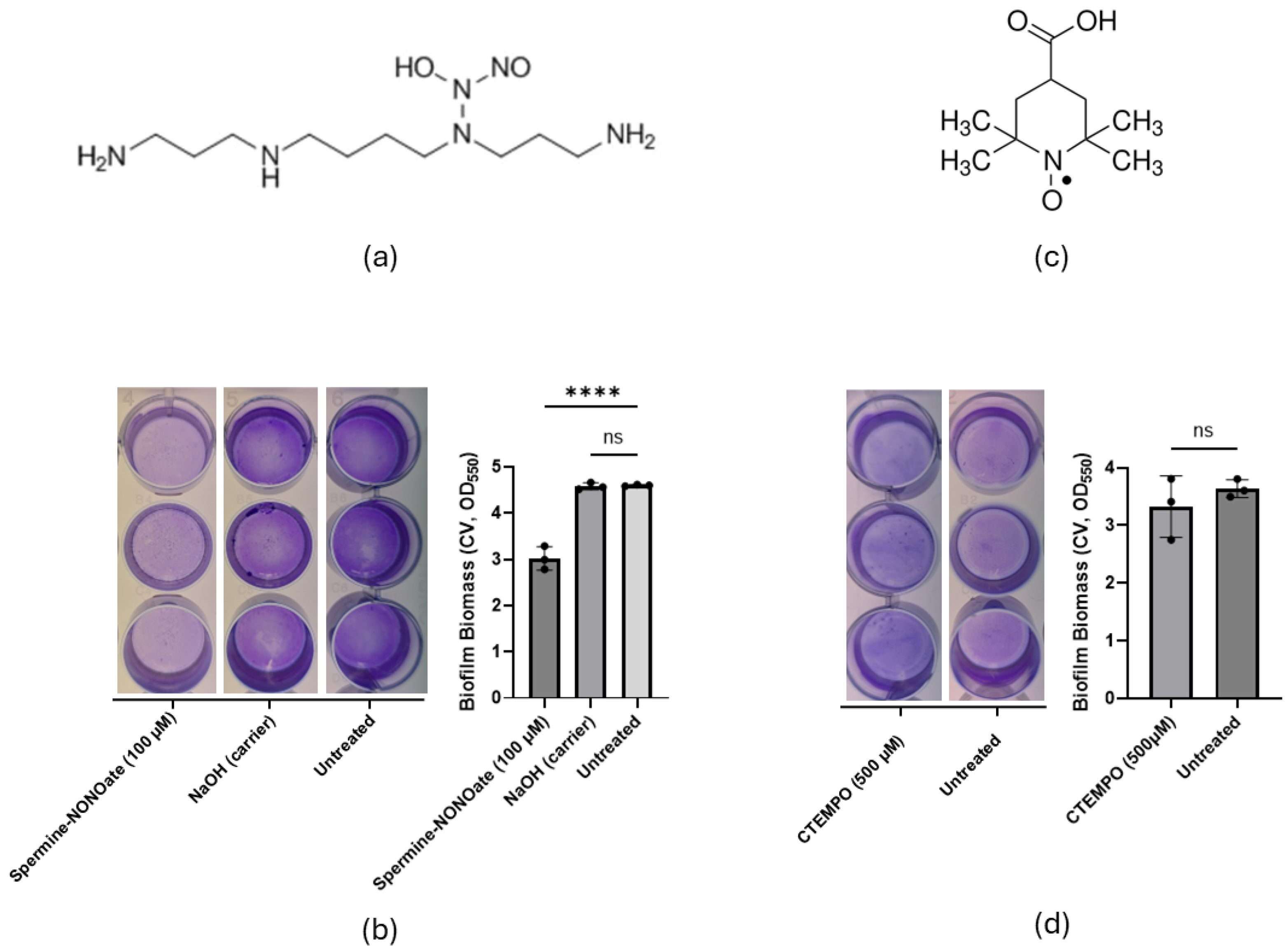
Figure 2.
Transcriptional profiles of C-TEMPO-treated and SP-NONO-treated P. aeruginosa biofilms. (A) Principal Component Analysis of RNA-Seq data from biofilm-residing cells treated with SP-NONO (orange) or C-TEMPO (green). Data were plotted with RNA-seq data from previously obtained untreated mature biofilm-residing cells (red) or spontaneously dispersed cells (blue) [23]. Normalised read counts for each gene (RPKM) were extracted from each sample and transformed into PC loadings using ClustVis. The values of PC1 and PC2 of each sample, accounting for the largest variance, are represented. Each point in the graph represents a biological replicate. (B) Venn diagrams of differentially transcribed genes using the comparisons C-TEMPO (green), SP-NONO (orange) and Spontaneous dispersal (blue) relative to untreated biofilms. (C) Volcano plot of genes upregulated and downregulated during C-TEMPO treatment relative to untreated biofilms. (D) Volcano plot of genes upregulated and downregulated during SP-NONO treatment relative to untreated biofilms. A full list of genes and their respective expression relative to untreated 4 h-old biofilms can be found in Table S1.
Figure 2.
Transcriptional profiles of C-TEMPO-treated and SP-NONO-treated P. aeruginosa biofilms. (A) Principal Component Analysis of RNA-Seq data from biofilm-residing cells treated with SP-NONO (orange) or C-TEMPO (green). Data were plotted with RNA-seq data from previously obtained untreated mature biofilm-residing cells (red) or spontaneously dispersed cells (blue) [23]. Normalised read counts for each gene (RPKM) were extracted from each sample and transformed into PC loadings using ClustVis. The values of PC1 and PC2 of each sample, accounting for the largest variance, are represented. Each point in the graph represents a biological replicate. (B) Venn diagrams of differentially transcribed genes using the comparisons C-TEMPO (green), SP-NONO (orange) and Spontaneous dispersal (blue) relative to untreated biofilms. (C) Volcano plot of genes upregulated and downregulated during C-TEMPO treatment relative to untreated biofilms. (D) Volcano plot of genes upregulated and downregulated during SP-NONO treatment relative to untreated biofilms. A full list of genes and their respective expression relative to untreated 4 h-old biofilms can be found in Table S1.
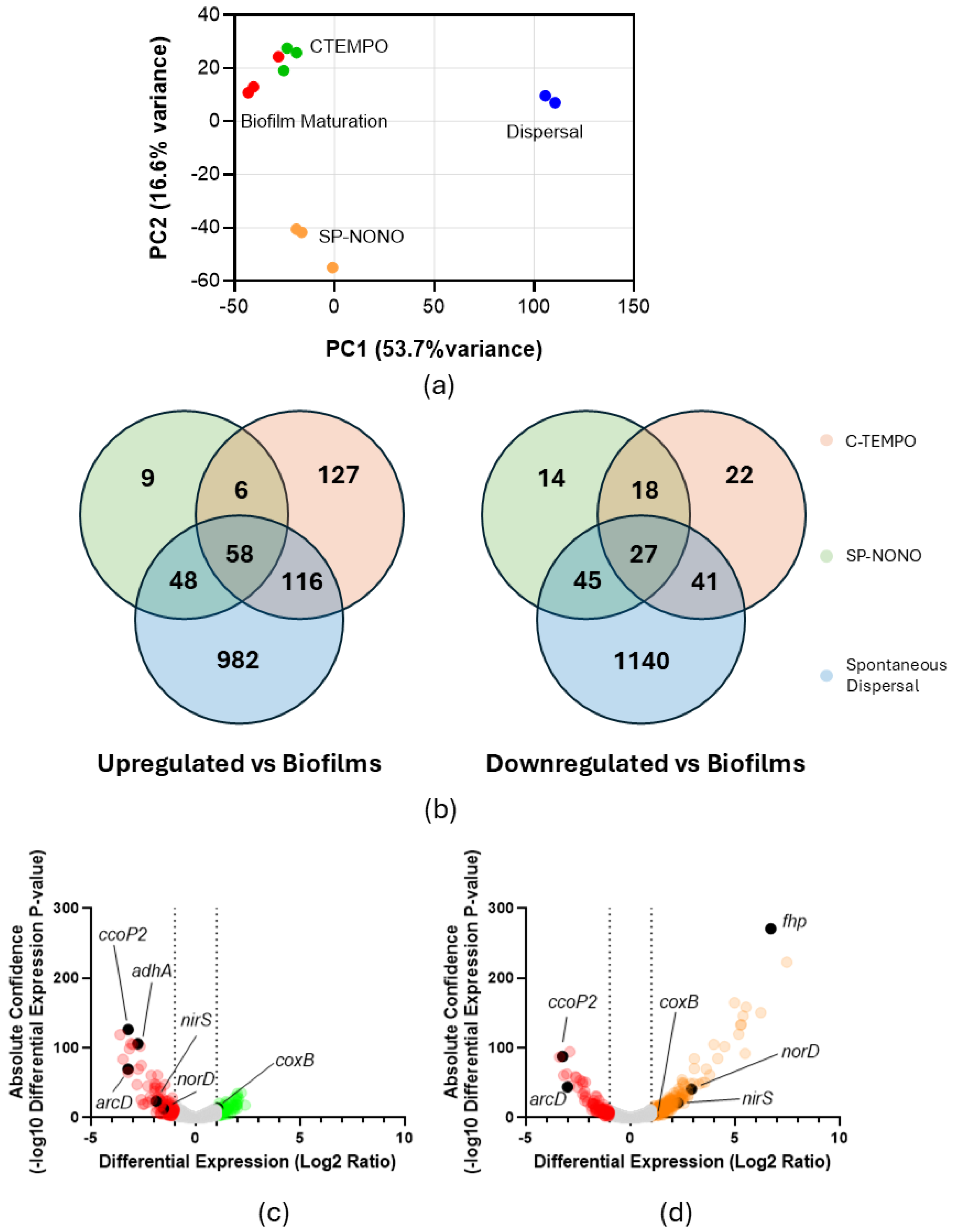

Table 1.
Genes involved in energy generation that are differentially regulated by C-TEMPO and NO treatment in P. aeruginosa biofilms.
Table 1.
Genes involved in energy generation that are differentially regulated by C-TEMPO and NO treatment in P. aeruginosa biofilms.
| Gene | Fold Change - C-TEMPOa | Fold Change - SP-NONOa | Gene product |
|---|---|---|---|
| Main anaerobiosis regulators | |||
| anr | -1.40 | -1.60 | transcriptional regulator Anr |
| dnr | -2.16 | -1.64 | transcriptional regulator Dnr |
| Oxidative phosphorylation | |||
| ccoP1 | 1.33 | 0.98 | cytochrome C oxidase cbb3-type subunit CcoP |
| ccoQ1 | 1.22 | 0.93 | cytochrome C oxidase cbb3-type subunit CcoQ |
| ccoO1 | 1.16 | 0.94 | cbb3-type cytochrome C oxidase subunit II |
| ccoN1 | 1.15 | 0.82 | cbb3-type cytochrome C oxidase subunit I |
| ccoP2 | -9.30 | -9.48 | cytochrome C oxidase cbb3-type subunit CcoP |
| ccoQ2 | -3.83 | -4.51 | cytochrome C oxidase cbb3-type subunit CcoQ |
| ccoO2 | -8.92 | -10.45 | cbb3-type cytochrome C oxidase subunit II |
| ccoN2 | -6.72 | -8.18 | cbb3-type cytochrome C oxidase subunit Id |
| coxA | 2.08 | 2.12 | cytochrome C oxidase subunit II |
| coxB | 3.90 | 2.95 | cytochrome C oxidase subunit I |
| cioA | 1.34 | 2.15 | cyanide insensitive terminal oxidase |
| cioB | 1.30 | 2.01 | cyanide insensitive terminal oxidase |
| cyoA | 1.09 | 1.80 | cytochrome o ubiquinol oxidase subunit II |
| cyoB | 1.06 | 1.27 | cytochrome o ubiquinol oxidase subunit I |
| cyoC | 1.26 | 1.01 | cytochrome o ubiquinol oxidase subunit III |
| cyoD | 1.31 | 0.87 | cytochrome o ubiquinol oxidase subunit IV |
| cyoE | 1.31 | 0.83 | protoheme IX farnesyltransferase |
| Denitrification | |||
| nirN | -1.25 | 2.70 | cytochrome C |
| PA0510 | -1.62 | 3.55 | uroporphyrin-III C-methyltransferase |
| nirJ | -1.48 | 3.67 | heme d1 biosynthesis protein NirJ |
| nirH | -1.10 | 3.30 | heme d1 biosynthesis protein NirH |
| nirG | -1.80 | 3.86 | heme d1 biosynthesis protein NirG |
| nirL | -2.63 | 2.37 | heme d1 biosynthesis protein NirL |
| nirD | -3.62 | 1.76 | heme d1 biosynthesis protein NirD |
| nirF | -4.88 | 1.54 | heme d1 biosynthesis protein NirF |
| nirC | -5.70 | 2.10 | cytochrome c55X |
| nirM | -5.44 | 3.13 | cytochrome C-551 |
| nirS | -3.70 | 4.80 | nitrite reductase |
| nirQ | -0.76 | 2.86 | denitrification regulatory protein NirQ |
| PA0521 | -0.95 | 6.67 | cytochrome C oxidase subunit |
| PA0522 | -1.20 | 6.08 | hypothetical protein |
| norC | -1.13 | 45.90 | nitric oxide reductase subunit C |
| norB | -1.05 | 31.34 | nitric oxide reductase subunit B |
| norD | -2.88 | 7.54 | denitrification protein NorD |
| nosR | 1.05 | 8.26 | regulatory protein NosR |
| nosZ | 1.02 | 7.28 | nitrous-oxide reductase |
| nosD | 0.95 | 3.93 | copper-binding periplasmic protein |
| nosF | 1.16 | 4.09 | copper ABC transporter ATP-binding protein |
| nosY | 0.88 | 3.47 | membrane protein NosY |
| nosL | 0.99 | 1.54 | acessory protein NosL |
| Arginine deiminase pathway | |||
| arcD | -9.37 | -8.02 | arginine/ornithine antiporter |
| arcA | -12.14 | -9.16 | arginine deiminase |
| arcB | -11.07 | -7.48 | ornithine carbamoyltransferase |
| arcC | -3.08 | -3.58 | carbamate kinase |
| Alcohol oxidation pathway | |||
| adhA | -6.79 | -5.97 | alcohol dehydrogenase |
| exaA | -1.27 | 1.34 | quinoprotein ethanol dehydrogenase |
| exaB | -1.39 | 1.84 | cytochrome C550 |
| exaC | -2.23 | 1.48 | NAD+ dependent aldehyde dehydrogenase ExaC |
a relative to untreated biofilms.
Table 2.
Genes uniquely upregulated during spontaneous and SP-NONO-induced dispersal of P. aeruginosa PAO1 biofilms.
Table 2.
Genes uniquely upregulated during spontaneous and SP-NONO-induced dispersal of P. aeruginosa PAO1 biofilms.
| Gene | Locus Tag | Fold Change - SP-NONO a | Fold Change - Spontaneous dispersal a | Gene product |
|---|---|---|---|---|
| Quorumsensing | ||||
| agtA | PA0604 | 4.63 | 3.20 | ABC transporter |
| agtB | PA0605 | 3.61 | 2.27 | ABC transporter permease |
| agtC | PA0606 | 2.36 | 2.10 | ABC transporter permease |
| PA1617 | 2.04 | 4.32 | AMP-binding protein | |
| mexG | PA4205 | 2.43 | 14.12 | hypothetical protein |
| mexH | PA4206 | 2.48 | 15.14 | resistance-nodulation-cell division (RND) efflux membrane fusion protein |
| mexI | PA4207 | 2.07 | 8.51 | resistance-nodulation-cell division (RND) efflux transporter |
| Sulphur metabolism | ||||
| cysW | PA0281 | -2.33 | -3.01 | sulfate transporter CysW |
| cysT | PA0282 | -2.73 | -2.81 | sulfate transporter CysT |
| cysP | PA1493 | -2.39 | -2.04 | sulfate ABC transporter substrate-binding protein |
| PA3449 | -3.23 | -3.05 | hypothetical protein | |
| PA3936 | -2.16 | -2.95 | taurine ABC transporter permease | |
| PA3937 | -2.45 | -2.85 | taurine ABC transporter ATP-binding protein | |
| PA3938 | -2.57 | -2.11 | taurine-binding protein | |
| cysN | PA4442 | -2.50 | -5.10 | bifunctional sulfate adenylyltransferase subunit1/adenylylsulfate kinase |
| cysD | PA4443 | -2.08 | -3.43 | sulfate adenylyltransferase subunit 2 |
| ABC transporters | ||||
| lhpK | PA1255 | 2.60 | 4.38 | trans-3-hydroxy-L-proline dehydratase |
| lhpO | PA1256 | 2.48 | 3.63 | amino acid ABC transporter ATP binding protein |
| lhpM | PA1258 | 2.41 | 2.25 | ABC transporter permease |
| nosF | PA3394 | 4.08 | 3.89 | copper ABC transporter ATP-binding protein |
| opuCA | PA3891 | 3.56 | 7.06 | ABC transporter ATP-binding protein |
| PA4193 | -2.25 | -8.63 | ABC transporter permease | |
| PA4194 | -2.13 | -4.14 | ABC transporter permease | |
| PA4195 | -2.08 | -2.55 | ABC transporter | |
| PA5095 | 2.10 | 2.55 | ABC transporter permease | |
| Two-component systems | ||||
| PA0034 | -2.00 | -8.11 | two-component response regulator | |
| PA0752 | 2.28 | 4.89 | hypothetical protein | |
| PA0753 | 2.57 | 4.35 | hypothetical protein | |
| PA0754 | 2.81 | 6.96 | hypothetical protein | |
| dctA | PA1183 | 44.63 | 7.57 | C4-dicarboxylate transport protein |
| ansB | PA1337 | 2.33 | 3.36 | glutaminase-asparaginase |
| PA3356 | 3.66 | 2.57 | hypothetical protein | |
| pprB | PA4296 | 2.14 | 8.57 | two-component response regulator PprB |
| tadB | PA4301 | 2.00 | 23.10 | type II secretion system protein TadB |
| rcpA | PA4304 | 2.11 | 28.25 | type II/III secretion system protein |
| rcpC | PA4305 | 2.19 | 30.48 | hypothetical protein |
| PA4648 | 2.36 | 21.86 | hypothetical protein | |
| PA4649 | 2.10 | 8.75 | hypothetical protein | |
| PA4908 | 3.14 | 3.25 | ornithine cyclodeaminase | |
| PA4909 | 2.68 | 3.27 | ABC transporter ATP-binding protein | |
| PA4910 | 3.14 | 3.03 | ABC transporter ATP-binding protein | |
| PA4911 | 3.97 | 3.07 | branched-chain amino acid ABC transporter permease | |
| PA4912 | 2.77 | 2.30 | branched-chain amino acid ABC transporter | |
| PA4913 | 2.01 | 2.14 | ABC transporter | |
| Alanine, aspartate and glutamate metabolism | ||||
| davD | PA0265 | 5.03 | 2.08 | glutarate-semialdehyde dehydrogenase DavD |
| davT | PA0266 | 4.06 | 2.66 | 5-aminovalerate aminotransferase DavT |
| ansB | PA1337 | 2.33 | 3.36 | glutaminase-asparaginase |
| PA3356 | 3.66 | 2.57 | hypothetical protein | |
| PA3758 | 3.39 | 2.13 | N-acetylglucosamine-6-phosphate deacetylase | |
| PA3759 | 3.36 | 2.73 | aminotransferase | |
| PA3760 | 3.41 | 2.45 | N-acetyl-D-glucosamine phosphotransferase system transporter | |
| PA5522 | 4.23 | 3.25 | glutamine synthetase | |
| PA5523 | 5.50 | 2.91 | aminotransferase | |
| Valine, leucine and isoleucine metabolism | ||||
| braC | PA1074 | 2.13 | 2.91 | branched-chain amino acid ABC transporter substrate-binding protein BraC |
| bkdB | PA2249 | 2.10 | 3.56 | branched-chain alpha-keto acid dehydrogenase complex lipoamide acyltransferase |
| lpdV | PA2250 | 2.69 | 2.93 | branched-chain alpha-keto acid dehydrogenase complex dihydrolipoyl dehydrogenase |
| leuD | PA3120 | -3.36 | -3.18 | isopropylmalate isomerase small subunit |
| leuC | PA3121 | -2.53 | -4.11 | 3-isopropylmalate dehydratase large subunit |
| PA3417 | 2.66 | 13.09 | pyruvate dehydrogenase E1 component subunit alpha | |
| ldh | PA3418 | 2.19 | 17.88 | leucine dehydrogenase |
| ilvI | PA4696 | -2.07 | -11.16 | acetolactate synthase 3 catalytic subunit |
| Arginine and proline metabolism | ||||
| PA4908 | 3.14 | 3.25 | ornithine cyclodeaminase | |
| PA4909 | 2.68 | 3.27 | ABC transporter ATP-binding protein | |
| PA4910 | 3.14 | 3.03 | ABC transporter ATP-binding protein | |
| PA4911 | 3.97 | 3.07 | branched-chain amino acid ABC transporter permease | |
| PA4912 | 2.77 | 2.30 | branched-chain amino acid ABC transporter | |
| PA4913 | 2.01 | 2.14 | ABC transporter | |
| Bacterial chemotaxis | ||||
| PA0173 | 3.12 | 4.17 | chemotaxis response regulator protein-glutamate methylesterase | |
| PA0174 | 3.46 | 2.95 | hypothetical protein | |
| cheR2 | PA0175 | 3.41 | 5.06 | chemotaxis protein methyltransferase |
| aer2 | PA0176 | 2.30 | 5.98 | aerotaxis transducer Aer2 |
| PA0177 | 2.01 | 4.56 | purine-binding chemotaxis protein | |
| PA0179 | 2.00 | 9.99 | two-component response regulator | |
| Porphyrin metabolism | ||||
| cobP | PA1278 | -2.30 | -5.70 | bifunctional adenosylcobinamide kinase/adenosylcobinamide-phosphate guanylyltransferase |
| cobU | PA1279 | -2.38 | -5.03 | nicotinate-nucleotide--dimethylbenzimidazole phosphoribosyltransferase |
| PA1280 | -2.33 | -7.16 | hypothetical protein | |
| cobV | PA1281 | -2.35 | -6.06 | adenosylcobinamide-GDP ribazoletransferase |
| PA4088 | 2.27 | 2.64 | aminotransferase | |
| PA5523 | 5.50 | 2.91 | aminotransferase | |
| Nicotinate and nicotinamide metabolism | ||||
| pntAB | PA0195.1 | -2.23 | -2.17 | NAD(P) transhydrogenase subunit alpha |
| pntB | PA0196 | -2.48 | -2.35 | pyridine nucleotide transhydrogenase subunit beta |
| nadE | PA4920 | -2.51 | -3.05 | NAD synthetase |
| Pyrroloquinoline quinone biosynthesis | ||||
| pqqA | PA1985 | 2.51 | 14.03 | coenzyme PQQ synthesis protein A |
| pqqD | PA1988 | 3.18 | 2.14 | coenzyme PQQ synthesis protein D |
| pqqE | PA1989 | 3.73 | 2.85 | coenzyme PQQ synthesis protein E |
| pqqH | PA1990 | 3.36 | 3.76 | peptidase |
a relative to untreated biofilms.
Table 3.
Differential transcription of dispersal biomarkers induced by SP-NONO and C-TEMPO treatment in P. aeruginosa PAO1 biofilms.
Table 3.
Differential transcription of dispersal biomarkers induced by SP-NONO and C-TEMPO treatment in P. aeruginosa PAO1 biofilms.
| Locus Tag | Fold Change – C-TEMPO a |
Fold Change – SP-NONO a | Gene product |
|---|---|---|---|
| PA0111 | 5.15 | 6.62 | hypothetical protein |
| cheR2 | 1.44 | 3.41 | chemotaxis protein methyltransferase |
| PA0743 | 1.32 | 1.83 | NAD-dependent L-serine dehydrogenase |
| PA1353 | 1.70 | 1.47 | hypothetical protein |
| pqqA | 1.21 | 2.52 | coenzyme PQQ synthesis protein A |
| cdpR | 1.39 | -1.01 | transcriptional regulator |
| amrZ | 1.16 | 1.40 | alginate and motility regulator Z |
| tadA | 2.01 | 2.21 | ATPase TadA |
| rcpA | 1.58 | 2.12 | type II/III secretion system protein |
| rcpC | 1.50 | 2.18 | hypothetical protein |
| flp | 2.20 | 2.27 | type IVb pilin Flp |
| PA4523 | -1.13 | 1.22 | hypothetical protein |
| cupE1 | 1.79 | 2.36 | fimbrial subunit CupE1 |
| cupE2 | 1.46 | 2.09 | fimbrial subunit CupE2 |
a relative to untreated biofilms.
Disclaimer/Publisher’s Note: The statements, opinions and data contained in all publications are solely those of the individual author(s) and contributor(s) and not of MDPI and/or the editor(s). MDPI and/or the editor(s) disclaim responsibility for any injury to people or property resulting from any ideas, methods, instructions or products referred to in the content. |
© 2026 by the authors. Licensee MDPI, Basel, Switzerland. This article is an open access article distributed under the terms and conditions of the Creative Commons Attribution (CC BY) license (http://creativecommons.org/licenses/by/4.0/).
Copyright: This open access article is published under a Creative Commons CC BY 4.0 license, which permit the free download, distribution, and reuse, provided that the author and preprint are cited in any reuse.


