

Submitted:
04 March 2026
Posted:
05 March 2026
You are already at the latest version
Abstract
The contemporary green transformation of the economy is a strategic imperative for businesses, especially small and medium-sized enterprises (SMEs) operating in the energy market, forcing the integration of sustainable practices in decision-making processes, including investment efficiency assessment. Classic financial tools, such as the internal rate of return and net present value, commonly used in the SME sector, do not always adequately account for environmental, regulatory, and social risks associated with green transformation. The goal of the study was to determine the impact of nominal and real discount rates, adjusted for a synthetic measure of green transformation, on investment decisions. The research methodology combines advanced multicriteria analysis techniques with sustainable finance concepts, offering an innovative approach to investment decision-making in the SME sector. The study shows that integrating environmental factors increases the cost of capital and reduces the net present value while maintaining the profitability of the analysed projects. Incorporating green components into the discount rate enhances valuation appropriateness and improves investment risk management, especially in conditions of macroeconomic uncertainty. The findings contribute to the development of research on dynamic methods of evaluating investment projects.
Keywords:
sustainable development
; environmental economics
; green energy market
; internal rate of return
1. Introduction
Contemporary management paradigms indicate that green transformation is no longer optional. It has become a strategic imperative, especially for small- and medium-sized enterprises operating in the energy market. SMEs operate in an environment of growing regulatory requirements and heightened stakeholder expectations [1,2]. In this context, traditional methods of evaluating investment effectiveness have proven insufficient. They do not fully account for the environmental and social factors characteristic of pro-ecological projects [3,4].
The Internal Rate of Return (IRR) remains one of the keys and most frequently used measures of the profitability of investment projects, especially in the SME sector, where capital constraints and high economic uncertainty necessitate quick, relatively simple decision-making. The IRR determines the discount rate at which the net present value of the project's cash flows equals zero, enabling one to assess whether the expected financial benefits exceed the cost of the capital invested. This makes the indicator a useful comparative tool when choosing among alternative investment options under limited allocation constraints. At the same time, the current IRR approach does not always adequately reflect the specifics of pro-ecological projects. Green investments, including the energy sector, often have a long-time horizon, a typical cash flow profile, and a strong dependence on regulatory and market factors. As a result, traditional methodologies may systematically underestimate their actual value or overlook the risks of failing to adapt to the requirements of energy transformation. This problem is particularly evident in the SME sector, where green innovations are often implemented in a fragmented manner, and entrepreneurs struggle to translate environmental goals into coherent, advanced analytical tools [5,6,7,8]. Although the literature on the IRR is abundant, little is known about its use in cases where complex transformation projects are burdened by green transformation.
From a research and practical perspective, the development of expanded investment evaluation models that integrate conventional financial measures with environmental and social factors is gaining increasing importance. Incorporating ESG (Environmental, Social, Governance) factors into the cash flow statement enables the monetisation of effects such as energy savings, CO₂ emissions reductions, regulatory cost reductions, and improved company market reputation [9]. This approach allows for determining an adjusted return rate that more accurately reflects the actual effectiveness of green projects, while also promoting SMEs' positioning in sustainable supply chains and strengthening their long-term competitive stability [10].
The evolution of investment evaluation methods towards integrated models is driven by both Porter's hypothesis, which posits a stimulating effect of environmental regulations on enterprise innovativeness, and the need for precise modelling of the cost of capital in the context of energy transformation [11]. The expanded IRR calculation, which considers not only direct cash flow but also operational benefits, reputation, and reduced regulatory risks, is becoming a key element of modern capital budgeting in the SME sector. Proper quantification of these factors helps fill the gap between financial orthodoxy and the requirements of sustainable development, supporting rational investment decisions and the sustainable integration of SMEs into the green transformation of the economy.
The purpose of this paper is to analyse the impact of using nominal and real discount rates, and their adjustment by a synthetic measure of green transformation, on the valuation of investment project efficiency. The study aims to determine how considering environmental, regulatory, and social risks within the framework of sustainable development and ESG policies affects the net present value (NPV) and the internal rate of return (IRR) of investments. Furthermore, the goal is to assess whether integrating these factors into the cost of capital translates into the sustainability and resilience of projects under changing macroeconomic conditions and increasing ecological requirements.
Considering the above objective, the paper formulates the following research questions: How do nominal and real discount rates affect the evaluation of the economic efficiency of investment projects? What are the consequences for project values and investment risk when using discount rates adjusted for green transformation? How does the attractiveness of investment projects change when environmental components are considered compared to traditional valuation methods? How do changes in the discount rate, caused by the green transformation, affect investment decisions and the economic resilience of regions?
The novelty of the presented research lies in the comprehensive combination of classical methods of evaluating investment effectiveness with a modern approach to assessing the risks associated with green transformation, which not only expands the discounting model to include ESG factors but also integrates them into authentic and nominal interest rates. The work goes beyond the traditional framework of financial analysis, considering the growing importance of environmental policies and their impact on the cost of capital. This area remains insufficiently studied and formally systematised in the literature. Furthermore, the study broadens the analysis to long-term horizons, considering the significant impact of later cash flows, thereby improving the model's predictive quality.
2. Materials and Methods
A systematic literature review conducted in accordance with the requirements [12,13] showed that the internal rate of return (IRR) is one of the most used measures of investment efficiency, especially in the SME sector. Its popularity stems primarily from its intuitive interpretation and the ability to quickly compare alternative investment projects under limited capital and analytical resources. Empirical research confirms that IRR is widely used as the primary criterion for accepting investment projects in the micro, small, and medium-sized enterprises (MSME) sector, where investment decisions are often made with limited access to advanced analytical tools. The use of this method correlates with improved capital allocation efficiency and enterprise financial performance [14,15,16,17,18,19,20,21,22,23,24,25,26,27,28,29,30,31,32,33,34].
Despite its widespread use, literature points to significant methodological limitations of the classical IRR approach. These problems are especially evident in projects characterised by non-standard cash flow structures, leading to multiple solutions to the IRR equation or to its absence, which makes it impossible to interpret the results unequivocally. This phenomenon has been extensively documented in studies of projects with variable cash flows. Additionally, the classical IRR formula assumes that financial surpluses are reinvested at the IRR, which is often unrealistic in practice and can lead to overestimation of the return on investment [17,18,19,24,25,26].
A significant drawback of the IRR method is its potential conflict with the NPV criterion, especially for mutually exclusive projects or those differing in scale or time horizon. In such situations, IRR may lead to the selection of projects that generate lower value for the company, which contradicts the fundamental assumption of the theory of maximising the company's value [27]. These limitations undermine the validity of using the IRR as an independent and overriding decision-making criterion, especially in the analysis of long-term projects [28].
In response to these challenges, the literature calls for the development of multidimensional analytical frameworks that integrate IRR, NPV, and cost-benefit analysis (CBA) with the valuation of environmental externalities, such as energy savings or CO₂ emissions reductions [30]. Monetising environmental effects enables a more accurate representation of the actual economic efficiency of green investments. Green transformation and the implementation of energy-efficiency and circular-economy practices significantly impact the competitiveness of the SME sector. Empirical research indicates that companies with high ESG maturity achieve better financial results, which justifies the inclusion of reputational benefits and regulatory risks in investment analyses [31]. At the same time, the implementation of green innovations in the SME sector is fragmented, due to difficulties in translating strategic environmental goals into systematic management processes, such as Green BPM or KEI indicators [32].
In the context of low-carbon investments, a deterministic approach to IRR is particularly problematic given the high volatility of energy and emission permit prices [33]. In sectors such as sustainable forestry, IRR only reflects the time profile of capital, disregarding the marginal environmental and social costs [34]. In response to these limitations, models integrating ESG factors with the financial account are being developed, enabling better risk management and improving access to capital focused on sustainable development. Expanded approaches to calculating IRR also include operational savings, reputational effects, and life cycle analysis of investments [35,36,37,38,39].
The regional dimension, encompassing regional resilience and spike development, is a significant complement to the analyses. The green transformation encourages the concentration of innovation in specialised growth centres, thereby increasing patent activity and employment in high-tech sectors. At the same time, investments in decarbonization and energy infrastructure strengthen regional resilience, but they require integrating financial indicators with measures of regional sustainable development [40,41,42]. According to Porter's hypothesis, stricter environmental regulations can stimulate innovation in companies [43,44], but without appropriately modified evaluation tools, such as extended IRR models, a reliable assessment of the profitability of pro-ecological projects remains difficult. The literature indicates the limited adequacy of classical tools, such as IRR, in conditions of increased investment risk complexity [45,46,47].
Despite numerous studies on the valuation of investment projects and the use of discount rates, there is a significant gap in the literature regarding the formal incorporation of green transformation into the cost of capital and its impact on discounting methodology and risk assessment. Previous analyses often limit themselves to nominal or real interest rates, failing to fully integrate environmental risks and thereby underestimating the actual financing costs of projects subject to increasingly stringent regulatory and social requirements. Furthermore, there is a lack of comprehensive research analysing how such adjustments affect long-term investment decisions and regional economic resilience, especially in the context of implementing sustainable development policies.
Based on the literature and the characteristics of investment projects, the following research hypotheses were formulated:
- (H1) Incorporating a synthetic measure of green transformation into the nominal discount rate significantly reduces the net present value (NPV) of investment projects but does not eliminate their profitability.
- (H2) Investment projects evaluated using a real discount rate adjusted for green transformation factors show greater resilience to macroeconomic variability and environmental risks than projects valued at traditional rates.
- (H3) The use of adjusted discount rates results in more accurate investment decisions, as measured by a higher correlation between financial evaluations and the actual results of projects and their long-term economic stability.
In the face of growing climate challenges and increasingly stringent environmental regulations, businesses (especially small and medium-sized ones) must consider ecological aspects in their investment processes. Traditional financial performance evaluation tools, such as the internal rate of return (IRR), need to be adapted to better support green transformation. The study proposed integrating a synthetic measure of green transformation into the classic IRR model to consider the impact of environmental factors on investment profitability. The methodology presented combines advanced multi-criteria analysis techniques with sustainable finance concepts, offering an innovative approach to investment decision-making in the SME sector.
To conduct the study comprehensively and avoid unreliable results, the analysis process was divided into several key stages: selecting criteria and data sources, normalising variables, determining criterion weights, aggregating data using the TOPSIS method, and adjusting the return rate to account for the impact of green transformation. Each of these stages was conducted in accordance with recognised research methods, ensuring the consistency and reliability of the results obtained.
(1) Selection of criteria and data sources. A synthetic measure of green transformation (GT) was constructed from a set of ESG indicators, with particular focus on the environmental component. The criteria include, among others, the share of renewable energy sources, energy efficiency, investment outlays for ecological protection, pollutant emissions, and regional-level environmental policy instruments. Quantitative data for a decision matrix:
where: – the values of the diagnostic variables under study of the j-th variable (j = 1, 2, ..., m) for the i-th object (i = 1, 2, ..., n).
Model data were used for the analysis because they allow for a controlled, comparable depiction of the impact of the internal rate of return on investment decision-making in SMEs in the context of green transformation. Empirical data on actual investments in the SME sector are often limited, heterogeneous, or subject to commercial secrecy, making them difficult to obtain and compare. Using model data allows one to focus on the IRR method itself and its sensitivity to key investment parameters, which is particularly important for long-term and uncertain green projects.
(2) Data normalisation (zero-based unification). Due to the diversity of measurement units, zero-based unification was used, normalising all variables to the [0,1] range. This method is characterised by simplicity of interpretation and high usefulness in linear or ordering analyses. Unification was performed according to the formula:
where: S is the stimulant, D is the destimulant, Zij is the value of the i-th unit for the j-th criterion, max(xij) is the maximum value of the j-th criterion, min(xij) is the minimum value of the j-th criterion, and nij is the normalised value [48,49].
(3) Determining the weights of criteria – the CRITIC method. The CRITIC (CRiteria Importance Through Intercriteria Correlation) method was used to objectively determine the criterion weights. This method accounts for both the variability of characteristics and their mutual correlations, assigning greater importance to criteria that provide unique information. The steps include: calculating the standard deviation σ_j, determining the correlation matrix r_jk, and calculating the information measure:
where: σj is the standard deviation for the jth criterion, n̅ is the normalized mean value for the jth criterion, rjk is the correlation coefficient between the jth and kth criteria, Rj is the sum of the distance coefficients (1 minus correlation) between the jth criterion and all other criteria, Cj is the information content measure for the jth criterion, wj is the weight of the jth criterion, m is the number of units (rows), and n is the number of criteria (columns) [50].
(4) Synthetic measure aggregation – TOPSIS. The TOPSIS (Technique for Order Preference by Similarity to Ideal Solution) method was used to determine the synthetic measure of green transformation, which assumes that the best alternative is both closest to the ideal solution and farthest from the anti-ideal solution. The following are determined: the ideal object , the anti-ideal object(=0), and the distance of the object from:
where: – weight of the j-th criterion , – is the normalised value of the j-th variable of the i-th object multiplied by the corresponding weighting factor, -– is the reference or anti-reference object, m is the number of criteria, and n is the number of objects. A synthetic measure aggregates multidimensional data across various criteria into a single value, making it easier to compare and classify. This measure was calculated according to the formula:
where: qi∈ [0; 1]; -- denotes the distance of the object from the anti-pattern (from 0), -- denotes the distance of the object from the pattern (from 1) [48,49,50,51,52,53,54].
(5) Modification of the IRR return. The internal rate of return (IRR) is the discountrate for which the net present value of cash flows is zero:
The nominal rate of return is treated as a variable dependent on the level of green transformation, according to the relationship:
where: ZT∈ [0,1] is a synthetic measure of the green transformation of a territorial unit or industry; r_n– the base nominal rate of return, ZT– the synthetic measure of green transformation. The real rate of return is similarly adjusted to account for inflation.
The record is based on the assumption that the green transformation is a factor that increases the effective return on investment by generating additional economic benefits, such as reducing operating costs, access to public support instruments, and improving the competitiveness of the enterprise. The variable ZT is interpreted as a positive bonus reflecting the level of advancement of pro-ecological actions and their positive impact on effective return on investment. The use of the " " symbol is justified when the long-term benefits of green transformation — such as cost savings, access to preferential financing sources, or increased competitiveness — outweigh the short-term costs of its implementation. The assumption is based on the interpretation that the green transformation increases the effective return on investment, rather than decreasing it.
Green transformation is considered a growth factor, generating additional economic benefits, such as cost savings, access to subsidies, and improved competitiveness of the enterprise, which is why will play the role of a premium added to the nominal return rate. The notation means that the level of green transformation acts as a multiplier that increases the rate of return, similar to the premium for innovation or public support. The "– ZT" symbol would only be applicable if the green transformation was seen as a source of additional costs or risk, whereas the adopted interval ZT ∈ [0,1] provides a moderate and realistic scale of correction. Proportional scaling of nominal and real return rates using the 1+ZT multiplier integrates the environmental dimension with classical financial tools, thereby enhancing the adequacy of investment assessment in the face of contemporary market and institutional challenges. Such an adjustment more accurately reflects the actual costs of capital and the investment risks associated with the ecological transformation, thereby strengthening the accuracy of decisions, especially in the SME sector. This method accounts for regulatory risk, the cost of failing to meet environmental standards, and bonuses for access to green finance, thereby increasing the consistency of investment assessment with the sustainable development paradigm.
In the face of global climate challenges, traditional investment assessment tools need to be redefined. In the SME sector, characterised by limited resources, it is crucial to incorporate ESG factors precisely into economic calculations. The study assumed that the internal rate of return (IRR) and the discount rate should be functions of green transformation (ZT). The proposed model assumes that the green transformation affects the risk profile and the cost of capital in a proportional manner. The adjustment of returns (nominal and real) is made through a multiplier (1/ZT), which reflects the endogenous impact of institutional-technological changes on investment profitability.
3. Results
The study analyzes the impact of different discount rate variants on the assessment of the profitability of the same investment project (initial investment - PLN 300,000) over a 5-year and 10-year horizon, using four approaches to the cost of capital: (1) nominal discount rate of 4%, (2) nominal discount rate adjusted for a synthetic measure of green transformation (ZT = 0.4) according to the formula , which gives 5.60%, (3) real discount rate of 0.97% (derived from the nominal 4% at an inflation of 3%), and (4) real discount rate adjusted for a synthetic measure of green transformation according to the analogous formula , which gives 1.36%. A synthetic measure of green transformation at 0.4 (at the national or regional level) reflects the additional regulatory, environmental, and technological risks associated with green transformation and serves to internalise ESG factors through a multiplicative adjustment of the cost of capital.
The data in Table 1 illustrate the discounting of the investment project's cash flows over five years at a nominal discount rate of 4%, reflecting the investor's cost of capital. The initial investment amount was PLN 300,000, and the discounted cash flow increased from approximately PLN 77,000 to over PLN 82,000 annually. The discounted cash flow analysis yielded a positive NPV of 98,919 PLN, indicating that the project is economically viable. The internal rate of return (IRR) of 14.60% is significantly above the cost of capital, confirming the investment's attractiveness. This analysis provides strong evidence to support the decision to implement the project, both financially and strategically.
Table 2 illustrates the investment project's cash flows over 10 years, discounted at a 4% rate. The initial investment is PLN -300,000, and the annual cash flows range from PLN 80,000 to PLN 35,000, with corresponding discount rates. The sum of discounted cash flows yields a positive NPV of 268,963.17 PLN, indicating the creation of economic value. The internal rate of return (IRR) is 22.39%, which is significantly above the cost of capital, confirming the project's profitability. The analysis clearly indicates that the investment is financially justified.
The positive NPV and high IRR results clearly justify the project's implementation, indicating its ability to generate economic value. An analysis based on the standard discounting method ensures comparability with other projects, and the long time horizon emphasises the importance of later cash flows to the final NPV. Given the low discount rate used, the analysis is sensitive to changes in macroeconomic conditions; therefore, it is recommended to conduct sensitivity and scenario tests. In the context of green transformation, it is worth considering green risk measures in the cost of capital to better assess the project's profitability and account for environmental factors. Such an approach will increase the accuracy of investment decisions in a changing regulatory and market environment. The summary of nominal and discounted cash flows illustrates the impact of the time value of money: although nominal inflows stabilise after the 5th year, their real contribution to the NPV structure gradually decreases as the discount rate declines. The small difference between the bars in the graph (especially in the initial phase) confirms the observation of a low discount rate, which makes the project attractive but also sensitive to changes in the cost of capital (Figure 1).
Using a higher discount rate of 5.60%, which accounts for the risks associated with the green transformation, leads to stronger discounting of future cash flows (Table 3). Despite the higher cost of capital, the project's net present value (NPV) remains positive at 80,956.52 PLN, indicating its profitability. Cash flows from 80,000 PLN to 100,000 PLN over the next five years, discounted at the appropriate rates, confirm the economic viability of the investment. The internal rate of return (IRR) of 14.60% significantly exceeds the adjusted discount rate, further confirming the project's attractiveness despite the inclusion of additional risk factors. Such a result testifies to the effectiveness of the investment even in conditions of increased environmental and regulatory risk.
Table 4 shows the discounting of the project's ten-year cash flows at an adjusted nominal discount rate of 5.60%, reflecting the impact of green transformation. The initial investment is PLN 300,000, and the annual cash flows of PLN 80,000 to PLN 35,000 were discounted by the appropriate factors, decreasing from 1.0000 to 0.5799. The sum of the discounted cash flows yields a positive NPV of 232,262.08 PLN, indicating the project's economic viability. The internal rate of return (IRR) of 22.39% is significantly above the cost of capital, confirming the investment's attractiveness. These results indicate that the project generates added value despite the additional environmental and regulatory risks considered.
Introducing a green transformation factor into the discount rate reflects the growing importance of ESG factors in assessing risk and expected returns. Despite the increased cost of capital, the project still yields a positive NPV and a high IRR, confirming its profitability and financial resilience. The increased discount rate reflects the impact of environmental policies on valuation, raising the discount rate for future benefits without eliminating the project's profitability. The long-term analysis horizon emphasises the importance of later flows, which is why it is recommended to conduct sensitivity and scenario tests to assess the resilience of the decision to changes in parameters. In summary, integrating environmental factors into the cost of capital improves the accuracy and sustainability of investment decisions in the context of green transformation. The visualisation presented confirms that, despite using a higher discount rate that accounts for the green transformation, the financial surpluses (cash flow) generated over the entire 10-year period are sufficient to more than cover the initial investment outlay of over 300,000 units. A clear downward trend in the discounting factor line illustrates the mechanism of increased discounting of future benefits, as evidenced by the growing difference between the nominal and red bars of discounted cash flows in the later stages of the project (Figure 2).
The analysis is based on a real discount rate of 0.97%, which accounts for inflation and separates nominal price effects from the real value of money over time. The initial investment cost is -300,000 PLN, and the cash flow in the next five years increases from 80,000 PLN to 100,000 PLN. A low real return rate results in a high discounted cash flow, yielding a positive NPV of 136,715.14 PLN, confirming the project's profitability (Table 5). The IRR of 14.60% significantly exceeds the discount rate used, further justifying the investment. This project generates a real increase in economic value, inflation-adjusted.
The financial analysis uses a real discount rate of 0.97%, which eliminates the effect of inflation and precisely reflects the value of money over time (Table 6). The project requires an initial investment of PLN 300,000 and generates a flow of PLN 80,000 to PLN 35,000 over the next ten years. The discount factors decrease gradually from 1.0000 to 0.9079, resulting in discounted cash flow values of PLN 79,230.77 in the first year and PLN 31,776.56 in the tenth year. The sum of discounted cash flows gives a positive NPV of 350,163.86 PLN, confirming the project's profitability. The IRR of 22.39% significantly exceeds the discount rate, which justifies the investment.
Comparing the IRR to the real capital rate reveals a significant excess of real profitability over the cost of financing, especially for long-term, moderate-risk investments. The analysis indicates that, taking the real interest rate into account, the project is highly resistant to price changes, and its real effectiveness remains stable and unequivocally positive. As a result, the project not only creates value but also does so in a way that is resistant to inflationary pressures, which is particularly important in decision-making processes concerning strategic or pro-development investments. Furthermore, the long-term time horizon and the systematic consideration of discounted cash flows emphasise the importance of precise modelling and reliable valuation in investment decision-making. Even when accounting for the real interest rate, the financial surplus generated significantly exceeds the discounted capital costs, confirming the project's high resilience to market volatility. The slope of the discount factor line and relatively small differences between nominal and discounted cash flows illustrate the stability of the real investment efficiency over the entire 10-year time horizon (Figure 3).
The analysis uses a real discount rate adjusted for the green transformation factor, yielding a value of 1.36% (Table 7). This considers both the real value of money and the additional risks associated with the green transformation, which affect the cost of capital. The project requires an initial investment of PLN 300,000 and generates positive cash flows of PLN 80,000 to PLN 100,000 over five years. Discounting at the allowed rate yielded an NPV of PLN 131,568.70, confirming the investment's profitability. The IRR of 14.60% significantly exceeds the adjusted cost of capital, justifying the project's implementation.
The analysis is based on a real discount rate adjusted for the green transformation factor of 1.36%, which accounts for both the real value of money and additional environmental risks (Table 8). The project requires an outlay of PLN 300,000 and generates positive cash flows of PLN 80,000 to PLN 35,000 over ten years. Discounting at the adjusted rate yields a net present value of PLN 338,787.55, confirming the investment's profitability. The IRR of 22.39% significantly exceeds the cost of capital, reinforcing the decision to implement the project. The results indicate a stable and attractive return that accounts for green transformation factors.
Incorporating the green transformation metric into the discount rate increases the cost of capital, reflecting the higher return-on-investment requirements associated with environmental and social risks. Despite this, the project remains highly financially attractive, a testament to its ability to generate value amid the complex challenges of green transformation. The analysis proves the economic feasibility of the green development paradigm. The project is not only profitable in light of traditional economics but also effective when evaluated through the lens of environmental economics. This is the argument that environmental and financial goals can converge, which underpins the "Green Growth" theory. The summary of nominal and discounted cash flows shows that even with tightened profitability criteria arising from ESG risks or green transformation, the financial surplus generated (as indicated by the positive bars after year zero) permanently exceeds the cost of the capital invested. The clear slope of the discount factor line confirms the inclusion of a higher premium for environmental risk, which does not eliminate the positive result, thus confirming the economic validity of the green growth paradigm (Figure 4).
The results of the financial analysis, which take into account the theory of the value of money and Fisher's equation by separating the nominal from the real, confirm that the use of real discount rates enables a precise assessment of the real growth of the investor's assets. In light of the investment theory and the NPV model, positive NPV values and stable IRR across variants indicate a high margin of safety and the project's resistance to changes in the cost of capital, driven by its technological characteristics. Adjusting the discount rate by a synthetic measure of green transformation (ZT), in line with the assumptions of modern portfolio theory, reflects the premium for systemic risk associated with energy transformation and environmental regulations, forcing investors to consider the additional cost of capital. The analysis also points to the importance of the legal and institutional environment, which relates to institutional economics — the discount rate serves as a carrier of information about the quality of norms and regulations, such as the EU Taxonomy, that affect asset valuation.
From the perspective of environmental economics and sustainable development, introducing the ZT adjustment shifts project assessment towards strong sustainability, where a positive NPV, even under stricter criteria, indicates the investment's ability to generate profits without overburdening the ecosystem. Through the internalisation of external effects, the project accounts for the financial burden of potential negative environmental effects, and the application of climate risk and ESG (Environmental, Social, Governance) theory enables reliable asset valuation, balancing transition risk with profitability. A long, ten-year analysis horizon emphasises that the stability of cash flows and discounted values is crucial for sustainable economic resilience, consistent with the concepts of intergenerational justice and time horizon.
In a regional context, integrating green transformation into the cost of capital supports the spike model of development, enabling the creation of growth centres that are resilient to environmental and economic risks. At the same time, it points to the need for mechanisms to diffuse benefits to counteract the negative effects of polarisation and strengthen the resilience of entire regional systems. The analysis confirms that economic efficiency and sustainable development are complementary goals, and that their simultaneous consideration is the basis for sustainable growth and resilience at the local, national, and global levels.
4. Discussion
Research influences theory and practice. Research influences theory and practice. The research aligns with the field of environmental economics and proposes a modified dynamic method for assessing the effectiveness of investment projects that accounts for ESG factors. The study confirmed that integrating nominal and real discount rates with a synthetic measure of green transformation affects the valuation of investment projects, primarily by increasing the cost of capital and reducing the NPV. Despite the increase in the discount rate, the projects remain profitable, which is a testament to their financial resilience and ability to create economic value in the context of sustainable development. Incorporating environmental and social factors into the analysis enhances the appropriateness of the valuation. It enables better management of investment risk, providing significant added value for investment decision-making amid growing ESG policy requirements.
Nominal and real discount rates significantly impact the economic evaluation of investment projects, with the real discount rate enabling a more stable and realistic valuation of the investment's value. Using discount rates adjusted for green transformation elements leads to higher investment return requirements and better reflection of environmental risk. As a result, the net present value (NPV) is reduced, but this does not eliminate the project's profitability. Integrating green risks and ESG requirements significantly improves the accuracy and relevance of valuation, increasing the resilience of investments to uncertainty and external factors. The attractiveness of projects changes when environmental factors are considered – the NPV decreases, while the internal rate of return (IRR) remains at a level that guarantees the investment's implementation. Changes in the discount rate resulting from the green transformation also affect investment decisions, especially in project selection and in strengthening regional economic resilience by promoting sustainable investments.
Verification of research hypotheses confirmed that including a synthetic measure of green transformation in the nominal discount rate significantly reduces the net present value (NPV) of investment projects but does not eliminate their profitability (H1). Projects evaluated using a real discount rate adjusted for green transformation factors show higher resilience to macroeconomic variability and environmental risks, as reflected in the maintenance of high internal rates of return (IRRs) that exceed the adjusted cost of capital (H2). Furthermore, the use of adjusted discount rates significantly improves the accuracy of investment decisions, as evidenced by greater consistency between financial forecasts and actual results and by the economic stability of projects in the long term (H3). The consequences of these adjustments include a reduction in NPV while maintaining profitability, thereby reducing investment risk by better accounting for regulatory and social risks.
From a local and regional policy perspective, the study's results underscore the importance of accounting for green transformation in the planning of public and private investments. Integrating environmental factors into project evaluation helps identify projects that generate not only economic value but also strengthen regional ecological and social resilience. The study confirms that the usage of modified IRR can limit the adverse effects of spatial polarisation and promote the diffusion of development benefits. This is because the use of nominal and real discount rates, adjusted for the green transformation factor, significantly affects the assessment of the economic efficiency of investment projects. Considering this factor increases the cost of capital, leading to higher discount rates and lower NPV values than the traditional approach, while still maintaining positive NPV across all variants. Furthermore, IRR significantly exceeds both the nominal and real discount rates, even after adjusting for green risk, confirming the projects' sustainable profitability and the validity of treating IRR as a supplement rather than a standalone decision-making criterion. The study shows that integrating environmental factors into discounting processes should become standard practice in both market practice and institutional investor guidelines.
From a business practice perspective, the study's results support arguments for implementing mechanisms to align investments with sustainable development principles and for developing analytical tools to enable a comprehensive assessment of ESG risks. This is especially important in the SME sector, where, as empirical research indicates, decision-making often relies on simplified profitability measures, such as IRR, due to resource and knowledge limitations. As a result, the lack of systemic analytical solutions may lead to an underestimation of both risks and long-term benefits of pro-ecological investments.
5. Conclusions
The study is based on model cash flows and assumptions about nominal and real discount rates, which may limit the results' universality in other economic sectors or under changing market conditions. Furthermore, the adopted synthetic measure of green transformation is a generalisation and may not fully capture the complexity and specificity of environmental risks across industries. The lack of consideration of the whole dynamics of regulatory policies and possible external effects limits the complete picture of the impact of green transformation on the investment process.
It is advisable to expand the research to include more detailed sectoral analyses that account for industry-specific factors and local environmental and regulatory conditions. It is also recommended to model dynamic inflation and macroeconomic scenarios to better adapt the valuation to a changing environment. Furthermore, future research could explore methods for quantitatively integrating ESG factors into investment risk assessments and develop decision-making tools that account for sustainable development and climate policies.
Author Contributions
Conceptualization, Z.D., P.D., G.D., I.K and O.N.; methodology, Z.D., P.D., G.D., I.K and O.N.; software, Z.D., P.D., G.D., I.K and O.N.; validation, Z.D., P.D., I.K and O.N.; formal analysis, Z.D., P.D. and G.D; investigation, Z.D., P.D., G.D., I.K and O.N.; resources, Z.D., P.D. and G.D.; data curation, Z.D., P.D., G.D., I.K and O.N.; writing—original draft preparation, Z.D., P.D., G.D., I.K and O.N.; writing—review and editing, Z.D., P.D. and G.D.; visualization, Z.D., P.D., and O.N.; supervision, Z.D.; project administration, Z.D.; funding acquisition, Z.D, A.B.. All authors have read and agreed to the published version of the manuscript.
Funding
Instytut Ekspertyz Ekonomicznych i Finansowych w Łodzi, Poland.
Institutional Review Board Statement
Not applicable.
Informed Consent Statement
Not applicable.
Data Availability Statement
Not applicable.
Conflicts of Interest
The authors declare no conflict of interest.
References
- Dobrowolski, Z.; Adamišin, P.; Sługocki, W.; Kotylak, S. Energy Ladder, Decarbonisation and Energy Poverty: The European Union Inside. Energies 2025, 18, 1180. [Google Scholar] [CrossRef]
- Dobrowolski, Z.; Adamišin, P.; Babczuk, A.; Kotylak, S. Towards a Green Transformation: Legal Barriers to Onshore Wind Farm Construction. Energies 2025, 18, 1271. [Google Scholar] [CrossRef]
- Purwanti, A. Green Investment Appraisal: A Comprehensive Framework for Evaluating Environmental and Financial Returns. Atestasi: Jurnal Ilmiah Akuntansi 2023, 6, 797–810. [Google Scholar] [CrossRef]
- Drozdowski, G.; Dziekański, P. Internal Rate of Return as an Enhancement of the Decision-Making Process in the Aspect of Choosing the Investment Process Market Infrastructure. Інфраструктура ринку 2022, 66, 46–49. [Google Scholar] [CrossRef]
- Rodrigues, M.; Franco, M. Green Innovation in Small and Medium-Sized Enterprises (SMEs): A Qualitative Approach. Sustainability 2023, 15, 4510. [Google Scholar] [CrossRef]
- Kallmuenzer, A.; Mikhaylov, A.; Chelaru, M.; Czakon, W. Adoption and performance outcome of digitalization in small and medium-sized enterprises. Review of Managerial Sciences 2025, 19, 2011–2038. [Google Scholar] [CrossRef]
- Osborne, M.J. A resolution to the NPV–IRR debate? The Quarterly Review of Economics and Finance 2010, 50, 234–239. [Google Scholar] [CrossRef]
- Usodan, A.K.M.; Jalal, F.D.H.; Bandera, A.D.; Usman-Macadaag, O.M. Making the Right Choice: A Literature-Based Analysis on Investment Appraisal. International Research Journal of Economics and Management Studies 2025, 4, 94–100. [Google Scholar] [CrossRef]
- Alonso-Conde, A. B.; Rojo-Suárez, J. On the Effect of Green Bonds on the Profitability and Credit Quality of Project Financing. Sustainability 2020, 12, 6695. [Google Scholar] [CrossRef]
- Tareemi, A.A. An Integrated Financial–Sustainability Framework for Predicting Green Infrastructure Project Success. Sustainability 2025, 17, 9529. [Google Scholar] [CrossRef]
- Meneses Cerón, L.Á.; van Klyton, A.; Rojas, A.; Muñoz, J. Climate Risk and Its Impact on the Cost of Capital—A Systematic Literature Review. Sustainability 2024, 16, 10727. [Google Scholar] [CrossRef]
- Nightingale, A. A guide to systematic literature reviews. Surgery (Oxford) 2009, 27, 381–384. [Google Scholar] [CrossRef]
- Verwiebe, P.A.; Seim, S.; Burges, S.; Schulz, L.; Müller-Kirchenbauer, J. Modeling Energy Demand—A Systematic Literature Review. Energies 2021, 14, 7859. [Google Scholar] [CrossRef]
- Hartman, J. C.; Schafrick, I. C. The Relevant Internal Rate of Return. The Engineering Economist 2004, 49, 139–158. [Google Scholar] [CrossRef]
- Dobrowolski, Z.; Drozdowski, G. Does the Net Present Value as a Financial Metric Fit Investment in Green Energy Security? Energies 2022, 15, 353. [Google Scholar] [CrossRef]
- Failasufa, M.; Mukhtaruddin, M. The Influence of Capital Budgeting Methods on The Feasibility of Company Investment: A Literature Review Study. Jurnal Manajemen Perbankan Keuangan Nitro 2025, 1, 60–69. Available online: https://nitromks.ac.id/ojs/index.php/JMPKN/article/view/546.
- Magni, C. A. Average Internal Rate of Return and Investment Decisions: A New Perspective. The Engineering Economist 2010, 55, 150–180. [Google Scholar] [CrossRef]
- Hazen, G. B. A New Perspective on Multiple Internal Rates of Return. The Engineering Economist 2003, 48, 31–51. [Google Scholar] [CrossRef]
- De Albornoz, V.A.C.; Galera, A.L.; Millán, J.M. Is It Correct to Use the Internal Rate of Return to Evaluate the Sustainability of Investment Decisions in Public-Private Partnership Projects? Sustainability 2018, 10, 4371. [Google Scholar] [CrossRef]
- Agung, T.S.; Zuhri, B. S. S. Analysis of the Financial Feasibility of Potential Post-Pandemic Businesses Using the Net Present Value (NPV), Internal Rate of Return (IRR), and Payback Period (PP) Methods (Case Study: MSME Environmentally Friendly Bioplastic Products). Jurnal Multidisiplin Madani 2023, 3, 1432–1441. [Google Scholar] [CrossRef]
- Sun, Q. Application Analysis of Internal Rate of Return Capital Budgeting Method in Project Investment Decision-Making. BCP Business & Management 2022, 35, 6–10. [Google Scholar] [CrossRef]
- Jurčević, J.; Pavić, I.; Čović, N.; Dolinar, D.; Zoričić, D. Estimation of Internal Rate of Return for Battery Storage Systems with Parallel Revenue Streams: Cycle-Cost vs. Multi-Objective Optimisation Approach. Energies 2022, 15, 5859. [Google Scholar] [CrossRef]
- Shields, J. F.; Bilsky, B. A.; Shelleman, J. M. SMEs, Sustainability, and Capital Budgeting. Small Business Institute Journal 2024, 20, 1–7. [Google Scholar] [CrossRef]
- Liang, H. Applying Three Financial Analysis Methods in Investment: A Comparative Case Study. Advances in Economics, Management and Political Sciences 2025, 145, 14–20. [Google Scholar] [CrossRef]
- Kierulff, H. MIRR: A better measure. Business Horizons 2008, 51, 321–329. [Google Scholar] [CrossRef]
- Limitations of IRR in VC Performance Evaluation: Explore the limitations of IRR in venture capital performance evaluation and discover better metrics for assessing fund success. Available online: https://www.phoenixstrategy.group/blog/limitations-of-irr-in-vc-performance-evaluation?utm_source=chatgpt.com.
- Su, C. Literature Review on the Net Present Value Method of Project Investment Decision. Advances in Economics, Management and Political Sciences 2024, 60, 60–66. [Google Scholar] [CrossRef]
- Zhang, Y. Comparison of Net Present Value Model and Internal Rate of Return Model in Investment Decisions. BCP Business & Management 2022, 30, 502–507. [Google Scholar] [CrossRef]
- Yilan, G.; Cordella, M.; Morone, P. Evaluating and managing the sustainability of investments in green and sustainable chemistry: An overview of sustainable finance approaches and tools. Current Opinion in Green and Sustainable Chemistry 2022, 36, 100635. [Google Scholar] [CrossRef]
- Burlea-Schiopoiu, A.; Mihai, L.S. An Integrated Framework on the Sustainability of SMEs. Sustainability 2019, 11, 6026. [Google Scholar] [CrossRef]
- Sohns, T.M.; Aysolmaz, B.; Figge, L.; Joshi, A. Green business process management for business sustainability: A case study of manufacturing small and medium-sized enterprises (SMEs) from Germany. Journal of Cleaner Production 2023, 401, 136667. [Google Scholar] [CrossRef]
- Dhavale, D.G.; Sarkis, J. Stochastic internal rate of return on investments in sustainable assets generating carbon credits. Computers & Operations Research 2018, 89, 324–336. [Google Scholar] [CrossRef]
- Wagner, J. E. Misinterpreting the Internal Rate of Return in Sustainable Forest Management Planning and Economic Analysis. Journal of Sustainable Forestry 2012, 31, 239–266. [Google Scholar] [CrossRef]
- Nurfitriani, N.; Latif, I. N. Sustainable Capital Budgeting: Assessing Long-Term Effects Beyond Profitability. JASF: Journal of Accounting and Strategic Finance 2025, 8, 133–151. [Google Scholar] [CrossRef]
- Baran, M.; Kuźniarska, A.; Makieła, Z.J.; Sławik, A.; Stuss, M.M. Does ESG Reporting Relate to Corporate Financial Performance in the Context of the Energy Sector Transformation? Evidence from Poland. Energies 2022, 15, 477. [Google Scholar] [CrossRef]
- Lunawat, R.M.; Elmarzouky, M.; Shohaieb, D. Integrating Environmental, Social, and Governance (ESG) Factors into the Investment Returns of American Companies. Sustainability 2025, 17, 8522. [Google Scholar] [CrossRef]
- Huang, J. Comparison Between NPV and IRR: Evaluation of Investment. BCP Business & Management 2023, 40, 149–154. [Google Scholar] [CrossRef]
- Kim, Y.; Tuluca, S. A Practical Approach to Determine NPV, IRR, and MIRR Ranking Conflicts With Excel. Journal of Applied Business and Economics 2024, 26, 272167739. [Google Scholar] [CrossRef]
- Koenigsmarck, M.; Geissdoerfer, M. Shifting the Focus to Measurement: A Review of Socially Responsible Investing and Sustainability Indicators. Sustainability 2023, 15, 984. [Google Scholar] [CrossRef]
- Peñalosa, P.; Kleine-Rueschkamp, L. The geography of green innovation hubs in OECD regions. In OECD Local Economic and Employment Development (LEED) Papers; OECD Publishing: Paris, 2024; Volume No. 2024/09. [Google Scholar] [CrossRef]
- Hu, S.; Liu, S.; Li, D.; Lin, Y. How Does Regional Innovation Capacity Affect the Green Growth Performance? Empirical Evidence from China. Sustainability 2019, 11, 5084. [Google Scholar] [CrossRef]
- Pylak, K.; Pizoń, J.; Łazuka, E. Evolution of Regional Innovation Strategies Towards the Transition to Green Energy in Europe 2014–2027. Energies 2024, 17, 5669. [Google Scholar] [CrossRef]
- Achmad, G.N.; Yudaruddin, R.; Nugroho, B. A; Fitrian, Z.; Suharsono, S.; Adi, A. S.; Hafsari, P.; Fitriansyah, F. Government support, eco-regulation and eco-innovation adoption in SMEs: The mediating role of eco-environmental. Journal of Open Innovation: Technology, Market, and Complexity 2023, 9, 100158. [Google Scholar] [CrossRef]
- Liu, S.; Liu, H.; Chen, X. Does environmental regulation promote corporate green investment? Evidence from China’s new environmental protection law. Environ Dev Sustain 2024, 26, 12589–12618. [Google Scholar] [CrossRef]
- Dev, D.; Sharma, G. D.; Gupta, M.; Tiwari, A. K. Sustainable finance in action: A comprehensive framework for policy and practice integration. International Review of Economics & Finance 2025, 103, 104511. [Google Scholar] [CrossRef]
- Wu, B. H. T.; Mazur, M. Managerial Incentives and Investment Policy in Family Firms: Evidence from a Structural Analysis. Journal of Small Business Management 2018, 56, 618–657. [Google Scholar] [CrossRef]
- Patrick, M.; French, N. The internal rate of return (IRR): projections, benchmarks and pitfalls. Journal of Property Investment & Finance 2016, 34, 664–669. [Google Scholar] [CrossRef]
- Kukuła, K.; Bogocz, D. Zero Unitarization Method and Its Application in Ranking. Research in Agriculture Economic and Regional Studies 2014, 7, 5–13. Available online: https://www.ers.edu.pl/pdf-93141-27232?filename=METODA%20UNITARYZACJI.pdf.
- Poplawski, L.; Glova, J.; Dziekański, P. What is the level of spatial autocorrelation of the green economy? The case study of voivodships in Poland. E & M Ekonomie a Management 2025, 2, 25–48. [Google Scholar] [CrossRef]
- Wang, C.; Wang, L.; Gu, T.; Yin, J.; Hao, E. CRITIC-TOPSIS-Based Evaluation of Smart Community Safety: A Case Study of Shenzhen, China. Buildings 2023, 13, 476. [Google Scholar] [CrossRef]
- Wang, W.; Qi, Y.; Jia, B.; Yao, Y. Dynamic prediction model of spontaneous combustion risk in goaf based on improved CRITIC-G2-TOPSIS method and its application. PLoS ONE 2021, 16, e0257499. [Google Scholar] [CrossRef]
- Kozera, A.; Dworakowska-Raj, M.; Standar, A. Role of Local Investments in Creating Rural Development in Poland. Energies 2021, 14, 1748. [Google Scholar] [CrossRef]
- Hassan, I.; Alhamrouni, I.; Azhan, N.H. A CRITIC–TOPSIS Multi-Criteria Decision-Making Approach for Optimum Site Selection for Solar PV Farm. Energies 2023, 16, 4245. [Google Scholar] [CrossRef]
- Grzelak, A.; Popławski, Ł.; Dziekański, P. Still trade-off or already synergy between waste management and the environment? In the light of experience at the level of the voivodeship in Poland. Economics and Environment 2024, 4, 886. [Google Scholar] [CrossRef]
Figure 1.
The time distribution of cash flows and the progression of discount factors. Source: own elaboration based on model data.
Figure 1.
The time distribution of cash flows and the progression of discount factors. Source: own elaboration based on model data.
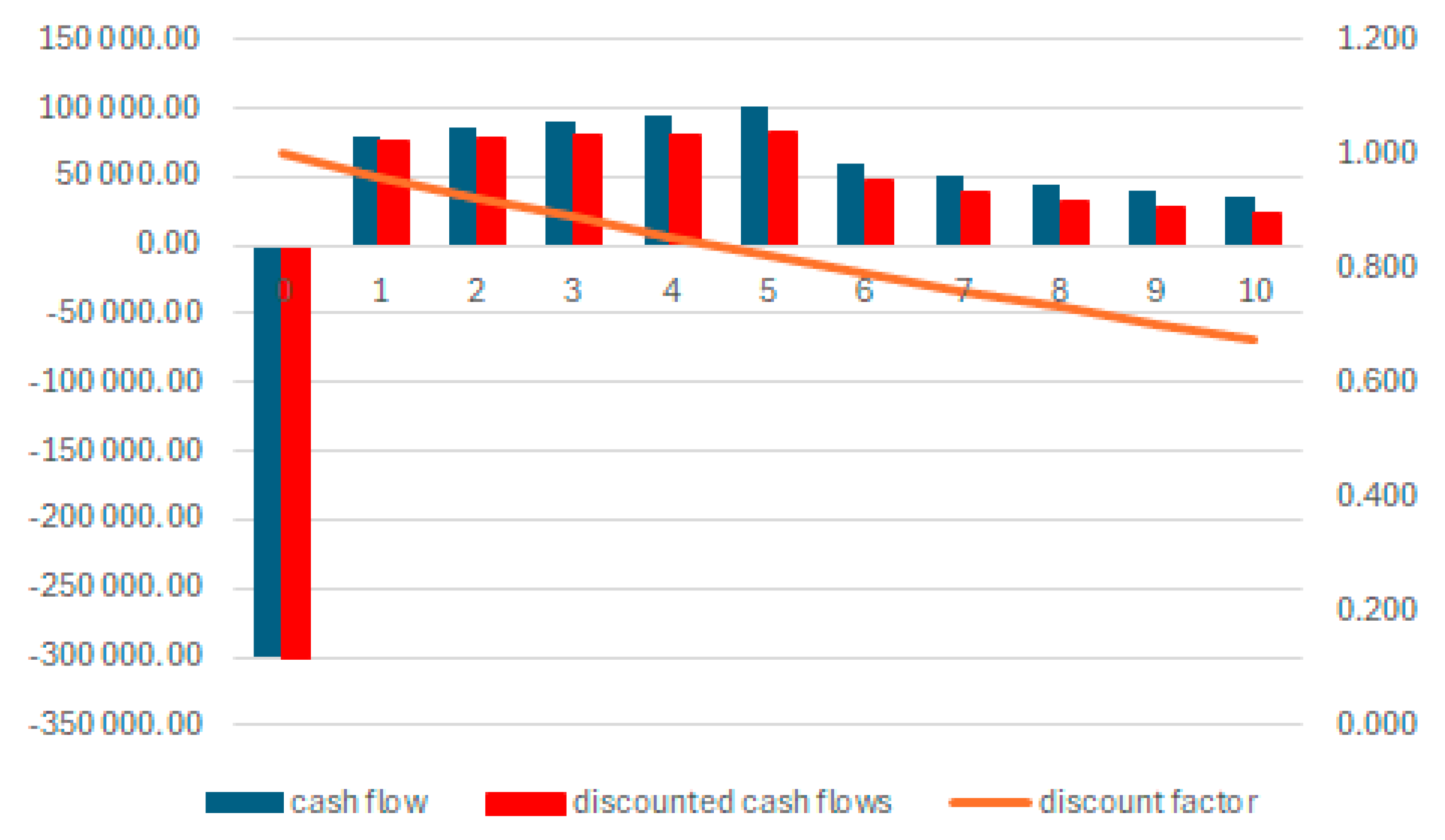
Figure 2.
Nominal and discounted cash flow structure for the "Green Transformation" scenario. Source: own elaboration based on model data.
Figure 2.
Nominal and discounted cash flow structure for the "Green Transformation" scenario. Source: own elaboration based on model data.
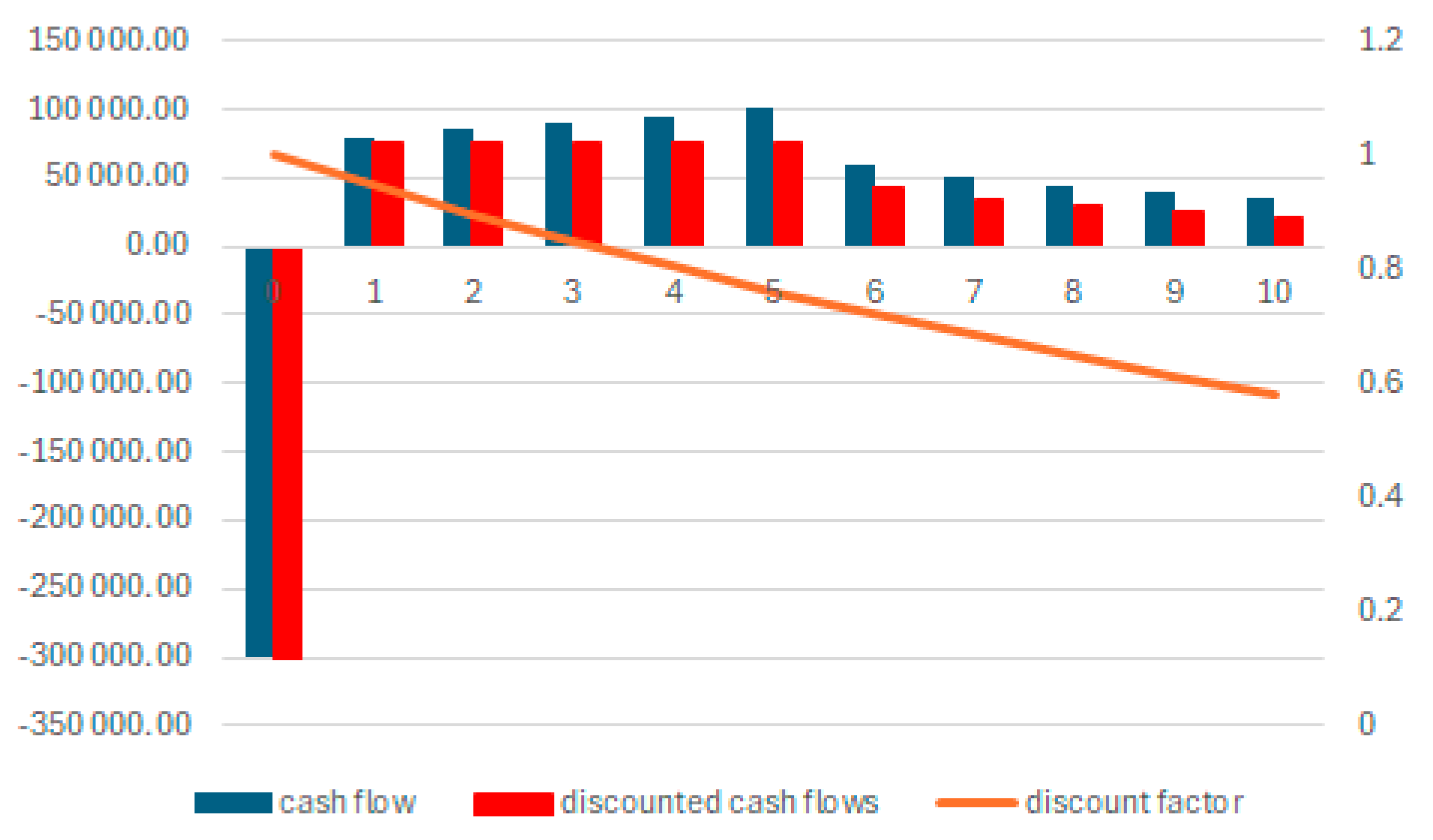
Figure 3.
A summary of nominal and discounted cash flows in relation to the discounting factor. Source: own elaboration based on model data.
Figure 3.
A summary of nominal and discounted cash flows in relation to the discounting factor. Source: own elaboration based on model data.
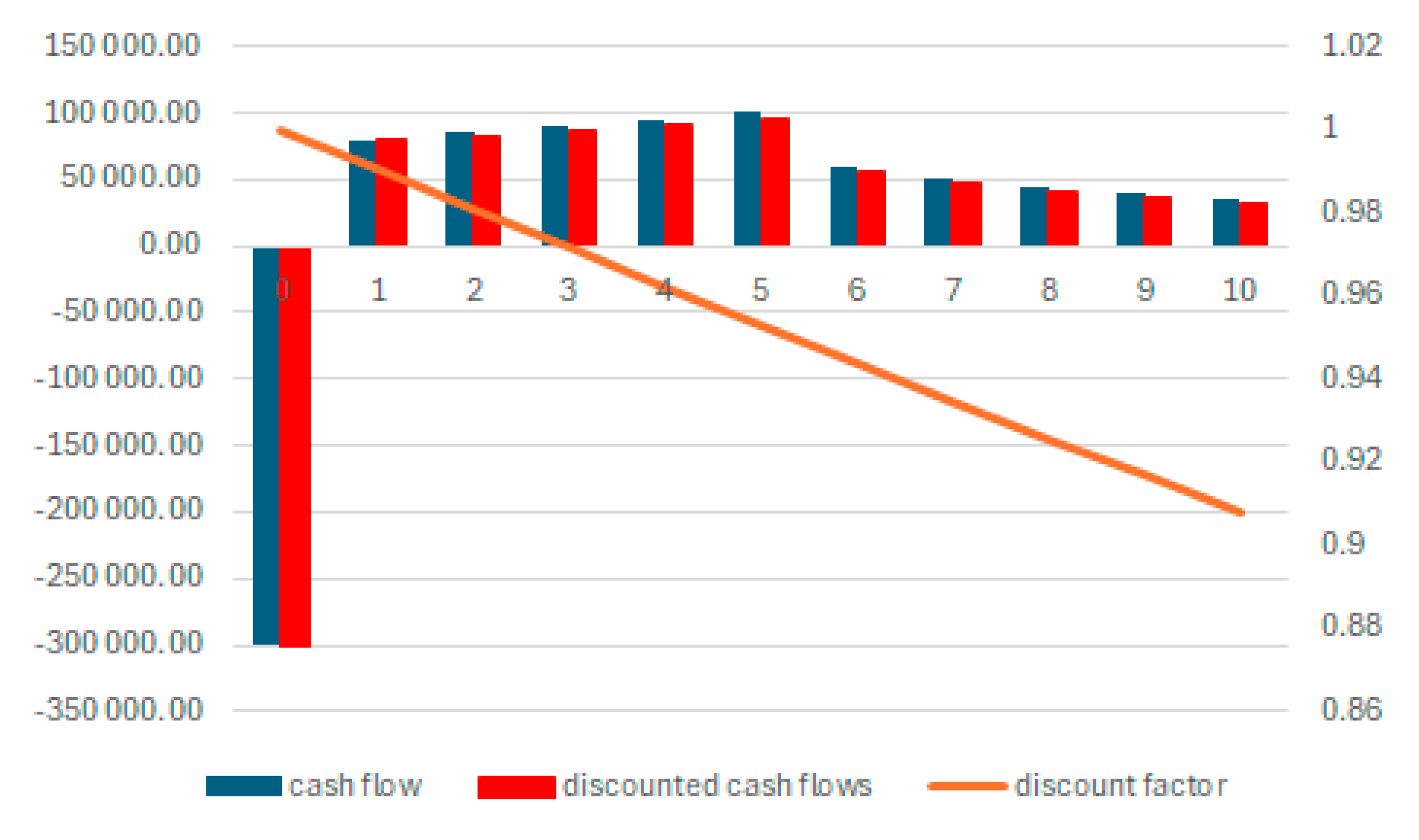
Figure 4.
Nominalanddiscountedcashflowprojectionsovera 5- and 10-yearhorizon. Source: own elaboration based on model data.
Figure 4.
Nominalanddiscountedcashflowprojectionsovera 5- and 10-yearhorizon. Source: own elaboration based on model data.
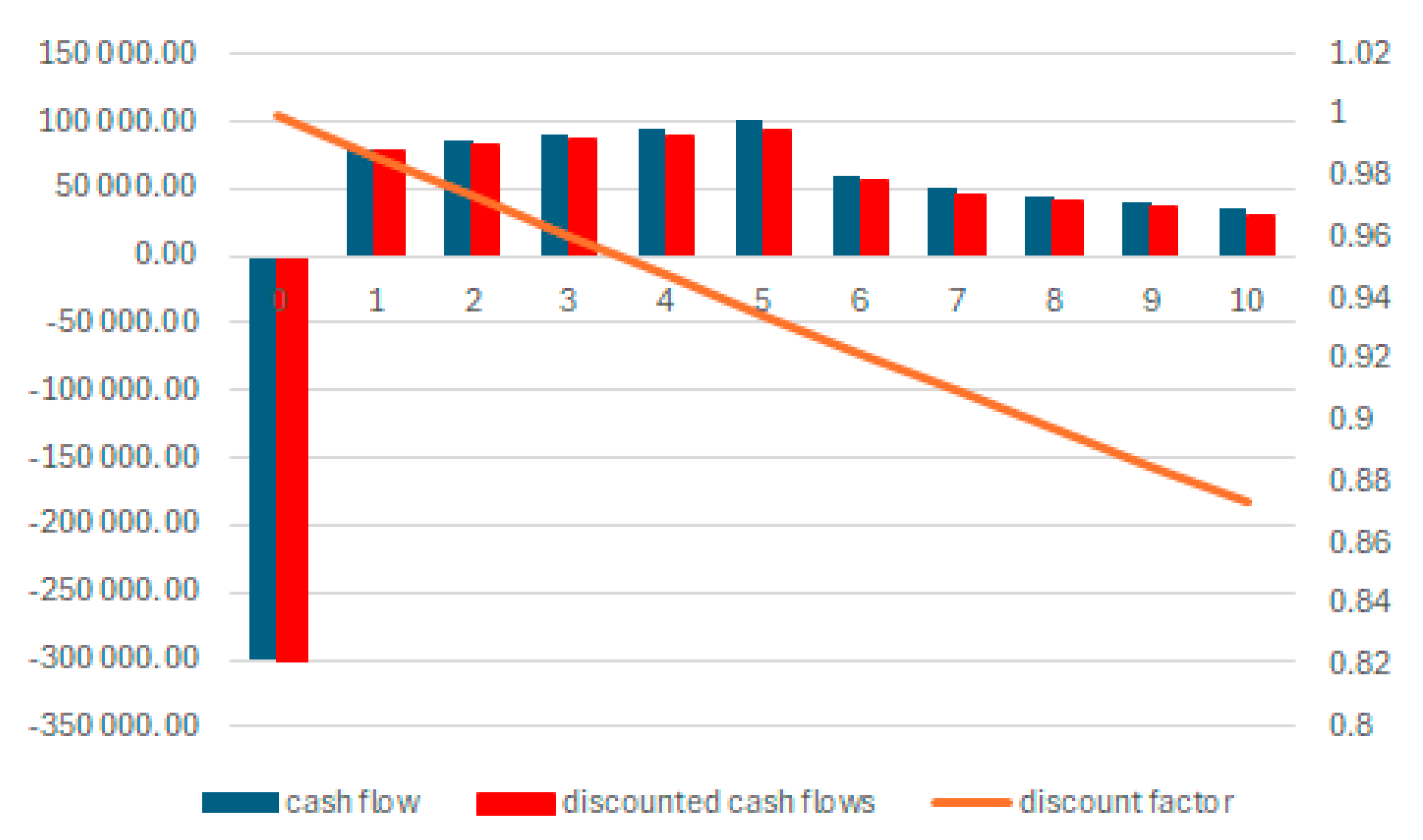

Table 1.
Cash flow analysis and evaluation of the investment project's profitability using the NPV and IRR methods.
Table 1.
Cash flow analysis and evaluation of the investment project's profitability using the NPV and IRR methods.
| size | n (period) | Cash flow | r (discount rate) cost of capital | discount factor | discounted cash flows | - |
|---|---|---|---|---|---|---|
| Initial investment | 0 | -300 000.00 | 4% | 1.0000 | -300 000.00 | - |
| flow 1 | 1 | 80 000.00 | 4% | 0.9615 | 76 923.08 | - |
| flow 2 | 2 | 85 000.00 | 4% | 0.9246 | 78 587.28 | - |
| flow 3 | 3 | 90 000.00 | 4% | 0.8890 | 80 009.67 | - |
| flow 4 | 4 | 95 000.00 | 4% | 0.8548 | 81 206.40 | - |
| flow 5 | 5 | 100 000.00 | 4% | 0.8219 | 82 192.71 | - |
| - | - | - | - | NPV= | 98 919.14 | a profitable |
| - | - | - | - | IRR= | 14.60% | perform |
Source: own elaboration based on model data.
Table 2.
Evaluation of the profitability of an investment project based on the NPV and IRR analysis over a 10-year horizon.
Table 2.
Evaluation of the profitability of an investment project based on the NPV and IRR analysis over a 10-year horizon.
| size | n (period) | Cash flow | r (discount rate) cost of capital | discount factor | discounted cash flows | - |
|---|---|---|---|---|---|---|
| Initial investment | 0 | -300 000.00 | 4% | 1.0000 | -300 000.00 | - |
| flow 1 | 1 | 80 000.00 | 4% | 0.9615 | 76 923.08 | - |
| flow 2 | 2 | 85 000.00 | 4% | 0.9246 | 78 587.28 | - |
| flow 3 | 3 | 90 000.00 | 4% | 0.8890 | 80 009.67 | - |
| flow 4 | 4 | 95 000.00 | 4% | 0.8548 | 81 206.40 | - |
| flow 5 | 5 | 100 000.00 | 4% | 0.8219 | 82 192.71 | - |
| flow 6 | 6 | 60 000.00 | 4% | 0.7903 | 47 418.87 | - |
| flow 7 | 7 | 50 000.00 | 4% | 0.7599 | 37 995.89 | - |
| flow 8 | 8 | 45 000.00 | 4% | 0.7307 | 32 881.06 | - |
| flow 9 | 9 | 40 000.00 | 4% | 0.7026 | 28 103.47 | - |
| flow 10 | 10 | 35 000.00 | 4% | 0.6756 | 23 644.75 | - |
| - | - | - | - | NPV= | 268 963.17 | a profitable |
| - | - | - | - | IRR= | 22.39% | perform |
Source: own elaboration based on model data.
Table 3.
Evaluation of the profitability of the investment project using the NPV and IRR methods at a discount rate of 5.6%.
Table 3.
Evaluation of the profitability of the investment project using the NPV and IRR methods at a discount rate of 5.6%.
| size | n (period) | cashflow | r (discount rate) cost of capital | discount factor | discounted cash flows | - |
|---|---|---|---|---|---|---|
| Initial investment | 0 | -300 000.00 | 5.60% | 1.0000 | -300 000.00 | - |
| flow 1 | 1 | 80 000.00 | 5.60% | 0.9470 | 75 757.58 | - |
| flow 2 | 2 | 85 000.00 | 5.60% | 0.8968 | 76 223.89 | - |
| flow 3 | 3 | 90 000.00 | 5.60% | 0.8492 | 76 427.69 | - |
| flow 4 | 4 | 95 000.00 | 5.60% | 0.8042 | 76 395.53 | - |
| flow 5 | 5 | 100 000.00 | 5.60% | 0.7615 | 76 151.84 | - |
| - | - | - | - | NPV= | 80 956.52 | a profitable |
| - | - | - | - | IRR= | 14.60% | perform |
Source: own elaboration based on model data.
Table 4.
An analysis of the profitability of the investment project, taking into account the green transformation, at a discount rate of 5.60%.
Table 4.
An analysis of the profitability of the investment project, taking into account the green transformation, at a discount rate of 5.60%.
| size | n (period) | Cash flow | r (discount rate) cost of capital | discount factor | discounted cash flows | - |
|---|---|---|---|---|---|---|
| Initial investment | 0 | -300 000.00 | 5.60% | 1.0000 | -300 000.00 | - |
| flow 1 | 1 | 80 000.00 | 5.60% | 0.9470 | 75 757.58 | - |
| flow 2 | 2 | 85 000.00 | 5.60% | 0.8968 | 76 223.89 | - |
| flow 3 | 3 | 90 000.00 | 5.60% | 0.8492 | 76 427.69 | - |
| flow 4 | 4 | 95 000.00 | 5.60% | 0.8042 | 76 395.53 | - |
| flow 5 | 5 | 100 000.00 | 5.60% | 0.7615 | 76 151.84 | - |
| flow 6 | 6 | 60 000.00 | 5.60% | 0.7211 | 43 268.09 | - |
| flow 7 | 7 | 50 000.00 | 5.60% | 0.6829 | 34 144.64 | - |
| flow 8 | 8 | 45 000.00 | 5.60% | 0.6467 | 29 100.55 | - |
| flow 9 | 9 | 40 000.00 | 5.60% | 0.6124 | 24 495.41 | - |
| flow 10 | 10 | 35 000.00 | 5.60% | 0.5799 | 20 296.86 | - |
| - | - | - | - | NPV= | 232 262.08 | a profitable |
| - | - | - | - | IRR= | 22.39% | perform |
Source: own elaboration based on model data.
Table 5.
Cash flow analysis and evaluation of the profitability of the investment project using the NPV and IRR methods.
Table 5.
Cash flow analysis and evaluation of the profitability of the investment project using the NPV and IRR methods.
| size | n (period) | Cash flow | r (discount rate) cost of capital | discount factor | discounted cash flows | - |
|---|---|---|---|---|---|---|
| Initial investment | 0 | -300 000.00 | 0.97% | 1.0000 | -300 000.00 | - |
| flow 1 | 1 | 80 000.00 | 0.97% | 0.9904 | 79 230.77 | - |
| flow 2 | 2 | 85 000.00 | 0.97% | 0.9809 | 83 373.24 | - |
| flow 3 | 3 | 90 000.00 | 0.97% | 0.9714 | 87 428.73 | - |
| flow 4 | 4 | 95 000.00 | 0.97% | 0.9621 | 91 398.52 | - |
| flow 5 | 5 | 100 000.00 | 0.97% | 0.9528 | 95 283.88 | - |
| - | - | - | - | NPV= | 136 715.14 | a profitable |
| - | - | - | - | IRR= | 14.60% | perform |
Source: own elaboration based on model data.
Table 6.
Cash flow analysis and evaluation of the profitability of the investment project using the NPV and IRR methods.
Table 6.
Cash flow analysis and evaluation of the profitability of the investment project using the NPV and IRR methods.
| size | n (period) | Cash flow | r (discount rate) cost of capital | discount factor | discounted cash flows | - |
|---|---|---|---|---|---|---|
| Initial investment | 0 | -300 000.00 | 0.97% | 1.0000 | -300 000.00 | - |
| flow 1 | 1 | 80 000.00 | 0.97% | 0.9904 | 79 230.77 | - |
| flow 2 | 2 | 85 000.00 | 0.97% | 0.9809 | 83 373.24 | - |
| flow 3 | 3 | 90 000.00 | 0.97% | 0.9714 | 87 428.73 | - |
| flow 4 | 4 | 95 000.00 | 0.97% | 0.9621 | 91 398.52 | - |
| flow 5 | 5 | 100 000.00 | 0.97% | 0.9528 | 95 283.88 | - |
| flow 6 | 6 | 60 000.00 | 0.97% | 0.9437 | 56 620.61 | - |
| flow 7 | 7 | 50 000.00 | 0.97% | 0.9346 | 46 730.15 | - |
| flow 8 | 8 | 45 000.00 | 0.97% | 0.9256 | 41 652.74 | - |
| flow 9 | 9 | 40 000.00 | 0.97% | 0.9167 | 36 668.65 | - |
| flow 10 | 10 | 35 000.00 | 0.97% | 0.9079 | 31 776.56 | - |
| - | - | - | - | NPV= | 350 163.86 | a profitable |
| - | - | - | - | IRR= | 22.39% | perform |
Source: own elaboration based on model data.
Table 7.
Cash flow analysis and evaluation of the profitability of the investment project using the NPV and IRR methods.
Table 7.
Cash flow analysis and evaluation of the profitability of the investment project using the NPV and IRR methods.
| size | n (period) | Cash flow | r (discount rate) cost of capital | discount factor | discounted cash flows | - |
|---|---|---|---|---|---|---|
| Initial investment | 0 | -300 000.00 | 1.36% | 1.0000 | -300 000.00 | - |
| flow 1 | 1 | 80 000.00 | 1.36% | 0.9866 | 78 927.20 | - |
| flow 2 | 2 | 85 000.00 | 1.36% | 0.9734 | 82 735.59 | - |
| flow 3 | 3 | 90 000.00 | 1.36% | 0.9603 | 86 427.65 | - |
| flow 4 | 4 | 95 000.00 | 1.36% | 0.9474 | 90 005.80 | - |
| flow 5 | 5 | 100 000.00 | 1.36% | 0.9347 | 93 472.45 | - |
| - | - | - | - | NPV= | 131 568.70 | a profitable |
| - | - | - | - | IRR= | 14.60% | perform |
Source: own elaboration based on model data.
Table 8.
Cash flow analysis and evaluation of the profitability of the investment project using the NPV and IRR methods.
Table 8.
Cash flow analysis and evaluation of the profitability of the investment project using the NPV and IRR methods.
| size | n (period) | Cash flow | r (discount rate) cost of capital | discount factor | discounted cash flows | - |
|---|---|---|---|---|---|---|
| Initial investment | 0 | -300 000.00 | 1.36% | 1.0000 | -300 000.00 | - |
| flow 1 | 1 | 80 000.00 | 1.36% | 0.9866 | 78 927.20 | - |
| flow 2 | 2 | 85 000.00 | 1.36% | 0.9734 | 82 735.59 | - |
| flow 3 | 3 | 90 000.00 | 1.36% | 0.9603 | 86 427.65 | - |
| flow 4 | 4 | 95 000.00 | 1.36% | 0.9474 | 90 005.80 | - |
| flow 5 | 5 | 100 000.00 | 1.36% | 0.9347 | 93 472.45 | - |
| flow 6 | 6 | 60 000.00 | 1.36% | 0.9222 | 55 331.39 | - |
| flow 7 | 7 | 50 000.00 | 1.36% | 0.9098 | 45 491.17 | - |
| flow 8 | 8 | 45 000.00 | 1.36% | 0.8976 | 40 393.02 | - |
| flow 9 | 9 | 40 000.00 | 1.36% | 0.8856 | 35 423.42 | - |
| flow 10 | 10 | 35 000.00 | 1.36% | 0.8737 | 30 579.85 | - |
| - | - | - | - | NPV= | 338 787.55 | a profitable |
| - | - | - | - | IRR= | 22.39% | perform |
Source: own elaboration based on model data.
Disclaimer/Publisher’s Note: The statements, opinions and data contained in all publications are solely those of the individual author(s) and contributor(s) and not of MDPI and/or the editor(s). MDPI and/or the editor(s) disclaim responsibility for any injury to people or property resulting from any ideas, methods, instructions or products referred to in the content. |
© 2026 by the authors. Licensee MDPI, Basel, Switzerland. This article is an open access article distributed under the terms and conditions of the Creative Commons Attribution (CC BY) license.
Copyright: This open access article is published under a Creative Commons CC BY 4.0 license, which permit the free download, distribution, and reuse, provided that the author and preprint are cited in any reuse.


