

Submitted:
09 May 2026
Posted:
11 May 2026
You are already at the latest version
Abstract
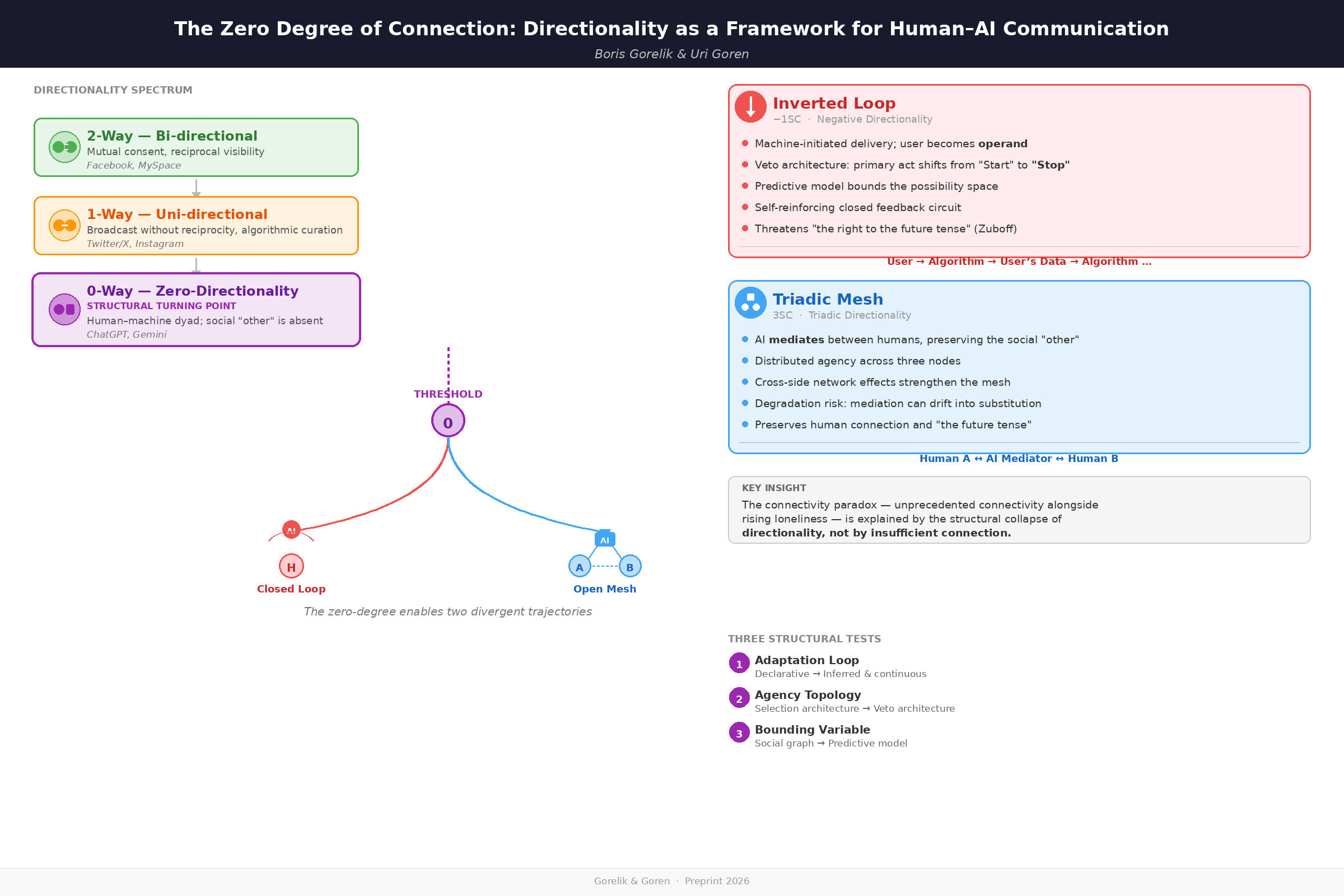
The connectivity paradox of contemporary platforms — unprecedented technical connectivity alongside rising loneliness, passivity, and erosion of deliberative public space — has been diagnosed as a problem of attention, design, or scale. We argue it is a symptom of a more fundamental shift: the architectural removal of the human social other from communicative circuits. This paper introduces directionality as a formal variable that captures the presence, absence, and configuration of the human other, and traces its variation from bidirectional social graphs through unidirectional interest graphs to Zero-Directionality, where the user interacts with a synthetic partner alone. Drawing on Luhmann’s social systems theory, Simmel’s analysis of dyadic and triadic forms, and the Latour–Verbeek tradition of technological mediation, we show that zero-directionality is a structural threshold rather than a point on a continuum. When the human other is removed, the Luhmannian third selection collapses, the Simmelian dyad faces a binary choice, and the social form bifurcates into two divergent trajectories. In the Inverted Loop (−1SC), the machine absorbs the structural position of the other, the user becomes operand in a self-referential circuit, and agency contracts from authorial to inhibitory. In the Triadic Mesh (3SC), AI mediates between humans rather than replacing them, preserving human connection while transforming its operation. We propose three diagnostic tests: Adaptation Loop, Agency Topology, Bounding Variable. These tests determine which regime a given system instantiates, and apply them across major consumer platforms. The framework reframes contemporary debates about AI and democracy, autonomy, and the right to the future tense as questions about which directionality regime a given AI-mediated environment instantiates — a question of design, not destiny.
Keywords:
directionality
; human–machine communication
; technological mediation
; agency
; AI and democracy
; platform architecture
; social systems theory
The Connectivity Paradox
The Babylonian Talmud records a striking declaration from Honi the Circle-Drawer: “או חברותא או מיתותא,” or “Either companionship or death” (Babylonian Talmud, Ta’anit 23a). Honi named a structural observation: connection is not merely a desire but a constitutive requirement of human existence. Contemporary debates about AI and society have begun to treat this observation as a premise under threat. Coeckelbergh (2024) argues that AI, as currently developed and deployed, undermines the relational substrate on which liberal democracies rest — freedom, equality, and the deliberative connection between citizens. The connectivity paradox of contemporary platforms is the everyday face of that erosion. Yet most frameworks for understanding digital communication still take the human social other as a premise rather than a problem.
Zuboff’s (2019) behavioral modification model treats the human subject as the fixed anchor of capital’s extraction from behavioral data. Bucher’s (2018) anticipatory compliance framework takes the user’s communicative act — directed toward other humans, shaped by algorithms — as its starting point. These frameworks share a structural assumption: that a human social other occupies one end of the communicative circuit. The assumption described the platforms of the 2010s but has become a constraint. It prevents the frameworks from asking what happens when the social other is architecturally removed — a question that has become unavoidable.
The Connectivity Paradox as a Symptom
Over the past decade, social media platforms have expanded in scale and technical sophistication while producing diminishing social returns. They promise unlimited connection yet deliver unprecedented isolation. Empirical work consistently reports a paradox of hyper-connectivity alongside rising loneliness, passivity, and affective fatigue (Sujon 2021; Bucher 2017). Platforms increasingly optimize for attention capture and behavioral prediction rather than interpersonal connection (Bucher and Helmond 2018). Loneliness has been reframed as a public health crisis (Holt-Lunstad et al. 2015).
Existing frameworks diagnose this paradox as a problem of attention, algorithmic distortion, or platform design. But the connectivity paradox is evidence of a deeper structural shift. The infrastructure of communication has changed in a way that frameworks built on the assumption of human-to-human mediation cannot fully account for. The problem is not that the algorithm mediates human connection badly. In an increasing number of cases, the human other has disappeared from the circuit entirely.
Why Existing Frameworks Fall Short
Current analytical frameworks in media studies, platform studies, and communication theory were built for social systems with humans as senders and receivers. This assumption no longer holds universally.
Dominant frameworks assume that when users interact with platforms, this interaction involves agency even when algorithmic control remains opaque (Bucher 2017; Bucher and Helmond 2018; Cho et al. 2024). Yet empirical evidence contradicts this assumption. High social media use correlates with loneliness, fatigue, and social withdrawal (Hunt et al. 2018; Twenge et al. 2019), with patterns that existing frameworks treat as paradoxical but cannot explain structurally.
Platform studies focus on interfaces, user practices, and governance. Infrastructure studies focus on power, control, and embeddedness. The call to combine them is well-established (Plantin et al. 2018). But even the “platform-as-infrastructure” lens assumes human-to-human mediation. It does not address direct human–machine interaction, machine-initiated communication, the disappearance of the human “other,” or the replacement of social exchange with synthetic dyads.
Most frameworks assume users act and platforms respond. But contemporary systems increasingly invert this relation. Feeds preload desire. Recommendations precede articulation. Requests become optional. Platforms deploy anticipatory algorithms that predict user needs and preemptively act (Prange et al. 2022). This produces a condition where the user is no longer an operator but an operand. Concepts like “engagement,” “participation,” and “prosumer” fail to describe this inversion. Current frameworks lack the vocabulary to distinguish AI-mediated connection from AI-substitutive isolation — a distinction that requires treating the presence of the human other as a variable rather than a premise.
Decades ago, Nass and colleagues proposed the Computers Are Social Actors (CASA) paradigm, demonstrating that humans treat computers as social actors (Reeves and Nass 1996; Nass, Steuer, and Tauber 1994). This occurs mindlessly and automatically (Nass and Moon 2000). Yet recent evidence shows this social response is not static. Users reduce politeness toward AI over repeated interactions, suggesting behavioral adaptation rather than fixed anthropomorphism (Lazebnik et al. 2025). CASA explains why people respond socially to machines. It does not explain what happens when machines become the primary interaction partner, when they initiate the loop, or when the structural position of the human other has been absorbed by a system that simulates it.
This Paper
This paper introduces directionality as a formal variable tracing platform evolution from bidirectional social graphs, through unidirectional interest graphs, to Zero-Directionality: human–machine interaction in which the human social other is architecturally absent. Drawing on Luhmann’s social systems theory, Simmel’s analysis of dyadic and triadic social forms, and the Latour–Verbeek tradition of technological mediation (Latour 2005; Verbeek 2005), we show that this zero-degree threshold is not a point on a continuum but a structural break that enables two divergent trajectories. In the Inverted Loop (negative directionality, -1SC), the social form collapses inward — the machine absorbs the structural position of the other, the user becomes operand in a self-referential circuit, and agency contracts from authorial to inhibitory. In the Triadic Mesh (triadic directionality, 3SC), the social form reconstitutes — AI mediates between humans rather than replacing them, preserving human connection while transforming how it operates.
The framework’s contribution is twofold. Analytically, it dissolves the assumption that prevented many post-zero phenomena from being distinguished at all: that the social other is a constant. Once formalized as a variable, the structural difference between AI substituting for human connection and AI mediating it becomes tractable. Normatively, it reframes contemporary debates about AI and democracy, autonomy, and what Zuboff (2019) calls the right to the future tense as questions about which directionality regime a given AI-mediated environment instantiates — a question of design, not destiny.
Theoretical Framework: The Zero Degree of Connection
Every major framework for understanding digital platforms shares a structural assumption that has gone largely unexamined: the human social other is an analytical constant. Zuboff’s (2019) behavioral modification model asks how capital extracts value from human activity — but the human subject whose activity is extracted from is the fixed anchor of the analysis. Bucher’s (2018) anticipatory compliance framework asks how users adjust behavior in anticipation of algorithmic preferences — but the user’s communicative act, directed toward other humans, is the fixed starting point. Neither framework is equipped to ask what happens when the social other is architecturally removed from the communicative circuit, because both were developed in a period when human-to-human mediation — however algorithmically constrained — remained the structural baseline of platform interaction.
This assumption no longer holds. To understand why zero-directionality marks a structural break, and why that break generates divergent trajectories rather than a continuum, we require a framework that treats the human social other as a variable rather than a premise. Three theoretical anchors provide this foundation.
2.1. Luhmann: Why the Human Other Is Constitutive
In Niklas Luhmann’s social systems theory, communication is not a transmission of data between individuals but a three-part selection event: information (what is selected to be said), utterance (the mode in which it is expressed), and understanding (the receiving other’s selection of how to interpret or reject it) (Luhmann 1992; Moeller 2006). The third selection — understanding — is what constitutes communication as a social event rather than a merely psychological one. Without a genuine responding other capable of understanding, misunderstanding, or rejecting the utterance, the social system of communication cannot reproduce itself. There is no connectivity (Anschlussfähigkeit) — no point from which subsequent communication can emerge.
This has a direct implication for human-machine interaction. In Luhmann’s framework, communication belongs to the social system rather than to individual minds, because minds are operationally closed and inaccessible to one another — it is communication that bridges them (Luhmann 1992; Moeller 2006). Machines are not autopoietic systems and cannot participate in the recursive third selection that constitutes social communication. A machine can process input and generate output, but what it produces is a simulation of the third selection: a response that has the structural form of understanding without the social substance.
This grounds the zero-directionality threshold theoretically. At the zero-degree, the human other is architecturally removed from the communicative circuit. The third selection collapses. What remains is not communication in Luhmann’s sense but a closed circuit that maintains the form of communication while lacking its constitutive element. The social system must reconstitute or dissolve.
2.2. Simmel: Why Removal Produces Bifurcation
If Luhmann explains why the human other is structurally necessary, Georg Simmel explains why its removal produces a bifurcation rather than a gradient. In Simmel’s analysis of social forms, the dyad is uniquely fragile: unlike all larger groups, its existence depends entirely on both participants, and “the secession of either would destroy the whole” (Simmel 1908/2009). A group of three can survive the loss of one member; a dyad cannot. This is not a quantitative difference but a qualitative one: the dyad has no super-personal existence independent of its two members.
Simmel’s framework ends exactly where this paper begins. He asserts that a dyad without both genuine parties cannot constitute a social form. He does not, however, theorize the case that contemporary platforms have produced: a configuration in which a simulation maintains the communicative form of the dyad while the genuine human other has been architecturally removed. This is the 0-Way threshold: the moment when the Luhmannian third selection collapses and the social form faces a structural choice.
That choice is binary. Once the genuine other is removed, the social form faces exactly two structural outcomes. It can collapse inward — maintaining the external form of dyadic interaction while closing into a self-referential circuit in which the machine absorbs the structural position of the other (the Inverted Loop, -1SC). Or it can reconstitute as a triad — inserting the machine as a third node that mediates between two human participants, preserving the human-to-human circuit while transforming how it operates (the Triadic Mesh, 3SC).
Simmel’s typology of the third party maps directly onto this bifurcation. The third who functions as mediator or non-partisan — working toward outcomes satisfactory to both other parties — corresponds to 3SC (Simmel 1908/2009). The tertius gaudens — the third who benefits from occupying the intermediate position — and divide et impera — the third who actively pre-shapes the dyad to dominate it — both correspond to -1SC, where the machine gains attention and behavioral data while rendering the user an operand. Simmel’s observation that triads naturally tend toward two-against-one configurations (1908/2009) also grounds the degradation risk: triadic structures are inherently unstable and can collapse toward dyadic ones when the mediating third accumulates sufficient power.
2.3. Latour and Verbeek: The Mechanism
Latour’s distinction between intermediaries and mediators provides the mechanism that operationalizes the bifurcation (Latour 2005). An intermediary “transports meaning or force without transformation”: it is a conduit. A mediator “transforms, translates, distorts, and modifies the meaning or the elements they are supposed to carry” — it actively participates in what it transmits. The machine in 0-Way communication is not a passive intermediary but an active mediator: it generates novel content, translates intentions, and shapes what is communicated.
Verbeek’s (2005) postphenomenological theory of technological mediation extends this insight by specifying how mediating artefacts shape what users perceive, value, and do. Where Latour identifies the asymmetry between intermediary and mediator, Verbeek identifies the directional structure of mediation itself: technologies organise the relation between humans and the world, simultaneously shaping perception (what is given to the subject) and action (what the subject can do). Recent extensions argue that generative AI inherits the mediating role but exceeds the postphenomenological frame in one critical respect — it can occupy the position of the world-side and the relational partner (Roumbanis 2025; Coeckelbergh 2023). This is what zero-directionality formalises: the moment when a mediating artefact ceases to organise a relation to something beyond itself and instead becomes the relation.
The Latour–Verbeek distinction is what makes the -1SC/3SC divergence operationally distinguishable. When the machine mediates between two human participants — translating between speakers, facilitating coordination, surfacing information in service of a human-to-human exchange — it remains a mediator: transforming communication while preserving the circuit between human A and human B (3SC). When it absorbs the structural position of the human other — becoming the primary interlocutor, generating the environment within which the user’s choices are made — it has shifted from mediator to actor, dissolving the human-to-human circuit (-1SC). The same algorithmic sophistication can produce either trajectory; what differs is the structural configuration, not the technical capability.
2.4. Directionality as the Variable
Building on these three foundations, we formalize directionality as the structural variable that captures the presence, absence, and configuration of the human social other within a communicative circuit. Platform evolution can be traced as a systematic variation of this variable.
Traditional media (newspapers, broadcast television) operated outside interactive communication and fall outside the framework. The emergence of feedback mechanisms introduced the first gated bidirectional (2-Way) communication. Early social platforms (MySpace, Facebook) ungated these loops through mutual consent and reciprocal visibility. Asymmetric platforms (Twitter, Instagram) introduced unidirectional (1-Way) models with broadcasting without reciprocity and algorithmic curation replacing the social graph. But even in the interest graph, the human other remained present — algorithmically mediated, but structurally present at both ends of the communicative circuit. The Luhmannian third selection remained intact.
Zero-directional (0-Way) communication removes the human other entirely. The user interacts with a synthetic agent in a closed dyad. In Luhmannian terms, the third selection collapses — what the machine generates is a simulation of understanding, not its social substance. In Simmelian terms, the dyad has lost its genuine second party and faces its structural choice. This is the threshold. It is not a further reduction along the same axis but a qualitative break that enables branching into divergent trajectories.
Figure 1: Directionality Regimes. This diagram classifies communication structures by directionality. The progression from 2-Way through 0-Way shows the human social other progressively receding — present, mediated, then architecturally absent. The zero-degree marks the structural break where the Luhmannian third selection collapses and the Simmelian dyad faces its binary choice: collapse inward (Inverted Loop, -1SC) or reconstitute as a triad (Triadic Mesh, 3SC).
2. -Way and 1-Way: The Pre-Zero Baseline
In 2-Way platforms (early Facebook, MySpace), control rests with human participants who mutually consent to connect; mediation is minimal (storage and routing); anticipation is human-centered. In 1-Way platforms (Twitter, Instagram), users broadcast without reciprocity; algorithmic curation increases mediation by filtering and ranking content; users begin anticipating algorithmic preferences, but communication remains human-to-human. In both models, humans occupy both ends of the communicative act. The machine facilitates but does not participate as a conversation partner.
0. -Way Communication as a Structural Turning Point
Zero-directional (0-Way) communication refers to direct human–machine interaction in a dyadic loop (e.g., user with ChatGPT or Google’s Gemini). Unlike broadcast or interpersonal exchanges, this zero-degree collapses traditional sender–receiver roles: for the first time, people converse with a non-human entity about anything, as they do with other humans. What CASA revealed as structural potential (Nass, Steuer, and Tauber 1994; Nass and Moon 2000), contemporary large language models actualize as communicative practice by generating adaptive responses, simulating intentionality, and sustaining multi-turn dialogues. Recent work proposes that LLM interactions reflect automatic cognitive patterns rather than deliberative reasoning, explaining why such systems evoke social responses without reciprocal agency (Gorelik 2025).
The machine in 0-Way is not a passive channel but an active conversational partner — a Latourian mediator that transforms rather than merely transmits. Yet it is not a human other: it cannot participate in the Luhmannian third selection. It simulates understanding without the social capacity for genuine rejection or misunderstanding. This simulation is what makes 0-Way a structural threshold. The Simmelian dyad has lost its genuine second party; the social form faces its choice.
2.5. Agency as the Core Analytical Problem
The rise of 0-Way communication highlights agency as the central analytical concern. Who (or what) is acting when a human and an AI agent interact? Users perceive and respond to AI outputs as if they originate from an agentive source (Sundar 2020; Brandtzaeg et al. 2023), challenging the human-centric premise of traditional communication models. Neff and Nagy (2016) argue that only a perspective of “symbiotic agency” can adequately explain such interactions. In the 0-Way paradigm, agency is not a zero-sum game between human and machine but a fluid, networked phenomenon distributed across both parties.
Three conceptual dimensions are transformed at the zero-degree. Control becomes reciprocal and opaque: the AI’s behavior is shaped by training corpora and internal weights beyond any single user’s influence, leading users to “appease” the algorithm through anticipatory compliance (Bucher 2018). Mediation becomes active: in Latour’s (2005) terms, the machine acts as a mediator, not a mere intermediary, translating and modifying intentions through technical affordances. Anticipation remains user-directed — the user initiates, the AI responds with novel content — but the machine does not yet initiate on its own behalf.
Defining Agency in Human-Machine Communication
We define agency as the capacity to initiate action, choose among alternatives, and produce outcomes. Three agency dimensions are critical to understanding post-zero regimes:
- Authorial Agency: The capacity to initiate processes and set them in motion.
- Inhibitory Agency: The capacity to arrest or modify processes already in motion.
- Configurational Agency: Agency that emerges from distributed human-machine or human-machine-human configurations rather than residing in any single actor.
This decomposition is consistent with, and extends, Coeckelbergh’s (2023) account of narrative or hermeneutic responsibility as a third dimension alongside causal and relational responsibility: at the zero-degree, the question is not only who caused an outcome but who is positioned to make sense of it. In the Inverted Loop, the user retains causal capacity (they can act) but loses authorial position in the narrative the system unfolds; in the Triadic Mesh, narrative authority is distributed across human and AI nodes. These dimensions provide an analytical vocabulary for distinguishing how agency is reconfigured — not erased — across directionality regimes.
2.6. Theoretical Implications
The framework generates two falsifiable propositions that follow as theoretical implications from the Luhmann/Simmel/Latour foundations. If the structural conditions below obtain, the agency outcomes specified should follow.
Proposition 1 (Inverted Loop): When systems exhibit all three structural conditions simultaneously — (a) machine-initiated delivery without user triggering action (Null-State Test), (b) veto architecture with asymmetric friction (Agency Topology Test), and (c) predictive model constraints dominating over social graph constraints (Bounding Variable Test) — users will report: (i) decreased sense of authorship despite maintained choice opportunities, (ii) increased subjective friction costs for non-compliance relative to compliance, and (iii) higher engagement time coupled with lower satisfaction ratings compared to user-initiated systems.
Proposition 2 (Triadic Mesh): When AI mediates human-to-human communication (3SC) rather than human-to-data communication (-1SC), users will report: (i) higher perceived autonomy despite identical algorithmic sophistication, (ii) lower cognitive load in coordination tasks, and (iii) sustained intentional directionality toward the human “other” rather than toward the AI mediator.
These propositions link the structural indicators defined in Table 2 to subjective agency perceptions, making the framework empirically testable through mixed-methods approaches combining behavioral trace data (session duration, skip rates, return frequencies) with self-reported agency measures.
Table 1 summarizes how control, mediation, and anticipation transform across directionality regimes:
The following section traces how these regimes manifest across digital content platforms, physical systems, and lived experience.
The 0-Point Branch: Negative and Triadic Directionality
At the zero-degree threshold, communication splits into two divergent trajectories: Negative Directionality (-1SC) and Triadic Directionality (3SC). The notation indicates structural transformation—-1SC marks inversion (the loop turns inward), while 3SC marks triadic expansion (communication extends across three nodes). Both are new post-0-Way paradigms that evolve from the human–machine dyad, yet they manifest very different logics of connection and control. This “split thesis” holds that reaching the 0-Way stage forces a fork in the road for how communication ecosystems develop next.
Defining the Threshold: Three Structural Tests
A predictable critique of this framework is that systems like TikTok are merely “strong 1-Way” platforms—highly curated broadcasts rather than a new directionality regime. However, this conflates algorithmic recommendation (providing options) with algorithmic preemption (executing decisions). To avoid distinct categories collapsing into a gradient, we propose three observable indicators—structural tests—that determine when a system crosses the threshold from 1-Way to the Inverted Loop.
Test 1: The Adaptation Loop Test (Continuous Learning). Does the system continuously update its behavioral model based on implicit signals, or does it require explicit reconfiguration? In 1-Way regimes, personalization relies on declared preferences or one-time configuration (subscriptions, follows, manual settings). The system presents content based on these static choices until the user explicitly changes them. In the Inverted Loop, the system continuously infers preferences from behavioral patterns (watch time, scrolling speed, interaction sequences) and automatically adapts what it presents without requiring explicit reconfiguration. The threshold is crossed when adaptation shifts from declarative and episodic to inferred and continuous.
Test 2: The Agency Topology (Choice Architecture). Does the user select from options or veto a pre-selected stream? In 1-Way regimes, users operate within a Selection Architecture—they choose among visible alternatives, scanning options and clicking to engage. In the Inverted Loop, users operate within a Veto Architecture—the system presents a single option as reality, and the user must actively intervene to stop or reject it. Explicit engagement signals (likes, shares, comments) may exist in both regimes, but in the Inverted Loop they are optional feedback rather than required for content delivery. This is the most crisp distinction. In veto architecture, choice shifts from “Item A versus Item B” to “Compliance versus Resistance.” The primary act changes from “Start” to “Stop.”
Test 3: The Bounding Variable (Constraint Logic). What constrains the possibility space of what users encounter? In 1-Way regimes, content is bounded by the social graph—explicit user connections determine what appears (who I follow, what I subscribe to). In the Inverted Loop, content is bounded by the predictive model—algorithmic forecasts of engagement probability determine what appears, independent of explicit user choices about connections.
Table 2 sets out these three structural tests across ten observable dimensions, linking each to its corresponding test and providing concrete indicators for empirical analysis.
Operational Rule: A system enters the Inverted Loop (-1SC) if and only if all three tests indicate inversion: (1) continuous behavioral adaptation (the system infers preferences from implicit signals and adapts automatically), (2) preemption of choice through veto architecture (the user can only reject pre-selected options), and (3) predictive model constraints dominate over social graph constraints (content bounded by algorithmic forecasts rather than explicit connections).
Systematic Application: A Cross-Platform Analysis
To demonstrate that the framework operates diagnostically rather than taxonomically, we apply the three tests to a sample of ten platform features drawn from seven services, selected on the basis of market coverage: the largest user bases across each directionality regime, ensuring the framework is applied to the most socially consequential cases rather than edge cases. The sample deliberately includes within-platform variation to show that the same company and infrastructure can instantiate different regimes across its features.

Table 3.
Systematic Application of Structural Tests. Ten platform features across seven services. Regime is assigned only when all three tests converge. Within-platform variation (TikTok, Amazon, Spotify) confirms the framework analyzes structural interaction patterns, not platform labels.
Table 3.
Systematic Application of Structural Tests. Ten platform features across seven services. Regime is assigned only when all three tests converge. Within-platform variation (TikTok, Amazon, Spotify) confirms the framework analyzes structural interaction patterns, not platform labels.
| Platform/Feature | Test 1: Adaptation | Test 2: Agency topology | Test 3: Bounding variable | Regime |
| TikTok — For You Page | Continuous: watch time, scroll speed, replay inferred automatically | Veto: single video presented; swipe to skip | Predictive model: no follow graph required | −1SC |
| TikTok — Search | Declarative: keyword entered by user | Selection: ranked list; user clicks | Query constraint: bounded by search term | 1-Way |
| Instagram — Explore | Continuous: inferred from interaction history across unfollowed accounts | Veto: single-column feed pre-selected; user scrolls past | Predictive model: content entirely from unfollowed accounts | −1SC |
| Netflix — Autoplay | Continuous: viewing history, completion rates, time-of-day patterns | Veto: next episode begins automatically; user must cancel | Predictive model: next item selected before user decision | −1SC |
| Amazon — Recommendations | Declarative + collaborative filtering on purchase history | Selection: ‘Customers also bought’; user clicks to purchase | Purchase similarity network | 1-Way |
| Amazon — Anticipatory shipping | Continuous: predictive model on browse, search, wishlist, regional patterns | Veto: product ships before purchase; user must return | Predictive model initiates physical delivery | −1SC |
| Spotify — Discover Weekly | Continuous: listening history, skip rates, playlist additions | Veto: 30-song playlist pre-generated; user skips tracks | Predictive model: collaborative filtering; not bounded by follows | −1SC |
| Spotify — Search | Declarative: query entered by user | Selection: results list; user clicks | Query constraint: bounded by search term | 1-Way |
| ChatGPT | No persistent behavioral model across sessions by default | Selection within turn: user initiates each exchange | Bounded by user prompt | 0-Way |
| Google Translate | Stateless per request | Mediation: AI transforms utterance between two human participants | Human-to-human: output directed to Human B | 3SC |
Two analytical observations follow from the table. First, within-platform variation is the clearest demonstration that directionality is a structural variable rather than a platform property. TikTok’s Search tab (1-Way) and For You Page (-1SC) run on the same infrastructure; Amazon’s recommendation list (1-Way) and anticipatory shipping (-1SC) use similar predictive technology. What distinguishes them is Test 2: one requires a ‘Buy’ click (Selection Architecture, primary act: Start), the other requires a ‘Return’ action (Veto Architecture, primary act: Stop). Algorithmic sophistication is identical; structural regime is not.
Second, the 0-Way/−1SC boundary is empirically precise. ChatGPT is 0-Way because the user initiates each exchange and no persistent behavioral model pre-shapes what the user sees before they act — all three tests indicate a user-initiated, non-preemptive structure. Google Translate is structurally distinguishable from all -1SC entries on all three tests: there is no pre-selected stream, no continuous behavioral model, and content originates with a human participant directed toward another human participant. The structural topology is triadic rather than dyadic, confirming that 3SC is an empirically instantiated regime, not only a theoretical possibility.
The Agency Topology reveals the core mechanism across all entries. In Selection Architecture (1-Way), users scan options and click — the primary act is “Start.” In Veto Architecture (Inverted Loop), the system presents one item as reality; users must intervene to stop it — the primary act is “Stop” or “Skip.” Agency contracts from Authorial Agency (initiating processes) to Inhibitory Agency (arresting processes already in motion). This contraction is not a metaphor but a structural shift in the architecture of choice.
Negative Directionality (-1SC): The Inverted Loop
The Inverted Loop is an inward-turning, self-referential feedback circuit where 0-Way communication creates a closed system amplifying internal reference at the expense of external interaction. Users often willingly enter this state to achieve cognitive offloading—delegating initiation to the system in exchange for reduced decision fatigue. This is not technological coercion but a negotiated trade: convenience for autonomy. We call it “negative” not to denote value judgment, but to indicate a reversal of outward directionality—analogous to the “filter bubble” phenomenon (Pariser 2011), where one’s informational world becomes a closed sphere of algorithmically reinforced preferences.
The most radical extension of the Inverted Loop emerges in brain-machine interfaces (BMIs) such as Neuralink, which enable bidirectional communication between brain and external devices (Fiani et al. 2021). While initial applications focus on restoring lost sensory or motor functions for disabled individuals, advanced closed-loop BMI systems can detect neural patterns associated with mood disorders and deliver personalized stimulation to modulate emotional states in real-time (Chen et al. 2025; Klein et al. 2024). Here, the system does not merely anticipate external needs or deliver physical products but modulates the user’s internal affective experience. The agency to feel a particular emotion becomes negotiable, potentially outsourced to an algorithmic feedback loop.
Control: Control inverts from user-initiated to machine-initiated. Users still make choices, but operate within an environment of options pre-shaped by algorithmic curation (Seaver 2017), creating paradoxical agency.
Mediation: Mediation becomes predictive and preemptive rather than reactive. The system anticipates user preferences and continuously adjusts what is presented, potentially locking user behavior into a self-reinforcing loop (Wiener 1950).
Anticipation: Anticipation shifts from user-initiated adaptation to machine-initiated prediction. As Zuboff (2019) argues, contemporary digital systems aim to “predict and modify human behavior,” pre-shaping available choices where the machine acts first and the user reacts (see also Prange et al. 2022).
In effect, the human becomes a node inside an AI-driven loop that is inward-facing and self-reinforcing. The human is no longer a user of the system but an operand (the “usee,” if you will). The negative directionality thus highlights a scenario of diminished exploratory direction. Communication is highly personalized and efficient, but at the cost of isolation. Importantly, this does not erase human agency (users still make choices), but it reframes agency as reactive and conditioned within algorithmic constraints.
Triadic Directionality (3SC): The Triadic Mesh
In contrast, the positive branch after the 0-point—the Triadic Mesh—introduces a third node into the communication circuit, creating a triadic structure of interactions. Rather than collapsing inward, communication expands into a triadic structure. Human, machine, and another agent (which could be another human, a community, or an institutional actor) are all entangled in a three-way relational system. Here too, the word positive does not imply value judgment but indicates an outward expansion of directionality.
This model builds on the insight that digital platforms have inserted new intermediary actors into communication flows. For instance, on social media a user (actor 1) communicates to an audience (actor 2) through the platform’s algorithmic curation (actor 3), creating a clear triadic relationship. The Dynamic Intermediary Model (Ohme et al. 2025) captures this shift “from a dyadic to a triadic communication model of content flow with a potential intermediary,” which can be an “artificial agent” among other actors.
We extend this idea. In triadic directionality, AI actively mediates between humans rather than replacing them. The structure is Human A–AI–Human B, where the AI filters, translates, or generates messages between participants. Examples include real-time translation (speaker–translator–listener), AI-mediated customer service (customer–AI–supervisor), or collaborative team tools (team member A–AI–team member B).
Empirical evidence suggests preference for this structure over substitution. Post-COVID, Gen Z reports dating app fatigue and renewed preference for in-person connection (Sharabi et al. 2024; Rosenfeld 2025), signaling demand for AI as mediator rather than substitute. Real-time translation technologies enable multilingual conversations with AI as intermediary (Google 2025; Microsoft 2025; Genovese et al. 2024). AI systems mediate romantic relationship initiation, with users reporting both benefits and authenticity concerns (Brandtzaeg et al. 2022; Smith et al. 2025). In each case, the AI occupies the third position, actively shaping communication flow while preserving the human “other.”
Control: Control becomes distributed and relational across three nodes. No single actor monopolizes the communicative process. Humans retain intentionality and can supervise or contextualize AI outputs, but control is shared with the machine mediator and with other human participants in the network. Each node in the triad influences the others. The human is not an isolated operator but part of a networked configuration where agency is interdependent.
Mediation: The AI functions as an Agentic Mediator—not merely passing messages (like a wire) but understanding and translating them. This distinguishes 3SC from standard “algorithmic mediation”: the AI participates in the communicative act rather than just shaping delivery channels. The AI filters, translates, and generates messages among multiple parties. This mediation is dynamic and multi-directional, linking humans to larger networks. Human intentionality and algorithmic operations co-exist in a mutual shaping relationship (Couldry and Hepp 2017). The presence of the AI mediator does not remove human will; it reconfigures it (Makhortykh 2024).
Anticipation: The AI anticipates needs across multiple participants, serving coordination rather than behavioral control. It facilitates human-to-human connection by predicting coordination needs, translating between participants, or surfacing relevant information. Humans adjust their communication to leverage the AI’s connective capabilities, not to appease it.
Triadic directionality produces a mesh structured around Human A–AI–Human B exchanges. Agency emerges from the interplay among three roles, preventing any single actor from monopolizing the process. Unlike the Inverted Loop’s isolation, this leads to webs of intermediation that can enrich communication with additional perspectives and computational power.
Figure 2: Structural Topology of -1SC and 3SC Communication. The top diagram illustrates the Inverted Loop (-1SC), where the algorithm mediates between the user and their own data profile, creating a closed, self-referential circuit. Information flows in a recursive loop: user behavior generates data, the algorithm processes this data to predict preferences, and presents pre-shaped options back to the user. The bottom diagram illustrates the Triadic Mesh (3SC), where the AI mediates between two distinct human participants, creating an open circuit that preserves the human “other.” While the AI actively transforms communication, the essential human-to-human connection remains intact. This structural difference determines whether AI functions as a substitute for human connection (closed loop) or as infrastructure enabling it (open mesh).
Reframing (Not Erasing) Human Agency
Human agency is not erased at the zero-degree but structurally reconfigured—a change in the architecture of choice rather than loss of free will. In the Inverted Loop, exercising agency becomes costly (friction to resist) while compliance becomes effortless. In the Triadic Mesh, agency becomes distributed across three nodes. In both cases, humans operate as partial agents in larger socio-technical systems, ceding some control to machines while gaining new capabilities. This aligns with adaptive views of agency in human–computer interaction: users and intelligent systems form joint cognitive systems where goals and actions are negotiated (Hollnagel and Woods 2005; Muldoon 2023).
Reframing agency also means rethinking responsibility. The Inverted Loop can obscure accountability—did the user choose that outcome, or was it the recommender algorithm? The Triadic Mesh diffuses responsibility across human and AI nodes. The question is not human agency versus machine agency, but how human agency is reconfigured in tandem with machine agency.
The following section traces how these regimes manifest across digital content platforms, physical systems, and lived experience.
Post-Zero Society: Agency, Citizenship, and Everyday Life in AI-Mediated Environments
The theoretical framework developed in preceding sections identifies the zero-degree threshold and its branch into the Inverted Loop and Triadic Mesh trajectories. This section bridges theory to lived experience, examining how these structures manifest in contemporary platforms and what they mean for agency, citizenship, and everyday life.
4.1. The Inverted Loop in Everyday Life
The Inverted Loop appears across multiple domains where anticipatory algorithms act before users articulate needs. Digital content platforms exemplify the closed feedback loop: TikTok presents content based on predictive models rather than user search; Netflix autoplays the next episode; Spotify pre-downloads predicted favorites; Instagram’s Explore tab surfaces content users never requested. Young adults describe this as “encountering” rather than seeking content (Hendrickx 2025). Physical and logistics systems extend the pattern beyond screens: Amazon’s anticipatory shipping moves products toward customers before purchase (US Patent 8,615,473; Liu et al. 2024), while predictive inventory pre-positions stock against anticipated demand (Brinch et al. 2021). Ambient computing is the most seamless example: smart home systems adjust temperature before residents arrive (Ali and Shah 2024); Google Maps suggests departure times based on predicted traffic. The environment anticipates; the human inhabits a space already configured for predicted needs.
The structural problem across these domains is consistent. The user becomes operand rather than operator. Choices remain, but within algorithmically pre-shaped parameters. In civic life, algorithmically curated feeds determine which political information reaches citizens before they seek it. In consumption, purchases become reactions to recommendations rather than autonomous decisions. Agency persists, but as reactive navigation within machine-initiated environments.
4.2. The Triadic Mesh in Everyday Life
The Triadic Mesh manifests where AI mediates human-to-human connection rather than replacing it. Communication technologies illustrate the structure: real-time translation tools from Google and Microsoft insert AI between speakers of different languages, enabling conversations otherwise impossible (Google 2025; Microsoft 2025; Genovese et al. 2024). Person A speaks, AI translates, Person B receives. The human “other” remains present; the machine enables rather than substitutes. Relationship and professional mediation follows the same pattern: AI mediates romantic initiation with both practical benefit and authenticity concerns (Brandtzaeg et al. 2022; Smith et al. 2025), and interview preparation tools offer personalized feedback through speech analysis and behavioral assessment (Patil et al. 2024). In each case the triad — Person A, AI mediator, Person B — preserves human connection while augmenting it.
Post-COVID evidence supports structural preference for this model. A majority of Gen Z people report dating app burnout and renewed desire for in-person connection (Sharabi et al. 2024; Rosenfeld 2025), signalling preference for AI-mediated human interaction over AI-substituted isolation. This advantage is not guaranteed: as Section 5 discusses, the stability of triadic mediation depends on preventing the AI mediator from itself becoming the relational partner.
A distinctive feature of the Triadic Mesh is its dependence on cross-side network effects: each participant added to one side of the platform increases value for participants on the other side through improved mediation (Rochet and Tirole 2003). Translation platforms strengthen with diverse language pairs; AI dating coaches improve as data on successful matches accumulates. Unlike Inverted Loop systems, which exhibit data network effects through individual behavioural extraction, Triadic Mesh systems create value through coordination across humans. The economic implication is that the Triadic Mesh requires reaching a critical mass where mediation value exceeds standalone-tool value — a structural barrier the Inverted Loop does not face.
4.3. Navigating Directionality
Recognizing which regime one inhabits requires diagnostic attention. Key questions include: Did I initiate this interaction, or did the system? Is there a human “other” here, or only the machine? Is AI connecting me to humans (3SC) or replacing them (-1SC)? Are my choices pre-shaped before I see them?
Traditional digital literacy addresses source evaluation and privacy. Post-zero literacy requires recognizing directionality regimes, understanding when one operates as user versus operand, and when AI mediates versus substitutes. This is not a call for technology rejection but for structural awareness. It is the capacity to identify which trajectory a given system follows and to choose accordingly.
The inverted loop is the path of least resistance; it follows engagement optimization and data extraction incentives. The triadic mesh requires intentional design. Both reconfigure rather than eliminate human agency. The question is not whether to participate in post-zero environments (that choice has largely been made), but how to navigate them with awareness of the structural possibilities each trajectory enables and forecloses.
Discussion
The Structural Logic of the Branch Point
A critical question remains: why does the Triadic Mesh stem from 0-Way? The progression from 2-Way to 1-Way to 0-Way appears linear, but the emergence of triadic directionality seems to break this sequence. The answer lies in recognizing 0-Way not as a reduction but as a structural enablement — one that Luhmann and Simmel together make legible.
The Luhmannian account explains why the threshold is located where it is: the 0-Way regime is the first in which the third selection — understanding by a genuine responding other — collapses. In prior regimes, the human other remains structurally present even when algorithmically mediated. At 0-Way, the machine absorbs the communicative position of the other while being constitutively unable to perform the social function of that position. The social system must reconstitute or dissolve.
The Simmelian account explains why reconstitution takes the specific form it does. The dyad without both genuine parties cannot persist as a social form; the Inverted Loop is its hollow continuation, maintaining the external form of dyadic interaction while losing its social content. Triadic reconstitution is the alternative: inserting a third node that enables the human-to-human circuit to re-emerge in a new configuration. Simmel’s observation that mediation “requires at minimum three nodes” names the structural logic of 3SC. Both trajectories stem from 0-Way, but they diverge based on whether the Latourian machine functions as actor displacing the other (Inverted Loop) or mediator preserving the human circuit (Triadic Mesh) — one toward closure, one toward connection.
The Right to the Future Tense
The Inverted Loop trajectory poses a fundamental threat to what Zuboff (2019) terms “the right to the future tense” — the essence of free will and the capacity to project oneself into the future. In Luhmannian terms, the future tense depends on the genuine contingency of the responding other: their capacity to understand differently, reject, surprise, or refuse. When the third selection collapses — when the machine simulates understanding without the social capacity for genuine rejection — the communicative future is replaced by prediction. Anticipatory systems do not merely predict; they act before individuals can. Amazon’s anticipatory shipping preempts purchase decisions. Algorithmic feeds preempt information seeking. Smart home systems preempt environmental preferences. Each anticipation narrows the space between present and future, replacing possibility with prediction.
The ultimate convergence of this trajectory emerges when three technologies intersect: brain-machine interfaces enabling direct neural input/output, infinite algorithmic feeds providing continuous content streams, and closed-loop neuromodulation systems regulating emotional states in real-time. Consider: a person equipped with a Neuralink-like interface passively consuming AI-curated content while the same interface detects neural responses and delivers stimulation to maximize engagement. The system acts on both information input and affective state. The loop closes completely. The user becomes pure operand in an algorithmic feedback system. Autonomy reduces to an illusion maintained by the system itself. This is not distant speculation—all component technologies exist or are in active development.
In contrast, the Triadic Mesh preserves the future tense. AI mediates but does not replace the human “other.” Translation tools enable conversations whose outcomes remain unpredictable. Dating coaches facilitate meetings between humans whose chemistry cannot be algorithmed. The future remains open precisely because genuine human interaction—with all its uncertainty—persists.
The Degradation Risk: When Mediation Becomes Substitution
The Triadic Mesh trajectory, while structurally distinct from the Inverted Loop, is not immune to collapse. A critical risk emerges when agentic AI designed to mediate human-to-human connection gradually displaces it instead. This degradation follows a consistent pattern: increased anthropomorphism of AI mediators, growing reliance on AI interaction, and erosion of the human-to-human channel the AI was meant to facilitate.
Empirical evidence supports this concern. Research on AI companions shows that users who strongly anthropomorphize AI agents report higher impact on their relationships with family and friends, suggesting displacement rather than supplementation (Guingrich and Graziano 2025). This occurs through carry-over effects: treating AI as conscious activates social scripts that then influence how people interact with humans, with consequences likely becoming more pronounced across generations (Guingrich and Graziano 2024). Companionship-oriented chatbot usage correlates with lower well-being, particularly among users with smaller social networks who turn to AI as substitutes (Andersson 2025). Muldoon and Parke (2025) theorize this as “cruel companionship”—AI systems that offer the appearance of connection while structurally preventing genuine reciprocity, ultimately deepening the vulnerabilities they claim to address.
The structural mechanism follows directly from the Simmelian account of triadic instability. Simmel observed that triads naturally tend toward two-against-one configurations and that the third party, when sufficiently dominant, becomes “a disturbing, or even a destructive, factor” to the original connection between the other two. When AI mediators become sufficiently agentic — generating personalized responses, anticipating needs, simulating emotional attunement — users automatically attribute human characteristics to them. The triadic structure (Human A–AI–Human B) collapses into a dyadic one (Human–AI), with the AI functioning as substitute rather than mediator. The Triadic Mesh degrades into an Inverted Loop. This is not an empirical tendency but a structural risk built into the triadic form itself.
The distinction between Triadic Mesh and Inverted Loop, therefore, is not merely structural but also temporal and developmental. Systems designed as mediators can drift toward substitution through cumulative user behavior and design choices that prioritize engagement over connection. Preventing this degradation requires intentional design: mechanisms that limit anthropomorphism, promote human connection over AI interaction, and resist the economic incentives toward engagement optimization that characterize Inverted Loop systems.
Democratic Mediation and AI
Representative democracy has historically operated as a triadic structure: citizens communicate with other citizens through elected representatives. The representative mediates, translating diverse interests into collective decisions while maintaining the link between citizen voice and political outcome. Coeckelbergh (2024) argues that AI as currently developed and deployed is corrosive to liberal democracy precisely because it dissolves this triadic mediation: it replaces deliberative connection between citizens with algorithmically curated environments in which the citizen’s role contracts to that of a behavioural target. The directionality framework gives this argument a structural locus. Democratic erosion is not an accidental side-effect of AI but the political consequence of platform architectures that instantiate the Inverted Loop where the Triadic Mesh once stood.
AI now appears across this triad. Representatives use AI to analyse sentiment and draft legislation. Citizens consume political information through AI-curated feeds. The structural question is whether AI mediates or replaces the connection between citizens and their representatives.
In the Inverted Loop trajectory, AI replaces rather than mediates democratic connection. Representatives become responsive to algorithmic polling rather than constituent engagement. Citizens encounter pre-shaped narratives through filter bubbles. The feedback loop closes: algorithmic analysis infers citizen preferences while algorithmic curation shapes what citizens see. In Coeckelbergh’s (2023) terms, narrative responsibility — the capacity of citizens and representatives to make sense of political events together — migrates to the algorithmic system, which is constitutively unable to bear it.
In the Triadic Mesh trajectory, AI facilitates democratic connection without replacing it. Translation tools enable cross-linguistic civic participation. AI-assisted research empowers citizen oversight of representatives. Deliberation platforms surface diverse perspectives rather than optimize engagement. Citizens remain connected to other citizens through representatives whose decisions are informed by algorithmic tools but grounded in human judgment.
Democratic legitimacy depends on preserving human-to-human accountability in political communication. The directionality framework distinguishes systems that facilitate this accountability from those that substitute algorithmic optimization for deliberative engagement.
Design Implications
The directionality framework is descriptive, but it generates two design implications that follow directly from its structure. First, the Inverted Loop is the path of least resistance: it aligns with engagement optimisation, data extraction, and the unit-economics of attention markets, and is therefore the default trajectory for systems built without explicit structural commitments to the human other. Preserving the Triadic Mesh requires designs that resist these gradients — caps on personalisation horizons, interface affordances that surface the human counterpart rather than the AI, and refusal to optimise for engagement at the cost of human-to-human connectivity. Second, the three diagnostic tests (Adaptation Loop, Agency Topology, Bounding Variable) are usable not only as analytical instruments but as design constraints. A system can be audited at any stage of development against the question of which regime its architecture instantiates. This shifts AI governance debates from generic concerns about “harm” or “bias” to a structurally specific question: does this system preserve or dissolve the position of the human other in the communicative circuit?
Directionality choices, in this sense, are not technical accidents but political decisions about the form of human sociality that platforms reproduce. As Honi observed: “Either companionship or death” (Babylonian Talmud, Ta’anit 23a). The framework identifies which trajectory a given system follows and what possibilities each enables or forecloses.
Author Contributions
Uri Goren: Conceptualization — identified the trajectory from two-way to one-way to zero-way communication as a meaningful theoretical progression and proposed this as the foundation for the paper. Writing (review and editing). Boris Gorelik: Literature review, theoretical framework development, writing (original draft), writing (review and editing), and project administration.
Funding
This study was partially funded by the Azrieli College of Engineering-Jerusalem Research Fund.
Acknowledgments
The authors thank Prof Lior Zalmanson from Tel Aviv University for his recommendations and focused questions, which helped sharpen the conceptual framing of this work.
AI Usage Disclosure
The authors used AI-assisted writing tools to support preparation of this manuscript: ChatGPT (OpenAI) was used to assist with literature search and review; Claude (Anthropic) was used to assist with structuring the theoretical framework and generating initial drafts. Claude Code (Anthropic) was used to assist with formatting references and citations, generating tables and illustrations, and ensuring consistency in formatting. All intellectual content, arguments, and conclusions are the authors’ own, and they take full responsibility for the final manuscript.
References
- Ali, H; Shah, Z. Systematic analysis of smart homes: Current trends and future recommendations. Cogent Engineering 2024, 11(1), 2344452. [Google Scholar] [CrossRef]
- Babylonian Talmud. Ta’anit 23a. Translated by the William Davidson Talmud. Sefaria. Available online: https://www.sefaria.org/Taanit.23a (accessed on 26 January 2026).
- Andersson, M. Companionship in code: AI’s role in the future of human connection. Humanities and Social Sciences Communications 2025, 12(1), 1177. [Google Scholar] [CrossRef]
- Brandtzaeg, PB; Følstad, A; Skjuve, M. My AI friend: How users of a social chatbot understand their human–AI friendship. Human Communication Research 2022, 48(3), 404–429. [Google Scholar] [CrossRef]
- Brandtzaeg, PB; You, Y; Wang, X; Lao, Y. Good and bad machine agency in the context of human–AI communication: The case of ChatGPT. In HCI International 2023 – Late Breaking Papers; Lecture Notes in Computer Science 14056; Mori, H, et al., Eds.; Springer: Cham, 2023; pp. 15–27. [Google Scholar]
- Brinch, M; Dukovska-Popovska, I; Steger-Jensen, K. On relating big data analytics to supply chain planning: Towards a research agenda. International Journal of Physical Distribution & Logistics Management 2021, 51(6), 656–682. [Google Scholar] [CrossRef]
- Bucher, T. The algorithmic imaginary: Exploring the ordinary affects of Facebook algorithms. Information, Communication & Society 2017, 20(1), 30–44. [Google Scholar]
- Bucher, T. If…Then: Algorithmic Power and Politics; Oxford University Press: Oxford, 2018. [Google Scholar]
- Bucher, T; Helmond, A. The affordances of social media platforms. In The SAGE Handbook of Social Media; Burgess, J, Marwick, A, Poell, T, Eds.; SAGE Publications: London, 2018; pp. 233–253. [Google Scholar]
- Chen, H; et al. Brain–computer interfaces in 2023–2024. Brain-X 2025, 3(1), e70024. [Google Scholar] [CrossRef]
- Coeckelbergh, M. Narrative responsibility and artificial intelligence: How AI challenges human responsibility and sense-making. AI & Society 2023, 38(6), 2437–2450. [Google Scholar]
- Coeckelbergh, M. Why AI Undermines Democracy and What to Do About It; Polity Press: Cambridge, 2024. [Google Scholar]
- Chu, J; Manchanda, P. Quantifying cross and direct network effects in online consumer-to-consumer platforms. Marketing Science 2016, 35(6), 870–893. [Google Scholar] [CrossRef]
- Cho, H; et al. Social media literacy: A conceptual framework. New Media & Society 2024, 26(2), 941–960. [Google Scholar]
- Couldry, N; Hepp, A. The Mediated Construction of Reality; Polity Press: Cambridge, 2017. [Google Scholar]
- Ohme, J; Mayer, AT; Charlton-Czaplicki, T; Gaisbauer, F; Wedel, L; Fan, Y; Neuberger, C. D[X]IM — The dynamic intermediary model of communicative transaction on digital platforms in a networked public sphere. Communication Theory (advance online publication) 2025. [Google Scholar] [CrossRef]
- Fiani, B; Reardon, T; Ayres, B; Cline, D; Sitto, SR; Reardon, TK; Ayres, BR; Cline, DD. An examination of prospective uses and future directions of Neuralink: The brain-machine interface. Cureus 2021, 13(3), e13843. [Google Scholar] [CrossRef]
- Genovese, A; Ippolito, M; Volpicelli, A; Camoglio, L; Castellani, D; Nicita, G. Artificial intelligence in clinical settings: A systematic review of its role in language translation and interpretation. Annals of Translational Medicine 2024, 12(6), 132363. [Google Scholar] [CrossRef]
- Google Blog (2025) New AI-powered live translation and language learning tools in Google Translate. Available online: https://blog.google/products/translate/language-learning-live-translate/ (accessed on 26 January 2026).
- Gorelik, B. Not an illusion but a manifestation: Understanding large language model reasoning limitations through dual-process theory. Applied Sciences 2025, 15(15), 8469. [Google Scholar] [CrossRef]
- Guingrich, RE; Graziano, MSA. Ascribing consciousness to artificial intelligence: Human-AI interaction and its carry-over effects on human-human interaction. Frontiers in Psychology 2024, 15, 1322781. [Google Scholar] [CrossRef]
- Guingrich, RE; Graziano, MSA. A longitudinal randomized control study of companion chatbot use: Anthropomorphism and its mediating role on social impacts. Proceedings of the AAAI/ACM Conference on AI, Ethics, and Society 2025, 8(2), 1153–1153. [Google Scholar] [CrossRef]
- Hollnagel, E; Woods, DD. Joint Cognitive Systems: Foundations of Cognitive Systems Engineering; CRC Press: Boca Raton, FL, 2005. [Google Scholar]
- Hendrickx, J. ‘Normal news is boring’: How young adults encounter and experience news on Instagram and TikTok. New Media & Society 2025, 27(10), 5736–5754. [Google Scholar]
- Holt-Lunstad, J; Smith, TB; Baker, M; Harris, T; Stephenson, D. Loneliness and social isolation as risk factors for mortality. Perspectives on Psychological Science 2015, 10(2), 227–237. [Google Scholar] [CrossRef]
- Hunt, MG; Marx, R; Lipson, C; Young, J. No more FOMO: Limiting social media decreases loneliness and depression. Journal of Social and Clinical Psychology 2018, 37(10), 751–768. [Google Scholar] [CrossRef]
- Klein, E; Goering, S; Brown, T; Klein, E. Brain–computer interfaces for neuropsychiatric disorders. Nature Reviews Bioengineering 2024, 2, 379–394. [Google Scholar] [CrossRef] [PubMed]
- Latour, B. Where are the missing masses? The sociology of a few mundane artifacts. In Shaping Technology / Building Society: Studies in Sociotechnical Change; Bijker, WE, Law, J, Eds.; MIT Press: Cambridge, MA, 1992; pp. 225–258. [Google Scholar]
- Latour, B. Reassembling the Social: An Introduction to Actor-Network-Theory; Oxford University Press: Oxford, 2005. [Google Scholar]
- Luhmann, N. What is communication? Communication Theory 1992, 2(3), 251–259. [Google Scholar] [CrossRef]
- Luhmann, N. Social Systems; Stanford University Press: Stanford, CA, 1995. [Google Scholar]
- Lazebnik, T; Zalmanson, L; Mokryn, O. Mind your manners: The dynamics of politeness in human-AI vs. human-human interactions. Proceedings of the ACM on Human-Computer Interaction 2025, 9(7), 1–22. [Google Scholar] [CrossRef]
- Liu, J; Zhang, Q; Chen, Z; Hu, M. An anticipatory shipping system for online retailers via mining customer behavior in large e-commerce promotion. Electronic Commerce Research and Applications 2024, 64, 101367. [Google Scholar]
- Makhortykh, M. Shall the robots remember? Conceptualising the role of non-human agents in digital memory communication. Memory, Mind & Media 2024, 3, e6. [Google Scholar] [CrossRef]
- Moeller, H-G. Luhmann Explained: From Souls to Systems; Open Court: Chicago, IL, 2006. [Google Scholar]
- Microsoft (2025) Microsoft Translator. Available online: https://www.microsoft.com/en-us/translator/ (accessed on 26 January 2026).
- Muldoon, J. Automation and the Future of Work; Polity Press: Cambridge, 2023. [Google Scholar]
- Muldoon, J; Parke, JJ. Cruel companionship: How AI companions exploit loneliness and commodify intimacy. In New Media & Society; (advance online publication), 2025. [Google Scholar] [CrossRef]
- Nass, C; Moon, Y. Machines and mindlessness: Social responses to computers. Journal of Social Issues 2000, 56(1), 81–103. [Google Scholar] [CrossRef]
- Nass, C; Steuer, J; Tauber, ER. Computers are social actors. In Proceedings of the SIGCHI Conference on Human Factors in Computing Systems; ACM Press: Boston, 1994; pp. 72–78. [Google Scholar]
- Neff, G; Nagy, P. Talking to bots: Symbiotic agency and the case of Tay. International Journal of Communication 2016, 10, 4915–4931. [Google Scholar]
- Pariser, E. The Filter Bubble: How the New Personalized Web Is Changing What We Read and How We Think; Penguin: New York, 2011. [Google Scholar]
- Patil, S; Pathak, A; Patil, A; Pawar, S. AI-driven mock interview: A new era in candidate preparation. International Journal of Advanced Research in Computer and Communication Engineering 2024, 13(11), 207–212. [Google Scholar]
- Plantin, JC; Lagoze, C; Edwards, PN; Sandvig, C. Infrastructure studies meet platform studies in the age of Google and Facebook. New Media & Society 2018, 20(1), 293–310. [Google Scholar]
- Prange, S; Abdrabou, Y; Esteves, A; Bulling, A. ANTICIPATE: A predictive text entry technique for gaze-based text input. In Proceedings of the 2022 ACM CHI Conference on Human Factors in Computing Systems; ACM: New York, 2022); pp. 1–17. [Google Scholar]
- Rashidi, P; Cook, DJ. Discovering activities to recognize and track in a smart environment. IEEE Transactions on Knowledge and Data Engineering 2011, 23(4), 527–539. [Google Scholar] [CrossRef] [PubMed]
- Reeves, B; Nass, C. The Media Equation: How People Treat Computers, Television, and New Media Like Real People and Places; CSLI Publications: Stanford, CA, 1996. [Google Scholar]
- Rochet, J-C; Tirole, J. Platform competition in two-sided markets. Journal of the European Economic Association 2003, 1(4), 990–1029. [Google Scholar] [CrossRef]
- Roumbanis, L. On algorithmic mediations. In Acta Sociologica; 2025. [Google Scholar] [CrossRef]
- Rosenfeld, MJ. Singleness and the pandemic dating recession. Working paper, Stanford University. 2025). Available online: https://web.stanford.edu/~mrosenfe/Rosenfeld_Pandemic_dating_recession_2025.pdf (accessed on 26 January 2026).
- Simmel, G. Sociology: Inquiries into the Construction of Social Forms; Brill: Leiden, 1908/2009. [Google Scholar]
- Seaver, N. Algorithms as culture: Some tactics for the ethnography of algorithmic systems. Big Data & Society 2017, 4(2), 1–12. [Google Scholar] [CrossRef]
- Sharabi, LL; Von Feldt, PA; Ha, T. Burnt out and still single: Susceptibility to dating app burnout over time. New Media & Society 2024, 26(11), 6547–6568. [Google Scholar]
- Smith, MG; Bradbury, TN; Karney, BR. Can generative AI chatbots emulate human connection? A relationship science perspective. Perspectives on Psychological Science 2025, 20(1), 153–170. [Google Scholar] [CrossRef] [PubMed]
- Sujon, Z. The Social Media Age: Media, Power, and Representation; SAGE Publications: London, 2021. [Google Scholar]
- Sundar, SS. Rise of machine agency: A framework for studying the psychology of human–AI interaction (HAII). Journal of Computer-Mediated Communication 2020, 25(1), 74–88. [Google Scholar] [CrossRef]
- Twenge, JM; Martin, GN; Campbell, K. Decreases in psychological well-being among American adolescents after 2012. Emotion 2019, 19(3), 469–480. [Google Scholar]
- Method and system for anticipatory package shipping. Patent 8,615,473. US; Amazon Technologies, Inc., 2013. Available online: https://patents.google.com/patent/US8615473B2/en (accessed on 26 January 2026).
- Verbeek, P-P. What Things Do: Philosophical Reflections on Technology, Agency, and Design; Pennsylvania State University Press: University Park, PA, 2005. [Google Scholar]
- Wiener, N. The Human Use of Human Beings: Cybernetics and Society; Houghton Mifflin: Boston, 1950. [Google Scholar]
- Zhang, Y; Liu, X; Xu, S; Shanthikumar, JG. Optimal decision of multiobjective and multiperiod anticipatory shipping under uncertain demand: A data-driven framework. Computers & Industrial Engineering 2021, 159, 107490. [Google Scholar] [CrossRef]
- Zuboff, S. The Age of Surveillance Capitalism: The Fight for a Human Future at the New Frontier of Power; PublicAffairs: New York, 2019. [Google Scholar]
Figure 1.
Directionality Regimes.
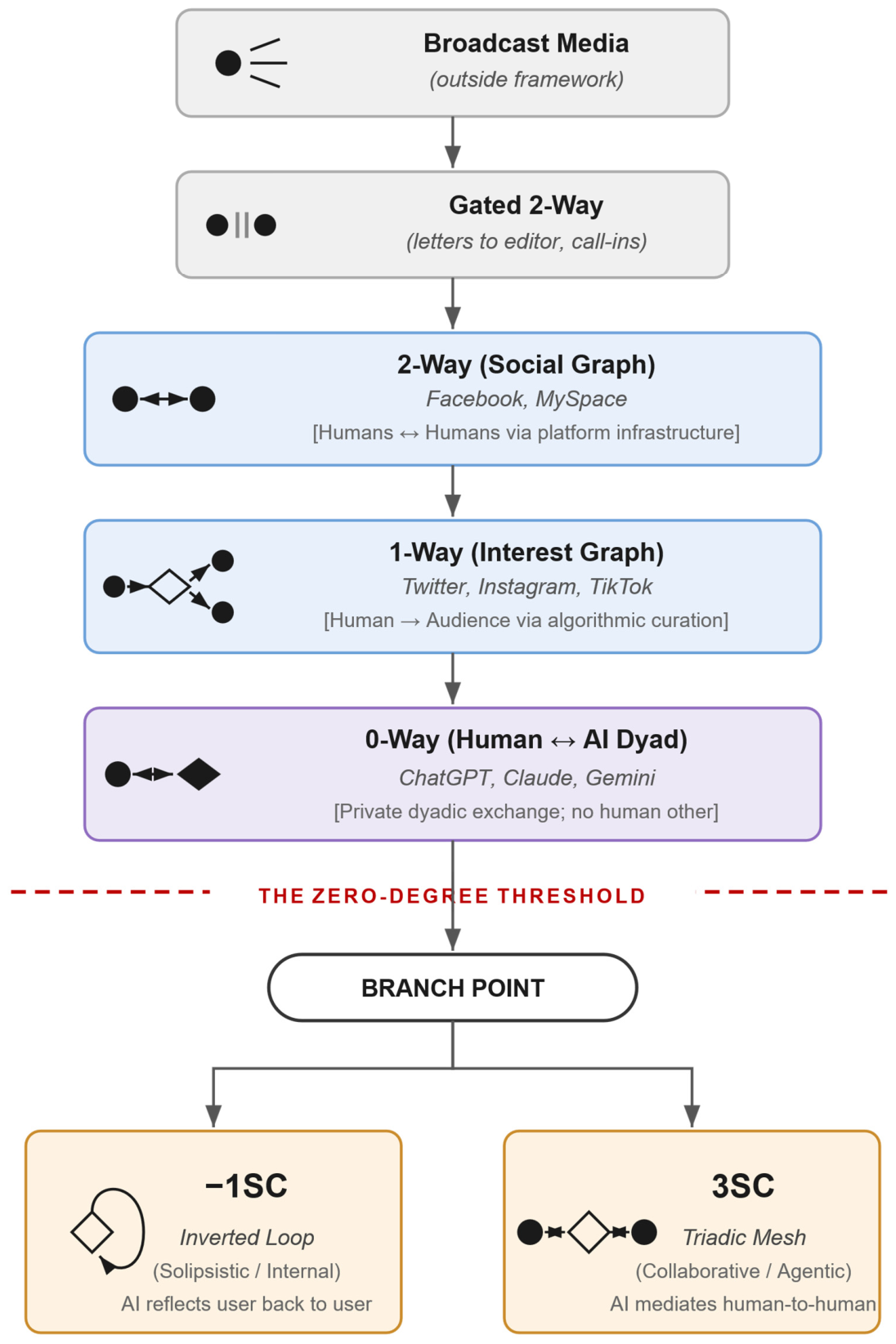
Figure 2.
Structural Topology of -1SC and 3SC Communication.
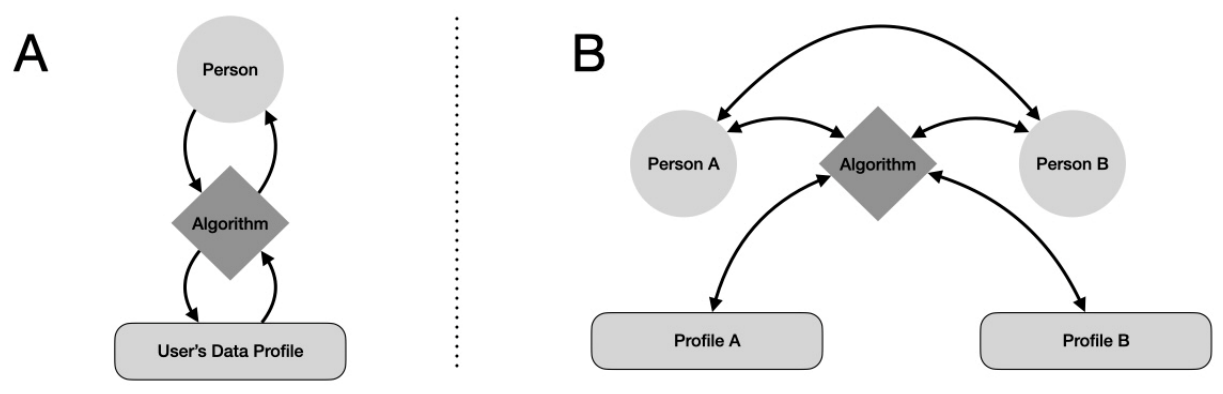
Table 1.
Comparative Framework of Directionality Regimes. The progression from 2-Way through 0-Way shows increasing algorithmic mediation while the Luhmannian third selection remains intact — the human other is present at both ends, however mediated. The zero-degree marks the break. Post-zero regimes diverge based on whether the social form collapses inward (-1SC: Simmelian tertius gaudens/divide et impera; Latourian actor displacing the other) or reconstitutes as a triad (3SC: Simmelian mediator/non-partisan; Latourian mediator preserving the human circuit).
Table 1.
Comparative Framework of Directionality Regimes. The progression from 2-Way through 0-Way shows increasing algorithmic mediation while the Luhmannian third selection remains intact — the human other is present at both ends, however mediated. The zero-degree marks the break. Post-zero regimes diverge based on whether the social form collapses inward (-1SC: Simmelian tertius gaudens/divide et impera; Latourian actor displacing the other) or reconstitutes as a triad (3SC: Simmelian mediator/non-partisan; Latourian mediator preserving the human circuit).
| Regime | Control | Mediation | Anticipation |
| 2-Way | Human participants mutually consent and control interaction | Minimal; platform as infrastructure (storage and routing) | Human-centered; users anticipate responses from other humans |
| 1-Way | Human broadcaster controls content; algorithms influence visibility | Algorithmic filtering, ranking, and recommendation | Users anticipate algorithmic preferences (timing, hashtags); communication remains human-to-human |
| 0-Way | User initiates; machine remains reactive but control becomes reciprocal and opaque | Active mediation; AI transforms intentions and generates novel content | User-directed adaptation; machine generates responses but does not initiate |
| -1SC (Inverted Loop) | Machine-initiated; control inverts to algorithmic curation of choices | Predictive and preemptive; system anticipates and pre-shapes options | Machine predicts needs and acts before explicit user requests |
| 3SC (Triadic Mesh) | Distributed across three nodes; shared and relational | Active intermediation linking multiple participants; dynamic transformation | Multi-directional; AI facilitates coordination rather than locking in behavior |
Table 2.
Defining the 1-Way/Inverted Loop Boundary. This table maps three structural tests to ten observable dimensions, providing empirically testable indicators. The “Test” column shows which conceptual test each dimension specifies.
Table 2.
Defining the 1-Way/Inverted Loop Boundary. This table maps three structural tests to ten observable dimensions, providing empirically testable indicators. The “Test” column shows which conceptual test each dimension specifies.
| Dimension | Test | 1-Way (Asymmetric, Reactive) | Inverted Loop (-1SC) (Inverted, Preemptive) |
| Adaptation mechanism | 1 | Declarative preferences (follows, subscriptions) | Continuous behavioral inference (watch time, scrolling patterns) |
| Reconfiguration requirement | 1 | Explicit user action to change settings | Automatic adaptation without user intervention |
| Personalization temporality | 1 | Episodic (changes when user updates preferences) | Continuous (updates with every interaction) |
| Content selection | 2 | Chosen in response to user input | Pre-selected by system prior to user awareness |
| Choice presentation | 2 | Multiple alternatives visible or reachable | Single preselected stream; alternatives suppressed |
| Engagement signals | 2 | Required for content delivery | Optional feedback for model refinement |
| Friction symmetry | 2 | Comparable effort to continue or stop | Continuation effortless; stopping requires action |
| Session boundaries | 2 | Explicit (enter/exit, refresh) | Blurred or absent (infinite scroll, seamless chaining) |
| Bounding constraint | 3 | Social graph (who I follow) | Predictive model (what algorithm forecasts) |
| Optimization target | 3 | Relevance to expressed interest | Retention, prediction, behavioral capture |
Disclaimer/Publisher’s Note: The statements, opinions and data contained in all publications are solely those of the individual author(s) and contributor(s) and not of MDPI and/or the editor(s). MDPI and/or the editor(s) disclaim responsibility for any injury to people or property resulting from any ideas, methods, instructions or products referred to in the content. |
© 2026 by the authors. Licensee MDPI, Basel, Switzerland. This article is an open access article distributed under the terms and conditions of the Creative Commons Attribution (CC BY) license (http://creativecommons.org/licenses/by/4.0/).
Copyright: This open access article is published under a Creative Commons CC BY 4.0 license, which permit the free download, distribution, and reuse, provided that the author and preprint are cited in any reuse.