

Submitted:
04 March 2026
Posted:
04 March 2026
You are already at the latest version
Abstract
Plant-based biomaterials are increasingly recognized as bio-instructive platforms capable of actively modulating immune responses rather than functioning solely as passive structural supports. In this context, the term plant-based is used operationally to denote photosynthetic biomass–derived platforms and includes both terrestrial plants and marine macroalgae, reflecting their shared richness in polysaccharides and secondary metabolites relevant to immune-engineering and regenerative medicine. Current evidence on plant-derived polysaccharides and phytochemicals is critically synthesized, including algal sulfated polysaccharides (fucoidan, alginate, carrageenan), terrestrial plant polysaccharides (e.g., Lycium barbarum and Aloe vera derivatives), and polyphenolic compounds, highlighting their roles as bioinstructive immunomodulators in biomedical contexts.Key immunoregulatory mechanisms are discussed, including macrophage polarization along an M1–M2 functional continuum, pattern-recognition receptor engagement, redox and metabolic regulation, and coordinated crosstalk between innate and adaptive immunity. Particular emphasis is placed on how material structure, molecular weight distribution, and chemical functionalization shape immune cell responses and downstream regenerative outcomes. Advanced delivery strategies, including polysaccharide-based hydrogels, nanocomposites, lipid-based phytosome formulations, and plant-derived extracellular vesicles (EVs), are reviewed as enabling technologies to enhance stability, bioavailability, and spatiotemporal control of plant-derived bioactives. Applications in wound, musculoskeletal, and bone regeneration are summarized with attention to tissue-specific immunological requirements. Key barriers to clinical translation are also addressed, including source variability, batch-to-batch reproducibility, establishment of structure–activity relationships, Good Manufacturing Practice (GMP) compliance, regulatory classification (medical device vs. drug vs. combination product), and ethical considerations related to sourcing and traditional knowledge. For clarity, extracellular vesicles (EVs) are used as an umbrella term encompassing heterogeneous vesicular subpopulations; the term “exosomes” is retained only when supported by subtype-specific characterization, as many studies report mixed EV preparations.
Keywords:
plant-based biomaterials
; immunomodulation
; macrophage polarization
; polysaccharides
; polyphenols
; hydrogels
; tissue engineering
; clinical translation
; sustainability
; extracellular vesicles
1. Introduction
1.1. Historical Context and Evolution of Biomaterials Design
Since the emergence of biomaterials science in the 1960s, the field has undergone substantial conceptual and technological evolution. Early, first-generation biomaterials were primarily designed to fulfill mechanical and structural requirements, such as strength, stability, and basic biocompatibility, while the host immune response was largely regarded as an undesirable side effect to be minimized or avoided [1]. Subsequent second-generation biomaterials introduced improved surface chemistry, porosity, and degradation profiles to reduce inflammatory reactions and enhance tissue integration.
Advances in immunology and regenerative biology have since driven a paradigm shift toward third-generation bioactive or “smart” biomaterials that actively interact with biological systems and guide cellular behavior. Rather than aiming for immune inertness, contemporary biomaterial design increasingly recognizes immune cells as central regulators of tissue repair and regeneration. In this context, inflammation is no longer viewed solely as a pathological process, but as a dynamic and essential biological signal that must be precisely regulated in space and time to promote functional healing rather than chronic damage [2].
Within this framework, biomaterials capable of bioinstruction that is, materials that actively direct immune cell phenotype and function, have gained considerable attention. Plant-based biomaterials have emerged as particularly promising candidates for such immuneengineering strategies, owing to their intrinsic bioactivity, chemical diversity, and long evolutionary history of interaction with biological defense systems [3,4].
1.2. Why Plants? Evolutionary and Functional Rationale for Plant-Based Bioactive Molecules
Plants are continuously exposed to environmental stressors, including pathogenic microorganisms, parasites, and herbivores, and have consequently evolved a broad repertoire of structurally diverse secondary metabolites and polysaccharides with biological activity [5,6]. These compounds function as components of complex defense and signaling systems, many of which interact with conserved immune pathways shared across biological kingdoms [7,8]. As a result, plant-derived molecules often display immunomodulatory properties that are directly relevant to mammalian immune regulation [9].
In contrast to many synthetic compounds designed through target-specific rational drug discovery, plant-derived bioactive molecules frequently engage multiple molecular targets simultaneously [10]. This multi-target mode of action can confer greater biological robustness and may reduce the likelihood of resistance development, particularly in inflammatory and infectious contexts [11,12]. Such pleiotropic activity is increasingly recognized as advantageous in complex biological processes such as tissue regeneration, where coordinated modulation of multiple immune and cellular pathways is required [13].
Ethnopharmacology further provides an important conceptual and practical foundation for plant-based biomedical research [14]. The traditional use of medicinal plants, refined through centuries of empirical observation, offers valuable prioritization cues for bioactive compounds with therapeutic potential [15]. When integrated with modern analytical, molecular, and materials science approaches, ethnopharmacological knowledge represents a complementary strategy for high-throughput screening, enabling more informed selection of candidates for biomaterial development and translational investigation [16]. Accordingly, throughout this review we adopt an operational definition of plant-based materials that includes macroalgae as established biomedical sources of structurally unique polysaccharides [17,18].
1.3. Scope and Organization of This Review
Unlike previous reviews that predominantly address structural properties or isolated pharmacological effects, the present work integrates materials design, immune signaling mechanisms, and translational constraints within a unified immune-engineering framework. It examines plant-based biomaterials as bio-instructive immunomodulators, with particular emphasis on their structural determinants, molecular mechanisms of immune regulation, and pathways toward clinical translation. In this context, the term plant-based encompasses both terrestrial plants and marine macroalgae, reflecting their shared capacity to produce structurally diverse polysaccharides and secondary metabolites with biomedical relevance.
The review is organized around six interconnected themes: (1) structural characteristics and bioactive properties of plant-derived polysaccharides and phytochemicals; (2) molecular and cellular mechanisms of immunomodulation, including regulation of innate and adaptive immune responses; (3) tissue-specific applications in regenerative medicine and tissue engineering; (4) advanced fabrication and delivery strategies designed to enhance stability, bioavailability, and functional performance; (5) translational pathways, including standardization, regulatory, and ethical considerations; and (6) critical research gaps and future directions.
The primary focus is placed on plant-derived polysaccharides, phytochemicals, and plant-derived extracellular vesicle–like nanoparticles as immunomodulatory biomaterials. Plant-tissue–derived decellularized scaffolds (e.g., leaf vasculature templates) and nanocellulose-based structural platforms are not addressed in detail, as their principal function is architectural rather than immunoregulatory. Although these systems represent significant advances in biofabrication, the present review specifically emphasizes plant-derived materials that actively modulate innate and adaptive immune responses. This defined scope enables a mechanistically grounded and translationally oriented analysis of immune-instructive plant-based biomaterials, while integrating perspectives from materials science, immunology, sustainability, and ethical resource stewardship.
2. Natural Plant-Derived Polysaccharides: Structural Diversity, Bioactive Properties, and Therapeutic Applications
Plant-derived polysaccharides constitute one of the most extensively explored classes of biomaterials in regenerative medicine and immune-engineering [19,20]. Their structural diversity, intrinsic biocompatibility, and capacity to engage conserved immune recognition pathways render them particularly suitable as bio-instructive materials [21]. Unlike inert synthetic polymers, many plant polysaccharides possess inherent biological activity, enabling direct modulation of immune cell behavior while simultaneously providing mechanical support and delivery functionality [22,23].
From an immunological perspective, polysaccharides derived from terrestrial plants and marine macroalgae share common features, high molecular weight, repeating carbohydrate motifs, and frequent chemical substitutions (e.g., sulfation, acetylation), that facilitate interaction with pattern recognition receptors and downstream immune signaling cascades [24,25,26]. This section examines major classes of marine- and terrestrial-derived polysaccharides, emphasizing how structural characteristics govern immunomodulatory function and translational potential [27].
2.1. Marine Polysaccharides: Seaweed-Derived Compounds
Marine macroalgae represents a rich and relatively underexploited source of structurally unique polysaccharides with high biomedical relevance [28,29]. The aqueous environments and evolutionary pressures experienced by seaweed have favored the development of sulfated and highly charged polysaccharides with pronounced bioactivity, many of which exhibit immunomodulatory, antioxidant, and antimicrobial properties [30,31].
2.1.1. Fucoidan: Multifunctional Sulfated Polysaccharide with Translational Potential
Fucoidan is among the most intensively investigated sulfated polysaccharides derived from brown macroalgae (Phaeophyceae) [32]. It has attracted considerable interest due to its favorable biocompatibility profile and wide-ranging biological activities, including immunomodulation, anti-inflammatory effects, antioxidant activity, and support of tissue repair processes [31,33,34,35]. Fucoidan has achieved regulatory acceptance in specific non-pharmaceutical contexts (e.g., food and nutraceutical applications), while its development as a clinical-grade biomaterial or therapeutic agent remains an active area of translational research [36].
Structurally, fucoidan consists primarily of α-L-fucose residues linked through glycosidic bonds, with varying degrees of sulfation, acetylation, and branching depending on algal species, geographic origin, and extraction methodology [24,35]. This intrinsic structural heterogeneity underlies both its biological versatility and its translational challenges. Variations in sulfation pattern, molecular weight, and monosaccharide composition critically influence receptor engagement, immune cell activation, and downstream signaling responses [37,38].
Molecular weight plays a particularly important role in determining bioactivity. Low-molecular-weight fucoidan fractions generally demonstrate enhanced cellular uptake and more pronounced anti-inflammatory effects, whereas higher-molecular-weight preparations exhibit superior rheological properties and are better suited for hydrogel formation and sustained-release applications [39,40]. These properties make fucoidan especially attractive for incorporation into polysaccharide-based hydrogels designed for immunomodulatory wound dressings or regenerative scaffolds [41].
Mechanistically, fucoidan modulates immune responses through multiple pathways, including suppression of pro-inflammatory cytokine production, regulation of macrophage polarization, and attenuation of oxidative stress [42,43]. However, clinical translation remains constrained by several factors: batch-to-batch variability linked to biological source material, incomplete structure–activity relationship mapping, and challenges in achieving reproducible chemical modification and crosslinking under good manufacturing practice conditions [44]. Despite these limitations, fucoidan remains a benchmark candidate for plant-based immunomodulatory biomaterials [45].
2.1.2. Alginate, Carrageenan and Ulvan: Structurally Robust Polysaccharides with Distinct Immunological Roles
Alginate, extracted from brown macroalgae via mild alkaline processes, is widely used in biomedical engineering due to its biocompatibility, biodegradability, and ease of processing into hydrogels, microspheres, fibers, and porous scaffolds [46,47]. Alginate gels form rapidly under physiological conditions through ionic crosslinking with divalent cations, most commonly calcium, enabling encapsulation of cells and labile biomolecules [48,49].
While alginate is often regarded as a structurally inert material, increasing evidence suggests that its molecular architecture and purity significantly influence host immune responses [49,50]. Residual contaminants, molecular weight distribution, and block composition (mannuronic vs. guluronic acid content) affect macrophage activation and fibrotic responses, underscoring the importance of material purification and characterization [51]. Thus, alginate serves as an instructive example of how ostensibly “passive” polysaccharides can exert immunological effects depending on structural and processing parameters.
Carrageenan, derived from red macroalgae (Rhodophyceae), consists of sulfated galactans with repeating units of galactose and 3,6-anhydrogalactose [52]. Unlike alginate, carrageenan exhibits intrinsic immunomodulatory activity, largely attributable to its sulfation pattern [53]. Different carrageenan types (κ-, ι-, and λ-carrageenan) display distinct biological effects, influencing inflammatory signaling, antiviral activity, and immune cell recruitment [54,55]. The immunological activity of carrageenan highlights the central role of sulfate ester positioning and density in determining receptor engagement and downstream immune responses.
Ulvan, a sulfated heteropolysaccharide isolated from green macroalgae (Chlorophyta), further expands the functional diversity of marine polysaccharides [56]. Composed of rhamnose, xylose, glucuronic acid, and iduronic acid residues, ulvan demonstrates immunomodulatory activity through interactions with pattern recognition receptors and adhesion molecules [57,58]. Its dual capacity to provide structural support and bioactive signaling positions ulvan as a promising candidate for next-generation immunoactive scaffolds [59].
2.2. Terrestrial Plant Polysaccharides: Traditional Knowledge and Modern Immunoengineering
Terrestrial plants have served as sources of medicinal polysaccharides for centuries, long before the molecular basis of immune regulation was understood [60]. Contemporary research has begun to elucidate how these polysaccharides influence innate and adaptive immunity, providing mechanistic insight into their long-standing therapeutic use [61].
2.2.1. Lycium barbarum Polysaccharides: Immunomodulation and Microbiota Interactions
Lycium barbarum (goji berry) is among the most extensively studied medicinal plants in traditional Asian medicine, with documented use spanning more than two millennia [62]. Its bioactive polysaccharides (LBP) comprise heterogeneous mixtures of neutral, acidic, and protein-bound polysaccharides with pronounced immunomodulatory activity [63].
LBP enhances immune function through multiple mechanisms, including activation of macrophages, stimulation of lymphocyte proliferation, enhancement of natural killer cell cytotoxicity, and promotion of antibody production [64,65,66]. Beyond direct immune activation, LBP influences adaptive immunity by modulating regulatory T cell differentiation and suppressing excessive pro-inflammatory signaling in disease models.
A particularly important and emerging aspect of LBP activity is its role as a prebiotic immunomodulator. As indigestible polysaccharides, LBP selectively promotes the growth of beneficial gut microbiota, including Lactobacillus and Bifidobacterium species [67]. Microbiota-derived metabolites subsequently influence systemic immune regulation, linking intestinal polysaccharide exposure to distal immune effects [68]. This indirect immunomodulatory pathway is increasingly recognized as relevant for biomaterials intended for long-term implantation or oral delivery.
Despite promising biological effects, clinical translation of LBP is hindered by substantial variability in extraction protocols, plant cultivars, and processing conditions, resulting in inconsistent polysaccharide composition and bioactivity [69]. Standardization remains a critical unmet requirement.
2.2.2. Acemannan from Aloe vera: Structure-Dependent Immunoregulation
Aloe vera has been used medicinally across diverse cultures, with acemannan identified as its principal immunologically active polysaccharide [70]. Acemannan is a β-(1→4)-linked polymannose with variable acetylation, a feature that critically determines its biological function [71].
Acemannan exhibits broad bioactivity, including stimulation of macrophage activation, promotion of wound healing through fibroblast proliferation and collagen synthesis, antioxidant activity, and modulation of inflammatory signaling pathways [72,73,74]. Experimental studies indicate that partially acetylated acemannan exhibits greater immunomodulatory potency than fully acetylated or deacetylated forms, underscoring the importance of structure–activity relationships [75]. Mechanistically, acemannan interacts with pattern recognition receptors, including Toll-like receptors, triggering downstream signaling pathways involved in immune activation and tissue repair [76]. These properties make acemannan a compelling example of how subtle chemical features can translate into pronounced immunological effects.
2.3. Structural Determinants and Chemical Modification of Plant Polysaccharides
2.3.1. Physicochemical Parameters Governing Bioactivity
The biological performance of plant-derived polysaccharides is dictated by a combination of chemical composition, molecular architecture, and higher-order structure. Key determinants include molecular weight, degree and pattern of substitution (e.g., sulfation, acetylation), charge density, solubility, and three-dimensional conformation. Small variations in these parameters can dramatically alter immune cell engagement and polarization outcomes [77]. Structure–activity relationships are particularly critical in immunomodulatory contexts, where minor changes in sulfation degree or linkage/substitution patterns can shift immune responses from pro-inflammatory to anti-inflammatory profiles [62]. This sensitivity is also evident in plant pectic polysaccharides, where immune stimulation can depend strongly on high molecular weight and specific structural domains [78].
Despite increasing recognition of structure–function relationships, quantitative and reproducible mapping between defined structural parameters and specific immune outcomes remains underdeveloped across most plant-derived systems. Bridging this gap will require standardized molecular profiling combined with time-resolved and multiparametric immune assays.
2.3.2. Chemical Modification Strategies for Immunoengineering
Chemical modification enables precise tuning of polysaccharide bioactivity and material performance. Oxidation reactions introduce aldehyde groups that facilitate dynamic covalent crosslinking via Schiff base formation, supporting injectable and self-healing hydrogel systems [79,80,81]. Carboxymethylation enhances hydrophilicity and provides conjugation sites for bioactive molecules [82]. Sulfation can increase immunological activity through enhanced pattern recognition receptor engagement, while acetylation can modulate physicochemical behavior and functional performance in delivery/biomedical settings [62,83]. Bioconjugation strategies, including click chemistry and other bio-orthogonal approaches, allow covalent attachment of growth factors, antimicrobial peptides, or small-molecule drugs while preserving biological function [84,85,86,87]. Together, these approaches enable rational design of plant-based polysaccharide biomaterials with predictable and tunable immunological outcomes. A comparative overview of representative plant-based biomaterials, highlighting structural determinants, PRR involvement, and immunological effects, is provided in Table 1.
Comparative overview of representative plant-derived polysaccharides, phytochemicals, and extracellular vesicle–like nanoparticles, highlighting key structural determinants, pattern-recognition receptor (PRR) involvement, dominant immune effects, level of preclinical or clinical evidence, and selected supporting references. The table emphasizes structure–function relationships and context-dependent immunomodulatory outcomes relevant to regenerative medicine and immune engineering.
3. Plant-Based Phytochemicals and Bioactive Secondary Metabolites: Molecular Mechanisms in Immune Regulation
Beyond structural polysaccharides, plants produce a wide array of low-molecular-weight secondary metabolites that play central roles in immune modulation and tissue regeneration [88,89]. These phytochemicals, particularly polyphenols, flavonoids, terpenoids, alkaloids, and lectins, have evolved as components of plant defense systems and signaling networks [5]. When integrated into biomaterial platforms, they act as potent bioactive cues capable of directing immune cell behavior, regulating oxidative stress, and shaping regenerative microenvironments [90].
In contrast to polysaccharides, which often exert effects through pattern recognition receptor engagement and structural bioinstruction, phytochemicals primarily function through modulation of intracellular signaling pathways, transcriptional programs, and redox balance [91]. Their combination with plant-based scaffolds therefore enables multiscale immunomodulation, spanning extracellular recognition to intracellular signal integration [92].
3.1. Polyphenolic Compounds: From Plant Defense to Therapeutic Agents
Polyphenols constitute one of the most extensively studied classes of plant secondary metabolites due to their pronounced antioxidant, anti-inflammatory, and immunomodulatory properties [93,94]. Structurally, polyphenols are characterized by multiple phenolic hydroxyl groups, which confer both chemical reactivity and biological versatility. In mammalian systems, these compounds influence immune regulation by targeting signaling pathways, transcription factors, and metabolic processes central to inflammation and tissue repair [95].
3.1.1. Polyphenols in Bone Biology and Immunoregulation
Bone regeneration is increasingly recognized as an immune-regulated process, in which osteogenesis, angiogenesis, and inflammation are tightly coupled [96]. Polyphenolic compounds, including flavonoids, phenolic acids, and condensed tannins, modulate bone homeostasis through coordinated actions on osteoblasts, osteoclasts, endothelial cells, and immune populations collectively governing osteoimmunology [97].
Polyphenols promote osteoblast differentiation and function primarily through activation of the Wnt/β-catenin signaling pathway and upregulation of osteogenic transcription factors such as Runx2 and Osterix [98]. Concurrently, they suppress osteoclast genesis by inhibiting receptor activator of nuclear factor κB ligand (RANKL) signaling and reducing the production of pro-osteoclastic cytokines, including TNF-α and IL-6 [99].
Beyond direct effects on bone cells, polyphenols regulate immune-mediated bone remodeling by attenuating chronic inflammation and oxidative stress [100]. By scavenging reactive oxygen species and modulating immune cytokine profiles, polyphenols restore a regenerative milieu conducive to bone repair [101].
Recent advances in biomaterial-assisted delivery have addressed key limitations of polyphenols, particularly their poor aqueous solubility and rapid metabolism [94]. Encapsulation within hydrogels, nanoparticles, and surface-functionalized scaffolds improves stability, local retention, and tissue-specific delivery [102]. Despite strong preclinical evidence, however, translation into clinical bone therapies remains limited [103].
3.1.2. Curcumin: A Model Polyphenol for Immunomodulatory Biomaterials
Curcumin, the principal bioactive component of Curcuma longa, exemplifies both the therapeutic potential and translational challenges of polyphenolic phytochemicals [104]. Curcumin exerts potent anti-inflammatory effects through inhibition of NF-κB signaling, suppression of pro-inflammatory cytokine production (TNF-α, IL-1β, IL-6), downregulation of COX-2 and inducible nitric oxide synthase, and attenuation of immune cell infiltration at inflammatory sites [105,106].
In preclinical cancer and inflammatory disease models, curcumin demonstrates multifaceted bioactivity, including apoptosis induction, inhibition of angiogenesis, suppression of epithelial–mesenchymal transition, and modulation of both innate and adaptive immune responses [107]. When incorporated into plant-based biomaterial systems, curcumin provides synergistic antimicrobial, antioxidative, and immunomodulatory effects [108].
A major barrier to curcumin translation is its extremely low oral bioavailability [109]. Advanced formulation strategies, including lipid-based carriers, polymeric nanoparticles, hydrogel matrices, and phytosome technology, substantially enhance bioavailability and prolong therapeutic action [110,111,112].
3.1.3. Icariin: A Multifunctional Flavonoid for Regenerative Immunomodulation
Icariin, a prenylated flavonol isolated from Epimedium species, has emerged as a promising bioactive molecule for regenerative medicine [113]. Icariin promotes osteogenic differentiation of mesenchymal stem cells through activation of Akt and Wnt/β-catenin signaling, while concurrently suppressing osteoclast activity by downregulating RANKL and macrophage colony-stimulating factor expression [114,115].
Importantly, icariin exerts pleiotropic protective effects, including cardioprotective, hepatoprotective, nephroprotective, and neuroprotective activities. However, its clinical translation is limited by poor bioavailability and rapid clearance, motivating the development of nanoformulations and biomaterial-based delivery systems [116].
3.2. Plant Lectins: Carbohydrate-Binding Proteins as Immune Recognition Modules
Plant lectins are carbohydrate-binding proteins that recognize specific glycan motifs without enzymatic modification [117]. In biomedical contexts, lectins modulate immune responses through engagement of lectin receptors, complement activation, and regulation of antigen presentation [118]. When incorporated into biomaterial platforms, lectins function as immune-targeting ligands enabling selective interaction with innate immune cells [119].
3.3. Phytochemicals in Complex Wound Repair: Integrated Immunomodulatory Pathways
3.3.1. Multicomponent Regulation of Chronic and Diabetic Wounds
Chronic and diabetic wounds are characterized by persistent inflammation, impaired angiogenesis, metabolic dysregulation, and infection susceptibility [120]. Plant-derived phytochemicals address these challenges through simultaneous modulation of inflammatory signaling, macrophage polarization, angiogenesis, and oxidative stress [121].
3.3.2. Reactive Oxygen Species Modulation as a Central Therapeutic Axis
Reactive oxygen species play a dual role in wound healing, acting as signaling mediators at physiological levels but driving chronic inflammation when excessive [122]. Plant-derived compounds mitigate pathological ROS accumulation through direct scavenging, activation of endogenous antioxidant pathways (notably Nrf2 signaling), and suppression of ROS-driven inflammatory cascades [123,124]. The coordinated innate and adaptive immune mechanisms through which plant-derived biomaterials shape regenerative microenvironments are summarized in Figure 1.
Schematic overview of the molecular and cellular pathways through which plant-derived biomaterials modulate innate and adaptive immune responses. Plant polysaccharides, phytochemicals, and plant-derived extracellular vesicle–like nanoparticles engage pattern-recognition receptors (PRRs), including TLR2, TLR4, and Dectin-1, triggering intracellular signaling pathways such as NF-κB activation, MAPK signaling, redox modulation, and NRF2 activation. These signaling events promote macrophage functional reprogramming, characterized by metabolic shifts (e.g., increased oxidative phosphorylation, OXPHOS) and controlled cytokine production, enabling a balanced transition from transient pro-inflammatory responses (IL-1β, TNF-α, IL-6) toward pro-reparative phenotypes (IL-10, TGF-β, pro-angiogenic mediators). Innate immune modulation further shapes adaptive immune regulation, including Treg induction and context-dependent Th17 modulation through dendritic cell conditioning. Structural determinants such as molecular weight, degree of sulfation, acetylation patterns, and material purity influence immune outcomes at multiple levels. The figure also highlights the critical need for endotoxin control, as contamination may result in false TLR4 activation and confound mechanistic interpretation. Downstream effects include angiogenesis, osteogenesis, collagen remodeling, and resolution of inflammation.
4. Macrophage Polarization and Immunomodulation: The Central Axis of Bioinstructive Biomaterials
Across regenerative medicine and immunoengineering, macrophage polarization has emerged as a unifying mechanistic axis through which biomaterials exert therapeutic effects [125,126]. Plant-based biomaterials and phytochemicals are particularly well suited to macrophage-directed immunomodulation, as their structural motifs and bioactive components directly engage immune sensing pathways and intracellular signaling networks [22,127]. Rather than acting through single-target mechanisms, these systems operate through coordinated modulation of immune recognition, metabolic reprogramming, and redox balance, collectively shaping macrophage phenotype and function [126,128].
4.1. M1/M2 Macrophage Polarization: A Functional Spectrum Rather Than a Binary State
4.1.1. Macrophage Plasticity and Phenotypic Continuum
Macrophages are among the most phenotypically plastic cells of the immune system, capable of dynamically adapting their functional state in response to microenvironmental signals [125]. This plasticity underpins their historical classification into M1 (classically activated, pro-inflammatory) and M2 (alternatively activated, anti-inflammatory and pro-reparative) phenotypes. However, contemporary immunology recognizes macrophage activation as a continuum encompassing multiple intermediate and context-dependent states rather than a rigid binary framework [129]. While the M1/M2 framework retains heuristic value, emerging single-cell transcriptomic and spatial profiling studies reveal a far more heterogeneous spectrum of macrophage activation states that remain largely unexplored in plant-based biomaterial research.
In physiological tissue repair, macrophage polarization follows a tightly regulated temporal sequence. Early after injury, macrophages adopt M1-like phenotypes that support host defense through pathogen clearance, production of pro-inflammatory cytokines, and generation of reactive oxygen species [130]. These functions are essential for eliminating microbial threats and removing damaged tissue. As repair progresses, changes in the local microenvironment, including accumulation of apoptotic cells, release of growth factors, and attenuation of inflammatory signals, drive macrophages toward M2-like phenotypes [125]. M2 macrophages promote angiogenesis, extracellular matrix remodeling, suppression of excessive inflammation, and coordination of stromal and progenitor cell activity, thereby enabling tissue regeneration [131].
Plant-based biomaterials leverage this intrinsic macrophage plasticity by providing biochemical and biophysical cues that favor timely transition from inflammatory to reparative phenotypes. Their capacity to simultaneously modulate immune signaling, oxidative stress, and metabolic state positions macrophages as primary targets of bioinstruction [126].
4.1.2. Dysregulated Polarization in Pathological Contexts
In pathological conditions such as diabetic wounds, chronic inflammation, and fibrotic diseases, the physiological macrophage polarization program becomes disrupted [132,133]. The diabetic tissue microenvironment, characterized by sustained hyperglycemia, accumulation of advanced glycation end-products, excessive oxidative stress, endothelial dysfunction, and persistent inflammatory signaling, impairs macrophage phenotypic transitions [134]. As a result, macrophages become functionally “locked” in pro-inflammatory states, continuously producing cytokines (TNF-α, IL-1β, IL-6) and proteolytic enzymes that perpetuate tissue damage and inhibit regeneration [135] .
This pathological macrophage persistence represents a critical therapeutic target. Biomaterial-based strategies designed to reprogram macrophages toward pro-reparative phenotypes have therefore gained substantial interest [136]. Plant-based hydrogels incorporating polysaccharides and phytochemicals are particularly effective in this context, as they provide three-dimensional matrices, sustained release of immunomodulatory agents, and mechanical cues that collectively promote M2-like polarization [137].
4.2. Molecular Mechanisms of Macrophage Reprogramming
4.2.1. Pattern Recognition Receptor Engagement and Immune Signal Encoding
Plant-derived polysaccharides exert profound effects on macrophage behavior through engagement of pattern recognition receptors (PRRs), which function as the immune system’s primary sensors of conserved molecular motifs. Key PRRs involved include toll-like receptors (TLR2, TLR3, TLR4, and TLR9), C-type lectin receptors such as dectin-1 and dectin-2, complement receptors, and scavenger receptors including CD14 and CD36 [138,139]. Importantly, PRR activation by plant polysaccharides should not be interpreted as a simple one-receptor/one-ligand interaction. Rather, immune outcomes emerge from the integration of multiple receptor-mediated signals occurring simultaneously within a defined cellular and cytokine context [140].
The specific immunological response elicited by a given polysaccharide is critically dependent on its molecular architecture. Parameters such as molecular weight distribution (rather than mean molecular weight alone), degree and regioselectivity of sulfation, branching frequency, and monosaccharide composition collectively determine receptor-binding preferences and downstream signaling pathways [22]. For example, β-1,3-glucans preferentially activate dectin-1–Syk signaling, whereas sulfated polysaccharides often engage multiple PRRs in parallel, including TLRs and CLRs, resulting in complex signal integration [141]. Depending on dose, exposure kinetics, and microenvironmental cues, this integration can drive either pro-inflammatory activation or immune resolution and tolerance [142].
This context dependence helps explain apparent inconsistencies in the literature, where the same named polysaccharide (e.g., fucoidan) has been reported to induce divergent immune outcomes. Such discrepancies frequently arise not from true biological contradiction, but from insufficient resolution of structural heterogeneity and experimental variables [35]. Even within a single material class, immune activity can vary substantially due to differences in molecular weight distribution, sulfation pattern, or co-extracted impurities such as proteins, polyphenols, or trace endotoxin contamination [143]. Low-level endotoxin presence can profoundly bias macrophage responses toward TLR4-mediated inflammatory activation, confounding interpretation if not rigorously controlled [144].
In addition to structural variability, dose and temporal exposure represent critical but often underappreciated determinants of immune instruction. Short, high-intensity PRR stimulation may favor inflammatory priming, whereas sustained low-level exposure can promote immune adaptation or tolerogenic responses in certain contexts [142,145]. Studies relying on single concentrations or single time-point analyses therefore provide an incomplete view of macrophage programming and limit meaningful comparison across platforms.
Collectively, these observations underscore that plant polysaccharides function as molecular “languages” rather than generic immune stimulants. Their structural features encode context-dependent immune instructions whose interpretation depends on receptor combinatorics, redox state, metabolic programming, and cytokine milieu [140,146]. Consequently, rigorous characterization of extraction methods, batch metadata, molecular weight distribution, substitution patterns, impurity profiles, and time-resolved immune readouts is not merely a technical consideration but a scientific prerequisite for reproducible structure–activity mapping and rational immunoengineering [22,147].
4.2.2. Redox Regulation and Metabolic Reprogramming
Reactive oxygen species represent a central convergence point linking immune signaling, metabolism, and macrophage polarization [148,149]. Excessive ROS production sustains inflammatory macrophage activation, damages mitochondrial function, and reinforces glycolytic metabolic programs characteristic of M1 phenotypes [150]. Plant-derived polysaccharides and phytochemicals counteract these processes through intrinsic antioxidant activity and activation of endogenous redox-regulatory pathways [127].
Macrophage metabolism is tightly coupled to phenotype. M1 macrophages rely predominantly on aerobic glycolysis, supporting rapid ATP generation and pro-inflammatory effector functions but producing high levels of ROS [151]. In contrast, M2 macrophages preferentially utilize oxidative phosphorylation and fatty acid oxidation, generating energy more efficiently while maintaining low oxidative stress [152]. By scavenging ROS, restoring mitochondrial integrity, and activating Nrf2-mediated antioxidant responses, plant-derived compounds facilitate the metabolic shift required for M1-to-M2 polarization [153].
This redox–metabolic coupling is particularly relevant in chronic inflammatory and diabetic settings, where oxidative stress is a dominant pathological driver [154]. While inorganic biomaterials may require doping or surface modification to achieve antioxidant effects, plant-based systems often possess intrinsic redox-regulatory capacity, conferring a distinct therapeutic advantage [155].
4.2.3. Integration of PI3K/AKT, NF-κB, and MAPK Signaling Pathways
Macrophage polarization is governed by integration of multiple intracellular signaling cascades, among which PI3K/AKT, NF-κB, and MAPK pathways play central roles [156,157]. Activation of PI3K/AKT signaling promotes M2 polarization by enhancing anti-inflammatory cytokine production (IL-10, TGF-β) and suppressing NF-κB-driven inflammatory gene expression [158]. Several plant-derived polyphenols, including resveratrol, enhance PI3K/AKT signaling while simultaneously activating Nrf2-mediated antioxidant pathways [159].
NF-κB represents a key pro-inflammatory transcriptional regulator driving expression of M1-associated genes, including cytokines, chemokines, and inflammatory enzymes [160]. Plant-based compounds inhibit NF-κB activation through diverse mechanisms, including suppression of IκB kinase activity, reduction of ROS-mediated signaling, and modulation of ubiquitination-dependent pathway activation [161].
MAPK signaling further refines macrophage phenotype. M1 macrophages exhibit dominant p38 and JNK activation, whereas M2 phenotypes are associated with ERK-biased signaling [162]. Plant-derived bioactive molecules selectively suppress p38 signaling while supporting ERK activation, thereby reinforcing reparative macrophage programs [163]. Such pathway-selective modulation exemplifies how plant compounds achieve immune reprogramming without global immunosuppression [164]. Figure 2 introduces a conceptual framework describing how material variability and structural features encode immune instructions that are contextually interpreted at the cellular level.
Plant-derived biomaterials translate source variability into defined structural features that encode immune-instructive signals. Molecular characteristics such as molecular weight distribution, sulfation or acetylation patterns, and purity determine engagement of pattern-recognition receptors (e.g., TLR2/4, Dectin-1, CLRs) and activation of interconnected intracellular pathways, including NF-κB, PI3K–AKT, MAPK, Nrf2, and metabolic reprogramming. Signal interpretation is shaped by contextual factors (dose, exposure time, redox state, cytokine milieu), ultimately driving macrophage functional polarization along a dynamic pro-inflammatory to pro-reparative continuum. These immune responses coordinate regenerative outcomes such as angiogenesis, osteogenesis, collagen remodeling, and resolution of inflammation.
4.3. Adaptive Immune Modulation and Immune Tolerance
4.3.1. Regulation of Th17/Treg Balance
Beyond innate immune regulation, plant-based biomaterials and phytochemicals exert significant influence on adaptive immunity, particularly through modulation of the Th17/Treg balance [165,166]. Th17 cells promote inflammatory responses through IL-17 production, whereas regulatory T cells suppress inflammation and maintain immune tolerance via IL-10 and TGF-β secretion [167]. Dysregulation of this balance underlies numerous chronic inflammatory and autoimmune disorders [168].
Plant-derived compounds restore immune equilibrium by promoting Treg differentiation, suppressing Th17-promoting cytokines, and attenuating inflammatory microenvironments that favor pathological immune activation [169]. When delivered via biomaterial platforms, these effects can be spatially and temporally controlled, enhancing therapeutic precision [170].
4.3.2. Tolerogenic Dendritic Cells and Biomaterial-Guided Immune Reprogramming
Plant-derived bioactive molecules also influence antigen-presenting cell function, particularly by promoting differentiation of tolerogenic dendritic cells (tolDCs) [171]. These cells exhibit reduced co-stimulatory molecule expression and increased production of anti-inflammatory cytokines, driving naïve T cell differentiation toward regulatory phenotypes rather than effector responses [172].
The capacity to engineer immune tolerance through biomaterial-guided dendritic cell programming represents a critical frontier in regenerative medicine and immunotherapy [172]. Plant-based biomaterials, by integrating innate and adaptive immune modulation within a single platform, offer a powerful and biologically congruent approach to immune reprogramming [173].
5. Plant-Based Biomaterials in Tissue Engineering: Tissue-Specific Applications and Mechanistic Considerations
The regenerative outcome of biomaterial-based therapies is strongly influenced by tissue-specific immune requirements and microenvironmental constraints [50]. While the fundamental principles of immunomodulation, particularly macrophage polarization, redox balance, and cytokine regulation, are conserved across tissues, their relative importance and temporal dynamics vary substantially [172]. Plant-based biomaterials are uniquely suited to address this complexity, as their intrinsic bioactivity enables adaptive immune regulation tailored to distinct tissue contexts [174].
This section examines how plant-derived biomaterials and phytochemicals are deployed in wound healing, bone regeneration, and cartilage and neural tissue engineering, highlighting tissue-specific immunological mechanisms and design strategies.
5.1. Wound Healing: From Acute Repair to Chronic Wound Management
5.1.1. Immune Orchestration During Physiological Wound Healing
Cutaneous wound healing is a highly coordinated, multistep biological process classically divided into three overlapping phases: inflammation (approximately days 0–7), proliferation (days 7–21), and remodeling (weeks to months) [175]. Across all phases, immune regulation serves as the central organizing principle, integrating inflammatory signaling, cellular recruitment, tissue repair, and resolution processes [176].
During the inflammatory phase, rapid hemostasis is followed by infiltration of neutrophils and macrophages that eliminate pathogens, clear necrotic debris, and initiate immune signaling through cytokine and chemokine release [177]. Reactive oxygen species play a dual role at this stage, contributing to antimicrobial defense while also functioning as secondary messengers in immune signaling [178]. Excessive suppression of inflammation at this stage compromises healing, underscoring the need for balanced immune modulation rather than blanket anti-inflammatory strategies [177].
The proliferative phase is characterized by a shift toward reparative immune activity. M2-like macrophages become predominant, promoting angiogenesis, fibroblast proliferation, granulation tissue formation, and extracellular matrix deposition [131]. Growth factors such as vascular endothelial growth factor (VEGF), basic fibroblast growth factor (bFGF), and transforming growth factor-β (TGF-β) orchestrate vascularization and matrix synthesis [185]. The remodeling phase involves collagen realignment and crosslinking, maturation of the vascular and neural networks, and restoration of functional barrier properties.
Plant-based biomaterials are particularly effective in supporting this dynamic immune choreography, as they can provide phase-appropriate immunomodulatory cues while simultaneously offering structural support.
5.1.2. Advanced Immunomodulatory Hydrogel Systems for Wound Healing
Among wound-healing biomaterials, hydrogels have emerged as particularly powerful platforms for immune regulation due to their high water content, tunable mechanical properties, and capacity for controlled release of bioactive agents [179,180]. Plant-derived polysaccharide hydrogels, used alone or in combination with phytochemicals, enable precise modulation of inflammatory, oxidative, and reparative pathways while simultaneously providing a permissive structural matrix for tissue regeneration [181].
Modern wound dressings now encompass a broad spectrum of formats, including hydrogels, aerogels, electrospun nanofibrous membranes, sponges, microneedle arrays, and 3D-printed constructs [182]. Increasingly, these systems are designed not as passive barriers but as active immunoregulatory devices capable of targeting mitochondrial function, redox homeostasis, autophagy, ferroptosis, and macrophage phenotype [177].
Particularly advanced hydrogel designs incorporate spatiotemporally controlled release profiles aligned with the physiological phases of wound healing [183]. Antimicrobial agents are preferentially delivered during the early inflammatory phase, antioxidant compounds are released throughout healing to regulate reactive oxygen species levels, and pro-reparative factors, such as growth factors or M2-polarizing phytochemicals, are deployed during the proliferative phase [120]. This phase-adaptive strategy more closely mimics endogenous healing processes and has demonstrated superior outcomes compared to conventional passive dressings [13].
Stimuli-responsive hydrogels further enhance therapeutic precision. For example, matrix metalloproteinase-responsive systems exploit elevated MMP-9 activity characteristic of chronic and diabetic wounds to trigger on-demand release of immunomodulatory cargo, including M2 macrophage–derived extracellular vesicles (EVs) [184]. Such conditional delivery limits off-target exposure and ensures that immune-modulating signals are deployed selectively under pathological inflammatory conditions [185].
5.1.3. Plant-Derived Extracellular Vesicles in Wound Repair
A rapidly emerging area of interest is the use of plant-derived extracellular vesicles (EVs) as immunomodulatory agents in wound healing [186]. EVs isolated from fruits and medicinal plants, such as grapes, lemons, and various herbs, contain complex cargos of bioactive lipids, proteins, metabolites, and nucleic acids reflective of their plant origin and physiological function [187]. Preclinical studies indicate that plant-derived EVs can modulate macrophage polarization, promoting the transition from pro-inflammatory to pro-reparative phenotypes, while simultaneously enhancing endothelial cell migration, fibroblast proliferation, and angiogenic signaling [188]. These effects are particularly pronounced in diabetic wound models, where chronic inflammation, oxidative stress, and impaired immune resolution severely compromise physiological healing trajectories [189].
When incorporated into polysaccharide-modified GelMA or other plant-based hydrogel systems, plant-derived EVs integrate biological signaling capacity with mechanical and structural support, yielding synergistic improvements in wound closure, granulation tissue formation, and neovascularization [190]. Conceptually, these platforms bridge traditional plant-based therapeutics with contemporary nanomedicine and biomaterials engineering, offering a scalable, biologically congruent, and immunologically active strategy for wound repair [190].
Here, we deliberately use the term extracellular vesicles (EVs) as an umbrella definition, in line with current ISEV recommendations, to reflect the heterogeneous nature of vesicular populations isolated from plant tissues. While several studies refer to these preparations as “exosomes”, rigorous demonstration of an endosomal biogenesis pathway remains limited in plant systems. We therefore adopt EVs as the most accurate and conservative terminology, retaining the term exosomes only when explicitly supported by the original characterization [191].
5.2. Bone Tissue Engineering and Osteoimmunology
Bone regeneration is increasingly understood through the lens of osteoimmunology, which recognizes immune cells, particularly macrophages, as central regulators of osteogenesis and bone remodeling [170,192]. Rather than suppressing inflammation indiscriminately, successful bone regeneration requires finely tuned immune activation that supports osteoblast differentiation, angiogenesis, and matrix mineralization while avoiding chronic inflammatory signaling [193].
Plant-based polysaccharide biomaterials are well suited for bone tissue engineering due to their structural resemblance to native extracellular matrix components and their intrinsic immunomodulatory capacity [194]. By promoting M2-like macrophage polarization, these materials enhance the secretion of osteogenic and angiogenic mediators, thereby creating an immune milieu permissive for bone formation and vascular integration [126].
Composite systems, such as chitosan-based nanocomposite hydrogels, exemplify the potential of integrating natural polymers with inorganic nanomaterials to achieve mechanical robustness without sacrificing biological activity [195]. These scaffolds provide both physical cues and immune-instructive signals, guiding macrophages toward phenotypes that actively support osteogenesis rather than fibrotic encapsulation [196].
Phyto-nanoparticles, nanoparticles synthesized using plant extracts as reducing and stabilizing agents, represent an additional innovative strategy in this context [197]. These systems inherit antioxidant and immunomodulatory properties from their plant precursors while enhancing osteogenic signaling pathways, including RUNX2 and Osterix activation [198]. Despite promising preclinical outcomes, challenges related to batch reproducibility, scale-up, and regulatory classification remain substantial and must be addressed before clinical translation can be realistically pursued [147].
5.3. Cartilage and Neural Tissue Engineering
Cartilage regeneration presents unique challenges due to limited intrinsic healing capacity and sensitivity to inflammatory damage [199]. Glycopeptide hydrogels constructed through dynamic covalent bonding between polysaccharides and peptides closely mimic the viscoelastic and biochemical properties of native cartilage extracellular matrix [200]. Their self-healing and stimuli-responsive characteristics allow them to withstand mechanical loading while providing sustained immunomodulatory signaling necessary to suppress inflammation and support chondrogenesis [201].
Neural tissue engineering imposes even stricter immunological constraints, as excessive inflammation and microglial activation can severely impair neural regeneration [201]. Seaweed-derived polysaccharides offer particular advantages in this context, as their structural and biochemical properties resemble neural extracellular matrix components while delivering inherent anti-inflammatory and antioxidant signals [202]. By attenuating neurotoxic microglial activation and oxidative stress, plant-based materials create permissive environments for neuronal survival and axonal regrowth [203].
6. Translational Challenges and Pathways Toward Clinical Application
The scientific rationale supporting plant-based immunomodulatory biomaterials is increasingly robust, grounded in advances in immune signaling, macrophage plasticity, and regenerative immunology [130,133,147]. However, translation into clinical practice has progressed more slowly than mechanistic advances would predict. This discrepancy reflects not a lack of therapeutic promise, but a convergence of unresolved challenges spanning material standardization, immune validation, manufacturing scalability, and regulatory positioning [90,91,176].
Plant-derived biomaterials are intrinsically heterogeneous, multicomponent systems in which biological activity often emerges from synergistic and network-level interactions rather than single defined molecules [10,11,12,90]. Such compositional complexity complicates conventional development paradigms built upon chemical uniformity and clearly defined active ingredients [90,91]. Moreover, the dual identity of these platforms—as both structural scaffolds and active immunomodulators—places them at the interface between structural biomaterials and immunologically active agents, increasing developmental complexity [1,4,176].
Beyond regulatory positioning, translational barriers include insufficient structure–function mapping in natural product research [90,91], inadequate control of endotoxin contamination—an established confounder in biomaterials immunology [150,181]—overreliance on simplified in vitro macrophage polarization models [134,168], and limited use of clinically relevant immune validation systems, given the well-documented discrepancies between preclinical models and human inflammatory responses [153,238]. Without systematic management of biological variability and explicit linkage between defined chemical parameters and validated bioactivity endpoints, reproducibility and translational confidence remain compromised [90,176].
Overcoming these barriers demands a paradigm shift from exploratory bioactivity reporting toward reproducible immune-engineering strategies. Standardized sourcing and rigorous phytochemical characterization [14,15,16,90], comprehensive physicochemical profiling [79,202], validated multiparametric immune assays that extend beyond static polarization markers [134,163], and integration of tissue-relevant experimental models [179,200] must be embedded early in development. The following sections critically analyze these translational constraints and delineate strategic pathways capable of converting mechanistic promise into clinically reliable, scalable, and biologically coherent immunomodulatory therapies. Key translational stages, critical quality attributes, and regulatory considerations are summarized in Table 2.
Summary of critical development stages from raw material sourcing to regulatory classification, outlining required actions, critical quality attributes (CQAs), and representative literature references. The framework integrates standardization strategies, endotoxin control, Good Manufacturing Practice (GMP) considerations, and regulatory pathway alignment necessary to support clinical translation.
6.1. Advanced Delivery Systems and Bioavailability Enhancement
A central limitation of many plant-derived bioactive compounds is their unfavorable pharmacokinetic profile, characterized by poor aqueous solubility, limited membrane permeability, rapid metabolic degradation, and low systemic or local bioavailability [94,109,204,205,206]. Advanced delivery systems are therefore essential to unlock the full therapeutic potential of plant-based immunomodulatory biomaterials [207,208].
Among these strategies, phytosome technology, based on the complexation of phytochemicals with phospholipids, has demonstrated particular promise in improving stability, membrane interaction, and tissue uptake of polyphenols and other bioactives small molecule [111,209,210]. Compared to conventional encapsulation approaches, phytosomes promote closer molecular association between the active compound and lipid carrier, enhancing both bioavailability and sustained release [111,209,210,211].
Polysaccharide-based nanoparticles, injectable hydrogels, and nanocomposite scaffolds further enable localized and controlled delivery, minimizing systemic exposure while maintaining therapeutically relevant concentrations within target tissues [207]. Importantly, delivery platforms also modulate immune outcomes by shaping release kinetics, spatial gradients, and co-presentation of multiple bioactive cues [90,136,170].
Despite these advances, cross-study comparability remains limited. Differences in extract composition, phospholipid ratios, formulation protocols, and pharmacokinetic endpoints complicate interpretation and translation [212,213]. Harmonized characterization strategies and clinically meaningful dosing frameworks are therefore essential to ensure that delivery innovations translate into reproducible therapeutic benefit [214,215].
6.2. Ethical and Regulatory Considerations in Plant-Based Biomaterial Development
6.2.1. Ethnopharmacology, Indigenous Knowledge, and Ethical Translation
Ethnopharmacology occupies a critical position at the interface between traditional medical knowledge and contemporary biomedical research, offering a historically informed framework for identifying biologically active plant-derived compounds [14]. For plant-based biomaterials, ethnopharmacological knowledge provides valuable insights into bioactivity, safety, and modes of administration that often predate modern experimental system [15]. However, meaningful integration of this knowledge into biomaterials research remains limited and uneven [216,217].
A persistent challenge lies in the asymmetry between scientific extraction of traditional knowledge and equitable recognition or compensation of indigenous communities. While international frameworks such as the Nagoya Protocol and World Health Organization guidelines formally recognize the rights of indigenous peoples over genetic resources and associated traditional knowledge, their implementation remains inconsistent across jurisdictions [218,219]. In practice, benefit-sharing agreements are frequently complex, under-enforced, or absent, increasing the risk of biopiracy and ethical misconduct [220,221].
From a translational perspective, ethical engagement with ethnopharmacology must extend beyond formal legal compliance. Responsible development of plant-based biomaterials requires transparent documentation of knowledge provenance, culturally informed consent processes, and long-term benefit-sharing mechanisms that include not only financial returns but also capacity building, technology transfer, and access to resulting therapies [218,221]. Case studies such as Euphorbia peplus–derived ingenol mebutate and Cordyceps-based therapeutics illustrate that ethically responsible pathways from traditional use to clinical validation are achievable when scientific rigor is coupled with social accountability [222,223].
Importantly, ethical considerations also intersect with scientific robustness. Traditional preparation methods often differ substantially from laboratory extraction protocols, potentially altering bioactive profiles and immunological outcomes [217,224]. Failure to acknowledge and systematically investigate these differences can lead to misinterpretation of efficacy, safety, and mechanism of action [212,217].
6.2.2. Standardization, GMP Compliance, and Regulatory Pathways
Regulatory approval remains one of the most significant bottlenecks in the clinical translation of plant-based biomaterials. Unlike synthetic polymers or single-molecule drugs, plant-derived materials are intrinsically variable systems. Phytochemical composition is influenced by botanical species, genotype, geographic origin, soil composition, climate, harvest timing, post-harvest processing, and storage conditions. This biological variability presents a fundamental challenge to regulatory frameworks that are predicated on chemical uniformity and batch-to-batch reproducibility [214,215,219].
Standardization therefore represents not merely a regulatory requirement, but a central scientific challenge. Advanced analytical tools, such as high-performance liquid chromatography, mass spectrometry, and nuclear magnetic resonance, enable increasingly detailed chemical characterization of plant extracts and polysaccharides [224,225]. However, chemical fingerprinting alone is insufficient. Regulatory acceptance requires demonstration that defined chemical parameters correlate reliably with biological function, necessitating rigorous structure–activity relationship studies and validated bioassays [60,77,215].
Good Manufacturing Practice (GMP) compliance further complicates translation. Many traditional extraction and processing methods lack the traceability, documentation, and quality control demanded for clinical-grade manufacturing. Scaling up production while maintaining biological activity and reproducibility often requires substantial modification of extraction protocols, which can in turn alter immunomodulatory properties. This creates tension between preserving bioactivity and achieving regulatory compliance [214,226].
Another unresolved challenge concerns regulatory classification. Plant-based biomaterials often occupy ambiguous positions between medical devices, biologics, and combination products. This regulatory ambiguity can slow approval processes and increase development costs, particularly when immunomodulatory activity blurs the distinction between structural support and pharmacological function. Clearer regulatory pathways and harmonized international guidelines will be essential to accelerate clinical translation without compromising safety [226,227,228]. Early dialogue with regulatory agencies to define product classification and evidentiary requirements may significantly reduce downstream development risk, particularly for platforms positioned at the interface between medical devices and biologically active products.
6.3. Evidence Quality, Reproducibility, and “Regulatory Readiness”: A Critical Appraisal
A major limitation across the plant-based biomaterials literature is the pronounced heterogeneity of experimental models, material definitions, and biological endpoints, which substantially complicates both mechanistic interpretation and translational decision-making [212,213]. A large proportion of studies rely on in vitro macrophage assays performed in immortalized cell lines, often using supraphysiological concentrations and short exposure times, with limited validation in human primary cells, disease-relevant models, or clinically realistic dosing scenarios [147,229]. Therefore, reported immunomodulatory effects frequently lack a clear path toward clinical extrapolation. Future studies should prioritize integration of primary human immune cells, organoid-based inflammatory models, and humanized systems to improve predictive validity and reduce translational attrition.
An additional and pervasive challenge concerns insufficient material definition. Plant-derived extracts and polysaccharides are often described using generic labels without adequate batch metadata, detailed chemical fingerprinting, or rigorous impurity and endotoxin control. Given the intrinsic biological variability of plant sources, this lack of definition makes it difficult to attribute observed immune effects to specific molecular features and represents a major barrier to reproducibility [215,219]. In many cases, apparent discrepancies between studies can be traced to differences in botanical origin, harvest conditions, extraction protocols, or post-processing steps rather than to true biological inconsistency [217,224].
Improving translational relevance therefore requires a shift toward systematic standardization across the entire development pipeline. At the source level, botanical authentication, cultivar or genotype documentation, geographic origin, seasonality, and harvesting and storage conditions should be explicitly defined, as these parameters directly influence chemical composition and bioactivity [219]. Extraction and purification processes must similarly be fixed and documented, including solvent systems, temperature and time parameters, and purification strategies, with deliberate justification provided when co-extracted components such as proteins or polyphenols are retained as part of the functional material [224].
From a materials science perspective, regulatory readiness depends on identification and control of critical quality attributes. These include molecular weight distribution rather than average values alone, substitution patterns such as sulfation or acetylation degree and regioselectivity, monosaccharide composition and branching indices, impurity and endotoxin thresholds, and stability metrics under relevant storage and physiological conditions [60,77,144,174,230,231]. Chemical characterization, however, is not sufficient in isolation. Defined chemical parameters must be explicitly linked to biological potency through validated bioactivity assays [215].
Accordingly, bioactivity assessment should move beyond single cytokine measurements toward multiparametric and time-resolved immune profiling. Functional macrophage assays, such as efferocytosis capacity, oxidative burst regulation, and secretion of pro-angiogenic mediators, provide more meaningful insight into regenerative potential than static polarization markers alone [232]. These assays should be complemented by polarization signatures assessed over time, pattern recognition receptor engagement proxies with appropriate impurity controls, and tissue-relevant co-culture systems that better reflect in vivo immune–tissue crosstalk [233].
Manufacturing considerations further constrain clinical translation. Scaling plant-based biomaterials to clinical-grade production requires development of robust, documented, and reproducible standard operating procedures compatible with good manufacturing practice. Cleaning and sterilization methods must be validated to preserve polysaccharide integrity or extracellular vesicle functionality, while release criteria should be directly tied to both critical quality attributes and validated potency assays. Stability-indicating methods are also essential to establish shelf-life and ensure consistent performance over time [214,226].
Finally, early and explicit regulatory classification is crucial. Plant-based immunomodulatory biomaterials often occupy ambiguous positions at the interface of medical devices, drugs or biologics, and combination products. Delayed or unclear classification increases development costs and regulatory risk, as evidence requirements, clinical endpoints, and post-market obligations differ substantially across regulatory pathways. Proactive alignment with regulatory agencies to define classification and evidentiary expectations can therefore significantly accelerate translation [228].
Taken together, these considerations underscore that successful clinical translation of plant-based biomaterials does not require elimination of biological variability, but rather its systematic management. Variability must be engineered into control through defined quality attributes, validated bioactivity assays, and early regulatory alignment [228]. Only through such integrated approaches can the field move from promising preclinical observations toward reproducible, clinically reliable, and regulatory-compliant immunomodulatory therapies [213].
Proposed minimum requirements for chemical characterization, endotoxin testing, immune profiling, mechanistic validation, human-relevant modeling, extracellular vesicle characterization (when applicable), and batch comparability. The table outlines key methodological benchmarks intended to improve reproducibility, mechanistic clarity, and alignment with regulatory expectations in the development of plant-based immunomodulatory biomaterials.

Table 3.
Recommended preclinical and analytical standards for regulatory readiness.
| Category | Minimum Requirement | Rationale | Key References |
|---|---|---|---|
| Chemical Characterization | Full compositional profiling (HPLC/MS/NMR); MW distribution; substitution degree | Link structure to function | [224,225,231] |
| Endotoxin Control | LAL or monocyte activation test; defined thresholds | Prevent false PRR activation | [150,181] |
| Immune Profiling | Multiplex cytokine panels; time-course studies; functional macrophage assays | Capture dynamic immune modulation | [134,232] |
| Mechanistic Validation | PRR blocking; receptor engagement assays | Demonstrate causality | [26,143,145] |
| Human-Relevant Models | Primary human macrophages; tissue-relevant co-culture | Improve translational validity | [147,229] |
| EV Characterization (if applicable) | Size distribution; marker profiling; purity assessment | Standardized EV reporting | [191] |
| Stability & Batch Comparability | Cross-batch chemical and biological consistency | Regulatory compliance | [214,226,231] |
7. Conclusion and Future Perspectives
Plant-based biomaterials represent a rapidly evolving class of bioinstructive platforms that blur traditional boundaries between structural materials and therapeutics. By actively engaging immune systems—particularly via macrophage reprogramming, redox regulation, and coordinated innate–adaptive crosstalk—these materials can create pro-reparative microenvironments that support tissue regeneration across multiple biomedical contexts [125,136,149,170,195].
Nevertheless, clinical translation remains limited not primarily due to lack of promising mechanisms, but due to gaps in reproducibility, standardization, and regulatory readiness. Intrinsic source variability, incomplete structure–activity relationships, inconsistent potency assays, and ambiguous regulatory classification frequently prevent otherwise compelling platforms from advancing beyond preclinical stages [213,215,228].
Future progress will require (i) mechanistic clarity linking defined structural features to immunological outcomes [60,77,136]; (ii) design principles that treat immune modulation as context-dependent orchestration rather than generic suppression [129,195]; (iii) delivery systems enabling phase-appropriate, tissue-specific spatiotemporal control [180,181,182]; (iv) rigorous, clinically meaningful validation strategies and endpoints [212,213,229]; and (v) ethically grounded development pipelines that ensure sustainable sourcing and equitable benefit-sharing [218,219,220,221]. The future of plant-based immunomodulatory biomaterials will depend less on the discovery of new bioactive compounds and more on the ability to engineer reproducibility, regulatory clarity, and context-specific immune control into clinically reliable platforms [214,215].
Funding
This research did not receive external funding.
Institutional Review Board Statement
Not applicable.
Informed Consent Statement
Not applicable.
Data Availability Statement
No new data were created.
Conflicts of Interest
The author declare no conflicts of interest.
References
- Hench, L.L. Biomaterials. Science 1980, 208, 826–831. [Google Scholar] [CrossRef] [PubMed]
- Rea, S.M.; Brooks, R.A.; Schneider, A.; Best, S.M.; Bonfield, W. Osteoblast-like Cell Response to Bioactive Composites—Surface-topography and Composition Effects. J. Biomed. Mater. Res. B Appl. Biomater. 2004, 70B, 250–261. [Google Scholar] [CrossRef]
- Hench, L.L.; Thompson, I. Twenty-First Century Challenges for Biomaterials. J. R. Soc. Interface 2010, 7. [Google Scholar] [CrossRef] [PubMed]
- Hench, L.L.; Wilson, J. Clinical Performance of Skeletal Prostheses; Springer, 1996; ISBN 0-412-72110-4. [Google Scholar]
- Wink, M. Plant Secondary Metabolism: Diversity, Function and Its Evolution. Nat. Prod. Commun. 2008, 3, 1934578X0800300801. [Google Scholar] [CrossRef]
- Dixon, R.A.; Paiva, N.L. Stress-Induced Phenylpropanoid Metabolism. Plant Cell 1995, 1085–1097. [Google Scholar] [CrossRef] [PubMed]
- Jones, J.D.G.; Dangl, J.L. The Plant Immune System. Nature 2006, 444, 323–329. [Google Scholar] [CrossRef] [PubMed]
- Medzhitov, R. Recognition of Microorganisms and Activation of the Immune Response. Nature 2007, 449, 819–826. [Google Scholar] [CrossRef]
- Spelman, K.; Burns, J.; Nichols, D.; Winters, N.; Ottersberg, S.; Tenborg, M. Modulation of Cytokine Expression by Traditional Medicines: A Review of Herbal Immunomodulators. Altern. Med. Rev. 2006, 11, 128. [Google Scholar]
- Hopkins, A.L. Network Pharmacology: The next Paradigm in Drug Discovery. Nat. Chem. Biol. 2008, 4, 682–690. [Google Scholar] [CrossRef]
- Wagner, H.; Ulrich-Merzenich, G. Synergy Research: Approaching a New Generation of Phytopharmaceuticals. Phytomedicine 2009, 16, 97–110. [Google Scholar] [CrossRef]
- Gertsch, J. Botanical Drugs, Synergy, and Network Pharmacology: Forth and Back to Intelligent Mixtures. Planta Med. 2011, 77, 1086–1098. [Google Scholar] [CrossRef] [PubMed]
- Eming, S.A.; Wynn, T.A.; Martin, P. Inflammation and Metabolism in Tissue Repair and Regeneration. Science 2017, 356, 1026–1030. [Google Scholar] [CrossRef]
- Heinrich, M.; Barnes, J.; Gibbons, S.; Williamson, E. Fundamentals of Pharmacognosy and Phytotherapy. 2nd. Ed. Edinb. Lond. N. Y. Churchhill Livingstone Elsevier 2012.
- Fabricant, D.S.; Farnsworth, N.R. The Value of Plants Used in Traditional Medicine for Drug Discovery. Environ. Health Perspect. 2001, 109, 69–75. [Google Scholar] [CrossRef]
- Atanasov, A.G.; Waltenberger, B.; Pferschy-Wenzig, E.-M.; Linder, T.; Wawrosch, C.; Uhrin, P.; Temml, V.; Wang, L.; Schwaiger, S.; Heiss, E.H.; et al. Discovery and Resupply of Pharmacologically Active Plant-Derived Natural Products: A Review. Biotechnol. Adv. 2015, 33, 1582–1614. [Google Scholar] [CrossRef]
- Laurienzo, P. Marine Polysaccharides in Pharmaceutical Applications: An Overview. Mar. Drugs 2010, 8, 2435–2465. [Google Scholar] [CrossRef] [PubMed]
- Cotas, J.; Lomartire, S.; Gonçalves, A.M.; Pereira, L. From Ocean to Medicine: Harnessing Seaweed’s Potential for Drug Development. Int. J. Mol. Sci. 2024, 25, 797. [Google Scholar] [CrossRef] [PubMed]
- Mano, J.F.; Silva, G.A.; Azevedo, H.S.; Malafaya, P.B.; Sousa, R.A.; Silva, S.S.; Boesel, L.F.; Oliveira, J.M.; Santos, T.C.; Marques, A.P.; et al. Natural Origin Biodegradable Systems in Tissue Engineering and Regenerative Medicine: Present Status and Some Moving Trends. J. R. Soc. Interface 2007, 4, 999–1030. [Google Scholar] [CrossRef] [PubMed]
- Lee, K.Y.; Mooney, D.J. Alginate: Properties and Biomedical Applications. Prog. Polym. Sci. 2012, 37, 106–126. [Google Scholar] [CrossRef]
- Brown, G.D.; Gordon, S. Immune Recognition of Fungal β-Glucans: Immune Recognition of Fungal β-Glucans. Cell. Microbiol. 2005, 7, 471–479. [Google Scholar] [CrossRef]
- Schepetkin, I.A.; Quinn, M.T. Botanical Polysaccharides: Macrophage Immunomodulation and Therapeutic Potential. Int. Immunopharmacol. 2006, 6, 317–333. [Google Scholar] [CrossRef]
- Jayakumar, R.; Prabaharan, M.; Sudheesh Kumar, P.T.; Nair, S.V.; Tamura, H. Biomaterials Based on Chitin and Chitosan in Wound Dressing Applications. Biotechnol. Adv. 2011, 29, 322–337. [Google Scholar] [CrossRef] [PubMed]
- Pomin, V.H. Structure–Function Relationship of Anticoagulant and Antithrombotic Well-Defined Sulfated Polysaccharides from Marine Invertebrates. In Advances in Food and Nutrition Research; Elsevier, 2012; Vol. 65, pp. 195–209. ISBN 978-0-12-416003-3. [Google Scholar]
- Fitton, J.H. Therapies from Fucoidan; Multifunctional Marine Polymers. Mar. Drugs 2011, 9, 1731–1760. [Google Scholar] [CrossRef]
- Takeuchi, O.; Akira, S. Pattern Recognition Receptors and Inflammation. Cell 2010, 140, 805–820. [Google Scholar] [CrossRef]
- Chen, L.; Huang, G. Antitumor Activity of Polysaccharides: An Overview. Curr. Drug Targets 2018, 19. [Google Scholar] [CrossRef]
- Rioux, L.-E.; Turgeon, S.L.; Beaulieu, M. Structural Characterization of Laminaran and Galactofucan Extracted from the Brown Seaweed Saccharina Longicruris. Phytochemistry 2010, 71, 1586–1595. [Google Scholar] [CrossRef]
- Holdt, S.L.; Kraan, S. Bioactive Compounds in Seaweed: Functional Food Applications and Legislation. J. Appl. Phycol. 2011, 23, 543–597. [Google Scholar] [CrossRef]
- Pomin, V.H. Sulfated Glycans in Inflammation. Eur. J. Med. Chem. 2015, 92, 353–369. [Google Scholar] [CrossRef] [PubMed]
- Luthuli, S.; Wu, S.; Cheng, Y.; Zheng, X.; Wu, M.; Tong, H. Therapeutic Effects of Fucoidan: A Review on Recent Studies. Mar. Drugs 2019, 17, 487. [Google Scholar] [CrossRef] [PubMed]
- Fitton, H.; Meyers, S.; Brooks, L.; Mulder, A.; Rolfe, M.; Baker, D.; Robinson, S. Effects of Fucoidan from Fucus Vesiculosus in Reducing Symptoms of Osteoarthritis: A Randomized Placebo-Controlled Trial. Biol. Targets Ther. 2016, 81. [Google Scholar] [CrossRef]
- Fitton, J.; Stringer, D.; Karpiniec, S. Therapies from Fucoidan: An Update. Mar. Drugs 2015, 13, 5920–5946. [Google Scholar] [CrossRef]
- Senthilkumar, K.; Manivasagan, P.; Venkatesan, J.; Kim, S.-K. Brown Seaweed Fucoidan: Biological Activity and Apoptosis, Growth Signaling Mechanism in Cancer. Int. J. Biol. Macromol. 2013, 60, 366–374. [Google Scholar] [CrossRef]
- Yang, J.-Y.; Lim, S.Y. Fucoidans and Bowel Health. Mar. Drugs 2021, 19, 436. [Google Scholar] [CrossRef]
- Pozharitskaya, O.N.; Shikov, A.N.; Obluchinskaya, E.D.; Vuorela, H. The Pharmacokinetics of Fucoidan after Topical Application to Rats. Mar. Drugs 2019, 17, 687. [Google Scholar] [CrossRef]
- Apostolova, E.; Lukova, P.; Baldzhieva, A.; Katsarov, P.; Nikolova, M.; Iliev, I.; Peychev, L.; Trica, B.; Oancea, F.; Delattre, C.; et al. Immunomodulatory and Anti-Inflammatory Effects of Fucoidan: A Review. Polymers 2020, 12, 2338. [Google Scholar] [CrossRef]
- Cumashi, A.; Ushakova, N.A.; Preobrazhenskaya, M.E.; D’Incecco, A.; Piccoli, A.; Totani, L.; Tinari, N.; Morozevich, G.E.; Berman, A.E.; Bilan, M.I.; et al. A Comparative Study of the Anti-Inflammatory, Anticoagulant, Antiangiogenic, and Antiadhesive Activities of Nine Different Fucoidans from Brown Seaweeds. Glycobiology 2007, 17, 541–552. [Google Scholar] [CrossRef] [PubMed]
- Irhimeh, M.R.; Fitton, J.H.; Lowenthal, R.M. Fucoidan Ingestion Increases the Expression of CXCR4 on Human CD34+ Cells. Exp. Hematol. 2007, 35, 989–994. [Google Scholar] [CrossRef]
- Qi, Y.; Wang, L.; You, Y.; Sun, X.; Wen, C.; Fu, Y.; Song, S. Preparation of Low-Molecular-Weight Fucoidan with Anticoagulant Activity by Photocatalytic Degradation Method. Foods 2022, 11, 822. [Google Scholar] [CrossRef]
- Liang, Y.; Zhao, X.; Hu, T.; Chen, B.; Yin, Z.; Ma, P.X.; Guo, B. Adhesive Hemostatic Conducting Injectable Composite Hydrogels with Sustained Drug Release and Photothermal Antibacterial Activity to Promote Full-Thickness Skin Regeneration During Wound Healing. Small 2019, 15, 1900046. [Google Scholar] [CrossRef]
- Sanjeewa, K.K.A.; Herath, K.H.I.N.M.; Yang, H.-W.; Choi, C.S.; Jeon, Y.-J. Anti-Inflammatory Mechanisms of Fucoidans to Treat Inflammatory Diseases: A Review. Mar. Drugs 2021, 19, 678. [Google Scholar] [CrossRef] [PubMed]
- Park, H.Y.; Han, M.H.; Park, C.; Jin, C.-Y.; Kim, G.-Y.; Choi, I.-W.; Kim, N.D.; Nam, T.-J.; Kwon, T.K.; Choi, Y.H. Anti-Inflammatory Effects of Fucoidan through Inhibition of NF-κB, MAPK and Akt Activation in Lipopolysaccharide-Induced BV2 Microglia Cells. Food Chem. Toxicol. 2011, 49, 1745–1752. [Google Scholar] [CrossRef] [PubMed]
- Troy, E.; Tilbury, M.A.; Power, A.M.; Wall, J.G. Nature-Based Biomaterials and Their Application in Biomedicine. Polymers 2021, 13, 3321. [Google Scholar] [CrossRef]
- Zahariev, N.; Katsarov, P.; Lukova, P.; Pilicheva, B. Novel Fucoidan Pharmaceutical Formulations and Their Potential Application in Oncology—A Review. Polymers 2023, 15, 3242. [Google Scholar] [CrossRef]
- Pawar, S.N.; Edgar, K.J. Alginate Derivatization: A Review of Chemistry, Properties and Applications. Biomaterials 2012, 33, 3279–3305. [Google Scholar] [CrossRef] [PubMed]
- Draget, K.I.; Skjåk-Bræk, G.; Smidsrød, O. Alginate Based New Materials. Int. J. Biol. Macromol. 1997, 21, 47–55. [Google Scholar] [CrossRef]
- Rowley, J.A.; Madlambayan, G.; Mooney, D.J. Alginate Hydrogels as Synthetic Extracellular Matrix Materials. Biomaterials 1999, 20, 45–53. [Google Scholar] [CrossRef] [PubMed]
- Bochenek, M.A.; Veiseh, O.; Vegas, A.J.; McGarrigle, J.J.; Qi, M.; Marchese, E.; Omami, M.; Doloff, J.C.; Mendoza-Elias, J.; Nourmohammadzadeh, M.; et al. Alginate Encapsulation as Long-Term Immune Protection of Allogeneic Pancreatic Islet Cells Transplanted into the Omental Bursa of Macaques. Nat. Biomed. Eng. 2018, 2, 810–821. [Google Scholar] [CrossRef]
- Anderson, J.M.; Rodriguez, A.; Chang, D.T. Foreign Body Reaction to Biomaterials. Semin. Immunol. 2008, 20, 86–100. [Google Scholar] [CrossRef] [PubMed]
- Rosiak, P.; Latanska, I.; Paul, P.; Sujka, W.; Kolesinska, B. Modification of Alginates to Modulate Their Physic-Chemical Properties and Obtain Biomaterials with Different Functional Properties. Molecules 2021, 26, 7264. [Google Scholar] [CrossRef]
- Campo, V.L.; Kawano, D.F.; Silva, D.B.D.; Carvalho, I. Carrageenans: Biological Properties, Chemical Modifications and Structural Analysis – A Review. Carbohydr. Polym. 2009, 77, 167–180. [Google Scholar] [CrossRef]
- Necas, J.; Bartosikova, L. Carrageenan: A Review. Veterinární Medicína 2013, 58, 187–205. [Google Scholar] [CrossRef]
- Talarico, L.B.; Damonte, E.B. Interference in Dengue Virus Adsorption and Uncoating by Carrageenans. Virology 2007, 363, 473–485. [Google Scholar] [CrossRef]
- Krylova, N.V.; Kravchenko, A.O.; Iunikhina, O.V.; Pott, A.B.; Likhatskaya, G.N.; Volod’ko, A.V.; Zaporozhets, T.S.; Shchelkanov, M.Y.; Yermak, I.M. Influence of the Structural Features of Carrageenans from Red Algae of the Far Eastern Seas on Their Antiviral Properties. Mar. Drugs 2022, 20, 60. [Google Scholar] [CrossRef] [PubMed]
- Lahaye, M.; Robic, A. Structure and Functional Properties of Ulvan, a Polysaccharide from Green Seaweeds. Biomacromolecules 2007, 8, 1765–1774. [Google Scholar] [CrossRef]
- Tziveleka, L.-A.; Ioannou, E.; Roussis, V. Ulvan, a Bioactive Marine Sulphated Polysaccharide as a Key Constituent of Hybrid Biomaterials: A Review. Carbohydr. Polym. 2019, 218, 355–370. [Google Scholar] [CrossRef]
- Pradhan, B.; Bhuyan, P.; Ki, J.-S. Immunomodulatory, Antioxidant, Anticancer, and Pharmacokinetic Activity of Ulvan, a Seaweed-Derived Sulfated Polysaccharide: An Updated Comprehensive Review. Mar. Drugs 2023, 21, 300. [Google Scholar] [CrossRef] [PubMed]
- D’Ayala, G.G.; Malinconico, M.; Laurienzo, P. Marine Derived Polysaccharides for Biomedical Applications: Chemical Modification Approaches. Molecules 2008, 13, 2069–2106. [Google Scholar] [CrossRef]
- Huang, L.; Shen, M.; Morris, G.A.; Xie, J. Sulfated Polysaccharides: Immunomodulation and Signaling Mechanisms. Trends Food Sci. Technol. 2019, 92, 1–11. [Google Scholar] [CrossRef]
- Wasser, S.P. Medicinal Mushroom Science: History, Current Status, Future Trends, and Unsolved Problems. Int. J. Med. Mushrooms 2010, 12, 1–16. [Google Scholar] [CrossRef]
- Potterat, O. Goji ( Lycium Barbarum and L. Chinense ): Phytochemistry, Pharmacology and Safety in the Perspective of Traditional Uses and Recent Popularity. Planta Med. 2010, 76, 7–19. [Google Scholar] [CrossRef]
- Amagase, H.; Farnsworth, N.R. A Review of Botanical Characteristics, Phytochemistry, Clinical Relevance in Efficacy and Safety of Lycium Barbarum Fruit (Goji). Food Res. Int. 2011, 44, 1702–1717. [Google Scholar] [CrossRef]
- Gan, L.; Zhang, S.-H.; Liu, Q.; Xu, H.-B. A Polysaccharide-Protein Complex from Lycium Barbarum Upregulates Cytokine Expression in Human Peripheral Blood Mononuclear Cells. Eur. J. Pharmacol. 2003, 471, 217–222. [Google Scholar] [CrossRef] [PubMed]
- Deng, X.; Luo, S.; Luo, X.; Hu, M.; Ma, F.; Wang, Y.; Lai, X.; Zhou, L. Polysaccharides from Chinese Herbal Lycium Barbarum Induced Systemic and Local Immune Responses in H22 Tumor-Bearing Mice. J. Immunol. Res. 2018, 2018, 1–12. [Google Scholar] [CrossRef]
- Feng, L.; Xiao, X.; Liu, J.; Wang, J.; Zhang, N.; Bing, T.; Liu, X.; Zhang, Z.; Shangguan, D. Immunomodulatory Effects of Lycium Barbarum Polysaccharide Extract and Its Uptake Behaviors at the Cellular Level. Molecules 2020, 25, 1351. [Google Scholar] [CrossRef] [PubMed]
- Gong, G.; Dang, T.; Deng, Y.; Han, J.; Zou, Z.; Jing, S.; Zhang, Y.; Liu, Q.; Huang, L.; Wang, Z. Physicochemical Properties and Biological Activities of Polysaccharides from Lycium Barbarum Prepared by Fractional Precipitation. Int. J. Biol. Macromol. 2018, 109, 611–618. [Google Scholar] [CrossRef]
- Rooks, M.G.; Garrett, W.S. Gut Microbiota, Metabolites and Host Immunity. Nat. Rev. Immunol. 2016, 16, 341–352. [Google Scholar] [CrossRef]
- Duan, J.-L.; Liu, M.-Q.; Liu, Y.-N.; Liang, X.-F.; Cao, C.; Yao, A.-N.; Zhao, L.-Q.; Guo, S.; Qian, D.-W.; Bao, C.-J.; et al. Comparative Study on Physicochemical Characterization and Immunomodulatory Activities of Neutral and Acidic Lycium Barbarum Polysaccharides. Biomed. Pharmacother. 2024, 181, 117659. [Google Scholar] [CrossRef]
- Reynolds, T.; Dweck, A.C. Aloe Vera Leaf Gel: A Review Update. J. Ethnopharmacol. 1999, 68, 3–37. [Google Scholar] [CrossRef]
- Ni, Y.; Turner, D.; Yates, K.M.; Tizard, I. Isolation and Characterization of Structural Components of Aloe Vera L. Leaf Pulp. Int. Immunopharmacol. 2004, 4, 1745–1755. [Google Scholar] [CrossRef]
- Tizard, I.; Carpenter, R.; McAnalley, B.; Kemp, M. The Biological Activities of Mannans and Related Complex Carbohydrates. Mol. Biother. 1989, 1, 290–296. [Google Scholar]
- Chithra, P.; Sajithlal, G.B.; Chandrakasan, G. Influence of Aloe Vera on Collagen Characteristics in Healing Dermal Wounds in Rats. Mol. Cell. Biochem. 1998, 181, 71–76. [Google Scholar] [CrossRef] [PubMed]
- Hamman, J.H. Composition and Applications of Aloe Vera Leaf Gel. Molecules 2008, 13, 1599–1616. [Google Scholar] [CrossRef]
- Matei, C.E.; Visan, A.I.; Cristescu, R. Aloe Vera Polysaccharides as Therapeutic Agents: Benefits Versus Side Effects in Biomedical Applications. Polysaccharides 2025, 6, 36. [Google Scholar] [CrossRef]
- Liu, C.; Cui, Y.; Pi, F.; Cheng, Y.; Guo, Y.; Qian, H. Extraction, Purification, Structural Characteristics, Biological Activities and Pharmacological Applications of Acemannan, a Polysaccharide from Aloe Vera: A Review. Molecules 2019, 24, 1554. [Google Scholar] [CrossRef]
- Chen, R.; Xu, J.; Wu, W.; Wen, Y.; Lu, S.; El-Seedi, H.R.; Zhao, C. Structure–Immunomodulatory Activity Relationships of Dietary Polysaccharides. Curr. Res. Food Sci. 2022, 5, 1330–1341. [Google Scholar] [CrossRef] [PubMed]
- Trakoolpolpruek, T.; Moonmangmee, S.; Chanput, W. Structure-Dependent Immune Modulating Activity of Okra Polysaccharide on THP-1 Macrophages. Bioact. Carbohydr. Diet. Fibre 2019, 17, 100173. [Google Scholar] [CrossRef]
- Reakasame, S.; Boccaccini, A.R. Oxidized Alginate-Based Hydrogels for Tissue Engineering Applications: A Review. Biomacromolecules 2018, 19, 3–21. [Google Scholar] [CrossRef]
- Balakrishnan, B.; Joshi, N.; Jayakrishnan, A.; Banerjee, R. Self-Crosslinked Oxidized Alginate/Gelatin Hydrogel as Injectable, Adhesive Biomimetic Scaffolds for Cartilage Regeneration. Acta Biomater. 2014, 10, 3650–3663. [Google Scholar] [CrossRef]
- Wei, Z.; Zhao, J.; Chen, Y.M.; Zhang, P.; Zhang, Q. Self-Healing Polysaccharide-Based Hydrogels as Injectable Carriers for Neural Stem Cells. Sci. Rep. 2016, 6, 37841. [Google Scholar] [CrossRef]
- Chakka, V.P.; Zhou, T. Carboxymethylation of Polysaccharides: Synthesis and Bioactivities. Int. J. Biol. Macromol. 2020, 165, 2425–2431. [Google Scholar] [CrossRef]
- Li, H.; Wang, Y.; Zhao, P.; Guo, L.; Huang, L.; Li, X.; Gao, W. Naturally and Chemically Acetylated Polysaccharides: Structural Characteristics, Synthesis, Activities, and Applications in the Delivery System: A Review. Carbohydr. Polym. 2023, 313, 120746. [Google Scholar] [CrossRef]
- Azagarsamy, M.A.; Anseth, K.S. Bioorthogonal Click Chemistry: An Indispensable Tool to Create Multifaceted Cell Culture Scaffolds. ACS Macro Lett. 2013, 2, 5–9. [Google Scholar] [CrossRef]
- Sletten, E.M.; Bertozzi, C.R. Bioorthogonal Chemistry: Fishing for Selectivity in a Sea of Functionality. Angew. Chem. Int. Ed. 2009, 48, 6974–6998. [Google Scholar] [CrossRef] [PubMed]
- Kolb, H.C.; Finn, M.; Sharpless, K.B. Click Chemistry: Diverse Chemical Function from a Few Good Reactions. Angew. Chem. Int. Ed. 2001, 40, 2004–2021. [Google Scholar] [CrossRef]
- Khodadadi Yazdi, M.; Sajadi, S.M.; Seidi, F.; Rabiee, N.; Fatahi, Y.; Rabiee, M.; Dominic, C.D.M.; Zarrintaj, P.; Formela, K.; Saeb, M.R.; et al. Clickable Polysaccharides for Biomedical Applications: A Comprehensive Review. Prog. Polym. Sci. 2022, 133, 101590. [Google Scholar] [CrossRef]
- Atanasov, A.G.; Zotchev, S.B.; Dirsch, V.M.; the International Natural Product Sciences Taskforce; Orhan, I.E.; Banach, M.; Rollinger, J.M.; Barreca, D.; Weckwerth, W.; Bauer, R.; et al. Natural Products in Drug Discovery: Advances and Opportunities. Nat. Rev. Drug Discov. 2021, 20, 200–216. [Google Scholar] [CrossRef]
- Cragg, G.M.; Newman, D.J. Natural Products: A Continuing Source of Novel Drug Leads. Biochim. Biophys. Acta BBA - Gen. Subj. 2013, 1830, 3670–3695. [Google Scholar] [CrossRef]
- Gaharwar, A.K.; Singh, I.; Khademhosseini, A. Engineered Biomaterials for in Situ Tissue Regeneration. Nat. Rev. Mater. 2020, 5, 686–705. [Google Scholar] [CrossRef]
- Ferreira, C.; Vieira, P.; Sá, H.; Malva, J.; Castelo-Branco, M.; Reis, F.; Viana, S. Polyphenols: Immunonutrients Tipping the Balance of Immunometabolism in Chronic Diseases. Front. Immunol. 2024, 15, 1360065. [Google Scholar] [CrossRef]
- Bai, Y.; Wang, Z.; He, X.; Zhu, Y.; Xu, X.; Yang, H.; Mei, G.; Chen, S.; Ma, B.; Zhu, R. Application of Bioactive Materials for Osteogenic Function in Bone Tissue Engineering. Small Methods 2024, 8, 2301283. [Google Scholar] [CrossRef]
- Pandey, K.B.; Rizvi, S.I. Plant Polyphenols as Dietary Antioxidants in Human Health and Disease. Oxid. Med. Cell. Longev. 2009, 2, 270–278. [Google Scholar] [CrossRef]
- Crozier, A.; Del Rio, D.; Clifford, M.N. Bioavailability of Dietary Flavonoids and Phenolic Compounds. Mol. Aspects Med. 2010, 31, 446–467. [Google Scholar] [CrossRef]
- Santangelo, C.; Vari, R.; Scazzocchio, B.; Di Benedetto, R.; Filesi, C.; Masella, R. Polyphenols, Intracellular Signalling and Inflammation. Ann.-Ist. Super. Sanita 2007, 43, 394. [Google Scholar] [PubMed]
- Takayanagi, H. Osteoimmunology: Shared Mechanisms and Crosstalk between the Immune and Bone Systems. Nat. Rev. Immunol. 2007, 7, 292–304. [Google Scholar] [CrossRef]
- Perrone, P.; De Rosa, C.; D’Angelo, S. Polyphenols and Bone Health: A Comprehensive Review of Their Role in Osteoporosis Prevention and Treatment. Molecules 2025, 30, 4154. [Google Scholar] [CrossRef]
- Trzeciakiewicz, A.; Habauzit, V.; Horcajada, M.-N. When Nutrition Interacts with Osteoblast Function: Molecular Mechanisms of Polyphenols. Nutr. Res. Rev. 2009, 22, 68–81. [Google Scholar] [CrossRef] [PubMed]
- Wu, Y.-W.; Chen, S.-C.; Lai, W.-F.T.; Chen, Y.-C.; Tsai, Y.-H. Screening of Flavonoids for Effective Osteoclastogenesis Suppression. Anal. Biochem. 2013, 433, 48–55. [Google Scholar] [CrossRef] [PubMed]
- Domazetovic, V. Oxidative Stress in Bone Remodeling: Role of Antioxidants. Clin. Cases Miner. Bone Metab. 2017, 14, 209. [Google Scholar] [CrossRef]
- Manolagas, S.C. From Estrogen-Centric to Aging and Oxidative Stress: A Revised Perspective of the Pathogenesis of Osteoporosis. Endocr. Rev. 2010, 31, 266–300. [Google Scholar] [CrossRef]
- Xue, S.; Tan, W.; Mao, S.; Pan, H.; Ye, X.; Donlao, N.; Tian, J. Polyphenol-Based Functional Materials: Structural Insights, Composite Strategies, and Biomedical Applications. Adv. Sci. 2025, 12, e08924. [Google Scholar] [CrossRef]
- Faienza, M.F.; Giardinelli, S.; Annicchiarico, A.; Chiarito, M.; Barile, B.; Corbo, F.; Brunetti, G. Nutraceuticals and Functional Foods: A Comprehensive Review of Their Role in Bone Health. Int. J. Mol. Sci. 2024, 25, 5873. [Google Scholar] [CrossRef]
- Aggarwal, B.B.; Harikumar, K.B. Potential Therapeutic Effects of Curcumin, the Anti-Inflammatory Agent, against Neurodegenerative, Cardiovascular, Pulmonary, Metabolic, Autoimmune and Neoplastic Diseases. Int. J. Biochem. Cell Biol. 2009, 41, 40–59. [Google Scholar] [CrossRef] [PubMed]
- Liu, M.; Wang, J.; Song, Z.; Pei, Y. Regulation Mechanism of Curcumin Mediated Inflammatory Pathway and Its Clinical Application: A Review. Front. Pharmacol. 2025, 16, 1642248. [Google Scholar] [CrossRef]
- Jurenka, J.S. Anti-Inflammatory Properties of Curcumin, a Major Constituent of Curcuma Longa: A Review of Preclinical and Clinical Research. Altern. Med. Rev. 2009, 14. [Google Scholar]
- Wilken, R.; Veena, M.S.; Wang, M.B.; Srivatsan, E.S. Curcumin: A Review of Anti-Cancer Properties and Therapeutic Activity in Head and Neck Squamous Cell Carcinoma. Mol. Cancer 2011, 10, 12. [Google Scholar] [CrossRef]
- Deng, X.; Ratnayake, J.; Ali, A. Curcumin-Loaded Drug Delivery Systems for Acute and Chronic Wound Management: A Review. Bioengineering 2025, 12, 860. [Google Scholar] [CrossRef]
- Anand, P.; Kunnumakkara, A.B.; Newman, R.A.; Aggarwal, B.B. Bioavailability of Curcumin: Problems and Promises. Mol. Pharm. 2007, 4, 807–818. [Google Scholar] [CrossRef]
- Kunnumakkara, A.B.; Bordoloi, D.; Padmavathi, G.; Monisha, J.; Roy, N.K.; Prasad, S.; Aggarwal, B.B. Curcumin, the Golden Nutraceutical: Multitargeting for Multiple Chronic Diseases. Br. J. Pharmacol. 2017, 174, 1325–1348. [Google Scholar] [CrossRef]
- Maiti, K.; Mukherjee, K.; Gantait, A.; Saha, B.P.; Mukherjee, P.K. Curcumin–Phospholipid Complex: Preparation, Therapeutic Evaluation and Pharmacokinetic Study in Rats. Int. J. Pharm. 2007, 330, 155–163. [Google Scholar] [CrossRef]
- Fu, Y.; Ge, Y.; Yi, S.; Peng, Q.; Jiang, H.; Zhou, J. Smart Nanoparticle Delivery Systems for Curcumin: A Targeted Strategy to Enhance Anticancer Efficacy and Bioavailability. J. Mater. Sci. Mater. Med. 2026, 37, 38. [Google Scholar] [CrossRef] [PubMed]
- Xie, Y.; Sun, W.; Yan, F.; Liu, H.; Deng, Z.; Cai, L. Icariin-Loaded Porous Scaffolds for Bone Regeneration through the Regulation of the Coupling Process of Osteogenesis and Osteoclastic Activity. Int. J. Nanomedicine 2019, Volume 14, 6019–6033. [Google Scholar] [CrossRef] [PubMed]
- Zhang, X.-Y.; Chen, Y.-P.; Zhang, C.; Zhang, X.; Xia, T.; Han, J.; Yang, N.; Song, S.-L.; Xu, C.-H. Icariin Accelerates Fracture Healing via Activation of the WNT1/β-Catenin Osteogenic Signaling Pathway. Curr. Pharm. Biotechnol. 2020, 21, 1645–1653. [Google Scholar] [CrossRef]
- Xie, B.; Liao, X.; Xin, L.; Xie, Z.; Jin, Q.; Li, A.; Li, H.; Li, J. Icaritin Inhibits Osteoclast Differentiation and Reduces Bone Loss by Targeting ESR1 to Inhibit miR503/RANK Pathway. Front. Pharmacol. 2025, 16, 1603333. [Google Scholar] [CrossRef]
- Luo, M.; Lin, X.; Wang, N.; Xie, Q.; Zeng, S.; Li, S.; He, Z.; Lan, X. Icariin Delivery System Based on Covalent Organic Framework Materials: Dual Effects of Immune Modulation and Osteogenesis Promotion. RSC Adv. 2025, 15, 23783–23800. [Google Scholar] [CrossRef] [PubMed]
- Sharon, N.; Lis, H. Lectins as Cell Recognition Molecules. Science 1989, 246, 227–234. [Google Scholar] [CrossRef] [PubMed]
- Van Kooyk, Y.; Rabinovich, G.A. Protein-Glycan Interactions in the Control of Innate and Adaptive Immune Responses. Nat. Immunol. 2008, 9, 593–601. [Google Scholar] [CrossRef]
- Peumans, W.J.; Van Damme, Ejm. Lectins as Plant Defense Proteins. Plant Physiol. 1995, 109, 347–352. [Google Scholar] [CrossRef] [PubMed]
- Frykberg, R.G.; Banks, J. Challenges in the Treatment of Chronic Wounds. Adv. Wound Care 2015, 4, 560–582. [Google Scholar] [CrossRef]
- Sen, C.K.; Gordillo, G.M.; Roy, S.; Kirsner, R.; Lambert, L.; Hunt, T.K.; Gottrup, F.; Gurtner, G.C.; Longaker, M.T. Human Skin Wounds: A Major and Snowballing Threat to Public Health and the Economy. Wound Repair Regen. 2009, 17, 763–771. [Google Scholar] [CrossRef]
- Schafer, M.; Werner, S. Oxidative Stress in Normal and Impaired Wound Repair. Pharmacol. Res. 2008, 58, 165–171. [Google Scholar] [CrossRef]
- Liu, Y.; Yang, X.; Liu, Y.; Jiang, T.; Ren, S.; Chen, J.; Xiong, H.; Yuan, M.; Li, W.; Machens, H.; et al. NRF2 Signalling Pathway: New Insights and Progress in the Field of Wound Healing. J. Cell. Mol. Med. 2021, 25, 5857–5868. [Google Scholar] [CrossRef]
- Ukaegbu, K.; Allen, E.; Svoboda, K.K.H. Reactive Oxygen Species and Antioxidants in Wound Healing: Mechanisms and Therapeutic Potential. Int. Wound J. 2025, 22, e70330. [Google Scholar] [CrossRef]
- Wynn, T.A.; Vannella, K.M. Macrophages in Tissue Repair, Regeneration, and Fibrosis. Immunity 2016, 44, 450–462. [Google Scholar] [CrossRef] [PubMed]
- Spiller, K.L.; Koh, T.J. Macrophage-Based Therapeutic Strategies in Regenerative Medicine. Adv. Drug Deliv. Rev. 2017, 122, 74–83. [Google Scholar] [CrossRef] [PubMed]
- Bai, L.; Xu, D.; Zhou, Y.-M.; Zhang, Y.-B.; Zhang, H.; Chen, Y.-B.; Cui, Y.-L. Antioxidant Activities of Natural Polysaccharides and Their Derivatives for Biomedical and Medicinal Applications. Antioxidants 2022, 11, 2491. [Google Scholar] [CrossRef] [PubMed]
- Murray, P.J.; Wynn, T.A. Protective and Pathogenic Functions of Macrophage Subsets. Nat. Rev. Immunol. 2011, 11, 723–737. [Google Scholar] [CrossRef]
- Murray, P.J.; Allen, J.E.; Biswas, S.K.; Fisher, E.A.; Gilroy, D.W.; Goerdt, S.; Gordon, S.; Hamilton, J.A.; Ivashkiv, L.B.; Lawrence, T.; et al. Macrophage Activation and Polarization: Nomenclature and Experimental Guidelines. Immunity 2014, 41, 14–20. [Google Scholar] [CrossRef]
- Guilliams, M.; Ginhoux, F.; Jakubzick, C.; Naik, S.H.; Onai, N.; Schraml, B.U.; Segura, E.; Tussiwand, R.; Yona, S. Dendritic Cells, Monocytes and Macrophages: A Unified Nomenclature Based on Ontogeny. Nat. Rev. Immunol. 2014, 14, 571–578. [Google Scholar] [CrossRef] [PubMed]
- Lucas, T.; Waisman, A.; Ranjan, R.; Roes, J.; Krieg, T.; Müller, W.; Roers, A.; Eming, S.A. Differential Roles of Macrophages in Diverse Phases of Skin Repair. J. Immunol. 2010, 184, 3964–3977. [Google Scholar] [CrossRef]
- Ferrante, C.J.; Leibovich, S.J. Regulation of Macrophage Polarization and Wound Healing. Adv. Wound Care 2012, 1, 10–16. [Google Scholar] [CrossRef] [PubMed]
- Wynn, T.A.; Ramalingam, T.R. Mechanisms of Fibrosis: Therapeutic Translation for Fibrotic Disease. Nat. Med. 2012, 18, 1028–1040. [Google Scholar] [CrossRef]
- Khanna, S.; Biswas, S.; Shang, Y.; Collard, E.; Azad, A.; Kauh, C.; Bhasker, V.; Gordillo, G.M.; Sen, C.K.; Roy, S. Macrophage Dysfunction Impairs Resolution of Inflammation in the Wounds of Diabetic Mice. PLoS ONE 2010, 5, e9539. [Google Scholar] [CrossRef] [PubMed]
- Mirza, R.; Koh, T.J. Dysregulation of Monocyte/Macrophage Phenotype in Wounds of Diabetic Mice. Cytokine 2011, 56, 256–264. [Google Scholar] [CrossRef] [PubMed]
- Chen, Z.; Klein, T.; Murray, R.Z.; Crawford, R.; Chang, J.; Wu, C.; Xiao, Y. Osteoimmunomodulation for the Development of Advanced Bone Biomaterials. Mater. Today 2016, 19, 304–321. [Google Scholar] [CrossRef]
- Spiller, K.L.; Freytes, D.O.; Vunjak-Novakovic, G. Macrophages Modulate Engineered Human Tissues for Enhanced Vascularization and Healing. Ann. Biomed. Eng. 2015, 43, 616–627. [Google Scholar] [CrossRef]
- Akira, S.; Uematsu, S.; Takeuchi, O. Pathogen Recognition and Innate Immunity. Cell 2006, 124, 783–801. [Google Scholar] [CrossRef]
- Brown, G.D.; Herre, J.; Williams, D.L.; Willment, J.A.; Marshall, A.S.J.; Gordon, S. Dectin-1 Mediates the Biological Effects of β-Glucans. J. Exp. Med. 2003, 197, 1119–1124. [Google Scholar] [CrossRef]
- Kawai, T.; Akira, S. The Role of Pattern-Recognition Receptors in Innate Immunity: Update on Toll-like Receptors. Nat. Immunol. 2010, 11, 373–384. [Google Scholar] [CrossRef]
- Goodridge, H.S.; Wolf, A.J.; Underhill, D.M. Β-glucan Recognition by the Innate Immune System. Immunol. Rev. 2009, 230, 38–50. [Google Scholar] [CrossRef]
- Iwasaki, A.; Medzhitov, R. Control of Adaptive Immunity by the Innate Immune System. Nat. Immunol. 2015, 16, 343–353. [Google Scholar] [CrossRef]
- Wang, J.; Zhang, Q.; Zhang, Z.; Li, Z. Antioxidant Activity of Sulfated Polysaccharide Fractions Extracted from Laminaria Japonica. Int. J. Biol. Macromol. 2008, 42, 127–132. [Google Scholar] [CrossRef]
- Gorbet, M.B.; Sefton, M.V. Endotoxin: The Uninvited Guest. Biomaterials 2005, 26, 6811–6817. [Google Scholar] [CrossRef] [PubMed]
- Matzinger, P.; Kamala, T. Tissue-Based Class Control: The Other Side of Tolerance. Nat. Rev. Immunol. 2011, 11, 221–230. [Google Scholar] [CrossRef]
- Medzhitov, R.; Janeway, C.A. Decoding the Patterns of Self and Nonself by the Innate Immune System. Science 2002, 296, 298–300. [Google Scholar] [CrossRef]
- Dobrovolskaia, M.A.; McNeil, S.E. Understanding the Correlation between in Vitro and in Vivo Immunotoxicity Tests for Nanomedicines. J. Controlled Release 2013, 172, 456–466. [Google Scholar] [CrossRef] [PubMed]
- Sena, L.A.; Chandel, N.S. Physiological Roles of Mitochondrial Reactive Oxygen Species. Mol. Cell 2012, 48, 158–167. [Google Scholar] [CrossRef]
- Mills, E.L.; Kelly, B.; O’Neill, L.A.J. Mitochondria Are the Powerhouses of Immunity. Nat. Immunol. 2017, 18, 488–498. [Google Scholar] [CrossRef] [PubMed]
- West, A.P.; Brodsky, I.E.; Rahner, C.; Woo, D.K.; Erdjument-Bromage, H.; Tempst, P.; Walsh, M.C.; Choi, Y.; Shadel, G.S.; Ghosh, S. TLR Signalling Augments Macrophage Bactericidal Activity through Mitochondrial ROS. Nature 2011, 472, 476–480. [Google Scholar] [CrossRef]
- Kelly, B.; O’Neill, L.A. Metabolic Reprogramming in Macrophages and Dendritic Cells in Innate Immunity. Cell Res. 2015, 25, 771–784. [Google Scholar] [CrossRef] [PubMed]
- Van Den Bossche, J.; O’Neill, L.A.; Menon, D. Macrophage Immunometabolism: Where Are We (Going)? Trends Immunol. 2017, 38, 395–406. [Google Scholar] [CrossRef]
- Ahmed, S.M.U.; Luo, L.; Namani, A.; Wang, X.J.; Tang, X. Nrf2 Signaling Pathway: Pivotal Roles in Inflammation. Biochim. Biophys. Acta BBA - Mol. Basis Dis. 2017, 1863, 585–597. [Google Scholar] [CrossRef] [PubMed]
- Furman, D.; Campisi, J.; Verdin, E.; Carrera-Bastos, P.; Targ, S.; Franceschi, C.; Ferrucci, L.; Gilroy, D.W.; Fasano, A.; Miller, G.W.; et al. Chronic Inflammation in the Etiology of Disease across the Life Span. Nat. Med. 2019, 25, 1822–1832. [Google Scholar] [CrossRef]
- Huang, L.; Su, Y.; Zhang, D.; Zeng, Z.; Hu, X.; Hong, S.; Lin, X. Recent Theranostic Applications of Hydrogen Peroxide-Responsive Nanomaterials for Multiple Diseases. RSC Adv. 2023, 13, 27333–27358. [Google Scholar] [CrossRef]
- Lawrence, T.; Natoli, G. Transcriptional Regulation of Macrophage Polarization: Enabling Diversity with Identity. Nat. Rev. Immunol. 2011, 11, 750–761. [Google Scholar] [CrossRef] [PubMed]
- Orecchioni, M.; Ghosheh, Y.; Pramod, A.B.; Ley, K. Macrophage Polarization: Different Gene Signatures in M1(LPS+) vs. Classically and M2(LPS–) vs. Alternatively Activated Macrophages. Front. Immunol. 2019, 10, 1084. [Google Scholar] [CrossRef] [PubMed]
- Arranz, A.; Doxaki, C.; Vergadi, E.; Martinez De La Torre, Y.; Vaporidi, K.; Lagoudaki, E.D.; Ieronymaki, E.; Androulidaki, A.; Venihaki, M.; Margioris, A.N.; et al. Akt1 and Akt2 Protein Kinases Differentially Contribute to Macrophage Polarization. Proc. Natl. Acad. Sci. 2012, 109, 9517–9522. [Google Scholar] [CrossRef]
- Meng, T.; Xiao, D.; Muhammed, A.; Deng, J.; Chen, L.; He, J. Anti-Inflammatory Action and Mechanisms of Resveratrol. Molecules 2021, 26, 229. [Google Scholar] [CrossRef]
- Liu, T.; Zhang, L.; Joo, D.; Sun, S.-C. NF-κB Signaling in Inflammation. Signal Transduct. Target. Ther. 2017, 2, 17023. [Google Scholar] [CrossRef]
- Ahmed, T.; Gilani, A. Therapeutic Potential of Turmeric in Alzheimer’s Disease: Curcumin or Curcuminoids? Phytother. Res. 2014, 28, 517–525. [Google Scholar] [CrossRef]
- Martinez, F.O.; Gordon, S. The M1 and M2 Paradigm of Macrophage Activation: Time for Reassessment. F1000Prime Rep. 2014, 6. [Google Scholar] [CrossRef]
- Yuan, G.; Wahlqvist, M.L.; He, G.; Yang, M.; Li, D. Natural Products and Anti-Inflammatory Activity. Asia Pac. J. Clin. Nutr. 2006, 15. [Google Scholar]
- Pan, M.-H.; Lai, C.-S.; Ho, C.-T. Anti-Inflammatory Activity of Natural Dietary Flavonoids. Food Funct. 2010, 1, 15. [Google Scholar] [CrossRef]
- Korn, T.; Bettelli, E.; Oukka, M.; Kuchroo, V.K. IL-17 and Th17 Cells. Annu. Rev. Immunol. 2009, 27, 485–517. [Google Scholar] [CrossRef] [PubMed]
- Lee, G.R. The Balance of Th17 versus Treg Cells in Autoimmunity. Int. J. Mol. Sci. 2018, 19, 730. [Google Scholar] [CrossRef]
- Josefowicz, S.Z.; Lu, L.-F.; Rudensky, A.Y. Regulatory T Cells: Mechanisms of Differentiation and Function. Annu. Rev. Immunol. 2012, 30, 531–564. [Google Scholar] [CrossRef]
- Noack, M.; Miossec, P. Th17 and Regulatory T Cell Balance in Autoimmune and Inflammatory Diseases. Autoimmun. Rev. 2014, 13, 668–677. [Google Scholar] [CrossRef]
- Zhang, S.; Gang, X.; Yang, S.; Cui, M.; Sun, L.; Li, Z.; Wang, G. The Alterations in and the Role of the Th17/Treg Balance in Metabolic Diseases. Front. Immunol. 2021, 12, 678355. [Google Scholar] [CrossRef]
- Franz, S.; Rammelt, S.; Scharnweber, D.; Simon, J.C. Immune Responses to Implants – A Review of the Implications for the Design of Immunomodulatory Biomaterials. Biomaterials 2011, 32, 6692–6709. [Google Scholar] [CrossRef] [PubMed]
- Maldonado, R.A.; Von Andrian, U.H. How Tolerogenic Dendritic Cells Induce Regulatory T Cells. In Advances in Immunology; Elsevier, 2010; Vol. 108, pp. 111–165. ISBN 978-0-12-380995-7. [Google Scholar]
- Benam, K.H.; Dauth, S.; Hassell, B.; Herland, A.; Jain, A.; Jang, K.-J.; Karalis, K.; Kim, H.J.; MacQueen, L.; Mahmoodian, R.; et al. Engineered In Vitro Disease Models. Annu. Rev. Pathol. Mech. Dis. 2015, 10, 195–262. [Google Scholar] [CrossRef]
- Martin, P.; Leibovich, S.J. Inflammatory Cells during Wound Repair: The Good, the Bad and the Ugly. Trends Cell Biol. 2005, 15, 599–607. [Google Scholar] [CrossRef] [PubMed]
- Lieder, R.; Petersen, P.H.; Sigurjónsson, Ó.E. Endotoxins—the Invisible Companion in Biomaterials Research. Tissue Eng. Part B Rev. 2013, 19, 391–402. [Google Scholar] [CrossRef]
- Gurtner, G.C.; Werner, S.; Barrandon, Y.; Longaker, M.T. Wound Repair and Regeneration. Nature 2008, 453, 314–321. [Google Scholar] [CrossRef] [PubMed]
- Steinman, R.M.; Hawiger, D.; Nussenzweig, M.C. Tolerogenic Dendritic Cells. Annu. Rev. Immunol. 2003, 21, 685–711. [Google Scholar] [CrossRef] [PubMed]
- Shaw, T.J.; Martin, P. Wound Repair at a Glance. J. Cell Sci. 2009, 122, 3209–3213. [Google Scholar] [CrossRef] [PubMed]
- Roy, S.; Khanna, S.; Nallu, K.; Hunt, T.K.; Sen, C.K. Dermal Wound Healing Is Subject to Redox Control. Mol. Ther. 2006, 13, 211–220. [Google Scholar] [CrossRef]
- Snyder, R.J.; Lantis, J.; Kirsner, R.S.; Shah, V.; Molyneaux, M.; Carter, M.J. Macrophages: A Review of Their Role in Wound Healing and Their Therapeutic Use. Wound Repair Regen. 2016, 24, 613–629. [Google Scholar] [CrossRef]
- Annabi, N.; Tamayol, A.; Uquillas, J.A.; Akbari, M.; Bertassoni, L.E.; Cha, C.; Camci-Unal, G.; Dokmeci, M.R.; Peppas, N.A.; Khademhosseini, A. 25th Anniversary Article: Rational Design and Applications of Hydrogels in Regenerative Medicine. Adv. Mater. 2014, 26, 85–124. [Google Scholar] [CrossRef]
- Qu, J.; Zhao, X.; Liang, Y.; Zhang, T.; Ma, P.X.; Guo, B. Antibacterial Adhesive Injectable Hydrogels with Rapid Self-Healing, Extensibility and Compressibility as Wound Dressing for Joints Skin Wound Healing. Biomaterials 2018, 183, 185–199. [Google Scholar] [CrossRef]
- Zhao, X.; Wu, H.; Guo, B.; Dong, R.; Qiu, Y.; Ma, P.X. Antibacterial Anti-Oxidant Electroactive Injectable Hydrogel as Self-Healing Wound Dressing with Hemostasis and Adhesiveness for Cutaneous Wound Healing. Biomaterials 2017, 122, 34–47. [Google Scholar] [CrossRef]
- Guo, S.; DiPietro, L.A. Factors Affecting Wound Healing. J. Dent. Res. 2010, 89, 219–229. [Google Scholar] [CrossRef]
- Liu, Z.; Yu, C.; Li, Z.; Wang, X.; Shang, D.; Dong, W. Matrix Metalloproteinase-Triggered Self-Assembling Peptides for Biomedical Applications. J. Mater. Chem. B 2025, 13, 8298–8334. [Google Scholar] [CrossRef]
- Du, L.; Lin, C.; Hu, H.; Zhao, Y.; Liao, J.; Al-Smadi, F.; Mi, B.; Hu, Y.; Liu, G. Recent Advances and Challenges in Hydrogel-Based Delivery of Immunomodulatory Strategies for Diabetic Wound Healing. Theranostics 2026, 16, 516–544. [Google Scholar] [CrossRef] [PubMed]
- Ju, S.; Mu, J.; Dokland, T.; Zhuang, X.; Wang, Q.; Jiang, H.; Xiang, X.; Deng, Z.-B.; Wang, B.; Zhang, L.; et al. Grape Exosome-like Nanoparticles Induce Intestinal Stem Cells and Protect Mice From DSS-Induced Colitis. Mol. Ther. 2013, 21, 1345–1357. [Google Scholar] [CrossRef]
- Raimondo, S.; Naselli, F.; Fontana, S.; Monteleone, F.; Lo Dico, A.; Saieva, L.; Zito, G.; Flugy, A.; Manno, M.; Di Bella, M.A.; et al. Citrus Limon -Derived Nanovesicles Inhibit Cancer Cell Proliferation and Suppress CML Xenograft Growth by Inducing TRAIL-Mediated Cell Death. Oncotarget 2015, 6, 19514–19527. [Google Scholar] [CrossRef]
- Kim, J.; Li, S.; Zhang, S.; Wang, J. Plant-Derived Exosome-like Nanoparticles and Their Therapeutic Activities. Asian J. Pharm. Sci. 2022, 17, 53–69. [Google Scholar] [CrossRef]
- Hu, Y.; Rao, S.-S.; Wang, Z.-X.; Cao, J.; Tan, Y.-J.; Luo, J.; Li, H.-M.; Zhang, W.-S.; Chen, C.-Y.; Xie, H. Exosomes from Human Umbilical Cord Blood Accelerate Cutaneous Wound Healing through miR-21-3p-Mediated Promotion of Angiogenesis and Fibroblast Function. Theranostics 2018, 8, 169–184. [Google Scholar] [CrossRef] [PubMed]
- Van Niel, G.; D’Angelo, G.; Raposo, G. Shedding Light on the Cell Biology of Extracellular Vesicles. Nat. Rev. Mol. Cell Biol. 2018, 19, 213–228. [Google Scholar] [CrossRef] [PubMed]
- Théry, C.; Witwer, K.W.; Aikawa, E.; Alcaraz, M.J.; Anderson, J.D.; Andriantsitohaina, R.; Antoniou, A.; Arab, T.; Archer, F.; Atkin-Smith, G.K.; et al. Minimal Information for Studies of Extracellular Vesicles 2018 (MISEV2018): A Position Statement of the International Society for Extracellular Vesicles and Update of the MISEV2014 Guidelines. J. Extracell. Vesicles 2018, 7, 1535750. [Google Scholar] [CrossRef]
- Schlundt, C.; El Khassawna, T.; Serra, A.; Dienelt, A.; Wendler, S.; Schell, H.; Van Rooijen, N.; Radbruch, A.; Lucius, R.; Hartmann, S.; et al. Macrophages in Bone Fracture Healing: Their Essential Role in Endochondral Ossification. Bone 2018, 106, 78–89. [Google Scholar] [CrossRef]
- Claes, L.; Recknagel, S.; Ignatius, A. Fracture Healing under Healthy and Inflammatory Conditions. Nat. Rev. Rheumatol. 2012, 8, 133–143. [Google Scholar] [CrossRef]
- Huang, G.; Li, F.; Zhao, X.; Ma, Y.; Li, Y.; Lin, M.; Jin, G.; Lu, T.J.; Genin, G.M.; Xu, F. Functional and Biomimetic Materials for Engineering of the Three-Dimensional Cell Microenvironment. Chem. Rev. 2017, 117, 12764–12850. [Google Scholar] [CrossRef]
- Nahrendorf, M.; Swirski, F.K. Abandoning M1/M2 for a Network Model of Macrophage Function. Circ. Res. 2016, 119, 414–417. [Google Scholar] [CrossRef] [PubMed]
- Veiseh, O.; Doloff, J.C.; Ma, M.; Vegas, A.J.; Tam, H.H.; Bader, A.R.; Li, J.; Langan, E.; Wyckoff, J.; Loo, W.S.; et al. Size- and Shape-Dependent Foreign Body Immune Response to Materials Implanted in Rodents and Non-Human Primates. Nat. Mater. 2015, 14, 643–651. [Google Scholar] [CrossRef] [PubMed]
- Iravani, S. Green Synthesis of Metal Nanoparticles Using Plants. Green Chem. 2011, 13, 2638. [Google Scholar] [CrossRef]
- Hussain, I.; Singh, N.B.; Singh, A.; Singh, H.; Singh, S.C. Green Synthesis of Nanoparticles and Its Potential Application. Biotechnol. Lett. 2016, 38, 545–560. [Google Scholar] [CrossRef]
- Sophia Fox, A.J.; Bedi, A.; Rodeo, S.A. The Basic Science of Articular Cartilage: Structure, Composition, and Function. Sports Health Multidiscip. Approach 2009, 1, 461–468. [Google Scholar] [CrossRef]
- Caldwell, A.S.; Rao, V.V.; Golden, A.C.; Anseth, K.S. Porous Bio-Click Microgel Scaffolds Control hMSC Interactions and Promote Their Secretory Properties. Biomaterials 2020, 232, 119725. [Google Scholar] [CrossRef]
- Rolls, A.; Shechter, R.; Schwartz, M. The Bright Side of the Glial Scar in CNS Repair. Nat. Rev. Neurosci. 2009, 10, 235–241. [Google Scholar] [CrossRef]
- Ruvinov, E.; Cohen, S. Alginate Biomaterial for the Treatment of Myocardial Infarction: Progress, Translational Strategies, and Clinical Outlook. Adv. Drug Deliv. Rev. 2016, 96, 54–76. [Google Scholar] [CrossRef]
- Olasehinde, T.A.; Olaniran, A.O.; Okoh, A.I. Sulfated Polysaccharides of Some Seaweeds Exhibit Neuroprotection via Mitigation of Oxidative Stress, Cholinergic Dysfunction and Inhibition of Zn – Induced Neuronal Damage in HT-22 Cells. BMC Complement. Med. Ther. 2020, 20, 251. [Google Scholar] [CrossRef]
- Walle, T. Bioavailability of Resveratrol. Ann. N. Y. Acad. Sci. 2011, 1215, 9–15. [Google Scholar] [CrossRef]
- Manach, C.; Scalbert, A.; Morand, C.; Rémésy, C.; Jiménez, L. Polyphenols: Food Sources and Bioavailability. Am. J. Clin. Nutr. 2004, 79, 727–747. [Google Scholar] [CrossRef]
- Chavda, H.; Patel, C.; Anand, I. Biopharmaceutics Classification System. Syst. Rev. Pharm. 2010, 1, 62. [Google Scholar] [CrossRef]
- Blanco, E.; Shen, H.; Ferrari, M. Principles of Nanoparticle Design for Overcoming Biological Barriers to Drug Delivery. Nat. Biotechnol. 2015, 33, 941–951. [Google Scholar] [CrossRef] [PubMed]
- Ventola, C.L. The Nanomedicine Revolution: Part 1: Emerging Concepts. Pharm. Ther. 2012, 37, 512. [Google Scholar]
- Barani, M.; Sangiovanni, E.; Angarano, M.; Rajizadeh, M.A.; Mehrabani, M.; Piazza, S.; Gangadharappa, H.V.; Pardakhty, A.; Mehrbani, M.; Dell’Agli, M.; et al. Phytosomes as Innovative Delivery Systems for Phytochemicals: A Comprehensive Review of Literature. Int. J. Nanomedicine 2021, Volume 16, 6983–7022. [Google Scholar] [CrossRef]
- Semalty, A.; Semalty, M.; Rawat, M.S.M.; Franceschi, F. Supramolecular Phospholipids–Polyphenolics Interactions: The PHYTOSOME® Strategy to Improve the Bioavailability of Phytochemicals. Fitoterapia 2010, 81, 306–314. [Google Scholar] [CrossRef] [PubMed]
- Amrit, P.; Sayyad, N.; Gade, S.; Dudhal, P.; Rasve, V.R.; Kale, A. An Extensive Review of Phytosomes: A Novel Approach to Delivering Phytoconstituents. World J Pharm Res 2024, 26, 346–357. [Google Scholar]
- Ioannidis, J.P.A. Why Most Published Research Findings Are False. PLoS Med. 2005, 2, e124. [Google Scholar] [CrossRef] [PubMed]
- Begley, C.G.; Ellis, L.M. Raise Standards for Preclinical Cancer Research. Nature 2012, 483, 531–533. [Google Scholar] [CrossRef]
- World Health Organization. WHO Guidelines on Good Manufacturing Practices (GMP) for Herbal Medicines; World Health Organization, 2007; ISBN 92-4-154716-2. [Google Scholar]
- Khan, I.A.; Smillie, T. Implementing a “Quality by Design” Approach to Assure the Safety and Integrity of Botanical Dietary Supplements. J. Nat. Prod. 2012, 75, 1665–1673. [Google Scholar] [CrossRef]
- Booker, A.; Johnston, D.; Heinrich, M. Value Chains of Herbal Medicines—Research Needs and Key Challenges in the Context of Ethnopharmacology. J. Ethnopharmacol. 2012, 140, 624–633. [Google Scholar] [CrossRef]
- Heinrich, M.; Edwards, S.; Moerman, D.E.; Leonti, M. Ethnopharmacological Field Studies: A Critical Assessment of Their Conceptual Basis and Methods. J. Ethnopharmacol. 2009, 124, 1–17. [Google Scholar] [CrossRef]
- Oguamanam, C. Genetic Resources & Access and Benefit Sharing: Politics, Prospects and Opportunities for Canada after Nagoya. Prospects Oppor. Can. Nagoya 2011, 22, 87–201. [Google Scholar]
- World Health Organization. WHO Guidelines on Good Agricultural and Collection Practices [GACP] for Medicinal Plants; World Health Organization, 2003; ISBN 92-4-154627-1. [Google Scholar]
- Robinson, D. Confronting Biopiracy: Challenges, Cases and International Debates; Routledge, 2010; ISBN 1-84977-471-4. [Google Scholar]
- Ethics Dumping: Case Studies from North-South Research Collaborations; Schroeder, D., Cook, J., Hirsch, F., Fenet, S., Muthuswamy, V., Eds.; SpringerBriefs in Research and Innovation Governance; Springer International Publishing: Cham, 2018; ISBN 978-3-319-64730-2. [Google Scholar]
- Ramsay, J.R.; Suhrbier, A.; Aylward, J.H.; Ogbourne, S.; Cozzi, S.-J.; Poulsen, M.G.; Baumann, K.C.; Welburn, P.; Redlich, G.L.; Parsons, P.G. The Sap from Euphorbia Peplus Is Effective against Human Nonmelanoma Skin Cancers: Euphorbia Peplus Sap Is Effective against Skin Cancers. Br. J. Dermatol. 2011, no–no. [Google Scholar] [CrossRef]
- El Enshasy, H.A. Cordyceps-Based Bioactives: Product Development and Marketing. In Cordyceps and Allied Species; Springer, 2025; pp. 379–394. [Google Scholar]
- Sarker, S.D.; Nahar, L. An Introduction to Natural Products Isolation. In Natural Products Isolation; Sarker, S.D., Nahar, L., Eds.; Methods in Molecular Biology; Humana Press: Totowa, NJ, 2012; Vol. 864, pp. 1–25. ISBN 978-1-61779-623-4. [Google Scholar]
- Wolfender, J.-L.; Rudaz, S.; Hae Choi, Y.; Kyong Kim, H. Plant Metabolomics: From Holistic Data to Relevant Biomarkers. Curr. Med. Chem. 2013, 20, 1056–1090. [Google Scholar] [PubMed]
- FDA, U. Guidance for Industry CGMP for Phase 1 Investigational Drugs. 2008.
- Kamisetti, R.R. Strategies Followed for the Assessment of the Advanced Therapies by European Medicines Agency. DOI 2023, 10, 2165–7920. [Google Scholar]
- Tian, J.; Song, X.; Wang, Y.; Cheng, M.; Lu, S.; Xu, W.; Gao, G.; Sun, L.; Tang, Z.; Wang, M.; et al. Regulatory Perspectives of Combination Products. Bioact. Mater. 2022, 10, 492–503. [Google Scholar] [CrossRef]
- Seok, J.; Warren, H.S.; Cuenca, A.G.; Mindrinos, M.N.; Baker, H.V.; Xu, W.; Richards, D.R.; McDonald-Smith, G.P.; Gao, H.; Hennessy, L.; et al. Genomic Responses in Mouse Models Poorly Mimic Human Inflammatory Diseases. Proc. Natl. Acad. Sci. 2013, 110, 3507–3512. [Google Scholar] [CrossRef] [PubMed]
- Hannon, G.; Prina-Mello, A. Endotoxin Contamination of Engineered Nanomaterials: Overcoming the Hurdles Associated with Endotoxin Testing. WIREs Nanomedicine Nanobiotechnology 2021, 13, e1738. [Google Scholar] [CrossRef]
- Reay, S.L.; Jackson, E.L.; Salthouse, D.; Ferreira, A.M.; Hilkens, C.M.U.; Novakovic, K. Effective Endotoxin Removal from Chitosan That Preserves Chemical Structure and Improves Compatibility with Immune Cells. Polymers 2023, 15, 1592. [Google Scholar] [CrossRef]
- Delavary, B.M.; Van Der Veer, W.M.; Van Egmond, M.; Niessen, F.B.; Beelen, R.H.J. Macrophages in Skin Injury and Repair. Immunobiology 2011, 216, 753–762. [Google Scholar] [CrossRef] [PubMed]
- Bhatia, S.N.; Ingber, D.E. Microfluidic Organs-on-Chips. Nat. Biotechnol. 2014, 32, 760–772. [Google Scholar] [CrossRef] [PubMed]
Figure 1.
Immune-instructive mechanisms of plant-derived biomaterials in regenerative contexts.
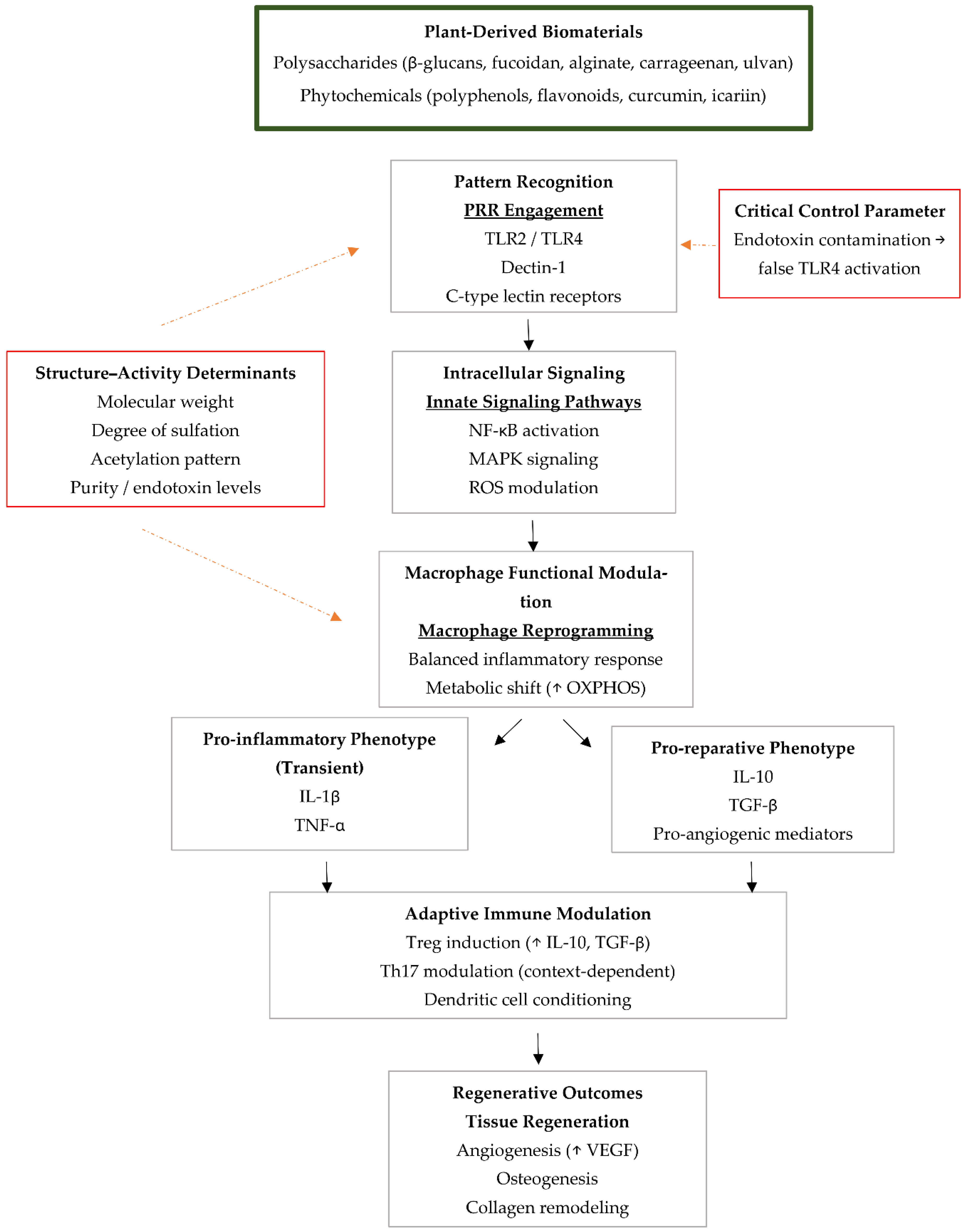
Figure 2.
Immune-encoding framework of plant-based biomaterials.
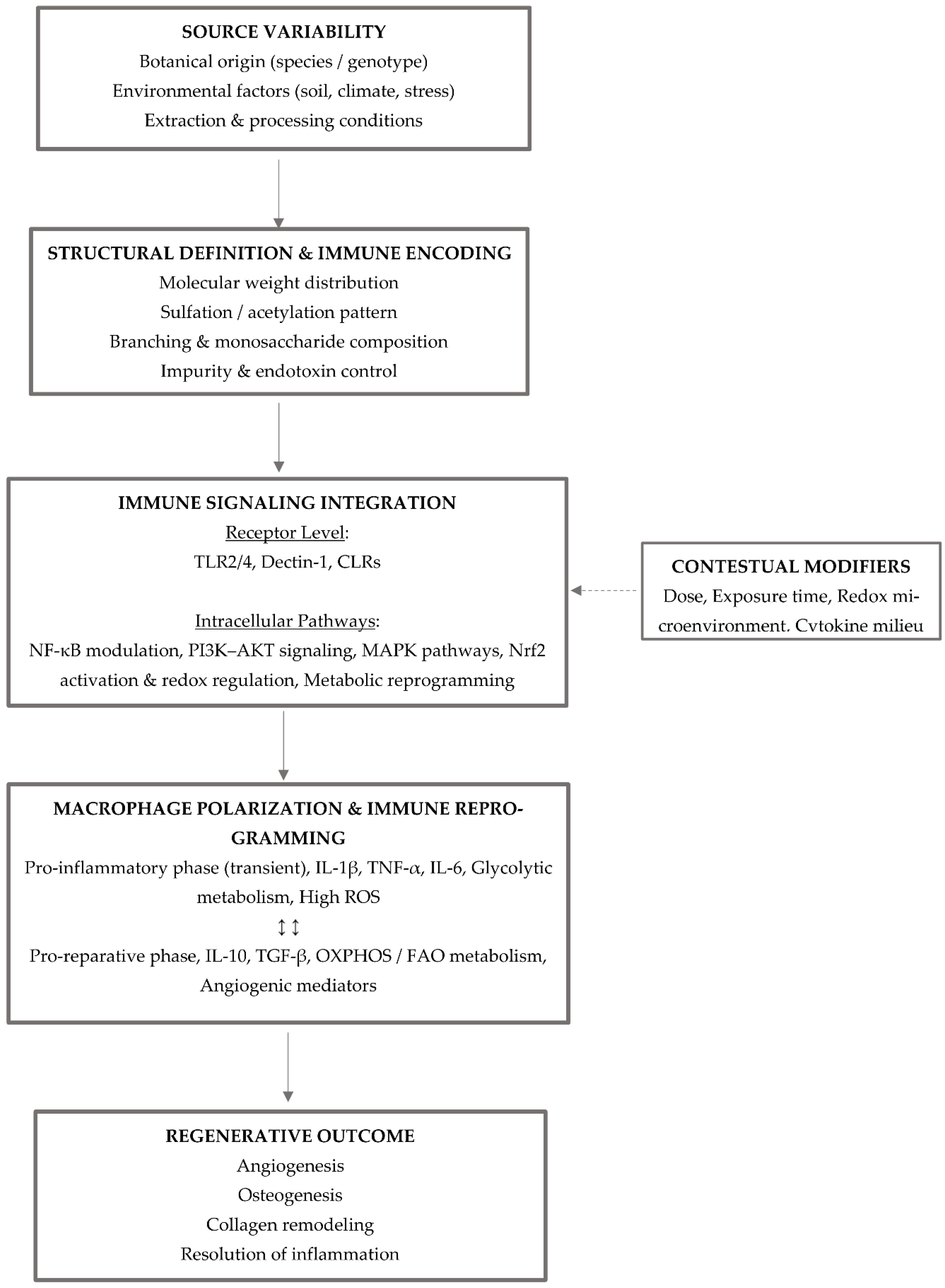
Table 1.
Structural and immunological characteristics of major plant-based biomaterials.
| Material | Key Structural Features | Main PRRs Involved | Dominant Immune Effects | Evidence Level | Key References |
|---|---|---|---|---|---|
| Fucoidan | Sulfated fucose-rich polysaccharide; MW variability; sulfation degree critical | TLR2/4, scavenger receptors | Anti-inflammatory, macrophage modulation, angiogenic support | In vitro, in vivo, limited clinical | [31,33,38,39,43] |
| Alginate | Mannuronic/guluronic acid blocks; tunable oxidation | Limited direct PRR activation; foreign body modulation | Immune shielding; fibrosis modulation (when purified) | Extensive in vivo biomaterials | [20,47,48,49,50,51] |
| Carrageenan | Sulfated galactans (κ, ι, λ isoforms) | TLR4 (context-dependent) | Context-dependent pro/anti-inflammatory | In vitro, inflammatory models | [53,54,55] |
| Ulvan | Sulfated rhamnose-rich polysaccharide | Proposed TLR-mediated signaling | Antioxidant and immunomodulatory | Preclinical | [57,58,59] |
| Lycium barbarum polysaccharides | Polysaccharide–protein complexes | TLR2/4 | Macrophage activation; cytokine modulation | Preclinical | [65,66,67,68,69] |
| Acemannan (Aloe vera) | Acetylated mannan | TLR4 | Macrophage activation; wound healing support | Preclinical + topical clinical | [73,74,75,76] |
| Curcumin | Hydrophobic polyphenol; pleiotropic signaling | NF-κB modulation (indirect) | Anti-inflammatory; antioxidant; immunometabolic effects | Extensive preclinical; delivery challenges | [108,109,110,111,112,113,114] |
| Plant-derived EV-like nanoparticles | Lipid bilayer vesicles; miRNA/protein cargo | Uptake via endocytosis; PRR-independent pathways | Inflammatory modulation; tissue repair | Early-stage preclinical | [186,187,188,189,190,191] |
Table 2.
Translational and regulatory framework for plant-based immunomodulatory biomaterials.
| Development Stage | Required Actions | Critical Quality Attributes (CQA) | Key References |
|---|---|---|---|
| Raw Material Sourcing | Botanical authentication; GACP compliance | Species identity; origin; harvest timing | [220,224,229] |
| Extraction & Processing | Standardized protocols; solvent and temperature control | MW distribution; sulfation/acetylation degree | [224,231] |
| Purification | Endotoxin removal; impurity control | Endotoxin thresholds; residual solvents | [150,181] |
| Biological Testing | Multiparametric immune assays; dose–response validation | Mechanism-linked potency assays | [134,232] |
| GMP Manufacturing | SOP documentation; traceability; scale-up validation | Reproducibility; stability metrics | [214,226] |
| Regulatory Classification | Early agency consultation | Device vs biologic vs combination product | [227,228] |
Disclaimer/Publisher’s Note: The statements, opinions and data contained in all publications are solely those of the individual author(s) and contributor(s) and not of MDPI and/or the editor(s). MDPI and/or the editor(s) disclaim responsibility for any injury to people or property resulting from any ideas, methods, instructions or products referred to in the content. |
© 2026 by the authors. Licensee MDPI, Basel, Switzerland. This article is an open access article distributed under the terms and conditions of the Creative Commons Attribution (CC BY) license (http://creativecommons.org/licenses/by/4.0/).
Copyright: This open access article is published under a Creative Commons CC BY 4.0 license, which permit the free download, distribution, and reuse, provided that the author and preprint are cited in any reuse.


