

Submitted:
02 March 2026
Posted:
04 March 2026
You are already at the latest version
Abstract
In agricultural practice, botanical extracts have emerged as promising biostimulants that can modulate key metabolic and redox processes in crops, thereby increasing stress resistance and productivity. This review provides a comprehensive synthesis of current knowledge on how botanical extracts influence plant metabolism and redox homeostasis, with particular emphasis on their role in adaptive cellular responses. Additionally, it examines how agronomic practices, such as nutritional strategies, water availability, light regimes, and preharvest biostimulant applications, can be utilized to increase the bioactive composition and efficacy of these extracts. By integrating recent advances in metabolomics and transcriptomics, this review outlines the biochemical and molecular reprogramming triggered by botanical extracts, identifies knowledge gaps, and outlines future research directions to optimize their use in sustainable agriculture. The sections comprising the review are an introduction that establishes the context and objective of the manuscript. The second section describes the bioactive constituents found in botanical extracts from different species, along with their metabolic and redox effects. The third section describes the plant response to the botanical extracts. The fourth section describes the metabolic and gene expression reprogramming that occurs following the application of a botanical extract. The last section presents the conclusion and future directions envisioned by the authors.
Keywords:
biostimulants
; plant extracts
; medicinal plants
; plant stress
; oxidation‒reduction metabolism
1. Introduction
Life is a complex phenomenon based substantially on redox reactions. The existence of highly organized living structures depends on the maintenance of redox potential differences with the growing media to sustain metabolic activity. How does the redox differential, which drives metabolic activity, arise? For aerobic organisms, the answer arises using the reducing potential derived from water, which is obtained during the process of photosynthesis. The reducing potential of biomolecules establishes a potential difference from O2, allowing to produce metabolic energy to power all cellular activities [1]. In the absence of O2, life can occur successfully. Nevertheless, it does not develop into highly organized multicellular forms such as those that have arisen in the current oxidizing atmosphere of the Earth [2].
Redox processes have been recognized since 1900, when Gombert described free radicals. [3]. Free radicals, or reactive species, in living organisms were characterized by [4]. The concept of redox homeostasis, which involves the dynamic balance between oxidation and reduction, was introduced by [5]. Redox homeostasis, also known as redoxtasis [6], involves metabolic pathways associated with the metabolism and regulation of reactive species and antioxidants and, in general, with the flow of reduction potential to oxidation sinks. Reactive species are the result of chemical reactions in which electron transfer occurs, such as the photosynthetic and respiratory electron transport chains, that maintains the synthesis of NADH and NADPH, and the metabolic pathways responsible for the synthesis of glutathione, ascorbate, and other redox metabolites [7].
Plant cells require the presence of reactive species for balanced metabolic functions; reactive species function as signalers of the cellular redox status, in addition to triggering or assisting in developmental events such as germination and flowering. The levels of reactive species are modulated by a battery of enzymatic and nonenzymatic antioxidants, the balance of which determines redox homeostasis [8].
Failure to maintain redox homeostasis causes what is called oxidative stress [9], which is defined as “an imbalance between oxidants and antioxidants in favor of the oxidants, potentially leading to damage” [10].
Oxidative stress is associated with environmental stress, and, in recent decades, biostimulants have emerged as a valuable alternative for mitigating stress in crops [11]. Biostimulants are defined as “a formulated product of biological origin that improves plant productivity as a consequence of the novel, or emergent properties of the complex of constituents, and not as a sole consequence of the presence of known essential plant nutrients, plant growth regulators, or plant protective compounds” [12]. Different categories are available for classifying biostimulants into physical, chemical, and biological types [13]. As shown in Figure 1, biostimulants have beneficial effects on plants through various mechanisms, including direct supply of essential and beneficial nutrients, improved nutrient bioavailability, provision of signaling biomolecules that trigger defense responses, and modulation of redox metabolism [8,11].
Among biostimulants, botanical extracts, which are manufactured from the biomass of terrestrial plant species, stand out for their complex composition, including secondary metabolites, polysaccharide oligomers, peptides, amino acids, osmolytes, and various minerals, among others [14,15]. Considering the great diversity of constituents in a botanical extract, it is interesting to explore the impact of this diversity on plant redox modulation and the possibility of manipulating its composition in some way.
Several reviews on the agricultural use of botanical extracts have been published since 2020, including those by [15,16,17,18,19,20,21,22]. However, these reviews do not explore botanical extracts from the specific perspective of cellular metabolic and redox responses. Instead, redox modulation or reactive oxygen species (ROS) are mentioned only as part of a broader set of response end points. This review aims to specifically highlight key metabolic and redox responses triggered by the application of botanical extracts. Furthermore, this study highlights the ability of manipulating the potential impact of botanical extracts through agronomic techniques, including crop nutrition, water management, irradiance manipulation or spectral balance in protected environments, and the application of other biostimulants to source plants used as raw materials for obtaining botanical extracts.
The objective of this review is to examine the impact of botanical extracts on adaptive cellular processes, with a particular focus on metabolic and redox mechanisms. It is intended as a resource for researchers exploring the underlying mechanisms of action of biostimulants.
2. Botanical Extracts and Bioactive Constituents Relevant to Redox Responses
Owing to their origin, botanical extracts are complex biostimulants. It is challenging to determine the quantity of different components included in a botanical extract, as the composition known about them depends on the measurements made by the authors of the studies. The inherent complexity can also be increased by the interactions of the plants that produce the biomass from which the botanical extract is obtained with their environment, making it difficult to obtain a botanical extract of uniform composition [23]. Therefore, a practical measure is to standardize the botanical extract using one of its components as a reference. An example of this is standardization based on phenolic concentration [24].
The first determinant of the composition of the botanical extract is taxonomy. Even closely related varieties of plants of the same species can exhibit significant differences. For example, the aromatic herbs of the Ocimum basilicum species present distinct chemotypes. The variety Sweet Dani accumulates neral and geranial oils, whereas the variety Cinnamon accumulates linalool and (E)-methyl cinnamate-rich profiles [25]. Interestingly, the adequate fertilization and growth under protected conditions improved biomass productivity without affecting the essential oil content. Similarly, Mentha spicata and M. longifolia ssp. cyprica differs markedly in its carvone and limonene content compared with pulegone and 1,8-cineole, which are dominant in other species [26].
The second determinant of the composition of botanical extracts is the impact of environmental factors on gene expression and the modulation of metabolic pathways. Intrinsic species differences define the profile and the maximum attainable pool of secondary metabolites. Nevertheless, the realized composition is highly plastic and is modulated by environmental conditions that interact with each species’ genetic and metabolic background [27].
Some of the environmental factors that modify the phytochemical composition of plant biomass include the age of the plant and the age of the different structures, e.g., mature leaves vs. young leaves [28]; irradiance and light quality, such as UV-B and blue light [29]; temperature [27]; water availability [30]; nutrition; type of soil or substrate [25,31]; and the use of biostimulants or plant growth regulators [32], among others.
Additional environmental variables, such as elevated atmospheric CO₂, diurnal and seasonal rhythms, and the interplay of multiple stressors, can also significantly influence secondary metabolism [33,34]. For example, light serves not only as an energy source but also as a signaling cue, modulating specific biosynthetic pathways through photoreceptors and light-responsive gene networks [34,35]. Similarly, drought stress and nutrient fluctuations can trigger the differential accumulation of phenolics, flavonoids, and terpenoids, often in an organ-specific manner [36]. The effects of these factors are also modulated by the internal circadian clock of the plant, which coordinates gene expression and enzymatic activity to fine-tune metabolite production over daily and seasonal cycles [33,37]. Moreover, the simultaneous occurrence of abiotic stressors, such as high temperatures and low water availability, can lead to synergistic or antagonistic interactions that reshape the phytochemical landscape of plant tissues [34].
In addition to the environmental impact on the composition of botanical extracts, different extraction techniques also modify the components found in the final product. The mechanism for preparing a botanical extract is as follows [22,38]: After the plant material is selected, it is rinsed thoroughly with tap water to remove surface impurities. The fresh or dry biomass—either at room temperature (~26 °C) or by freeze-drying at −80 °C—was used to safeguard bioactive compounds. The dried tissue was ground and sieved to homogenize it and maximize the surface area. Extraction success hinges on pretreatment, technique, and solvent. Physical methods, including maceration, autoclaving, and ultrasonication, are widely applied because they disrupt cell walls and increase the release of compounds. Organic solvents (methanol, ethanol, and acetone) are preferred for their selectivity and high yields. Some studies employ anaerobic fermentation, in which fresh material is inoculated with microorganisms (e.g., manure). Microbial activity releases bioactive compounds, often enhancing the chemical and functional properties of the extract, thereby increasing its efficacy as a biostimulant. Ultimately, scalable protocols must combine efficiency, compound integrity, cost-effectiveness, and ecological safety.
Another variable that affects the impact of a botanical extract on plants is the method of application. Botanical extracts are applied to crops through multiple strategies tested in diverse experimental settings, including seed pretreatment (seed priming), foliar application, incorporation into nutrient solutions, amendment of substrates or soils, or combinations of these methods [22].
Although the use of botanical extracts in postharvest management has been explored in various studies, further research is needed to better understand their efficacy under specific conditions, crop types, and formulation strategies. Botanical extracts are gaining recognition as sustainable alternatives to synthetic chemicals because of their ability to reduce decay, delay ripening, and preserve key physicochemical attributes in fruits and flowers [39,40]. Their bioactive constituents, including polyphenols, flavonoids, terpenoids, and essential oils, exhibit potent antimicrobial, antifungal, and antioxidant activities and have been shown to inhibit common postharvest pathogens such as Penicillium, Botrytis, Colletotrichum, and Fusarium spp. [39,41]. When incorporated into edible coatings, these compounds can form semipermeable barriers that regulate gas exchange, reduce water loss, and lower respiration rates, contributing to delayed senescence and improved firmness [40,42].
Additionally, botanical extracts have demonstrated synergistic effects when combined with other natural agents, such as chitosan, further increasing their capacity to control microbial spoilage while maintaining sensory and nutritional quality [39]. Its efficacy has been validated in a wide range of crops, including tropical fruits such as citrus, mango, and papaya, where it helps reduce physiological weight loss and preserves antioxidant compounds [40,43,44,45]. Some extracts also trigger host defense responses, such as the induction of resistance-related pathways mediated by jasmonates or volatile aldehydes, providing an additional layer of protection against postharvest diseases [40,46]. In addition to their role in fruit preservation, these natural treatments have also shown promising applications in delicate commodities such as flowers and soft fruits, contributing to reduced microbial contamination and improved handling conditions [39,46].
Taken together, these findings highlight the potential of botanical extracts as eco-friendly tools for postharvest disease control and quality maintenance while also addressing the growing consumer demand for safer, residue-free alternatives [40].
The mechanics of obtaining a botanical extract imply that its composition is complex, potentially reflecting all the extractable and stable components found in the plant structures used as raw material. The precise profile of the extract depends on several factors, including the species and organ used as raw material, the physiological state of the plant, the preharvest and postharvest conditions, and the extraction methodology employed.
The presence of many bioactive components contributes to the remarkable biostimulating capacity of botanical extracts. Indeed, the biological effectiveness of a botanical extract is not the mere sum of its purified constituents. Mixtures of bioactive metabolites often exhibit nonlinear effects, yielding biostimulant or antimicrobial activities that surpass those of the best single molecule in standard in vitro tests. Such favorable deviations from additivity, or synergy, refer to the interaction between two or more components that results in a combined effect exceeding the sum of their separate effects. Synergy emerges because the extracted metabolites collaborate and modulate each other’s redox potential, affinity for proteins or other metabolites, polarity, and diffusivity [47,48].
With respect to synergy, there can be at least three complementary levels of interaction. The first is when an oxidized antioxidant can be regenerated by a companion reductant (e.g., ascorbate recycling quercetin), extending effective action and economizing intracellular pools. Second, differently substituted bioactive metabolites (e.g., phenolics) preferentially quench distinct radical species or lipid oxidation stages, resulting in more effective scavenging of radicals or chelation of metal ions. Third, amphiphilic terpenes or organic acids enhance the membrane permeation or solubility of polyphenols, thereby increasing their bioavailability [49].
Table 1 lists some of the multiple components identified in botanical extract samples and reported in recent publications. The list can include botanical extracts used for medicinal purposes, since they can also be used as agricultural biostimulants (e.g., Moringa oleifera). Table 1 includes in one of its columns the redox impact reported for some of the components cited.
In addition to the above species, [118] mention the following species as potential sources of biomass and raw material for the manufacture of botanical extracts: Aronia melanocarpa, Beta vulgaris, Equisetum arvense, Hippophae rhamnoides, Lens culinaris, Pteridium aquilinum, Polygonum aviculare, Pisum sativum, Plantago major, and Urtica dioica.
Table 1 highlights the wide diversity of bioactive metabolites present in botanical extracts. This chemical heterogeneity underpins the broad spectrum of biological responses observed in treated crops, ranging from the activation of antioxidant defense systems to the modulation of primary and secondary metabolism. The presence of phenolic acids (e.g., gallic acid), flavonoids (e.g., quercetin, rutin), terpenoids (e.g., limonene, carvone), and alkaloids across different botanical sources reflects a conserved ability to modulate cellular redox homeostasis, either by directly scavenging reactive oxygen species or by inducing enzymatic antioxidant pathways such as SOD, CAT, and APX.
Table 1 also implicitly suggests the importance of studying even minor constituents in these extracts, which may exert significant effects through synergistic interactions with major compounds. For example, extracts from Mentha, Zingiber, and Curcuma species contain a complex mixture of compounds whose collective impact on redox related signaling cascades likely contributes to increased stress resistance in plants.
The examples in Table 1 further demonstrate that botanical extracts appear to exert their primary physiological impact through redox-associated mechanisms, including the modulation of ROS signaling, hormone crosstalk, and the reprogramming of energy metabolism. These redox-mediated changes are often coupled with improved tolerance to abiotic and biotic stressors, effects that will be further discussed in subsequent sections.
Many extracts stimulate the activity of antioxidant enzymes, including SOD, CAT, POX, APX, GPX, and GR. Additionally, they enhance nonenzymatic antioxidants and osmolytes, including ascorbate, glutathione, proline, carotenoids, and α-tocopherol. For example, garlic, cypress leaf, and liquorice root extracts increased enzymatic activity and mitigated oxidative damage in crops exposed to salinity or heavy metals, whereas ginger and curcumin-containing extracts reduced lipid peroxidation under metal or arsenic stress. This redox modulation often results in improved photosynthesis, membrane integrity, and stress tolerance, indicating that redox homeostasis is central to the biostimulant action of these extracts.
Notably, Table 1 also indicates some gaps and opportunities. While some species, such as garlic, have extensive agricultural applications, other species with well-characterized antioxidant potential—B. officinalis, C. officinalis, E. purpurea, and H. perforatum—have limited use as crop biostimulants. This fact highlights the opportunity for a systematic evaluation of medicinal and food plants as sources of botanical extracts for agriculture.
An interesting point to consider in evaluating new botanical extracts concerns the transcriptomic response reported by [119] across different tomato genotypes (commercial and landraces) under water stress. Commercial genotypes regulate a broad range of metabolic pathways, including plant defense, which is indicative of a response to a general metabolic disorder. On the other hand, landraces presented a more specific transcriptional response, activating drought- and stress-related metabolism. The landraces presented increased expression of osmotic-stress-related genes and heat-stress pathways, as well as of salt transmembrane transporters and antioxidant defenses, particularly in roots.
Considering the above, it would be advisable for transcriptomic studies to provide information on whether a particular botanical extract induces broad changes in gene expression or whether the response is limited to specific mechanisms aimed at tolerance to a certain type of stress.
The examples in Table 1 also raise the question of biomass optimization. How can cultivation conditions be manipulated to increase the concentration and diversity of bioactive compounds in source plants to maximize the efficacy of botanical extracts? Even species cultivated for food production, not necessarily medicinal species, can be valuable sources of botanical extracts. In this case, one of the questions that should be explored is how to promote a greater amount (in diversity and concentration) of bioactive compounds in that biomass.
Recent research has demonstrated that the bioactive profile of plant biomass can be modulated through controlled environmental and agronomic interventions, as well as stress priming, thereby significantly enhancing the functional quality of the resulting extracts [15,120,121]. Controlled abiotic stresses, such as drought, salinity, and moderate temperature extremes, induce the accumulation of stress-responsive metabolites, including phenolics, flavonoids, and terpenoids [122].
For example, drought stress has been shown to change the levels of bioactive metabolites in Dendrobium moniliforme subjected to four drought intensities for 20 days, followed by rewatering at days 0, 5, 10, 15, and 20. The carotenoid levels peaked under severe drought conditions, whereas the total chlorophyll content increased during the early stages of drought. The CAT activity decreased under stress but increased with early rewatering. Drought also increased the contents of stem polysaccharides, flavonoids, and alkaloids. The PRX activity and MDA content increased under drought conditions [123]. The authors concluded that D. moniliforme adapts to drought by increasing secondary metabolite production under stress and during rehydration.
On the other hand, deficit irrigation provides controlled eustress that induces secondary metabolism. Drought perception and signaling induce the production of reactive oxygen species and stress hormones, thereby upregulating pathways involved in the activity of antioxidant enzymes, phenylpropanoids, and alkaloid synthesis. Moderate stress often enhances the production of bioactive compounds, whereas excessive stress negatively impacts both the yield of biomass and the yield of active compounds [124]. An example is provided by [125], who applied 50% deficit irrigation to lettuce, increasing the concentrations of chicoric acid, caftaric acid, and chlorogenic and caffeic acid without compromising fresh mass for commercial use.
Another helpful technique for inducing bioactive compounds is priming seeds or seedlings with controlled salt shocks, usually NaCl. The perception of salinity triggers a response that modifies gene expression and metabolic adjustments, increasing the concentration of osmolytes and antioxidants in plants. These changes in metabolism create stress memory that enables them to face future challenges, in addition to improving the production of bioactive compounds in biomass [120], which can subsequently be used to obtain botanical extracts. For example, faba bean plants subjected to gradual exposure to NaCl (50, 100, and 150 mM NaCl) withstand a subsequent salt shock of 200 mM NaCl while increasing the concentration of bioactive compounds, such as phenolics and proline, and increasing the expression of enzymes related to glutathione metabolism [126].
In addition to field stress management, other techniques related to plant nutrition, irradiance, and spectral light balance, as well as the application of biostimulants, also improve the composition of active compounds in plant biomass.
Nutritional management also plays a pivotal role in shaping the phytochemical composition of plants. Supplementation with beneficial elements such as Se, Si, and I have demonstrated efficacy in enhancing plant resilience and promoting the synthesis of bioactive compounds. The literature provides several examples of the above. In maize under saline stress, the application of Si had a beneficial effect on nearly all growth and physiological parameters. The beneficial effect was associated with the regulation of key salinity markers and an increase in redox metabolites, including anthocyanins, ascorbic acid, total phenols, and flavonoids [127].
In the case of Se, the application of sodium selenate in Origanum vulgare under hydroponic conditions at concentrations ranging from 0.39 to 1.589 mg L-1 increased the concentrations of phenolic compounds, flavonoids, hydroxycinnamic acids, luteolin-7-glucoside and its derivatives, catechin, 3,4-dihydroxybenzoic acid, rosmarinic acid, and oleanolic and ursolic acids, as well as essential oils, without yield reduction [128].
With respect to nutrient iodine, spraying lettuce in a saline environment in the form of potassium iodate at 3 mg L-1 induced high activity of CAT, SOD, and APX, as well as high levels of ascorbate, proline, and phenolics, with increased head weight and total yield [129]. In another study on strawberry plants, the plants were grown under control or saline conditions (EC 2.5 dS m-1) to assess the effects of iodine on yield, antioxidants, mineral nutrition, and iodine accumulation. Under salinity, iodine increased fruit APX and CAT activities, GSH content, and yield. In leaves, iodine increased the P, Ca, Mn, and iodine contents and ascorbic acid content. Under nonsaline conditions, iodine enhances fruit phenolics and increases Ca and Mn [130].
Despite the above findings, other experiments with iodine have reported mixed results. For example, in a study of tomato plants under saline stress (100 mM NaCl) in which foliar KIO3 was applied every 15 days at 100 μM, iodine did not mitigate the adverse impact of salinity on fresh or dry biomass but increased fruit production by 23%. However, the content of Ca and Mg in fruits of plants treated with iodine, as well as the activity of GPX, lycopene, and the antioxidant potential, decreased [131].
In other words, the combination of abiotic stresses, such as salinity, and the use of biostimulant nutrients can mitigate the stress impact on biomass production and is associated with a greater accumulation of bioactive compounds. Nevertheless, the effect may be subject to variation depending on the plant species and growing conditions. If this stress-biostimulant system is applied to biomass production to produce botanical extracts, perhaps in hydroponic, vertical farming, or other protected agricultural systems, it would be possible to obtain botanical extracts with significantly better biostimulant value.
The quality of crop biomass and its potential utility for fabricating botanical extracts can also be improved by manipulating the irradiance and light spectral balance. PAR irradiance, through its effect on photosynthesis, is a recognized factor influencing the quality and accumulation of bioactive compounds, as well as its impact on postharvest life [132]. On the other hand, [133] reported a study on Eruca sativa, in which two LED lighting modes, red:blue 1:1 and red:green:blue 2:1:2, were compared with conventional white light fluorescent tubes. The red:blue spectral mode increased the total antioxidant activity; guaiacol peroxidase activity; and contents of pigments, flavonoids, polyphenols, ascorbate, and polyamines. Another study with Glehnia littoralis confirmed that the red‒blue mixture (7:5) was superior to the red‒green-blue mixture and that a high proportion of blue light stimulated the accumulation of bioactive components, including the medicinally valuable compounds imperatorin, bergamottin, and coumarin [134].
Additionally, the application of biostimulants such as chitosan, salicylic acid, benzoic acid, and humic substances has been reported to increase the biosynthesis of bioactive secondary metabolites in various plant species. The biostimulants act as signaling molecules, triggering a controlled oxidative stress response that interacts with hormonal activation of gene expression and defense-related pathways, leading to the accumulation of bioactive molecules. A recent example of the above is the response of rice to humic substances [135]. Recent studies have highlighted the effectiveness of applying chitosan, either to the soil or as a foliar spray, in increasing plant growth and stimulating the biosynthesis of secondary metabolites across various species [136]. In another example, the treatment of Mentha piperita with salicylic acid (150 mg/L) increased the concentration of essential oils [137].
In addition to modulating the biomass composition, the method of extraction significantly affects the chemical composition and functional efficacy of botanical extracts. Aqueous, hydroalcoholic, enzymatic, and supercritical CO₂ extraction techniques differ in their ability to solubilize various classes of compounds. Aqueous extracts tend to be rich in polar compounds such as polysaccharides and some phenolics. In contrast, hydroalcoholic extracts extract a broader range of compounds, including polyphenols, flavonoids, alkaloids, tannins, and essential oils. Tailoring extraction techniques to match the desired bioactive profile is thus essential for maximizing extract potency and consistency. The topic of different extraction techniques is covered in reviews dedicated to this subject [114,138,139].
3. Perception, Signaling, and Putative Redox Modulation Responses After Botanical Extract Application
Botanical extracts have long been recognized as complex mixtures of bioactive compounds that can modulate cellular homeostasis. In addition to their direct antioxidant properties, they can activate or inhibit signaling cascades that regulate antioxidant defenses, inflammatory responses, and mitochondrial function [140,141]. The molecular perception of these compounds often involves redox-sensitive proteins, receptor-mediated recognition, and the modulation of pathways such as the PI3K/Akt, NF-κB, Nrf2, AMPK–SIRT1, and MAPK pathways, which ultimately converge on redox modulation responses.
The effects of botanical extracts on metabolic and physiological behavior, as well as gene expression, do not depend on a single component but rather on the synergistic influence of all present components. In addition to the bioactive compounds listed in Table 1, botanical extracts contain inorganic nutrients such as Fe and Zn, as well as other components, including amino acids and peptides, possibly low-molecular-weight proteins, oligomers, and polysaccharides, and components subject to varying levels of degradation that qualify as DAMPs. All the components that are part of the original plant biomass are extracted with varying efficiency depending on the extraction method used [22].
This section describes the putative perception and response process that occurs after the application of the multiplicity of components in a botanical extract, with emphasis on the responses associated with redox responses. Interestingly, in humans, botanical extracts can trigger rapid changes in the redox state of cells and modulate key signaling networks. For example, the electrophilic nature of certain phytochemicals can modify cysteine residues on redox-sensitive proteins such as Kelch-like ECH-associated protein-1 (Keap1), thereby promoting the release and nuclear translocation of Nrf2 and subsequent upregulation of antioxidant response element (ARE)-driven gene expression [142,143]. In parallel, botanical extracts can modulate inflammatory signaling by altering the activity of transcription factors such as NF-κB and AP-1 [144].
Similar to other biostimulants, the reaction of plants to the application of a botanical extract involves a sequence of events that begins with the (1) perception of the extract’s components, after which the cellular receptors (2) transduce the information in the form of cellular (3) signaling that triggers the action of second messengers (e.g., ROS, Ca2+, MAP-kinases) that (4) modify enzyme activity, metabolism and gene expression [145] (Figure 2).
The initial interaction between the exogenous molecules and the plant (the perception) occurs at the cuticle, epidermis, or seed coat. Plant surfaces have structural and biochemical receptors that sense and transduce changes in osmotic pressure, pH, and redox potential, as well as the presence of specific bioactive compounds [146]. Receptor proteins primarily perceive many developmental, biotic, and abiotic signals at the cell wall and plasma membrane. However, crosstalk between signaling pathways is triggered by extracellular and intracellular receptors [147]. At the cell surface, receptor-mediated recognition also plays an essential role. In humans, botanical extracts influence cell survival and metabolism by modulating receptor tyrosine kinases and their associated kinases. The PI3K/Akt signaling axis, which is intimately linked to mitochondrial function and NADPH oxidase (NOX) activity, can be activated by these extracts, leading to improved mitochondrial integrity, reduced ROS production, and the modulation of downstream targets involved in metabolic regulation [141,148].
During the subsequent signaling phase, ion fluxes, especially Ca²⁺ influx into the cytoplasm, represent one of the earliest measurable responses, establishing a chemical signature that varies depending on the identity, concentration, and temporal profile of the stimulus [149]. In parallel, apoplastic and symplastic oxidative bursts occur due to the activation of respiratory burst oxidases, resulting in the transient accumulation of ROS that have redox signaling functions [150].
Another possible signaling mechanism of botanical extracts may involve gasotransmitters, such as NO and H2S. In the biomedical field, botanical extracts are recognized as natural sources of gasotransmitters [151,152,153]. The components found in botanical extracts are gasotransmitter inducers [154,155]; however, to our knowledge, the primary literature does not present a direct link between the use of botanical extracts and gasotransmitter redox signaling. The above is a highly relevant area of research that has been explored little from an agricultural perspective.
The signaling induced by botanical extracts, which in some ways resembles the oxidative stress stimuli caused by abiotic stress, may result in (1) posttranslational modifications that modulate metabolism while also causing changes in gene expression through alterations in (2) transcriptional regulation and (3) the cellular epigenome. These adjustments are highly important in the adaptive responses and development of plants [156,157,158].
The ROS produced upon contact with botanical extracts act as secondary messengers, propagating signals within the cell and to neighboring cells and additionally inducing posttranslational modifications. The ROS burst modifies the redox state of proteins, thereby modulating the activity of redox-sensitive proteins, such as transcription factors, MAPKs, calcium-dependent protein kinases, and phosphatases [159]. These redox-based posttranslational modifications serve as a biochemical imprint, linking early perception to downstream signaling cascades and thereby orchestrating signal amplification and specificity by phosphorylating transcription factors and other regulatory proteins [147,160].
Additionally, redox signals are known to lead to broad posttranslational modifications, such as the oxidation of cysteine thiols, S-glutathionylation, S-nitrosylation, and carbonylation of proteins. These modifications dynamically adjust enzyme activities and protein–protein interactions in pathways associated with photosynthesis, respiration, and nutrient assimilation [8]. However, despite the importance of these adjustments for crop metabolism, information regarding the impact of botanical extracts is scarce or absent.
Additionally, botanical extracts may contain ABA, auxins, salicylic acid, and other hormones that work synergistically to influence stress-responsive metabolic pathways via integrated networks of hormone crosstalk, gene regulation, and physiological responses [161].
The response phase following the application of botanical extracts includes the transcriptional reprogramming of genes involved in antioxidant defense, redox modulation, secondary metabolism, and hormonal signaling. In a recent study, extracts of different plant species (Trifolium officinale, T. pratense, P. sativum, S. gigantea, H. perforatum), when applied to cabbage seedlings, were shown to regulate genes associated with defense and redox regulation, such as glutathione S-transferase, chlorophyll A-B binding protein, S-adenosylmethionine-dependent methyltransferase, heat shock protein 70 family, heat shock protein Hsp90 family, gibberellin-regulated protein, and B-box-type zinc finger genes. Functional analysis revealed that the application of botanical extracts reduced the expression of numerous genes associated with stress responses and photosynthetic systems, which explains the decrease in oxidative stress levels observed in the treated plants [162].
In another example, the treatment of bean seeds with liquorice extract enhances ascorbate, glutathione, and the activities of the antioxidant enzymes CAT, SOD, APX, and GR [163]. In a study linking nanomaterials with botanical extracts, a supercritical carbon dioxide extract of garlic was encapsulated in nanoliposomes. The material was applied to wheat in greenhouse experiments via foliar spraying. The results suggested increased expression of ABA pathway genes and pathogenesis-related (PR) genes [164].
On the other hand, although no published direct evidence was found, botanical extracts may also induce the transcription of genes coding for small RNAs and noncoding RNAs, which act as regulatory nodes in the adaptation to stress.
Research on the RNA-mediated regulation of phytochemicals by botanical extracts remains largely unexplored. In plants, RNA signaling involves a wide range of molecules and pathways that coordinate both cellular and systemic functions. RNA molecules act as dynamic regulators of development, environmental adaptation, and metabolic processes. Among them, small RNAs (sRNAs), particularly microRNAs (miRNAs) and small interfering RNAs (siRNAs), play key roles in posttranscriptional gene regulation. These sRNAs direct the degradation or suppression of target mRNAs, thereby modulating gene expression [165]. Notably, miRNAs can move within plants and even between organisms, thereby including the possibility of their presence in botanical extracts, which can influence gene expression and phenotypic outcomes [166].
The epigenetic modifications induced by botanical extracts have been well described in the biomedical field [167,168,169]. However, in the agricultural field, the impact of botanical extracts on epigenetic modifications, an essential part of stress memory in crops, remains, to the best of the authors’ knowledge, unexplored.
The integrated set of perception and signaling events triggered by botanical extracts leads to adaptive redox responses in crops, including increased mitochondrial bioenergetics and the modulation of antioxidant pathways. These effects contribute to the regulation of plant metabolism and improved tolerance to abiotic stress conditions, supporting crop resilience under adverse environmental scenarios. However, challenges remain in optimizing the bioavailability of these compounds in the field, distinguishing between synergistic and antagonistic effects among extract components, and determining accurate dosing to maximize their metabolic and redox impact in agricultural applications [170].
4. Metabolic and Gene Expression Reprogramming by Botanical Extracts
The application of botanical extracts through foliar or fruit spraying, seed priming, or root treatment in soil or a nutritive solution triggers a complex cascade of cellular events, leading to morphological, physiological, and molecular adjustments. These responses align with the paradigm of plants as intelligent systems capable of integrating environmental information and performing adaptive reprogramming [171,172]. In this context, botanical extracts can serve as valuable sources of information, providing environmental signals that reconfigure plant metabolism and gene expression through adaptive reprogramming [158]. These compounds act as potent biostimulants that reprogram plant metabolic pathways and gene expression through a complex array of bioactive compounds, such as phytohormones, polysaccharides, vitamins, amino acids, and secondary metabolites, that synergistically trigger intricate signaling cascades, leading to improved nutrient uptake, enhanced growth, and increased stress resistance [173,174].
In general, adaptive reprogramming refers to the dynamic changes that cells, tissues, or complete organisms undergo in response to internal or external stimuli to maintain function, improve survival, or enhance fitness. It involves modifying gene expression, metabolism, signaling pathways, or epigenetic states to adapt to new conditions [175]. In adaptive reprogramming, metabolic reprogramming refers to the controlled alteration of cellular metabolic pathways in response to developmental cues, environmental changes, or stress conditions.
For example, seaweed-derived extracts have been shown to upregulate nutrient transporter genes, such as BnNRT1.1, BnNRT2.1, BnSultr4.1, and BnSultr4.2, thereby increasing nitrogen, sulfur, and iron uptake and assimilation. This is associated with increased biomass, chlorophyll content, and antioxidant accumulation [174]. Similarly, the application of an alfalfa protein hydrolysate (0.1, 1 mL L-1) resulted in improved biomass, chlorophyll, and soluble sugar content in tomato plants. The observed favorable effect was associated with adjustments in the expression of genes encoding proteins that impact various metabolic pathways. Of particular note for this review are those proteins related to metabolism or redox homeostasis whose abundance was significantly modified in response to the biostimulant application, such as cytochrome 450, glutathione-S-transferase, lactoylglutathione lyase, alternative oxidase 1A, and antioxidant-related genes like APX, CAT, thioredoxins, hemoglobins, glutaredoxins, dehydroascorbate reductase, CTF2A monooxygenases, and ferredoxin [176].
Metabolic reprogramming enables cells and organisms to optimize the production and utilization of energy, photosynthates, and other molecules, as well as redox equivalents, to support specific physiological states [177,178].
Metabolic reprogramming occurs within the context of a developmental program, which is a dynamic and coordinated set of metabolic, physiological, and gene expression processes that guide the transition of plant cells and tissues from an initial state at time t0 to a specific functional state at time t1 (t1>t0). The transition occurs in response to information provided by endogenous and exogenous physical or chemical signals [179]. In parallel, botanical extracts modulate secondary metabolism, often activating the phenylpropanoid pathway and increasing the production of flavonoids, phenolic acids, and carotenoids, which are key metabolites that facilitate defense and stress tolerance [173,180].
Plants perceive the exogenous molecules of the botanical extract through membrane-bound receptors, kinases, and redox sensors, which induce metabolic reprogramming [181]. The above initiates signal transduction cascades involving Ca2+ flux, ROS waves, mitogen-activated protein kinase (MAPK) activation, and hormone crosstalk. The result is that botanical extracts may mimic endogenous signals, such as those derived from the action of stress hormones and signals, including ethylene, auxin response modulation, and the MAPK signaling pathway, thereby inducing stress-analogous response networks that have a relevant redox component [182,183]. Additionally, botanical extracts are likely to induce heritable epigenetic changes, resulting in long-term transcriptional stress memory or biostimulation [183].
Hormonal regulation is central to this process; for example, Ascophyllum nodosum extracts can transiently increase cytokinin levels and activate cytokinin-responsive genes (e.g., ARR5) while suppressing auxin signaling, thereby modifying root architecture and contributing to a strategic rebalancing of the growth–defense trade-off [184,185].
As with other environmental stress stimuli, the metabolic reprogramming response that occurs after the application of a botanical extract is accompanied by a redirection of photosynthates toward defense. This growth‒defense trade-off is an evolutionarily conserved strategy that enables plants to respond adaptively to environmental challenges [186].
The trade-off can result from the fact that many compounds in botanical extracts originate from metabolic responses to biotic or abiotic stress in the source plant [187]. These molecules thus carry chemical signatures of ecological history or experiences; they may be considered analogous to allelochemicals that communicate information to elicit a response [188]. In addition, botanical extracts act as elicitors, priming plants through the upregulation of antioxidant enzymes (SOD, CAT, APX) and activating the salicylic acid (SA) and methyl jasmonate (MeJA) pathways via transcription factors such as WRKY, MYB, and AP2/ERF, which are often coupled with MAPK cascades that increase phytoalexin production [173,180,189].
Like other biostimulants, the botanical extract composition, dose, application timing, and environmental conditions can influence the growth‒defense trade-off. Low concentrations of extracts (equivalent to eustress) may act as priming agents, preparing plants for faster defense activation upon future stress without significant growth penalties. In contrast, higher concentrations or frequent applications (equivalent to distress) may push the metabolic balance more strongly toward defense, impairing biomass accumulation [190]. Multiomic analyses, combining transcriptomics, proteomics, and metabolomics, have revealed the modulation of enzymes such as oxidosqualene cyclase, β-amyrin synthase, and UDP-glycosyltransferases, redirecting metabolic flux toward high-value compounds. In Panax ginseng, MeJA treatment upregulated PgMYB2, increasing dammarenediol synthase expression and enhancing ginsenoside biosynthesis [180,191].
Importantly, the abovementioned trade-off is not necessarily detrimental. In modern agroecosystems, where abiotic stress and pathogen pressure are frequent, temporary defense prioritization may increase overall plant fitness and yield stability. Thus, botanical extracts can serve as both elicitors and modulators of plant phenotypic plasticity, fine-tuning the balance between defense and development in an ecologically relevant manner [187]. Furthermore, in isolated human cells, botanical extracts exhibit adaptogenic properties, inducing heat shock proteins (Hsp70) and stress-responsive transcription factors (e.g., HSF1), thereby expanding the homeostatic range of cellular functions and improving resilience against environmental stressors [192].
As with previous topics, metabolic and gene expression reprogramming have been studied most extensively in the biomedical field [193,194]. With respect to the agricultural use of botanical extracts, although molecular response mechanisms analogous to those described in mammalian cells might be expected, little information is available. On the other hand, it is interesting to consider the combination of techniques, such as seed priming and seedling priming with botanical extracts, which may enable the development of crops with greater tolerance to biotic and abiotic environmental challenges. Figure 3 presents a schematic model of adaptive reprogramming, which includes metabolic reprogramming.
Considering the average composition of plant extracts (Table 1) and the impact of their components on plant redox homeostasis, which components of plant extracts should be balanced, increased, or decreased to improve their potential as crop biostimulants? Assuming that a substantial part of the beneficial impact of a botanical extract is related to redox modulation in the target crop, those components that promote a rapid, but not sustained, redox response (e.g., nonprotein antioxidants, antioxidant protein cofactors, and nonpolymeric pro-oxidants) are expected to produce an oxidative burst triggering defense responses without maintaining prolonged production of reactive species. Ascorbate, glutathione, phenolic and flavonoid compounds; peptides; polysaccharide oligomers; and nutrients such as Zn and Se may contribute to the enhancement of the quality of the botanical extract. On the other hand, the presence of transition metals related to Fenton reactions and the induction of ROS in the presence of phenolics, such as Fe and Cu, as well as the presence of alkaloids at high concentrations, should be avoided.
To increase the concentration of the above mentioned beneficial compounds, simple agronomic biostimulation or biofortification techniques can be used, either with conventional nutrients or with nanonutrients [195]. In many cases, the responses of treated plants match the above findings: increased levels of ascorbate, glutathione, phenolic, and flavonoid compounds, as well as increased concentrations of trace nutrients such as Zn and Se.
While conventional genetic improvement techniques or those involving genetic transformation or editing can achieve substantial improvements in the yield of bioactive compounds in medicinal species, it should not be overlooked that agronomic management, through nutrition, biostimulation, irrigation management, temperature, irradiance, and spectral balance, can also improve biomass quality in terms of biostimulant potential. The medicinal plant H. perforatum is an example of a technique used to strengthen the phytochemical composition through agronomic management strategies, as described previously [196,197].
Another point worth highlighting is that the previously mentioned agronomic techniques can be applied to improve the biomass of the species used for food production. Most likely, unused plant biomass and postharvest residues from biostimulated plants (e.g., corn, wheat, and broccoli), among others, can be used to produce plant extracts with significant biostimulant potential. If this is possible, it would be a way to add value to these residues.
In preliminary, not yet published, studies conducted in our laboratory using seed priming in hydroponic green corn forage, we found evidence that the mechanism mentioned above is functional and that the magnitude of the change in bioactive compound content depends on the identity and concentration of the biostimulant. Extracts obtained from hydroponic maize green forage biomass treated with salicylic acid, benzoic acid, selenium, and iodide have shown biostimulant benefits on lettuce plants equivalent to those of commercial biostimulants.
5. Conclusions and Future Directions
The literature suggests that botanical extracts can induce controlled ROS signaling, which primes plants for increased tolerance to abiotic and biotic stressors. The response is associated with modified expression of genes encoding antioxidant enzymes, upregulation of nonenzymatic antioxidant metabolism, and the modulation of stress hormone crosstalk. Transcriptomic and proteomic analyses revealed that the extracts modulated stress-responsive pathways, the synthesis of bioactive metabolites, and signaling cascades that modify the cellular redox state, in addition to potentially affecting the proteome, metabolome, and ionome of the target plants.
Despite significant advances, several knowledge gaps remain. For example, as with other biostimulants, the variability in plant responses to botanical extracts is substantial. This variability is partly attributable to differences in extract composition, application methods, crop species, developmental stages, and the growth environments of the target crops. When research advances regarding the use of extracts in practice are translated, this fact can impact the feasibility of knowledge transfer.
Crops biofortified with Fe, Zn, Se, I, and Si can be potential sources of biomass for obtaining high-quality botanical extracts. To date, the focus of biofortification and biostimulation has been on obtaining edible organs with higher nutritional and nutraceutical qualities. Nevertheless, biomass not utilized as food is likely also enriched with bioactive metabolites. The same argument applies to crops biostimulated with amino acids, salicylic acid, chitosan, or humic substances, among others. The practical objective is to improve the yield and nutraceutical quality of the organs consumed. Nevertheless, there is also the opportunity to obtain potentially useful biomass to produce botanical extracts.
Furthermore, the complexity of the extract composition poses challenges for mechanistic elucidation and commercial standardization. Currently, both points vary between species and growing conditions. A deeper understanding of the composition and the factors that modify it, in pursuit of greater control and the subsequent standardization of botanical extracts, is a current challenge. A detailed metabolomic characterization of botanical extracts will be particularly relevant for identifying the specific compounds and synergistic combinations responsible for redox modulation. Furthermore, the combination of metabolomic and multiomic information with artificial intelligence-based optimization techniques could facilitate the design of predictive schemes for specific extraction applications for specific crop genotypes and agroclimatic zones.
Future research should prioritize field-scale validation under variable environmental conditions, bridging the gap between controlled-environment studies and real-world agricultural systems. This includes evaluating long-term impacts on crop yield stability, quality traits, and soil health, as well as understanding interactions with the plant microbiome. The integration of microbiome profiling with plant physiological and biochemical response data could reveal additional indirect benefits of botanical extracts, such as enhanced nutrient cycling and biological pest suppression.
Relatedly, the combined use of nanomaterials and botanical extracts can contribute to a hybrid biostimulation system. Encapsulation, nanoformulations, and controlled-release systems may increase the stability and bioavailability of redox-active compounds in botanical extracts, improving field-level efficacy and scalability. Moreover, developing cost-effective and eco-friendly nanodelivery systems will be crucial for ensuring the adoption of these technologies in smallholder and resource-limited farming systems.
Ultimately, interdisciplinary collaboration among plant scientists, agronomists, microbiologists, and data scientists will be crucial to accelerate the translation of laboratory findings into practical, scalable agricultural solutions. Establishing standardized guidelines for extract preparation, quality control, and efficacy testing will not only improve reproducibility but also facilitate regulatory approval and market acceptance, positioning botanical extracts as cornerstones of next-generation sustainable agriculture.
Author Contributions
FPL, AJM, and PF (Acquisition and integration of literature data for the review, drafting); FRS, GT, and SGM (Drafting and review); ABM (Conception and design of the manuscript, drafting and review). All authors reviewed and approved the final version of the manuscript.
Funding
This research received no external funding.
Data Availability Statement
Not applicable.
Conflicts of Interest
The authors declare no conflicts of interest.
Abbreviations
The following abbreviations are used in this manuscript:
| APX | Ascorbate peroxidase |
| CAT | Catalase |
| DHAR | Dehydroascorbate reductase |
| GPX | Glutathione peroxidase |
| GR | Glutathione reductase |
| GSH | Glutathione |
| LED | Light Emitting Diode |
| MDA | Malondialdehyde |
| PAR | Photosynthetically Active Radiation |
| PRX | Peroxidase |
| PrxQ | Peroxiredoxin Q |
| ROS | Reactive oxygen species |
| SOD | Superoxide dismutase |
| DOAJ | Directory of open access journals |
| TLA | Three letter acronym |
| LD | Linear dichroism |
References
- Mansoor, S.; Ali Wani, O.; Lone, J.K.; Manhas, S.; Kour, N.; Alam, P.; Ahmad, A.; Ahmad, P. Reactive Oxygen Species in Plants: From Source to Sink. Antioxidants 2022, 11, 225. [Google Scholar] [CrossRef]
- Mikhailovsky, G.E. Life, Its Definition, Origin, Evolution, and Four-Dimensional Hierarchical Structure. BioSystems 2024, 237, 105158. [Google Scholar] [CrossRef] [PubMed]
- Gomberg, M. An Instance of Trivalent Carbon: Triphenylmethyl. J.Am. Chem. Soc. 1900, 22, 757–771. [Google Scholar] [CrossRef]
- Commoner, B.; Townsend, J.; Pake, G.E. Free Radicals in Biological Materials. Nature 1954, 174, 689–691. [Google Scholar] [CrossRef] [PubMed]
- Ylikahri, R.H.; Hassinen, I.; Kähönen, M.T. Effect of a Transaminase Inhibitor on the Transport of Cytosolic Reducing Equivalents into Mitochondria. Biochemical and Biophysical Research Communications 1971, 44, 150–156. [Google Scholar] [CrossRef]
- Anelli, T.; Sannino, S.; Sitia, R. Proteostasis and “Redoxtasis” in the Secretory Pathway: Tales of Tails from ERp44 and Immunoglobulins. Free Radical Biology and Medicine 2015, 83, 323–330. [Google Scholar] [CrossRef]
- Kunert, K.J.; Foyer, C.H. Chapter Three - The Ascorbate/Glutathione Cycle. In Advances in Botanical Research;Oxidative Stress Response In Plants; Mittler, R., Breusegem, F.V., Eds.; Academic Press, 2023; Vol. 105, pp. 77–112. [Google Scholar]
- Medrano-Macías, J.; Flores-Gallegos, A.C.; Nava-Reyna, E.; Morales, I.; Tortella, G.; Solís-Gaona, S.; Benavides-Mendoza, A. Reactive Oxygen, Nitrogen, and Sulfur Species (RONSS) as a Metabolic Cluster for Signaling and Biostimulation of Plants: An Overview. Plants 2022, 11, 3203. [Google Scholar] [CrossRef]
- Sies, H. Oxidative Stress: Introductory Remarks. In Oxidative stress; Academic Press: London, UK, 1985; pp. 1–8. [Google Scholar]
- Sies, H. Oxidative Stress: Oxidants and Antioxidants. Experimental Physiology 1997, 82, 291–295. [Google Scholar] [CrossRef]
- Baltazar, M.; Correia, S.; Guinan, K.J.; Sujeeth, N.; Bragança, R.; Gonçalves, B. Recent Advances in the Molecular Effects of Biostimulants in Plants: An Overview. Biomolecules 2021, 11, 1096. [Google Scholar] [CrossRef]
- Yakhin, O.I.; Lubyanov, A.A.; Yakhin, I.A.; Brown, P.H. Biostimulants in Plant Science: A Global Perspective. Front Plant Sci 2017, 7. [Google Scholar] [CrossRef]
- Garza-Alonso, C.A.; Olivares-Sáenz, E.; González-Morales, S.; Cabrera-De la Fuente, M.; Juárez-Maldonado, A.; González-Fuentes, J.A.; Tortella, G.; Valdés-Caballero, M.V.; Benavides-Mendoza, A. Strawberry Biostimulation: From Mechanisms of Action to Plant Growth and Fruit Quality. Plants 2022, 11, 3463. [Google Scholar] [CrossRef] [PubMed]
- Ben Mrid, R.; Benmrid, B.; Hafsa, J.; Boukcim, H.; Sobeh, M.; Yasri, A. Secondary Metabolites as Biostimulant and Bioprotectant Agents: A Review. Science of The Total Environment 2021, 777, 146204. [Google Scholar] [CrossRef]
- Han, M.; Kasim, S.; Yang, Z.; Deng, X.; Saidi, N.; Uddin, M.; Shuib, E. Plant Extracts as Biostimulant Agents: A Promising Strategy for Managing Environmental Stress in Sustainable Agriculture. PHYTON 2024, 93, 2149–2166. [Google Scholar] [CrossRef]
- Rodrigues, M.; Baptistella, J.L.C.; Horz, D.C.; Bortolato, L.M.; Mazzafera, P. Organic Plant Biostimulants and Fruit Quality—A Review. Agronomy 2020, 10, 988. [Google Scholar] [CrossRef]
- Yuniati, N.; Kusumiyati, K.; Mubarok, S.; Nurhadi, B. The Role of Moringa Leaf Extract as a Plant Biostimulant in Improving the Quality of Agricultural Products. Plants 2022, 11, 2186. [Google Scholar] [CrossRef]
- Martínez-Lorente, S.E.; Martí-Guillén, J.M.; Pedreño, M.Á.; Almagro, L.; Sabater-Jara, A.B. Higher Plant-Derived Biostimulants: Mechanisms of Action and Their Role in Mitigating Plant Abiotic Stress. Antioxidants 2024, 13, 318. [Google Scholar] [CrossRef]
- Roche, D.; Rickson, J.R.; Pawlett, M. Moving towards a Mechanistic Understanding of Biostimulant Impacts on Soil Properties and Processes: A Semi-Systematic Review. Front. Agron. 2024, 6. [Google Scholar] [CrossRef]
- Di Sario, L.; Boeri, P.; Matus, J.T.; Pizzio, G.A. Plant Biostimulants to Enhance Abiotic Stress Resilience in Crops. International Journal of Molecular Sciences 2025, 26, 1129. [Google Scholar] [CrossRef]
- Hernández-Bolaños, E.; Sánchez-Retuerta, V.; Matías-Hernández, L.; Cuyas, L. Promising Applications on the Use of Medicinal and Aromatic Plants in Agriculture. Discov Agric 2025, 3, 36. [Google Scholar] [CrossRef]
- Espinoza-Antón, A.A.; Hernández-Herrera, R.M.; Pizano-Andrade, J.C.; Salcedo-Perez, E. Botanical Extracts with Biostimulant Potential for Agriculture in Mexico: A Review. Biotecnia 2025, 27, e2633–e2633. [Google Scholar] [CrossRef]
- Tudu, C. keya; Dey, A.; Pandey, D.K.; Panwar, J.S.; Nandy, S. Chapter 8 - Role of Plant Derived Extracts as Biostimulants in Sustainable Agriculture: A Detailed Study on Research Advances, Bottlenecks and Future Prospects. In New and Future Developments in Microbial Biotechnology and Bioengineering; Singh, H.B., Vaishnav, A., Eds.; Elsevier, 2022; pp. 159–179. ISBN 978-0-323-85579-2. [Google Scholar]
- Michalak, I.; Chojnacka, K.; Dmytryk, A.; Wilk, R.; Gramza, M.; Rój, E. Evaluation of Supercritical Extracts of Algae as Biostimulants of Plant Growth in Field Trials. Front. Plant Sci. 2016, 7. [Google Scholar] [CrossRef] [PubMed]
- de Oliveira, R.C.; Alves, M.F.; Luz, J.M.Q.; Blank, A.F.; Nizio, D.A. de C.; Nogueira, P.C. de L.; Silva, S.M.; Castoldi, R. Organo-Mineral Fertilizer Improves Ocimum Basilicum Yield and Essential Oil. Plants 2025, 14, 997. [Google Scholar] [CrossRef] [PubMed]
- İsfendiyaroğlu, H.; Hanoğlu, A.; Yiğit Hanoğlu, D.; Alkaş, F.B.; Başer, K.H.C.; Özkum Yavuz, D. Chemical Characterization of the Essential Oil Compositions of Mentha Spicata and M. Longifolia Ssp. Cyprica from the Mediterranean Basin and Multivariate Statistical Analyses. Molecules 2024, 29, 1970. [Google Scholar] [CrossRef]
- Pant, P.; Pandey, S.; Dall’Acqua, S. The Influence of Environmental Conditions on Secondary Metabolites in Medicinal Plants: A Literature Review. Chemistry & Biodiversity 2021, 18, e2100345. [Google Scholar] [CrossRef] [PubMed]
- Yu, Y.; Kleuter, M.; Taghian Dinani, S.; Trindade, L.M.; van der Goot, A.J. The Role of Plant Age and Leaf Position on Protein Extraction and Phenolic Compounds Removal from Tomato (Solanum Lycopersicum) Leaves Using Food-Grade Solvents. Food Chemistry 2023, 406, 135072. [Google Scholar] [CrossRef]
- Shiga, T.; Shoji, K.; Shimada, H.; Hashida, S.; Goto, F.; Yoshihara, T. Effect of Light Quality on Rosmarinic Acid Content and Antioxidant Activity of Sweet Basil, Ocimum Basilicum L. Plant Biotechnology 2009, 26, 255–259. [Google Scholar] [CrossRef]
- Formica, V.; Leoni, F.; Duce, C.; González-Rivera, J.; Onor, M.; Guarnaccia, P.; Carlesi, S.; Bàrberi, P. Controlled Drought Stress Affects Rosemary Essential Oil Composition with Minimal Impact on Biomass Yield. Industrial Crops and Products 2024, 221, 119315. [Google Scholar] [CrossRef]
- Sah, A.; Naseef, P.P.; Kuruniyan, M.S.; Jain, G.K.; Zakir, F.; Aggarwal, G. A Comprehensive Study of Therapeutic Applications of Chamomile. Pharmaceuticals (Basel) 2022, 15, 1284. [Google Scholar] [CrossRef]
- Rithichai, P.; Jirakiattikul, Y.; Nambuddee, R.; Itharat, A. Effect of Salicylic Acid Foliar Application on Bioactive Compounds and Antioxidant Activity in Holy Basil (Ocimum Sanctum L.). International Journal of Agronomy 2024, 2024, 8159886. [Google Scholar] [CrossRef]
- Liebelt, D.J.; Jordan, J.T.; Doherty, C.J. Only a Matter of Time: The Impact of Daily and Seasonal Rhythms on Phytochemicals. Phytochem Rev 2019, 18, 1409–1433. [Google Scholar] [CrossRef]
- Qaderi, M.M.; Martel, A.B.; Strugnell, C.A. Environmental Factors Regulate Plant Secondary Metabolites. Plants 2023, 12, 447. [Google Scholar] [CrossRef] [PubMed]
- Dou, H.; Niu, G.; Gu, M.; Masabni, J.G. Effects of Light Quality on Growth and Phytonutrient Accumulation of Herbs under Controlled Environments. Horticulturae 2017, 3, 36. [Google Scholar] [CrossRef]
- Sun, Y.; Alseekh, S.; Fernie, A.R. Plant Secondary Metabolic Responses to Global Climate Change: A Meta-Analysis in Medicinal and Aromatic Plants. Global Change Biology 2023, 29, 477–504. [Google Scholar] [CrossRef] [PubMed]
- Ogwu, M.C.; Izah, S.C.; Joshua, M.T. Ecological and Environmental Determinants of Phytochemical Variability in Forest Trees. Phytochem Rev 2025, 24, 5109–5137. [Google Scholar] [CrossRef]
- Krakowska-Sieprawska, A.; Kiełbasa, A.; Rafińska, K.; Ligor, M.; Buszewski, B. Modern Methods of Pre-Treatment of Plant Material for the Extraction of Bioactive Compounds. Molecules 2022, 27, 730. [Google Scholar] [CrossRef]
- Belgacem, I.; Li Destri Nicosia, M.G.; Pangallo, S.; Abdelfattah, A.; Benuzzi, M.; Agosteo, G.E.; Schena, L. Pomegranate Peel Extracts as Safe Natural Treatments to Control Plant Diseases and Increase the Shelf-Life and Safety of Fresh Fruits and Vegetables. Plants 2021, 10, 453. [Google Scholar] [CrossRef]
- Shahbaz, M.U.; Arshad, M.; Mukhtar, K.; Nabi, B.G.; Goksen, G.; Starowicz, M.; Nawaz, A.; Ahmad, I.; Walayat, N.; Manzoor, M.F.; et al. Natural Plant Extracts: An Update about Novel Spraying as an Alternative of Chemical Pesticides to Extend the Postharvest Shelf Life of Fruits and Vegetables. Molecules 2022, 27, 5152. [Google Scholar] [CrossRef]
- Givi, F.; Gholami, M.; Massah, A. Application of Pomegranate Peel Extract and Essential Oil as a Safe Botanical Preservative for the Control of Postharvest Decay Caused by Penicillium Italicum and Penicillium Digitatum on “Satsuma” Mandarin. Journal of Food Safety 2019, 39, e12639. [Google Scholar] [CrossRef]
- Gidagiri, P.; P. R. G., L.; S., S. Nanoparticle-Enriched Edible Coatings with Plant Extracts and Essential Oils for Extending Postharvest Quality of Fruits and Vegetables. Journal of Advances in Biology & Biotechnology 2025, 28, 290–300. [Google Scholar] [CrossRef]
- Pangallo, S.; Li Destri Nicosia, M.G.; Scibetta, S.; Strano, M.C.; Cacciola, S.O.; Belgacem, I.; Agosteo, G.E.; Schena, L. Preharvest and Postharvest Applications of a Pomegranate Peel Extract to Control Citrus Fruit Decay During Storage and Shelf Life. Plant Disease 2021, 105, 1013–1018. [Google Scholar] [CrossRef]
- Gull, A.; Bhat, N.; Wani, S.M.; Masoodi, F.A.; Amin, T.; Ganai, S.A. Shelf Life Extension of Apricot Fruit by Application of Nanochitosan Emulsion Coatings Containing Pomegranate Peel Extract. Food Chemistry 2021, 349, 129149. [Google Scholar] [CrossRef] [PubMed]
- Yasmin, A.; Hossain, M.M.; Hafiz, M.M.H.; Rabeya, T.; Imran, S.; Sayed, S.; Gaber, A.; Hossain, A. Impact of Different Botanical Extracts on the Postharvest Biochemical Attributes and Shelf Life of Mango (Mangifera Indica L.). Qual. Assur. Saf. Crops Foods 2025, 17, 75–85. [Google Scholar] [CrossRef]
- Chitranshi, S.; Dubey, N.; Sajjad, M. Sustainable Botanical Products for Safe Post-Harvest Management of Perishable Produce: A Review. Journal of Horticulture and Postharvest Research 2020, 3, 125–140. [Google Scholar] [CrossRef]
- Rouphael, Y.; Colla, G. Synergistic Biostimulatory Action: Designing the Next Generation of Plant Biostimulants for Sustainable Agriculture. Front. Plant Sci. 2018, 9, 1–7. [Google Scholar] [CrossRef]
- Villanueva-Bermejo, D.; Siles-Sánchez, M. de las N.; Martín Hernández, D.; Rodríguez García-Risco, M.; Jaime, L.; Santoyo, S.; Fornari, T. Theoretical Framework to Evaluate Antioxidant Synergistic Effects from the Coextraction of Marjoram, Rosemary and Parsley. Food Chemistry 2024, 437, 137919. [Google Scholar] [CrossRef]
- Bayram, I.; Decker, E.A. Underlying Mechanisms of Synergistic Antioxidant Interactions during Lipid Oxidation. Trends in Food Science & Technology 2023, 133, 219–230. [Google Scholar] [CrossRef]
- El-Saadony, M.T.; Saad, A.M.; Korma, S.A.; Salem, H.M.; Abd El-Mageed, T.A.; Alkafaas, S.S.; Elsalahaty, M.I.; Elkafas, S.S.; Mosa, W.F.A.; Ahmed, A.E.; et al. Garlic Bioactive Substances and Their Therapeutic Applications for Improving Human Health: A Comprehensive Review. Front. Immunol. 2024, 15. [Google Scholar] [CrossRef]
- Hayat, S.; Ahmad, H.; Ali, M.; Ren, K.; Cheng, Z. Aqueous Garlic Extract Stimulates Growth and Antioxidant Enzymes Activity of Tomato (Solanum Lycopersicum). Scientia Horticulturae 2018, 240, 139–146. [Google Scholar] [CrossRef]
- Ali, M.; Cheng, Z.; Hayat, S.; Ahmad, H.; Ghani, M.I.; Liu, T. Foliar Spraying of Aqueous Garlic Bulb Extract Stimulates Growth and Antioxidant Enzyme Activity in Eggplant (Solanum Melongena L.). Journal of Integrative Agriculture 2019, 18, 1001–1013. [Google Scholar] [CrossRef]
- Khaldoune, K.; Fdil, N.; Ait Ali, M. Exploring Aloe Vera: A Comprehensive Review on Extraction, Chemical Composition, Biological Effects, and Its Utilization in the Synthesis of Metallic Nanoparticles. Biocatalysis and Agricultural Biotechnology 2024, 57, 103052. [Google Scholar] [CrossRef]
- Alkuwayti, M.A.; Aldayel, M.F.; Yap, Y.-K.; El Sherif, F. Exogenous Application of Aloe Vera Leaf Extract Improves Silybin Content in Silybum Marianum L. by Up-Regulating Chalcone Synthase Gene. Agriculture 2022, 12, 1649. [Google Scholar] [CrossRef]
- Melguizo-Melguizo, D.; Diaz-de-Cerio, E.; Quirantes-Piné, R.; Švarc-Gajić, J.; Segura-Carretero, A. The Potential of Artemisia Vulgaris Leaves as a Source of Antioxidant Phenolic Compounds. Journal of Functional Foods 2014, 10, 192–200. [Google Scholar] [CrossRef]
- Del Pino, A.M.; Pannacci, E.; Di Michele, A.; Bravi, E.; Marconi, O.; Tei, F.; Palmerini, C.A. Selective Inhibition of Wild Sunflower Reproduction with Mugwort Aqueous Extract, Tested on Cytosolic Ca2+ and Germination of the Pollen Grains. Plants 2021, 10, 1364. [Google Scholar] [CrossRef] [PubMed]
- Findura, P.; Kocira, S.; Hara, P.; Pawłowska, A.; Szparaga, A.; Kangalov, P. Extracts from Artemisia Vulgaris L. in Potato Cultivation—Preliminary Research on Biostimulating Effect. Agriculture 2020, 10, 356. [Google Scholar] [CrossRef]
- Pannacci, E.; Baratta, S.; Falcinelli, B.; Farneselli, M.; Tei, F. Mugwort (Artemisia Vulgaris L.) Aqueous Extract: Hormesis and Biostimulant Activity for Seed Germination and Seedling Growth in Vegetable Crops. Agriculture 2022, 12, 1329. [Google Scholar] [CrossRef]
- Chang, L.; Liu, Y.; Zhang, W.; Xu, G.; Wang, L.; Yuan, W. Antifungal Activity and Chemical Composition of Neem Seed Extract (Azadirachta Indica A.). | EBSCOhost. BioResources 2022, 17, 592. [Google Scholar] [CrossRef]
- Pretali, L.; Bernardo, L.; Butterfield, T.S.; Trevisan, M.; Lucini, L. Botanical and Biological Pesticides Elicit a Similar Induced Systemic Response in Tomato (Solanum Lycopersicum) Secondary Metabolism. Phytochemistry 2016, 130, 56–63. [Google Scholar] [CrossRef]
- Michalak, M.; Zagórska-Dziok, M.; Klimek-Szczykutowicz, M.; Szopa, A. Phenolic Profile and Comparison of the Antioxidant, Anti-Ageing, Anti-Inflammatory, and Protective Activities of Borago Officinalis Extracts on Skin Cells. Molecules 2023, 28, 868. [Google Scholar] [CrossRef]
- Zając, M.; Duda, I.; Skoczylas, Ł.; Tabaszewska, M. Potential Use of Hyssopus Officinalis and Borago Officinalis as Curing Ingredients in Pork Meat Formulations. Animals 2020, 10, 2327. [Google Scholar] [CrossRef]
- Franzoni, G.; Ferrante, A. Plant Extract Improves Quality Traits of Green and Red Lettuce Cultivars. Heliyon 2024, 10. [Google Scholar] [CrossRef]
- Brindisi, L.J.; Lyu, W.; Juliani, H.R.; Wu, Q.; Tepper, B.J.; Simon, J.E. Determination of Glucosinolates and Breakdown Products in Brassicaceae Baby Leafy Greens Using UHPLC-QTOF/MS and GC/MS. Food Chemistry Advances 2023, 3, 100389. [Google Scholar] [CrossRef]
- Øverby, A.; Stokland, R.A.; Åsberg, S.E.; Sporsheim, B.; Bones, A.M. Allyl Isothiocyanate Depletes Glutathione and Upregulates Expression of Glutathione S-Transferases in Arabidopsis Thaliana. Front. Plant Sci. 2015, 6. [Google Scholar] [CrossRef]
- Shahane, K.; Kshirsagar, M.; Tambe, S.; Jain, D.; Rout, S.; Ferreira, M.K.M.; Mali, S.; Amin, P.; Srivastav, P.P.; Cruz, J.; et al. An Updated Review on the Multifaceted Therapeutic Potential of Calendula Officinalis L. Pharmaceuticals 2023, 16, 611. [Google Scholar] [CrossRef] [PubMed]
- Sapkota, B.; Kunwar, P. A Review on Traditional Uses, Phytochemistry and Pharmacological Activities of Calendula Officinalis Linn. Natural Product Communications 2024, 19, 1934578X241259021. [Google Scholar] [CrossRef]
- Vella, F.M.; Pignone, D.; Laratta, B. The Mediterranean Species Calendula Officinalis and Foeniculum Vulgare as Valuable Source of Bioactive Compounds. Molecules 2024, 29, 3594. [Google Scholar] [CrossRef] [PubMed]
- Shu, Z.; Ji, Q.; He, T.; Zhou, D.; Zheng, S.; Zhou, H.; He, W. Combined Metabolome and Transcriptome Analyses Reveal That Growing under Red Shade Affects Secondary Metabolite Content in Huangjinya Green Tea. Front. Genet. 2024, 15. [Google Scholar] [CrossRef]
- Ahammed, G.J.; Wu, Y.; Wang, Y.; Guo, T.; Shamsy, R.; Li, X. Epigallocatechin-3-Gallate (EGCG): A Unique Secondary Metabolite with Diverse Roles in Plant-Environment Interaction. Environmental and Experimental Botany 2023, 209, 105299. [Google Scholar] [CrossRef]
- Xu, Y.; He, P.; He, B.; Chen, Z. Bioactive Flavonoids Metabolites in Citrus Species: Their Potential Health Benefits and Medical Potentials. Front. Pharmacol. 2025, 16. [Google Scholar] [CrossRef]
- Arikan, B.; Ozfidan-Konakci, C.; Yildiztugay, E.; Zengin, G.; Alp, F.N.; Elbasan, F. Exogenous Hesperidin and Chlorogenic Acid Alleviate Oxidative Damage Induced by Arsenic Toxicity in Zea Mays through Regulating the Water Status, Antioxidant Capacity, Redox Balance and Fatty Acid Composition. Environmental Pollution 2022, 292, 118389. [Google Scholar] [CrossRef]
- Figueirinha, A.; Paranhos, A.; Pérez-Alonso, J.J.; Santos-Buelga, C.; Batista, M.T. Cymbopogon Citratus Leaves: Characterization of Flavonoids by HPLC–PDA–ESI/MS/MS and an Approach to Their Potential as a Source of Bioactive Polyphenols. Food Chemistry 2008, 110, 718–728. [Google Scholar] [CrossRef]
- Baranová, B.; Kudláčková, B.; Baral, R.P.; Svojanovská, L.; Javed, Q.; Amato, G.; Caputo, L.; De Martino, L.; Francolino, R.; Chaudhary, S.K.; et al. Potential Herbicidal and Insecticidal (Beneficial) Properties of Nepalese Lemongrass Essential Oil. Chemistry & Biodiversity 2025, n/a. [Google Scholar] [CrossRef]
- Purba, R.A.P.; Laosam, P.; Pongsamai, N.; Sangsawad, P. Comparative Evaluation of Takhrai (Cymbopogon Citratus) Leaf Extracts with Commercial Antioxidants for Oxidative Stress Mitigation in Ruminants Under Heat Stress. Veterinary Sciences 2025, 12, 432. [Google Scholar] [CrossRef] [PubMed]
- Petkova, N.; Petrova, A.; Ivanov, I.; Hambarlyiska, I.; Tumbarski, Y.; Dincheva, I.; Ognyanov, M.; Denev, P. Chemical Composition of Different Extracts from Echinacea Purpurea (L.) Moench Roots and Evaluation of Their Antimicrobial Activity. ChemEngineering 2023, 7, 94. [Google Scholar] [CrossRef]
- Hu, C.; Kitts, D.D. Studies on the Antioxidant Activity of Echinacea Root Extract. J. Agric. Food Chem. 2000, 48, 1466–1472. [Google Scholar] [CrossRef]
- Hou, R.; Xu, T.; Li, Q.; Yang, F.; Wang, C.; Huang, T.; Hao, Z. Polysaccharide from Echinacea Purpurea Reduce the Oxidant Stress in Vitro and in Vivo. International Journal of Biological Macromolecules 2020, 149, 41–50. [Google Scholar] [CrossRef]
- ElSayed, A.I.; Rafudeen, M.S.; Ganie, S.A.; Hossain, M.S.; Gomaa, A.M. Seed Priming with Cypress Leaf Extract Enhances Photosynthesis and Antioxidative Defense in Zucchini Seedlings under Salt Stress. Scientia Horticulturae 2022, 293, 110707. [Google Scholar] [CrossRef]
- Wu, H.; Liu, Z.; Zhang, Y.; Gao, B.; Li, Y.; He, X.; Sun, J.; Choe, U.; Chen, P.; Blaustein, R.A.; et al. Chemical Composition of Turmeric (Curcuma Longa L.) Ethanol Extract and Its Antimicrobial Activities and Free Radical Scavenging Capacities. Foods 2024, 13, 1550. [Google Scholar] [CrossRef]
- Zhang, L.; Zengin, G.; Ozfidan-Konakci, C.; Yildiztugay, E.; Arikan, B.; Ekim, R.; Koyukan, B.; Elbasan, F.; Lucini, L. Exogenous Curcumin Mitigates As Stress in Spinach Plants: A Biochemical and Metabolomics Investigation. Plant Physiology and Biochemistry 2024, 211, 108713. [Google Scholar] [CrossRef]
- Desoky, E.-S.M.; EL-Maghraby, L.M.M.; Awad, A.E.; Abdo, A.I.; Rady, M.M.; Semida, W.M. Fennel and Ammi Seed Extracts Modulate Antioxidant Defence System and Alleviate Salinity Stress in Cowpea (Vigna Unguiculata). Scientia Horticulturae 2020, 272, 109576. [Google Scholar] [CrossRef]
- von Eggelkraut-Gottanka, S.G.; Abu Abed, S.; Müller, W.; Schmidt, P.C. Quantitative Analysis of the Active Components and the By-Products of Eight Dry Extracts of Hypericum Perforatum L. (St John’s Wort). Phytochem Anal 2002, 13, 170–176. [Google Scholar] [CrossRef]
- Rady, M.M.; Desoky, E.-S.M.; Elrys, A.S.; Boghdady, M.S. Can Licorice Root Extract Be Used as an Effective Natural Biostimulant for Salt-Stressed Common Bean Plants? South African Journal of Botany 2019, 121, 294–305. [Google Scholar] [CrossRef]
- Liu, W.-Y.; Qiu, H.; Li, H.-M.; Zhang, R.; Pan, Y.-K.; Cao, C.-Y.; Tian, J.-M.; Gao, J.-M. Prenylated Flavonoids from Hypericum Perforatum L. and Their Anti-Neuroinflammatory and Neuroprotective Activities. Industrial Crops and Products 2024, 216, 118792. [Google Scholar] [CrossRef]
- Mišina, I.; Perkons, I.; Siger, A.; Soliven, A.; Górnaś, P. Residues of St. John’s Wort (Hypericum Perforatum) Tea Infusions/Water Extracts as a Valuable Source of Tocotrienols: An Extraction Study. Applied Sciences 2025, 15, 2047. [Google Scholar] [CrossRef]
- Paun, G.; Neagu, E.; Alecu, A.; Albu, C.; Seciu-Grama, A.-M.; Radu, G.L. Evaluating the Antioxidant and Antidiabetic Properties of Medicago Sativa and Solidago Virgaurea Polyphenolic-Rich Extracts. Molecules 2024, 29, 326. [Google Scholar] [CrossRef]
- Król, A.; Railean-Plugaru, V.; Pomastowski, P.; Buszewski, B. Phytochemical Investigation of Medicago Sativa L. Extract and Its Potential as a Safe Source for the Synthesis of ZnO Nanoparticles: The Proposed Mechanism of Formation and Antimicrobial Activity. Phytochemistry Letters 2019, 31, 170–180. [Google Scholar] [CrossRef]
- Zagórska-Dziok, M.; Ziemlewska, A.; Nizioł-Łukaszewska, Z.; Bujak, T. Antioxidant Activity and Cytotoxicity of Medicago Sativa L. Seeds and Herb Extract on Skin Cells. BioResearch Open Access 2020, 9, 229–242. [Google Scholar] [CrossRef]
- Ertani, A.; Schiavon, M.; Muscolo, A.; Nardi, S. Alfalfa Plant-Derived Biostimulant Stimulate Short-Term Growth of Salt Stressed Zea Mays L. Plants. Plant Soil 2013, 364, 145–158. [Google Scholar] [CrossRef]
- Panova, N.; Gerasimova, A.; Tumbarski, Y.; Ivanov, I.; Todorova, M.; Dincheva, I.; Gentscheva, G.; Gledacheva, V.; Slavchev, V.; Stefanova, I.; et al. Metabolic Profile, Antioxidant, Antimicrobial, Contractile, and Anti-Inflammatory Potential of Moringa Oleifera Leaves (India). Life 2025, 15, 583. [Google Scholar] [CrossRef]
- Mei, Y.; Sun, H.; Du, G.; Wang, X.; Lyu, D. Exogenous Chlorogenic Acid Alleviates Oxidative Stress in Apple Leaves by Enhancing Antioxidant Capacity. Scientia Horticulturae 2020, 274, 109676. [Google Scholar] [CrossRef]
- Mir-Cerdà, A.; Granados, M.; Saurina, J.; Sentellas, S. Olive Tree Leaves as a Great Source of Phenolic Compounds: Comprehensive Profiling of NaDES Extracts. Food Chemistry 2024, 456, 140042. [Google Scholar] [CrossRef]
- Benavente-Garcı́a, O.; Castillo, J.; Lorente, J.; Ortuño, A.; Del Rio, J.A. Antioxidant Activity of Phenolics Extracted from Olea Europaea L. Leaves. Food Chemistry 2000, 68, 457–462. [Google Scholar] [CrossRef]
- Hashmi, M.A.; Khan, A.; Hanif, M.; Farooq, U.; Perveen, S. Traditional Uses, Phytochemistry, and Pharmacology of Olea Europaea (Olive). Evidence-Based Complementary and Alternative Medicine 2015, 2015, 541591. [Google Scholar] [CrossRef] [PubMed]
- Wanas, A.; Hamada, M.; Shaimaa, M. Investigation the Ability of Olive Leaf Extract Enhance Growth and Physio-Biochemical Performance of Faba Bean Plants Under Salt Stress Conditions. Damietta Journal of Agricultural Sciences 2025, 4, 35–49. [Google Scholar] [CrossRef]
- Siddiqui, S.A.; Singh, S.; Nayik, G.A. Bioactive Compounds from Pomegranate Peels - Biological Properties, Structure–Function Relationships, Health Benefits and Food Applications – A Comprehensive Review. Journal of Functional Foods 2024, 116, 106132. [Google Scholar] [CrossRef]
- Benchagra, L.; Berrougui, H.; Islam, M.O.; Ramchoun, M.; Boulbaroud, S.; Hajjaji, A.; Fulop, T.; Ferretti, G.; Khalil, A. Antioxidant Effect of Moroccan Pomegranate (Punica Granatum L. Sefri Variety) Extracts Rich in Punicalagin against the Oxidative Stress Process. Foods 2021, 10, 2219. [Google Scholar] [CrossRef]
- Zhang, H.; Wang, M.; Yu, G.; Pu, J.; Tian, K.; Tang, X.; Du, Y.; Wu, H.; Hu, J.; Luo, X.; et al. Comparative Analysis of the Phenolic Contents and Antioxidant Activities of Different Parts of Two Pomegranate (Punica Granatum L.) Cultivars: ‘Tunisia’ and ‘Qingpi.’ Front. Plant Sci. 2023, 14. [Google Scholar] [CrossRef]
- Mena, P.; Cirlini, M.; Tassotti, M.; Herrlinger, K.A.; Dall’Asta, C.; Del Rio, D. Phytochemical Profiling of Flavonoids, Phenolic Acids, Terpenoids, and Volatile Fraction of a Rosemary (Rosmarinus Officinalis L.) Extract. Molecules 2016, 21, 1576. [Google Scholar] [CrossRef]
- Munné-Bosch, S.; Mueller, M.; Schwarz, K.; Alegre, L. Diterpenes and Antioxidative Protection in Drought-Stressed Salvia Officinalis Plants. Journal of Plant Physiology 2001, 158, 1431–1437. [Google Scholar] [CrossRef]
- Gligorić, E.; Igić, R.; Teofilović, B.; Grujić-Letić, N. Phytochemical Screening of Ultrasonic Extracts of Salix Species and Molecular Docking Study of Salix-Derived Bioactive Compounds Targeting Pro-Inflammatory Cytokines. International Journal of Molecular Sciences 2023, 24, 11848. [Google Scholar] [CrossRef]
- Shahzad, A.; Hameed, S.; Qin, M.; Li, H.; Zafar, S.; Siddiqui, S.; Sattar, S.; Mahmood, Z.; Mehwish, S. Cadmium (Cd) Detoxification and Activation of Plant Defense Enzymes in Wheat (Triticum Aestivum) through the Use of Endophytic Bacillus Thuringiensis and Salix Alba Root Powder. Environmental Pollution 2025, 364, 125147. [Google Scholar] [CrossRef]
- Radusiene, J.; Marska, M.; Ivanauskas, L.; Jakstas, V.; Karpaviciene, B. Assessment of Phenolic Compound Accumulation in Two Widespread Goldenrods. Industrial Crops and Products 2015, 63, 158–166. [Google Scholar] [CrossRef]
- Godlewska, K.; Biesiada, A.; Michalak, I.; Pacyga, P. The Effect of Plant-Derived Biostimulants on White Head Cabbage Seedlings Grown under Controlled Conditions. Sustainability 2019, 11, 5317. [Google Scholar] [CrossRef]
- Krüzselyi, D.; Bakonyi, J.; Ott, P.G.; Darcsi, A.; Csontos, P.; Morlock, G.E.; Móricz, Á.M. Goldenrod Root Compounds Active against Crop Pathogenic Fungi. J. Agric. Food Chem. 2021, 69, 12686–12694. [Google Scholar] [CrossRef] [PubMed]
- Jaffar, H.M.; Al-Asmari, F.; Khan, F.A.; Rahim, M.A.; Zongo, E. Silymarin: Unveiling Its Pharmacological Spectrum and Therapeutic Potential in Liver Diseases—A Comprehensive Narrative Review. Food Science & Nutrition 2024, 12, 3097–3111. [Google Scholar] [CrossRef] [PubMed]
- Buzón-Durán, L.; Martín-Gil, J.; Ramos-Sánchez, M. del C.; Pérez-Lebeña, E.; Marcos-Robles, J.L.; Fombellida-Villafruela, Á.; Martín-Ramos, P. Antifungal Activity against Fusarium Culmorum of Stevioside, Silybum Marianum Seed Extracts, and Their Conjugate Complexes. Antibiotics 2020, 9, 440. [Google Scholar] [CrossRef] [PubMed]
- Andrzejewska, J.; Martinelli, T.; Sadowska, K. Silybum Marianum: Non-Medical Exploitation of the Species. Annals of Applied Biology 2015, 167, 285–297. [Google Scholar] [CrossRef]
- Wirngo, F.E.; Lambert, M.N.; Jeppesen, P.B. The Physiological Effects of Dandelion (Taraxacum Officinale) in Type 2 Diabetes. Rev Diabet Stud 2016, 13, 113–131. [Google Scholar] [CrossRef]
- Hu, C.; Kitts, D.D. Antioxidant, Prooxidant, and Cytotoxic Activities of Solvent-Fractionated Dandelion (Taraxacum Officinale) Flower Extracts in Vitro. J. Agric. Food Chem. 2003, 51, 301–310. [Google Scholar] [CrossRef]
- Lis, B.; Jedrejek, D.; Rywaniak, J.; Soluch, A.; Stochmal, A.; Olas, B. Flavonoid Preparations from Taraxacum Officinale L. Fruits—A Phytochemical, Antioxidant and Hemostasis Studies. Molecules 2020, 25, 5402. [Google Scholar] [CrossRef]
- Ivanov, Y.; Atanasova, M.; Godjevargova, T. Nutritional and Functional Values of Grape Seed Flour and Extract for Production of Antioxidative Dietary Supplements and Functional Foods. Molecules 2025, 30, 2029. [Google Scholar] [CrossRef]
- Plaskova, A.; Mlcek, J. New Insights of the Application of Water or Ethanol-Water Plant Extract Rich in Active Compounds in Food. Front. Nutr. 2023, 10. [Google Scholar] [CrossRef]
- Balea, Ş.S.; Pârvu, A.E.; Pârvu, M.; Vlase, L.; Dehelean, C.A.; Pop, T.I. Antioxidant, Anti-Inflammatory and Antiproliferative Effects of the Vitis Vinifera L. Var. Fetească Neagră and Pinot Noir Pomace Extracts. Front. Pharmacol. 2020, 11. [Google Scholar] [CrossRef]
- Mao, Q.-Q.; Xu, X.-Y.; Cao, S.-Y.; Gan, R.-Y.; Corke, H.; Beta, T.; Li, H.-B. Bioactive Compounds and Bioactivities of Ginger (Zingiber Officinale Roscoe). Foods 2019, 8, 185. [Google Scholar] [CrossRef] [PubMed]
- Ezeonu, C.S.; Tatah, S.V.; Imo, C.; Yakubu, O.E.; Garba, Q.H.; Arowora, K.; Umaru, I.J.; Abah, M.A.; Abu, M.S.; Yohanna, E.R.; et al. Antioxidant Potential of Ginger Extract on Metals (Lead, Cadmium, and Boron) Induced Oxidative Stress in Maize Plant. Asian Journal of Tropical Biotechnology 2022, 19. [Google Scholar] [CrossRef]
- Godlewska, K.; Biesiada, A.; Michalak, I.; Pacyga, P. The Effect of Botanical Extracts Obtained through Ultrasound-Assisted Extraction on White Head Cabbage (Brassica Oleracea L. Var. Capitata L.) Seedlings Grown under Controlled Conditions. Sustainability 2020, 12, 1871. [Google Scholar] [CrossRef]
- Juan-Cabot, A.; Carrillo, L.; Fullana-Pericàs, M.; Galmés, J.; Medina, J.; Conesa, M.À. Mediterranean Tomato Landraces Exhibit Genotype-Specific Transcriptomic Responses to Water Stress. Physiologia Plantarum 2025, 177, e70696. [Google Scholar] [CrossRef]
- Aswathi, K.P.R.; Ul-Allah, S.; Puthur, J.T.; Siddique, K.H.M.; Frei, M.; Farooq, M. The Plant Mind: Unraveling Abiotic Stress Priming, Memory, and Adaptation. Physiologia Plantarum 2025, 177, e70372. [Google Scholar] [CrossRef]
- Dsouza, A.; Dixon, M.; Shukla, M.; Graham, T. Harnessing Controlled-Environment Systems for Enhanced Production of Medicinal Plants. Journal of Experimental Botany 2025, 76, 76–93. [Google Scholar] [CrossRef]
- Punetha, A.; Kumar, D.; Suryavanshi, P.; Padalıa, R.; K.t, V. Environmental Abiotic Stress and Secondary Metabolites Production in Medicinal Plants: A Review. J Agr Sci-Tarim Bili 2022, 28, 351–362. [Google Scholar] [CrossRef]
- Wu, X.; Yuan, J.; Luo, A.; Chen, Y.; Fan, Y. Drought Stress and Re-Watering Increase Secondary Metabolites and Enzyme Activity in Dendrobium Moniliforme. Industrial Crops and Products 2016, 94, 385–393. [Google Scholar] [CrossRef]
- Alami, M.M.; Guo, S.; Mei, Z.; Yang, G.; Wang, X.; Alami, M.M.; Guo, S.; Mei, Z.; Yang, G.; Wang, X. Environmental Factors on Secondary Metabolism in Medicinal Plants: Exploring Accelerating Factors. Med. Plant Biol. 2024, 3, e016. [Google Scholar] [CrossRef]
- Malejane, D.N.; Tinyani, P.; Soundy, P.; Sultanbawa, Y.; Sivakumar, D. Deficit Irrigation Improves Phenolic Content and Antioxidant Activity in Leafy Lettuce Varieties. Food Science & Nutrition 2018, 6, 334–341. [Google Scholar] [CrossRef]
- Nasrallah, A.K.; Atia, M.A.M.; Abd El-Maksoud, R.M.; Kord, M.A.; Fouad, A.S. Salt Priming as a Smart Approach to Mitigate Salt Stress in Faba Bean (Vicia Faba L.). Plants 2022, 11, 1610. [Google Scholar] [CrossRef] [PubMed]
- Ullah, M.S.; Mahmood, A.; Alawadi, H.F.N.; Seleiman, M.F.; Khan, B.A.; Javaid, M.M.; Wahid, A.; Abdullah, F.; Wasonga, D.O. Silicon-Mediated Modulation of Maize Growth, Metabolic Responses, and Antioxidant Mechanisms under Saline Conditions. BMC Plant Biology 2025, 25, 3. [Google Scholar] [CrossRef]
- Skrypnik, L.; Feduraev, P.; Golubkina, N.; Maslennikov, P.; Antipina, M.; Katserov, D.; Nebreeva, S.; Murariu, O.C.; Tallarita, A.V.; Caruso, G. Selenium Improves the Nutritional and Antioxidant Properties of Oregano (Origanum Vulgare L.) Grown in Hydroponics. Horticulturae 2024, 10, 1320. [Google Scholar] [CrossRef]
- Shalaby, O.A. Iodine Application Induces the Antioxidant Defense System, Alleviates Salt Stress, Reduces Nitrate Content, and Increases the Nutritional Value of Lettuce Plants. Functional Plant Biol. 2025, 52, FP24273. [Google Scholar] [CrossRef]
- Medrano-Macías, J.M.; López Caltzontzit, M.G.; Rivas-Martínez, E.N.; Narváez-Ortiz, W.A.; Benavides-Mendoza, A.; Martínez-Lagunes, P. Enhancement to Salt Stress Tolerance in Strawberry Plants by Iodine Products Application. Agronomy 2021, 11, 602. [Google Scholar] [CrossRef]
- García-Fuentes, J.E.; Herrera-Castellanos, B.F.; Rivas-Martínez, E.N.; Narváes-Ortiz, W.A.; Benavides-Mendoza, A.; Medrano-Macías, J. Outcomes of Foliar Iodine Application on Growth, Minerals and Antioxidants in Tomato Plants under Salt Stress. Folia Horticulturae 2022, 34, 1–11. [Google Scholar] [CrossRef]
- Viršilė, A.; Gudžinskaitė, I.; Laužikė, K.; Kudirka, G.; Pukalskas, A.; Samuolienė, G. Light Intensity Effects on Productivity and Post-Harvest Quality in Perilla Frutescens Cultivated in CEA. Agriculture 2024, 14, 2079. [Google Scholar] [CrossRef]
- Doneva, D.; Pál, M.; Szalai, G.; Vasileva, I.; Brankova, L.; Misheva, S.; Janda, T.; Peeva, V. Manipulating the Light Spectrum to Increase the Biomass Production, Physiological Plasticity and Nutritional Quality of Eruca Sativa L. Plant Physiology and Biochemistry 2024, 217, 109218. [Google Scholar] [CrossRef]
- Yeom, M.-S.; Oh, M.-M. Tailoring Red, Green, and Blue LED Spectra to Improve Yield and Quality of Glehnia Littoralis. Sci Rep 2025, 15, 23268. [Google Scholar] [CrossRef]
- Faria de Souza, A.F.; Calderín García, A.; Nivaldo de Oliveira Sátiro, J.; Ribeiro de Lima, B.; Silvestre Fernandes, M.; Louro Berbara, R.L.; Azevedo Santos, L. Humic Acid Regulates Root Growth through ROS-Dependent Pathway and Hormone Signaling in Rice. J. Agric. Food Chem. 2025. [Google Scholar] [CrossRef] [PubMed]
- Sun, W.; Shahrajabian, M.H.; Petropoulos, S.A.; Shahrajabian, N. Developing Sustainable Agriculture Systems in Medicinal and Aromatic Plant Production by Using Chitosan and Chitin-Based Biostimulants. Plants 2023, 12, 2469. [Google Scholar] [CrossRef] [PubMed]
- Saharkhiz, M.J.; Goudarzi, T. Foliar Application of Salicylic Acid Changes Essential Oil Content and Chemical Compositions of Peppermint (Mentha Piperita L.). Journal of Essential Oil Bearing Plants 2014, 17, 435–440. [Google Scholar] [CrossRef]
- Wen, L.; Zhang, Z.; Sun, D.-W.; Sivagnanam, S.P.; Tiwari, B.K. Combination of Emerging Technologies for the Extraction of Bioactive Compounds. Critical Reviews in Food Science and Nutrition 2020, 60, 1826–1841. [Google Scholar] [CrossRef]
- Usman, I.; Hussain, M.; Imran, A.; Afzaal, M.; Saeed, F.; Javed, M.; Afzal, A.; Ashfaq, I.; Al Jbawi, E.; Saewan, A.S. Traditional and Innovative Approaches for the Extraction of Bioactive Compounds. International Journal of Food Properties 2022, 25, 1215–1233. [Google Scholar] [CrossRef]
- Allegra, M. Redox Systems, Oxidative Stress, and Antioxidant Defences in Health and Disease. Antioxidants 2021, 10, 1955. [Google Scholar] [CrossRef]
- Luo, M.; Zheng, Y.; Tang, S.; Gu, L.; Zhu, Y.; Ying, R.; Liu, Y.; Ma, J.; Guo, R.; Gao, P.; et al. Radical Oxygen Species: An Important Breakthrough Point for Botanical Drugs to Regulate Oxidative Stress and Treat the Disorder of Glycolipid Metabolism. Front. Pharmacol. 2023, 14. [Google Scholar] [CrossRef]
- Stefanson, A.L.; Bakovic, M. Dietary Regulation of Keap1/Nrf2/ARE Pathway: Focus on Plant-Derived Compounds and Trace Minerals. Nutrients 2014, 6, 3777–3801. [Google Scholar] [CrossRef]
- Di Giacomo, M.; Zara, V.; Bergamo, P.; Ferramosca, A. Crosstalk between Mitochondrial Metabolism and Oxidoreductive Homeostasis: A New Perspective for Understanding the Effects of Bioactive Dietary Compounds. Nutrition Research Reviews 2020, 33, 90–101. [Google Scholar] [CrossRef]
- Kaulmann, A.; Bohn, T. Carotenoids, Inflammation, and Oxidative Stress—Implications of Cellular Signaling Pathways and Relation to Chronic Disease Prevention. Nutrition Research 2014, 34, 907–929. [Google Scholar] [CrossRef] [PubMed]
- Juárez-Maldonado, A.; Ortega-Ortíz, H.; Morales-Díaz, A.B.; González-Morales, S.; Morelos-Moreno, Á.; Cabrera-De la Fuente, M.; Sandoval-Rangel, A.; Cadenas-Pliego, G.; Benavides-Mendoza, A. Nanoparticles and Nanomaterials as Plant Biostimulants. International Journal of Molecular Sciences 2019, 20, 162. [Google Scholar] [CrossRef] [PubMed]
- Bhatla, S.C.; Lal, M.A. Signal Perception and Transduction Mechanisms. In Plant Physiology, Development and Metabolism; Bhatla, S.C., Lal, M.A., Eds.; Springer Nature: Singapore, 2023; pp. 517–542. ISBN 978-981-9957-36-1. [Google Scholar]
- Ravi, B.; Foyer, C.H.; Pandey, G.K. The Integration of Reactive Oxygen Species (ROS) and Calcium Signalling in Abiotic Stress Responses. Plant, Cell & Environment 2023, 46, 1985–2006. [Google Scholar] [CrossRef] [PubMed]
- Mansuri, M.L.; Parihar, P.; Solanki, I.; Parihar, M.S. Flavonoids in Modulation of Cell Survival Signalling Pathways. Genes Nutr 2014, 9, 400. [Google Scholar] [CrossRef]
- Ranf, S.; Eschen-Lippold, L.; Pecher, P.; Lee, J.; Scheel, D. Interplay between Calcium Signalling and Early Signalling Elements during Defence Responses to Microbe- or Damage-Associated Molecular Patterns. The Plant Journal 2011, 68, 100–113. [Google Scholar] [CrossRef]
- Mittler, R.; Zandalinas, S.I.; Fichman, Y.; Van Breusegem, F. Reactive Oxygen Species Signalling in Plant Stress Responses. Nat Rev Mol Cell Biol 2022, 23, 663–679. [Google Scholar] [CrossRef]
- Melino, S.; Leo, S.; Toska Papajani, V. Natural Hydrogen Sulfide Donors from Allium Sp. as a Nutraceutical Approach in Type 2 Diabetes Prevention and Therapy. Nutrients 2019, 11, 1581. [Google Scholar] [CrossRef]
- Piragine, E.; Malanima, M.A.; Ceccanti, C.; Guidi, L.; Martelli, A.; Lucenteforte, E.; Calderone, V. Alliaceae versus Brassicaceae for Dyslipidemia: State of the Art and Future Perspectives. Systematic Review and Meta-Analysis of Clinical Studies. Phytotherapy Research 2024, 38, 5765–5781. [Google Scholar] [CrossRef]
- Parra-Espejel, E. de J.; Hipólito-Jiménez, S.J.; Galicia González, M.D.; Montes Rojas, D.; Llera-Rojas, V.G.; Velázquez-Moyado, J.A. Nephroprotective Activity of Eysenhardtia Polystachya through Antioxidant, H2S, and NO Pathways. Naunyn-Schmiedeberg’s Arch Pharmacol 2025. [Google Scholar] [CrossRef]
- Planchet, E.; Kaiser, W.M. Nitric Oxide Production in Plants: Facts and Fictions. Plant Signaling & Behavior 2006, 1, 46–51. [Google Scholar] [CrossRef]
- Muchová, L.; Šranková, M.; Balasubramani, S.; Mehta, P.; Vlachopoulou, D.; Kapoor, A.; Ramundo, A.; Jézéquel, Y.A.; Bożek, I.; Hurtová, M.; et al. Carbon Monoxide-Releasing Activity of Plant Flavonoids. J. Agric. Food Chem. 2025, 73, 1308–1318. [Google Scholar] [CrossRef]
- Khan, R.A.; Abbas, N. Role of Epigenetic and Post-Translational Modifications in Anthocyanin Biosynthesis: A Review. Gene 2023, 887, 147694. [Google Scholar] [CrossRef] [PubMed]
- Abdulraheem, M.I.; Xiong, Y.; Moshood, A.Y.; Cadenas-Pliego, G.; Zhang, H.; Hu, J. Mechanisms of Plant Epigenetic Regulation in Response to Plant Stress: Recent Discoveries and Implications. Plants 2024, 13, 163. [Google Scholar] [CrossRef]
- Cimmino, L.; Staiti, A.; Carputo, D.; Docimo, T.; D’Amelia, V.; Aversano, R. Adaptable Alchemy: Exploring the Flexibility of Specialized Metabolites to Environmental Perturbations Through Post-Translational Modifications (PTMs). Plants 2025, 14, 489. [Google Scholar] [CrossRef] [PubMed]
- Bhuvaneshwari, V.; Paul, P.K. Dual Specific Protein Kinases Mediate Neem Fruit Extract-Induced Defense Gene Expression in Solanum Lycopersicum L. South African Journal of Botany 2023, 155, 16–26. [Google Scholar] [CrossRef]
- Demasi, M.; Augusto, O.; Bechara, E.J.H.; Bicev, R.N.; Cerqueira, F.M.; da Cunha, F.M.; Denicola, A.; Gomes, F.; Miyamoto, S.; Netto, L.E.S.; et al. Oxidative Modification of Proteins: From Damage to Catalysis, Signaling, and Beyond. Antioxidants & Redox Signaling 2021, 35, 1016–1080. [Google Scholar] [CrossRef]
- Feng, D.; Zhang, W.; Zheng, C.; Tang, G.; Adili, Y.; Ge, C.; Xu, W. Mechanisms of Plant Extracts in Alleviating Drought and Saline-Alkali Stress in Plants. Industrial Crops and Products 2025, 233, 121346. [Google Scholar] [CrossRef]
- Pacyga, K.; Pacyga, P.; Boba, A.; Kozak, B.; Wolko, Ł.; Kochneva, Y.; Michalak, I. Potential of Plant-Based Extracts to Alleviate Sorbitol-Induced Osmotic Stress in Cabbage Seedlings. Plants 2024, 13, 843. [Google Scholar] [CrossRef]
- Desoky, E.-S.M.; ElSayed, A.I.; Merwad, A.-R.M.A.; Rady, M.M. Stimulating Antioxidant Defenses, Antioxidant Gene Expression, and Salt Tolerance in Pisum Sativum Seedling by Pretreatment Using Licorice Root Extract (LRE) as an Organic Biostimulant. Plant Physiology and Biochemistry 2019, 142, 292–302. [Google Scholar] [CrossRef]
- Kutasy, B.; Kiniczky, M.; Decsi, K.; Kálmán, N.; Hegedűs, G.; Alföldi, Z.P.; Virág, E. ‘Garlic-Lipo’4Plants: Liposome-Encapsulated Garlic Extract Stimulates ABA Pathway and PR Genes in Wheat (Triticum Aestivum). Plants 2023, 12, 743. [Google Scholar] [CrossRef]
- Alum, E.U.; Udechukwu, C.D.; Obasi, D.C. RNA Signaling in Medicinal Plants: An Overlooked Mechanism for Phytochemical Regulation. Biochemistry and Biophysics Reports 2025, 42, 102032. [Google Scholar] [CrossRef] [PubMed]
- Sun, M.; Xu, S.; Mei, Y.; Li, J.; Gu, Y.; Zhang, W.; Wang, J. MicroRNAs in Medicinal Plants. International Journal of Molecular Sciences 2022, 23, 10477. [Google Scholar] [CrossRef] [PubMed]
- Kirk, H.; Cefalu, W.T.; Ribnicky, D.; Liu, Z.; Eilertsen, K.J. Botanicals as Epigenetic Modulators for Mechanisms Contributing to Development of Metabolic Syndrome. Metabolism 2008, 57, S16–S23. [Google Scholar] [CrossRef]
- Namkoong, J.; Kern, D.; Knaggs, H.E. Assessment of Human Skin Gene Expression by Different Blends of Plant Extracts with Implications to Periorbital Skin Aging. International Journal of Molecular Sciences 2018, 19, 3349. [Google Scholar] [CrossRef]
- Karwasra, R.; Khanna, K.; Bhardwaj, S.; Sharma, N.; Janakiraman, A.K.; Sundarapandian, R.; Singh, S. Chapter 13 - Harnessing Plant-Derived Biosynthetic Nanomaterials for Epigenetic Modulation in Cancer Therapy. In Cancer Epigenetics and Nanomedicine; Kesharwani, P., Thakur, C., Eds.; Academic Press, 2024; pp. 279–295. ISBN 978-0-443-13209-4. [Google Scholar]
- Nemzer, B.V.; Centner, C.; Zdzieblik, D.; Fink, B.; Hunter, J.M.; König, D. Oxidative Stress or Redox Signalling – New Insights into the Effects of a Proprietary Multifunctional Botanical Dietary Supplement. Free Radical Research 2018, 52, 362–372. [Google Scholar] [CrossRef] [PubMed]
- Trewavas, A. The Foundations of Plant Intelligence. Interface Focus 2017, 7, 20160098. [Google Scholar] [CrossRef]
- Calvo, P.; Friston, K. Predicting Green: Really Radical (Plant) Predictive Processing. Journal of The Royal Society Interface 2017, 14, 20170096. [Google Scholar] [CrossRef]
- EL Boukhari, M.E.M.; Barakate, M.; Bouhia, Y.; Lyamlouli, K. Trends in Seaweed Extract Based Biostimulants: Manufacturing Process and Beneficial Effect on Soil-Plant Systems. Plants 2020, 9, 359. [Google Scholar] [CrossRef]
- Ali, O.; Ramsubhag, A.; Jayaraman, J. Biostimulant Properties of Seaweed Extracts in Plants: Implications towards Sustainable Crop Production. Plants 2021, 10, 531. [Google Scholar] [CrossRef]
- Son, S.; Park, S.R. Plant Translational Reprogramming for Stress Resilience. Front. Plant Sci. 2023, 14. [Google Scholar] [CrossRef]
- Ertani, A.; Schiavon, M.; Nardi, S. Transcriptome-Wide Identification of Differentially Expressed Genes in Solanum lycopersicon L. in Response to an Alfalfa-Protein Hydrolysate Using Microarrays. Front. Plant Sci. 2017, 8. [Google Scholar] [CrossRef] [PubMed]
- Majeed, A.; Singh, A.; Sharma, R.K.; Jaitak, V.; Bhardwaj, P. Comprehensive Temporal Reprogramming Ensures Dynamicity of Transcriptomic Profile for Adaptive Response in Taxus Contorta. Mol Genet Genomics 2020, 295, 1401–1414. [Google Scholar] [CrossRef] [PubMed]
- Xu, Y.; Fu, X. Reprogramming of Plant Central Metabolism in Response to Abiotic Stresses: A Metabolomics View. International Journal of Molecular Sciences 2022, 23, 5716. [Google Scholar] [CrossRef] [PubMed]
- Sugimoto, K.; Xu, L.; Paszkowski, U.; Hayashi, M. Multifaceted Cellular Reprogramming at the Crossroads Between Plant Development and Biotic Interactions. Plant and Cell Physiology 2018, 59, 651–655. [Google Scholar] [CrossRef]
- Karalija, E.; Macanović, A.; Ibragić, S. Revisiting Traditional Medicinal Plants: Integrating Multiomics, In Vitro Culture, and Elicitation to Unlock Bioactive Potential. Plants 2025, 14, 2029. [Google Scholar] [CrossRef]
- Conrath, U. Chapter 9 Priming of Induced Plant Defense Responses. In Advances in Botanical Research; Advances in Botanical Research; Academic Press, 2009; Vol. 51, pp. 361–395. [Google Scholar]
- Mutlu-Durak, H.; Yildiz Kutman, B. Seed Treatment with Biostimulants Extracted from Weeping Willow (Salix Babylonica) Enhances Early Maize Growth. Plants 2021, 10, 1449. [Google Scholar] [CrossRef]
- Monterisi, S.; Zhang, L.; Garcia-Perez, P.; Alzate Zuluaga, M.Y.; Ciriello, M.; El-Nakhel, C.; Buffagni, V.; Cardarelli, M.; Colla, G.; Rouphael, Y.; et al. Integrated Multi-Omic Approach Reveals the Effect of a Graminaceae-Derived Biostimulant and Its Lighter Fraction on Salt-Stressed Lettuce Plants. Sci Rep 2024, 14, 10710. [Google Scholar] [CrossRef]
- Teklić, T.; Parađiković, N.; Špoljarević, M.; Zeljković, S.; Lončarić, Z.; Lisjak, M. Linking Abiotic Stress, Plant Metabolites, Biostimulants and Functional Food. Annals of Applied Biology 2020, 178, 169–191. [Google Scholar] [CrossRef]
- De Saeger, J.; Van Praet, S.; Vereecke, D.; Park, J.; Jacques, S.; Han, T.; Depuydt, S. Toward the Molecular Understanding of the Action Mechanism of Ascophyllum Nodosum Extracts on Plants. J Appl Phycol 2020, 32, 573–597. [Google Scholar] [CrossRef]
- Hönig, M.; Roeber, V.M.; Schmülling, T.; Cortleven, A. Chemical Priming of Plant Defense Responses to Pathogen Attacks. Front. Plant Sci. 2023, 14. [Google Scholar] [CrossRef]
- Figueroa-Macías, J.P.; García, Y.C.; Núñez, M.; Díaz, K.; Olea, A.F.; Espinoza, L. Plant Growth-Defense Trade-Offs: Molecular Processes Leading to Physiological Changes. International Journal of Molecular Sciences 2021, 22, 693. [Google Scholar] [CrossRef]
- Staszek, P.; Krasuska, U.; Wal, A.; Zak, J.; Gniazdowska, A. 12 - NO and Metabolic Reprogramming under Phytotoxicity Stress. In Nitric Oxide in Plant Biology; Singh, Pratap, Singh, V., Tripathi, S., Romero-Puertas, D.K., Sandalio, M.C.L.M., Eds.; Academic Press, 2022; pp. 297–318. ISBN 978-0-12-818797-5. [Google Scholar]
- Serag, A.; Salem, M.A.; Gong, S.; Wu, J.-L.; Farag, M.A. Decoding Metabolic Reprogramming in Plants under Pathogen Attacks, a Comprehensive Review of Emerging Metabolomics Technologies to Maximize Their Applications. Metabolites 2023, 13, 424. [Google Scholar] [CrossRef] [PubMed]
- Karasov, T.L.; Chae, E.; Herman, J.J.; Bergelson, J. Mechanisms to Mitigate the Trade-Off between Growth and Defense. The Plant Cell 2017, 29, 666–680. [Google Scholar] [CrossRef] [PubMed]
- Marchev, A.S.; Vasileva, L.V.; Amirova, K.M.; Savova, M.S.; Balcheva-Sivenova, Z.P.; Georgiev, M.I. Metabolomics and Health: From Nutritional Crops and Plant-Based Pharmaceuticals to Profiling of Human Biofluids. Cell. Mol. Life Sci. 2021, 78, 6487–6503. [Google Scholar] [CrossRef] [PubMed]
- Panossian, A.; Seo, E.-J.; Efferth, T. Novel Molecular Mechanisms for the Adaptogenic Effects of Herbal Extracts on Isolated Brain Cells Using Systems Biology. Phytomedicine 2018, 50, 257–284. [Google Scholar] [CrossRef]
- R. Dias, T.; L. Bernardino, R.; J. Meneses, M.; Sousa, M.; Sá, R.; G. Alves, M.; M. Silva, B.; Oliveira, F.P. Emerging Potential of Natural Products as an Alternative Strategy to Pharmacological Agents Used Against Metabolic Disorders. Current Drug Metabolism 2016, 17, 582–597. [Google Scholar] [CrossRef]
- Oyenihi, O.R.; Oyenihi, A.B.; Erhabor, J.O.; Matsabisa, M.G.; Oguntibeju, O.O. Unravelling the Anticancer Mechanisms of Traditional Herbal Medicines with Metabolomics. Molecules 2021, 26, 6541. [Google Scholar] [CrossRef]
- Lim, J.-S.; Yu, M.-H.; Choi, D.K.; Kim, H.W.; Park, S.-H.; Sin, S.-I.; Kim, J.-S. Enhanced Antioxidant and Antiproliferative Activities of Apple and Korean Green Chili Pepper Extracts Cultivated with Mineral Supplementation. Foods 2025, 14, 2685. [Google Scholar] [CrossRef]
- Poutaraud, A.; Girardin, P. Improvement of Medicinal Plant Quality: A Hypericum Perforatum Literature Review as an Example. Plant Genetic Resources 2005, 3, 178–189. [Google Scholar] [CrossRef]
- Nazari, M.R.; Abdossi, V.; Hargalani, F.Z.; Larijani, K. Antioxidant Potential and Essential Oil Properties of Hypericum Perforatum L. Assessed by Application of Selenite and Nano-Selenium. Sci Rep 2022, 12, 6156. [Google Scholar] [CrossRef]
Figure 1.
Mechanisms by which biostimulants enhance plant performance. Biostimulants exert their effects through (i) the direct supply of essential and beneficial nutrients (e.g., N, P, K, Mg, and Fe); (ii) improved nutrient bioavailability via processes such as chelation and mobilization; (iii) the provision of signaling biomolecules that activate defense pathways; and (iv) the modulation of redox metabolism through the regulation of antioxidant systems in key organelles such as chloroplasts and mitochondria (e.g., SOD, CAT, and APX), contributing to cellular homeostasis and stress tolerance.
Figure 1.
Mechanisms by which biostimulants enhance plant performance. Biostimulants exert their effects through (i) the direct supply of essential and beneficial nutrients (e.g., N, P, K, Mg, and Fe); (ii) improved nutrient bioavailability via processes such as chelation and mobilization; (iii) the provision of signaling biomolecules that activate defense pathways; and (iv) the modulation of redox metabolism through the regulation of antioxidant systems in key organelles such as chloroplasts and mitochondria (e.g., SOD, CAT, and APX), contributing to cellular homeostasis and stress tolerance.
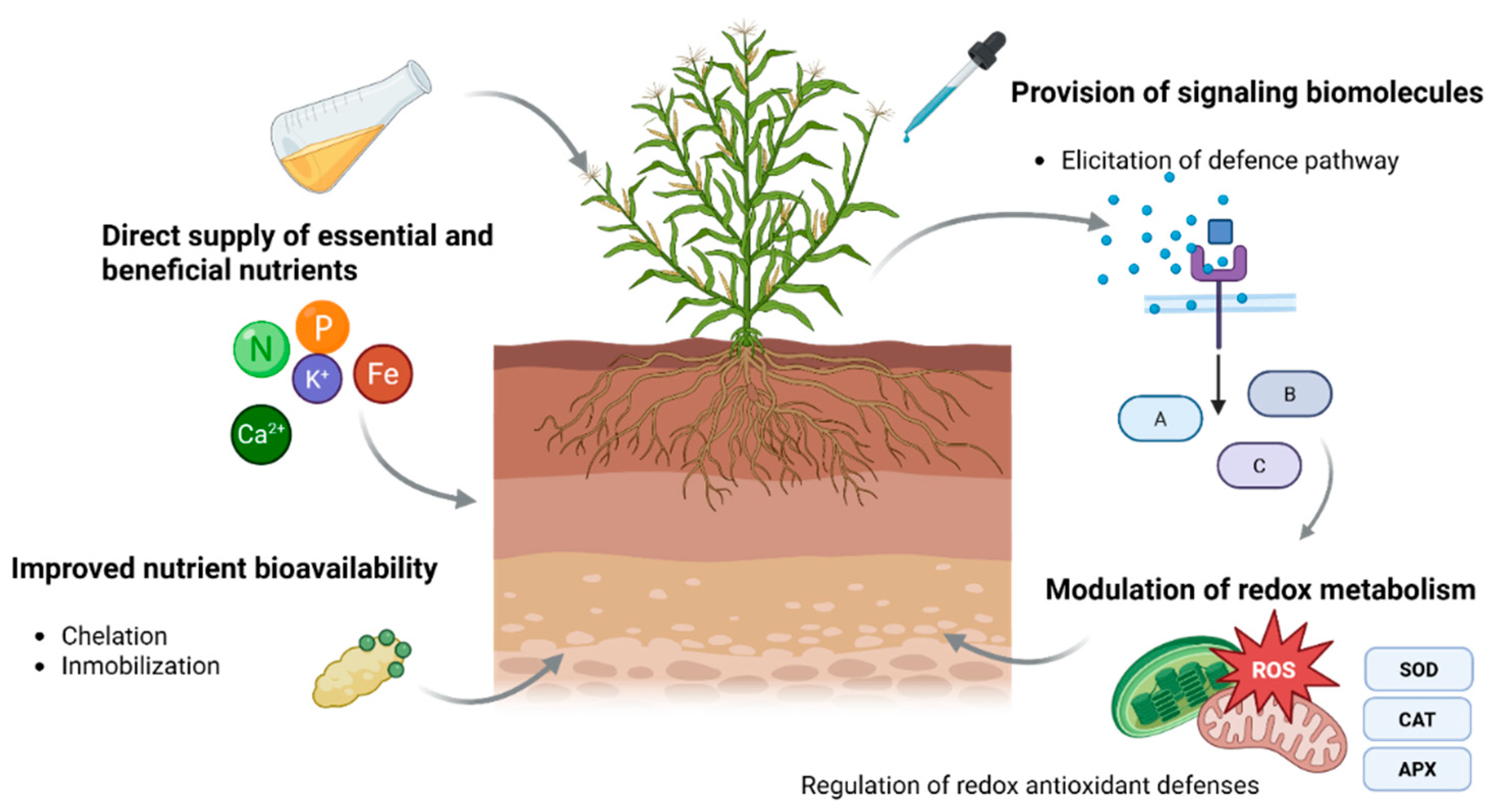
Figure 2.
Sequence of events related to biostimulation with botanical extracts.
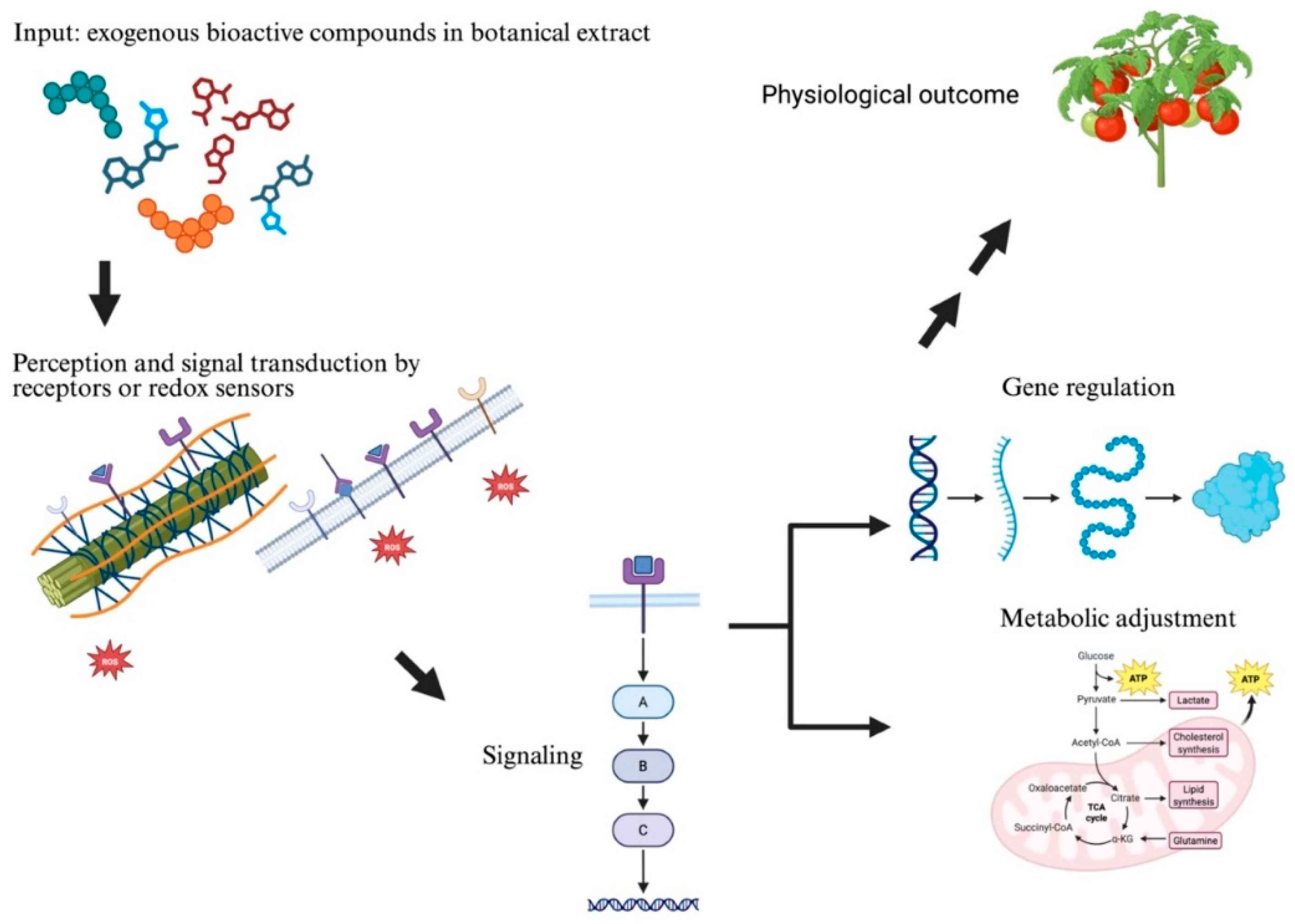
Figure 3.
Schematic diagram of adaptive reprogramming that occurs after the application of a botanical extract. Metabolic reprogramming is part of adaptive reprogramming.
Figure 3.
Schematic diagram of adaptive reprogramming that occurs after the application of a botanical extract. Metabolic reprogramming is part of adaptive reprogramming.
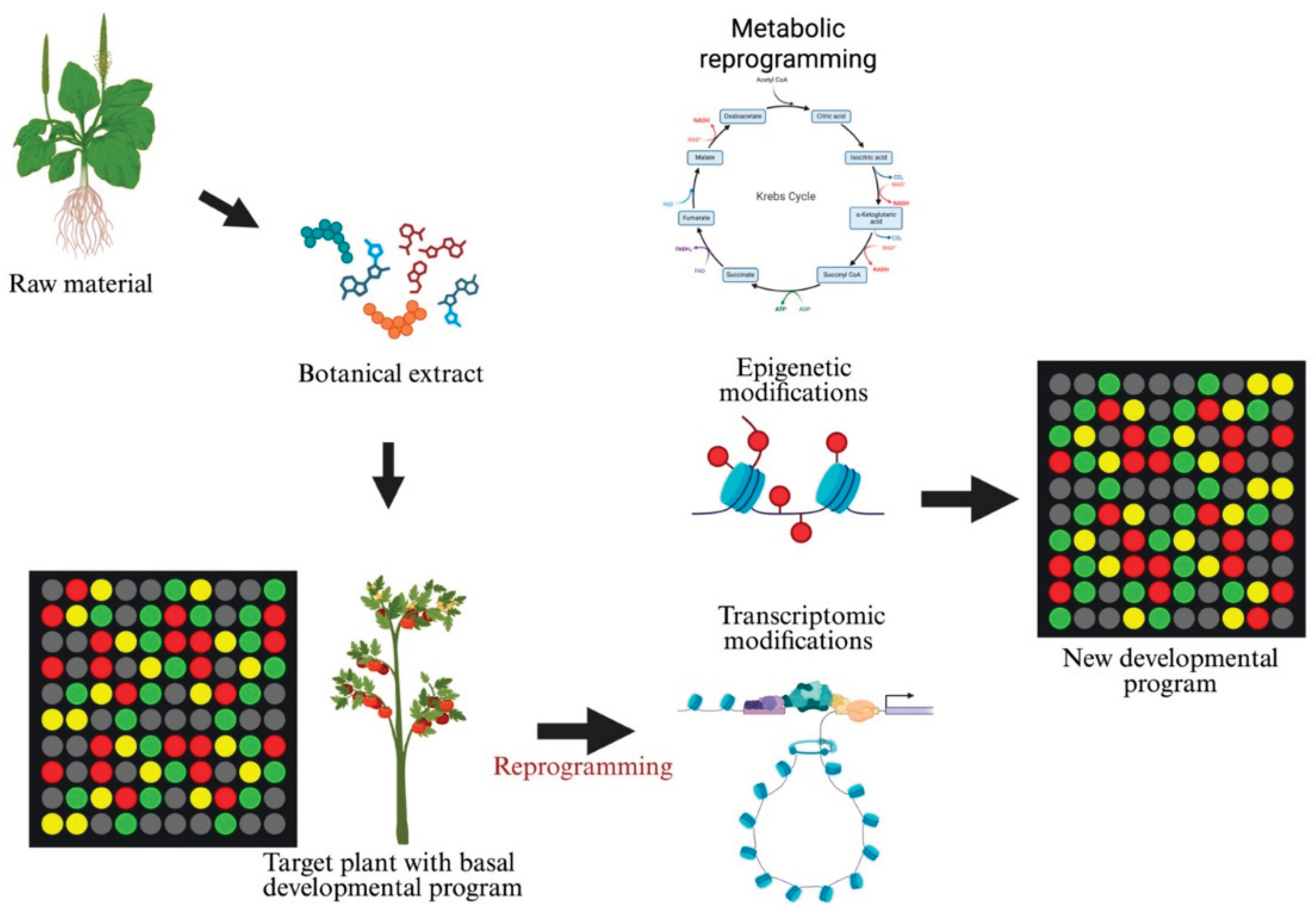

Table 1.
List of different botanical extracts, some of the reported components, and the redox impact of the latter.
Table 1.
List of different botanical extracts, some of the reported components, and the redox impact of the latter.
| Botanical Extract | Representative Chemical Components | Representative Redox Impact of Chemical Component(s) in Planta |
|---|---|---|
| Allium sativum bulb | Alliin, diallyl sulfide, ajoene, carvacrol, geraniol, quercetin, apigenin, rutin [50] | The aqueous garlic extract enhances the activity of antioxidant enzymes, including SOD and PRX, in tomatoes and eggplant [51,52]. |
| Aloe vera inner-leaf gel | Quercetin, kaempherol, aloesin, rutin, caffeic acid, cinnamic acid, vanillic acid, and acemannan [53] | Application of 60 mL L-1 of Aloe vera extract enhanced the growth and productivity of Silybum marianum, whereas a concentration of 40 mL L-1 A. vera extract increased both silybin content and chalcone synthase gene expression [54]. |
| Artemisia vulgaris leaves | Artemisinic acid, rutin, luteolin, kaempferol-3-O-glucoside, tracheloside [55], hydroxycinnamic acids (caffeic, sinapic, p/m-coumaric, ferulic, homovanillic and chlorogenic) and hydroxybenzoic acids (p-hydroxybenzoic, gallic, syringic, salicylic and gentisic) [56]. | Artemisia vulgaris extract elevated the levels of chlorophyll, carotenoids, proline, and polyphenols in potato plants [57]. A. vulgaris extract (leaves and stems) improved germination and seedling growth in some plant species, while it showed no impact in others [58]. |
| Azadirachta indica (neem) seeds | Azadirachtin, astaxanthin, cinobufagin, anodendroside, marinobufagin [59] | Azadirachtin (2.4% azaridachtin A) application to leaves triggers a defense response in tomatoes comparable to that elicited by Bacillus subtilis through Induced Systemic Resistance (ISR). Foliar treatment with B. subtilis activated ISR via the jasmonic acid signaling pathway and promoted the synthesis of secondary metabolites, including flavonoids, phytoalexins, and auxins. Alterations in sterol and terpene profiles, along with elevated glucosinolate levels, were also detected [60]. |
| Borago officinalis flowers | Rosmarinic acid, astragalin, rutin, linoleic acid [61] | Borago officinalis extracts possess antioxidant properties, enabling their use in food preservation and offering broad therapeutic potential [62]. Its use as a agricultural botanical extract appears to be limited [63]. |
| Brassica juncea seeds | Glucosinolates: 4-hydroxyglucobrassicin, glucobarbarin, glucobrassicanapin, glucoerucin, gluconapin, gluconasturtiin and neoglucobrassicin [64] |
Allyl isothiocyanate (AITC) is a phytochemical associated with plant defense in plants from the Brassicaceae family. AITC has long been recognized as a countermeasure against external threats and is also involved in the onset of defense-related mechanisms, such as the regulation of stomatal aperture. At the level of redox modulation, AITC induces depletion of glutathione and the upregulation of glutathione S-transferases in Arabidopsis thaliana [65]. |
| Calendula officinalis flowers | Lupeol, erythrodiol, calenduloside, rutin, narcissin, esculetin, cubenol, limonene, calenduloside B [66] | Calendula officinalis extracts possess antioxidant properties, enabling their use in food preservation and offering a range of therapeutic benefits [67]. Its use as a agricultural botanical extract appears to be limited [68]. |
| Camellia sinensis leaves (green-tea extract) | Catechins, caffeine, theanine, gallic acid [69] | Exogenous application of catechin enhances photosynthesis, plant growth, leaf expansion, antioxidant defense mechanisms, reactive oxygen species signaling, redox balance, and hormone metabolism under environmental stress conditions [70]. |
| Citrus sinensis peel | Naringin, rutin, hesperidin, melittoside [71] | The physiological and biochemical effects of hesperidin (100 μM) and chlorogenic acid (50 μM) were evaluated in Zea mays under arsenate stress (100 μM). Hesperidin and chlorogenic acid enhanced the activities of SOD, CAT, PRX, glutathione S-transferase, and glutathione peroxidase under stress, effectively reducing H2O2 accumulation and lipid peroxidation [72]. |
| Cymbopogon citratus leaf extract | Luteolin, apigenin, di-C-glycosylflavones, tannins [73] | Cymbopogon citratus extracts possess antioxidant properties, enabling their use in food preservation, as well as herbicide and insecticide, and offering a broad range of medicinal uses [74,75]. The extract use as a agricultural biostimulant appears to be limited. |
| Echinacea purpurea roots | Mannitol, benzoic acid, betulin, campesterol, β-sitosterol [76] | Echinacea purpurea root extracts possess antioxidant properties, enabling their use in food preservation and offering broad therapeutic potential [77,78]. Its use as a plant biostimulant appears to be limited. |
| Cupressus macrocarpa leaf extract | Secondary metabolites, phenolics, flavonoids, saponins, tannins, terpenes, and essential oils | Cypress leaf extract and salicylic acid were applied to seeds of zucchini and the seedlings were subjected to salinity stress. Pretreatment with the biostimulants enhanced growth and photosynthetic performance; elevated SOD, CAT, APX, GPX, GR, and DHAR activities; and increased ascorbate, glutathione, and proline compared with untreated stressed plants. Both treatments mitigated declines in CO₂ assimilation and significantly stimulated Rubisco activity. The extract also upregulated stress-inducible antioxidant genes (CuZnSOD2, CAT1, APX, GR, DHAR, PrxQ) and outperformed salicylic acid under both saline and nonsaline conditions [79]. |
| Curcuma longa rhizome | Curcumin and derivatives, calebin A, gallic acid, rutin [80] | Spinach was used as a model to study the toxicity of arsenic on physico-biochemical processes and the mitigating effect of exogenous curcumin at concentrations of 1, 10, and 20 μM. Curcumin reduced oxidative stress markers (H2O2 and MDA) and boosted nonenzymatic antioxidant capacity. It also enhanced the accumulation of glucosinolate and phenolic compounds and increased glutathione redox cycle activity, indicating the activation of secondary metabolism. Moreover, curcumin promoted crosstalk between ROS signaling and phytohormones, especially melatonin and serotonin, to alleviate arsenic-induced oxidative stress [81]. |
| Foeniculum vulgare and Ammi visnaga seed extract | Osmoprotectants, antioxidants and trace nutrients | The seed extracts—rich in macro- and micronutrients, α-tocopherol, phenolics, and glutathione GSH—strengthened salt-stressed cowpea plants’ antioxidant defenses by modulating osmoprotectants, such as proline and soluble sugars, and enhancing CAT, PRX, APX, and SOD enzymes and nonenzymatic systems, including carotenoid and glutathione levels [82]. |
| Glycyrrhiza glabra root | Glycyrrhizin, glycyrrhizic acid, isoliquiritigenin, licochalcone A, 18-β-glycyrrhetinic acid, glabrene [83] | Two field trials assessed the effects of licorice root extract (0.5%; 5 g L-1 in distilled water), applied as seed priming and/or foliar spray, on growth, yield, physiological, biochemical, and antioxidant traits of Phaseolus vulgaris under saline soil (EC = 7.15 dS m-1). Licorice treatments significantly enhanced growth, yield, photosynthetic pigments, proline, soluble carbohydrates and sugars, nutrient content, K+/Na+ ratio, relative water content, membrane stability, antioxidant enzyme activity, and anatomical features. Concurrently, they reduced electrolyte leakage, malondialdehyde levels, Na+ levels, H2O2 levels, and superoxide levels compared to untreated controls under salt stress [84]. |
| Hypericum perforatum leaves and flowers | Hyperforin, adhyperforin hyperoside, rutin, isoquercitrin, quercitrin [83] | Hypericum perforatum extracts possess antioxidant properties, enabling their use in food preservation and offering a range of therapeutic benefits [85,86]. Its use as a plant biostimulant appears to be limited. |
| Medicago sativa leaves | Chlorogenic acid, rutin, quercetin, kaempferol, genistein, vitexin [87] | Medicago sativa extracts possess antioxidant properties, which enable their potential use in food preservation and offer a range of therapeutic and cosmetic applications [88,89]. The use of botanical extracts as an agricultural biostimulant appears to be limited [90]. |
| Moringa oleifera leaves | Phenolic acids (chlorogenic, caffeic), fatty acids, amino acids, flavonoids (rutin, quercetin, kaempferol), glucosinolates, tocopherols [91] | Under oxidative stress, the exogenous application of chlorogenic acid to apple leaves mitigated chlorophyll loss, the decline in photosystem II efficiency, membrane damage, and lipid oxidation, while enhancing the activity of antioxidant enzymes. Phenolic concentrations significantly increased, and the expression of genes involved in antioxidant defense was modulated [92]. |
| Olea europaea leaves | Homogentisic acid, hydroxybenzoic acids, caffeic acid, vicenin, and luteolin [93] | Olea europaea leaf extracts possess antioxidant properties, enabling their use in food preservation and offering a broad therapeutic potential [94,95,96]. Its use as a plant biostimulant appears to be limited. |
| Punica granatum peel | Punicalagin, rutin, ellagic acid, gallic acid, and anthocyanins [97] | Punica granatum peel extracts possess antioxidant properties, enabling their use in food preservation and offering broad therapeutic potential [98,99]. Its use as a plant biostimulant appears to be limited. |
| Rosmarinus officinalis leaves | Carnosic acid, rosmarinic acid, luteolin, apigenin, caffeic acid [100] | The study measured endogenous levels of carnosic acid and α-tocopherol—lipophilic antioxidants in the chloroplasts of Salvia officinalis during a drought-recovery cycle. Drought significantly reduced salvia leaf water content, and as stress intensified, α-tocopherol and carnosic acid levels declined while the oxidation products, rosmanol and isorosmanol, increased. Carnosic acid serves a similar antioxidative role in both rosemary and salvia, emphasizing that drought resistance relies on the combined action of multiple antioxidants rather than a single mechanism [101]. |
| Salix alba bark | Salicin, chlorogenic acid, rutin, epicatechin [102] | Application of Salix alba root powder and Bacillus thuringiensis to wheat significantly increased shoot dry weight, root fresh weight, and the levels of CAT and APX. The combined use of B. thuringiensis and S. alba root powder promoted plant growth and defense responses under elevated soil cadmium concentrations [103]. |
| Solidago gigantea , S. canadensis, S. virgaurea, S. graminifolia, S. speciosa leaves and flowers | Chlorogenic acid, rutin, hyperoside, quercitrin, isoquercitrin [104] | Its use as a biostimulant has been reported [105], as well as its applications in controlling plant pathogens [106]. |
| Silybum marianum seeds | Silybin A, silydianin, taxifolin, quercetin [107] | Silybum marianum seed extracts possess antioxidant properties, offering a range of therapeutic uses for both humans and plants [108]. However, its use as a botanical extract in agriculture appears to be limited [109]. |
| Taraxacum officinale leaves, flowers, and fruits | Chicoric acid, chlorogenic acid, luteolin, quercetin glycosides [110] | Taraxacum officinale extracts possess antioxidant properties [111], enabling their use in food preservation and offering therapeutic potential [112]. Its use as a plant biostimulant appears to be limited. |
| Vitis vinifera seeds | Polyphenolics, flavonoids, procyanidins [113] | Vitis vinifera extracts possess antioxidant properties, enabling their use in food preservation [114] and offering medicinal uses [115]. Its use as a crop biostimulant appears to be limited. |
| Zingiber officinale rhizome | Gingerols (6-shogaol, 6-gingerol, 8-gingerol, 10-gingerol), ginger phenylpropanoids [116] | The inhibitory effect of ginger on lead-, cadmium-, and boron-induced oxidative stress in maize seedlings was examined, revealing an increase in inhibition with higher concentrations of ginger extract. Maize grown for 10-40 days with 1 g each of lead, cadmium, and boron exhibited significantly higher lipid peroxidation than the controls. Ginger extract notably reduced lipid peroxide levels and increased antioxidant enzyme activities in contaminated soil. These results suggest that ginger extract stimulates antioxidant enzymes, which can help mitigate metal-induced oxidative stress in maize [117]. |
Disclaimer/Publisher’s Note: The statements, opinions and data contained in all publications are solely those of the individual author(s) and contributor(s) and not of MDPI and/or the editor(s). MDPI and/or the editor(s) disclaim responsibility for any injury to people or property resulting from any ideas, methods, instructions or products referred to in the content. |
© 2026 by the authors. Licensee MDPI, Basel, Switzerland. This article is an open access article distributed under the terms and conditions of the Creative Commons Attribution (CC BY) license.
Copyright: This open access article is published under a Creative Commons CC BY 4.0 license, which permit the free download, distribution, and reuse, provided that the author and preprint are cited in any reuse.


