

Submitted:
03 March 2026
Posted:
04 March 2026
You are already at the latest version
Abstract
Autophagy is a fundamental lysosome-dependent degradation process, which maintains cellular homeostasis in response to stress. VSP34 (Vacuolar Protein Sorting 34, PIK3C3), as the only Class III phosphatidylinositol 3-kinase, generates phosphatidylinositol 3-phosphate (PI3P) for au-to-phagosome nucleation and maturation, thereby providing a critical adaptive survival pathway for cells experiencing metabolic stress. The VPS34-autophagy axis displays a context-dependent dual roles in cancer: it can restrain early tumorigenesis; however, in established tumors it can promote survival under hypoxia, nutrient deprivation, and therapeutic pressure. Additionally, VPS34 shapes the tumor microenvironment (TME) by influencing both immune and cancer cells through modulating autophagy, cGAS-STING (cyclic GMP-AMP synthase Stimulator of Interfer-on Genes) and STAT1 pathways. VPS34 inhibition has been reported to induce interferon response that enhance CD8+ T and natural killer (NK) cell infiltration and convert cold tumor into hot, providing a rationale for combination of VPS34 inhibitors with cancer immunotherapies. In this review, we summarize the molecular functions and regulations of VPS34 in autophagy and dis-cuss recent advances linking VPS34 to tumor and cancer immunotherapy.
Keywords:
VPS34
; autophagy
; immunity
; cancer immunity
; cancer therapy
; cancer immunotherapy
1. Introduction
Phosphoinositide 3-kinases (PI3Ks) are part of a family of lipid kinases playing a crucial role in cell metabolism, signalling and other essential cellular functions in all eukaryotic cells. These enzymes are classified in three different classes (Class I, II and III) based on their structures and functions [1].
PI3K Class I consists of a catalytic and a regulatory subunit and includes 4 isoforms, (PI3Kα, PI3Kβ, PI3Kδ, and PI3Kγ), PI3K Class II are monomeric proteins[2] which includes three isoforms (PI3K-C2α, PI3K-C2β, and PI3K-C2γ), while only one PI3K Class III was discovered until now, which is VPS34, encoded by the PIK3C3 gene [3,4].
Vps34 gene was originally discovered through yeast genetic studies in 1990 by Herm and Emr, later recognised as the ancestral form of PI3 kinase, despite it continues to be classified as “class III” [5,6]. Unlike class I and II, which generate multiple phosphoinositide products, VPS34 specifically phosphorylates the 3rd position of the inositol ring of phosphatidylinositol (Ptdins), producing phosphatidylinositol-3-phosphate (PtdIns3P) [7,8], a lipid essential to orchestrate various cellular processes, such as autophagy, membrane dynamics and endocytic trafficking [9,10].
Through these processes, VPS34 integrates stress and nutrient signals, sustaining both tumor cell metabolism and intracellular quality control. In addition to the intrinsic functions of VPS34 in tumors, VPS34 profoundly shapes the tumor microenvironment and immune response. On one side, VPS34-mediated autophagy and endosomal trafficking in tumor cells modulate different cellular pathways such as cGAS-STING and STAT1 signaling, resulting in the activation of interferon response [11,12,13]; On the other, VPS34 also regulates cellular metabolic fitness, activation and survival in different immune cells, like T cells, NK cells and dendritic cells [14]. Collectively, these roles allow VPS34 inhibitors to reshape the tumor microenvironment by modulating immune cells infiltration, interferon response and potentially contributes to the conversion of immunologically “cold” into “hot”.
Preclinical studies have shown that targeting VPS34 pharmacologically boosts tumor immunogenicity and produces synergistic effects with immune checkpoint inhibitors, making it a highly promising immune-metabolic target. In this review, we summarize VPS34’s essential functions in autophagy, its diverse roles in tumor progression and TME regulation, and the strategic potential of VPS34 inhibitors in enhancing the efficacy of cancer immunotherapy.
2. Structure of VPS34 and the Two Complexes
2.1. Molecular and Structural Features of VPS34
VPS34 is a 100kDa protein, and comprises a three domains architecture: a C-terminal catalytic domain, which is responsible for the conversion of PtdIns to PI3P, a helical domain and a N-terminal C2 domain, which is centrally located between the two VPS34 complexes and acts as a crucial structural and protein interaction site [15,16].
The C-terminal kinase domain is the catalytic engine of VPS34, it functions to carry out the phosphorylation of phosphatidylinositol (PI) to produce PI3P. The kinase domain contains the ATP-binding pocket and three loops. The ATP binding pocket is present between two lobes: N-lobe and C-lobe, connected by a hinge region. This pocket is smaller than the one in the other PI3Ks, thus this feature has been exploited to design selective VPS34- inhibitors [17].
The loops of the kinase domain consist of a P-loop, an activation loop and a catalytic loop. The P-loop binds to and phosphates ATP at the N-lobe. The activation loop interacts with the substrate PtdIns in the C-lobe. The conserved DFG motif (Aspartate-Phenylalanine-Glycine motif), which is at the beginning of the activation loop, is critical for phosphate transfer through metal ion binding, while, in the catalytic loop, gamma phosphates of ATP are transferred through a conserved DHR motif (Distal Histidine Regidine motif) to the substrate PtdIns [18,19].
The helical domain locates in the central of VPS34, it serves as a connecter to link C2 domain and the catalytic kinase domain. It helps to form the main structure of the “catalytic arm” in the VPS34 complex [20].
The N-terminal C2 domain is the structural hub for the complex, to recruit the regulatory subunits such as VPS15, Beclin 1, Atg14L/UVRAG to form the complete complex. It contains a helical insertion C2HH (C2 Helical Hairpin), which serves as the binding site for regulatory small GTPases like Rab5, Rab1 and directs the complex to membranes [21]. (Figure 1A)
2.2. VPS34 Complexes: Complex I and Complex II
VPS34 rarely functions alone, instead, it forms two different and mutually exclusive heterotetrameric complexes (Complex I and Complex II) in order to regulate two different functions: autophagy and endocytosis. Both two complexes have a conserved V-shape structure preserved through evolution from yeast to humans [20] and the core components of both include the catalytic subunit VPS34, the serine/threonine protein kinase VPS15 (also known as p150 or PIK3R4), and an accessory subunits, Beclin 1 (mammalian counterpart of Atg6/Vps30) [21].
Beclin 1 is a ~ 60-kDa protein encoded by BECN1 gene in humans and Atg1 in yeasts. It’s crucial for controlling autophagy, and it consists of a B-cell lymphoma 2 (Bcl.2)-homology-3 (BH3) motif, a helical domain, a coiled-coil domain (CCD), an evolutionary conserved domain (ECD) along with a β/α-repeated, autophagy-related domain (BARA) [22,23].
Beclin 1 binds to the VPS34-VPS15 through its ECD and CCD domains, forming the Beclin 1-VPS34-VPS15 core heterotrimer. This heterotrimer subsequently, interacts with Atg14L(Atg14 in yeasts), forming the Beclin 1-VPS34-VPS15-Atg14L complex I, which enhances VPS34 lipid kinase activity, thereby promoting the synthesis of PI3P and autophagy initiation [24]; Or with UVRAG (UV irradiation resistance-associated gene product, Vps38 in yeasts) to form Beclin 1-VPS34-VPS15-UVRAG complex II (endosomal trafficking specific) to mediate endocytosis [25].
The structural difference between these two complexes determines their distinct cellular localisations. Atg14L directs complex I to the site of phagophore formation and ER compartments under conditions of starvation, while UVRAG directs complex II to Rab9 and Rab5 positive endosomes, and has a role in endocytic trafficking and autophagosome-lysosome fusion [20,21]. (Figure 1B)
3. Canonical Functions of VPS34 in Autophagy
3.1. Role of VPS34 in Macroautophagy
Autophagy, particularly macroautophagy, originates with the formation of a de novo double membraned phagophore (also called isolation membrane). This structure subsequently expands within the cytoplasm, sealing in a double membrane vesicle knows as autophagosome to sequester cellular components - such as damaged organelles, proteins and other materials. Subsequently, these autophagosomes fuse with lysosomes (in mammals) or vacuoles (in yeast cells), degrading the material and recycling the cargos [26]. VPS34 has a central role in the regulation of autophagy, where it is indispensable for both the initiation and progression of autophagy.
VPS34 Complex I has a key function in the early stages of phagophore formation (initiation and nucleation), by producing PtdIns3P on specialised membrane domains, known as phagophore assembly sites (PAS) in yeast, while in mammals, it arises from different locations, such as the omeagasome, collocated in the endoplasmic reticulum (ER) [27]. This process subsequently recruits downstream PtdIns3P effector proteins, including WD-repeat protein interacting with phosphoinositides (WIPIs) and double-FYVE containing protein 1 (DFCP1), crucial for autophagosome maturation [28].
WIPIs include four proteins (WIPI 1-4), while yeasts have three (Atg18, Atg21, Hsv2). WIPI2b is crucial to promote LC3 (Microtubule-associated protein 1A/1B-light chain 3) lipidation and starvation-induced autophagy, mainly through the recruitment of ATG12-ATG5-ATG16L1. These findings suggest that upon sensing increased PtdIns3P levels, WIPI2b recruits the LC3 conjugation machinery, thereby facilitating the conjugation of LC3 to the membrane of the forming autophagosome [20,29].
The lipidated form of LC3 (also called LC3-II) will remain attached to the membrane and further fulfilled the needs of cargo receptors, such as p62/SQSTM1, to bind ubiquitinated substrates.
Some studies also suggest that LC3-II, together with other ATG proteins, is involved in the contribution of the membrane curvature and closure during the last steps of autophagosome formation [30].
The mature autophagosome then fuses with lysosomes to form the autophago-lysosome through VPS34 complex II. At this stage, LC3-I located on the inner membrane is degraded together with the cargo, while LC3-II located on the outer membrane is delipidated and recycled to its soluble form, LC3-I. For this reason, LC3 (LC3-I/LC3-II), together with the cargo p62, are widely used as markers to monitor the autophagy flux [31]. (Figure 1C)
3.2. Role of VPS34 in Selective Autophagy
In addition to the regulation on macroautophagy, VPS34 also functions as key role to regulate different selective autophagy.
Selective autophagy is a precise intracellular degradation process which specifically degrades organelles, invading pathogens and proteins aggregates for lysosomal breakdown. These processes includes mitophagy (damaged mitochondria), xenophagy (pathogens), ER-phagy (endoplasmic reticulum), ribophagy (ribosomes) and pexophagy (peroxisomes) [32,33].
In selective autophagy, VPS34 also functions as a localized signaling hub that converts PI into PI3P, thereby recruiting downstream effector like WIPI2 and DFCP1 to initiate autophagosome membrane (phagophore) nucleation around specific substrates and utilizing specific receptors (or selective autophagy receptors, SARs) to bridge the VPS34-dependent phagophore to enable subsequent autophagosome maturation and maintain cellular homeostasis[34] [35].
In context of mitophagy, upon mitochondrial depolarization, PINK1 accumulates on the outer mitochondrial membrane and phosphorylates and activates Parkin, leading to the accumulation of phospho-ubiquitin chains on multiple mitochondrial membrane proteins. These phosphorylated ubiquitin signals are then recognized by receptors such as OPTN and NDP52, which link damaged mitochondria to VPS34-dependent phagophore [36].
Xenophagy is another specialized form of selective autophagy that degrades invading pathogens like bacteria, viruses and parasites. Pathogens are often ubiquitized and recognized by galectins, further bound by receptors like p62 and NDP52, leading to recruit the VPS34-Atg14L complex for the autophagosome maturation [37].
ER-phagy is the selective degradation of damaged or excess fragment of endoplasmic reticulum via lysosomes. Under stress conditions, ER-resident receptors such as FAM134B, SEC62, and RTN3 mediate the recognition and sequestration of specific ER domains. These receptors coordinate with the autophagy initiation machinery, facilitating localized activation of the VPS34 complex at ER subdomains. VPS34-dependent PI3P production then promotes phagophore formation and initiate the sequestration of ER fragments [38].
VPS34 is also essential for other selective autophagy like ribophagy and pexophagy by generating the PI3P signal required for phagophore nucleation at organelle-specific sites. In ribophagy, the selective receptor NUFIP1 (or yeast Heh1) mediates the recognition and sequestration of ribosomes, whereas in pexophagy, NBR1 (or yeast Atg30/Atg36) targets peroxisomes for degradation. Although cargo specificity is dictated by these distinct receptors, VPS34 activity provides the indispensable membrane platform that enables receptor-guided autophagosome formation [39,40].
3.3. Regulation of VPS34 Complexes and VPS34 Activity
3.3.1. Regulation of VPS34 Complex I and Complex II
VPS34 complex I is tightly regulated during autophagy in response to nutrient stress. This complex is specifically dedicated to the autophagy initiation,and its activity is mainly regulated by Unc-51-like kinase 1 (ULK1) complex through phosphorylation of key components such as Beclin 1 and Atg14L[41].
ULK1 is a serine/threonine kinase, which localizes to organelles such as the endoplasmic reticulum (ER), lysosomes and mitochondria. ULK1 can form a stable complex with ATG13 and FIP200 regardless of nutrient conditions, leading to the altered activity of VPS34 complex I. The activity of ULK1 is mainly modulated through two upstream regulators: the mammalian target of rapamycin complex 1 (mTORC1) and AMP-activated protein kinase (AMPK) [42].mTORC1 is a key protein complex that monitors cellular energy and nutrient status, including ATP and amino acid availability, to coordinate cell growth, metabolism, and catabolic processes such as autophagy. Under nutrient-rich conditions, mTORC1 remains active and phosphorylates ULK1 and ATG13, thereby suppressing the kinase activity of ULK1 complex and inhibiting autophagy through blocking VPS34 Complex I.
Conversely, under nutrient deprivation, AMPK (the central cellular energy sensing kinase) will be activated and inhibits mTORC1 activity, thereby dissociating mTOR from ULK1, enabling the ULK1 complex to phosphorylate ATG13 and FIP200, which triggers autophagy initiation [42,43,44,45].
In addition to regulation by the AMPK–mTORC1–ULK1 axis, VPS34 complex I activity is further modulated by competitive interactions with components of VPS34 complex II. Specifically, UVRAG can compete with Atg14L for binding to the coiled-coil domain (CCD) of Beclin 1, thereby influencing VPS34 complex I function fine-tuning the balance between autophagy initiation, autophagosome maturation and endocytic trafficking[24]. Moreover, Atg14L can also enhance the kinase activity of VPS34 to promote autophagy initiation; however, this effect appears to depend on the overexpression of Beclin 1 [46].
The activity of VPS34 complex II is manily regulated by Rubicon (Run domain Beclin 1 interacting and cysteine-rich containing protein). Rubicon is primarily known as a negative regulator of canonical autophagy, acting as a “brake” that slows down the degradation of damaged cellular components. Mechanistically, Rubicon directly associates with UVRAG through the CCD and RUN domains within the VPS34 complex II to form a pentameric Rubicon-UVRAG-Beclin1-VPS34-VPS15 complex, which then block the activity of complex II and thereby hindering the maturation of autophagosomes and endosomes [47,48]. Moreover, with the phosphorylation of UVRAG by mTORC1, the binding of UVRAG with Rubicon is amplified through the RUN domain, preventing autophagosomes maturation and lysosome fusion [49,50].
3.3.2. Post-Translational Modifications of VPS34
Beyond the regulation of VPS34 through its interactions with various regulatory proteins and the AMPK-mTORC1 axis, VPS34 is also modulated by different stresses via specific post-translational modifications (PTMs). PTMs are protein alterations occur after translation, which are essential to maintain a stable and regulated autophagy machinery. Under conditions of cellular stress, AMPK phosphorylates VPS34 at Thr163 and Ser165, leading to inhibition of non-autophagic VPS34 complexes. This regulation helps preserve cellular energy homeostasis during starvationUnder cellular stress conditions, the phosphorylation of VPS34 at the Thr163 and Ser165 from AMPK inhibit the non-autophagy VPS34 complexes, in order to preserve cellular energy during starvation [51]. In contrast, autophagy-promoting VPS34 complexes are regulated by the phosphorylation of Beclin 1 at the S15 (Ser14 in mice) from ULK1 and of Beclin 1 at the S90/S93 (Ser91 and Ser94 in mice) from AMPK, both of which activate VPS34 complexes I and II, respectively [52,53].
VPS34 is also negatively regulated by cyclin-dependent kinases. Specifically, CDK1 phosphorylates VPS34 at Thr159, which disrupts its interaction with Beclin 1. Similarly, CDK5 phosphorylates VPS34 at Thr668 within the catalytic domain. Both modifications serve to inhibit VPS34 kinase activity [8].
Moreover, under nutrient deprivation, ULK1 phosphorylates lactate dehydrogenase A (LDHA) at Ser196, thereby increasing intracellular lactate levels. This metabolic shift triggers VPS34 lactylation at Lys356 and Lys781, mediated by KAT5/TIP60. Consequently, the recruitment of VPS34 to the Beclin 1–Atg14L and UVRAG complexes is enhanced, bolstering its lipid kinase activity and driving the autophagy machinery forward” [54].
Together, these findings highlight the mechanisms that how VPS34 is highly regulated by the cellular metabolic state through different post-translational modifications.
3.3.3. Regulation of VPS34 by Hypoxia in a HIF-1α-Dependent Manner
Hypoxia represents a major metabolic stress condition that greatly affects the autophagy machinery. Hypoxia, commonly found in solid tumors, consists in a reduced oxygen availability. Up to 90% of tumor present hypoxic regions, identifying it as a hallmark of cancer [55]. It is correlated with worse prognosis and the activation of important transcription factors: HIFs [56]. Hypoxia –inducible factor (HIF)-1 is a heterodimeric transcription factor with a central role the cellular response to low oxygen levels [57].
Under hypoxic conditions, the stabilization of HIF-1α triggers the transcriptional upregulation of the autophagy receptors BNIP3 and BNIP3L. Due to its superior binding affinity, BNIP3 competitively displaces Beclin 1 from its inhibitory sequestration by BCL-2. This relocation liberates Beclin 1 to assemble with and activate the VPS34 complex, thereby initiating autophagy in response to low oxygen availability [58]. Consequently, VPS34 functions as a critical downstream effector of the hypoxia signaling pathway, where its production of PI3P is indispensable for both autophagosome formation and maturation.
4. Non-Autophagic Functions of VPS34
4.1. Role of VPS34 in Endosomal Trafficking and Vesicular Transport
VPS34 also plays an important role in endosomal trafficking and vesicular transport, particularly in the regulation of Rab5 activity and early endosome function. Endosomes are organelles which sort, process and transport intracellular materials through endocytic pathways [61].
The Rab family of GTPase are crucial for membrane trafficking [62] and can be found in a GTP-bound active state or a GDP-bound inactive state. Specifically, Rab5 and Rab7 are essential for early and late endosomes trafficking respectively and recruitment of effector proteins, particularly VPS34. The recruitment of VPS34 activates the complex through the binding of VPS34 C2 domain to VPS15 WD40 domain [20,63], to produce PI3P. PI3P binds to FYVE and PX domain-containing proteins and triggers the endosome maturation and trafficking. Simultaneously, VPS34 also inhibits Rab5 and Rab7 through a negative feedback loop, recruiting Rab GTPase-activating proteins (GAPs) such as TBC1D2/Armus, which convert them to their inactive form [64].
4.2. Role of VPS34 in Phagocytosis, Lysosomal Biology and Nutrient Sensing
Phagocytosis is a form of endocytosis based on the engulfment and elimination of pathogens and other particles. VPS34 has been demonstrated to regulate the formation of phagosomes and fusion with lysosomes through the production of PI3P. In the absence of VPS34, phagocytosis is impaired, leading to the accumulation of lysosomes and a failure of phagosomes to fuse properly with these degradative compartments.[65].
Moreover, Vps34 is also critical for lysosomes through PI3P production. Under nutrient-rich conditions, there is a positive loop between mTORC1 and VPS34 activation, with following lysosomal PI3P production. This loop keeps the lysosomes peripheral, motile and less degradative. When mTORC1 is inhibited, during starvation, this loop is interrupted and the lysosomes appears larger, static and more degradative [66].
4.3. Role of VPS34 in Exocytosis and Secretion
Once VPS34 switches on the activation of the autophagy pathway, through the production of PI3P and following production of autophagosomes, it can go towards different directions. The first direction is the degradative autophagy with the fusion of autophagosomes with lysosomes, and successive autophagolysosomes production. In addition, there is a specific form of autophagy, called secretory autophagy, where autophagosomes (which contain cargoes inside), fuse with the plasma membrane through an event denominated exocytosis [67]. Before the plasma membrane extrusion, autophagosomes may fuse with late endosomes/multivescicular bodies (MVBs) and produce amphisomes. These organelles then fuse with either lysosomes (in degradative autophagy) or plasma membrane (in secretory autophagy) [68].
Secretory autophagy therefore relies on the core VPS34–Beclin 1 machinery while redirecting downstream trafficking.
This type of autophagy has recently emerged as a contributor not only of proteins, organelles and microbes exocytosis, but also of cytokines, such as IL-1β, IL-6, IL-18, and TNF-α [69,70]. These insights provides new cell mechanisms of substances secretion correlated with tumor environment regulation and autophagy [71].
5. Role of VPS34 in Cancer
VPS34 as the master regulator of autophagy and endosome trafficking, plays important roles in tumorigenesis by modulating tumors’ metabolic survival and immune evasion [72]. The roles of VPS34 in cancer cells are defined by its dual functions. Due to the role on initiating autophagosome formation and endocytic trafficking to prevent cellular dysfunction, depletion or impairment of VPS34 will disrupts the process, which would lead to the tumor initiation and progression[72] [73]. However, the role of VPS34 is highly context-dependent; it would shift to an opposite role based on tumors’ stages and the microenvironment.
5.1. VPS34 as a Tumor Suppressor
VPS34 typically functions primarily to prevent cancer initiation at the early stage of transformation by driving basal autophagy to maintain cellular homeostasis and keep genomic stability. Moreover, in some cancer types such as hepatocellular carcinoma (HCC), it has been identified as an invasion suppressor to reduce tumor metastasis by promoting lysosomal accumulation and reducing cellular surface receptor recycling [73].
5.2. VPS34 as a Tumor Promoter
In established tumors, VPS34 can paradoxically support cancer progression by promoting tumor cells’ survival from metabolic stress, supporting oncogenic signaling and facilitating tumor microenvironment adaptation [74] [75].
Interestingly, a recent study from Ramos-Delgado et al. demonstrated the atypical role of VPS34 on cell plasticity differentiation and cancer initiation. Through deletion of VPS34 on pancreatic exocrine cells, with increased lysosomal degradation of pro-inflammatory REG3A, the newly differentiated cell state was less sensitive to cancer promotion by oncogenic KRAS in pancreatic cancer, which indicates the potential opposite role of VPS34 on cancer initiation [76].
5.3. VPS34’s Role on Cancer Cell Metabolism, Survival and Metastasis
Cancer cells frequently operate under conditions of nutrient lack and metabolic volatility. VPS34 supports cancer cells’ metabolism primarily by regulating nutrient scavenging and keeping proteostasis when cancer cells are under stress. VPS34-mediated autophagy provides a continuous supply of amino acids, fatty acids and nucleotides, maintaining mitochondrial TCA cycle flux and ATP production even with an external nutrient shortage [72].
VPS34-driven autophagy is a canonical adaptive response for cancer cells to survive from different stresses as amino acid/glucose limitation, therapeutic stress and hypoxia. During chemotherapy or radiotherapy, VPS34 helps to clear proteotoxic aggregates and contributes to mitophagy, preventing the activation of apoptotic pathways and enhancing therapeutic resistance [36].
VPS34 is also revealed to facilitate tumor metastasis by modulating autophagy initiation, mitochondrial homeostasis and metabolism. Chen et al. uncovered that VPS34 inhibits hepatocellular carcinoma invasion by regulating endosome-lysosome trafficking [73]. Qi lv et al. even reported that death-effector domain-containing DNA-binding protein (DEDD) could interact with and stabilize PIK3C3/Beclin 1 complex to attenuate epithelial-mesenchymal transition in human breast cancer cells [74]. Interestingly, a study from Fengchao liu et al. further demonstrated the role of VPS34 in promoting liver cancer stem cells (CSCs) to facilitate tumor progression, mechanistically, VPS34 inhibition can deactivate SGK3(a CSCs promoter) and enhance AMPK activation, leading to suppression of liver CSCs [77]. Nevertheless, in another study, VPS34 was reported to promote EMT markers like snail and Vimentin through stimulation of p62 phosphorylation in breast cancer cells [78]. Furthermore, Islam et al. recently reported that targeting PIK3C3-mTORC1 signaling in dormancy-prone breast cancer cells will blunt the metastasis initiation on the mouse model [75]. Thus, the role of VPS34 in regulation of metastasis remains largely unknown and needs further investigation.
5.4. Genetic Depletion of VPS34 in Mouse Models and VPS34’s Clinical and Prognostic Relevance in Human Cancers
It is well known that complete germline deletion of Pik3c3 is embryonic lethal, in contrast, Pik3c3+/- heterozygous mice are viable and fertile [79], but have not been reported to develop spontaneous tumors. Instead of tumorigenesis, conditional depletion of Pik3c3 in different tissues have been shown to induce other diseases, such as rapid neurodegeneration [80] and Fanconi-like syndrome [81].
Nevertheless, mouse models targeting VPS34-related autophagy genes have demonstrateda tumor suppressive functions of autophagy in the early stages of tumorigenesis. Beclin 1 is the core component that coordinates the assembly and activation of the VPS34 complex, Yue et al. reported that while homozygous deletion Becn1 -/- is embryonic lethal, Becn1 +/- heterozygous mice can survive and develop a higher incidence of spontaneous tumors and develop various malignancies, such as lymphomas, lung adenocarcinomas, and hepatocellular carcinomas [82]. Moreover, liver-specific deletion of VPS34 downstream (Atg5 or Atg7) leads to benign liver adenomas [83], and accelerates tumorigenesis once hydrides with other oncogenic drivers [84].
To date, there is no clear study to combine canonical cancer-specific genetically engineered mouse models (GEMM) with Pik3c3 deletion. However, genetic depletion of VPS34 can reduce tumor growth on various syngeneic murine cancer models like melanoma and colorectal cancer [14].
While PIK3C3 is rarely deleted or mutated in human cancers, the expression of VPS34 is context-dependent across cancer types. Transcriptomic analysis from TCGA cohorts demonstrates that VPS34 has a relative lower expressions on most cancer types, but a significant higher expression on Cholangiocarcinoma (CHOL), Liver hepatocellular carcinoma (LIHC) and Stomach adenocarcinoma (STAD), compared with normal tissues. (Figure 2A)
Moreover, ZHU et al. investigated 60 gastric cancer (GC) patients’ tumor samples and their normal counterparts by IHC staining and concluded a significant lower VPS34 expression in GC patients (Positive VPS34 expression: 23.3% in tumor tissues and 66.7% in adjacent tissues) [85]. Marzia et al. also reported that in breast cancer patients, high VPS34 correlates with a worse overall survival[86].
Survival probability analysis on TCGA cancer patients also indicates the increased patient mortality risk with higher VPS34 expression in some cancers like liver cancer and Adenoid cystic carcinoma (ACC). (Figure 2B)
In summary, VPS34 exhibits distinct characteristics across different cancer types and patients, which needs further studies to assess the possibility of targeting VPS34 on cancers.
6. VPS34/Autophagy in Immunity and Cancer Immunotherapy
6.1. Role of VPS34/Autophagy in the Regulation of Innate Immunity
6.1.1. VPS34/Autophagy and cGAS-STING Pathway
Innate immunity is body’s first line to protect us from invading pathogens. The cGAS-STING pathway is the critical innate immune mechanism, which functions to detect the cytosolic DNA, viral or bacterial infection or cellular damage, thereby triggering an immune response, especially the production of Type I Interferons (IFN-I), primarily IFN-β [87].
Autophagy and endolysosomal trafficking are functionally interconnected with cytosolic DNA sensing. As the key component to mediate autophagy, Beclin-1 has been shown to interact with cGAS; once cGAS binds to small cytosolic dsDNA (<45bp), leading to the autophagic degradation of cytosolic dsDNA and reducing STING activation [88]. Moreover, another study reported that ubiquitinated cGAS can be captured by p62 to lysosomal degradation [89].
STING is also linked to autophagy, Tuozhi et al. recently reported that STING can induce non-canonical autophagy to regulate endolysosomal homeostasis, which further reveals the mutual regulatory relationships between STING and autophagy [90]. Meanwhile, autophagy can degrade STING through different mechanisms. First, STING is degraded through endosomal sorting complexes required for transport (ESCRT)-driven microautophagy [91]; second, TBK1-mediated phorsphorylation of p62 will increase ubiquitination level of STING and facilitate the interaction between p62 and STING, leading to STING’s degradation with a p62-mediated selective autophagy [92].
The interplay between cGAS-STING and autophagy has been recognized to regulate cancer progression and anti-tumor immunity with different manners. Blockade of trafficking-mediated STING degradation with autophagy inhibitor bafilomycin A1 could specifically enhance STING signaling and anti-tumor response [93].
Mostly, VPS34 plays a crucial role in maintaining autophagic flux and endolysosomal trafficking, which is essential for regulating cGAS-STING translocation and subsequent degradation. Recent studies have demonstrated that both pharmacologic and genetic inhibition of VPS34 would amplify cGAS–STING signaling, leading to a type I IFN response and an increased secretion of T cell-recruiting chemokines such as CCL5 and CXCL10. Mechanically, phosphorylation levels of TBK1 and IRF3 significantly increased upon VPS34 blocking by either siRNA or VPS34 inhibitors’ treatments [11,12,13]. (Figure 3)
6.1.2. Role of VPS34 in Dendritic Cells (DCs) and NK Cells
VPS34 is also reported to regulate DCs and NK cells. A recent study from Paulo et al. demonstrated that blocking VPS34 in plasmacytoid dendritic cells (pDCs) with the small inhibitor such as VPS34-IN1 triggers the activation of the STING and significantly enhances pDCs’ response to the STING agonist 2’3’-cyclic guanosine monophosphate-adenosine monophosphate (2’3’-cGAMP), leading to an increased expression of type-I interferons (IFNs) [94]. Moreover, VPS34 has been uncovered to be critical for NK cells’ development and senescence. A recent study from Zhongjun Dong lab generated a Vps34 fl/fl/ CD122Cre/+ mice, with deleting Vps34 during and after NK-cells commitment and revealed that VPS34-mediated vesicular transport is crucial for CD122 membrane trafficking during NK cells commitment and VPS34-mediated autophagy can delay NK cell senescence [95].
6.2. Role of VPS34/Autophagy in the Regulation of Adaptive Immunity
Adaptive immunity is the third line of defense system to provide protection against infectious and malignant diseases, especially malignant tumors. Unlike innate immunity, adaptive immunity is a highly specialized system for antigen recognition and responsible for long-lasting memory immune system. Adaptive immunity is mediated by lymphocytes mostly B-lymphocytes and T-lymphocytes. Autophagy has been proven to play crucial roles in modulating several processes in adaptive immunity as Lymphocyte metabolism, T cells activation and differentiation, B cell activation and development [96].
Autophagy is essential for antigen processing and presentation, especially MHC-I with dendritic cells cross-presentation to CD8+ T cells and MHC-II in CD4+ T cells. The homeostasis, activation and differentiation of T and B lymphocytes are particularly modulated by autophagy to maintain the lymphocytes heath [97].
As the key component of autophagy, VPS34 is essential for autophagic processes in lymphocytes, thereby underpinning fundamental aspects of T cell biology.
Willinger et al. in 2012 generated conditional Pik3c3 KO mice in T cells, and demonstrated the essential role of Vps34 for the homeostasis of Naïve T cells (CD4+ and CD8+ T cells) but not T-cell development. Vps34-deficient T cells shows accumulation of reactive oxygen species, consistent with deficient removal of damage mitochondria with a canonical autophagy manner [98]. The role of VPS34 on regulatory T (Treg) cells has also been demonstrated by Courreges et al.: loss of VPS34 induces a state of heightened metabolic activity that may interfere with metabolic networks required for maintenance or suppressive functions of Treg cells [99].
Further study by Luc et al., uncovered the VPS34’s function on Thymic epithelial cells(TECs) for CD4+ T selection, demonstrating that deletion of the Vps34 gene in TEC cells causes severe defects in positive selection of the CD4 T cell lineage, but not the CD8 T cell lineage [100,101].
Moreover, Yang et al. further revealed the role of VPS34 on T cell metabolism and function. They found that Pik3c3-deficient T cells exhibited impaired cellular metabolism and Pik3c3-deficient CD4+ T cells failed to differentiate into T helper 1 cells with reduced active mitochondria upon T cell activation, however, no impact of tumor metastasis upon Vps34 deletion on T cells were observed by them [102,103]. The high dependence of activated T cells on VPS34 reveals a critical therapeutic trade-off: while targeting Vps34 in tumor cells enhances antitumor immunity, systemic blockade may simultaneously compromise T cells survival.
Dendritic cell homeostasis and antigen cross-presentation are tightly regulated by autophagy and VPS34-mediated autophagy in adaptive immunity.
In 2017, Vrajesh et al. generated a DC-specific Vps34-deficient mice and found that Vps34-deficent DCs show a partially activated phenotype, spontaneously produce cytokines, and exhibit enhanced activity of the classic MHC class I and class II antigen-presentation pathways. Mechanistically, VPS34 orchestrates endosomal maturation and autophagosome–endosome fusion, maintaining the delicate balance between antigen degradation and effective cross-presentation. However, these animals displayed a defect in the homeostatic maintenance of splenic CD8α+ DCs and the cross-presentations with MHC class I-restricted T cells [104,105].
Monaci et al. also reported that hypoxia-induced autophagy in DCs is mediated by VPS34. Treatment of specific VPS34 inhibitor SAR405 abolishes autophagy and affects survival and inflammatory cytokine expression in hypoxic LPS-treated DCs [106].
However, the role of VPS34 in B cells remains largely unknown. Recently, Luc et al.generated conditional deletion of Vps34 in pro-B cells and demonstrated the increased ROS levels in Vps34-deficient B cells with an anti-inflammatory cytokine profile, cell homeostasis disruption, and altered immune response capacity [107].
6.3. VPS34’s Role in Shaping the Tumor Microenvironment
Vps34 activity in malignant tumors and adjacent tissues shapes the tumor microenvironment through multiple non-mutually exclusive mechanisms:
(a)regulating the secretome of tumor cells (notably chemokines and cytokines, eg. CCL5 and CXCL10) to dictate immune cell recruitment; (b) Maintaining tumor cell viability under hypoxic and nutrient-deprived conditions, thereby affecting antigen accessibility; and c) Regulating endothelial cell migration and the processing of angiogenesis factors, which in turn influences vascular perfusion and immune cell extravasation. Studies using B16-F10 and CT26 syngeneic mouse models have shown that VPS34 inhibition, either via shRNA-mediated silencing or pharmacological inhibitors such as SB02024 and SAR405, enhances the infiltration of M1-like tumor-associated macrophages, NK cells, and effector T cells. Concurrently, VPS34 targeting appears to reduce the immunosuppressive activity of regulatory T cells (Tregs) and myeloid-derived suppressor cells (MDSCs), thereby reprogramming the tumor microenvironment (TME) toward a more immunostimulatory state [14].
Moreover, VPS34 inhibition in tumors enhances the cGAS-STING pathway, leading to greater tumor control through immune-mediated mechanisms [11].
Hypoxia is the main feature of tumor microenvironment; hypoxia-induced autophagy in cancer cells supports the survival, meanwhile, hypoxia-induced autophagy in endothelial cells (ECs) and blood vessels will also regulate pathological angiogenesis, hypoxia adaptation and reshape the tumor microenvironment [108,109]. Inhibition of VPS34 would abolish hypoxia-induced autophagy in dendritic cells, along with decreased pro-survival signaling, viability and increased pro-inflammatory cytokines [106]. However, the direct evidence to demonstrate VPS34 role on tumor angiogenesis and hypoxia adaptation remains unknown. (Figure 3)
7. Pharmacological Targeting of VPS34
7.1. Overview of VPS34 Inhibitors
The development of highly potent and specific VPS34 inhibitors is crucial for elucidating the role of this kinase in membrane transport and autophagy. Unlike pan-PI3K compounds, these small molecules specifically target the catalytic pocket of class III PI3K, enabling the investigation of VPS34-dependent biological mechanisms in cancer models.
Several specific VPS34 inhibitors have been developed in the past years. Such as SAR405 from Sanofi [110], VPS34-IN1 from University of Dundee and AstraZeneca [111], SB02024 from Sprint Bioscience [112] and PIK-III from Novartis [113]. These inhibitors have been primarily used in cancer and neurodegenerative disease models, where they have been shown to inhibit tumor growth and, in certain contexts, promote the clearance of protein aggregates. Targeting VPS34 with these inhibitors has already shown impressive impact on tumor growth and chemotherapy resistance:
SAR405 is a potent, selective, and orally bioavailable VPS34 inhibitor. By blocking the conversion of PI to PI3P, SAR405 suppresses autophagic flux and perturbs late endosomal trafficking. Concomitant inhibition of VPS34 and mTOR with SAR405 and Everolimus results in synergistic anti-proliferation effect in renal tumor cells [110]. Blocking VPS34 with SAR405 in head and neck cancer enhances the antitumor efficacy of cisplatin via modulating cancer-associated fibroblasts [114]. Similar impact by combining cisplatin with SAR405 has also discovered on urothelial carcinoma cells and pleural mesothelioma cells, demonstrating that targeting the autophagic machinery by SAR405 might represent a suitable approach to overcome cisplatin resistance in urothelial carcinoma and pleural mesothelioma [115,116]. Further studies validated the impact of VPS34 inhibition by SAR405 in suppressing tumor growth in syngeneic tumor models [11,14].
VPS34-IN1 is a highly selective VPS34 inhibitor with minimal cross-reactivity toward class-I PI3Ks. It induces a rapid 50%-60% reduction of SGK phosphorylation which would inhibits tumor growth and drug resistance [117,118]. Meunier et al. reported that VPS34 inhibition driven by VPS34-IN1 induces apoptosis of acute myeloid leukemia (AML) but not CD34+ hematopoietic cells via inhibition of basal and L-asparaginase-induced autophagy, blocking mTORC1 signaling and FLT3-ITD-STAT5 pathway [119]. VPS34-IN1 has also shown significant impact on breast cancer cell proliferation and spheroid growth [86]. Another study from Wu et al. also demonstrated that VPS34-IN1 significantly reduces tumor growth of ER+ breast cancer by activation of PERK/ATF4/CHOP pathway [120]. A study on liver cancer also indicates the tumor growth inhibition by VPS34-IN1 [77].
SB02024 is a new generation of VPS34 inhibitor with favorable pharmacokinetic properties. SB02024 has shown significant impact on xenograft growth with MDA-MB231 and MCF-7 breast cancer cells. Further evidence on the monolayer cultures demonstrated a significant potentiated cytotoxicity of Sunitinib and Eroltinib in breast cancer cells [112]. VPS34 inhibition by SB02024 induced STAT1-IRF7 and cGAS-STING pathways’ activation, resulting in robust in vivo antitumor activity in syngeneic models, where the combination of SB02024 and immune checkpoint blockade (ICB) achieved significantly enhanced tumor growth inhibition relative to monotherapy groups [11,14].
PIK-III: PIK-III exhibits marked selectivity for VPS34 (reported up to ~100-fold over other PI3K isoforms) and effectively blocks autophagy [113]. Marenk J Kobylarz et al. reported that the impact of VPS34 inhibition with PIK-III on RKO cancer cells to impair iron mobilization via the VPS34-RAB7A axis [121]. (Figure 3)
7.2. Other VPS34 Inhibitors
In addition to VPS34 inhibitors described above, there are also some potential compounds under development to block autophagy and inhibiting tumor growth. Liu et al. discovered a highly potent ATP-competitive PI3Kδ/VPS34 dual inhibitor, named PI3KD/V-IN-01, displayed 10-1500 folds selectivity over other PI3K isoforms and did not inhibit any other kinases in the kineme. They showed that PI3KD/V-IN-01 exhibited better inhibition effect against AML, CLL and Burkitt lymphoma cell lines than other known inhibitors [117].
MPT0L145 is another PIK3C3 inhibitor, which was initially identified as a novel FGFR inhibitor [122], and further characterized as a potent PIK3C3 inhibitor with a Kd value of 0.53 nmol/L. In bladder cancer models, MPT0L145 exhibits significant antitumor activity by inducing mitochondrial dysfunction, ROS accumulation, and DNA damage, ultimately overcoming cisplatin resistance[123]. The role of MPT0L145 on inhibition tumor growth and reversing targeted therapy/chemotherapy resistance has been further validated in different cancer types [124].
8. Combination Strategies: Synergizing VPS34 Inhibition with Other Therapies in Cancers
8.1. Synergizing VPS34 Inhibition with ICB
Preclinical evaluation of selective VPS34 inhibitors, such as SAR405 and SB02024, has demonstrated potent therapeutic efficacy when combined with ICB. Combining VPS34 inhibitors (SAR405 and SB02024) with anti-PD-1/PD-L1 therapies is an active preclinical strategy. SB02024 and SAR405 treatments on melanoma and colorectal cancers induce the infiltration of NK, CD8+ and CD4+ T effector cells to establish a T-cell-inflamed tumor microenvironment by modulating STAT1-IRF7-CCL5/CXCL10 axis. Combing SAR405/SB02024 with anti-PD-1/PD-L1 improves the therapeutic benefit and prolong mice survival [14,125].
Moreover, Zhang et al. demonstrated that pharmacological targeting VPS34 resulted in enhanced apoptosis of neuroblastoma cells and a notable reduction in tumor growth in vivo. Notably, VPS34 inhibition significantly enhanced the efficacy of anti-GD2 antibodies in promoting antitumor immune responses in in vivo animal experiments [126].
8.2. Synergizing VPS34 Inhibition with Sting Agonists
VPS34 inhibition can also amplify cGAS–STING signaling and thereby increase tumor production of Th1-type chemokines (e.g., CCL5, CXCL10), converting immunologically “cold” tumors into more inflamed, T cell-permissive lesions. Yu et al. reported that blocking VPS34 by SAR405 or SB02024 activates cGAS-STING pathway and increases Type I IFN response with IFNB1, IRF1, IRF7 and IRF9 elevation in renal cancer and melanoma cells [11]. Rationally, combination therapy with SAR405/SB02024 and STING agonists, leading to greater tumor control through immune-mediated mechanisms by enhancing the cGAS-STING pathway.
VPS34 inhibition has shown promising impacts on remodeling tumor microenvironment, however, given its role on regulating T cells’ fitness, clinical translation will require sophisticated strategies-such as intermittent dosing or tumor-targeted delivery-to mitigate the potential deleterious effects on systemic lymphocyte fitness and essential physiological functions.
8.3. Synergizing VPS34 Inhibition with Other Therapies
In advanced cancers, inhibiting autophagy represents a significant clinical strategy. By blocking the cellular recycling system, tumors rely on to counteract treatment-induced stress, which enhances tumor sensitivity to chemotherapy, radiotherapy and targeted therapies [127,128]. However, most of these preclinical studies focused on Chloroquine (CQ)/HCQ, Bafilomycin A1 etc. instead of VPS34 inhibitors [129].
Some studies have shown the impact of different VPS34 inhibitors to improve cisplatin efficacy and overcome chemotherapy-resistance across different cancers [114,116,130]. SB02024 has also shown significant impact to enhance Sunitinib and Eroltinib in breast cancer cells [112].
However, no study has ever reported the synergized effect of VPS34 inhibition and radiotherapy on cancers. Given the pivotal role of VPS34 in regulating autophagy, blocking its synergistic effects with these therapies could benefit cancer patients.
9. Conclusion and Perspectives
A major challenge of systemic VPS34 inhibition is the preservation of immune competence, particularly T cell function. VPS34 is essential for T cell metabolism, survival, homeostasis, and memory formation; therefore, prolonged or non-selective VPS34 blockade may impair adaptive antitumor immunity.
Feasible strategies to mitigate this limitation include intermittent (pulse) dosing and tumor-targeted delivery approaches. Short-term, transient VPS34 inhibition may induce intrinsic tumor inflammatory signaling, thereby promoting the recruitment and activation of immune effector cells while allowing systemic lymphocytes to fully recover. Furthermore, tumor-targeted delivery strategies—such as antibody-drug conjugates, tumor-targeting nanoparticles, or other selective delivery platforms—can enhance VPS34 inhibitor accumulation within the tumor microenvironment while minimizing off-target effects on peripheral immune cells and normal tissues.
Although VPS34 inhibition has been shown to impair T cell metabolic adaptability and plasticity, its precise mechanism of action remains incompletely elucidated. Notably, the role of VPS34 in tumor immunity may vary depending on the tumor microenvironment and physiological state, particularly in terms of tumor-infiltrating T cell dysfunction and the functional regulation of other immune cell populations, including tumor-associated macrophages. These context-dependent effects underscore the necessity for mechanistic studies to optimize VPS34-targeting therapeutic strategies while preserving anti-tumor immune responses.
Author Contributions
Conceptualization: R.G., E.B., and B.J.; Writing review: E.B., and R.G.; Editing: R.G., E.B. and B.J.; Supervision: R.G., and B.J.; Funding acquisition: B.J. All authors have read and agreed to the published version of the manuscript.
Funding
This work was supported by grants from Kriibskrank Kanner Foundation, Luxembourg; Stiftelsen Cancera (CombiN), Sweden.
Institutional Review Board Statement
Not applicable.
Informed Consent Statement
Not applicable.
Data Availability Statement
No new data were created or analyzed in this study.
Conflicts of Interest
The authors declare no conflict of interest.
References
- Cianciulli, A., Porro, C., Calvello, R., Trotta, T., Lofrumento, D. D., & Panaro, M. A. Microglia Mediated Neuroinflammation: Focus on PI3K Modulation. Biomolecules 2020, 10(11). [CrossRef]
- Len Stephens, P.H. Signalling via class IA PI3Ks. 2011; pp. Volume 51, Issue 51, Pages 27-36, ISSN 0065-2571. [CrossRef]
- He, Y., Sun, M.M., Zhang, G.G. et al. Targeting PI3K/Akt signal transduction for cancer therapy. Sig Transduct Target Ther 2021, 6, 425. [CrossRef]
- Thibault, B.; Ramos-Delgado, F.; Guillermet-Guibert, J. Targeting Class I-II-III PI3Ks in Cancer Therapy: Recent Advances in Tumor Biology and Preclinical Research. Cancers 2023, 15, 784. [CrossRef]
- Paul Workman, R.L.M.v.M. Unveiling the Secrets of the Ancestral PI3 Kinase Vps34. Cancer Cell, 2010, Volume 17, Issue 15, Pages 421-423, ISSN 1535-6108. [CrossRef]
- N. Jaber, Z.D., J. Chen, J. Catanzaro, Y. Jiang, L.M. Ballou, E. Selinger, X. Ouyang, R.Z. Lin, J. Zhang, & W. Zong. Class III PI3K Vps34 plays an essential role in autophagy and in heart and liver function. Proc. Natl. Acad. Sci. U.S.A. 2012, 109 (106) 2003-2008. [CrossRef]
- Françoise Hullin-Matsuda, T.T., Peter Greimel, Toshihide Kobayashi,. Lipid compartmentalization in the endosome system. In Seminars in Cell & Developmental Biology, Volume 31, 2014; pp. Pages 48-56, ISSN 1084-9521,.
- Furuya, T., Kim, M., Lipinski, M., Li, J., Kim, D., Lu, T., Shen, Y., Rameh, L., Yankner, B., Tsai, L. H., & Yuan, J. Negative regulation of Vps34 by Cdk mediated phosphorylation. Molecular cell 2010, 38(34), 500–511. [CrossRef]
- Gillooly, D.J., Simonsen, A., & Stenmark, H. Cellular functions of phosphatidylinositol 3-phosphate and FYVE domain proteins. The Biochemical journal 2001, 355(Pt 352), 249–258. [CrossRef]
- Bechtel, W., Helmstädter, M., Balica, J., Hartleben, B., Kiefer, B., Hrnjic, F., Schell, C., Kretz, O., Liu, S., Geist, F., Kerjaschki, D., Walz, G., & Huber, T. B. Vps34 deficiency reveals the importance of endocytosis for podocyte homeostasis. Journal of the American Society of Nephrology: JANS 2013, 24(25), 727-743. [CrossRef]
- Yu, Y., Bogdan, M., Noman, M. Z., Parpal, S., Bartolini, E., Van Moer, K., Kleinendorst, S. C., Bilgrav Saether, K., Trésaugues, L., Silvander, C., Lindström, J., Simeon, J., Timson, M. J..Janji, B. Combining VPS34 inhibitors with STING agonists enhances type I interferon signaling and anti-tumor efficacy. Molecular oncology 2024. [CrossRef]
- Bartolini, E., Van Moer, K., & Janji, B. Improving STING agonist-based cancer therapy by inhibiting the autophagy-related protein VPS34. Oncoimmunology 2024. [CrossRef]
- Bartolini, E., Van Moer, K., & Janji, B. Unleashing anti-tumor immunity: Targeting the autophagy-related protein VPS34 to enhance STING agonist-based therapy. Autophagy reports 2024.
- Noman, M.Z., Parpal, S., Van Moer, K., Xiao, M., Yu, Y., Viklund, J., De Milito, A., Hasmim, M., Andersson, M., Amaravadi, R. K., Martinsson, J., Berchem, G., & Janji, B. Inhibition of Vps34 reprograms cold into hot inflamed tumors and improves anti-PD-1/PD-L1 immunotherapy. Science advances 2020. [CrossRef]
- Sulochanadevi Baskaran, L.-A.C., Goran Stjepanovic, Lindsey N Young, Do Jin Kim, Patricia Grob, Robin E Stanley, Eva Nogales, James H Hurley. Architecture and dynamics of the autophagic phosphatidylinositol 3-kinase complex,. eLife 2014 3:e05. [CrossRef]
- Lo, W., Zhang, Y., Vadas, O. et al. Structural basis of phosphatidylinositol 3-kinase C2α function. Nat Struct Mol Biol 2022, 29, 218–228. [CrossRef]
- Morris, D.H., Yip, C. K., Shi, Y., Chait, B. T., & Wang, Q. J. BECLIN 1-VPS34 COMPLEX ARCHITECTURE: UNDERSTANDING THE NUTS AND BOLTS OF THERAPEUTIC TARGETS. Frontiers in biology 2015, 10(15), 398–426. [CrossRef]
- Ohashi, Y. Activation Mechanisms of the VPS34 Complex-es. Cells 2021, 10(11), 3124. [CrossRef]
- Yuan Liu, Q.Y., Siwei Chen, Zixiang Li, Leilei Fu. Targeting VPS34 in autophagy: An update on pharmacological small-molecule compounds. European Journal of Medicinal Chemistry, Volume 256, 2023, 115467, ISSN 110223-115234,. [CrossRef]
- Lee, Y., Tuan, N. M., Lee, G. J., Kim, B., Park, J. H., & Lee, C. H. Regulatory Mechanisms Governing the Autophagy-Initiating VPS34 Complex and Its inhibitors. Biomolecules & therapeu-tics 2024, 32(36), 723–735.
- Ohashi, Y., Tremel, S., & Williams, R. L. VPS34 complexes from a structural perspective. Journal of lipid research 2019, 60(62), 229–241. [CrossRef]
- Cao Zhumin, T.K., Ran Yincheng, Zhou Haonan, Zhou Lei, Ding Yana, Tang Xiaowei. Beclin-1: a therapeutic target at the intersection of autophagy, immunotherapy, and cancer treatment. Frontiers in Immunology.: 2024; p. Volume 15.
- Jing Ye, J.Z., Yanghui Zhu, Lian Wang, Xian Jiang, Bo Liu, Gu He. Targeting autophagy and be-yond: Deconvoluting the complexity of Beclin-1 from biological function to cancer therapy. Acta Phar-maceutica Sinica B: 2023; pp. Volume 13, Issue 12, Pages 468.
- Sargeet Kaur, H.C. The beclin 1 interactome: Modification and roles in the pathology of autophagy-related disorders,. In Biochimie,; ELSEVIER: 2020; pp. Pages 34-49,.
- Yohei Ohashi, S.T., Glenn Robert Masson, Lauren McGinney, Jerome Boulanger, Ksenia Rostislavleva, Christopher M Johnson, Izabella Niewczas, Jonathan Clark, Roger L Williams. Membrane characteristics tune activities of endosomal and autophagic human VPS34 complexes. eLife 2020, 9:e58281. [CrossRef]
- David M. Hollenstein, C.K. Autophagosomes are formed at a distinct cellular structure,. In Membrane Trafficking, Frances M Brodsky, J.L.S., Ed.; Current Opinion in Cell Biology: 2020; pp. Volume 65, 2020, Pages 2050-2057, ISSN 0955-0674,.
- Parzych, K.R., & Klionsky, D. J. An overview of autophagy: morphology, mechanism, and regulation. Antioxidants & redox signaling, 2014, 20(23), 460–473.
- Itakura, E., & Mizushima, N. Characterization of autophagosome formation site by a hierarchical analysis of mammalian Atg proteins. Autophagy, 2010, 6(6), 764–776. [CrossRef]
- Dooley, H.C., Razi, M., Polson, H. E., Girardin, S. E., Wilson, M. I., & Tooze, S. A. WIPI2 links LC3 conjugation with PI3P, autophagosome formation, and pathogen clearance by recruiting Atg12-5-16L1. Molecular cell 2014, 55(52), 238–252. [CrossRef]
- Hu, M., Ladowski, J. M., & Xu, H. The Role of Autophagy in Vascular Endothelial Cell Health and Physiology. Cells 2024, 13(10), 825. [CrossRef]
- Ornatowski, W., Lu, Q., Yegambaram, M., Garcia, A. E., Zemskov, E. A., Maltepe, E., Fineman, J. R., Wang, T., & Black, S. M. Complex interplay between autophagy and oxidative stress in the development of pulmonary disease. Redox biology, 2020, 36, 101679. [CrossRef]
- Camuzard, O., Santucci-Darmanin, S., Carle, G. F., & Pierrefite-Carle, V. Autophagy in the crosstalk between tumor and microenvironment. Cancer letters 2020, 490, 143–153. [CrossRef]
- Alessio Reggio, V.B., Paolo Grumati. Eating the unknown: Xenophagy and ER-phagy are cytoprotective defenses against pathogens. experimental cell research: 2020; pp. Volume 396, Issue 391, 112276, ISSN 110014-114827. [CrossRef]
- Gubas, A.a.D., I. A guide to the regulation of selective autophagy receptors. FEBS J 2022, 289: 275-289. [CrossRef]
- Claudia Dall’Armi, K.A.D., Gilbert Di Paolo. The Role of Lipids in the Control of Autophagy. Current Biology,: 2013; pp. Volume 23, Issue 21,Pages R33-R45, ISSN 0960-9822.
- Lorentzen, K.C., Prescott, A. R., & Ganley, I. G. Artificial tar-geting of autophagy components to mitochondria reveals both conventional and unconventional mitophagy pathways Autophagy 2025, 21(22), 315–337. [CrossRef]
- Mao, K., & Klionsky, D. J. Xenophagy: A battlefield between host and microbe, and a possible avenue for cancer treatment Autophagy 2017, 13(12), 223–224. [CrossRef]
- Pablo Sanz-Martinez, A.S. Mechanisms and physiological functions of ER-phagy. In Current Opinion in Physiology; 2022; pp. Volume 30,100613,ISSN 102468-108673,. [CrossRef]
- Hayat, M.A. Chapter 1 - Introduction to Autophagy: Cancer, Other Pathologies, Inflammation, Immunity, Infection, and Aging,. In Autophagy: Cancer, Other Pathologies, Inflamma-tion, Immunity, Infection and Aging; Academic Press: 2014; pp. Volumes 1–4, 1-35, ISB.
- John RP Knight, T.S., Mark Stoneley, Anne E Willis. Ribosomes and Stress - Linked from Birth to Death. In Encyclopedia of Cell Biology (Second Edition); Academic Press: 2023; pp. Pages 44-56, ISBN 9780128216248.
- Wold, M.S., Lim, J., Lachance, V., Deng, Z., & Yue, Z. ULK1-mediated phosphorylation of ATG14 promotes autophagy and is impaired in Huntington’s disease models. Molecular neurodegeneration 2016, 11(11), 76. [CrossRef]
- Ki Eun Pyo, C.R.K., Minkyoung Lee, Jong-Seo Kim, Keun Il Kim, Sung Hee Baek,. ULK1 O-GlcNAcylation Is Crucial for Activating VPS34 via ATG14L during Autophagy Initiation,. In Cell Reports,; 2018; Volume 2825, pp. Pages 2878-2890.e2874,. [CrossRef]
- Zhang, S., Lin, X., Hou, Q., Hu, Z., Wang, Y., & Wang, Z. Regulation of mTORC1 by amino acids in mammalian cells: A general picture of recent advances. Animal nutrition 2021. [CrossRef]
- Garcia, D., & Shaw, R. J. AMPK: Mechanisms of Cellular Energy Sensing and Restoration of Metabolic Balance. Molecular cell 2017. [CrossRef]
- Lin, M.G., & Hurley, J. H. Structure and function of the ULK1 com-plex in autophagy. Current opinion in cell biology, 2016, 39, 61–68. [CrossRef]
- Yun, Z.; Wang, Q.J.; Yue, Z. Atg14L and Rubicon: yin and yang of Beclin 1-mediated autophagy control. Autophagy 2009, 5, 890-891. [CrossRef]
- Magné, J., & Green, D. R. LC3-associated endocytosis and the functions of Rubicon and ATG16L1. Science advances 2022, 8. eabo5600. [CrossRef]
- Bhargava, H.K., Tabata, K., Byck, J. M., Hamasaki, M., Farrell, D. P., Anishchenko, I., DiMaio, F., Im, Y. J., Yoshimori, T., & Hurley, J. H. Structural basis for autophagy inhibition by the human Rubicon-Rab7 complex. Proceedings of the National Academy of Sciences of the United States of America 2020. [CrossRef]
- Wong, S.-W., Sil, P. and Martinez, J. Rubicon: LC3-associated phagocytosis and beyond. FEBS J, 2018, 285: 1379-1388.
- Nah, J., Zablocki, D. & Sadoshima, J. The roles of the inhibitory autophagy regulator Rubicon in the heart: A new therapeutic target to prevent cardiac cell death. Exp Mol Med 2021, 53, 528–536. [CrossRef]
- Kim, J., Kim, Y. C., Fang, C., Russell, R. C., Kim, J. H., Fan, W., Liu, R., Zhong, Q., & Guan, K. L. Differential regulation of distinct Vps34 complexes by AMPK in nutrient stress and autophagy. Cell 2013. [CrossRef]
- Yohei Ohashi, S.T., Roger L. Williams,. VPS34 complexes from a structural perspective,. Journal of Lipid Research, 2019. [CrossRef]
- Hill, S.M., Wrobel, L., & Rubinsztein, D. C. Post-translational modifications of Beclin 1 provide multiple strategies for autophagy regulation. Cell death and differentiation 2019.
- Jia M., Y., X., Sun, W., Zhou, Q., Chang, C., Gong, W., Feng, J., Li, X., Zhan, R., Mo, K., Zhang, L., Qian, Y., Sun, Y., Wang, A., Zou, Y., Chen, W., Li, Y., Huang, L., Yang, Y., Zhao, Y., … Cheng, X.,. ULK1-mediated metabolic reprogramming regulates Vps34 lipid kinase activity by its lactylation. Science advances 2023. [CrossRef]
- Ye Y., H., Q., Chen, H., Liang, K., Yuan, Y., Xiang, Y., Ruan, H., Zhang, Z., Song, A., Zhang, H., Liu, L., Diao, L., Lou, Y., Zhou, B., Wang, L., Zhou, S., Gao, J., Jonasch, E., Lin, S. H., Xia, Y., … Han, L. Characterization of Hypoxia-associated Molecular Features to Aid Hypoxia-Targeted Therapy. Nature metabolism 2019. [CrossRef]
- Chen Z., H., F., Du, Y. et al. Hypoxic microenvironment in cancer: molecular mechanisms and therapeutic interventions. Sig Transduct Target Ther 2023.
- Ziello J. E., J., I. S., & Huang, Y. Hypoxia-Inducible Factor (HIF)-1 regulatory pathway and its potential for therapeutic intervention in malignancy and ischemia. The Yale journal of biology and medicine 2007.
- Zaarour R. F., A., B., Hajam, E. Y., Nawafleh, H., Zeinelabdin, N. A., Engelsen, A. S. T., Thiery, J., Jamora, C., & Chouaib, S. Role of Hypoxia-Mediated Autophagy in Tumor Cell Death and Survival. Cancers 2021. [CrossRef]
- Zhao L., Q., H., Lv, H., Liu, W., Zhang, R., Yang, A. Lactylation in health and disease: physiological or pathological?. Theranostics 2025. [CrossRef]
- Kierans S.J. and Taylor, C.T. Regulation of glycolysis by the hypoxia-inducible factor (HIF): implications for cellular physiology. J Physiol 2021. [CrossRef]
- Dong, J., Tong, W., Liu, M. et al. Endosomal traffic disorders: a driving force behind neuro-degenerative diseases. Transl Neurodegener 13, 66 2024. [CrossRef]
- Tremel, S., Ohashi, Y., Morado, D.R. et al. Structural basis for VPS34 kinase activation by Rab1 and Rab5 on membranes. Nat Commun 12, 1564 2021. [CrossRef]
- Law, F., & Rocheleau, C. E. Vps34 and the Armus/TBC-2 Rab GAPs: Putting the brakes on the endosomal Rab5 and Rab7 GTPases. Cellular Logistics 7(4). 2017. [CrossRef]
- W. Liu, K.W., Y. Lin, L. Wang, X. Jin, Y. Qiu, W. Sun, L. Zhang, Y. Sun, X. Dou, S. Luo, Y. Su, Q. Sun, W. Xiang, F. Diao, J. Li. VPS34 Governs Oocyte Developmental Competence by Regulating Mito/Autophagy: A Novel Insight into the Significance of RAB7 Activity and its subcellular location. Adv. Sci. 2024. [CrossRef]
- He, F., Nichols, R. M., Agosto, M. A., & Wensel, T. G. Roles of class III phosphatidylinositol 3-kinase, Vps34, in phagocytosis, autophagy, and endocytosis in retinal pigmented epithelium. iScience, 28(5), 112371. 2025. [CrossRef]
- Mélanie Mansat, R.J.B. Lysosome identity crisis: Phosphoinositides and mTORC1 negotiate lysosomal behavior. Molecular Cell, Volume 84, Issue 1 2024, Pages 17-19. [CrossRef]
- Wu, S., Chen, JW., Liu, HY. et al. Secretory autophagy promotes Rab37-mediated exocyto-sis of tissue inhibitor of metalloproteinase 1. J Biomed Sci 29, 103 2022.
- Buratta, S., Tancini, B., Sagini, K., Delo, F., Chiaradia, E., Urbanelli, L., & Emiliani, C. Lysosomal Exocytosis, Exosome Release and Secretory Autophagy: The Autophagic- and Endo-Lysosomal Systems Go Extracellular. International journal of molecular Sciences, 21(7), 2576 2020. [CrossRef]
- Paulina Kaminska, A.T., Ela Scholz, Anna R. Malik. Cytokines on the way to secretion,Cytokine & Growth Factor Reviews. 2024; pp. Volume 79, Pages 52-65,ISSN 1359-6101.
- Weigert A, H.L. Immune modulation through secretory autophagy. J Cell Biochem. 2024. [CrossRef]
- Li, X., Zhao, H. Targeting secretory autophagy in solid cancers: mechanisms, immune regulation and clinical insights. Exp Hematol Oncol 2025. [CrossRef]
- Jaber, N., Dou, Z., Chen, J. S., Catanzaro, J., Jiang, Y. P., Ballou, L. M., Selinger, E., Ouyang, X., Lin, R. Z., Zhang, J., & Zong, W. X. Class III PI3K Vps34 plays an essential role in autophagy and in heart and liver function. Proceedings of the National Academy of Sciences of the United States of America 2012.
- Qi, C., Zou, L., Wang, S., Mao, X., Hu, Y., Shi, J., Zhang, Z., & Wu, H. Vps34 Inhibits Hepatocellular Carcinoma Invasion by Regulating Endosome-Lysosome Trafficking via Rab7-RILP and Rab11. Cancer research and treatment 2022. [CrossRef]
- Lv, Q., Wang, W., Xue, J., Hua, F., Mu, R., Lin, H., Yan, J., Lv, X., Chen, X., & Hu, Z. W. DEDD interacts with PI3KC3 to activate autophagy and attenuate epithelial-mesenchymal transition in human breast cancer. Cancer research 2012. [CrossRef]
- Elkholi, I.E., Robert, A., Malouf, C., Wu, J. L., Kuasne, H., Drapela, S., Macleod, G., Hébert, S., Pacis, A., Calderon, V., Kleinman, C. L., Gomes, A. P., Alvarez, J. V., Aguirre-Ghiso, J. A., Park, M., Angers, S., & Côté, J. F. Targeting the Dependence on PIK3C3-mTORC1 Signaling in Dormancy-Prone Breast Cancer Cells Blunts Metastasis Initiation. Cancer research 2025. [CrossRef]
- F. Ramos-Delgado, H.S., C. Guyon, C. Handschin, P. Cerapio-Arroyo, R. D’Angelo, N. Therville, A. Villard, C. Cayron, C. Valle, E. Sarot, N Dussere, M. Di-Luoffo, V. Rebours, A. Couvelard, C. Joffre,H. de Oliveira,M. Dufresne,B. Thibault,J. Guilbert. Autophagy driven by VPS34 enables differentiated cell plasticity and cancer initiation. bioRxiv 2025. [CrossRef]
- Liu, F., Wu, X., Qian, Y., Jiang, X., Wang, Y., & Gao, J. PIK3C3 regulates the expansion of liver CSCs and PIK3C3 inhibition counteracts liver cancer stem cell activity induced by PI3K inhibitor. Cell death & disease 2020.
- Jiang, X., Bao, Y., Liu, H., Kou, X., Zhang, Z., Sun, F., Qian, Z., Lin, Z., Li, X., Liu, X., Jiang, L., & Yang, Y. Oncogene. VPS34 stimulation of p62 phosphorylation for cancer progression 2017.
- Zhou, X., Takatoh, J., & Wang, F. The mammalian class 3 PI3K (PIK3C3) is required for early embryogenesis and cell proliferation. PloS one 2011.
- Zhou, X., Wang, L., Hasegawa, H., Amin, P., Han, B. X., Kaneko, S., He, Y., & Wang, F. Deletion of PIK3C3/Vps34 in sensory neurons causes rapid neurodegeneration by disrupting the endosomal but not the autophagic pathway. Proceedings of the National Academy of Sciences of the United States of America 2010.
- Grieco, G., Janssens, V., Gaide Chevronnay, H. P., N’Kuli, F., Van Der Smissen, P., Wang, T., Shan, J., Vainio, S., Bilanges, B., Jouret, F., Vanhaesebroeck, B., Pierreux, C. E., & Courtoy, P. J. Vps34/PI3KC3 deletion in kidney proximal tubules impairs apical trafficking and blocks autophagic flux, causing a Fanconi-like syndrome and renal insufficiency. Scientific reports 2018. [CrossRef]
- Yue, Z., Jin, S., Yang, C., Levine, A. J., & Heintz, N. Beclin 1, an autophagy gene essential for early embryonic development, is a haploinsufficient tumor suppressor. Proceedings of the National Academy of Sciences of the United States of America 2003.
- Takamura, A., Komatsu, M., Hara, T., Sakamoto, A., Kishi, C., Waguri, S., Eishi, Y., Hino, O., Tanaka, K., & Mizushima, N. Autophagy-deficient mice develop multiple liver tumors. Genes & development 2011.
- Cho, K.J., Shin, S. Y., Moon, H., Kim, B. K., & Ro, S. W. Knockdown of Atg7 suppresses Tumorigenesis in a murine model of liver cancer. Translational oncology 2021. [CrossRef]
- Zhu, C., Liu, W., & Da, M. Expression, Characteristics, and Clinical Target Prediction of PIK3C3/ vps34 in Gastric Cancer. Current cancer drug targets 2024. [CrossRef]
- Di Donato, M., Giovannelli, P., Migliaccio, A., & Bilancio, A. Inhibition of Vps34 and p110δ PI3K Impairs Migration, Invasion and Three-Dimensional Spheroid Growth in Breast Cancer Cells. International journal of molecular sciences 2022. [CrossRef]
- Deng, C., Chen, D., Yang, L., Zhang, Y., Jin, C., Li, Y., Lin, Q., Luo, M., Zheng, R., Huang, B., & Liu, S. The role of cGAS-STING pathway ubiquitination in innate immunity and multiple diseases. Frontiers in immunology 2025. [CrossRef]
- Liu, Y., Chen, X., Zhao, Y., Wang, X. Y., Luo, Y. W., Chen, L., Wang, W., Zhong, S., Hu, M., Dai, Z., Jiang, J., Wang, X., Ji, H., Cheng, X. X., Zheng, A., Zuo, J., Liu, H., Ma, D., Luo, Z., Cao, F., … Tang, K. F. Small cytosolic double-stranded DNA represses cyclic GMP-AMP synthase activation and induces autophagy. Cell reports 2023. [CrossRef]
- Chen, M., Meng, Q., Qin, Y., Liang, P., Tan, P., He, L., Zhou, Y., Chen, Y., Huang, J., Wang, R. F., & Cui, J. TRIM14 Inhibits cGAS Degradation Mediated by Selective Autophagy Receptor p62 to Promote Innate Immune Responses. Molecular cell 2016. [CrossRef]
- Huang, T., Sun, C., Du, F., & Chen, Z. J. STING-induced noncanonical autophagy regulates endolysosomal homeostasis. Proceedings of the National Academy of Sciences of the United States of America 2025.
- Kuchitsu, Y., Mukai, K., Uematsu, R., Takaada, Y., Shinojima, A., Shindo, R., Shoji, T., Hamano, S., Ogawa, E., Sato, R., Miyake, K., Kato, A., Kawaguchi, Y., Nishitani-Isa, M., Izawa, K., Nishikomori, R., Yasumi, T., Suzuki, T., Dohmae, N., Uemura, T., …. STING signalling is terminated through ESCRT-dependent microautophagy of vesicles originating from recycling endosomes. Nature cell biology 2023. [CrossRef]
- Tokatly Latzer, I., Roullet, J. B., Cesaro, S., DiBacco, M. L., Arning, E., Rotenberg, A., Lee, H. H. C., Opladen, T., Jeltsch, K., García-Cazorla, À., Juliá-Palacios, N., Gibson, K. M., Bertoldi, M., & Pearl, P. L. Phenotypic correlates of structural and functional protein impairments resultant from ALDH5A1 variants. Human genetics 2023. [CrossRef]
- Gonugunta VK, S.T., Pokatayev V, et al. Trafficking-Mediated STING Degradation Requires Sorting to Acidified Endolysosomes and Can Be Targeted to Enhance Anti-tumor Response. Cell Reports 2017. [CrossRef]
- Paulo Antas, M.D.M., Fátima Leite-Pinheiro, Daniela Barros, Carlota Ramalhinho, Andreia Mendes, Beatriz H. Ferreira, Daniela Carvoeiro, Marisa Reverendo, Iola F. Duarte, Miwako Narita, Bing Su, Rafael J. Argüello, Beatrice Nal,..Evelina Gatti. VPS34-IN1 inhibits cap-mediated translation and synergizes with STING to drive type-I IFN expression in human plasmacytoid DCs. bioRxiv 2024.
- Chen, S., Li, Z., Feng, J., Quan, Y., He, J., Hao, J., & Dong, Z. Dual Activity of Type III PI3K Kinase Vps34 is Critical for NK Cell Development and Senescence. Advanced science 2024. [CrossRef]
- Crotzer, V.L., & Blum, J. S. Autophagy and adaptive immunity. Immunology, 2010.
- Metur, S.P., & Klionsky, D. J. Adaptive immunity at the crossroads of autophagy and metabolism. Cellular & molecular immunology 2021.
- Willinger, T., & Flavell, R. A. Canonical autophagy dependent on the class III phosphoinositide-3 kinase Vps34 is required for naive T-cell homeostasis. Proceedings of the National Academy of Sciences of the United States of America 2012.
- Courreges, C.J.F., Davenport, E. C. M., Bilanges, B., Rebollo-Gomez, E., Hukelmann, J., Schoenfelder, P., Edgar, J. R., Sansom, D., Scudamore, C. L., Roychoudhuri, R., Garden, O. A., Vanhaesebroeck, B., & Okkenhaug, K. Lack of phosphatidylinositol 3-kinase VPS34 in regulatory T cells leads to a fatal lymphoproliferative disorder without affecting their development. Frontiers in immunology, 2024. [CrossRef]
- Postoak, J.L., Song, W., Yang, G., Guo, X., Xiao, S., Saffold, C. E., Zhang, J., Joyce, S., Manley, N. R., Wu, L., & Van Kaer, L. Thymic epithelial cells require lipid kinase Vps34 for CD4 but not CD8 T cell selection. The Journal of experimental medicine 2022. [CrossRef]
- Postoak, J.L., Song, W., Wu, L., & Van Kaer, L. PIK3C3/VPS34 helps school T cells in the thymus. Autophagy 2023. [CrossRef]
- Yang, G., Song, W., Postoak, J. L., Chen, J., Martinez, J., Zhang, J., Wu, L., & Van Kaer, L. Autophagy-related protein PIK3C3/VPS34 controls T cell metabolism and function. Autophagy 2021. [CrossRef]
- Yang G, V.K.L. PIK3C3/VPS34 links T-cell autophagy to autoimmunity. Cell Death & Disease. 2020.
- Ghislat, G., & Lawrence, T. Autophagy in dendritic cells. Cellular & molecular immunology, 2018.
- Parekh, V.V., Pabbisetty, S. K., Wu, L., Sebzda, E., Martinez, J., Zhang, J., & Van Kaer, L. Autophagy-related protein Vps34 controls the homeostasis and function of antigen cross-presenting CD8α+ dendritic cells. Proceedings of the National Academy of Sciences of the United States of America 2017.
- Monaci S, C.F., Rossi D, Giuntini G, Filippi I, Marotta G, Sozzani S, Carraro F, Naldini A. Hypoxia Induces Autophagy in Human Dendritic Cells: Involvement of Class III PI3K/Vps34. Cells 2022. [CrossRef]
- Yiwen Wang, L.P., Sung Hoon Cho, Wenqiang Song, Lan Wu, Mark Robin Boothby, Luc Van Kaer. Autophagy-related lipid kinase Vps34 is required for B cell homeostasis and humoral immunity 2555. In The Journal of Immunology, Volume 214; 2025. [CrossRef]
- Hu, Y.L., DeLay, M., Jahangiri, A., Molinaro, A. M., Rose, S. D., Carbonell, W. S., & Aghi, M. K. Hypoxia-induced autophagy promotes tumor cell survival and adaptation to antiangiogenic treatment in glioblastoma. Cancer research 2012. [CrossRef]
- Schaaf, M.B., Houbaert, D., Meçe, O., & Agostinis, P. Autophagy in endothelial cells and tumor angiogenesis. Cell death and differentiation 2019.
- Ronan, B., Flamand, O., Vescovi, L., Dureuil, C., Durand, L., Fassy, F., Bachelot, M. F., Lamberton, A., Mathieu, M., Bertrand, T., Marquette, J. P., El-Ahmad, Y., Filoche-Romme, B., Schio, L., Garcia-Echeverria, C., Goulaouic, H., & Pasquier, B. A highly potent and selective Vps34 inhibitor alters vesicle trafficking and autophagy. Nature chemical biology, 2014. [CrossRef]
- Bago, R., Malik, N., Munson, M. J., Prescott, A. R., Davies, P., Sommer, E., Shpiro, N., Ward, R., Cross, D., Ganley, I. G., & Alessi, D. R. Characterization of VPS34-IN1, a selective inhibitor of Vps34, reveals that the phosphatidylinositol 3-phosphate-binding SGK3 protein kinase is a downstream target of class III phosphoinositide 3-kinase. The Biochemical journal, 2014. [CrossRef]
- Dyczynski, M., Yu, Y., Otrocka, M., Parpal, S., Braga, T., Henley, A. B., Zazzi, H., Lerner, M., Wennerberg, K., Viklund, J., Martinsson, J., Grandér, D., De Milito, A., & Pokrovskaja Tamm, K. Targeting autophagy by small molecule inhibitors of vacuolar protein sorting 34 (Vps34) improves the sensitivity of breast cancer cells to Sunitinib. Cancer letters 2018. [CrossRef]
- Dowdle, W.E., Nyfeler, B., Nagel, J., Elling, R. A., Liu, S., Triantafellow, E., Menon, S., Wang, Z., Honda, A., Pardee, G., Cantwell, J., Luu, C., Cornella-Taracido, I., Harrington, E., Fekkes, P., Lei, H., Fang, Q., Digan, M. E.,.. Murphy, L. O. Selective VPS34 inhibitor blocks autophagy and uncovers a role for NCOA4 in ferritin degradation and iron homeostasis in vivo. Nature cell biology 2014. [CrossRef]
- New, J., Arnold, L., Ananth, M., Alvi, S., Thornton, M., Werner, L., Tawfik, O., Dai, H., Shnayder, Y., Kakarala, K., Tsue, T. T., Girod, D. A., Ding, W. X., Anant, S., & Thomas, S. M. Secretory Autophagy in Cancer-Associated Fibroblasts Promotes Head and Neck Cancer Progression and Offers a Novel Therapeutic Target. Cancer research 2017. [CrossRef]
- David Schlütermann, M.A.S., Niklas Berleth, Philip Böhler, Jana Deitersen, Fabian Stuhldreier, Nora Wallot-Hieke, Wenxian Wu, Christoph Peter, Michèle J Hoffmann, Günter Niegisch, Björn Stork. Targeting urothelial carcinoma cells by combining cisplatin with a specific inhibitor of the autophagy-inducing class III PtdIns3K complex. Urologic oncology 2017. [CrossRef]
- Kuwabara, Y.; Sakai, K.; Ishi, S.; Yokosuka, S.; Abe, M.; Takahashi, T.; Kawano, Y.; Nishimura, H.; Toda-Sasaki, M.; Kobayashi-Ogawa, Y.; et al. Evaluation of effect of autophagy inhibition by SAR405, a selective Vps34 inhibitor, on proliferation of pleural mesothelioma cells. Cancer Res 15 March 2024; 84 (6_Supplement): 4711. 2024. [CrossRef]
- Liu, X., Wang, A., Liang, X., Liu, J., Zou, F., Chen, C., Zhao, Z., Deng, Y., Wu, H., Qi, Z., Wang, B., Wang, L., Liu, F., Xu, Y., Wang, W., Fernandes, S. M., Stone, R. M., Galinsky, I. A., Brown, J. R., Loh, T., … Liu, Q. Simultaneous inhibition of Vps34 kinase would enhance PI3Kδ inhibitor cytotoxicity in the B-cell malignancies. Oncotarget 2016. [CrossRef]
- Bago, R., Sommer, E., Castel, P., Crafter, C., Bailey, F. P., Shpiro, N., Baselga, J., Cross, D., Eyers, P. A., & Alessi, D. R. The hVps34-SGK3 pathway alleviates sustained PI3K/Akt inhibition by stimulating mTORC1 and tumour growth. The EMBO journal 2016. [CrossRef]
- Meunier, G., Birsen, R., Cazelles, C. et al. Antileukemic activity of the VPS34-IN1 inhibitor in acute myeloid leukemia. Oncogenesis 2020. [CrossRef]
- Wu, Q., Zhou, D., Shen, Z., Chen, B., Wang, G., Wu, L., Zhang, L., Li, X., Yuan, L., Wu, Y., Qu, N., & Zhou, W. VPS34-IN1 induces apoptosis of ER+ breast cancer cells via activating PERK/ATF4/CHOP pathway. Biochemical pharmacology 2023. [CrossRef]
- Kobylarz, M.J., Goodwin, J. M., Kang, Z. B., Annand, J. W., Hevi, S., O’Mahony, E., McAllister, G., Reece-Hoyes, J., Wang, Q., Alford, J., Russ, C., Lindeman, A., Beibel, M., Roma, G., Carbone, W., Knehr, J., Loureiro, … Nyfeler, B. An iron-dependent metabolic vulnerability underlies VPS34-dependence in RKO cancer cells. PloS one 2020.
- Chen, C.H., Liu, Y. M., Pan, S. L., Liu, Y. R., Liou, J. P., & Yen, Y. Trichlorobenzene-substituted azaaryl compounds as novel FGFR inhibitors exhibiting potent antitumor activity in bladder cancer cells in vitro and in vivo. Oncotarget 2016. [CrossRef]
- Chen, C.H., Changou, C. A., Hsieh, T. H., Lee, Y. C., Chu, C. Y., Hsu, K. C., Wang, H. C., Lin, Y. C., Lo, Y. N., Liu, Y. R., Liou, J. P., & Yen, Y. Dual Inhibition of PIK3C3 and FGFR as a New Therapeutic Approach to Treat Bladder Cancer. Clinical cancer research: an official journal of the American Association for Cancer Research 2018.
- Chen, C.H., Hsieh, T. H., Lin, Y. C., Liu, Y. R., Liou, J. P., & Yen, Y. Targeting Autophagy by MPT0L145, a Highly Potent PIK3C3 Inhibitor, Provides Synergistic Interaction to Targeted or Chemotherapeutic Agents in Cancer Cells. Cancers 2019. [CrossRef]
- Janji, B., Hasmim, M., Parpal, S., De Milito, A., Berchem, G., & Noman, M. Z. Lighting up the fire in cold tumors to improve cancer immunotherapy by blocking the activity of the autophagy-related protein PIK3C3/VPS34. Autophagy 2020. [CrossRef]
- Zhang, J.; Chen, L.; Takahashi, Y.; Wang, H.-G. Abstract LB033: Targeting autophagy in neuroblastoma: Inhibiting VPS34 to enhance anti-GD2 immunotherapy. Cancer Res 15 April 2025; 85 (8_Supplement_2): LB033. 2025. [CrossRef]
- Mele, L., Del Vecchio, V., Liccardo, D., Prisco, C., Schwerdtfeger, M., Robinson, N., Desiderio, V., Tirino, V., Papaccio, G., & La Noce, M. The role of autophagy in resistance to targeted therapies. Cancer treatment reviews 2020. [CrossRef]
- Xiao, M., Benoit, A., Hasmim, M., Duhem, C., Vogin, G., Berchem, G., Noman, M. Z., & Janji, B. Targeting Cytoprotective Autophagy to Enhance Anticancer Therapies. Frontiers in oncology 2021. [CrossRef]
- Hassan, A.M.I.A., Zhao, Y., Chen, X., & He, C. Blockage of Autophagy for Cancer Therapy: A Comprehensive Review. International journal of molecular sciences, 2024. [CrossRef]
- Schlütermann, D., Skowron, M. A., Berleth, N., Böhler, P., Deitersen, J., Stuhldreier, F., Wallot-Hieke, N., Wu, W., Peter, C., Hoffmann, M. J., Niegisch, G., & Stork, B. Targeting urothelial carcinoma cells by combining cisplatin with a specific inhibitor of the autophagy-inducing class III PtdIns3K complex. Urologic oncology 2018. [CrossRef]
Figure 1.
Structure of VPS34, Complex I and II, role of VPS34 in autophagy: (A) Structure of VPS34: VPS34 contains a C2 domain, a helical domain, and a C-terminal kinase domain. The C2 domain mediates membrane association, the helical domain contributes to protein–protein interactions and structural stability, and the kinase domain catalyzes the conversion of phosphatidylinositol (PI) to phosphatidylinositol-3-phosphate (PI3P); (B) Two VPS34 complexes: VPS34 forms two major complexes with distinct functions. VPS34 Complex I consists of VPS34, VPS15, Beclin 1, and Atg14L and primarily regulates autophagy initiation. VPS34 Complex II consists of VPS34, VPS15, Beclin 1, and UVRAG and is mainly involved in endosomal trafficking, autophagosome maturation, and lysosomal fusion; (C) The role of VPS34 in regulation of autophagy: VPS34 Complex I generates PI3P at the phagophore assembly site, promoting phagophore formation. This process facilitates the recruitment of LC3 and adaptor proteins such as p62, enabling autophagosome formation. The mature autophagosome subsequently fuses with lysosomes, leading to cargo degradation and recycling.Created in BioRender. Janji, B. (2026) https://BioRender.com/ovau4r3.
Figure 1.
Structure of VPS34, Complex I and II, role of VPS34 in autophagy: (A) Structure of VPS34: VPS34 contains a C2 domain, a helical domain, and a C-terminal kinase domain. The C2 domain mediates membrane association, the helical domain contributes to protein–protein interactions and structural stability, and the kinase domain catalyzes the conversion of phosphatidylinositol (PI) to phosphatidylinositol-3-phosphate (PI3P); (B) Two VPS34 complexes: VPS34 forms two major complexes with distinct functions. VPS34 Complex I consists of VPS34, VPS15, Beclin 1, and Atg14L and primarily regulates autophagy initiation. VPS34 Complex II consists of VPS34, VPS15, Beclin 1, and UVRAG and is mainly involved in endosomal trafficking, autophagosome maturation, and lysosomal fusion; (C) The role of VPS34 in regulation of autophagy: VPS34 Complex I generates PI3P at the phagophore assembly site, promoting phagophore formation. This process facilitates the recruitment of LC3 and adaptor proteins such as p62, enabling autophagosome formation. The mature autophagosome subsequently fuses with lysosomes, leading to cargo degradation and recycling.Created in BioRender. Janji, B. (2026) https://BioRender.com/ovau4r3.
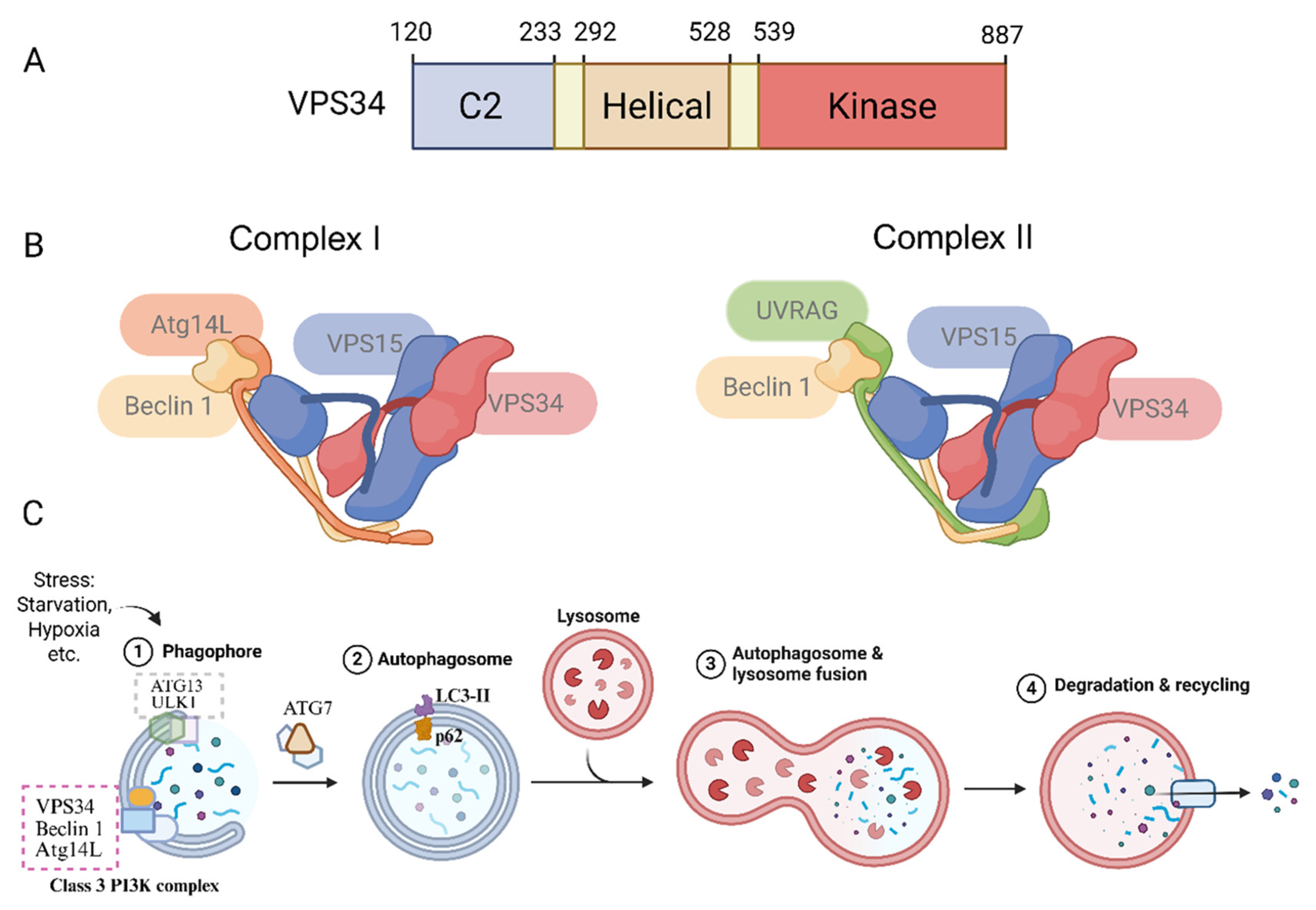
Figure 2.
Pan-cancer mRNA expression and prognostic significance of VPS34 (PIK3C3): (A) mRNA expression profile of VPS34 across various cancer types and adjacent normal tissues based on TCGA datasets. Statistical significance (* P < 0.05, ** P < 0.01, *** P < 0.001, ns: non-significant). Analysis using the TIMER 3.0 database; (B) Heatmap indicates the correlation between VPS34 expression and patient survival (Z-score). Red indicates high expression is associated with higher risk, while blue signifies low expression as a risk factor; Crossed boxes indicate statistically significant associations (P < 0.05). Analysis using the TIMER 3.0 database.
Figure 2.
Pan-cancer mRNA expression and prognostic significance of VPS34 (PIK3C3): (A) mRNA expression profile of VPS34 across various cancer types and adjacent normal tissues based on TCGA datasets. Statistical significance (* P < 0.05, ** P < 0.01, *** P < 0.001, ns: non-significant). Analysis using the TIMER 3.0 database; (B) Heatmap indicates the correlation between VPS34 expression and patient survival (Z-score). Red indicates high expression is associated with higher risk, while blue signifies low expression as a risk factor; Crossed boxes indicate statistically significant associations (P < 0.05). Analysis using the TIMER 3.0 database.
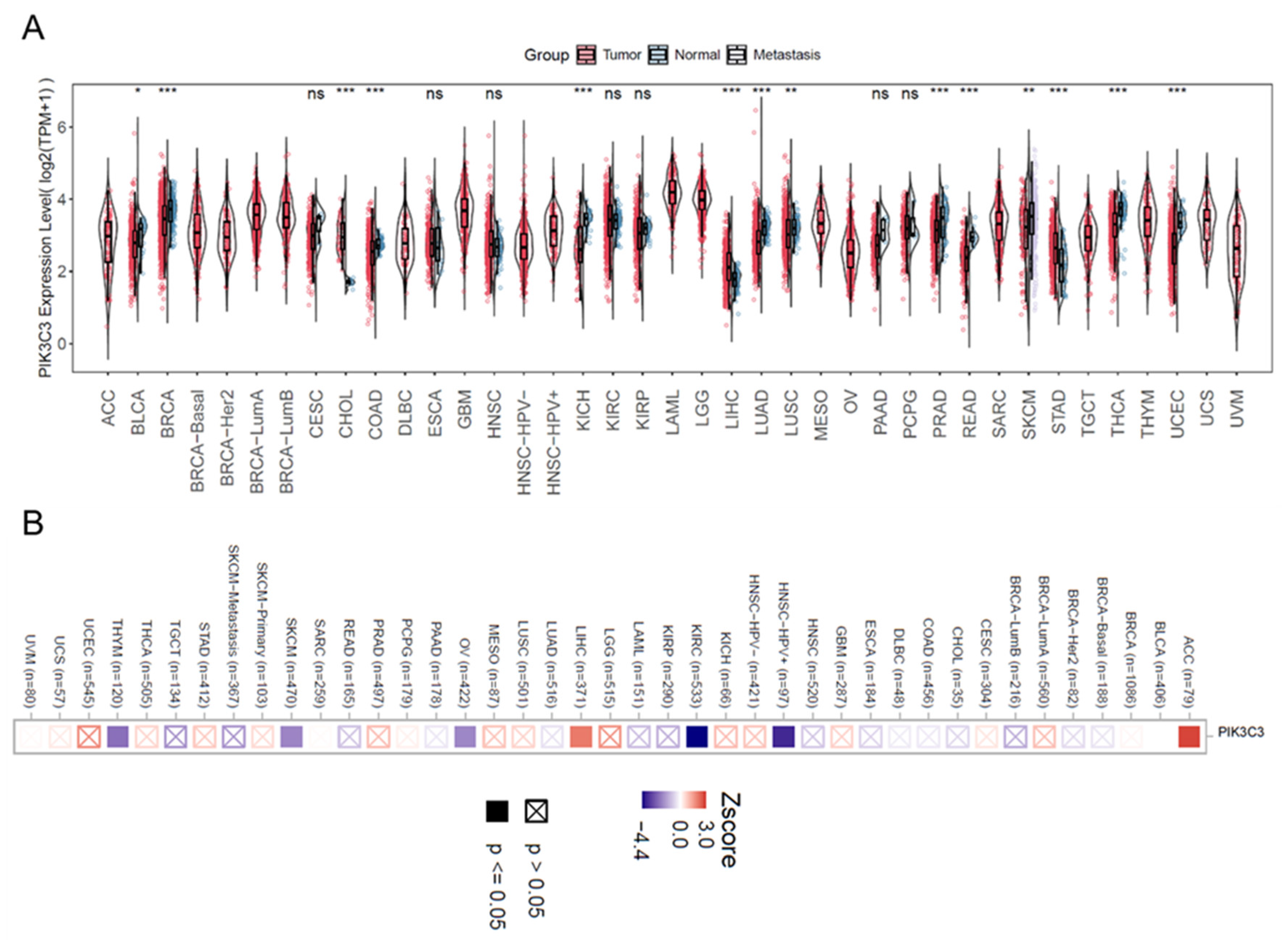
Figure 3.
Integrated roles of VPS34 in cancer and cancer immunotherapy: VPS34 (PIK3C3) regulates autophagy, cellular metabolism, and immune signaling in cancer. In early tumorigenesis, VPS34-mediated basal autophagy, maintains genomic stability and restrains tumor initiation. In established tumors, VPS34 supports tumor cell survival under metabolic stress, promotes EMT, cancer stemness, and therapeutic resistance. Within the tumor microenvironment, VPS34 shapes immune responses by regulating chemokine secretion (e.g., CCL5, CXCL10), hypoxia adaptation, and angiogenesis, and by controlling the function of dendritic cells, NK cells, T cells, and B cells. Pharmacological inhibition of VPS34 using selective inhibitors (SAR405, SB02024, VPS34-IN1, and PIK-III) enhances cGAS–STING signaling and type I interferon responses, promoting immune cell infiltration and converting “cold” tumors into “hot” tumors. Combination strategies with immune checkpoint blockade, STING agonists, or conventional therapies are proposed to improve antitumor efficacy. Created in BioRender. Janji, B. (2026) https://BioRender.com/d1gzz01.
Figure 3.
Integrated roles of VPS34 in cancer and cancer immunotherapy: VPS34 (PIK3C3) regulates autophagy, cellular metabolism, and immune signaling in cancer. In early tumorigenesis, VPS34-mediated basal autophagy, maintains genomic stability and restrains tumor initiation. In established tumors, VPS34 supports tumor cell survival under metabolic stress, promotes EMT, cancer stemness, and therapeutic resistance. Within the tumor microenvironment, VPS34 shapes immune responses by regulating chemokine secretion (e.g., CCL5, CXCL10), hypoxia adaptation, and angiogenesis, and by controlling the function of dendritic cells, NK cells, T cells, and B cells. Pharmacological inhibition of VPS34 using selective inhibitors (SAR405, SB02024, VPS34-IN1, and PIK-III) enhances cGAS–STING signaling and type I interferon responses, promoting immune cell infiltration and converting “cold” tumors into “hot” tumors. Combination strategies with immune checkpoint blockade, STING agonists, or conventional therapies are proposed to improve antitumor efficacy. Created in BioRender. Janji, B. (2026) https://BioRender.com/d1gzz01.
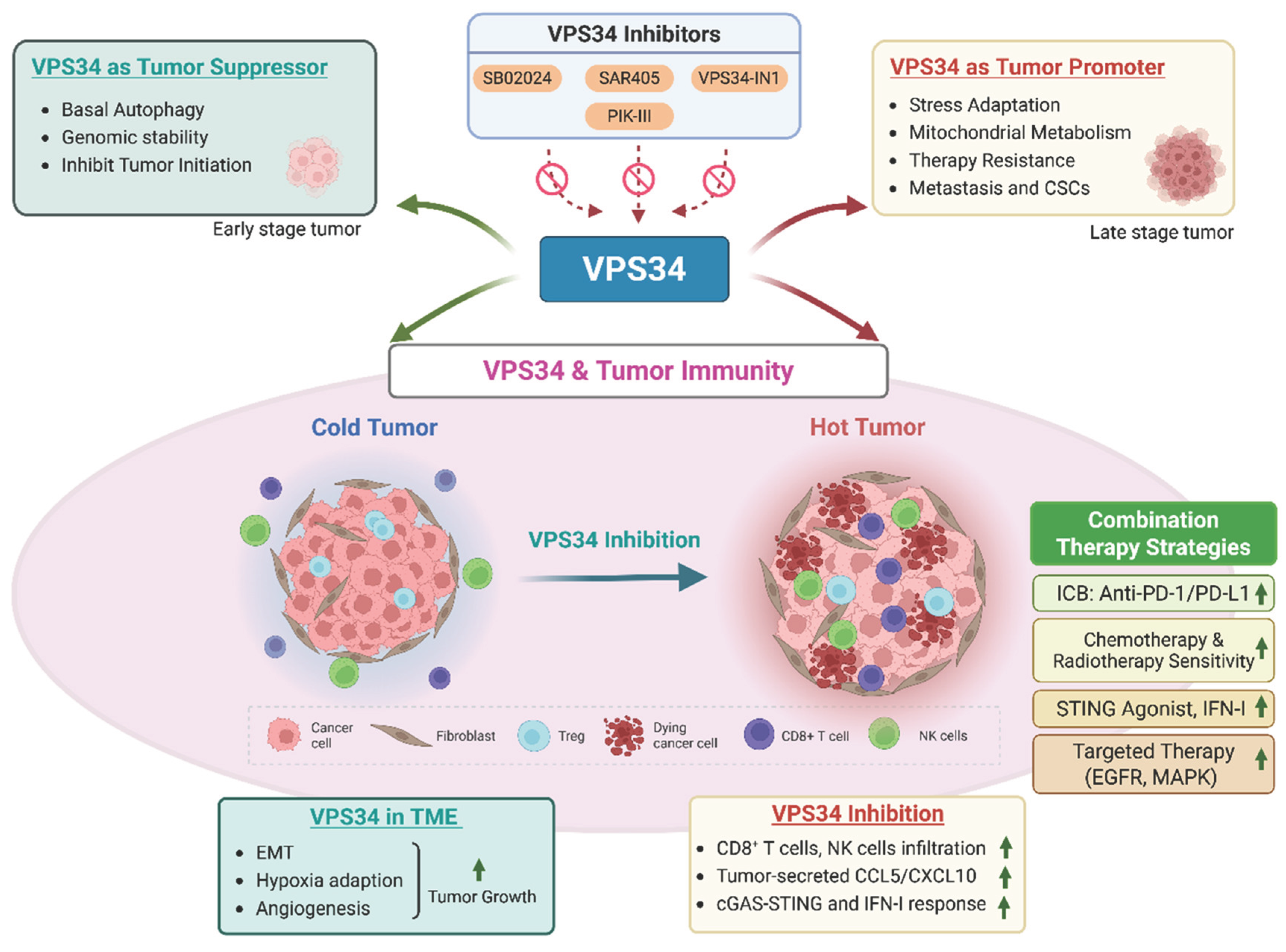
Disclaimer/Publisher’s Note: The statements, opinions and data contained in all publications are solely those of the individual author(s) and contributor(s) and not of MDPI and/or the editor(s). MDPI and/or the editor(s) disclaim responsibility for any injury to people or property resulting from any ideas, methods, instructions or products referred to in the content. |
© 2026 by the authors. Licensee MDPI, Basel, Switzerland. This article is an open access article distributed under the terms and conditions of the Creative Commons Attribution (CC BY) license (http://creativecommons.org/licenses/by/4.0/).
Copyright: This open access article is published under a Creative Commons CC BY 4.0 license, which permit the free download, distribution, and reuse, provided that the author and preprint are cited in any reuse.


