

Submitted:
03 March 2026
Posted:
04 March 2026
You are already at the latest version
Abstract
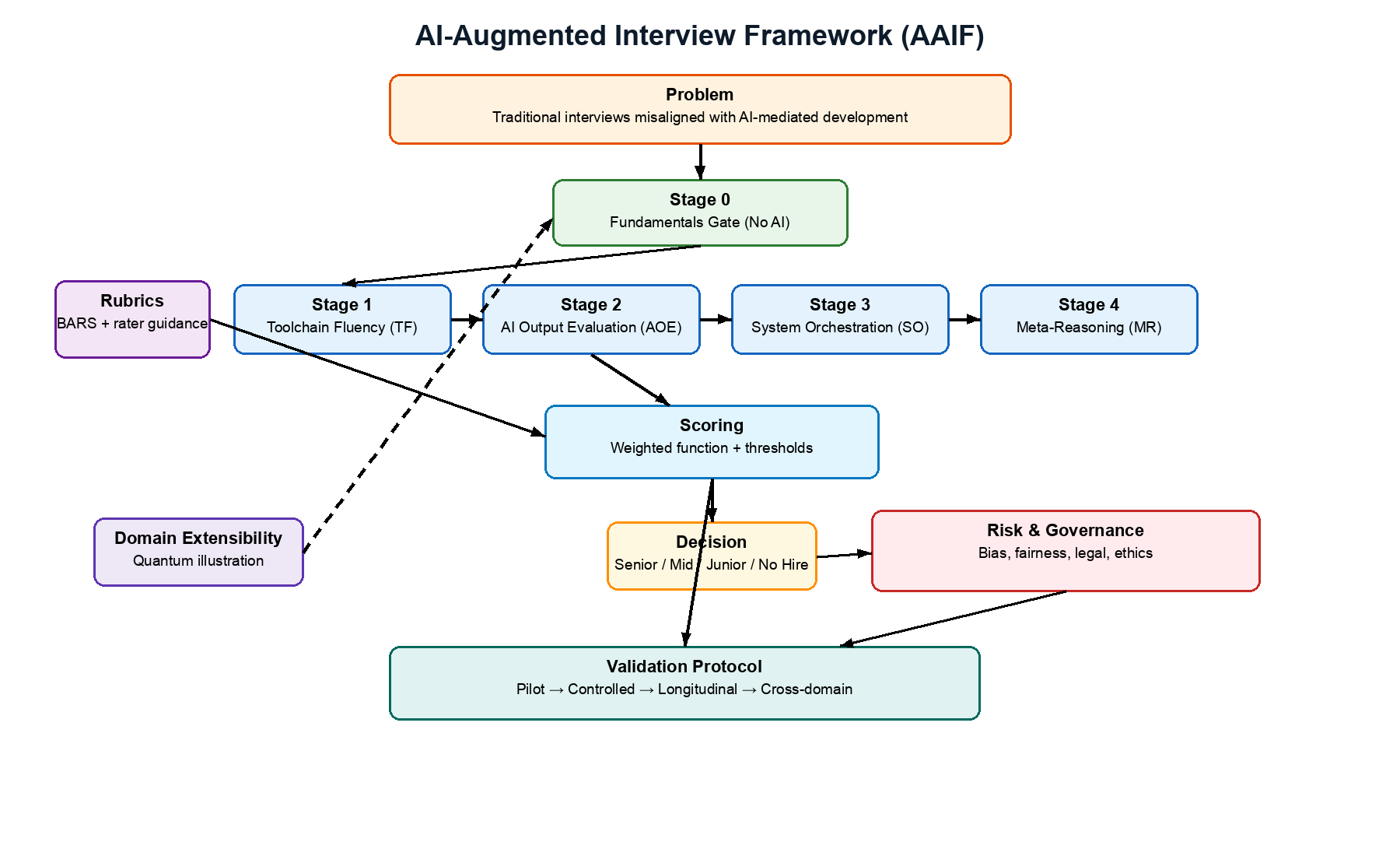
This paper presents a conceptual framework, the AI-Augmented Interview Framework (AAIF), requiring empirical validation before deployment. No interviews have been conducted; all thresholds, weights, and KPI linkages are conjectures pending empirical testing. The accelerating adoption of AI-powered development tools (GitHub Copilot, ChatGPT, Claude) is transforming software engineering practice. Industry surveys indicate that over 75% of professional developers now use AI coding assistants regularly (noting potential self-selection bias in survey samples), yet fewer than one in four organizations assess AI fluency during technical interviews. AAIF proposes a structured five-stage interview methodology (Stage 0 fundamentals gate plus four AI-augmented stages) for evaluating developer competencies in AI-mediated environments. The framework assesses: (1) toolchain fluency and prompt engineering, (2) AI output evaluation and critical reasoning, (3) system-oriented problem solving with AI integration, and (4) meta-reasoning about AI limitations, ethics, and failure modes. We develop evaluation rubrics with behaviorally anchored rating scales, propose configurable decision thresholds, and provide an integrated risk framework addressing bias, fairness, legal compliance, and ethical dimensions. The novelty lies in the systematic integration of established methods from industrial-organizational psychology, software engineering, and risk management for the specific and underexplored problem of assessing developers who use AI tools. A detailed four-phase empirical validation protocol is proposed as a key contribution.
Keywords:
AI-augmented technical interviews
; AI-augmented interview framework (AAIF)
; AImediated software development
; developer competency assessment
; human-AI collaboration
; technical hiring
; structured interviews
; behaviorally anchored rating scales (BARS)
; interview validity
; design science research
; output evaluation
; prompt engineering assessment
; socio-technical systems
; hiring fairness and bias mitigation
; responsible ai in recruitment
Copyright: This open access article is published under a Creative Commons CC BY 4.0 license, which permit the free download, distribution, and reuse, provided that the author and preprint are cited in any reuse.


