

Submitted:
03 March 2026
Posted:
04 March 2026
You are already at the latest version
Abstract
As service robots increasingly enter public buildings such as hospitals and offices, human-robot sharing space has emerged as a pivotal topic in architectural design field, yet its relevant theoretical framework remains underdeveloped and incomplete. Existing frameworks—including Human-Robot Interaction (HRI), Human-Robot Collaboration (HRC), and Human-Robot Coexistence—have advanced research on interaction, coordination, and safety, but most regard the built environment as a passive backdrop, overlooking its active design value. This review retrieved literatures from 2000 to 2026 across four databases (Web of Science, Scopus, IEEE Xplore, and ScienceDirect) and analyzed 183 core publications using CiteSpace, systematically synthesizing the interdisciplinary knowledge in this field. The study introduces "Human-Robot Sharing Space (HRSS)" as an independent conceptual framework, repositioning the built environment from an interactive background to a core design variable while clarifying its boundaries with other traditional frameworks. Through bibliometric analysis, it reveals the field’s evolutionary trajectory from basic technical exploration to scenario-specific refinement. Finally, five systematic gaps in current research are identified: interdisciplinary theoretical integration, transferability to real-world scenarios, multidimensional evaluation indicators, coverage of architectural typology, and longitudinal empirical studies. This review bridges the gap between robotic technology and architectural design needs, providing a theoretical foundation for constructing an environment-centric, scale-inclusive, and practical design framework for HRSS.
Keywords:
human–robot sharing space
; built environment
; spatial design
; human–robot interaction
; human–robot collaboration
; spatial intelligence
; scoping review
1. Introduction
As service robots increasingly enter civil buildings such as hospitals, offices, commercial spaces, and residences, the shared human-robot space is evolving from an experimental topic into a practical challenge for built environment design. Scholarship has demonstrated a paradigm shift in robotics research, moving beyond HRC (Human–Robot Collaboration) and HRI (Human–Robot Interaction) in traditional industrial units to address navigation, safety, comfort, and trust in open/semi-open environments. Further advancements now encompass digital twins, semantic path planning, and shared space management[1,2]. Reviews focusing on complex built environments have explicitly pointed out that existing HRC methods predominantly originate from manufacturing, logistics and outdoor construction. Systematic summaries and collaborative methods tailored to indoor built environments, which characterized by dynamic layouts, confined spaces, complex circulation patterns, and human-robot coupling, remain insufficient[3,4,5].
Concurrently, advancements in spatial intelligence and embodied intelligence are transforming the relationship between robots and space: robots are evolving beyond mere automated devices performing single tasks into new spatial agents capable of sustained movement, perception, avoidance, interaction, and even collaboration within architectural spaces. Consequently, the core challenge shifts from merely “enhancing robot algorithm performance” to constructing spaces that can be jointly understood, predicted, and utilized by both humans and robots. This shift is already evident in research on shared spaces and social navigation. For instance, in a review of socially aware navigation[2] robots entering everyday public and domestic spaces have driven research on “shared space management” and “social mapping”.
Furthermore, with the development of digital twins and semantic maps, increasing research highlights the role of “spatial intelligence” in shared scenarios. Achour et al. (2022) demonstrate that semantic maps not only support localization and path planning but also provide robots with cognitive interpretations of their environment, enabling context-based reasoning and decision-making[6]. Omer et al. (2025) further demonstrated how to utilize building digital twin data for heterogeneous robot semantic path planning, optimizing human-robot sharing space management through semantic-geometric information fusion[7]. However, these studies remain fragmented across domains such as robot navigation, HRI, and safety control, lacking a unified conceptual framework oriented toward spatial design.
Based on this research landscape, this paper introduces HRSS (Human–Robot Sharing Space) as the core perspective for examining how spaces should be designed, organized, and evaluated when robots enter civil buildings. Unlike HRI/HRC/HR-Coexistence frameworks, HRSS elevates architectural space from a contextual background to a key element alongside humans and robots. In this way, space is not merely a container but an interactive interface, a mechanism for behavioral coordination, and a vehicle for governance. Within this framework, human-robot sharing space issues are reframed as a coupled problem involving “human–robot–space–rules.” The focus lies on how spatial form and streamline organization influence human comfort and robotic efficiency and how interfaces and nodes facilitate human-robot shared scenarios and design collaboration.
This review aims to achieve two objectives: (1) Systematically trace the thematic evolution, methodological frameworks, and application scenarios of HRI, HRC, HR-Coexistence, and shared-space research, identifying the shift “from task-center to space-center” approaches. (2) Establishing the HRSS conceptual framework, clarifying its distinctions and continuities with HRI/HRC/HR-Coexistence, and defining its correspondence with architectural design spaces (function, circulation, interfaces, nodes, operational infrastructure).
The objectives of this review are threefold. First, proposing the “design-evaluation integration” perspective of HRSS, explicitly defining human-robot sharing space as a socio-technical-spatial coordination problem within the built environment; Second, connecting robot interaction research and architectural spatial design by distinguishing the hierarchical levels of HRI/HRC/HR-Coexistence and HRSS; Third, it proposes a discussion framework for human-robot sharing space design in civil architecture based on the paradigm shift “from replacement to enhancement and symbiosis,” providing theoretical support for subsequent studies on strategic patterns and spatial evolution.
The remainder of this paper is organized as follows: Section 2 introduces the systematic literature review methodology, including database selection and retrieval strategies; Section 3 conducts thematic analysis of the literature around the HRSS framework; Section 4 presents a critical synthesis discussion; and Section 5 concludes the paper.
2. Materials and Methods
This study systematically reviews the current state and emerging trends of human-robot sharing space design within the built environment from the perspective of spatial intelligence. Adopting a hybrid approach of scoping review and science mapping, the research follows the PRISMA-ScR (Preferred Reporting Items for Systematic Reviews and Meta-Analyses extension for Scoping Reviews) guidelines for systematic identification, screening, and evaluation. CiteSpace is further employed to visualize the evolution of knowledge structures and thematic clusters. The overall research process is divided into four stages (Figure 1).
- Literature Search
The literature search was conducted in January 2026 across four primary databases: Web of Science (WOS), Scopus, IEEE Xplore, and ScienceDirect (SD), ensuring comprehensive coverage of architecture, robotics, human-robot interaction (HRI), and computer science. No temporal restrictions were applied to fully capture the field’s evolutionary trajectory.
Based on preliminary searches, two core keyword categories were identified: Architecture/Built Environment (5 keywords): Building, Built Environment, Shared Space, Spatial Design, Indoor Environment; Human-Robot/Robotics (7 keywords): Human-Robot Collaboration, Human-Robot Interaction, Human-Robot Coexistence, Embodied Intelligence, Service Robot, Mobile Robot, Spatial Intelligence. A consistent search strategy was implemented across all four databases using the following Boolean logic: (HRC OR human–robot collaboration OR human–robot interaction OR human–robot coexistence OR human–computer interaction OR man–machine interaction) AND (built environment OR building OR indoor environment OR shared space OR spatial design OR spatial intelligence). The initial search yielded N0 = 553 records (including duplicates).
- 2.
- Preliminary Screening
Limited to English-language documents and publication types including journal articles and conference papers. The selection was further limited by subject categories (Engineering, Robotics, Architecture, Computer Science, and Human-Computer Interaction), publication status (Final version), and language (English). After applying these filters, 227 documents remained. The multi-database search results were imported into EndNote for deduplication. Combining automated detection with manual verification, 9 duplicate documents were removed, leaving 218 documents for the next phase.
- 3.
- Screening and Selection
Two independent reviewers (Tang, Mao) assessed the relevance of the above articles. This stage excluded 15 articles, with 203 proceeding to full-text review. Ultimately, 183 articles were selected.
- 4.
- Inclusion and Data Analysis
For the final 183 included articles, two types of analysis were conducted: (1) Data extraction: The following basic information was extracted from each paper (author, year, journal/conference, country, institution); human-computer interaction elements (safe distance, navigation strategies). (2) Thematic synthesis and science mapping: Citespace (version 6.4) was employed to conduct visual analysis of bibliometric data.
3. Results
This study conducted a bibliometric analysis of 183 publications using CiteSpace. The following findings systematically reveal the temporal evolution, publication venues, disciplinary focus, geographic distribution, and key foci within the field of “ Human-Robot Sharing Space”
This section may be divided by subheadings. It should provide a concise and precise description of the experimental results, their interpretation as well as the experimental conclusions that can be drawn.
3.1. Field Growth of Annual Publication Trend
Figure 2 illustrates the annual publication trend of the field from 2000 to 2026, reflecting the growing academic attention. The field was in an embryonic stage before the mid-2010s, with an average annual publication volume of only 1-2 papers between 2000 and 2014, indicating that interdisciplinary integration had not yet formed a scale. The period 2015-2019 witnessed slow growth, with the average annual publication count rising to 4-6 papers, marking the initial convergence between robotic technology and architectural spatial requirements. After 2020, the field entered a period of explosive growth, with 119 cumulative publications between 2020 and 2025 (accounting for 65% of the total literature), and 41 papers were published in 2025 alone, representing a 355.6% increase compared to 2019 (9 papers).
In terms of publication types, conference papers dominated before 2019, with early research primarily focusing on the prototype verification and rapid exchange of robotic technologies and interactive algorithms. After 2020, the proportion of journal papers surpassed and continued to rise, accounting for 67.4% of all publications over seven years. This shift reflects the transition of research from rapid exploration to systematic design and theoretical synthesis, indicating that the field has gradually formed a stable academic paradigm and research frameworks.
3.2. Publication Venue Distribution: Journal/Conference Output Map
Figure 3 presents the distribution of 183 publications across core journals and conference proceedings, revealing the academic carrier characteristics of the field. Research outputs are mainly concentrated in journals in the fields of robotics and intelligent manufacturing: Robotics and Computer-Integrated Manufacturing published 13 papers, and Robotics and Autonomous Systems published 12 papers, collectively accounting for 13.7% of the total literature. This indicates that current research remains fundamentally anchored in robotic technology systems.
Among architecture-related carriers, Automation in Construction is the only core journal explicitly focusing on the architectural field, publishing 4 papers (2.2% of the total literature). Its relatively low proportion reflects that specialized research on this theme within the architectural discipline is still in its nascent stage, yet to establish an independent academic platform.
Conference proceedings have contributed substantial interdisciplinary outcomes. Among them, the ACM/IEEE International Conference on Human-Robot Interaction published 6 papers, and the IEEE International Conference on Intelligent Robots and Systems published 5 papers. Together with other conference papers, they account for 10.4% of the total literature. Focusing on cutting-edge directions such as technical prototype validation[8,9] and interaction mechanism exploration[10,11,12], these papers provide crucial technological reserves for the field’s advancement.
The overall distribution of publication venues shows that the field is currently driven by robotics-oriented research, with some applications extended to architectural contexts. It relies heavily on interdisciplinary platforms to bridge disciplinary gaps.
3.3. Density Distribution by Discipline Classification
Figure 4 reveals that the field is a typical technology-intensive interdisciplinary field, where technical disciplines provide core capabilities, applied disciplines clarify implementation directions, and foundational disciplines ensure technical feasibility. This reflects the dual dependence on technological innovation and scenario adaptation, confirming that interdisciplinary collaboration is the core driving force for the development of the field.
In terms of the number of publications, among 28 disciplines, Robotics, Computer Science, Artificial Intelligence, and Automation and Control Systems dominate, accounting for 40.4% (59 papers) of all disciplinary types, providing underlying support for human-robot collaboration in architectural spaces.
Concurrently, engineering and manufacturing disciplines, as pivotal fields within applied sciences, also constitute a significant segment of this field. Among them, Construction and Building Technology, which is directly related to the core application scenarios of this study, has 6 papers accounting for 4.1% of the total. It focuses on architectural space layout adaptation[20,29], human-robot collaboration workflow design in construction scenarios[30,31], and human-robot symbiosis optimization in the built environment[13,27]. Its core role is to bridge robotic technology with the practical demands of architectural spaces, addressing the critical challenge of adapting robotic systems to building environments.
In addition, other foundational disciplines such as materials science, environmental monitoring, and geospatial modeling also make sporadic contributions. Their research content provides basic theories, materials, and detection support for technological research and development. Examples include sensitivity optimization of sensor materials[32], 3D modeling and positioning of architectural spaces[33,34], and detection technologies for architectural environmental pollutants[5].
3.4. Geographic Distribution and Country Collaboration Network
Figure 5 visually presents the geographic distribution and collaboration network of the publications, revealing the research pattern of 29 countries worldwide. The overall contribution pattern comprises a dual core of China and the United States, flanked by a secondary cluster of European nations. China and the United States have a total of 72 person-times, accounting for 30.6% of the total collaborations, with both countries experiencing early bursts of activity prior to 2010. Multiple European countries form a secondary cluster, with 20 countries accounting for approximately 40.9% of the publications, predominantly concentrated after 2009.
Chronologically, the United States started research earlier, with significant progress in 2004; China’s publications clustered around 2010, with rapid development of interdisciplinary research, which is highly related to domestic policy orientations such as smart construction and new-type building industrialization. Both nations have maintained stable activity throughout the entire period, collaborating closely with countries such as Germany, Italy, the Netherlands, and Canada.
This geographic distribution and collaboration pattern indicate that research on “Human-Robot Sharing Space” has been a global frontier focus over the past decade. Contributions and collaborations are concentrated in regions possessing architectural innovation capabilities, robotic engineering strength, and policy support. Cross-regional collaboration is poised to become a significant trend in the future development of the field.
3.5. Keywords Co-Occurrence Cluster Map
The keyword co-occurrence cluster map shown in Figure 6 divides the literature into 13 thematic clusters based on keyword co-occurrence strength, forming a thematic network structure radiating from the core field to other disciplines and further forming an integrated connection. The network center, #0 Human-Robot Collaboration (HRC) (red cluster), includes 43 keywords with 141 co-occurrence instances, accounting for 13.2% of the total frequency. This confirms its role as the interdisciplinary core linking robotics and architecture, permeating the entire research process.
Centered around the #0 cluster, three complementary radiating dimensions form the primary framework of the field’s research.
- Technical Support Clusters: Including #3 Deep Reinforcement Learning, #6 Robotic Technology, and #10 Distributed Graph Optimization. These clusters contain 85 keywords with a total co-occurrence frequency of 243 (22.8%), focusing on customized algorithms and engineering support for architectural scenarios. #3 primarily investigates intelligent algorithms for path planning[35,36] and task allocation[37]; #6 centers on engineering challenges like robot hardware design[38] and sensor fusion[39]; #10 addresses optimization methods for multi-robot collaboration[40,41]. Together, they form the technical foundation of “Human-Robot Sharing Space”.
- Interaction Mechanism Clusters: Including #1 Proxemics, #8 Cognitive Interaction, and #12 Human Observation. These clusters comprise 82 keywords with a total co-occurrence frequency of 186 (17.5%), exploring human-centered design logic: #1 focuses on issues such as spatial distance norms[42] and social distance adaptation between human and robots in architectural environments[43,44]; #8 investigates advanced interaction mechanisms such as robot recognition of human intentions and emotional perception[45,46,47]; #12 addresses on acquiring human behavioral data through visual, tactile, and other sensors to provide a basis for interaction decisions[48,49,50].
- Scenario Application Clusters: Including #2 Navigation, #7 Collaborative Robotics, #9 Map Building, and #13 Pedestrian Navigation. They contain 104 keywords with 230 co-occurrence instances (21.6%). This dimension directly addresses behavioral patterns and collaborative tasks in architectural spaces. #2 and #13 primarily investigate autonomous navigation[7,51] and human-robot cooperative navigation within buildings[52,53]; #7 focuses on practical applications of industrial robots and service robots in construction and spatial services[31,54,55]; #9 concentrates on basic supporting technologies such as 3D modeling[56] and semantic map generation for architectural environments[57,58].
Additionally, #5 Social Robot Collaboration serves as a core connecting node between the technical support and scenario application dimensions, driving research toward multidimensional adaptation rather than purely technical implementation. Keywords within this cluster such as “intelligent robots”, “social robot”, and “collaboration” reflect a shift from isolated technical implementation toward multi-dimensional alignment between robotic functions, architectural capabilities, and human social habits. Clusters such as #4 Human Robot Interaction and #11 Technology in HRCs form cross-dimensional associations, further strengthening the synergy of the three dimensions of technology, interaction, and scenarios, indicating that field research is evolving from fragmented technical exploration to systematic integrated innovation.
In terms of cluster intensity, the core cluster #0 exhibits a modularity index Q=0.65, with an average silhouette value S=0.87 across all clusters. This indicates a well-defined clustering structure and high thematic distinctiveness, suggesting the field has established a relatively mature thematic framework. Its development trend is shifting from singular technological breakthroughs to multi-dimensional systematic integration, with a particular focus on the collaborative optimization of “Human-Robot Sharing Space”.
4. Discussion
4.1. Research Evolution: From Technical Integration to Paradigm Shift
Through a bibliometric analysis of 183 core documents, this study systematically reveals the development trajectory and knowledge structure of the field of “architectural space design from the perspective of Human-Robot sharing.” The analysis results indicate that this field has transitioned from the early stages of technological emergence and prototype validation to a phase of explosive growth characterized by system integration and theoretical construction. This field has formed an interdisciplinary pattern with robotics, artificial intelligence, and automated control as the core technologies, and construction and building technology as the application scenarios. Through technologies such as deep reinforcement learning path planning[21] and visual reasoning and semantic mapping[8], foundational empowerment is provided; by addressing the issue of how robotic technology can deeply adapt to physical space layouts and construction processes[59], application scenarios for Human-Robot collaboration are offered.
Current research consistently centers on Human-Robot collaboration (HRC), giving rise to three main dimensions, including technical support, interaction mechanisms, and scene applications. The research focus is shifting from a singular emphasis on technical support (such as hardware design and sensor fusion) to a broader scope, deeply integrating interaction mechanisms (such as Proxemics, cognitive and emotional interactions) with scene applications (such as collaborative navigation within buildings). This multidimensional and systematic evolution of themes indicates that to achieve truly safe and efficient Human-Robot collaboration within architectural spaces, it cannot be limited to the mechanical performance of robots. It is also necessary to incorporate human physiological and psychological factors, spatial semantics, and social norms into a closed system, achieving a paradigm shift from Human-Robot coexistence to Human-Robot sharing.
4.2. Paradigm Shift from HRC/HRI to HRSS
As robots move from enclosed industrial settings into open architectural environments such as hospitals, offices, and homes, the human, robot relationship is undergoing a paradigm transition from conventional Human-Robot Interaction (HRI), Human-Robot Collaboration (HRC), and Human-Robot Coexistence (HR-Coexistence) toward Human-Robot Sharing Space (HRSS), where interaction and collaboration evolve into a deeper logic of “sharing.” This transition represents a broader restructuring of research reasoning, manifested as systematic shifts across three core dimensions: the research object, governance mechanisms, and methodologies.
Authors should discuss the results and how they can be interpreted from the perspective of previous studies and of the working hypotheses. The findings and their implications should be discussed in the broadest context possible. Future research directions may also be highlighted.
- At the level of research objects, the focus has shifted from Human-Robot interaction to the ternary system of Human-Robot-Space. In traditional frameworks, space is often viewed as a static background or external constraint (passable areas, safety distances, obstacle sets) for interaction or collaboration. HRI focuses on the immediate communication and behavioral dimensions between humans and robots, such as spatial language commands[60] and proxemic behavior[61]. HRC introduces task-oriented coordination into the framework, but its spatial scope is still strictly limited to work tasks[37,62,63]. However, while HR-Coexistence focuses on traffic order, social acceptability, and long-term operation[64] in shared environments, it still does not consider space as a core design variable.
From the HRSS perspective, architectural space is elevated to an endogenous variable. Architectural space is no longer a passive carrier but an interactive interface and governance infrastructure that requires active organization, evaluation, and iteration. The core of the research emphasizes how spatial layouts can adapt to the occupancy needs of multiple entities, transforming architectural interfaces into “spatial interfaces” with governance functions, achieving a transition from binary interaction to ternary coupling.
- 2.
- Governance mechanisms have expanded from simple physical obstacle avoidance to perception safety and social interaction. Early safety logic primarily focused on avoiding physical collisions, ensuring that the robot’s end effector or the machine itself would not have unintended contact with humans[65,66]. In the context of HRS, the concept of “safety” has expanded to a multidimensional integration of physical safety, perceived safety, trust, and psychological comfort[67,68]. Conflict resolution in sharing spaces not only relies on planning algorithms but also needs to incorporate social rules and considerations of human behavioral uncertainties. For example, dynamic modeling of personal space based on proxemics and recognition of uncomfortable scenarios can enhance the readability and predictability of the space, thereby reducing psychological stress and anxiety in humans within dynamic coexistence environments[69]. Architectural space design has been endowed with the social function of enhancing Human-Robot trust and reducing cognitive load[70]. Therefore, the core goal of HRSS has been upgraded to Human-Robot symbiosis that is understandable, predictable, and socially acceptable.
- 3.
- At the methodological level, the requirements of HRSS for spatial intelligence have evolved from rule-driven to semantic representation and virtual-real collaboration. To address the complexity of unstructured architectural spaces, traditional metric maps are being replaced by semantic maps that integrate functional semantics and logical relationships[2], enabling robots to adaptively adjust their behavior logic based on spatial context[6]. The Task and Motion Planning (TAMP) framework has been introduced to resolve conflict negotiations for core spatial resources such as corridors and elevators[35,36,37]. Therefore, semantic representation is not merely a robotics issue but a spatial intelligence requirement that links robotic perception with architectural planning.
At the same time, Digital Twin technology builds the infrastructure for virtual and physical collaboration, enabling iterative optimization of spatial layout and robotic strategies[24,47] through the simulation of human behavior patterns before physical deployment. And integrate technologies such as TAMP, multimodal communication, mixed reality interfaces, deep learning, and predictive modeling[22], embedding HRSS spatial semantic maps, collectively forming an intelligent toolkit for multimodal collaboration, providing full-process support from virtual simulation to physical deployment for Human-Robot sharing at the architectural scale.
4.3. Definition of HRSS for Built Environment Design
The paradigm shifts in the research objects, governance mechanisms, and methodologies requires us to go beyond traditional terms of collaboration and interaction, and to propose a more inclusive definition for Human-Robot sharing environments. This study defines the Human-Robot Sharing Space (HRSS) as a deliberately designed, configured, and managed built environment, aimed at supporting simultaneous, safe, readable, and mutually adaptive spatial occupancy for humans and autonomous robots in various functional scenarios. HRSS places the built environment at the core of design, encompassing spatial layout, circulation, physical attributes, and digital infrastructure, while integrating physical safety, perceptual safety, and operational efficiency as equally important design goals (Table 1).
Compared to existing research concepts, this definition has four core characteristics.
- Environment-centricity: Unlike HRI/HRC, which focuses on Human-Robot interaction, HRSS centers on architectural systems that accommodate all elements, viewing the architectural system itself as the primary design variable for coordinating Human-Robot relationships.
- Scale Inclusiveness: The conceptual framework encompasses cross-scale scenarios, ranging from small-scale individual rooms (such as shared hospital rooms with care robots), to medium-scale entire buildings (such as logistics hospitals with robots), and to large-scale urban districts (such as campuses with automated delivery vehicles).
- Multi-objective Synergy: Emphasizes the dynamic balance of zero collisions in the physical dimension, perceived safety in the psychological dimension, and dynamic balance of system operation efficiency.
- Temporal Dynamism: With the help of digital twins and semantic mapping, HRSS can respond to the real-time evolution of Human-Robot configurations throughout the building lifecycle, achieving long-term sustainability in spatial governance.
5. Conclusions
This review introduces Human–Robot Sharing Space (HRSS) as an integrative, spatial design–centered framework that repositions the built environment from a passive container to an active design variable. Through a PRISMA-ScR scoping review and CiteSpace-based mapping, we show that the field has evolved from early work focused on navigation and collision avoidance toward more scene-oriented research and spatial design, with increasing attention to social interaction, semantic understanding, and related emerging techniques. Within this trajectory, the review identifies three coupled paradigm shifts: (1) the unit of analysis expands from a human–robot dyad to a human–robot–space triad; (2) the scope of human–robot relations extend from physical safety to perceived safety, legibility, and predictability; and (3) HRSS emerges as a multiscale, multi-objective design paradigm linking engineering performance with spatial experience.
This study has several limitations. First, the bibliometric corpus was restricted to English-language publications indexed in four databases, which may underrepresent contributions from non-English research communities, as well as practice-oriented architectural knowledge that circulates through design competitions, professional guidelines, and built-project documentation rather than academic journals. Second, the thematic synthesis relies on heterogeneous studies with different tasks, environments, and evaluation protocols, which complicates cross-study comparison and limits our ability to derive generalizable spatial thresholds or design rules. In addition, the HRSS framework proposed here remains at a conceptual stage. Its operationalization into testable design principles, quantifiable spatial parameters, and evaluation protocols still requires empirical validation across diverse building typologies, cultural contexts, and robot morphologies.
The shift from “designing space for humans” to “designing space for human–robot cohabitation” is not simply a technical upgrade; it represents an expansion of the architectural design paradigm. As robots take on increasingly diverse roles—such as caregivers in hospitals, guides in museums, couriers in offices, and companions in homes—the built environment must evolve from a stage where human–robot encounters merely occur into an active infrastructure that shapes the quality, safety, and social acceptability of those encounters. The HRSS framework proposed in this review offers an initial concept for robotic engineering intelligence and architectural spatial intelligence. By coordinating space prototype modification, environmental cues, and operational governance with robot capabilities, architecture can more systematically support safe, understandable and socially acceptable human–robot sharing.
Author Contributions
Conceptualization, Z.L., M.T. and M.L.; methodology, M.T., M.L. and Q.M.; software, M.T. and Q.M.; validation, M.T., M.L. and Q.M.; formal analysis, M.T., M.L. and Q.M.; writing—original draft preparation, M.T. and M.L.; writing—review and editing, Z.L., M.T., Q.M. and M.L; visualization, M.T. and Q.M.; supervision, M.L. All authors have read and agreed to the published version of the manuscript.
Data Availability Statement
Data will be made available on request.
Conflicts of Interest
The authors declare no conflict of interest.
Abbreviations
The following abbreviations are used in this manuscript:
| HRI | Human-Robot Interaction |
| HRC | Human-Robot Collaboration |
| HR-Coexistence | Human-Robot Coexistence |
| HRSS | Human-Robot Sharing Space |
References
- Duorinaah, F.X.; Rajendran, M.; Kim, T.W.; Kim, J.I.; Lee, S.; Lee, S.; Kim, M.-K. Human and Multi-Robot Collaboration in Indoor Environments: A Review of Methods and Application Potential for Indoor Construction Sites. Buildings 2025, 15. [Google Scholar] [CrossRef]
- Charalampous, K.; Kostavelis, I.; Gasteratos, A. Recent Trends in Social Aware Robot Navigation: A Survey. Rob. Auton. Syst. 2017, 93, 85–104. [Google Scholar] [CrossRef]
- Li, H.; Ding, X. Adaptive and Intelligent Robot Task Planning for Home Service: A Review. Eng. Appl. Artif. Intell. 2023, 117. [Google Scholar] [CrossRef]
- Li, Z.; Yu, Y.; Zeng, N.; Tian, F.; Zhang, S.; Sun, H.; Li, Q. Human-Centric Human-Robot Collaboration in on-Site Construction(2014-2024): Advances, Barriers, and Future Directions. Autom. Constr. 2025, 180. [Google Scholar] [CrossRef]
- Hu, X.; Assaad, R.H. A BIM-Enabled Digital Twin Framework for Real-Time Indoor Environment and Visualization by Integrating Autonomous Robotics, LiDAR-Based 3D Mobile Mapping, IoT Sensing, and Indoor Positioning. JOURNAL OF BUILDING ENGINEERING 2024, 86. [Google Scholar] [CrossRef]
- Achour, A.; Al-Assaad, H.; Dupuis, Y.; El Zaher, M. Collaborative Mobile Robotics for Semantic Mapping: A Survey. APPLIED SCIENCES-BASEL 2022, 12. [Google Scholar] [CrossRef]
- Omer, K.; de Vos, K.; Pauwels, P.; Torta, E.; Monteriù, A. Semantic Path Planning for Heterogeneous Robots from Building Digital Twin Data. Lecture Notes in Computer Science 2025, 15570 LNAI, 56–67. [Google Scholar] [CrossRef]
- Zheng, P.; Li, S.; Xia, L.; Wang, L.; Nassehi, A. A Visual Reasoning-Based Approach for Mutual-Cognitive Human-Robot Collaboration. CIRP Annals 2022, 71, 377–380. [Google Scholar] [CrossRef]
- Yang, S.; Kang, S.; Kim, M.; Kim, D. Human-Aware Waypoint Planner for Mobile Robot in Indoor Environments. In Proceedings of the Proceedings - 2022 6th IEEE International Conference on Robotic Computing, IRC 2022, 2022; Institute of Electrical and Electronics Engineers Inc.; pp. 287–291. [Google Scholar]
- Huettenrauch, H.; Eklundh, K.S.; Green, A.; Topp, E.A. Investigating Spatial Relationships in Human-Robot Interaction. In Proceedings of the IEEE International Conference on Intelligent Robots and Systems, Beijing, 2006; pp. 5052–5059. [Google Scholar]
- Truong, X.-T.; Yoong, V.N.; Ngo, T.-D. Dynamic Social Zone for Human Safety in Human-Robot Shared Workspaces. In Proceedings of the 2014 11th International Conference on Ubiquitous Robots and Ambient Intelligence, URAI 2014, 2014; Institute of Electrical and Electronics Engineers Inc.; pp. 391–396. [Google Scholar]
- Kathuria, T.; Xu, Y.; Chakhachiro, T.; Yang, X.J.; Ghaffari, M. Providers-Clients-Robots: Framework for Spatial-Semantic Planning for Shared Understanding in Human-Robot Interaction. In Proceedings of the RO-MAN 2022 - 31st IEEE International Conference on Robot and Human Interactive Communication: Social, Asocial, and Antisocial Robots, 2022; Institute of Electrical and Electronics Engineers Inc.; pp. 1099–1106. [Google Scholar]
- Olukanni, E.; Akanmu, A.; Jebelli, H. Systematic Literature Review of Competencies for Human-Robot in Construction: A Task-Technology Fit Perspective. JOURNAL OF COMPUTING IN CIVIL ENGINEERING 2026, 40. [Google Scholar] [CrossRef]
- Asif, S.; Callari, T.C.; Khan, F.; Eimontaite, I.; Hubbard, E.-M.; Bahraini, M.S.; Webb, P.; Lohse, N. Exploring Tasks and Challenges in Human-Robot Collaborative Systems: A. Robot. Comput. Integr. Manuf. 2026, 97. [Google Scholar] [CrossRef]
- Mantha, B.R.K.; Jung, M.K.; de Soto, B.G.; Menassa, C.C.; Kamat, V.R. Generalized Task Allocation and Route Planning for Robots with Multiple in Indoor Building Environments. Autom. Constr. 2020, 119. [Google Scholar] [CrossRef]
- Qian, K.; Xu, X.; Liu, H.; Bai, J.; Luo, S. Environment-Adaptive Learning from Demonstration for Proactive in Human-Robot Collaborative Tasks. Rob. Auton. Syst. 2022, 151. [Google Scholar] [CrossRef]
- Rodrigues, P.B.; Singh, R.; Oytun, M.; Adami, P.; Woods, P.J.; Becerik-Gerber, B.; Soibelman, L.; Copur-Gencturk, Y.; Lucas, G.M. A Multidimensional Taxonomy for Human-Robot Interaction in Construction. Autom. Constr. 2023, 150. [Google Scholar] [CrossRef]
- Macalupu, V.; Miller, E.; Martin, L.; Caldwell, G. Human-Robot Interactions and Experiences of Staff and Service Robots in aged Care. Sci. Rep. 2025, 15. [Google Scholar] [CrossRef] [PubMed]
- Semeraro, F.; Griffiths, A.; Cangelosi, A. Human–Robot Collaboration and Machine Learning: A Systematic Review of Recent Research. Robot. Comput. Integr. Manuf. 2023, 79, 102432. [Google Scholar] [CrossRef]
- Nikolakis, N.; Maratos, V.; Makris, S. A Cyber Physical System (CPS) Approach for Safe Human-Robot in a Shared Workplace. Robot. Comput. Integr. Manuf. 2019, 56, 233–243. [Google Scholar] [CrossRef]
- Li, Z.; Shi, N.; Zhao, L.; Zhang, M. Deep Reinforcement Learning Path Planning and Task Allocation for Multi-Robot Collaboration. Alexandria Engineering Journal 2024, 109, 408–423. [Google Scholar] [CrossRef]
- Liu, Z.; Liu, Q.; Xu, W.; Liu; Zude, Z.; Zhou; Chen, J. Deep Learning-Based Human Motion Prediction Considering Context for Human-Robot Collaboration in Manufacturing. In Proceedings of the 11TH CIRP CONFERENCE ON INDUSTRIAL PRODUCT-SERVICE SYSTEMS; Huang, G.Q., Qu, T., Thurer, M., Xu, S., Khalgui, M., Eds.; Radarweg 29, PO Box 211, AMSTERDAM, NETHERLANDS: ELSEVIER, 2019; Vol. 83, pp. 272–278. [Google Scholar]
- Fan, J.; Zheng, P.; Li, S. Vision-Based Holistic Scene Understanding towards Proactive Human–Robot Collaboration. Robotics and Computer Integrated Manufacturing 2022, 75. [Google Scholar] [CrossRef]
- Liu, X.; Li, G.; Xiang, F.; Tao, B.; Jiang, G. A Digital Twin-Driven Method for Improving Human Comfort in Human-Robot. INTERNATIONAL JOURNAL OF ADVANCED MANUFACTURING TECHNOLOGY 2025, 137, 339–359. [Google Scholar] [CrossRef]
- Huang, J.; Gao, J.; Yu, Z. Orchestrating Mechanics, Perception and Control: Enabling Embodied Intelligence in Humanoid Robots. Inf. Process. Manag. 2026, 63. [Google Scholar] [CrossRef]
- Islam, S.O.B.; Lughmani, W.A. A Connective Framework for Social Collaborative Robotic System. Machines 2022, 10. [Google Scholar] [CrossRef]
- Ferraguti, F.; Landi, C.T.; Costi, S.; Bonfe, M.; Farsoni, S.; Secchi, C.; Fantuzzi, C. Safety Barrier Functions and Multi-Camera Tracking for Human-Robot Environment. Rob. Auton. Syst. 2020, 124. [Google Scholar] [CrossRef]
- Sousa, L.C.; Silva, Y.M.R.; Schettino, V.B.; Santos, T.M.B.; Zachi, A.R.L.; Gouvea Josiel, A.; Pinto, M.F. Obstacle Avoidance Technique for Mobile Robots at Autonomous Human-Robot Warehouse Environments. SENSORS 2025, 25. [Google Scholar] [CrossRef] [PubMed]
- Adil, A.A.; Sakhrieh, S.; Mounsef, J.; Maalouf, N. A Multi-Robot Collaborative Manipulation Framework for Dynamic and Obstacle-Dense Environments: Integration of Deep Learning for Real-Time Task Execution. Front. Robot. AI 2025, 12. [Google Scholar] [CrossRef] [PubMed]
- Yang, X.; Amtsberg, F.; Kaiser, B.; Skoury, L.; Stark, T.; Treml, S.; Opgenorth, N.; Sousa Calepso, A.; Sedlmair, M.; Wortmann, T.; et al. An Implementation and Evaluation of Large-Scale Multi-User Human–Robot Collaboration with Head-Mounted Augmented Reality. Advanced Engineering Informatics 2025, 67. [Google Scholar] [CrossRef]
- Xu, L.; Zhang, Y.; Liu, M.; Li; Yihang, Y.; Li; Yu, Y.; Tang, Q.; Weng, S.; Sang, K.; Lin, G. Robotics in the Construction Industry: A Bibliometric Review of Recent and Technological Evolution. APPLIED SCIENCES-BASEL 2025, 15. [Google Scholar] [CrossRef]
- Jiao, R.; Wang, Z.; Wang, R.; Xu, Q.; Jiang, J.; Zhang, B.; Yang, S.; Li, Y.; Cheung, Y.K.; Shi, F.; et al. Deep Learning Based Large-Area Contact Sensing for Safe Human–Robot Interaction Using Conformal Kirigami Structure-Enabled Robotic E-Skin. Advanced Intelligent Systems 2025, 7. [Google Scholar] [CrossRef]
- Kim, K.; Peavy, M. BIM-Based Semantic Building World Modeling for Robot Task Planning and Execution in Built Environments. Autom. Constr. 2022, 138, 104247. [Google Scholar] [CrossRef]
- Lobato, C.; Vega-Magro, A.; Núñez, P.; Manso, L.J. Human-Robot Dialogue and Collaboration for Social Navigation in Crowded Environments. In Proceedings of the 19th IEEE International Conference on Autonomous Robot Systems and Competitions; ICARSC 2019, Reis, Almeida L., M.A.P., L.P., Eds.; Institute of Electrical and Electronics Engineers Inc., 2019. [Google Scholar]
- Umay, I.; Melek, W.; Fidan, B. Integrated Task and Motion Planning for Multi-Robot Manipulation in Industry and Service Automation. IEEE Access 2025, 13, 165989–165998. [Google Scholar] [CrossRef]
- Lee, J.; Long, D. Conflict-Based Task and Motion Planning for Multi-Robot, Multi-Goal Problems. In Proceedings of the 2023 21st International Conference on Advanced Robotics (ICAR), December 5 2023; IEEE; pp. 142–149. [Google Scholar]
- Xue, J.; Li, X.; Zhang, N. A Hierarchical Spatial–Aware Algorithm with Efficient Reinforcement Learning for Human–Robot Task Planning and Allocation in Production. Robotics and Computer Integrated Manufacturing 2026, 98. [Google Scholar] [CrossRef]
- Zacharaki, A.; Kostavelis, I.; Gasteratos, A.; Dokas, I. Safety Bounds in Human Robot Interaction: A Survey. Saf. Sci. 2020, 127. [Google Scholar] [CrossRef]
- Wang, S.; Ahmad, N.S. AI-Based Approaches for Improving Autonomous Mobile Robot Localization in Indoor Environments: A Comprehensive Review. Engineering Science and Technology an International Journal 2025, 63. [Google Scholar] [CrossRef]
- Zhu, H.; Claramunt, F.M.; Brito, B.; Alonso-Mora, J. Learning Interaction-Aware Trajectory Predictions for Decentralized Multi-Robot Motion Planning in Dynamic Environments. IEEE Robot. Autom. Lett. 2021, 6, 2256–2263. [Google Scholar] [CrossRef]
- Do, T.B.; Guerin, F. A Unified Orchestration Architecture for Multi-Robot Systems in Automated Ground Levelling. In Proceedings of the 2025 European Conference on Mobile Robots, ECMR 2025 - Proceedings; Gasteratos A. Bellotto N., T.S., Ed.; Institute of Electrical and Electronics Engineers Inc., 2025. [Google Scholar]
- Jung, S.; Kim, H.; Kang, H.; Kim, M.J.; Noh, H.; Ji, Y.G. Proximity Zones Based on Perceived Danger in Human-Robot Interaction. In Proceedings of the ACM/IEEE International Conference on Human-Robot Interaction, 2025; IEEE Computer Society; pp. 1378–1382. [Google Scholar]
- Rahmah, S.A.; Setyawan, M.R.H.; Obo, T.; Takesue, N.; Kubota, N. Modeling Human–Robot Proxemics Based on Human Communication Theory: A Behavior–Interaction–Object-Dependent Approach. Applied Sciences (Switzerland) 2025, 15. [Google Scholar] [CrossRef]
- Geiskkovitch, D.Y.; Rea, D.J.; Seo, A.Y.; Seo, S.H.; Postnikoff, B.; Young, J.E. Where Should I Sit? Exploring the Impact of Seating Arrangement in a Human-Robot Collaborative Task. In Proceedings of the PROCEEDINGS OF THE 8TH INTERNATIONAL CONFERENCE ON HUMAN-AGENT INTERACTION, HAI 2020, ASSOC COMPUTING MACHINERY: 1601 Broadway, 10th Floor, NEW YORK, NY, 2020; UNITED STATES; pp. 41–49. [Google Scholar]
- Abilkassov, S.; Gentner, M.; Shintemirov, A.; Steinbach, E.; Popa, M. Proactive Robot Task Sequencing through Real-Time Hand Motion Prediction in Human–Robot Collaboration. Image Vis. Comput. 2025, 155. [Google Scholar] [CrossRef]
- Li, J.; Xiong, J.; Zhang, Z.; Guo, D. A Multimodal Large Model to Enhance Robot Understanding of Human Intentions for Accurate Human Robot Collaborative Manufacturing. Proceedings of the IFAC Papersonline 2025, Vol. 59, 2820–2825. [Google Scholar] [CrossRef]
- Tuli, T.B.; Kohl, L.; Chala, S.A.; Manns, M.; Ansari, F. Knowledge-Based Digital Twin for Predicting Interactions in Human-Robot. In Proceedings of the 2021 26TH IEEE INTERNATIONAL CONFERENCE ON EMERGING TECHNOLOGIES AND FACTORY AUTOMATION (ETFA), IEEE: 345 E 47TH ST, NEW YORK, NY 10017 USA, 2021. [Google Scholar]
- Chen, Y.; Luo, Y.; Yang, C.; Yerebakan, M.O.; Hao, S.; Grimaldi, N.; Li, S.; Hayes, R.; Hu, B. Human Mobile Robot Interaction in the Retail Environment. Sci. Data 2022, 9. [Google Scholar] [CrossRef]
- Liu, Y.; Leib, R.; Franklin, D.W. Follow the Force: Haptic Communication Enhances Coordination in Physical-Robot Interaction When Humans Are Followers. IEEE Robot. Autom. Lett. 2023, 8, 6459–6466. [Google Scholar] [CrossRef]
- Wu, Y.; Messaoud, R.; Chen, X.; Hildebrandt, A.-C.; Baldini, M.; Patsch, C.; Sadeghian, H.; Haddadin, S.; Steinbach, E. Vision-Driven Collaborative Mobile Robotic Human Assistant System for Daily Living Activities. Proceedings of the IFAC Papersonline 2023, Vol. 56, 4400–4405. [Google Scholar] [CrossRef]
- Chen, H.L.; Torta, E.; Bruyninckx, H.; van de Molengraft, R. Mobile Robot Defensive Wayfinding for Incomplete and Ambiguous Route Instructions. Rob. Auton. Syst. 2026, 196. [Google Scholar] [CrossRef]
- Yu, X.; Hoggenmueller, M.; Tomitsch, M. Your Way or My Way: Improving Human-Robot Co-Navigation through Robot Intent and Pedestrian Prediction Visualisations. In Proceedings of the ACM/IEEE International Conference on Human-Robot Interaction, 2023; IEEE Computer Society; pp. 211–221. [Google Scholar]
- Yan, J.; Diakite, A.A.; Zlatanova, S.; Aleksandrov, M. Top-Bounded Spaces Formed by the Built Environment for Navigation. ISPRS Int. J. Geoinf. 2019, 8. [Google Scholar] [CrossRef]
- Zachariae, A.; Plahl, F.; Tang, Y.; Mamaev, I.; Hein, B.; Wurll, C. Human-Robot Interactions in Autonomous Hospital Transports. Rob. Auton. Syst. 2024, 179. [Google Scholar] [CrossRef]
- Hu, D.; Zhong, H.; Li, S.; Tan, J.; He, Q. Segmenting Areas of Potential Contamination for Adaptive Robotic in Built Environments. Build. Environ. 2020, 184. [Google Scholar] [CrossRef]
- Sujan, V.A.; Meggiolaro, M.A.; Belo, F.A.W. Information Based Indoor Environment Robotic Exploration and Modeling Using 2-D Images and Graphs. Auton. Robots 2006, 21, 15–28. [Google Scholar] [CrossRef]
- Chaves, D.; Ruiz-Sarmiento, J.R.; Petkov, N.; Gonzalez-Jimenez, J. Integration of CNN into a Robotic Architecture to Build Semantic Maps of Indoor Environments. In Proceedings of the ADVANCES IN COMPUTATIONAL INTELLIGENCE, IWANN 2019, PT II; Rojas, I., Joya, G., Catala, A., Eds.; SPRINGER INTERNATIONAL PUBLISHING AG: GEWERBESTRASSE 11, CHAM, CH-6330: SWITZERLAND, 2019; Vol. 11507, pp. 313–324. [Google Scholar]
- Elibol, E.; Calderon, J.; Weitzenfeld, A. Optimizing Energy Usage through Variable Joint Stiffness Control during Humanoid Robot Walking; 2014; pp. 492–503. [Google Scholar]
- Zhi, J.; Yu, L.-F.; Lien, J.-M. Designing Human-Robot Coexistence Space. IEEE Robot. Autom. Lett. 2021, 6, 7161–7168. [Google Scholar] [CrossRef]
- Skubic, M.; Perzanowski, D.; Blisard, S.; Schultz, A.; Adams, W.; Bugajska, M.; Brock, D. Spatial Language for Human-Robot Dialogs. IEEE Transactions on Systems, Man and Cybernetics Part C: Applications and Reviews 2004, 34, 154–167. [Google Scholar] [CrossRef]
- Mumm, J.; Mutlu, B. Human-Robot Proxemics: Physical and Psychological Distancing in Human-Robot Interaction. In Proceedings of the HRI 2011 - Proceedings of the 6th ACM/IEEE International Conference on Human-Robot Interaction, Lausanne, 2011; pp. 331–338. [Google Scholar]
- Ojanen, R.; Pieters, R. Bidirectional Verbal Communication in Human-Robot Collaboration. Proceedings of the IFAC Papersonline 2025, Vol. 59, 2274–2279. [Google Scholar] [CrossRef]
- Noormohammadi-Asl, A.; Smith, S.L.; Dautenhahn, K. To Lead or to Follow? Adaptive Robot Task Planning in Human-Robot. IEEE TRANSACTIONS ON ROBOTICS 2025, 41, 4215–4235. [Google Scholar] [CrossRef]
- Boldrer, M.; Antonucci, A.; Bevilacqua, P.; Palopoli, L.; Fontanelli, D. Multi-Agent Navigation in Human-Shared Environments: A Safe and Socially-Aware Approach. Rob. Auton. Syst. 2022, 149. [Google Scholar] [CrossRef]
- Savkin, A. V; Li, H. A Safe Area Search and Map Building Algorithm for a Wheeled Mobile robot in Complex Unknown Cluttered Environments. Robotica 2018, 36, 96–118. [Google Scholar] [CrossRef]
- Magrini, E.; Ferraguti, F.; Ronga, A.J.; Pin, F.; De Luca, A.; Leali, F. Human-Robot Coexistence and Interaction in Open Industrial Cells. Robot. Comput. Integr. Manuf. 2020, 61. [Google Scholar] [CrossRef]
- Rubagotti, M.; Tusseyeva, I.; Baltabayeva, S.; Summers, D.; Sandygulova, A. Perceived Safety in Physical Human–Robot Interaction—A Survey. Rob. Auton. Syst. 2022, 151. [Google Scholar] [CrossRef]
- Hopko, S.; Wang, J.; Mehta, R. Human Factors Considerations and Metrics in Shared Space Human-Robot Collaboration: A Systematic Review. Front. Robot. AI 2022, 9. [Google Scholar] [CrossRef]
- Burdman, R.; Nahum, E.; Edan, Y.; Oron-Gilad, T. Modeling Social Robot Navigation: From Human Observation to Proxemics-Based Scenario Simulation. Lecture Notes in Computer Science 2026, 16131 LNAI, 372–384. [Google Scholar] [CrossRef]
- Jafari, A.; Liu, Y.-C. Time-to-Collision Based Social Force Model for Intelligent Agents on Shared Public Spaces. Int. J. Soc. Robot. 2024, 16, 1953–1968. [Google Scholar] [CrossRef]
Figure 1.
PRISMA-ScR flow diagram of the literature selection process. (Source: Authors).
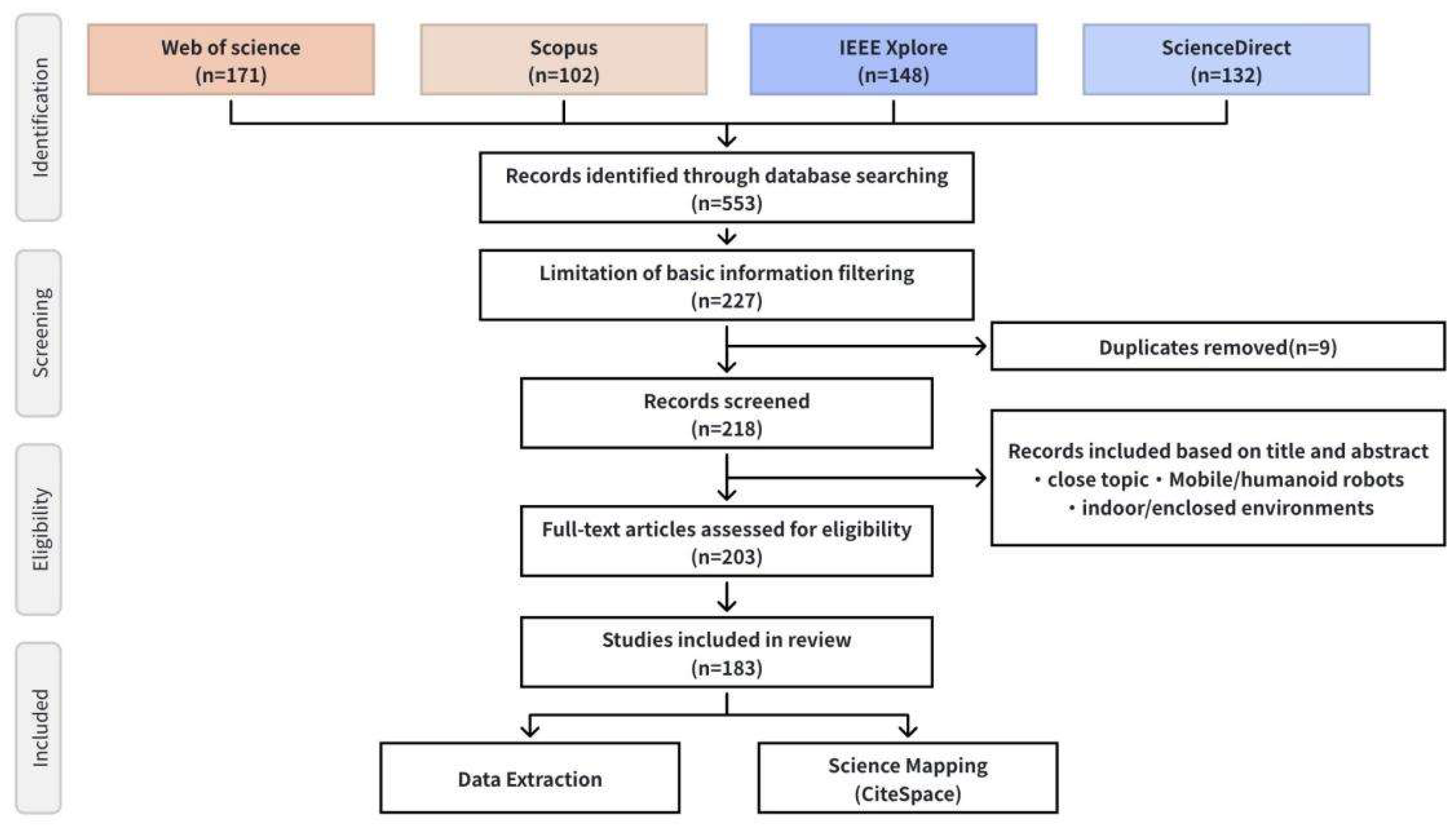
Figure 2.
Field growth of annual publication (Source: Authors).
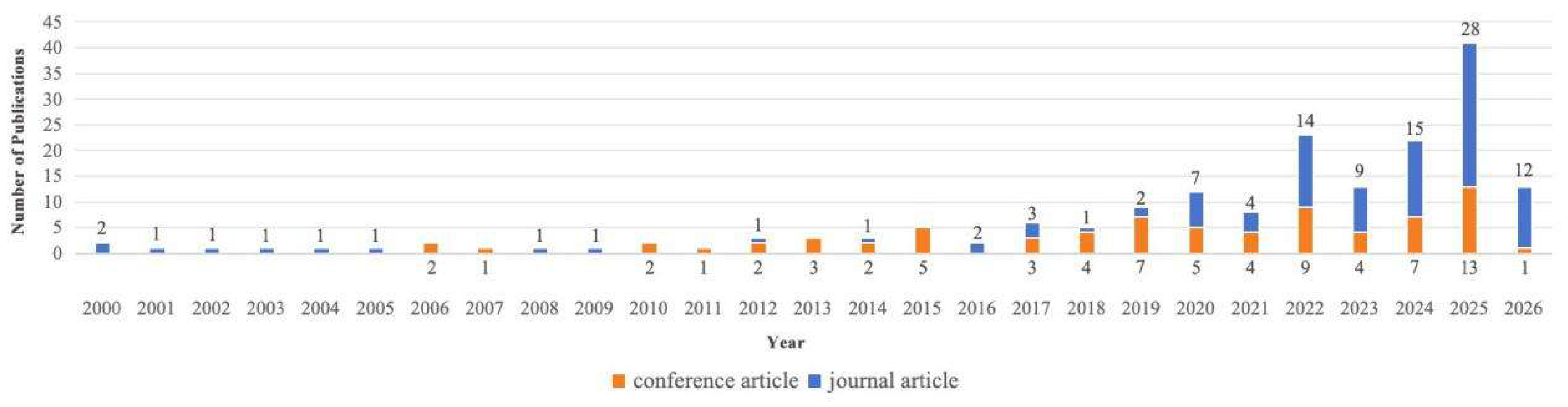
Figure 3.
Publication venue distribution (Source: Authors).
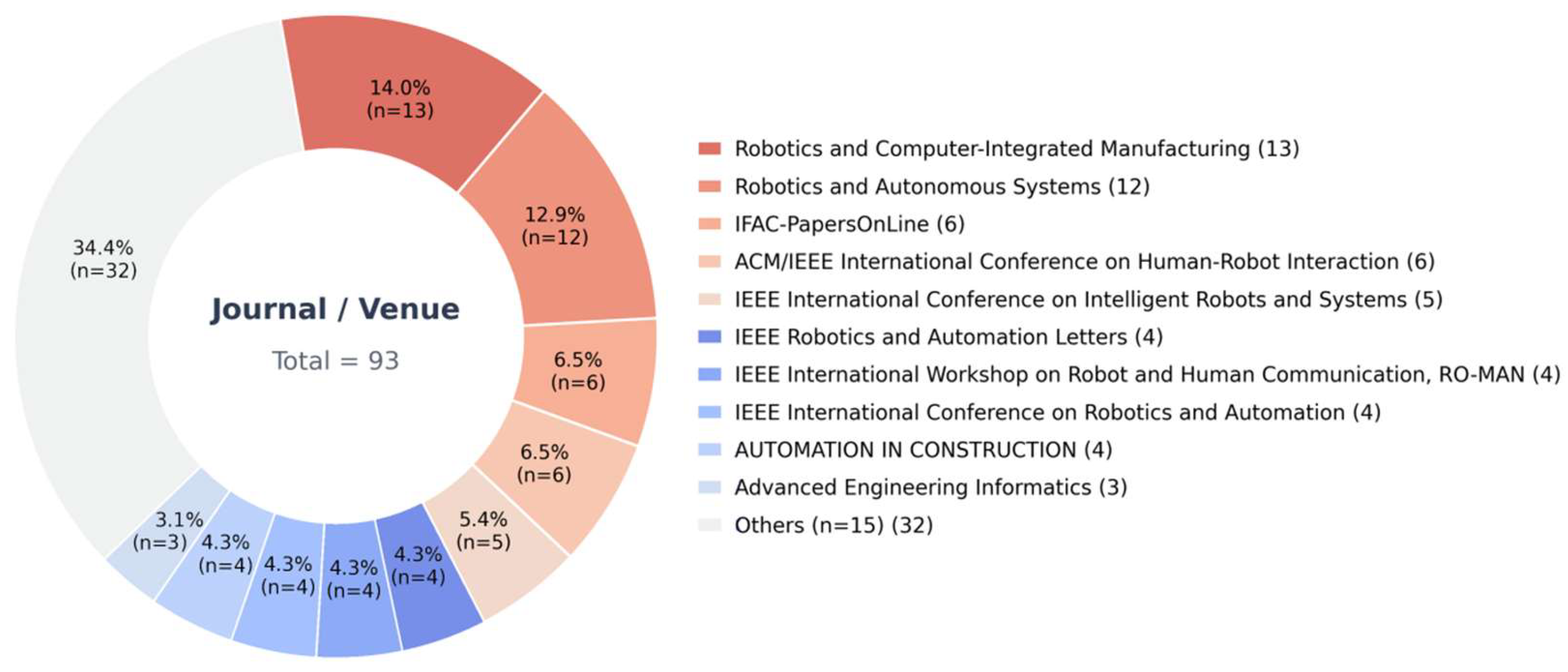
Figure 4.
Density distribution by discipline classification (Source: Authors).
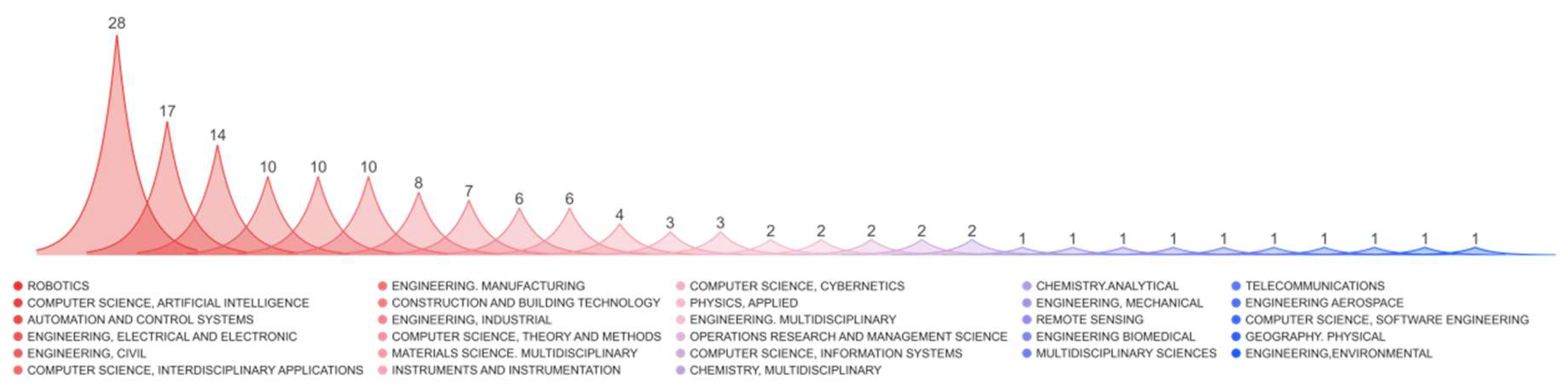
Figure 5.
Geographic distribution and country collaboration network (Source: Authors analyzed via CiteSpace).
Figure 5.
Geographic distribution and country collaboration network (Source: Authors analyzed via CiteSpace).
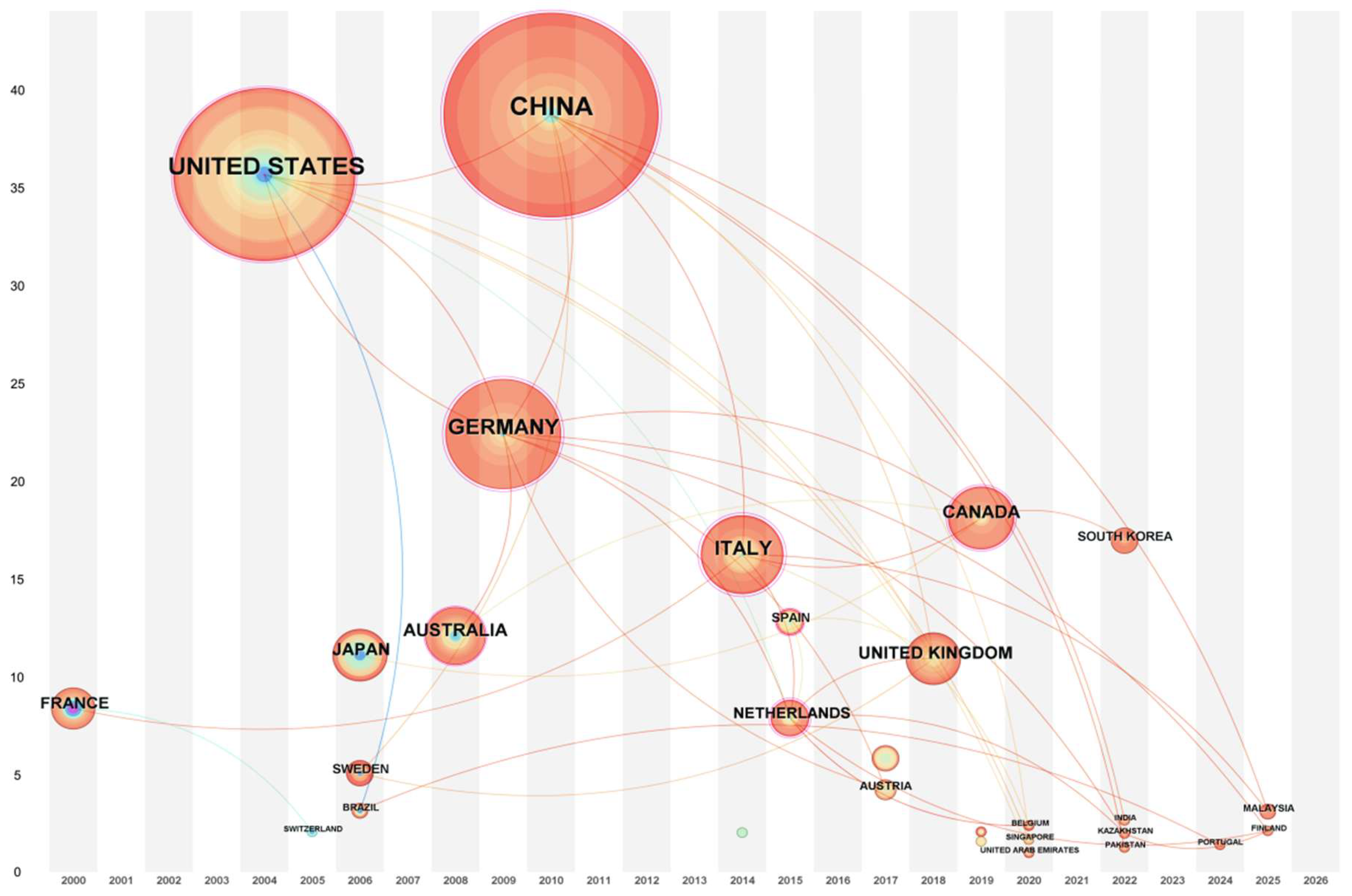
Figure 6.
Keywords Co-Occurrence Cluster Map (Source: Authors analyzed via CiteSpace).
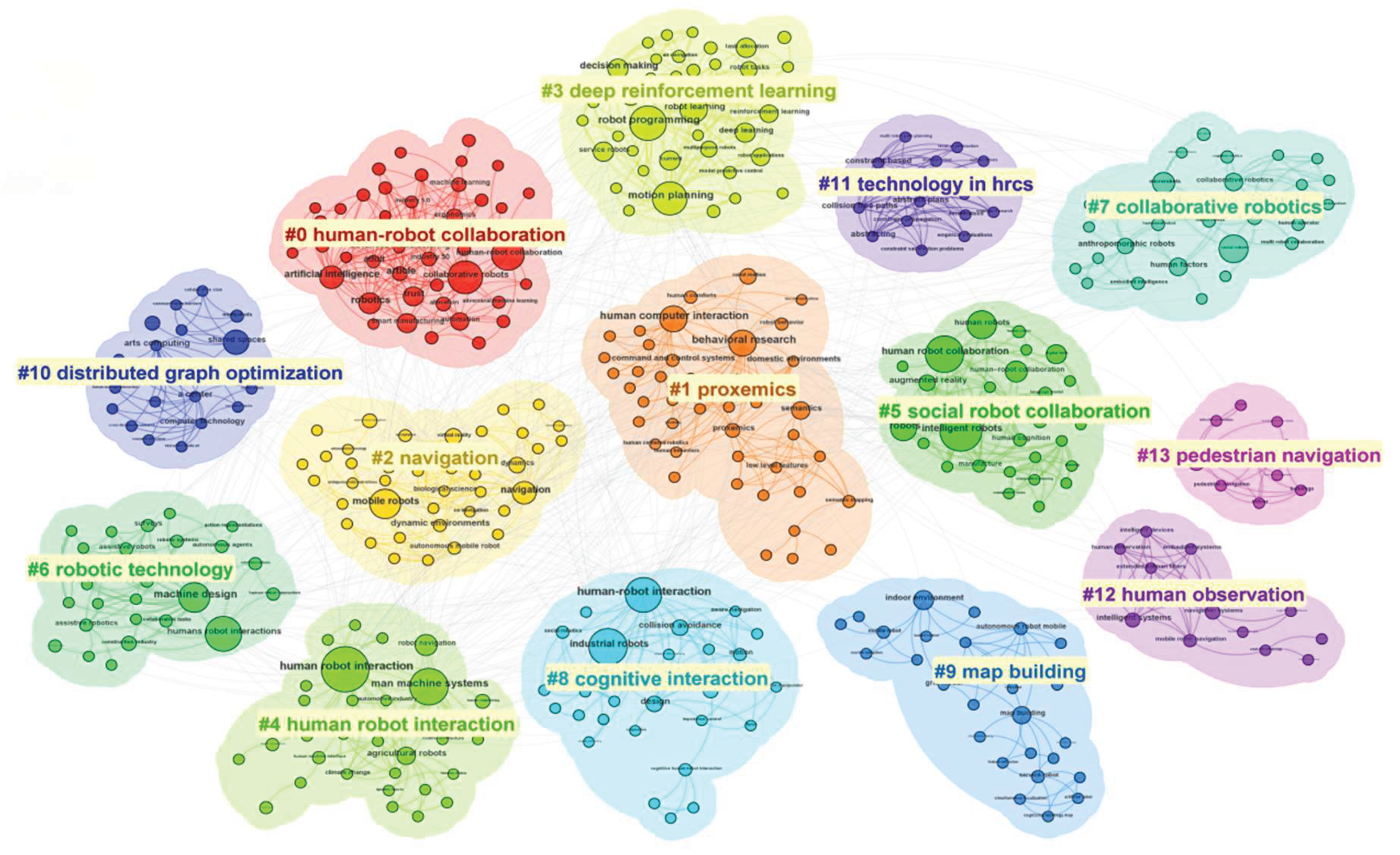

Table 1.
A Typological Framework of Human-Robot Relationships (Source: Authors).
| Dimension | HRI | HRC | HR-Coexistence | HRSS |
|---|---|---|---|---|
| Core Focus | Dyadic Interaction | Task Collaboration | Physical Co-presence |
Spatial Co-occupancy |
| Spatial Scale | Proxemic Field | Workstation Unit | Functional Zoning | Systemic Multi-scale |
| Role of Space | Background Variable | Operational Constraint | Safety Boundary | Primary Design Domain |
| Safety Logic | Physical Avoidance | Dynamic Adaptation | Zonal Control | Perceived Legibility |
| Time Frame | Transient Encounter | Periodic Task Cycle | Long-term Operation Cycle | Building Lifecycle |
| Design Agency | Behavior Tuning | Layout Optimization | Circulation Management |
Architectural Reconfiguration |
Disclaimer/Publisher’s Note: The statements, opinions and data contained in all publications are solely those of the individual author(s) and contributor(s) and not of MDPI and/or the editor(s). MDPI and/or the editor(s) disclaim responsibility for any injury to people or property resulting from any ideas, methods, instructions or products referred to in the content. |
© 2026 by the authors. Licensee MDPI, Basel, Switzerland. This article is an open access article distributed under the terms and conditions of the Creative Commons Attribution (CC BY) license.
Copyright: This open access article is published under a Creative Commons CC BY 4.0 license, which permit the free download, distribution, and reuse, provided that the author and preprint are cited in any reuse.


