
Submitted:
02 March 2026
Posted:
04 March 2026
You are already at the latest version
Abstract
Foremost, the structural-, functional- and behavioural traits of birds relate directly or indirectly to powered flight, an elite mode of locomotion which has importantly made them what they are - ‘specialist and extreme animals’. Placing them at the pinnacle of the evolutionary hierarchy, birds possess exceptional biological specialisations which have conferred profound survival advantages. The adaptive novelties of birds are particularly exhibited by the exemplary morphological and physiological refinements of their respiratory system, the lung-air sac system. To contribute to the ongoing discussions and debates on the impacts of the existing extreme environmental conditions (ECs) on the biology of birds, here, a perspective is posed that the adaptive specialisations which birds acquired ostensibly under different ECs may have undermined their capacity of efficiently adjusting to different ones. To explain the viewpoint, the following aspects are considered: the specialist- and extreme biology of birds; the prevailing harsh ECs which are brutally impacting on birds and; the consequences from their enduring the harsh conditions which include among others global warming and habitat devastation. It is contended that under the existential threats, the adaptive capacities of birds appear to have declined, rendering them more vulnerable to external stressors. It is urged that urgent conservation measures, especially of the most threatened species of birds, are necessary.
Keywords:
birds
; morphology
; physiology
; flight
; adaptation
; climate change
; pollution
1. Introduction
‘Evolutionary novelty, while often beneficial, frequently comes with associated costs. These costs can manifest as reduced fitness in certain environments, increased susceptibility to specific challenges, or trade-offs with other advantageous traits’. [1]
Recently, it was ardently argued that ‘Darwin’s Theory of Evolution by Natural Selection’ [2], the longstanding overarching biological framework which persuasively explains why, how and when evolutionary changes and adaptive traits develop should from lack of alternative as robust formulations be considered a ‘law’ [3,4]. Multicellular organisms comprise various complex structurally- and functionally reciprocally interdependent parts [5,6]. Synergy between traits fosters outcomes which result in total performance which surpasses the sum of the operations of the individual parts [7,8,9]. Terms such as ‘integrated phenotype’ [10,11], ‘morphological integration’ [12,13,14] and ‘symmorphosis’ [15,16,17] have been used to express the correlations between biological traits, particularly those between structure and function. For animals, from cellular to organ-system levels of organisation, life exists under finite resources of energy, nutrients and time [18,19,20,21]. Invariably, allocation of resources to one trait reduces what remains for the others [22,23]. Foremost, genetic-, environmental-, morphological-, physiological- and behavioural factors determine the nature of the biological adaptations which develop to most optimally support life [24,25,26]. According to Chen and Khanna [27], for the birds of North America, compared to the generalist species, the ongoing climate change is notably impacting the specialist ones. From the ongoing environmental changes (ECs), it is projected that by the end of this century, declines of 7–16% will have occurred for specialist animal species while the generalist ones will have suffered relatively lower losses of 1–3% [27]. While specialist animals operate optimally under specific ECs, their adaptive specialisations may constrain their capacity of adjusting to different ECs [28,29,30].
To maintain balance while imparting optimization, in biology, adaptive processes entail transactions which comprise trade-offs and compromises [31,32,33]. The best fitness levels are determined by traits which develop and work together [34,35,36,37]. Adaptively well-endowed animals survive and thrive to pass on their ‘good’ genes to new generations [7,34]. Under extreme ECs, such as those existing now, the adaptive capacity of birds appears to have weakened [38,39,40]. Ancel [41], Price et al. [42] and Paenke et al. [43] observed that rapid and extreme changes in the ECs constrain adaptability, limiting further specialisations. Adaptations make generalist animals change to specialists and interestingly, depending on the nature and the level of the severity of the ECs, specialist species can change to generalists [44,45]. According to the classical model of biological trade-offs and traits [35], for specialist animals, convex trade-offs support sympatry, i.e., coexistence between species, while concave ones afford development of intermediate ones. Determining how ECs impact ecological diversity instructively informs on the most cost-effective conservation strategies [46,47,48]. Specialist animals, which are restricted to small ecological ranges and utilise a special kind of food are at greater risk of annihilation from shifts in ECs [49,50,51,52]. While specialisation brings about greater extinction risk, exploitation of various resources allows generalist animals to adapt and thrive in adverse habitats [53,54,55].
In contribution to the ongoing studies, discussions and debates and hopefully stimulate further research on the many indeterminate aspects on the effects of the pressures imposed on the bird life by the present ECs, the following question was posed: did evolution of unique adaptations in birds, ostensibly under different ECs, undermine their capacity of attuning to different conditions such as those existing now? To explain the perspective, the following aspects were considered: a) birds as ‘specialist’ and ‘extreme’ animals; b) the foremost ECs, i.e., climate change and habitat devastation and pollution, which are adversely affecting the bird life and; c) the consequences arising from their living under the challenging surroundings.
2. Birds Are Specialist- and Extreme Animals
Termed ‘living dinosaurs’, evolutionary, birds are a unique animal group. They are ‘well-oiled machines’, which possess diverse adaptive specialisations that have allowed them to globally disperse into various habitats and consequently speciate profusely. Unequivocally, unique biological traits make birds a ‘specialist- and extreme’ animal taxon [56,57,58,59,60,61,62]. During the ~4.3 billion years (109) that life has existed of life on earth [63,64,65], only four animal taxa, namely insects, the now extinct pterosaurs, birds and bats, chronologically in that order, have ever accomplished powered flight [66,67,68,69,70]. The adaptive success of birds, which largely afforded their capacity of flight, explains the remarkable speciation into ~11,000 extant species [71,72,73] which surpass the 3,000 amphibian-, the ~6,000 reptilian- and the 4,100 mammalian ones [74,75,76]. Volancy, which enabled birds to overcome geographical obstacles such as mountains, rivers, seas, oceans and deserts, permitted them to disperse widely into diverse habitats, causing outstanding adaptive radiation which lead to profound speciation [77,78,79].
Among others, morphological-, physiological-, genetic-, neurological-, reproductive- and behavioral adaptive traits, which suited the habitats they occupied and the lifestyles they pursued, allowed birds to live and thrive, increasing their numerical abundance [58,80,81,82,83]. While compared to other modes of travel powered flight is a highly costly type of locomotion, the energetic cost of movement per unit distance covered is considerably less [66,84,85,86,87,88,89]. For the migratory birds, particularly those which fly continuously for long periods of time over long distances, an activity which occurs under metabolic rates that are ~10 times more than those at rest [90], as much as ~20% of the flight muscle mass is lost due to protein catabolism (breakdown) [91]. The morphological specialisations for powered flight are so restrictive that while the number of species of birds far exceed those of mammals by a factor of about three, regarding their external features, morphometrically, birds are reported to be more uniform than mammals [74,75,92,93]. Even those species that have for various reasons lost flight, i.e., they have acquired secondary flightlessness [94,95,96], derive from volant progenitors [97,98].
Distinctive biological traits have placed birds high up on the vertebrate evolutionary ranking. The foremost properties include the following: a) the forelimbs were adapted into wings which were fully committed to powered flight [99,100]; b) the skeletal system was considerably modified mainly by loss and fusion of bones and significantly refined for lightness [100,101,102,103]; c) the development of large and powerful hearts with strong cardiac muscles generated large cardiac output and short circulatory times which increased O2- and nutrient delivery to the cells of the body [104,105,106]; d) loss of teeth [107,108] and their swallowing food whole was countered by development of a food grinding gizzard [109], a feature which contributed to modification of the craniofacial skeleton; e) high and constant body temperatures (38-42oC) permitted elevated metabolic rates [93,106,110,111,112,113] which together with powerful flight muscles [114,115] supported active flight; f) an exceptionally efficient respiratory system [58,59,116,117,118] permitted acquisition of the large amounts of O2 which sustained high metabolic rates that were vital to powered flight; g) all-encompassing egg-lying (oviporosity) and development of embryos outside of the body, reduced body mass which promoted powered flight [119,120,121,122]; h) scrupulous parental care, which included shrewd nest-building and their placement at strategic places ensured survival [123,124]; i) highly developed nervous system with sharp senses allowed important specialised activities such as proper navigation during migration and effective communication [125,126,127]; j) advanced brains allowed problem-solving capacities, e.g., ‘tool use’, i.e., dropping hard difficult to break nuts from a height to crack them and access food [128,129,130] and food caching, i.e., strategic storing of food for use during times of scarcity [131,132,133]; k) sophisticated vocalisation permitted complex sexual displays and ensured successful mating [134,135]; l) the development of large eyes and excellent visual acuity, especially for the diurnal raptorial species, was important for navigation and effective prey capture [136,137,138] and; m) light and strong feathers served important needs such as thermal insulation, sexual display, communication and importantly supported flight [139].
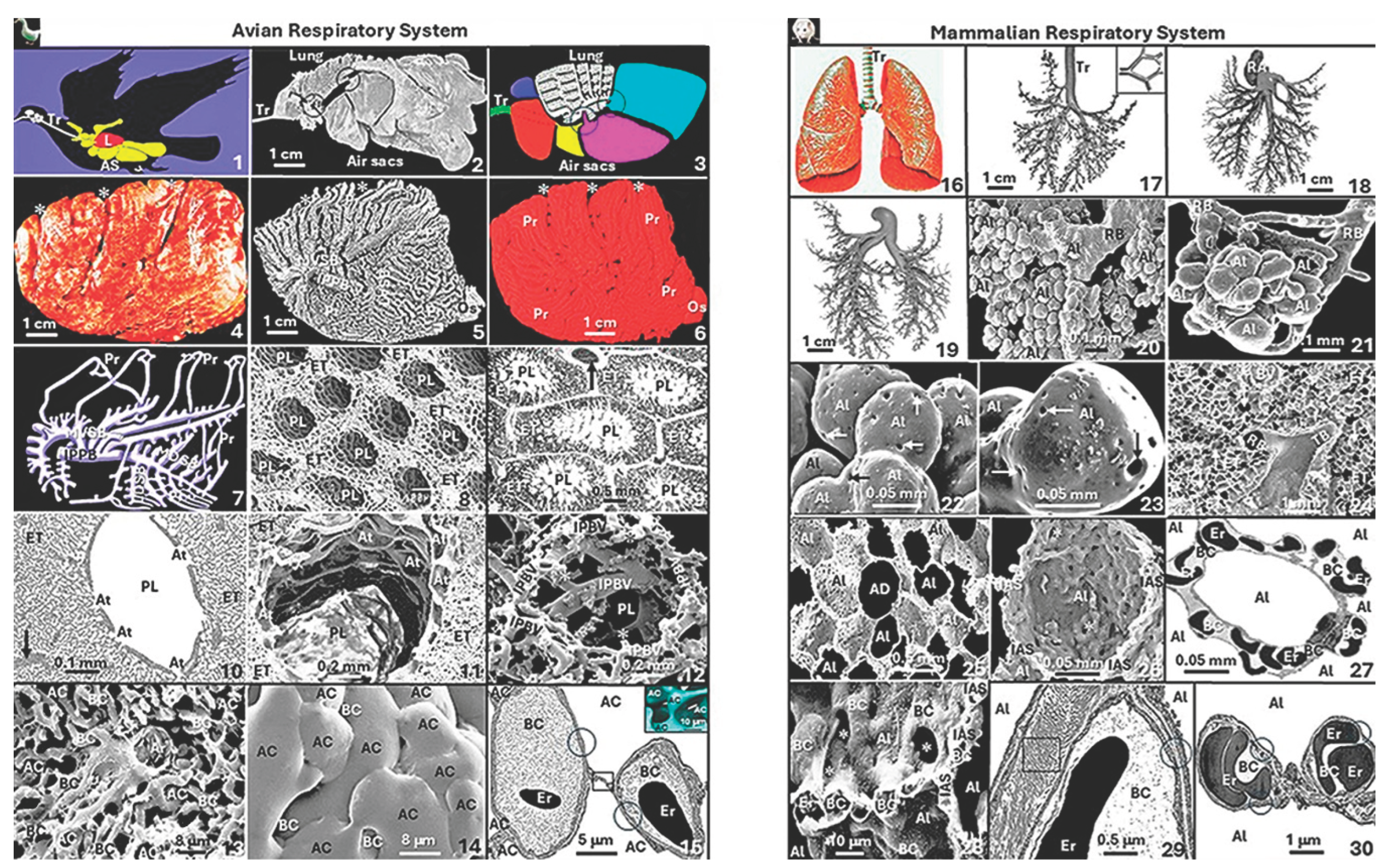
Among the air-breathing vertebrates, the avian respiratory system (ARS), the lung-air sac system, is the most structurally complex and functionally efficient gas exchanger [58,59,75,116,118,140,141,142,143]. While its primary function is that of acquisition of O2 and removal of CO2, other important roles include sound production at the syrinx [58,75] and thermoregulation [93,144], especially since birds lack sweat glands [144,145,146]. In biology, research on the form and function of the ARS has been a long and frustrating process which has been riddled passionate debates and controversies [58,116,140,141,142,143]. The differences between the structural properties of the ARS [58,147,148] and the mammalian one [149] are respectively shown on Figures 1-15 and 16-30. The incomparable evolutionary-, developmental-, structural- and functional specialisations of the ARS were recently detailed in Maina [58,59]. They include the following aspects: a) the ARS is structurally and functionally divorced into a lung which serves as the gas exchanger and air sacs that work as ventilators (Figures 1-3); b) the lungs, which are small and compact, are firmly affixed to the ribs and the vertebrae, rendering them uninflatable (Figures 1-7); c) structurally, the airway (bronchial) system of the avian lung comprises a three-tier, hoop-like, i.e., continuous, configuration (Figure 7); d) the exchange tissue is intensely partitioned into miniscule terminal respiratory air spaces, the air capillaries (Figures 8-15); e) remarkable morphometric specialisations, which include large respiratory surface area, thin blood-gas barrier (BGB) and large pulmonary capillary blood volume, exist in the avian lung [58,59,147,148] (Figures 14, 15); f) in the exchange tissue, the arrangements of the structural components establish cross-current-, counter-current- and multicapillary serial arterialisation gas exchange systems [58,5]] (Figures 8-12); g) synchronized bellows-like actions of the caudal- and the cranial groups of air sacs (Figures 1-3) efficiently ventilate the avian lung continuously and unidirectionally in a caudocranial direction [116,150]; h) for the avian lung, the O2 extraction efficiency (EO2) of the ARS, i.e., the ratio of O2 consumption (VO2) to O2 delivery (DO2) [75] of which the values are as high as 60–70% [150,151,152,153] are relatively greater than those of ~20–30% for the nonflying mammals [154,155] and appreciably surpass those of 35–45% for bats (chiroptera) [156,157]; i) compared to the mammalian lung [149], the avian one extracts ~25% more O2 from the inspired air [106,153] and; j) importantly, from existence of particularly the cross-current- and the multicapillary serial arterialisation gas exchange systems, for the avian lung, the PO2 in the expired air surpasses those of the arterial- and the mixed venous blood [116,158,159,160,161].
AVIAN LUNG.
Figure 1 Schematic diagram showing the avian respiratory system (the lung-air sac system). It comprises a lung (L - red) which is separated from and intercalated between the air sacs (AS - yellow). Tr, trachea. Figure 2. Lateral view of a latex rubber cast preparation of the lung-air sac system of the do-mestic fowl (Gallus gallus variant domesticus) showing the lung located between the air sacs. Circles (ostia), connections between the air sacs and the lung. Tr, trachea. Figure 3. Schematic illustration showing the lung-air sac system of birds. In mature birds, the air sacs comprise cervical- (blue), interclavicular- (red), cranial thoracic- (yellow), caudal thoracic- (pink) and abdominal- (cyan) air sacs. Tr, trachea; circles, ostia. Figures 4-6. The compact, i.e., nonlobulated, morphology of the avian lung shown by those of the domestic fowl: 4: Fresh lung (lateral view); 5, 6: Medial- (5) and lateral (6) views of latex rubber macerated cast preparations showing the complex airway arrangement. IPPB, intrapulmonary primary bronchus; MVSB, medioventral secondary bronchi; LVSB, lateroventral secondary bronchi; Pr, parabronchi; Os, ostia; asterisks, costal sulci, i.e., rib impressions. Figure 7. Schematic diagram showing the complexity of the airway (bronchial) system of the avian lung. A continuous hoop-like arrangement exists. IPPB, in-trapulmonary primary bronchus; MVSB, medioventral secondary bronchi; MDSB, mediodorsal secondary bronchi; LVSB, lateroventral secondary bronchi; Pr, parabronchi. Figures 8-11. Scanning electron mi-crographs showing parabronchi respectively of the lungs of the house sparrow (Passer domesticus) (8), domestic fowl (9, 11) and ostrich (Struthio camelus) (10). PL, parabronchial lumen; ET, exchange tissue; arrows, inter- (9) and intra- (10) parabronchial blood vessels; At, atria (10, 11). Figure 12. Macerated latex rubber cast preparation of the lung of the domestic fowl showing the parabronchial vasculature. IPBV, interparabronchial blood vessels; PL, parabroncial lumen; asterisks, intraparabronchial blood vessels. Figures 13-15. Exchange tissue of the lung of the domestic fowl shown by a scanning electron micrograph (SEM) (13), a SEM of a latex cast preparation of the air capillaries (AC) and blood capillaries (BC) (14) and a transmission electron micrograph showing same structures (15) at higher magnification. Ar, arteriole (13); circles, blood-gas barrier (15); square, epithelial-epithelial connection (15); Er, erythrocyte (15). Insert - 15): Three-dimensional serial section computer reconstruction showing air capillaries (AC) of the lung of the domestic fowl. MAMMALIAN LUNG: Figure 16. Diagramatic illustration of the lobulated mammalian lung. Tr, trachea. Figures 17-19: Latex rubber cast macerated preparations of the pig (Sus scrofa) lung showing the airway (bronchial)- (17), the venous- (18) and the arterial (19) systems. The passageways (conduits) branch rather dichotomously. Insert (17), Schematic diagram showing dichotomous branching. Tr, trachea (17); RA, right atrium (18). Figures 20-23: Latex rubber cast preparations showing the terminal parts of the airway system of the lung of the baboon (Papio anubis) showing pulmonary acini (20, 21); alveoli (20-23); respira-tory bronchi (RB) (20, 21) and alveoli (Al) (20-23). Interalveolar pore (arrows - 22, 23) and asterisks (23). Figures 24-28: Terminal parts of the mammalian (baboon) lung showing alveoli and blood capillaries. Scan-ning electron micrographs (24-26, 28) and transmission electron micrographs (27, 29, 30). TB, terminal bronchus; RB, respiratory bronchiole; ET, exchange tissue; alveoli (arrows – 24; al – 25-28). BV, blood vessel (24); AD, alveolar duct (25); Al, alveoli (25-28); IAS, interalveolar septum (26, 28); BC, blood capillaries (27, 28); Er, erythrocyte (27); asterisks, interalveolar pores (26, 28). Figures 29, 30: Transmission electron mi-crographs of the baboon lung showing the blood-gas barrier and the interalveolar septa. Circles, blood-gas barrier (29, 30) and square (29), the thicker (supporting) part of the interalveolar septum which contains plentiful collagen fibers (square - 29. Al, alveoli; BC, blood capillaries; Er, erythrocytes.
AVIAN LUNG.
Figure 1 Schematic diagram showing the avian respiratory system (the lung-air sac system). It comprises a lung (L - red) which is separated from and intercalated between the air sacs (AS - yellow). Tr, trachea. Figure 2. Lateral view of a latex rubber cast preparation of the lung-air sac system of the do-mestic fowl (Gallus gallus variant domesticus) showing the lung located between the air sacs. Circles (ostia), connections between the air sacs and the lung. Tr, trachea. Figure 3. Schematic illustration showing the lung-air sac system of birds. In mature birds, the air sacs comprise cervical- (blue), interclavicular- (red), cranial thoracic- (yellow), caudal thoracic- (pink) and abdominal- (cyan) air sacs. Tr, trachea; circles, ostia. Figures 4-6. The compact, i.e., nonlobulated, morphology of the avian lung shown by those of the domestic fowl: 4: Fresh lung (lateral view); 5, 6: Medial- (5) and lateral (6) views of latex rubber macerated cast preparations showing the complex airway arrangement. IPPB, intrapulmonary primary bronchus; MVSB, medioventral secondary bronchi; LVSB, lateroventral secondary bronchi; Pr, parabronchi; Os, ostia; asterisks, costal sulci, i.e., rib impressions. Figure 7. Schematic diagram showing the complexity of the airway (bronchial) system of the avian lung. A continuous hoop-like arrangement exists. IPPB, in-trapulmonary primary bronchus; MVSB, medioventral secondary bronchi; MDSB, mediodorsal secondary bronchi; LVSB, lateroventral secondary bronchi; Pr, parabronchi. Figures 8-11. Scanning electron mi-crographs showing parabronchi respectively of the lungs of the house sparrow (Passer domesticus) (8), domestic fowl (9, 11) and ostrich (Struthio camelus) (10). PL, parabronchial lumen; ET, exchange tissue; arrows, inter- (9) and intra- (10) parabronchial blood vessels; At, atria (10, 11). Figure 12. Macerated latex rubber cast preparation of the lung of the domestic fowl showing the parabronchial vasculature. IPBV, interparabronchial blood vessels; PL, parabroncial lumen; asterisks, intraparabronchial blood vessels. Figures 13-15. Exchange tissue of the lung of the domestic fowl shown by a scanning electron micrograph (SEM) (13), a SEM of a latex cast preparation of the air capillaries (AC) and blood capillaries (BC) (14) and a transmission electron micrograph showing same structures (15) at higher magnification. Ar, arteriole (13); circles, blood-gas barrier (15); square, epithelial-epithelial connection (15); Er, erythrocyte (15). Insert - 15): Three-dimensional serial section computer reconstruction showing air capillaries (AC) of the lung of the domestic fowl. MAMMALIAN LUNG: Figure 16. Diagramatic illustration of the lobulated mammalian lung. Tr, trachea. Figures 17-19: Latex rubber cast macerated preparations of the pig (Sus scrofa) lung showing the airway (bronchial)- (17), the venous- (18) and the arterial (19) systems. The passageways (conduits) branch rather dichotomously. Insert (17), Schematic diagram showing dichotomous branching. Tr, trachea (17); RA, right atrium (18). Figures 20-23: Latex rubber cast preparations showing the terminal parts of the airway system of the lung of the baboon (Papio anubis) showing pulmonary acini (20, 21); alveoli (20-23); respira-tory bronchi (RB) (20, 21) and alveoli (Al) (20-23). Interalveolar pore (arrows - 22, 23) and asterisks (23). Figures 24-28: Terminal parts of the mammalian (baboon) lung showing alveoli and blood capillaries. Scan-ning electron micrographs (24-26, 28) and transmission electron micrographs (27, 29, 30). TB, terminal bronchus; RB, respiratory bronchiole; ET, exchange tissue; alveoli (arrows – 24; al – 25-28). BV, blood vessel (24); AD, alveolar duct (25); Al, alveoli (25-28); IAS, interalveolar septum (26, 28); BC, blood capillaries (27, 28); Er, erythrocyte (27); asterisks, interalveolar pores (26, 28). Figures 29, 30: Transmission electron mi-crographs of the baboon lung showing the blood-gas barrier and the interalveolar septa. Circles, blood-gas barrier (29, 30) and square (29), the thicker (supporting) part of the interalveolar septum which contains plentiful collagen fibers (square - 29. Al, alveoli; BC, blood capillaries; Er, erythrocytes.
3. Environmental Conditions, Their Impacts on Birds and Aspects Which Suggest Weakening of Their Adaptive Capacities
3.1. Susceptibility of Birds to Diseases and Injuries by Foreign Particulates
The ‘One Health Concept’ arose from appreciation that human health is closely associated with the well-being of other animals as well as with the states and conditions of the shared environments and habitats [162,163,164,165]. Zoonotic diseases are sicknesses that are naturally transmissible between animals and human beings or vice versa [166,167]. Of the emergent diseases, ~75% of them are zoonotic [168,169,170]. From the close association between people and animals, especially pet- and companion ones, zoonotic diseases are of important public health concern [171,172,173]. Migratory birds, which travel over long distances during their seasonal sojourns, are important transmitters of zoonotic diseases [171,173,174,175,176,177]: they interact with various species of animals and humans during stopovers and at their final destinations [173,177,178,179]. Rural birds generally visit polluted areas such as sprayed agricultural fields while the urban ones go to contaminated places such as factories, hospitals, dump sites and waste water and refuse treatment plants where they pick up pathogenic microorganisms and toxic chemical substances which they introduce into the food chain by their droppings, carcasses and direct interactions with other animals [180].
While avian migration is a highly rewarding undertaking because birds relocate to sites where food is assured, escape adverse weather conditions and reproductive success is more certain, it a highly perilous undertaking [181]. The travels entail high energy cost from the strenuous work of flapping flight and exposure to scarcity or lack of food and water and coping with the extreme ECs of the high altitude such as extremely low ambient temperatures, low PO2 (hypoxia) and dry air [182,183,184]. During migration, the continuous strenuous work of flight causes muscle damage, dehydration, weight loss, declined immunity and diseases and deaths [91,94,185,186]: immunosuppressed birds are more susceptible to diseases [187,188,189]. Human incursion into habitats which were exclusively occupied by birds and human pursuits such as taming and domestication of wild birds as pets or for sport as well as the increase of farming, consumption and utilization of poultry products have considerably increased the possibility of pathogenic microorganisms crossing biological (genetic) barriers and triggering zoonotic disease outbreaks [174]. For animals, the immune system (IS) has taken at least 1,000 million years to evolve to its modern status [190]. Evolutionary, the avian IS separated from the mammalian one more than 200 million years ago [191]. While the basic structure and function of the avian IS is similar to the mammalian one, the avian one is structurally less elaborate and more uniform [192,193]. For birds, fewer immunoglobulin classes exist, lymph nodes are lacking and the neutrophils are undifferentiated [194]. The avian IS has certain unique attributes such as presence of the Bursa of Fabricius, a lymphoid organ where B lymphocytes (B-cells) differentiate and mature and a suite of antibodies is produced [194]. According to Cottier [195], developmentally and functionally, the avian IS fits between those of fish, amphibians and reptiles and that of mammals.
The structural- and functional novelties of the ARS have been well-described [58,75,116,140,141,142,143,150,152,196,197]. Under ECs that were ostensibly different from the present ones [199], the adaptive specialisations developed in a transactional manner [198]. Birds are particularly susceptible to attacks by pathogenic microorganisms, fungi and parasites and injury by particulate matter, especially those that are acquired by inhalation of air [58,200,201,202,203]. The physical- and cellular defenses of the ARS comprise intricate processes which include filtering of air and clearance, isolation, destruction of harmful pathogenic microorganisms and particulates and repair of the injuries caused [204,205,206]. The notable structural features which make the ARS particularly vulnerable to infections, afflictions and injuries include the following: a) compared with mammals, for animals of equivalent body mass, birds have a respiratory surface area which is 15 % greater, the BGB is 56-67% thinner and the pulmonary capillary blood volume is 22% greater [58,147,148]; b) the protective phagocytic free avian respiratory macrophages (FARMs) are scarce and even lacking on the respiratory surface [58,152,207,208,209,210,211]; c) the exchange tissue is lined by non-ciliated cuboidal- or squamous epithelia which cannot efficiently remove or destroy pathogenic microorganisms and injurious particulates which settle there [152,212]; d) lacking a diaphragmatic partitioning, with some of them pneumatizing bones, the capacious air sacs (ASs) spread extensively in the coelomic cavity [213] and for species such as the ostrich (Struthio camelus), some of the ASs exit the coelomic cavity to lie subcutaneously [58,214,215,216,217] where they are highly vulnerable to injury especially from trauma; e) from the dispersion of the ASs to most parts of the avian body, diseases and infections affecting the body end up spreading to the ARS; f) the capacious ASs of the ARS provide large tidal volume which leads to delivery of a large measure of pathogens and particulates to the body and; g) because the walls of the ASs are very thin and delicate, poorly vascularized and scantly lined by an epithelium [143,218], the ASs are highly vulnerable to attack and injury by pathogens and particulates and because of their fragility they provide little protection to the structures of the body which they interface with. Interestingly, evident trade-offs and compromises were involved in the adaptive specialisations of the ARS. For example: a) while lack of FARMs on the respiratory surface promoted respiratory efficiency by decreasing the thickness of the BGB [147,148,219], it made the tissue barrier (BGB) highly susceptible to structural failure and injury by pathogens and particulates [220,221] and; b) while the rigidity of the avian lung allowed intense subdivision of the exchange tissue, a process which generated large respiratory surface, the minuscular terminal respiratory units (the air capillaries) were rendered highly vulnerable to infections and afflictions particularly from scarcity or lack of FARMs from the respiratory surface [219].
Physiologically, the foremost processes which make birds particularly vulnerable to respiratory infections and afflictions are the following: a) during every respiratory cycle, the large tidal volume, which comes from the large ASs, leads to complete turnover of the volume of air in the lung [158], delivering large quantities of pathogens and particulates to the lung; b) from the synchronised actions of the cranial and caudal ASs, the exchange tissue of the avian lung is continuously and unidirectionally ventilated with air in a caudocranial direction, a process which increases the delivery and deposition of pathogens and injurious particulates in the exchange tissue [58,116,150,152,219]; c) for a disease such as aspergillosis [187,222,223], rapid fungal growth has been attributed to the high body temperatures of birds which range from 38 to 420 C and; d) because the inhaled air, which contains large quantities of pathogens and particulates, is shunted to the back of the lung via the intrapulmonary primary bronchus into the caudal ASs [58,59,150,152], compared to the other parts of the ARS, the caudal areas of the avian body are more vulnerable to injuries by inhaled pathogens and particulates [152].
Respiratory diseases are particularly common in the pet- and poultry birds [224,225,226] where mortalities cause considerable financial losses [202,226,227]. The notable susceptibility of poultry to diseases, especially respiratory ones, may, however, largely derive from the conditions under which the birds are reared [58,228,229,230,231]. States and conditions such as overcrowding, poor ventilation, high environmental temperatures and humidities, hypoxia and high concentrations of toxic gases such as ammonia (mainly from putrefaction of fecal waste matter) and possible harsh routine procedures such as poor handling during occasions such as feeding, examination and medication inflict stress on birds particularly poultry [189,231,232,233,234,235,236]. Stress from adverse ECs weakens the immune system of birds, making them more susceptible to infections and afflictions [231,237,238,239,240]. The current high temperatures and those predicted in the future [241,242], especially in the tropics, will worsen the susceptibility of birds to diseases.
3.2. Effects of Climate- and Anthropogenic Habitat Devastation on the Bird Life
The continuing climate- and habitat changes are some of the leading drivers of the losses of biodiversity, population declines and species extinctions [184,241,242,243]. Among the vertebrates, birds and amphibians are the most vulnerable animal taxa [244,245,246,247,248]. Regarding the impacts of the current changes in the ECs on the animal life, birds are the better studied group [249,250,251]. The many enthusiastic bird watchers and bird lovers who observe, identify, enumerate and track birds across the world, contribute importantly to the understanding their biology in various ecotopes [252,253,254,255]. For their being involved in activities such as eradication of pests and disease vectors, pollination of plants and dispersal of seeds, birds play vital roles of maintaining ecosystem integrities [256,257,258]. From their global distribution and with some of them migrating over long distances, birds are highly vulnerable to the effects of climate- and habitat changes [245,246,259], conditions which adversely affect their distribution, diversity and numerical abundance [260,261,262,263,264]. With the average global temperature predicted to rise significantly in the future [265,266], extinction rates will increase greatly [267,268,269]. By the year 2,100, the anticipated 3.5oC increase of the earth’s surface temperature will cause extinctions of 600 to 900 species of birds of which 89% of them will be in the tropics [270]. In future, climate change is expected to accelerate at a rate 20 times faster than it has at any time during the last 2 million years [271]. The process will lead to severe ecological range reductions [272]. Birds with poor capacity of vacating stressful habitats, e.g., the flightless ones, face greater danger of extinction [244]. While certain species of birds are more vulnerable to the effects of climate change than others [255], generally, depending on the nature and the degree of susceptibility, species of birds which possess extreme attributes such as small body size are, compared to the larger ones, at greater risk of population decline and extinction from changes in ECs [273,274,275]. While for the evolutionary ‘older’, i.e., ‘ancestral’ or ‘basal’, species phylogeny affects the social organisation of bird populations by increasing the size and the range of their habitats, for the ‘recent’, i.e., derived species, phylogeny determines species abundance [276,277]. Because extreme ECs decimate occasional species, it is expected that in future birds will become more homogenous in aspects such as body size and shape [276,277,278].
Regarding the onsets of their travels and breeding times, for the migratory species of birds, climate change has particularly considerably impacted on the timing of their seasonal travels [246,279,280,281]. With catastrophic consequences, loss of stopover habitats has made birds fail reaching their breeding sites on time or not at all [241,244,282,283,284]. Late starting- and arrival times are a common cause of the declines of the migratory bird populations [279,281,285,286,287]. Disordered food webs, changed bleeding seasons, reduced survival and reproduction rates, increased disease incidents, changes in ecological ranges and population declines are indicators of the adverse effects which changed ECS are having on the animal life [244,246,288,289,290]. Haile [291] and Radchuk et al. [292] observed that presently, birds are exhibiting signs of incapacity of adjusting to the pressures they are facing from the prevailing ECs. Alternatively, the birds may not be responding fast- or adequately enough to the challenges presented by the ECs. Interestingly, for the caribou or the reindeer (Rangifer tarandus), Canteri et al. [293] reported that while the species well-tolerated a sudden climatic warming event during the last deglaciation episode (~21,000 years ago), the animals are now experiencing marked worldwide numerical decline. While the investigators did not give a specific reason for the decrease in numbers, it is plausible that they may now have lost their adaptive capacity to the present extreme ECs. For birds, the adaptive novelties which may have served them well in the past under different ECs may now have rendered them unresponsive under the prevailing extreme conditions.
Significant population recoveries of threatened species can conceivably be reversed by adopting species-focused, broad-based conservation strategies which include aspects such as habitat restoration, captive breeding and release and community awareness and involvement [294,295,296]. Interestingly, recently, Cullen et al. [297] reported that the once nationally endangered Australian ampurta (Dasycercus hillieri), a rat-sized marsupial micro-predator, has defied all odds and the numbers have significantly recovered: the population rebound was attributed to aspects such as a remarkable increase of ecological range, flexible diet and physiological adaptation to low energy food. It shows that compared to specialist animal species, generalists may stand a better chance of successfully adjusting to environmental perturbations. While external morphological features such as the sizes of the tail, wing, mid toe, tarsus, beak width, beak length and beak depth, which have been argued to correlate with the ecological differences between avian taxa [298,299,300], have been used to determine how specialisations may have driven diversification at different levels of population organisations, interpretations and views have varied between investigators. Foremost, this may be because the external morphologies of birds are unlikely to utterly represent the correlations between the avian morphologies and their diverse ecological choices.
3.3. Effects of Environmental Pollution on Birds
The increasing global level of environmental pollution is critically impacting on the survival of the animals life especially that of birds [246,301,302]. By causing among others suppression of the immune system, birds are becoming more vulnerable to diseases, injuries and poisoning [246,302,303,304,305]. From their high metabolic rates [110,111,112,113,306], particularly for the migratory species of birds which perform strenuous sustained flights over long distances [307,308], production of large quantities of reactive O2 species causes oxidative tissue injuries [309,310,311]. Also, the high metabolic rates of birds increase production of toxins [312,313]. From their numerical abundance and global distribution, at various places, birds are exposed to different ECs and consequently to varied pathogenic microorganisms and contaminants [173,314,315,316].
Birds are well-known ‘biosensors’, ‘bioindicators’ or ‘sentinels’ of environmental pollution [314,315,317,318,319,320,321]. Their sensitivity to changes in the ECs makes them important early warning animals of ecosystem hazards [318]. Smith et al. [322] determined that for birds, air quality correlates with species diversity, numerical abundance and breeding success while Fry [323], Abbasi et al. [324], Sanderfoot and Holloway [314], Shore and Taggart [325], Maznikova et al. [326], Castagna et al. [327] and Vetere et al. [328] noted that in accord with other apex predators, birds are highly susceptible to toxins and pollutants which they largely acquire from the air they breathe, foods they eat, water they drink and from physical contact with their surroundings. Depending on the nature and level of pollution in a habitat and the state of immune suppression, which usually occurs under various stressful conditions, birds are particularly susceptible to diseases and injuries [234,314,316,329]. Birds exposed to PM2.5 size particulates have high macrophage infiltration and small lung volumes [330]. Feral pigeons exposed to inhalation of nitrogen oxides (Nox) have lower erythrocyte counts and high oxidative stress markers [331]. Liang et al. [332] reported that the decrease of the numbers of migratory warblers across North America was attributable to ozone pollution. Jat et al. [333] observed that air pollution seriously affects the migratory behaviours of birds. Increased exposure to PM2.5 size particulates at a concentration of 120 µg/m3 caused the bar- headed geese (Anser indicus) and the Arctic terns (Sterna paradisaea) to stray from their normal migratory paths across the Indo-Gangetic Plain by a distance of as much as 250–320 km.
Because of the high energetic cost of flight, which is aggravated by the effect of pollution, Hedenström and Hedh [334] noted that long-distance migratory birds suffer severe metabolic stress and have relatively shorter longevities. In the coal mining parts of China and India, high mortality rates of birds, low species diversity and respiratory distresses were reported [335]. After the birds were exposed to smoke from wildfire, for a time afterwards, song complexity and performance were reduced by a factor of 15% [336]. Sanderfoot and Holloway [314] observed that together with deteriorating lung function, birds exposed to highly toxic gases and injurious particulates presented histopathological injuries of the respiratory tissues. In various ways, compared with the mammalian respiratory system (Figures 16-30), certain aspects of the morphological- and physiological specialisations of the ARS (Figures 1-15) [58,116,143,147,148,219] predispose birds to attack by pathogenic microorganisms and injury by particulates.
4. Conclusions
The evolutionary progress of birds is well-reflected in aspects such as their global dispersion, their remarkable speciosity, numerical abundance and the diverse lifestyles they pursue. Presently, the marked reduction of the avian biodiversity and the increase in the rates of extinction are largely been driven by ongoing harsh ECs which include global warming, pollution and habitat devastation. Some of the results inflicted by the ECs on birds include high susceptibility to diseases (especially pulmonary acquired ones) and inability to adequately respond to physiological challenges such as suffering heat burden. Cage birds are particularly vulnerable to conditions like hyperthermia which may arise from poor physiological thermoregulatory capacity [232,337,338]. Extreme environmental temperatures negatively affect bird health [339,340,341]. This is particularly worrisome because modeling studies have predicted that temperature will continue to rise for the rest of this (21st) century [342,343,344]. The migratory birds will particularly face multiple challenges such as devastation of their stop-over sites, deaths from extreme weather conditions and food and water scarcity. Presently, seabirds are among the most threatened group of birds [345,346].
The notable decrease in avian biodiversity may especially be explained by the fact that while the development of adaptive traits is a drawn-out process, the severity of the ECs may be increasing at a rate faster than that by which the birds are attuning to the changes. Given the existential threat, conservation of birds, especially the threatened and endangered species, is urgently warranted. The resilient nature of the animal life in general and that of birds in particular to threats presented by the ECs is astounding. For example, between the years 1970 and 2022, the estimated spring population of the lesser snow geese (Anser caerulescens caerulescens) in the Pacific Flyway of North America increased from ~300,000 to ~2,300,000 [347]. The increase was attributed mainly to changes in productivity in the Western Arctic and productivity and immigration in Wrangel Island. Knowing the most important measurable biological- and ecosystem parameters which signal early presence of environmental stressors should allow timely intervention and possibly reversal of damages [346]. In attempt to contend with different ECs, some bird species have acquired distinctive adaptive plasticity which has lead to unique foraging abilities and nesting behaviours [347,348,349]. For meaningful prediction of how birds in particular respond to extreme conditions, different spatial- and temporal factors which impact on their health should be considered [350,351]. Regrettably, for now, data on the biological- and ecological ‘tipping points’ of many species of birds are lacking [351]. Such details can be importantly leveraged to enhance conservation efforts.
Author Contributions
JNM wrote and prepared the manuscript.
Funding
This research received no external funding.
Institutional Review Board Statement
Ethical review and approval were waived for this study.
Informed Consent Statement
Not applicable.
Data Availability Statement
No new data were created or analyzed in this study. Data sharing is not applicable to this article.
Acknowledgments
I am grateful to the National Research Foundation (NRF) of South Africa for the support received in the preparation of this paper.
Conflicts of Interest
There are no conflicts of interest to declare.
References
- Moczek, A.P. When the end modifies its means: the origins of novelty and the evolution of innovation. Biol. J. Linnean Soc. 2023, 139, 433–440. [Google Scholar] [CrossRef]
- Darwin, C. On the Origin of Species by Means of Natural Selection, or the Preservation of Favoured Races in the Struggle for Life, 2nd ed.; D. Appleton and Company: New York (NY), USA, 1859. [Google Scholar]
- van Wijnen, A.J.; Lewallen, E.A. Natural selection and evolution: evolving concepts. Acad. Biol. 2024, 2. [Google Scholar] [CrossRef] [PubMed]
- Crouch, D.J.M.; Walter, F.B. Evolution by natural selection is a scientific law and not just a theory. Acad. Biol. 2024, 2. [Google Scholar] [CrossRef]
- Mathot, K.J.; Kok, E.M.A.; Burant, J.B.; Dekinga, A.; Manche, P.; Saintonge, D.; Piersma, T. Evolutionary design of a flexible, seasonally migratory, avian phenotype: why trade gizzard mass against pectoral muscle mass? Proc. R. Soc. B 2019, 286, 20190518. [Google Scholar] [CrossRef]
- Jaeger, J. The fourth perspective: evolution and organismal agency. In Organization in Biology. History, Philosophy and Theory of the Life Sciences; Mossio, M., Ed.; Springer: Cham (Switzerland), 2024; Vol. 33, pp. 159–186. [Google Scholar]
- Gregory, T.R. Understanding natural selection: essential concepts and common misconceptions. Evo. Edu. Outreach 2009, 2, 156–175. [Google Scholar] [CrossRef]
- Gardner, A. The purpose of adaptation. Interface Focus 2017, 7, 20170005. [Google Scholar] [CrossRef]
- De Loof, A. The evolution of ‘life’: a metadarwinian integrative approach. Commun. Integrative Biol. 2017, 10, e1301335. [Google Scholar] [CrossRef]
- Phenotypic Integration: Studying the Ecology and Evolution of Complex Phenotypes; Massimo, P., Preston, K., Eds.; Academic Press: Oxford, 2004. [Google Scholar]
- Murren, C.J. The integrated phenotype. Integr. Comp. Biol. 2012, 52, 64–76. [Google Scholar] [CrossRef]
- Olson, E.C; Miller, R.J. Morphological Integration; University of Chicago Press: Chicago (Illinois), 1958. [Google Scholar]
- Chernoff, B.; Magwene, P.M. Afterward - Morphological integration: forty years later. In Morphological Integration; Olson, E.C., Miller, R.L., Eds.; University of Chicago Press: Chicago, Illinois, 1999; pp. 319–353. [Google Scholar]
- Klingenberg, C. Morphological integration and developmental modularity. Annu. Rev. Ecol. Evol. Syst. 2008, 39, 115–132. [Google Scholar] [CrossRef]
- Alexander, R.McN. Evolution of integrated design. Amer. Zool. 1975, 15, 419–425. [Google Scholar] [CrossRef]
- Garland, T.; Huey, R.B. Testing symmorphosis: does structure match functional requirements? Evolution 1987, 41, 1404–1409. [Google Scholar] [CrossRef] [PubMed]
- Principles of Animal Design: The Optimization and Symmorphosis Debate; Weibel, E.R., Taylor, C.R., Bolis, L., Eds.; Cambridge University Press: Cambridge (UK), 2000. [Google Scholar]
- Huber, K. Invited review: resource allocation mismatch as pathway to disproportionate growth in farm animals – prerequisite for a disturbed health. Animal 2018, 12, 528–536. [Google Scholar] [CrossRef]
- Garland, T. Quick guide: trade-offs. Curr. Biol. 2014, 24, R60–R61. [Google Scholar] [CrossRef]
- Garland, T.; Downs, C.J.; Ives, A.R. Trade-offs (and constraints) in organismal biology. Physiol. Biochem. Zool. 2022, 95, 82–112. [Google Scholar] [CrossRef] [PubMed]
- Debelgarric, M.; Récapet, C. Exploring physiological constraints on life-history traits using dynamic energy budgets. Ecol. Model. 2025, 501, 110993. [Google Scholar] [CrossRef]
- Duclos, K.K.; Hendrikse, J.L.; Jamniczky, H.A. Investigating the evolution and development of biological complexity under the framework of epigenetics. Evol. Dev. 2019, 21, 247–264. [Google Scholar] [CrossRef] [PubMed]
- Force, E.; Lamy, D.; Debernard, S.; Savouré, A.; Dacher, M. Developmental transitions involve common biological processes across living beings. Heliyon 2025, 11, e42995. [Google Scholar] [CrossRef]
- Ardia, D.R.; Parmentier, H.K.; Vogel, L.A. The role of constraints and limitation in driving individual variation in immune response. Ecol. Immunol. 2011, 25, 61–73. [Google Scholar] [CrossRef]
- Holekamp, K.E.; Swanson, E.M.; Van Meter, P.E. Developmental constraints on behavioural flexibility. Philos. Trans. R. Soc. Lond. B 2013, 368, 20120350. [Google Scholar] [CrossRef]
- Goldsmith, T.C. Programmed aging, digital genetics, and the evolution of acquisition traits in mammals. Acad. Biol. 2025, 3. [Google Scholar] [CrossRef]
- Chen, L.; Khanna, M. Heterogeneous and long-term effects of a changing climate on bird biodiversity. GEC Advances 2024, 2, 100008. [Google Scholar] [CrossRef]
- Vinton, A.C.; Gascoigne, S.J.L.; Sepil, I.; Salguero-Gómez, R. Plasticity’s role in adaptive evolution depends on environmental change components. Trends Ecol. Evol. 2022, 37, 1067–1078. [Google Scholar] [CrossRef]
- Guo, Y.-W.; Liu, Y.; Huang, P.-C.; Rong, M.; Wei, W.; Xu, Y.-H.; Wei, J.-H. Adaptive changes and genetic mechanisms in organisms under controlled conditions: a review. Int. J. Mol. Sci. 2025, 26, 2130. [Google Scholar] [CrossRef] [PubMed]
- Daniels, R.J.R. Patterns of regional species richness and endemism in Indian birds: a biogeographical perspective. Acad. Biol. 2025, 3. [Google Scholar] [CrossRef]
- Zera, A.J.; Harshman, L.G. The physiology of life history trade-offs in animals. Annu. Rev. Ecol. Syst. 2001, 32, 95–126. [Google Scholar] [CrossRef]
- Bennett, A.F.; Lenski, R.E. An experimental test of evolutionary trade-offs during temperature adaptation. Proc. Natl. Acad. Sci. USA 2007, 104, 8649–8654. [Google Scholar] [CrossRef]
- Garland, T. Quick guide: trade-offs. Curr. Biol. 2014, 24, R60–R61. [Google Scholar] [CrossRef]
- Chu, E.W.; Karr, J.R. Environmental Impact: Concept, Consequences, Measurement. Reference Module in Life Sciences; 2017; B978-0-12-809633-8.02380-3. [Google Scholar]
- Ehrlich, E.; Becks, L.; Gaedke, U. Trait-fitness relationships determine how trade-off shapes affect species coexistence. Ecology 2017, 98, 3188–3198. [Google Scholar] [CrossRef] [PubMed]
- Farahpour, F.; Saeedghalati, M.; Brauer, V.; Hoffmann, D. Trade-off shapes diversity in eco-evolutionary dynamics. eLife 2018, 7, e36273. [Google Scholar] [CrossRef] [PubMed]
- Zinner, M.; Lukonin, I.; Liberali, P. Design principles of tissue organisation: how single cells coordinate across scales. Curr. Opin. Cell Biol. 2020, 67, 37–45. [Google Scholar] [CrossRef]
- Gibert, P.; Debat, V.; Ghalambor, C.K. Phenotypic plasticity, global change, and the speed of adaptive evolution. Curr. Opin. Insect Sci. 2019, 35, 34–40. [Google Scholar] [CrossRef]
- Mauro, A.A.; Ghalambor, C.K. Trade-offs, pleiotropy, and shared molecular pathways: a unified view of constraints on adaptation. Integr. Compar. Biol. 2020, 60, 332–347. [Google Scholar] [CrossRef]
- Lalejini, A.; Ferguson, A.J.; Grant, N.A.; Ofria, C. Adaptive phenotypic plasticity stabilizes evolution in fluctuating environments. Front. Ecol. Evol. 2021, 9, 715381. [Google Scholar] [CrossRef]
- Ancel, L.W. Undermining the Baldwin expediting effect: does phenotypic plasticity accelerate evolution? Theor. Popul. Biol. 2000, 58, 307–319. [Google Scholar] [CrossRef]
- Price, T.D.; Qvarnstrm, A.; Irwin, D.E. The role of phenotypic plasticity in driving genetic evolution. Proc. R. Soc. Lond. Ser. B Biol. Sci. 2003, 270, 1433–1440. [Google Scholar] [CrossRef]
- Paenke, I.; Sendhoff, B.; Kawecki, T. Influence of plasticity and learning on evolution under directional selection. Am. Nat. 2007, 170, E47–E58. [Google Scholar] [CrossRef] [PubMed]
- Futuyma, D.J.; Moreno, G. The evolution of ecological specialization. Annu. Rev. Ecol. Syst. 1988, 19, 207–233. [Google Scholar] [CrossRef]
- Schluter, D. The Ecology of Adaptive Radiation; Oxford University Press: New York (NY), 2000. [Google Scholar]
- Sintayehu, D.W. Impact of climate change on biodiversity and associated key ecosystem services in Africa: a systematic review. Ecosyst. Health Sustainability (EHS) 2018, 4, 225–239. [Google Scholar] [CrossRef]
- Ardoin, N.M.; Bowers, A.W.; Gaillard, E. Environmental education outcomes for conservation: a systematic review. Biol. Conserv. 2020, 241, 108224. [Google Scholar] [CrossRef]
- Stephenson, P.J.; Londoño-Murcia, M.C.; Borges, P.A.V.; Claassens, L.; Frisch-Nwakanma, H.; Ling, N. Measuring the impact of conservation: the growing importance of monitoring fauna, flora and funga. Diversity 2022, 14, 824. [Google Scholar] [CrossRef]
- Julliard, R.; Jiguet, F.; Couvet, D. Common birds facing global changes: what makes a species at risk? Glob. Chang. Biol. 2003, 10, 148–154. [Google Scholar] [CrossRef]
- Büchi, L.; Vuilleumier, S. Coexistence of specialist and generalist species is shaped by dispersal and environmental factors. Am. Nat. 2014, 183, 612–624. [Google Scholar] [CrossRef]
- Morelli, F.; Benedetti, Y.; Callaghan, C.T. Ecological specialization and population trends in European breeding birds. Glob. Ecol. Conserv. 2020, 22, e00996. [Google Scholar] [CrossRef]
- Morris, J.R.; Allhoff, K.T.; Valdovinos, F.S. Strange invaders increase disturbance and promote generalists in an evolving food web. Sci. Rep. 2021, 11, 21274. [Google Scholar] [CrossRef]
- Biesmeijer, J.C.; Roberts, S.P.M.; Reemer, M.; Ohlemuller, R.; Edwards, M.; Peeters, T.; et al. Parallel declines in pollinators and insect-pollinated plants in Britain and the Netherlands. Science 2006, 313, 351–354. [Google Scholar] [CrossRef]
- Rezende, E.L.; Lavabre, J.E.; Guimaraes, P.R.; Jordano, P.; Bascompte, J. Non-random coextinctions in phylogenetically structured mutualistic networks. Nature 2007, 448, 925–928. [Google Scholar] [CrossRef] [PubMed]
- Colles, A.; Liow, L.H.; Prinzing, A. Are specialists at risk under environmental change? Neoecological, paleoecological and phylogenetic approaches. Ecol. Lett. 2009, 12, 849–863. [Google Scholar] [CrossRef]
- Cooke, R.S.C.; Eigenbrod, F.; Bates, A.E. Ecological distinctiveness of birds and mammals at the global scale. Global Ecol. Conserv. 2020, 22, e00970. [Google Scholar] [CrossRef]
- Tobias, J.A.; Sheard, C.; Pigot, A.L.; Devenish, A.J.M.; Yang, J.; Sayol, F.; et al. AVONET: Morphological, ecological and geographical data for all birds. Ecol. Let. 2022, 25, 581–597. [Google Scholar] [CrossRef]
- Maina, J.N. Current Perspectives on the Functional Design of the Avian Respiratory System; Springer: Cham (Switzerland), 2023. [Google Scholar]
- Maina, J.N. Structure and function of the avian respiratory system. Philos. Trans. R. Soc. Lond. B 2025, 380, 20230435. [Google Scholar] [CrossRef]
- Hernando, M.G.; Roa, I.; Fernandez-Gil, J.; Benito-Fuertes, J.J.; Reguera, B.; Revilla, E. Trends in weather conditions favor generalist over specialist species in rear-edge alpine bird communities. Ecosphere 2022, 13, e3953. [Google Scholar] [CrossRef]
- Germain, R.R.; Feng, S.; Rahbeka, C.; Lein, F.; Buffan, L.; Carmonag, C.P.; et al. Changes in the functional diversity of modern bird species over the last million years. Proc. Natl. Acad. Sci. USA 2023, 120, e2201945119. [Google Scholar] [CrossRef] [PubMed]
- Ashrafzadeh, M.R.; Moradi, M.; Khosravi, R.; Naghipour, A.A.; Chamberlain, D. Impacts of climate change on a high elevation specialist bird are ameliorated by terrain complexity. Glob. Ecol. Conserv. 2024, 56, e03281. [Google Scholar] [CrossRef]
- Mojzsis, S.J.; Arrhenius, G.; McKeegan, K.D.; Harrison, T.M.; Nutman, A.P.; Friend, C.R. Evidence for life on earth before 3,800 million years ago. Nature 1996, 384, 55–59. [Google Scholar] [CrossRef]
- Schopf, J.W.; Kudryavtsev, A.B. Biogenicity of earth’s earliest fossils. In Evolution of Archean Crust and Early Life, Modern Approaches in Solid Earth Sciences; Dilek, Y., Furnes, H., Eds.; Springer: Dordrecht, 2014; Vol. 7, pp. 333–349. [Google Scholar]
- Bell, E.A.; Boehnkea, P.; Harrisona, T.M.; Mao, WL. Potentially biogenic carbon preserved in a 4.1 billion-year-old zircon. Proc. Natl. Acad. Sci. USA 2015, 112, 14518–14521. [Google Scholar] [CrossRef]
- Maina, J.N. What it takes to fly: the structural and functional respiratory refinements in birds and bats. J. Exp. Biol. 2000, 203, 3045–3064. [Google Scholar] [CrossRef]
- Dudley, R. The Biomechanics of Insect Flight: Form, Function. Evolution; Princeton University Press: Princeton (NJ), 2000. [Google Scholar]
- Koroljov, A.V. The flight of pterosaurs. Zh. Obshch. Biol. 2016, 77, 182–238. [Google Scholar] [CrossRef] [PubMed]
- Anderson, S.C.; Ruxton, G.D. The evolution of flight in bats: a novel hypothesis. Mammal Rev. 2020, 50, 426–439. [Google Scholar] [CrossRef]
- Pittman, M.; Barlow, L.A.; Kaye, T.G.; Habib, M.B. Pterosaurs evolved a muscular wing- body junction providing multifaceted flight performance benefits: advanced aerodynamic smoothing, sophisticated wing root control, and wing force generation. Proc. Natl. Acad. Sci. USA 2021, 118, e2107631118. [Google Scholar] [CrossRef]
- Brusatte, S.L.; Lloyd, G.T.; Wang, S.C.; Norell, M.A. Gradual assembly of avian body plan culminated in rapid rates of evolution across the dinosaur-bird transition. Curr. Biol. 2014, 24, 2386–2392. [Google Scholar] [CrossRef]
- Brusatte, S.L.; O’Connor, J.K.; Jarvis, E.D. The origin and diversification of birds. Curr. Biol. 2015, 25, R888–R898. [Google Scholar] [CrossRef]
- Tietze, D.T. Introduction: studying birds in time and space. In Bird Species: How they Arise, Modify and Vanish; Tietze, D.T, Ed.; Springer: Cham (Switzerland), 2018; pp. 1–7. [Google Scholar]
- King, A.S.; King, D.Z. Avian morphology: general principles. In Form and Function in Birds; King, A.S., McLelland, J., Eds.; Academic Press: London, 1979; Vol. 1, pp. 1–38. [Google Scholar]
- King, A.S.; McLelland, J. Birds: Their Structure and Function, 2nd Edtn ed; Bailliere Tindal: London, 1984. [Google Scholar]
- Chatterjee, A. The Rise of Birds: 225 million Years of Evolution; The Johns Hopkins University Press: Baltimore (MD), 1997. [Google Scholar]
- Myers, E. A.; Burbrink, F. T. Ecological opportunity: trigger of adaptive radiation. Nat. Sci. Educ. 2012, 3, 23. [Google Scholar]
- Chaparro-Pedraza, P.C.; Roth, G.; Seehausen, O. The enrichment paradox in adaptive radiations: emergence of predators hinders diversification in resource rich environments. Ecol. Lett. 2022, 25, 802–813. [Google Scholar] [CrossRef]
- Yamasaki, T.; Kobayashi, Y. Evolving dispersal ability causes rapid adaptive radiation. Sci. Rep. 2024, 14, 15734. [Google Scholar] [CrossRef] [PubMed]
- Wingfield, J.C.; Pérez, J.H.; Krause, J.S.; Word, K.R.; González-Gómez, P.L.; Lisovski, S.; Chmura, H.E. How birds cope physiologically and behaviourally with extreme climatic events. Philos. Trans. R. Soc. Lond. B 2017, 2027(372), 20160140. [Google Scholar] [CrossRef] [PubMed]
- Töpfer, T. Morphological variation in birds: plasticity, adaptation, and speciation. In Bird Species: How they Arise, Modify and Vanish; Tietze, D., Ed.; Springer: Cham (Switzerland), 2007; pp. 63–74. [Google Scholar]
- Fragueira, R.; Helfenstein, F.; Fischer, K.; Beaulieu, M. Birds of different morphs use slightly different strategies to achieve similar reproductive performance following heat wave exposure. J. Anim. Ecol. 2021, 90, 2594–2608. [Google Scholar] [CrossRef] [PubMed]
- Swanson, D.L.; Vézina, F.; McKechnie, A.E.; Nord, A. Editorial: Avian behavioral and physiological responses to challenging thermal environments and extreme weather events. Front. Ecol. Evol. 2022, 10, 1034659. [Google Scholar] [CrossRef]
- Norberg, U.M. Energetics of flight. In Avian Energetics and Nutritional Ecology; Carey, C., Ed.; Springer: Boston (MA), 1996; pp. 199–249. [Google Scholar]
- Alexander, R.McN. Principles of Animal Locomotion; Princeton University Press: Princeton (NJ), 2003. [Google Scholar]
- Pennycuick, C.J. Modelling the Flying Bird; Academic Press: London, 2008. [Google Scholar]
- Bishop, C.M.; Butler, P.J. Flight. In Sturkie's Avian Physiology; Scanes, C.G., Ed.; Academic Press: London, 2025; pp. 919–974. [Google Scholar]
- Tobalske, B.W. Evolution of avian flight: Muscles and constraints on performance. Phil. Trans. R. Soc. Lond. B 2016, 371, 20150383. [Google Scholar] [CrossRef]
- Nespolo, R.F.; González-Lagos, C.; Solano-Iguaran, J.J.; Elfwing, M.; Garitano-Zavala, A.; Mañosa, S.; et al. Aerobic power and flight capacity in birds: a phylogenetic test of the heart-size hypothesis. J. Exp. Biol. 2018, 221, jeb162693. [Google Scholar] [CrossRef]
- Guglielmo, C.G. Obese super athletes: fat-fueled migration in birds and bats. J. Exp.Biol. 2018, 221, jeb165753. [Google Scholar] [CrossRef]
- Groom, D.J.E.; Black, B.; Deakin, J.E.; DeSimone, J.G.; Lauzau, M.C.; Pedro, B.P.; et al. Flight muscle size reductions and functional changes following long-distance flight under variable humidity conditions in a migratory warbler. Physiol. Rep. 2023, 11, e15842. [Google Scholar] [CrossRef] [PubMed]
- Wyles, J.S.; Kunkel, J.G.; Wilson, A.C. Birds, behavior, and anatomical evolution. Proc. Nat. Acad. Sci. 1983, 80, 4394–4397. [Google Scholar] [CrossRef]
- O'Malley, B. Clinical Anatomy and Physiology of Exotic Species: Structure and Function of Mammals, Birds, Reptiles and Amphibians; W.B. Saunders: Edinburgh, 2005. [Google Scholar]
- Roff, D.A. The evolution of flightlessness: is history important? Evol. Ecol. 1994, 8, 639–657. [Google Scholar] [CrossRef]
- Iwaniuk, A.N.; Nelson, J.E.; James, H.F.; Olson, S.L. A comparative test of the correlated evolution of flightlessness and relative brain size in birds. J. Zool. 2004, 263, 317–327. [Google Scholar] [CrossRef]
- Wright, N.A.; Steadman, D.W.; Witt, C.C. Predictable evolution toward flightlessness in volant island birds. Proc. Natl. Acad. Sci. USA 2016, 113, 4765–4770. [Google Scholar] [CrossRef]
- Welty, J.C. The Life of Birds, 2nd Edtn ed; Saunders: Philadelphia, 1979. [Google Scholar]
- Maderspacher, F. Flightless birds. Curr. Biol. 2022, 32, R1155–R1162. [Google Scholar] [CrossRef]
- Hieronymus, T.L. Qualitative skeletal correlates of wing shape in extant birds (Aves: Neoaves). BMC Evol. Biol. 2015, 15, 30. [Google Scholar] [CrossRef]
- Chin, D.D.; Matloff, L.Y.; Stowers, A.K.; Tucci, E.R.; Lentink, D. Inspiration for wing design: how forelimb specialization enables active flight in modern vertebrates. J. R. Soc. Interface 2017, 14, 20170240. [Google Scholar] [CrossRef] [PubMed]
- Buhler, P. Light bones in birds. LA Mus. Nat. Hist. Sci. Ser. 1992, 36, 385–394. [Google Scholar]
- Cubo, J.; Casinos, A. Incidence and mechanical significance of pneumatization in the long bones of birds. Zool. J. Linn. Soc. 2000, 130, 499–510. [Google Scholar] [CrossRef]
- Dumont, E.R. Bone density and the light weight skeletons of birds. Proc. Biol. Sci. 2010, 277, 2193–2198. [Google Scholar] [PubMed]
- Hartman, F.A. Heart weight in birds. Condor 1955, 57, 221–238. [Google Scholar] [CrossRef]
- Dzialowski, E.M.; Crossley, D.A. The cardiovascular system. In Sturkie’s Avian Physiology, 7th Edtn. ed; Academic Press: San Diego (CA), 2022; pp. 327–409. [Google Scholar]
- O'Malley, B. Clinical Anatomy and Physiology of Avian Species - From Bird Brains to Pigeon. 2008. Available online: https://www.vin.com/doc/?id=3866642 (accessed on 10-07-25).
- Louchart, A.; Viriot, L. From snout to beak: the loss of teeth in birds. Trends Ecol. Evol. 2011, 26, 663–673. [Google Scholar] [CrossRef]
- Meredith, R.W.; Zhang, G.; Gilbert, M.T.; Jarvis, E.D.; Springer, M.S. Evidence for a single loss of mineralized teeth in the common avian ancestor. Science 2014, 346, 1254390. [Google Scholar] [CrossRef]
- Enoki, Y.; Morimoto, T. Gizzard myoglobin contents and feeding habits in avian species. Comp. Biochem. Physiol. A: Mol.Integr. Physiol. 2000, 125, 33–43. [Google Scholar] [CrossRef]
- McNab, B.K. Ecological factors affect the level and scaling of avian BMR. Comp. Biochem. Physiol. A: Molec. Integr. Physiol. 2009, 152, 22–45. [Google Scholar] [CrossRef]
- Lovegrove, B.G. A phenology of the evolution of endothermy in birds and mammals. Biol. Rev. 2017, 92, 1213–1240. [Google Scholar] [CrossRef] [PubMed]
- Price, E.R.; Dzialowski, E.M. Development of endothermy in birds: patterns and mechanisms. J. Comp. Physiol. B. 2018, 188, 373–391. [Google Scholar] [CrossRef]
- Swanson, D.L.; Stager, M.; Vézina, F.; Liu, J.S.; McKechnie, A.E.; Amirkhiz, R.E. Evidence for a maintenance cost for birds maintaining highly flexible basal, but not summit, metabolic rates. Sci. Rep. 2023, 13, 8968. [Google Scholar] [CrossRef] [PubMed]
- Biewener, A.A. Muscle function in avian flight: achieving power and control. Phil. Trans. R. Soc. Lond. B 2011, 366, 1496–1506. [Google Scholar] [CrossRef]
- Hedrick, T.L.; Tobalske, B.W.; Ros, I.G.; Warrick, D.R.; Biewener, A.A. Morphological and kinematic basis of the hummingbird flight stroke: scaling of flight muscle transmission ratio. Proc Biol Sci. 2012, 279, 1986–1992. [Google Scholar] [CrossRef]
- Scheid, P. Mechanisms of gas exchange in bird lungs. Rev. Physiol. Biochem. Pharmacol. 1979, 86, 137–186. [Google Scholar]
- Avian Medicine and Surgery; Altman, R.B., 117, Clubb, S.L., Dorrestein, G.M., Quesenberry, K., Eds.; Saunders: Philadelphia (PA), 1997. [Google Scholar]
- Sturkie’s Avian Physiology, 7th Edtn; Scanes, C.G., Dridi, S., Eds.; Academic Press: New York, 2022. [Google Scholar]
- Packard, G.C.; Packard, M.J. Evolution of the cleidoic egg among reptilian antecedents of birds. Amer. Zool. 1980, 20, 351–362. [Google Scholar] [CrossRef]
- Blackburn, D.; Evans, H.E. Why are there no viviparous birds? Amer. Natur. 1986, 128, 165–190. [Google Scholar] [CrossRef]
- Lodé, T. Oviparity or viviparity? That is the question. Reprod, Biol. 2012, 12, 259–264. [Google Scholar] [CrossRef] [PubMed]
- Rawal, D.; Rajpurohit, A. Cleidoic eggs: a key to water to land transition. Indian J. Appl. Pure Biol. 2025, 40, 621–627. [Google Scholar] [CrossRef]
- Cockburn, A. Prevalence of different modes of parental care in birds. Proc. R. Soc. B 2006, 273, 1375–1383. [Google Scholar] [CrossRef] [PubMed]
- Mock, D.W. Parental care in birds. Curr. Biol. 2022, 32, R1132–R1136. [Google Scholar] [CrossRef]
- Jacoboski, L.I. Why integrate evolutionary and functional aspects in bird studies inconverted habitats? Internat. Ornithol. 2018, 1, 1–2. [Google Scholar]
- Wiltschko, R.; Wiltschko, W. Magnetoreception in birds. J. R. Soc. Interface 2019, 16, 20190295. [Google Scholar] [CrossRef]
- Demšar, U.; Zein, B.; Long, J.A. A new data-driven paradigm for the study of avian migratory navigation. Mov. Ecol. 2025, 13, 16. [Google Scholar] [CrossRef]
- Rolando, A.; Zunino, M. Observations of tool use in corvids. Ornis Scandinavica 1992, 23, 201–202. [Google Scholar] [CrossRef]
- Hunt, G. Vice-anvil use in nut processing by two Corvus species. New Zealand J. Zool. 2013, 41, 68–76. [Google Scholar] [CrossRef]
- Hunt, G.R.; Sakuma, F.; Shibata, Y. New Caledonian crows drop candle-nuts onto rock from communally used forks on branches. Emu 2002, 102, 283–290. [Google Scholar] [CrossRef]
- Raby, C.R.; Clayton, N.S. The cognition of caching and recovery in food-storing birds. In Advances in the Study of Behavior; Brockmann, H.J., Roper, T.J., Naguib, M., Wynne-Edwards, K.E., Mitani, J.C., Simmons, L.W., Eds.; Elsevier: Amsterdam, 2010; Vol. 41, pp. 1–34. [Google Scholar]
- Applegate, M.C.; Aronov, D. Flexible use of memory by food-caching birds. eLife 2022, 11, e70600. [Google Scholar] [CrossRef]
- Brea, J.; Clayton, N.S.; Gerstner, W. Computational models of episodic-like memory in food-caching birds. Nat. Commun. 2023, 14, 2979. [Google Scholar] [CrossRef] [PubMed]
- Cardoso, G.C. Paradoxical calls: the opposite signaling role of sound frequency across bird species. Behav. Ecol. 2012, 23, 237–241. [Google Scholar] [CrossRef]
- Crisologo, T.L.; Dzielski, S.A.; Purcell, J.R.; Webster, M.S.; Welbergen, J.A.; Dalziell, A.H. Selective alarm call mimicry in the sexual display of the male superb lyrebird (Menura novaehollandiae). Evol. Ecol. 2023, 37, 245–266. [Google Scholar] [CrossRef]
- Brooke, M.L.; Hanley, S.; Laughlin, S.B. The scaling of eye size with body mass in birds. Proc. R. Soc. B Biol. Sci. 1999, 266, 405–412. [Google Scholar] [CrossRef]
- Kiltie, R.A. Scaling of visual acuity with body size in mammals and birds. Funct. Ecol. 2000, 14, 226–234. [Google Scholar] [CrossRef]
- Jetz, W.; Thomas, G.H.; Joy, J.B.; Hartmann, K.; Mooers, A.O. The global diversity of birds in space and time. Nature 2012, 491, 444–448. [Google Scholar] [CrossRef]
- Terrill, R.S.; Shultz, A.J. Feather function and the evolution of birds. Biol. Rev. 2023, 98, 540–566. [Google Scholar] [CrossRef]
- King, A.S. Structural and functional aspects of the avian lung and its air sacs. Intern. Rev. Gen. Exp. Zool 1966, 2, 171–267. [Google Scholar]
- Duncker, H.R. The lung-air sac system of birds. A contribution to the functional anatomy of the respiratory apparatus. Ergeb. Anat. Entwicklung. 1971, 45, 1–171. [Google Scholar]
- Form and Function in Birds; King, A.S., McLelland, J., Eds.; Academic Press: London, 1989; Vol. 4. [Google Scholar]
- McLelland, J. Anatomy of the lungs and air sacs. In Form and Function in Birds, Vol. IV; King, A.S., McLelland, J., Eds.; Academic Press: London, 1989; pp. 221–279. [Google Scholar]
- Ehrlich, P.R.; Dobkin, D.S.; Wheye, D. The Birder’s Handbook: A Field Guide to the Natural History of North American Birds; Simon and Schuster: New York (NY), 1988. [Google Scholar]
- Schwab, R.G.; Schafer, V.F. Avian Thermoregulation and its Significance in Starling Control. In Proceedings of the 5th Vertebrate Pest Conference, 1972; 25. [Google Scholar]
- Mota-Rojas, D.; Titto, C.G.; de Mira Geraldo, A.; Martínez-Burnes, J.; Gómez, J.; Hernández-Ávalos, I. Efficacy and function of feathers, hair, and glabrous skin in the thermoregulation strategies of domestic animals. Animals 2021, 11, 3472. [Google Scholar] [CrossRef]
- Maina, J.N.; King, A.S.; Settle, J.G. An allometric study of the pulmonary morphometric parameters in birds, with mammalian comparison. Philos. Trans. R. Soc. Lond. B 1989, 326, 1–57. [Google Scholar] [CrossRef]
- Maina, J.N. The morphometry of the avian lung. In Form and Function in Birds; King, A.S., McLelland, J., Eds.; Academic Press: London, 1989; Vol. 4, pp. 307–368. [Google Scholar]
- Weibel, E.R. The Pathway for Oxygen: Structure and Function in the Mammalian Respiratory System.; Harvard University Press: Cambridge (MA), 1984. [Google Scholar]
- Fedde, M.R. The structure and gas flow pattern in the avian lung. Poult. Sci. 1980, 59, 2642–2653. [Google Scholar] [CrossRef]
- Stahel, C.D.; Nicol, S.C. Ventilation and oxygen extraction in the little penguin (Eudyptula minor), at different temperatures in air and water. Respir. Physiol. 1988, 71, 387–398. [Google Scholar] [CrossRef] [PubMed]
- Fedde, M.R. Relationship of structure and function of the avian respiratory system to disease susceptibility. Poult. Sci. 1998, 77, 1130–1138. [Google Scholar] [CrossRef]
- Ritchison, G. a Class of their Own: A Detailed Examination of Avian Forms and Functions; Springer: Cham (Switzerland), 2023. [Google Scholar]
- Brent, R.; Rasmussen, J.G.; Bech, C.; Martini, S. Lung ventilation and temperature regulation in the European Coot, Fulica atra. Physiol Zool 1984, 57, 19–25. [Google Scholar] [CrossRef]
- Larcombe, A. Effects of temperature on metabolism, ventilation, and oxygen extraction in the southern brown bandicoot Isoodon obesulus (Marsupialia: Peramelidae). Physiol. Biochem. Zool. 2002, 75, 405–411. [Google Scholar] [CrossRef]
- Chappell, M.A.; Roverud, R.C. Temperature effects on metabolism, ventilation, and oxygen extraction in Neotropical bat. Respir. Physiol. 1990, 81, 401–412. [Google Scholar] [CrossRef]
- Thomas, S.P.; Follette, D.B.; Thomas, G.S. Metabolic and ventilatory adjustments and tolerance of the bat Pteropus poliocephalus to acute hypoxic stress. Comp. Biochem. Physiol. 1995, 112A, 43–54. [Google Scholar] [CrossRef]
- Lasiewski, R.C.; Calder, W.A. A preliminary allometric analysis of respiratory variables in resting birds. Respir. Physiol. 1971, 11, 152–166. [Google Scholar] [CrossRef]
- Meyer, M.; Worth, H.; Scheid, P. Gas-blood CO2 equilibration in parabronchial lungs of birds. J. Appl. Pysiol. 1976, 41, 302–309. [Google Scholar] [CrossRef] [PubMed]
- Scheid, P. Respiration and control of breathing in birds. Physiologist 1978, 2, 60–64. [Google Scholar]
- Monique, P.; Ludders, J.W.; Erb, H.N. Association of partial pressure of carbon dioxide in expired gas and arterial blood at three different ventilation states in apneic chickens (Gallus domesticus) during air sac insufflation anesthesia. Vet. Anaesth. Analg. 2013, 40, 245–256. [Google Scholar]
- Evans, B.R.; Leighton, F.A. A history of One Health. Rev. Sci. Tech. 2014, 33, 413–420. [Google Scholar] [CrossRef] [PubMed]
- Lerner, H.; Berg, C. The concept of health in One Health and some practical implications for research and education: what is One Health? Infect. Ecol. Epidemiol. 2015, 5, 25300. [Google Scholar] [CrossRef]
- Mackenzie, J.S.; Jeggo, M. The One Health Approach - why is it so important? Trop. Med. Infect. Dis. 2019, 4, 88. [Google Scholar] [CrossRef]
- Pitt, S.J.; Gunn, A. The One Health Concept. Br. J. Biomed. Sci. 2024, 81, 12366. [Google Scholar] [CrossRef] [PubMed]
- Messenger, A.M.; Barnes, A.N.; Gray, G.C. Reverse zoonotic disease transmission (zooanthroponosis): a systematic review of seldom-documented human biological threats to animals. PLoS ONE 2014, 9, e89055. [Google Scholar] [CrossRef]
- Wang, L.F.; Crameri, G. Emerging zoonotic viral diseases. Rev. Sci. Tech. 2014, 33, 569–581. [Google Scholar] [CrossRef]
- Rahman, M.T.; Sobur, M.A.; Islam, M.S.; Ievy, S.; Hossain, M.J.; El Zowalaty, M.E.; et al. Zoonotic diseases: etiology, impact, and control. Microorganisms 2020, 8, 1405. [Google Scholar] [CrossRef]
- Dharmarajan, G.; Li, R.; Chanda, E.; Dean, K.R.; Dirzo, R.; Jacobsen, K.S.; et al. The animal origin of major human infectious diseases: what can past epidemics teach us about preventing the next pandemic? Zoonoses 2022, 2, 11. [Google Scholar] [CrossRef]
- Marie, V.; Gordon, M.L. The (re-) emergence and spread of viral zoonotic disease: a perfect storm of human ingenuity and stupidity. Viruses 2023, 15, 1638. [Google Scholar] [CrossRef]
- Boseret, G.; Losson, B.; Mainil, J.G.; Thiry, E.; Saegerman, C. Zoonoses in pet birds: review and perspectives. Vet. Res. 2013, 44, 36. [Google Scholar] [CrossRef]
- Hosseinian, S.A. Zoonotic diseases associated with pet birds. J. Zoonotic Dis. 2022, 6, 91–112. [Google Scholar]
- Qiu, Y.; Chenlong, L.; Chen, J.; Sun, Y.; Tang, T.; Zhang, Y.; et al. The global distribution and diversity of wild-bird-associated pathogens: an integrated data analysis and modeling study. Med. 2025, 6, 100553. [Google Scholar] [CrossRef] [PubMed]
- Chan, J.F.W.; To, K.K.W.; Chen, H.; Yuen, K.Y. Cross-species transmission and emergence of novel viruses from birds. Curr. Opin. Virol. 2015, 10, 63–69. [Google Scholar] [CrossRef]
- Contreras, A.; Gómez-Martín, A.; Paterna, A.; Tatay-Dualde, J.; Prats-van der Ham, M.; Corrales, J.C.; et al. Epidemiological role of birds in the transmission and maintenance of zoonoses. Rev. Sci. Tech. 2016, 35, 845–862. [Google Scholar] [CrossRef]
- Wille, M.; Holmes, E.C. Wild birds as reservoirs for diverse and abundant gamma- and delta coronaviruses. FEMS Microbiol. Rev. 2020, 44, 631–644. [Google Scholar] [CrossRef]
- Softić, A.; Nicevic, M.; Koro-Spahic, A.; Terzic, I.; Goletic, S.; Kapo, N.; et al. The monitoring of emergent zoonotic pathogens in wild and captive birds in Sarajevo Canton, Bosnia and Herzegovina. Front. Vet. Sci. 2025, 2, 1621094. [Google Scholar] [CrossRef]
- Najdenski, H.; Dimova, T.; Zaharieva, M.M.; Nikolov, B.; Petrova-Dinkova, G.; Dalakchieva, S.; et al. Migratory birds along the mediterranean - Black Sea flyway as carriers of zoonotic pathogens. Can. J. Microbiol. 2018, 64, 915–924. [Google Scholar] [CrossRef]
- Rappole, J.H.; Derrickson, S.R.; Hubalek, Z. Migratory birds and spread of West Nile virus in the western hemisphere. Emerg. Infect. Dis. 2000, 6, 319–328. [Google Scholar] [CrossRef] [PubMed]
- Cruz, B. The Impact of Living near Industrial Areas on Bird Microbial Health. 2024. Available online: https://www.midogtest.com/blog/the-impact-of-living-near-industrial-areas-on-bird-microbial-health/ (accessed on 18-09-25).
- Newton, I. Migration mortality in birds. Ibis 2024, 167, 106–123. [Google Scholar] [CrossRef]
- Klaassen, M.; Hoye, B.J.; Nolet, B.A.; Buttemer, W.A. Ecophysiology of avian migration in the face of current global hazards. Philos. Trans. R. Soc. Lond. B 2012, 367, 1719–1732. [Google Scholar] [CrossRef] [PubMed]
- Ivy, C.M.; Williamson, J.L. On the physiology of high-altitude flight and altitudinal migration in birds. Integr. Comp. Biol. 2024, 64, 1766–1779. [Google Scholar] [CrossRef]
- McPherson, R.A.; Alger, K.E.; Hofmeister, E. Climate-related drivers of migratory bird health in the south-central USA. Biol. Rev. 2025, 100, 1272–1293. [Google Scholar] [CrossRef]
- Dick, M.; Guglielmo, C.G. Flight muscle protein damage during endurance flight is related to energy expenditure but not dietary polyunsaturated fatty acids in a migratory bird. J. Exp. Biol. 2019, 222, jeb187708. [Google Scholar] [CrossRef]
- Eikenaar, C.; Hessler, S.; Hegemann, A. Migrating birds rapidly increase constitutive immune function during stopover. R. Soc. Open Sci. 2020, 7, 192031. [Google Scholar] [CrossRef] [PubMed]
- Melo, A.M.; Stevens, D.A.; Tell, L.A.; Veríssimo, C.; Sabino, R.; Xavier, M.O. Aspergillosis, avian species and the One Health perspective: the possible importance of birds in azole resistance. Microorganisms 2020, 8, 2037. [Google Scholar] [CrossRef] [PubMed]
- Balakin, E.; Yurku, K.; Ivanov, M.; Izotov, A.; Nakhod, V.; Pustovoyt, V. Regulation of stress induced immunosuppression in the context of neuroendocrine, cytokine, and cellular processes. Biology 2025, 14, 76. [Google Scholar] [CrossRef] [PubMed]
- Alispahic, A.; Softic, A.; Kustura, A.; Omeragic, J.; Goletic, T. Clinical and welfare aspects of immunosuppression in poultry farming. In Clinical and Welfare Aspects of Immunosuppression in Poultry Farming; Bakker, J., de la Garza, M.A., Eds.; Intechopen: Slovenia, 2025; pp. 1–24. [Google Scholar]
- Buchmann, K. Evolution of innate immunity: clues from invertebrates via fish to mammals. Front. Immunol. 2014, 5, 459. [Google Scholar] [CrossRef]
- Wigley, P. Immunology of Birds; John Wiley and Sons, Ltd.: Chichester, 2017. [Google Scholar]
- Davison, F. The importance of the avian immune system and its unique features. In Avian Immunology, 2nd edtn.; Schat, K.A., Kaspers, B., Kaiser, P., Eds.; Academic Press: Boston, 2014; pp. 1–9. [Google Scholar]
- Verma, V.K.; Yadav, S.K.; Haldar, C. Influence of environmental factors on avian immunity: an overview. J. Immun. Res. 2017, 4, 1028. [Google Scholar]
- Schat, K.A.; Skinner, M.A. Avian immunosuppressive diseases and immunoevasion. In Avian Immunology, 2nd Edtn.; Schat, K.A., Kaspers, B., Kaiser, P., Eds.; Academic Press: Boston, 2014; pp. 275–297. [Google Scholar]
- Germinal Centers in Immune Responses: Proceedings of a Symposium; Cottier, H., Ed.; Springer-Verlag: Bern (Switzerland).
- Jenni-Eiermann, S; Srygley, R.B. Physiological aeroecology: anatomical and physiological adaptations for flight. In Aeroecology; Chilson, P., Frick, W.F., Kelly, J., Liechti, F., Eds.; Springer: Cham (Switzerland), 2017; pp. 87–118. [Google Scholar]
- Ingle, D.; Bruellman, R.; Espana, E.; Galloway, K.; Anderson, T.; Meredith, T.L.; Porter, M.E. Science behind the lesson: it’s a bird! it’s a plane! it’s biomechanics! 2019 (course). Accessed on. (accessed on 12-12-25). [CrossRef]
- Dutilleul, M.; Réale, D.; Goussen, B.; Lecomte, C.; Galas, S.; Bonzom, J.M. Adaptation costs to constant and alternating polluted environments. Evol. Appl. 2017, 10, 839–851. [Google Scholar] [CrossRef]
- Jansen, M.; Stoks, R.; Coors, A.; van Doorslaer, W.; de Meester, L. Collateral damage: rapid exposure-induced evolution of pesticide resistance leads to increased susceptibility to parasites. Evolution 2011, 65, 2681–2691. [Google Scholar] [CrossRef]
- Lawton, M. Management of respiratory disease in psittacine birds. In Practice 1999, 21, 76–88. [Google Scholar] [CrossRef]
- Kallapura, G.; Hernandez-Velasco, X.; Pumford, N.R.; Bielke, L.R.; Hargis, B.M.; Tellez, G. Evaluation of respiratory route as a viable portal of entry for Salmonella in poultry. Vet. Med. 2014, 5, 59–73. [Google Scholar]
- Yehia, N.; Salem, H.M.; Mahmmod, Y.; Said, D.; Samir, M.; Mawgod, S.; et al. Common viral and bacterial avian respiratory infections: an updated review. Poult. Sci. 2023, 102, 102553. [Google Scholar] [CrossRef]
- Liu, H.; Pan, S.; Wang, C.; Wenwen, Y.; Xiaofang, W.; Yang, H.; et al. Review of respiratory syndromes in poultry: pathogens, prevention, and control measures. Vet. Res. 2025, 56, 101. [Google Scholar] [CrossRef]
- Hill, D.B.; Button, B.; Rubinstein, M.; Boucher, R.C. Physiology and pathophysiology of human airway mucus. Physiol. Rev. 2022, 102, 1757–1836. [Google Scholar] [CrossRef] [PubMed]
- Kia'i, N.; Bajaj, T. Histology, Respiratory Epithelium. 2023. Available online: https://www.ncbi.nlm.nih.gov/books/NBK541061/.
- Dezube, R. Defense Mechanisms of the Respiratory System. 2025. Available online: https://www.msdmanuals.com/home/lung-and-airway-disorders/biology-of-the-lungs-and-airways/defense-mechanisms-of-the-respiratory-system (accessed on 20-08-25).
- Toth, T.E.; Siegel, P.B. Cellular defense for the avian respiratory tract: paucity of free residing macrophages in the normal chicken. Avian Dis. 1986, 30, 67–75. [Google Scholar] [CrossRef] [PubMed]
- Nganpiep, L.N.; Maina, J.N. Composite cellular defense stratagem in the avian respiratory system: functional morphology of the free (surface) macrophages and specialized pulmonary epithelia. J. Anat. 2002, 200, 499–516. [Google Scholar] [CrossRef] [PubMed]
- Kiama, S.G.; Adekunle, J.S.; Maina, J.N. Comparative in vitro study of interactions between particles and respiratory surface macrophages, erythrocytes, and epithelial cells of the chicken and the rat. J. Anat. 2008, 213, 452–463. [Google Scholar] [CrossRef]
- Mutua, P.M.; Gicheru, M.M.; Makanya, A.N.; Kiama, S.G. Comparative quantitative and qualitative attributes of the surface respiratory macrophages in the domestic duck and the rabbit. Int. J. Morphol. 2011, 29, 353–362. [Google Scholar] [CrossRef]
- Mutua, M.P.; Muya, S.; Gicheru, M.M. Protective roles of free avian respiratory macrophages in captive birds. Biol. Res. 2016, 49, 29. [Google Scholar] [CrossRef]
- Lahellec, C.; Colin, P.; Bennejean, G.; Paquin, J.; Guillerm, A.; Debois, J. Influence of resident Salmonella on contamination of broiler flocks. Poult. Sci. 1986, 65, 2034–2039. [Google Scholar] [CrossRef]
- Mitchell, J.R. The number and location of air sacs in broiler chickens and the implication in Escherichia coli infection. J. S.A. Vet. Assoc. 1984, 2, 57–60. [Google Scholar]
- Bezuidenhout, A.J.; Groenewald, H.B.; Soley, J.T. An anatomical study of the respiratory air sacs in ostriches. Onderstepoort J. Vet. Res. 1999, 66, 317–325. [Google Scholar]
- Daoust, P.Y.; Dobbin, G.V.; Ridlington, A.R.C.F.; Dawson, S.D. Descriptive anatomy of the subcutaneous air diverticula in the Northern gannet, Morus bassanus. Seabird 2008, 21, 64–67. [Google Scholar] [CrossRef]
- Casteleyn, C.; Cornillie, P.; Van Cruchten, S.; Van den Broeck, W.; van Ginneken, C.; Simoens, P. Anatomy of the lower respiratory tract in domestic birds, with emphasis on respiration. Anat. Histol. Embryol. 2018, 47, 89–99. [Google Scholar] [CrossRef]
- da Silva Viegas, K.A.; Correia, S.; Padula, K.; Martins, E.H.; de Vasconcelos Silva, J.A.; Cruz dos, L.E.; Filadelpho, A.L. Morphological analysis of air sacs in red-winged tinamou (Rhynchotus rufescens Temminck, 1815). Brazilian Anim. Sci. 2024, 25, 79886E. [Google Scholar]
- Bezuidenhout, A.J. Light and electron microscopic study of the thoracic respiratory air sacs of the fowl. Anat. Histol. Embryol. 2005, 34, 185–191. [Google Scholar] [CrossRef]
- Maina, J.N. The Lung-Air Sac System of Birds: Development, Structure, and Function.; Springer: Berlin, 2005. [Google Scholar]
- Maina, J.N.; Jimoh, S.A. Study of stress induced failure of the blood-gas barrier and the epithelial-epithelial cells connections of the lung of the domestic fowl, Gallus gallus variant domesticus after vascular perfusion. Biomed. Eng. Comput. Biol. 2013, 5, 77–88. [Google Scholar] [CrossRef]
- Maina, J.N.; Jimoh, S.A. Structural failures of the blood-gas barrier and the epithelial-epithelial cell connections in the different vascular regions of the lung of the domestic fowl (Gallus gallus variant domesticus), at rest and during exercise. Biol Open 2013, 2, 267–76. [Google Scholar] [CrossRef]
- Tell, L.A. Aspergillosis in mammals and birds: impact on veterinary medicine. Med. Mycol. 2005, 43, 71–73. [Google Scholar] [CrossRef]
- Beernaert, L.A.; Pasmans, F.; Van Waeyenberghe, L.; Haesebrouck, F.; Martel, A. Aspergillus infections in birds: a review. Avian Pathol. 2010, 39, 325–31. [Google Scholar] [CrossRef]
- Fletcher, O.J. Pathology of the avian respiratory system. Poult. Sci. 1980, 59, 2666–2679. [Google Scholar] [CrossRef] [PubMed]
- Crosta, L. Respiratory diseases of parrots: anatomy, physiology, diagnosis and treatment. Vet. Clin. Exot. Anim. 2021, 24, 397–418. [Google Scholar] [CrossRef] [PubMed]
- Lightfoot, T.L. Lung and Airway Disorders of Pet Birds (Avian Flu, Bird Flu). Merck Veterinary Manual. 2025. Available online: https://www.msdvetmanual.com/bird-owners/disorders-and-.
- Jordan, A.B.; Gongora, V.; Hartley, D.; Oura, C. A review of eight high-priority, economically important viral pathogens of poultry within the Caribbean region. Vet. Sci. 2018, 5, 14. [Google Scholar]
- Abudabos, A.M.; Samara, E.M.; Hussein, E.O.S.; Al-Ghadi, M.Q.; Al-Atiyat, R.M. Impacts of stocking density on the performance and welfare of broiler chickens. Ital. J. Anim. Sci. 2013, 12, 11. [Google Scholar] [CrossRef]
- Akinyemi, F.T.; Bello, S.F.; Uyanga, V.A.; Oretomiloye, C.; Meng, H. Heat stress and gut microbiota: effects on poultry productivity. Int. J. Poult. Sci. 2020, 19, 294–302. [Google Scholar] [CrossRef]
- Abo Ghanima, M.M.; Abd El-Hack, M.E.; Othman, S.I.; Taha, A.E.; Allam, A.A.; Eid Abdel-Moneim, A.M. Impact of different rearing systems on growth, carcass traits, oxidative stress biomarkers, and humoral immunity of broilers exposed to heat stress. Poult. Sci. 2020, 99, 3070–3078. [Google Scholar] [CrossRef]
- Akinyemi, F.; Adewole, D. Environmental stress in chickens and the potential effectiveness of dietary vitamin supplementation. Front. Anim. Sci. 2021, 2, 775311. [Google Scholar] [CrossRef]
- Hofmann, T.; Schmucker, S.S.; Bessei, W.; Grashorn, M.; Stefanski, V. Impact of housing environment on the immune system in chickens: a review. Animals 2020, 10, 1138. [Google Scholar] [CrossRef]
- Wasti, S.; Sah, N.; Mishra, B. Impact of heat stress on poultry health and performances, and potential mitigation strategies. Animals 2020, 10, 1266. [Google Scholar] [CrossRef] [PubMed]
- Awad, E.A.; Najaa, M.; Zulaikha, Z.A.; Zulkifli, I.; Soleimani, A.F. Effects of heat stress on growth performance, selected physiological and immunological parameters, caecal microflora, and meat quality in two broiler strains. Asian-Australas. J. Anim. Sci 2020, 33, 778–787. [Google Scholar] [CrossRef] [PubMed]
- Abo-Al-Ela, H.G.; El-Kassas, S.; El-Naggar, K.; Abdo, S.E.; Jahejo, A.R.; Al-Wakeel, R.A. Stress and immunity in poultry: light management and nanotechnology as effective immune enhancers to fight stress. Cell Stress Chaperones (CSC) 2021, 26, 457–472. [Google Scholar] [CrossRef] [PubMed]
- Oke, O.E.; Akosile, O.A.; Oni, A.I.; Opowoye, I.O.; Ishola, C.A.; Adebiyi, J.O.; et al. Oxidative stress in poultry production. Poult. Sci. 2024, 103, 104003. [Google Scholar] [CrossRef]
- Ncho, C.J.; Berdos, J.I.; Gupta, V.; Rahman, A.; Mekonnen, K.T.; Bakhsh, A.; 237. Abiotic stressors in poultry production: a comprehensive review. J. Anim. Physiol. Anim. Nutr. 2025, 109, 30–50. [Google Scholar] [CrossRef]
- Elitok, B. Importance of stress factors in poultry. Juniper Online J. Case Stud. 2018, 7, 20–22. [Google Scholar] [CrossRef]
- Eugen, K.V.; Nordquist, R.E.; Zeinstra, E.; Staay, F.J.V. Stocking density affects stress and anxious behavior in the laying hen chick during rearing. Animals 2019, 9, 53. [Google Scholar] [CrossRef] [PubMed]
- Gržinić, G.; Piotrowicz-Cieślak, A.; Klimkowicz-Pawlas, A.; Górny, R.L.; Ławniczek-Wałczyk, A.; Piechowicz, L.; et al. Intensive poultry farming: a review of the impact on the environment and human health. Sci. Total Environ. 2023, 858, 160014. [Google Scholar] [CrossRef] [PubMed]
- Izah, S.C.; Nurmahanova, A.; Ogwu, M.C.; Toktarbay, Z.; Umirbayeva, Z.; Ussen, K.; et al. Public health risks associated with antibiotic residues in poultry food products. J. Agric. Food Res. 2025, 21, 101815. [Google Scholar] [CrossRef]
- Trautmann, S. Climate change impacts on bird species. In Bird Species: How they Arise, Modify and Vanish; Tietze, D.T, Ed.; Springer: Cham (Switzerland), 2018; pp. 217–234. [Google Scholar]
- Freeman, B.G.; Scholer, M.N.; Ruiz-Gutierrez, V.; Fitzpatrick, J.W. Climate change causes upslope shifts and mountain top extirpations in a tropical bird community. Proc. Natl. Acad. Sci. USA 2018, 115, 11982–11987. [Google Scholar] [CrossRef] [PubMed]
- Simmons, R.E.; Barnard, P.; Dean, W.R.J.; Midgley, G.F.; Thuiller, W.; Hughes, G. Climate change and birds: perspectives and prospects from Southern Africa. Ostrich 2005, 75, 295–308. [Google Scholar] [CrossRef]
- Wormworth, J.; Mallon, K. Climate Risk Report - Bird Species and Climate Change. The Global Status Report Version 1.0; Climate Risk Pty Ltd, 2006. Available online: www.climaterisk.net (accessed on 11-09-25).
- Foden, W.B.; Butchart, S.H.M.; Stuart, S.N.; Vié, J.C.; Akcakaya, H.R.; et al. Identifying the world’s most climate change vulnerable species: a systematic trait-based assessment of all birds, amphibians and corals. PLoS ONE 2013, 8, e65427. [Google Scholar] [CrossRef]
- Dutta, H. Insights into the impacts of four current environmental problems on flying birds. Energ. Ecol. Environ. 2017, 2, 329–349. [Google Scholar] [CrossRef]
- Li, B.; Liang, C.; Song, P.; Liu, D.; Qin, W.; Jiang, F.; et al. Threatened birds face new distribution under future climate change on the Qinghai-Tibet Plateau (QTP). Ecol. Indic. 2023, 150, 110217. [Google Scholar] [CrossRef]
- Pottier, P.; Kearney, M.R.; Wu, N.C.; Gunderson, A.R.; Rej, J.E.; Rivera-Villanueva, A.N. Vulnerability of amphibians to global warming. Nature 2025, 639, 954–961. [Google Scholar] [CrossRef] [PubMed]
- Walker, L.A.; Shore, R.F.; Turk, A.; Pereira, M.G.; Best, J. The predatory bird monitoring scheme: identifying chemical risks to top predators in Britain. Ambio 2008, 37, 466–471. [Google Scholar] [CrossRef] [PubMed]
- Wormworth, J.; Şekercioğlu, Ç.H. Winged Sentinels: Birds and Climate Change, 1st Edtn. ed; Cambridge University Press: Cambridge, 2011. [Google Scholar]
- Badry, A.; Krone, O.; Jaspers, V.L.B.; Mateo, R.; García-Fernández, A.; Leivits, M.; Shore, R.F. Towards harmonisation of chemical monitoring using avian apex predators: identification of key species for pan-European biomonitoring. Sci. Total Environ. 2020, 731, 139198. [Google Scholar] [CrossRef]
- Price, T.D.; Hooper, D.M.; Buchanan, C.D.; Johansson, U.S.; Tietze, D.T.; Alstrom, P; et al. Niche filling slows the diversification of Himalayan songbirds. Nature 2014, 509, 222–225. [Google Scholar] [CrossRef]
- Ezard, T.H.; Purvis, A. Environmental changes define ecological limits to species richness and reveal the mode of macroevolutionary competition. Ecol. Lett. 2016, 19, 899–906. [Google Scholar] [CrossRef]
- Boyle, A.W.; Sandercock, B.K.; Martin, K. Patterns and drivers of intraspecific variation in avian life history along elevational gradients: a meta-analysis. Biol. Rev. 2016, 91, 469–82. [Google Scholar] [CrossRef]
- Stronen, A.V.; Norman, A.J.; Vander, W.E.; Paquet, P.C. The relevance of genetic structure in ecotype designation and conservation management. Evol. Appl. 2022, 15, 185–202. [Google Scholar] [CrossRef]
- Cooper, E. Birds and biodiversity: the vital role of birds in ecosystem function. J. Zool. Sci. 2023, 11, 007. [Google Scholar]
- Whelan, C.J.; Şekercioğlu, Ç.H.; Wenny, D.G. Why birds matter: from economic ornithology to ecosystem services. J. Ornithol. 2015, 56, 227–238. [Google Scholar] [CrossRef]
- Why Birds Matter: Avian Ecological Function and Ecosystem Service; Şekercioğlu, Ç.H., Wenny, D.G., Whelan, C.J., Eds.; University of Chicago Press: Chicago (IL), 2016. [Google Scholar]
- Sumasgutner, P.; Cunningham, S.J.; Hegemann, A.; Amar, A.; Watson, H.; Nilsson, J.F.; et al. Interactive effects of rising temperatures and urbanisation on birds across different climate zones: a mechanistic perspective. Glob. Chang. Biol. 2023, 29, 2399–2420. [Google Scholar] [CrossRef] [PubMed]
- Hewitt, G.M. Genetic consequences of climatic oscillations in the quaternary. Phil. Trans. R. Soc. Lond. B 2004, 359, 183–195. [Google Scholar] [CrossRef] [PubMed]
- Prieto-Torres, D.A.; Lira-Noriega, A.; Navarro-Sigüenza, A.G. Climate change promotes species loss and uneven modification of richness patterns in the avifauna associated to neotropical seasonally dry forests. Perspect. Ecol. Conserv. 2010, 18, 19–30. [Google Scholar] [CrossRef]
- Kerr, J.T. Racing against change: understanding dispersal and persistence to improve species' conservation prospects. Proc. Biol. Sci. 2020, 287, 20202061. [Google Scholar] [CrossRef]
- Pfenning-Butterworth, A; Buckley, L.B.; Drake, J.M.; Farner, J.E.; Farrell, M.J.; Gehman, A.M.; et al. Interconnecting global threats: climate change, biodiversity loss, and infectious diseases. Lancet Planet. Health 2024, 8, e270–e283. [Google Scholar] [CrossRef]
- Chen, J.; Wang, Y.L. Effects of habitat fragmentation on bird behavior and extinction mechanisms. Int. J. Mol. Zool. 2024, 14, 97–110. [Google Scholar] [CrossRef]
- Clark, P.; Shakun, J.; Marcott, S.; Mix, A.C.; Eby, M.; Kulp, S.; et al. Consequences of twenty-first-century policy for multi-millennial climate and sea-level change. Nature Clim. Change 2016, 6, 360–369. [Google Scholar] [CrossRef]
- Scafetta, N. Impacts and risks of ‘realistic’ global warming projections for the 21st century. Geosci. Front. 2024, 15, 101774. [Google Scholar] [CrossRef]
- Kaiho, K.; Kaiho, K.; Extinction magnitude of animals in the near future. An animal crisis caused by pollution, deforestation, and warming in the late 21st century and exacerbation by nuclear war. Sci. Rep.;Heliyon 2022, 12 9, 19593.269 e15221. [Google Scholar] [CrossRef]
- Abbass, K.; Qasim, M.Z.; Song, H.; Murshed, M.; Mahmood, H.; Younis, I. A review of the global climate change impacts, adaptation, and sustainable mitigation measures. Environ. Sci. Pollut. Res. 2022, 29, 42539–42559. [Google Scholar] [CrossRef]
- Şekercioğlu, Ç.H.; Primack, R.B.; Wormworth, J. The effects of climate change on tropical birds. Biol. Conserv. 2012, 148, 1–18. [Google Scholar] [CrossRef]
- Mann, M.E.; Zhang, Z.; Hughes, M.K.; Bradley, R.S.; Miller, S.K.; Rutherford, S.; Ni, F. Proxy-based reconstructions of hemispheric and global surface temperature variations over the past two millennia. Proc. Natl. Acad. Sci. USA 2008, 105, 13252–13257. [Google Scholar] [CrossRef]
- Warren, R.; VanDerWal, J.; Price, J.; Welbergen, J.A.; Atkinson, I.; Ramirez-Villegas; et al. Quantifying the benefit of early climate change mitigation in avoiding biodiversity loss. Nature Clim. Change 2013, 3, 678–682. [Google Scholar] [CrossRef]
- Brüniche-Olsen, A.; Kellner, K.F.; DeWoody, J.A. Island area, body size and demographic history shape genomic diversity in Darwin's finches and related tanagers. Mol. Ecol. 2019, 28, 4914–4925. [Google Scholar] [CrossRef]
- Ripple, W.J.; Wolf, C.; Newsome, T.M.; Hoffmann, M.; Wirsing, A.J.; McCauley, D.J. Extinction risk is most acute for the world's largest and smallest vertebrates. Proc. Natl. Acad. Sci. USA 2017, 114, 10678. [Google Scholar] [CrossRef] [PubMed]
- Chichorro, F.; Juslén, A.; Cardoso, P. A review of the relation between species traits and extinction risk. Biol. Conserv. 2019, 237, 220–229. [Google Scholar] [CrossRef]
- Owens, I.P.F.; Bennett, P.M. Ecological basis of extinction risk in birds: habitat loss versus human persecution and introduced predators. Proc. Natl. Acad. Sci. USA 2000, 97, 12144–12148. [Google Scholar] [CrossRef]
- Hughes, E.C.; Edwards, D.P.; Bright, J.A.; Capp, E.J.R.; Cooney, C.R.; Varley, Z.K.; Thomas, G.H. Global biogeographic patterns of avian morphological diversity. Ecol. Lett. 2022, 25, 598–610. [Google Scholar] [CrossRef]
- Hughes, E.C.; Edwards, D.P.; Thomas, G.H. The homogenization of avian morphological and phylogenetic diversity under the global extinction crisis. Curr. Biol. 2022, 32, 3830–3837.e3. [Google Scholar] [CrossRef]
- Ali, J.R.; Blonder, B.W.; Pigot, A.L.; Tobias, J.A. Bird extinctions threaten to cause disproportionate reductions of functional diversity and uniqueness. Funct. Ecol. 2023, 37, 162–175. [Google Scholar] [CrossRef]
- Marra, P.P.; Francis, C.M.; Mulvihill, R.S.; Moore, F.R. The influence of climate on the timing and rate of spring bird migration. Oecologia 2005, 142, 307–315. [Google Scholar] [CrossRef]
- Møller, A.P.; Flensted-Jensen, E.; Klarborg, K.; Marda, W.; Nielsen, J.T. Climate change affects the duration of the reproductive season in birds. J. Anim. Ecol. 2010, 79, 777–784. [Google Scholar] [CrossRef] [PubMed]
- Charmantier, A.; Gienapp, P. Climate change and timing of avian breeding and migration: e volutionary versus plastic changes. Evol. Appl. 2014, 7, 15–28. [Google Scholar] [CrossRef]
- Huntley, B.; Collingham, Y.C.; Green, R.E.; Hilton, G.M.; Rahbek, C.; Willis, S. Potential impacts of climate change upon geographical distributions of birds. Ibis 2006, 148, 8. [Google Scholar] [CrossRef]
- Gill, J.A.; Alves, J.A.; Sutherland, W.J.; Appleton, G.F.; Potts, P.M.; Gunnarsson, T.G. Why is timing of bird migration advancing when individuals are not? Proc. R. Soc. B 2014, 281, 20132161. [Google Scholar] [CrossRef]
- Harnos, A.; Fehérvári, P.; Piross, I.S.; Karcza, Z.; Ágh, N.; Kovács, S.; Csörgo, T. Exploratory analyses of migration timing and morphometrics of the pied flycatcher (Ficedula hypoleuca). Ornis Hung 2016, 24, 109–126. [Google Scholar] [CrossRef]
- Both, C.; Bouwhuis, S.; Lessells, C.M.; Visser, M.W. Climate change and population declines in a long-distance migratory bird. Nature 2006, 441, 81. [Google Scholar] [CrossRef]
- Saino, N.; Ambrosini, R.; Rubolini, D.; von Hardenberg, J.; Provenzale, A.; Hüppop, K.; et al. Climate warming, ecological mismatch at arrival and population decline in migratory birds. Proc. R. Soc. B 2011, 278, 835–842. [Google Scholar] [CrossRef]
- Schmaljohann, H. The start of migration correlates with arrival timing, and the total speed of migration increases with migration distance in migratory songbirds: a cross-continental analysis. Mov. Ecol. 2019, 7, 25. [Google Scholar] [CrossRef]
- Grazer, V.M.; Martin, O.Y. Investigating climate change and reproduction: experimental tools from evolutionary biology. Biology 2012, 1, 411–438. [Google Scholar] [CrossRef] [PubMed]
- Haile, W.A. Impact of climate change on animal production and expansion of animal disease: a review on Ethiopia perspective. Amer. J. Pure Appl. Biosci. 2020, 2, 64–76. [Google Scholar]
- Radchuk, V.; Reed, T.; Teplitsky, C.; van de Pol, M.; Charmantier, A.; Hassall, C.; et al. Adaptive responses of animals to climate change are most likely insufficient. Nat. Commun. 2019, 10, 3109. [Google Scholar] [CrossRef] [PubMed]
- Canteri, E.; Brown, S.C.; Post, E.; Schmidt, N.M.; Nogues-Bravo, D.; Fordham, D.A. Mismatch in reindeer resilience to past and future warming signals ongoing declines. Sci. Adv. 2025, 11, eadu0175. [Google Scholar] [CrossRef] [PubMed]
- Evans, D.M.; Che-Castaldo, J.P.; Crouse, D.; Davis, F.W.; Epanchin-Niell, R.; Flather, C.H.; et al. Species recovery in the United States: increasing the effectiveness of the endangered species act. Issues in Ecology 2016, 20. [Google Scholar]
- Taylor, G. Improving the Recovery Efforts of Threatened Species. PhD Thesis, University College London, 2019.
- Kovach, A.I.; Cheeseman, A.E.; Cohen, J.B.; Rittenhouse, C.D.; Whipps, C.M. Separating proactive conservation from species listing decisions. Environ. Manag. 2022, 70, 710–729. [Google Scholar] [CrossRef]
- Cullen, D.; Kingsford, R.T.; Bino, G.; West, R.; Letnic, M.; Pedler, R. Bucking the trend recovery from near continent-wide extinction by a marsupial micro-predator during drought. Biol. Conserv. 2025, 311, 111411. [Google Scholar] [CrossRef]
- Ricklefs, R. E.; Travis, J. A morphological approach to the study of avian community organization. Auk 1980, 97, 321–338. [Google Scholar]
- Ecological Morphology: Integrative Organismal Biology; Wainwright, P.C., Reilly, S.M., Eds.; University of Chicago Press: Chicago, 1994. [Google Scholar]
- Ricklefs, R.E.; Miles, D.B. Ecological and evolutionary inferences from morphology: an ecological perspective. In Ecological Morphology: Integrative Organismal Biology; Wainwright, P.C., Reilly, S.M., Eds.; University of Chicago Press: Chicago, 1994; pp. 13–41. [Google Scholar]
- Acevedo-Whitehouse, K; Duffus, A.L. Effects of environmental change on wildlife health Philos. Trans. R. Soc. Lond. B, Biol. Sci. 2009, 364, 3429–38. [Google Scholar] [CrossRef]
- Richard, F.J.; Southern, I.; Gigauri, M.; Bellini, G.; Rojas, O.; Runde, A. Warning on nine pollutants and their effects on avian communities. Global. Ecol. Conserv. 2021, 32, e01898. [Google Scholar] [CrossRef]
- Steyn, L.; Bouwman, H.; Maina, J.N. Associations between DDT and egg parameters of the house sparrow, Passer domesticus from the Thohoyandou area of South Africa. Chemosphere 2018, 198, 249–256. [Google Scholar] [CrossRef]
- Bouwman, H.; Yohannes, Y.B.; Nakayama, S.M.M.; Motohira, K.; Ishizuka, M.; Humphries, M.S.; et al. Evidence of impacts from DDT in pelican, cormorant, stork, and egret eggs from KwaZulu-Natal, South Africa. Chemosphere 2019, 225, 647–658. [Google Scholar] [CrossRef]
- Mansfield, I.; Reynolds, S.J.; Lynch, I.; Matthews, T.J.; Sadler, J.P. Birds as bioindicators of plastic pollution in terrestrial and freshwater environments: a 30-year review. Environ. Pollut. 2024, 348, 123790. [Google Scholar] [CrossRef]
- Bundle, M.; Hoppeler, H.; Vock, R.; Tester, J.M.; Weyand, P.G. High metabolic rates in running birds. Nature 1999, 397, 31–32. [Google Scholar] [CrossRef]
- Hedenström, A. Extreme endurance migration: what is the limit to non-stop flight? PLoS Biol. 2010, 8, e1000362. [Google Scholar] [CrossRef]
- Conklin, J.R.; Senner, N.R.; Battley, P.F.; Piersma, T. Extreme migration and the individual quality spectrum. J. Avian Biol. 2017, 48, 19–36. [Google Scholar] [CrossRef]
- Costantini, D. Oxidative stress in ecology and evolution: lessons from avian studies. Ecol. Lett. 2008, 11, 1238–1251. [Google Scholar] [CrossRef]
- Jenni-Eiermann, S.; Jenni, L.; Smith, S.; Costantini, D. Oxidative stress in endurance flight: an unconsidered factor in bird migration. PLoS One 2014, 9, 1–6. [Google Scholar] [CrossRef] [PubMed]
- Gutiérrez, J.S.; Sabat, P.; Castañeda, L.E.; Contreras, C.; Navarrete, L.; Peña-Villalobos, I.; Navedo, J.G. Oxidative status and metabolic profile in a long-lived bird preparing for extreme endurance migration. Sci. Rep. 2019, 9, 17616. [Google Scholar] [CrossRef]
- Eikenaar, C.; Hessler, S.; Hegemann, A. Migrating birds rapidly increase constitutive immune function during stopover. R. Soc. Open Sci. 2020, 7, 192031. [Google Scholar] [CrossRef]
- Kuo, D.T.F.; Rattner, B.A.; Marteinson, S.C.; Letcher, R.; Fernie, K.J.; Treu, G.; et al. A critical review of bioaccumulation and biotransformation of organic chemicals in birds. Rev. Env. Contamination 2022, 260, 6. [Google Scholar] [CrossRef]
- Sanderfoot, O.V.; Holloway, T. Air pollution impacts on avian species via inhalation exposure and associated outcomes. Environ. Res. Lett. 2017, 12, 083002. [Google Scholar] [CrossRef]
- Egwumah, F.A.; Egwumah, P.O.; Edet, D.I. Paramount roles of wild birds as bioindicators of contamination. Int. J. Avian Wildlife Biol. 2017, 2, 194–200. [Google Scholar]
- Barton, M.G.; Henderson, I.; Border, J.A.; Siriwardena, G. A review of the impacts of air pollution on terrestrial birds. Sci. Total Environ. 2023, 873, 162136. [Google Scholar] [CrossRef] [PubMed]
- Carrasco, L.; Jiménez-Mora, E.; Utrilla, M.J.; Pizarro, I.T.; Reglero, M.M.; Rico-San Román, L.; Martin-Maldonado, B. Birds as bioindicators: revealing the widespread.
- impact of microplastics. Birds 2025, 6, 10. [CrossRef]
- Souto, H.N.; de Campos Júnior, E.O.; Siqueira, M.V.B.M.; Campos, C.F.; Morais, C.R.; Pereira, B.B.; Morelli, S. Birds as environmental bioindicators of genotoxicity in Brazilian cerrado farmlands: an in situ approach. Animals 2025, 15, 3208. [Google Scholar] [CrossRef] [PubMed]
- Smits, J.E.G.; Fernie, K.J. Avian wildlife as sentinels of ecosystem health. Comp. Immunol. Microbiol. Infect. Dis. 2013, 36, 333–342. [Google Scholar] [CrossRef]
- Brown, R.E.; Brain, J.D.; Wang, N. The avian respiratory system: a unique model for studies of respiratory toxicosis and for monitoring air quality. Environ. Health Perspect. 1997, 105, 188–200. [Google Scholar] [CrossRef] [PubMed]
- Zhang, W.; Ma, J. Waterbirds as bioindicators of wetland heavy metal pollution. Procedia Environ. Sci. 2011, 10, 2769–2774. [Google Scholar] [CrossRef]
- Smith, P. A.; Smith, A. C.; Andres, B.; Francis, C. M.; Harrington, B.; Friis, C.; et al. Accelerating declines of North America’s shorebirds signal the need for urgent conservation action. Ornithol. Appl. 2023, 125, duad003. [Google Scholar] [CrossRef]
- Fry, D.M. Reproductive effects in birds exposed to pesticides and industrial chemicals. Environ. Health Perspect. 1995, 7, 165–171. [Google Scholar]
- Abbasi, N.A.; Jaspers, V.L.B.; Chaudhry, M.J.I.; Ali, S; Malik, R.N. Influence of taxa, trophic level, and location on bioaccumulation of toxic metals in bird’s feathers: a preliminary biomonitoring study using multiple bird species from Pakistan. Chemosphere 2015, 120, 527–537. [Google Scholar] [CrossRef]
- Shore, R.F.; Taggart, M.A. Population-level impacts of chemical contaminants on apex avian species. Curr. Opin. Environ. Sci. Health 2019, 11, 65–70. [Google Scholar] [CrossRef]
- Maznikova, V.N.; Ormerod, S.J.; Gómez-Serrano, M.A. Birds as bioindicators of river pollution and beyond: specific and general lessons from an apex predator. Ecol. Indic. 2024, 158, 111366. [Google Scholar] [CrossRef]
- Castagna, F.; Montano, L.; Lombardi, R.; Pagano, A.; Gigliotti, A.; Bava, R.; et al. Understanding environmental contamination through the lens of the peregrine falcon (Falco peregrinus). Environments 2024, 11, 264. [Google Scholar] [CrossRef]
- Vetere, A.; Di Ianni, F.; Gavezzoli, M.; Cococcetta, C. Avian toxicoses: a review. Front. Vet. Sci. 2025, 12, 1572736. [Google Scholar] [CrossRef]
- Salaberria, C.; Chávez-Zichinelli, C.A.; López-Rull, I.; Romano, M.C.; Schondube, J.E. Physiological status of house sparrows (Passer domesticus) along an ozone pollution gradient. Ecotoxicology 2023, 32, 261–272. [Google Scholar] [CrossRef]
- Zhang, H.; Guo, J.; Peng, P.; Wang, M.; Shen, J.; Sun, X.; et al. Evolution and biological characteristics of the circulated H8N4 avian influenza viruses. J. Integr. Agric. 2025, 24, 23422355. [Google Scholar] [CrossRef]
- Salmón, P.; Stroh, E.; Herrera-Dueñas, A.; von Post, M.; Isaksson, C. Oxidative stress in birds along a NOx (nitrogen oxides) and urbanisation gradient: an interspecific approach. Sci. Total Environ. 2018, 622, 635643. [Google Scholar]
- Liang, Y.; Rudik, I.; Zou, E. Y.; Johnston, A.; Rodewald, A. D.; Kling, C. L. Conservation cobenefits from air pollution regulation: evidence from birds. Proc. Natl. Acad. Sci. USA 2020, 117, 30900–30906. [Google Scholar] [CrossRef]
- Jat, R.; Gurjar, B.R. Contribution of different source sectors and source regions of Indo- Gangetic Plain in India to PM2.5 pollution and its short-term health impacts during peak polluted winter. Atmos. Pollut. Res. 2021, 12, 89–100. [Google Scholar] [CrossRef]
- Hedenström, A.; Hedh, L. Seasonal patterns and processes of migration in a long-distance migratory bird: energy or time minimization? Proc. R. Soc. B 2024, 291, 20240624. [Google Scholar] [CrossRef] [PubMed]
- Cortes-Ramirez, J.; Naish, S.; Sly, P. D.; Jagals, P. Mortality and morbidity in populations in the vicinity of coal mining: a systematic review. BMC Public Health 2018, 18, 1–17. [Google Scholar] [CrossRef]
- Sanderfoot, O.V.; Tingley, M.W.; Bassing, S.B.; Vaughan, J.K.; June, N.A.; Gardner, B. Hazardous wildfire smoke events can alter dawn soundscapes in dry forests of central and eastern Washington, United States. Global Ecol. Conserv. 2024, 54, e03044. [Google Scholar] [CrossRef]
- Saeed, M; Abbas, G.; Alagawany, M.; Kamboh, A.A.; Abd, E.H.; Mohamed, E.; Khafaga, A.F.; Chao, S. Heat stress management in poultry farms: a comprehensive overview. J. Therm. Biol. 2019, 84, 414–425. [Google Scholar] [CrossRef]
- Brugaletta, G.; Teyssier, J.R.; Rochell, S.J.; Dridi, S.; Sirri, F. A review of heat stress in chickens. Part I: insights into physiology and gut health. Front. Physiol. 2022, 13, 934381. [Google Scholar] [CrossRef] [PubMed]
- McKechnie, A.E.; Wolf, B.O. Climate change increases the likelihood of catastrophic avian mortality events during extreme heat waves. Biol Lett. 2010, 6, 253–256. [Google Scholar] [CrossRef] [PubMed]
- Irannezhad, M.; Tahami, M.S.; Ahmadi, B.; Liu, J.; Chen, D. Compound climate extreme events threaten migratory birds’ conservation in western U.S. Sustainable Horizons 2022, 3, 100023. [Google Scholar] [CrossRef]
- Kotz, M.; Amano, T.; Watson, J.E.M. Large reductions in tropical bird abundance attributable to heat extreme intensification. Nat. Ecol. Evol. 2025, 9, 1897–1909. [Google Scholar] [CrossRef]
- Bathiany, S.; Dakos, V.; Scheffer, M.; Lenton, T.M. Climate models predict increasing temperature variability in poor countries. Sci. Adv. 2018, 4, eaar5809. [Google Scholar] [CrossRef]
- McBride, C.M.; Kruger, A.C.; Johnston, C.; Dyson, L. Projected changes in daily temperature extremes for selected locations over South Africa. Weather and Climate Extremes 2025, 47, 100753. [Google Scholar] [CrossRef]
- Liu, Q.; Fu, C.; Xu, Z.; Aijun, D. Global warming intensifies extreme day-to-day temperature changes in mid–low latitudes. Nat. Clim. Chang. 2026, 16, 69–76. [Google Scholar] [CrossRef]
- Gorta, S.B.Z.; Allen, P; Kingsford, R.T.; Berryman, A.J.; Davies, J.; Roderick, M.; et al. Environmental drivers of gadfly petrel vagrancy in the Southwest Pacific. Ibis 2026. [Google Scholar] [CrossRef]
- Phillips, R.A.; Fort, J.; Dias, M.P. Conservation status and overview of threats to seabirds. In Conservation of Marine Birds; Young, L., VanderWerf, E., Eds.; Academic Press: London, 2023; pp. 35–56. [Google Scholar]
- Piironen, A.; Knetter, J.M.; Spragens, K.A.; Dooley, J.L.; Patil, V.; Reed, E.T.; et al. Environmental drivers of productivity explain population patterns of an Arctic-nesting bird across a half-century. Ecol. Appl. 2025, 35, e70067. [Google Scholar] [CrossRef] [PubMed]
- Bressler, S.A.; Diamant, E.S.; Tingley, M.W.; Yeh, P.J. Nests in the cities: adaptive and non-adaptive phenotypic plasticity and convergence in an urban bird. Proc. Biol. Sci. 2020, 287, 20202122. [Google Scholar] [CrossRef] [PubMed]
- Burton, J.F. Birds and Climate Change; Christopher Helm: London, 1995. [Google Scholar]
- Harper, M.; Rytwinski, T.; Creed, I.F.; Helmuth, B.; Smol, J.P.; Bennett, J.R.; et al. A multi-realm perspective on applying potential tipping points to environmental decision-making. Environ. Rev. 2024, 32, 131–144. [Google Scholar] [CrossRef]
- Fattorini, D. Environmental Quality and Global Health; Academia Global and Public Health, 2025. Available online: https://api.semanticscholar.org/CorpusID:283662081.
Disclaimer/Publisher’s Note: The statements, opinions and data contained in all publications are solely those of the individual author(s) and contributor(s) and not of MDPI and/or the editor(s). MDPI and/or the editor(s) disclaim responsibility for any injury to people or property resulting from any ideas, methods, instructions or products referred to in the content. |
© 2026 by the authors. Licensee MDPI, Basel, Switzerland. This article is an open access article distributed under the terms and conditions of the Creative Commons Attribution (CC BY) license (http://creativecommons.org/licenses/by/4.0/).
Copyright: This open access article is published under a Creative Commons CC BY 4.0 license, which permit the free download, distribution, and reuse, provided that the author and preprint are cited in any reuse.


