

Submitted:
03 March 2026
Posted:
04 March 2026
You are already at the latest version
Abstract
Background: Guillain–Barré syndrome (GBS) is an autoimmune peripheral neuropathy that can lead to paralysis and respiratory failure. In addition to infections, several drugs have been identified as potential triggers of GBS. This study investigated drugs potentially associated with GBS and evaluated its onset timing using a spontaneous adverse event reporting database. Methods: The Japan Adverse Drug Event Report (JADER) database was analyzed to assess more than 4000 drugs for possible associations with GBS. Signal detection was performed using reporting odds ratios, Fisher’s exact test, and total report counts. For vaccines and immune checkpoint inhibitors, onset patterns were assessed using Weibull distribution analysis. Results: Signals suggestive of possible associations with GBS were identified for 45 drugs, including vaccines, immune checkpoint inhibitors, tumor necrosis factor-α inhibitors, non-immune checkpoint inhibitor anticancer drugs, antifungal drugs, and interferons. Vaccine-associated GBS frequently occurred within 1–3 weeks after coronavirus disease 2019, influenza, and pneumococcal vaccination and within 1–3 months after bivalent human papillomavirus vaccination, with the risk decreasing thereafter. Conversely, GBS associated with immune checkpoint inhibitors developed 1–3 months after nivolumab, ipilimumab, and pembrolizumab administration, whereas atezolizumab was linked to a peak onset within 1–3 weeks. Unlike vaccine-associated cases, no clear decline in risk over time was observed. Conclusions: Drugs that modulate immune function, including vaccines and immune checkpoint inhibitors, might be associated with GBS development. Vaccine-associated cases exhibit an early-onset pattern, whereas immune checkpoint inhibitor-associated GBS might occur irrespective of treatment duration. These findings support pharmacovigilance and adverse event monitoring.
Keywords:
Guillain–Barré syndrome
; acute inflammatory demyelinating polyneuropathy
; Japan Adverse Drug Event Report database
; pharmacovigilance
; spontaneous reporting system
; disproportionality analysis
; Time-to-onset analysis
; Weibull distribution
; vaccines
; immune checkpoint inhibitors
1. Introduction
Guillain–Barré syndrome (GBS) is an autoimmune peripheral neuropathy that develops after infections such as diarrhea or the common cold [1]. GBS progresses over a period of days to weeks, with severe cases leading to paralysis and respiratory failure [2,3]. The mechanism of the pathogenesis of GBS has been attributed to cross-reaction of antibodies induced by infection with components of the neuronal membrane, resulting in nerve cell demyelination [4,5]. The incidence of GBS is 1.12 cases per 100,000 people per year, albeit with variance by region and a slight male predominance [6]. GBS treatments include intravenous immunoglobulin and plasma exchange, but early diagnosis and treatment are crucial [7]. Although GBS is often caused by infection, cases of drug-related GBS, including that caused by vaccines [8] and immune checkpoint inhibitors [9], have been reported. As drug-induced GBS is rare, there is insufficient data for pharmaceutical management and adverse event monitoring.
Spontaneous reporting systems, which collect data on adverse events in clinical settings, play an important role in epidemiological studies and drug safety assessments, including pharmacovigilance studies [10,11]. Spontaneous reporting systems specifically collect spontaneous reports from patients, healthcare professionals, pharmaceutical companies, and other sources [12], covering data on children, older adults, and patients with renal and hepatic impairment. These systems contain vast numbers of adverse event reports, reflecting prescriptions and conditions of use and making them excellent tools for inductively understanding drug adverse events. Adverse event databases consisting of spontaneous reports have been used to investigate the association between various drugs and adverse events [13,14,15]. The Japanese adverse drug event report (JADER) database, established by the Japanese Pharmaceuticals and Medical Devices Agency (PMDA), is a spontaneous reporting database containing approximately 1,500,000 adverse drug reaction records [16]. In spontaneous reporting system databases such as JADER, disproportionality-based signal detection methods, including reporting odds ratio (ROR) calculation, can be used to explore potential associations between drugs and adverse events in an exploratory, hypothesis-generating manner. Because JADER includes information on the interval between drug administration and adverse event onset, temporal analysis of adverse events is possible [17]. Thus, JADER-based evaluations are highly beneficial for improving adverse event management and drug safety.
The present study aimed to identify drugs potentially associated with the onset of GBS and assessed the timing of onset and the surrounding circumstances.
2. Results
2.1. JADER Analysis Dataset
The JADER dataset used in this study contained 4,707,221 records in the Drug table, 1,568,295 records in the Reaction table, and 949,124 records in the Demographic table (Figure 1). After merging these three tables, the analysis dataset consisted of 2,794,953 records, among which 1873 reports (0.067%) involved drug-induced GBS.
2.2. Drugs Associated with GBS and Patient Characteristics
Among more than 4000 drugs that could be analyzed in JADER, 45 drugs were identified as potentially associated with GBS (Supplementary Table S1). By therapeutic class, these agents included 19 vaccines, 5 immune checkpoint inhibitors, 4 tumor necrosis factor alpha (TNF-α) inhibitors, 6 antiviral drugs, 4 anticancer drugs other than immune checkpoint inhibitors, 2 antifungal drugs, and 2 interferons. The breakdown of reported cases by drug category was as follows: vaccines, 927 reports (49.5%); immune checkpoint inhibitors, 268 reports (14.3%); TNF-α inhibitors, 54 reports (2.9%); antiviral drugs, 22 reports (1.2%); anticancer drugs other than immune checkpoint inhibitors, 19 reports (1.0%); antifungal drugs, 17 reports (0.9%); and interferons, 15 reports (0.8%). The relationships between drugs and GBS are plotted in Figure 2.
The number of reports by vaccine type totaled 354 for coronavirus disease 2019 (COVID-19) vaccines, 98 for COVID-19 vaccines*, 250 for influenza HA vaccines, 23 for influenza HA vaccines (A/H1N1), 56 for human papillomavirus 2-valent vaccines, 19 for human papillomavirus 4-valent vaccines, 50 for pneumococcal vaccines, 14 for hepatitis B vaccines, 10 for Japanese encephalitis vaccines, nine for zoster vaccines, eight for measles-rubella combined vaccines, seven for mumps vaccines, six for diphtheria-tetanus combined toxoid, and six for tetanus toxoid. The JADER dataset did not include detailed information on COVID-19 vaccine types or influenza vaccine strains. An asterisk (*) was used only for COVID-19 vaccines when reports shared the same generic name but could not be distinguished as different medicinal products.
The number of reports by immune checkpoint inhibitor was 91 for nivolumab, 76 for pembrolizumab, 54 for ipilimumab, 43 for atezolizumab, and four for avelumab. Conversely, durvalumab, cemiplimab, and tremelimumab exhibited no association with drug-induced GBS.
The number of reports TNF-α inhibitors totaled 26 for infliximab, 14 for adalimumab, 11 for etanercept, and three for infliximab (biosimilar 1).
The number of reports for various antiviral drugs totaled seven for lamivudine, four for lopinavir/ritonavir, three for ombitasvir/paritaprevir/ritonavir, three for stavudine, three for abacavir, and two for bictegravir/emtricitabine/tenofovir alafenamide fumarate.
Other drugs suggested to be associated with GBS included the anticancer drugs gilteritinib, nelarabine, forodesine, and penicillamine; the antifungal agents voriconazole and posaconazole; and the interferon preparations pegylated interferon alpha-2a and interferon beta-1b.
The characteristics of patients with potential cases of drug-induced GBS are presented in Table 1.
2.3. Time-to-Event Analysis and Weibull Distribution
The time to onset of drug-induced GBS for vaccines and immune checkpoint inhibitors and the parameters of the Weibull distribution are presented in Table 2 and Figure 3. For vaccines, the median time (range) to GBS onset for COVID-19 vaccines, COVID-19 vaccines*, influenza HA vaccines, influenza A HA vaccines (H1N1 strain), pneumococcal vaccines, and human papillomavirus 2-valent vaccines were 8.5 (0.5–225.5), 10.5 (0.5–347.5), 10.5 (0.5–212.5), 10.5 (1.5–51.5), 4.5 (0.5–212.5), and 32.5 days (1.5–352.5), respectively (Table 2). For COVID-19, COVID-19*, influenza HA, and pneumococcal vaccines, the shape parameter (β) of the Weibull distribution displayed a pattern of early failure (β <1, 95% confidence interval [CI] <1), suggesting a high risk of GBS development early in the administration period, followed by a decrease in risk thereafter (Table 2). A significant difference in the time of disease onset was observed between vaccines (P < 0.001; Figure 3a).
Concerning the immune checkpoint inhibitors nivolumab, ipilimumab, pembrolizumab, and atezolizumab, the median times (range) to GBS onset were 57.5 (0.5–359.5), 45.5 (5.5–169.5), 63.5 (0.5–314.5), and 19.5 days (4.5–147.5), respectively. β approximated a random failure type (approximately β = 1) for many immune checkpoint inhibitors, and the risk tended not to change over time (Table 2). A significant difference in the time to GBS onset was observed between different immune checkpoint inhibitors (P = 0.016; Figure 3b).
As presented in Table 3, the median (range) time to GBS onset for COVID-19 vaccines* was 16.5 days (1.5–287.5) for men and 4.5 days (0.5–347.5) for women (P = 0.005). The median time to GBS onset for influenza HA vaccines (A/H1N1 strain) was significantly lower in men (14.5 days [2.5–51.5]) than for women (5.5 days [1.5–16.5], P = 0.032). No significant differences were observed for other vaccines or immune checkpoint inhibitors. In Table 4, no significant differences in the time to GBS onset were observed for vaccines based on patient age, and immune checkpoint inhibitors were only used in patients aged 20 years or older.
3. Discussion
3.1. Drugs Associated with GBS
Vaccines effectively prevent infectious diseases because pathogen-derived antigens are presented by antigen-presenting cells, which activate helper T cells and stimulate B cells, thereby inducing antibody production and immunological memory, enabling a rapid and powerful immune response in the event of reinfection [18]. Several vaccines have been reported to pose a risk of GBS, and this study also suggested possible associations. In this study, COVID-19 and influenza vaccines accounted for the majority of reports of vaccine-induced GBS. This study additionally confirmed an association between some COVID-19 vaccines and drug-induced GBS. A meta-analysis reported an increased risk of GBS after administration of an adenovirus-vector-based COVID-19 vaccine [19]. Patone et al. reported that adenovirus vector-based COVID-19 vaccines carried a 2-fold increased risk of GBS within 28 days of vaccination (IRR = 2.04), whereas mRNA-based COVID-19 vaccines caused no increased risk [20]. Meanwhile, coronavirus infection itself increased the risk of GBS by 5-fold (IRR = 5.25) [20]. The current study also confirmed the possibility that some COVID-19 vaccines might increase the risk of GBS, supporting previous reports. This study did not allow comparisons between COVID-19 vaccines because the type of COVID-19 vaccine was unknown.
This study confirmed an association between some influenza vaccines and the risk of GBS. The influenza vaccine has been reported to have a relative risk of GBS of 1.41 [21]. The 1976 swine influenza vaccine was deemed likely to induce the production of anti-ganglioside antibodies, potentially contributing to an increased risk of GBS [22]. Therefore, this study confirmed the possibility that some influenza vaccines might also be associated with GBS, supporting previous reports. This study did not allow comparisons between influenza virus vaccines because the details of the influenza virus vaccines were unknown.
This study also found a link between vaccines other than COVID-19 and influenza vaccines and GBS. Cases of drug-induced GBS have been reported with pneumococcal [23], human papillomavirus [24], Japanese encephalitis [25], varicella-zoster [26], measles-rubella combined [27], and diphtheria-tetanus combined toxoid vaccines [28], in line with the present results. Conversely, Souayah et al. reported that these vaccines were associated with a small number of GBS cases based on data from the US Vaccine Adverse Event Reporting System from 1990 to 2005, but no significant increased risk was observed [29]. There is a lack of epidemiological data demonstrating a causal relationship between these vaccines and GBS risk [30]. Therefore, the risk of GBS associated with other vaccines remains a topic for further investigation.
Immune checkpoint inhibitors exert their antitumor effects by inhibiting the cytotoxic T lymphocyte-associated protein 4 (CTLA-4) pathway, which suppresses the initial stage of T cell activation, and the programmed death-1 (PD-1)/programmed death-ligand 1 (PD-L1) pathway, which tumor cells use for immune evasion [31,32]. In addition to their expression in malignant tumors, PD-1/PD-L1 receptors are also expressed in activated immune cells and peripheral tissues [33]. Therefore, immune checkpoint inhibitors are known to cause immune-related adverse events (irAEs), autoimmune diseases caused by excessive immune activation, and T cell- and antibody-mediated GBS [34,35]. The incidence of serious neurological adverse events associated with immune checkpoint inhibitors has been reported to be lower than 1% [36]. Nivolumab [37], pembrolizumab [38], ipilimumab [39], atezolizumab [40], and avelumab [41] have been found to be potentially associated with the risk of GBS, in line with the present findings. Contrarily, this study found no association with GBS for some immune checkpoint inhibitors, including the PD-L1 inhibitor durvalumab and the CTLA-4 inhibitor tremelimumab. Although a WHO Vigibase study found no association between PD-L1 inhibitors and GBS risk, the possibility of an increased risk cannot be dismissed [42]. PD-L1 inhibitors, similarly as PD-1 inhibitors, inhibit the binding of PD-L1 to PD-1, which reduces inhibitory signals to T cells, thereby promoting the activation of tumor-specific T cells and suppressing tumor growth [43]. As the mechanisms of irAEs are believed to be similar between PD-1 and PD-L1 inhibitors, future research is needed to determine the differences in side effects among PD-1, PD-L1, and CTLA-4 inhibitors [44].
TNF-α inhibitors are widely used to treat autoimmune diseases such as rheumatoid arthritis and inflammatory bowel disease [45]. Adverse events associated with TNF-α inhibitors include demyelination [46] and forms of peripheral neuropathy, including GBS [47]. Adalimumab [48], infliximab [49], and etanercept [50], which were associated with GBS in this study, were previously reported to cause GBS. Hypothesized mechanisms of onset include immune dysfunction attributable to multifunctional TNF-α inhibition [51] and autoantibody induction [52], but these mechanisms have not been fully elucidated [53]. This study also found that an infliximab biosimilar also carried a potential risk of GBS. Although there are insufficient data on the risk of GBS associated with TNF-α inhibitor biosimilars, the present findings suggest if the original drug carries a risk of GBS, similar precautions might be needed for its biosimilars.
Although the Japanese package inserts for antiviral drugs include a warning about GBS, no specific reports have directly linked these drugs to GBS. Restoration of immune function with antiviral therapy might increase the risk of GBS because of an autoimmune response caused by the virus itself or treatment-related immune reconstitution inflammatory syndrome [54,55].
Meanwhile, anticancer drugs other than immune checkpoint inhibitors, as well as antifungal drugs and interferon preparations, were also suggested to be potentially associated with GBS in this study. Although there have been reports of the associations of nelarabine [56], voriconazole [57], posaconazole [58], and peginterferon alfa-2a [59] with GBS, further investigation is needed given the lack of evidence for these drugs.
3.2. Timing of Vaccine- and Immune Checkpoint Inhibitor-Associated GBS Onset
In this study, the most common time to onset for vaccine-induced GBS was 1–3 weeks for COVID-19, influenza, and pneumococcal vaccines and 1–3 months for the human papillomavirus 2-valent vaccine, although the risk tended to decrease thereafter. A systematic review of GBS cases associated with COVID-19 vaccines reported that more than 80% of cases occurred within 3 weeks of vaccination [60]. An analysis using the US Vaccine Adverse Event Reporting System reported that the median time to GBS onset following COVID-19 vaccination was 10 days, the median patient age was 55 years, and half of the patients were male [61]. In this study, the type of COVID-19 vaccine administered was unknown, and there was a slight female predominance. However, the median time to GBS onset was 8.5 days for the COVID-19 vaccine and 10.5 days for the COVID-19 vaccine*, consistent with previous reports. Regarding the relationship between influenza vaccine and GBS, a prior report found that GBS cases were concentrated within 5 weeks of vaccination [62]. Analyses of seasonal influenza vaccines identified a peak incidence rate 2–4 weeks after vaccination [63,64], consistent with the median time to onset of 10.5 days for influenza vaccines in the present study. Furthermore, women tended to develop symptoms earlier than men after vaccination against COVID-19 and influenza. Reports indicated that women might develop earlier and more severe clinical symptoms of GBS than men after of COVID-19 vaccination [65]. There have also been reports of GBS occurring within 2–4 weeks after pneumococcal vaccine administration [66,67], as noted in the present study. However, GBS most commonly emerged 1–3 months after human papillomavirus 2-valent vaccine administration in the present study, representing a later onset that that for other vaccines. Previous studies did not identify a link between human papillomavirus vaccination and GBS [68]. Because the human papillomavirus vaccine is a cervical cancer vaccine, its target population is young women. In this study, most patients with human papillomavirus vaccine–induced GBS were girls in their teens, differing from the patient backgrounds associated with other vaccines (Table 3 and Table 4). This difference likely reflects the target population of the vaccine and should be considered when interpreting the observed associations. Children have immature immune systems, including immature regulatory T cells and Th17 cells, and myelination is incomplete; thus, the impact of demyelination might differ from that in adults [69]. The incidence of GBS in children (0.62 cases/100,000 person-years) is lower than that in adults (2.66 cases/100,000 person-years) [70]. In addition, women appear to have a significantly lower risk of developing GBS than men [71]. Also, the human papillomavirus vaccine is administered in multiple doses over a defined period. These differences could explain the observed later onset of GBS following human papillomavirus vaccination in this study.
In this study, the most common time to the onset of drug-induced GBS was 1–3 months for nivolumab, ipilimumab, and pembrolizumab and 2–4 weeks for atezolizumab. Repeated administration of immune checkpoint inhibitors lead to continuous inhibition of the PD-1/PD-L1 and CTLA-4 pathways, which is believed to promote the expansion of autoreactive T cells and the production of anti-neuronal antibodies, resulting in an autoimmune response targeting peripheral nerves [72,73]. Previous reports found that GBS associated with immune checkpoint inhibitors occurs 5.4 [74] and 8.2 weeks [75] after treatment initiation, in line with the current findings for the PD-1 inhibitors nivolumab and pembrolizumab and the CTLA-4 inhibitor ipilimumab. Conversely, the time to GBS onset for the PD-L1 inhibitor atezolizumab was earlier at 19.5 days. There are no published studies comparing the timing of drug-induced GBS onset among immune checkpoint inhibitors. However, PD-L1 inhibitors such as atezolizumab cause fewer irAEs than PD-1 inhibitors [76,77]. Although both PD-L1 and PD-1 inhibitors block the PD-1/PD-L1 pathway, PD-L1 inhibitors block the B7-1/PD-L1 pathway while sparing the PD-1/PD-L2 pathway, contrary to PD-1 inhibitors [78,79,80]. Therefore, it is possible that the mechanism of GBS induced by PD-L1 inhibitors might differ from that induced by PD-1 inhibitors, possibly because of the influence of the PD-1/PD-L2 or B7-1/PD-L1 pathway. The impact of these pathways on immune function in drug-induced GBS remains a topic for future investigation.
3.3. Limitations
Spontaneous adverse drug events reporting databases, such as JADER, have data biases and limitations. First, adverse event databases rely on self-reported adverse drug event information, and the number of drugs used is unknown, making direct risk assessments impossible [81]. Because this study employed disproportionality analysis for signal detection, the results should be interpreted as exploratory findings, and the possibility of false-positive signals cannot be excluded [82]. Therefore, we carefully considered the ROR alongside the integrated criteria of the Fisher’s exact test p-value and the threshold for the number of reports per drug (a + b >100 in Figure 4). Second, adverse event reporting databases are prone to several biases. Because JADER relies heavily on reports from healthcare professionals, mild adverse events and unknown risks tend to be overlooked, whereas serious adverse events and known risks tend to be overreported [83,84]. When multiple drugs are administered, it is difficult to identify the exact cause of an adverse event [85]. Therefore, these biases must be considered when examining spontaneous reporting databases. Third, JADER contains blank cells and clerical errors. Therefore, we manually cleaned the data values for adverse events and drug names as much as possible. Furthermore, detailed analysis was not possible in this study because of the lack of data on COVID-19 vaccine types and influenza vaccine strains.
4. Materials and Methods
4.1. Identification of Drugs Associated with Drug-Induced GBS
4.1.1. Construction of the JADER Analysis Data Table
This study analyzed data registered in the JADER database from April 2004 to February 2025 [16]. The JADER Drug (e.g., drug name, drug involvement, start date, end date), Reaction (e.g., adverse events, onset date), and Demographic tables (e.g., basic patient information, such as gender, age, weight) were used in this study. Drugs in the Drug table were assigned to three categories based on their involvement in adverse events: suspected drugs, concomitant drugs, and drug interactions. Only the suspected drug data were used in this study. Furthermore, each drug was assigned an Anatomical Therapeutic Chemical Classification System (ATC) code for drug classification [86]. Adverse events in the Reaction table were based on the ICH International Medical Dictionary for Regulatory Activities (MedDRA)/Japanese version 27.1 [87]. Adverse events in the Reaction table can be grouped into specific medical conditions using standard MedDRA queries (SMQs) [88]. In this study, drug-induced GBS was defined using the nine GBS and related disease preferred terms within GBS (SMQ code: 20000131, narrow scope): acute motor axonal neuropathy, acute motor–sensory axonal neuropathy, Bickerstaff’s encephalitis, chronic inflammatory demyelinating polyradiculoneuropathy, demyelinating polyneuropathy, GBS, Miller Fisher syndrome, subacute inflammatory demyelinating polyneuropathy, and Zika virus-associated GBS. Additionally, a column was added to the Reaction table to indicate the presence or absence of drug-induced GBS. Overlapping cases between the Drug and Reaction tables were eliminated using the method reported by Hirooka et al. [89,90]. In the Demographic table, gender was treated as a binary variable (male/female), and age was treated as a continuous variable. Specifically, ages were converted to 105 years for those in their 100s, 95 years for those in their 90s, 85 years for those in their 80s, 75 years for those in their 70s, 65 years for those in their 60s, 55 years for those in their 50s, 45 years for those in their 40s, 35 years for those in their 30s, 25 years for those in their 20s, 15 years for those in their 10s, and 5 years for those under 10. The three tables were joined using identification numbers (IDs) to create a data table for JADER analysis (Figure 1).
4.1.2. Drugs Associated with Drug-Induced GBS and Patient Characteristics
In this study, all drugs available for analysis in the JADER analysis data table were analyzed. A 2 × 2 contingency table was created for each drug potentially associated with drug-induced GBS (Figure 4). Using the 2 × 2 contingency table, three indices were calculated and evaluated for each drug: ROR, Fisher’s exact p-value, and the total number of reports for each drug (Figure 4). The 2 × 2 contingency table was corrected by adding 0.5 to all cells (Haldane–Anscombe 1/2 correction) to avoid instability in estimates when each cell was zero [91,92]. ROR is an important indicator of signal detection in disproportionality analysis of adverse drug events and safety in pharmacovigilance [93]. ROR is widely used in pharmacoepidemiologic studies because of its high sensitivity and low bias [94]. However, traditional signal detection indices such as ROR might overestimate signals and produce unstable statistical estimates when reports are infrequent [95]. To address this issue, the EudraVigilance guidelines recommend a minimum number of reports to ensure a stable signal [96]. To prevent overlooking commonly used drugs, we set the total number of reports for each drug at 100 as a threshold (a + b >100 in Figure 4) [97]. Furthermore, we used Fisher’s exact test to assess the independence of drugs and GBS in the 2 × 2 contingency table (Figure 4). Therefore, drugs with ROR >1, Fisher’s exact p-value < 0.05, and total number of reports >100 were assumed to be associated with drug-induced GBS [98].
To visually interpret the associations of approximately 4000 drugs with GBS, we created a scatter plot (volcano plot) of the ROR and p-value calculated using Fisher’s exact test. This volcano plot presents lnROR on the x-axis and −log10 (p-value) on the y-axis [99,100]. This scatter plot is equivalent to the volcano plot frequently used in bioinformatics to understand trends in gene expression.
We also investigated the characteristics of patients with reported drug-induced GBS, including gender and age.
4.2. Onset Timing of Drug-Induced GBS
4.2.1. Construction of a Data Table for Time-to-Onset Analysis
We performed a time-to-event analysis of GBS cases reported to JADER attributable to vaccines and immune checkpoint inhibitors, and classified the incidence patterns using the Weibull distribution [101,102]. The drug table used “identification number (ID)”, “drug involvement”, “drug name”, and “administration start date”. Concerning drug involvement, only suspected drugs were used. Administration start dates were converted to eight digits (yyyymmdd). Specifically, 12-digit administration start dates were multiplied by 1/10,000, eight-digit dates were left as is, six-digit dates were multiplied by 100 and then increased by 15, and four-digit dates were deleted to standardize all administration start dates to eight digits (yyyymmdd). Next, we extracted only data with eight-digit (yyyymmdd) administration start dates between 19600101 and 20250228. If each drug ID had multiple administration dates, the first was considered the administration start date. The adverse events table extracted reports of drug-induced GBS. The onset dates of drug-induced GBS in the adverse events table were cleaned to eight digits (yyyymmdd) using the same procedure applied for the drug table. If a patient (with the same ID) had multiple dates of GBS onset, the first date of onset was used. The Drug and Reaction tables were linked using IDs. The number of days until onset was calculated by taking the difference between the start date of administration (eight digits) and the onset date (eight digits) and then adding 0.5 to correct the number of days. Only values between 0.5 and 365.5 days were used in the analysis to eliminate the influence of outliers because of long-term progression in which causal relationships are difficult to interpret and input errors. For drugs that are administered multiple times, we examined the period from treatment initiation (first dose) to the date of GBS onset.
4.2.2. Evaluation of Adverse Event Onset Profiles
The timing of drug-induced GBS onset associated with vaccines and immune checkpoint inhibitors was evaluated, and onset patterns were further classified using the Weibull distribution [103]. The scale parameter (α) represents the dispersion of the distribution, and the shape parameter (β) characterizes the failure pattern. A β value <1 indicates early failure, with a higher hazard shortly after exposure that decreases over time; β=1 indicates random failure with a constant hazard; and β>1 indicates wear-out failure, with an increasing hazard over time [104]. In this study, the onset date of drug-induced GBS was defined as the failure time.
4.3. Statistical Analysis
All analyses were performed using JMP Pro 18.0.0 (SAS Institute Inc., Cary, NC, USA), and P < 0.05 was considered significant.
5. Conclusions
This study examined drug-induced GBS using the JADER database. Drug-related GBS was frequently reported in association with vaccines, such as COVID-19 and influenza vaccines, and immune checkpoint inhibitors, including nivolumab and pembrolizumab. Furthermore, other drugs affecting immune function, such as antivirals, TNF-α inhibitors, anticancer drugs other than immune checkpoint inhibitors, antifungal drugs, and interferons, might also increase the risk of GBS. Vaccine-induced GBS was most likely to occur 1–3 weeks after administration for COVID-19, influenza, and pneumococcal vaccines and 1–3 months after administration for human papillomavirus 2-valent vaccines, with the risk tending to decrease thereafter. Among immune checkpoint inhibitors, the most common time of onset was 1–3 months after administration for nivolumab, ipilimumab, and pembrolizumab and 1–3 weeks after administration for atezolizumab, but the risk did not change over time. These findings will provide important information for pharmaceutical management, such as adverse event monitoring and pharmacovigilance assessments.
Supplementary Materials
The following supporting information can be downloaded at the website of this paper posted on Preprints.org., Table S1: 45 drugs associated with drug-induced Guillain-Barré syndrome.
Author Contributions
Conceptualization, S.T. and Y.U.; methodology, Y.U.; software, Y.U.; validation, S.T., Y.K., K.S., A.T., Y.S., N.A., O.H. and Y.U.; formal analysis, S.T. and Y.U.; investigation, S.T. and Y.U.; resources, S.T. and Y.U.; data curation, S.T. and Y.U.; writing—original draft preparation, S.T. and Y.U.; writing—review and editing, S.T., Y.K., K.S., A.T., Y.S., N.A., O.H. and Y.U.; visualization, S.T. and Y.U.; supervision, Y.U.; project administration, S.T. and Y.U.; funding acquisition, Y.U. All authors have read and agreed to the published version of the manuscript.
Funding
This work was partially supported by the Grants-in-Aid for Scientific Research (KAKENHI) from the Japan Society for the Promotion of Science (JSPS), Grant Number 22K06707.
Informed Consent Statement
This study was exempt from ethical approval and informed consent by the Ethics Committee of Meiji Pharmaceutical University as the study used anonymized data from an open-access database.
Data Availability Statement
The data presented in this study are openly available in [JADER (Japanese Adverse Drug Event Report database)] at (https://www.pmda.go.jp/) on March 16, 2025.
Acknowledgments
We would like to express our gratitude to the National Hospital Organization Kanagawa Hospital and the Department of Medical Molecular Informatics at Meiji Pharmaceutical University for their support in conducting this study. We would also like to express our sincere gratitude to our families for supporting us so that we could devote ourselves to this research.
Conflicts of Interest
The authors declare no conflicts of interest.
Abbreviations
The following abbreviations are used in this manuscript:
| ATC | Anatomical Therapeutic Chemical Classification System |
| COVID-19 vaccine | Coronavirus disease 2019 vaccine. |
| CTLA-4 | Cytotoxic T lymphocyte-associated protein 4 |
| GBS | Guillain-Barré syndrome |
| ID | Identification number |
| IrAEs | Immune-mediated adverse events |
| JADER | Japan adverse event reporting database |
| MedDRA/J | Medical Dictionary for Regulatory Activities / Japanese version |
| PD-1 | Programmed death-1 |
| PD-L1 | Programmed death-Ligand 1 |
| PMDA | Pharmaceuticals and Medical Devices Agency |
| ROR | Reporting odds ratio |
| SMQ | Standard MedDRA query |
| TNF-α | Tumor necrosis factor alpha |
References
- van Doorn, P.A.; Van den Bergh, P.Y.K.; Hadden, R.D.M.; Avau, B.; Vankrunkelsven, P.; Attarian, S.; Blomkwist-Markens, P.H.; Cornblath, D.R.; Goedee, H.S.; Harbo, T.; et al. European Academy of Neurology/Peripheral Nerve Society Guideline on diagnosis and treatment of Guillain-Barré syndrome. Eur J Neurol. 2023, 30, 3646–3674. [Google Scholar] [CrossRef] [PubMed]
- Shahrizaila, N.; Lehmann, H.C.; Kuwabara, S. Guillain-Barré syndrome. Lancet. 2021, 397, 1214–1228. [Google Scholar] [CrossRef]
- Yuki, N.; Hartung, H.P. Guillain-Barré syndrome. N Engl J Med. 2012, 366, 2294–2304. [Google Scholar] [CrossRef]
- Yuki, N.; Taki, T.; Inagaki, F.; Kasama, T.; Takahashi, M.; Saito, K.; Handa, S.; Miyatake, T. A bacterium lipopolysaccharide that elicits Guillain-Barré syndrome has a GM1 ganglioside-like structure. J Exp Med. 1993, 178, 1771–1775. [Google Scholar] [CrossRef] [PubMed]
- Hahn, A.F. Guillain-Barré syndrome. Lancet 1998, 352, 635–641. [Google Scholar] [CrossRef] [PubMed]
- Xu, L.; Zhao, C.; Bao, Y.; Liu, Y.; Liang, Y.; Wei, J.; Liu, G.; Wang, J.; Zhan, S.; Wang, S.; et al. Variation in worldwide incidence of Guillain-Barré syndrome: a population-based study in urban China and existing global evidence. Front Immunol. 2024, 15, 1415986. [Google Scholar] [CrossRef]
- van den Berg, B.; Walgaard, C.; Drenthen, J.; Fokke, C.; Jacobs, B.C.; van Doorn, P.A. Guillain-Barré syndrome: pathogenesis, diagnosis, treatment and prognosis. Nat Rev Neurol. 2014, 10, 469–482. [Google Scholar] [CrossRef] [PubMed]
- Haber, P.; Sejvar, J.; Mikaeloff, Y.; DeStefano, F. Vaccines and Guillain-Barré syndrome. Drug Saf. 2009, 32, 309–323. [Google Scholar] [CrossRef]
- Schneiderbauer, R.; Schneiderbauer, M.; Wick, W.; Enk, A.H.; Haenssle, H.A.; Hassel, J.C. PD-1 Antibody-induced Guillain-Barré Syndrome in a Patient with Metastatic Melanoma. Acta Derm Venereol. 2017, 97, 395–396. [Google Scholar] [CrossRef]
- Fusaroli, M.; Salvo, F.; Begaud, B.; AlShammari, T.M.; Bate, A.; Battini, V.; Brueckner, A.; Candore, G.; Carnovale, C.; Crisafulli, S.; et al. The Reporting of a Disproportionality Analysis for Drug Safety Signal Detection Using Individual Case Safety Reports in PharmacoVigilance (READUS-PV): Development and Statement. Drug Saf. 2024, 47, 575–584. [Google Scholar] [CrossRef]
- Fusaroli, M.; Salvo, F.; Begaud, B.; AlShammari, T.M.; Bate, A.; Battini, V.; Brueckner, A.; Candore, G.; Carnovale, C.; Crisafulli, S.; et al. The Reporting of A Disproportionality Analysis for DrUg Safety Signal Detection Using Individual Case Safety Reports in PharmacoVigilance (READUS-PV): Explanation and Elaboration. Drug Saf. 2024, 47, 585–599. [Google Scholar] [CrossRef] [PubMed]
- Nomura, K.; Takahashi, K.; Hinomura, Y.; Kawaguchi, G.; Matsushita, Y.; Marui, H.; Anzai, T.; Hashiguchi, M.; Mochizuki, M. Effect of database profile variation on drug safety assessment: an analysis of spontaneous adverse event reports of Japanese cases. Drug Des Devel Ther. 2015, 9, 3031–3041. [Google Scholar] [CrossRef] [PubMed]
- Watanabe, A.; Uesawa, Y. Steroid-Induced Thrombosis: A Comprehensive Analysis Using the FAERS Database. Pharmaceuticals (Basel). 2025, 18, 1463. [Google Scholar] [CrossRef]
- Yamaoka, K.; Masago, S.; Uchida, M.; Uesawa, Y.; Muroi, N.; Shimizu, T. Adverse events of antibody-drug conjugates: comparative analysis of agents with a common payload using the adverse event spontaneous reporting database. Oncologist. 2025, 30, oyaf298. [Google Scholar] [CrossRef]
- Toriumi, S.; Kobayashi, A.; Sueki, H.; Yamamoto, M.; Uesawa, Y. Exploring the Mechanisms Underlying Drug-Induced Fractures Using the Japanese Adverse Drug Event Reporting Database. Pharmaceuticals (Basel). 2021, 14, 1299. [Google Scholar] [CrossRef]
- Pharmaceutical and Medical Devices Agency. Available online: https://www.pmda.go.jp/safety/info-services/drugs/adr-info/suspected-adr/0005.html (accessed on 16 March 2025).
- Toriumi, S.; Mimori, R.; Sakamoto, H.; Sueki, H.; Yamamoto, M.; Uesawa, Y. Examination of Risk Factors and Expression Patterns of Atypical Femoral Fractures Using the Japanese Adverse Drug Event Report Database: A Retrospective Pharmacovigilance Study. Pharmaceuticals (Basel). 2023, 16, 626. [Google Scholar] [CrossRef]
- Pulendran, B.; Ahmed, R. Immunological mechanisms of vaccination. Nat Immunol. 2011, 12, 509–517. [Google Scholar] [CrossRef]
- Censi, S.; Bisaccia, G.; Gallina, S.; Tomassini, V.; Uncini, A. Guillain-Barré syndrome and COVID-19 vaccination: a systematic review and meta-analysis. J Neurol. 2024, 271, 1063–1071. [Google Scholar] [CrossRef]
- Patone, M.; Handunnetthi, L.; Saatci, D.; Pan, J.; Katikireddi, S.V.; Razvi, S.; Hunt, D.; Mei, X.W.; Dixon, S.; Zaccardi, F.; et al. Neurological complications after first dose of COVID-19 vaccines and SARS-CoV-2 infection. Nat Med. 2021, 12, 2144–2153. [Google Scholar] [CrossRef]
- Martín Arias, L.H.; Sanz, R.; Sáinz, M.; Treceño, C.; Carvajal, A. Guillain-Barré syndrome and influenza vaccines: A meta-analysis. Vaccine. 2015, 33, 3773–3778. [Google Scholar] [CrossRef] [PubMed]
- Nachamkin, I.; Shadomy, S.V.; Moran, A.P.; Cox, N.; Fitzgerald, C.; Ung, H.; Corcoran, A.T.; Iskander, J.K.; Schonberger, L.B.; Chen, R.T. Anti-ganglioside antibody induction by swine (A/NJ/1976/H1N1) and other influenza vaccines: insights into vaccine-associated Guillain-Barré syndrome. J Infect Dis. 2008, 198, 226–233. [Google Scholar] [CrossRef] [PubMed]
- Sato, S.; Katsuta, T.; Kawazoe, Y.; Takahashi, M.; Murata, F.; Maeda, M.; Fukuda, H.; Kamidani, S. Immune thrombocytopenic purpura and Guillain-Barré syndrome after 23-valent pneumococcal polysaccharide vaccination in Japan: The vaccine effectiveness, networking, and universal safety (VENUS) study. Vaccine. 2024, 42, 4–7. [Google Scholar] [CrossRef]
- Mbata, O.E.; Atiku, P.M. Rapid Onset of Guillain Barré Syndrome following Quadrivalent Human Papilloma Virus Vaccination in a Young Female: A Case Report. Ann Vaccines Immunization 2025, 9, 1026. [Google Scholar]
- Hegde, N.R.; Gore, M.M. Japanese encephalitis vaccines: Immunogenicity, protective efficacy, effectiveness, and impact on the burden of disease. Hum Vaccin Immunother. 2017, 13, 1–18. [Google Scholar] [CrossRef]
- Nelson, J.C.; Ulloa-Pérez, E.; Yu, O.; Cook, A.J.; Jackson, M.L.; Belongia, E.A.; Daley, M.F.; Harpaz, R.; Kharbanda, E.O.; Klein, N.P.; et al. Active Postlicensure Safety Surveillance for Recombinant Zoster Vaccine Using Electronic Health Record Data. Am J Epidemiol. 2023, 192, 205–216. [Google Scholar] [CrossRef]
- Di Pietrantonj, C.; Rivetti, A.; Marchione, P.; Debalini, M.G.; Demicheli, V. Vaccines for measles, mumps, rubella, and varicella in children. Cochrane Database Syst Rev. 2021, 11, CD004407. [Google Scholar] [CrossRef] [PubMed]
- Pan, M.; Sun, T.; Zhu, W.; Liu, H.; Dong, H. Guillain Barré syndrome after combined diphtheria, tetanus, and acellular pertussis (DTaP) vaccine: A rare pediatric case report and review of literature. Hum Vaccin Immunother. 2023, 19, 2261199. [Google Scholar] [CrossRef]
- Souayah, N.; Nasar, A.; Suri, M.F.; Qureshi, AI. Guillain-Barré syndrome after vaccination in United States: data from the Centers for Disease Control and Prevention/Food and Drug Administration Vaccine Adverse Event Reporting System (1990-2005). J Clin Neuromuscul Dis. 2009, 11, 1–6. [Google Scholar] [CrossRef]
- Principi, N.; Esposito, S. Vaccine-preventable diseases, vaccines and Guillain-Barre' syndrome. Vaccine. 2019, 37, 5544–5550. [Google Scholar] [CrossRef] [PubMed]
- Leach, D.R.; Krummel, M.F.; Allison, J.P. Enhancement of antitumor immunity by CTLA-4 blockade. Science 1996, 271, 1734–1736. [Google Scholar] [CrossRef]
- Ishida, Y.; Agata, Y.; Shibahara, K.; Honjo, T. Induced expression of PD-1, a novel member of the immunoglobulin gene superfamily, upon programmed cell death. EMBO J. 1992, 11, 3887–3895. [Google Scholar] [CrossRef]
- Sonpavde, G.P.; Grivas, P.; Lin, Y.; Hennessy, D.; Hunt, J.D. Immune-related adverse events with PD-1 versus PD-L1 inhibitors: a meta-analysis of 8730 patients from clinical trials. Future Oncol. 2021, 17, 2545–2558. [Google Scholar] [CrossRef]
- Salim, A.; Tapia Rico, G.; Shaikh, A.; Brown, M.P. A systematic review of immune checkpoint inhibitor-related neurological adverse events and association with anti-neuronal autoantibodies. Expert Opin Biol Ther. 2021, 21, 1237–1251. [Google Scholar] [CrossRef] [PubMed]
- Möhn, N.; Beutel, G.; Gutzmer, R.; Ivanyi, P.; Satzger, I.; Skripuletz, T. Neurological Immune Related Adverse Events Associated with Nivolumab, Ipilimumab, and Pembrolizumab Therapy-Review of the Literature and Future Outlook. J Clin Med. 2019, 8, 1777. [Google Scholar] [CrossRef]
- Cuzzubbo, S.; Javeri, F.; Tissier, M.; Roumi, A.; Barlog, C.; Doridam, J.; Lebbe, C.; Belin, C.; Ursu, R.; Carpentier, A.F. Neurological adverse events associated with immune checkpoint inhibitors: Review of the literature. Eur J Cancer. 2017, 73, 1–8. [Google Scholar] [CrossRef] [PubMed]
- Kyriazoglou, A.; Liontos, M.; Papadopoulos, C.; Bilali, A.; Kostouros, E.; Pagoni, S.; Doumas, K.; Dimopoulos, M.A.; Bamias, A. Guillain-Barré Syndrome Related to Nivolumab: Case Report of a Patient With Urothelial Cancer and Review of the Literature. Clin Genitourin Cancer. 2019, 17, e360–e364. [Google Scholar] [CrossRef] [PubMed]
- Oguri, T.; Sasada, S.; Shimizu, S.; Shigematsu, R.; Tsuchiya, Y.; Ishioka, K.; Takahashi, S.; Oki, K.; Kimura, Y.; Seki, R.; et al. A Case of Guillain-Barré Syndrome and Stevens-Johnson Syndrome/Toxic Epidermal Necrosis Overlap After Pembrolizumab Treatment. J Investig Med High Impact Case Rep. 2021, 9, 23247096211037462. [Google Scholar] [CrossRef]
- Kelly Wu, W.; Broman, K.K.; Brownie, E.R.; Kauffmann, R.M. Ipilimumab-induced Guillain-Barré Syndrome Presenting as Dysautonomia: An Unusual Presentation of a Rare Complication of Immunotherapy. J Immunother. 2017, 40, 196–199. [Google Scholar] [CrossRef]
- Yamanaka, N.; Oishi, M.; Shimizu, F.; Koga, M.; Kanda, T. Atezolizumab-induced Guillain-Barré syndrome-like acute demyelinating polyneuropathy responsive to steroid therapy: a case report. Rinsho Shinkeigaku. 2021, 61, 653–657. [Google Scholar] [CrossRef]
- Abrahao, A.; Tenório, P.H.M.; Rodrigues, M.; Mello, M.; Nascimento, OJM. Guillain-Barré syndrome and checkpoint inhibitor therapy: insights from pharmacovigilance data. BMJ Neurol Open. 2024, 6, e000544. [Google Scholar] [CrossRef]
- Johnson, D.B.; Manouchehri, A.; Haugh, A.M.; Quach, HT.; Balko, J.M.; Lebrun-Vignes, B.; Mammen, A.; Moslehi, J.J.; Salem, J.E. Neurologic toxicity associated with immune checkpoint inhibitors: a pharmacovigilance study. J Immunother Cancer. 2019, 7, 134. [Google Scholar] [CrossRef]
- Freeman, G.J.; Long, A.J.; Iwai, Y.; Bourque, K.; Chernova, T.; Nishimura, H.; Fitz, L.J.; Malenkovich, N.; Okazaki, T.; Byrne, M.C.; et al. Engagement of the PD-1 immunoinhibitory receptor by a novel B7 family member leads to negative regulation of lymphocyte activation. J Exp Med. 2000, 192, 1027–1034. [Google Scholar] [CrossRef] [PubMed]
- Buchbinder, E.I.; Desai, A. CTLA-4 and PD-1 Pathways: Similarities, Differences, and Implications of Their Inhibition. Am J Clin Oncol. 2016, 39, 98–106. [Google Scholar] [CrossRef]
- Zhang, H.; Shi, N.; Diao, Z.; Chen, Y.; Zhang, Y. Therapeutic potential of TNFα inhibitors in chronic inflammatory disorders: Past and future. Genes Dis. 2020, 8, 38–47. [Google Scholar] [CrossRef]
- Mohan, N.; Edwards, E.T.; Cupps, T.R.; Oliverio, P.J.; Sandberg, G.; Crayton, H.; Richert, J.R.; Siegel, J.N. Demyelination occurring during anti-tumor necrosis factor alpha therapy for inflammatory arthritides. Arthritis Rheum. 2001, 44, 2862–2869. [Google Scholar] [CrossRef]
- Silburn, S.; McIvor, E.; McEntegart, A.; Wilson, H. Guillain-Barré syndrome in a patient receiving anti-tumour necrosis factor alpha for rheumatoid arthritis: a case report and discussion of literature. Ann Rheum Dis. 2008, 67, 575–576. [Google Scholar] [CrossRef]
- Natividade, N.B.; Felix, P.A.O.; Lerer, C. Guillain-Barré syndrome in a patient on adalimumab for the treatment of psoriasis. An Bras Dermatol. 2017, 92, 85–87. [Google Scholar] [CrossRef] [PubMed]
- Ferreira, S.D.C.; Vasconcelos, J.R.O.; Rezende, R.E.F.; Aprile, L.R.O.; Troncon, L.E.A. Guillain-Barré Syndrome in a Patient Receiving Anti-Tumor Necrosis Factor for Crohn Disease: Coincidence or Consequence? Am J Case Rep. 2024, 25, e943709. [Google Scholar] [CrossRef]
- Doden, M.H.; Manasra, M.R.; AbuIrayyeh, B.M.; Al-Ihribat, A.R.; Albandak, M. Guillain-Barrè syndrome after treatment with anti-tumour necrosis factor α (etanercept) in a rheumatoid arthritis patient: Case report and literature review. Sci Prog. 2024, 107, 368504241304203. [Google Scholar] [CrossRef]
- Billmeier, U.; Dieterich, W.; Neurath, M.F.; Atreya, R. Molecular mechanism of action of anti-tumor necrosis factor antibodies in inflammatory bowel diseases. World J Gastroenterol. 2016, 22, 9300–9313. [Google Scholar] [CrossRef] [PubMed]
- Beigel, F.; Schnitzler, F.; Paul Laubender, R.; Pfennig, S.; Weidinger, M.; Göke, B.; Seiderer, J.; Ochsenkühn, T.; Brand, S. Formation of antinuclear and double-strand DNA antibodies and frequency of lupus-like syndrome in anti-TNF-α antibody-treated patients with inflammatory bowel disease. Inflamm Bowel Dis. 2011, 17, 91–98. [Google Scholar] [CrossRef] [PubMed]
- Kunchok, A.; Aksamit, A.J, Jr.; Davis, J.M., 3rd; Kantarci, O.H.; Keegan, BM.; Pittock, S.J.; Weinshenker, B.G.; McKeon, A. Association Between Tumor Necrosis Factor Inhibitor Exposure and Inflammatory Central Nervous System Events. JAMA Neurol. 2020, 77, 937–946. [Google Scholar] [CrossRef]
- Girgin, N.K.; İşçimen, R.; Yılmaz, E.; Kahveci, Ş.F.; Kutlay, O. Guillain-Barré Syndrome and Human Immunodeficiency Virus. Turk J Anaesthesiol Reanim. 2014, 42, 100–102. [Google Scholar] [CrossRef]
- Piliero, P.J.; Fish, D.G.; Preston, S.; Cunningham, D.; Kinchelow, T.; Salgo, M.; Qian, J.; Drusano, G.L. Guillain-Barré syndrome associated with immune reconstitution. Clin Infect Dis. 2003, 36, e111–e114. [Google Scholar] [CrossRef]
- Braish, J.S.; Kugler, E.; Jabbour, E.; Woodman, K.; Ravandi, F.; Nicholas, S.; Jain, N.; Kantarjian, H.; Sasaki, K. Incidence and Clinical Presentation of Severe Neurotoxicity from Nelarabine in Patients with T-Cell Acute Lymphoblastic Leukemia. Clin Lymphoma Myeloma Leuk. 2024, 24, 783–788. [Google Scholar] [CrossRef]
- Tsiodras, S.; Zafiropoulou, R.; Kanta, E.; Demponeras, C.; Karandreas, N.; Manesis, E.K. Painful peripheral neuropathy associated with voriconazole use. Arch Neurol. 2005, 62, 144–146. [Google Scholar] [CrossRef]
- Benitez, LL; Carver, PL. Adverse Effects Associated with Long-Term Administration of Azole Antifungal Agents. Drugs 2019, 79, 833–853. [Google Scholar] [CrossRef] [PubMed]
- Niazi, M.A.; Azhar, A.; Tufail, K.; Feyssa, E.L.; Penny, S.F.; McGregory, M.; Araya, V.; Ortiz, J.A. Guillain-Barre syndrome associated with peginterferon alfa-2a for chronic hepatitis C: A case report. World J Hepatol. 2010, 2, 162–166. [Google Scholar] [CrossRef] [PubMed]
- Ogunjimi, O.B.; Tsalamandris, G.; Paladini, A.; Varrassi, G.; Zis, P. Guillain-Barré Syndrome Induced by Vaccination Against COVID-19: A Systematic Review and Meta-Analysis. Cureus. 2023, 15, e37578. [Google Scholar] [CrossRef] [PubMed]
- Chalela, J.A.; Andrews, C.; Bashmakov, A.; Kapoor, N.; Snelgrove, D. Reports of Guillain-Barre Syndrome Following COVID-19 Vaccination in the USA: An Analysis of the VAERS Database. J Clin Neurol. 2023, 19, 179–185. [Google Scholar] [CrossRef]
- Schonberger, L.B.; Bregman, D.J.; Sullivan-Bolyai, J.Z.; Keenlyside, R.A.; Ziegler, D.W.; Retailliau, H.F.; Eddins, D.L.; Bryan, J.A. Guillain-Barre syndrome following vaccination in the National Influenza Immunization Program, United States, 1976--1977. Am J Epidemiol. 1979, 110, 105–123. [Google Scholar] [CrossRef] [PubMed]
- Lasky, T.; Terracciano, G.J.; Magder, L.; Koski, C.L.; Ballesteros, M.; Nash, D.; Clark, S.; Haber, P.; Stolley, P.D.; Schonberger, L.B.; et al. The Guillain-Barré syndrome and the 1992-1993 and 1993-1994 influenza vaccines. N Engl J Med. 1998, 339, 1797–1802. [Google Scholar] [CrossRef]
- Kwong, JC.; Vasa, PP.; Campitelli, MA.; Hawken, S.; Wilson, K.; Rosella, LC.; Stukel, TA.; Crowcroft, NS.; McGeer, AJ.; Zinman, L.; et al. Risk of Guillain-Barré syndrome after seasonal influenza vaccination and influenza health-care encounters: a self-controlled study. Lancet Infect Dis. 2013, 13, 769–776. [Google Scholar] [CrossRef]
- Kaneda, Y.; Hashimoto, T.; Kaneda, U.; Higuchi, Y.; Murakami, J.; Inada, M.; Senoo, Y.; Fujieda, T.; Murata, Y.; Tanimoto, T. Guillain-Barre Syndrome After COVID-19 Vaccination: A Secondary Analysis of Domestic Safety Data by the Japanese Government. Cureus. 2022, 14, e30905. [Google Scholar] [CrossRef] [PubMed]
- Ravishankar, N. Guillain-Barre Syndrome Following PCV Vaccine. Clin Surg. 2017, 2, 1413. [Google Scholar]
- Oliveira, M.; Marquez, P.; Ennulat, C.; Blanc, P.; Welsh, K.; Nair, N.; Taminato, M.; Moro, P.L. Post-licensure Safety Surveillance of 20-Valent Pneumococcal Conjugate Vaccine (PCV20) Among US Adults in the Vaccine Adverse Event Reporting System (VAERS). Drug Saf. 2025, 48, 279–286. [Google Scholar] [CrossRef]
- Boender, T.S.; Bartmeyer, B.; Coole, L.; Wichmann, O.; Harder, T. Risk of Guillain-Barré syndrome after vaccination against human papillomavirus: a systematic review and meta-analysis, 1 January 2000 to 4 April 2020. Euro Surveill. 2022, 27, 2001619. [Google Scholar] [CrossRef]
- Roodbol, J.; de Wit, M.C.; Walgaard, C.; de Hoog, M.; Catsman-Berrevoets, C.E.; Jacobs, B.C. Recognizing Guillain-Barre syndrome in preschool children. Neurology. 2011, 76, 807–810. [Google Scholar] [CrossRef]
- Hagen, K.M.; Ousman, S.S. The Neuroimmunology of Guillain-Barré Syndrome and the Potential Role of an Aging Immune System. Front Aging Neurosci. 2021, 12, 613628. [Google Scholar] [CrossRef] [PubMed]
- Sejvar, J.J.; Baughman, A.L.; Wise, M.; Morgan, O.W. Population incidence of Guillain-Barré syndrome: a systematic review and meta-analysis. Neuroepidemiology. 2011, 36, 123–133. [Google Scholar] [CrossRef]
- O'Hare, M.; Guidon, A.C. Peripheral nervous system immune-related adverse events due to checkpoint inhibition. Nat Rev Neurol. 2024, 20, 509–525. [Google Scholar] [CrossRef] [PubMed]
- Albarrán, V.; Chamorro, J.; Rosero, D.I.; Saavedra, C.; Soria, A.; Carrato, A.; Gajate, P. Neurologic Toxicity of Immune Checkpoint Inhibitors: A Review of Literature. Front Pharmacol. 2022, 13, 774170. [Google Scholar] [CrossRef]
- Fan, Q.; Hu, Y.; Wang, X.; Zhao, B. Guillain-Barré syndrome in patients treated with immune checkpoint inhibitors. J Neurol. 2021, 268, 2169–2174. [Google Scholar] [CrossRef]
- Li, Y.; Zhang, X.; Zhao, C. Guillain-Barré Syndrome-Like Polyneuropathy Associated with Immune Checkpoint Inhibitors: A Systematic Review of 33 Cases. Biomed Res Int. 2021, 2021, 9800488. [Google Scholar] [CrossRef]
- Sun, X.; Roudi, R.; Dai, T.; Chen, S.; Fan, B.; Li, H.; Zhou, Y.; Zhou, M.; Zhu, B.; Yin, C.; et al. Immune-related adverse events associated with programmed cell death protein-1 and programmed cell death ligand 1 inhibitors for non-small cell lung cancer: a PRISMA systematic review and meta-analysis. BMC Cancer. 2019, 19, 558. [Google Scholar] [CrossRef] [PubMed]
- Kanaoka, K.; Matsumoto, K.; Shiroyama, T.; Tsukaguchi, A.; Shoshihara, N.; Moritomo, K.; Kinehara, Y.; Mihashi, Y.; Kuge, T.; Yoneda, M.; et al. A Multicenter, Retrospective, Real-World Study of Atezolizumab Plus Chemotherapy and Pembrolizumab Plus Chemotherapy for Older Patients With NSCLC. JTO Clin Res Rep. 2025, 6, 100891. [Google Scholar] [CrossRef] [PubMed]
- Chen, D.S.; Irving, B.A.; Hodi, F.S. Molecular pathways: next-generation immunotherapy--inhibiting programmed death-ligand 1 and programmed death-1. Clin Cancer Res. 2012, 18, 6580–6587. [Google Scholar] [CrossRef] [PubMed]
- Paterson, A.M.; Brown, K.E.; Keir, M.E.; Vanguri, V.K.; Riella, L.V.; Chandraker, A.; Sayegh, M.H.; Blazar, B.R.; Freeman, G.J.; Sharpe, A.H. The programmed death-1 ligand 1: B7-1 pathway restrains diabetogenic effector T cells in vivo. J Immunol. 2011, 187, 1097–1105. [Google Scholar] [CrossRef]
- Yang, J.; Riella, L.V.; Chock, S.; Liu, T.; Zhao, X.; Yuan, X.; Paterson, A.M.; Watanabe, T.; Vanguri, V.; Yagita, H.; et al. The novel costimulatory programmed death ligand 1/B7.1 pathway is functional in inhibiting alloimmune responses in vivo. J Immunol. 2011, 187, 1113–1119. [Google Scholar] [CrossRef]
- Alemayehu, D. Evaluation of Reporting Bias in Postmarketing Risk Assessment Based on Spontaneous Reporting Systems. Pharm Med. 2009, 23, 195–200. [Google Scholar] [CrossRef]
- Caster, O.; Aoki, Y.; Gattepaille, L.M.; Grundmark, B. Disproportionality Analysis for Pharmacovigilance Signal Detection in Small Databases or Subsets: Recommendations for Limiting False-Positive Associations. Drug Saf. 2020, 43, 479–487. [Google Scholar] [CrossRef]
- Matsuda, S.; Aoki, K.; Kawamata, T.; Kimotsuki, T.; Kobayashi, T.; Kuriki, H.; Nakayama, T.; Okugawa, S.; Sugimura, Y.; Tomita, M.; et al. Bias in spontaneous reporting of adverse drug reactions in Japan. PLoS One. 2015, 10, e0126413. [Google Scholar] [CrossRef] [PubMed]
- Pariente, A.; Avillach, P.; Salvo, F.; Thiessard, F.; Miremont-Salamé, G.; Fourrier-Reglat, A.; Haramburu, F.; Bégaud, B.; Moore, N. Effect of competition bias in safety signal generation: analysis of a research database of spontaneous reports in France. Drug Saf. 2012, 35, 855–864. [Google Scholar] [CrossRef]
- García-Abeijon, P.; Costa, C.; Taracido, M.; Herdeiro, M.T.; Torre, C.; Figueiras, A. Factors Associated with Underreporting of Adverse Drug Reactions by Health Care Professionals: A Systematic Review Update. Drug Saf. 2023, 46, 625–636. [Google Scholar] [CrossRef]
- ATC/DDD Index. Available online: https://atcddd.fhi.no/atc_ddd_index/ (accessed on 3 March 2025).
- MedDRA Japanese Maintenance Organization. Available online: https://www.pmrj.jp/jmo/php/indexj.php (accessed on 16 February 2025).
- Medical Dictionary for Regulatory Activities. Available online: https://www.meddra.org/standardised-meddra-queries (accessed on 10 February 2025).
- Hirooka, T.; Yamada, M. Evaluation of AEs Risk Using the “Japanese Adverse Drug Event Report Database” of PMDA. In Proceedings of the SAS User General Assembly, Tokyo, Japan, 1–3 December 2012; pp. 263–270. [Google Scholar]
- Hosoya, R.; Ishii-Nozawa, R.; Kurosaki, K.; Uesawa, Y. Analysis of Factors Associated with Hiccups Using the FAERS Database. Pharmaceuticals (Basel). 2021, 15, 27. [Google Scholar] [CrossRef]
- Ruxton, G.D.; Neuhäuser, M. Review of alternative approaches to calculation of a confidence interval for the odds ratio of a 2 × 2 contingency table. Methods Ecol Evol. 2013, 4, 9–13. [Google Scholar] [CrossRef]
- Yajima, A.; Uesawa, Y. A Comprehensive Analysis of Adverse Events Associated with HER2 Inhibitors Approved for Breast Cancer Using the FDA Adverse Event Report System (FAERS). Pharmaceuticals (Basel). 2025, 18, 1510. [Google Scholar] [CrossRef] [PubMed]
- van Puijenbroek, E.P.; Bate, A.; Leufkens, HG.; Lindquist, M.; Orre, R.; Egberts, AC. A comparison of measures of disproportionality for signal detection in spontaneous reporting systems for adverse drug reactions. Pharmacoepidemiol Drug Saf. 2002, 11, 3–10. [Google Scholar] [CrossRef] [PubMed]
- Rothman, K.J.; Lanes, S.; Sacks, S.T. The reporting odds ratio and its advantages over the proportional reporting ratio. Pharmacoepidemiol Drug Saf. 2004, 13, 519–523. [Google Scholar] [CrossRef]
- Harpaz, R.; DuMouchel, W.; LePendu, P.; Bauer-Mehren, A.; Ryan, P.; Shah, N.H. Performance of pharmacovigilance signal-detection algorithms for the FDA adverse event reporting system. Clin Pharmacol Ther. 2013, 93, 539–546. [Google Scholar] [CrossRef]
- European Medicines Agency. “Guideline on the Use of Statistical Signal Detection Methods in the Eudravigilance Data Analysis System”. Available online: https://www.ema.europa.eu/en/documents/regulatory-procedural-guideline/draft-guideline use-statistical-signal-detection-methods-eudravigilance-data-analysis-system_en.pdf (accessed on 5 July 2022).
- Kurosaki, K.; Uesawa, Y. Molecular Initiating Events Associated with Drug-Induced Liver Malignant Tumors: An Integrated Study of the FDA Adverse Event Reporting System and Toxicity Predictions. Biomolecules 2021, 11, 944. [Google Scholar] [CrossRef] [PubMed]
- Toriumi, S.; Shimokawa, K.; Yamamoto, M.; Uesawa, Y. Development of a Medication-Related Osteonecrosis of the Jaw Prediction Model Using the FDA Adverse Event Reporting System Database and Machine Learning. Pharmaceuticals (Basel). 2025, 18, 423. [Google Scholar] [CrossRef] [PubMed]
- Toriumi, S.; Kobayashi, A.; Uesawa, Y. Comprehensive Study of the Risk Factors for Medication-Related Osteonecrosis of the Jaw Based on the Japanese Adverse Drug Event Report Database. Pharmaceuticals (Basel). 2020, 13, 467. [Google Scholar] [CrossRef]
- Kan, Y.; Doi, M.; Uesawa, Y. Investigation of the total anticholinergic load of reported anticholinergic drug-related adverse events using the Japanese adverse drug event report database: a retrospective pharmacovigilance study. J Pharm Health Care Sci. 2025, 11, 8. [Google Scholar] [CrossRef]
- Kan, Y.; Nagai, J.; Uesawa, Y. Evaluation of antibiotic-induced taste and smell disorders using the FDA adverse event reporting system database. Sci Rep. 2021, 11, 9625. [Google Scholar] [CrossRef] [PubMed]
- Nakao, S.; Hasegawa, S.; Umetsu, R.; Shimada, K.; Mukai, R.; Tanaka, M.; Matsumoto, K.; Yoshida, Y.; Inoue, M.; Satake, R.; et al. Pharmacovigilance study of anti-infective-related acute kidney injury using the Japanese adverse drug event report database. BMC Pharmacol Toxicol. 2021, 22, 47. [Google Scholar] [CrossRef]
- Hasegawa, S.; Ikesue, H.; Satake, R.; Inoue, M.; Yoshida, Y.; Tanaka, M.; Matsumoto, K.; Wakabayashi, W.; Oura, K.; Muroi, N.; et al. Osteonecrosis of the Jaw Caused by Denosumab in Treatment-Naïve and Pre-Treatment with Zoledronic Acid Groups: A Time-to-Onset Study Using the Japanese Adverse Drug Event Report (JADER) Database. Drugs Real World Outcomes. 2022, 9, 659–665. [Google Scholar] [CrossRef]
- Sauzet, O.; Carvajal, A.; Escudero, A.; Molokhia, M.; Cornelius, V.R. Illustration of the weibull shape parameter signal detection tool using electronic healthcare record data. Drug Saf. 2013, 36, 995–1006. [Google Scholar] [CrossRef]
Figure 1.
Procedure for creating the analysis data table from JADER. Duplicate data were removed from the Drug, Reaction, and Demographic tables. Only “suspected drugs” were extracted from the Drug table. ATC codes for therapeutic classification were added to the Drug table. Drug-induced GBS was defined using Standard ICH International Medical Dictionary for Regulatory Activities Queries among the adverse events in the Reaction table. Furthermore, the Drug, Reaction, and Demographic tables were combined using identification numbers. Of the 2,794,953 reports included in the JADER analysis data table, 1873 involved drug-induced GBS.
Figure 1.
Procedure for creating the analysis data table from JADER. Duplicate data were removed from the Drug, Reaction, and Demographic tables. Only “suspected drugs” were extracted from the Drug table. ATC codes for therapeutic classification were added to the Drug table. Drug-induced GBS was defined using Standard ICH International Medical Dictionary for Regulatory Activities Queries among the adverse events in the Reaction table. Furthermore, the Drug, Reaction, and Demographic tables were combined using identification numbers. Of the 2,794,953 reports included in the JADER analysis data table, 1873 involved drug-induced GBS.
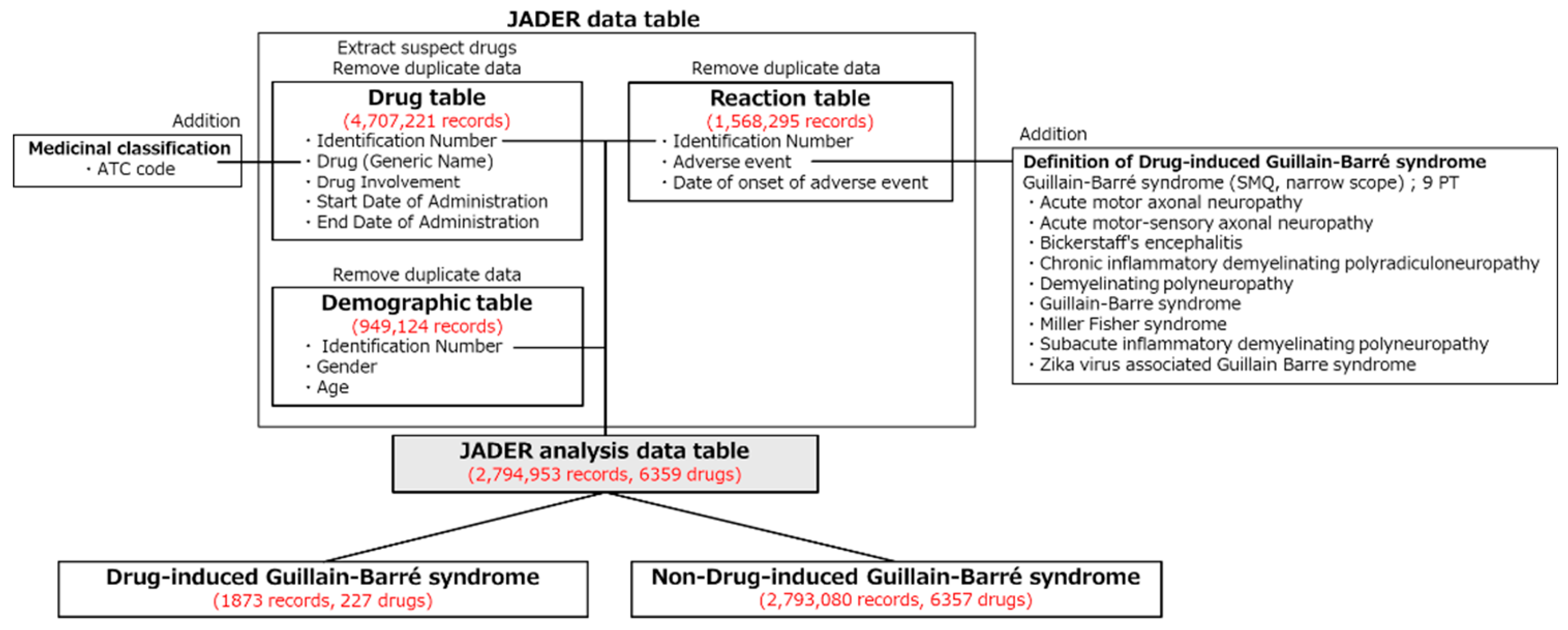
Figure 2.
Relationships of drugs with GBS. In this scattergram volcano plot, the x-axis represents lnROR, and the y-axis represents −log10 (p-value). The dotted line on the y-axis indicates a p-value of 0.05 on Fisher’s exact test. The color of the plot represents the therapeutic class of each drug. Drugs associated with GBS are located in the upper right corner of the plot.
Figure 2.
Relationships of drugs with GBS. In this scattergram volcano plot, the x-axis represents lnROR, and the y-axis represents −log10 (p-value). The dotted line on the y-axis indicates a p-value of 0.05 on Fisher’s exact test. The color of the plot represents the therapeutic class of each drug. Drugs associated with GBS are located in the upper right corner of the plot.
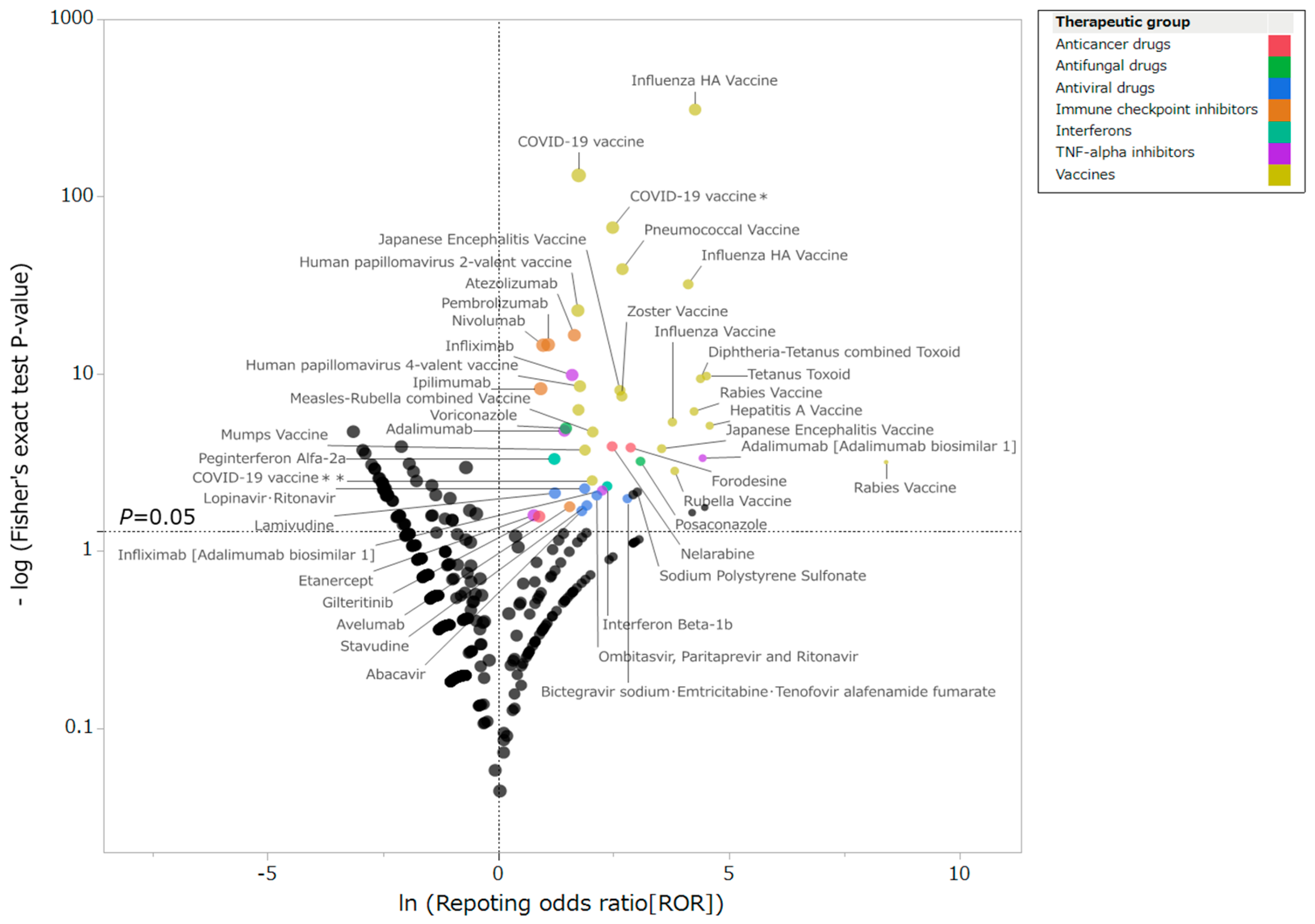
Figure 3.
Time to onset of GBS associated with vaccines and immune checkpoint inhibitors. (a) Comparison among vaccines. (b) Comparison among immune checkpoint inhibitors. For drugs administered multiple times, the time to onset was defined as the interval from treatment initiation (first dose) to onset. The numbers in parentheses indicate the number of reported cases for each drug.
Figure 3.
Time to onset of GBS associated with vaccines and immune checkpoint inhibitors. (a) Comparison among vaccines. (b) Comparison among immune checkpoint inhibitors. For drugs administered multiple times, the time to onset was defined as the interval from treatment initiation (first dose) to onset. The numbers in parentheses indicate the number of reported cases for each drug.
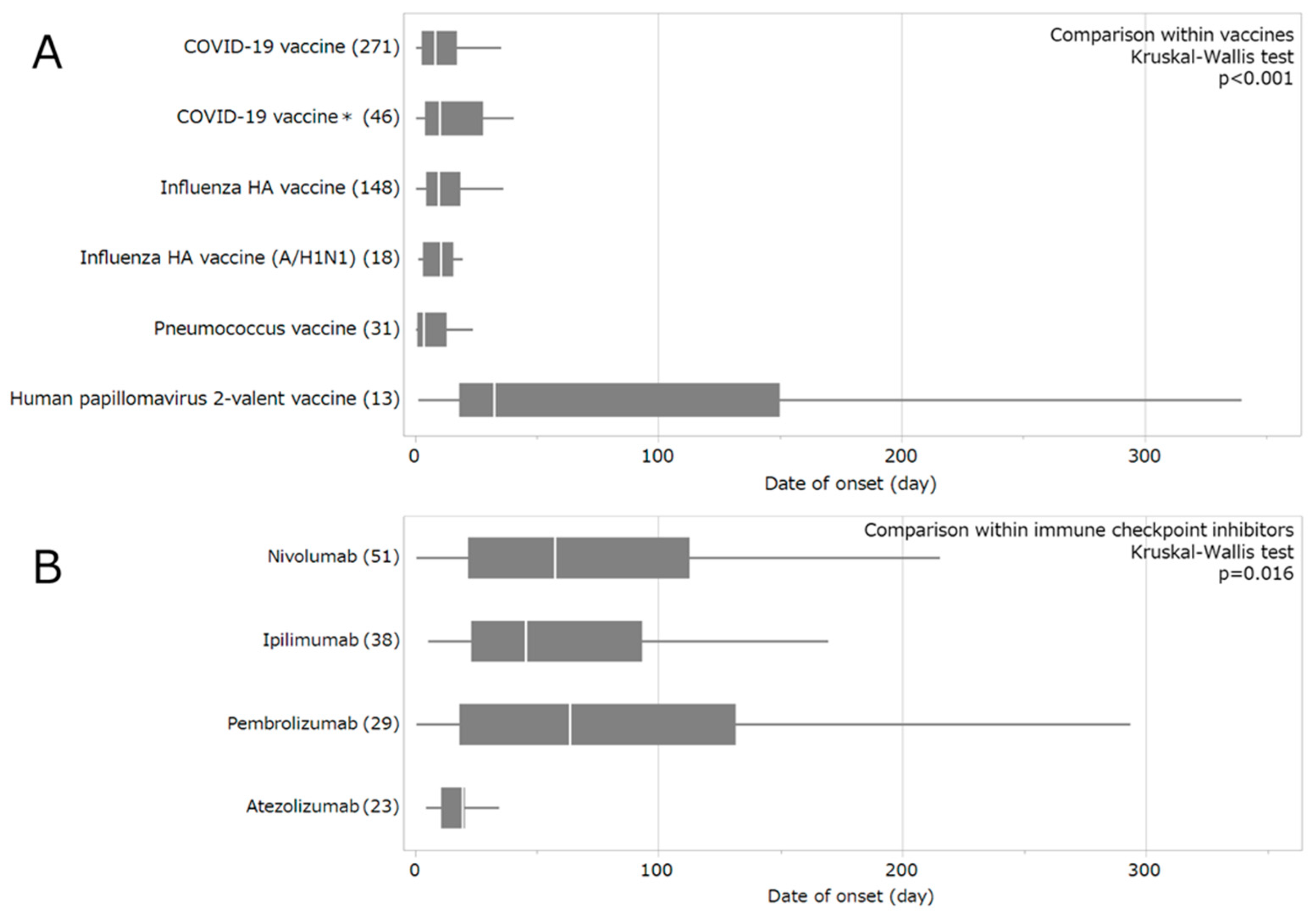
Figure 4.
Cross-tabulation and formula used to calculate the ROR for an adverse event. The cross-tabulation is structured with reports for the suspected drug, all other reports, reports with an adverse event, and reports without an adverse event (a–d indicate the number of reports).
Figure 4.
Cross-tabulation and formula used to calculate the ROR for an adverse event. The cross-tabulation is structured with reports for the suspected drug, all other reports, reports with an adverse event, and reports without an adverse event (a–d indicate the number of reports).
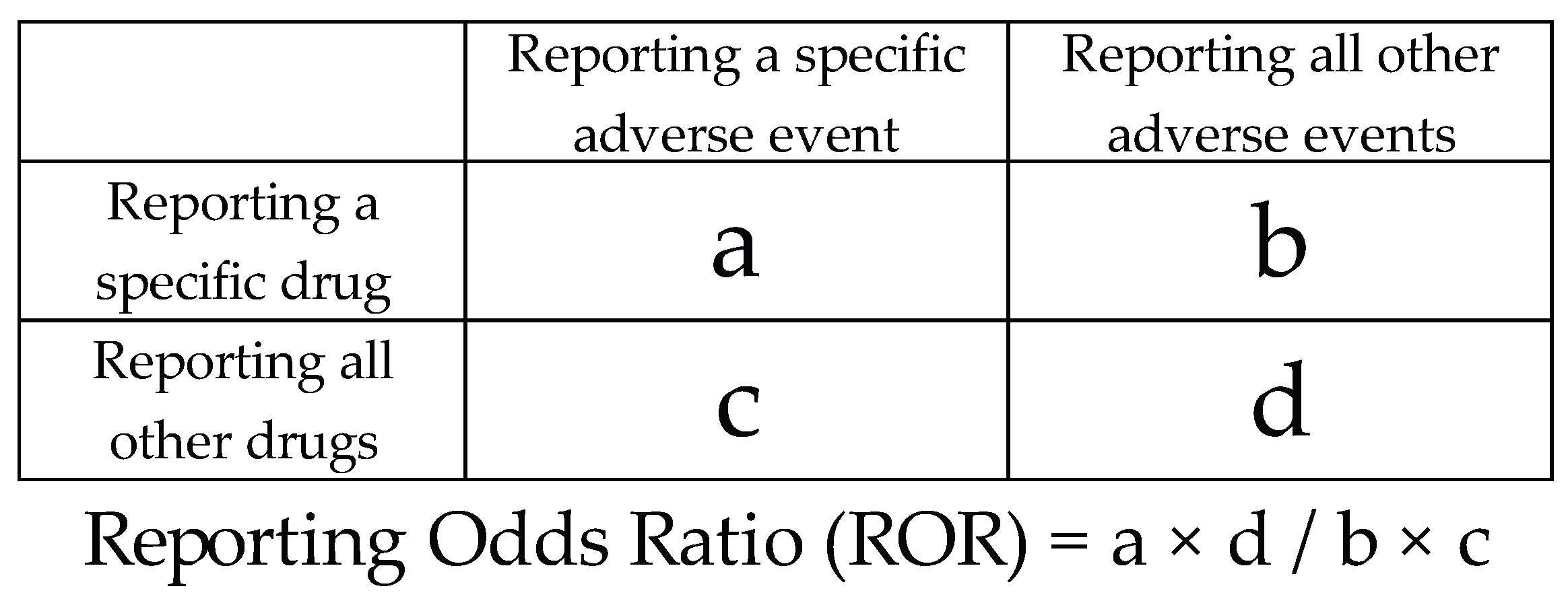

Table 1.
Characteristics of patients involved in reports of drug-induced GBS.
| Drug | N | Gender male/female/Unknown and not reported |
Age median (min–max) |
|---|---|---|---|
| Vaccines | |||
| COVID-19 vaccine | 354 | 165/185/4 | 55 (5–95) |
| COVID-19 vaccine* | 98 | 56/42/0 | 45 (15–85) |
| Influenza HA vaccine | 250 | 131/115/4 | 55 (5–85) |
| Influenza HA vaccine (A/H1N1) | 23 | 13/10/0 | 65 (5–75) |
| Human papillomavirus 2-valent vaccine | 56 | 0/56/0 | 15 (15–35) |
| Human papillomavirus 4-valent vaccine | 19 | 0/19/0 | 15 (15–45) |
| Pneumococcal vaccine | 50 | 28/15/7 | 75 (45–85) |
| Hepatitis B vaccine | 14 | 7/7/0 | 25 (5–35) |
| Japanese encephalitis vaccine | 10 | 5/5/0 | 10 (5–15) |
| Varicella zoster vaccine | 9 | 4/5/0 | 65 (55–75) |
| Immune checkpoint inhibitors | |||
| Nivolumab | 91 | 62/26/3 | 65 (35–85) |
| Pembrolizumab | 76 | 44/27/5 | 75 (25–85) |
| Ipilimumab | 54 | 37/17/0 | 65 (45–85) |
| Atezolizumab | 43 | 26/14/3 | 75 (45–95) |
| Avelumab | 4 | 3/0/1 | 75 (75–75) |
| Others | |||
| Infliximab | 26 | 22/4/0 | 65 (15–75) |
Table 2.
Onset status and Weibull distribution of drug-induced GBS.
| Drug | Onset days | Weibull distribution | N | |||
|---|---|---|---|---|---|---|
| Median (min–max) |
Scale Parameter α (95%CI) |
Shape Parameter β (95%CI) |
Shape Pattern | |||
| Vaccines | ||||||
| COVID-19 vaccine | 8.5 (0.5 –225.5) |
13.41 (11.21–16.00) |
0.71 (0.65–0.77) |
Early failure type | 271 | |
| COVID-19 vaccine* | 10.5 (0.5–347.5) |
27.43 (16.27–45.28) |
0.61 (0.49–0.75) |
Early failure type | 46 | |
| Influenza HA vaccine | 10.5 (0.5–212.5) |
15.44 (12.66–18.76) |
0.87 (0.77–0.98) |
Early failure type | 148 | |
| Influenza HA vaccine (A/H1N1) | 10.5 (1.5–51.5) |
13.36 (8.23–21.12) |
1.09 (0.74–1.51) |
Random failure type | 18 | |
| Pneumococcal vaccine | 4.5 (0.5–212.5) |
10.83 (5.44–20.94) |
0.57 (0.43–0.72) |
Early failure type | 31 | |
| Human papillomavirus 2-valent vaccine | 32.5 (1.5–352.5) |
81.92 (35.55–179.17) |
0.77 (0.48–1.13) |
Random failure type | 13 | |
| Immune checkpoint inhibitors | ||||||
| Nivolumab | 57.5 (0.5–359.5) |
83.75 (62.50–110.90) |
1.03 (0.82 –1.27) |
Random failure type | 51 | |
| Ipilimumab | 45.5 (5.5–169.5) |
65.52 (50.42–84.10) |
1.35 (1.03 –1.71) |
Wear-out failure type | 38 | |
| Pembrolizumab | 63.5 (0.5–314.5) |
92.13 (57.51–144.19) |
0.86 (0.63–1.14) |
Random failure type | 29 | |
| Atezolizumab | 19.5 (4.5–147.5) |
33.68 (21.36–51.90) |
1.02 (0.74–1.33) |
Random failure type | 23 | |
Table 3.
Time to onset and Weibull distribution of drug-induced GBS by gender.
| Drug | Gender | Onset days | Weibull distribution | N | P value# | |||
|---|---|---|---|---|---|---|---|---|
| Median (Min -Max) |
Scale Parameter α (95%CI) |
Shape Parameter β (95%CI) |
||||||
| Vaccine | ||||||||
| COVID-19 vaccine | 0.432 | |||||||
| Male | 8.5 (0.5–175.5) | 13.64 (10.77–17.18) | 0.81 (0.71–0.92) | 122 | ||||
| Female | 8 (0.5–242.5) | 13.44 (10.28–17.48) | 0.66 (0.58–0.74) | 144 | ||||
| COVID-19 vaccine* | 0.005 | |||||||
| Male | 16.5 (1.5–287.5) | 40.01 (22.62–68.82) | 0.70 (0.53–0.90) | 30 | ||||
| Female | 4.5 (0.5–347.5) | 11.49 (4.04–31.15) | 0.53 (0.37–0.72) | 16 | ||||
| Influenza HA vaccine | 0.416 | |||||||
| Male | 9.5 (0.5–71.5) | 13.71 (10.74–17.36) | 0.98 (0.83–1.15) | 79 | ||||
| Female | 10 (0.5–108.5) | 16.20 (12.11– 21.46) | 0.89 (0.74–1.06) | 68 | ||||
| Influenza HA vaccine (A/H1N1) | 0.032 | |||||||
| Male | 14.5 (2.5–51.5) | 19.65 (11.20–33.32) | 1.33 (0.77–2.03) | 10 | ||||
| Female | 5.5 (1.5–16.5) | 7.03 (3.57–13.24) | 1.28 (0.68–2.11) | 8 | ||||
| Human papillomavirus 2-valent vaccine | - | |||||||
| Male | - | - | - | - | ||||
| Female | 32.5 (1.5–352.5) | 81.92 (35.55–179.17) | 0.77 (0.48–1.13) | 13 | ||||
| Pneumococcal vaccine | 0.496 | |||||||
| Male | 3 (0.5–23.5) | 6.07 (3.09 - 11.39) | 0.80 (0.53–1.12) | 18 | ||||
| Female | 4.5 (0.5–31.5) | 8.23 (3.98 - 16.23) | 0.98 (0.58–1.47) | 11 | ||||
| Immune checkpoint inhibitors | ||||||||
| Nivolumab | 0.422 | |||||||
| Male | 57.5 (0.5–359.5) | 76.83 (53.49–108.62) | 1.01 (0.77–1.29) | 35 | ||||
| Female | 67 (7.5–215.5) | 99.97 (59.12–163.25) | 1.09 (0.71–1.59) | 16 | ||||
| Ipilimumab | 0.649 | |||||||
| Male | 46.5 (5.5–112.5) | 59.91 (45.95–76.97) | 1.64 (1.17–2.20) | 26 | ||||
| Female | 44.5 (7.5–169.5) | 77.04 (42.21–135.01) | 1.13 (0.68–1.71) | 12 | ||||
| Pembrolizumab | 0.853 | |||||||
| Male | 63.5 (1.5–314.5) | 104.55(55.05–191.02) | 0.89 (0.57–1.28) | 16 | ||||
| Female | 97 (0.5–293.5) | 81.32 (35.13–179.83) | 0.85 (0.49–1.33) | 11 | ||||
| Atezolizumab | 0.203 | |||||||
| Male | 20.5 (4.5–147.5) | 46.27 (23.87–85.81) | 0.97 (0.61–1.43) | 13 | ||||
| Female | 15.5 (8.5–20.5) | 16.97 (14.36–19.85) | 4.85 (2.63–7.91) | 9 | ||||
# Wilcoxon/Kruskal–Wallis test.
Table 4.
Time to onset and Weibull distribution of drug-induced GBS by age.
| Drug | Age | Onset days | Weibull distribution | N | P value# | |||
|---|---|---|---|---|---|---|---|---|
| Median (Min -Max) |
Scale Parameter α (95%CI) |
Shape Parameter β (95%CI) |
||||||
| Vaccine | ||||||||
| COVID-19 vaccine | 0.610 | |||||||
| <20y | 9.5 (0.5–153.5) | 14.96 (7.54–28.65) | 0.75 (0.52–1.00) | 19 | ||||
| ≧20y | 7.5 (0.5–242.5) | 13.41 (11.12–16.12) | 0.71 (0.65–0.77) | 250 | ||||
| COVID-19 vaccine* | 0.524 | |||||||
| <20y | 347.5 (347.5–347.5) | - | - | 1 | ||||
| ≧20y | 9.5 (0.5–287.5) | 24.57 (14.81–39.98) | 0.64 (0.51–0.78) | 45 | ||||
| Influenza HA vaccine | 0.311 | |||||||
| <20y | 12.5 (1.5–108.5) | 18.52 (12.42–27.18) | 0.98 (0.75–1.23) | 31 | ||||
| ≧20y | 9.5 (0.5–90.5) | 13.94 (11.27–17.15) | 0.92 (0.80–1.06) | 116 | ||||
| Influenza HA vaccine (A/H1N1) | 0.333 | |||||||
| <20y | 16.5 (16.5–16.5) | - | - | 1 | ||||
| ≧20y | 10.5 (1.5–51.5) | 12.98 (7.73–21.16) | 1.06 (0.71–1.47) | 17 | ||||
| Human papillomavirus 2-valent vaccine | 0.894 | |||||||
| <20y | 32.5 (1.5–352.5) | 82.62 (33.25–193.62) | 0.74 (0.45–1.11) | 12 | ||||
| ≧20y | 52.5 (52.5–52.5) | - | - | 1 | ||||
| Pneumococcal vaccine | - | |||||||
| <20y | - | - | - | 0 | ||||
| ≧20y | 3.5 (0.5–31.5) | 6.86 (4.25–10.79) | 0.86 (0.63–1.12) | 29 | ||||
| Immune checkpoint inhibitors | ||||||||
| Nivolumab | - | |||||||
| <20y | - | - | - | 0 | ||||
| ≧20y | 57.5 (0.5–359.5) | 83.75 (62.50–110.90) | 1.03 (0.82–1.27) | 51 | ||||
| Ipilimumab | - | |||||||
| <20y | - | - | - | 0 | ||||
| ≧20y | 45.5 (5.5–169.5) | 65.52 (50.42–84.10) | 1.35 (1.03–1.71) | 38 | ||||
| Pembrolizumab | - | |||||||
| <20y | - | - | - | 0 | ||||
| ≧20y | 63.5 (0.5–314.5) | 90.05 (55.02–143.74) | 0.84 (0.61–1.12) | 28 | ||||
| Atezolizumab | - | |||||||
| <20y | - | - | - | 0 | ||||
| ≧20y | 19.5 (4.5–147.5) | 33.68 (21.36–51.90) | 1.02 (0.74–1.33) | 23 | ||||
# Wilcoxon/Kruskal–Wallis test.
Disclaimer/Publisher’s Note: The statements, opinions and data contained in all publications are solely those of the individual author(s) and contributor(s) and not of MDPI and/or the editor(s). MDPI and/or the editor(s) disclaim responsibility for any injury to people or property resulting from any ideas, methods, instructions or products referred to in the content. |
© 2026 by the authors. Licensee MDPI, Basel, Switzerland. This article is an open access article distributed under the terms and conditions of the Creative Commons Attribution (CC BY) license (http://creativecommons.org/licenses/by/4.0/).
Copyright: This open access article is published under a Creative Commons CC BY 4.0 license, which permit the free download, distribution, and reuse, provided that the author and preprint are cited in any reuse.


