

Submitted:
03 March 2026
Posted:
04 March 2026
You are already at the latest version
Abstract
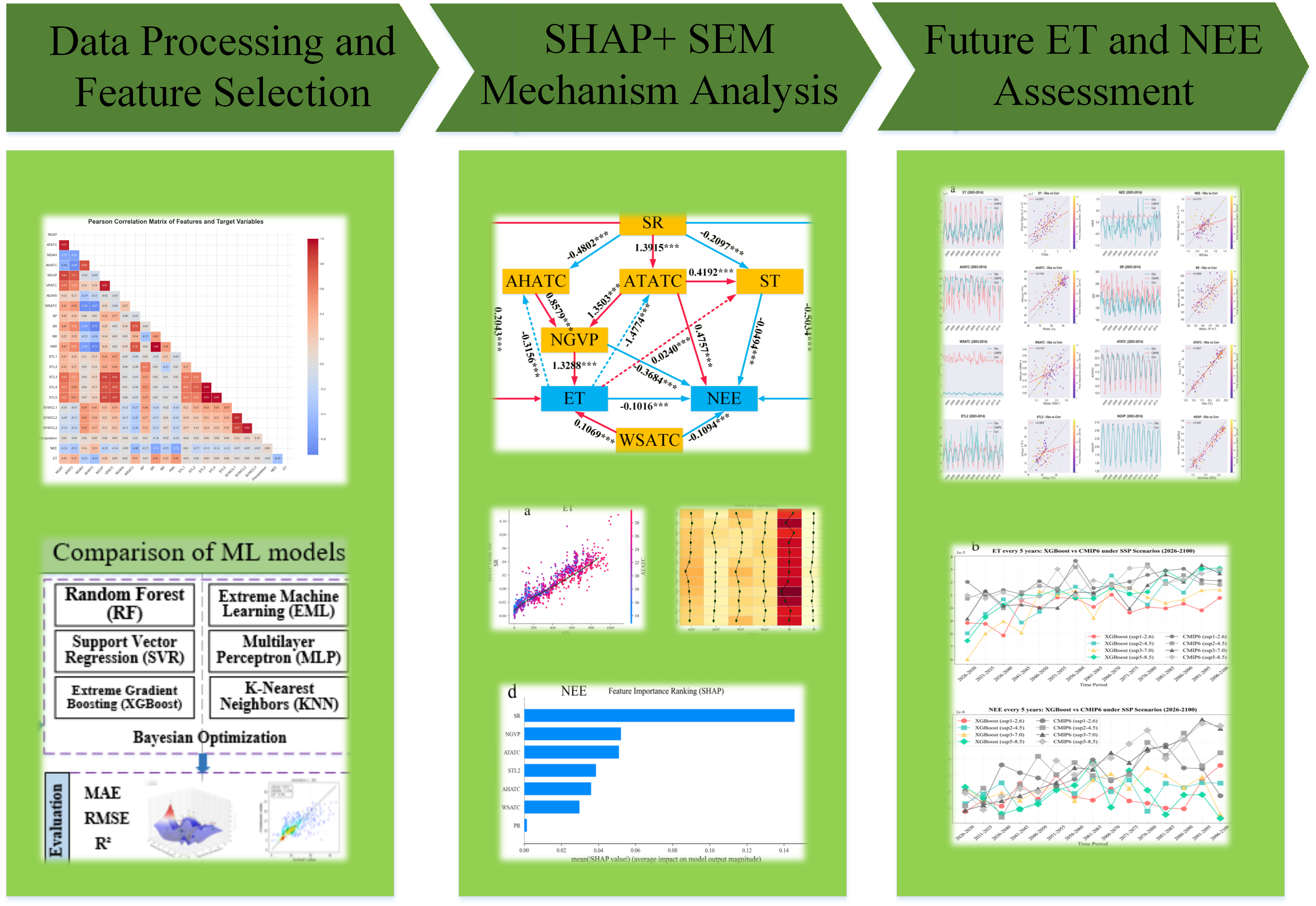
Tropical forests are predicted to become carbon sources by mid-century under climate change. However, this trajectory may not be inevitable for forests under long-term protection. Using 12 years of eddy covariance flux data from a strictly protected tropical forest in Xishuangbanna, China, we develop an explainable machine learning framework (SHAP + Structural Equation Modeling) to disentangle the environmental drivers of net ecosystem exchange (NEE) and evapotranspiration (ET), and project their future trajectories under four CMIP6 climate scenarios. We find a fundamental divergence: while conventional climate models predict a sink-to-source transition by 2050–2066, our data-driven model—trained on conservation-era observations—projects a persistent carbon sink through 2100 across all scenarios. This divergence suggests that long-term protection may buffer tropical forests against climate-driven decline, challenging the prevailing narrative of inevitable carbon loss. We further identify critical environmental thresholds—solar radiation (~200 W m⁻²) and air temperature (~25°C)—beyond which carbon uptake efficiency declines. Our findings provide empirical support for nature-based climate solutions and highlight the need to integrate conservation legacies into Earth system models.
Keywords:
Xishuangbanna Tropical Rainforest
; carbon and water fluxes
; explainable machine learning
; SHAP
; Structural Equation Modeling (SEM)
; CMIP6
Copyright: This open access article is published under a Creative Commons CC BY 4.0 license, which permit the free download, distribution, and reuse, provided that the author and preprint are cited in any reuse.


