

Submitted:
02 March 2026
Posted:
04 March 2026
You are already at the latest version
Abstract
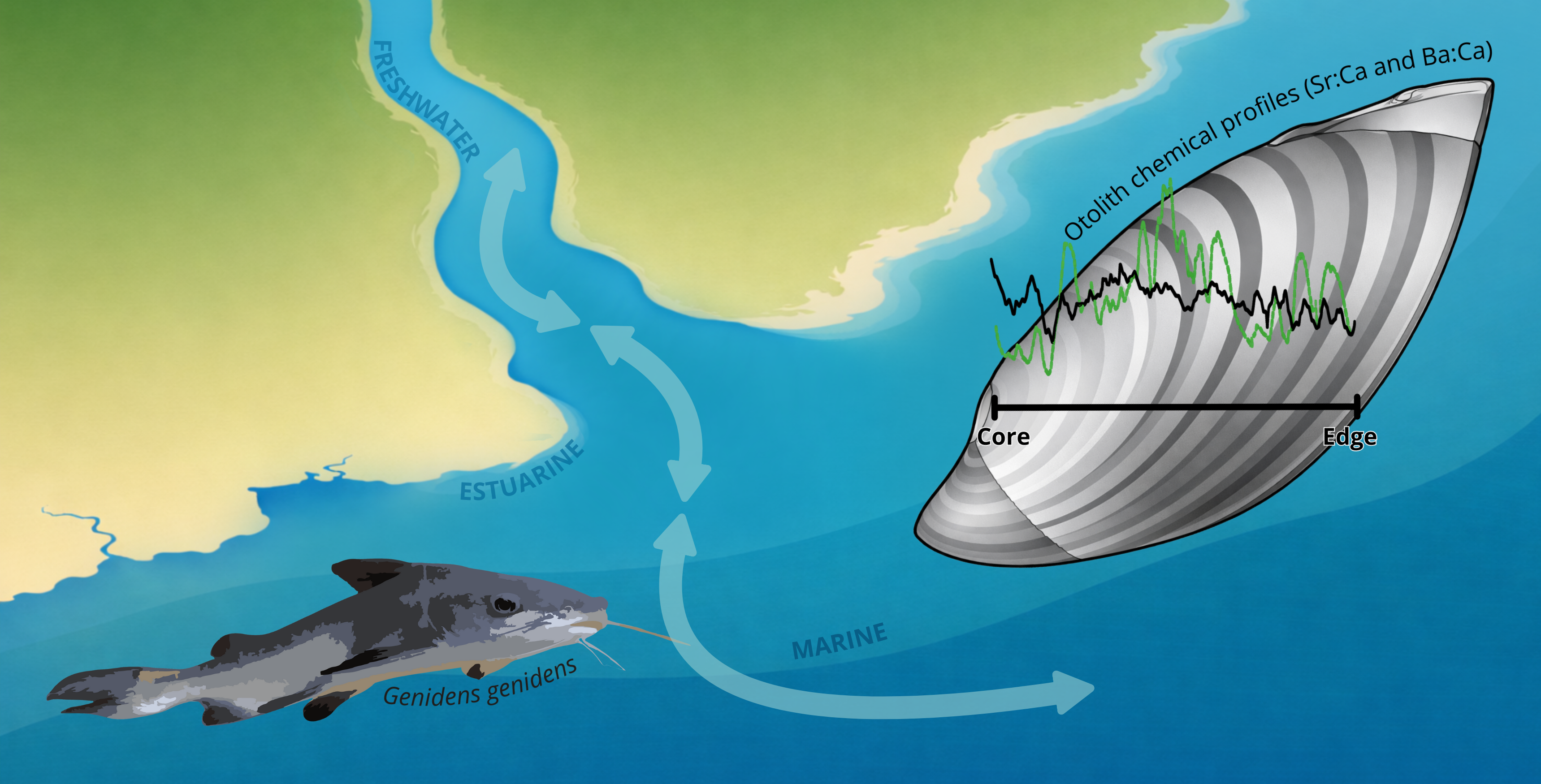
Otolith microchemistry was used to investigate habitat use and connectivity of the estuarine catfish Genidens genidens across three estuaries in southeastern Brazil. A total of 58 individuals were analyzed using laser ablation inductively coupled plasma mass spectrometry, focusing on strontium-to-calcium (Sr:Ca) and barium-to-calcium (Ba:Ca) ratios. Variations in elemental ratios along otolith transects allowed the reconstruction of individual ontogenetic trajectories along the estuarine–marine gradient. Most individuals exhibited combined use of estuarine and marine environments, while trajectories restricted to freshwater were rare. The complexity of chemical profiles increased with age, indicating more frequent habitat shifts throughout ontogeny. These patterns reveal high ecological plasticity and partial migration within populations of G. genidens. Strontium-to-calcium ratios were effective indicators of salinity-related habitat transitions, whereas Ba:Ca ratios provided complementary information associated with continental influence. Overall, this study demonstrates the applicability of otolith microchemistry to infer individual life-history pathways and highlights the role of estuaries as key habitats for feeding, growth, and recruitment in G. genidens.
Keywords:
estuarine connectivity
; ontogenetic habitat use
; partial migration
; elemental ratios
; Sr:Ca
; Ba:Ca
; estuarine–marine gradient
; fish ecology
Copyright: This open access article is published under a Creative Commons CC BY 4.0 license, which permit the free download, distribution, and reuse, provided that the author and preprint are cited in any reuse.


