
Preprint
Review

This version is not peer-reviewed.

From Traditional Risk Factors to Machine Learning Models: Advancing the Prediction of Anastomotic Leak and Other Major Complications in Colorectal Cancer Surgery

Submitted:

02 March 2026

Posted:

03 March 2026

You are already at the latest version

Abstract
Colorectal cancer (CRC) represents a major global health burden, accounting for roughly 10% of all newly diagnosed cancers and cancer-related deaths worldwide. It is the third most diagnosed malignancy and the second leading cause of cancer mortality according to the World Health Organization. Postoperative complications remain a significant concern after CRC resection, occurring in up to 50% of patients and contributing to increased morbidity, mortality, prolonged hospitalization, and substantial healthcare expenditure. Artificial intelligence (AI) has emerged as a transformative tool in modern healthcare, offering advanced capabilities in predictive analytics, clinical decision support, and personalized perioperative management. The present review systematically evaluates the application of AI, specifically machine learning (ML) and deep learning (DL) algorithms, in predicting anastomotic leak (AL) and other major postoperative complications. AI models aim to refine risk stratification and enhance surgical decision-making. A total of 13 studies were included, encompassing 15,105 patients. Across these studies, ML and DL algorithms consistently outperformed conventional statistical models in forecasting postoperative outcomes. Current evidence suggests that AI has substantial potential to improve perioperative risk prediction, support intraoperative decision-making, and personalize postoperative surveillance in CRC surgery. Methodological limitations including high risk of bias, limited external validation, heterogeneous outcome definitions, and inconsistent reporting necessitate more robust, prospective, multicenter research before widespread clinical adoption can be realized.
Keywords: 
;  ;  ;  ;  

1. Introduction

Colorectal cancer (CRC) represents a significant global health concern, accounting for approximately 10% of all newly diagnosed cancers and cancer-related mortalities worldwide annually (1,2). Surgical resection remains a basic curative strategy for CRC patients. Despite recent advancements in minimally invasive techniques, including laparoscopic, endoscopic, and robotic surgical options (3), as well as improvements in perioperative care, postoperative complications continue to present substantial clinical challenges (4). These complications significantly and adversely affect patients, often resulting in prolonged hospital stays (HS), increased healthcare costs, and, in some cases, mortality (5).
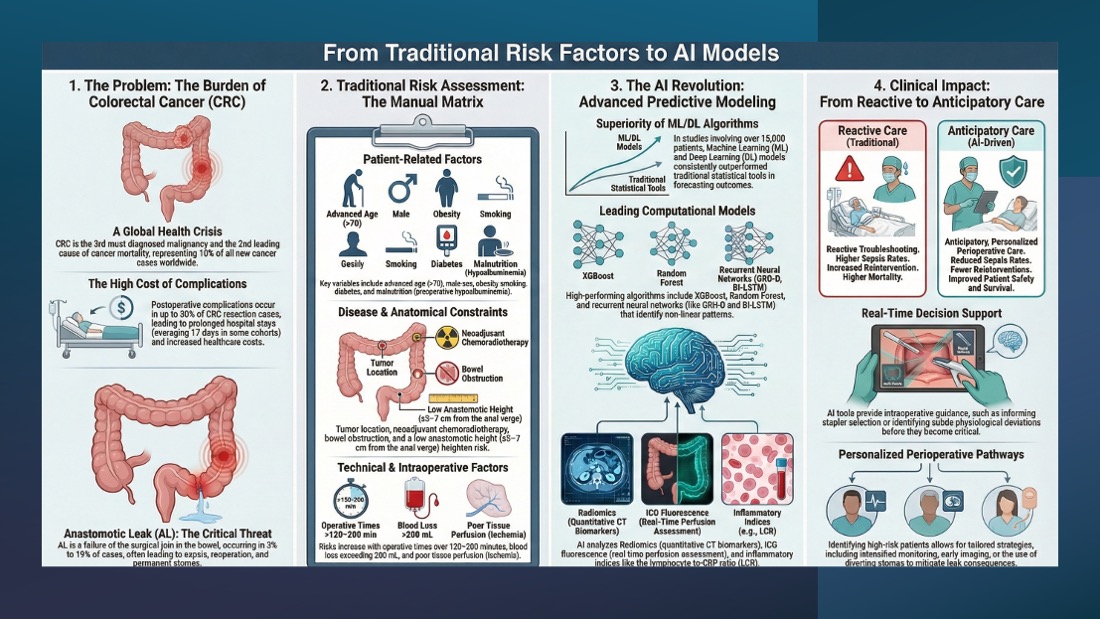
Anastomotic leak (AL) is a critical and highly concerning complication in colorectal surgery, significantly affecting both short and long-term patient outcomes. The reported incidence varies from 3% to 19%, contingent upon factors such as the anastomotic level, emergency status, and patient selection (6). The repercussions of AL extend beyond immediate morbidity, as it increases the length of hospital stay, reoperation rates, and mortality. Additionally, it disrupts the timely initiation of adjuvant therapy, adversely affects oncologic survival in colorectal cancer, and often results in permanent stomas. AL is a major determinant of surgical quality and long-term oncologic success (5,6). Despite ongoing advancements in perioperative care, surgical techniques, and enhanced recovery protocols, predicting which anastomoses will fail remains a formidable challenge. Numerous risk factors have been identified, reflecting the multifactorial nature of AL. Patient-related factors, such as malnutrition, smoking, diabetes, obesity, cardiopulmonary disease, and systemic inflammation, are recognized contributors. Disease-related factors include tumor location, neoadjuvant chemoradiotherapy, local sepsis, bowel obstruction, and anatomical constraints within the pelvis. Intraoperative factors, like poor tissue perfusion, high anastomotic tension, technical error, and emergency surgery contribute to compromised healing (7). Postoperative inflammatory response and infectious complications further modulate the risk. The pathophysiological background, as extensively described in the literature, involves a complex interplay of tissue ischemia, microbiome alterations, matrix degradation, and impaired collagen remodeling, ultimately leading to the failure of anastomotic integrity. Existing clinical scoring systems attempt to synthesize these variables into structured risk-assessment tools; however, none has achieved widespread clinical adoption (8). Their discriminative performance is modest, limited by the complexity of AL, the heterogeneity of surgical populations, and the difficulty of capturing dynamic intraoperative factors. Moreover, these models typically rely on linear associations and cannot account for complex, non-linear interactions among variables. As a result, surgeons continue to rely on clinical judgment, which, although irreplaceable, lacks standardized quantification or reproducibility across settings (6-8). Over the past decade, artificial intelligence (AI) and machine learning (ML) have emerged as promising tools for risk stratification in complex clinical settings. In colorectal surgery, ML has already demonstrated utility in predicting morbidity, mortality, conversion to open surgery, and postoperative complications (9). For AL specifically, AI models are particularly attractive given the large number of interacting risk factors and the incomplete understanding of the biological processes underlying anastomotic failure (10). Early ML models incorporated demographic and perioperative variables, demonstrating improved predictive accuracy compared to conventional scoring systems. Subsequently, more sophisticated approaches have utilized deep neural networks, ensemble learning, and gradient boosting. Imaging-based models have also gained attention: radiomics allows for the extraction of quantitative imaging biomarkers from preoperative CT scans, capturing subtle textural or microarchitectural features not visible to the human eye (11). Similarly, intraoperative near-infrared fluorescence imaging with indocyanine green (ICG) has provided a platform for AI-assisted perfusion quantification, potentially offering a more reliable assessment of microvascular adequacy than the surgeon’s subjective visual evaluation (9-11). Moreover, many studies lack external validation, which is essential for the clinical application in real-world settings. Ethical considerations, data privacy, interpretability, and medico-legal implications also constitute significant barriers. While the potential of AI in predicting anastomotic leakage (AL) and other postoperative complications in colorectal surgery is considerable, its integration into routine clinical practice requires rigorous validation and standardized evaluation frameworks. To date, most AI-based models for AL prediction are limited by heterogeneity in study design, small and often single-center training cohorts, and a lack of external validation factors that significantly constrain their clinical applicability. Moreover, no existing review has comprehensively bridged established surgical risk determinants with emerging computational methodologies. Addressing this gap is critical for translating AI from theoretical promise into practical, evidence-based intraoperative decision support. The aim of our review is to evaluate the current role of AI and machine learning models in predicting complications after colorectal surgery by explicitly linking traditional clinical risk factors, underlying pathophysiological mechanisms, and modern computational approaches. By integrating insights from conventional surgical knowledge with advances in data-driven modeling, this review synthesizes the strengths and limitations of existing AI-based prediction tools, highlights methodological challenges that impede widespread implementation, and outlines key future directions. Ultimately, we explore how these technologies may evolve to support real-time surgical decision-making and improve patient outcomes.

1.1. Risk Factors Contributing to Post-Operative Complications

Postoperative complications following colorectal surgery emerge from a complex interplay of patient-related, disease-related, and perioperative factors (Figure 1). Advanced age, frailty, and the presence of comorbidities particularly neurological and cardiorespiratory conditions consistently increase postoperative vulnerability.
Preoperative 120. minutes, and peritoneal contamination substantially elevate the risk of adverse postoperative outcomes (Figure 2).
Evidence from extensive multicenter cohorts underscores this multifactorial nature. In a prospective study conducted across 81 French hospitals and involving 1421 patients treated for colorectal cancer or diverticular disease, several variables were identified as independent predictors of postoperative mortality. Emergency surgery, preoperative weight loss exceeding 10%, neurological comorbidities, and age over 70 years cumulatively contributed to heightened risk. Overall postoperative morbidity reached 35%, with wound infection, anastomotic leak, hemorrhage, stoma-related complications, prolonged ileus, and cardiorespiratory events emerging as the most common complications. Hospital stays were significantly extended averaging 17 days particularly among patients undergoing emergency procedures, those with underlying malignancy, and those treated in public hospitals (12).
In additional studies focusing on elderly surgical populations, sarcopenia assessed by diminished psoas muscle area on preoperative CT emerged as a strong independent predictor of major complications. Alongside hypoalbuminemia, it consistently signaled physiological fragility and correlated closely with prolonged hospital stay. Although 30-day readmission rates were low (4%) and 90-day mortality modest (1%), reduced psoas density reliably identified patients at increased risk for postoperative deterioration (13,14). Taken together, these findings highlight the importance of comprehensive preoperative evaluation, integrating frailty indices and CT-derived markers of sarcopenia, to identify high-risk individuals who may benefit from more tailored perioperative strategies.
Role of the intestinal microbiome in anastomotic healing adds further biological complexity. Microbial dysbiosis, particularly the overrepresentation of collagenase-producing species such as Enterococcus faecalis and Pseudomonas aeruginosa, has been implicated in collagen degradation at the anastomotic site. Altered biofilm behavior, shaped by bowel preparation or exposure to broad-spectrum antibiotics, may further promote bacterial phenotypes that weaken the extracellular matrix and impair mucosal regeneration. These microbial influences interact intimately with host immune and inflammatory responses: elevated postoperative inflammatory markers, including CRP and aberrant neutrophil-to-lymphocyte ratios, have been associated with an increased likelihood of clinically significant anastomotic leak, reflecting this complex microbe–immune interface (15). Collectively, these clinical, physiological, and biological dimensions illustrate postoperative morbidity as a deeply multifaceted phenomenon. In the specific context of anastomotic healing, the convergence of mechanical stressors, host vulnerability, microbial influences, and intraoperative technical considerations underscores the need for multidimensional risk-assessment frameworks. Such integrated models combining patient physiology, disease characteristics, operative variables, and emerging insights from microbiome science represent the most promising pathway toward more accurate prediction of anastomotic failure and, ultimately, improved surgical outcomes.

1.2. Postoperative Complications Following CRC Resection

Postoperative complications following colorectal cancer (CRC) resection, affecting up to 50% of patients and markedly increasing morbidity, mortality, hospital stay, and healthcare costs (16). Approximately 40% of individuals experience at least one complication, ranging from surgical events such as anastomotic leak (AL), hemorrhage, and wound infection to systemic complications including pneumonia, thromboembolism, and sepsis (Figure 3) (17).
Clavien–Dindo classification provides a standardized and widely adopted framework for grading severity, and higher-grade complications are strongly associated with delayed recovery and impaired long-term oncological outcomes (18). Notably, complications often interrupt or postpone adjuvant chemotherapy, a critical determinant of survival in stage III CRC. In a large retrospective study, patients with postoperative complications exhibited significantly lower 5-year overall and disease-free survival compared with those without complications (19). Among postoperative complications, AL is particularly concerning, with incidence rates ranging from 2% to 19% depending on tumor location, surgical technique, and patient characteristics; in distal rectal cancer, rates may reach 24% (20). AL carries substantial morbidity, increased mortality risk, a higher likelihood of permanent stoma, and adverse oncological consequences including local recurrence and reduced long-term survival (19).
Risk factors for AL are multifactorial and span patient-related, disease-related, and technical domains. Patient-related factors include male sex, obesity, diabetes, chronic pulmonary disease, smoking, alcohol use, and advanced age, all of which impair tissue healing or increase technical complexity (21,22). Disease-related contributors include tumor location, neoadjuvant chemoradiotherapy, obstruction, and local sepsis. Technical and intraoperative factors such as prolonged operative time (>200 minutes), blood loss >200 mL, intraoperative transfusions, and low anastomotic height (≤5–7 cm from the anal verge) further elevate risk by reducing perfusion and increasing procedural difficulty (21). Postoperative factors including anemia, corticosteroid or NSAID use, and perioperative transfusions may also compromise anastomotic healing. Although diverting stomas do not reduce the incidence of AL, they mitigate its clinical consequences by lowering the need for reoperation and limiting sepsis-related morbidity (21). A detailed understanding of these inter-related risk factors forms the clinical foundation upon which ML-based models aim to enhance predictive accuracy and guide perioperative decision-making.

1.3. Artificial Intelligence in Surgical Prognosis

Artificial intelligence (AI) has rapidly evolved into a transformative force in modern healthcare, offering unprecedented capabilities in predictive analytics, clinical decision-making, and outcome optimization. Within colorectal surgery, AI particularly through machine learning (ML) and deep learning (DL) algorithms has shown considerable promise in enhancing prognostic accuracy beyond the limitations of traditional statistical approaches (22). Conventional models, which rely on linear assumptions and struggle to integrate complex, interdependent variables, are inherently constrained when applied to the multifactorial landscape of surgical complications. In contrast, ML techniques can process high-dimensional, multimodal datasets and uncover subtle, non-linear patterns that would otherwise remain undetected. AI-driven models have already been applied across a broad spectrum of clinical scenarios, including prediction of postoperative morbidity, mortality, conversion to open surgery, surgical site infections, prolonged ileus, and most critically anastomotic leak (AL). By synthesizing preoperative characteristics, intraoperative metrics, and early postoperative indicators, ML systems can generate dynamic, patient-specific risk estimates, enabling real-time support for intraoperative and perioperative decision-making (23–25). Beyond risk prediction, AI holds transformative potential in shaping perioperative management: identifying high-risk patients, guiding tailored operative strategies, and informing targeted postoperative surveillance. Early evidence suggests that AI-enhanced risk stratification may allow clinicians to intervene earlier through diversion, intensified monitoring, or optimization of modifiable risk factors thereby improving clinical outcomes and streamlining resource utilization across surgical pathways (25-27). As these technologies progress, their effective integration into routine surgical practice will depend on rigorous external validation, model interpretability, and seamless incorporation into established clinical workflows.

1.4. Objective

The aim of this review is to provide a comprehensive and critical assessment of artificial intelligence applications specifically machine learning and deep learning methodologies in predicting anastomotic leak and other major postoperative complications following colorectal cancer resection. By synthesizing evidence across the entire perioperative continuum, this review explores how AI-based models may enhance traditional risk assessment, offer real-time decision support, and ultimately improve clinical outcomes through earlier and more accurate identification of high-risk patients.

2. Methodology

2.1. Study Framework (PICO/PICOS)

This systematic review was conducted utilizing a PICOS framework specifically adapted for studies that develop or validate artificial intelligence-based predictive models in colorectal cancer (CRC) surgery. The Population (P) consisted of published clinical studies involving adult patients undergoing colorectal resection either colon or rectal surgery via open, laparoscopic, robotic, or hybrid approaches, wherein machine learning or deep learning techniques were employed for postoperative risk prediction. The Intervention/Index Test (I) encompassed any artificial intelligence-driven predictive methodology, including Random Forest, XGBoost, LightGBM, Support Vector Machines, neural networks, GRU-D architectures, BI-LSTM models, automated AI platforms, or hybrid approaches integrating intraoperative imaging or biochemical data. The Comparator (C) included conventional statistical models (e.g., logistic regression, ACS-NSQIP calculators, Colon Leakage Score) when reported; however, studies lacking explicit comparators were also considered eligible, recognizing that many AI models remain exploratory and in early developmental stages. The Outcomes (O) included all postoperative complications predicted by the included models. Anastomotic leak (AL) was the most frequently examined endpoint, but secondary outcomes such as surgical site and organ-space infections, prolonged ileus, cardiopulmonary events, postoperative bleeding, readmission, length of stay, mortality, and functional outcomes including low anterior resection syndrome (LARS) were also evaluated across the literature. The Study Design (S) comprised retrospective and prospective cohort studies either single-center or multicenter that developed, internally validated, or externally validated AI-based prediction models. Exclusion criteria included randomized trials (none identified), editorials, commentaries, narrative reviews, conference abstracts without full manuscripts, non-English publications, and studies lacking quantitative model performance metrics.

2.2. Search Strategy and Study Selection

A systematic literature search was conducted in accordance with PRISMA 2020 guidelines to identify studies evaluating AI-based prediction of postoperative complications after CRC resection. Searches were performed across PubMed (MEDLINE), Cochrane Library, Embase, Scopus, and ScienceDirect, without date restrictions, using the Boolean query: (“Artificial Intelligence”) AND (“Predictive Modeling”) AND (“Postoperative Complications”) AND (“Colorectal Cancer”).
Eligible studies were required to:
  • Evaluate postoperative outcomes following CRC surgery;
  • Apply an ML or DL model for prediction;
  • Report performance metrics (e.g., AUROC, accuracy, sensitivity, specificity);
  • Provide full-text original research.
Exclusion criteria were R1 for non-English language, R2 for studies unrelated to CRC surgery and R3 for abstracts without full text, editorials, commentaries, narrative reviews, or studies lacking quantitative model performance. Screening was performed in two stages (Figure 4). Title/abstract screening followed by full-text evaluation according to predefined criteria. Reference lists of included studies were also screened to identify additional eligible articles.

3. Results

A total of 13 studies satisfied the inclusion criteria, representing a combined cohort of 15,105 patients (Table 1). The included studies comprised both multicenter and single-center cohort designs, employing retrospective and prospective methodologies; notably, no randomized controlled trials (RCTs) were identified. Publication years ranged from 2017 to 2025, with most studies appearing after 2020, reflecting the rapid acceleration and maturation of AI applications in colorectal surgery during the current decade.
Our A2020. flow diagram for this review (Figure 4). A PROBAST-based quality assessment of the 13 included studies identified significant methodological variability, with most investigations exhibiting a high or unclear risk of bias. Only a minority of studies demonstrated low risk across multiple PROBAST domains, and none met all criteria (Figure 5 and Figure 6). Additionally, the AUC (Area Under the ROC Curve) was used as the primary metric of model discrimination, reflecting each algorithm’s ability to distinguish between patients who developed postoperative complications particularly anastomotic leak (AL) and those who did not.

3.1. Targeted Subset Synthesis for Anastomotic Leak Prediction

AL represents the most clinically important postoperative event, we performed a targeted subset synthesis of studies that reported discrimination performance (AUROC) for AL prediction, summarized below (Figure 7). This approach enabled a direct comparison across models using a common metric due to heterogeneity in study design, predictors, outcome definition and validation strategies; therefore, a quantitate meta-analysis was not pursued.
Targeted subset synthesis included five studies (He 2025, Kang 2025, Mazaki 2021, Sammour 2017, Tahamehlitz 2024). As shown in Figure 7, reported AUROC values in smaller retrospective cohorts ranged from 0.766 (Mazaki) to 0.820 (Tahamehlitz). In the largest multicenter study, discrimination was excellent in internal validation (AUROC 0.984) but decreased substantially on external validation (AUROC 0.703) (Kang), highlighting potential overfitting and limited generalizability. Sammour et al. reported a broader discriminatory performance range (0.73–0.96), depicted as a midpoint with error bars. He et al. incorporated intraoperative perfusion information and reported a strong signal association with AL risk using a non-AUROC metric; thus, this study is described narratively rather than included in the AUROC comparison.

3.2. Study-by-Study Synthesis Across Postoperative Outcomes

Mazaki et al. evaluated 256 left-sided CRC resections using an Auto-AI platform (Prediction One), achieving an AUC of 0.766 for AL prediction and demonstrating lower leak rates with triple-row staplers. Masum et al. analyzed 4,336 patients from a UK NHS trust, showing that BI-LSTM and SVR models predicted length of stay, readmission, and 31-day mortality with accuracies of 83%, 87.5%, and 96.6%, respectively, emphasizing the advantage of incorporating comprehensive variable sets. Chen et al. assessed 1,067 patients undergoing simultaneous colorectal and liver resections for CRLM and reported that Random Forest models predicted postoperative complications (AUC 0.716) and long-term oncologic outcomes, with KRAS, BRAF, and MMR status emerging as key variables. In elderly CRC populations, Tian et al. evaluated 512 patients ≥65 years using the MGA-XGBoost algorithm, achieving an AUC of 0.862 for infectious complications and highlighting inflammatory and nutritional indices particularly the lymphocyte-to-C-reactive protein ratio (LCR) as dominant predictors. He et al. introduced an intraoperative perfusion-assessment model using ICG fluorescence imaging and XGBoost in 68 rectal cancer patients, achieving an R² of 97.2% for perfusion quantification and demonstrating strong associations with postoperative complications. Anania et al. analyzed 2,013 registry patients and found that deep learning models predicted overall postoperative morbidity with an accuracy of 0.86, though AL-specific prediction was not examined. Wang et al. studied 493 rectal cancer patients and reported that Random Forest achieved the highest performance for early postoperative complications (AUC 0.880), with inflammatory markers such as PNI and IPI identified as major predictors. Sammour et al. validated the anastomoticleak.com calculator in 402 colon cancer patients, demonstrating superior discrimination compared with ACS-NSQIP and the Colon Leakage Score (AUC 0.73 overall; 0.96 for left colectomy). Fang et al. evaluated 109 elderly patients undergoing robotic NOSE surgery and found that XGBoost achieved an AUC of 0.92, with age, coronary heart disease, ASA grade, and hemoglobin emerging as key predictors. Ruan et al. analyzed 3,534 CRC patients using time-series models and demonstrated that GRU-D architectures outperformed logistic regression for predicting wound and organ-space infections (AUC 0.80 vs 0.69), highlighting the value of dynamic physiologic data. Huang et al. applied multiple ML models to 342 patients to predict LARS, with Random Forest achieving an AUC of 0.858 and tumor-related anatomical variables dominating feature importance. Kang et al. conducted one of the largest AL-focused investigations (1,818 patients), demonstrating excellent internal performance of an XGBoost model (AUC 0.984) but substantial degradation upon external validation (AUC 0.703); serum calcium was the strongest predictor. The Swiss pilot study by Taha-Mehlitz et al. applied logistic regression, Random Forest, and gradient boosting to preoperative biochemical and radiologic variables, demonstrating encouraging internal discrimination but limited generalizability due to the small sample size and lack of external validation.

4. Discussion

Artificial intelligence is increasingly transforming postoperative risk prediction in CRC surgery, with growing evidence that machine learning (ML) and deep learning (DL) approaches can achieve clinically meaningful discrimination across a spectrum of postoperative outcomes, including anastomotic leakage (AL), infectious morbidity, prolonged ileus, cardiopulmonary events, readmission, and functional impairment. By integrating multidimensional perioperative data including biochemical and inflammatory markers, intraoperative perfusion metrics, genomic profiles, and dynamic time-series variables AI facilitates granular risk stratification, supports intraoperative decision-making, and enables increasingly personalized perioperative care.
Across the 13 included studies, several model families recurred (e.g., XGBoost, Random Forest, recurrent neural networks such as BI-LSTM and GRU-D, and automated AI platforms), reflecting a broad methodological landscape. A key strength of AI in this context is its ability to model complex, non-linear relationships among predictors, which may be challenging for conventional regression-based approaches. Both established and emerging predictors were repeatedly highlighted, including age, ASA grade, comorbidity burden, operative duration, surgical approach, and stoma formation. Inflammatory and nutritional indices, such as NLR, PLR, LMR, PNI, and particularly the lymphocyte-to-C-reactive protein ratio (LCR), requently ranked among influential variables, especially in older cohorts. Novel physiologic features were also introduced; notably, He et al. combined ICG fluorescence angiography with ML-based perfusion assessment, reporting strong associations between perfusion deficits and postoperative complications, supporting the potential role of intraoperative physiologic signals in AL-related risk assessment (32).
Several investigations suggested actionable clinical utility beyond performance metrics. For example, Mazaki et al. reported that an Auto-AI approach could inform technical decisions such as stapler selection (23), while Chen et al. proposed individualized prediction tools in the setting of simultaneous colorectal and liver resections (30). In elderly populations where baseline vulnerability is higher and conventional calculators may underperform studies (31,35) focusing on patients ≥65 years reported encouraging discrimination for infectious and cardiopulmonary complications and AL-related morbidity, suggesting that AI-based stratification could be particularly valuable in high-risk subgroups.
These findings indicate that AI may be especially valuable in populations in which traditional risk calculators underperform. Methodological inconsistencies were prevalent in these studies. The definitions of AL and postoperative infections varied significantly, complicating cross-study comparisons. Essential steps in model development such as feature preprocessing, hyperparameter optimization, calibration assessment, and handling of missing data were reported inconsistently. These weaknesses were evident in the PROBAST evaluation, where most studies were classified as having a high overall risk of bias, despite low or unclear ratings in several individual domains. Notably, the PROBAST tool does not calculate overall risk as an average; rather, a single high-risk domain automatically assigns a high-risk label to the entire study (Figure 5 and Figure 6). In the present review, the Analysis domain was the primary contributor to the high overall risk, due to insufficient handling of missing data, lack of calibration, inadequate assessment of overfitting, and limited external validation. This structural characteristic accounts for the disproportionately elevated overall bias ratings observed in the included studies. Beyond their predictive accuracy, AI-enhanced models have direct surgical relevance, as early recognition of postoperative complications remains a critical determinant of patient outcomes. Anastomotic leak, infectious morbidity, and cardiopulmonary deterioration often follow a rapid and clinically deceptive course, and delayed diagnosis significantly increases sepsis rates, reintervention requirements, prolonged hospitalization, and mortality. Timely identification of high-risk patients enables closer monitoring, personalized perioperative pathways, and earlier therapeutic interventions, including expedited imaging, targeted antimicrobial therapy, and prompt surgical or endoscopic management. From a surgical standpoint, tools capable of detecting subtle physiological deviations or radiological patterns before overt clinical deterioration offer the potential to shift management from reactive to anticipatory, thereby reducing both morbidity and mortality. In this context, AI-supported early warning systems could meaningfully complement clinical judgment, especially in high-volume units where postoperative trajectories vary widely among patients. Several limitations impede the immediate integration of artificial intelligence (AI) into routine surgical practices. External validation is rare, and models frequently exhibit substantial performance decline when applied outside their development cohorts. For instance, Kang et al. reported an internal area under the receiver operating characteristic (AUROC) of 0.984, which decreased to 0.703 during external testing [38]. Similarly, the Swiss pilot study by Taha-Mehlitz et al. showed promising internal discrimination but lacked broader validation, thereby limiting its generalizability [41]. The predominance of retrospective, single-center studies further exacerbate concerns regarding overfitting, selection bias, and limited applicability across diverse clinical settings. Despite these limitations, the trajectory of AI integration into colorectal cancer (CRC) surgery is overwhelmingly positive. Evidence increasingly suggests a shift from experimental modeling toward clinically meaningful decision support. As methodological rigor improves, datasets expand, and interpretability tools such as SHAP become more prevalent, AI-based predictive models are likely to play a crucial role in surgical planning, intraoperative assessment, and postoperative surveillance (42). Future research should prioritize the development of large, multicenter prospective datasets with harmonized outcome definitions and standardized reporting frameworks for prediction-model development. The use of SHAP-based interpretability is essential for building clinical trust, alongside rigorous external validation with performance stability and decision curve analyses to evaluate clinical utility (42). Additionally, the integration of AI tools into user-friendly clinical workflows is crucial. Although only a minority of included studies incorporated imaging-derived features, radiomics represents a promising frontier in AI-assisted risk prediction for colorectal surgery. Radiomics facilitates the extraction of high-dimensional quantitative biomarkers from routine preoperative CT scans, capturing subtle textural, geometric, and microarchitectural characteristics of bowel wall integrity, mesenteric vascularity, and tumor biology that are imperceptible to human evaluation. Preliminary research in colorectal surgery has demonstrated that radiomic signatures derived from perianastomotic tissue, mesorectal fat, or the tumor microenvironment may predict impaired healing, infectious complications, or the propensity for anastomotic failure (41.42). Radiogenomic correlations linking CT-based texture features with KRAS, BRAF, or MMR status further underscore the potential of integrating genomic and imaging biomarkers within unified machine-learning frameworks (43). When combined with intraoperative perfusion metrics obtained from ICG fluorescence, radiomics may enable the construction of multimodal models that assess both structural and physiological determinants of anastomotic integrity (42-43). Although such imaging-based approaches remain underrepresented in the current literature and were not captured in most of the included studies, they constitute a critical future research direction with substantial potential for enhancing patient-specific risk stratification. Overall, AI has the potential to transform perioperative care in CRC surgery, but its safe and effective implementation requires rigorous validation, methodological transparency, and careful clinical integration (40-43).
Despite these promising advances, the existing literature is constrained by notable methodological limitations. Most studies are retrospective, single-center, and exhibit a high or unclear risk of bias (Figure 5 and Figure 6), particularly concerning participant selection, outcome definitions, missing-data handling, and analytical transparency. External validation remains uncommon, and calibration reporting is inconsistent, raising concerns about reproducibility, overfitting, and real-world generalizability. These limitations underscore the need for well-designed multicenter prospective datasets, standardized reporting frameworks, transparent model-development pipelines, and robust external validation procedures. Nevertheless, the overall trajectory of AI integration into CRC surgery is distinctly positive. As methodological rigor improves, and as intuitive, clinician-friendly interfaces continue to emerge, AI-enhanced prediction tools are poised to become integral components of surgical planning, intraoperative assessment, and postoperative surveillance. With continued refinement and responsible implementation, artificial intelligence has the potential to meaningfully improve surgical outcomes, enhance patient safety, and optimize resource utilization across the entire continuum of colorectal cancer care.

5. Conclusions

Artificial intelligence is increasingly transforming postoperative risk prediction in colorectal surgery, with machine- and deep-learning models consistently exhibiting superior discriminative capacity compared to traditional statistical methods. In the 13 studies included in this systematic review, AI-based tools demonstrated strong performance in predicting a wide range of postoperative complications, highlighting the growing maturity and clinical relevance of computational modeling in colorectal surgery. Among the outcomes examined, anastomotic leak (AL) emerged as the most clinically significant complication, with AI showing some of the most compelling results in this area. Although the current literature remains methodologically heterogeneous, a focused subgroup synthesis of five AL-specific models revealed consistently high discriminative performance (AUC 0.73–0.984). This targeted analysis, supported by a comparative logit-transformed plot, illustrates the clear potential of AI-driven approaches to enhance the early recognition of AL, an outcome with profound implications for morbidity, mortality, reintervention, and long-term oncologic survival. Rather than representing a limitation of this review, the inclusion of studies covering a broader range of complications provides a comprehensive understanding of how AI functions throughout the entire perioperative continuum. This broader perspective underscores an important observation: models that perform well for AL tend to perform well across other major postoperative endpoints, suggesting that AL prediction may serve as a benchmark for evaluating the robustness of AI-based perioperative tools. Looking forward, the field will benefit from harmonized definitions, rigorous external validation, and integration of emerging modalities, such as radiomics and intraoperative perfusion analytics. With continued methodological refinement and responsible clinical integration, artificial intelligence has the potential to become a pivotal adjunct to surgical judgment, enabling earlier intervention, reducing postoperative morbidity, and improving outcomes for patients undergoing colorectal cancer resection.

Author Contributions

Author Contributions: Conceptualization, P.B.; methodology, P.B. and [S.T.]; literature search, S.T., N.K., D.T, K.K, F.A, study selection and eligibility assessment, P.B. S.T, data extraction and curation, S.T., risk of bias assessment (PROBAST), S.T, formal analysis and synthesis, P.B., S.T, visualization (figures and tables), P.B.; writing original draft, S.T; writing review and editing, P.B. supervision, P.B. project administration, P.B. All authors have read and agreed to the published version of the manuscript.

Conflicts of Interest

The authors declare no conflicts of interest.

References

  1. Dekker E., Tanis PJ., Vleugels JLA., et al. Colorectal cancer. The Lancet 2019:1467–80. [CrossRef]
  2. Bray F., Ferlay J., Soerjomataram I., et al. Global cancer statistics 2018: GLOBOCAN estimates of incidence and mortality worldwide for 36 cancers in 185 countries. CA Cancer J Clin 2018;68(6):394–424. [CrossRef]
  3. Vilsan J., Maddineni SA., Ahsan N., et al. Open, Laparoscopic, and Robotic Approaches to Treat Colorectal Cancer: A Comprehensive Review of Literature. Cureus 2023. [CrossRef]
  4. Pallan A., Dedelaite M., Mirajkar N., et al. Postoperative complications of colorectal cancer. Clin Radiol 2021;76(12):896–907. [CrossRef]
  5. Javed H., Olanrewaju OA., Ansah Owusu F., et al. Challenges and Solutions in Postoperative Complications: A Narrative Review in General Surgery. Cureus 2023. [CrossRef]
  6. Rama N, Parente D, Silva CG, et al. Anastomotic leak in Colorectal Cancer Surgery: From Diagnosisto Management or Failure - A Retrospective Cohort Study. Surg. Gastroenterol. Oncol. 2021;26(3):183-190.
  7. Sciuto A, Merola G, De Palma GD, et al. Predictive factors for anastomotic leakage after colorectal surgery: Multivariate analysis. World J Gastroenterol. 2018;24(15):2247–2260.
  8. McDermott FD, Heeney A, Kelly ME, et al. Systematic review of preoperative, intraoperative and postoperative risk factors for colorectal anastomotic leaks. Ann Surg. 2015;261(4):673–684.
  9. Cira K, Neumann PA. Machine Learning for Anastomotic Leak Prediction in Colorectal Surgery-Between Validation and Clinical Implementation. JAMA Netw Open. 2025 Oct 1;8(10):e2538274. [CrossRef]
  10. Alves A, Panis Y, Matthieu P, et al. Postoperative Mortality and Morbidity in French Patients Undergoing Colorectal Surgery. Archives of Surgery 2005;140(3):278. Doi: 10.1001/archsurg.140.3.278. [CrossRef]
  11. Jones KI, Doleman B, Scott S, et al. Simple psoas cross-sectional area measurement is a quick and easy method to assess sarcopenia and predicts major surgical complications. Col Dis 17(1):2015. [CrossRef]
  12. Parnasa SY., Lev-Cohain N., Bader R., et al. Predictors of perioperative morbidity in elderly patients undergoing colorectal cancer resection. Tech Coloproctol 2025;29(1). [CrossRef]
  13. Russ AJ, Casillas MA. Gut Microbiota and colorectal Surgery: Impact on postoperative complications. Clin Colon Rectal Surg. 2016 Sep;29(3):253-257. [CrossRef]
  14. Silaghi A, Serban D, Tudor C, et al. A Review of Postoperative Complications in Colon Cancer Surgery: The Need for Patient-Centered Therapy. Journal of Mind and Medical Sciences 2025;12(1):21. [CrossRef]
  15. Zarnescu EC, Zarnescu NO, Costea R. Updates of risk factors for anastomotic leakage after colorectal surgery. Diagnostics 2021. [CrossRef]
  16. He J, He M, Tang JH, et al. Anastomotic leak risk factors following colon cancer resection: a systematic review and meta-analysis. Langenbecks Arch Surg 2023. [CrossRef]
  17. Lee JE, Kim KE, Jeong WK, et al. Effect of postoperative complications on 5-year survival following laparoscopic surgery for resectable colorectal cancer: a retrospective study. Int J Colorectal Dis 2024;39(1). [CrossRef]
  18. Zarnescu EC, Zarnescu NO, Costea R. Updates of risk factors for anastomotic leakage after colorectal surgery. Diagnostics 2021. [CrossRef]
  19. Tsalikidis C, Mitsala A, Mentonis VI, et al. Predictive Factors for Anastomotic Leakage Following Colorectal Cancer Surgery: Where Are We and Where Are We Going? Current Oncology 2023:3111–37. [CrossRef]
  20. Mohamed A, Zaman Y, Mosaab SA, et al. Systematic review and meta-analysis of the role of machine learning in predicting postoperative complications following colorectal surgery: how far has machine learning come?. Nuha International Journal of Surgery 111(11):p 8550-8562, November 2025. [CrossRef]
  21. Abbaoui W, Retal S, El Bhiri B, et al. Towards revolutionizing precision healthcare: A systematic literature review of artificial intelligence methods in precision medicine. Inform Med Unlocked 2024;46:101475. [CrossRef]
  22. Varnosfaderani MS, Forouzanfar M. The Role of AI in Hospitals and Clinics: Transforming Healthcare in the 21st Century. Bioengineering 2024;11(4):337. [CrossRef]
  23. Alowais SA, Alghamdi SS, Alsuhebany N, et al. Revolutionizing healthcare: the role of artificial intelligence in clinical practice. BMC Med Educ 2023;23(1):689. [CrossRef]
  24. Mansur A, Saleem Z, Elhakim T, et al. Role of artificial intelligence in risk prediction, prognostication, and therapy response assessment in colorectal cancer: current state and future directions. Front Oncol 2023;13. [CrossRef]
  25. Shin Y, Lee M, Lee Y, et al. Artificial Intelligence-Powered Quality Assurance: Transforming Diagnostics, Surgery, and Patient Care—Innovations, Limitations, and Future Directions. Life 2025;15(4):654. [CrossRef]
  26. Mazaki J, Katsumata K, Ohno Y, et al. A novel predictive model for anastomotic leakage in colorectal cancer using auto-artificial intelligence. Anticancer Res 2021;41(11):5821–5. [CrossRef]
  27. Masum S, Hopgood A, Stefan S, et al. Data analytics and artificial intelligence in predicting length of stay, readmission, and mortality: a population-based study of surgical management of colorectal cancer. Discover Oncology 2022;13(1). [CrossRef]
  28. Chen Q, Chen J, Deng Y, et al. Personalized prediction of postoperative complication and survival among Colorectal Liver Metastases Patients Receiving Simultaneous Resection using machine learning approaches: A multi-center study. Cancer Lett 2024;593. [CrossRef]
  29. Tian Y, Li R, Wang G, et al. Prediction of postoperative infectious complications in elderly patients with colorectal cancer: a study based on improved machine learning. BMC Med Inform Decis Mak 2024;24(1). [CrossRef]
  30. He W, Zhu H, Rao X, et al. Biophysical modeling and artificial intelligence for quantitative assessment of anastomotic blood supply in laparoscopic low anterior rectal resection. Surgical Endoscopy 2025;39(5):3412–21. [CrossRef]
  31. Anania G, Mascagni P, Chiozza M, et al. Deep learning neural network prediction of postoperative complications in patients undergoing laparoscopic right hemicolectomy with or without CME and CVL for colon cancer: insights from SICE (Società Italiana di Chirurgia Endoscopica) CoDIG data. Tech Coloproctol 2025;29(1). [CrossRef]
  32. Wang K, Tang Y, Zhang F, et al. Combined application of inflammation-related biomarkers to predict postoperative complications of rectal cancer patients: a retrospective study by machine learning analysis. Langenbecks Arch Surg 2023. [CrossRef]
  33. Fang C, Shi W, Qiao Y, et al. Construction of a risk factor prediction model for postoperative complications in elderly patients with colorectal cancer using machine learning. J Robot Surg 2025;19(1). [CrossRef]
  34. Ruan X, Fu S, Storlie CB, et al. Real-time risk prediction of colorectal surgery-related post-surgical complications using GRU-D model. J Biomed Inform 2022;135. [CrossRef]
  35. Huang S, Fu J, Zhao R, et al. The effect of combined supplementation with vitamin d and omega-3 fatty acids on blood glucose and blood lipid levels in patients with gestational diabetes. Ann Palliat Med 2021;10(5):5652–8. [CrossRef]
  36. Kang BY, Qiao YH, Zhu J, et al. Serum calcium-based interpretable machine learning model for predicting anastomotic leakage after rectal cancer resection: A multi-center study. World J Gastroenterol 2025;31(19). [CrossRef]
  37. Sammour T, Cohen L, Karunatillake AI, et al. Validation of an online risk calculator for the prediction of anastomotic leak after colon cancer surgery and preliminary exploration of artificial intelligence-based analytics. Tech Coloproctol 2017;21(11):869–77. [CrossRef]
  38. Huang MJ, Ye L, Yu KX, et al. Development of prediction model of low anterior resection syndrome for colorectal cancer patients after surgery based on machine-learning technique. Cancer Med 2023;12(2):1501–19. [CrossRef]
  39. Taha-Mehlitz S, Wentzler L, Angehrn F, et al. Machine learning-based preoperative analytics for the prediction of anastomotic leakage in colorectal surgery: a swiss pilot study. Surg Endosc 2024;38:3672–83.
  40. Loh R, Yeo SY, Tan RS, et al. Explainable machine learning predictions to support personalized cardiology strategies. Eur Heart J Digit Health. 2021 Nov 4;3(1):49-55. PMID: 36713989; PMCID: PMC9708009. [CrossRef]
  41. Porto-Álvarez J, Cernadas E, Martínez AR, et al. CT-Based Radiomics to Predict KRAS Mutation in CRC Patients Using a Machine Learning Algorithm: A Retrospective Study. Biomedicines. 2023 Jul 29;11(8):2144. PMID: 37626641; PMCID: PMC10452272. [CrossRef]
  42. Faber RA, Tange FP, Galema HA, et al. Quantification of indocyanine green near-infrared fluorescence bowel perfusion assessment in colorectal surgery. Surg Endosc. 2023 Sep;37(9):6824-6833. Epub 2023 Jun 7. PMID: 37286750; PMCID: PMC10462565. [CrossRef]
  43. Li P, Liu N, Wang Y, et al. Preoperative prediction of tumor budding in colorectal cancer based on quantitative parameters of dual-layer detector spectral computed tomography: a preliminary study. J Gastrointest Oncol. 2025 Oct 31;16(5):1971-1984. Epub 2025 Oct 21. PMID: 41220763; PMCID: PMC12598332. [CrossRef]
Figure 1. Factor for Anastomotic Leak after Colorectal Surgery.
Preprints 201036 g001
Figure 2. Risk factors of Postop Complications.
Preprints 201036 g002
Figure 3. Postop Complications.
Preprints 201036 g003
Figure 4. Prisma Chart.
Preprints 201036 g004
Figure 5. Risk of bias.
Preprints 201036 g005
Figure 6. Applicability.
Preprints 201036 g006
Figure 7. AUROC rates for AL studies.
Preprints 201036 g007
Table 1. Included studies.
Preprints 201036 i001
Disclaimer/Publisher’s Note: The statements, opinions and data contained in all publications are solely those of the individual author(s) and contributor(s) and not of MDPI and/or the editor(s). MDPI and/or the editor(s) disclaim responsibility for any injury to people or property resulting from any ideas, methods, instructions or products referred to in the content.
Copyright: This open access article is published under a Creative Commons CC BY 4.0 license, which permit the free download, distribution, and reuse, provided that the author and preprint are cited in any reuse.
Prerpints.org logo

Preprints.org is a free preprint server supported by MDPI in Basel, Switzerland.

Subscribe

Disclaimer

Terms of Use

Privacy Policy

Privacy Settings

© 2026 MDPI (Basel, Switzerland) unless otherwise stated