

Submitted:
15 May 2026
Posted:
19 May 2026
You are already at the latest version
Abstract
The field of international relations confronts significant research gaps as established theoretical frameworks struggle to address the multidimensional challenges of the twenty-first century. This study presents a comprehensive qualitative analysis of four priority research domains requiring urgent scholarly attention: artificial intelligence (AI) governance and global power dynamics, climate security and interstate conflict, digital sovereignty in the Global South, and non-state actors in hybrid warfare. Employing systematic literature review and thematic analysis grounded in interpretivist epistemology and critical realist ontology, this research identifies critical theoretical and empirical deficiencies in existing scholarship while proposing integrated frameworks for addressing them. Findings reveal that traditional international relations theories—including realism (Waltz, 1979/2010; Mearsheimer, 2001), liberalism (Keohane, 1984; Ikenberry, 2011), and constructivism (Wendt, 1999; Finnemore & Sikkink, 1998)—require substantial adaptation to address challenges posed by technological transformation, environmental change, and evolving security paradigms. The analysis identifies significant cross-domain interconnections: AI governance intersects with hybrid warfare through autonomous weapons systems and cyber operations, while climate security connects with digital sovereignty through environmental data governance. The paper concludes with evidence-based recommendations for future research agendas, emphasizing interdisciplinary collaboration, methodological innovation, and policy-relevant scholarship. This analysis contributes to advancing international relations scholarships in an era of unprecedented global complexity.
Keywords:
international relations theory
; artificial intelligence governance
; climate security
; digital sovereignty
; hybrid warfare
; qualitative research
; non-state actors
; and global governance
1. Introduction
The twenty-first century has unsettled the assumptions on which international relations scholarship was built. Power no longer flows predictably from material capability, threats no longer respect the boundary between state and society, and the state itself is no longer the only actor whose decisions reshape the international order. Algorithms set the terms of geopolitical competition; a warming climate redraws the map of strategic risk; data flows constitute a new domain of sovereignty; and conflicts unfold below the threshold of conventional war, prosecuted by actors whose status international law was never designed to capture. Each of these shifts is, on its own, a familiar object of scholarly attention. Taken together, they pose a more fundamental question: whether the conceptual vocabulary of the field is still adequate to the world it purports to explain.
The discipline of international relations stands at a critical juncture where established theoretical frameworks and methodological approaches increasingly struggle to explain and predict contemporary global phenomena. The accelerating pace of technological change, the intensifying impacts of climate change, and the evolving nature of warfare and security threats have created a landscape demanding new analytical tools and conceptual innovations. As Nye (2011) observed, the diffusion of power in the twenty-first century creates challenges that existing paradigms are ill-equipped to address. Traditional paradigms that served scholars during the Cold War era now require fundamental reconsideration to remain relevant in addressing the complex challenges of a rapidly transforming international order.
This paper systematically examines four priority areas where current international relations scholarship is insufficient to guide policy and practice: artificial intelligence governance and global power dynamics, climate security and interstate conflict, digital sovereignty in the Global South, and non-state actors in hybrid warfare. The selection of these domains reflects both their urgency in real-world implications and their potential for theoretical innovation. Each represents a domain where boundaries between traditional analytical categories have become increasingly blurred, a phenomenon that Acharya (2014) identified as characteristic of a post-Western, multiplex world order. AI capabilities simultaneously function as military assets, economic multipliers, and diplomatic tools, challenging conventional distinctions between hard and soft power (Horowitz, 2018). Climate change operates as both an environmental stressor and a security threat, requiring integration of natural science data with political analysis (Homer-Dixon, 1999; Mach et al., 2019). Digital sovereignty questions traditional notions of territorial control in an era of transnational data flows, while hybrid warfare obscures distinctions between state and non-state actors, peace and conflict, and military and civilian domains (Kaldor, 2012; Hoffman, 2007).
The significance of this research extends beyond academic interest to encompass practical policy implications of considerable urgency. Decision-makers in government, international organizations, and civil society increasingly require evidence-based guidance on issues that existing theoretical frameworks cannot adequately address. International organizations including the United Nations, the European Union, and regional bodies have called for enhanced analytical frameworks to support governance responses to emerging threats, yet the academic community has been slow to provide such frameworks in a manner that is both theoretically rigorous and practically applicable (Gheciu & Wohlforth, 2018). This paper aims to contribute to narrowing the gap between scholarly analysis and policy needs by identifying specific areas requiring attention and proposing frameworks for addressing them.
The interconnected nature of these four research domains presents additional analytical challenges and opportunities. AI governance intersects with hybrid warfare through autonomous weapons systems and cyber operations, a convergence that Scharre (2018) identified as one of the most consequential developments in modern warfare. Climate security connects with digital sovereignty through questions of environmental data governance and monitoring infrastructure. These interconnections suggest that addressing research gaps requires not only domain-specific analysis but also cross-cutting theoretical and methodological innovation capable of capturing the systemic nature of contemporary global challenges.
The research employs a qualitative methodology combining systematic literature review, comparative case analysis, and interpretive policy analysis, following methodological guidelines established by Schwartz-Shea and Yanow (2012). The interpretivist epistemological foundation enables examination of not only what scholars and policymakers articulate about emerging challenges but also the underlying assumptions, conceptual frameworks, and meaning-making processes that shape their analyses and responses. This approach is particularly appropriate given the exploratory nature of the research questions and the need to develop new theoretical frameworks rather than test existing hypotheses. The structure of this paper proceeds as follows: Section 2 presents the literature review and theoretical framework; Section 3 details the methodology; Section 4 provides in-depth domain analysis; Section 5 discusses theoretical, methodological, and policy implications; Section 6 acknowledges limitations; Section 7 presents conclusions; and Section 8 offers recommendations for future research.
2. Literature Review and Theoretical Framework
This section examines the foundational scholarship and conceptual underpinnings relevant to the four priority domains identified in this study. By reviewing the principal theoretical traditions in international relations alongside emerging challenges posed by technological, environmental, and security transformations, the review highlights both the strengths and limitations of existing frameworks and outlines the necessity for interdisciplinary perspectives and methodological innovation.
2.1. Traditional International Relations Theories
The theoretical foundations of international relations scholarship have historically rested upon three dominant paradigms: realism, liberalism, and constructivism. Each offers distinct analytical perspectives on state behavior, power dynamics, and international cooperation, yet each faces significant limitations when applied to emerging global challenges. Realist theory, with its emphasis on state sovereignty, military capability, and balance of power dynamics, provides essential insights into great power competition but struggles to incorporate non-material forms of power characterizing contemporary international relations (Waltz, 1979/2010). Structural realism posits that the anarchic structure of the international system compels states to prioritize survival and relative power, yet this framework was developed when primary dimensions of power were more clearly delineated. Mearsheimer (2001) extended this framework with offensive realism, yet even this approach struggles to accommodate novel forms of power associated with AI capabilities, data control, and digital infrastructure. The realist assumption that states are unitary rational actors fails to capture the complexity of decision-making in an era of networked governance where technology corporations, private military companies, and non-governmental organizations exercise considerable independent agency (Avant, 2005; Drezner, 2019).
Liberal international relations theory, emphasizing institutions, economic interdependence, and democratic governance, offers important correctives to realist pessimism but faces its own limitations. Keohane’s (1984) foundational work on international institutions demonstrated how cooperation could emerge under anarchy through institutional mechanisms. Ikenberry (2011) analyzed how the United States constructed a liberal international order through institutional investments. However, the liberal faith in institutional effectiveness has been challenged by institutional fragmentation and the emergence of alternative governance mechanisms operating outside traditional multilateral frameworks (Keohane & Victor, 2011). Liberal assumptions about the pacifying effects of economic interdependence require reconsideration in light of weaponized interdependence, where states exploit network centrality for strategic advantage (Farrell & Newman, 2019). The liberal emphasis on domestic political structures also requires updating to account for how digital platforms and AI-driven information ecosystems fundamentally alter political processes (Tucker et al., 2017).
Constructivist approaches, emphasizing norms, identities, and social structures, have contributed significantly to understanding non-material dimensions of international relations. Wendt’s (1999) foundational argument opened analytical space for examining how shared ideas shape the international system. Finnemore and Sikkink (1998) demonstrated how international norms emerge through processes of entrepreneurship, cascade, and internalization, providing tools for understanding governance frameworks in new domains. However, constructivist scholarship has struggled to address rapid technological change and its implications for identity formation, norm diffusion, and social structure in digital environments where algorithmic curation shapes information flow (Hoffmann, 2019; Bjola & Kornprobst, 2018). The question of how norms emerge, evolve, and influence behavior in digital environments presents challenges that constructivist analysis has yet to fully resolve. Moreover, the speed at which AI-generated content and synthetic media proliferate raises fundamental questions about the epistemic foundations of constructivist analysis, as the meaning-making processes that constructivism examines are increasingly mediated by technological systems whose operation is opaque to the actors they influence.
Beyond these three dominant paradigms, the English School tradition, represented by Bull (1977) and Buzan (2014), offers a distinctive approach by examining international society and the institutions that sustain order among states. The English School bridges material and normative concerns and provides historical depth, yet its engagement with technology governance and non-state actors remains limited. Critical Theory, drawing on the work of Cox (1981) and Linklater (1998), focuses on power structures, emancipation, and inequality, positioning it well to address issues such as digital colonialism and Global South marginalization. However, Critical Theory often lacks the policy prescriptions and empirical specificity needed to guide practical governance responses. More recently, feminist international relations scholarship has challenged the discipline to examine how gendered power structures intersect with technological governance, climate vulnerability, and security provision, though these contributions remain peripheral to mainstream theoretical debates (Tickner & Sjoberg, 2011). Post-colonial and decolonial approaches similarly offer important perspectives on how the global governance of technology and environment reproduces historical patterns of domination and exclusion, yet their integration into mainstream international relations theory remains incomplete.
Beyond these foundational paradigms, literature increasingly acknowledges that traditional theories are insufficient for explaining the multidimensional challenges posed by technological advancement, environmental crises, and evolving security threats. The English School and Critical Theory offer valuable perspectives but their engagement with technology and non-state actors remains limited. As a result, scholars are increasingly advocating interdisciplinary approaches combining insights from political science, computer science, environmental studies, and sociology (Buzan & Hansen, 2009; Acharya, 2014).

Table 1.
Comparative Assessment of Traditional IR Theories and Emerging Challenges.
| Theoretical Tradition | Core Assumptions | Strengths for Emerging Challenges | Key Limitations |
|---|---|---|---|
| Realism (Waltz, 1979; Mearsheimer, 2001) | Anarchy, state-centrism, power maximization | Explains great power AI competition, resource conflicts | Cannot accommodate non-state actors, digital power, climate cooperation |
| Liberalism (Keohane, 1984; Ikenberry, 2011) | Institutions, interdependence, democratic peace | Explains governance regimes, cooperation incentives | Challenged by weaponized interdependence, institutional fragmentation |
| Constructivism (Wendt, 1999; Finnemore & Sikkink, 1998) | Norms, identity, social construction | Explains norm development, identity in digital spaces | Struggles with rapid tech change, algorithmic influence |
| English School (Bull, 1977; Buzan, 2014) | International society, institutions, order | Bridges material and normative, historical depth | Limited engagement with technology, non-state actors |
| Critical Theory (Cox, 1981; Linklater, 1998) | Power structures, emancipation, inequality | Addresses digital colonialism, Global South perspectives | Often lacks policy prescriptions, empirical specificity |
Source: Author’s compilation based on theoretical literature.
2.2. Emerging Theoretical Challenges
The four research domains present distinct theoretical challenges that existing frameworks struggle to address. In AI governance, traditional concepts of power require fundamental reconsideration. AI capabilities represent a novel form of power that does not fit neatly into conventional categories (Nye, 2011; Cummings, 2017). The dual-use nature of AI technologies creates analytical challenges that existing tools cannot adequately address. Singer (2009) anticipated many of these challenges, demonstrating how technological transformation creates gaps between innovation pace and the capacity of political, legal, and ethical frameworks to adapt. Furthermore, the role of technology corporations in developing and deploying AI systems challenges state-centric assumptions underlying most international relations theories (Drezner, 2019).
Climate security presents equally significant challenges. The traditional separation between environmental politics and security studies has obscured complex causal pathways linking climate change to conflict. Homer-Dixon (1999) provided early theoretical groundwork, yet his framework focused primarily on intrastate dynamics. The securitization framework developed by Buzan et al. (1998) offers tools for analyzing how climate becomes constructed as a security threat but does not fully address material causal pathways through which environmental stress translates into political outcomes. The implications of climate change for sovereignty, territory, and international law require theoretical innovation that existing paradigms cannot provide (Barnett & Adger, 2007; Ide, 2015). Emerging scholarship on climate-conflict linkages increasingly recognizes the need for multi-causal models that account for mediating variables including governance quality, economic resilience, demographic pressures, and resource distribution, yet the integration of these variables into coherent theoretical frameworks remains an ongoing challenge.
Digital sovereignty represents a particularly challenging domain. The concept of sovereignty itself requires fundamental reconsideration in the digital age. Floridi (2020) argued that digital sovereignty constitutes a new form of political authority that does not map onto existing frameworks. The emergence of digital sovereignty claims by states in the Global South challenges Western-centric assumptions (Couture & Toupin, 2019). Zuboff (2019) further complicated the picture by demonstrating how surveillance capitalism creates new forms of power through extraction and commodification of behavioral data. The structural asymmetries embedded in the global digital economy—where a handful of corporations headquartered in a few countries control the platforms, data flows, and algorithmic systems upon which billions of users depend—create dependencies that traditional theories of sovereignty and power inadequately address. Kwet (2019) has argued that these dynamics constitute a form of digital colonialism, reproducing historical patterns of extraction and subordination through technological rather than territorial means.
Hybrid warfare presents fundamental challenges to security studies. The traditional distinction between war and peace, state and non-state actors, becomes increasingly problematic (Kaldor, 2012; Hoffman, 2007). The evolution of hybrid warfare to encompass cyber operations, influence campaigns, and strategic use of economic instruments represents a further challenge (Reichborn-Kjennerud & Olsen, 2019). The Tallinn Manual 2.0 (Schmitt, 2017) attempted to apply existing international law to cyber operations, yet the rapid evolution of hybrid threats—including the use of AI-enabled disinformation, mercenary cyber capabilities, and the weaponization of social media platforms—has outpaced legal and analytical frameworks. The conceptual challenge is compounded by the strategic utility of ambiguity in hybrid operations, where actors deliberately exploit the grey zone between peace and war to achieve objectives while avoiding the thresholds that would trigger collective defense mechanisms or international legal accountability.
2.3. The Need for Theoretical Innovation
The limitations of existing frameworks across all four domains suggest the need for significant theoretical innovation. First, the relationship between technology and power requires systematic theoretical attention. Horowitz (2018) argued that AI represents a transformative military technology comparable to nuclear weapons in its potential to reshape the international balance of power. Second, the question of agency requires reconsideration, as non-state actors exercise increasingly significant influence (Risse, 2000; Avant, 2005). Third, the relationship between domestic and international politics requires re-examination, as Putnam’s (1988) two-level games framework has become increasingly untenable in an era of digital connectivity and transnational threats.
Table 2.
Cross-Domain Theoretical Challenges in International Relations.
| Cross-Cutting Theme | AI Governance | Climate Security | Digital Sovereignty | Hybrid Warfare |
|---|---|---|---|---|
| Nature of Power | AI as dual-use power resource | Climate as structural power shift | Data as new currency of power | Ambiguity in power attribution |
| Actor Plurality | Tech corporations as power centers | NGOs, scientific bodies as actors | Platform companies, regional blocs | PMCs, cyber mercenaries, proxies |
| Domestic–International Nexus | Tech regulation, innovation policy | Local impacts, global governance | Data localization, digital rights | Influence operations, information war |
| Sovereignty Challenges | Algorithmic governance beyond borders | Climate-induced territorial loss | Transnational data flows | Deniable operations across borders |
| Norm Development | AI ethics, responsible use | Climate justice, common responsibility | Digital rights, data governance | Rules of engagement, attribution norms |
Source: Author’s compilation based on analysis of emerging theoretical challenges.
These cross-domain challenges illuminate the urgent need for international relations theory to move beyond static models and adapt to the fluid realities of contemporary global affairs. Theoretical innovation must proceed on several fronts: integrating insights from technology studies, environmental politics, and digital governance; developing conceptual frameworks that accommodate actor plurality and networked forms of influence; and constructing models that reflect the recursive relationship between norms, institutions, and rapidly evolving material conditions.
3. Methodology
The methodology section outlines the research approach and philosophical foundations guiding this study of emerging challenges in international relations. By employing a qualitative framework grounded in interpretivist and critical realist positions, the research aims to capture the complex, socially constructed nature of global phenomena. The design integrates systematic literature review, comparative case analysis, and interpretive policy analysis to ensure a comprehensive understanding of the evolving theoretical landscape. Through rigorous data collection and thematic analysis, the study seeks to illuminate patterns, gaps, and conceptual innovations, while adhering to ethical standards that prioritize diverse perspectives and transparent methods.
3.1. Research Design and Philosophical Foundations
This study employs a qualitative research methodology grounded in an interpretivist epistemological position that recognizes the socially constructed nature of international relations phenomena. The interpretivist approach is particularly appropriate given the focus on understanding meanings, interpretations, and conceptual frameworks that scholars and policymakers bring to emerging challenges (Schwartz-Shea & Yanow, 2012). The ontological position is one of critical realism, which acknowledges the existence of reality independent of perceptions while recognizing that knowledge is always mediated by social, cultural, and theoretical frameworks (Bhaskar, 2008). Critical realism allows analysis of how material conditions shape possibilities while acknowledging that actors’ interpretations significantly influence outcomes.
The research design incorporates multiple qualitative methods to ensure methodological triangulation. The primary methods include systematic literature review, comparative case analysis, and interpretive policy analysis. The systematic literature review establishes the current state of knowledge, drawing upon peer-reviewed scholarship from leading international relations journals. Comparative case analysis enables in-depth examination of specific instances where research gaps are most evident. Interpretive policy analysis provides insights into how policymakers understand and respond to emerging challenges, drawing upon government strategy documents, international organization reports, and think tank publications.
3.2. Data Collection and Analysis
Data collection proceeded through multiple phases designed to capture the breadth and depth of scholarship and policy discourse. Systematic searches of academic databases including JSTOR, Web of Science, Scopus, and Google Scholar were conducted for peer-reviewed articles, books, and book chapters relevant to each topic. Search terms were developed iteratively through preliminary scanning and refined to ensure comprehensive coverage across the four domains. Additional searches targeted policy documents from governmental and intergovernmental sources, think tank reports, and working papers.
The analytical approach employed thematic analysis as the primary technique for identifying patterns, themes, and conceptual categories (Braun & Clarke, 2006). The analysis proceeded through six phases: familiarization with data through repeated reading; generating initial codes capturing key concepts and gaps; searching for themes by grouping related codes; reviewing themes for internal coherence; defining and naming themes; and producing the final analytical narrative. Quality assurance measures followed criteria established by Lincoln and Guba (1985), including audit trails, peer debriefing, and member checking with subject matter experts.
3.3. Ethical Considerations
While this research primarily involves analysis of publicly available documents, several ethical considerations guided the process: ensuring accurate representation of sources, including diverse perspectives from different geographic regions and theoretical traditions, maintaining transparency about methodological choices, and presenting analysis cognizant of diverse stakeholder perspectives.
Table 3.
Summary of Methodological Framework.
| Methodological Component | Approach | Rationale |
|---|---|---|
| Epistemology | Interpretivist | Recognizes socially constructed nature of IR phenomena |
| Ontology | Critical Realist | Acknowledges material and ideational dimensions |
| Research Design | Multi-method qualitative | Enable triangulation and comprehensive analysis |
| Primary Methods | Literature review, case analysis, policy analysis | Captures academic and policy perspectives |
| Analysis Technique | Thematic analysis (Braun & Clarke, 2006) | Flexible approach for identifying patterns |
| Quality Assurance | Audit trail, peer debriefing, member checking | Enhances trustworthiness (Lincoln & Guba, 1985) |
| Data Sources | Academic databases, policy documents, think tank reports | Ensures comprehensive coverage of discourse |
Source: Author’s compilation based on methodological frameworks.
4. Research Domain Analysis
This section provides comprehensive analysis of the four interconnected research domains. Drawing on the methodological framework established in Section 3, the analysis identifies specific research gaps through systematic examination of existing literature and proposes frameworks for addressing these deficiencies.
4.1. AI Governance and Global Power Dynamics
Artificial intelligence is rapidly becoming a pivotal force in shaping global power dynamics. As Horowitz (2018) argued, AI may prove to be one of the most consequential technologies in the history of international competition. The governance of AI—encompassing regulatory frameworks, ethical standards, and strategic policy decisions—plays a crucial role in determining how states and other actors wield influence, form alliances, and compete.
4.1.1. Research Gap Identification
The intersection of AI and international relations represents one of the most significant and underexplored areas in contemporary scholarship. Existing literature inadequately addresses how AI reshapes power distribution among states and non-state actors. Traditional concepts of hard and soft power fail to capture AI’s dual nature as both military capability and economic multiplier (Nye, 2011; Payne, 2021). The gap is particularly evident in understanding how AI leadership affects alliance structures, deterrence dynamics, and the fundamental nature of international competition. While substantial attention has been devoted to technical and ethical dimensions, the implications for international relations theory remain underdeveloped.
The literature on AI governance has predominantly focused on technical standards and regulatory frameworks at national and international levels, often treating AI governance as a discrete policy domain rather than analyzing its implications for broader patterns of international relations (Maas, 2019). A particularly significant gap concerns technology transfer as a strategic tool. The U.S.-China competition has been extensively documented, but analytical frameworks remain underdeveloped. The emergence of export controls on advanced semiconductors, restrictions on technology investment, and concerns about academic collaboration represent new forms of strategic competition that existing frameworks struggle to analyze (Congressional Research Service, 2025; Allen, 2022). Furthermore, the literature has not adequately addressed how AI governance interacts with existing international institutions and the proliferation of AI-related initiatives across multiple forums (Keohane & Victor, 2011).
The role of non-state actors in AI governance presents an additional analytical challenge. Technology corporations such as Google, Microsoft, OpenAI, and their Chinese counterparts control computational infrastructure, talent pools, and algorithmic capabilities that rival or exceed those of many states, yet no established theoretical framework adequately accounts for their role in shaping international power dynamics (Drezner, 2019). The concept of “infrastructural power”—the capacity to shape outcomes through control of essential systems and networks—may offer a productive avenue for theorizing the role of technology corporations in international relations, but this concept requires further development and empirical grounding. Moreover, the question of how AI capabilities affect deterrence dynamics remains undertheorized. The deployment of autonomous weapons systems, AI-enhanced surveillance, and algorithmic decision-making in military contexts introduces new forms of uncertainty and escalation risk that classical deterrence theory, developed for nuclear weapons, does not adequately address.
Table 4 .
a: Research Gap Map — AI Governance and Global Power Dynamics.
| Research Gap Domain | Core Deficiency in Literature | Theoretical Implication |
|---|---|---|
| AI & Power Distribution | Traditional hard/soft power dichotomy fails to capture AI’s dual nature as military capability and economic multiplier | Need for composite power indices integrating material and intangible AI capabilities |
| AI Governance Frameworks | AI governance treated as discrete policy domain; not analyzed for broader IR pattern implications | Requires integration with regime complexity theory and institutional analysis |
| Technology Transfer & Strategic Competition | U.S.–China competition documented but analytical frameworks for export controls, investment restrictions underdeveloped | New forms of strategic competition demand updated frameworks beyond classical realism |
| Non-State Actor Power | No established framework for technology corporations’ role in shaping international power dynamics | “Infrastructural power” concept needs development to theorize corporate geopolitical influence |
| Deterrence & Autonomous Systems | Classical deterrence theory (nuclear-era) inadequate for AI-enhanced surveillance, autonomous weapons, algorithmic decision-making | New escalation dynamics and uncertainty require revised deterrence models |
| Institutional Proliferation | Proliferation of AI initiatives across forums creates coordination challenges existing institutional theory cannot explain | Norm diffusion and governance fragmentation as emerging research priority |
Note: Arrows of influence flow across all six domains. AI power distribution shapes governance frameworks; technology transfer restrictions reconfigure non-state actor roles; deterrence models must account for institutional proliferation dynamics. The gaps are interdependent — addressing any single domain in isolation risks reproducing the fragmented analysis the literature currently exhibits.Source: Synthesized from
Section 4.1.1
analysis (Nye, 2011; Payne, 2021; Maas, 2019; Drezner, 2019; Keohane & Victor, 2011).
4.1.2. Proposed Research Framework
Addressing these gaps requires new theoretical models linking AI development indices to traditional power metrics while accounting for AI’s unique characteristics. Such models must incorporate material capabilities—computing infrastructure, talent pools, investment levels—and intangible factors such as regulatory influence, standard-setting capacity, and soft power associated with AI leadership. Case studies should include the U.S.-China AI competition, EU regulatory approaches demonstrating the Brussels Effect (Bradford, 2020), and the role of middle powers in navigating great power technology competition.
Table 4.
Key Research Dimensions in AI Governance and Global Power Dynamics.
| Research Dimension | Key Questions | Analytical Approach |
|---|---|---|
| Power Distribution | How does AI reshape relative capabilities among states? | Development of AI power indices |
| Alliance Politics | How do AI capabilities affect alliance structures? | Comparative case analysis |
| Technology Transfer | What are the strategic implications of AI-related controls? | Policy document analysis |
| Security Dilemmas | Do AI capabilities create new security dilemma dynamics? | Theoretical modeling |
| Governance Mechanisms | What governance structures emerge at international level? | Institutional analysis |
| Non-State Actors | What role do corporations play in AI-driven power dynamics? | Network analysis |
| Norm Development | How do AI ethics norms emerge and diffuse internationally? | Process tracing |
Source: Author’s compilation based on analysis of AI governance literature (Horowitz, 2018; Maas, 2019; Payne, 2021; Scharre, 2018; Cummings, 2017).
Addressing these gaps requires not only domain-specific analytical innovation but also attention to the governance landscape as it evolves. The proliferation of AI-related governance initiatives across multiple international forums creates both coordination challenges and opportunities for norm diffusion that existing institutional theory cannot fully explain (Keohane & Victor, 2011). The comparative analysis of these governance approaches, their effectiveness, and their implications for international power dynamics represents a critical research priority that should be pursued alongside the theoretical and empirical agendas outlined above.
4.2. Climate Security and Interstate Conflict
Climate change has moved from the periphery of international relations to its analytical core, reshaping how scholars and policymakers understand the drivers of conflict, cooperation, and state behavior. As Homer-Dixon (1999) anticipated, environmental stress increasingly mediates competition over resources, the stability of states, and the conditions under which populations move across borders. Yet the discipline has been slower to develop frameworks that integrate climate dynamics into core theories of security, alliance formation, and sovereignty. This section examines where existing scholarship falls short and outlines a research agenda capable of capturing the material, institutional, and discursive dimensions of the climate-security nexus.
4.2.1. Research Gap Identification
Climate change is increasingly recognized as a security threat, yet international relations scholarship lacks robust frameworks linking environmental stress to conflict escalation pathways. Homer-Dixon’s (1999) foundational work established important theoretical groundwork, but most existing studies treat climate as a background variable rather than analyzing its direct causal mechanisms (Barnett, 2003). The gap is most pronounced in understanding climate’s role in alliance formation, resource competition, and new forms of cooperation that transcend traditional categories. The securitization framework (Buzan et al., 1998) offers tools for analyzing how climate becomes constructed as a security threat but does not fully address material pathways through which environmental change produces security outcomes.
The literature has produced contested findings regarding the relationship between environmental stress and violent conflict. Some studies find significant correlations between temperature anomalies and conflict incidence, while others emphasize the importance of mediating political and economic factors (Mach et al., 2019; Gleditsch, 2012; Ide, 2015). These debates reflect both methodological challenges, including issues of spatial and temporal scale, measurement, and causal identification—and theoretical limitations regarding the mechanisms through which environmental change translates into political outcomes. A particularly significant gap concerns climate cooperation as a confidence-building measure. The Paris Agreement and other multilateral frameworks create opportunities for cooperation, but security implications require systematic analysis. Additionally, literature has not adequately addressed implications for sovereignty and territorial integrity as rising sea levels threaten small island states and Arctic shipping routes create new geopolitical competition (Barnett & Adger, 2007).
Emerging research has begun to examine the concept of the “climatization of security”—the process by which climate change becomes integrated into security discourse and institutions. This includes analysis of how security agencies incorporate climate considerations into threat assessments, how climate issues are securitized in political discourse, and the implications of these processes for both security policy and climate governance. The climate-security nexus also intersects with questions of justice and equity: the country’s most vulnerable to climate impacts are frequently those least responsible for greenhouse gas emissions and least equipped to adapt, creating dynamics of inequality that have implications for international cooperation, migration, and conflict. Understanding these distributional dimensions is essential for developing governance frameworks that are both effective and legitimate.
Table 5.
Climate Security Dimensions and Their Impacts on International Relations.
| Security Dimension | Climate Factor | Potential Outcomes | Analytical Framework |
|---|---|---|---|
| Resource Competition | Water scarcity, agricultural stress | Conflict or cooperation over shared resources | Transboundary resource governance theory |
| Migration Pressures | Sea-level rise, extreme weather | Cross-border movement, regional instability | Migration-security nexus analysis |
| Territorial Change | Rising sea levels, Arctic opening | Sovereignty disputes, new shipping routes | Sovereignty and territorial integrity law |
| Food Security | Agricultural disruption, yield decline | Price volatility, civil unrest, trade conflicts | Food systems and political stability |
| Cooperation Opportunities | Shared environmental challenges | Environmental peacemaking | Environmental peacebuilding theory |
| Securitization Dynamics | Climate as security threat | Policy changes, institutional adaptation | Copenhagen School securitization framework |
Source: Author’s compilation based on climate security literature (Homer-Dixon, 1999; Buzan et al., 1998; Barnett, 2003; Barnett & Adger, 2007; Mach et al., 2019).
4.2.2. Proposed Research Framework
Research on climate security should examine multiple causal pathways linking environmental stress to international outcomes, employing frameworks that capture both the material and social dimensions of climate-security linkages. Comparative analysis of water conflict resolution mechanisms can identify factors promoting cooperation over shared resources, building upon existing work on transboundary water governance while extending it to address intensifying pressures created by climate change. Investigation of climate-induced migration as a driver of regional instability requires migration studies with security analysis, examining both the direct effects of population movement and the indirect effects on host communities and interstate relations. Analysis of climate cooperation as a confidence-building measure can contribute to understanding environmental peacemaking, examining how shared environmental challenges create opportunities for diplomatic engagement even among adversaries.
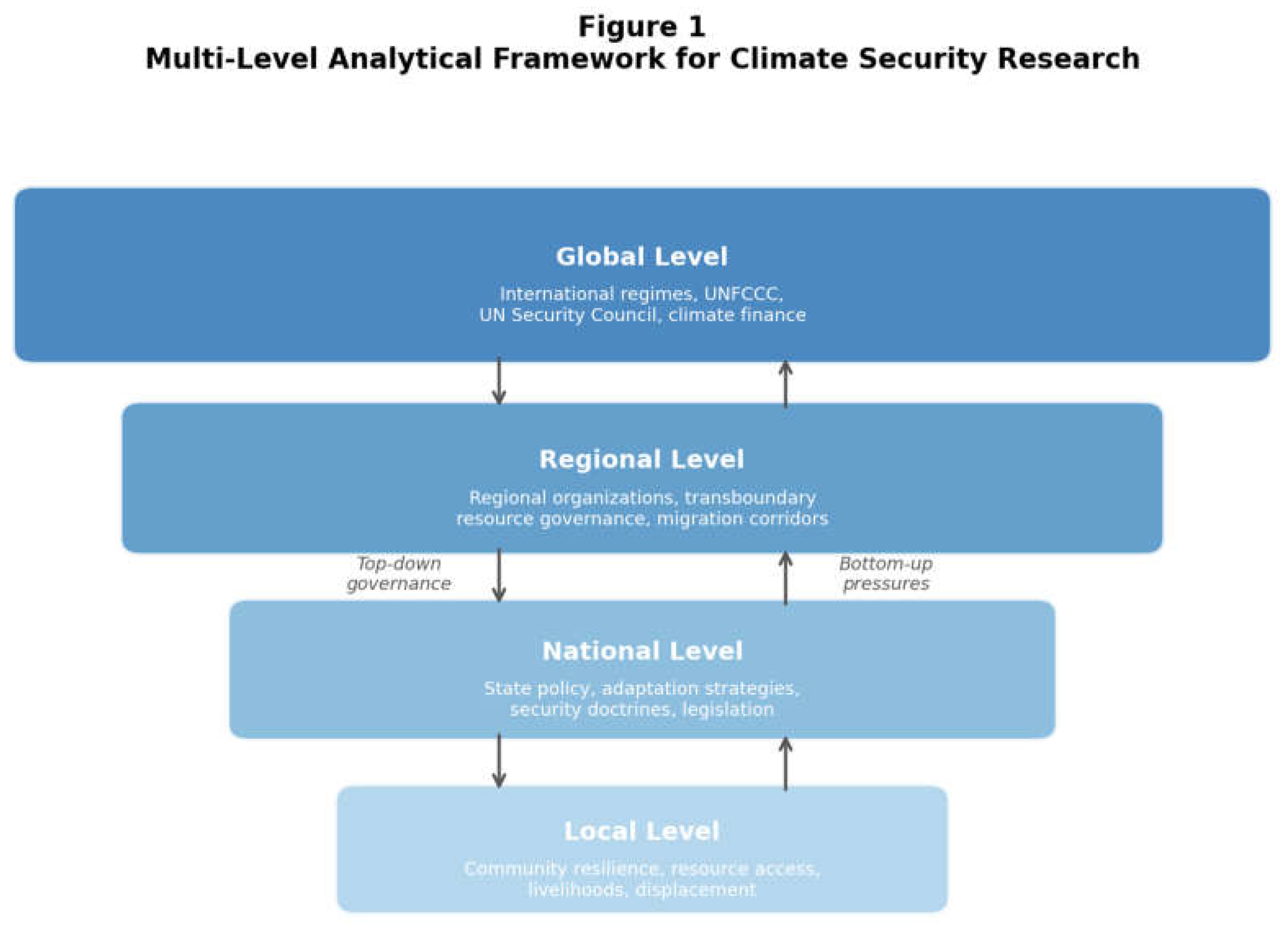
The research should adopt a multi-level analytical framework examining climate security at local, national, regional, and global levels. Climate impacts operate differently at each level, and the interactions between levels create complex dynamics that single-level analysis cannot capture. Local-level conflicts over resources may escalate to national and regional levels, while global governance frameworks shape local and national responses. Furthermore, the research should examine the emerging concept of the “climatization of security”—the process by which climate change becomes integrated into security discourse and institutions—and its implications for both security policy and climate governance.
Figure 1.
Multi-level analytical framework for climate security research illustrates the bidirectional interactions between global governance structures and local-level impacts. Source: Author’s conceptualization based on Homer-Dixon (1999), Buzan et al. (1998), and Barnett and Adger (2007).
Figure 1.
Multi-level analytical framework for climate security research illustrates the bidirectional interactions between global governance structures and local-level impacts. Source: Author’s conceptualization based on Homer-Dixon (1999), Buzan et al. (1998), and Barnett and Adger (2007).
4.3. Digital Sovereignty in the Global South
The global expansion of digital infrastructure has made data governance, platform regulation, and technological self-determination central questions for international relations—yet the discipline’s engagement with these issues remains anchored in the experiences and priorities of a small number of advanced industrial states. Existing scholarship frames digital sovereignty primarily through the lens of U.S.–China competition, treating the regulatory choices of developing countries as derivative of great-power dynamics rather than as expressions of distinct political economies and strategic interests (Couture & Toupin, 2019; Acharya, 2014). This framing obscures the agency of Global South states and regional organizations that are constructing alternative governance models—from India’s data localization requirements to the African Union’s collective digital strategy—and leaves the discipline without adequate tools for analyzing the structural dependencies, development trade-offs, and non-alignment strategies that define digital politics beyond the North Atlantic. This section maps the resulting analytical gaps and outlines a research framework that foregrounds the diversity of digital sovereignty trajectories across the Global South.
4.3.1. Research Gap Identification
Western-centric international relations theories inadequately explain how developing nations navigate digital dependency while asserting sovereignty. Existing literature focuses predominantly on great power competition—particularly the U.S.-China technology rivalry—with insufficient attention to strategic choices available to smaller states (Couture & Toupin, 2019). The conceptual gap in understanding “digital non-alignment” strategies limits policy guidance for emerging economies. European debates about data localization and privacy regulation reflect specific concerns about U.S. and Chinese technology dominance that may not capture priorities facing developing countries (Floridi, 2020; Acharya, 2014).
A particularly significant gap concerns the relationship between digital sovereignty and development. While digital transformation is widely recognized as essential for economic development, tensions between asserting digital sovereignty and accessing global digital infrastructure remain underexplored. Zuboff (2019) illuminated how surveillance capitalism creates structural asymmetries, yet specific implications for developing countries require further investigation. The phenomenon of “digital colonialism”—structural dependencies characterizing the relationship between Global South countries and dominant technology powers—represents an important research direction bridging international relations, development studies, and science and technology studies (Kwet, 2019).
The diversity of approaches to digital sovereignty across the Global South reveals the inadequacy of binary frameworks that reduce the issue to a choice between the U.S. and Chinese models. Countries such as India, Brazil, and Indonesia have developed distinctive regulatory frameworks—including India’s data localization requirements, Brazil’s General Data Protection Law (LGPD), and Indonesia’s electronic system governance regulations—that reflect specific national priorities and political economies. Regional organizations, including the African Union and ASEAN, are developing collective approaches to digital governance that seek to enhance bargaining power vis-à-vis dominant technology powers while addressing shared challenges of digital infrastructure, skills development, and regulatory capacity. These diverse trajectories suggest that a typological approach to digital sovereignty—one that identifies distinct models and the conditions under which they emerge—would be more analytically productive than existing frameworks that treat digital governance primarily through the lens of great power competition.
Table 6.
Digital Infrastructure and Governance Indicators in Selected Global South Regions.
| Indicator | Sub-Saharan Africa | Southeast Asia | Latin America | Key Governance Challenge |
|---|---|---|---|---|
| Internet Penetration | ~40% | ~75% | ~75% | Access equity and digital divide |
| Local Data Center Capacity | Very limited | Growing | Moderate | Data sovereignty and localization |
| Domestic Platform Ecosystem | Nascent | Moderate | Moderate | Dependency on foreign platforms |
| Data Protection Legislation | Emerging (30+ states) | Varied (ASEAN framework) | Moderate (LGPD in Brazil) | Regulatory capacity and enforcement |
| Digital Skills Workforce | Limited | Growing rapidly | Moderate | Human capital for technology governance |
| Regional Coordination | AU Digital Strategy | ASEAN Digital Masterplan | Limited frameworks | Collective bargaining power |
Source: Author’s compilation based on digital governance literature and policy reports (Couture & Toupin, 2019; Floridi, 2020; Kwet, 2019; Acharya, 2014).
As Table 6 illustrates, the disparities in digital infrastructure, regulatory capacity, and platform ecosystem development across the Global South are substantial, yet existing international relations scholarship has insufficiently theorized their implications for sovereignty, dependency, and development. The variation in internet penetration, data center capacity, and data protection legislation across Sub-Saharan Africa, Southeast Asia, and Latin America reflects not merely differences in economic development but distinct political choices about the role of digital technology in national strategies that existing Western-centric frameworks inadequately capture.
4.3.2. Proposed Research Framework
Research should analyze multiple dimensions of digital sovereignty in the Global South. Comparative study of data localization policies across Southeast Asia, Africa, and Latin America can identify patterns, determinants, and consequences of different approaches, examining how domestic political economies, institutional capacities, and international pressures shape policy choices. Evaluation of multilateral digital governance initiatives—including those led by or focused on developing countries—can illuminate opportunities and constraints for collective action, analyzing how institutions such as the African Union and ASEAN are developing regional digital governance frameworks. Assessment of technology diversification as a hedging strategy can inform understanding of how states balance dependence on competing technology powers, drawing on alliance theory adapted to the technology domain.
The research should prioritize non-Western perspectives and policy approaches through engagement with scholarship and policy discourse from the Global South, following Acharya’s (2014) call for more inclusive discipline. This requires moving beyond analysis of Global South countries as objects of great power competition to understanding their agency in shaping digital governance outcomes. Additionally, the research should examine the emerging phenomenon of “digital non-alignment”—strategies by which states seek to maintain autonomy and flexibility in their technology relationships without fully aligning with either major technology power—and the conditions under which such strategies are feasible.
Table 7.
Comparative Models of Digital Sovereignty in the Global South.
| Model | Key Features | Representative Cases | Theoretical Implications |
|---|---|---|---|
| State-Led Development | Government-driven digital infrastructure | China, Vietnam, Ethiopia | State capacity and developmental state theory |
| Regulatory Assertion | Strong data localization, privacy frameworks | India, Brazil, Indonesia | Regulatory sovereignty and market power |
| Strategic Hedging | Balancing multiple tech powers | Southeast Asian states, Kenya | Alliance theory adapted to technology |
| Regional Integration | Collective infrastructure, shared standards | African Union, ASEAN | Regional governance and collective action |
| Open Digital Economy | Minimal restrictions, foreign investment | Singapore, Rwanda, UAE | Liberal economic integration theory |
| Digital non-alignment | Autonomous positioning between tech powers | Brazil, South Africa, Mexico | Non-alignment theory in digital context |
Source: Author’s compilation based on analysis of digital sovereignty approaches (Couture & Toupin, 2019; Floridi, 2020; Acharya, 2014).
4.4. Non-State Actors and Hybrid Warfare
The contemporary landscape of organized violence is increasingly populated by actors who occupy ambiguous positions between state and society, combatant and civilian, public and private. Private military companies, cyber mercenaries, influence networks, and platform intermediaries shape outcomes that international relations theory has traditionally attributed to states alone, while hybrid operations blur the boundaries between war and peace, attribution and deniability, and military and civilian targets (Hoffman, 2007; Kaldor, 2012). Existing frameworks, developed largely to analyze interstate conflict and conventional non-state insurgency, are ill-equipped to capture these dynamics. This section identifies the analytical gaps in current scholarship on non-state actors and hybrid warfare and proposes a research agenda capable of theorizing the diverse state–non-state relationships through which contemporary conflict is increasingly conducted.
4.4.1. Research Gap Identification
Hybrid warfare studies focus disproportionately on state actors, underestimating the role of non-state entities as both perpetrators and victims of hybrid threats. Theoretical frameworks for analyzing proxy relationships, deniability mechanisms, and attribution challenges remain underdeveloped (Reichborn-Kjennerud & Olsen, 2019; Hoffman, 2007). Kaldor (2012) identified the growing importance of non-state violence, yet her “new wars” framework requires extension to encompass sophisticated hybrid operations. The literature on private military companies has grown significantly—Avant (2005) provided foundational analysis—but subsequent developments including PMC operations across Africa, contractors in cyber operations, and proliferation of private intelligence services have outpaced theoretical development.
A particularly significant gap concerns cyber mercenaries and non-state actors conducting offensive cyber operations on behalf of states. The attribution problem in cyberspace creates opportunities for states to employ non-state actors while denying responsibility, yet existing frameworks remain underdeveloped. The role of influence operations conducted through non-state media networks similarly requires analysis bridging security studies and media studies. Furthermore, literature has not adequately addressed challenges that hybrid warfare poses for international law and institutions (Schmitt, 2017).
The proliferation of private military companies operating across multiple theatres—including Russian-linked groups in Africa, Western private security firms in the Middle East, and cyber-for-hire operations globally—represents a fundamental transformation in the landscape of organized violence that international relations theory has not yet adequately assimilated. These entities operate in a grey regulatory zone, often beyond the reach of the international humanitarian law frameworks designed for state-to-state conflict, and their activities create accountability gaps that undermine both human rights protections and the capacity of international institutions to manage conflict. The question of how states use PMCs to achieve strategic objectives while maintaining plausible deniability requires systematic analysis extending beyond existing frameworks. Additionally, the convergence of AI capabilities with hybrid warfare tactics, including AI-generated deepfakes for influence operations, automated cyber-attacks, and algorithmic targeting of vulnerable populations—introduces qualitatively new challenges that demand integrated analytical approaches drawing on both security studies and computer science.
4.4.2. Proposed Research Framework
Research should develop typologies of state–non-state relationships capturing the diversity of arrangements and their implications. Such typologies must distinguish between delegation, proxy, sponsorship, and franchise relationships while analyzing conditions under which each form emerges. Case studies should include Russian-linked PMC operations, cyber mercenaries, and influence operations through non-state media networks. The research should also examine regulatory challenges including the Montreux Document and its adequacy for contemporary challenges.
Table 8.
Typology of Non-State Actors in Hybrid Warfare.
| Non-State Actor Type | Hybrid Warfare Role | State Relationship | Governance Challenge |
|---|---|---|---|
| Private Military Companies | Kinetic operations, security services | Contract, delegation, proxy | Accountability, IHL compliance |
| Cyber Mercenaries | Offensive cyber operations, surveillance | Implicit authorization, sponsorship | Attribution, jurisdiction |
| Media Networks | Influence operations, disinformation | Covert support, amplification | Free speech vs. information warfare |
| Proxy Forces | Irregular warfare, deniable operations | Training, equipping, directing | International law, civilian protection |
| Platform Companies | Information control, data access | Regulation, cooperation, coercion | Content moderation, data sovereignty |
| Hacktivist Groups | Cyber disruption, data leaks | Opportunistic alignment | Legal status, proportionality |
Source: Author’s compilation based on hybrid warfare literature (Reichborn-Kjennerud & Olsen, 2019; Kaldor, 2012; Hoffman, 2007; Avant, 2005; Schmitt, 2017).
5. Discussion
The domain analyses presented in Section 4 surface a set of challenges that, while distinct in their substantive content, share a common analytical signature: each strains the conceptual vocabulary, methodological repertoire, and policy frameworks the discipline has inherited from a prior international order. Read across domains rather than within them, the research gaps point to a more fundamental question about whether the field’s organizing categories—state and non-state, domestic and international, military and civilian, material and ideational—still carve the international system at its joints. This section synthesizes the implications of that finding along three axes: the theoretical reconstruction the four domains demand, the methodological innovations such reconstruction will require, and the policy consequences of the disconnect between current scholarship and decision-makers’ needs. A final subsection draws out the cross-domain interconnections that bind the four areas into a single research program.
5.1. Theoretical Implications
The analysis of these four research domains reveals significant theoretical implications for international relations scholarship. Across all domains, traditional theoretical frameworks prove inadequate for addressing emerging challenges, requiring fundamental reconsideration rather than incremental extension. Waltz’s (1979/2010) structural realism, Keohane’s (1984) institutional liberalism, and Wendt’s (1999) social constructivism each capture important dimensions, but none individually or collectively provides an adequate framework for phenomena that blur the boundaries between their respective domains.
The concept of power emerges as particularly problematic. Traditional distinctions between hard and soft power, even as refined by Nye (2011), fail to capture power in an era of AI, digital platforms, and hybrid threats. AI capabilities represent power that is simultaneously material and ideational, military and economic. Digital sovereignty challenges traditional notions of territorial power, while hybrid warfare blurs distinctions between military and civilian forms of power. Farrell and Newman’s (2019) concept of weaponized interdependence captures one dimension, but a more comprehensive reconceptualization is needed that accounts for the full range of dynamics identified in this analysis. The emergence of what might be termed “algorithmic power”—the capacity to shape outcomes through control of data, algorithms, and digital infrastructure—represents a form of power that does not fit comfortably within existing typologies and demands new conceptual vocabulary.
The question of agency similarly requires fundamental reconsideration. Technology corporations, private military companies, cyber mercenaries, and digital platforms exercise significant agency that cannot be captured by state-centric frameworks (Drezner, 2019). Risse’s (2000) communicative action approach and constructivist network analysis offer partial tools, but more comprehensive frameworks are needed that can model complex interactions between state and non-state actors across multiple domains simultaneously. The relationship between domestic and international politics, always problematic as Putnam (1988) demonstrated, has become increasingly untenable in an era of digital connectivity and hybrid operations that simultaneously target domestic and international audiences.
Furthermore, the analysis suggests that the boundaries between the four research domains themselves are analytically constructed rather than naturally given. The same technological capabilities that enable AI governance challenges also underpin hybrid warfare operations; the same data infrastructure that raises digital sovereignty concerns also provides the monitoring systems essential for climate security. This insight points toward a broader theoretical implication: the need for frameworks capable of analyzing the international system as an interconnected complex adaptive system rather than decomposing it into discrete issue areas. Systems-theoretic approaches, long marginal in international relations, may offer productive starting points for developing such frameworks.
Figure 2.
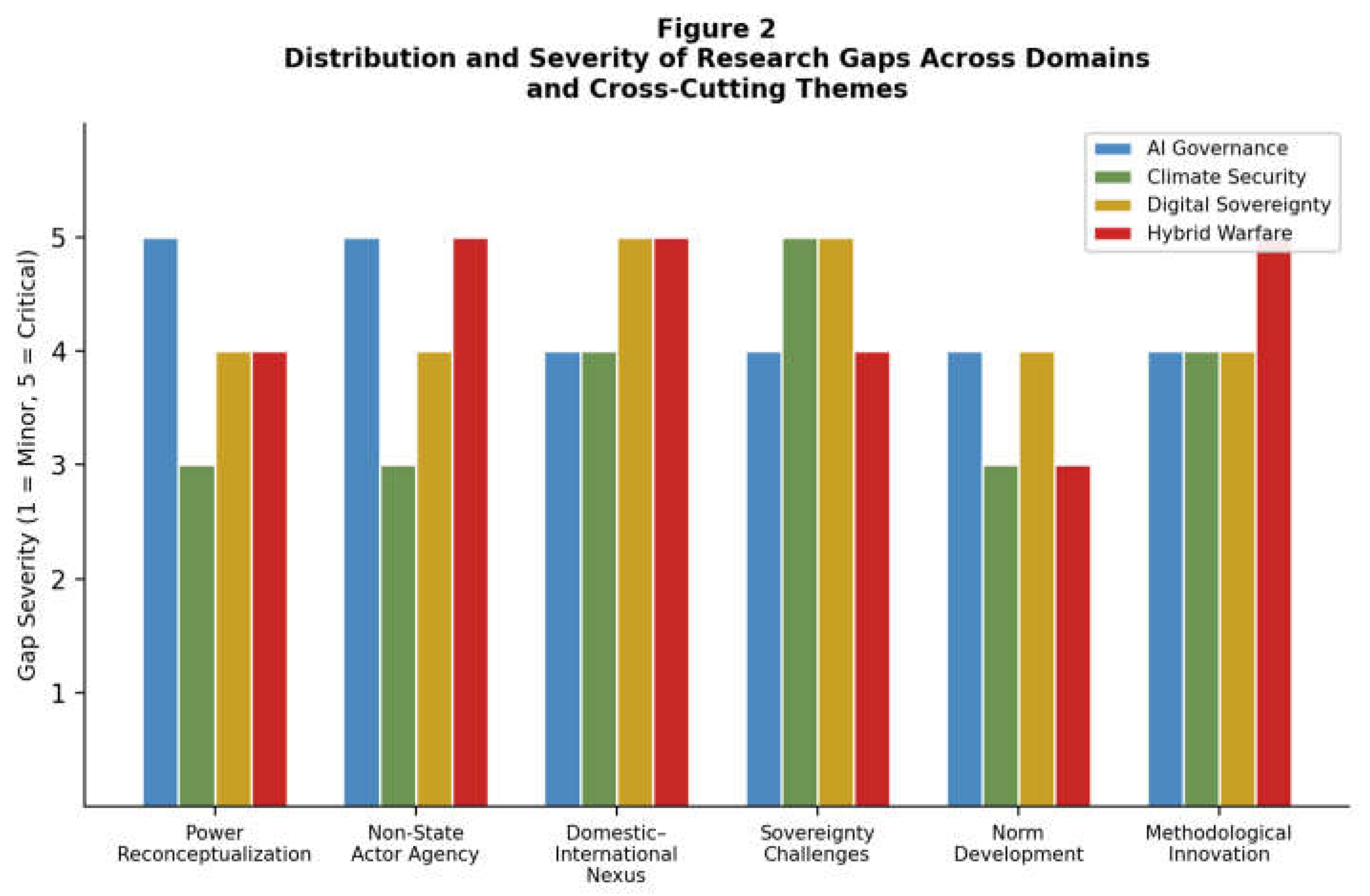
Distribution and severity of research gaps across the four domains and six cross-cutting themes, based on qualitative assessment of existing literature. Severity ratings reflect the degree to which existing scholarship addresses identified challenges (1 = minor gap; 5 = critical gap). Source: Author’s assessment based on thematic analysis of the literature reviewed in this study.
Figure 2.
Distribution and severity of research gaps across the four domains and six cross-cutting themes, based on qualitative assessment of existing literature. Severity ratings reflect the degree to which existing scholarship addresses identified challenges (1 = minor gap; 5 = critical gap). Source: Author’s assessment based on thematic analysis of the literature reviewed in this study.
5.2. Methodological Implications
The research gaps identified have significant methodological implications. The complexity of phenomena resists single-method approaches. Mixed methods combining qualitative case analysis with quantitative indicators are likely most productive for advancing knowledge in these domains. Computational methods, including natural language processing for analyzing policy documents, network analysis for mapping actor relationships, and agent-based modeling for simulating complex system dynamics, offer promising avenues for methodological innovation. The analysis also suggests the importance of interdisciplinary approaches: AI governance requires engagement with computer science and ethics; climate security demands integration of environmental science and economics; digital sovereignty involves legal and technical dimensions; hybrid warfare requires understanding of cyber security, media studies, and political communication.
As Figure 2 illustrates, the severity of research gaps varies across domains and themes, but the pervasive pattern of high-severity gaps across all four domains confirms that no single theoretical tradition can adequately address the contemporary challenges identified in this study. The cross-cutting themes of power reconceptualization, non-state actor agency, and the domestic–international nexus emerge as consistently critical across all domains, underscoring the need for integrated analytical frameworks. Table 11 maps the specific cross-domain interconnections and the corresponding methodological approaches best suited to examining each.
Table 9.
Cross-Domain Interconnections and Research Priorities.
| Domain Intersection | Key Linkages | Research Priority | Methodological Approach |
|---|---|---|---|
| AI Governance × Hybrid Warfare | Autonomous weapons, AI-enabled cyber operations | AI in conflict attribution and escalation | Case studies, simulation modeling |
| AI Governance × Climate Security | AI for climate modeling, resource optimization | AI applications in climate adaptation | Interdisciplinary modeling |
| AI Governance × Digital Sovereignty | AI development dependency, algorithmic governance | Technology dependency and AI capacity building | Comparative policy analysis |
| Climate Security × Digital Sovereignty | Environmental data governance, satellite monitoring | Data sovereignty in climate science | Multi-stakeholder analysis |
| Climate Security × Hybrid Warfare | Resource conflict, climate migration as destabilizer | Climate stress as catalyst for hybrid operations | Multi-level causal analysis |
| Digital Sovereignty × Hybrid Warfare | Information operations through platforms | Platform governance and information warfare | Network analysis, legal analysis |
Source: Author’s compilation based on cross-domain analysis of research gaps identified in this study.
Data availability presents significant challenges across all four domains. AI development involves proprietary technologies and corporate decisions that may not be publicly documented. Climate impacts vary significantly across locations and time periods, creating challenges for comparative analysis. Digital sovereignty policies evolve rapidly, with policy documents in multiple languages. Hybrid warfare operations are, by their nature, conducted covertly, making systematic data collection difficult. These challenges require methodological innovation, including creative approaches to data collection such as open-source intelligence analysis, satellite imagery interpretation, and digital trace data analysis. The development of shared datasets and data infrastructure would support more systematic comparative research and enable replication of findings across different contexts.
5.3. Policy Implications
The disconnect between academic research and policy needs creates risks of poorly informed decisions, missed opportunities for effective action, and potential for unintended consequences. In AI governance, policymakers require frameworks for understanding how AI capabilities affect strategic competition and alliance management—analysis that current scholarship cannot fully provide. In climate security, decision-makers need analysis of causal pathways linking climate change to conflict and cooperation, as well as evaluation of intervention options that integrate environmental and security considerations. In digital sovereignty, governments in the Global South require guidance on balancing development objectives with autonomy concerns in an international environment shaped by great power technology competition. In hybrid warfare, security agencies need updated frameworks for threat assessment and response planning that account for the expanding role of non-state actors.
Table 10.
AI Governance Initiatives and Their International Relations Implications.
| Initiative/Framework | Key Actors | Governance Focus | IR Implications |
|---|---|---|---|
| EU AI Act (2024) | EU member states | Risk-based regulation, transparency | Regulatory power projection, Brussels Effect |
| U.S. Executive Orders on AI | U.S. federal government | Safety, security, innovation balance | Great power standard-setting |
| China’s AI Development Plan | Chinese government, state enterprises | Strategic development, military-civil fusion | Technology competition, power transition |
| OECD AI Principles | OECD member states | Responsible AI, human-centered values | Liberal norm diffusion |
| UNESCO AI Ethics | 193 member states | Ethics, human rights, sustainability | Universal norm-building |
| G7 Hiroshima AI Process | G7 states | Responsible AI for advanced systems | Alliance-based governance |
Source: Author’s compilation based on policy analysis of major AI governance frameworks (Bradford, 2020; Maas, 2019; Congressional Research Service, 2025).
The governance landscape summarized in Table 5 illustrates the diverse approaches to AI regulation and their far-reaching consequences for international relations. The EU AI Act positions the European Union as a global standard-setter through the Brussels Effect (Bradford, 2020). China’s AI Development Plan emphasizes strategic advancement and military-civil fusion, highlighting the geopolitical dimensions of AI. The OECD AI Principles and UNESCO’s AI Ethics Recommendation represent efforts to diffuse liberal and universal norms. The G7 Hiroshima AI Process demonstrates alliance-based governance, signaling collective commitment to responsible innovation. Collectively, these frameworks exemplify the dynamic interplay between regulatory, ethical, and strategic considerations in shaping the global distribution of power and influence.
The relationship between academic research and policy communities requires structural attention. The gaps identified reflect in part the incentive structures of academic research, which may not reward policy-relevant work, rapid response to emerging issues, or interdisciplinary collaboration. Mechanisms for better connecting academic research to policy needs—including funding programs specifically for policy-relevant research, regular forums for researcher-policymaker engagement, and recognition of policy impact in academic evaluation—could help narrow the gap between scholarly analysis and policy requirements. The urgency of these challenges demands that scholarship move beyond theoretical innovation to actively inform policy development through accessible outputs including policy briefs, executive summaries, and direct engagement with decision-makers.
5.4. Cross-Domain Interconnections
A significant finding concerns the interconnections between the four research domains. These are not isolated areas but interrelated phenomena sharing common features. The intersection of AI governance and hybrid warfare is particularly significant: AI capabilities are increasingly employed in cyber operations, influence campaigns, and autonomous weapons systems (Scharre, 2018). AI-enabled deepfake technology, for instance, represents a convergence point where questions of governance, attribution, and information warfare intersect in ways that no single theoretical tradition can adequately address. Climate security and digital sovereignty present another important interconnection, as environmental monitoring increasingly relies on digital infrastructure raising questions about data sovereignty and technological dependency.
Table 11.
Comparative Analysis of Hybrid Warfare Case Studies.
| Case Study | Primary Non-State Actors | Key Hybrid Dimensions | Attribution Challenges | Governance Responses |
|---|---|---|---|---|
| Ukraine conflict (2014–present) | PMCs, cyber groups, media networks | Military, cyber, information, economic | State denial of PMC involvement | Sanctions, international investigations |
| Sahel region conflicts | PMCs, proxy forces, extremist groups | Military, governance, resource control | Complex multi-actor environment | AU/ECOWAS frameworks, UN mandates |
| South China Sea tensions | Maritime militia, coast guard proxies | Gray zone operations, legal warfare | Civilian vs. military classification | UNCLOS proceedings, bilateral diplomacy |
| Information warfare campaigns | Social media networks, troll farms | Disinformation, election interference | Digital anonymity, cross-border ops | Platform policies, election security |
| Cyber operations (various) | Cyber mercenaries, hacktivists | Espionage, sabotage, data theft | Technical attribution difficulties | Norms development, deterrence |
Source: Author’s compilation based on comparative analysis of hybrid warfare literature (Kaldor, 2012; Reichborn-Kjennerud & Olsen, 2019; Hoffman, 2007; Schmitt, 2017).
The cross-domain perspective also reveals common structural features that characterize all four research domains. Each involves the blurring of traditional distinctions—between state and non-state actors, between domestic and international politics, between civilian and military domains, and between material and ideational forms of power. Each involves the emergence of new governance challenges that existing institutions and legal frameworks are ill-equipped to address. Each is characterized by the accelerating pace of change, which outstrips the capacity of traditional academic and policy processes to respond. And each demonstrates the growing importance of non-state actors—technology corporations, private military companies, environmental organizations, and digital platforms—whose influence on international outcomes increasingly rivals that of states. These common features suggest that the four domains may be manifestations of a more fundamental transformation in the structure and dynamics of the international system.
Figure 3.
Conceptual framework illustrating cross-domain interconnections among the four research gap domains. Dashed lines indicate key linkages identified through thematic analysis. Source: Author’s conceptualization based on the cross-domain analysis presented in Section 4 and Section 5.
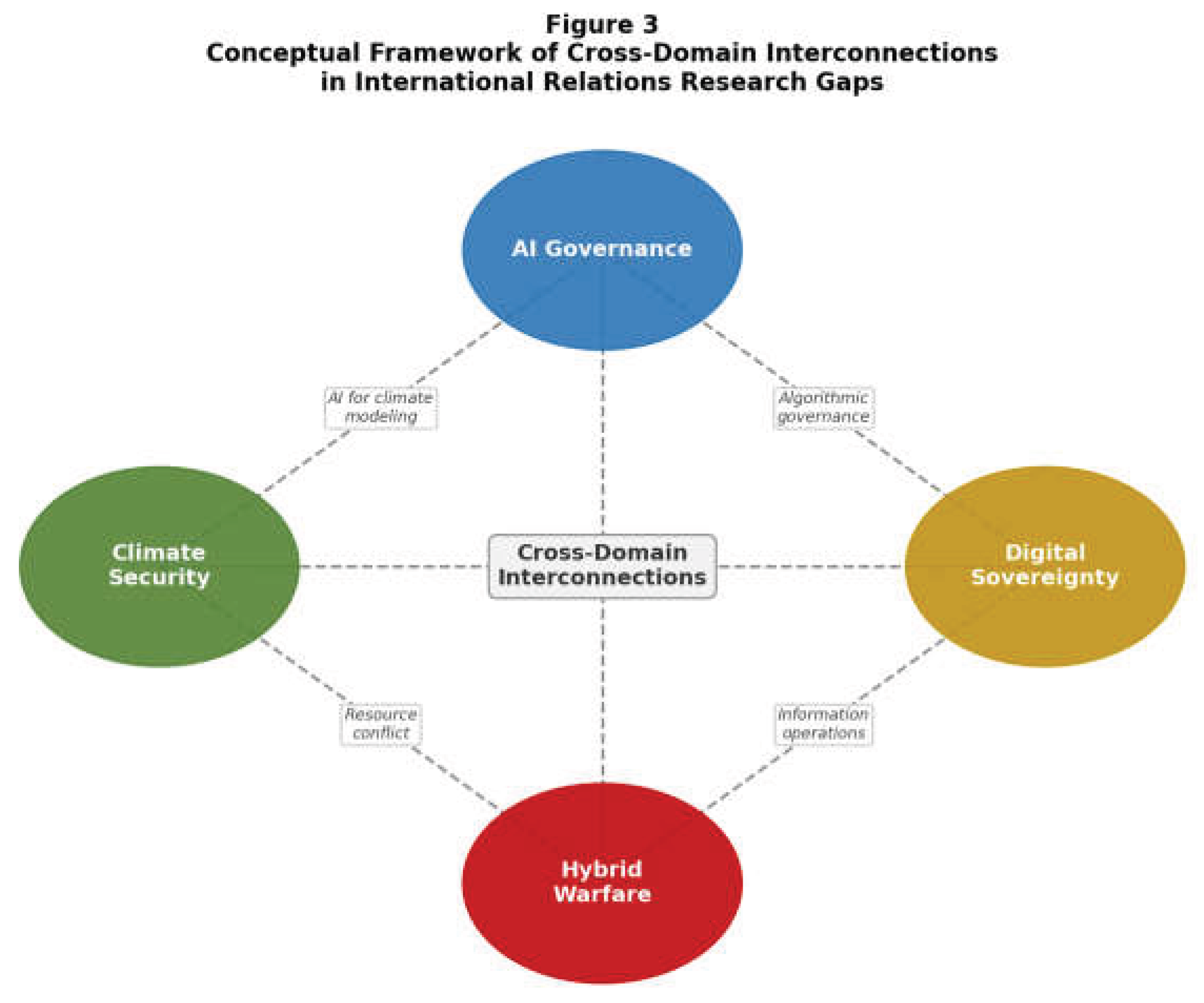
These cross-domain interconnections suggest that research gaps cannot be addressed in isolation. Theoretical innovation must account for the ways in which AI capabilities, environmental pressures, digital governance, and hybrid security threats interact to create complex adaptive challenges. The development of integrated analytical frameworks that address cross-domain dynamics while maintaining sufficient specificity represents one of the most important directions for future scholarships.
6. Limitations
This research has several limitations that should be acknowledged transparently. First, the qualitative methodology, while appropriate for the exploratory objectives (Schwartz-Shea & Yanow, 2012), does not permit statistical generalization or hypothesis testing. The findings represent interpretive analysis that should be understood as provisional insights requiring further investigation through complementary methodological approaches. The interpretive approach involves subjectivity in coding, theme identification, and interpretation; while quality assurance measures followed Lincoln and Guba’s (1985) criteria, alternative interpretations of the evidence are possible.
Second, the focus on four domains necessarily excludes other areas where international relations scholarship may face significant gaps. Additional domains—such as space governance, pandemic preparedness, emerging financial technologies, or the governance of biotechnology—could have been included and may merit similar analysis. The selection of four domains was guided by considerations of urgency, theoretical potential, and interconnectedness, but other configurations would have been equally defensible. Third, the analysis relies primarily on English-language literature and policy documents, potentially missing important perspectives from non-English sources. This limitation is particularly relevant for the analysis of digital sovereignty in the Global South, where scholarship and policy discourse may occur in French, Spanish, Portuguese, Arabic, Mandarin, and other languages.
Fourth, the rapid pace of change in these domains means that some findings may become dated as new developments emerge. The research represents a snapshot of current knowledge gaps rather than a definitive statement of the research agenda. Since the completion of data collection, significant developments have continued in AI regulation, climate governance, digital policy, and hybrid operations that may affect the salience and nature of the gaps identified. Fifth, while the study identifies cross-domain interconnections as an important feature of contemporary international relations, the depth of analysis achievable within a single study is necessarily limited. Each of the six domain intersections identified in Table 11 merits its own detailed investigation. The findings presented here should therefore be understood as establishing a framework for subsequent, more focused research rather than providing definitive analysis of these interconnections.
7. Conclusion
This research has presented a comprehensive qualitative analysis of research gaps in four critical domains of international relations scholarship. The analysis reveals that traditional theoretical frameworks—including realism (Waltz, 1979/2010; Mearsheimer, 2001), liberalism (Keohane, 1984; Ikenberry, 2011), and constructivism (Wendt, 1999; Finnemore & Sikkink, 1998)—face significant limitations in addressing distinctive characteristics of emerging challenges. These limitations concern fundamental concepts including power, agency, sovereignty, and the boundaries of the international system.
Across all four domains, the analysis identifies specific gaps requiring attention. In AI governance, existing frameworks inadequately address how AI reshapes power distribution and alliance structures. In climate security, scholarships lack robust frameworks linking environmental stress to interstate outcomes. In digital sovereignty, Western-centric theories fail to capture Global South strategies for navigating digital dependency. In hybrid warfare, frameworks understate the role of non-state actors and attribution challenges. The analysis also identifies important cross-domain interconnections revealing that these research areas interact in complex ways demanding integrated analytical approaches.
Looking ahead, the imperative for international relations scholarship is not only to recognize the multidimensionality of contemporary global issues but also to operationalize this understanding in research and policy practice. The synthesis of findings demonstrates that discrete, siloed approaches are no longer sufficient. Instead, the field must embrace analytical models capable of capturing feedback loops, emergent behaviors, and multi-level interactions. To meet this challenge, scholars should invest in methodological pluralism and interdisciplinarity, drawing on insights from political science, computer science, environmental studies, law, and security studies. Moreover, the relationship between academic research and policy formulation must be strengthened, with mechanisms for regular dialogue and research agendas responsive to evolving policy needs.
The field of international relations faces a critical moment in which established frameworks prove inadequate while the need for evidence-based analysis has never been greater. By pursuing the research directions outlined, including new theoretical frameworks, interdisciplinary methodologies, and mechanisms for connecting scholarship to policy—scholars can contribute to both academic advancement and evidence-based policymaking in an increasingly complex international environment. Ultimately, the advancement of international relations as a field depends on its ability to adapt to changing global realities. Theoretical innovation, methodological rigor, and a commitment to evidence-based analysis—combined with diversity in perspectives, including those from the Global South—will position scholars to address the multifaceted challenges outlined in this research. The stakes are high, and the opportunities for impactful research have never been greater.
8. Recommendations for Future Research
First, the academic community should prioritize developing new theoretical frameworks accommodating the complexities identified in this analysis. Such frameworks must address power in an era of technological transformation (Nye, 2011; Farrell & Newman, 2019), the role of non-state actors (Avant, 2005; Kaldor, 2012), integration of domestic and international analysis beyond Putnam’s (1988) two-level games, and the climate-security nexus (Homer-Dixon, 1999; Barnett, 2003). Theoretical innovation should be recognized and rewarded in academic evaluation systems through expanded criteria that value conceptual contributions alongside empirical findings. The development of integrative frameworks—capable of bridging insights from realism, liberalism, and constructivism while incorporating the distinctive dynamics of technological, environmental, and hybrid security challenges—represents an urgent intellectual priority.
Second, interdisciplinary research should be actively promoted through funding mechanisms, institutional structures, and recognition systems. Research on AI governance should bring together political scientists, computer scientists, ethicists, and legal scholars. Climate security research requires collaboration between environmental scientists, economists, and security specialists. Digital sovereignty scholarship should involve technologists, legal experts, and development specialists alongside international relations scholars. Hybrid warfare research must integrate military affairs, cyber security, media studies, and political communication. Academic institutions should create structures that facilitate and reward such interdisciplinary collaboration, including joint appointments, interdisciplinary research centers, and cross-departmental graduate programs.
Third, improved mechanisms for connecting academic research to policy needs should be developed, including funding for policy-relevant research, researcher-policymaker forums, and recognition of policy impact in academic evaluation. Research outputs should be communicated in formats accessible to policy audiences, including policy briefs, executive summaries, and direct engagement with government and international organization officials. Fourth, data infrastructure should be developed to support research through shared datasets on AI capabilities, climate stress indicators, digital policies, and hybrid warfare incidents. Such infrastructure requires investment from funding agencies, collaboration among research institutions, and attention to ethical considerations around data collection and sharing. Fifth, greater attention should be devoted to perspectives from the Global South, following Acharya’s (2014) call for a more globally representative discipline. Research agendas should be developed in consultation with scholars and policymakers from diverse regions, and efforts should be made to include perspectives that dominant theoretical frameworks have historically marginalized. Sixth, a mixed methods approach combining qualitative case analysis with quantitative indicators and computational methods should be adopted as a standard for research in these domains, enabling more robust and comprehensive findings.
Table 12.
Summary of Recommendations and Implementation Strategies.
| Recommendation | Implementation Strategy | Expected Outcome | Key Stakeholders |
|---|---|---|---|
| Develop new theoretical frameworks | Theory-building workshops, special journal issues | Updated conceptual tools for emerging challenges | Scholars, journal editors |
| Promote interdisciplinary research | Joint funding programs, cross-departmental centers | Integrated analysis across disciplines | Universities, funding agencies |
| Connect research to policy | Researcher-policymaker forums, policy briefs | Better informed policy decisions | Academics, government, IOs |
| Build data infrastructure | Shared datasets, collaborative data collection | Enhanced comparative research capacity | Research institutions, associations |
| Include Global South perspectives | Inclusive research agendas, multilingual scholarship | Globally representative scholarship | Global academic community |
| Adopt mixed methods approaches | Methodological training, collaborative designs | More robust findings | Graduate programs, research teams |
Source: Author’s compilation based on the analysis and findings presented in this study.
The six recommendations summarized above should be understood as interlocking rather than additive. Theoretical innovation without interdisciplinary engagement risks producing frameworks that remain disconnected from the technological, environmental, and security realities they aim to explain; interdisciplinary collaboration without sustained investment in shared data infrastructure produces studies that cannot be replicated, compared, or scaled; data infrastructure built without meaningful inclusion of Global South perspectives reproduces the very asymmetries that this study has identified as a central research gap. Progress in any one of these areas is therefore contingent on parallel progress in the others, and the implementation strategies outlined in Table 12 should be pursued as components of a single research program rather than as discrete initiatives.
Taken as a whole, the agenda set out in this paper proceeds from a single underlying claim: that the discipline of international relations stands at a juncture comparable in significance to the post–Cold War recalibration that produced much of its present theoretical apparatus. The transformations described across the four research domains—artificial intelligence, climate, digital sovereignty, and hybrid warfare—are unlikely to resolve into the categories the field has inherited; they are more likely to demand new ones. Whether the discipline produces those categories quickly enough to remain analytically useful, and whether it does so in dialogue with the policy communities and global constituencies most affected, will determine whether international relations scholarship continues to clarify the international system or recedes from the conversations that most need its insight. The research priorities advanced here are intended as a contribution to that effort—partial, provisional, and offered in the expectation that they will be refined, contested, and extended by the broader scholarly community whose collective work this moment requires.
Funding Statement
This work was supported and funded by the Deanship of Scientific Research at Imam Mohammad ibn Saud Islamic University (IMSIU) (grant number IMSIU-DDRSP2602).
Conflicts of Interest
The author declares no conflicts of interest.
Transparency Statement
The author confirms that the manuscript is an honest, accurate, and transparent account of the study, that no vital features of the study have been omitted, and that any discrepancies from the study as planned have been explained. This study followed all ethical practices during writing.
References
- Acharya, A. The end of American world order; Polity Press, 2014; ISBN 978-0745672472. [Google Scholar]
- Allen, G. C. Choking off China’s access to the future of AI. Center for Strategic and International Studies. 2022. Available online: https://www.csis.org/analysis/choking-chinas-access-future-ai.
- Avant, D. D. The market for force: The consequences of privatizing security; Cambridge University Press, 2005. [Google Scholar] [CrossRef]
- Barnett, J. Security and climate change. Global Environmental Change 2003, 13, 7–17. [Google Scholar] [CrossRef]
- Barnett, J.; Adger, W. N. Climate change, human security and violent conflict. Political Geography 2007, 26, 639–655. [Google Scholar] [CrossRef]
- Bhaskar, R. A realist theory of science, 2nd ed.; Routledge, 2008. [Google Scholar] [CrossRef]
- Bjola, C.; Kornprobst, M. Understanding international diplomacy: Theory, practice and ethics, 2nd ed.; Routledge, 2018. [Google Scholar] [CrossRef]
- Bradford, A. The Brussels effect: How the European Union rules the world; Oxford University Press, 2020. [Google Scholar] [CrossRef]
- Braun, V.; Clarke, V. Using thematic analysis in psychology. Qualitative Research in Psychology 2006, 3, 77–101. [Google Scholar] [CrossRef]
- Bull, H. Anarchical society: A study of order in world politics; Columbia University Press., 1977; ISBN 978-0231127639. [Google Scholar]
- Buzan, B. An introduction to the English School of international relations; Polity Press, 2014; ISBN 978-0745653167. [Google Scholar]
- Buzan, B.; Hansen, L. The evolution of international security studies; Cambridge University Press, 2009. [Google Scholar] [CrossRef]
- Buzan, B.; Wæver, O.; de Wilde, J. Security: A new framework for analysis; Lynne Rienner Publishers, 1998; ISBN 978-1555877842. [Google Scholar]
- Congressional Research Service. U.S. export controls and China: Advanced semiconductors and AI chips (CRS Report R48642). 2025. Available online: https://crsreports.congress.gov/product/R48642.
- Couture, S.; Toupin, S. Digital sovereignty: Steps towards the autonomy of a connected society. Internet Policy Review 2019, 8, 1–17. [Google Scholar] [CrossRef]
- Cox, R. W. Social forces, states and world orders: Beyond international relations theory. Millennium: Journal of International Studies 1981, 10, 126–155. [Google Scholar] [CrossRef]
- Cummings, M. L. Artificial intelligence and the future of warfare. Chatham House Research Paper. 2017. Available online: https://www.chathamhouse.org/sites/default/files/publications/research/2017-01-26-artificial-intelligence-future-warfare-cummings.pdf.
- Drezner, D. W. Technological change and international relations. International Relations 2019, 33, 286–303. [Google Scholar] [CrossRef]
- Farrell, H.; Newman, A. L. Weaponized interdependence: How global economic networks shape state coercion. International Security 2019, 44, 42–79. [Google Scholar] [CrossRef]
- Finnemore, M.; Sikkink, K. International norm dynamics and political change. International Organization 1998, 52, 887–917. [Google Scholar] [CrossRef]
- Floridi, L. The fight for digital sovereignty: What it is, and why it matters, especially for the EU. Philosophy & Technology 2020, 33, 369–378. [Google Scholar] [CrossRef]
- The Oxford handbook of international security; Gheciu, A., Wohlforth, W. C., Eds.; Oxford University Press, 2018. [Google Scholar] [CrossRef]
- Gleditsch, N. P. Whither the weather? Climate change and conflict. Journal of Peace Research 2012, 49, 3–9. [Google Scholar] [CrossRef]
- Hoffman, F. G. Conflict in the 21st century: The rise of hybrid wars. Potomac Institute for Policy Studies. 2007. Available online: https://www.potomacinstitute.org/images/stories/publications/potomac_hybridwar_0108.pdf.
- Hoffmann, M. J. The renaissance of constructivism in international relations. European Journal of International Relations 2019, 25, 1061–1081. [Google Scholar] [CrossRef]
- Homer-Dixon, T. F. Environment, scarcity, and violence; Princeton University Press, 1999; ISBN 978-0691089799. [Google Scholar]
- Horowitz, M. C. Artificial intelligence, international competition, and the balance of power. Texas National Security Review 2018, 1, 36–57. [Google Scholar] [CrossRef]
- Ide, T. Research methods for exploring the links between climate change and conflict. WIREs Climate Change 2015, 6, 255–268. [Google Scholar] [CrossRef]
- Ikenberry, G. J. Liberal Leviathan: The origins, crisis, and transformation of the American world order; Princeton University Press, 2011; ISBN 978-0691156170. [Google Scholar]
- Kaldor, M. New and old wars: Organised violence in a global era, 3rd ed.; Polity Press, 2012; ISBN 978-0745655635. [Google Scholar]
- Keohane, R. O. After hegemony: Cooperation and discord in the world political economy; Princeton University Press, 1984; ISBN 978-0691122489. [Google Scholar]
- Keohane, R. O.; Victor, D. G. The regime complex for climate change. Perspectives on Politics 2011, 9, 7–23. [Google Scholar] [CrossRef]
- Kwet, M. Digital colonialism: US empire and the new imperialism in the Global South. Race & Class 2019, 60, 3–26. [Google Scholar] [CrossRef]
- Lincoln, Y. S.; Guba, E. G. Naturalistic inquiry; Sage Publications, 1985; ISBN 978-0803924314. [Google Scholar]
- Linklater, A. The transformation of political community: Ethical foundations of the post-Westphalian era; Polity Press, 1998; ISBN 978-0745617459. [Google Scholar]
- Maas, M. International law does not compute: Artificial intelligence and the development, destruction, and reconstruction of legal norms. Maryland Journal of International Law 2019, 34, 185–222. Available online: https://digitalcommons.law.umaryland.edu/mjil/vol34/iss2/3.
- Mach, K. J.; Kraan, C. M.; Adger, W. N.; Buhaug, H.; Burke, M.; Fearon, J. D.; Field, C. B.; Hendrix, C. S.; Maystadt, J. F.; O’Loughlin, J.; et al. Climate as a risk factor for armed conflict. Nature 2019, 571, 193–197. [Google Scholar] [CrossRef]
- Mearsheimer, J. J. The tragedy of great power politics; W. W. Norton, 2001; ISBN 978-0393349276. [Google Scholar]
- Nye, J. S. The future of power; PublicAffairs, 2011; ISBN 978-1610390699. [Google Scholar]
- Payne, K. Artificial intelligence: A new strategic reality. Parameters 2021, 51, 19–30. [Google Scholar] [CrossRef]
- Putnam, R. D. Diplomacy and domestic politics: The logic of two-level games. International Organization 1988, 42, 427–460. [Google Scholar] [CrossRef]
- Reichborn-Kjennerud, K.; Olsen, K. T. Private military companies in hybrid warfare. Comparative Strategy 2019, 38, 222–236. [Google Scholar] [CrossRef]
- Risse, T. “Let’s argue!”: Communicative action in world politics. International Organization 2000, 54, 1–39. [Google Scholar] [CrossRef]
- Scharre, P. Army of none: Autonomous weapons and the future of war; W. W. Norton, 2018; ISBN 978-0393356588. [Google Scholar]
- Tallinn manual 2.0 on the international law applicable to cyber operations, 2nd ed.; Schmitt, M. N., Ed.; Cambridge University Press, 2017. [Google Scholar] [CrossRef]
- Schwartz-Shea, P.; Yanow, D. Interpretive research design: Concepts and processes; Routledge, 2012. [Google Scholar] [CrossRef]
- Singer, P. W. Wired for war: The robotics revolution and conflict in the 21st century; Penguin Books, 2009; ISBN 978-0143116844. [Google Scholar]
- Tickner, J. A.; Sjoberg, L. Feminism and international relations: Conversations about the past, present, and future; Routledge, 2011. [Google Scholar] [CrossRef]
- Tucker, J. A.; Theocharis, Y.; Roberts, M. E.; Barberá, P. From liberation to turmoil: social media and democracy. Journal of Democracy 2017, 28, 46–59. [Google Scholar] [CrossRef]
- Waltz, K. N. Theory of international politics; (Original work published 1979); Waveland Press, 2010; ISBN 978-1577666707. [Google Scholar]
- Wendt, A. Social theory of international politics; Cambridge University Press, 1999. [Google Scholar] [CrossRef]
- Zuboff, S. The age of surveillance capitalism: The fight for a human future at the new frontier of power; PublicAffairs, 2019; ISBN 978-1610395694. [Google Scholar]
Disclaimer/Publisher’s Note: The statements, opinions and data contained in all publications are solely those of the individual author(s) and contributor(s) and not of MDPI and/or the editor(s). MDPI and/or the editor(s) disclaim responsibility for any injury to people or property resulting from any ideas, methods, instructions or products referred to in the content. |
© 2026 by the authors. Licensee MDPI, Basel, Switzerland. This article is an open access article distributed under the terms and conditions of the Creative Commons Attribution (CC BY) license (http://creativecommons.org/licenses/by/4.0/).
Copyright: This open access article is published under a Creative Commons CC BY 4.0 license, which permit the free download, distribution, and reuse, provided that the author and preprint are cited in any reuse.