

Submitted:
28 February 2026
Posted:
02 March 2026
You are already at the latest version
Abstract
This study evaluates the extent and quality of tax transparency reporting among the Top 40 firms listed on the Johannesburg Stock Exchange (JSE), distinguishing between mandatory tax disclosures and voluntary transparency practices. A qualitative, disclosure-based research design was employed, involving content analysis of publicly available annual reports, integrated reports, and sustainability reports. A structured tax transparency framework grounded in stakeholder theory and legitimacy theory, and adapted from prior empirical studies was applied to systematically assess tax-related disclosures. Findings indicate high compliance with mandatory tax disclosure requirements, reflecting strong adherence to accounting standards and regulatory obligations. In contrast, voluntary tax transparency shows considerable variation: firms predominantly provide narrative, policy-oriented, and governance-related information, while detailed, forward-looking, and jurisdiction-specific disclosures remain limited. The discussion highlights that voluntary transparency is shaped by stakeholder expectations, legitimacy concerns, and perceived reputational and commercial risks, leading to selective disclosure. Regulatory compliance emerges as the primary driver of tax reporting, whereas voluntary practices are influenced by firm-specific and contextual factors. The results hold relevance for investors, regulators, and policymakers seeking greater corporate accountability, and for standard-setters aiming to enhance the consistency and depth of tax transparency reporting. Overall, the study enriches the limited literature on corporate tax transparency in emerging markets by offering contemporary empirical evidence from South Africa and identifying key areas requiring improvement in voluntary tax disclosures.
Keywords:
tax transparency
; tax disclosure
; mandatory and voluntary disclosure
; stakeholder theory
; legitimacy theory
; JSE Top 40
Introduction
Tax transparency refers to the degree to which companies provide clear, accessible, and meaningful information on their tax affairs, enabling stakeholders to assess compliance and broader tax behaviour. Transparent tax reporting builds trust, demonstrates accountability, and enhances organisational legitimacy (Stiglingh et al., 2017). Tax disclosures influence stakeholder perceptions and firm reputation, especially under public and regulatory scrutiny (Venter et al., 2014). Integrated and sustainability frameworks have expanded tax disclosures beyond financial statements, though firms balance transparency against commercial sensitivity and competitive concerns (Hanlon et al., 2014).
This study replicates Stiglingh et al. (2017), who examined tax transparency among the top 50 JSE-listed firms, but narrows focus to the Top 40 JSE-listed companies. These firms, due to substantial market capitalisation and contribution to the JSE All Share Index, are influential market leaders across diverse industries in South Africa (De Villiers & Middelberg, 2013; Mamaro & Tjano, 2019). Their visibility, governance, and stakeholder exposure make them ideal for studying contemporary tax transparency practices.
The Johannesburg Stock Exchange (JSE), over a century old, is Africa's largest securities exchange (Kotze, 2017). The Top 40 firms represent a major share of market capitalisation and draw significant attention from investors, analysts, and stakeholders (Russell, 2021). Analysing their tax transparency offers insights into communication of tax positions by key economic players, with implications for investment, regulation, and stakeholder evaluation.
Corporate tax transparency faces growing scrutiny from stakeholders seeking insight into tax management and disclosure (Stiglingh et al., 2017). Modern views extend beyond compliance to voluntary disclosures on strategies, governance, effective tax rates, and economic contributions (Adams, Demers, & Klassen, 2025). Despite global focus, large firms' tax disclosures often lack depth, are fragmented, or standardised, limiting stakeholder utility (GRI & Deloitte, 2025).
Opaque reporting may hide aggressive tax planning and profit shifting, eroding confidence in governance and tax fairness (Müller, Spengel, & Vay, 2020). Limited disclosure weakens market discipline and oversight, especially on BEPS, a threat to revenues and equitable burdens (OECD, 2015). Transparency reinforces accountability and societal expectations.
Empirical evidence links greater transparency to higher effective tax rates, lower avoidance, reduced information asymmetry, and lower cost of capital (Stiglingh & Smit, 2022; Aboud et al., 2025). Limited disclosure heightens perceived tax risk and scrutiny.
Even among large listed firms, transparency remains inconsistent, with sustainability/integrated reports lacking detail, comparability, and depth (Adams et al., 2025; GRI & Deloitte, 2025). Emerging markets face added regulatory and enforcement challenges (Müller et al., 2020).
In South Africa, research on tax transparency is limited. Studies show variation in JSE firms' disclosure quality, often minimal on strategies, governance, and contributions (Stiglingh et al., 2017). Given the Top 40's significance, updated evidence is needed on alignment with global expectations.
This study examines tax transparency in Top 40 JSE firms, covering mandatory and voluntary practices like effective tax rate disclosures, tax policies, and governance. It advances South African literature and informs regulators, standard-setters, investors, and stakeholders on accountability and sustainable tax practices.
The aim of this study is to examine the quality of tax-related disclosures among the Top 40 listed companies and to identify the factors that hinder tax transparency.
The research question guiding this study is: To what extent do the tax-related disclosures of the Top 40 JSE-listed companies reflect high-quality tax transparency?
To answer the research question, the study employs qualitative content analysis to examine the quality and transparency of tax disclosures in the annual reports of JSE-listed companies.
This study extends research on tax transparency by providing empirical evidence on the tax reporting practices of the Top 40 companies listed on the Johannesburg Stock Exchange (JSE). While prior studies have examined corporate disclosure and tax transparency more broadly (Clatworthy & Jones, 2006; Stiglingh et al., 2017), limited attention has focused on South Africa’s most influential firms. The study applies and extends Bozzolan et al.’s (2015) framework to assess narrative tax disclosures. Findings inform investors, regulators, and civil society on the quality and consistency of corporate tax transparency. The study addresses the significant void in literature. The following sections includes literature review, method, results and analysis and conclusion.
1. Literature Review
Theoretical Literatures
Stakeholder theory is central to corporate governance and disclosure research, asserting that firms are accountable to a broad range of stakeholders beyond shareholders (Freeman, 1984; Freeman et al., 2010). Organisational sustainability depends on recognising and responding to stakeholder expectations (Harrison et al., 2019). In the context of tax transparency, stakeholders increasingly expect disclosure of tax strategies, governance, and societal contributions, as corporate taxes finance public goods (OECD, 2021; GRI, 2019; PwC, 2025). Transparent reporting reduces information asymmetry and enhances accountability by providing insight into both quantitative tax outcomes and qualitative governance aspects (Bloomfield et al., 2020). Empirical evidence shows that firms with stronger ESG and stakeholder orientations exhibit higher tax transparency and lower aggressive tax behaviour (Huseynov & Klamm, 2019; Stiglingh & Smit, 2022). Disclosure decisions are further shaped by stakeholder salience and visibility pressures (Cho et al., 2015; Mitchell et al., 1997), particularly in South Africa’s unequal socio-economic context (Stiglingh et al., 2017). The ethical dimension of stakeholder theory reinforces moral responsibilities beyond profit maximisation (Jones, 1995; Phillips et al., 2003).
Legitimacy theory complements this perspective by explaining how firms seek congruence with societal norms to secure ongoing acceptance (Deegan, 2019; Al Amosh & Khatib, 2022). Corporate tax practices have become legitimacy-sensitive issues amid scrutiny of tax avoidance and profit shifting (Müller, Spengel, & Vay, 2020; OECD, 2021). Firms may enhance tax disclosures to mitigate reputational risk and signal fairness, compliance, and accountability (Deegan, 2019; Müller et al., 2020). Disclosures such as effective tax rates and tax policy statements function as legitimacy-enhancing mechanisms (Müller et al., 2020; Stiglingh et al., 2017; Adams, Demers, & Klassen, 2025). Narrative references to frameworks like GRI 207 often serve symbolic purposes (Adams et al., 2025; Al Amosh & Khatib, 2022). Evidence from South Africa shows variation in tax disclosure quality reflecting discretionary, reputation-driven choices (Stiglingh et al., 2017).
Together, stakeholder and legitimacy theories provide a complementary framework for interpreting tax transparency reporting. Stakeholder theory explains who exerts pressure (Freeman, 2010; Hillison et al., 2019), while legitimacy theory explains why firms respond strategically through disclosure (Deegan, 2019; Müller et al., 2020). Tax transparency thus emerges as an outcome of stakeholder influence and legitimacy management, with disclosures ranging from substantive to symbolic (Bloomfield et al., 2020; OECD, 2021; Stiglingh et al., 2017). This synthesis is particularly relevant for highly visible firms facing intensified scrutiny.
2. Empirical Literature
2.1. Tax Transparency
Tax transparency refers to the openness, clarity, and accessibility of information organisations provide regarding their tax practices, contributions, and governance processes, enabling stakeholders to assess corporate tax behaviour and its alignment with legal and societal expectations (GRI, 2025; OECD, 2021; PwC, 2025). It extends beyond financial statement tax expenses to include qualitative and narrative disclosures on tax strategy, governance, risk management, and decision-making principles (Adams, Demers, & Klassen, 2025; OECD, 2021).
The literature highlights a dual purpose. First, tax transparency enhances accountability by enabling investors, regulators, governments, civil society, and the public to evaluate corporate tax conduct and contributions to public revenue (GRI, 2025; OECD, 2021). Second, it supports informed assessment of fiscal behaviour over time, including alignment with fairness and sustainable development aims (GRI, 2025; PwC, 2025). Consequently, tax transparency is increasingly embedded within the ESG agenda and responsible business conduct discourse (Adams et al., 2025; PwC, 2025).
From a corporate perspective, tax transparency encompasses both mandatory and voluntary disclosures (Adams et al., 2025; OECD, 2021). Mandatory disclosures ensure minimum compliance, comparability, and accountability (OECD, 2021). Voluntary disclosures—such as tax policy statements, effective tax rate explanations, and governance narratives—seek to enhance stakeholder confidence beyond legal requirements (GRI, 2025; PwC, 2025). International developments, including GRI 207 and expanded reporting expectations, have broadened transparency standards (GRI, 2025; OECD, 2021; PwC, 2025).
Despite these advances, practices remain heterogeneous. Some firms limit disclosure to compliance-based reporting, while others provide extensive narrative explanations (Müller, Spengel, & Vay, 2020). Such variation reflects not only regulatory requirements but also stakeholder expectations and legitimacy considerations (Al Amosh & Khatib, 2022). Distinguishing between mandatory and voluntary tax transparency is therefore essential for analysing disclosure motivations and quality.
2.1.1. Mandatory Tax Reporting
Mandatory tax reporting refers to tax-related information that firms are legally required to disclose in annual financial statements under applicable accounting standards and regulatory frameworks (Deegan, 2019; OECD, 2021). It establishes a minimum disclosure baseline, focusing on measurable tax data that enable users to assess tax position, performance, and compliance (Müller, Spengel, & Vay, 2020; PwC, 2025). Its primary aim is to ensure consistency, comparability, and reliability across firms and jurisdictions (OECD, 2021).
Despite its obligatory nature, uniform compliance cannot be assumed. Variations arise from complex tax rules, managerial judgment, and flexibility within accounting standards, potentially limiting clarity and usefulness (Deegan, 2019; Nel, 2025; Müller et al., 2020; PwC, 2025).
In South Africa, mandatory tax reporting for listed entities is governed by IFRS through JSE Listings Requirements (JSE, 2025). IAS 12: Income Taxes regulates recognition and disclosure of current and deferred tax assets and liabilities, tax expenses, and related effects (IFRS Foundation, 2024). Required disclosures include income tax amounts, deferred tax balances, and adjustments from legislative changes, enabling assessment of temporary differences and future tax consequences (IFRS Foundation, 2024; Nel, 2025). Firms must also present income tax expense in profit or loss and reconcile statutory and effective tax rates (Müller et al., 2020; Nel, 2025).
Additional mandatory disclosures may address tax incentives, uncertain tax positions (IFRS Foundation, 2019; PwC, 2025), material disputes (OECD, 2021), and significant judgments under IAS 1 (IFRS Foundation, 2023; Deegan, 2019; Nel, 2025). Governance frameworks such as King IV reinforce transparency principles (IoDSA, 2016; JSE, 2025; OECD, 2021; PwC, 2025). Evidence suggests generally high compliance among large JSE firms, yet variation persists in depth and clarity (Stiglingh et al., 2017). Mandatory reporting thus provides a baseline, but its informational value depends on application quality (Deegan, 2019; Müller et al., 2020; Nel, 2025).
2.1.2. Regulatory Framework
The regulatory framework for mandatory tax reporting operates at both international and national levels, forming the legal foundation for corporate tax disclosures. Internationally, the International Accounting Standards Board issues IFRS, which prescribe recognition, measurement, and disclosure requirements for income taxes (IFRS Foundation, 2024). IAS 12: Income Taxes governs the accounting treatment and disclosure of corporate income taxes, ensuring faithful representation of tax position and performance (IFRS Foundation, 2024). It requires disclosures that enable users to understand current and future tax consequences, promoting comparability and transparency across jurisdictions (OECD, 2021; PwC, 2025). Compliance with IFRS-based standards underpins mandatory tax transparency in global capital markets (Müller, Spengel, & Vay, 2020).
In South Africa, the Companies Act No. 71 of 2008 mandates IFRS compliance for listed entities (Republic of South Africa, 2008; JSE, 2025). The JSE Listings Requirements further reinforce adherence to IFRS and applicable laws (JSE, 2025). Governance principles in King IV promote transparency and accountability in tax reporting (IoDSA, 2016; OECD, 2021; PwC, 2025). Collectively, these instruments establish the baseline for mandatory tax transparency.
2.2. Voluntary Tax Reporting
Voluntary tax reporting refers to disclosures that firms provide beyond mandatory requirements to offer a more complete view of corporate performance, governance, and accountability (Adams, Demers, & Klassen, 2025; OECD, 2021). Unlike mandatory reporting, which establishes a compliance baseline, voluntary disclosures reflect managerial discretion regarding the extent, depth, and form of tax information shared with stakeholders (Müller, Spengel, & Vay, 2020).
Voluntary reporting enhances completeness by contextualising numerical tax outcomes, explaining strategies, governance, and planning approaches, and providing stakeholders with a holistic understanding of corporate tax behaviour (Bloomfield et al., 2020; Adams et al., 2025; OECD, 2021). It is increasingly emphasised by international organisations, regulators, investors, and civil society to address concerns over tax avoidance and base erosion (GRI, 2025; OECD, 2021).
Although not legally required for JSE-listed firms, voluntary disclosures demonstrate responsible tax behaviour, strengthen corporate reputation, and build stakeholder trust (Bloomfield et al., 2020; PwC, 2025). They typically include qualitative and narrative information on tax strategy, governance, risk management, and societal contributions, allowing stakeholders to assess compliance, decision-making, and alignment with corporate and societal values (GRI, 2025; Bloomfield et al., 2020).
Empirical evidence shows that extensive voluntary tax reporting signals ethical commitment, CSR, and accountability while enhancing stakeholder engagement and mitigating reputational risk (Adams et al., 2025; Dyreng, Hoopes, & Wilde, 2017; Deegan, 2019; Müller et al., 2020). In South Africa, the scope and consistency of voluntary disclosures among JSE-listed firms remain uneven, highlighting the need for systematic analysis of tax transparency practices (PwC, 2025; Stiglingh et al., 2017).
Frameworks for Voluntary Tax Reporting
Several international frameworks and guidelines support voluntary tax reporting by promoting consistency, comparability, and transparency, responding to stakeholder demands for insight into corporate tax practices (Bloomfield et al., 2020; OECD, 2021; PwC, 2025). These frameworks supplement mandatory reporting by guiding disclosure of tax strategies, governance, and societal contributions.
A widely adopted framework is the Global Reporting Initiative (GRI). GRI 207: Tax provides guidance on tax approach, governance, stakeholder engagement, and country-by-country reporting, enabling stakeholders to assess both outcomes and decision-making processes (GRI, 2019; GRI, 2025). Firms applying GRI 207 tend to provide more structured and comprehensive disclosures, though implementation depth varies (Adams, Demers, & Klassen, 2025; PwC, 2025).
Investor-led initiatives, such as the Principles for Responsible Investment (PRI), promote consideration of tax transparency within ESG frameworks, influencing voluntary disclosures by shaping investor expectations of corporate accountability and risk management (PRI, 2023; PwC, 2025). Business and civil society frameworks, such as BITC Responsible Tax Principles, reinforce transparency, fairness, and alignment with ethical standards (BITC, 2023; PwC, 2025).
The OECD Guidelines for Multinational Enterprises further encourage disclosure of tax policies, payments, and compliance aligned with economic substance, providing normative influence on voluntary reporting practices (OECD, 2023; Müller, Spengel, & Vay, 2020; OECD, 2021).
Collectively, these frameworks encourage firms to move beyond compliance, align tax strategies with governance and stakeholder expectations, and enhance transparency. Challenges include framework complexity, confidentiality concerns, resource constraints, and variable stakeholder expectations (Müller et al., 2020; PwC, 2025). Despite this, voluntary tax reporting strengthens accountability, stakeholder trust, CSR, and informed decision-making, reinforcing its importance in contemporary corporate reporting (Adams et al., 2025; Bloomfield et al., 2020; OECD, 2021; PwC, 2025).
2.3. Importance of Tax Transparency
Tax transparency has become a critical aspect of corporate reporting, influencing reputation, stakeholder trust, governance, risk management, and sustainable development, especially for large firms like the Top 40 JSE-listed companies (OECD, 2021; PwC, 2025). Transparent tax disclosure signals ethical, responsible, and accountable behaviour, positively affecting stakeholder perceptions and firm value (Bloomfield et al., 2020; Hardeck & Hertl, 2018; Adams, Demers, & Klassen, 2025).
It strengthens stakeholder trust by enabling investors to assess earnings quality, tax risk, and compliance, while customers, suppliers, and employees view transparency as a signal of integrity and ethical leadership (Bloomfield et al., 2020; PwC, 2025; Hebous & Johannesen, 2021). Tax transparency also enhances corporate governance, supporting boards, audit committees, and regulators in monitoring tax risk and internal controls (Adams et al., 2025; OECD, 2021), and mitigates risks from audits, disputes, or legislative changes (Müller, Spengel, & Vay, 2020; KPMG, 2023).
Beyond firm-level benefits, transparent tax reporting promotes fair competition, enabling comparison of ethical conduct and discouraging aggressive tax strategies (Bloomfield et al., 2020; PwC, 2025). It supports policy development, allowing governments and regulators to evaluate corporate tax impact and enhance fiscal accountability (GRI, 2025; OECD, 2021). Moreover, transparency aligns with corporate social responsibility and ESG frameworks, demonstrating contributions to public services and sustainable development, particularly in emerging economies like South Africa (Adams et al., 2025; GRI, 2025; Stiglingh et al., 2017).
Overall, tax transparency extends beyond compliance, reinforcing accountability, trust, governance, and sustainability, and remains essential for assessing corporate tax behaviour and informing policy and stakeholder decisions (PwC, 2025).
2.4. Tax Transparency Reporting and Corporate Social Responsibility
Tax transparency reporting is increasingly recognised as a core component of corporate social responsibility (CSR), reflecting the view that corporate tax practices influence societal welfare and sustainable development (Adams, Demers, & Klassen, 2025; OECD, 2021). Traditionally, CSR focused on environmental, labour, and community issues, with tax treated as a technical matter. However, transparent reporting of tax payments and strategies allows stakeholders to assess whether firms contribute fairly to society and align tax practices with CSR commitments (Bloomfield et al., 2020; GRI, 2025).
Frameworks such as GRI 207: Tax integrate tax into sustainability and ESG reporting, encouraging disclosure of tax strategy, governance, stakeholder engagement, and country-by-country information (GRI, 2019; GRI, 2025). Firms adopting these frameworks link tax transparency to societal contribution and value creation (Adams et al., 2025; PwC, 2025). Transparent tax reporting also reinforces the ethical dimension of CSR, signalling alignment with societal expectations of fairness and integrity and mitigating reputational risks from aggressive tax planning (Deegan, 2019; Müller, Spengel, & Vay, 2020).
Empirical evidence shows that firms with stronger CSR orientations provide more extensive voluntary tax disclosures, demonstrating coherence between tax practices and social responsibility, although some disclosures may be symbolic (Adams et al., 2025; Bloomfield et al., 2020; Müller et al., 2020). Tax transparency enhances stakeholder engagement and trust by enabling informed assessments of governance quality and social impact (OECD, 2021; PwC, 2025). In South Africa, where large JSE-listed firms face social and economic pressures, transparent tax reporting strengthens the credibility of CSR claims and supports national development aims (PwC, 2025; Stiglingh et al., 2017).
Overall, tax transparency intersects with CSR by promoting accountability, ethical conduct, and sustainable development, highlighting the importance of examining the quality and consistency of corporate tax disclosures.
2.5. Determinants and Drivers of Tax Transparency
The extent and quality of corporate tax transparency are shaped by multiple interrelated factors operating at the firm, governance, stakeholder, and institutional levels. While regulatory frameworks establish a baseline for mandatory disclosures, variations in tax transparency—especially voluntary reporting—are primarily influenced by firm-specific characteristics, stakeholder expectations, and legitimacy considerations (Adams, Demers, & Klassen, 2025; Müller, Spengel, & Vay, 2020; OECD, 2021).
Firm-level characteristics: Firm size is a consistent determinant of tax transparency, with larger firms typically providing more extensive disclosures due to greater public visibility, higher political costs, and increased scrutiny from regulators, media, and civil society (Bloomfield et al., 2020; Müller et al., 2020). Among Top 40 JSE-listed firms, size heightens reputational exposure, incentivising transparent tax reporting to manage stakeholder expectations and legitimacy risks (PwC, 2025; Stiglingh et al., 2017).
Operational complexity also shapes tax transparency. Multinational firms face intricate tax structures and scrutiny over profit shifting and base erosion, prompting additional disclosures to explain complex outcomes and mitigate perceptions of aggressive tax planning (OECD, 2021; Adams et al., 2025). However, complexity may simultaneously limit disclosure due to concerns about commercial sensitivity and interpretability (Müller et al., 2020).
Profitability and tax performance further influence transparency. Firms with stable or higher effective tax rates are more willing to disclose, as the information is less likely to provoke negative attention, whereas firms with volatile or unusually low rates may restrict disclosures to avoid reputational or regulatory scrutiny (Bloomfield et al., 2020; Nel, 2025).
Corporate governance and internal controls: Corporate governance quality significantly drives tax transparency. Strong governance, including independent boards, active audit committees, and robust internal controls, is linked to higher disclosure quality and accountability (Adams et al., 2025; OECD, 2021). Firms with formalised tax policies, clear tax risk appetite, and integrated tax governance in enterprise risk management disclose structured tax information, signalling managerial competence, responsible oversight, and reinforcing stakeholder confidence and organisational legitimacy (Bloomfield et al., 2020; PwC, 2025).
Stakeholder pressure and reputational considerations: Stakeholder pressure strongly influences tax transparency, especially voluntary disclosures. Investors seek transparency to evaluate earnings sustainability, governance, and regulatory or reputational risks (Adams et al., 2025; PwC, 2025). ESG-focused and institutional investors consider tax transparency a material governance issue affecting decisions (PRI, 2023). Civil society, media, and NGOs also pressure firms, particularly when tax practices affect public finances or social equity, prompting visible firms to enhance transparency for reputation and legitimacy (OECD, 2021; Müller et al., 2020).
Regulatory and institutional environment: The regulatory environment fundamentally shapes tax transparency. Mandatory IFRS reporting, national legislation, and listing rules set minimum disclosure levels, while international initiatives like country-by-country reporting raise expectations (OECD, 2021). Enforcement variation explains differences across firms and countries (Müller et al., 2020). Institutional norms and governance frameworks, such as South Africa’s principles-based King IV Code, further encourage transparent tax practices, with alignment to international standards motivating firms to enhance disclosure and remain globally competitive (IoDSA, 2016; PwC, 2025; Adams et al., 2025).
Corporate social responsibility and sustainability orientation: A firm’s commitment to CSR and sustainability is a key driver of tax transparency. Companies emphasizing social responsibility and sustainable value creation are more likely to present tax payments as part of their societal contribution and disclose tax information in CSR, ESG, or integrated reports (Bloomfield et al., 2020; GRI, 2025). Tax transparency thus signals alignment between tax practices and CSR aims. However, disclosures may be symbolic, underscoring the need to assess their depth and quality (Adams et al., 2025; Müller et al., 2020).
Synthesis and relevance to the study: Overall, the literature indicates that tax transparency is driven by a combination of firm characteristics, governance structures, stakeholder pressures, regulatory requirements, and CSR orientation. These drivers operate simultaneously and interactively, shaping both mandatory compliance and voluntary disclosure practices. For Top 40 JSE-listed firms, high visibility, economic significance, and stakeholder scrutiny are expected to intensify these drivers, resulting in observable variation in tax transparency reporting.
Understanding these determinants is essential for interpreting differences in tax transparency practices and for designing empirical measures that capture both the extent and quality of tax disclosures. This study therefore draws on these drivers to inform the conceptual framework and empirical analysis that follow.
2.6. Challenges and Barriers to Tax Transparency Reporting
Despite growing regulatory scrutiny and stakeholder expectations, several challenges constrain corporate tax transparency, affecting both mandatory and voluntary disclosures (Müller, Spengel, & Vay, 2020; OECD, 2021; PwC, 2025). Complexity of tax systems: Multinational firms face diverse tax laws, rates, and reporting obligations across jurisdictions, making coherent disclosure difficult and increasing the risk of stakeholder misinterpretation (OECD, 2021; Müller et al., 2020). Firms may limit disclosure to avoid confusion. Lack of standardisation: Voluntary reporting frameworks, such as GRI 207, are inconsistently applied, leading to selective disclosures that hinder comparability across firms and jurisdictions (GRI, 2025; Adams, Demers, & Klassen, 2025; PwC, 2025). Confidentiality and commercial sensitivity: Detailed tax disclosures may reveal competitively sensitive information, discouraging firms from full transparency (Müller et al., 2020; OECD, 2021; PwC, 2025).
Reputational and litigation risk: Disclosure of low effective tax rates or aggressive tax positions may attract public or regulatory scrutiny, prompting conservative reporting strategies (Bloomfield et al., 2020; Adams et al., 2025; Müller et al., 2020).
Managerial discretion and impression management: Voluntary reporting allows selective disclosure, emphasising positive narratives while omitting critical quantitative data (Adams et al., 2025; Müller et al., 2020). Resource constraints and regulatory uncertainty: High-quality tax disclosures require expertise, coordination, and adaptation to evolving rules such as public country-by-country reporting and global minimum taxes (OECD, 2021; PwC, 2025). South African context: Economic pressures, inequality concerns, and public scrutiny amplify reputational risks, creating tension between openness and cautious disclosure (Stiglingh et al., 2017; PwC, 2025).These barriers collectively explain variations in tax transparency practices and provide essential context for analysing mandatory and voluntary disclosures among Top 40 JSE-listed firms.
2.7. The South African Context
In South Africa, research on tax transparency reporting by JSE-listed firms is limited, though broader studies examine corporate governance, sustainability reporting, and tax’s role in social and economic development. Firms face unique challenges, including the complexity of the tax system, corporate social investment obligations, and alignment with international reporting frameworks. Marx and Mohammadali-Haji (2014) and Stiglingh et al. (2017) highlight the need for improved tax transparency among JSE-listed firms to enhance accountability and stakeholder trust.
Why Focus on the Top 40 JSE-Listed Firms?
Focusing on the Top 40 is theoretically and empirically justified due to their economic dominance, visibility, governance maturity, and influence on disclosure norms. These firms, ranked by market capitalisation, account for a substantial proportion of the JSE’s total market value and trading activity (FTSE Russell, 2025; JSE, 2025). Their size increases visibility and reputational stakes, making transparent tax reporting strategically important (PwC, 2025; Stiglingh et al., 2017).
Market influence, diversity, and leadership: Top 40 firms carry disproportionate weight in the FTSE/JSE All Share Index, influencing market movements and investor returns (JSE, 2025; FTSE Russell, 2025). Sectoral diversity—including mining, financial services, telecommunications, manufacturing, retail, and energy—permits cross-industry comparison while maintaining regulatory and scale consistency (De Villiers & Middelberg, 2013; Phesa et al., 2022). Large JSE-listed firms act as market leaders, shaping governance and disclosure practices emulated by smaller firms, thus playing a norm-setting role (Phesa et al., 2022).
Stakeholder scrutiny and regulatory readiness: Their visibility attracts sustained scrutiny from investors, analysts, regulators, media, and civil society, increasing incentives for enhanced transparency (Bloomfield et al., 2020; OECD, 2021; Phesa et al., 2022; van Zijl & Hewlett, 2022). Top 40 firms often adopt new governance codes, sustainability standards, and disclosure frameworks earlier, making them ideal for examining mandatory IFRS reporting and voluntary frameworks such as GRI 207 (Phesa et al., 2022; PwC, 2025).
Governance, resources, and alignment with prior research: Strong boards, audit committees, internal controls, and dedicated tax functions enable sophisticated tax governance and reporting (PwC, 2025; Phesa et al., 2022). Despite uniform regulatory requirements, tax transparency varies among large firms (Stiglingh et al., 2017). Focusing on the Top 40 addresses this gap, providing updated, context-specific evidence and capturing firms most likely to shape disclosure norms post-COVID-19 (Adams et al., 2025; GRI, 2025).
This focus also allows explicit differentiation between mandatory and voluntary disclosures, and the assessment of disclosure quality and substance, addressing gaps in South African and international tax transparency literature while providing insights relevant to regulators, investors, and policymakers.
3. Method
3.1. Research Design
This study employed a descriptive research design, consistent with Stiglingh et al. (2017), appropriate for systematically analysing characteristics and practices of a defined population without testing causal relationships (Saunders, Lewis, & Thornhill, 2019; Sekaran & Bougie, 2016). It examined tax transparency reporting among Top 40 JSE-listed firms post-COVID-19, assessing mandatory IFRS disclosures and voluntary practices (Adams, Demers, & Klassen, 2025; Bloomfield, O’Hara, & Wilks, 2020). Documentary analysis of annual, integrated, and CSR reports ensured methodological transparency, governance oversight, and external validity (Collis & Hussey, 2014; Krippendorff, 2018; Neuendorf, 2017; OECD, 2021; Christensen, Glaeser & Miguel, 2019).
3.2. Research Population
The research population comprises the Top 40 companies listed on the Johannesburg Stock Exchange (JSE) by market capitalisation at 31 December 2025. These firms represent the largest publicly traded entities in South Africa and account for a substantial share of total JSE market value, underscoring their systemic importance (De Villiers & Middelberg, 2013; FTSE Russell, 2025; Kotze, 2017; Pholohane et al., 2020; van Zijl & Hewlett, 2021).
Focusing on the Top 40 is appropriate, as firm size and prominence are associated with greater visibility, political and reputational costs, and stakeholder scrutiny, which influence disclosure practices, including tax reporting (Baker et al., 2016; Bloomfield, O’Hara & Wilks, 2020; Adams, Demers, & Klassen, 2025). Prior South African studies largely examined Top 50 or Top 100 firms (Malola & Maroun, 2019; Stiglingh et al., 2014; Yasseen et al., 2017). Narrowing the focus enables more granular analysis of firms most likely to shape reporting norms.
Sample
A purposive, census-like sampling approach included all Top 40 firms, ensuring full coverage within the defined frame (Bell, Bryman, & Harley, 2018; Viljoen et al., 2016). These firms operate across diverse industries, enhancing analytical robustness (Phesa, Magwentshu, & Naidoo, 2022; PwC, 2025), and comply with IFRS, JSE Listings Requirements, and King IV, strengthening comparability (OECD, 2021; PwC, 2025).
3.2.1. Data Collection Method
This study employed secondary data collection through documentary analysis of publicly available corporate reports, a method widely used in accounting and corporate disclosure research (Bowen, 2009; Saunders, Lewis, & Thornhill, 2019). Top 40 JSE-listed firm websites were accessed, and audited integrated reports, annual financial statements, and sustainability/CSR reports were downloaded in PDF format, containing mandatory IFRS disclosures and voluntary tax transparency information (OECD, 2021; Stiglingh et al., 2017). Data were manually collected, securely stored, and backed up (Saunders et al., 2019), reflecting intentionally disclosed stakeholder information (Bowen, 2009; Neuendorf, 2017). The most recent reporting cycle was analysed for post-COVID-19 comparability (Bloomfield, O’Hara, & Wilks, 2020; PwC, 2025).
A structured tax transparency reporting framework (Stiglingh et al., 2017) served as a disclosure checklist, capturing:
- Mandatory disclosures: current/deferred tax assets/liabilities, tax expense reconciliations, tax rate changes, judgments, uncertain positions.
- Voluntary disclosures: tax policy/strategy, governance, risk management, country-level info, CSR/ESG alignment.
A binary scoring method ensured objectivity, comparability, reliability, and replicability (Neuendorf, 2017; Christensen, Glaeser, & Miguel, 2019; Krippendorff, 2018).
3.2.2. Data Extraction Procedure
Following identification of reports and development of the framework, a systematic manual extraction process ensured consistency and replicability across the Top 40 JSE-listed firms. The steps were:
- Downloading of corporate reports
Audited annual financial statements, integrated reports, and sustainability/CSR reports were downloaded from official company websites as primary data sources.
- 2.
- Identification of tax-related disclosures
Reports were reviewed in full. Mandatory disclosures focused on the income tax note and accounting policies; voluntary disclosures covered tax governance, risk management, sustainability, and stakeholder engagement narratives.
- 3.
- Completion of the disclosure index checklist
The framework in Section 3.5.2 was applied to assess each disclosure item.
- 4.
- Capture of binary scores
Items were scored 1 (present) or 0 (absent) and recorded in Microsoft Excel.
- 5.
- Calculation of disclosure percentages
Firm- and industry-level percentages were calculated for comparative analysis.
This protocol enhanced rigour and replicability (Krippendorff, 2018; Neuendorf, 2017).
3.3. Data Validity and Reliability
Validity refers to how well an instrument measures the intended phenomenon (Saunders, Lewis, & Thornhill, 2019). Construct validity was ensured by adapting Stiglingh et al.’s (2017) framework, grounded in IFRS (IAS 12) and contemporary voluntary practices (Bloomfield, O’Hara, & Wilks, 2020; OECD, 2021). Face validity relied on clearly defined, observable disclosure items (Hair et al., 2020; Saunders et al., 2019). Content validity encompassed mandatory IFRS and voluntary governance-related disclosures (Adams, Demers, & Klassen, 2025; GRI, 2019), while external validity was supported via a census of Top 40 JSE firms (Sekaran & Bougie, 2016).
3.3.1. Data Reliability
Reliability refers to measurement consistency under similar conditions (Hair et al., 2020). It was enhanced through uniform scoring criteria applied consistently across firms, with clearly defined disclosure items limiting researcher discretion. A single structured template ensured consistent data capture (Neuendorf, 2017). All firms were assessed using the most recent reporting cycle to improve comparability. A binary scoring system (1 = present; 0 = absent) minimised subjectivity and aligns with disclosure research practice (Krippendorff, 2018; Stiglingh et al., 2017).
3.3.2. Data Analysis
The study employed descriptive statistics to summarise tax transparency practices, appropriate for identifying patterns within a defined population (Saunders, Lewis, & Thornhill, 2019). Measures included frequencies, percentages, and mean, minimum, and maximum firm-level scores, as well as comparisons between mandatory and voluntary disclosures. Industry-level averages enabled cross-sector analysis, interpreted considering regulatory exposure and stakeholder pressure. Results are presented using tables and figures with supporting narrative. Findings are compared with prior research, particularly Stiglingh et al. (2017), and international evidence, distinguishing compliance-driven from voluntary disclosures. Cross-tabulations by industry and market capitalisation enhance interpretation.

Table 3.1.
Industry Representation of the Sample.
| Industry | No. of Firms | % of Sample | Market Cap % |
|---|---|---|---|
| Finance, Insurance & Real Estate | 14 | 35% | 14.83% |
| Food & Beverage | 1 | 2.5% | 10.13% |
| Forestry & Paper | 1 | 2.5% | 0.47% |
| Industrial Goods & Services | 2 | 5% | 1.17% |
| Media | 2 | 5% | 17.37% |
| Mining | 13 | 32.5% | 39.19% |
| Oil & Gas | 1 | 2.5% | 0.36% |
| Personal & Household Goods | 1 | 2.5% | 11.54% |
| Retail | 3 | 7.5% | 1.77% |
| Telecommunications | 2 | 5% | 3.18% |
| Total | 40 | 100% | 100.00% |
This table provides an overview of the distribution of firms across industries, the proportion of the sample represented by each sector, and the economic weight of each sector based on market capitalisation. This enables meaningful interpretation of disclosure patterns at both firm and industry level.
3.4. Ethical Consideration
Ethical clearance was obtained from the University of KwaZulu-Natal. The study used only publicly available reports, ensuring no risk to participants. Data were securely stored, and academic integrity was maintained throughout. The next section presents the results.
4. Results
4.1. Introduction
This chapter presents and analyses findings on tax transparency reporting by the Top 40 companies listed on the Johannesburg Stock Exchange (JSE). Tax disclosures in annual, integrated, and other corporate reports are evaluated to address the research questions and assess the extent and quality of mandatory and voluntary disclosures. Using a structured framework adapted from Stiglingh et al. (2017), mandatory disclosures are assessed in relation to financial statements, while voluntary disclosures are examined through narrative and governance reporting. The chapter reports diagnostic test results, presents the main empirical findings, and concludes with a summary of key insights.
4.2. Diagnostic Test Results
Diagnostic procedures are performed to support the reliability and interpretability of the disclosure indices. First, the datasets are screened to confirm completeness of firm-level observations and consistency of binary scoring. Secondly, internal consistency is assessed for the mandatory and voluntary indices using Cronbach’s alpha. The mandatory disclosure index demonstrates acceptable internal consistency (Cronbach’s alpha = 0.676), while the voluntary disclosure index demonstrates high internal consistency (Cronbach’s alpha = 0.908). These results support the use of the indices for descriptive and comparative analysis in the sections that follow.
4.3. Results Presentation and Analysis
The results are presented in alignment with the study’s aim. The first part evaluates the quality of tax-related disclosures of the Top 40 JSE-listed companies, assessing mandatory compliance and voluntary transparency using a framework adapted from Stiglingh et al. (2017). The second part examines factors influencing or hindering tax transparency through observed reporting patterns.
4.3.1. The Quality of Tax-Related Disclosures of the Top 40 JSE-Listed Companies
This subsection presents the empirical findings on the quality of tax-related disclosures of the Top 40 JSE-listed companies, drawing on an assessment of both mandatory tax-related disclosure compliance and voluntary tax transparency disclosures.
4.3.2. Mandatory Tax Reporting
The mandatory tax reporting checklist is applied to the financial statements of the 40 sample firms. Where it is evident that a disclosure requirement is not applicable to a firm, the requirement is treated as not applicable and excluded from the denominator when compliance percentages are calculated. Based on the evaluation of the mandatory checklist, 31 firms (77.5%) complied with at least 70% of the applicable mandatory requirements. The average rate of compliance across the sample is 79.94%. The top 17 firms (42.5%) comply with more than 85% of the applicable mandatory requirements, with an average compliance rate of 90.59%.
The mandatory checklist is organised into five reporting areas, namely (1)statement of financial position; (2) statement of profit or loss and other comprehensive income; (3) statement of cash flows; (4) statement of changes in equity; and (5) notes to the financial statements. Table 4.1 below summarises the distribution of mandatory, voluntary and overall disclosure scores, while Table 4.2 presents the mandatory reporting results by reporting area and disclosure item.
Table 4.1.
Descriptive statistics for disclosure indices (Top 40 JSE-listed firms).
| Statistic | Mandatory Disclosure (%) | Voluntary Disclosure (%) | Overall Disclosure (%) |
|---|---|---|---|
| Mean | 79.94 | 51.46 | 65.70 |
| Median | 81.82 | 52.78 | 67.30 |
| Minimum | 50.00 | 25.00 | 37.50 |
| Maximum | 100.00 | 77.78 | 88.89 |
| Std. deviation | 12.04 | 16.32 | 13.91 |
Table 4.2.
Mandatory tax reporting results.
| IFRS Requirement/Disclosure Item | % Compliance |
|---|---|
| Statement of Financial Position | |
| Offset deferred tax assets and deferred tax liabilities. | 100% |
| Offset current tax assets and current tax liabilities. | 100% |
| Deferred tax included as a separate line item. | 100% |
| Not classified deferred tax as current asset(liability). | 100% |
| Current tax included as a separate line item. | 92% |
| Amount of non-current portion of deferred or current taxes that is recovered/settled after more than 12 months. | 48% |
| Statement of profit or loss and other comprehensive income | |
| Exchange differences on deferred foreign tax liabilities or assets included in other comprehensive income. | 75% |
| Tax expense (income) from ordinary activities presented as separate line item. | 100% |
| Statement of cash flows | |
| Cash flows arising from taxes on income shall be separately disclosed and classified as cash flows from operating activities unless related to financing and investing activities. | 98% |
| Statement of changes in equity | |
| Aggregate current and deferred tax relating to items charged or credited to equity | 80% |
| The amount of income tax relating to each item of other comprehensive income | 90% |
| Items of other comprehensive income presented net of related tax effects or before related tax effects | 88% |
| Notes to the financial statements | |
| Accounting policies | 98% |
| Deferred tax – recognition of deferred tax asset/liability | 100% |
| Deferred tax asset – no recognition of deferred tax asset | 82% |
| Income tax expense – major components | 100% |
| Business combinations – goodwill not deductible for tax purposes | 50% |
| Business combinations – income tax expense(income) for each joint venture | 18% |
| Dividends – tax relates to dividends | 90% |
| Contingent tax liabilities | 70% |
| Segment reporting - income tax expense(income) for each reportable segment | 22% |
| Discontinued operations – tax expense relating to ordinary activities of discontinued operations | 46% |
Overall compliance is strongest in foundational presentation and recognition-related disclosures, including offsetting of current and deferred taxes and disclosure of the major components of income tax expense. By contrast, the weakest compliance rates are observed in disclosure areas that require more granular disaggregation or that are dependent on specific transactions and reporting structures (for example, segment-level income tax information and certain business combination disclosures). This pattern indicates that although baseline mandatory requirements are largely met, some mandatory disclosures that require additional detail are less consistently presented across the sample.
4.3.3. Voluntary Tax Reporting
For the evaluation of voluntary tax transparency reporting, each firm’s publicly available reports are assessed against the Tax Transparency Framework criteria. Consistent with Stiglingh et al. (2017), voluntary disclosures are analysed in three categories, namely Category 1 (tax strategy and risk management), Category 2 (tax numbers and performance), and Category 3 (total tax contribution and wider economic impact). The results are presented first by ranking and then by criterion.
Voluntary tax transparency performance varies meaningfully across the sample. The average voluntary disclosure rate is 51.46% (median = 52.78%), with firm-level scores ranging from 25.00% to 77.78%. The observed dispersion indicates that while a baseline level of voluntary disclosure is evident across the Top 40 JSE-listed companies, there remains considerable variation in the extent to which firms exceed minimum regulatory requirements. This variation suggests that discretionary transparency, rather than mandatory compliance, constitutes a key differentiating factor among firms’ tax reporting practices. Table 4.3 below summarises the mean voluntary tax transparency scores by performance group across the three disclosure categories, thereby illustrating how the depth and focus of voluntary tax reporting differ between higher- and lower-performing firms.
Table 4.3.
Mean voluntary tax transparency scores by performance group and category.
| Performance Group | Total Score | Tax Strategy and Risk Management | Tax Numbers and Performance | TTC and Wider Economic Impact |
|---|---|---|---|---|
| Excellent | 28.00 | 9.75 | 8.25 | 10.00 |
| Good | 25.50 | 9.25 | 8.25 | 8.00 |
| Transparent | 21.25 | 8.50 | 6.00 | 6.75 |
| Progress to be made | 12.00 | 4.75 | 4.50 | 2.75 |
Firms classified as “Excellent” and “Good” achieve consistently stronger scores across all three categories. Top performers are distinguished by more comprehensive disclosure in Category 1 (tax strategy and risk management) and Category 3 (total tax contribution and economic impact), rather than reliance on Category 2 (tax numbers). This suggests that strategic and broader contribution disclosures reflect higher levels of voluntary transparency. Table 4.4 presents detailed results by framework criterion across the three categories.
Table 4.4.
Voluntary tax transparency framework criteria and results.
| No. | Criterion | No. of Firms | % of Sample |
|---|---|---|---|
| Category 1: Tax strategy and risk management | |||
| A1 | Is tax identified as a business risk? | 39 | 97.5% |
| A2 | Is there a discussion of how the firm approaches its tax affairs (tax strategy, policy, or approach)? | 32 | 80.0% |
| A3 | Does the firm discuss its approach to tax planning/minimising tax liabilities? | 28 | 70.0% |
| A4 | Does the firm discuss its approach/policy on transfer pricing? | 22 | 55.0% |
| A5 | Does the firm discuss its relationship/interaction with tax authorities, including compliance aspects? | 30 | 75.0% |
| A6 | Is there discussion of tax risk management and responsibility for governance and oversight? | 37 | 92.5% |
| A7 | Is it apparent that the board or audit committee discussed tax during the year? | 37 | 92.5% |
| A8 | Is there disclosure of any amount set aside for uncertain tax positions? | 9 | 22.5% |
| A9 | Is there disclosure of the circumstances leading to uncertain tax positions? | 11 | 27.5% |
| A10 | Is there discussion of important changes in tax legislation and their impact on results? | 35 | 87.5% |
| A11 | Is there disclosure of policies on the use of low-tax or “tax haven” jurisdictions? | 10 | 25.0% |
| Category 2: Tax numbers and performance | |||
| B1 | Does the firm comply with IFRS tax-related disclosure requirements? | 40 | 100.0% |
| B2 | Are tax reconciliation headings understandable to a knowledgeable user? | 37 | 92.5% |
| B3 | Are “other” reconciling items less than 10% of total reconciling items? | 11 | 27.5% |
| B4 | Does the firm disclose an adjusted tax rate and/or the effective tax rate (ETR)? | 5 | 12.5% |
| B5 | Does the firm disclose the weighted average statutory corporate income tax rate? | 17 | 42.5% |
| B6 | Is the deferred tax note consistent with the tax note and income statement? | 40 | 100.0% |
| B7 | Is there discussion of cash tax payments and their relationship to the tax charge? | 28 | 70.0% |
| B8 | Is there discussion of the main drivers of the tax rate? | 35 | 87.5% |
| B9 | Is there discussion of how the ETR is likely to perform in future? | 11 | 27.5% |
| B10 | Is a forecast ETR disclosed? | 4 | 10.0% |
| B11 | Is a forecast cash tax rate disclosed? | 4 | 10.0% |
| B12 | Is the impact of tax on future business results stated? | 17 | 42.5% |
| B13 | Is there disclosure of public subsidies received? | 4 | 10.0% |
| Category 3: Total tax contribution and wider economic impact | |||
| C1 | Is there discussion of how tax impacts business strategy or results? | 32 | 80.0% |
| C2 | Is there discussion of advocacy or lobbying activity on tax? | 14 | 35.0% |
| C3 | Is there discussion of country-by-country reporting initiatives and their impact? | 16 | 40.0% |
| C4 | Does the firm disclose taxes paid by country, region, or project? | 22 | 55.0% |
| C5 | Is there mention of paying taxes in the developing world? | 11 | 27.5% |
| C6 | Is there mention of the impact of tax on shareholder value? | 4 | 10.0% |
| C7 | Is there mention of the importance of tax transparency or stakeholder interest in tax paid? | 31 | 77.5% |
| C8 | Is tax mentioned in discussions of economic value added? | 6 | 15.0% |
| C9 | Does the discussion include taxes other than corporate income tax? | 30 | 75.0% |
| C10 | Is there reconciliation of other taxes paid to other taxes charged/borne in the income statement? | 7 | 17.5% |
| C11 | Does the firm disclose its total tax contribution (TTC)? | 16 | 40.0% |
| C12 | Does the firm disclose a split between taxes borne and taxes collected? | 13 | 32.5% |
At criterion level, the most frequently disclosed voluntary items relate to governance and explanatory information, including identification of tax as a business risk, board and audit committee oversight, and narrative explanations of tax reconciliations and effective tax rate drivers. These areas show high uptake, reflecting responsiveness to stakeholder expectations for governance transparency. In contrast, forward-looking disclosures such as forecast effective and cash tax rates and detailed reconciliations of taxes borne and collected are less common. Although firms acknowledge the importance of tax transparency, comprehensive quantified disclosures of total tax contribution remain limited, indicating uneven and selective voluntary transparency.
4.3.4. Disclosure Quality Through Stakeholder and Legitimacy Perspectives
Overall, the findings indicate that the quality of tax-related disclosures among the Top 40 JSE-listed companies is uneven, characterised by consistently high compliance with mandatory requirements and more variable levels of voluntary tax transparency. From a stakeholder theory perspective, firms are accountable to a broad range of stakeholders whose expectations shape disclosure practices (Freeman, 1984; Freeman et al., 2010). Mandatory disclosures provide a standardised baseline that reduces information asymmetry and enhances accountability (Bloomfield et al., 2020), particularly in a context where corporate tax contributions finance public goods and attract heightened scrutiny (OECD, 2021; GRI, 2019). In South Africa’s unequal socio-economic environment, visibility pressures further intensify stakeholder demands for transparency (Mitchell et al., 1997; Cho et al., 2015; Stiglingh et al., 2017).
However, the observed variation in voluntary disclosures suggests that firms exercise discretion in exceeding regulatory minimums. While governance- and risk-oriented narratives are widely disclosed, forward-looking, jurisdiction-specific, or detailed total tax contribution information is less common. This selective pattern aligns with legitimacy theory, which posits that organisations seek congruence with societal norms while managing reputational risk (Deegan, 2019; Müller et al., 2020). Disclosures such as tax strategy statements or references to frameworks like GRI 207 may function as legitimacy-enhancing mechanisms, sometimes symbolic rather than fully substantive (Al Amosh & Khatib, 2022; Adams et al., 2025).
Accordingly, regulatory compliance largely determines baseline disclosure quality, while voluntary transparency reflects stakeholder salience and legitimacy management (Freeman et al., 2010; Deegan, 2019). This addresses the first research aim by demonstrating that although mandatory compliance is strong, higher-quality, substantive tax transparency remains differentiated and strategically determined among Top 40 JSE-listed companies.
4.4. Factors Influencing or Hindering Tax Transparency as Reflected in Observed Disclosure Practices of the Top 40 JSE-Listed Companies
This section addresses the second research aim of the study, namely to establish the factors that influence or hinder tax transparency as reflected in the observed disclosure practices of the Top 40 JSE-listed companies. Rather than re-presenting disclosure levels, the analysis interprets patterns in voluntary tax transparency reporting to identify underlying drivers, constraints, and strategic considerations shaping firms’ disclosure behaviour through the lenses of stakeholder theory and legitimacy theory.
4.4.1. Stakeholder-Driven Influences on Tax Transparency
The results indicate that stakeholder expectations play a significant role in shaping voluntary tax transparency practices. High disclosure rates are observed for governance- and risk-related criteria, including the identification of tax as a business risk (A1: 98%, 39 firms), discussion of tax risk management and governance responsibility (A6: 93%, 37 firms), and evidence of board or audit committee engagement with tax matters (A7: 93%, 37 firms). Similarly, a substantial proportion of firms disclose their overall approach to tax affairs or tax strategy (A2: 80%, 32 firms) and discuss changes in tax legislation and their impact on results (A10: 88%, 35 firms).
These disclosure patterns suggest that firms are particularly responsive to the information demands of powerful stakeholders such as institutional investors, regulators, and governance bodies. In line with stakeholder theory, organisations tend to prioritise disclosures that address the expectations of stakeholders who possess the greatest ability to influence organisational outcomes (Freeman, 1984; Freeman et al., 2010). For large and highly visible firms comprising the JSE Top 40, the emphasis on tax governance, oversight, and compliance reflects an effort to demonstrate accountability and responsible tax behaviour to these stakeholder groups.
4.4.2. Legitimacy Considerations and Selective Disclosure
Despite strong disclosure of governance-oriented information, the results reveal markedly lower disclosure rates for more sensitive or potentially controversial tax information. Only 23% of firms disclose amounts set aside for uncertain tax positions (A8: 9 firms), and 28% provide explanations of the circumstances giving rise to such positions (A9: 11 firms). Disclosure of policies relating to the use of low-tax or so-called “tax haven” jurisdictions is also limited (A11: 25%, 10 firms).
Similarly, forward-looking disclosures remain rare. Only 28% of firms discussed how the effective tax rate is expected to perform in future (B9: 11 firms), while just 10% disclosed a forecast effective tax rate (B10: 4 firms) or forecast cash tax rate (B11: 4 firms). These patterns are consistent with legitimacy theory, which suggests that firms disclose information selectively to maintain organisational legitimacy while avoiding disclosures that could expose them to reputational damage, regulatory scrutiny, or public criticism (Deegan, 2019). In the context of tax transparency, disclosures relating to uncertainty, future tax outcomes, or aggressive tax arrangements may threaten a firm’s social licence to operate, leading to more cautious disclosure behaviour.
4.4.3. Commercial Sensitivity and Cost–Benefit Constraints
The uneven nature of voluntary tax transparency also reflects practical and commercial considerations. Disclosure rates are relatively low for detailed tax reconciliation items, such as limiting “other” reconciling items to less than 10% of the total (B3: 28%, 11 firms) and disclosure of adjusted tax rates alongside effective tax rates (B4: 13%, 5 firms). Similarly, only 33% of firms disclose a split between taxes borne and taxes collected (C12: 13 firms), and just 18% reconcile other taxes paid to amounts recognised in the income statement (C10: 7 firms).
These disclosures often require granular internal data and may reveal commercially sensitive information relating to group structures, pricing arrangements, or strategic tax positions. The reluctance to provide such information suggests that firms weigh the benefits of enhanced transparency against potential competitive and regulatory costs. This trade-off is consistent with prior literature, which highlights that voluntary tax transparency is shaped not only by normative pressures but also by cost–benefit considerations and perceived disclosure risks (Müller et al., 2020; Stiglingh & Smit, 2022).
4.4.4. Broader Economic Contribution and Symbolic Legitimacy
Disclosures relating to the broader economic contribution of tax present a mixed picture. While a substantial proportion of firms acknowledge stakeholder interest in tax transparency (C7: 78%, 31 firms) and disclose taxes other than corporate income tax (C9: 75%, 30 firms), fewer firms provide quantified disclosures of their overall tax footprint. Only half of the sample discloses total tax contribution figures (C11: 50%, 20 firms), and even fewer provide detailed reconciliations linking taxes paid to amounts recognised in the income statement (C10: 18%, 7 firms).
Firms are more inclined to provide high-level or narrative statements about the importance of tax and their broader economic contribution than to disclose comprehensive, quantified information. Legitimacy theory posits that organisations seek congruence with prevailing societal norms to secure continued acceptance (Deegan, 2019; Al Amosh & Khatib, 2022). In the context of heightened scrutiny over corporate tax practices (OECD, 2021; Müller et al., 2020), narrative disclosures—such as tax policy statements or references to recognised frameworks—may function as legitimacy-enhancing mechanisms that symbolically signal responsibility while limiting exposure to reputational or commercial risk (Adams et al., 2025; Stiglingh et al., 2017). In fact, disclosure choices reflect the salience and influence of key stakeholder groups (Freeman et al., 2010; Mitchell et al., 1997). Firms appear more willing to disclose information that reinforces governance credibility and addresses investor, regulator, and societal expectations for accountability (Bloomfield et al., 2020; GRI, 2019), while exercising caution where disclosures could reveal sensitive tax positions or create competitive disadvantages. Consistent with evidence that tax transparency varies in response to visibility pressures and reputation management (Cho et al., 2015; Stiglingh et al., 2017), the findings indicate that voluntary tax transparency is strategically determined rather than automatic. This directly addresses the second research objective by demonstrating that tax transparency is shaped by stakeholder influence, legitimacy considerations, and commercial constraints.
5. Discussion of the Results
The analysis of tax transparency reporting among the Top 40 JSE-listed companies highlights a clear distinction between compliance-driven mandatory disclosures and discretionary voluntary reporting. The diagnostic results confirm the reliability of the disclosure indices, supporting their application to both mandatory and voluntary measures (OECD, 2021; Adams et al., 2025). Empirically, mandatory disclosures are consistently high, reflecting strong adherence to IFRS and JSE regulatory requirements, including IAS 12 and King IV governance principles, which ensure comparability, reliability, and accountability (IFRS Foundation, 2024; JSE, 2025; Deegan, 2019; Müller et al., 2020; PwC, 2025). This finding aligns with prior research demonstrating that large, highly visible firms maintain high compliance standards, providing stakeholders with a structured baseline for assessing corporate tax conduct and reducing information asymmetry (Bloomfield et al., 2020; Stiglingh et al., 2017).
In contrast, voluntary tax transparency exhibits substantial variation across firms, reflecting managerial discretion, commercial sensitivity, and heterogeneous responses to stakeholder pressures (Adams et al., 2025; Bloomfield et al., 2020). Firms selectively disclose information regarding tax strategy, governance oversight, risk management, and contributions to the broader economy, while forward-looking, jurisdiction-specific, or sensitive quantitative data remain less frequently reported. From a stakeholder theory perspective, these practices indicate that firms prioritise disclosures that address the expectations of salient stakeholders—investors, regulators, civil society, and the public—who exert visibility and legitimacy pressures (Freeman, 1984; Freeman et al., 2010; Cho et al., 2015; Harrison et al., 2019; Mitchell et al., 1997; GRI, 2025; OECD, 2021; PwC, 2025). Narrative and governance-oriented disclosures serve to reassure these groups regarding compliance, risk management, and responsible tax practices.
Legitimacy theory further explains the variation in voluntary reporting. Firms strategically use disclosures to signal alignment with societal norms, ethical conduct, and responsible tax behaviour while mitigating reputational, regulatory, and commercial risks associated with full transparency (Deegan, 2019; Müller, Spengel, & Vay, 2020; Al Amosh & Khatib, 2022; Stiglingh et al., 2017; Adams, Demers, & Klassen, 2025). High-level narrative disclosures, such as the economic and social significance of tax contributions or governance frameworks, often function symbolically to enhance legitimacy without revealing sensitive operational details, while lower-level quantitative disclosures remain more limited.
The findings indicate that overall tax transparency among Top 40 JSE-listed companies is shaped by the interplay of regulatory compliance, stakeholder pressures, legitimacy concerns, governance quality, and commercial considerations. Mandatory disclosures provide a strong compliance-based foundation, ensuring accountability and comparability across firms. Voluntary disclosures, however, are discretionary and strategic, reflecting deliberate choices aimed at enhancing stakeholder confidence, reputation, and legitimacy. This pattern underscores that tax transparency is not merely a technical compliance exercise but a multidimensional governance mechanism, integrating ethical, strategic, and stakeholder-oriented objectives (Bloomfield et al., 2020; OECD, 2021; PwC, 2025).
Together, these insights illuminate the empirical realities of corporate tax transparency in South Africa’s most prominent listed firms. They provide a basis for targeted recommendations to improve voluntary disclosure quality and consistency while maintaining robust compliance with mandatory reporting frameworks. Crucially, this discussion bridges the gap between observed reporting practices and theoretical expectations from stakeholder and legitimacy perspectives, demonstrating that transparency is both an accountability and a strategic legitimacy instrument.
6. Conclusions
This study examined tax transparency reporting among the Top 40 companies listed on the Johannesburg Stock Exchange (JSE), providing updated evidence in a post-COVID-19 reporting environment and extending prior South African research. Grounded in stakeholder and legitimacy perspectives, the study assessed the extent and quality of both mandatory and voluntary tax disclosures using a structured reporting framework distinguishing between compliance-based and discretionary transparency. The findings indicate that mandatory tax disclosures are generally strong and consistent across firms, reflecting broad compliance with accounting standards and regulatory requirements. In contrast, voluntary tax transparency disclosures exhibit substantial variation. While many firms provide high-level narrative information on tax strategy, governance, and risk management, fewer disclose forward-looking, granular, or commercially sensitive information such as forecast tax rates, uncertain tax positions, or detailed jurisdictional data. This suggests that transparency beyond compliance remains uneven and strategically managed. Overall, the quality of tax-related reporting among the Top 40 firms reflects a predominantly compliance-driven transparency profile. Firms that demonstrate stronger overall transparency are those that meaningfully supplement mandatory disclosures with credible, accessible, and comparable voluntary information relating to tax strategy, governance oversight, and explanatory narratives. Voluntary disclosure therefore emerges as the primary differentiator in transparency performance. The study further concludes that barriers to enhanced tax transparency arise less from the absence of reporting frameworks and more from strategic, reputational, and cost–benefit considerations shaping discretionary disclosure decisions. Firms appear more willing to disclose information that reinforces perceptions of governance and regulatory compliance, while limiting disclosures that may increase scrutiny or reveal commercially sensitive details.
Several limitations must be acknowledged. The study relies exclusively on publicly available reports and therefore assesses reported transparency rather than actual tax behaviour. The double content analysis approach captures the presence of disclosures but not their depth or substantive quality. The cross-sectional design limits conclusions about trends over time, and the focus on large-cap firms restricts generalisability to smaller or unlisted entities. Despite these limitations, the study provides a robust and contemporary assessment of tax transparency practices among South Africa’s most visible listed firms. It contributes to the literature by distinguishing clearly between mandatory compliance and discretionary transparency, and by highlighting the central role of voluntary disclosure in shaping overall transparency outcomes. Future research could extend this work through longitudinal analysis, broader samples, comparative international studies, and qualitative inquiry into the organisational drivers of tax disclosure decisions.
Author Contributions
Conceptualization, Nontuthuko Khanyile and Masibulele Phesa; Methodology, Nontuthuko Khanyile; Formal analysis, Nontuthuko Khanyile; Writing – original draft, Nontuthuko Khanyile; Writing – review & editing, Nontuthuko Khanyile and Masibulele Phesa; Supervision, Masibulele Phesa; Project administration, Masibulele Phesa. All authors have read and agreed to the published version of the manuscript.
Funding
This research received no external funding.
Data Availability Statement
No new data were created or analyzed in this study.
Conflicts of Interest
The authors declare no conflict of interest.
Appendix 1. Tax Transparency Reporting Framework (Checklist)
This appendix presents the mandatory tax disclosure framework applied in this study to assess the extent and quality of tax-related disclosures by the Top 40 companies listed on the Johannesburg Stock Exchange (JSE). The framework is adapted from Stiglingh et al. (2017).
Part A: Mandatory Tax Disclosure Checklist (IFRS-based)Part B: Voluntary Tax Transparency Checklist
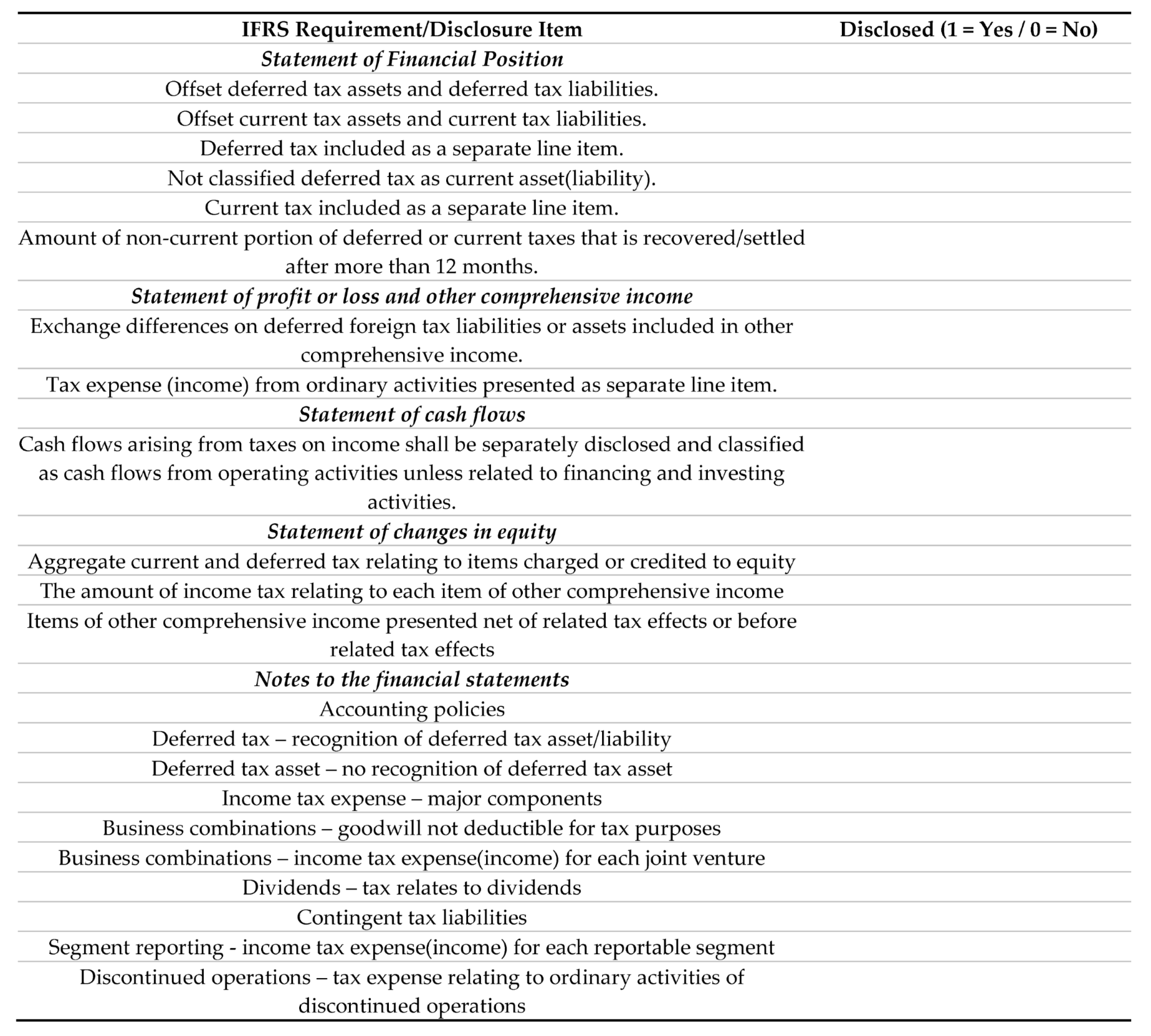
Part B: Voluntary Tax Transparency Checklist
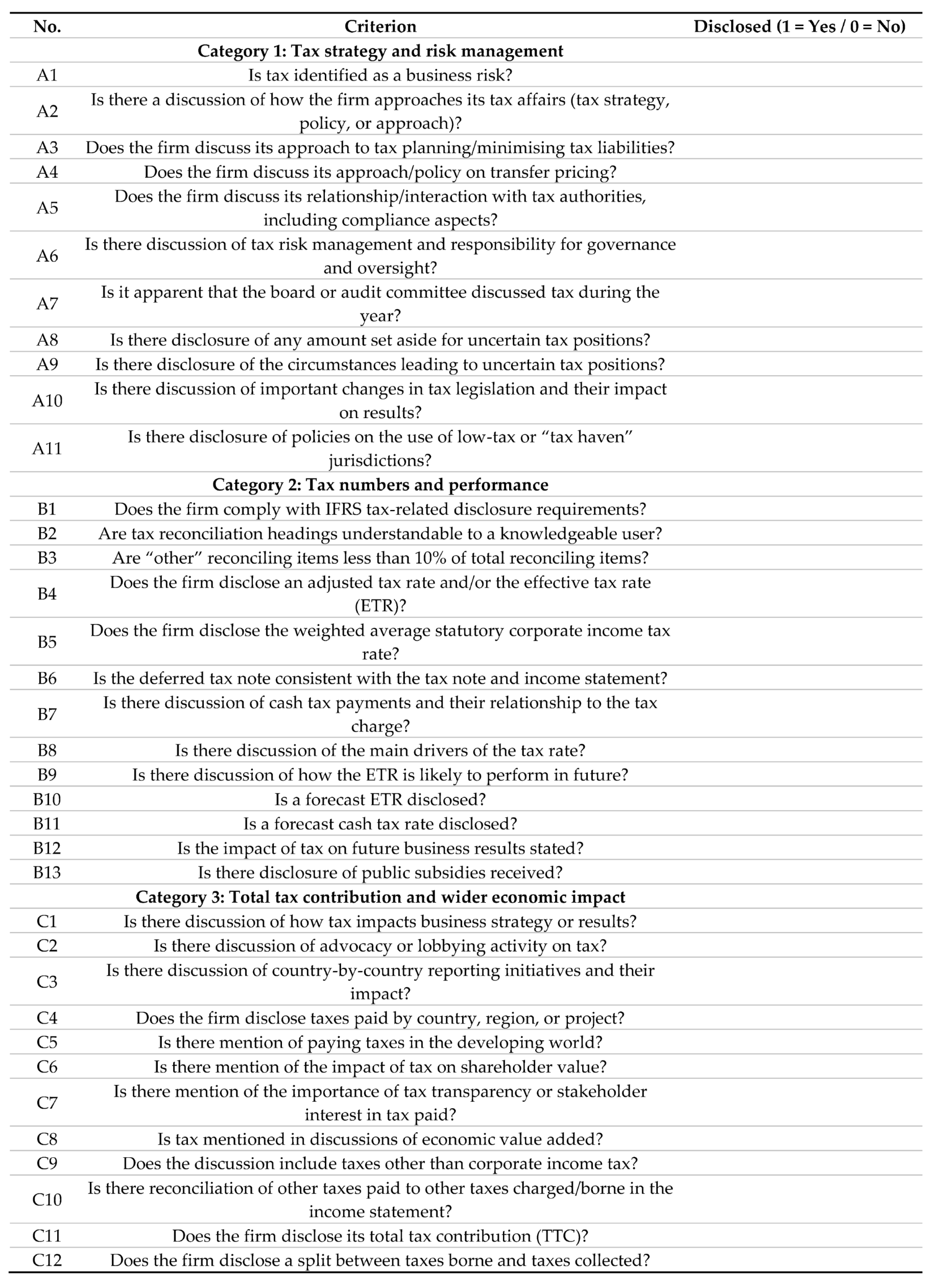
References
- Adams, J.R.; Demers, E.; Klassen, K. Tax transparency in corporate sustainability reporting. Journal of Accounting and Public Policy 2025, forthcoming. [Google Scholar]
- Al Amosh, H.; Khatib, S.F.A. Theories of corporate disclosure: A literature review. Corporate Governance and Sustainability Review 2022, 6(1), 46–59. [Google Scholar] [CrossRef]
- Baker, H.K.; et al. Corporate disclosure and firm size in emerging markets. Emerging Markets Review 2016, 28, 1–15. [Google Scholar]
- Bell, E.; Bryman, A.; Harley, B. Business Research Methods, 5th ed.; Oxford University Press: Oxford, 2018. [Google Scholar]
- Bloomfield, M.J.; O’Hara, J.L.; Wilks, T.J. Tax transparency and corporate accountability. The Accounting Review 2020, 95(6), 1–29. [Google Scholar]
- Bowen, G.A. Document analysis as a qualitative research method. Qualitative Research Journal 2009, 9(2), 27–40. [Google Scholar] [CrossRef]
- Bryman, A.; Bell, E. Business Research Methods, 4th ed.; Oxford University Press: Oxford, 2015. [Google Scholar]
- Cho, C.H.; Laine, M.; Roberts, R.W.; Rodrigue, M. Organized hypocrisy, organizational façades, and sustainability reporting. Accounting, Organizations and Society 2015, 40, 78–94. [Google Scholar] [CrossRef]
- Christensen, G.; Glaeser, E.L.; Miguel, E. Transparency, reproducibility, and the credibility of economics research. Journal of Economic Literature 2019, 57(4), 920–980. [Google Scholar]
- Clatworthy, M.; Jones, M.J. Differential patterns of textual characteristics and company performance in the chairman's statement. Accounting, Auditing & Accountability Journal 2006, 19(4), 493–511. [Google Scholar] [CrossRef]
- Collis, J.; Hussey, R. Business Research: A Practical Guide for Undergraduate and Postgraduate Students, 4th ed.; Palgrave Macmillan: London, 2014. [Google Scholar]
- Crane, A.; Matten, D.; Glozer, S.; Spence, L. Business Ethics: Managing Corporate Citizenship and Sustainability in the Age of Globalization; Oxford University Press: Oxford, 2019. [Google Scholar]
- Creswell, J.W. Research Design: Qualitative, Quantitative, and Mixed Methods Approaches, 4th ed.; Sage: Thousand Oaks, CA, 2014. [Google Scholar]
- De Villiers, C.; Middelberg, S. Corporate social responsibility disclosure and firm size: Evidence from South Africa. Journal of Accounting and Public Policy 2013, 32(3), 168–187. [Google Scholar]
- Deegan, C. Financial Accounting Theory, 5th ed.; McGraw-Hill Education: Sydney, 2019. [Google Scholar]
- Dyreng, S.D.; Hoopes, J.L.; Wilde, J.H. Public pressure and corporate tax behavior. Journal of Accounting Research 2017, 55(1), 147–186. [Google Scholar]
- Freeman, R.E. Strategic Management: A Stakeholder Approach; Pitman: Boston, 1984. [Google Scholar]
- Freeman, R.E.; Harrison, J.S.; Wicks, A.C.; Parmar, B.L.; De Colle, S. Stakeholder Theory: The State of the Art; Cambridge University Press: Cambridge, 2010. [Google Scholar]
- Global Reporting Initiative (GRI). GRI 207: Tax; GRI: Amsterdam, 2019. [Google Scholar]
- Global Reporting Initiative (GRI). Tax transparency is on the rise — yet depth of disclosure is often lacking; GRI: Amsterdam, 2025. [Google Scholar]
- Hair, J.F.; Black, W.C.; Babin, B.J.; Anderson, R.E. Multivariate Data Analysis, 8th ed.; Cengage: Boston, 2020. [Google Scholar]
- Hanlon, M.; Maydew, E.L.; Shevlin, T. An empirical examination of corporate tax avoidance. The Accounting Review 2014, 89(2), 605–636. [Google Scholar]
- Hardeck, I.; Hertl, R. Consumer reactions to corporate tax strategies. Journal of Business Ethics 2018, 149(2), 309–326. [Google Scholar]
- Hebous, S.; Johannesen, N. Tax evasion, disclosure, and social norms. Journal of Public Economics 2021, 195, 104386. [Google Scholar]
- Hillison, W.; Pacini, C.; Sinason, D. Stakeholder influence and voluntary disclosure. Journal of Accounting and Public Policy 2019, 38(4), 1–15. [Google Scholar]
- Institute of Directors in Southern Africa (IoDSA). King IV Report on Corporate Governance for South Africa; IoDSA: Johannesburg, 2016. [Google Scholar]
- IFRS Foundation. IFRIC 23: Uncertainty over Income Tax Treatments; IFRS Foundation: London, 2019. [Google Scholar]
- IFRS Foundation. IAS 1: Presentation of Financial Statements; IFRS Foundation: London, 2023. [Google Scholar]
- IFRS Foundation. IAS 12: Income Taxes; IFRS Foundation: London, 2024. [Google Scholar]
- JSE Limited. JSE Listings Requirements; JSE: Johannesburg, 2025. [Google Scholar]
- Jones, T.M. Instrumental stakeholder theory. Academy of Management Review 1995, 20(2), 404–437. [Google Scholar] [CrossRef]
- Krippendorff, K. Content Analysis: An Introduction to Its Methodology, 4th ed.; SAGE: Thousand Oaks, CA, 2018. [Google Scholar]
- Mamaro, S.; Tjano, A. Market concentration and performance of JSE-listed firms. South African Journal of Business Management 2019, 50(1), 1–8. [Google Scholar]
- Maroun, W.; Van Zijl, W. Isomorphism and resistance in IFRS-based disclosure. The British Accounting Review 2016, 48(1), 1–19. [Google Scholar]
- Marx, B.; Mohammadali-Haji, A. Emerging trends in integrated reporting. Meditari Accountancy Research 2014, 22(2), 9–23. [Google Scholar]
- Mitchell, R.K.; Agle, B.R.; Wood, D.J. Toward a theory of stakeholder identification and salience. Academy of Management Review 1997, 22(4), 853–886. [Google Scholar] [CrossRef]
- Müller, R.; Spengel, C.; Vay, H. On the determinants and effects of corporate tax transparency. 2020; ZEW Discussion Paper No. 20-012. [Google Scholar]
- Nel, R. Effective tax rate reconciliation disclosures of JSE-listed companies. South African Journal of Economic and Management Sciences 2025, 28(1). [Google Scholar] [CrossRef]
- Neuendorf, K.A. The Content Analysis Guidebook, 2nd ed.; SAGE: Thousand Oaks, CA, 2017. [Google Scholar]
- OECD. Base Erosion and Profit Shifting Project; OECD Publishing: Paris, 2015. [Google Scholar]
- OECD. Corporate tax transparency: Building trust through disclosure; OECD Publishing: Paris, 2021. [Google Scholar]
- OECD. OECD Guidelines for Multinational Enterprises on Responsible Business Conduct; OECD Publishing: Paris, 2023. [Google Scholar]
- Phillips, R.; Freeman, R.E.; Wicks, A.C. What stakeholder theory is not. Business Ethics Quarterly 2003, 13(4), 479–502. [Google Scholar] [CrossRef]
- Principles for Responsible Investment (PRI). Why tax matters to investors; PRI: London, 2023. [Google Scholar]
- PwC. Global tax transparency and tax sustainability reporting study 2025; PwC: London, 2025. [Google Scholar]
- Republic of South Africa. Companies Act No. 71 of 2008; Government Printer: Pretoria, 2008. [Google Scholar]
- Russell, A. The importance of being transparent. Journal of Accounting Research 2021, 59(3), 787–821. [Google Scholar]
- Saunders, M.; Lewis, P.; Thornhill, A. Research Methods for Business Students, 8th ed.; Pearson: Harlow, 2019. [Google Scholar]
- Sekaran, U.; Bougie, R. Research Methods for Business, 7th ed.; Wiley: Chichester, 2016. [Google Scholar]
- Stiglingh, M.; Venter, E.R.; Penning, I.; Smit, A.-R.; Schoeman, A.; Steyn, T.L. Tax transparency reporting by the top 50 JSE-listed firms. South African Journal of Accounting Research 2017, 31(1), 1–19. [Google Scholar] [CrossRef]
- Stiglingh, M.; Smit, A.-R. The relationship between tax transparency and tax avoidance. South African Journal of Accounting Research 2022, 36(1), 1–21. [Google Scholar] [CrossRef]
- van Zijl, W.; Hewlett, V. Disclosure practices of JSE-listed companies. South African Journal of Accounting Research 2021, 36(2), 81–104. [Google Scholar] [CrossRef]
- Yasseen, H.; Gazzawi, Z.; Farhat, H. Measuring profitability of firms. Journal of Accounting and Finance Research 2017, 6(2), 1–12. [Google Scholar]
- Huseynov, F.; Klamm, B.K. Tax avoidance, tax management, and corporate social responsibility. Journal of Corporate Finance 2019, 56, 423–453. [Google Scholar] [CrossRef]
- Venter, E.R.; Stiglingh, M.; Smit, A.R. Tax risk management and tax compliance: A survey of large South African companies. eJournal of Tax Research 2014, 12(2), 419–441. [Google Scholar]
- Harrison, J.S.; Barney, J.B.; Freeman, R.E.; Phillips, R.A. The Cambridge Handbook of Stakeholder Theory; Cambridge University Press, 2019. [Google Scholar]
- Business in the Community (BITC). Responsible tax principles; BITC: London, 2023. [Google Scholar]
- KPMG. Tax transparency and governance: Managing risk in a changing environment; KPMG: London, 2023. [Google Scholar]
- Phesa, M.; Magwentshu, N.; Naidoo, S. Corporate governance and disclosure practices of JSE-listed companies. South African Journal of Business Management 2022, 53(1), 1–12. [Google Scholar]
- van Zijl, W.; Hewlett, V. Financial reporting practices of JSE Top 40 firms. South African Journal of Accounting Research 2022, 36(2), 81–104. [Google Scholar] [CrossRef]
- Mankayi, S. Disclosure quality in Top 40 JSE-listed companies. Risks 2023, 11(3), 54. [Google Scholar]
- FTSE Russell. FTSE/JSE Top 40 Index: Methodology and factsheet; FTSE Russell: London, 2025; Available online: https://www.ftserussell.com.
- Kotze, E. Firm size and disclosure practices on the Johannesburg Stock Exchange. South African Journal of Economic and Management Sciences 2017, 20(1), 1–12. [Google Scholar]
- Malola, A.; Maroun, W. Corporate reporting practices of JSE-listed companies. Meditari Accountancy Research 2019, 27(2), 1–24. [Google Scholar]
- Pholohane, T.; Maseko, N.; Ngwakwe, C.C. Disclosure practices and firm performance on the Johannesburg Stock Exchange. South African Journal of Business Management 2020, 51(1), 1–10. [Google Scholar]
- Stiglingh, M.; Venter, E.R.; Smit, A.-R. Corporate disclosure trends among the Top 50 JSE-listed firms. South African Journal of Accounting Research 2014, 28(1), 1–20. [Google Scholar]
Disclaimer/Publisher’s Note: The statements, opinions and data contained in all publications are solely those of the individual author(s) and contributor(s) and not of MDPI and/or the editor(s). MDPI and/or the editor(s) disclaim responsibility for any injury to people or property resulting from any ideas, methods, instructions or products referred to in the content. |
© 2026 by the authors. Licensee MDPI, Basel, Switzerland. This article is an open access article distributed under the terms and conditions of the Creative Commons Attribution (CC BY) license.
Copyright: This open access article is published under a Creative Commons CC BY 4.0 license, which permit the free download, distribution, and reuse, provided that the author and preprint are cited in any reuse.


