

Submitted:
27 February 2026
Posted:
02 March 2026
You are already at the latest version
Abstract
Ancient pathogen genomics has redefined how infectious disease histories are reconstructed,revealing unexpected origins, transmission routes and lineage turnovers that are invisible frommodern genomes alone. Yet this perspective remains heavily biased toward Eurasia and theAmericas, leaving Africa, central to human evolution, biodiversity and zoonotic emergence,largely unexplored. In this review, we assess the current state of ancient pathogen research inAfrica and synthesize insights from bacterial, parasitic and viral perspectives. We identify Africaas a pivotal frontier for the field and outline strategic priorities to move from isolated detectionstoward continent-scale reconstructions of past disease landscapes, with direct relevance forunderstanding present-day and future epidemic risk.
Keywords:
paleogenomics
; Africa
; aDNA
; pathogens
; evolution
Africa as a Frontier for Ancient Pathogen Genomics
As the continent where Homo sapiens evolved, Africa encompasses a wide range of environments and lifeways, including hunter-gatherers, herders, farmers and urban populations, offering an exceptional setting to examine how disease pressures have shaped mobility, health and adaptation over time [1]. Africa’s ecological, climatic and socioeconomic conditions - including high biodiversity, humid environments, frequent human–animal contact and dense populations — make it a critical hotspot for emerging infectious diseases. In the first decades of this century, outbreaks of influenza A, Dengue, Ebola, Mpox and SARS-CoV-2 have caused major epidemics and pandemics, affecting millions of people and disrupting social and economic systems worldwide. Against the longer continuum of epidemic history, Africa is especially important, since rapid ecological change and shifting climate are expanding vector ranges and increasing opportunities for zoonotic spillover. Pathogens are dynamic evolutionary entities shaped by the same environmental and social transformations as their hosts. Holocene lifestyle transitions triggered an epidemiological shift, with closer contact to domesticated animals, as intensified human–animal contact, rising population densities and increased sedentism promoted both zoonotic and sustained human-to-human infection [2,3]. Over 60 % of emerging infectious diseases have zoonotic origins, and many pathogens still persist primarily as zoonoses [4,5]. Yet direct genomic evidence for how these processes unfolded in Africa remains limited.
Ancient pathogen genomics offers a direct means to investigate past disease dynamics by detecting pathogen DNA in metagenomes recovered from bone, teeth, and associated microbiota [2,6,7,8,9,10]. Advances in laboratory protocols and bioinformatic pipelines now allow robust identification and authentication of bacterial, viral and eukaryotic pathogens, including diseases that leave no skeletal lesions and predate written records [11,12] (Figure 1).
Despite Africa’s central role in human evolution, biodiversity and pathogen emergence, ancient pathogen genomics on the continent remains in its infancy. Systematic ancient DNA (aDNA) studies in Africa are therefore crucial to reconstruct past disease burdens, clarify how infections shaped population history and provide an evolutionary framework for anticipating future threats. In this review, we draw on well-sampled studies from Eurasia and the Americas to provide a comparative basis and synthesize how ancient genomics has reshaped our knowledge of infectious microbes, with a particular focus on African ancient pathogens and future research priorities for the continent.
Ancient Pathogens - Revising Origins, Hosts and Spread
In Europe, ancient DNA studies have recovered genomes of Mycobacterium tuberculosis [13], Yersinia pestis [14], and viruses such as hepatitis B [15,16] and Herpes simplex virus 1 (HSV-1) [17], as well as protozoans including Plasmodium falciparum and P. vivax [18,19]. Similar research on human remains from the Americas [20,21,22] and Asia [23,24] has further expanded the ancient pathogen record. Together, these studies provide the clearest evidence that directly dated pathogen genomes can revise models of origin, transmission and dispersal that were previously inferred from modern genomes alone.
For Y. pestis, aDNA has shown that the same species caused the First plague pandemic, the Black Death and the third pandemic [25], and that the bacterium was already infecting humans over 5,000 years ago in Neolithic and Bronze Age Eurasia [26,27,28]. These early strains occupy basal positions in the Y. pestis phylogeny and lack key flea-associated virulence factors, indicating that efficient flea-borne transmission and high virulence evolved gradually over time [26,27]. In line with this early biology, the Late Neolithic Bronze Age (LNBA) Y. pestis has been identified at multiple sites across northern Europe, pointing to a broad geographic distribution [26,29]. This widespread presence occurred despite the absence of genomic features typically associated with classical flea-borne transmission. In Sweden, for example, Y. pestis was detected in 17% of individuals from Neolithic collective burials, a prevalence that is compatible with frequent human exposure during this period given the stringent detection limits of ancient pathogen analyses [27]. Genomic analyses have shown that Y. pestis strains responsible for the First plague pandemic formed a distinct, now-extinct or unsampled lineage, phylogenetically separate from later pandemic strains [30]. In contrast, dense sampling showed that the Black Death strains are highly clonal and derive from a lineage dated to 1338–1339 CE in the Tian Shan region [31,32], supporting a single introduction into Europe followed by centuries of local circulation and recurrent outbreaks. aDNA studies also contributed to shifts in understanding for the Mycobacterium tuberculosis complex (MTBC). Modern genomes-only analyses proposed that the MTBC emerged ~70,000 years ago, linked to human migrations out of Africa and inferred from parallels with human mitochondrial phylogenies [41]. In contrast, studies using ancient genomes as direct calibration points consistently produce much younger most recent common ancestor (MRCA) dates, generally under 6,000 years, supporting a Holocene origin and dispersal [22,35] (Box 1). Phylogenetic analyses of MTBC genomes from pre-colonial South American mummies did not fall within the main human-adapted lineages that dominate post-contact epidemics. Instead, they clustered with Mycobacterium pinnipedii, which today primarily infects seals and sea lions [22,33]. Bayesian dating placed the time to the most recent common ancestor (tMRCA) of the MTBC complex at ~2.8–5.8 kya and estimated that the South American M. pinnipedii cluster diverged from its closest relatives about 1,000 years ago, consistent with the radiocarbon ages [22]. These findings support seal-to-human transmission along the South American coast and show that an animal-derived tuberculosis lineage infected humans in the Americas before 1492 CE [22], contradicting the idea that tuberculosis in the New World derives solely from post-contact European introductions.
For malaria, P. falciparum and P. vivax account for most global disease burden today [36], with the WHO African Region carrying the vast majority of cases and deaths (https://www.afro.who.int/health-topics/malaria). P. falciparum appears to have arisen via a zoonotic spillover from gorillas in sub-Saharan Africa [37], with tMRCA estimates for extant strains ranging from <10,000 to ~450,000 years ago [38,39]. P. vivax is generally considered older [38]. While early mitochondrial and nuclear analyses supported a Southeast Asian origin based on clustering with macaque parasites [40,41], more recent studies identify African great-ape parasites (P. carteri and P. vivax-like) as its closest relatives [39,42]. This challenges a simple Asian-origin model. The high frequency of Duffy negativity in sub-Saharan Africa further suggests long-standing selective pressure from P. vivax and divergence estimates indicate separation from macaque parasites earlier than expected under a recent Asian origin [39]. Ancient data further indicate close relatedness of European and American P. vivax strains around the contact period, supporting introduction by European colonizers [38], whereas present-day American P. falciparum clusters with modern African lineages, consistent with dispersal via the trans-Atlantic slave trade.
Recovering viral genomes from ancient materials is more challenging because viral DNA and RNA are typically low in abundance and highly degraded [7]. Nevertheless, recent successes have transformed the field.
The sequencing of hepatitis B virus (HBV) from human remains spanning 400 to 10,500 years ago revealed lineages persisting in humans for over 11,000 years [16]. HBV circulated widely across western Eurasian hunter-gatherers (around ~10 kya), before the onset of agriculture and animal husbandry. Early Holocene genomes (~11–7.5 kya BP) fall into two Mesolithic clades [16]. Following the Neolithic transition, these HBV lineages were replaced by the Western Eurasian Neolithic–to–Bronze Age (WENBA) lineage, which spread with early European farmers from Anatolia and persisted for >4,000 years [16]. A second major turnover occurred at the end of the Bronze Age, when WENBA diversity collapsed and was superseded by the modern genotypes, indicating at least two major HBV lineage turnovers in known viral evolution [16]. A Bronze Age HBV genome from eastern Europe ancestral to modern African sequences suggests genotype A originated in western Eurasia and entered Africa, where it diversified by the end of the second millennium BCE [16,43]. Today, genotype A is highly diverse in Africa, and modern phylogenetic analyses link subgenotype A1 and A4 to introductions into the Americas during the transatlantic slave trade, with documented presence in Venezuela, Mexico, Haiti, Martinique and Colombia [44,45,46,47].
Ancient Herpes simplex virus type 1 (HSV-1) genomes recovered from four individuals across Northern Europe, dated to the past 2,000 years, provide the first direct time-stamped sequences of this virus [17]. These genomes place the tMRCA of circulating HSV-1 strains at ~4,000 years ago, implying a major lineage replacement, broadly coincident with the late Neolithic and Bronze Age migrations [17]. These findings conflict with earlier out-of-Africa scenarios inferred solely from modern sequences [48] and highlights the need for broader ancient sampling, particularly in Africa [17].
Across bacteria, protozoa and DNA viruses, these studies show how ancient genomic data can overturn long-standing models based on modern sequences alone, by refining MRCA estimates, revealing unexpected animal reservoirs, documenting repeated lineage turnovers and constraining the timing and routes of global dispersal. This basis is directly relevant for Africa, where equivalent ancient datasets are still scarce but have the potential to similarly reshape narratives of pathogen origins and spread on the continent and out of it.
Box 1. Timescale dependent rates and the interpretation of pathogen evolution
Estimating evolutionary rates and divergence times from genetic data requires temporal calibration. For most microbial pathogens, datasets are dominated by contemporary isolates, so molecular-clock analyses typically rely on tip dating using sequences sampled at known times. For rapidly evolving RNA viruses, sequences collected over only a few decades can provide sufficient temporal signal[49]. By contrast, for more slowly evolving pathogens, especially bacteria and DNA viruses, modern genomes often exhibit too little accumulated genetic change over the available sampling interval to support reliable inference [50,51].
Ancient genomes extend molecular-clock calibration beyond contemporary sampling by capturing pathogen genetic diversity from centuries to millennia in the past. For viruses, endogenous viral elements (EVEs) provide additional, independent calibration points on geological timescales [52,53]. Extending calibration across these longer timescales reveals a consistent pattern, the time-dependent rate phenomenon (TDRP), in which evolutionary rates estimated over short intervals are systematically higher than those inferred over longer timescales [54].
Time dependence of evolutionary rates has long been recognized in evolutionary biology, but its consequences are particularly pronounced for rapidly evolving pathogens [51,55,56]. When timescales are inferred primarily from short-term sampling, pathogen diversity accumulated over deep evolutionary time may be misinterpreted as having arisen much more recently, distorting inferences about the processes driving diversification. For example, ancient lineage divergence may be incorrectly attributed to recent ecological change, host population dynamics, or historical events, rather than to long-term evolutionary processes.
Long-term genomic records, such as ancient pathogen genomes and EVEs, expand the temporal window over which evolutionary rates can be evaluated, revealing the scale dependence of pathogen evolution and placing bounds on the extent to which short-term rate estimates can be extrapolated across deeper timescales. This perspective supports the development and empirical calibration of models that accommodate time-dependent rates, and clarifies both the possibilities and the limits of molecular-clock inference across pathogens [57,58] (Figure 2).
Recovering Ancient RNA Viruses - Challenges and Promise
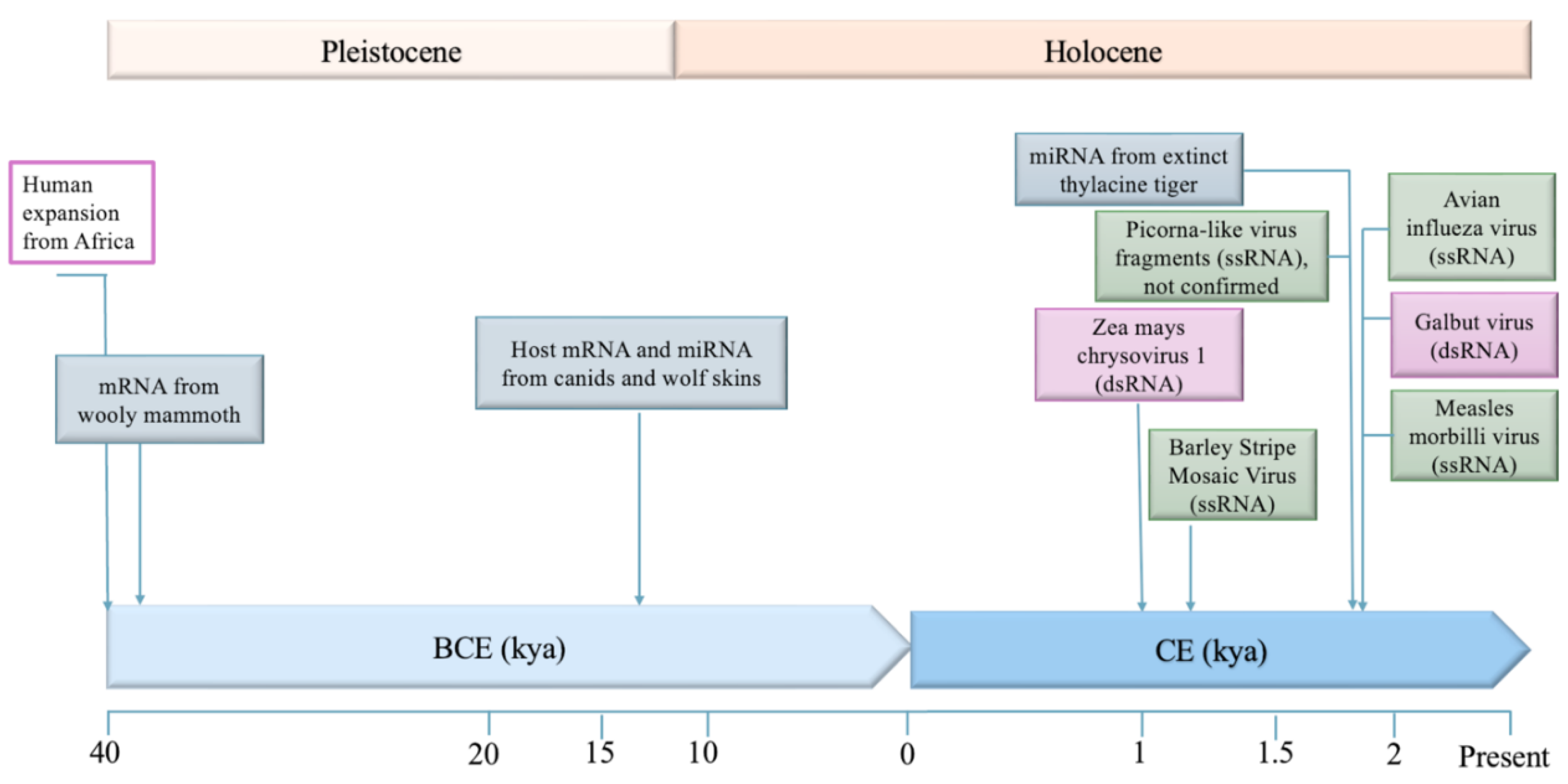
Despite the success of ancient DNA virus retrieval, no authenticated RNA virus has yet been recovered from archaeological human remains. RNA viruses nevertheless include some of the most important human pathogens, responsible for diseases such as Ebola, Dengue, influenza and Lassa fever, with case-fatality rates that can be high in some outbreaks. If preserved in ancient specimens, viral RNA could illuminate long-term viral evolution, zoonotic emergence and host–pathogen interactions. RNA was long assumed too unstable for deep-time recovery because of its short cellular half-life and susceptibility to hydrolysis, which limited efforts to study ancient RNA. However, recent work has overturned this view, demonstrating that RNA can persist over extended periods. RNA has been recovered from ancient and non-human contexts, including a ~750-year-old ssRNA virus from barley and a ~1,000-year-old dsRNA virus from maize, alongside preserved host mRNA and miRNA from museum specimens and Late Pleistocene canids and historical wolf skins (14 kya) [59,60,61,62,63]. In the Tasmanian tiger sample, picorna-like RNA virus fragments of uncertain origin were detected [59]. A recent preprint reported near-complete viral RNA genomes from a 1908 Drosophila melanogaster specimen and suggested that ribonucleoprotein complexes may help stabilize RNA over time [64]. Most remarkably, Mármol-Sánchez et al. recovered transcriptional profiles from Pleistocene woolly mammoths, including a specimen dated to ~39,000 years ago, extending this proof of principle into deep prehistory [65]. Collectively, these results demonstrate RNA’s potential longevity and establish ancient specimens as valuable archives for studying ancient RNA and, potentially, RNA viruses. Human historical specimens further demonstrate the value of RNA recovery for reconstructing origins and timescales. Analysis of influenza virus genomes from the 1918–1920 pandemic, amplified from formalin-fixed paraffin-embedded (FFPE) tissue, revealed an avian origin with specific mammalian host adaptations [66]. Similarly, a 1912 measles morbillivirus (MeV) genome from FFPE tissue is the oldest RNA genome of a human virus to date [67]. It showed that MeV and rinderpest diverged roughly 2,500 years ago after a cattle-to-human spillover, and it anchored the MeV MRCA estimate to around 528 BCE [67].
Together, these advances indicate that if archaeological human RNA virus recovery becomes feasible, it could substantially refine models of zoonotic origin, lineage replacement and epidemic emergence. In Africa, however, this goal faces additional hurdles: high ambient temperatures, fluctuating humidity and acidic or microbially active soils often reduce biomolecular preservation, making RNA survival even less likely. Success will likely depend on carefully targeted contexts with exceptional preservation potential and protocols optimized for ultra-short, highly degraded RNA fragments.
Figure 3.
Timeline of ancient RNA and RNA virus recoveries. Schematic overview of reported ancient RNA virus detections from the late Pleistocene to the present.
Figure 3.
Timeline of ancient RNA and RNA virus recoveries. Schematic overview of reported ancient RNA virus detections from the late Pleistocene to the present.
Ancient Pathogen Genomics in Africa - Current Limitations and Insights into Disease Landscape
In Africa, ancient pathogen research remains scarce, and no systematic survey of sub-Saharan contexts exists, with most research efforts concentrated on Egyptian mummies [68]. Many large African aDNA studies to date have relied on sequence capture techniques targeting only human DNA, which does not yield metagenomes for pathogen screening [69,70].
Ancient Egyptian remains nonetheless reveal a diverse infectious disease burden (Table 1). Molecular studies have repeatedly detected human-adapted MTBC DNA in Egyptian mummies, but to date no high-quality complete MTBC genome has been reported from this context [71,72,73]. The 2,200-year-old Mycobacterium leprae genome from Egypt is currently the earliest recovered and phylogenetically placed leprosy genome, clustering with present-day West African and Brazilian strains [43]. Including this genome in dated phylogenies shifts the inferred tMRCA to roughly 2.6–4.5 kya and the global M. leprae tMRCA to about 5.8 kya. This extends previous estimates by ~1.3 kyr and indicates that leprosy was established in North Africa by the late Iron Age. The ~2,000-year-old HBV genome recovered from Egyptian mummies falls within genotype A, between subclades A1 (Asia) and A3 (Africa), with a short branch length compatible with its ancient status [43]. Parasitic infections are likewise well represented among findings from Egypt. Plasmodium falciparum has been detected by PCR and NGS [73,74,75], while Toxoplasma gondii was detected in embalmed heads, plausibly linked to close human–cat contact [75]. This finding should be interpreted with caution, since an earlier study showed that the T. gondii reference genome is contaminated with human DNA [76], underscoring the importance of careful database selection prior to classification. Schistosoma mansoni and S. haematobium were identified in a canopic-jar liver from the Middle Kingdom and pointed to intestinal and urinary schistosomiasis [77]. Leishmania donovani appeared in Egyptian and Nubian material, with higher prevalence in Nubia [78]. Collectively, these data indicate a complex landscape of chronic bacterial, viral and parasitic infections.
Beyond Egypt, only one study has directly investigated metagenomes in sub-Saharan Africa: a 2,000-year-old hunter-gatherer child from Ballito Bay in South Africa [10]. The analysis recovered Rickettsia felis, a flea-borne pathogen that causes a typhus-like disease. A high-quality ancient R. felis genome was reconstructed with 11× mean coverage from petrous bone, suggesting that in severe infection in children, the petrous bone can potentially harbor sufficient pathogen DNA for genome reconstruction. Consistent with this, pathogen DNA has also been recovered from the petrous bone in other contexts, including Treponema pallidum in a human infant and Brucella melitensis in an adult sheep [79,80]. Skeletal evidence suggested that R. felis infection may have contributed to the child’s poor health and early death, estimated at about seven years old [10]. These findings demonstrate that R. felis was already present at least 2,000 years ago among Later Stone Age hunter-gatherers who did not practice farming or herding [10]. This observation contradicts earlier assumptions that R. felis is a modern “emerging” pathogen associated with sedentism and animal domestication [81], instead suggesting persistence among mobile foragers.
Future aDNA Research Perspectives on Africa’s Disease History
Africa is poised to be a major frontier for ancient pathogen genomics, but progress will depend on framing testable questions that match the realities of preservation and sampling. A useful organizing principle is to treat Africa as both a point of comparison that helps test models built from Eurasian and American data and as a continent with its own endemic and zoonotic histories that require African ancient genomes to be understood. The priorities below emphasize pathogens with plausible preservation routes in teeth, bone, calculus and contextual sediments, and they highlight cases where ancient genomes could directly test competing models of origin, transmission mode and long-term persistence.
Written sources claimed that the plague of Justinian began in Ethiopia, and intensified military, diplomatic and economic ties between this region and the Byzantine Empire in the early sixth century likely provided an effective pathway for its spread into Europe [82]. Although the issue cannot be definitively resolved, an African origin for the plague of Justinian remains a plausible and arguably the most probable scenario [82]. This long view aligns with the present: Africa continues to carry a major share of the global plague burden, with Madagascar as a persistent hotspot. Understanding why plague persists there offers a testable model for long-term reservoir–vector–human dynamics. The key components (black rats and competent fleas) are widespread across Africa, but Madagascar appears to sustain particularly efficient transmission cycles shaped by highlands ecology, synanthropic mammal communities, household-level exposure and vector performance, together enabling self-sustaining persistence after introduction during the third pandemic [83,84].
Beyond plague, Africa bears a high burden of bacterial and parasitic diseases including tuberculosis, cholera, malaria and schistosomiasis. Climate-driven shifts in vector ranges and habitats are likely to increase the broader relevance of several Africa-linked infections, reinforcing the need for deep-time baselines. These baselines are valuable not only for reconstructing past burdens but also for clarifying when key transmission systems became established, how often spillover events occurred and whether current endemic patterns reflect recent introductions or long-standing local persistence.
Future work should prioritize pathogens with realistic aDNA recovery potential. The Mycobacterium tuberculosis complex is a central target, given Africa’s high modern burden and the distinctive presence of lineages 5 and 6 (M. africanum) in West Africa. Ancient genomes could test lineage emergence and replacement, refine divergence histories of African clades and clarify how local transmission systems evolved. Despite younger MRCA estimates from ancient calibration, the MTBC ancestor is still often inferred to have originated in Africa, followed by expansion and global dispersal via human movements [3,35]. An African MTBC genome substantially older than the currently available ancient calibrations would be particularly informative, helping to test the proposed African origin and to evaluate how tightly Holocene MRCA estimates bound deeper lineage history. Salmonella enterica is another high-value target: long historical records of enteric fever and a bloodstream phase increase the plausibility of recovery from teeth, enabling tests of introduction timing, lineage turnover and the deep history of antimicrobial resistance. For cholera and related gastrointestinal pathogens, direct detection in skeletal tissues is less reliable, thus targeted screening of burial-adjacent sediments and latrine-associated contexts may provide a more productive route.
Flea-borne bacteria also warrant systematic inclusion. Rickettsia felis has already been recovered from a ~2,000-year-old child in South Africa, and modern studies report widespread detection in humans, fleas and animal reservoirs across the continent, including asymptomatic infections [85,86]. This ecology makes R. felis a strong candidate for routine screening in African aDNA datasets, using curated reference panels and stringent authentication. A broader time series could determine whether R. felis persistence predates major Holocene shifts in settlement, livestock ecology and urbanization.
Parasitic pathogens should be integrated into the same approach, with Plasmodium falciparum as the key priority given its major contribution to Africa’s disease burden. Leishmania donovani is feasible based on prior positives in North/Northeast Africa and remains a major cause of visceral leishmaniasis in East Africa today. Trypanosoma brucei represents a historically important disease system whose ancient genomic record could contextualize modern low-level persistence and illuminate how vector ecology, human mobility and cattle farming have shaped regional transmission intensity over time. Yet there is still little direct genomic evidence for how past African populations were affected by infectious diseases, how outbreaks unfolded before written records, or how hosts adapted over time. This gap is partly methodological: well-preserved human skeletons remain unevenly distributed across the continent due to heat, humidity and mortuary practices. Nonetheless, the growing body of African aDNA studies, including sub-Saharan genomes dating back ~10,200 years [87], demonstrates that suitable material is available, and systematic metagenomic screening of these sequences now offers a realistic avenue to address this gap.
Taken together, these priorities outline a practical, hypothesis-driven roadmap for African ancient pathogen research. Although no authenticated RNA virus has yet been recovered from archaeological human remains, even partial success in Africa would open a new temporal window on fast-evolving pathogens and clarify when major zoonotic lineages emerged or shifted. Broad, standardized screening across teeth, calculus, bone and contextual sediments (Table 2), should move the field from isolated detections toward continent-scale reconstructions of endemicity, emergence and long-term host–pathogen coevolution.
Conclusion
Understanding Africa’s deep pathogen history is essential for anticipating future outbreaks. Ancient DNA studies in Europe, Asia and the Americas have shown how DNA viruses, bacteria and parasites shaped health, mobility and demography, but Africa remains profoundly understudied. Systematic ancient pathogen research on African human and animal remains could uncover infections that affected past populations but are undocumented today, and clarify how disease influenced migration, community stability, and the rise or decline of complex societies. Epidemics have been proposed as contributors to demographic downturns and societal collapse in parts of Africa [88,89], yet direct genomic evidence is still scarce.
Ancient African pathogen genomes could refine divergence rates and timescales, reconstruct long-term changes in virulence and transmission, and clarify the timing and ecological contexts of emergence, spread and persistence (Figure 4) (see Outstanding questions box). Combined with information on host identity and sampling location, phylogenetic analyses can also reveal past routes of disease dispersal and shifts in transmission dynamics. These insights will sharpen regional risk assessments, inform vaccine, antibiotic and antiviral development, and clarify historic spillover pathways at the wildlife–human interface, strengthening One Health strategies aimed at preventing future zoonotic pandemics.
With expanding archaeological access, rapidly improving biomolecular methods and growing interest in Africa’s disease history, the coming years are likely to transform our understanding of ancient pathogens on the continent and their long-term impacts on African populations.
Acknowledgments
CS was funded by the Swedish Research Council (nr. 2023-02944), the Knut and Alice Wallenberg foundation and the Erik Philip-Sörensens Foundation (nr. G2023-047), MV was funded by the Sven and Lilly Lawski Foundation, HW was funded by the Swedish Research Council (nr. 2024-03665).
Declaration of interests
The authors declare no competing interests.
References
- Avila-Arcos, M.C.; et al. Going local with ancient DNA: A review of human histories from regional perspectives. Science 2023, 382, 53–58. [Google Scholar] [CrossRef]
- Sikora, M.; et al. The spatiotemporal distribution of human pathogens in ancient Eurasia. Nature 2025, 643, 1011–1019. [Google Scholar] [CrossRef] [PubMed]
- Blevins, K.E.; et al. Ancient DNA insights into diverse pathogens and their hosts. Nature Reviews Genetics 2026, 27, 96–111. [Google Scholar] [CrossRef] [PubMed]
- Jones, K.E.; et al. Global trends in emerging infectious diseases. Nature 2008, 451, 990–993. [Google Scholar] [CrossRef] [PubMed]
- Wolfe, N.D.; et al. Origins of major human infectious diseases. Nature 2007, 447, 279–283. [Google Scholar] [CrossRef]
- Bos, K.I.; et al. A draft genome of Yersinia pestis from victims of the Black Death. Nature 2011, 478, 506–510. [Google Scholar] [CrossRef]
- Spyrou, M.A.; et al. Ancient pathogen genomics as an emerging tool for infectious disease research. Nature Reviews Genetics 2019, 20, 323–340. [Google Scholar] [CrossRef]
- Key, F.M.; et al. Mining metagenomic data sets for ancient DNA: recommended protocols for authentication. Trends in Genetics 2017, 33, 508–520. [Google Scholar] [CrossRef]
- Philips, A.; et al. Comprehensive analysis of microorganisms accompanying human archaeological remains. GigaScience 2017, 6, gix044. [Google Scholar] [CrossRef]
- Rifkin, R.F.; et al. Rickettsia felis DNA recovered from a child who lived in southern Africa 2000 years ago. Communications biology 2023, 6, 240. [Google Scholar] [CrossRef]
- Kerner, G.; et al. Ancient DNA as a tool for medical research. Nature medicine 2023, 29, 1048–1051. [Google Scholar] [CrossRef]
- Warinner, C.; et al. A robust framework for microbial archaeology. Annual review of genomics and human genetics 2017, 18, 321–356. [Google Scholar] [CrossRef] [PubMed]
- Donoghue, H.D. Insights gained from ancient biomolecules into past and present tuberculosis—a personal perspective. International Journal of Infectious Diseases 2017, 56, 176–180. [Google Scholar] [CrossRef] [PubMed]
- Swali, P.; et al. Yersinia pestis genomes reveal plague in Britain 4000 years ago. Nature Communications 2023, 14, 2930. [Google Scholar] [CrossRef]
- Mühlemann, B.; et al. Ancient hepatitis B viruses from the Bronze Age to the Medieval period. Nature 2018, 557, 418–423. [Google Scholar] [CrossRef] [PubMed]
- Kocher, A.; et al. Ten millennia of hepatitis B virus evolution. Science 2021, 374, 182–188. [Google Scholar] [CrossRef]
- Guellil, M.; et al. Ancient herpes simplex 1 genomes reveal recent viral structure in Eurasia. Science Advances 2022, 8, eabo4435. [Google Scholar] [CrossRef]
- Gelabert Xirinachs, P.; et al. Malaria was a weak selective force in ancient Europeans. Scientific reports 2017, 7, 1377. [Google Scholar] [CrossRef]
- Marciniak, S.; et al. Plasmodium falciparum malaria in 1st–2nd century CE southern Italy. Current Biology 2016, 26, R1220–R1222. [Google Scholar] [CrossRef]
- Guzmán-Solís, A.A.; et al. Ancient viral genomes reveal introduction of human pathogenic viruses into Mexico during the transatlantic slave trade. Elife 2021, 10, e68612. [Google Scholar] [CrossRef]
- Vågene, Å.J.; et al. Salmonella enterica genomes from victims of a major sixteenth-century epidemic in Mexico. Nature ecology & evolution 2018, 2, 520–528. [Google Scholar]
- Bos, K.I.; et al. Pre-Columbian mycobacterial genomes reveal seals as a source of New World human tuberculosis. Nature 2014, 514, 494–497. [Google Scholar] [CrossRef]
- Spyrou, M.A.; et al. Analysis of 3800-year-old Yersinia pestis genomes suggests Bronze Age origin for bubonic plague. Nature communications 2018, 9, 2234. [Google Scholar] [CrossRef]
- Kahila Bar-Gal, G.; et al. Tracing hepatitis B virus to the 16th century in a Korean mummy. Hepatology 2012, 56, 1671–1680. [Google Scholar] [CrossRef]
- Spyrou, M.A.; et al. Phylogeography of the second plague pandemic revealed through analysis of historical Yersinia pestis genomes. Nature communications 2019, 10, 4470. [Google Scholar] [CrossRef] [PubMed]
- Rascovan, N.; et al. Emergence and spread of basal lineages of Yersinia pestis during the Neolithic decline. Cell 2019, 176, 295–305. [Google Scholar] [CrossRef] [PubMed]
- Seersholm, F.V.; et al. Repeated plague infections across six generations of Neolithic Farmers. Nature 2024, 632, 114–121. [Google Scholar] [CrossRef]
- Macleod, R.; et al. Lethal Plague Outbreaks in Lake Baikal Hunter–gatherers 5500 Years Ago. bioRxiv 2024. [Google Scholar] [CrossRef]
- Valtueña, A.A.; et al. The Stone Age plague and its persistence in Eurasia. Current biology 2017, 27, 3683–3691. [Google Scholar] [CrossRef]
- Wagner, D.M.; et al. Yersinia pestis and the Plague of Justinian 541–543 AD: a genomic analysis. The Lancet Infectious Diseases 2014, 14, 319–326. [Google Scholar] [CrossRef]
- Spyrou, M.A.; et al. The source of the Black Death in fourteenth-century central Eurasia. Nature 2022, 606, 718–724. [Google Scholar] [CrossRef]
- Spyrou, M.A.; et al. Historical Y. pestis genomes reveal the European Black Death as the source of ancient and modern plague pandemics. Cell host & microbe 2016, 19, 874–881. [Google Scholar]
- Vågene, Å.J.; et al. Geographically dispersed zoonotic tuberculosis in pre-contact South American human populations. Nature communications 2022, 13, 1195. [Google Scholar] [CrossRef]
- Comas, I.; et al. Out-of-Africa migration and Neolithic coexpansion of Mycobacterium tuberculosis with modern humans. Nature genetics 2013, 45, 1176–1182. [Google Scholar] [CrossRef]
- Sabin, S.; et al. A seventeenth-century Mycobacterium tuberculosis genome supports a Neolithic emergence of the Mycobacterium tuberculosis complex. Genome biology 2020, 21, 201. [Google Scholar] [CrossRef] [PubMed]
- Michel, M.; et al. Ancient Plasmodium genomes shed light on the history of human malaria. Nature 2024, 631, 125–133. [Google Scholar] [CrossRef]
- Liu, W.; et al. Origin of the human malaria parasite Plasmodium falciparum in gorillas. Nature 2010, 467, 420–425. [Google Scholar] [CrossRef] [PubMed]
- Michel, M.; et al. Ancient Plasmodium genomes shed light on the history of human malaria. Nature 2024, 631, 125–133. [Google Scholar] [CrossRef]
- Loy, D.E.; et al. Out of Africa: origins and evolution of the human malaria parasites Plasmodium falciparum and Plasmodium vivax. International journal for parasitology 2017, 47, 87–97. [Google Scholar] [CrossRef]
- Mu, J.; et al. Host switch leads to emergence of Plasmodium vivax malaria in humans. Molecular biology and evolution 2005, 22, 1686–1693. [Google Scholar] [CrossRef] [PubMed]
- Jongwutiwes, S.; et al. Mitochondrial genome sequences support ancient population expansion in Plasmodium vivax. Molecular biology and evolution 2005, 22, 1733–1739. [Google Scholar] [CrossRef]
- Loy, D.E.; et al. Evolutionary history of human Plasmodium vivax revealed by genome-wide analyses of related ape parasites. Proceedings of the National Academy of Sciences 2018, 115, E8450–E8459. [Google Scholar] [CrossRef] [PubMed]
- Neukamm, J.; et al. 2000-year-old pathogen genomes reconstructed from metagenomic analysis of Egyptian mummified individuals. BMC biology 2020, 18, 108. [Google Scholar] [CrossRef]
- Andernach, I.E.; et al. Slave trade and hepatitis B virus genotypes and subgenotypes in Haiti and Africa. Emerging Infectious Diseases 2009, 15, 1222. [Google Scholar] [CrossRef] [PubMed]
- Quintero, A.; et al. Molecular epidemiology of hepatitis B virus in Afro-Venezuelan populations. Archives of virology 2002, 147, 1829–1836. [Google Scholar] [CrossRef]
- Brichler, S.; et al. African, Amerindian and European hepatitis B virus strains circulate on the Caribbean Island of Martinique. Journal of General Virology 2013, 94, 2318–2329. [Google Scholar] [CrossRef] [PubMed]
- Alvarado-Mora, M.V.; et al. Phylogenetic analysis of complete genome sequences of hepatitis B virus from an Afro-Colombian community: presence of HBV F3/A1 recombinant strain. Virology Journal 2012, 9, 244. [Google Scholar] [CrossRef]
- Forni, D.; et al. Recent out-of-Africa migration of human herpes simplex viruses. Molecular Biology and Evolution 2020, 37, 1259–1271. [Google Scholar] [CrossRef]
- Duffy, S.; et al. Rates of evolutionary change in viruses: patterns and determinants. Nature Reviews Genetics 2008, 9, 267–276. [Google Scholar] [CrossRef]
- Firth, C.; et al. Using time-structured data to estimate evolutionary rates of double-stranded DNA viruses. Molecular biology and evolution 2010, 27, 2038–2051. [Google Scholar] [CrossRef]
- Duchêne, S.; et al. Genome-scale rates of evolutionary change in bacteria. Microbial genomics 2016, 2, e000094. [Google Scholar] [CrossRef]
- Katzourakis, A.; Gifford, R.J. Endogenous viral elements in animal genomes. PLoS genetics 2010, 6, e1001191. [Google Scholar] [CrossRef] [PubMed]
- Aiewsakun, P.; Katzourakis, A. Endogenous viruses: Connecting recent and ancient viral evolution. Virology 2015, 479, 26–37. [Google Scholar] [CrossRef]
- Ho, S.Y.; et al. Time dependency of molecular rate estimates and systematic overestimation of recent divergence times. Molecular biology and evolution 2005, 22, 1561–1568. [Google Scholar] [CrossRef] [PubMed]
- Aiewsakun, P.; Katzourakis, A. Time-dependent rate phenomenon in viruses. Journal of virology 2016, 90, 7184–7195. [Google Scholar] [CrossRef]
- Duchêne, S.; et al. Analyses of evolutionary dynamics in viruses are hindered by a time-dependent bias in rate estimates. Proceedings of the Royal Society B: Biological Sciences 2014, 281. [Google Scholar] [CrossRef]
- Bromham, L.; et al. Bayesian molecular dating: opening up the black box. Biological Reviews 2018, 93, 1165–1191. [Google Scholar] [CrossRef]
- Menardo, F.; et al. The molecular clock of Mycobacterium tuberculosis. PLoS pathogens 2019, 15, e1008067. [Google Scholar] [CrossRef] [PubMed]
- Mármol-Sánchez, E.; et al. Historical RNA expression profiles from the extinct Tasmanian tiger. Genome research 2023, 33, 1299–1316. [Google Scholar] [CrossRef]
- Smith, O.; et al. A complete ancient RNA genome: identification, reconstruction and evolutionary history of archaeological Barley Stripe Mosaic Virus. Scientific reports 2014, 4, 4003. [Google Scholar] [CrossRef]
- Smith, O.; et al. Ancient RNA from Late Pleistocene permafrost and historical canids shows tissue-specific transcriptome survival. PLoS biology 2019, 17, e3000166. [Google Scholar] [CrossRef]
- Fromm, B.; et al. Ancient microRNA profiles of 14,300-yr-old canid samples confirm taxonomic origin and provide glimpses into tissue-specific gene regulation from the Pleistocene. RNA 2021, 27, 324–334. [Google Scholar] [CrossRef] [PubMed]
- Peyambari, M.; et al. A 1,000-year-old RNA virus. Journal of virology 2019, 93, 10–1128. [Google Scholar] [CrossRef] [PubMed]
- Keene, A.H.; Stenglein, M.D. Viral metagenomics of 100-year-old museum specimens highlights the long-term stability of RNA. bioRxiv 2024. [Google Scholar] [CrossRef]
- Mármol-Sánchez, E.; et al. Ancient RNA expression profiles from the extinct woolly mammoth. Cell 2025, 189, 52–69. [Google Scholar] [CrossRef]
- Guzmán-Solís, A.A.; et al. A glimpse into the past: What ancient viral genomes reveal about human history. Annual Review of Virology 2023, 10, 49–75. [Google Scholar] [CrossRef]
- Düx, A.; et al. Measles virus and rinderpest virus divergence dated to the rise of large cities. Science (New York, NY) 2020, 368, 1367. [Google Scholar] [CrossRef] [PubMed]
- Gad, Y.Z.; et al. Insights from ancient DNA analysis of Egyptian human mummies: clues to disease and kinship. Human Molecular Genetics 2021, 30, R24–R28. [Google Scholar] [CrossRef]
- Lipson, M.; et al. Ancient DNA and deep population structure in sub-Saharan African foragers. Nature 2022, 603, 290–296. [Google Scholar] [CrossRef]
- Brielle, E.S.; et al. Entwined African and Asian genetic roots of medieval peoples of the Swahili coast. Nature 2023, 615, 866–873. [Google Scholar] [CrossRef]
- Zink, A.R.; et al. Molecular history of tuberculosis from ancient mummies and skeletons. International Journal of Osteoarchaeology 2007, 17, 380–391. [Google Scholar] [CrossRef]
- Crubézy, E.; et al. Identification of Mycobacterium DNA in an Egyptian Pott’s disease of 5400 years old. Comptes Rendus de l’Académie des Sciences-Series III-Sciences de la Vie 1998, 321, 941–951. [Google Scholar] [CrossRef] [PubMed]
- Lalremruata, A.; et al. Molecular identification of falciparum malaria and human tuberculosis co-infections in mummies from the Fayum depression (Lower Egypt). PloS one 2013, 8, e60307. [Google Scholar] [CrossRef] [PubMed]
- Nerlich, A.G.; et al. Plasmodium falciparum in ancient Egypt. Emerging infectious diseases 2008, 14, 1317. [Google Scholar] [CrossRef] [PubMed]
- Khairat, R.; et al. First insights into the metagenome of Egyptian mummies using next-generation sequencing. Journal of applied genetics 2013, 54, 309–325. [Google Scholar] [CrossRef]
- Lu, J.; Salzberg, S.L. Removing contaminants from databases of draft genomes. PLoS computational biology 2018, 14, e1006277. [Google Scholar] [CrossRef]
- Matheson, C.D.; et al. Molecular confirmation of Schistosoma and family relationship in two ancient Egyptian mummies. Verlag Dr. Friedrich Pfeil 2014, 39–47. [Google Scholar]
- Zink, A.R.; et al. Leishmaniasis in ancient Egypt and upper Nubia. Emerging infectious diseases 2006, 12, 1616. [Google Scholar] [CrossRef]
- L’Hôte, L.; et al. An 8000 years old genome reveals the Neolithic origin of the zoonosis Brucella melitensis. Nature Communications 2024, 15, 6132. [Google Scholar] [CrossRef]
- Majander, K.; et al. Ancient Bacterial Genomes Reveal a High Diversity of Treponema pallidum Strains in Early Modern Europe. Current Biology 2020, 30, 3788–3803.e10. [Google Scholar] [CrossRef]
- Angelakis, E.; et al. Rickettsia felis: the complex journey of an emergent human pathogen. Trends in Parasitology 2016, 32, 554–564. [Google Scholar] [CrossRef]
- Sarris, P. The Justinianic plague: origins and effects. Continuity and change 2002, 17, 169–182. [Google Scholar] [CrossRef]
- Esquivel Gomez, L.R.; et al. Phylogenetic analysis of the origin and spread of plague in Madagascar. PLoS Neglected Tropical Diseases 2023, 17, e0010362. [Google Scholar] [CrossRef]
- Rakotobe Harimanana, R.; et al. Bioecology of fleas with a focus on the plague vector Xenopsylla Brasiliensis in Mandritsara district, Northern Madagascar. Scientific Reports 2025, 15, 24297. [Google Scholar] [CrossRef]
- Mediannikov, O.; et al. Common epidemiology of Rickettsia felis infection and malaria, Africa. Emerging infectious diseases 2013, 19, 1775. [Google Scholar] [CrossRef] [PubMed]
- Maina, A.N.; et al. Rickettsia felis infection in febrile patients, western Kenya, 2007–2010. Emerging infectious diseases 2012, 18, 328. [Google Scholar] [CrossRef] [PubMed]
- Jakobsson, M.; et al. Homo sapiens-specific evolution unveiled by ancient southern African genomes. Nature 2025. [Google Scholar] [CrossRef] [PubMed]
- Phillipson, D.W. African archaeology; Cambridge University Press: Cambridge, UK, 2005. [Google Scholar]
- Li, S.; et al. Genetic variation reveals large-scale population expansion and migration during the expansion of Bantu-speaking peoples. Proceedings of the Royal Society B: Biological Sciences 2014, 281, 20141448. [Google Scholar] [CrossRef]
Figure 1.
Sources and workflows for ancient pathogen genomics. Ancient pathogens can be detected from multiple biological substrates, including dental calculus, dental pulp, skeletal lesions and tooth roots. Following ancient DNA extraction, libraries are prepared for shotgun sequencing or targeted enrichment to increase pathogen recovery. Downstream bioinformatic analyses enable identification, authentication and genomic reconstruction of bacterial, viral and eukaryotic pathogens from archaeological remains.
Figure 1.
Sources and workflows for ancient pathogen genomics. Ancient pathogens can be detected from multiple biological substrates, including dental calculus, dental pulp, skeletal lesions and tooth roots. Following ancient DNA extraction, libraries are prepared for shotgun sequencing or targeted enrichment to increase pathogen recovery. Downstream bioinformatic analyses enable identification, authentication and genomic reconstruction of bacterial, viral and eukaryotic pathogens from archaeological remains.
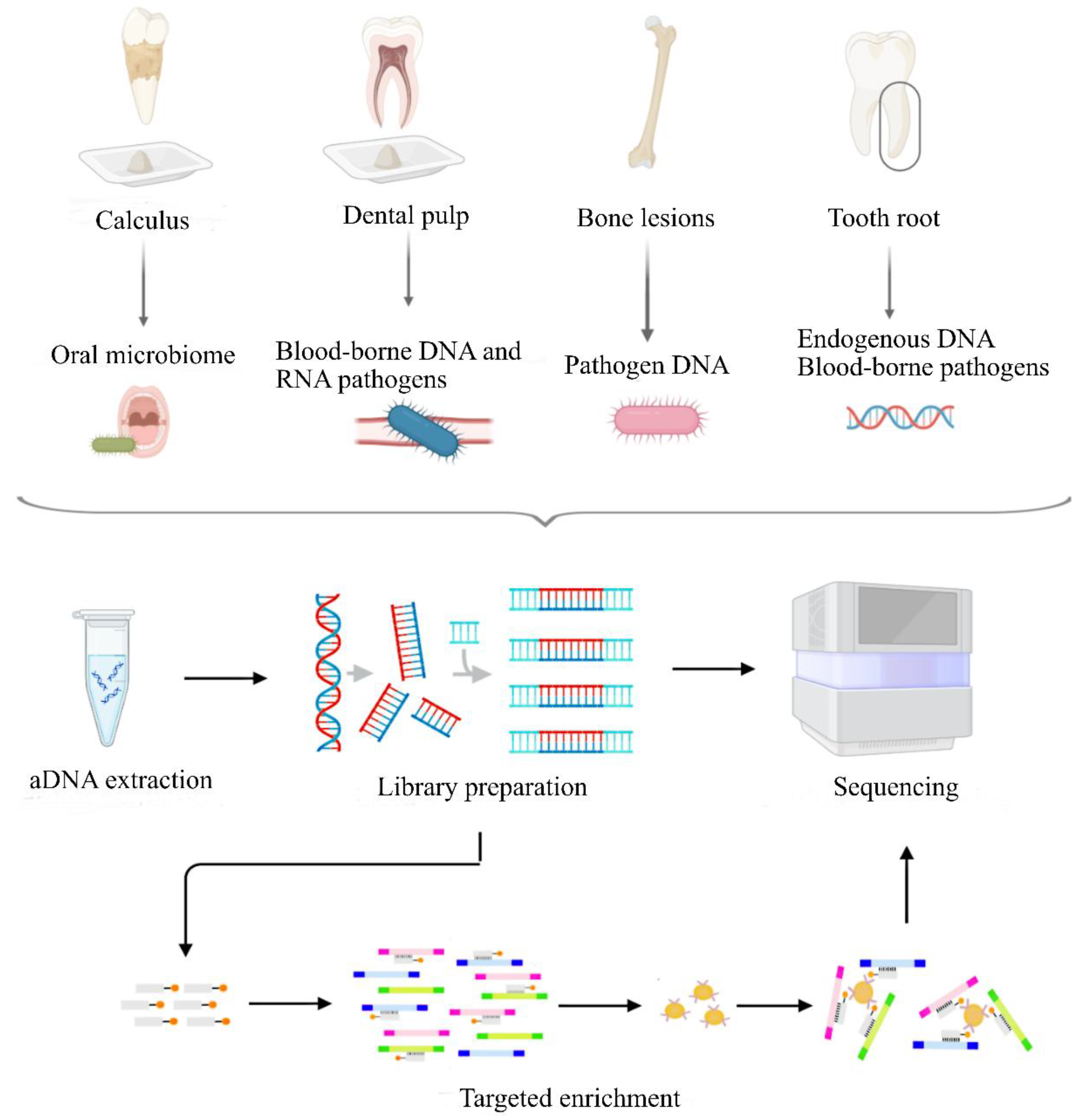
Figure 2.
Ancient genomes provide temporal leverage for molecular clock calibration. (A) Conceptual schematic of sampling times. (B) Time-scaled phylogenies inferred using modern samples only (left) or combined ancient and modern samples (right). When only modern genomes are included, tips are clustered within a narrow temporal window, resulting in shallow trees and clock estimates dominated by short-term substitution dynamics. Incorporation of ancient genomes extends the phylogeny deeper in time and anchors internal nodes to absolute dates (red star), improving estimation of long-term evolutionary rates and divergence times. (C) Root-to-tip genetic distance plotted against sampling time. Modern-only data show limited temporal structure, whereas inclusion of ancient genomes broadens the timescale, strengthens temporal signal, and enables more reliable rate estimation.
Figure 2.
Ancient genomes provide temporal leverage for molecular clock calibration. (A) Conceptual schematic of sampling times. (B) Time-scaled phylogenies inferred using modern samples only (left) or combined ancient and modern samples (right). When only modern genomes are included, tips are clustered within a narrow temporal window, resulting in shallow trees and clock estimates dominated by short-term substitution dynamics. Incorporation of ancient genomes extends the phylogeny deeper in time and anchors internal nodes to absolute dates (red star), improving estimation of long-term evolutionary rates and divergence times. (C) Root-to-tip genetic distance plotted against sampling time. Modern-only data show limited temporal structure, whereas inclusion of ancient genomes broadens the timescale, strengthens temporal signal, and enables more reliable rate estimation.
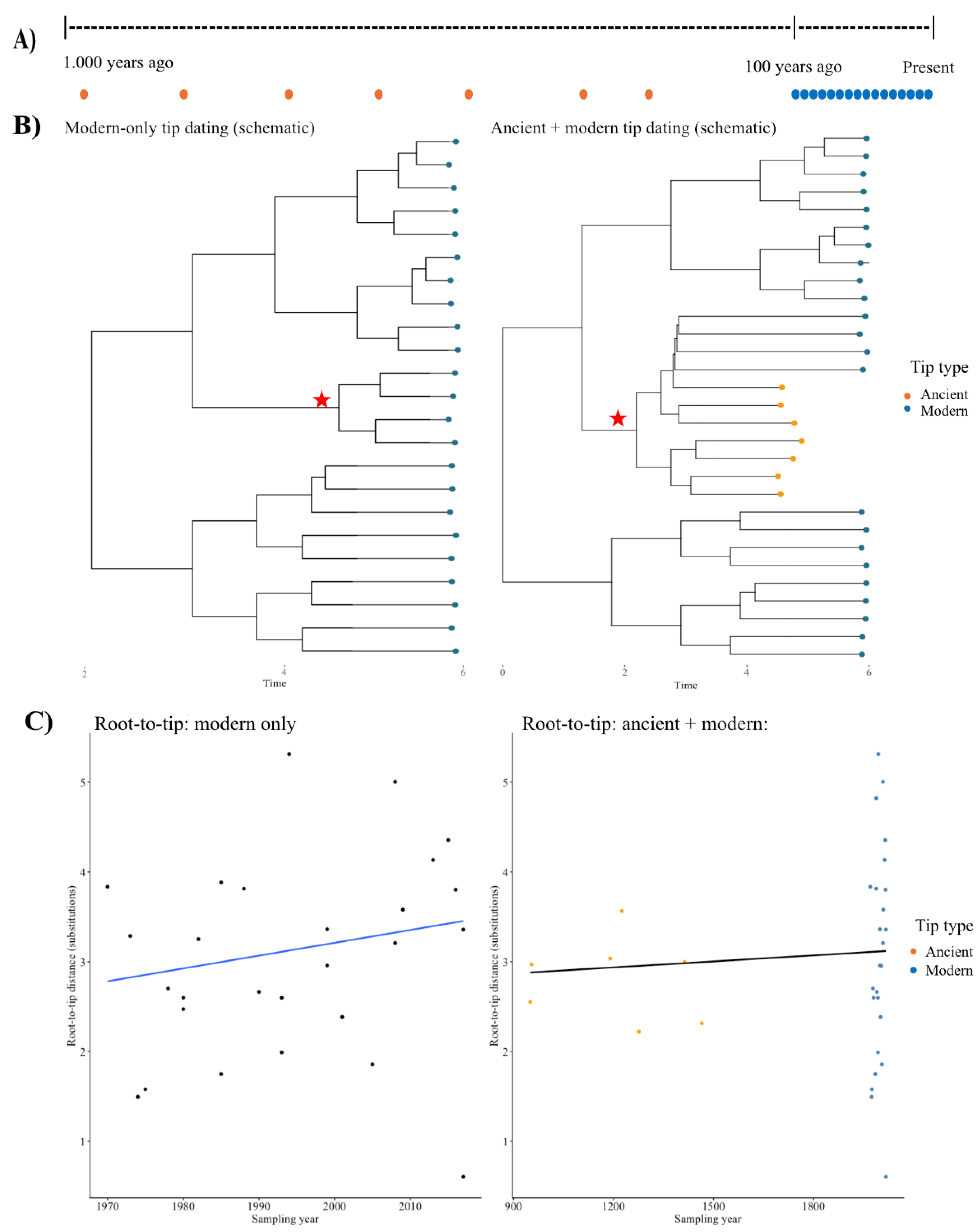
Figure 4.
From ancient pathogen discovery to public health insight. Conceptual framework outlining how targeted sampling, metagenomic screening and phylogenetic inference in ancient pathogen genomics can inform evolutionary timescales, reservoir dynamics and transmission shifts, with downstream relevance for One Health risk forecasting and surveillance design.
Figure 4.
From ancient pathogen discovery to public health insight. Conceptual framework outlining how targeted sampling, metagenomic screening and phylogenetic inference in ancient pathogen genomics can inform evolutionary timescales, reservoir dynamics and transmission shifts, with downstream relevance for One Health risk forecasting and surveillance design.
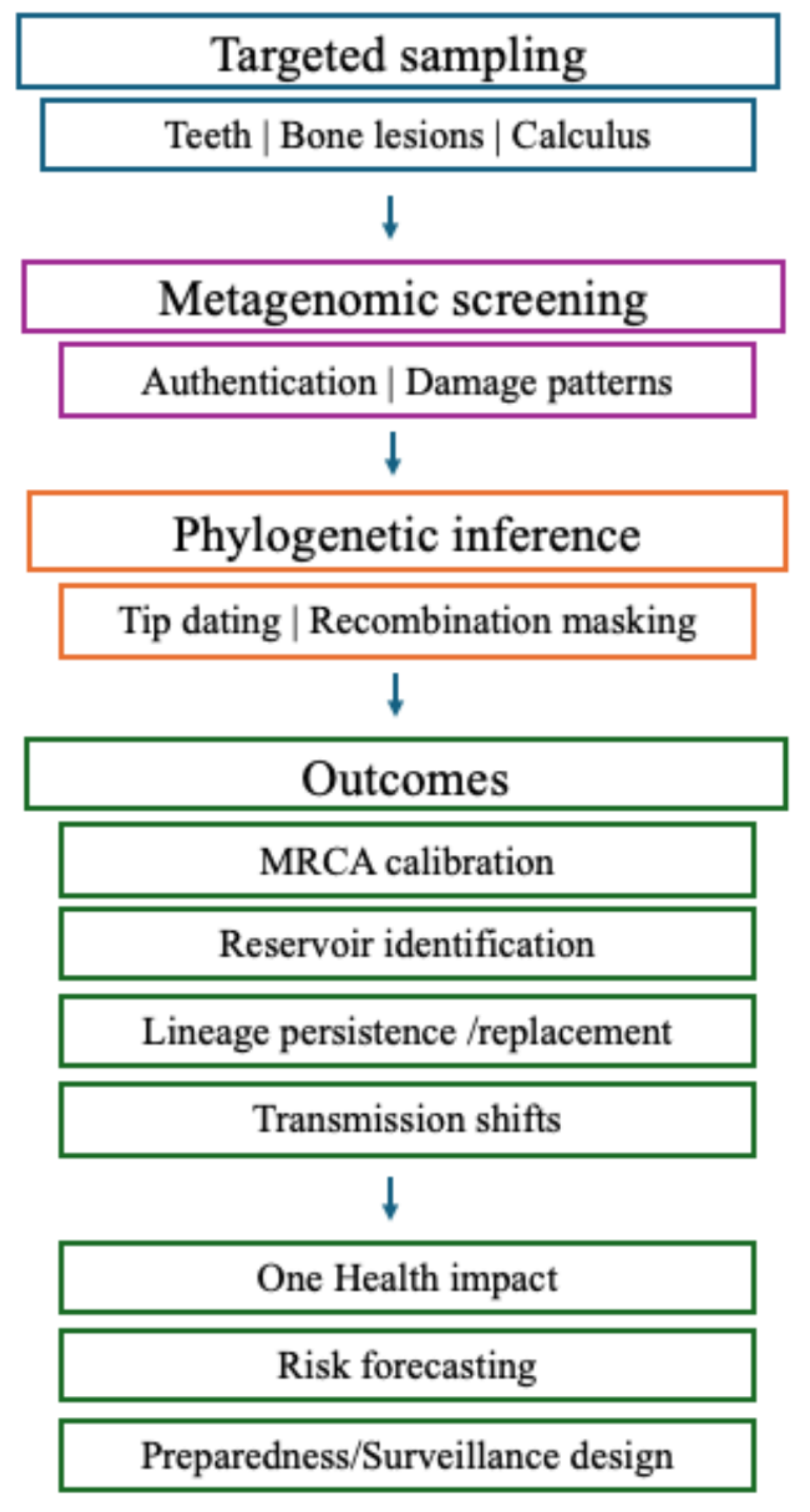

Table 1.
Overview of ancient pathogen detections in Africa.
| Pathogen (genome type) | Disease | Method | Sampling material | Location | Reference |
|---|---|---|---|---|---|
| Mycobacterium tuberculosis complex (dsDNA) | Tuberculosis | PCR | Mummified tissue/bones | Egypt | [71,72,73] |
| Mycobacterium leprae (dsDNA) | Leprae | NGS | Mummified tissue/bones | Egypt | [43] |
| HBV (partially dsDNA) | Hepatitis B | NGS | Mummified tissue/bones | Egypt | [43] |
| Plasmodium falciparum (dsDNA) | Malaria | PCR and NGS | Mummified tissue/bones | Egypt | [73,74,75] |
| Toxoplasma gondii (dsDNA) | Toxoplasmosis | PCR | Embalmed heads | Egypt | [75] |
| Schistosoma mansoni / S. haematobium (dsDNA) | Schistosomiasis | PCR | Canopic liver | Egypt | [77] |
| Leishmania donovani (dsDNA) | Leishmaniasis | PCR | Mummified tissue/bones | Egypt | [78] |
| Rickettsia felis (dsDNA) | Rickettsiosis | NGS | Petrous bone | South Africa | [10] |
Table 2.
Expected recoverability of ancient pathogen DNA by substrate and transmission route. Dots indicate relative likelihood of detecting pathogen DNA/RNA consistent with transmission route and tissue tropism. Ratings reflect biological plausibility and preservation constraints rather than methodological sensitivity. ●●● high likelihood; ●● moderate; ● low; ○ speculative.
Table 2.
Expected recoverability of ancient pathogen DNA by substrate and transmission route. Dots indicate relative likelihood of detecting pathogen DNA/RNA consistent with transmission route and tissue tropism. Ratings reflect biological plausibility and preservation constraints rather than methodological sensitivity. ●●● high likelihood; ●● moderate; ● low; ○ speculative.
| Parasites | Bacteria | DNA viruses | RNA viruses | |||||||||
|---|---|---|---|---|---|---|---|---|---|---|---|---|
| Blood borne | Oral-fecal | Mucosal | Blood borne | Oral-fecal | Mucosal | Blood borne | Oral-fecal | Mucosal | Blood borne | Oral-fecal | Mucosal | |
| Teeth | ●● | ○ | ● | ●●● | ● | ●● | ●● | ○ | ● | ○ | ○ | ○ |
| Bone lesions | ● | ○ | ○ | ●●● | ○ | ● | ● | ○ | ○ | ○ | ○ | ○ |
| Dental calculus | ● | ●●● | ●● | ●●● | ●●● | ●●● | ● | ● | ● | ○ | ○ | ○ |
| Sediment (skeletal remains associated) | ● | ● | ○ | ●● | ● | ● | ● | ● | ○ | ○ | ○ | ○ |
Disclaimer/Publisher’s Note: The statements, opinions and data contained in all publications are solely those of the individual author(s) and contributor(s) and not of MDPI and/or the editor(s). MDPI and/or the editor(s) disclaim responsibility for any injury to people or property resulting from any ideas, methods, instructions or products referred to in the content. |
© 2026 by the authors. Licensee MDPI, Basel, Switzerland. This article is an open access article distributed under the terms and conditions of the Creative Commons Attribution (CC BY) license (http://creativecommons.org/licenses/by/4.0/).
Copyright: This open access article is published under a Creative Commons CC BY 4.0 license, which permit the free download, distribution, and reuse, provided that the author and preprint are cited in any reuse.