

Submitted:
01 March 2026
Posted:
02 March 2026
You are already at the latest version
Abstract
Meat condemnation at slaughterhouses reflects the burden of animal diseases, economic losses, and potential public health risks. In northern Nigeria, however, longitudinal and model-based assessments of condemnation patterns using routine abattoir data remain limited. To quantify species- and disease-specific meat condemnation rates, assess temporal trends, and identify factors associated with condemnation at the Sokoto State Main Abattoir. A retrospective longitudinal study was conducted using abattoir meat inspection records from January to June 2025. Condemnation rates per 1,000 animals slaughtered were calculated by species, disease category, and month. Temporal trends and associated factors were evaluated using negative binomial regression with an offset for slaughter volume. Model adequacy was assessed through dispersion diagnostics, multicollinearity checks, residual analyses, sensitivity analyses, and predictive calibration using observed versus model-predicted rates. A total of 317,685 animals were slaughtered during the study period, with 1,628 condemnation cases, corresponding to an overall condemnation rate of 5.12 per 1,000 animals (95% CI: 4.88–5.38). Condemnation rates varied markedly by species, with camels exhibiting the highest rates (27.4 per 1,000), followed by cattle, sheep, and goats. Disease-specific analyses identified contagious bovine pleuropneumonia, fascioliasis, hydatidosis, and tuberculosis as major contributors to condemnation. Temporal patterns demonstrated non-linear monthly variation, with elevated rates in mid-study months. The final negative binomial model showed good calibration, with close agreement between observed and predicted rates across species and diseases. Meat condemnation at the Sokoto State abattoir demonstrates substantial heterogeneity by species, disease, and time. Priority conditions such as CBPP, fascioliasis, hydatidosis, and tuberculosis-like lesions warrant targeted control efforts. These findings reinforce the value of routinely collected abattoir data as a practical and robust component of animal health surveillance in resource-limited settings.
Keywords:
meat inspection
; abattoir surveillance
; condemnation rates
; negative binomial regression
; Nigeria
1. Introduction
Abattoirs occupy a strategic position at the interface between animal health, food safety, and public health, serving not only as points of meat production but also as sentinel surveillance sites for livestock diseases of economic and zoonotic importance. Routine ante- and post-mortem inspections conducted at slaughterhouses provide a unique opportunity to detect pathological conditions that may otherwise remain unreported at farm level, particularly in settings where access to veterinary services and laboratory diagnostics is limited [1,2,3]. Meat condemnation, whether partial or total, represents the visible outcome of disease processes severe enough to compromise food safety or carcass wholesomeness. Beyond its immediate role in protecting consumers, condemnation carries substantial economic implications, including direct losses to livestock owners, traders, and processors, as well as indirect losses arising from reduced market confidence and inefficiencies in livestock value chains [4,5,6,7,8,9]. From a public health perspective, condemned organs and carcasses often signal the presence of priority zoonoses such as bovine tuberculosis and cystic echinococcosis, reinforcing the importance of abattoir data for One Health surveillance [10,11,12,13].
In low- and middle-income countries (LMICs), where formal disease reporting systems are frequently under-resourced, abattoir records may constitute one of the most consistent and scalable sources of animal health information. However, the epidemiological value of such data depends critically on appropriate analytical approaches that account for heterogeneous slaughter volumes, sparse disease counts, and temporal variability, features that are often overlooked in descriptive-only studies [14,15,16].
A growing body of literature from Nigeria and other parts of sub-Saharan Africa documents the burden and causes of meat and organ condemnation in slaughtered livestock. Nigerian studies have consistently identified parasitic infections (e.g. fascioliasis, hydatidosis, cysticercosis), respiratory disease complexes (notably contagious bovine pleuropneumonia [CBPP] and contagious caprine pleuropneumonia [CCPP]), and tuberculosis-like lesions as leading causes of condemnation across cattle, sheep, goats, and camels [17,18,19,20,21].
Several investigations have highlighted the economic consequences of condemnation, demonstrating substantial financial losses to producers and traders through liver, lung, and whole-carcass rejection [17,22,23,24]. Studies from different ecological zones, including North-Central, North-West, and North-East Nigeria, further indicate that condemnation patterns may vary by season, species composition, and slaughter practices [25,26,27]. Comparable findings have been reported elsewhere in sub-Saharan Africa, including Ethiopia and Ghana, underscoring the regional relevance of abattoir-based condemnation data [28,29].
Despite these contributions, important methodological gaps remain. Many existing studies are cross-sectional or limited to short time windows, rely primarily on crude counts rather than rates, and do not explicitly account for variability in slaughter volume or overdispersion in condemnation data. In addition, formal regression modelling, diagnostic assessment, and evaluation of model robustness are rarely applied, limiting the inferential strength and policy relevance of findings derived from routine abattoir records [2,30,31].
Sokoto State represents one of Nigeria’s most important livestock production and trade hubs, strategically located within the semi-arid Sahelian zone and serving as a major corridor for transboundary animal movement from neighbouring countries. The Sokoto State Main Abattoir processes large numbers of cattle, sheep, goats, and camels sourced from diverse production systems, making it an ideal setting for examining species-specific and disease-specific condemnation patterns [32,33]. Given the scale and diversity of slaughter operations in Sokoto, a longitudinal and model-based analysis of condemnation data has the potential to generate insights that extend beyond simple descriptive summaries. By explicitly modelling condemnation counts as rates, adjusted for slaughter volume, and by evaluating temporal trends and disease effects within a unified statistical framework, this study seeks to address key limitations of earlier work and enhance the epidemiological utility of abattoir records for surveillance and decision-making. The primary objective of this study was to estimate species-specific and disease-specific meat condemnation rates over time at the Sokoto State Main Abattoir between January and June 2025. Assess temporal trends in condemnation rates across species and disease categories. Identify factors associated with condemnation using regression modelling that accounts for variable slaughter volumes and overdispersion.
2. Materials and Methods
2.1. Ethical Approval
Prior to the commencement of data collection, ethical approval and permission were obtained from the Sokoto State Ministry of Animal Health and Fisheries Development with the reference number (ML&FD/PLAN/197/VOL.I)
2.2. Study Design and Setting
This study employed a retrospective longitudinal observational design based on routinely collected abattoir surveillance data. The investigation was conducted at the Sokoto Main Abattoir, the largest slaughter facility in Sokoto State, north-western Nigeria. The abattoir serves as the principal hub for slaughtering food animals supplying Sokoto metropolis and surrounding local government areas and receives livestock originating from both local production systems and transboundary trade routes linking Niger Republic and other parts of northern Nigeria. The study period covered January to June 2025, allowing assessment of temporal patterns in slaughter throughput and meat condemnation across consecutive months. This six-month period captures short-term temporal variation while maintaining consistency in inspection practices and record-keeping procedures. The longitudinal structure of the dataset permitted evaluation of trends over time as well as stratified analyses by animal species and disease category.
2.3. Data Sources and Data Management
Data were obtained from routine meat inspection records maintained by veterinary officers at the Sokoto State Main Abattoir. These records document the outcomes of post-mortem inspection for all slaughtered animals and are used primarily for food safety monitoring and regulatory enforcement. The analytical dataset comprised 96 aggregated records, representing all combinations of six calendar months, four livestock species (cattle, sheep, goats, and camels), and multiple recorded causes of condemnation. Each record contained the total number of animals slaughtered for a given species–month stratum and the corresponding number of condemnation cases attributed to specific disease conditions. This structure provided a multidimensional framework suitable for longitudinal, species-specific, and disease-specific analyses. Data cleaning involved consistency checks across variables, verification of plausible ranges, and harmonisation of disease nomenclature. Records with missing counts for slaughtered animals or condemned cases were excluded. Disease labels were standardised to ensure consistent categorisation across species and months. All data processing steps were conducted prior to statistical analysis to minimise misclassification and ensure internal validity.
2.4. Case Definitions and Meat Inspection Procedures
A condemnation case was defined as any carcass or organ deemed unfit for human consumption following routine post-mortem inspection by authorised veterinary inspectors. Condemnations included both partial condemnation (removal of affected organs or tissues) and total condemnation (entire carcass), as documented in abattoir records. Where distinctions between partial and total condemnation were not consistently recorded, cases were analysed collectively as condemnation events. All photographs were taken during routine meat inspection procedures with permission from abattoir authorities and without identifying individual animals or personnel. Disease classification was based on routine post-mortem diagnostic criteria applied during meat inspection, including gross pathological findings consistent with specific infectious, parasitic, or non-infectious conditions. Meat inspection procedures followed standard veterinary public health guidelines consistent with national and international recommendations, including those of the World Organisation for Animal Health and Codex Alimentarius principles for meat hygiene [34,35,36].
2.5. Inclusion and Exclusion Criteria
All slaughtered cattle, sheep, goats, and camels recorded at the Sokoto Main Abattoir during the study period were eligible for inclusion. Records were included of both the number of animals slaughtered and the number of condemnation cases were available for a given species–month–disease combination. For regression modelling, disease categories with extremely low frequencies were considered rare and posed a risk of sparse-data bias and model instability. Sensitivity analyses were therefore conducted in which rare disease categories were excluded or collapsed into broader groups, as described below, to evaluate the robustness of model estimates.
2.6. Statistical Analysis
Descriptive statistics were used to summarise slaughter volumes and condemnation patterns. Total numbers of animals slaughtered were calculated overall and by species. Condemnation rates were expressed as the number of condemned cases per 1,000 animals slaughtered, calculated as the ratio of condemned cases to slaughtered animals multiplied by 1,000. Exact or approximate 95% confidence intervals for rates were computed assuming a Poisson distribution of counts. Disease-specific summaries were generated within each species to characterise the relative contribution of different conditions to condemnation burden. Monthly condemnation rates were examined to assess temporal trends across the six-month period. Visual inspection suggested non-linear patterns rather than simple monotonic trends. Consequently, month was treated as an ordinal time variable and modelled using orthogonal polynomial terms, allowing flexible representation of linear and higher-order temporal effects while minimising collinearity between polynomial components. Count regression models were used to quantify associations between condemnation counts and explanatory variables while accounting for variation in slaughter volume.
An initial Poisson regression model was specified as:
With
wheredenotes the number of condemnation cases for speciesand month represents the number of animals slaughtered (included as a log offset);is the intercept;coefficients for orthogonal polynomial terms of month; andandrepresent species and disease effects, respectively. Exponentiated coefficients were interpreted as incidence rate ratios (IRRs).
Formal dispersion diagnostics revealed substantial over dispersion, violating the Poisson equidispersion assumption. Consequently, a negative binomial regression model was adopted for final inference:
with the same linear predictor as above, wheredenotes the overdispersion parameter. Exponentiated coefficients from this model were interpreted as adjusted incidence rate ratios (aIRRs).
Model adequacy was assessed using multiple diagnostic approaches. Overdispersion was evaluated using Pearson chi-square statistics and dispersion ratios. Multicollinearity among predictors was assessed using generalised variance inflation factors (GVIFs), with adjusted GVIF values used for factors with multiple degrees of freedom. Residual diagnostics included examination of Pearson and deviance residuals to identify systematic patterns or deviations from model assumptions. Sensitivity analyses were conducted to assess the robustness of findings to alternative disease classifications. First, disease categories with very low counts were excluded and the negative binomial model refitted. Second, diseases were collapsed into broader etiological categories (e.g., parasitic versus other causes) to reduce model dimensionality. Effect estimates from these alternative specifications were compared with the primary model to evaluate consistency in direction and magnitude of associations. Model-predicted condemnation rates were generated from the final negative binomial model and compared with observed rates across species and disease categories. Predictive calibration was assessed visually using scatter plots of predicted versus observed condemnation rates and quantitatively by examining absolute and signed differences between predicted and observed values. These comparisons enabled evaluation of systematic bias and the model’s ability to reproduce observed patterns across the full range of condemnation rates. Model validation focused on overall agreement and consistency of temporal and species-specific trends rather than formal limits-of-agreement approaches. All data management and statistical analyses were conducted using R statistical software (R Foundation for Statistical Computing, Vienna, Austria). Selected analyses and visualisations were additionally implemented using Datably.ai, an online analytical platform integrated with R, to facilitate model fitting, prediction, and graphical presentation.
3. Results
3.1. Slaughter Throughput and Overall Condemnation Burden
Between January and June 2025, a total of 317,685 animals were slaughtered at the Sokoto main abattoir. Cattle accounted for the largest proportion of slaughtered animals (37.8%), followed by goats (33.6%) and sheep (25.6%), while camels constituted a relatively small fraction (3.0%) of the total throughput. Across all species, 1,628 condemnation cases were recorded during the study period, corresponding to an overall condemnation rate of 5.12 per 1,000 animals slaughtered (95% CI: 4.88–5.38). This overall estimate provides a baseline measure of condemnation burden against which species- and disease-specific patterns can be interpreted (Table 1). Figure 1 illustrates the distribution of animals slaughtered by species at the Sokoto State abattoir between January and June 2025, showing that cattle accounted for the largest share of slaughter throughput (37.8%), followed by goats (33.6%) and sheep (25.6%), while camels represented only a small proportion (3.0%) of all animals slaughtered. This distribution highlights the dominant contribution of cattle and small ruminants to overall abattoir activity during the study period.
When interpreted alongside Table 1, however, a contrasting pattern emerges with respect to condemnation outcomes. Despite their low slaughter volume, camels exhibited by far the highest condemnation rate, at 27.4 per 1,000 animals slaughtered (95% CI: 24.2–31.0). In contrast, species that dominated slaughter throughput—particularly goats and cattle—showed substantially lower condemnation rates of 2.47 per 1,000 (95% CI: 2.18–2.79) and 6.39 per 1,000 (95% CI: 5.95–6.86), respectively. Sheep had an intermediate condemnation rate of 4.12 per 1,000 (95% CI: 3.69–4.59). Taken together, Figure 1 and Table 1 demonstrate that condemnation risk is not proportional to slaughter volume. While cattle and goats contribute most to the number of animals processed, camels contribute disproportionately to condemnation burden relative to their throughput. This divergence underscores the importance of examining rate-based measures rather than absolute counts alone and provides a strong justification for the species-stratified and model-based analyses presented in subsequent sections of the manuscript.
3.2. Distribution of Condemnation Cases by Recorded Cause
The distribution of condemnation cases varied substantially by species and recorded cause. In camels, parasitic and chronic conditions predominated, with hydatidosis accounting for the highest number of cases (126), followed by camel tuberculosis (62) and bovine tuberculosis (41). In cattle, condemnations were largely driven by contagious bovine pleuropneumonia (CBPP) (358 cases) and fascioliasis (212 cases), together constituting the majority of cattle condemnations. Among small ruminants, contagious caprine pleuropneumonia (CCPP) was the leading cause of condemnation in both goats (133 cases) and sheep (148 cases). Other notable causes included lung abscesses and cysticercosis, though these contributed fewer cases relative to the dominant conditions within each species (Table 2).
Figure 2 shows marked heterogeneity in condemnation rates per 1,000 animals across diseases within each species. Among camels, hydatidosis stands out with the highest condemnation rate, approaching ~90 per 1,000 animals, far exceeding rates observed for other conditions. In cattle, condemnation was dominated by contagious bovine pleuropneumonia (CBPP), with rates of approximately ~27 per 1,000 animals, while fascioliasis and other conditions occurred at substantially lower levels. In goats and sheep, contagious caprine pleuropneumonia (CCPP) was the leading cause of condemnation, although at markedly lower rates (~2–4 per 1,000 animals) compared with the dominant diseases in camels and cattle. The non-overlapping or minimally overlapping confidence intervals across major disease categories indicate that these differences are statistically robust, supporting true disease-specific contrasts rather than random variation. Overall, the faceted structure of Figure 2 highlights distinct species–disease profiles of condemnation risk, with each species characterised by a small number of dominant conditions driving the majority of condemnation events. 3.3 Leading causes of condemnation by species. When summarised by the most frequent cause per species (derived from Table 2; Supplementary Table S1), distinct species-specific patterns emerged. Hydatidosis was the leading cause of condemnation in camels, CBPP in cattle, and CCPP in both goats and sheep. This concise summary highlights the priority diseases responsible for the largest share of condemnations within each species and provides a clear epidemiological rationale for the subsequent regression and modelling analyses.
3.3. Temporal Trends in Species-Specific Condemnation Rates
Figure 3 illustrates the temporal evolution of monthly condemnation rates per 1,000 animals slaughtered by species between January and June 2025, while the corresponding numerical estimates and 95% confidence intervals are presented in Table 3. Across the study period, camels consistently exhibited the highest condemnation rates, with marked month-to-month variability. Rates declined slightly from January to March, followed by a pronounced peak in April (46.7 per 1,000; 95% CI: 35.4–60.4), before decreasing again in May and June (Figure 3; Table 3). Although confidence intervals were wider for camels, particularly during April, they remained clearly elevated relative to other species throughout the period.
In cattle, condemnation rates were comparatively stable during the first five months, fluctuating between approximately 5 and 6 per 1,000 animals, before increasing noticeably in June (8.63 per 1,000; 95% CI: 7.41–10.03) (Figure 3; Table 3). This late-period increase suggests a temporal effect that was less evident earlier in the study period. Sheep exhibited moderate condemnation rates with limited temporal fluctuation, ranging from 3.75 to 4.67 per 1,000 animals, with overlapping confidence intervals across months, indicating no strong evidence of sharp temporal changes (Figure 3; Table 5). Similarly, condemnation rates in goats remained consistently low throughout the study period, varying narrowly between 2.23 and 2.54 per 1,000 animals, with largely overlapping confidence intervals, suggesting minimal temporal variation (Figure 3; Table 3).
Taken together, Figure 3 and Table 3 demonstrate that temporal patterns of condemnation differ substantially by species, characterised by pronounced non-linear variation in camels, a late increase in cattle, and relative temporal stability in sheep and goats. These descriptive findings provide a strong empirical basis for the regression-based assessment of temporal trends presented in subsequent analyses.
3.4. Regression Analysis of Factors Associated with Condemnation
Regression modelling was undertaken to quantify the association between temporal patterns, animal species, and disease categories with meat condemnation counts, while accounting for variation in slaughter volume through the inclusion of a logarithmic offset for the number of animals slaughtered. A Poisson regression model was initially fitted to evaluate temporal, species-level, and disease-specific associations with meat condemnation counts, incorporating the logarithm of the number of animals slaughtered as an offset. Month was modelled using orthogonal polynomial terms to capture potential non-linear temporal patterns. As presented in Supplementary Table S2, the Poisson model suggested a strong temporal signal, with a significant positive linear trend and multiple higher-order month terms indicating non-linear variation in condemnation rates. Relative to camels, condemnation rates were substantially lower in cattle and goats and moderately lower in sheep. Several disease categories – particularly contagious bovine pleuropneumonia (CBPP), fascioliasis, hydatidosis, and camel tuberculosis – were associated with markedly elevated condemnation rates, whereas cysticercosis and hardware disease were associated with reduced rates.
However, dispersion diagnostics demonstrated severe overdispersion (Supplementary Table S3), with a dispersion ratio of 11.4 (p < 0.001), indicating a clear violation of the Poisson equidispersion assumption. As a result, Poisson regression was considered unsuitable for final inference. A negative binomial regression model, which accounts for overdispersion, was therefore adopted as the primary analytical approach. Poisson regression results are retained in Supplementary Table S2 for completeness, while all substantive inferences are based on the negative binomial model presented in the main Results section (Table 4).
3.5. Negative Binomial Regression Analysis (Primary Model)
A negative binomial regression model was fitted with the number of condemnation cases as the outcome, adjusting for slaughter volume using a logarithmic offset. Results are presented as adjusted incidence rate ratios (aIRRs), with camels and other/unspecified causes serving as reference categories for species and disease, respectively (Table 4). After accounting for overdispersion, a significant overall increasing temporal trend in condemnation rates persisted, as indicated by the positive linear month effect. In contrast to the Poisson model, higher-order polynomial terms were largely non-significant, suggesting that some of the apparent temporal complexity observed earlier was attributable to overdispersion rather than true seasonal structure. Marked species-level differences were observed. Compared with camels, condemnation rates were approximately 80% lower in cattle and goats, even after adjusting for time and slaughter volume. Sheep also showed lower rates relative to camels, although this association did not reach statistical significance in the fully adjusted model.
Strong disease-specific associations were evident. CBPP emerged as the most influential predictor of condemnation, with more than a six-fold increase in rates relative to other causes. Fascioliasis was also strongly associated with elevated condemnation rates. Hydatidosis and camel tuberculosis demonstrated borderline but potentially meaningful increases. In contrast, cysticercosis and hardware disease were associated with significantly lower condemnation rates, while liver abscess and lung abscess showed no statistically significant associations. Overall, these findings indicate that species and disease effects are robust determinants of condemnation, while temporal effects are best characterised as a general upward trend rather than complex seasonal variation.
3.6. Model-Based Prediction of Condemnation Rates over Time
Figure 4 presents observed and negative binomial model–predicted monthly condemnation rates per 1,000 animals by species, with corresponding numerical estimates provided in Supplementary Table S4. Overall, the model captures the broad temporal patterns and species-level contrasts observed in the data, while smoothing short-term fluctuations inherent in monthly count data. Among camels, predicted condemnation rates exhibited pronounced temporal variability, consistent with the high observed burden. For example, while the observed rate peaked sharply in April at 46.7 per 1,000, the model predicted a more moderate rate of 29.1 per 1,000, with wide uncertainty (95% CI: 13.8–44.3), reflecting substantial variability and smaller denominators (Figure 4; Table S4). Across all months, predicted values for camels remained within the corresponding confidence intervals, indicating an acceptable model fit despite attenuation of extreme peaks.
In cattle, predicted rates closely tracked observed values across most months. From March to June, observed rates ranged from 5.7 to 8.6 per 1,000, while predicted rates ranged from 5.9 to 9.1 per 1,000, with overlapping confidence intervals throughout (Figure 4; Table S4). This close agreement suggests good model calibration for cattle, the species contributing the largest slaughter volume.
For goats, the model smoothed pronounced month-to-month fluctuations evident in the observed data. Notably, an observed spike in February (7.4 per 1,000) was moderated in the model prediction (3.2 per 1,000; 95% CI: 1.4–4.9), while predicted rates for other months remained within confidence intervals that encompassed observed values (Figure 4; Table S4). This pattern indicates the model’s capacity to stabilise estimates in the presence of sparse counts and high relative variability. Similarly, in sheep, predicted rates closely mirrored observed trends from February onwards. For instance, observed rates increased from 8.2 per 1,000 in February to 10.2 per 1,000 in May, while predicted rates followed a comparable trajectory (8.0 to 8.8 per 1,000), with overlapping confidence intervals across months (Figure 4; Table S4). Discrepancies observed in January likely reflect small counts and increased stochastic variation rather than systematic model bias.
Taken together, Figure 4, supported by Table S4, demonstrates that the negative binomial model provides an adequate representation of underlying temporal trends in condemnation rates across species. Differences between observed and predicted values are most evident in months characterised by low counts or high variability, which is expected for count data and appropriately reflected by the model’s uncertainty intervals.
3.7. Model-Predicted Condemnation Rates by Species and Disease
Figure 5 and Table 5 present the model-predicted condemnation rates per 1,000 animals by disease and species, derived from the negative binomial regression model. The Tables and Figures collectively demonstrate pronounced heterogeneity in predicted condemnation burden across both disease categories and livestock species. Among cattle, the highest predicted condemnation rates were associated with contagious bovine pleuropneumonia (CBPP), with a mean predicted rate of 69.5 per 1,000 animals (95% CI: 35.5–135.8), followed by fascioliasis (40.9 per 1,000; 95% CI: 20.8–80.4). Other bacterial conditions, including bovine tuberculosis, liver abscess, and lung abscess, showed substantially lower but still non-negligible predicted rates, while hardware disease contributed the smallest predicted burden. In sheep, contagious caprine pleuropneumonia (CCPP) dominated predicted condemnation risk (33.4 per 1,000; 95% CI: 18.2–61.1), followed by liver abscess (20.7 per 1,000; 95% CI: 11.2–38.2). Predicted rates for hardware disease and cysticercosis were comparatively lower but remained epidemiologically relevant.

Table 5.
Mean model-predicted condemnation rates per 1,000 animals by species and disease with 95% confidence intervals.
Table 5.
Mean model-predicted condemnation rates per 1,000 animals by species and disease with 95% confidence intervals.
| Species | Disease | Mean predicted rate per 1,000 | Lower 95% CI | Upper 95% CI |
|---|---|---|---|---|
| Cattle | CBPP | 69.47 | 35.54 | 135.78 |
| Cattle | Fascioliasis | 40.9 | 20.81 | 80.38 |
| Cattle | Bovine tuberculosis | 10.63 | 5.49 | 20.57 |
| Cattle | Liver abscess | 8.75 | 4.68 | 16.38 |
| Cattle | Lung abscess | 8.29 | 4.46 | 15.4 |
| Cattle | Hardware disease | 4.84 | 2.53 | 9.27 |
| Sheep | CCPP | 33.38 | 18.23 | 61.12 |
| Sheep | Liver abscess | 20.68 | 11.18 | 38.23 |
| Sheep | Hardware disease | 11.43 | 6.08 | 21.49 |
| Sheep | Cysticercosis | 10.06 | 5.35 | 18.92 |
| Goat | CCPP | 25.37 | 13.83 | 46.56 |
| Goat | Lung abscess | 14.89 | 7.87 | 28.15 |
| Goat | Cysticercosis | 7.65 | 4.05 | 14.45 |
| Camel | Hydatidosis | 24.76 | 12.46 | 49.19 |
| Camel | Bovine tuberculosis | 18.01 | 8.17 | 39.71 |
| Camel | Camel tuberculosis | 16 | 7.14 | 35.86 |
| Camel | Lung abscess | 7.57 | 3.85 | 14.89 |
For goats, predicted condemnation rates were again highest for CCPP (25.4 per 1,000; 95% CI: 13.8–46.6), with lung abscess and cysticercosis contributing moderate burdens. The wider confidence intervals observed for several goat diseases reflect smaller denominators and greater uncertainty.
In camels, parasitic and mycobacterial conditions dominated predicted condemnation rates. Hydatidosis showed the highest predicted rate (24.8 per 1,000; 95% CI: 12.5–49.2), followed by bovine tuberculosis and camel tuberculosis, confirming camels as the species with the greatest predicted condemnation burden across multiple disease categories. Figure 6 and Table 6 assess model calibration by comparing observed and predicted condemnation rates across species and diseases. Overall, predicted values closely approximated observed rates, with most absolute differences falling within ±2 per 1,000 animals. For example, predicted rates for cattle CBPP exceeded observed rates by only 2.0 per 1,000, while fascioliasis differed by 0.7 per 1,000. Minor under- or over-prediction was observed for selected conditions, such as camel bovine tuberculosis (−5.6 per 1,000), but no systematic bias across species or diseases was evident.
The calibration pattern in Figure 6 suggests that points cluster closely around the identity line, indicating good agreement between predicted and observed rates. Larger discrepancies were confined to diseases with high variability or smaller sample sizes, which is expected in count-based epidemiological models.
Taken together, the Tables and Figures demonstrate that the negative binomial model provides credible and well-calibrated estimates of condemnation rates across species and disease categories, supporting its suitability for disease-specific risk assessment and comparative burden evaluation.
4. Discussion
This retrospective abattoir-record study quantified meat condemnation patterns at Sokoto State Main Abattoir from January to June 2025 and identified predictors of condemnation counts using rate-based modelling with an offset for slaughter volume. Overall condemnation burden was 1,628 cases among 317,685 slaughtered animals (5.12 per 1,000), with pronounced heterogeneity by species: camels had the highest condemnation rate (27.4 per 1,000), followed by cattle (6.39 per 1,000), sheep (4.12 per 1,000), and goats (2.47 per 1,000). Disease profiles differed by species, with hydatidosis dominating camel condemnations, CBPP dominating cattle condemnations, and CCPP dominating small ruminant condemnations. In regression analyses, formal dispersion diagnostics (dispersion ratio ≈ 11.4; p < 0.001) demonstrated severe overdispersion under the Poisson assumption, justifying negative binomial modelling for inference and yielding adjusted incidence rate ratios that highlighted strong disease effects (notably CBPP and fascioliasis) and persistent species contrasts after accounting for slaughter volume and month. These findings reinforce the value of abattoir records as a practical surveillance stream for priority livestock diseases and zoonoses in Nigeria, while also underscoring the need for strengthened standardisation of meat inspection and recording systems to reduce misclassification and improve comparability across settings [2,19,29,37,38].
The markedly higher condemnation rates observed in camels relative to cattle, sheep, and goats likely reflect a combination of biological susceptibility, production/marketing pathways, and inspection visibility of certain chronic lesions. Camel populations in semi-arid systems are often managed under extensive pastoral conditions and may be marketed after longer productive lifespans than small ruminants, increasing cumulative exposure time to chronic parasitic and granulomatous diseases that are readily detected at post-mortem inspection [39,40,41,42]. Additionally, the “case mix” of camel condemnations in this dataset was dominated by hydatidosis and tuberculosis-labelled lesions, conditions that frequently produce grossly recognisable organ changes and therefore have higher detection probability during routine inspection than some subclinical bacterial or metabolic conditions [40,43,44]. In contrast, goats showed the lowest overall condemnation rate, which may be partly attributable to shorter market cycles, lower mean age at slaughter, and potential under-detection of subtle lesions in smaller carcasses when inspection workloads are high, an operational issue repeatedly reported in Nigerian slaughter systems where staffing constraints and facility limitations may affect inspection depth and documentation completeness [29,45,46,47,48].
CBPP in cattle emerged as the single strongest disease-associated predictor of condemnation in the models, consistent with its status as a high-impact transboundary disease of cattle in Africa with substantial production and trade implications [49,50]. The elevated condemnation burden attributable to CBPP aligns with the pathophysiology of severe pleuropneumonia and chronic pleural lesions that can necessitate trimming or condemnation depending on lesion extent and food safety judgement. In Sokoto and comparable northern Nigerian settings, CBPP has been repeatedly documented as a priority constraint in cattle populations and abattoir-linked studies, supporting the interpretation that the signal observed here plausibly reflects genuine disease occurrence rather than recording artefact [51,52,53]. Fascioliasis in cattle was also strongly associated with condemnation rates, which is epidemiologically coherent given that fasciolosis classically drives liver condemnation and measurable economic losses in abattoir surveys across Africa and elsewhere [54,55,56,57,58,59]. Local evidence from Sokoto has documented fascioliasis among slaughtered cattle, reinforcing the plausibility of its contribution to organ losses and highlighting the need for upstream control (strategic anthelmintic use, grazing/water management where feasible, and targeted risk communication to producers and traders) [20,60].
TB categories (camel TB and bovine TB) showed elevated rates in several strata and were among key predictors in Poisson outputs, with attenuated/borderline effects under the negative binomial model – an expected pattern when accounting for overdispersion and sparse cells. Regardless, abattoir detection of tuberculous-like lesions remains programmatically important because Mycobacterium bovis has zoonotic potential and abattoirs can provide one of the few scalable detection points in settings without comprehensive test-and-slaughter control programs [61,62,63,64,65,66]. However, routine meat inspection alone is an imperfect proxy for laboratory-confirmed bTB, and misclassification with other granulomatous conditions can occur; thus, interpretation should emphasise “suspected TB lesions” unless confirmatory diagnostics were performed [28,62,67,68,69].
Hydatidosis (cystic echinococcosis) was the dominant camel-associated cause and showed elevated rates, consistent with the ecology of Echinococcus granulosus cycles where dog livestock interfaces facilitate transmission and chronic cyst development becomes apparent at slaughter [70,71,72,73]. From a One Health standpoint, abattoir-based detection is not only an economic indicator (organ losses) but also a sentinel event for community-level exposure risks particularly where offal disposal practices permit access by dogs and perpetuate transmission [3,29,47].
Across January–June 2025, monthly rates varied by species, with camels showing particularly wide uncertainty intervals consistent with smaller denominators and higher variance – while cattle demonstrated more stable month-to-month estimates due to large slaughter volumes. The initial Poisson model suggested complex non-linear month effects (multiple significant orthogonal polynomial terms), but after correcting for overdispersion using a negative binomial model, only the linear month trend remained consistently significant in several specifications (e.g., sensitivity analysis excluding rare diseases), suggesting a general upward movement with limited evidence for strong curvature over this short window. In practical terms, any apparent “seasonality” should be interpreted cautiously because six months is often insufficient to characterise annual cycles in livestock marketing, disease transmission, and inspection throughput; furthermore, changes in slaughter throughput, animal sourcing, and market demand around specific periods can induce temporal variation in detected lesion counts independent of true incidence [26,33,74].
Longer time series (≥ 24 months) are typically needed to robustly distinguish trend from seasonal components and to support more formal time-series approaches for rates [30,31,75,76]. The observed overall and species-specific condemnation patterns align with a broader Nigerian and regional literature showing that condemnations are frequently driven by a mix of parasitic infections (fascioliasis, hydatidosis, cysticercosis), respiratory disease complexes (including CBPP/CCPP), and tuberculous-like lesions, with substantial associated economic losses through organ condemnation and carcass trimming [18,19,77,78,79,80,81]. Within Nigeria, studies from different geopolitical zones consistently highlight condemnations as both an animal health indicator and a proxy for abattoir-level public health protection, while also documenting operational constraints that can affect inspection quality and recording fidelity [82,83,84,85,86,87]. Importantly, the prominence of CBPP and fascioliasis in the present analyses is consistent with northern Nigeria-specific evidence on CBPP epidemiology and fascioliasis occurrence in slaughter cattle, supporting external plausibility of the results despite the short study window [18,20,88,89,90,91,92,93].
A major strength is the explicit rate-based framework that accounted for highly variable slaughter denominators by using an offset in count regression models, thereby avoiding misleading comparisons based purely on raw condemnation counts. The staged modelling strategy – starting with Poisson regression and then formally diagnosing and correcting overdispersion via negative binomial regression improves inferential credibility for routine abattoir data, which commonly exhibit extra-Poisson variation due to clustering by time, sourcing, inspector effects, and sparse disease strata [94,95]. The inclusion of robustness checks (excluding rare categories and collapsing diseases) and multicollinearity assessment strengthens confidence that the principal conclusions are not artefacts of sparse cells or unstable coefficient estimation, and the presentation of uncertainty (95% confidence intervals) supports more policy-relevant interpretation than p-values alone [96,97].
Several limitations should frame interpretation. First, routine meat inspection records are not collected primarily for research; they may contain incomplete fields, inconsistent diagnostic labels, and variability in inspector thresholds, which can introduce both non-differential and differential misclassification across diseases and species [98,99,100,101,102,103,104]. Second, the study period (six months) is short for robust inference about seasonality and longer-term trends; observed temporal changes may reflect shifts in animal sourcing, market dynamics, or operational changes in inspection intensity rather than true disease incidence changes [26,33,74]. Third, without laboratory confirmation (e.g., bacteriology, histopathology, or molecular tests), categories such as tuberculosis should be reported as “suspected lesions consistent with TB” to avoid over-interpretation [62,105]. Finally, although predictive calibration was assessed using observed–predicted comparisons and differences, formal agreement approaches (e.g., Bland–Altman limits of agreement) are methodologically designed for comparing two measurement methods and are not always appropriate for model validation; if such analyses were not performed, the manuscript should avoid implying them [106,107].
The findings support strengthening abattoir-based surveillance as a pragmatic, scalable component of animal health intelligence in Sokoto State and similar settings, especially for priority conditions with clear condemnation signatures (CBPP, fascioliasis, hydatidosis, and suspected TB lesions). First, targeted control efforts could focus on CBPP risk reduction through improved movement management, vaccination strategies where feasible, and outbreak-sensitive reporting aligned with WOAH-notifiable disease frameworks [26,108,109]. Second, fascioliasis and hydatidosis findings justify integrated parasite control measures and improved offal disposal practices to reduce transmission and prevent dog access to infected organs, which is central to echinococcosis control [110,111,112,113]. Third, investments in abattoir infrastructure, inspector training, and standardised recording templates can improve diagnostic consistency, data completeness, and the utility of records for routine surveillance and research [29,104,114,115,116]. Finally, adopting standard reporting guidance (e.g., STROBE) will improve transparency, reproducibility, and comparability of abattoir-based observational studies in Nigeria and the region [37,117,118].
5. Conclusions
This study demonstrates that routine abattoir meat inspection records can provide valuable epidemiological insights into patterns and drivers of meat condemnation in Sokoto State, Nigeria, when analysed using appropriate rate-based and model-based approaches. Between January and June 2025, condemnation rates varied substantially by species and disease, with camels consistently exhibiting the highest rates, followed by cattle, sheep, and goats. Disease-specific analyses identified contagious bovine pleuropneumonia, fascioliasis, hydatidosis, and tuberculosis-like lesions as the principal contributors to condemnation burden across species. The application of negative binomial regression, informed by formal overdispersion diagnostics and supported by robustness checks and model validation, allowed reliable quantification of associations while accounting for highly variable slaughter volumes and sparse disease categories. These findings highlight the importance of using flexible statistical methods when analysing routine abattoir data, which commonly deviate from simple Poisson assumptions. From a policy and practice perspective, the results underscore the role of abattoirs as sentinel surveillance points for priority livestock diseases of economic and public health importance. Strengthening abattoir-based surveillance – through improved inspection capacity, standardised recording systems, and integration with veterinary field services could enhance early detection and monitoring of high-impact diseases such as CBPP, fascioliasis, and hydatidosis. While the findings are based on a relatively short observation period and routine inspection diagnoses, they provide a strong rationale for sustained, systematic use of abattoir data to inform targeted disease control strategies and support evidence-based decision-making within Nigeria’s livestock health system.
Supplementary Materials
The following supporting information can be downloaded at the website of this paper posted on Preprints.org.
Author Contributions
A.H.J: Conceptualization, original drafting, writing and editing, analysis, supervision, resources, and methodology. I.I: Conceptualization, writing and editing, analysis, and methodology. A.S: Original drafting, writing and editing, data analysis, resources, and methodology. A.O.U: Original drafting, writing and editing, supervision, and methodology. R.B.S: Conceptualization, original drafting, writing and editing, analysis, supervision, resources, and methodology. B.M.A: Original drafting, and writing and editing. A.B: Original drafting, writing and editing, and methodology. B.G: Conceptualization, writing and editing, analysis, and methodology. M.S.G: Writing and editing. A.A.M: Original drafting, writing and editing, analysis, and methodology.
Funding
Authors declare that no funding was received for this study.
Institutional Review Board Statement
Ethical approval for this study was obtained prior to the commencement of data collection from the Sokoto State Ministry of Animal Health and Fisheries Development. The study protocol, including the objectives, methodology, and data collection procedures, was reviewed and approved in accordance with institutional guidelines (Reference No. ML&FD/PLAN/197/VOL.I). Permission to access relevant records and facilities was formally granted by the Ministry before the study began.
Informed Consent Statement
Not applicable.
Data Availability Statement
Data will be made available upon request.
Acknowledgments
Authors will like to appreciate the management of the Sokoto Main Abattoir for providing us with the environment to obtain data for this study.
Conflicts of Interest
Authors declare that there is no any conflict of interest.
References
- García-Díez, J.; Saraiva, S.; Moura, D.; Grispoldi, L.; Cenci-Goga, B.T.; Saraiva, C. The importance of the slaughterhouse in surveilling animal and public health: A systematic review. Vet. Sci. 2023, 10, 167. [Google Scholar] [CrossRef]
- Nwankwo, I.; Nwanta, J.; Onunkwo, J. Abattoirs as meat safety and disease surveillance points in Nigeria: The case of Ikpa slaughterhouse, Nsukka, Nigeria. Sokoto J. Vet. Sci. 2023, 21, 47–50. [Google Scholar] [CrossRef]
- Nwanta, K.A.; Fair, J.M.; Bett, B.K.; Kerfua, S.D.; Fasina, F.O.; Bartlow, A.W. A scoping review of zoonotic parasites and pathogens associated with abattoirs in Eastern Africa and recommendations for abattoirs as disease surveillance sites. Front. Public Health 2023, 11, 1194964. [Google Scholar]
- Adebowale, O.; Ekundayo, O.; Olasoju, M.; Bankole, N.; Oladejo, O.; Awoseyi, A. Causes of organ condemnation in food animals slaughtered at a municipal abattoir in Oyo State, Nigeria. Savannah Vet. J. 2021, 1, 4. [Google Scholar]
- Ciui, S.; Morar, A.; Tîrziu, E.; Herman, V.; Ban-Cucerzan, A.; Popa, S.A.; Morar, D.; Imre, M.; Olariu-Jurca, A.; Imre, K. Causes of post-mortem carcass and organ condemnations and economic loss assessment in a cattle slaughterhouse. Animals 2023, 13, 3339. [Google Scholar] [CrossRef]
- Harley, S.; More, S.; Boyle, L.; Connell, N.O.; Hanlon, A. Good animal welfare makes economic sense: Potential of pig abattoir meat inspection as a welfare surveillance tool. Ir. Vet. J. 2012, 65, 11. [Google Scholar] [CrossRef]
- Jaja, I.F.; Mushonga, B.; Green, E.; Muchenje, V. Factors responsible for the post-slaughter loss of carcass and offal’s in abattoirs in South Africa. Acta Trop. 2018, 178, 303–310. [Google Scholar] [CrossRef] [PubMed]
- Sheferaw, D.; Abdu, K. Major causes of organ and carcass condemnation and associated financial losses in cattle slaughtered at Kombolcha ELFORA abattoir from 2008–2012, Ethiopia. Ethiop. Vet. J. 2017, 21, 54–66. [Google Scholar] [CrossRef]
- Tembo, W.; Nonga, H.E. A survey of the causes of cattle organs and/or carcass condemnation, financial losses and magnitude of foetal wastage at an abattoir in Dodoma, Tanzania. Onderstepoort J. Vet. Res. 2015, 82, 855. [Google Scholar] [CrossRef]
- Sa’idu, A.S.; Okolocha, E.C.; Dzikwi, A.A.; Gamawa, A.A.; Ibrahim, S.; Kwaga, J.K.; Usman, A.; Maigari, S.A. Public health implications and risk factors assessment of Mycobacterium bovis infections among abattoir personnel in Bauchi State, Nigeria. J. Vet. Med. 2015, 2015, 718193. [Google Scholar] [CrossRef]
- Odetokun, I.A.; Alhaji, N.B.; Aminu, J.; Lawan, M.K.; Abdulkareem, M.A.; Ghali-Mohammed, I. One Health risk challenges and preparedness regarding bovine tuberculosis at abattoirs in North-central Nigeria: Associated drivers and health belief. PLoS Negl. Trop. Dis. 2022, 16, e0010729. [Google Scholar] [CrossRef]
- Mbobo, S.; Byaruhanga, C.; Jaja, I.F. Knowledge, attitudes and practices of abattoir workers towards cystic echinococcosis in the Eastern Cape Province, South Africa. PAMJ-One Health 2025, 18, 17. [Google Scholar] [CrossRef]
- Bekederemo, B.O.; Onwumere-Idolor, O.S.; Mukoro, J.E.; Akpogheneoyibo-Owigho, O. Awareness, attitudes, and practices of abattoir workers towards bovine tuberculosis in Isoko north local government area of Delta State, Nigeria. Direct Res. J. Agric. Food Sci. 2025, 13, 24–29. [Google Scholar] [CrossRef]
- Anyanwu, U.; Dimov, A.; Zinsstag, J.; Tediosi, F.; Markosyan, T. Profitability and cost-effectiveness analysis of brucellosis control in Armenia: A One Health approach. CABI One Health 2024, 3. [Google Scholar] [CrossRef]
- Engdawork, A.; Negussie, H. Advances in animal disease surveillance and information systems and their role in disease control and prevention: Implications in Ethiopia. Vet. Med. Sci. 2025, 11, e70701. [Google Scholar] [CrossRef]
- Yang, L.; Fan, M.; Wang, Y. Dynamic modeling of prevention and control of brucellosis in China: A systematic review. Transbound. Emerg. Dis. 2025, 2025, 1393722. [Google Scholar] [CrossRef] [PubMed]
- Alhaji, N.B.; Yatswako, S.; Isola, T.O. A survey of organs/offal condemnations and foetal losses in slaughtered trade cattle at abattoirs in north-central Nigeria: Major causes and associated economic implications. Bull. Anim. Health Prod. Afr. 2017, 65, 81–93. [Google Scholar]
- Alhaji, N.B.; Babalobi, O.O. Economic impacts assessment of pleuropneumonia burden and control in pastoral cattle herds of north-central Nigeria. Bull. Anim. Health Prod. Afr. 2017, 65, 235–248. [Google Scholar]
- Cadmus, S.I.; Adesokan, H.K. Causes and implications of bovine organs/offal condemnations in some abattoirs in Western Nigeria. Trop. Anim. Health Prod. 2009, 41, 1455–1463. [Google Scholar] [CrossRef] [PubMed]
- Magaji, A.A.; Ibrahim, K.; Salihu, M.D.; Saulawa, M.A.; Mohammed, A.A.; Musawa, A.I. Prevalence of fascioliasis in cattle slaughtered in Sokoto metropolitan abattoir, Sokoto, Nigeria. Adv. Epidemiol. 2014, 2014, 247258. [Google Scholar] [CrossRef]
- Molla, D.; Nazir, S.; Mohammed, A.; Tintagu, T. Parasitic infections as major cause of abattoir condemnations in cattle slaughtered at an Ethiopian abattoir: 10-year retrospective study. J. Helminthol. 2019, 94, e31. [Google Scholar] [CrossRef] [PubMed]
- Abuseir, S. Major causes and associated economic losses of carcass and organ condemnation in cattle and sheep in the northern part of Palestine. World’s Vet. J. 2019, 9, 317–323. [Google Scholar] [CrossRef]
- Abunna, F.; Hordofa, D. Major causes of organ condemnation for cattle and its financial impact at Wolaita Soddo municipality abattoir, southern Ethiopia. Glob. Vet. 2013, 11, 730–734. [Google Scholar]
- Taha, A.; Saad, S.; Jubara, A.; Wani, C.; Phiri, A.M.; Simuunza, M.; Munyeme, M.; Hang’ombe, B.; Mumba, C. Financial losses arising from cattle organ and carcass condemnation at Lokoloko Abattoir in Wau, South Sudan. Adv. Prev. Med. 2023, 2023, 7975876. [Google Scholar] [CrossRef]
- Yatswako, S.; Alhaji, N.B. Survey of bovine fasciolosis burdens in trade cattle slaughtered at abattoirs in North-central Nigeria: The associated predisposing factors and economic implication. Parasite Epidemiol. Control 2017, 2, 30–39. [Google Scholar] [CrossRef]
- Zakariyau, U.; Sanyinna, Z.M.; Shafiu Samaila, A.M.; Ahmad, U.G.; Abdullahi, S.M.; Abdulrashid, B. Prevalence and trends of abattoir-detected diseases in slaughtered livestock between 2021–2024 at Sokoto metropolitan abattoir, Sokoto State, Nigeria. Direct Res. J. Public Health Environ. Technol. 2025, 10. [Google Scholar]
- Olusiyi, J.A.; Igila, T.T.; Jatutu, S.S.; Ebule, K. Seasonal trend of slaughter animals in the Sahelian zone of north eastern Nigeria: A case study of Borno State. Niger. J. Anim. Prod. 2021, 48, 1003–1006. [Google Scholar]
- Aylate, A.; Shah, S.N.; Aleme, H.; Gizaw, T.T. Bovine tuberculosis: Prevalence and diagnostic efficacy of routine meat inspection procedure in Woldiya municipality abattoir north Wollo zone, Ethiopia. Trop. Anim. Health Prod. 2013, 45, 855–864. [Google Scholar] [CrossRef]
- Asare, D.A.; Sanogo, P.; Bannor, J.O.; Ware, G.J.; Dokrugu, B.A.; Tongban, M.; Emikpe, B.; Mahamadu, A.; Kikimoto, B.B.; Akita, C.; Jones, S. Retrospective analysis and the impact of improved meat inspection on organ condemnation at Kumasi Abattoir. PAMJ One Health 2024, 14. [Google Scholar] [CrossRef]
- Hilbe, J.M. Negative Binomial Regression; Cambridge University Press: Cambridge, UK, 2011. [Google Scholar]
- Musunuru, A.; Proffitt, D.; Ewing, R.; Greene, W.H. Poisson and negative binomial regression analysis. In Advanced Quantitative Research Methods for Urban Planners; Routledge: London, UK, 2020; pp. 74–94. [Google Scholar]
- Lawan, M.K.; Bello, M.; Kwaga, J.K.; Raji, M.A. Evaluation of physical facilities and processing operations of major abattoirs in North-western states of Nigeria. Sokoto J. Vet. Sci. 2013, 11, 56–61. [Google Scholar] [CrossRef]
- Shittu, A.; Zaharadeen, M.M.; Fasina, F.O.; Umaru, M.A.; Ahmed, A. Classification of slaughtered animals and estimation of body condition scores during rainy season in Sokoto abattoir. Sokoto J. Vet. Sci. 2014, 12, 31–40. [Google Scholar] [CrossRef]
- Schnöller, A. Pautas para los procedimientos de inspección en animales y carnes en un matadero [Guidelines for animal and meat inspection procedures in the slaughterhouse]. Rev. Sci. Tech. 2006, 25, 849–860. [Google Scholar] [CrossRef] [PubMed]
- Herenda, D.C.; Chambers, P.G. Manual on Meat Inspection for Developing Countries; Food & Agriculture Organization: Rome, Italy, 1994; Vol. 119. [Google Scholar]
- Ferri, M.; Blagojevic, B.; Maurer, P.; Hengl, B.; Guldimann, C.; Mojsova, S.; Sakaridis, I.; Antunovic, B.; Gomes-Neves, E.; Zdolec, N.; Vieira-Pinto, M. Risk-based meat safety assurance system—An introduction to key concepts for future training of official veterinarians. Food Control 2023, 146, 109552. [Google Scholar] [CrossRef]
- von Elm, E.; Altman, D.G.; Egger, M.; Pocock, S.J.; Gøtzsche, P.C.; Vandenbroucke, J.P.; STROBE Initiative. Strengthening the Reporting of Observational Studies in Epidemiology (STROBE) statement: Guidelines for reporting observational studies. BMJ 2007, 335, 806–808. [Google Scholar] [CrossRef]
- Sa'idu, A.S.; Mohammed, S.; Ashafa, M.; Gashua, M.M.; Mahre, M.B.; Maigado, A.I. Retrospective study of bovine tuberculosis in Gombe Township Abattoir, Northeastern Nigeria. Int. J. Vet. Sci. Med. 2017, 5, 65–69. [Google Scholar] [CrossRef]
- Chafe, U.M.; Musa, A.; Dogara, B. Studies of some health aspects of traditional camel management in Northwestern Nigeria. Livest. Res. Rural Dev. 2008, 20, 45. Available online: http://www.lrrd.org/lrrd20/2/chaf20031.htm (accessed on 14 February 2026).
- Okolugbo, B.C.; Luka, S.A.; Ndams, I.S. Hydatidosis of camels and cattle slaughtered in Sokoto State, Northern Nigeria. Food Sci. Qual. Manag. 2013, 21. [Google Scholar]
- Lorusso, V.; Wijnveld, M.; Latrofa, M.S.; Fajinmi, A.; Majekodunmi, A.O.; Dogo, A.G.; Igweh, A.C.; Otranto, D.; Jongejan, F.; Welburn, S.C.; Picozzi, K. Canine and ovine tick-borne pathogens in camels, Nigeria. Vet. Parasitol. 2016, 228, 90–92. [Google Scholar] [CrossRef]
- Abdullahi, M.; Mohammed, A.K.; Okubanjo, O.O. Prevalence of haemoparasites and their effects on haematological values of infected one-humped camel (Camelus dromedarius) in the semi-arid region of Sokoto State, Nigeria. Niger. J. Anim. Prod. 2022, 49, 355–359. [Google Scholar]
- Anvari, D.; Pourmalek, N.; Rezaei, S.; Fotovati, A.; Hosseini, S.A.; Daryani, A.; Spotin, A.; Sarvi, S.; Hosseini, M.; Narouei, M.R.; Kalkali, M.; Pendar, F.; Gholami, S. The global status and genetic characterization of hydatidosis in camels (Camelus dromedarius): A systematic literature review with meta-analysis based on published papers. Parasitology 2021, 148, 259–273. [Google Scholar] [CrossRef]
- Gareh, A.; Saleh, A.A.; Moustafa, S.M.; Tahoun, A.; Baty, R.S.; Khalifa, R.M.A.; Dyab, A.K.; Yones, D.A.; Arafa, M.I.; Abdelaziz, A.R.; El-Gohary, F.A.; Elmahallawy, E.K. Epidemiological, morphometric, and molecular investigation of cystic echinococcosis in camel and cattle from Upper Egypt: Current status and zoonotic implications. Front. Vet. Sci. 2021, 8, 750640. [Google Scholar] [CrossRef]
- Bekele Atoma, T.; Szonyi, B.; Haile, A.F.; Fries, R.; Baumann, M.P.O.; Randolph, D.G. Assessment of health problems of sheep and goats based on ante-mortem and post-mortem inspection at Addis Ababa Abattoir, Ethiopia. Front. Vet. Sci. 2024, 11, 1406801. [Google Scholar] [CrossRef] [PubMed]
- Njoga, E.O.; Ezenduka, E.V.; Ogbodo, C.G.; Ogbonna, C.U.; Jaja, I.F.; Ofomatah, A.C.; Okpala, C.O.R. Detection, distribution and health risk assessment of toxic heavy metals/metalloids, arsenic, cadmium, and lead in goat carcasses processed for human consumption in South-Eastern Nigeria. Foods 2021, 10, 798. [Google Scholar] [CrossRef]
- Nwanta, J.A.; Onunkwo, J.I.; Ezenduka, V.E.; Phil-Eze, P.O.; Egege, S.C. Abattoir operations and waste management in Nigeria: A review of challenges and prospects. Sokoto J. Vet. Sci. 2008, 7. [Google Scholar]
- Shima, K.; Mosugu, I.; Apaa, T. Assessment of livestock slaughtered for food and meat inspection issues in selected abattoirs in Benue State, Nigeria. Cogent Food Agric. 2015, 1, 1106386. [Google Scholar] [CrossRef]
- Al-Mustapha, A.I.; Adetunji, V.; Ogundijo, O.A.; Odetokun, I.A.; Oyafajo, L.; Abali, H.W.; Oyewo, M.; Abubakar, A.T.; Muhammad, S.O.; Adetunji, D.A.; Odukoya, A.; Haruna, A.; Bamidele, F.; Elelu, N.; Fasina, F.O. Animal disease burden in Nigeria, 2006–2023. Transbound. Emerg. Dis. 2025, 2025, 1694850. [Google Scholar] [CrossRef]
- Markus, I.F.; Adamu, J.; Allam, L.; Kwanashie, C.N.; Raji, M.A.; Mohammed, B. Epidemiological and pathological screening of suspected cases of contagious bovine pleuropneumonia in Yola Modern Abattoir, Adamawa State, Nigeria. Niger. Vet. J. 2021, 42, 292–300. [Google Scholar] [CrossRef]
- Masiga, W.N.; Domenech, J.; Windsor, R.S. Manifestation and epidemiology of contagious bovine pleuropneumonia in Africa. Rev. Sci. Tech. 1996, 15, 1283–1308. [Google Scholar] [CrossRef]
- Ahmad, K.H.; Mamman, P.H.; Adamu, J.; Bello, M.; Olorunshola, I.D.; Umar, B.N.; Dalis, J.S.; Salawudeen, M.T.; Sada, A. Seroprevalence of contagious bovine pleuropneumonia in cattle slaughtered from Sokoto and Zamfara States, North-western Nigeria. Sahel J. Vet. Sci. 2024, 21, 20–26. [Google Scholar] [CrossRef]
- Alhaji, N.B.; Ankeli, P.I.; Ikpa, L.T.; Babalobi, O.O. Contagious bovine pleuropneumonia: Challenges and prospects regarding diagnosis and control strategies in Africa. Vet. Med. (Auckl.) 2020, 11, 71–85. [Google Scholar] [CrossRef]
- Khoramian, H.; Arbabi, M.; Osqoi, M.M.; Delavari, M.; Hooshyar, H.; Asgari, M. Prevalence of ruminants fascioliasis and their economic effects in Kashan, center of Iran. Asian Pac. J. Trop. Biomed. 2014, 4, 918–922. [Google Scholar] [CrossRef]
- Liba, J.W.; Atsanda, N.N.; Francis, M.I. Economic loss from liver condemnation due to fasciolosis in slaughtered ruminants in Maiduguri abattoir, Borno State, Nigeria. J. Adv. Vet. Anim. Res. 2017, 4, 65–70. [Google Scholar] [CrossRef]
- Nyirenda, S.S.; Sakala, M.; Moonde, L.; Kayesa, E.; Fandamu, P.; Banda, F.; Sinkala, Y. Prevalence of bovine fascioliasis and economic impact associated with liver condemnation in abattoirs in Mongu district of Zambia. BMC Vet. Res. 2019, 15, 33. [Google Scholar] [CrossRef]
- Arias-Pacheco, C.; Lucas, J.R.; Rodríguez, A.; Córdoba, D.; Lux-Hoppe, E.G. Economic impact of the liver condemnation of cattle infected with Fasciola hepatica in the Peruvian Andes. Trop. Anim. Health Prod. 2020, 52, 1927–1932. [Google Scholar] [CrossRef] [PubMed]
- Girma, A.; Teshome, K.; Abdu, I.; Genet, A.; Tamir, D. Prevalence and associated economic losses of bovine fasciolosis from postmortem inspection in municipal abattoirs in Ethiopia: A systematic review and meta-analysis. Vet. Anim. Sci. 2024, 24, 100360. [Google Scholar] [CrossRef]
- Opio, L.G.; Abdelfattah, E.M.; Terry, J.; Odongo, S.; Okello, E. Prevalence of fascioliasis and associated economic losses in cattle slaughtered at Lira Municipality Abattoir in Northern Uganda. Animals 2021, 11, 681. [Google Scholar] [CrossRef] [PubMed]
- Salihu, M.D.; Musawa, A.I.; Garba, B.; Yakubu, Y.; Bello, M.B.; Magaji, A.A.; Junaidu, A.U.; Jibril, A.H.; Ballah, F.M.; Achi, C.R. Molecular characterization and species differentiation of Fasciola parasite isolated from cattle slaughtered at Sokoto Modern Abattoir, Nigeria. Niger. J. Parasitol. 2022, 43. [Google Scholar] [CrossRef]
- Mamo, G.; Bayleyegn, G.; Sisay Tessema, T.; Legesse, M.; Medhin, G.; Bjune, G.; Abebe, F.; Ameni, G. Pathology of camel tuberculosis and molecular characterization of its causative agents in pastoral regions of Ethiopia. PLoS ONE 2011, 6, e15862. [Google Scholar] [CrossRef]
- Shittu, A.; Clifton-Hadley, R.S.; Ely, E.R.; Upton, P.U.; Downs, S.H. Factors associated with bovine tuberculosis confirmation rates in suspect lesions found in cattle at routine slaughter in Great Britain, 2003–2008. Prev. Vet. Med. 2013, 110, 395–404. [Google Scholar] [CrossRef]
- Jibril, Y.; Mamo, G.; Hanur, I.; Zewude, A.; Ameni, G. Prevalence of camel tuberculosis and associated risk factors in camels slaughtered at Akaki Abattoir, Ethiopia. Ethiop. Vet. J. 2016, 20, 23–38. [Google Scholar] [CrossRef]
- Ghebremariam, M.K.; Michel, A.L.; Vernooij, J.C.M.; Nielen, M.; Rutten, V.P.M.G. Prevalence of bovine tuberculosis in cattle, goats, and camels of traditional livestock raising communities in Eritrea. BMC Vet. Res. 2018, 14, 73. [Google Scholar] [CrossRef]
- Jajere, S.M.; Atsanda, N.N.; Bitrus, A.A.; Hamisu, T.M.; Goni, M.D. A retrospective study of bovine tuberculosis at the municipal abattoir of Bauchi State, Northeastern Nigeria. Vet. World 2018, 11, 598–605. [Google Scholar] [CrossRef]
- Danladi, J.; Kwaghe, A.V.; Olasoju, T.; Ibrahim, H.I.; Buba, M.I.; Dakogi, A.Y.; Vakuru, C.T. Prevalence, trends, and magnitude of bovine tuberculosis in slaughtered cattle across States in Nigeria, 2020–2022: A retrospective study. PAMJ One Health 2024, 15. [Google Scholar] [CrossRef]
- Vicenzi, J.M.; Cerva, C.; Karam, F.S.C.; de Moraes, L.B.; Rodrigues, R.O.; Oliveira, P.L.; Bertagnolli, A.C.; Mayer, F.Q. Accuracy of inspection surveillance in detecting bovine tuberculosis during slaughter in Rio Grande do Sul. Vet. Res. Commun. 2025, 49, 215. [Google Scholar] [CrossRef]
- Woldemariyam, F.T.; Markos, T.; Shegu, D.; Abdi, K.D.; Paeshuyse, J. Evaluation of postmortem inspection procedures to diagnose bovine tuberculosis at Debre Birhan municipal abattoir. Animals 2021, 11, 2620. [Google Scholar] [CrossRef] [PubMed]
- Boko, C.K.; Zoclanclounon, A.R.; Adoligbe, C.M.; Dedehouanou, H.; M'Po, M.; Mantip, S.; Farougou, S. Molecular diagnosis of bovine tuberculosis on postmortem carcasses during routine meat inspection in Benin: GeneXpert® testing to improve diagnostic scheme. Vet. World 2022, 15, 2506–2510. [Google Scholar] [CrossRef] [PubMed]
- Harandi, M.F.; Hobbs, R.P.; Adams, P.J.; Mobedi, I.; Morgan-Ryan, U.M.; Thompson, R.C.A. Molecular and morphological characterization of Echinococcus granulosus of human and animal origin in Iran. Parasitology 2002, 125, 367–373. [Google Scholar] [CrossRef]
- Ahmadi, N.A. Hydatidosis in camels (Camelus dromedarius) and their potential role in the epidemiology of Echinococcus granulosus in Iran. J. Helminthol. 2005, 79, 119–125. [Google Scholar] [CrossRef] [PubMed]
- Mirzaei, M.; Rezaei, H.; Nematollahi, A.; Ashrafihelan, J. Survey of hydatidosis infection in slaughtered camel (Camelus dromedarius) in Tabriz area, Northwest Iran. J. Parasit. Dis. 2016, 40, 444–447. [Google Scholar] [CrossRef]
- Ebrahimipour, M.; Sadjjadi, S.M.; Yousofi Darani, H.; Najjari, M. Molecular studies on cystic echinococcosis of camel (Camelus dromedarius) and report of Echinococcus ortleppi in Iran. Iran. J. Parasitol. 2017, 12, 323–331. [Google Scholar]
- Garba, Y.; Haruna, K.A.; Bello, N.U. Slaughter practices, figures and incidence of post-mortem condemnation as affected by seasons in Karu Mini Abattoir Abuja, Nigeria. Niger. J. Anim. Prod. 2022, 49, 351–355. [Google Scholar]
- Alhaji, N.B.; Odetokun, I.A.; Shittu, A.; Onyango, J.; Chafe, U.M.; Abubakar, M.S.; Muraina, I.A.; Fasina, F.O.; Lee, H.S. Time-series analysis of ruminant foetal wastage at a slaughterhouse in North Central Nigeria between 2001 and 2012. Onderstepoort J. Vet. Res. 2015, 82, 1010. [Google Scholar] [CrossRef] [PubMed]
- Athiyarath, S.; Paul, M.; Krishnaswamy, S. A comparative study and analysis of time series forecasting techniques. SN Comput. Sci. 2020, 1, 175. [Google Scholar] [CrossRef]
- Ola-Fadunsin, S.D.; Uwabujo, P.I.; Halleed, I.N.; Richards, B. Prevalence and financial loss estimation of parasitic diseases detected in slaughtered cattle in Kwara State, North-central Nigeria. J. Parasit. Dis. 2020, 44, 1–9. [Google Scholar] [CrossRef] [PubMed]
- Muhammed, B.A.; Salisu, U.S.; Idris, M.; Auwalu, Y.; Garasin, M.U.; Mamuda, M.A.; Garga, M.A.; Bakomi, O.W.; Garba, I.L. Retrospective study on condemned carcass and organ at Katsina Central Abattoir for a period of 2013 to 2019. UMYU Scientifica 2023, 2, 62–67. [Google Scholar] [CrossRef]
- Agbajelola, V.I.; Agbajelola, B.S. A systematic review and meta-analysis on the prevalence of bovine fascioliasis in Nigeria. Acta Parasitol. 2025, 70, 57. [Google Scholar] [CrossRef]
- Amuda, T.O.; Li, L.; Wang, L.Q.; Dai, G.D.; Wu, Y.D.; Morenikeji, O.A.; Pu, G.T.; Afayibo, D.J.A.; Wu, K.K.; Jia, W.Z.; Luo, X.N.; Yan, H.B. Cystic echinococcosis and Taenia spp. infections in Nigeria: A systematic review and meta-analysis of prevalence and geographical distribution. Acta Trop. 2025, 271, 107826. [Google Scholar] [CrossRef]
- Chukwu, E.; Yunusa, H.; Onyekaihu, A.L.; Aremu, S.; Oraka, O.; Simon, K. Concurrent hepatic and pulmonary fasciolosis in a White Fulani cow: A case report highlighting food safety and economic implications. Sahel J. Life Sci. FUDMA 2025, 3, 320–323. [Google Scholar] [CrossRef]
- Omotosho, O.O.; Emikpe, B.O.; Lasisi, O.T.; Oladunjoye, O.V. Pig slaughtering in Southwestern Nigeria: Peculiarities, animal welfare concerns and public health implications. Afr. J. Infect. Dis. 2016, 10, 146–155. [Google Scholar] [CrossRef]
- Ibrahim, S.; Kaltungo, B.Y.; Uwale, H.B.; Baba, A.Y.; Saidu, S.N.; Mohammed, F.U.; Dahiru, H.M. Role of slaughter facilities management in zoonoses and safety of meat produced for human consumption in Nigeria: A review. Bull. Natl. Res. Cent. 2021, 45, 137. [Google Scholar] [CrossRef]
- Njoga, E.O.; Ilo, S.U.; Nwobi, O.C.; Onwumere-Idolor, O.S.; Ajibo, F.E.; Okoli, C.E.; Jaja, I.F.; Oguttu, J.W. Pre-slaughter, slaughter and post-slaughter practices of slaughterhouse workers in Southeast Nigeria: Animal welfare, meat quality, food safety and public health implications. PLoS ONE 2023, 18, e0282418. [Google Scholar] [CrossRef] [PubMed]
- Edward, I.G.; Akpabio, U. Preliminary investigation of food safety practices and environmental hygiene in Uyo Central Abattoir, Uyo, Nigeria. J. Sustain. Vet. Allied Sci. 2024, 6. [Google Scholar]
- Ekpunobi, N.F.; Adesanoye, S.; Orababa, O.; Adinnu, C.; Okorie, C.; Akinsuyi, S. Public health perspective of public abattoirs in Nigeria, challenges and solutions. GSC Biol. Pharm. Sci. 2024, 26, 115–127. [Google Scholar] [CrossRef]
- Nigussie, A.G.; Velde, F.V.; Sarba, E.J.; Kumsa, B.; Gabriel, S. African abattoirs: A scoping review of practices, factors influencing implementation of good practices, and recommended solutions for improvement. BMC Vet. Res. 2025, 21, 415. [Google Scholar] [CrossRef]
- Aliyu, M.M.; Obi, T.U.; Egwu, G.O. Prevalence of contagious bovine pleuropneumonia (CBPP) in northern Nigeria. Prev. Vet. Med. 2000, 47, 263–269. [Google Scholar] [CrossRef]
- Tambuwal, F.M.; Egwu, G.O.; Shittu, A.; Sharubutu, G.H.; Umaru, M.A.; Umar, H.U. Vaccination coverage and prevalence of contagious bovine pleuropneumonia (1999–2008) in two transboundary states of North-Western Nigeria. Niger. Vet. J. 2011, 32, 3. [Google Scholar]
- Billy, I.L.; Balami, A.G.; Sackey, A.K.; Tekdek, L.B.; Sa’Idu, S.N.; Okaiyeto, S.O. Sero-prevalence of contagious bovine pleuropneumonia in three senatorial district of Kaduna State, Nigeria using latex agglutination test. World’s Vet. J. 2017, 7, 65–73. [Google Scholar] [CrossRef]
- Ameh, A.O.; Kabir, J.; Jatau, I.D.; Ashar, S.J.; Kaoje, A.B.; Halilu, L.L.; Igah, O.E.; Isa, U.; Maikai, B.V. High prevalence of human and cattle fascioliasis in Zaria and environs: An emerging zoonotic problem. medRxiv 2025. [Google Scholar] [CrossRef]
- Yuguda, A.U.; Iliyasu, M.Y.; Mudi, H.; Muhammad, A.; Panda, S.M.; Samaila, A.B. Prevalence and intensity of fascioliasis in cattle slaughtered at Central Abattoir Gombe, Gombe State, Nigeria. South Asian J. Parasitol. 2024, 7, 321–332. [Google Scholar]
- Bolajoko, M.B. Biosecurity and economic impact of major diseases of livestock among rural farmers in Plateau State, Nigeria: A pilot study. J. Vet. Biomed. Sci. 2023, 5, 74–86. [Google Scholar]
- Chen, W.; Qian, L.; Shi, J.; Franklin, M. Comparing performance between log-binomial and robust Poisson regression models for estimating risk ratios under model misspecification. BMC Med. Res. Methodol. 2018, 18, 63. [Google Scholar] [CrossRef]
- Gardner, W.; Mulvey, E.P.; Shaw, E.C. Regression analyses of counts and rates: Poisson, overdispersed Poisson, and negative binomial models. Psychol. Bull. 1995, 118, 392–404. [Google Scholar] [CrossRef] [PubMed]
- Riley, R.D.; Collins, G.S.; Kirton, L.; Snell, K.I.; Ensor, J.; Whittle, R.; Dhiman, P.; van Smeden, M.; Liu, X.; Alderman, J.; Nirantharakumar, K.; Manson-Whitton, J.; Westwood, A.J.; Cazier, J.B.; Moons, K.G.M.; Martin, G.P.; Sperrin, M.; Denniston, A.K.; Harrell, F.E., Jr.; Archer, L. Uncertainty of risk estimates from clinical prediction models: Rationale, challenges, and approaches. BMJ 2025, 388, e080749. [Google Scholar] [CrossRef] [PubMed]
- Rostron, P.D.; Fearn, T.; Ramsey, M.H. Confidence intervals for robust estimates of measurement uncertainty. Accredit. Qual. Assur. 2020, 25, 107–119. [Google Scholar] [CrossRef]
- Biffa, D.; Bogale, A.; Skjerve, E. Diagnostic efficiency of abattoir meat inspection service in Ethiopia to detect carcasses infected with Mycobacterium bovis: Implications for public health. BMC Public Health 2010, 10, 462. [Google Scholar] [CrossRef]
- Stärk, K.D.; Alonso, S.; Dadios, N.; Dupuy, C.; Ellerbroek, L.; Georgiev, M.; Hardstaff, J.; Huneau-Salaün, A.; Laugier, C.; Mateus, A.; Nigsch, A. Strengths and weaknesses of meat inspection as a contribution to animal health and welfare surveillance. Food Control 2014, 39, 154–162. [Google Scholar] [CrossRef]
- Horst, A.; Gertz, M.; Krieter, J. Challenges and opportunities of using meat inspection data to improve pig health traits by breeding: A review. Livest. Sci. 2019, 221, 155–162. [Google Scholar] [CrossRef]
- Buzdugan, S.N.; Alarcon, P.; Huntington, B.; Rushton, J.; Blake, D.P.; Guitian, J. Enhancing the value of meat inspection records for broiler health and welfare surveillance: Longitudinal detection of relational patterns. BMC Vet. Res. 2021, 17, 278. [Google Scholar] [CrossRef]
- Comin, A.; Jonasson, A.; Rockström, U.; Kautto, A.H.; Keeling, L.; Nyman, A.K.; Lindberg, A.; Frössling, J. Can we use meat inspection data for animal health and welfare surveillance? Front. Vet. Sci. 2023, 10, 1129891. [Google Scholar] [CrossRef]
- Ambaw, M.; Gelalcha, B.D.; Bayissa, B.; Worku, A.; Yohannis, A.; Zewude, A.; Ameni, G. Pathology of bovine tuberculosis in three breeds of dairy cattle and spoligotyping of the causative mycobacteria in Ethiopia. Front. Vet. Sci. 2021, 8, 715598. [Google Scholar] [CrossRef]
- Maric, D.; Vetter-Lang, S.; Klinger, J.; Böhm, N.; Schwaiger, K.; Käsbohrer, A. Improvement in the usability of meat inspection findings for swine herd health management. Animals 2025, 15, 688. [Google Scholar] [CrossRef] [PubMed]
- Claxton, P.D.; Eamens, G.J.; Mylrea, P.J. Laboratory diagnosis of bovine tuberculosis. Aust. Vet. J. 1979, 55, 514–520. [Google Scholar] [CrossRef]
- Bland, J.M.; Altman, D.G. Statistical methods for assessing agreement between two methods of clinical measurement. Lancet 1986, 1, 307–310. [Google Scholar] [CrossRef]
- Mansournia, M.A.; Waters, R.; Nazemipour, M.; Bland, M.; Altman, D.G. Bland–Altman methods for comparing methods of measurement and response to criticisms. Glob. Epidemiol. 2020, 3, 100045. [Google Scholar] [CrossRef] [PubMed]
- EFSA Panel on Animal Health and Welfare (AHAW); More, S.; Bøtner, A.; Butterworth, A.; Calistri, P.; Depner, K.; Edwards, S.; Garin-Bastuji, B.; Good, M.; Gortázar Schmidt, C.; Michel, V.; Miranda, M.A.; Nielsen, S.S.; Raj, M.; Sihvonen, L.; Spoolder, H.; Stegeman, J.A.; Thulke, H.H.; Velarde, A.; Willeberg, P.; Winckler, C.; Baldinelli, F.; Broglia, A.; Candiani, D.; Beltrán-Beck, B.; Kohnle, L.; Bicout, D. Assessment of listing and categorisation of animal diseases within the framework of the Animal Health Law (Regulation (EU) No 2016/429): Contagious bovine pleuropneumonia. EFSA J. 2017, 15, e04995. [Google Scholar] [CrossRef]
- Onu, J.E. Fasciolosis and bovine liver condemnation in Sokoto metropolitan abattoir. J. Appl. Anim. Res. 2001, 20, 251–254. [Google Scholar] [CrossRef]
- McManus, D.P.; Zhang, W.; Li, J.; Bartley, P.B. Echinococcosis. Lancet 2003, 362, 1295–1304. [Google Scholar] [CrossRef]
- Heath, D.; Yang, W.; Li, T.; Xiao, Y.; Chen, X.; Huang, Y.; Yang, Y.; Wang, Q.; Qiu, J. Control of hydatidosis. Parasitol. Int. 2006, 55, S247–S252. [Google Scholar] [CrossRef]
- Craig, P.S.; McManus, D.P.; Lightowlers, M.W.; Chabalgoity, J.A.; Garcia, H.H.; Gavidia, C.M.; Gilman, R.H.; Gonzalez, A.E.; Lorca, M.; Naquira, C.; Nieto, A. Prevention and control of cystic echinococcosis. Lancet Infect. Dis. 2007, 7, 385–394. [Google Scholar] [CrossRef] [PubMed]
- Borhani, M.; Fathi, S.; Harandi, M.F.; Casulli, A.; Ding, J.; Liu, M.; Zhang, W.; Wen, H. Echinococcus granulosus sensu lato control measures: A specific focus on vaccines for both definitive and intermediate hosts. Parasit. Vectors 2024, 17, 533. [Google Scholar] [CrossRef]
- Correia-Gomes, C.; Smith, R.P.; Eze, J.I.; Henry, M.K.; Gunn, G.J.; Williamson, S.; Tongue, S.C. Pig abattoir inspection data: Can it be used for surveillance purposes? PLoS ONE 2016, 11, e0161990. [Google Scholar] [CrossRef]
- Gadisa, B.; Yusuf, Y.; Kurtu, M.Y. Evaluation of physical facilities, operation, and management practice in selective public abattoirs in Eastern Oromia, Ethiopia. Int. J. Agric. Sci. Food Technol. 2019, 5, 043–049. [Google Scholar] [CrossRef]
- George, J.; Häsler, B.; Komba, E.; Sindato, C.; Rweyemamu, M.; Mlangwa, J. Towards an integrated animal health surveillance system in Tanzania: Making better use of existing and potential data sources for early warning surveillance. BMC Vet. Res. 2021, 17, 109. [Google Scholar] [CrossRef] [PubMed]
- Vandenbroucke, J.P.; von Elm, E.; Altman, D.G.; Gøtzsche, P.C.; Mulrow, C.D.; Pocock, S.J.; Poole, C.; Schlesselman, J.J.; Egger, M.; STROBE Initiative. Strengthening the Reporting of Observational Studies in Epidemiology (STROBE): Explanation and elaboration. PLoS Med. 2007, 4, e297. [Google Scholar] [CrossRef] [PubMed]
- Cuschieri, S. The STROBE guidelines. Saudi J. Anaesth. 2019, 13, S31–S34. [Google Scholar] [CrossRef]
Figure 1.
Distribution of animals slaughtered by species at the Sokoto State main abattoir, January–June 2025.
Figure 1.
Distribution of animals slaughtered by species at the Sokoto State main abattoir, January–June 2025.
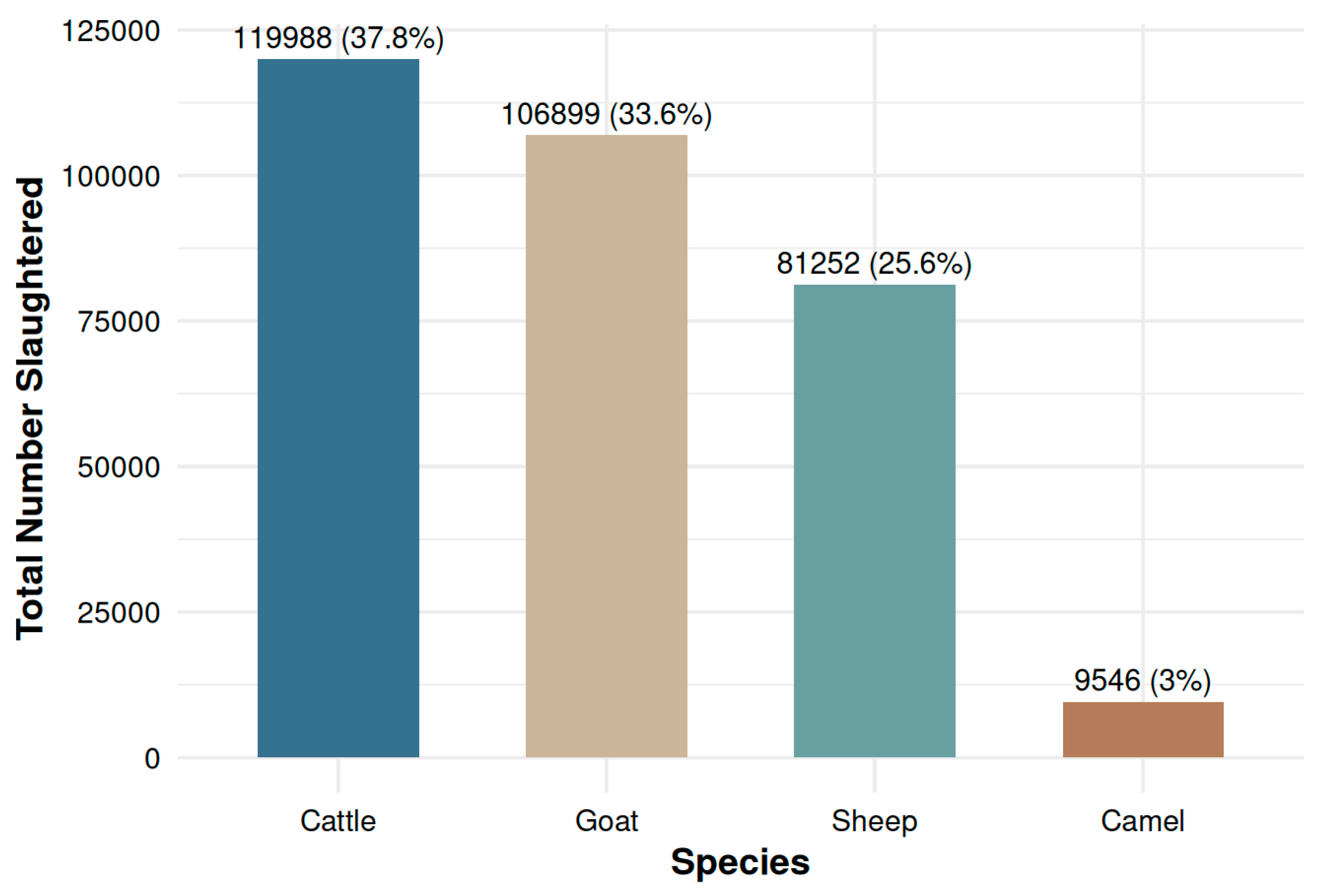
Figure 2.
Species-specific condemnation rates per 1,000 animals by recorded cause at the Sokoto State main abattoir, January–June 2025.
Figure 2.
Species-specific condemnation rates per 1,000 animals by recorded cause at the Sokoto State main abattoir, January–June 2025.
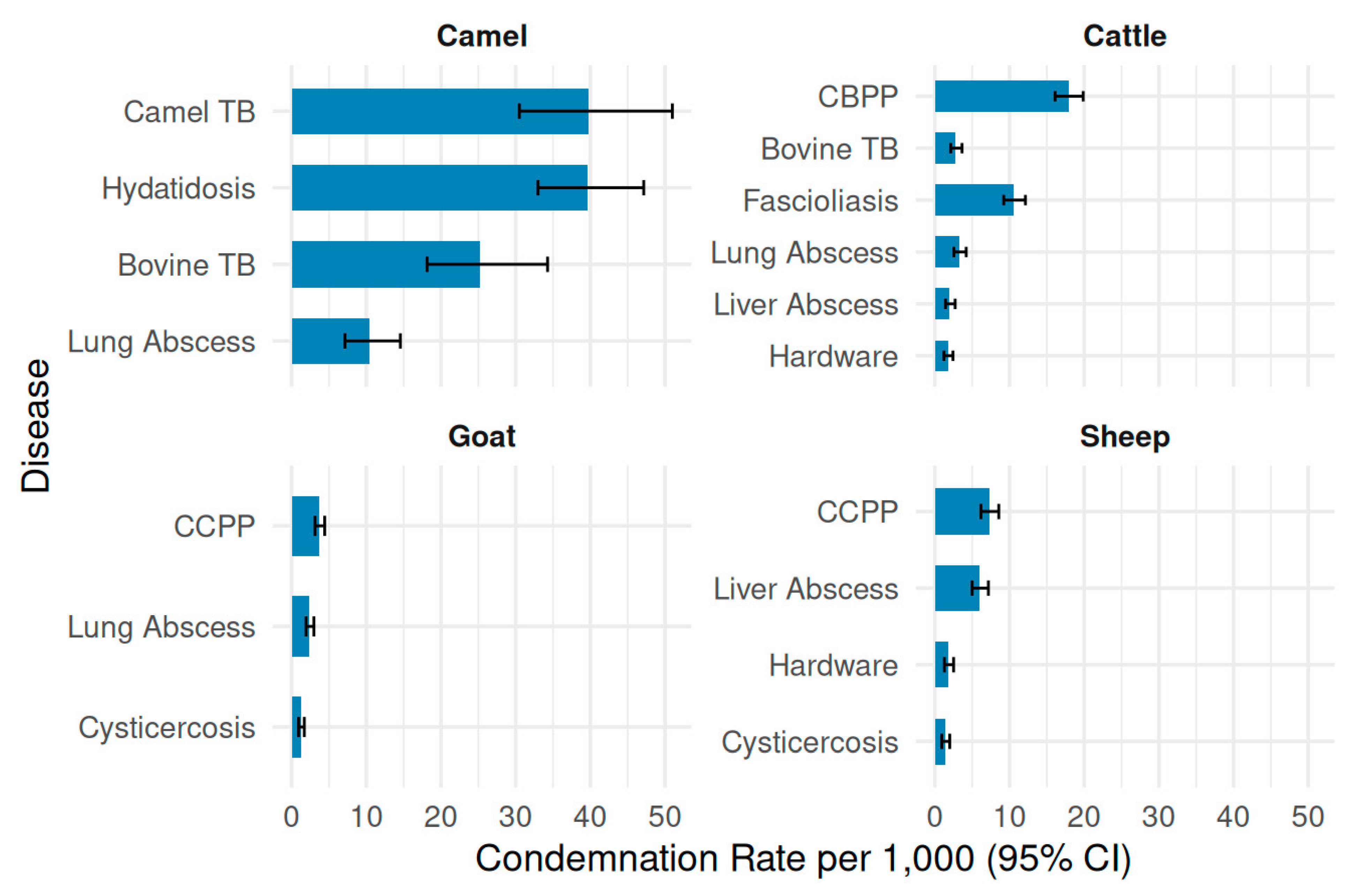
Figure 3.
Monthly condemnation rates per 1,000 animals slaughtered by species at the Sokoto State main abattoir, January–June 2025.
Figure 3.
Monthly condemnation rates per 1,000 animals slaughtered by species at the Sokoto State main abattoir, January–June 2025.
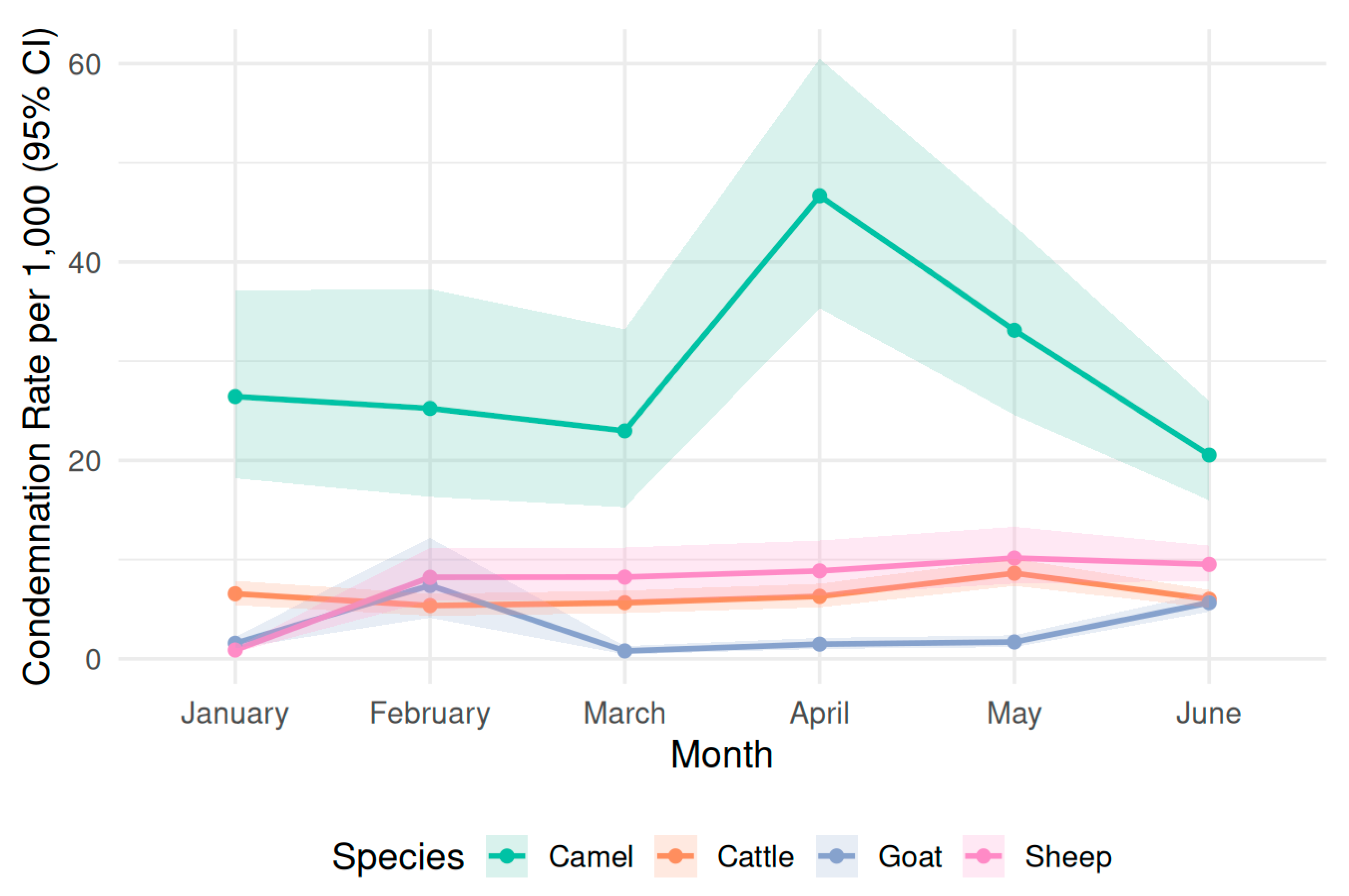
Figure 4.
Model-predicted and observed monthly condemnation rates per 1,000 animals by species based on the negative binomial regression model, January–June 2025.
Figure 4.
Model-predicted and observed monthly condemnation rates per 1,000 animals by species based on the negative binomial regression model, January–June 2025.
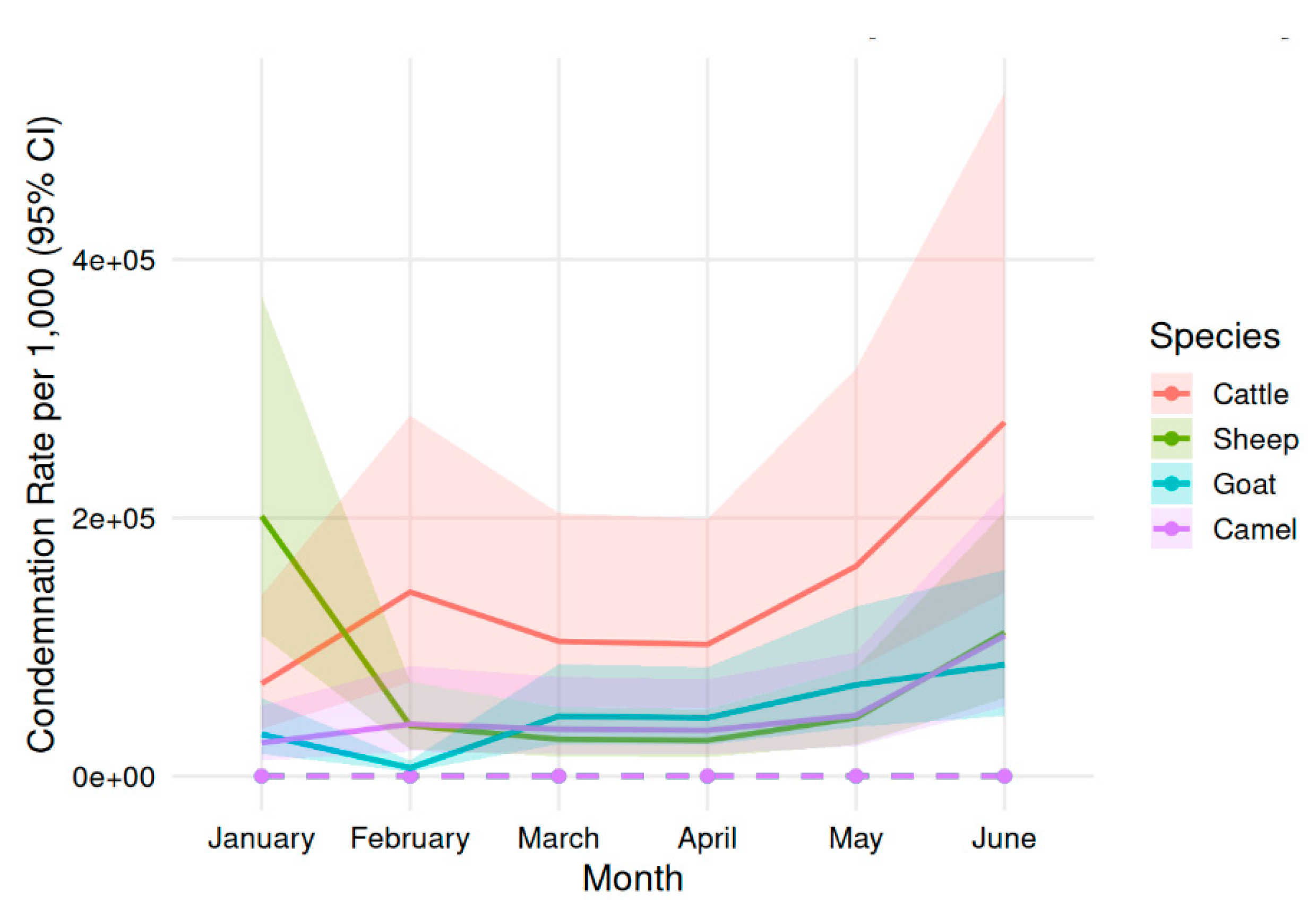
Figure 5.
Model-predicted condemnation rates per 1,000 animals by disease and species (negative binomial model).
Figure 5.
Model-predicted condemnation rates per 1,000 animals by disease and species (negative binomial model).
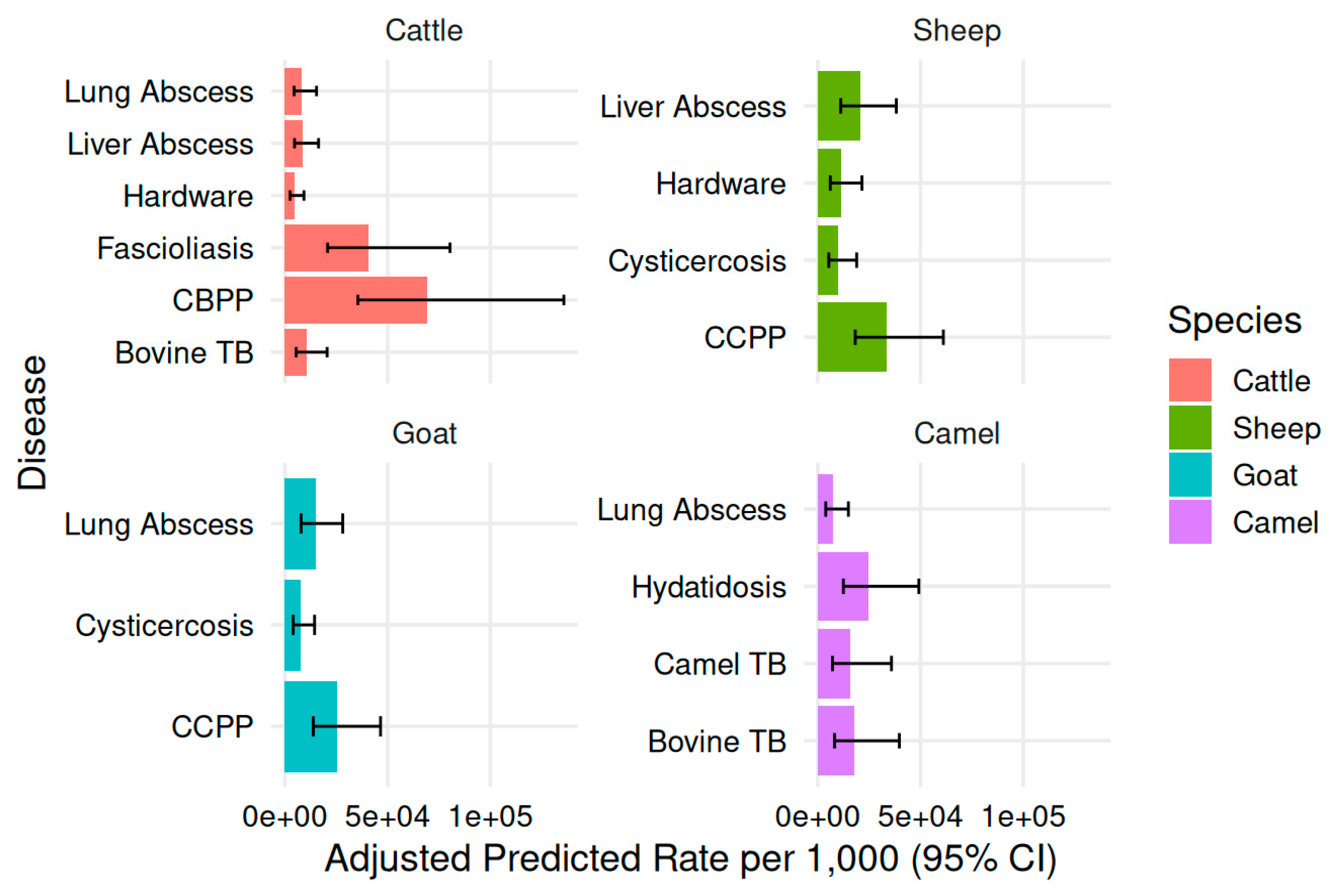
Figure 6.
Calibration plot comparing observed and model-predicted condemnation rates per 1,000 animals, stratified by species and disease.
Figure 6.
Calibration plot comparing observed and model-predicted condemnation rates per 1,000 animals, stratified by species and disease.
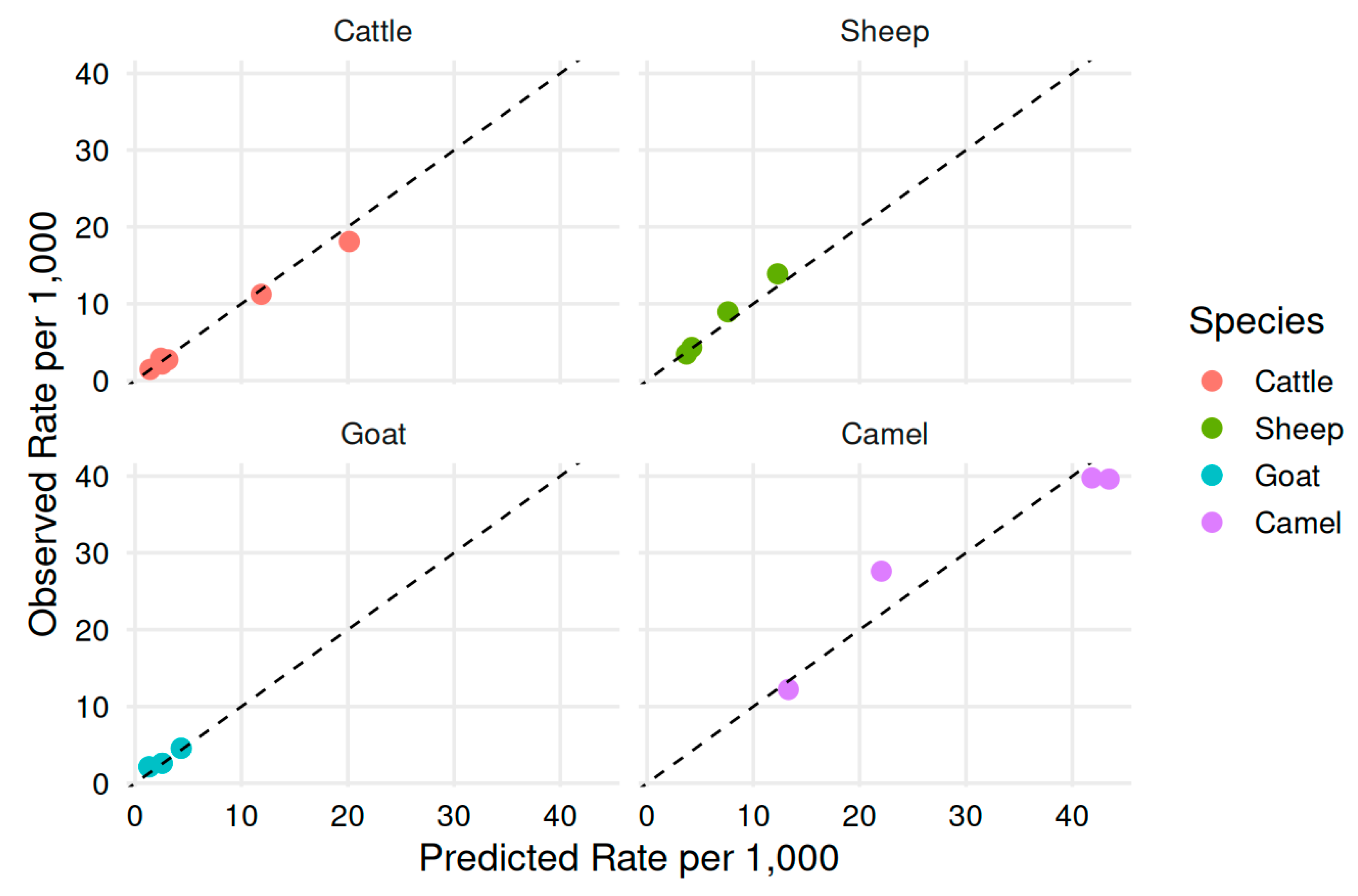
Table 1.
Slaughter throughput and meat condemnation burden/rate by species at the Sokoto State abattoir, January–June 2025.
Table 1.
Slaughter throughput and meat condemnation burden/rate by species at the Sokoto State abattoir, January–June 2025.
| Species of Food animal | Number of animal slaughtered | Percentage Slaughtered |
Number of condemned cases | Rate per 1,000 | Lower-Upper At 95% CI |
|---|---|---|---|---|---|
| Cattle | 119,988 | 37.8 | 767 | 6.39 | 5.95-6.86 |
| Goat | 106,899 | 33.6 | 264 | 2.47 | 2.18-2.79 |
| Sheep | 81,252 | 25.6 | 335 | 4.12 | 3.69-4.59 |
| Camel | 9,546 | 3.0 | 262 | 27.4 | 24.2-31.0 |
| Total | 317,685 | 100 | 1,628 | 5.12 | 4.88-5.38 |
Table 2.
Species-specific meat condemnation burden and rates.
| Species | Recorded cause of condemnation | Number of cases |
|---|---|---|
| Camel | Hydatidosis | 126 |
| Camel | Camel tuberculosis | 62 |
| Camel | Bovine tuberculosis | 41 |
| Camel | Lung abscess | 33 |
| Cattle | Contagious bovine pleuropneumonia (CBPP) | 358 |
| Cattle | Fascioliasis | 212 |
| Cattle | Lung abscess | 66 |
| Cattle | Bovine tuberculosis | 56 |
| Cattle | Liver abscess | 40 |
| Cattle | Hardware disease | 35 |
| Goat | Contagious caprine pleuropneumonia (CCPP) | 133 |
| Goat | Lung abscess | 86 |
| Goat | Cysticercosis | 45 |
| Sheep | Contagious caprine pleuropneumonia (CCPP) | 148 |
| Sheep | Liver abscess | 122 |
| Sheep | Hardware disease | 37 |
| Sheep | Cysticercosis | 28 |
| Total | 1,628 |
Table 3.
Monthly species-specific condemnation rates per 1,000 animals slaughtered with 95% confidence intervals at the Sokoto State main abattoir, January–June 2025.
Table 3.
Monthly species-specific condemnation rates per 1,000 animals slaughtered with 95% confidence intervals at the Sokoto State main abattoir, January–June 2025.
| Month | Camel_Rate (95% CI) | Cattle_Rate (95% CI) | Goat_Rate (95% CI) | Sheep_Rate (95% CI) |
|---|---|---|---|---|
| January | 26.4 (18.2–37.1) | 6.56 (5.42–7.87) | 2.46 (1.80–3.28) | 4.17 (3.20–5.36) |
| February | 25.2 (16.3–37.2) | 5.37 (4.35–6.56) | 2.23 (1.59–3.05) | 3.75 (2.80–4.92) |
| March | 23.0 (15.3–33.3) | 5.66 (4.61–6.89) | 2.39 (1.72–3.23) | 4.16 (3.14–5.41) |
| April | 46.7 (35.4–60.4) | 6.30 (5.19–7.60) | 2.51 (1.82–3.36) | 4.67 (3.59–5.98) |
| May | 33.1 (24.6–43.6) | 6.07 (5.20–7.06) | 2.54 (1.85–3.40) | 3.90 (2.92–5.11) |
| June | 20.5 (16.0–25.8) | 8.63 (7.41–10.03) | 2.54 (1.88–3.37) | 4.09 (3.06–5.35) |
Table 4.
Negative binomial regression analysis of factors associated with meat condemnation rates at the Sokoto State abattoir, January–June 2025.
Table 4.
Negative binomial regression analysis of factors associated with meat condemnation rates at the Sokoto State abattoir, January–June 2025.
| Variable domain | Predictor | aIRR | 95% CI | p-value |
|---|---|---|---|---|
| Temporal effects (Month) | Month (linear) | 1.67 | 1.13 – 2.48 | 0.008 |
| Month (quadratic) | 0.98 | 0.66 – 1.45 | 0.896 | |
| Month (cubic) | 1.3 | 0.87 – 1.94 | 0.181 | |
| Month (4th order) | 0.67 | 0.45 – 0.99 | 0.04 | |
| Month (5th order) | 1 | 0.67 – 1.49 | 0.987 | |
| Species effects | Cattle | 0.18 | 0.09 – 0.36 | <0.001 |
| Goat | 0.19 | 0.08 – 0.43 | <0.001 | |
| Sheep | 0.54 | 0.23 – 1.23 | 0.138 | |
| Disease-specific effects | Camel tuberculosis | 2.88 | 1.01 – 8.49 | 0.053 |
| CBPP | 6.54 | 2.88 – 15.20 | <0.001 | |
| CCPP | 1.33 | 0.56 – 3.12 | 0.508 | |
| Cysticercosis | 0.4 | 0.16 – 0.98 | 0.038 | |
| Fascioliasis | 3.85 | 1.67 – 9.05 | 0.001 | |
| Hardware disease | 0.46 | 0.20 – 1.00 | 0.047 | |
| Hydatidosis | 2.55 | 0.98 – 6.64 | 0.055 | |
| Liver abscess | 0.82 | 0.37 – 1.79 | 0.617 | |
| Lung abscess | 0.78 | 0.39 – 1.53 | 0.482 | |
| Model intercept | Intercept | 0.016 | 0.008 – 0.035 | <0.001 |
aIRR = adjusted incidence rate ratio; CI = confidence interval. A negative binomial regression model was fitted with the number of condemnation cases as the outcome. Month was modelled using orthogonal polynomial terms to capture non-linear temporal trends. All estimates were adjusted for slaughter volume through inclusion of a logarithmic offset for the number of animals slaughtered. Camel (species) and other/unspecified causes (disease) served as reference categories. Statistically significant associations (p < 0.05) indicate factors independently associated with condemnation rates.
Table 6.
Observed versus model-predicted condemnation rates per 1,000 animals by species and disease.
Table 6.
Observed versus model-predicted condemnation rates per 1,000 animals by species and disease.
| Species | Disease | Observed rate/1,000 | Predicted rate/1,000 | Difference (Predicted − Observed) |
|---|---|---|---|---|
| Cattle | CBPP | 18.1 | 20.1 | 2.0 |
| Cattle | Fascioliasis | 11.2 | 11.9 | 0.7 |
| Cattle | Bovine tuberculosis | 2.7 | 3.08 | 0.38 |
| Cattle | Lung abscess | 2.91 | 2.4 | −0.51 |
| Cattle | Liver abscess | 2.15 | 2.54 | 0.39 |
| Cattle | Hardware disease | 1.45 | 1.4 | −0.05 |
| Sheep | CCPP | 13.9 | 12.3 | −1.60 |
| Sheep | Liver abscess | 8.95 | 7.6 | −1.35 |
| Sheep | Hardware disease | 4.31 | 4.2 | −0.11 |
| Sheep | Cysticercosis | 3.45 | 3.7 | 0.25 |
| Goat | CCPP | 4.56 | 4.33 | −0.23 |
| Goat | Lung abscess | 2.62 | 2.54 | −0.08 |
| Goat | Cysticercosis | 2.14 | 1.31 | −0.83 |
| Camel | Hydatidosis | 39.6 | 43.5 | 3.9 |
| Camel | Camel tuberculosis | 39.8 | 41.9 | 2.1 |
| Camel | Bovine tuberculosis | 27.6 | 22 | −5.60 |
| Camel | Lung abscess | 12.2 | 13.3 | 1.1 |
Disclaimer/Publisher’s Note: The statements, opinions and data contained in all publications are solely those of the individual author(s) and contributor(s) and not of MDPI and/or the editor(s). MDPI and/or the editor(s) disclaim responsibility for any injury to people or property resulting from any ideas, methods, instructions or products referred to in the content. |
© 2026 by the authors. Licensee MDPI, Basel, Switzerland. This article is an open access article distributed under the terms and conditions of the Creative Commons Attribution (CC BY) license (http://creativecommons.org/licenses/by/4.0/).
Copyright: This open access article is published under a Creative Commons CC BY 4.0 license, which permit the free download, distribution, and reuse, provided that the author and preprint are cited in any reuse.


