

Submitted:
01 March 2026
Posted:
02 March 2026
You are already at the latest version
Abstract
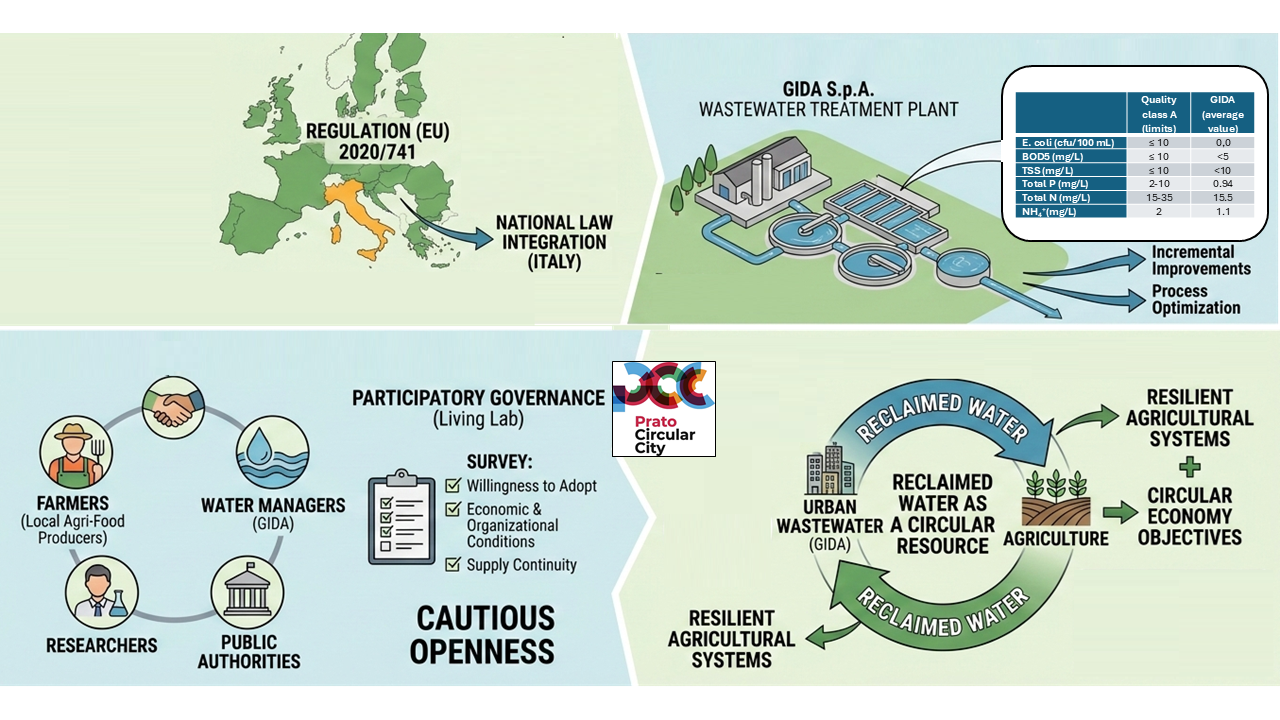
The reuse of treated wastewater for agricultural irrigation is increasingly recognized as a strategic response to the growing challenges posed by climate change and freshwater scarcity. The paper outlines the development of EU regulations on using treated wastewater for irrigation, focusing on Italy. It highlights Regulation (EU) 2020/741, which sets minimum standards and water quality classes for agricultural reuse, and discusses its integration into national law. The aim of the paper is to present a case study of the wastewater treatment plant operated by GIDA S.p.A. in the Municipality of Prato, Tuscany. A quali-quantitative survey was conducted with a sample of local agri-food producers located in proximity to the plant, aimed at assessing their irrigation needs, current water sources, and attitudes toward the use of reclaimed water. Results indicate a general willingness to adopt treated wastewater for irrigation. The case of Prato is further contextualized within two ongoing municipal frameworks: the development of a local food policy strategy and the “Prato Circular City” program, which positions cir-cular economy principles at the core of urban planning. Through the integration of policy analysis and empirical data, this study provides valuable insights into peri-urban agricultural environments in Central Italy.
Keywords:
treated wastewater reuse
; water policy
; circular economy
; local farming
1. Introduction
Climate change and increasing freshwater scarcity are posing major challenges to global food production systems, particularly in Mediterranean regions where water stress is already acute. Water use for irrigation and food production represents a critical global challenge, especially considering that agriculture accounts for over 70% of global freshwater withdrawals, and up to 90% in some rapidly growing economies [1]. In today’s context, in which climate change is altering natural balances and future forecasts estimate a global population growth of up to 10 billion individuals by 2050 [2], we are witnessing the construction of a time horizon in which pressure on food production will increase exponentially, burdening water resources, the environment and the economy [3]. While non-European countries have widely adopted water reuse practices, uptake within the EU remains limited, primarily because of stricter regulatory requirements for industrial effluent reuse compared to urban wastewater, the absence (until recently) of harmonized minimum quality standards across reuse applications, and persistent perceptions that reused water is inferior to conventional freshwater sources [4]. Indeed, over the past decade, growing attention has been paid to the regulatory and operational conditions required to implement safe and acceptable water reuse systems in agriculture. In the European Union, a comprehensive regulatory framework was finally introduced with the adoption of Regulation (EU) 2020/741, which defines quality standards and monitoring requirements for the reuse of treated urban wastewater. Its national implementation, however, remains complex and uneven across Member States. In this context, the reuse of treated wastewater for agricultural purposes is gaining strategic relevance as a sustainable water management solution. This practice not only alleviates pressure on freshwater resources but also contributes to the circular economy by recovering valuable water and nutrients from wastewater streams. In fact, this approach promotes the circular treatment of wastewater and sludge, converting them into valuable resources, including reclaimed water, energy, and materials recovered from sludge [5]. Recent regulatory updates and technological developments have renewed also in Italy the interest in scaling up these systems, particularly in urban and peri-urban settings where water demands and wastewater production co-exist. Increasing treated wastewater reuse can alleviate pressure on surface and groundwater resources, safeguarding the ecosystem services they provide and ensuring a stable summer water supply for agriculture [6]. Achieving this objective, however, requires an integrated management approach that links water supply, wastewater treatment, and drainage systems in a coherent framework. Such an approach ensures not only environmental protection but also safeguards public health and enhances overall community well-being. Embracing circular water management contributes to building more resilient, inclusive, and livable cities, in line with global sustainability goals.
Beyond the technical and regulatory aspects discussed above, the social acceptability of the process must also be considered, particularly how local communities and stakeholders (from farmers to consumers) perceive the use of wastewater in production processes. While the benefits of this practice are well established, technical and economic constraints may hinder its development, especially without adequate incentives or support from governments and local authorities, potentially imposing excessive costs on farmers.
In addition to technical and economic constraints, socio-behavioural factors are equally important, since farmers who are better informed about treatment processes and associated health and environmental risks tend to be more supportive of wastewater reuse, while low trust in responsible institutions raises concerns about hygiene standards and discourages its adoption [7]. One major psychological barrier is the “disgust factor,” highlighted in global surveys. Many farmers express strong aversion to using treated wastewater, as shown in Menegaki et al.’s research. [8] which shows that about 33% of Greek farmers surveyed identified disgust as the main reason for rejection. On the other hand, many farmers also recognise concrete advantages in the reuse of wastewater, such as the supply of nutrients to the soil (nitrogen, phosphorus, etc.) that reduce the use of chemical fertilizers and the increased reliability of the resource under climatic stress conditions [7]. Indeed, EU Regulation 2020/761 aims to boost data and process transparency by involving stakeholders. Projects like “water citizen science,” where stakeholders monitor irrigation water themselves, can help build trust in reuse practices. While many Europeans are open to eating produce irrigated with purified wastewater, concerns about hygiene and health persist despite better information or education [9]. This requires an interdisciplinary approach that integrates social sciences, public policy and environmental health, in addition to the technical health assessment. It is therefore essential to promote information campaigns and to involve citizens in the governance of reuse, as suggested by EU 2020/761 itself.
Italy is among the European countries most reliant on irrigation, ranking second after Spain in terms of irrigated area, with more than 2.4 million hectares under irrigation (excluding protected crops and household gardens), compared to approximately 3 million hectares in Spain. Furthermore, Italy ranks fourth among EU member states for the share of irrigated land relative to Utilised Agricultural Area (UAA), with irrigated land accounting for approximately 19%. This percentage is comparable to that of Greece (around 20%), and follows Malta, Cyprus, and Greece, where irrigation holds a particularly strategic role in national agricultural systems. At the national level, 65.6% of the technically irrigable land is irrigated, and 19.3% of the overall UAA is subject to irrigation. The average volume of water applied per hectare of irrigated land amounts to 4,666.1 m³, according to the 6th Agricultural Water Census conducted by ISTAT [10]. Irrigation practices vary significantly across regions and crops, resulting in a highly heterogeneous national landscape in terms of water use and efficiency. Although still limited in scope, the reuse of treated wastewater in agriculture, especially for high-demanding crops could play a significant role in promoting sustainable water use. When combined with good agricultural practices, the adoption of reclaimed water for irrigation may contribute substantially to water conservation efforts, with positive implications for hydrogeological stability and the mitigation of desertification processes.
Although Regulation (EU) 2020/741 establishes a harmonised framework for agricultural water reuse across the European Union, limited empirical evidence is available on its local feasibility and social acceptance, particularly in peri-urban contexts. This paper addresses this gap by analysing the implications of the new regulatory framework and assessing the feasibility of treated wastewater reuse for irrigation in the Prato area (Italy).
Combining policy analysis with a field-based survey of local agri-food producers, the study examines the technical, economic, and socio-institutional factors shaping implementation, thereby contributing to the understanding of the conditions under which circular water reuse systems can be effectively adopted at the local level.
2. Materials and Methods
This paper adopted a mixed-methods approach, combining document analysis, geographic mapping using Gis-based software, and a quali-quantitative field survey targeting local agri-food producers in the Prato area. The research aimed to explore both the technical feasibility and the socio-institutional acceptability of reclaimed water reuse for irrigation. The research was developed within the framework of the Prato Circular City (PCC) program, which integrates urban metabolism strategies with circular economy principles [11]. PCC follows the Living Lab model, integrating research, experimentation, and co-creation with multiple stakeholders to develop and test sustainable solutions in real-world settings [12]. The study engaged specialists in commodity science, environmental engineering, urban planning, social innovation, and agricultural systems, thereby ensuring a comprehensive transdisciplinary perspective. The methodological process was structured in the following four steps:
- (i)
- Stakeholder engagement and living labs (LLs): Informed by the principles of social innovation and living lab methodologies [13,14] a series of multi-stakeholder workshops [15] within the framework of PCC, were organized to explore the social acceptability, perceived risks, and governance conditions associated with the reuse of treated wastewater for irrigation. These LLs brought together representatives from local government, agricultural associations, research institutions, and civil society.
- (ii)
- Survey: A field survey was carried out using a targeted selection of farms near the Prato treatment plant to gather local agricultural data. Thus, structured interviews were carried out through in-person visits to collect data on current water sources, irrigation practices, openness to the use of reclaimed water, and the conditions required for its acceptance. Open-ended questions were included to capture qualitative insights into perceived benefits and barriers [16,17].
- (iii)
- Spatial analysis: A GIS-based spatial representation was developed to identify the treatment plant’s potential area of influence and to map nearby agricultural plots and irrigation infrastructures. This geospatial analysis was used to assess logistical feasibility, potential environmental impacts, and future technological options for reclaimed water distribution [18,19].
- (iv)
- SWOT analysis and definition of policy guidelines for the territory: the outputs of the regulatory review, stakeholder consultations, field survey, and spatial analysis were triangulated to develop a systemic understanding of the technical, institutional, and social dimensions of water reuse in the local context.
In addition to assessing the technical and regulatory feasibility of reclaimed water reuse, this paper aims to demonstrate the relevance of participatory, multi-actor engagement processes in informing and shaping local policy frameworks. The case study focuses on the GIDA S.p.A. wastewater treatment plant, located in the industrial area of Prato, Tuscany. The plant serves both domestic and industrial users and has the technical capacity to produce treated water compliant with agricultural reuse standards. Its proximity to agricultural plots makes it a suitable candidate for potential reuse schemes. A mapping of nearby farms was carried out using land-use data and municipal databases. A purposive sample of 14 farmers was selected based on proximity to the plant, irrigation needs, and type of production (e.g., horticulture, vineyards, cereals). A structured questionnaire was developed to gather detailed information on various aspects of agricultural water use and stakeholders’ attitudes toward the reuse of treated wastewater. The instrument explored current water sources and irrigation practices, as well as respondents’ perceptions and willingness to adopt reclaimed water for agricultural purposes. Particular attention was given to the conditions under which such reuse would be considered acceptable, including factors such as water quality, supply reliability, and cost. The questionnaire also addressed perceived risks and concerns associated with the use of treated wastewater. Data collection was conducted through a combination of face-to-face interviews and online surveys administered between January and April 2025. Quantitative responses were analyzed using descriptive statistics and cross-tabulations. Open-ended responses were coded thematically to identify key perceptions, concerns, and enablers. For the sake of data transparency and methodological clarity, the composition of the sample and the reference population require specification. A total of 15 farms were interviewed: 14 located in the Municipality of Prato and 1 in the Municipality of Carmignano. Of these, 14 out of 15 are registered in the ARTEA database (Regional Agency for Agricultural Payments in Tuscany). ARTEA records indicate that twenty-nine farms have their legal headquarters located within the Municipality of Prato, specifically within the boundaries of the “Parco Agricolo della Piana” (PAP). Consequently, these farms are regarded as part of the reference population. Among these, 13 farms can be confidently identified as included in the interview sample. If the population is defined as farms registered in ARTEA within the Municipality of Prato, a sample of 13 units represents a substantial proportion of the total (approximately 45%), allowing it to be considered statistically representative of the local agricultural structure. However, this criterion introduces certain limitations. Some farms may physically operate on land located within the PAP without having their legal headquarters there, while others registered within the PAP may cultivate land outside its boundaries.
3. Results and Discussion
The methodological design explicitly incorporates the use of LLs, conceived as an open, collaborative, and iterative environment in which stakeholders can jointly explore problems, co-produce knowledge, and formulate actionable policy recommendations.
In this context, the LLs function as a social innovation instrument [14,15] enabling the integration of experiential knowledge from farmers, public authorities, water utilities, research institutions, and civil society actors. Such participatory mechanisms are increasingly recognized as essential for addressing complex sustainability challenges, particularly those involving resource management, environmental risks, and socio-technical transitions, where traditional top-down decision-making often proves insufficient [20].
Through a sequence of guided workshops, thematic discussions, and co-design sessions, stakeholders contributed to the identification of key barriers, opportunities, and priorities related to treated wastewater reuse. This process not only facilitated the collection of qualitative insights but also enhanced the legitimacy, robustness, and local ownership of the resulting policy proposals. By embedding stakeholder deliberation within the broader methodological framework, the study illustrates how participatory approaches can support evidence-based policy design and strengthen the alignment between municipal strategies, such as the PCC framework, and the practical needs and expectations of end-users.
3.1. GIDA Wastewater Treatment Plant
Prato is one of the largest textile districts in Europe, with over 7,200 SMEs. Since 1981, the city’s centralized wastewater treatment system, managed by GIDA S.p.A., has exemplified a closed-loop model integrating industrial and domestic wastewater treatment. GIDA was established in response to Italian Law 319/76, which required wastewater treatment for industrial facilities. Instead of obliging each textile company to build its own treatment plant, local authorities and industry leaders jointly created a centralized plant, generating economies of scale and environmental benefits. GIDA’s Baciacavallo wastewater treatment plant (WTP) processes a mix of domestic and industrial wastewater. It serves around 400 textile SMEs through a 75 km industrial aqueduct, one of Italy’s largest, covering 1.5 million m². Treated water is returned to textile factories for reuse, effectively closing the water loop. The plant includes two water lines and operates in several phases: (i) Pre-treatment: Wastewater undergoes coarse and fine screening, solid removal (EWC 19.08.01), and grit separation in four 50 m³ sand traps. (ii) Primary treatment: Coagulation (with ferric chloride and anionic polymer) and sedimentation take place in mixing and settling tanks. Separated sludge is extracted and thickened. (iii) Biological (secondary) treatment: The effluent enters four oxidation/nitrification tanks with surface aerators, followed by sedimentation. Sludge is partially recycled or sent for further thickening. (iv) Tertiary treatment: Includes chemical treatment (aluminum trichloride and polymers), followed by ozonation to reduce color and residual surfactants. Ozone is produced on-site from liquid oxygen via high-voltage discharge, then injected through porous disks into contact basins. (v) Sludge treatment: Excess sludge from all stages is thickened, dewatered (to 25–27% dry matter), and either incinerated on-site or transported offsite. The incinerator operates with a 100 t/day capacity and includes post-combustion, a scrubber, and continuous emission monitoring (e.g., CO, TOC, SO₂, NO₂, dust).
To evaluate the suitability of reclaimed water from the GIDA treatment plant for agricultural reuse, we compared the annual average values obtained from monthly chemical analyses conducted in 2023 with the threshold limits established for the four reuse classes (A to D) under Regulation (EU) 2020/741, as summarized in Table 1.
The GIDA effluent demonstrates good performance across most monitored parameters. Specifically, E. coli levels are consistently non-detectable (0 cfu/100 mL), significantly below the Class A threshold of ≤10 cfu/100 mL, indicating a high level of microbiological safety. Similarly, values for Biochemical Oxygen Demand (BOD5) and Total Suspended Solids (TSS) fall well within Class A limits, with readings of <5 mg/L and <10 mg/L respectively.
Nutrient parameters also show favorable results: Total phosphorus is 0.94 mg/L, and Total nitrogen is 15.5 mg/L, both values aligned with the permissible range for all classes. The temporal pattern of total phosphorus exhibits values at or close to the detection limit (<0.1 mg/L) during the winter and early spring (January–March), followed by sporadic increases in late spring and summer (e.g., 0.68 mg/L in May, 0.84 mg/L in July). The highest concentrations occur in early autumn (2.30–2.39 mg/L in October), before stabilizing again around lower values toward December. Regarding total nitrogen, the variance, calculated at 16.80, and the standard deviation of 4.10 mg/L, demonstrate that its measurements exhibited greater fluctuation compared to phosphorus. The minimum total nitrogen concentration observed was 7.89 mg/L in April, while the maximum reached 26.4 mg/L in June. Notable features of the data include relatively high concentrations during winter months, ranging from 12 to 19 mg/L. A pronounced peak was recorded in early summer, with June showing the highest value (26.4 mg/L), which may be associated with increased industrial activity or reduced nitrification efficiency due to temperature stress. Additionally, a secondary peak occurred in July, with levels at 22.2 mg/L. Toward late autumn and early winter, concentrations tended to stabilize, remaining within the range of 13 to 16 mg/L. However, a notable exceedance is observed in ammonium nitrogen (NH₄⁺) concentration, showed marked temporal variability throughout the year 2023, with an annual mean of 1.10 mg/L but several episodic peaks exceeding 5 mg/L. Such fluctuations, likely attributable to variations in industrial loads (i.e. high influent ammonium concentrations linked to the industrial component of the wastewater, particularly from the textile sector), seasonal temperature shifts, and biological process dynamics, result in non-compliance with the 2 mg/L threshold established by Regulation (EU) 2020/741. Despite the generally low annual mean, compliance requires systematic, not occasional, adherence to threshold values. The presence of multiple monthly peaks exceeding 2 mg/L means that the effluent does not consistently comply with the ammonium limit for any reuse class (A–D). From a policy and planning perspective, the presence of a single non-compliant parameter underlines the importance of parameter-specific compliance monitoring, especially when reclaimed water is intended for high-value agricultural uses. It also underscores the need for targeted investments and technical upgrades if the goal is to expand the role of reclaimed water in supporting local food systems, as envisioned within the PCC framework.
3.2. Prato Circular City framework
The city of Prato has adopted an ambitious vision for sustainability, positioning the circular economy not only as a strategy for efficient waste management but as a transformative paradigm for urban development. The PCC Framework encompasses various interrelated domains, including modular and flexible building design, renewable and resilient energy systems, sustainable urban mobility, urban bioeconomy, and production systems oriented towards resource efficiency, reuse, recycling, and recovery. Circularity is placed at the core of the city’s innovation and development policies, embedded in a broader integrated planning framework based on digital and ecological transitions, economic development support, and inclusive urban policies. The framework was launched in July 2020 and shaped as a permanent living lab involving local stakeholders. The initiative seeks to overcome the main barriers to the circular transition by pursuing three complementary directions: Better Regulation, Better Funding, and Better Knowledge. These pillars aim respectively to influence regulatory frameworks at regional, national, and EU levels; to mobilize appropriate financial resources and partnerships; and to strengthen awareness and knowledge across all levels of society. Its operational focus revolves around four interconnected domains: the textile and apparel district, urban resource management, circular consumption, and sustainable urban agriculture.
The methodological approach is structured around thematic working groups composed of relevant stakeholders. Each working group follows a step-by-step process that includes stakeholder identification, topic selection, collaborative discussion, proposal drafting, external feedback, and the development of an operational action plan. The process also incorporates an initial diagnostic phase in which participants identify existing initiatives, good practices, regulatory frameworks, and funding opportunities. This is used to assess feasibility and relevance through a decision tree, allowing the group to select and refine actions that are both meaningful and implementable. Overall, the incorporation of a living-lab methodology demonstrates that policy relevance and feasibility are significantly enhanced when technical assessments are coupled with participatory governance processes, ultimately contributing to the development of more adaptive, context-sensitive, and socially accepted solutions for circular water management.
As of April 2024, PCC has held 64 meetings, including 17 specifically dedicated to urban agriculture. These meetings addressed issues such as the promotion of short food supply chains for school canteens, the development of the local brewing sector, and the signature of a Memorandum of Understanding to support Prato’s agri-food heritage. In this domain, agriculture is seen both as a provider of ecosystem services in urban and peri-urban settings, and as a tool for social and environmentally sustainable employment policies. The goal is to promote the production and distribution of local, autochthonous varieties through short supply chains, particularly within the PAP and municipal school canteens.
3.3. Local Farming
The PAP covers approximately 8,000 hectares in the peri-urban area between Florence and Prato, encompassing eight municipalities and serving a population of over 720,000 residents [21]. Historically devoted to intensive agriculture, the area supports traditional crops (cereals, vegetables, fruit trees, olives, and vines) mapped by ARTEA, which in 2023 recorded some 3,900 ha of agricultural land and 327 enterprises benefiting from EAFRD funds for rural development [22]. Established by Tuscan Regional Resolution No. 161 of 16 July 2014, the PAP willing to function as an “organizing element” for the protection and regeneration of peri-urban rural zones [21]. In 2018 it was also designated as an Integrated Territorial Project for biodiversity measures, climate adaptation, and sustainable resource management [23]. Although the PAP have been in place since 2007, the adoption of agroecological practices remains patchy, and farms, often small in scale, report logistical and regulatory barriers to accessing innovative irrigation technologies [24].
Due to data constraints, it is not possible to precisely determine the actual spatial distribution of cultivated plots in relation to the PAP’s perimeter. Concerning crop typologies, ARTEA data present inconsistencies in classification and terminology, which limits their reliability for detailed sectoral analysis. Among the 14 farms interviewed for this paper, cereals and arable crops are most common (14 farms), with horticulture following (7 farms). Livestock farming (cattle) and forage crops each account for 3 farms, while viticulture and olive cultivation each represent 2 farms. Smaller shares are recorded for nursery production, textile crops such as flax and hemp, legumes, oilseed crops, and apiculture. Overall, despite certain data limitations, the sample provides a meaningful representation of the agricultural activities formally registered within the PAP area and offers a sufficiently robust basis for qualitative and exploratory quantitative analysis.
3.4. Perceptions of Reclaimed Water in Irrigation
The survey highlights a farming system under increasing climatic pressure, characterized by cautious adaptation strategies, strong local embeddedness, and growing awareness of environmental challenges. These conditions provide fertile ground for introducing alternative water sources, such as treated wastewater, provided that economic, technical, and governance concerns are adequately addressed through participatory and policy-integrated approaches. Most interviewed farms are affiliated with a farmers’ association. Approximately 80% of respondents are members of a professional organization, mainly Coldiretti and CIA. Only 20% report no current membership, often motivated by dissatisfaction with the availability or effectiveness of technical support. This high level of association membership suggests a generally good level of institutional embeddedness and access to collective services, which may facilitate information dissemination and policy engagement. About 53% of the interviewed farms participate in local markets or short food supply chains, such as Terra di Prato, Campagna Amica, or other local farmers’ markets. The remaining 47% mainly sell through intermediaries or wholesale channels, especially cereal producers. Farms engaged in direct sales show greater proximity to consumers and stronger links to local food systems, potentially enhancing acceptance of sustainability-oriented practices, including reclaimed water reuse. The agricultural system in the study area is highly diversified. Approximately half of the farms are primarily engaged in horticultural production, often combined with fruit trees and olives, while around one third focus mainly on cereal crops and fodder, frequently under rainfed conditions. A smaller number specialize in ornamental plants or mixed systems. Crop rotation is widely practiced, and several farmers highlight adaptive strategies in response to climate stress, such as reducing maize cultivation due to drought-related yield losses and mycotoxin risks. The majority of respondents (about 80%) report no substantial change in cropping systems over the last five years. When changes occurred, they were mainly driven by climatic constraints, particularly water scarcity and heat stress, rather than by market incentives or policy measures. This indicates a relatively conservative production structure, with adaptation occurring incrementally rather than through radical shifts. Only a small minority of farms (approximately 15–20%) report planned changes in cropping systems in the coming years. Proposed changes include experimentation with alternative crops (e.g., hemp or flax) or minor adjustments within existing rotations. Overall, uncertainty related to climate conditions and economic returns discourages proactive transformation, reinforcing the need for supportive policies and risk-sharing mechanisms. Yield reductions have been widely experienced. Ten farmers reported that they had experienced periods of reduced production in recent years. These events are mainly associated with summer droughts, prolonged heatwaves, floods, and pest outbreaks. The temporal concentration of production losses between June and October underscores the vulnerability of local agriculture to seasonal water stress. Extreme weather impacts are even more pronounced. More than 70% of respondents report having suffered significant crop damage due to anomalous meteorological events, including floods and prolonged droughts. In several cases, damages reached near-total crop losses (up to 100%) or resulted in substantial economic losses (up to tens of thousands of euros). These findings confirm the increasing exposure of peri-urban agriculture to climate-related risks. Knowledge of the PAP is relatively widespread. About 67% of respondents are aware of the initiative, often through previous projects, institutional roles, or professional networks. However, awareness does not necessarily translate into active involvement, suggesting untapped potential for stronger integration between agricultural policies, territorial planning, and circular economy initiatives. Irrigation practices are heterogeneous. Approximately 53% of farms rely primarily on groundwater wells, while about one third cultivate mainly under rainfed conditions. A smaller group combines rainwater harvesting, storage tanks, surface water bodies, or municipal water supplies. Drip irrigation systems are widely adopted among irrigating farms, indicating an existing orientation toward water-efficient technologies. About 40% of the farmers interviewed report experiencing seasonal water scarcity, particularly during the summer months. Others do not report direct water shortages but highlight indirect climate-related constraints, such as soil crusting and reduced fertility caused by extreme heat. Interestingly, some farms face the opposite problem (excess water and flooding) emphasizing the dual challenge of water scarcity and water surplus in the local context.
Figure 1 illustrates the agricultural land registered within the PAP located inside the administrative boundaries of the Municipality of Prato. Parcels that both fall within the PAP perimeter and are listed in the ARTEA database are highlighted in yellow. The map shows that the main wastewater treatment plant of Baciacavallo, operated by GIDA, is situated in close proximity to, and largely surrounded by, PAP agricultural land. The water distribution network depicted in blue corresponds to the so-called “separate sewer system”. Thus, in the industrial district east of the GIDA treatment plant, where textile companies are predominantly located, this network is used to redistribute treated wastewater back to industrial users, operating within a circular economy framework. By contrast, the aqueduct extending across the rest of the urban area toward the western boundary of Prato is currently employed primarily for non-potable purposes, such as supplying water for street-level fire prevention systems. Notably, the branch of the network reaching the western sector, characterized by a significant belt of agricultural land, could potentially be upgraded to enable the distribution of treated wastewater for irrigation purposes. Such an intervention would require relatively limited infrastructural modifications and may therefore be technically feasible from an engineering and planning perspective.
The following SWOT analysis integrates empirical evidence from farmers’ interviews and LLs activities within the PCC initiative and aligns them with the emerging local food policy framework of the Municipality of Prato. The results indicate cautious optimism toward water reuse, consistent with other studies in Italy and the Mediterranean. Farmers see reclaimed water as a solution to climate-related shortages but emphasize the need for coordination, risk management, and economic feasibility. The Prato case underscores the value of integrating reuse into urban policies, connecting environmental aims with local food systems and service innovation. However, fragmented responsibilities, unclear regulations, and infrastructure gaps present major challenges. Effective water reuse requires collaboration among utilities, municipalities, farm groups, and regional authorities to transition beyond pilot programs.

Table 2.
SWOT analysis based on empirical evidence from farmers’ interviews and LLs activities within PCC.
Table 2.
SWOT analysis based on empirical evidence from farmers’ interviews and LLs activities within PCC.
| Dimension | Evidence from farmers’ survey and Living Labs | Link with Prato Circular City framework | Link with Prato Urban Food Policy framework |
| Strengths | High awareness of climate change impacts on agriculture. General openness to reclaimed water reuse if quality and safety are guaranteed. Strong collaborative attitude among farmers, institutions, and research actors. Familiarity with GIDA and existing industrial water reuse practices. |
Reinforces Better knowledge through shared learning and co-design. Living Labs function as a stable arena for dialogue and experimentation. Builds on Prato’s consolidated experience in circular water management. |
Strong producer–consumer relationships and short supply chains enhance trust. Local, traceable, seasonal food production supports acceptance of sustainable practices. Educational role of local food systems can facilitate communication on water reuse. |
| Weaknesses | Limited technical knowledge of agricultural water reuse experiences. Economic concerns regarding water pricing and investment costs. Uncertainty about supply continuity and infrastructure reliability. Fear of negative consumer perception regarding food safety. |
Indicates the need for targeted capacity building under Better knowledge. Highlights economic barriers to be addressed via Better funding. Suggests communication gaps in the circular transition. |
Limited production capacity of local farms increases vulnerability. Weather-related variability affects market participation and planning. Risk that sustainability innovations may not be equally accessible to all producers. |
| Opportunities | Increasing drought frequency strengthens the need for alternative irrigation sources. Interest in pilot projects supported by public funding and technical assistance. Positive perception of participatory governance approaches. Proximity to peri-urban agricultural areas and the Agricultural Park of the Prato Plain. |
Strong alignment with Better funding through EU and regional instruments. Supports integrated water–food–urban strategies. Living Labs enable testing and scaling of circular solutions. |
Growing consumer demand for sustainable and local food. Educational and cultural events can enhance acceptance of reclaimed water use. Urban food policies provide a platform to link water reuse with food security and resilience. |
| Threats | Uncertainty about long-term governance and maintenance of reuse infrastructure. Regulatory complexity and authorization procedures. Risk of low social acceptance if food safety concerns persist. Misalignment between institutional timelines and farmers’ needs. |
Calls for Better regulation and multilevel policy coordination. Highlights the role of Prato Circular City as a governance interface. Emphasizes trust-building mechanisms. |
Increasing climate extremes threaten agricultural continuity. Competition from large-scale retail and non-local products. Risk of declining institutional support for local food systems and farmers. |
4. Conclusions
This study examined the feasibility and social acceptability of treated wastewater reuse for irrigation within the framework of Regulation (EU) 2020/741, using the Prato case as an empirical testbed. The findings indicate cautious but tangible openness among local farmers, particularly in response to increasing climatic pressures and seasonal water scarcity. While economic and organizational conditions remain critical, reclaimed water is not perceived as inherently problematic, provided that quality standards, supply continuity, and institutional support are clearly ensured.
From a technical perspective, the quality assessment of the GIDA wastewater treatment plant demonstrates substantial compliance with EU reuse standards. Most monitored parameters meet the thresholds for high-quality irrigation classes. The main critical issue concerns episodic exceedances of ammonium nitrogen concentrations. Although this parameter currently limits full regulatory compliance, it does not constitute an insurmountable barrier. Rather, it highlights the need for targeted process optimization, parameter-specific monitoring, and integrated agronomic management strategies. In this sense, technical feasibility appears achievable through incremental improvements and appropriate risk management procedures.
Beyond technical compliance, the study underscores the importance of participatory governance mechanisms. The Living Lab approach adopted within the Prato Circular City framework proved instrumental in fostering dialogue among farmers, water utility managers, researchers, and public authorities. Such multi-actor engagement processes contributed to reframing treated wastewater from a residual output into a potential circular resource embedded within local development strategies.
The Prato case illustrates how reclaimed water reuse can be integrated into broader urban and food policy frameworks, linking water management, agricultural resilience, and circular economy objectives. However, regulatory complexity, fragmented responsibilities, infrastructure adaptations, and long-term governance arrangements remain key challenges. Addressing these dimensions requires coordinated action across institutional levels, financial support mechanisms, and continued stakeholder involvement.
Overall, this research contributes empirical evidence on the local implementation of EU water reuse regulation in a peri-urban context. It highlights that the transition toward circular water systems is not solely a technical matter, but a socio-institutional process in which regulatory alignment, infrastructural capacity, and social trust must evolve simultaneously.
Author Contributions
Leonardo Borsacchi: Writing – review & editing, Writing – original draft, Supervision, Data curation, Con-ceptualization. Donatella Fibbi: Writing – review & editing, Writing – original draft, Methodology, Formal analysis, Conceptualization. Lorenzo Baronti: Writing – review & editing, Writing – original draft, Methodology, Investigation, Data curation, Conceptualization. Gabriele Feligioni: Writing – review & editing, Writing – original draft, Data curation, Conceptualization. Tommaso Toccafondi: Writing – review & editing, Writing – original draft, Visualisation, Data curation, Conceptualization. Leonardo Bogani: Writing – review & editing, Writing – original draft, Data curation, Conceptualization. Patrizia Pinelli: Writing – review & editing, Writing – original draft, Supervision, Conceptualization.
Funding
This research received no external funding.
Conflicts of Interest
The authors declare no conflicts of interest.
Abbreviations
The following abbreviations are used in this manuscript:
| LLs | Living Labs |
| PAP PCC |
Parco Agricolo della Piana Prato Circular City |
| WTP | Water Treatment Plant |
References
- UN-Water. The United Nations World Water Development Report 2017: Wastewater: The Untapped Resource; UNESCO: Paris, France, 2017. [Google Scholar]
- United Nations, Department of Economic and Social Affairs, Population Division. World Population Prospects; United Nations: New York, NY, USA, 2020. [Google Scholar]
- Ingrao, C.; Siracusa, V.; Tricase, C.; D’Agostino, D.; Mbohwa, C.; Camposeo, S.; Vivaldi, G.A. Application of water footprint to olive growing systems in the Apulia region: A comparative assessment. J. Clean. Prod. 2015, 103, 119–126. [Google Scholar]
- European Commission. Proposal for a Regulation of the European Parliament and of the Council on minimum requirements for water reuse; COM(2018) 337 final; European Commission: Brussels, Belgium, 2018. [Google Scholar]
- Mannina, G.; Badalucco, L.; Barbara, L.; Cosenza, A.; Di Trapani, D.; Gallo, C.G.; Laudicina, V.A.; Marino, G.; Muscarella, S.M.; Presti, D.; et al. Enhancing a Transition to a Circular Economy in the Water Sector: The EU Project WIDER UPTAKE. Water 2021, 13, 946. [Google Scholar] [CrossRef]
- Nuvoli, S. Il riuso delle acque reflue in agricoltura: aspetti tecnico-normativi. In Atti dei Georgofili; Accademia dei Georgofili: Firenze, Italy, 2020. [Google Scholar]
- Mirra, L.; Russo, S.; Borrello, M. Exploring Factors Shaping Farmer Behavior in Wastewater Utilization for Agricultural Practices: A Rapid Review. Sustainability 2024, 16, 2870. [Google Scholar] [CrossRef]
- Menegaki, A.N.; Mellon, R.C.; Vrentzou, A.; Koumakis, G.; Tsagarakis, K.P. What’s in a name: Framing treated wastewater as recycled water increases willingness to use and willingness to pay. J. Econ. Psychol. 2009, 30, 285–292. [Google Scholar] [CrossRef]
- Verhoest, P.; Gaume, B.L.S.; Bauwens, J.; Van der Linden, S. Public acceptance of recycled water: A survey of social attitudes toward the consumption of crops grown with treated wastewater. Sustain. Prod. Consump. 2022, 34, 467–475. [Google Scholar] [CrossRef]
- ISTAT. Utilizzo della risorsa idrica a fini irrigui in agricoltura; ISTAT: Roma, Italy, 2014. [Google Scholar]
- Borsacchi, L.; Pinelli, P.; Tacconi, D. “Prato Circular City”: an integrated strategy to accelerate the circular urban transition through innovation, regeneration, cohesion. In Proceedings of the 27th Annual Conference, International Sustainable Development Research Society, Mid Sweden University, Östersund, Sweden, 2021; pp. 719–729. [Google Scholar]
- Evans, J.; Karvonen, A.; Raven, R. The Experimental City: Futures of Urban Sustainability; Routledge: London, UK, 2015. [Google Scholar]
- Franz, Y.; Tausz, K.; Thiel, S. Contextuality and co-creation matter: A qualitative case study comparison of living lab concepts in urban research. Technol. Innov. Manag. Rev. 2015, 5, 48–55. [Google Scholar] [CrossRef]
- Schuurman, D.; De Marez, L.; Ballon, P. The impact of living lab methodology on open innovation contributions and outcomes. Technol. Innov. Manag. Rev. 2016, 6, 7–16. [Google Scholar] [CrossRef]
- Voytenko, Y.; McCormick, K.; Evans, J.; Schliwa, G. Urban living labs for sustainability and low carbon cities. J. Clean. Prod. 2016, 123, 45–54. [Google Scholar] [CrossRef]
- Bryman, A. Social Research Methods, 4th ed.; Oxford University Press: Oxford, UK, 2012. [Google Scholar]
- Bazeley, P. Integrating Analyses in Mixed Methods Research; SAGE Publications: Thousand Oaks, CA, USA, 2018. [Google Scholar]
- Goodchild, M. F. Citizens as sensors: the world of volunteered geography. GeoJournal 2007, 69, 211–221. [Google Scholar] [CrossRef]
- Mancuso, G.; Parlato, M.; Lavrnic, S.; Toscano, A.; Valenti, F. GIS-Based Assessment of the Potential for Treated Wastewater Reuse in Agricultural Irrigation: A Case Study in Northern Italy. Sustainability 2022, 14, 9364. [Google Scholar] [CrossRef]
- Menny, M.; Voytenko Palgan, Y.; McCormick, K. Urban living labs and the role of users in co-creation. GAIA 2018, 27, 68–77. [Google Scholar] [CrossRef]
- Regione Toscana. Delibera del Consiglio Regionale n. 161: Istituzione del Parco Agricolo della Piana; Gazzetta Ufficiale della Regione Toscana: Firenze, Italy, 2014.
- ARTEA. Anagrafe delle aziende agricole; Agenzia Regionale Toscana per le Erogazioni in Agricoltura: Firenze, Italy, 2023. [Google Scholar]
- Regione Toscana; Direzione Agricoltura. Progetto Integrato Territoriale “Parco Agricolo della Piana”. In Programma di Sviluppo Rurale 2014–2020; Regione Toscana: Firenze, Italy, 2018. [Google Scholar]
- Fanfani, D.; Duží, B.; Mancino, M.; Rovai, M. Multiple evaluation of urban and periurban agriculture and its relation to spatial planning: The case of Prato territory (Italy). Sustain. Cities Soc. 2022, 79, 103636. [Google Scholar] [CrossRef]
Figure 1.
Agricultural land in Prato (source: authors’).
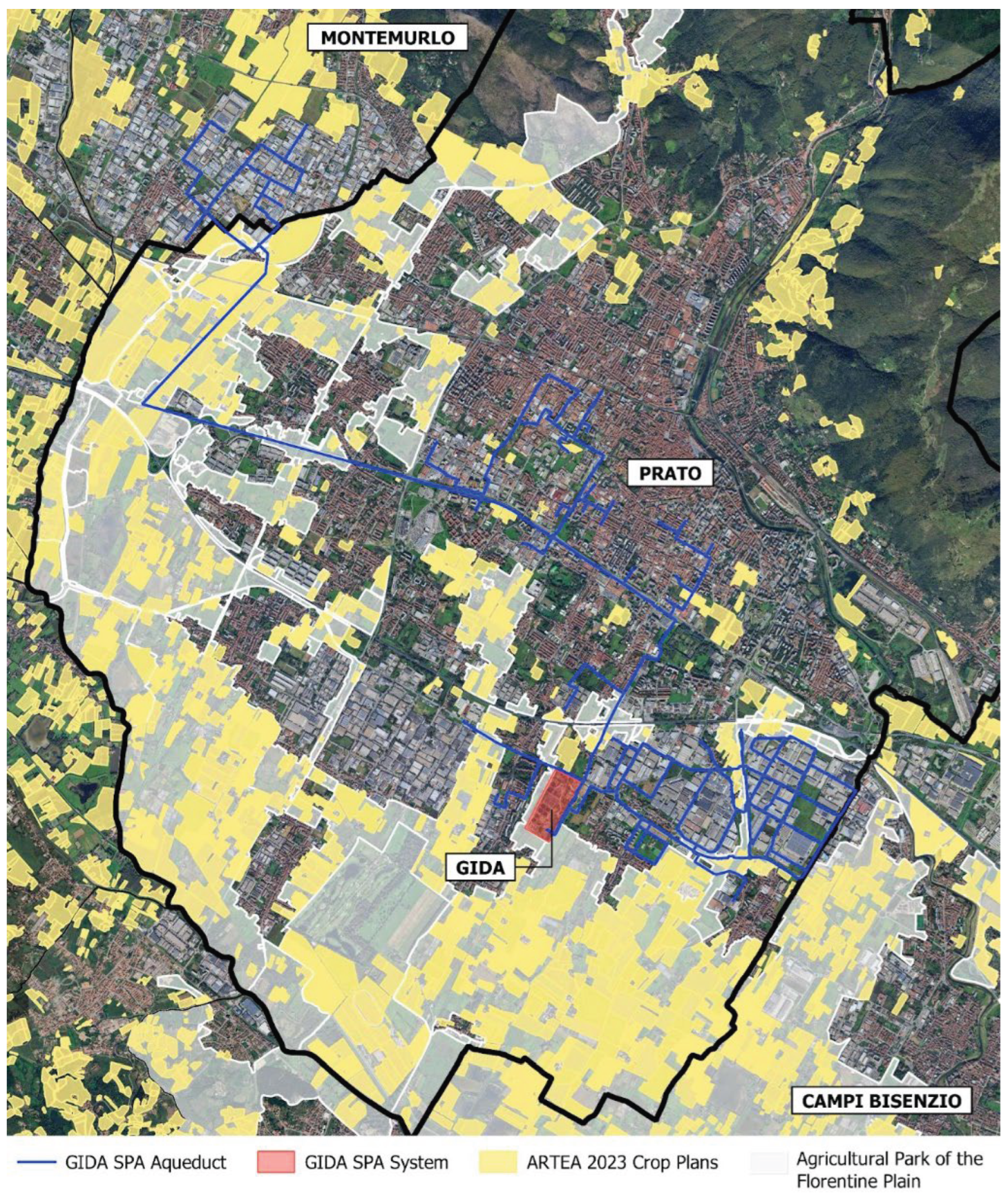
Table 1.
Comparison between the 2023 annual average chemical parameters of reclaimed water from the GIDA treatment plant and the threshold limits for agricultural reuse classes (A–D) established under Regulation (EU) 2020/741.
Table 1.
Comparison between the 2023 annual average chemical parameters of reclaimed water from the GIDA treatment plant and the threshold limits for agricultural reuse classes (A–D) established under Regulation (EU) 2020/741.
|
Quality class A (limits) |
Quality class B (limits) |
Quality class C (limits) |
Quality class D (limits) |
GIDA (average value) |
|
| E. coli (cfu/100 mL) | ≤ 10 | ≤ 100 | ≤ 1000 | ≤ 10000 | 0,0 |
| BOD5 (mg/L) | ≤ 10 | ≤ 25 | ≤ 25 | ≤ 25 | <5 |
| TSS (mg/L) | ≤ 10 | ≤ 35 | ≤ 35 | ≤ 35 | <10 |
| Total phosphorus (mg P/L) | 2-10 | 2-10 | 2-10 | 2-10 | 0.94 |
| Total nitrogen (mg N/L) | 15-35 | 15-35 | 15-35 | 15-35 | 15.5 |
| Ammonium nitrogen (mg NH4+/L) | 2 | 2 | 2 | 2 | 1.1 |
Disclaimer/Publisher’s Note: The statements, opinions and data contained in all publications are solely those of the individual author(s) and contributor(s) and not of MDPI and/or the editor(s). MDPI and/or the editor(s) disclaim responsibility for any injury to people or property resulting from any ideas, methods, instructions or products referred to in the content. |
© 2026 by the authors. Licensee MDPI, Basel, Switzerland. This article is an open access article distributed under the terms and conditions of the Creative Commons Attribution (CC BY) license (http://creativecommons.org/licenses/by/4.0/).
Copyright: This open access article is published under a Creative Commons CC BY 4.0 license, which permit the free download, distribution, and reuse, provided that the author and preprint are cited in any reuse.


