

Submitted:
27 February 2026
Posted:
02 March 2026
You are already at the latest version
Abstract
This study aims to investigate the nature of socio-scientific reasoning around climate change issues using a simulation model. More specifically, the nature of the socio-scientific reasoning of twenty undergraduate students from different disciplinary majors was measured as they engaged with the En-ROADS climate simulation. Data were collected from classroom worksheets that six stakeholder groups completed and individual reflection of twenty students. Data were analyzed using a rubric on a 0-2 scale. The study found that students have high level competency in complexity, perspective taking and multiple perspective taking. The skill of inquiry was absent in group level data, though individual level data showed some high scores. Skepticism and the affordance of science need improvement. Study findings have implications for the development of socio-scientific reasoning competencies through climate change education.
Keywords:
socio-scientific reasoning
; En-ROADS
; simulation
; pillars of sustainability
1. Introduction
Long term changes in temperature and weather patterns are referred to as climate change. Climate change is a multifaceted issue that requires scientific understanding, ethical awareness, and policy action [1]. Indeed, climate change is the most urgent and complex socio-scientific challenge confronting humanity today [2]. Addressing complex socio-scientific issues, such as climate change, requires interdisciplinary educational approaches that cultivate socio-scientific reasoning (SSR). SSR encompasses the ability to recognize complexity, analyze multiple perspectives, employ evidence-based reasoning, and consider the ethical implications of an issue [3,4]. When considering positive climate actions, these reasoning skills become essential for weighing scientific, social, economic, and political factors that influence decision making [5]. Given the inherently interdisciplinary nature of climate change, SSR provides a valuable lens for examining how students engage with decisions related to climate action.
This study seeks to uncover how students make sense of climate action and the associated complex interconnections among environmental, economic, and societal variables [6]. While climate change is a common SSI topic within both K-12 and undergraduate education, a recent systematic literature review of environmental SSIs revealed limited research that explored socio-scientific reasoning related to environmental SSIs [7]. Thus, this investigation furthers understanding of socio-scientific reasoning as an analytical lens to explore how students reason about and evaluate different climate actions. Specifically, this research seeks to explore the research question,
What is the nature of undergraduate students’ socio-scientific reasoning as they engage with possible actions to address global climate change?
1.1. Literature Review
Addressing climate change requires more than a grasp of scientific concepts; it calls for the development of socio-scientific reasoning (SSR), a cognitive and ethical skill set that enables individuals to analyze, evaluate, and make decisions where science, economy, society, and values intersect [8,9,10]. Acquiring such reasoning abilities is vital for becoming informed citizens and active participants in sustainable futures. This literature review examines the role of socio-scientific issues (SSIs) and socio-scientific reasoning (SSR) in fostering critical engagement with complex, real world problems. It further explores their application in climate education, with particular attention to the use of simulations as pedagogical tools.
1.1.1. Socio-Scientific Issues
Socio-scientific issues (SSIs) are complex, real world problems situated at the intersection of science with ethical, political, and societal concerns [4,11]. SSIs serve as authentic contexts for learning and developing the necessary skills and practices needed for the 21st century [12,13]. A growing body of literature highlights the value of using SSIs in education to enhance students’ scientific literacy and equip them with essential 21st-century skills [9,14]. For example, SSI-based approaches have been shown to improve not only students’ content knowledge, but also their understanding of the dynamic relationship between science and society [8,15]. By engaging with SSIs, students develop skills such as critical thinking, argumentation, and decision making [12,16]. They learn to evaluate evidence-based arguments, consider ethical and moral dilemmas, and engage in constructive dialogue. SSI instruction can also increase student engagement and motivation by making science learning more relevant to their lives and empowering them to become informed and active citizens [17].
1.1.2. Socio-Scientific Reasoning
Socio-scientific reasoning (SSR) refers to a set of interrelated cognitive and epistemic practices that individuals use to engage with SSIs. SSR encompasses the ability to critically evaluate information, consider multiple perspectives, and make informed decisions on SSIs [4,8,10,15]. It is not an innate skill, but a competency developed through intentional and integrated instruction [10,18]. Research consistently shows that individuals, particularly children and adolescents, develop their SSR skills over time, moving from simplistic to more sophisticated reasoning [8,18].
The original SSR framework by Sadler et al. (2007) identified four key dimensions: complexity, perspective-taking, inquiry, and skepticism by reflecting the multifaceted reasoning required to address SSIs [4]. Zeidler et al. (2019) expanded the SSR framework by adding a fifth dimension, understanding the affordances and limitations of science, acknowledging that SSI reasoning requires recognition of both the potential and the boundaries of scientific knowledge [19]. Building on this work, Ben-Horin et al. (2023) introduced a sixth dimension, understanding the process of decision making within a community, as essential for navigating SSIs in a society where multiple perspectives exist [20]. Accordingly, this study defines SSR through six dimensions: complexity, perspective-taking, inquiry, skepticism, affordances of science, and multiple perspective-taking.
Complexity recognizes that SSIs are inherently open-ended and interdisciplinary, and as such lack simple solutions [4]. Sadler and colleagues (2007) described a progression in how individuals navigate this complexity, ranging from a low-level reliance on simple cause and effect reasoning to a sophisticated understanding of the competing interests of different stakeholders [4]. At the lower end of this continuum, issues are perceived as straightforward or merely lacking enough data to be solved. Conversely, the most advanced level of reasoning recognizes that because SSIs involve a complex web of competing stakeholder interests and biases, information alone cannot simplify the inherent tensions of the issue [4]. Skills in identifying complexity are a desired educational outcome, and previous studies have shown that when learners interact with dynamic models, they are more likely to conceptualize sustainability as a complex issue [21,22]. Specific to this study, complexity is defined through the triple bottom line, meaning how the students consider complexity from social, economic, and environmental standpoints and the interaction among these standpoints [23].
Perspective-taking can be considered as the ability to examine an SSI from students’ own viewpoints and interest [24]. More explicitly, drawing primarily on personal (or single stakeholder) beliefs rather than coordinated consideration of multiple perspectives. Owens et al. (2020) argued that perspective-taking involves more than simply listing viewpoints, it requires understanding why a particular group holds specific positions and how these perspectives influence potential solutions to socio-scientific issues [3]. In other words, perspective-taking is the ability to reason deeply and coherently from a given standpoint.
Inquiry reflects an appreciation that SSIs are subject to ongoing investigation and uncertainty [4,17]. According to Kinslow and colleagues (2019), inquiry exists on a continuum from students simply listing what they do not know to forming specific questions and creating a plan to explore both the scientific facts and social impacts of SSI [25]. Abrori et al., (2023) argued that students primarily concentrate on answering questions that are explicitly needed to answer questions or solve problems [8]. Meaning to say, there is a notable absence of student initiated questioning, as their engagement is typically limited to the explicit demands of the academic task.
Skepticism marks the evolution from a passive acceptance of information to a more critical evaluation of evidence and sources [25]. This dimension of SSR judges the information and tries to identify if there are any hidden assumptions when it comes to the implementation of actions in the real world [24,26]. Research has established skepticism as a core scientific habit of mind, one that employs critical and innovative lenses to evaluate the implications of proposed solutions to socio-scientific issues (SSIs) [8,27].
Affordance of science describes the ability to determine how scientific knowledge and processes contribute to the resolution of an SSI [19]. The application of scientific knowledge to real world problems also develops, with individuals increasingly recognizing science as a tool for understanding and solving complex socio-scientific issues [24,26,28]. Awareness of how science can and cannot explain phenomena related to socio-scientific issues involves understanding the appropriate role of scientific evidence relative to sociocultural and ethical factors in determining possible resolutions [3,19]. The affordance of science emerges as the evolving capacity to critically assess and strategically deploy scientific knowledge to solve complex socio-scientific issues.
Multiple perspective-taking refers to the process of evaluating and selecting among alternative solutions to socio-scientific issues in light of multiple perspectives and consideration of different beneficiaries [20,29]. Multiple perspective-taking improves as individuals learn to move from impulsive or biased choices to more reasoned, and democratic judgments [20]. Research indicates a developmental progression from egocentric views to more coordinated perspective taking, allowing learners to consider how diverse priorities, values, and professional contexts shape their positions on SSIs [27,30]. Smith et al. (2025) further argued that when students experience difficulty in considering multiple perspectives, it limits the development of their own informed viewpoints [29].
The literature indicates a hierarchy among these six SSR skills. Research argued that even students with low levels of SSR are likely to identify the complexity of an SSI [24], and at the next level of SSR proficiency students show an understanding that different stakeholders will hold different views about the issue [24]. Indeed, complexity and multiple perspective taking show greater gain in comparison to other SSR dimensions [18,25]. Inquiry and skepticism are documented as higher order competencies in comparison to complexity or multiple perspective taking [24]. While Ozturk and Roehrig (2024) reported significant gains in students’ scores for complexity and multiple perspective taking [18], they did not find a significant increase in inquiry and skepticism. Similarly, a study conducted by Ownes and colleagues (2020) found that nearly half of their participants failed to exhibit any skepticism in their reasoning [3]. Romine and colleagues argue that growth in the dimension of complexity may facilitate growth in multiple perspective-taking, which in turn is likely necessary for growth in the dimensions of skepticism and inquiry [24]. They further argue that multiple perspective taking is “a necessary bridge between students’ understanding of complexity and the higher-level competencies of inquiry and skepticism [24] (p.2981)”. In other words, seeing multiple perspectives related to an SSI is “central to development of the other SSR competencies.”
1.1.3. Climate Simulations
Simulations are powerful educational tools that model real world systems, providing a safe, interactive environment for students to experiment, test hypotheses, understand complex relationships, and observe real time consequences [21,31,32,33]. In the context of education, simulations can range from simple interactive models of biological processes to complex digital environments that represent economic or political systems [31,34,35]. These are particularly valuable for subjects that involve abstract, long-term processes that are difficult to observe directly, such as climate change [36].
A growing body of research supports the effectiveness of using climate simulations in education settings [21,22,37,38]. Studies have found that engaging with climate simulations can lead to gains in climate literacy, including a better understanding of the causes, dynamics and impacts of climate change [1,22,33,39]. In addition to knowledge acquisition, climate simulations also foster a deeper and more effective engagement with global climate change. This experience leads to a greater sense of urgency, hope, and a stronger desire to learn and do more about climate change [36,37]. The literature indicates that policy focused simulations are particularly effective at helping students understand that there are no single solutions to climate change, and that a combination of simultaneous actions is necessary to limit global warming [34,37,39,40].
While many climate simulations focus on the scientific aspects of the climate system, such as Earth System Models (ESMs) and General Circulation Models (GCMs), a smaller but equally important category of tools integrates socio-economic and policy variables. For example, En-ROADS (Energy Rapid Overview and Decision Support) allows users to explore the impacts of various policy interventions, such as carbon pricing, renewable energy subsidies, or land use changes on future climate outcomes [22,36]. While prior research has examined the role of simulations in teaching the scientific mechanisms of climate change [41,42], less attention has been given to how students demonstrate and enact socio-scientific reasoning when engaging with climate change scenarios. Understanding the nature of students’ SSR in the context of a climate change simulation such as En-ROADS, can therefore provide valuable insights for advancing climate education.
1.2. Theoretical Framework
From a situated learning perspective, learning is understood as participation in authentic practices rather than the acquisition of abstract knowledge [43]. Learners develop understanding by engaging in activities that mirror how knowledge is used in real world settings and by interacting with others within a community of practice [44]. In this study, students are intentionally positioned not as traditional learners but as members of stakeholder groups who must think, argue, negotiate, and make decisions in ways that resemble real world climate policy processes. Through role play as different stakeholders, students participate in practices similar to those enacted in international climate negotiations, such as UN climate summits. This role-based engagement reflects legitimate participation in a simulated but authentic context.
Within this situated environment, socio-scientific reasoning represents the specific kind of thinking that students are expected to enact and that this study examines. As described earlier, SSR captures how students reason about complex socio-scientific issues by considering assigned perspective-taking, engaging in inquiry, expressing skepticism, drawing on the affordances of science and multiple perspective-taking [3,20,27]. In this framework, SSR is not treated as a decontextualized cognitive skill but as a form of reasoning that emerges through participation in authentic climate action practices.
2. Materials and Methods
2.1. Context
This study explored the nature of undergraduate students’ socio-scientific reasoning (SSR) within a sustainability education course at a private university in North Africa. The university emphasizes liberal arts education, requiring all undergraduate students to complete a set of courses in the humanities, social sciences and natural sciences as part of the university’s core curriculum. The course from which data was collected is part of Global Studies offered by the School of Humanities and Social Sciences. The course enrolls approximately 20 students from various academic disciplines across the university.
The overarching goal of this course is to support undergraduate students in developing a profound understanding of Education for Sustainable Development (ESD) as a critical societal need, both locally and globally. The course uses an interdisciplinary approach, STE²AM (Science, Technology, Engineering, Environmental Education, Arts, and Mathematics) education [45], emphasizing the role of STE²AM in fostering sustainable solutions while equipping students with the knowledge, skills, and ethical perspectives needed to navigate complex ESD issues. This course is organized into five modules and is scheduled for two sessions per week, with each session lasting 1 hour and 15 minutes. (see Table 1):
2.2. Curricular Context
As the focus of this study is module 2, it is described here in detail. Module 2 was taught over five class sessions. In the first session, students were introduced to the En-ROADS climate simulation. En-ROADS offers a dynamic, interactive platform where users can explore the impacts of various policy decisions on global climate outcomes [1,22]. En-ROADS provides immediate visual feedback on projected global temperature changes through the manipulation of variables such as carbon taxes, energy efficiency, and deforestation (see Figure 1). The platform provides 19 interactive and adjustable sliders (or levers) distributed across six categories: Energy Supply, Transport, Buildings and Industry, Growth, Carbon Dioxide Removal, and Other Sources of Greenhouse Gases. Each slider represents a specific action or policy decision aimed at reducing global temperature below 20C by 2100. By adjusting the sliders, students can immediately observe the projected consequences of their actions on global temperature change.
Students were assigned by the instructor to small groups with each group representing a specific stakeholder: Agriculture, Forestry and Land Management; Clean Technology; Climate Justice Hawks; Conventional Energy; Developed Nations; and Developing Nations. And in the second session, students worked within their stakeholder groups to explore possible actions for reducing global temperature. From their stakeholder perspectives, they selected specific actions and identified both the potential benefits and consequences of those choices.
In the third session, each group presented a speech summarizing their proposed actions and anticipated outcomes to the whole class. After each presentation, other stakeholder groups could ask questions and provide comments. During the session, students identified other stakeholders to form coalitions to work together toward decreasing global temperature change.
In the fourth session, each coalition developed joint actions aimed at reducing global temperature to below 2 °C by 2100 and presented a short speech to the class, outlining its final proposal.
The final session included a whole class debrief. After completion of the module, students wrote an individual reflection on their learning.
2.3. Participants
Participants in this study were undergraduate students from different majors. Participants were purposefully divided into six stakeholder groups so that each stakeholder group had members from different majors (see Table 2).
2.4. Research Design
A qualitative case study [46] was utilized to examine students’ socio-scientific reasoning in making decisions to reduce global temperature using the En-ROADS simulation. The case was bounded by the duration of this instructional module and focused on how students engaged in decision making tasks aimed at reducing global temperature. This methodology was selected because it allows for an in-depth exploration of students’ socio- scientific reasoning related to climate action. SSR analysis was conducted at both the group level and individual level.
2.5. Data Collection
Data collection focused on two primary sources: worksheets completed by each stakeholder group and the end of module individual reflection assignment. The group worksheets served as a comprehensive data collection tool that guided students through stakeholder analysis, speech development, and coalition building. In the first section of the worksheet, students used their stakeholder perspective to identify at least three possible climate actions. For each climate action, they documented the action’s alignment with their stakeholder goals, action’s quantitative impact on global temperature, additional positive outcomes, at least two negative consequences, and a priority ranking of the possible actions. In the second section of the worksheet, students were asked to draft a formal advocacy speech that articulated their first ranked action, addressed implementation challenges, and justified why the benefits outweighed the negative trade-offs. The final section of the worksheet asked groups to identify possible coalition partners and document the rationale for forming a coalition with that stakeholder, including the mutual benefits of the partnership, the compromises required to reach a consensus.
At the end of the module, students were asked to complete an individual reflection assignment. Specifically, the students answered six questions (see Table 3).
2.6. Data Analysis
Both the stakeholder group worksheets and individual reflection assignments were analyzed according to the six dimensions of socio-scientific reasoning (SSR). A rubric was developed based on previous work [18], and adapted for the context of climate action, with each dimension being scored on a three-point scale of 0 to 2, where 0 indicates Beginning, 1 indicates Approaching, and 2 indicates Meets (see Table 4).
Group worksheets and individual reflection assignments were coded separately to provide an understanding of SSR at both the stakeholder group and individual student level. Each data source was coded independently by the three authors. Following independent scoring, the three authors met and came to consensus on scores.
3. Results
The results of this study are presented in two subsections. The first section presents findings related to SSR within stakeholder groups and the second section presents findings related to individual student’s SSR.
3.1. Stakeholder group level SSR
Table 5 presents the scores for each SSR dimension for the six stakeholder groups. Looking across the groups, scores were high for complexity, perspective taking, and multiple perspectives. Whereas scores for inquiry, skepticism and affordance of science were at the low to moderate level.
3.1.1. Complexity
Complexity scores across the groups demonstrated that groups were able to consider multiple aspects related to possible climate decisions beyond simply focusing on the impact of a proposed climate action on global temperature change. For example, the Agriculture, Forestry and Land Management group proposed a high reduction of agricultural emissions as their climate action, they acknowledged complexity through consideration of economic issues, in addition to the impact on global temperature change. Specifically, they noted the need to invest in new technology,
While there will be an initial cost to implement these changes, in the long run, we will save resources such as water and sustain economic activity on degrading land because farms will operate more efficiently and emit fewer greenhouse gases.
Climate Justice Hawks identified the complexity of climate action through economic, environmental and social pillars. They wrote in their speech,
One of our goals is to increase taxation on carbon emissions, while this change may negatively impact oil and gas companies profit-wise and might cause a slight spike in price, however we feel the positive impacts of decreasing global warming definitely outweigh the negatives.
They considered the economic impact on business, as well as the impact on individuals. Price increases at the individual level also represent social impacts as these impacts are often equitably distributed within the population. Similarly, Developing Nations drew on economic, environmental and social pillars in proposing subsidizing renewables as their climate action, “Paying subsidies can be very expensive, which requires a reallocation of government funds, taking away from other needs like healthcare or education.” In recognizing the economics involved in providing subsidies, they also connected to the impact that reallocating government funds would have in society.
3.1.2. Perspective Taking
Perspective taking scores across the groups demonstrated that groups were able to propose climate actions that were aligned with their assigned stakeholder. For example, Conventional Energy showed strong alignment with the perspective of their stakeholder when they suggested highly reduced waste and leakage as their climate action. In support of this action, they wrote, “Improves operational efficiency and reduces product loss, cuts emissions without eliminating fossil fuel use.” This action is aligned with the goals of Conventional Energy as it reduces emissions without reducing fossil fuel use. On the other hand, Agriculture, Forestry and Land Management scored 1 in perspective taking because their actions were not fully aligned with their stakeholder’s perspectives. For example, they mentioned increasing carbon prices as a possible climate action, however, policies like carbon pricing would raise costs, particularly for large agribusinesses.
3.1.3. Inquiry
Inquiry scores were 0 for all stakeholder groups. There was no evidence within the worksheets that showed the groups had questions and wanted more information about any aspect of the climate actions that they considered.
3.1.4. Skepticism
Skepticism was also a low scoring dimension, with Clean Tech and Agriculture, Forestry and Land Management scoring 0 (i.e., there was no evidence of skepticism related to possible climate actions) while the other four stakeholders scored 1. For example, while Conventional Energy considered high growth in CO2 removal technology as a possible climate action, they were skeptical about the potential success of this action, stating, “Technological advancements are very expensive and take time and resources to develop. So should we be spending our scarce resources on this?” As another example, Developing countries showed some skepticism about the likelihood of the success of subsidizing renewable energy as a climate action, stating, “ If renewable energy depends too much on government subsidies, companies can see it as unstable, as subsidies are at risk of being modified, so they might not be willing to take the risk of investing.”
3.1.5. Affordance of Science
Affordance of science reflected a wide range of scores across the stakeholder groups. Clean Tech scored 0 as they showed no evidence of using scientific knowledge in their decision making. Climate Justice Hawks were the only stakeholder group that scored high (2) on the affordance of science. In considering reducing deforestation as a possible climate action, they stated, “Trees act as carbon sinks i.e., naturally remove carbon emissions from the atmosphere and so reducing deforestation helps reduce the carbon from the atmosphere.” They also mentioned “Protecting endangered species, promoting biodiversity” and “Decrease in pollution, ocean acidification, acidic soils” as additional benefits of deforestation and decreasing carbon emissions by taxing carbon. Other groups incorporated elements of scientific reasoning into their decision making, for instance, the Developed Nation demonstrated some understanding of science regarding global warming when they stated, “Reducing methane can rapidly slow the rate of global warming, as it is much more effective at trapping heat than CO₂”.
3.1.6. Multiple Perspective Taking
Multiple perspective taking scores were high across all groups with all groups scoring a 2, except for Clean Tech (score of 1). For example, when considering the negative impacts of high growth of natural-based carbon removal as a possible climate action, Agriculture, Forestry and Land Management described how this could “reduce available land to advance infrastructure and economic growth” and that is might negatively impact the “growth of technological carbon dioxide removal to support green industries/companies.” Also, in determining possible coalition partners, they showed an understanding of the perspectives of the Developing Nations groups, stating, “Agriculture is vital to sustaining the well-being and food security of developing countries, as their economies rely heavily on it.” Other stakeholders described differences in perspectives as a factor in determining possible coalition partners. For example, in considering Conventional Energy as a possible partner, Developing countries wrote, “they won’t give up conventional energy, i.e., fossil fuels and coal, which goes against our stakeholder goals.” Similarly, in considering a partnership with Developed Nations, Climate Justice Hawks noted that “Developed countries are concerned about economic growth which might go against some of our goals (we prioritize the environment over economic development).”
3.2. Individual Level SSR
At the individual level, students wrote reflections based on the six prompts shared in Table 3. Each reflection response was scored using the same SSR rubric as the stakeholder groups. The spread of the scores for each dimension is shared in Table 6. Looking across the dimensions, the majority of students (18/20) scored high for complexity and skepticism. Whereas only half of the students scored high for affordance of science, with three students scoring zero in this dimension.
3.2.1. Complexity
Complexity scores showed a high level of reasoning related to the complex nature of climate action. This mirrored findings from the group level analysis, while providing richer evidence of how students considered complexity in their decision making. Students’ reasoning drew not only on environmental impacts for a chosen climate action but also weighed both economic and social impacts. For example, S6 from the Clean Tech group identified complexity in regard to increasing carbon price,
However, this policy was environmentally effective while having numerous economic and social consequences. From an economic perspective, raising carbon prices would increase production costs and put pressure on industries that are dependent on fossil fuels. Socially, my team and I realized that the impact would not be evenly distributed. Richer nations and corporations could afford the new taxes and transition more easily to clean technologies, while developing countries and smaller businesses might struggle to do that.
Some students also considered economic and social factors having an inequitable impact on individual citizens, not just businesses. For example, S4 from Agriculture, Forestry and Land Management group shared,
When we considered policies like increasing taxes on coal, we immediately had to think about the economic impact on business owners, the social burden placed on low-income populations through higher prices, and the environmental benefit of reducing carbon emissions.
Students used the language of trade-offs in weighing environmental, economic and social aspects of complexity. For example, S16 from the Developing Nations stakeholder group, highlighted the trade-offs between environmentally friendly actions such as reduction of waste and leakage,
The En-ROADS simulation showed me how challenging it is to balance between the three components of the triple bottom line: people, profit, and the planet. Every time we adjust any of the strategies, the others get affected. For example, environmentally friendly actions such as reducing waste, leakage and cutting emissions often come with additional expenses and needed adjustments to the companies and their staff. On the other hand, focusing only on the economy typically resulted in increasing pollution and health issues for people.
3.2.2. Perspective Taking
For perspective taking students were asked to project and explain the perspectives of Conventional Energy and Developing Nations to a proposal to move to 100% renewable energy. Nine students received a score of 1 and 11 students received a score of 2. Students with lower scores did not provide reasoning related to the position of the respective stakeholders. For example, S5 from Clean Tech wrote,
I think that conventional energy would respond to moving to 100% renewable energy saying that it’s not realistic. For example, using solar energy panels requires sunlight, which is present only during daytime. This will create a problem of limited work hours. Also, the weather may affect the efficiency of renewable energy sources.
While they appropriately recognized that Conventional Energy would be opposed to moving fully to renewable energy, their reasoning drew on issues of science and the technologies themselves, rather pushing for protections for the fossil fuel industry. This is in contrast to students who scored higher using arguments specific to the stakeholder’s perspectives. For example, S8, a member of the Conventional Energy group, emphasized that a rapid shift away from conventional energy sources could threaten the economic viability of conventional energy industries.
If the climate justice hawks demanded moving to 100% renewable energy, the conventional energy group would strongly oppose that. From conventional energy’s point of view, a transition as such would threaten the entire industry and millions of jobs related to fossil fuels. Although we realize the need to reduce emissions and how important it is, we would argue for a more gradual transition that allows room for technological improvements or adaptations rather than fully moving to renewable energy. In my opinion, I think conventional energy would respond by promoting actions like CO2 removal technologies or reducing waste and leakage as mentioned before. This would lower emissions without fully eliminating fossil fuel use. In this way, they would still be aligned with the goals they have.
3.2.3. Inquiry
Inquiry scores were stronger than found in the stakeholder group data, with 13 out of 20 students scoring at the highest level and the other nine students scoring a 1. When asked what additional information students would like to have beyond that provided in the simulation, students expressed a desire for information related to economic and social impacts. For example, S16, a member of the Developing Nations group, stated, “I would have preferred additional details regarding each policy’s social, economic, and job creation effects, not just its environmental effects.” Other students were more specific in the types of information where more data would be needed to make an informed decision on climate action. For example, S6 (Clean Tech) stated,
We would have benefited from a clearer view on how carbon taxes might affect employment rates and consumer prices. We also needed more information about job creation opportunities in the clean energy area compared to job losses in fossil fuel industries. Overall I think having such data would make it easier to analyze whether the transition would cause harm or deliver benefits and combining it with more real world socioeconomic data would make it powerful and realistic.
Another common area of inquiry was for regional level data; some students inquired about country or region-specific information because the simulation presented only global level information. For example, S7 from Clean Tech noted,
The simulation lacked sector and region specific information which is why I was not entirely confident with all my actions, although the simulation was very valuable at a global scale. The model only presented global averages, but within each country the energy dependencies, industrial structures, and economic capabilities vary widely. For instance, developed nations could easily implement a universal carbon tax, however, poorer nations which are dependent on coal could be heavily disadvantaged. More background data on regions within Africa, Asia or Europe would have made the decision making far more informed and fair.
3.2.4. Skepticism
Skepticism was demonstrated by students through their recognition that proposed climate actions would be successful only under specific political, economic, and social conditions. In contrast to the group level data, students scored high in skepticism with no students scoring 0, only two students scoring 1, and 18 students scoring 2. Across responses, students emphasized that real world climate actions require coordinated governance, economic feasibility and social acceptance. For example, S6 (Clean Tech) reflected, “I think for this action to be successful in the real world, many political, economic, and social conditions must be implemented.” Students who scored highly went on to provide specific details. Some examples of political conditions needed for successful climate action were:
Politically, governments must come together to set a fair and coordinated carbon pricing system. Formulating universal frameworks for carbon policies, global markets, and fair enforcement mechanisms would be important (S2, Agriculture, Forest and Land Management)
Politically, the government should support companies that try to implement clean work by cutting taxes or placing subsidies because this will motivate businesses to take action (S9, Conventional Energy).
Students also provided detailed examples of economic conditions that would need to be in place for a climate action to be successful:
Economically, governments need to offer subsidies and incentives to industries and consumers to help them transition smoothly. This might include investing in renewable infrastructure, supporting clean tech startups, and providing tax breaks for sustainable innovations. It is also important to ensure that carbon tax revenues are reinvested into the green economy (S6, Clean Tech).
For the economic aspect we must ensure that there is funding for anyone who is contributing to achieving this action, there must be rewards for those who reach the targets set for them, the prices for the technology needed for such an action has to be realistic and it mustn’t have a negative effect on the economy of any country (S10, Conventional Energy).
Finally, students also described social parameters that could impede the success of possible climate actions, in particular pointing to the need to educate the public.
Socially, there should be social support to aid the public in understanding the concepts of carbon pricing and its positive impact for the future. People need to understand that there is more to pricing carbon than taxes, there is a future with a cleaner environment associated with it. There will be societal support when there is proper education, incentives to live a greener lifestyle, and policies to monitor positive change in the air and actively create jobs in clean technology (S7, Clean Tech).
Socially, people would need to change their behavior, choosing electric vehicles, supporting wind and solar projects in their communities, and accepting that fossil fuel jobs may decline as renewable jobs grow (S13, Developed Nation).
Socially, people must understand why reducing emissions matters and support sustainable lifestyles (S19, Climate Justice Hawks).
3.2.5. Affordance of Science
Affordance of science was evident in students’ reflections on how scientific knowledge informed their climate related decision making. The scores reflected varied levels of understanding, with three participants scoring 0, seven scoring 1, and ten scoring 2. While this was the lowest overall scoring dimension, there is strong growth in comparison to the group level data. Students with a score of 0 for affordance of science simply mentioned that carbon dioxide emissions are the cause of global temperature rise. Other students showed a stronger consideration of science in their decision making. For example, S8 from Conventional Energy stated,
My knowledge in biology was critical, it allowed me to understand the positive feedback loops … I know that although a 0.3 degree celsius change due to reduction in waste and leakage might seem insignificant, a change like that could mean the difference between ice thawing which is one of the main positive feedback loops increasing warming.
While S8 (Conventional Energy) was a science major, non-science majors were also able to engage in scientific reasoning related to proposed climate actions. For example, S13 from the Developed Nations group, demonstrated the affordance of science by explicitly linking scientific knowledge to the group’s support for deforestation reduction, “When we looked at deforestation, I remembered how forests don’t just absorb carbon, but also stabilize rainfall and protect biodiversity, which the science clearly links to climate resilience.”
3.2.6. Multiple Perspective Taking
Multiple perspective taking was strong at the individual level, with six students scoring 1 and fourteen scoring 2. These scores paralleled scores from the group data showing that students are aware of different perspectives and the need to negotiate to build consensus. For example, S7 from Clean Tech identified the importance of negotiation, and strategic planning in forming a coalition between Clean Teach and Climate Justice Hawks,
The Climate Justice Hawks spoke more on the social and ethical aspects of climate action and how the increasing energy costs would unfairly affect vulnerable people while we of the Clean Tech spoke more on innovation, market, and the long-term profitability of renewable solution economics. We, therefore, fully supported a strategic plan of a gradual increase in carbon prices, while also improving or developing tech in clean energy.
S14 from Developed Nations demonstrated multiple perspective taking by reflecting on the coalition with Conventional Energy, she recognized that tensions exist between economic and energy security concerns with Conventional energy wanting to protect fossil fuels and Developed Nations wanting to accelerate renewable energy,
Their goals were maintaining energy reliability, protecting existing fossil-fuel jobs, and minimizing economic disruption, while we wanted mainly to accelerate the transition to renewable energy and reduce emissions. So initially, both goals were contradicting, seeming almost impossible to find common ground.
4. Discussion
This study examined the nature of undergraduate students’ socio-scientific reasoning (SSR) as they engaged in determining possible climate actions to reduce global temperature change. There was notable variation across SSR dimensions, each dimension is discussed below.
Complexity was prominent in participants’ socio-scientific reasoning about climate action. Students demonstrated a strong level of understanding and consideration of complexity at both the stakeholder and individual setting. This is consistent with prior research showing that complexity is often more strongly developed than other dimensions of socio-scientific reasoning [18,25]. Students utilized the “triple bottom line” as a framework to evaluate the environmental, economic, and social aspects of complexity in taking climate actions. This aligns with literature suggesting that, when learners interact with dynamic models, they are more likely to conceptualize sustainability as a complex issue [21,22].
Perspective-taking scores at the group level were high, demonstrating competency in aligning climate actions with specific stakeholder goals. Students demonstrated stronger performance at the stakeholder group level, where they remained embedded within a single stakeholder perspective over time. In contrast at the individual level, when asked to take the perspective of both Conventional Energy and Developing Nations, several students struggled to fully internalize these perspectives, which resulted in lower scores. While the literature suggests that some students struggle to engage in critical examination from a single standpoint [4], this study shows that students can engage in SSR from a specific perspective, especially when given time to engage in SSR from that perspective.
Inquiry as an SSR dimension revealed significant discrepancies between group and individual scores. At the group level all stakeholders scored 0, whereas at the individual level students consistently inquired and acknowledged uncertainty, leading towards better scores. These inquiries included a desire for more information about finance, policy and social aspects of climate action. The higher scores at the individual level may be attributed to the structure of the reflection questions, which explicitly prompted students to inquire more deeply about the simulation. This aligns with the literature suggesting that students tend to focus primarily on responding to given questions and are more likely to generate their own inquiries only when such questioning is necessary to solve a problem [8]. Whereas, at the stakeholder level students were able to choose actions from the simulation, without needing to ask questions about financial, political, social, or additional environmental impacts. As the module continued and students had a chance to debate the proposed climate actions of other groups and to form coalitions, they needed to consider additional aspects related to each climate action beyond its impact on global temperature change. As students strengthened their understanding of the multiple perspectives, their reasoning related to the inquiry dimension developed. This parallels the literature that suggests that growth in multiple perspective-taking is necessary for growth in the inquiry dimension [24].
Students’ engagement in skepticism as part of their reasoning about climate action followed a similar trajectory to inquiry, showing marked improvement from the group to individual level. Students moved from a passive acceptance of information to a more critical evaluation at the individual reflection writing, expressing skepticism about the economic, social and political feasibility of proposed climate actions. As noted in the literature, skepticism evolves from a passive acceptance of information to a more critical evaluation of information in real world implementation [25]. Similar to growth in the inquiry dimension, skepticism developed as the class activities required students to engage with other stakeholder groups, addressing questions from other stakeholders, defending their positions, and forming coalitions. Similar to inquiry, skepticism is considered as a higher competency of SSR that develops only after the lower level competencies of complexity and multiple perspectives have developed [24].
Affordance of science scores were the most varied, ranging from 0 to 2 both at the stakeholder and individual levels. A central claim of this study is that limited scientific knowledge did not hamper students’ ability to reason about climate actions. The simulation incorporated built-in key scientific relationships, such as the link between increased CO2 emissions and the rising global temperature which provided enough scientific information to consider, select, and defend possible climate actions. This aligns with the argument that science is just one tool among many, including sociocultural and ethical factors, used in reasoning related to an SSI such as climate change [28]. Though the literature recognizes science as a tool for understanding and solving complex socio-scientific issues [24,26,28], the current study suggests that other SSR dimensions can flourish even when technical scientific literacy is still developing. Indeed, these SSR dimensions can transfer to reasoning about other SSI topics, whereas scientific knowledge about climate change is not transferable to a new SSI [24].
Multiple perspective-taking was a strong dimension in students’ reasoning at both the stakeholder and individual levels. Students demonstrated the ability to evaluate diverse perspectives of different stakeholders and honor these differences in working toward coalitions for climate action. This indicates a successful transition from impulsive choices to more reasoned and democratic judgment. This aligns with the literature that multiple perspective taking allows learners to consider how diverse stakeholders’ priorities, values and professional contexts shape decision making [20,30].
The findings of this study have important implications in education for sustainable development, climate communication, curriculum design, and policy engagement. By highlighting how instructional approaches can foster socio-scientific reasoning, the study underscores the value of learning environments that immerse students in authentic climate related decision making. Examining how students reason through complex trade-offs, such as balancing economic costs with environmental and social benefits, provides insight into decision making about sustainability issues. This study also highlights the importance of in-depth engagement with climate action that goes beyond working in isolation about multiple stakeholders. It was not until students were pushed beyond their initial stakeholder groups and engaged in developing coalitions for climate action, that the dimensions of inquiry and skepticism started to develop.
5. Conclusions
The findings of this study demonstrated students’ competency in SSR, in particular the dimensions of complexity, perspective taking, and multiple perspective taking. This solid foundation and the opportunity to engage in proposing and reasoning about climate actions both as a single stakeholder group and later as a coalition of multiple stakeholder groups strengthen students’ engagement in the dimensions of inquiry and skepticism which are essential for deeper socio-scientific reasoning in climate education. Socio-scientific reasoning is critical to develop a more climate literate citizenry, as climate action needs to consider multifaceted contexts and perspectives. A sustainable, equitable and peaceful future requires that students practice and fully engage in the different dimensions of SSR.
Supplementary Materials
The following supporting information can be downloaded at the website of this paper posted on Preprints.org.
Author Contributions
Conceptualization, Gillian Roehrig, Heba EL-Deghaidy and Shuvra Rahman; methodology, Gillian Roehrig, Heba EL-Deghaidy and Shuvra Rahman; formal analysis, Gillian Roehrig, Heba EL-Deghaidy and Shuvra Rahman; investigation, Gillian Roehrig, Heba EL-Deghaidy and Shuvra Rahman; resources, Gillian Roehrig, Heba EL-Deghaidy and Shuvra Rahman; writing—original draft preparation, Shuvra Rahman; writing—review and editing, Gillian Roehrig, Heba EL-Deghaidy; supervision, Gillian Roehrig, Heba EL-Deghaidy. All authors have read and agreed to the published version of the manuscript.
Institutional Review Board Statement
The study was conducted in accordance with the Declaration of Helsinki, and approved by the Institutional Review Board of The American University of Cairo (Case # 2024-2025-270 Date of approval July 22, 2025) and University of Minnesota, (STUDY 00026246, Date of approval Sept 12, 2025).
Informed Consent Statement
Informed consent was obtained from all subjects involved in the study.
Data Availability Statement
The original contributions presented in this study are included in the article/supplementary material. Further inquiries can be directed to the corresponding author.
Conflicts of Interest
The authors declare no conflicts of interest.
Abbreviations
The following abbreviations are used in this manuscript:
| En-ROADS | Energy Rapid Overview and Decision Support |
| SSR | Socio-Scientific Reasoning |
| SSI | Socio-Scientific Issues |
References
- Rooney-Varga, J. N.; Hensel, M.; McCarthy, C.; McNeal, K.; Norfles, N.; Rath, K.; Sterman, J. D. Building consensus for ambitious climate action through the world climate simulation. Earth’s Future 2021, 9, e2021EF002283. [Google Scholar] [CrossRef]
- Rayhan, M. Climate change and sustainable development–Public awareness measure with climate simulator En-ROADS. Master’s Thesis, University of South-Eastern Norway, Notodden, Norway, 2022. [Google Scholar]
- Owens, D. C.; Petitt, D. N.; Lally, D.; Forbes, C. T. Cultivating water literacy in STEM education: Undergraduates’ socio-scientific reasoning about socio-hydrologic issues. Water 2020, 12, 2857. [Google Scholar] [CrossRef]
- Sadler, T. D.; Barab, S. A.; Scott, B. What do students gain by engaging in socioscientific inquiry? Res. Sci. Educ. 2007, 37, 371–391. [Google Scholar] [CrossRef]
- Mukherjee, I. Optimizing Climate Policy through C-ROADS and En-ROADS Analysis. arXiv 2023, arXiv:2311.03546. [Google Scholar]
- Carleton, T. A.; Hsiang, S. M. Social and economic impacts of climate. Science 2016, 353, aad9837. [Google Scholar] [CrossRef]
- Kumar, V.; Choudhary, S. K.; Singh, R. Environmental socio-scientific issues as contexts in developing scientific literacy in science education: A systematic literature review. Soc. Sci. Humanit. Open 2024, 9, 100765. [Google Scholar] [CrossRef]
- Abrori, F. M.; Lavicza, Z.; Anđić, B. Enhancing socio-scientific reasoning of elementary school students through educational comics: A comprehensive exploration across diverse domain of knowledge. Educ. 2023, 3–13, 1–22. [Google Scholar]
- Owens, D. C.; Sadler, T. D.; Petitt, D. N.; Forbes, C. T. Exploring undergraduates’ breadth of socio scientific reasoning through domains of knowledge. Res. Sci. Educ. 2022, 52, 1643–1658. [Google Scholar] [CrossRef]
- Romine, W. L.; Sadler, T. D.; Kinslow, A. T. Assessment of scientific literacy: Development and validation of the Quantitative Assessment of Socio-Scientific Reasoning (QuASSR). J. Res. Sci. Teach. 2017, 54, 274–295. [Google Scholar] [CrossRef]
- Pleasants, J. Inquiring into the nature of STEM problems: Implications for pre-college education. Sci. Educ. 2020, 29, 831–855. [Google Scholar] [CrossRef]
- Gulacar, O.; Zowada, C.; Burke, S.; Nabavizadeh, A.; Bernardo, A.; Eilks, I. Integration of a sustainability-oriented socio-scientific issue into the general chemistry curriculum: Examining the effects on student motivation and self-efficacy. Sustainable Chem. Pharm. 2020, 15, 100232. [Google Scholar] [CrossRef]
- Sadler, T. D.; Romine, W. L.; Topçu, M. S. Learning science content through socio-scientific issues-based instruction: A multi-level assessment study. Int. J. Sci. Educ. 2016, 38, 1622–1635. [Google Scholar] [CrossRef]
- Kahn, S.; Zeidler, D. L. A conceptual analysis of perspective taking in support of socioscientific reasoning. Sci. Educ. 2019, 28, 605–638. [Google Scholar] [CrossRef]
- Eggert, S.; Nitsch, A.; Boone, W. J.; Nückles, M.; Bögeholz, S. Supporting students’ learning and socioscientific reasoning about climate change—the effect of computer-based concept mapping scaffolds. Res. Sci. Educ. 2017, 47, 137–159. [Google Scholar] [CrossRef]
- Chang, H. Y.; Hsu, Y. S.; Wu, H. K.; Tsai, C. C. Students’ development of socio-scientific reasoning in a mobile augmented reality learning environment. Int. J. Sci. Educ. 2018, 40, 1410–1431. [Google Scholar] [CrossRef]
- Ariza, M. R.; Christodoulou, A.; van Harskamp, M.; Knippels, M. C. P.; Kyza, E. A.; Levinson, R.; Agesilaou, A. Socio-scientific inquiry-based learning as a means toward environmental citizenship. Sustainability 2021, 13, 11509. [Google Scholar] [CrossRef]
- Ozturk, N.; Roehrig, G. H. Effects of an Integrated STEM Unit Designed around Socioscientific Issues on Middle School Students’ Socioscientific Reasoning. Int. J. Sci. Math. Educ. 2024, 1–26. [Google Scholar] [CrossRef]
- Zeidler, D. L.; Herman, B. C.; Sadler, T. D. New directions in socioscientific issues research. Disciplinary Interdiscip. Sci. Educ. Res. 2019, 1, 1–9. [Google Scholar] [CrossRef]
- Ben-Horin, H.; Kali, Y.; Tal, T. The fifth dimension in socio-scientific reasoning: Promoting decision-making about socio-scientific issues in a community. Sustainability 2023, 15, 9708. [Google Scholar] [CrossRef]
- Ardh, K.; Fujii, H.; Iwata, K.; Ogura, Y.; Koeda, M.; Teramoto, T. Implementation and Evaluation of Climate Change Education in School Science and Science Teacher Training Using Simulation as Teaching Materials. JSSE Res. Rep. 2025, 39, 43–48. [Google Scholar]
- Burger, J.; Clark, R.; Preece, D.; Webb, H. Simulated climate solutions: using the EN-ROADS simulator. Teach. Geogr. 2023, 48, 114–116. [Google Scholar]
- Harvard Business School Online. The triple bottom line: What it is & why it’s important. Business Insights Blog. Available online: https://online.hbs.edu/blog/post/what-is-the-triple-bottom-line (accessed on 8 December 2020).
- Romine, W. L.; Sadler, T. D.; Dauer, J. M.; Kinslow, A. Measurement of socio-scientific reasoning (SSR) and exploration of SSR as a progression of competencies. Int. J. Sci. Educ. 2020, 42, 2981–3002. [Google Scholar] [CrossRef]
- Kinslow, A. T.; Sadler, T. D.; Nguyen, H. T. Socio-scientific reasoning and environmental literacy in a field-based ecology class. Environ. Educ. Res. 2019, 25, 388–410. [Google Scholar] [CrossRef]
- Karahan, E.; Roehrig, G. Secondary school students’ understanding of science and their socio scientific reasoning. Res. Sci. Educ. 2017, 47, 755–782. [Google Scholar] [CrossRef]
- Sadler, T. D. Situated learning in science education: socio-scientific issues as contexts for practice. Stud. Sci. Educ. 2009, 45, 1–42. [Google Scholar] [CrossRef]
- Owens, D. C.; Sadler, T. D. Socio-scientific issues as contexts for the development of STEM literacy. In Handbook of Research on STEM Education; Routledge: New York, NY, USA, 2020; pp. 210–222. [Google Scholar]
- Smit, R.; Rietz, F.; Büchel, D. Using the socioscientific issue approach to foster secondary students’ argumentation skills, science self-efficacy beliefs and science interest. Int. J. Sci. Educ. 2025, 1–17. [Google Scholar] [CrossRef]
- Namdar, B.; Namdar, A. O. Fostering students’ values through role play about socioscientific issues. Phys. Teach. 2021, 59, 497–499. [Google Scholar] [CrossRef]
- Feurzeig, W.; Roberts, N. Modeling and Simulation in Science and Mathematics Education; Springer Science & Business Media: New York, NY, USA, 1999; Vol. 1. [Google Scholar]
- Khademolhosseini, M. S. Impacts of global warming on the whole environment and suggestions for solving them by EN-ROADS model. Environ. Eng. Manag. J. 2023, 22. [Google Scholar] [CrossRef]
- Wyatt, S. N.; Sullivan-Watts, B. K.; Watts, D. R.; Sacks, L. A. Facilitating Climate Change Action in the Ocean Sciences Using the Interactive Computer Model En-ROADS. (journal or source details incomplete; adjust if available). 2022.
- Adedoyin, O. B.; Soykan, E. Covid-19 pandemic and online learning: the challenges and opportunities. Interact. Learn. Environ. 2023, 31, 863–875. [Google Scholar] [CrossRef]
- Marhraoui, M. A.; Ojubanire, O. A. Smart Learning and Climate Change Awareness: A Simulation-Based Case Study in Morocco. Eur. J. Educ. 2025, 60, e12917. [Google Scholar] [CrossRef]
- Rooney-Varga, J. N.; Kapmeier, F.; Sterman, J. D.; Jones, A. P.; Putko, M.; Rath, K. The climate action simulation. Simul. Gaming 2020, 51, 114–140. [Google Scholar] [CrossRef]
- Howell, T. A Climate Policy Primer. Open Educational Resources. 2022, 28. Available online: https://rdw.rowan.edu/oer/28 (accessed on 6 February 2026).
- World Climate Simulation for Classrooms. Available online: https://www.uml.edu/research/climate-change/resources/education/simulation-based-learning/world-climate-simulation-classroom.aspx (accessed on 6 February 2026).
- Interactive, C. En-ROADS Climate Solutions Simulator, Climate Interactive. United States of America. Available online: https://coilink.org/20.500.12592/562k19 (accessed on 10 May 2025).
- Karabiyik, T.; Jaiswal, A.; Thomas, P. Assessing Climate Literacy in Engineering Undergraduate Students Through Simulation-Based Learning. In Proceedings of the 2024 IEEE Frontiers in Education Conference (FIE), 2024; pp. 1–7. [Google Scholar]
- Hensel, M.; Bryan, J.; McCarthy, C.; McNeal, K. S.; Norfles, N.; Rath, K.; Rooney-Varga, J. N. Participatory approaches enhance a sense of urgency and collective efficacy about climate change: Qualitative evidence from the world climate simulation. J. Geosci. Educ. 2023, 71, 177–191. [Google Scholar] [CrossRef]
- Shepardson, D. P.; Niyogi, D.; Choi, S.; Charusombat, U. Students’ conceptions about the greenhouse effect, global warming, and climate change. Clim. Change 2011, 104, 481–507. [Google Scholar] [CrossRef]
- Lave, J. Cognition in Practice: Mind, Mathematics and Culture in Everyday Life; Cambridge University Press: Cambridge, UK, 1988. [Google Scholar]
- Brown, J. S.; Collins, A.; Duguid, P. Situated cognition and the culture of learning. Educ. Res. 1989, 18, 32–42. [Google Scholar] [CrossRef]
- EL-Deghaidy, H. Education for sustainability in Egypt: Participants’ perspectives; 2016. [Google Scholar]
- Yin, R. K. Case Study Research: Design and Methods, 5th ed.; Sage: Thousand Oaks, CA, USA, 2014. [Google Scholar]
Figure 1.
Initial En-ROADS screen.
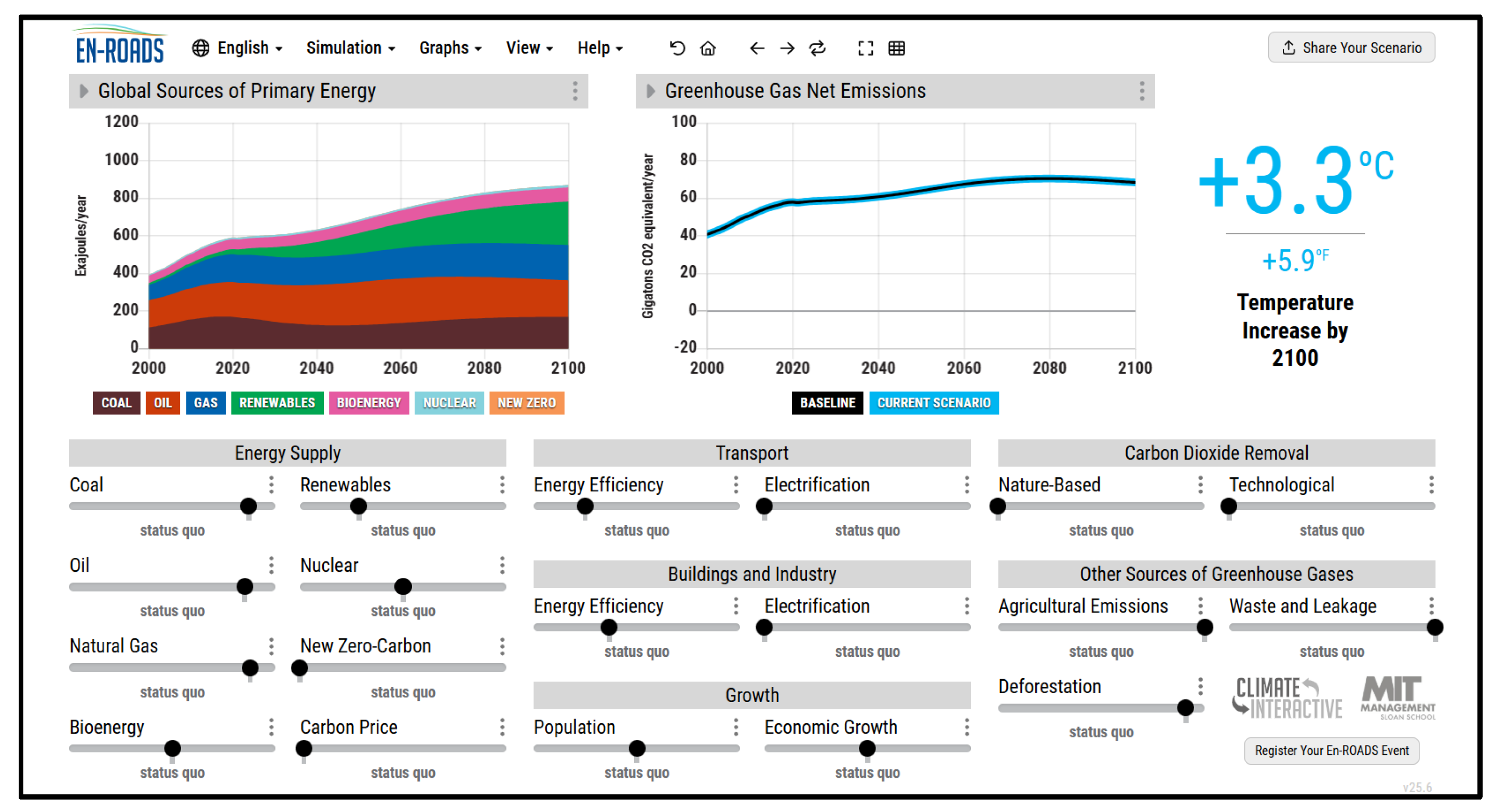

Table 1.
Course module and content.
| Module No | Content |
|---|---|
| Module 1 | Sustainable Development Goals (SDGs), ESD and its goals, ESD in regional and global level. |
| Module 2 | Climate action through a climate change simulation (En-ROADS). |
| Module 3 | STEM/STEAM education: its goals, strategies, and elements. Integration of ESD and STE²AM in curriculum development. |
| Module 4 | Pedagogical approaches and assessment suitable for ESD/STEM/STEAM. |
| Module 5 | STE²AM in action through group projects. |
Table 2.
Stakeholder groups and members.
| Stakeholder groups | Students and their majors |
|---|---|
| Agriculture, Forestry and Land Management | S1 (Computer science) S2 (Psycology) S3 (Business and Entrepreneurship) S4 (Architectural Engineering) |
| Clean Tech | S5 (Middle East Studies) S6 (Electronics and Communications Engineering) S7 (Accounting) |
| Conventional Energy | S8 (Biology) S9 (Business) S10 (Sociology) |
| Developed Nations |
S11 (Integrated Marketing Communication) S12 (Business and Entrepreneurship) S13 (Finance,TRG & MES) S14 (Computer Engineering) |
| Developing Nations |
S15 (Biology) S16 (Mechanical Engineering) S17 (Psychology) |
| Climate Justice Hawks | S18 (Chemistry) S19 (Computer Engineering) S20 (Integrated Marketing Communication) |
Table 3.
Reflection questions for individual assignments.
| Write an individual reflection (1000-1500 words) addressing the following questions, from your point of view. Reflection questions 1. Describe how the En-ROADS simulation revealed the complexity of the triple bottom line. What interconnections between these different pillars impacted your choice of action? Based on your experience with the simulation, is keeping the temperature rise below 20C by 2100 possible? Explain. 2. The Climate Justice Hawks advocate to move to 100% renewable energy. How do you think Conventional Energy would respond to that? Explain. How do you think developing countries would respond to this? Explain. 3. Did the simulation provide enough information for you to feel confident with your actions? (Explain). What additional information would you have liked to have? 4. What action did your group decide for round one? From your point of view, what other things would need to happen (politically, economically, socially) for this action to be successful? 5. What scientific knowledge informed your decisions? 6. In round two, you had to consider multiple stakeholders to come to a consensus. How did the different views influence your decision-making process? |
Table 4.
Definitions and rubric of six SSR dimensions.
| SSR Dimension | Definition and Rubric |
|---|---|
| Complexity | Recognizing that global climate change action presents a complex problem without straightforward solutions and can not be resolved without consideration of the three pillars of sustainability (economic, social, and environmental) factors and their interactions. 0- Views addressing global climate actions as a simple problem with straightforward solutions without considering any negative impacts. 1- Acknowledges some complexity related to interactions between two or more pillars of sustainability. 2- Fully acknowledges complexity amongst the three pillars of sustainability and the tradeoffs between them. |
| Perspective-taking | Each stakeholder has their own priorities, values and preconceptions towards positive climate actions. Understanding an assigned stakeholder’s view is essential. 0 - Suggested actions are not aligned with stakeholder goals. 1 - Suggested actions are partially aligned with stakeholder goals. 2 - Suggested actions are fully aligned with stakeholder goals. |
| Inquiry | Acknowledging that positive climate actions include inherent uncertainty and ambiguity that requires ongoing investigation and inquiry. 0- Accepts the provided information and outcomes of climate actions without question, showing no recognition of uncertainty or need for further inquiry. 1- Expresses some awareness that the outcomes of climate actions may be uncertain, but the description of what inquiry or data would be needed remains unclear or vague. 2- Explicitly acknowledges uncertainty in the outcomes of proposed climate actions and clearly identifies the types of inquiry, evidence, or data needed to investigate and address that uncertainty. |
| Skepticism | Exhibiting skepticism when assessing the likelihood of the outcomes of chosen climate actions in the practical world. 0 - Students accept the modelled outcomes of their chosen climate actions without question. 1- Students identify some issues that might impact the modelled outcome of their proposed climate action, but the issues are not clearly explained. 2- Students clearly identify and explain issues that might impact the modelled outcome of their climate action. |
| Affordance of science | Identifying how scientific knowledge, data and/or methods can contribute to decisions and actions related to global climate change. 0 - Students demonstrate no understanding of how science informs decisions/actions towards global climate change. 1- Students show some understanding of how science informs decisions/actions towards global climate change. However, they are not fully able to articulate the role of science in decision making. 2- Students are able to clearly identify and articulate how science informs their decision making related to global climate actions. |
| Multiple perspective- taking |
Different stakeholders have different positions on socio-scientific issues based on their priorities, professional backgrounds, values and preconceptions. Including multiple stakeholders’ perspectives is important in making decisions related to global climate change. 0- Students do not demonstrate an understanding of other stakeholders’ views or possible reactions to suggested climate actions. 1- Students demonstrate understanding of other stakeholders’ views but show minimal understanding of working with different views to develop consensus about possible climate actions. 2- Students demonstrate understanding of other stakeholders’ views and the reality of working with different views to develop consensus about possible climate actions. |
Table 5.
Scores for each SSR dimension at the stakeholder level.
| Stakeholder group | Complexity | Perspective taking | Inquiry | Skepticism | Affordance of Science | Multiple perspective taking |
|---|---|---|---|---|---|---|
| Agriculture, Forestry and Land Management | 2 | 1 | 0 | 0 | 1 | 2 |
| Clean Tech | 1 | 2 | 0 | 0 | 0 | 1 |
| Conventional Energy | 2 | 2 | 0 | 1 | 1 | 2 |
| Developing Countries | 2 | 1 | 0 | 1 | 1 | 2 |
| Developed Countries | 2 | 2 | 0 | 1 | 1 | 2 |
| Climate Justice Hawks | 2 | 2 | 0 | 1 | 2 | 2 |
Table 6.
Scores of SSR dimensions from individual reflections.
| SSR dimension | Number of students scoring 0 | Number of students scoring 1 | Number of students scoring 2 |
|---|---|---|---|
| Complexity | 0 | 2 | 18 |
| Perspective taking | 0 | 9 | 11 |
| Inquiry | 0 | 7 | 13 |
| Skepticism | 0 | 2 | 18 |
| Affordance of Science | 3 | 7 | 10 |
| Multiple perspective taking | 0 | 6 | 14 |
Disclaimer/Publisher’s Note: The statements, opinions and data contained in all publications are solely those of the individual author(s) and contributor(s) and not of MDPI and/or the editor(s). MDPI and/or the editor(s) disclaim responsibility for any injury to people or property resulting from any ideas, methods, instructions or products referred to in the content. |
© 2026 by the authors. Licensee MDPI, Basel, Switzerland. This article is an open access article distributed under the terms and conditions of the Creative Commons Attribution (CC BY) license (http://creativecommons.org/licenses/by/4.0/).
Copyright: This open access article is published under a Creative Commons CC BY 4.0 license, which permit the free download, distribution, and reuse, provided that the author and preprint are cited in any reuse.


