

Submitted:
17 February 2026
Posted:
03 March 2026
You are already at the latest version
Abstract
We study entropic cosmology with new nonadditive entropy of the apparent horizon $S_K=S_{BH}/(1+\sigma S_{BH})^2$ where $S_{BH}$ is the Bekenstein--Hawking entropy. Making use of the thermodynamics-gravity correspondence a new model of dark energy is analyzed. We obtain the generalised Friedmann equations for Friedmann--Lema\^{i}tre--Robertson--Walker spatially flat universe with the barotropic matter fluid possessing the equation of state (EoS) $w=p/\rho$. The dark energy pressure $p_D$, the energy density $\rho_D$, and the deceleration parameter $q$ of the universe are computed. At some model parameters $w$ and $\sigma$ we obtain the normalized density parameter of the matter $\Omega_{m}\approx 0.315$ and the deceleration parameter $q_0\approx -0.535$ for the current epoch that are in agreement with the Planck data. We show that our model has the phantom divide for the EoS of dark energy. The model under consideration, with the help of the thermodynamics-gravity correspondence, describes the universe inflation and the late time of the universe acceleration. It is proven that the suggested entropic cosmology being equivalent to cosmology within the teleparallel gravity with the function $F(T)$ which we computed.
Keywords:
Entropic cosmology
; entropy
; dark energy
; barotropic matter
; deceleration parameter
; teleparallel gravity
1. Introduction
The current universe acceleration can be explained by introducing the cosmological constant in the Einstein equation which plays the role of the dark energy. Such standard cosmology leads to large scale homogeneity and isotropy. The latest observational data show the deviation from such scenario with the constant cosmological constant with better describing the acceleration of universe by dynamical cosmological constant (the dark energy). There are discrepancies with the CDM model called cosmic tensions [1,2,3,4]. At the same time the thermodynamics of the apparent horizon can describe the acceleration of the universe [5,6,7,8,9,10,11,12,13,14,15,16] due to a correspondence between gravity and thermodynamics. It was shown [17,18] that the entropy is expressed through the horizon area and the temperature is connected with the surface gravity [19,20,21,22]. The Friedmann equations can be found by the virtue of the first law of apparent horizon thermodynamics because the apparent horizon (or the Hubble horizon) of the FLRW space-time represents a thermodynamic system [5,7,22,23,24]. Nonadditive entropies [25,26,27,28,29,30,31,32], due to the long-range nature of gravity, were considered and they lead to the generalized Friedmann equations. Some holographic dark energy models were studied in [33,34,35,36,37,38]. Here, we propose new apparent horizon non-extensive entropy where being the Bekenstein–Hawking entropy. We use the equation of state (EoS) for barotropic perfect fluid, , where p is the matter pressure and is the enrgy density of the matter. The modified Friedmann equations, dark energy density and pressure were obtained. We show that the early and late time universe acceleration take place. The normalized density parameter of the matter and the deceleration parameter for the current epoch are found for some model parameters which are in agreement with the Planck data. It is shown that our model describes the phantom divide for the EoS of dark energy. The entropic cosmology considered is equivalent to cosmology based on the teleparallel gravity with the function evaluated.
We use units with .
2. The Entropy
Let us introduce new entropy
with W being a number of states and each state has a probability with the distribution and is a free dimensionless parameter. The summation in Equation (1) is given by all possible microstates of the system. After putting in Equation (1), it is converted into the Gibbs entropy
We suppose that each microstate is populated with equal probability, and therefore () and Equation (2) is converted into the Boltzmann entropy . Taking into account that , one obtains from Equation (1) the equation
It is worth noting that the Bekenstein–Hawking entropy reads and from Equation (3) we obtain
At the entropy (4) becomes the Bekenstein–Hawking entropy , where is the horizon area. For two probabilistically independent systems A and B, one has and we obtain nonadditive entropy . It should be noted that the Bekenstein–Hawking entropy as well as other entropies [25,26,27,28] has a singularity at , but the entropy does not possess a singularity, at . For small the entropy becomes
Thus, corrections to the entropy decrease the entropy and the same effect takes place in quantum gravity [39]. We suppose that entropy (4) includes the quantum gravity corrections to .
3. The Thermodynamics of the Apparent Horizon
The FLRW spatially flat universe possesses the metric
were is a scale factor and represents the 2-dimensional unit sphere line element. The apparent horizon radius () is given by
with the Hubble parameter of the universe being and . It is worth noting that the apparent horizon corresponds to the Hubble horizon. The first law of apparent horizon thermodynamics is
where W is the work density, and is the energy density of a matter. The work density is given by [22,23,24]
the p is the pressure of the matter and the apparent horizon temperature is
From first law of apparent horizon thermodynamics (8), and using Equations (9) and (10) we obtain
Making use of the continuity equation
and taking into account Equation (11), one finds
4. The Friedmann Equations
From Equations (12) and (13) and using the inequality , we obtain
We utilize the entropy
where . Then from Equations (14) and (15) we obtain the generalized Friedmann equation
where . After integrating Equation (16) and with the help of Equation (12) one finds the second generalized Friedmann equation
with the integration constant . When () Equation (17) is converted into the Friedmann equation of general relativity. Equation (17) can be represented as
where
and can be treated as the dynamical cosmological constant. We plotted the versus H at in Figure 1, were the Planckian units with are used.
Figure 1 shows that when b increases, at fixed H, the also increases and we have . As a result, at small H (the large apparent horizon radius ), the is constant. Making use of Equation (18) we obtain the density of dark energy
The normalized density parameters is given by and with being the reduced Planck mass. Then from Equations (17) and (20) we have . By virtue of Equation (17) one obtains the normalized density for the matter
With the dimensionless variable , Equation (21) is converted into
We plotted versus x in Figure 2.
According to Figure 2 as (, ) we have . For the current epoch, in accordance with the Planck data, [40]. At the solution to Equation (22) is and we find the entropy parameter :
Assuming that there is not mutual interaction between various cosmos components, and using Equation (12) for dark energy, we obtain
From Equations (20) and (24) it follows that the pressure corresponding to the dark energy is given by
By virtue of Equations (16), (17) and (25) we find
Making use of Equations (20) and (26), EoS for dark energy is
With the variable , Equation (27) becomes
The versus x is plotted in Figure 3.
From Equation (28) we have . As a result, the dark energy EoS for the large Hubble parameter H (the small ) that corresponds for the inflation epoch. According to Figure 3 the phantom phase with takes place. Making use of Equation (28) the equation for the phantom divide is given by
The approximate solution to Equation (29) being (see also Figure 3) and the model realizes the scenario with the crossing of the phantom divide for the dark energy EoS. Making use of the redshift with being a scale factor at the current time, utilizing the continuity Equation (12) and EoS , we obtain the density energy of the matter as follows:
where is the energy density of the matter at the present time. By virtue of Equations (17) and (30) one finds the equation
With the aid of Equation (31) we obtain the redshift
By using dimensionless parameters , , Equation (32) is converted into
In Figure 4 we depicted the reduced Hubble parameter versus redshift z.
Figure 4 shows that when redshift z increases the reduced Hubble parameter also increases. In accordance with the left panel of Figure 4, when parameter w increases (at fixed ) the redshift z decreases. Right panel of Figure 4 shows that if parameter increases (at fixed z) the reduced Hubble parameter also increases.
Let us consider the deceleration parameter
When the acceleration phase of the universe takes place and when the deceleration phase occurs. From Equations (16), (17) and (34) we obtain
With the help of Equations (31) and (35) one finds
By using dimensionless variable Equation (36) takes the form
Taking into consideration the value () that reproduces the normalized density of the matter field at the current time and the deceleration parameter [40], one finds the solution to Equation (37) for the EoS parameter of the matter .
According to Figure 5 two phases takes place, the universe acceleration and deceleration.
By virtue of Equation (36), the asymptotic is
According to Equation (38) when () (at small ) the universe decelerates. The universe acceleration at small occurs at . From Equation (37) at , the equation for the transition phase is given by
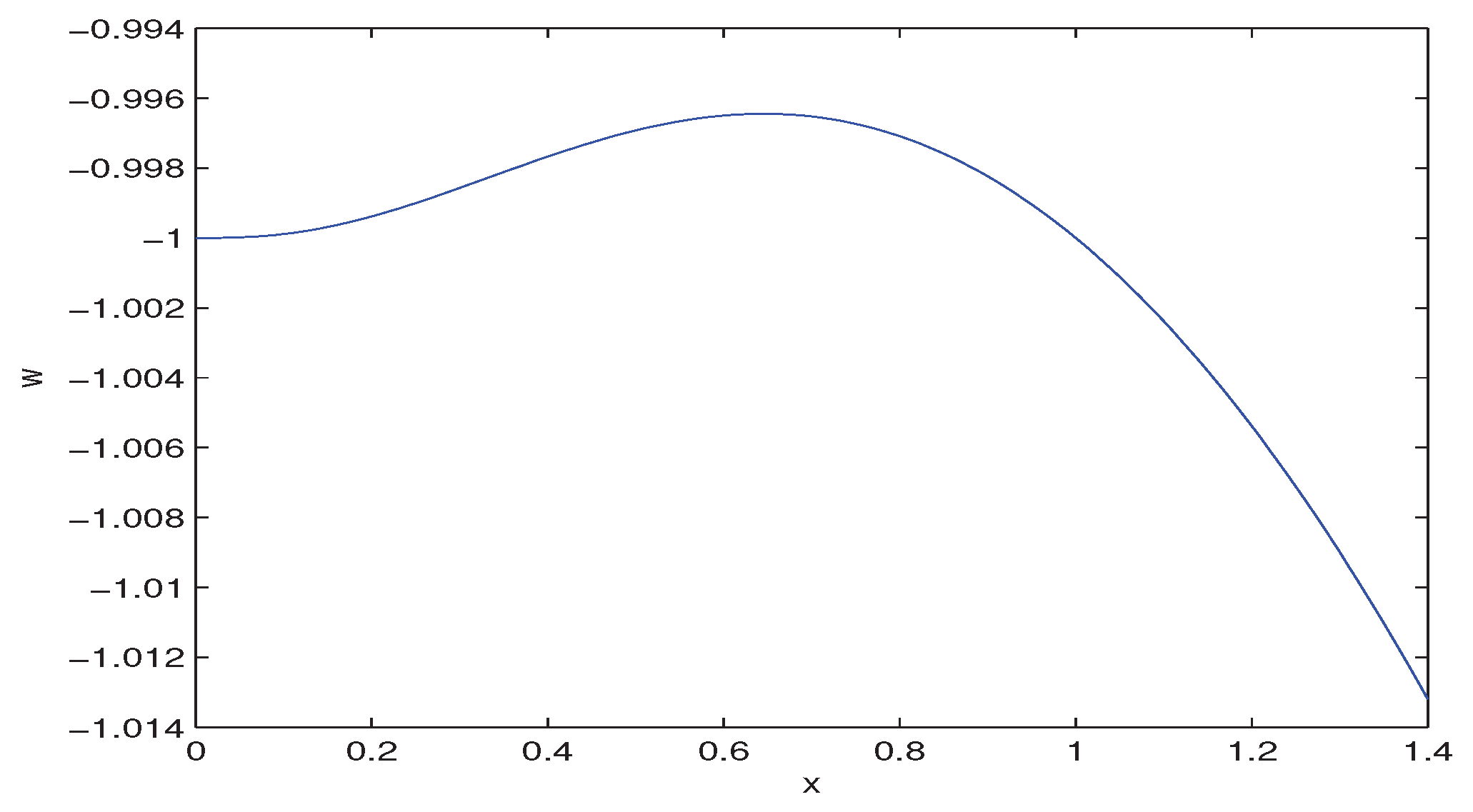
The EoS parameter for the matter w versus x is depicted in Figure 6.
According to Figure 6 when we have . Figure 6 shows that when increases from the EoS parameter w decreases from (de Sitter space) and becomes the phantom space.
4.1. Inflation
At the phase of inflation the matter density of energy and pressure are zero, . The dark energy density results the universe to accelerate. From Equation (16) we obtain , and during inflation the Hubble parameter is constant. The scale factor becomes corresponding to the de Sitter space-time. At the de Sitter stage the eternal inflation occurs. The Hubble parameter at the inflation phase being () and . Making use of Equation (17), at with the variable we find the equation
corresponding to Equation (29) for the phantom divide. The solution to Equation (40) is with the relation
From the Hubble parameter at the inflation phase , we obtain parameter b from Equation (41) and the entropy parameter .
5. F(T)-Gravity from Generalized Entropy
The scalar torsion T in teleparallel gravity is a field analogous to the curvature R in the Einstein theory [43,44]. The teleparallel theory of gravity explores the Weitzenböck connection and in the theory the field equations are the second-order. The torsion field T is defined as [45,46],
The tensors and are given by
with () being a vierbein field. The metric tensor is , where is the flat metric of the tangent spacetime. For FLRW metric (5) and the torsion scalar is . The variation of the action with respect to (the Lagrangian is ) gives the equation [47]
From equations (17) and (44) we obtain
Integrating Equation (45) one finds
with the integration constant . Because , we have used the relation . It should be noted that in Equation (46) is the real function. The teleparallel gravity models with some functions were investigated in [48,49] The entropic cosmology with entropy (15) can be considered as a cosmology within the teleparallel gravity with the function (46).
6. Conclusions
We have proposed a new entropy with being the Bekenstein–Hawking entropy and becomes zero when the apparent horizon radius vanishes. The entropic cosmology with our entropy leads to inflation and current acceleration of the universe. The matter barotropic perfect fluid and the spatial flat FLRW universe are assumed. Making use of the first law of apparent horizon thermodynamics we obtained the modified Friedmann equations which have a term corresponding to the density of dark energy. Also, such term can be considered as a dynamical cosmological constant. We assume that there is no interaction between various components of dark energy (the dark energy density and pressure and obey ordinary conservation law). The and the dark energy EoS have been computed with . This shows that at the small apparent horizon radius the inflation of the universe occurs. In our model the universe may have two phases, acceleration and deceleration, because of the dark energy. The deceleration parameter was computed which shows that the acceleration at the current epoch takes place. At the entropy parameter and the deceleration parameter possesses the value and the normalized density parameter is that are in accordance with the Planck data at the current epoch [40]. In addition, our model has the phantom divide for the EoS of dark energy. We have showed that entropic cosmology with our entropy can be considered as the cosmology within the teleparallel gravity with the function obtained.
References
- Lusso, E.; Piedipalumbo, E.; Risaliti, G.; Paolillo, M.; Bisogni, S.; Nardini, Emanuel E.; Amati, Lorenzo. Tension with the flat ΛCDM model from a high-redshift hubble diagram of supernovae, quasars, and gamma-ray bursts. Astron. Astrophys. 2019, 628, L4. [Google Scholar] [CrossRef]
- Di Valentino, E. Cosmology Intertwined II: The Hubble Constant Tension, Astropart. Phys. 2021, 131, 102605. [Google Scholar]
- Riess, A. G. Type Ia supernova discoveries at. Astrophys. J. 2004, 607, 665. [Google Scholar] [CrossRef]
- Riess, A. G.; Casertano, S.; Yuan, W.; Macri, L. M.; Scolnic, D. Large magellanic cloud cepheid standards provide a One percent foundation for the determination of the hubble constant and stronger evidence for physics beyond ΛCDM. Astrophys. J. 2019, 876, 85. [Google Scholar]
- Akbar, M.; Cai, R. G. Thermodynamic Behavior of Friedmann Equation at Apparent Horizon of FRW Universe. Phys. Rev. D 2007, 75, 084003. [Google Scholar] [CrossRef]
- Cai, R. G.; Cao, L. M. Unified First Law and Thermodynamics of Apparent Horizon in FRW Universe. Phys. Rev. D 2007, 75, 064008. [Google Scholar] [CrossRef]
- Cai, R. G.; Kim, S. P. First Law of Thermodynamics and Friedmann Equations of Friedmann-Robertson-Walker Universe. JHEP 2005, 0502, 050. [Google Scholar]
- Paranjape, A.; Sarkar, S.; Padmanabhan, T. Thermodynamic route to Field equations in Lanczos-Lovelock Gravity. Phys. Rev. D 2006, 74, 104015. [Google Scholar] [CrossRef]
- Sheykhi, A.; Wang, B.; Cai, R. G. Thermodynamical Properties of Apparent Horizon in Warped DGP Braneworld. Nucl. Phys. B 2007, 779, 1. [Google Scholar] [CrossRef]
- Cai, R. G.; Ohta, N. Horizon Thermodynamics and Gravitational Field Equations in Horava-Lifshitz Gravity. Phys. Rev. D 2010, 81, 084061. [Google Scholar]
- Wang, S.; Wang, Y.; Li, M. Holographic Dark Energy. Phys. Rept 2017, 696, 1. [Google Scholar] [CrossRef]
- Jamil, M.; Saridakis, E. N.; Setare, M. R. The generalized second law of thermodynamics in Horava-Lifshitz cosmology. JCAP 2010, 1011, 032. [Google Scholar] [CrossRef]
- Gim, Y.; Kim, W.; Yi, S. H. The first law of thermodynamics in Lifshitz black holes revisited. JHEP 2014, 1407, 002. [Google Scholar] [CrossRef]
- Fan, Z. Y.; Lu, H. Thermodynamical First Laws of Black Holes in Quadratically-Extended Gravities. Phys. Rev. D 2015, 91, 064009. [Google Scholar] [CrossRef]
- D’Agostino, R. Holographic dark energy from nonadditive entropy: Cosmological perturbations and observational constraints. Phys. Rev. D 2019, 99, 103524. [Google Scholar] [CrossRef]
- Sanchez, L. M.; Quevedo, H. Thermodynamics of the FLRW apparent horizon. Phys. Lett B 2023, 839, 137778. [Google Scholar] [CrossRef]
- Bekenstein, J. D. Black Holes and Entropy. Phys. Rev. D 1973, 7, 2333–2346. [Google Scholar] [CrossRef]
- S.W. Hawking, Particle creation by black holes, Commun. Math. Phys. 43 (1975), 199-220; Erratum: Ibid. 46 (1976), 206. [CrossRef]
- Jacobson, T. Thermodynamics of Spacetime: The Einstein Equation of State. Phys. Rev. Lett. 1995, 75, 1260. [Google Scholar] [CrossRef] [PubMed]
- T. Padmanabhan, Gravity and the Thermodynamics of Horizons, Phys. Rept. 406 (2005), 49. [CrossRef]
- Padmanabhan, T. Thermodynamical Aspects of Gravity: New insights. Rept. Prog. Phys. 2010, 73, 046901. [Google Scholar] [CrossRef]
- Hayward, S. A. Unified first law of black-hole dynamics and relativistic thermodynamics. Class. Quant. Grav. 1998, 15, 3147–3162. [Google Scholar] [CrossRef]
- Hayward, S. A.; Mukohyana, S.; Ashworth, M.C. Dynamic black-hole entropy. Phys. Lett. A 1999, 256, 347. [Google Scholar] [CrossRef]
- Bak, D.; Rey, S. J. Cosmic holography. Class. Quant. Grav. 2000, 17, 83. [Google Scholar] [CrossRef]
- C. Tsallis, Possible generalization of Boltzmann-Gibbs statistics, J. Stat. Phys., 52 (1-2) (1988), 479-487; C. Tsallis, The Nonadditive Entropy Sq and Its Applications in Physics and Elsewhere: Some Remarks, Entropy 13 (2011), 1765. [CrossRef]
- J. D. Barrow, The Area of a Rough Black Hole, Phys. Lett. B 808 (2020), 135643. [CrossRef] [PubMed]
- Rényi, A. Proceedings of the Fourth Berkeley Symposium on Mathematics, Statistics and Probability; University of California Press, 1960; pp. 547–56. [Google Scholar]
- Kaniadakis, G. Statistical mechanics in the context of special relativity II. Phys. Rev. E 2005, 72, 036108. [Google Scholar] [CrossRef]
- Masi, Marco. A step beyond Tsallis and Rényi entropies. Phys. Lett. A 2005, 338, 217–224. [Google Scholar] [CrossRef]
- Czinner, V. G.; Iguchi, H. Rényi entropy and the thermodynamic stability of black holes. Phys. Lett. B 2016, 752, 306–310. [Google Scholar] [CrossRef]
- Kruglov, S. I. Cosmology Due to Thermodynamics of Apparent Horizon. Annalen der Phys. 2025, 534, e00204. [Google Scholar] [CrossRef]
- Kruglov, S. I. Cosmology, new entropy and thermodynamics of apparent horizon. Chin. J. Phys. 2025, 98, 277–286. [Google Scholar] [CrossRef]
- Sayahian Jahromi, A.; Moosavi, S. A.; Moradpour, H.; Morais Graca, J. P.; Lobo, I. P.; Salako, I. G.; Jawad, A. Generalized entropy formalism and a new holographic dark energy model. Phys. Lett. B 2018, 780, 21–24. [Google Scholar] [CrossRef]
- Ren, J. Analytic critical points of charged Rényi entropies from hyperbolic black holes. JHEP 2021, 05, 080. [Google Scholar] [CrossRef]
- Mejrhit, K.; Ennadifi, S. E. Thermodynamics, stability and Hawking–Page transition of black holes from non-extensive statistical mechanics in quantum geometry. Phys. Lett. B 2019, 794, 45–49. [Google Scholar] [CrossRef]
- A. Majhi, Non-extensive Statistical Mechanics and Black Hole Entropy From Quantum Geometry, Phys. Lett. B 775 (2017), 32-36. [CrossRef]
- Pavon, D.; Zimdahl, W. Holographic dark energy and cosmic coincidence. Phys. Lett. B 2005, 628, 206. [Google Scholar] [CrossRef]
- Landim, R. C. G. Holographic dark energy from minimal supergravity. Int. J. Mod. Phys. D 2016, 25, 1650050. [Google Scholar] [CrossRef]
- Ashtekar, Abhay; Wilson-Ewing, Edward. The covariant entropy bound and loop quantum cosmology. Phys. Rev. D 2008, 78, 064047. [Google Scholar] [CrossRef]
- Aghanim, N.; et al. [Planck], Cosmological parameters. Astron. Astrophys. 2020, 641, A6, Erratum: Ibid 652(2021), C4. [Google Scholar]
- Di Gennaro, Sofia; Xu, Hao; Chin Ong, Yen. How barrow entropy modifies gravity: With comments on Tsallis entropy. Eur. Phys. J. C 2022, 82, 1066. [Google Scholar] [CrossRef]
- M. Roos, Introduction to Cosmology (John Wiley and Sons, UK, 2003).
- Hehl, F. W.; Von Der Heyde, P.; Kerlick, G. D.; Nester, J. M. General Relativity with Spin and Torsion: Foundations and Prospects. Rev. Mod. Phys. 1976, 48, 393–416. [Google Scholar] [CrossRef]
- Bajardi, Francesco; Blixt, Daniel; Capozziello, Salvatore. Hamilton equations in teleparallel gravity and in new general relativity. Phys. Rev. D 2025, 111, 084012. [Google Scholar] [CrossRef]
- Weitzenböck R., Invarianten Theorie, (Nordhoff, Groningen, 1923).
- Maluf, J. W. Hamiltonian formulation of the teleparallel description of general relativity. J. Math. Phys. 1994, 35, 335. [Google Scholar] [CrossRef]
- Bengochea, G. R.; Ferraro, R. Dark torsion as the cosmic speed-up. Phys. Rev. D 2009, 79, 124019. [Google Scholar] [CrossRef]
- Wu, P.; Yu, H. W. f(T) models with phantom divide line crossing. Eur. Phys. J. C 2011, 71, 1552. [Google Scholar] [CrossRef]
- Nesseris, S.; Basilakos, S.; Saridakis, E. N.; Perivolaropoulos, L. Viable f(T) models are practically indistinguishable from LCDM. Phys. Rev. D 2013, 88, 103010. [Google Scholar] [CrossRef]
Figure 1.
The function versus H at . According to Figure 1 increases as b increases. As () one has .
Figure 1.
The function versus H at . According to Figure 1 increases as b increases. As () one has .
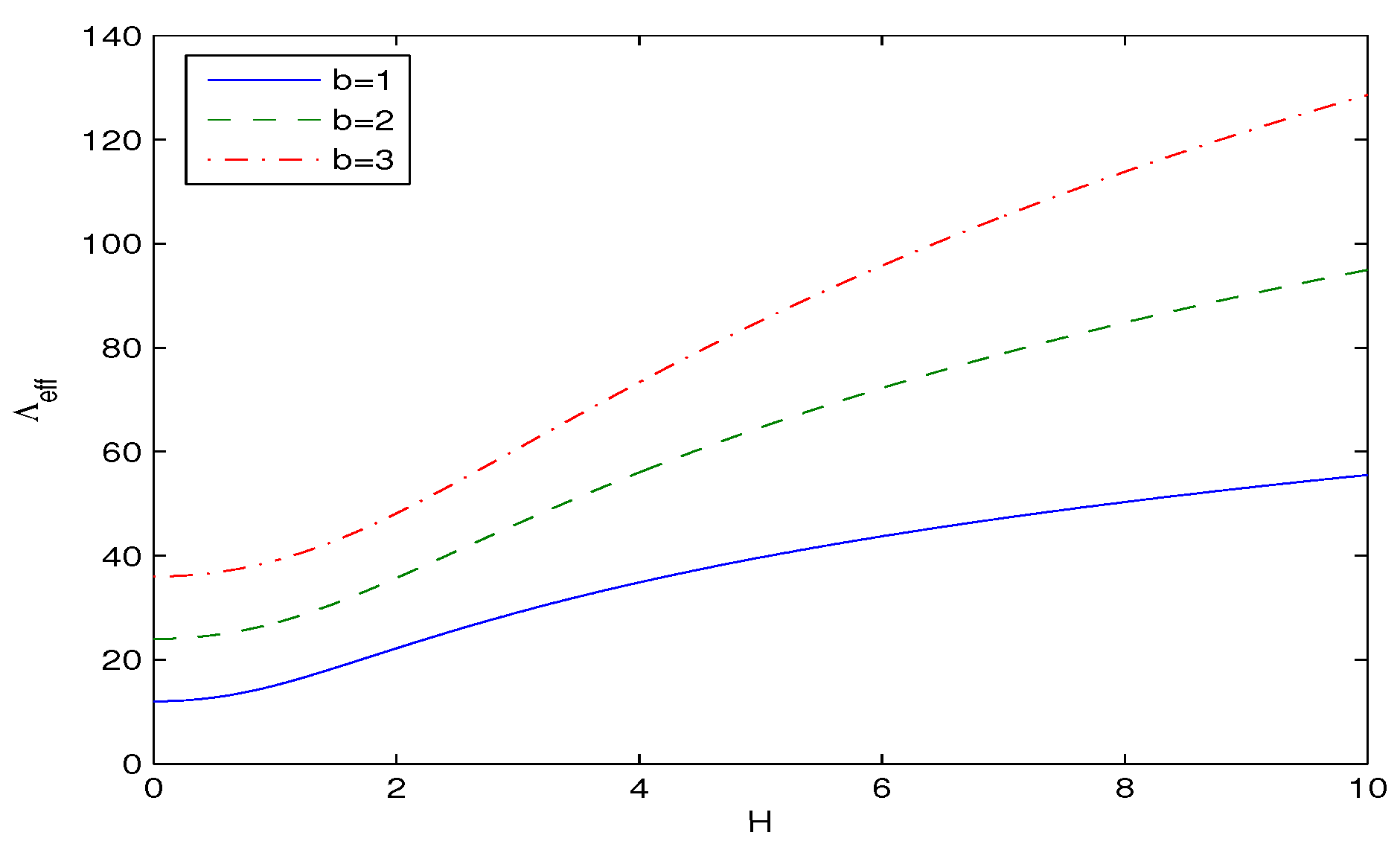
Figure 2.
The versus x is shown in figure. The increases if x increases and when () one has .
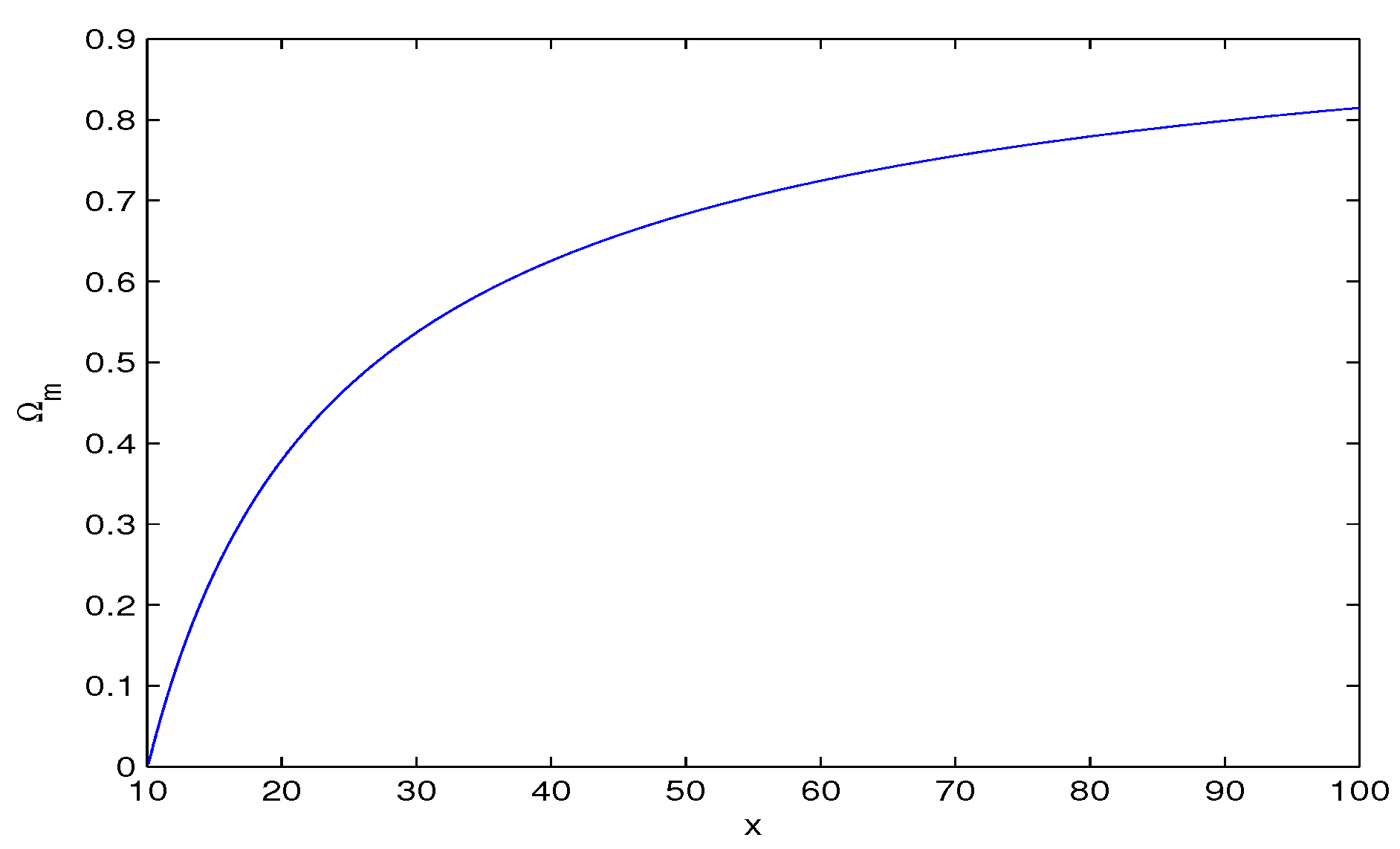
Figure 3.
The versus is depicted at . When x is large, the EoS parameter possesses the limit .
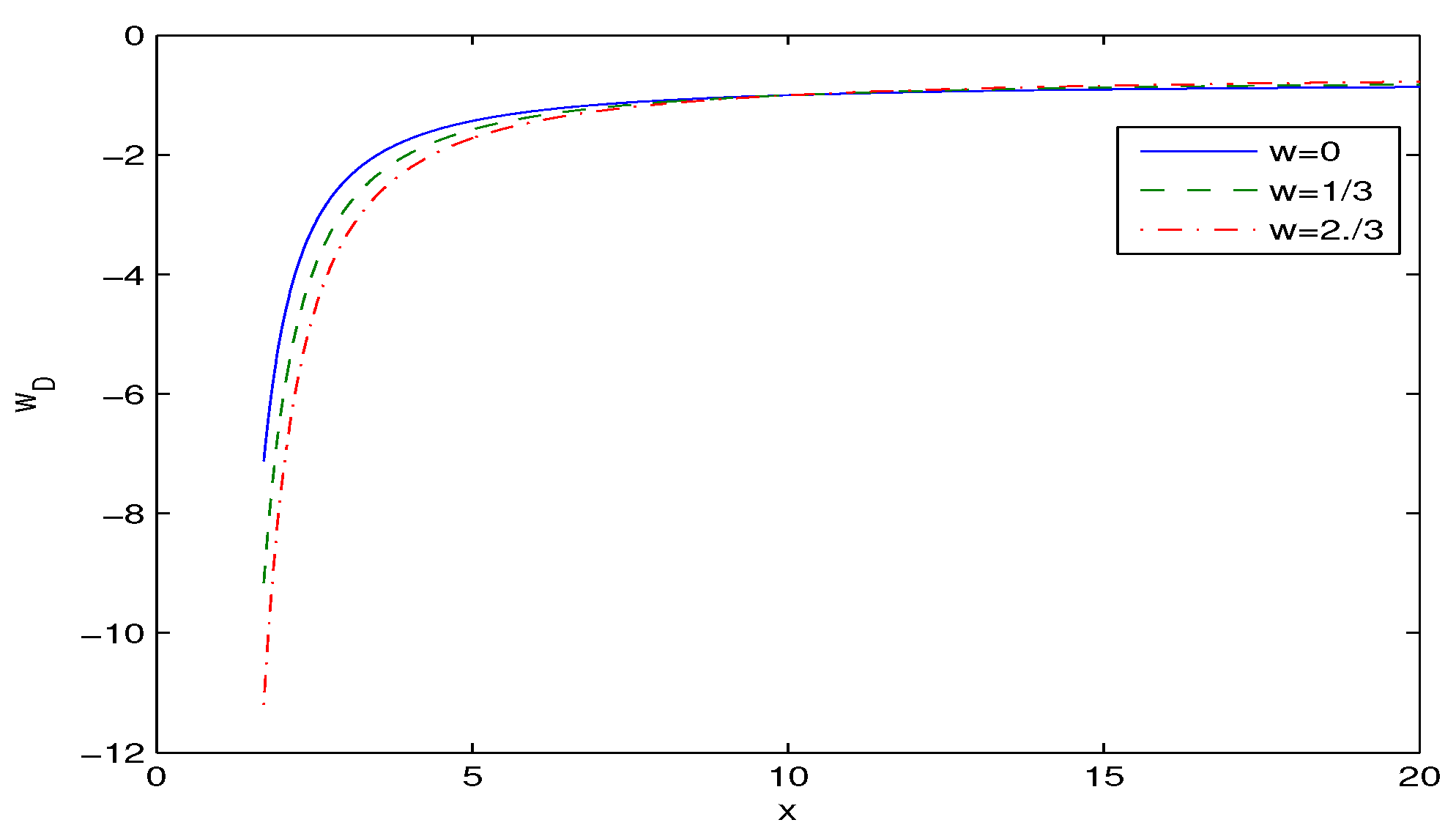
Figure 4.
Left panel: The versus z with , . Figure shows that increases when z increases. When EoS parameter for the matter w increases, at fixed , the redshift z decreases. Right panel: According to figure, when parameter increases (at fixed z), the reduced Hubble parameter also increases.
Figure 4.
Left panel: The versus z with , . Figure shows that increases when z increases. When EoS parameter for the matter w increases, at fixed , the redshift z decreases. Right panel: According to figure, when parameter increases (at fixed z), the reduced Hubble parameter also increases.
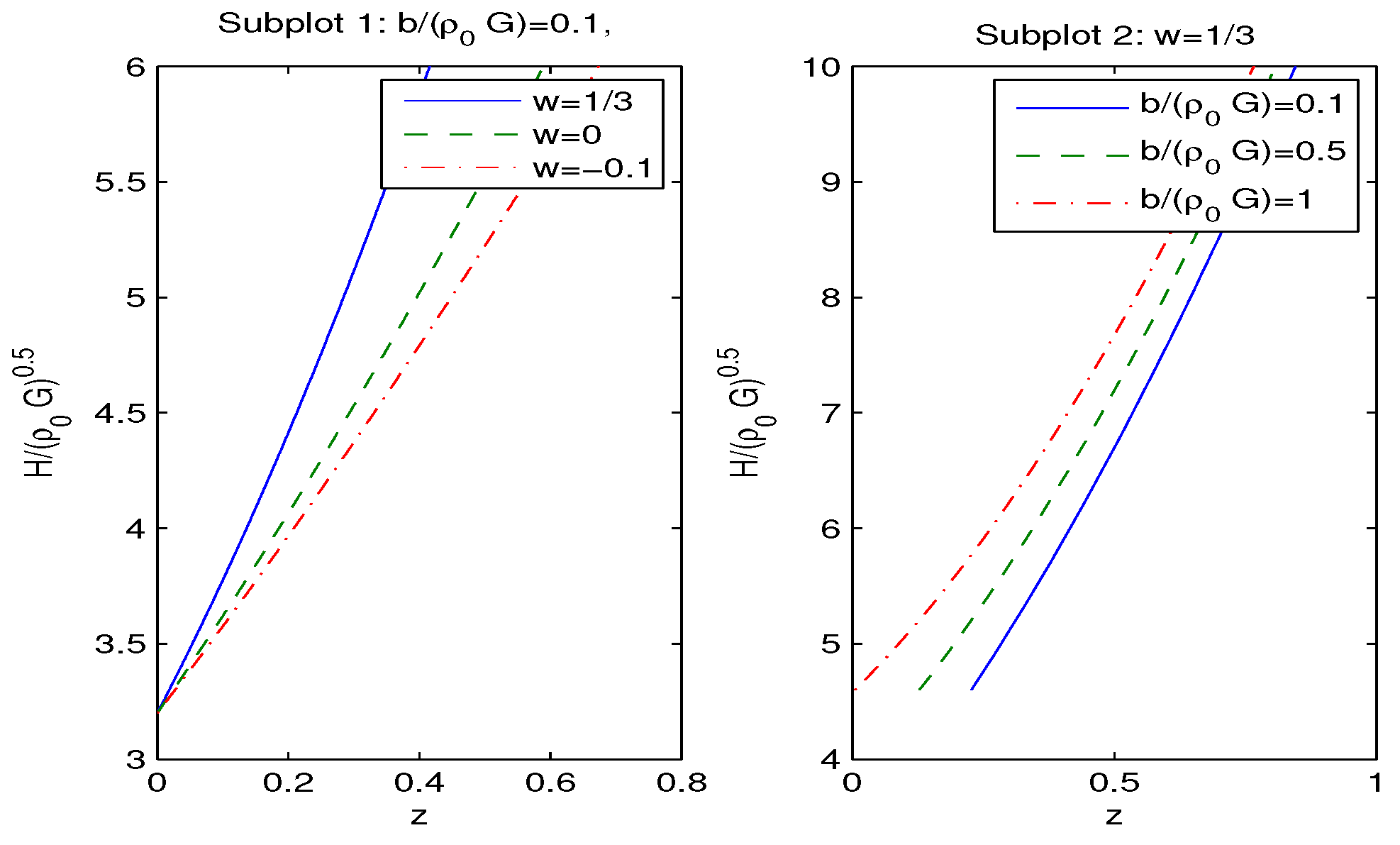
Figure 5.
The deceleration parameter q versus x with . Figure shows that the deceleration parameter q increases when the parameter x increases. If the EoS parameter of the matter w increases (at fixed x) the deceleration parameter q also increases. We observe two phases, universe acceleration at and deceleration at .
Figure 5.
The deceleration parameter q versus x with . Figure shows that the deceleration parameter q increases when the parameter x increases. If the EoS parameter of the matter w increases (at fixed x) the deceleration parameter q also increases. We observe two phases, universe acceleration at and deceleration at .
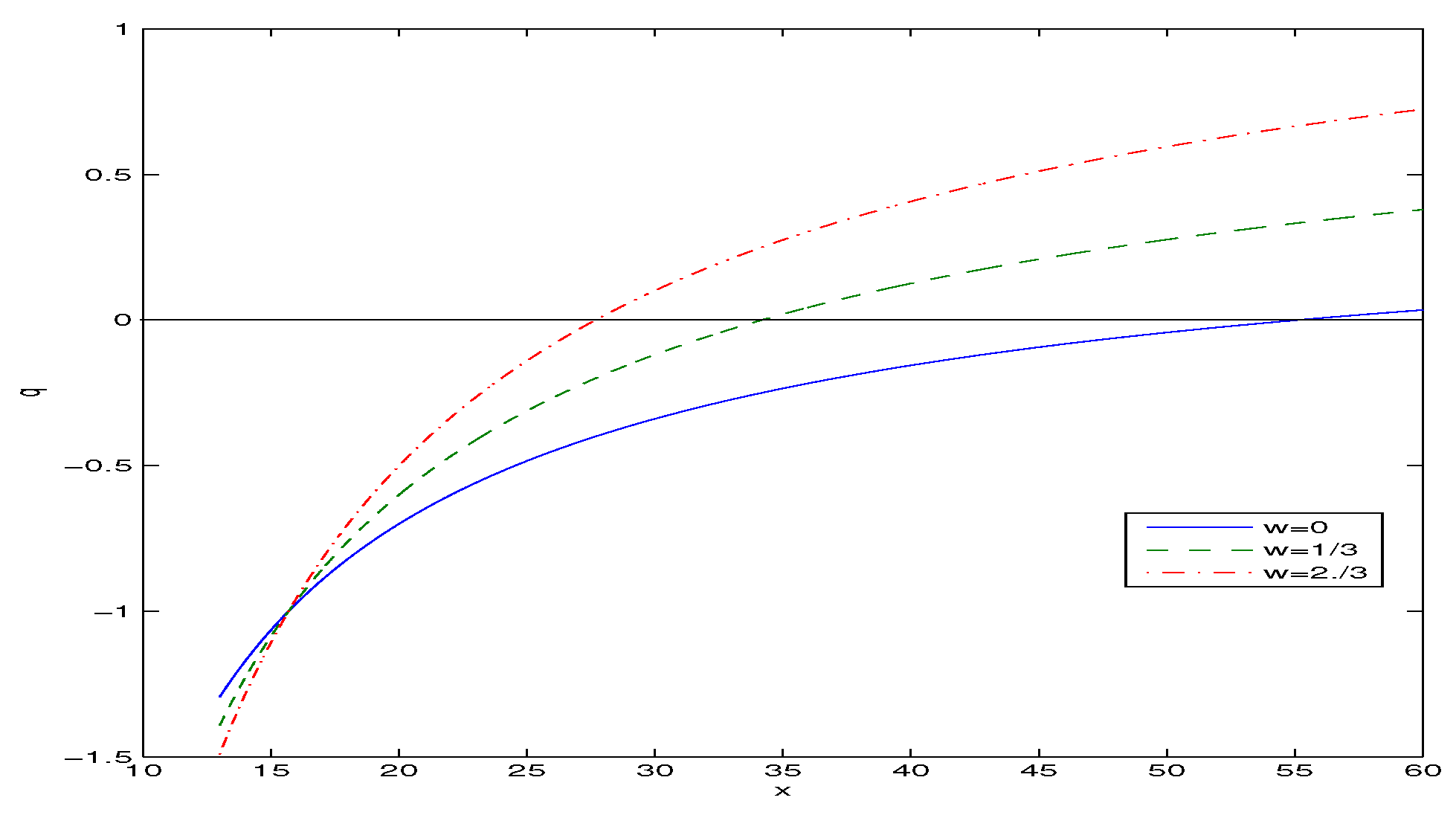
Figure 6.
According to figure at we have . When x increases from , the EoS parameter w decreases from (the de Sitter space) and w corresponds to the fantom space.
Figure 6.
According to figure at we have . When x increases from , the EoS parameter w decreases from (the de Sitter space) and w corresponds to the fantom space.
Disclaimer/Publisher’s Note: The statements, opinions and data contained in all publications are solely those of the individual author(s) and contributor(s) and not of MDPI and/or the editor(s). MDPI and/or the editor(s) disclaim responsibility for any injury to people or property resulting from any ideas, methods, instructions or products referred to in the content. |
© 2026 by the authors. Licensee MDPI, Basel, Switzerland. This article is an open access article distributed under the terms and conditions of the Creative Commons Attribution (CC BY) license (http://creativecommons.org/licenses/by/4.0/).
Copyright: This open access article is published under a Creative Commons CC BY 4.0 license, which permit the free download, distribution, and reuse, provided that the author and preprint are cited in any reuse.


