

Submitted:
15 April 2026
Posted:
15 April 2026
You are already at the latest version
Abstract
This paper presents Scheme T, a presidential framework. It originates from the author's quest for partisan continuity, whereby a mid-term presidential vacancy is filled by a successor from the same political party as the incumbent, unless a new popular election is held. While the American system fails to guarantee this due to rigid election timing, the Turkish framework offers synchronized terms and flexible scheduling; however, the current Turkish constitution suffers from “plebiscitary succession” and “violation of election synchronization”. Scheme T builds upon the Turkish framework by introducing a vice-presidential office with dual-path confirmation and mandating that double vacancy or any renewal initiative triggers a full general election, thereby eliminating standalone presidential elections. It also proposes PLAR (Popular Legislative Automatic Runoff), a novel single-round electoral method for simultaneous presidential and legislative elections that achieves fairness comparable to two-round absolute-majority systems with greater efficiency. In contrast to the current Turkish system, Scheme T removes the Assembly's direct renewal authority and introduces instead a Westminster-style no-confidence mechanism with a three-fifths threshold, restricted to the final two years of the five-year presidential term. This guarantees the president three years of secure tenure while adding confidence-based accountability. By integrating the strengths of Turkish, Westminster, and American paradigms, Scheme T combines strong executive stability with carefully calibrated democratic control, offering an elegant and innovative blueprint for building resilient and responsive presidential governments.
Keywords:
Turkish-style presidentialism
; Westminster model
; partisan continuity
; PLAR
; election synchronization
1. Introduction
Presidential systems inherently grapple with the “problem of succession” – specifically, the challenge of ensuring partisan continuity (also termed same-party succession), whereby a mid-term presidential vacancy is filled by a successor from the same political party as the incumbent, unless a new popular election is held. This mechanism helps preserve the political mandate delivered by voters in the most recent election and deters incentives for assassination attempts on the president.
In this paper, however, “party” is understood not in its narrow legal sense (formal membership or registration) but in its broader political sense (shared policy orientation, platform, governing coalition, or ideological alignment). To operationalize this concept, we assume that a person belongs to the president’s party if the president is willing to hand over the presidency to them in the event that the president cannot serve. This includes cases where the two individuals appeared together on the same electoral ticket or where the president nominated the person to a backup office in the line of presidential succession.
1.1. The American Vulnerability
Not all presidential constitutions fully realize partisan continuity. Structural flaws in succession protocols can lead to “accidental” shifts in partisan control, potentially subverting the will of the electorate. The United States provides the clearest and most frequently cited illustration of this vulnerability. Under the Presidential Succession Act of 1947, once both the presidency and vice presidency become vacant, the line of succession passes to the Speaker of the House. This arrangement introduces a significant design flaw: a Speaker from an opposing party could ascend to the presidency mid-term, without any direct national mandate from the voters.
This vulnerability was nearly realized during the Watergate scandal. When Vice President Spiro Agnew resigned in 1973, followed by the looming impeachment of Richard Nixon, the next in line was Speaker Carl Albert – a Democrat. The United States narrowly avoided a non-electoral party takeover only because the Democratic leadership – possessing the legislative power to deter any nomination – prioritized traditional norms of succession over partisan opportunism, allowing the swift confirmation of Gerald Ford as Vice President under the 25th Amendment. Had the opposition prioritized partisan gain over established norms, the executive branch could have undergone a total partisan shift dictated by legislative hierarchy rather than the ballot box.
This paper does not seek to “fix” the succession flaw within the U.S. Constitution; any such attempt would be viewed as undemocratic. As famously noted by President Truman, the core constitutional dilemma was that placing unelected cabinet secretaries ahead of the Speaker of the House and President Pro Tempore in the line of succession violated democratic principles by favoring appointees over elected officials. Furthermore, the American system lacks a mechanism for snap presidential elections. Even if the two congressional officials were removed from the line of succession, since the quadrennial election cycle is fixed, any contingency resulting in exhaustion of executive backups for the presidency risks a violation of partisan continuity. Thus, within the existing U.S. constitutional architecture, this vulnerability is not a mere oversight but a permanent structural feature – one shared by presidential systems with fixed terms and no direct-election contingency mechanisms.
1.2. Partisan Continuity in Turkish-Style Presidentialism
The transition of the Republic of Türkiye to a “Turkish-style” presidentialism in 2018 offers a structural alternative to the American model. The defining characteristic of this system is its non-rigid election scheduling. Unlike the United States, where the election calendar is anchored to a rigid quadrennial cycle, the Turkish model allows for the “renewal” of the government’s mandate at any time. Both the executive and legislative branches can trigger a general election, resetting the political clock for both branches simultaneously.
In this paper, it is essential to distinguish between the Turkish framework (or Turkish-style presidentialism) – the overarching structural logic of the regime – and the current Turkish constitution, which represents one specific application of that logic. The Turkish framework is fundamentally defined by typical presidential features coupled with non-rigid synchronized election timing for the presidency and legislature – a departure from fixed election calendars.
The issue of partisan continuity also emerges under Turkish-style presidentialism. However, as a mere institutional framework, its defining principles permit – but do not guarantee – full adherence to partisan continuity. Designing constitutional mechanisms that ensure partisan continuity therefore constitutes the primary focus of this paper.
1.3. Partisan Continuity in the Current Turkish Constitution
We now examine the current Turkish Constitution as a concrete case study regarding its conformance with partisan continuity. In sharp contrast to the American model, the Turkish Constitution makes no provision for a standing “backup” successor. Instead, any vacancy in the presidency triggers a new national election. This mechanism makes the constitution technically “fully satisfy” partisan continuity, but it clearly deviates from the original intent behind that principle. From another angle, this approach of Türkiye exhibits two significant systemic drawbacks that undermine both institutional stability and systemic elegance: plebiscitary succession and violation of election synchronization.
Plebiscitary succession, as dictated by Article 106 of the Turkish Constitution, is a mechanism that prioritizes direct popular legitimacy over institutional continuity by mandating a fresh national election to fill a presidential vacancy. Rooted in a historical distrust of “establishment” intermediaries and unelected power centers, this feature ensures that no official may assume permanent presidency without a direct mandate. However, this is at the potential cost of political or economic stability, as it thrusts the country into a high-stakes, disruptive election cycle at short notice.
Violation of election synchronization is actually not a standalone drawback but essentially a consequence of plebiscitary succession and the consideration of preserving the term length of the Grand National Assembly. When a presidential vacancy occurs and more than one year remains until the next scheduled general election, the system mandates a presidential-only snap election within 45 days. In such cases, parliamentary elections are not triggered concurrently. This decouples the electoral cycles of the executive and legislative branches, temporarily abandoning the core principle of simultaneous mandates enshrined in the 2017 amendments (Article 77).
1.4. The Objective of This Study
The central aim of this paper is to propose an alternative constitutional scheme that remains compatible with the fundamental structure of the Turkish presidential system – particularly its non-rigid, synchronized timing of elections – while deliberately departing from the constitutional practice currently implemented in Türkiye. Specifically, the proposed design seeks to achieve two interrelated goals:
- to enable secure partisan continuity to the presidency in the event of a vacancy, thereby preserving political continuity and party-based governance;
- to overcome the two principal systemic drawbacks identified earlier – namely, plebiscitary succession and the violation of election synchronization.
To this end, Scheme T incorporates a Westminster-inspired no-confidence mechanism along with several other carefully calibrated design innovations. This allows the framework to strike a more balanced trade-off between democratic legitimacy (through enhanced parliamentary accountability) and the practical requirements of political and institutional stability within the Turkish presidential context.
2. Literature Review
2.1. The Partisan Continuity Dilemma in American Presidentialism
Scholars such as Amar and Amar (1995) and Kalt (2003) have critiqued the American “legislative line of succession”. They argue that the potential ascension of an opposition-party Speaker (the “Truman Dilemma”) creates a partisan discontinuity that violates the electoral mandate. This suggests that while the U.S. model protects the stability of the calendar, it fails to protect the mandate of the party chosen by the people.
2.2. The Genesis of “Presidentialism à la Turca”
The cornerstone of the 2017 Turkish constitutional reform is the principle of synchronized mandates, a mechanism largely attributed to Kuzu (1997), who long served as Chairperson of the Constitutional Commission of the Grand National Assembly. Codified in Article 116, this principle mandates that an early renewal of electoral terms – whether initiated by the President or by a three-fifths majority of the Assembly – must trigger simultaneous presidential and parliamentary elections.
Although Article 106 allows for a standalone presidential election in limited vacancy cases, the system is fundamentally designed to preserve mandate synchronization under normal circumstances. Achieving complete fidelity to this principle constitutes one of the central objectives of the present study.
Reform proponents, such as Kuzu (2017), argued that holding presidential and parliamentary elections on the same day would foster political stability through a “coattail effect”. The rationale was that simultaneous elections would likely produce a legislative majority ideologically aligned with the president. By synchronizing the mandates of both branches, the system aims to ensure a unified popular legitimacy, thereby reducing the risk of the ideological divergence and executive-legislative gridlock often found in presidential systems with staggered election cycles.
While synchronized elections and their interaction with the country’s electoral system for the legislature are frequently discussed in the literature as a design feature for executive-legislative alignment (Kirişci 2017,Venice Commission 2017,von Steinsdorff 2017), we argue that this interaction is critical to the effectiveness of Turkish-style presidentialism. Let us contrast two electoral logics:
-
Single-Member District Plurality (SMDP) systems (as in the United States) tend to polarize the legislature into two dominant parties and foster single-party control of the chamber. Even when presidential and legislative elections are held concurrently, this electoral design produces two key undesired effects:
- –
- The House tends to be either overly obedient (unified government) or overly rebellious (divided government), with few stable intermediate states.
- –
- The winner-take-all nature creates extreme volatility in House majorities: small fluctuations in national vote shares or district-level outcomes can flip control from one party to the other.
- Proportional Representation (PR) or hybrid systems (as in Türkiye) generate a more pluralistic and nationally representative legislature. Türkiye’s current electoral formula – primarily PR – tends to produce a partisan composition of the Grand National Assembly that broadly reflects national vote patterns among viable parties, reducing the likelihood of sharp executive–legislative ideological divergence.
By aligning the timing of executive and legislative elections and maintaining a relatively continuous political spectrum in the legislature, the Turkish design aims to foster greater political coherence and institutional stability than is typically observed in presidential regimes with majoritarian legislative elections.
Yet other scholars have characterized the regime as “Presidentialism à la Turca” – a distinctive variant of presidentialism that departs markedly from classical models of separation of powers (Esen and Gözler 2017). While sharp criticisms of the regime abound, these focus primarily on the excessive powers allocated to the president rather than on the core structural feature this paper highlights in Turkish-style presidentialism, namely its synchronized mandates and non-rigid election scheduling.
2.3. Plebiscitary Succession in the Current Turkish Constitution
Plebiscitary succession, as described in SubSection 1.3, is based on the belief that the president’s legitimacy must come directly from the people, not from intermediaries like parliament or bureaucratic institutions.
Scholarly endorsements: ending bureaucratic tutelage
A central theme in pro-reform scholarship is that this rule rejects “bureaucratic tutelage” (bürokratik vesayet) – the long-standing influence of unelected elites, especially the military and judiciary, over elected leaders. Authors such as Sözen (2017) and Kuzu (2011) argue that past presidents were sometimes blocked or shaped by these “establishment” forces using parliamentary or judicial loopholes.
By requiring a fresh direct election, the 2017 design aims to “bulletproof” the presidency against such interference. The deputy presidency is kept weak on purpose: the deputy president is appointed by the president and has no independent electoral mandate, so they cannot become a permanent successor without public approval (Gözler 2017). Reform supporters see this as strengthening the “National Will” (Milli İrade) as the only legitimate source of executive power.
Scholarly critiques: the instability and “trap” problem
Many analysts view the same rule as problematic. They argue that the mandatory 45-day snap election creates a structural “trap”: the system legally cannot prioritize short-term stability or continuity over an immediate national vote.
For example, Venice Commission (2017); Yokuş (2018) and others describe the mechanism as “unstable”, because a sudden vacancy can force a full-scale election campaign almost immediately – potentially while the country is still in a phase of national mourning or adjustment. Critics argue that this prioritizes plebiscitary (direct popular) legitimacy above practical governance needs, such as preserving institutional continuity and political calm, and may lead to disruption, economic uncertainty, and weakened government effectiveness during already difficult moments.
2.4. Violation of Election Synchronization in the Current Turkish Constitution
Under the current Turkish Constitution, presidential and parliamentary elections are not invariably held concurrently, as discussed in SubSection 1.3.
Analysts such as Özbudun (2017) point out that this breaks the simultaneity principle that the system was built on. When a vacancy triggers a standalone presidential election, the unified electoral calendar – seen as the main stabilizer of the system – is sacrificed to ensure the presidency receives a fresh direct popular mandate.
Scholars describe this outcome as problematic in several ways:
- The newly elected president receives a truncated (shortened) mandate, filling only the remaining time until the next parliamentary election (Gözler 2018). This can make the president appear as a temporary or “placeholder” leader rather than a fully empowered executive (Yokuş 2018).
- Some authors argue that this forces the president into a near-constant campaign mode during the shortened term, potentially weakening executive effectiveness and adding uncertainty to governance.
Overall, the literature views this exception as one of the system’s main practical weaknesses, especially in scenarios involving unexpected vacancies.
2.5. Proposals for Refinement of the Turkish Model
Recent literature has moved toward proposing technical fixes for the Turkish system, focusing on reconciling executive efficiency with institutional checks.
2.5.1. Executive Succession and Legitimacy
Although the deputy president’s exercise of presidential powers during a vacancy is temporary, given the extensive powers of the president granted by the constitution, scholars such as Gözler (2022); Yazıcı (2020) argue that the lack of an elective mandate for the deputy president remains a structural weakness. To remedy this, two main proposals have emerged:
2.5.2. Strengthening Legislative Oversight
Beyond succession, the literature also addresses several other institutional adjustments. These include narrowing the scope of presidential decrees to prevent the executive from legislating on fundamental rights, and restoring the parliament’s “power of the purse” to prevent the executive from operating on a “default budget” if the legislative version is rejected. Additionally, some scholars suggest decoupling presidential and parliamentary elections to foster a more independent legislature through staggered mandates, thereby enhancing checks and balances.
2.6. The Novelty of the Proposed Scheme
While scholars have criticized the current Turkish model for its potential to trigger “plebiscitary succession”, they have yet to offer a mechanism that ensures same-party continuity without sacrificing the synchronized timing that proponents of the Turkish system value. This study fills that gap by moving beyond the standard reformist tropes. Unlike previous attempts that suggest decoupling elections to foster institutional checks, this paper proposes a scheme that maintains synchronization while fixing the internal succession logic of the executive branch. This specific synthesis – balancing party-based governance with the preservation of election synchronization – has not been previously articulated in the literature on Turkish-style presidentialism.
3. Scheme T: Background Rules of Presidential Systems
The proposed institutional design is referred to as “Scheme T”, where the letter “T” acknowledges its conceptual roots in the constitutional framework of Türkiye.
The present section (Section 3) and the subsequent section (Section 4) together provide a complete description of Scheme T. Section 3 focuses exclusively on the background rules that are almost common to presidential systems in general. These rules are deliberately formulated in a manner that is agnostic to the specific Turkish implementation and do not presuppose any uniquely Turkish arrangements.
Presidential systems exist in both unicameral and bicameral forms. Scheme T is intentionally designed to be compatible with either structure. To ensure terminological consistency, the following naming convention is adopted throughout the scheme:
- Unicameral case: The legislature is designated as the National Assembly. This terminology is chosen to align with the established terminology of Türkiye, a unicameral republic.
-
Bicameral case: The legislature is designated as the Parliament. It consists of two chambers:
- –
- The lower house is named the National Assembly,
- –
- The upper house is named the Senate.
In contexts where strict formality is not required, “Assembly” will be used as a shorthand for “National Assembly”.
3.1. Elections of the President and the Legislature
In presidential systems, the president and the legislature derive independent democratic legitimacy through direct popular elections.
The National Assembly (lower/unicameral house) is generally elected using a hybrid system combining single-member district plurality (SMDP) and proportional representation (PR), or pure PR. Pure SMDP should be avoided due to its deficiencies noted in SubSection 2.2.
In bicameral systems, the Senate should ideally be elected on a fixed and staggered schedule and remain undissolvable. Common models include six-year terms with one-third of seats renewed every two years (as in the United States) or six-year terms with one-half of seats renewed every three years (as in the Philippines). Either approach ensures institutional continuity, dampens short-term volatility relative to the Assembly, and promotes a more neutral, deliberative chamber focused on long-term oversight, personnel consents, confirmations, and constitutional balance.
Scheme T conforms to these electoral rules, which uphold the separation of powers while balancing democratic accountability with structural stability.
3.2. Institutional Relationship Between the President and the Assembly
Until the emergence of the Turkish-style presidentialism, virtually all established presidential regimes featured mutual independence between the president and the legislature: neither branch could routinely remove or dissolve the other. While the president could be removed through impeachment (a process typically initiated by the legislature), this was an exceptional, high-threshold mechanism rather than a routine tool of political control. This strict separation profoundly shaped the electoral calendars and term structures of the two branches.
The most common patterns include:
- Equal terms for president and legislature: In several presidential systems, the president and the legislature (or lower house) serve terms of the same length, allowing concurrent elections. Examples include Brazil (4 years for both) and Indonesia (5 years for both).
- Legislative term half the length of the presidential term: In some systems, the legislature serves a term half as long as the president’s, resulting in mid-term legislative elections alongside full-term general elections. Prominent examples include the United States (President 4 years; House 2 years), Mexico (President 6 years; Chamber of Deputies 3 years), and the Philippines (President 6 years; House 3 years).
- Other arrangements: A small number of presidential systems follow neither pattern and adopt unique solutions (e.g., South Korea: 5-year non-reelectable presidential term and 4-year National Assembly term).
Scheme T’s approach to the relationship between the president and the Assembly draws on the Turkish model and is therefore reserved for Section 4. This subsection therefore serves primarily as a reminder that Scheme T diverges from conventional presidential systems in this area – the precise nature of that divergence will become apparent as the features of Scheme T unfold in Section 4.
3.3. Establishment of the Vice Presidency
While the office of Vice President is not a universal feature of presidential systems (notably absent in several Latin American and African models), it constitutes an essential institutional component of Scheme T.
As previously stated, a core objective of Scheme T is to guarantee succession to the presidency by a figure from the same political party as the outgoing president. Achieving this goal would be awkward and costly without a constitutional office of Vice President who serves as a standing, pre-designated successor in the event of a presidential vacancy.
For this reason, Scheme T incorporates the office of Vice President as a mandatory and integral element of its institutional design. It adopts the following core rules concerning the office of Vice President:
- There is only one Vice President.
- The Vice President automatically assumes the office of President in the event of a vacancy in the presidency.
- The Vice President cannot be unilaterally dismissed from office by the President.
- If the office of Vice President is or becomes vacant, the President may nominate an individual to fill the office, subject to confirmation by the legislature.
Like in the U.S., Scheme T limits the vice presidency to one person. One designated successor is sufficient to provide a clear line of succession and maintain same-party continuity, while avoiding the complexity, rivalry, or ambiguity that multiple vice presidents would introduce.
Scheme T deliberately leaves open the initial method of filling the vice presidency, offering two permissible models:
- The Vice President is elected jointly with the President on the same ticket (as in the U.S. model), in which case the office is filled from the beginning of the presidential term.
- The office of Vice President is left vacant at the start of the presidential term, to be filled subsequently through presidential nomination and legislative confirmation.
This flexibility allows Scheme T to accommodate different constitutional traditions and political contexts while preserving the core function of the vice presidency: providing a standing successor capable of ensuring same-party continuity in the executive branch upon a presidential vacancy.
For bicameral systems, Scheme T recommends that the Vice President serve ex officio as President of the Senate, with authority mainly limited to casting tie-breaking votes and ceremonial/procedural oversight. This model, seen in the United States and Argentina, provides modest executive-legislative linkage, reinforces continuity during vacancies, and avoids overloading the Vice President with routine duties. However, this is not essential for the scheme.
For unicameral systems, Scheme T recommends constitutional silence regarding any functions of the Vice President beyond succession. The President may nonetheless assign temporary, consultative, or other ad hoc duties at discretion.
3.4. Organization of the Executive Branch
The executive branch is headed by the president, who serves as both chief of state and head of government.
The cabinet comprises ministers responsible for specific policy portfolios. These officials are appointed and dismissed by the president and are accountable solely to the president, with appointment subject to legislative consent. The cabinet members do not require ongoing legislative confidence to remain in office, a defining feature that distinguishes presidentialism from parliamentary models.
While the president enjoys broad appointment powers, the threshold for consenting cabinet-level positions varies across countries. Consent modalities include, but are not restricted to, the following:
- No consent required (executive autonomy): In many presidential systems, the president possesses the unilateral power to appoint and dismiss ministers. Examples include Argentina, Brazil, Chile, Colombia, Costa Rica, Indonesia, Mexico, South Korea, and Türkiye.
- Senate consent (in bicameral case): In systems like the United States, the Philippines, and Liberia, the Senate serves as the consenting body. Consent typically requires a simple majority (). In the event of a tie (), the president of the Senate may cast a tie-breaking vote, provided a quorum (typically more than half of all senators) is present.
- Assembly consent: In unicameral systems or specific bicameral designs like Kenya, the National Assembly serves as the consenting body. In the Kenyan model, for instance, a simple majority of those present and voting () is sufficient, provided the quorum of 50 members is met.
- Commission consent (in bicameral case): In the Philippine model, consent is not the sole prerogative of the Senate but is vested in the Commission on Appointments. This specialized, bicameral body consists of twelve senators and twelve representatives, with the Senate President acting as the ex-officio chair. This design ensures cross-chamber vetting while maintaining a streamlined, representative subset of the entire legislature.
Neutral or independent agencies – such as central banks, electoral commissions, and regulatory bodies – operate with statutory autonomy. While their leadership is often appointed by the president and consented by the legislature, they are insulated from partisan pressures through fixed terms, staggered appointments, and “for-cause” removal protections
Scheme T upholds these principles, demanding no special deviations.
3.5. How Laws Are Passed
Formally, the legislature is the primary institution empowered to enact laws. However, the president’s constitutional veto power makes the president a crucial gatekeeper in the law-making process. Strictly speaking, the president forms part of the legislative procedure in the broadest sense – as one of the bodies whose concurrence is required for a bill to become law. It is therefore accurate to describe the president as an additional “chamber” of the legislature in presidential systems.
A bill becomes law through one of the following paths:
- The bill is passed by the Assembly (and, in bicameral systems, also by the Senate), and the president either signs it or allows it to become law without signature (in some systems, after a specified period of inaction); or
-
The legislature overrides a presidential veto by securing the required supermajority. Override rules vary across presidential systems:
- –
- In most bicameral systems, both chambers must independently meet the override threshold (typically two-thirds of members present or voting, as in the United States, Argentina, Brazil, Chile, and Mexico).
- –
- In unicameral systems, or in a few bicameral systems (rarer, but seen in certain asymmetric bicameral arrangements), only the lower chamber (National Assembly) needs to meet the override threshold.
Scheme T requires no significant deviation from standard presidential practices in this area. However, certain threshold designs for legislative passage align most effectively with the mandate-renewal frameworks to be investigated in Section 4. Consequently, these specific designs will be recommended to ensure best internal consistency across the system, a matter to which we will return in SubSection 4.11.
4. Scheme T: The Main Provisions
We now present the main components of Scheme T – which constitute its principal innovations. In contrast to the informal descriptions provided in Section 3, the scheme is here formulated as a single, unified sequence of consecutively numbered constitutional rules, each prefixed with “T” (e.g., Article T1, Provision T2). For presentational clarity, a rule is designated as an Article when it is sufficiently complete and self-contained to function independently in an actual constitutional text; a more limited or supplementary rule is designated as a Provision. Each Article or Provision is accompanied by the explanatory commentary necessary for its interpretation and justification.
4.1. Variation Across Structural Options
As noted earlier, Scheme T is designed to accommodate both the “initially-elected vice-presidency” and “initially-vacant vice-presidency” models, as well as both unicameral and bicameral legislatures. This yields four possible combinations. Presenting four fully distinct versions of every provision would, however, render the text excessively repetitive and difficult to navigate. Therefore, the text that follows presents only the initially-elected vice-presidency combined with the bicameral configuration – the version we consider the baseline or most representative case. The other three variants can be derived from this baseline with minimal, mechanical modifications.
Obtaining the initially-vacant vice-presidency variant
Delete all clauses that refer to the popular election of the vice president in SubSection 4.3. No other changes are required.
Obtaining the unicameral variant
To derive a unicameral version of Scheme T, suppress all references to the Senate. In provisions that condition outcomes on Senate action (e.g., confirmation thresholds, veto overrides, or joint procedures), provisionally replace Senate involvement with a favorable outcome (equivalent to true) and evaluate whether the resulting threshold or rule remains reasonable in a unicameral context. If not, test the unfavorable outcome (false) and reassess. Repeat this process across interdependent clauses as necessary. In some cases, multiple adjustments may yield defensible unicameral configurations; the choice among them should be guided by the intended balance between decisiveness and safeguards in a single-chamber legislature.
4.2. General Elections and Terming of the Offices
A distinctive feature of Turkish-style presidentialism is the mechanism of synchronized renewal, whereby a regular or early general election simultaneously renews both the executive and legislative branches. Scheme T retains this principle of synchronized renewal but replaces the mutual character of the power with a unilateral presidential authority. We will return to a discussion of this issue later.
In the current Turkish system, a vacancy in the presidency also triggers a fresh presidential election. In Scheme T, these two mechanisms are merged: an early general election for both the Presidency and the Assembly is triggered either by a presidential decree ordering synchronized renewal or by the simultaneous vacancy of the offices of President and Vice President.
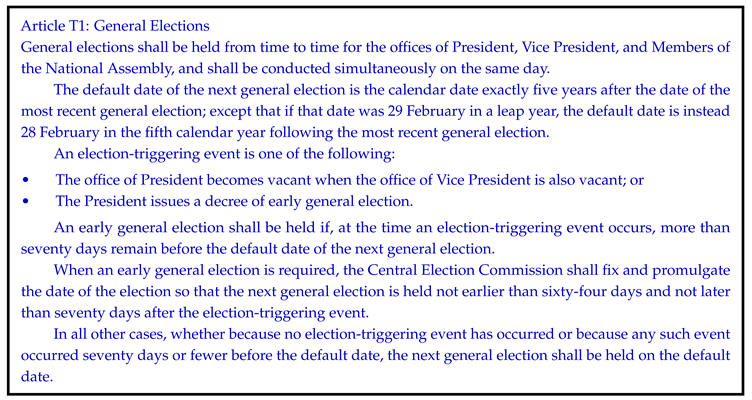
Some design choices are explained below:
- In the absence of any early-election trigger, general elections are held every five years, giving both the President and the Assembly five-year terms. This follows the current Turkish model and is considered optimal.
- The election scheduling mechanism is fully continuous, allowing an election to be held on almost any calendar day.
- A minimum of 64 days is guaranteed between any election-triggering event and the subsequent general election. This duration aims to provide adequate time for the extensive national coordination and candidate vetting required for presidential elections, particularly when parties do not need to hold primary elections to select their candidates. As with many procedural details, the precise length can be adjusted according to national circumstances.
- The short 64–70 day window limits opportunities for political manipulation, while the 7-day flexibility allows polling day to fall on a suitable weekday, accommodating religious or cultural holidays.
The timing of elections in turn determines the exact terms of the offices.

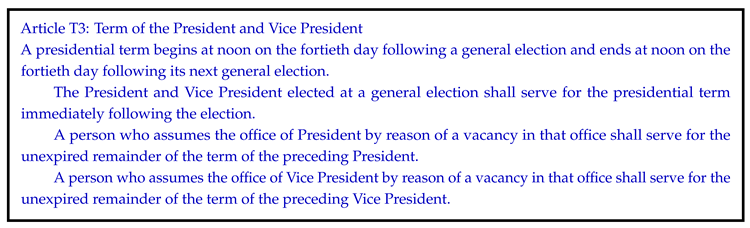
The intervals between the election and the commencement of terms are designed to balance prompt renewal with practical preparation time. The key considerations are as follows:
- The 30-day gap before the Assembly convenes provides a realistic transition period. It allows sufficient time for certification of results, resolution of electoral disputes, and logistical arrangements for the first sitting, while ensuring that the outgoing Assembly does not remain in power excessively long.
- The 40-day gap before the president takes office gives the incoming president the necessary preparation time – particularly for cabinet formation, security briefings, and orderly transition of executive responsibilities. This also creates a deliberate 10-day buffer after the Assembly convenes, reinforcing the legislature’s role during the handover and facilitating a structured transfer of power.
It is also important to note that Scheme T follows the Turkish tradition whereby the Assembly is not “dissolved” even when its term is shortened by an early general election. The Assembly continues to exercise its functions until the newly elected Assembly convenes. This approach is supported by the following considerations:
- During the period between an early election call and the new Assembly’s convening, members of the outgoing Assembly will be overwhelmingly preoccupied with campaigning. Serious legislative work is therefore unlikely and could even be counterproductive. As a result, the practical consequences of formally “dissolving” the Assembly versus allowing it to continue are minimal.
- By not dissolving the Assembly, the system ensures – at least formally – that there is always a functioning legislative body capable of enacting emergency legislation if a genuine crisis arises during what would otherwise be a dissolution period.
- In Turkish-style presidentialism, an early election curtails the president’s term simultaneously with the Assembly’s. This symmetry removes any incentive for the outgoing Assembly to enact retaliatory or “revenge” legislation against the executive.
4.3. Recommended Method for Presidential Election: PLAR
Methods of presidential election in presidential systems must feature direct, popular elections, and they generally fall into three main categories:
(1) One-Round Plurality
Only one round of popular election is held. The candidate receiving the highest number of votes wins, regardless of whether they achieve an absolute majority. This method is simple and decisive but can produce presidents with weak overall support in fragmented fields. Moreover, it is highly vulnerable to strategic entry by a selfish or opportunistic candidate, who can split votes from a stronger, ideologically similar frontrunner – often causing the entire camp to lose an election that the frontrunner would very likely have won had the spoiler not run. This method is used in Ghana, Indonesia, Mexico, the Philippines, and South Korea.
(2) Two-Round Absolute Majority
Two rounds of popular election are held. In the first round, if any candidate receives an absolute majority of the votes cast, they are elected. Otherwise, the two candidates with the highest number of votes advance to a second (runoff) round, where the candidate with the most votes wins. This method ensures the winner has comparatively broad support but is time-consuming, expensive, causing voter fatigue, and logistically demanding. Additionally, the legitimacy of the runoff depends on the first round being conducted and counted fairly and accurately; a short interval between rounds increases the risk of administrative errors or unresolved disputes. This method is used in Argentina, Brazil, Chile, and Colombia.
(3) Electoral College
Only one round of popular election is held. Voters cast ballots for presidential candidates, but the final winner is determined by an electoral college whose members are chosen or allocated according to the popular vote outcome. This method filters the popular will through a representative body, providing a deliberative safeguard against pure plurality outcomes, but it risks disconnecting the final result from the national popular vote and can appear less democratic. This method is used in the United States.
We initially considered adopting the two-round absolute majority system as the illustrative method for presidential election in Scheme T. However, its significant drawbacks prompted us to explore alternatives. We now believe we have developed a much better method. However, this method is not an essential or required element of Scheme T; it remains fully independent of the scheme’s core principles. It is presented here solely as a recommended option for countries seeking a direct yet efficient presidential election process.
This method presupposes a concurrent Assembly election. We therefore introduce some relevant provisions.
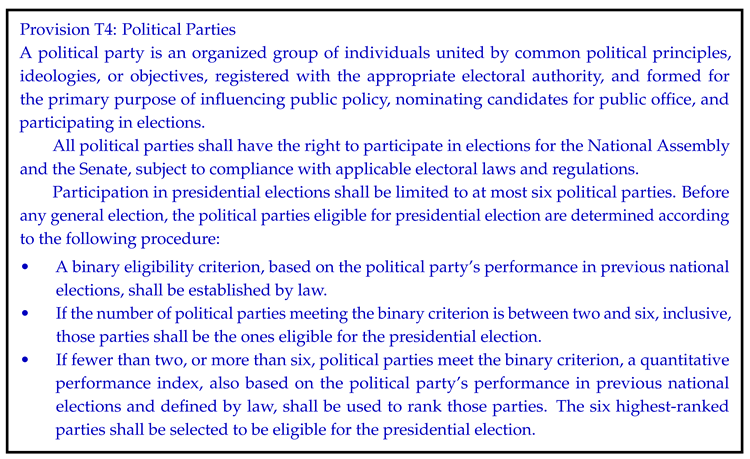
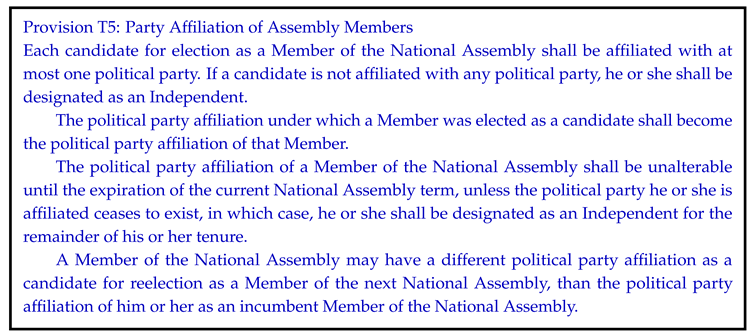
Then we can present this long article on presidential election.
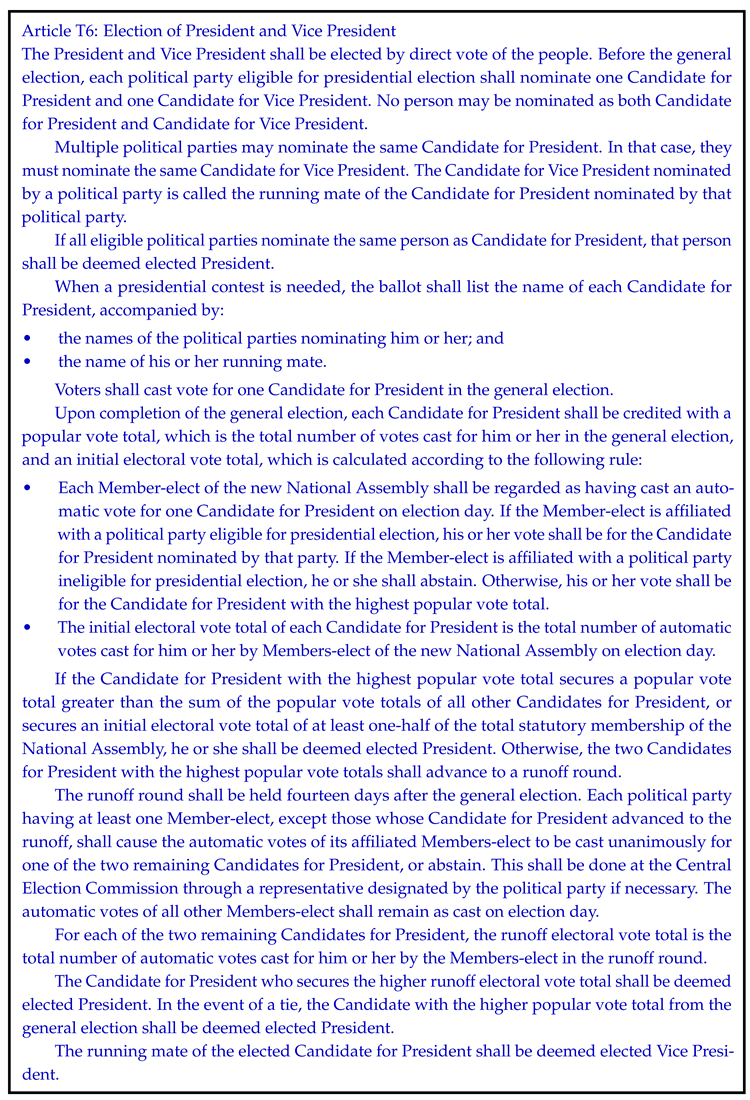
The method codified in the above article is termed Popular with Legislative Automatic Runoff, abbreviated as PLAR. It deserves detailed explanations.
4.3.1. PLAR Is a Bona Fide Popular Election
In PLAR, nearly every aspect of the outcome is directly determined by the voters’ choice in the general election.
The initial electoral vote is not a separate legislative decision: each member-elect casts an automatic, non-discretionary vote that is wholly predetermined – either by their party’s presidential nomination (for members of qualifying parties) or by the national popular-vote ranking (for unaffiliated members). No individual Assembly member exercises personal judgment.
The only partial exception occurs in the runoff round, where members affiliated with parties whose candidates did not advance may collectively redirect their votes to one of the two finalists. However, these votes are cast as unanimous party blocks rather than individual choices. Such collective decisions are almost invariably guided by the party’s political orientation and platform – the same orientation for which those voters deliberately cast their legislative ballots. In this sense, even the runoff phase remains a reasonably faithful extension of the popular will expressed in the general election, rather than an independent elite intervention.
In effect, PLAR produces outcomes very similar to those of a classic two-round absolute-majority system, yet it avoids the high cost, logistical burden, voter fatigue, and the danger of strategic manipulation between rounds. By embedding the equivalent of a runoff inside the legislature as an automatic, low-cost mechanism, PLAR delivers the same majoritarian logic and legitimacy with greater efficiency and stability.
4.3.2. Rationale for Excluding Independent Candidates for Presidency
This choice is based on our belief that independent or signature-based candidates are inherently unsuitable for the presidential contest.
By requiring party affiliation, systems ensure that a president enters office with a built-in legislative caucus and a vetted policy platform. Furthermore, political parties act as vital democratic gatekeepers, providing a rigorous internal vetting process that filters out erratic or extremist candidates who might otherwise bypass traditional scrutiny through purely populist appeals.
Moreover, party affiliation for the president is now a defining feature of modern presidentialism. The ideal of a supra-partisan, father-like figure standing above politics belongs to ceremonial presidencies of the past.
Finally, the inclusion of independent candidates often introduces mathematical instability into the electoral process. Since almost any viable policy platform is already reflected by a major party candidate, the addition of an independent frequently serves only as a “spoiler”. This fragmentation of the vote typically causes both the independent and the ideologically aligned party candidate to lose, perversely handing victory to an opponent who lacks a true majority mandate.
4.3.3. Rationale for Party as Voting Bloc
The PLAR system’s use of unanimous party-block voting in both rounds is grounded in two key rationales: ideological coherence and anti-corruption safeguards.
First, party members typically share similar ideologies, as voters elect them under a common party platform. Requiring unanimous block voting reflects this political reality. In contrast, the U.S. Electoral College’s winner-take-all state allocation often imposes uniformity on diverse electorates, which does not accurately reflect internal divisions – especially in swing states where slim majorities override significant minorities.
Second, block voting serves as an anti-bribery mechanism. By mandating that votes be cast collectively through a party representative (if needed), it reduces opportunities for individual members to be targeted for illicit influence or corruption. This centralized, transparent process minimizes the risk of vote-buying or undue external pressures that could arise in a system allowing personal discretion.
Even when only a single member from a party is elected to the Assembly, that member’s vote in the runoff is not determined by them alone. The party’s voting decision must be made according to procedures formally submitted to the Central Election Commission, as well as documented in the party’s internal regulations and operational records. This structure leaves virtually no room for individual corruption.
In PLAR, the mandatory allocation of unaffiliated members’ votes to the popular-vote frontrunner, eliminating any personal discretion of them, is also grounded in anti-bribery considerations.
4.3.4. Suitability of PLAR to Large Countries
Large countries feature extreme geographic diversity, with sparsely populated border regions, remote rural areas, and islands often holding distinct strategic, economic, or security importance. In conventional direct popular-vote presidential systems, candidates concentrate on densely populated urban centers, marginalizing these low-density areas.
Most large countries already correct such geographic imbalance in legislative elections through malapportionment, equal subnational representation, or minimum seat guarantees for peripheral territories. PLAR extends this logic directly to the presidential contest: because the initial electoral vote and runoff phase draw from the Assembly’s composition, the same seat-allocation rules that over-represent low-density or border regions in the legislature automatically influence the presidential outcome. Candidates must therefore campaign nationwide rather than focus solely on population-heavy zones, ensuring the chief executive reflects territorial as well as demographic balance. PLAR is thus especially suitable for large, geographically heterogeneous countries.
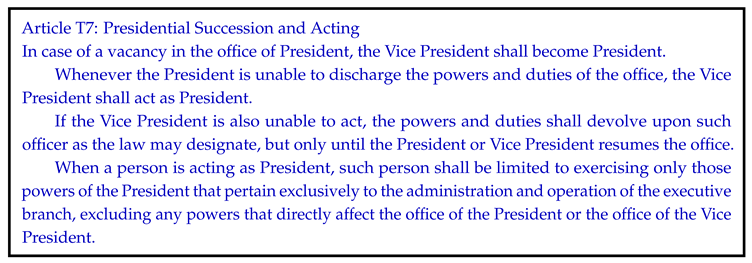
4.4. Presidential Succession and Acting
The succession rule in Scheme T is deliberately simple: only the vice president succeeds to the presidency upon a vacancy. No other officer – neither the Speaker of the Assembly, nor the President Pro Tempore of the Senate (if such an office exists), nor any cabinet member – is placed in the line of succession. This is why an early general election is triggered whenever the two offices are both vacant. This rule also ensures partisan continuity (in conjunction with Article T1 on General Elections), since the vice president either originates from the same electoral ticket as the president or is nominated by the president themselves.
For temporary inability of both the president and vice president to discharge the powers and duties of the office, it is considered better to leave the designation of an acting president to ordinary law. This flexibility allows future legislatures to adapt the temporary-acting arrangement to changing circumstances without requiring constitutional amendment, while preserving the core principle that permanent succession remains strictly limited to the elected/confirmed vice president.
The above considerations are reflected in the following article.
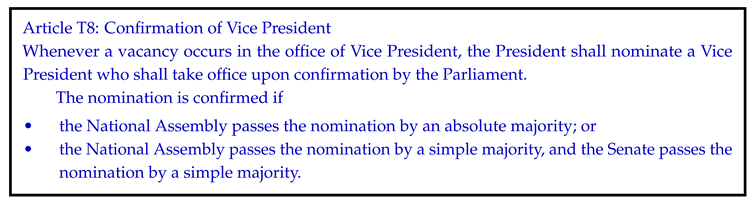
4.5. Confirmation of Vice President
In Scheme T, the confirmation of a vice president nominated to fill a vacancy follows a dual-path mechanism. Path 1 permits confirmation through an absolute majority in the Assembly alone, providing a more convenient route when the nomination enjoys decisive support in the lower house. Path 2 retains the traditional bicameral requirement, as used in the United States and the Philippines. The addition of Path 1 does not significantly reduce the overall difficulty of confirmation, but it enables the Senate to remain largely outside the bargaining process between the president and the Assembly. When the president offers concessions to secure Assembly approval, the Senate is spared from having to take a visible position in that exchange.
4.6. Removal of Vice President
In conventional presidential systems, the vice president can only be removed through impeachment – a rare, extraordinary process reserved for serious misconduct and requiring a high threshold (typically two-thirds in the upper house).
Scheme T introduces a Vice President but deliberately makes this office removable by the Assembly through a vote of no-confidence. This is not a feature of classical presidentialism, nor does it exist in the current Turkish model. The rationale for this design will be clear later.

4.7. The President’s Renewal Authority
As previously noted, Scheme T follows the Turkish constitutional approach in allowing the term of the Assembly (also of the president) to be curtailed through an early general election. The Turkish Constitution employs the specific phrasing “renew the elections” (or “renewal of elections”) for this mechanism. The president is granted the authority to call such an early general election.

Its effects have already been addressed
This article is notably cleaner than analogous articles in most existing constitutions. The effects of a decree of early general election – including, in particular, the arrangements for determining the election date – are already specified in Article T1 (General Elections).
Early general election is a suicide attack
Early general election also brings about the early termination of the president’s term, making this decree a form of “suicide attack” by the president.
No restrictive time-window for the decree
The president may issue a decree of renewal at any time during their term, with one nominal exception: it may not be issued in the final thirty days. However, this “final thirty days” clause does not constitute a genuine restriction. According to Articles T1 and T3, a renewal decree issued during this period has no legal effect. Prohibiting an action that produces no consequence is not a restriction in any meaningful sense. Even if this period were extended somewhat, it would still not qualify as a substantive limitation, as a marginally earlier general election would be politically inconsequential.
In Version 1 of this paper, the former Article T10 imposed a restrictive time window, limiting renewal decrees to “January or July”. That limitation was designed to safeguard the security of the president’s tenure. We have since identified a more effective and targeted mechanism for achieving the same goal: restricting the Assembly’s power to pass a vote of no-confidence against the president during the final two years of the presidential term. This new restriction on the Assembly replaces the previous time-window restriction on the president. Consequently, the “January or July” limitation on the presidential decree of renewal has been removed.
Although the Assembly faces a time restriction on votes of no-confidence, no reciprocal time restriction applies to the president’s authority to issue a renewal decree. This asymmetry is intentional. The renewal decree functions as a form of “suicide attack” – a high-stakes, self-sacrificial measure. The president needs maximum flexibility to respond effectively to legislative deadlock or legislative-executive paralysis that may occur at any time.
4.8. No-Confidence in the President
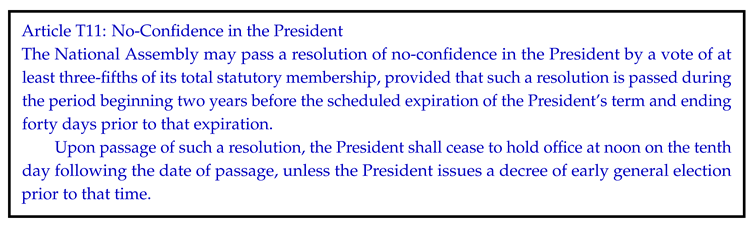
Scheme T supplements the Turkish presidential framework by introducing a no-confidence mechanism directed against the president. The underlying rationale is straightforward: if the Assembly can pressure the president into a corner without simultaneously sacrificing itself, it will do so.
In the current Turkish system, the absence of a vice president creates a marked strategic asymmetry. If the Assembly were to adopt a no-confidence vote and force the president into a binary choice – resign or trigger an early general election – the president would have no attractive option. Resignation would leave the presidency vacant with no successor from the president’s party, triggering a presidential-only early election, while an early general election would renew both the presidency and the Assembly. Consequently, the president would almost always choose the early general election. This makes a hypothetical no-confidence mechanism in Türkiye functionally indistinguishable from the existing direct early-election power – likely the reason the Turkish model relies solely on the latter.
Scheme T fundamentally alters this calculus by establishing the office of Vice President. In certain circumstances, resignation becomes a preferable alternative to an early general election. For instance, if the president is deeply unpopular and has no realistic prospect of winning re-election – or even securing renomination – resignation would at least partially preserve their political legacy by allowing a vice president sharing a similar ideological orientation to assume office. For the Assembly, preserving its current term is almost always more advantageous than having it curtailed by an early election.
In short, the no-confidence mechanism in Scheme T is more flexible and less self-destructive than Türkiye’s direct self-renewal power. Its inclusion offers meaningful benefits to all major political institutions involved.
Connection with Westminster
The no-confidence mechanism in Scheme T draws inspiration from the Westminster parliamentary tradition, where a vote of no-confidence is the principal tool by which the legislature can hold the executive accountable. In classic Westminster systems, a successful no-confidence motion typically forces the resignation of the prime minister or triggers dissolution. Scheme T adapts this principle to a presidential framework: the Assembly can remove the president through no-confidence, but the president retains the countervailing power to dissolve the Assembly first. This creates a balanced, reciprocal check absent in pure presidential systems, while preserving the Westminster-inspired logic of legislative oversight over executive tenure.
Rationale for adopting mandatory termination instead of resignation
The article replaces resignation with mandatory termination of office. The two outcomes are practically equivalent, but mandatory termination eliminates uncertainty over whether a resignation has occurred and the exact time it takes effect – issues that could complicate the 10-day transition period. More importantly, the traditional wording makes the “do-nothing” option illegal for the prime minister (now the president in Scheme T): the executive must actively choose either resignation or early election. In contrast, our wording allows “do-nothing” to remain perfectly lawful – inaction simply defaults to resignation.
Rationale for the threshold
The three-fifths threshold mirrors the Turkish model exactly. This level is elegant and balanced: higher than the simple majority used in parliamentary systems, but justified by the office being that of President rather than Prime Minister.
Rationale for the final-two-year restriction
Scheme T limits the passage of a resolution of no-confidence in the president to the final two years of the scheduled original five-year presidential term. This ensures the president enjoys three years of secure tenure, thereby preserving the fundamentally presidential character of the system.
Internal consistency among the three temporal parameters
To achieve internal consistency and logical symmetry, the following three temporal parameters should be coordinated:
- : No-Confidence Prohibition – the number of final days of the presidential term during which a no-confidence resolution is prohibited.
- : Renewal Decree Prohibition – the number of final days of the presidential term during which the president may not issue a decree of renewal.
- : President’s Response Time – the number of days granted to the president to decide on issuing a renewal decree after a no-confidence resolution.
These parameters must satisfy to allow the president to have the intended time for consideration. It is strongly recommended to adopt strict equality for maximum mathematical elegance and internal symmetry.
4.9. No Assembly’s Renewal Authority
In Version 1 of this paper, we followed the Turkish approach by including a symmetric article granting the Assembly the authority to call an early general election. Upon further reflection, we decided to remove that article.
Simulation of Assembly’s renewal authority via no-confidence
Suppose a politically united 3/5 supermajority in the Assembly adopts the following sequence:
- First, a resolution of no-confidence against the vice president;
- Second, a resolution of no-confidence against the president.
Regardless of the president’s response, the outcome is essentially the same: either the president issues a decree of early general election, or a double vacancy occurs – both of which trigger an early general election.
This shows that the Assembly’s renewal authority is to some extent reproducible using the existing no-confidence mechanism. However, this simulation is oversimplified. It may not hold when the 3/5 supermajority is not politically united – for example, when it consists of opposition members plus rebellious ruling-party members who support removing the vice president but not the president, or vice versa.
Imagined simulation of no-confidence via Assembly’s renewal authority
Conversely, suppose the constitution grants the Assembly renewal authority but contains no no-confidence provision (as in the current Turkish constitution). A 3/5 supermajority could threaten the president: “Resign within 10 days, or we will renew both mandates”. If the president refuses, the Assembly could then pass a resolution for early general election.
However, this simulation also has hurdles. Threatening is not a formal constitutional action, and even if threatening is formalized into a resolution, passing the two resolutions would still encounter the same coordination problem: passing one resolution may not guarantee passing the other due to divergence in the said supermajority.
The above exercises illustrate the functional similarity but exact non-equivalence between no-confidence and renewal provisions.
Key rationale for not directly granting Assembly renewal authority
On paper, mutual renewal powers between the president and the Assembly seem symmetrical. In practice, however, their effects differ sharply. Renewal by the legislature tends to produce only incremental adjustments in seat shares among parties. By contrast, presidential renewal is a high-stakes, winner-take-all event that can dramatically realign policy and power. As a result, a 3/5 supermajority in the Assembly can exercise renewal at relatively low cost but with the prospect of outsized returns – making legislative dissolution authority significantly weightier. Given this asymmetry and the pivotal nature of renewal power, we believe the power should come from a single source – the president.
This design choice makes Scheme T resemble Westminster-style systems more closely than the Turkish model from which it originally drew inspiration.
4.10. Recommended Term Limits
If the no-confidence threshold in Scheme T were lowered to a simple absolute majority, the system would closely resemble the Westminster model. In that case, term limits for the president would be unnecessary, as prime ministers in Westminster-style systems worldwide face no formal term limits.
Given Scheme T’s elevated three-fifths threshold – which significantly strengthens executive stability – term limits remain essential to prevent prolonged entrenchment in the presidency.
We therefore recommend that no person be elected President more than twice in succession. To avoid unduly harsh outcomes in a system where early elections may frequently produce short or partial terms, the framework includes a limited relaxation: only a person who has served for at least eight years (including any time by succession from the vice presidency) becomes ineligible to stand for President or Vice President in the next general election.
No cap is imposed on the total number of non-consecutive (lifetime) terms a person may serve.
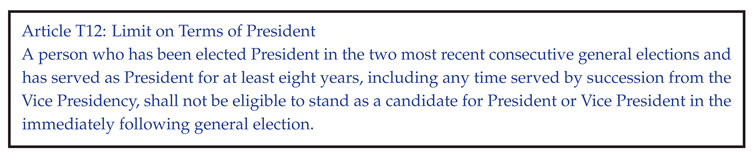
The rationale for omitting a lifetime cap is that it encourages the president to prioritize the long-term electoral health of their party. A president in a final term has a strong incentive to cherish every remaining moment in office and to avoid decisions – such as calling early general elections – that might shorten that term, even if such actions could benefit the party electorally in the short run.
Beyond term limits, preserving the neutrality and independence of investigative and prosecutorial agencies is perhaps even more critical. This ensures that any presidential misconduct will be exposed – at the latest – after the president leaves office, thereby eliminating any realistic prospect of reelection and reinforcing accountability through post-tenure scrutiny.
To further safeguard this independence, it is advisable to reduce the president’s authority in appointing the heads of these agencies. A more robust mechanism – such as vesting nomination in a cross-partisan committee (comprising representatives from the executive, judiciary, bar association, and legislature) that shortlists qualified candidates, from which the president selects and appoints – would help insulate these offices from undue executive influence while minimizing the risk of prolonged vacancies or partisan gridlock.
4.11. Recommended Threshold for Passing Laws
The articles show that an opposition coalition commanding a three-fifths supermajority in the Assembly may likely force the nation into an early general election (effectively a referendum on the government), but it cannot instantly defeat the president; the outcome remains contingent on the election result. In light of this observation, a three-fifths threshold is not sufficiently high to serve as the override standard for laws vetoed by the president. The two-thirds threshold used in the United States Constitution is a more appropriate choice.
The two-thirds threshold applies to the Assembly. For the Senate, however, two-thirds would be excessively high, given its role as a more neutral and deliberative body. Reaching two-thirds in the Senate is significantly more difficult than in the Assembly due to its composition and design. A threshold between simple majority and two-thirds is therefore more appropriate, and three-fifths strikes a balanced compromise.
Consequently, Scheme T recommends to adopt the following legislative procedure for passing laws:
- The National Assembly passes the bill by simple majority, the Senate passes it by simple majority, and the President does not veto it; or
- If the President vetoes the bill, the National Assembly re-passes it by a two-thirds majority of Members present and voting (a quorum being present), and the Senate re-passes it by a three-fifths majority of Members present and voting (a quorum being present).
5. Comparative Analysis
5.1. Comparison Between Türkiye and Scheme T
Scheme T adopts several core features of Turkish-style presidentialism, but it deliberately modifies key elements to alter the balance of power and political incentives.
Both systems share the following:
- A directly elected president with strong executive authority and no prime minister.
- The president’s unilateral power to renew the legislature at will, functioning as a “suicide attack” that also shortens the president’s own term.
- No removal of the president by a simple or absolute majority of the Assembly. A three-fifths supermajority threshold for the most significant legislative action against the executive (self-renewal in Türkiye; no-confidence in Scheme T).
The most significant divergences are:
- Vice presidency: Türkiye has no vice president. Scheme T creates the office, with the vice president elected on the same ticket as the president and automatically succeeding upon vacancy. This introduces continuity and partisan succession entirely absent in the Turkish model.
- Guaranteed election synchronization: Double vacancy (simultaneous vacancy in both presidency and vice presidency) triggers a full general election. No presidential-only early election is possible, ensuring that legislative and presidential terms remain synchronized.
- Replacement of Assembly’s renewal authority with no-confidence in the executive: Türkiye grants the Assembly (3/5 supermajority) the power to call early general elections, whereas Scheme T withholds this authority entirely from the Assembly and instead provides a time-restricted no-confidence (also 3/5 supermajority) mechanism against the president. This may result in vice-presidential succession or renewal of both branches. No-confidence is also applied against the vice president without time-restriction.
- Guaranteed three-year secure presidential tenure: Türkiye offers no guaranteed secure period for the president. Scheme T prohibits any no-confidence resolution in the first three years of the five-year term, thereby ensuring the president enjoys three years of protected tenure.
5.2. Comparison Between the Westminster Model and Scheme T
The no-confidence mechanism in Scheme T closely resembles the classical Westminster parliamentary model in many respects. Most surface-level similarities are obvious and require little elaboration. The discussion below therefore focuses on deeper, more structurally revealing parallels, while also highlighting the most significant points of divergence – principally the no-confidence threshold, the succession mechanism, and the number of fallback positions.
5.2.1. Strategic Choices of the Executive Leader Facing No-Confidence
When confronted with a no-confidence resolution, the executive leader (prime minister in Westminster systems, president in Scheme T) faces strikingly similar strategic options in both models.
Opposition-driven no-confidence
In Westminster systems, the prime minister typically chooses dissolution, unless the party is so unpopular that it has virtually no chance of winning the ensuing election.
In Scheme T, the president faces essentially the same choice. There is one nuance: resignation would allow the vice president to succeed and keep the ruling party in power. However, this option is largely illusory, as the opposition can simply pass another no-confidence resolution against the new president.
Hybrid or coalition-defection no-confidence
A no-confidence resolution supported solely by the ruling party or coalition is virtually impossible. The more realistic scenario arises when members of the ruling coalition (or backbenchers from the governing party) defect to support an opposition-led motion, often triggered by a major scandal that erodes leadership legitimacy.
In Westminster systems, such defections have historically tipped fragile majorities – for example, the 1979 fall of James Callaghan’s government or recent party rebellions that forced leaders toward resignation or dissolution. The executive typically responds with dissolution to seek a fresh mandate, though resignation becomes likely if the internal rift proves irreparable.
In Scheme T, the president faces analogous choices, with renewal (early election) as the default response during most of the term. A key political dynamic remains the same as in Westminster: the greater the number of ruling party or coalition members supporting the no-confidence vote, the more likely the president is to resign rather than force an election. This reflects the familiar logic of party discipline and damage control – when internal dissent reaches a critical mass, fighting on becomes untenable.
5.2.2. Impact of the Three-Year Secured Presidential Tenure
Scheme T guarantees the president three years of secure tenure by prohibiting any resolution of no-confidence during the first three years of the five-year term. This design choice produces two major effects.
First, it preserves the fundamentally presidential character of the system. By shielding the executive from immediate and continuous legislative pressure, Scheme T avoids the chronic instability often seen in pure parliamentary systems, where governments can collapse at any moment due to shifting coalitions or internal rebellions.
Second, it provides the president with a protected window to implement policy initiatives that may be unpopular in the short term but are necessary in the long run, without the constant threat of removal. This stability is particularly valuable in polarized or transitional democracies, where short-term political turbulence could otherwise derail long-term reforms.
5.2.3. Strategic Election Timing
Scheme T restores the president’s ability to engage in strategic election timing, granting a privilege similar to that enjoyed by the prime minister in Westminster systems. The president can now call for early general elections practically at any time during the five-year term, free from the rigid “January or July” restrictions that existed in Version 1.
5.2.4. Investiture in Westminster Systems Versus Confirmation in Scheme T
In Westminster-style systems, investiture refers to the process of identifying and installing a prime minister who can command (or at least survive) the confidence of the lower house. This usually occurs following a vacancy – most commonly after the resignation or electoral defeat of the incumbent prime minister. The procedure is informal, uncodified, and largely discretionary: the head of state consults parliamentary party leaders and appoints the individual deemed most likely to secure the confidence of the house. No formal parliamentary vote or explicit investiture election is required.
The functional analogue in Scheme T is the confirmation procedure. Unlike its Westminster counterpart, confirmation in Scheme T is a formal, legally codified process that may involve three institutions: the president, the Assembly, and – following American precedent – the Senate. However, to achieve closer alignment with the Westminster logic of parliamentary predominance, Scheme T introduces a “Path 1” confirmation route that explicitly bypasses Senate involvement. Presidential participation remains unavoidable, since Scheme T is structurally a presidential rather than a parliamentary system.
In Westminster systems, investiture occurs after a vacancy arises, leaving the outgoing prime minister with minimal influence over their successor. By contrast, Scheme T’s confirmation process takes place before a vacancy, while the sitting president still holds nomination power and political leverage. This ex-ante mechanism gives the departing president greater assurance and control over who will succeed them, reinforcing Scheme T’s presidential character and executive stability.
5.2.5. Consequences of the Higher No-Confidence Threshold in Scheme T
The most immediate consequence of Scheme T’s substantially higher no-confidence threshold (3/5 supermajority) is that it is considerably more difficult for the parliamentary opposition to remove an incumbent government.
A second, less immediately obvious implication is that the same elevated threshold — reinforced by the three-year protected tenure – also makes it significantly harder for the ruling coalition itself to replace the president. In other words, it raises the barrier to an intra-coalition coup. As a result, the president faces markedly reduced pressure from their own party leadership or coalition partners compared with a conventional Westminster prime minister.
5.2.6. Succession Rules as an Additional Barrier to Intra-Coalition Coups
Scheme T imposes yet another structural obstacle to intra-coalition leadership change. If the sitting vice president is not the preferred choice of the ruling elites, those elites must first pass a separate no-confidence resolution against the vice president before they can install a more acceptable successor. Even after such removal, only the president has the authority to nominate a replacement vice president. This creates an additional round of bargaining between the president and the coalition leadership.
No comparable multi-step hurdle exists in most Westminster systems, where removal of the prime minister normally allows the governing party or coalition to install its preferred successor relatively quickly.
In summary, meaningful intra-coalition coups against the chief executive are feasible in Scheme T only when the ruling elites are already broadly satisfied with the sitting vice president. This contrast is unsurprising: Westminster systems remain fundamentally parliamentary in character, whereas Scheme T is fundamentally presidential. The higher institutional barriers to leadership change reflect – and reinforce – that underlying constitutional logic.
5.2.7. Near-Infinite Backups in Westminster Versus at Most One Backup in Scheme T
In Westminster systems, a vacancy in the prime ministership renders virtually any member of the Assembly eligible as a successor, creating an effectively unlimited pool of potential replacements. This broad eligibility ensures that a vacancy virtually never necessitates a general election.
In Scheme T, by contrast, succession is restricted to at most one pre-designated backup – the vice president. Should that vice president be unavailable or removed, a genuine vacancy may arise without an immediate successor in place. This creates an outcome rarely seen in other democracies – a distinctive feature of Turkish-style presidentialism – namely, that the Assembly’s term may be curtailed for reasons largely unrelated to political conflict, principally an unforeseen vacancy in the presidency when no vice president is in office. To be fair, such cases are extremely rare. In Scheme T, however, the curtailment may also be attributable to the Assembly’s sustained refusal to approve the president’s vice-presidential nominations.
This also underscores the critical importance of “Path 2” in the confirmation process. By increasing the likelihood of successful confirmation, Path 2 reduces the probability of an early election triggered by prolonged deadlock. Far from being a mere nod to American tradition, Path 2 constitutes a logical, coherent, and indispensable element of Scheme T’s overall design.
6. Conclusions
Scheme T emerges as a carefully designed constitutional framework that initially addresses the challenge of partisan continuity in executive leadership – a limitation inherent in the American presidential model. Its fixed terms and rigidly scheduled elections make partisan continuity theoretically unachievable.
We therefore turn to the Turkish presidential framework, which seeks greater inter-branch alignment by synchronizing executive and legislative terms and permits non-rigid election scheduling. Nevertheless, two features of the Turkish constitution, the only living implementation of that framework, render it less than ideal: “plebiscitary succession” (which undermines stability) and “violation of election synchronization” (which hurts elegance).
To address these shortcomings within the Turkish framework, Scheme T establishes a dedicated vice-presidential office, supported by a formal confirmation procedure featuring dual pathways: Path 1 enables streamlined Assembly approval, while Path 2 incorporates broader institutional involvement, drawing on American traditions. Critically, the scheme mandates that any double vacancy (simultaneous absence of president and vice president) or an order of renewal will invariably trigger a comprehensive general election encompassing both branches, thereby eliminating the possibility of isolated presidential-only elections.
An important by-product of Scheme T’s design is PLAR (Popular Legislative Automatic Runoff), a novel method for presidential elections that presupposes simultaneous presidential and legislative elections. PLAR achieves efficiency, stability, and fairness by concluding the process in a single round of popular voting, yet delivers outcomes comparable to a traditional two-round absolute-majority system.
In addition to the presidential renewal power retained from Turkish presidentialism, Scheme T incorporates a Westminster-style no-confidence mechanism with an elevated three-fifths threshold, while deliberately removing the Assembly’s direct renewal authority that exists in the current Turkish system and was also present in Version 1 of this paper. The no-confidence procedure is further restricted to the final two years of the presidential term, ensuring the president enjoys three years of secure tenure.
This Westminster infusion is essential. It introduces confidence-based accountability that enables parliamentary majorities or coalitions to constrain or remove the executive when necessary, while the high threshold and the three-year protected tenure prevent the chronic instability often associated with pure parliamentary systems. By replacing the Assembly’s renewal authority with a carefully constrained no-confidence mechanism and combining it with strong presidential stability features, Scheme T achieves a more balanced equilibrium between executive decisiveness and democratic accountability.
In sum, Scheme T synthesizes the strengths of the Turkish, Westminster, and American paradigms into a presidential system that markedly enhances stability, accountability, and adaptability. Through structured succession, deadlock-resistant confirmation processes, calibrated removal mechanisms, and innovative electoral design, it offers a coherent blueprint for building stable, resilient, and responsive presidential governments.
References
- Amar, Akhil Reed and Vikram David Amar. 1995. Presidents, vice presidents, and death: Closing the constitution’s succession gap. The Journal of Law, Philosophy and Culture 48, 161.
- Esen, Selin and Kemal Gözler. 2017. Presidentialism à la Turca: A distinctive extreme case.
- Gözler, Kemal. 2022. El Kitabı Anayasa Hukuku [Handbook of Constitutional Law] (18 ed.). Bursa: Ekin Basım Yayın.
- Gözler, Kemal. 2017. Elveda Anayasa: 16 Nisan 2017’de Oylayacağımız Anayasa Değişikliği Hakkında Eleştiriler. Bursa: Ekin Yayınları.
- Gözler, Kemal. 2018. Elveda anayasa [farewell constitution]. International Journal of Constitutional Law 16(1), 307–310. [CrossRef]
- Kalt, Brian C. 2003. Constitutional Cliffhangers: A Legal Guide for Presidents and Their Enemies. New Haven: Yale University Press.
- Kirişci, Kemal. 2017, April. The Turkish constitutional referendum, explained. Brookings Institution. Explains how simultaneous elections, alongside potential legislative majorities and dissolution powers, reduce checks and enable the president’s party to dominate parliament.
- Kuzu, Burhan. 1997. Türkiye İçin Başkanlık Sistemi [Presidential System for Turkey]. İstanbul: Fakülteler Matbaası.
- Kuzu, Burhan. 2011. Her Yönü ile Başkanlık Sistemi. İstanbul: Babıali Kültür Yayıncılık.
- Kuzu, Burhan. 2017. Cumhurbaşkanlığı hükümet sistemi ve mevcut durum. Siyaset, Ekonomi ve Toplum Araştırmaları Vakfı (SETA).
- Özbudun, Ergun. 2018. Turkey’s presidential system: Model and practice. Southeast European and Black Sea Studies 18(3), 443–453.
- Sözen, Yunus. 2017. The 2017 presidential amendments in Turkey: The rise of the Turkish-type presidentialism. Turkish Studies.
- Venice Commission. 2017, March. Turkey – opinion on the amendments to the constitution adopted by the Grand National Assembly on 21 January 2017 and to be submitted to a national referendum on 16 april 2017. Technical Report CDL-AD(2017)005, European Commission for Democracy through Law, Council of Europe, Strasbourg. Adopted by the Venice Commission at its 110th Plenary Session (Venice, 10-11 March 2017).
- von Steinsdorff, Silvia. 2017, February. Presidentialism à la Turka or what? the (missing) logic behind the constitutional amendments. Verfassungsblog. Highlights synchronization of electoral cycles as interlocking executive and legislative fates, potentially amplifying effects of electoral rules on power concentration. [CrossRef]
- Yazıcı, Serap. 2020. Turkey’s constitutional revision of 2017 and the presidential system à la Turca. European Review 28(4), 562–574.
- Yokuş, Sevtap. 2018, August. Elections and the presidential system in Turkey / Türkiye’de seçimler ve cumhurbaşkanlığı sistemi. Technical report, Democratic Progress Institute (DPI), London. Assessment report prepared for DPI.
- Özbudun, Ergun. 2017. Turkey’s Constitutional Reform and the 2017 Referendum. İstanbul: Bilgi University Press.
Disclaimer/Publisher’s Note: The statements, opinions and data contained in all publications are solely those of the individual author(s) and contributor(s) and not of MDPI and/or the editor(s). MDPI and/or the editor(s) disclaim responsibility for any injury to people or property resulting from any ideas, methods, instructions or products referred to in the content. |
© 2026 by the authors. Licensee MDPI, Basel, Switzerland. This article is an open access article distributed under the terms and conditions of the Creative Commons Attribution (CC BY) license (http://creativecommons.org/licenses/by/4.0/).
Copyright: This open access article is published under a Creative Commons CC BY 4.0 license, which permit the free download, distribution, and reuse, provided that the author and preprint are cited in any reuse.