
Submitted:
22 February 2026
Posted:
28 February 2026
You are already at the latest version
Abstract
Under resource constraints, technology-based SMEs are highly sensitive to the return on training investment. This study analyzes the impact of different training strategies on employee performance, focusing on the relationship between skills gap and training effectiveness. Based on skills assessment, training records, and performance appraisal data of 2,784 technical personnel in a technology-based SME, a skills gap index was constructed, and two types of investment methods were distinguished: general training and job-oriented training. A multiple regression model was used to analyze the relationship between training duration and performance changes. The results show that implementing job-oriented training for employees with skills gaps in the upper quartile resulted in an average performance score improvement of 0.21 standard deviations, while the improvement from general training was less than 0.06. The research results provide a quantitative basis for SMEs to optimize the allocation of training resources.
Keywords:
skills gap
; return on training
; technology-based SMEs
; multiple regression
; human resource management
1. Introduction
Technology-intensive small and medium-sized enterprises (SMEs) operate in environments characterized by rapid technological change, compressed product life cycles, and continuous upgrading of production and service processes [1]. In such settings, the alignment between employee skills and job requirements is inherently dynamic. Skill mismatches may emerge quickly as technologies evolve, standards shift, and customer expectations increase. When capability gaps accumulate without timely adjustment, they can directly constrain productivity, innovation output, and operational reliability. International labor market analyses consistently indicate that a substantial share of the workforce will require reskilling or upskilling in analytical, digital, and problem-solving domains in the coming years [2,3]. Strategic human resource leadership research further emphasizes that data-driven skill diagnostics and targeted capability development are central to sustaining competitiveness under technological turbulence [4]. For SMEs, these pressures are intensified by limited financial slack, smaller internal labor markets, and lean management structures. Training expenditures are therefore often evaluated in terms of short-term and observable returns rather than long-term capability accumulation, creating a tension between immediate performance demands and sustained human capital development [5,6].
The relationship between training investment and performance has been widely examined, yet empirical conclusions remain inconclusive [7]. Firm-level studies frequently report positive associations between employer-provided training and productivity, suggesting that accumulated training inputs can enhance organizational output [8,9]. However, effect sizes vary substantially across industries, technological intensity levels, and firm sizes. Reviews of empirical research note that estimated training returns are highly sensitive to measurement strategies, including how training intensity, duration, and content are operationalized, as well as how performance outcomes are defined [10]. Variations in data sources, econometric specifications, and observation windows often produce inconsistent findings. These challenges are particularly salient in SMEs, where training participation is selective rather than universal, and where a small number of employees may account for a disproportionate share of training hours [11,12]. Human resource management research has increasingly shifted attention toward the conditions under which training translates into improved job performance. Evidence suggests that training aligned with clearly identified skill needs is more likely to generate measurable gains than undifferentiated or compliance-driven programs [13]. Studies on training transfer emphasize that the opportunity to apply newly acquired skills in daily tasks is critical for realizing performance improvements [14]. When training content is weakly connected to actual job requirements, performance effects tend to be modest, even if participation rates are high. These findings underscore the importance of distinguishing between broadly applicable general training and training that is closely linked to specific positions, technologies, or task structures. In technology-oriented SMEs, where job roles are often specialized and project-based, such distinctions may be particularly consequential. Despite growing interest in training effectiveness, several limitations persist in the existing literature, especially in studies focusing on SMEs. A common issue is the reliance on indirect or self-reported proxies for skill levels, such as education attainment or tenure, which do not capture concrete capability gaps at the task level [15,16]. Without direct measurement of required and actual competencies, it is difficult to assess whether training addresses real mismatches or merely supplements already adequate skills. Another limitation concerns the aggregation of training inputs into total hours or participation indicators without differentiating training content, objectives, or relevance [17]. This practice may obscure heterogeneous effects across training types. In addition, many empirical analyses rely on relatively small samples or short observation periods, limiting the ability to detect variation across employees with different baseline skill profiles or to identify non-linear relationships between training intensity and performance change. A further gap relates to the interaction between initial skill gaps and training type. Employees with larger capability deficits may benefit differently from training compared with those whose skills already closely match job requirements. General training may broaden knowledge but fail to address specific operational deficiencies, whereas position-oriented training may directly reduce task-related gaps. However, systematic evidence comparing these effects within resource-constrained, technology-intensive SMEs remains limited. The absence of detailed skill-gap measurement and matched performance data has restricted the capacity of prior research to clarify how training effectiveness varies across employees and contexts [18].
Against this background, the present study examines the relationship between skill gaps, training type, and performance outcomes in a technology-oriented SME operating under resource constraints. Using matched data on skill assessments, detailed training records, and performance evaluations for 2,784 technical employees, a skill-gap index is constructed to quantify the distance between current competencies and job-specific requirements at the task level. Training inputs are classified into general training and position-oriented training to reflect differences in relevance to daily work. Multivariate regression models are employed to estimate the association between training duration and subsequent performance changes, with explicit modeling of heterogeneity across different levels of initial skill gaps. By integrating direct measurement of capability mismatches with differentiated training categories, this study provides clearer evidence on how targeted training strategies can enhance performance in technology-intensive SMEs. The findings contribute to the literature by linking skill-gap diagnostics with training design and by offering quantitative guidance for firms seeking to allocate limited training resources more effectively under rapid technological change.
2. Materials and Methods
2.1. Sample and Study Context
The analysis is based on personnel records from a technology-oriented small and medium-sized enterprise in the software and applied engineering sector. The final sample includes 2,784 technical employees who remained in the same job role throughout the observation period and had complete records for skill assessment, training participation, and performance evaluation. The workforce covers software developers, system engineers, data analysts, and technical support staff, all operating under a unified job classification and appraisal system. The firm is subject to typical SME constraints, including limited training budgets and project-driven workloads, which makes training decisions closely tied to short-term operational needs. Employees with incomplete records or major job changes during the study period were excluded to maintain consistency in performance comparisons.
2.2. Training Design and Control Structure
Training activities were arranged by the human resource department based on annual skill assessment results and operational requirements. Employees who participated in formal training during the study period were assigned to the treatment group, while those without any training records formed the control group. Within the treatment group, training was classified into general training and position-oriented training according to course content and training objectives. General training focused on broadly applicable skills such as programming fundamentals, project coordination tools, and technical communication. Position-oriented training targeted task-specific skills directly related to the employee’s current position. This classification allows training effects to be compared under different levels of task relevance. All employees, including those in the control group, were evaluated using the same performance appraisal framework.
2.3. Measurement Procedures and Quality Control
Employee skill levels were measured using standardized internal assessments conducted annually by the firm. These assessments combined technical tests, task-based evaluations, and supervisor ratings, each linked to role-specific competency standards. Training participation data were obtained from the firm’s learning management system and included information on training type, duration, and completion status. Performance outcomes were measured using standardized performance scores derived from annual evaluations, which integrate indicators of work output, task quality, and project contribution. To ensure data accuracy, records with missing values or internal inconsistencies were removed. Assessment criteria and evaluation procedures remained unchanged during the study period, reducing variation caused by procedural adjustments.
2.4. Data Processing and Model Specification
All variables were cleaned and standardized prior to analysis. A skill gap index was calculated as the standardized difference between required competency levels for a given position and the observed skill scores of each employee. Training input was measured as the total number of training hours completed during the observation period. The association between training and performance change was estimated using multivariate regression models with controls for demographic and job-related characteristics. The baseline specification is given by:
where represents the standardized change in performance for employee , denotes training duration, denotes the skill gap index, and is a vector of control variables. Additional regressions were estimated separately for different quartiles of the skill gap distribution to assess differences in training effects across employee groups.
2.5. Robustness and Validation Procedures
Several checks were conducted to assess the stability of the results. Alternative model specifications were estimated using transformed measures of training duration and performance to test sensitivity to scale choice. Observations in the extreme tails of the performance distribution were removed to evaluate the influence of outliers. Separate regressions were also performed for general training and position-oriented training to confirm the consistency of estimated effects. Multicollinearity was assessed using variance inflation factors, and heteroskedasticity-robust standard errors were applied in all models. These procedures support the reliability of the estimated relationships between skill gaps, training type, and performance outcomes.
3. Results and Discussion
3.1. Descriptive Results and Baseline Differences Across Skill-Gap Groups
The distribution of the skill-gap index exhibited a clear upper tail, indicating a limited but relevant group of employees with marked mismatch between required and observed skills. Training participation differed across skill-gap levels, with employees facing larger gaps more frequently assigned to position-oriented programs than to broad courses. This allocation pattern reflects common practice in small firms, where training resources are often directed toward areas with immediate operational relevance rather than evenly distributed across the workforce. Similar patterns have been documented in recent empirical work on small and medium-sized enterprises, showing that training-related adjustments tend to be more pronounced when firms operate under tight resource constraints and short planning horizons [19]. Figure 1. Heterogeneous effects of training support by firm size.
3.2. Main Effects of Training Type on Performance Change
Regression results showed that the type of training was more strongly associated with performance change than the total number of training hours. Among employees in the highest skill-gap quartile, position-oriented training corresponded to an average performance increase of 0.21 standard deviations, while the estimated effect of general training remained below 0.06 standard deviations. This difference suggests that training closely linked to current job tasks is more likely to translate into short-term performance improvements captured by formal evaluations. By contrast, general training may contribute to broader capability development, but its effects are less visible within limited evaluation periods. Related firm-level studies also report that measured training returns vary widely depending on how training inputs are structured and how performance outcomes are defined [20,21].
3.3. Skill-Gap–Dependent Returns and Plausible Mechanisms
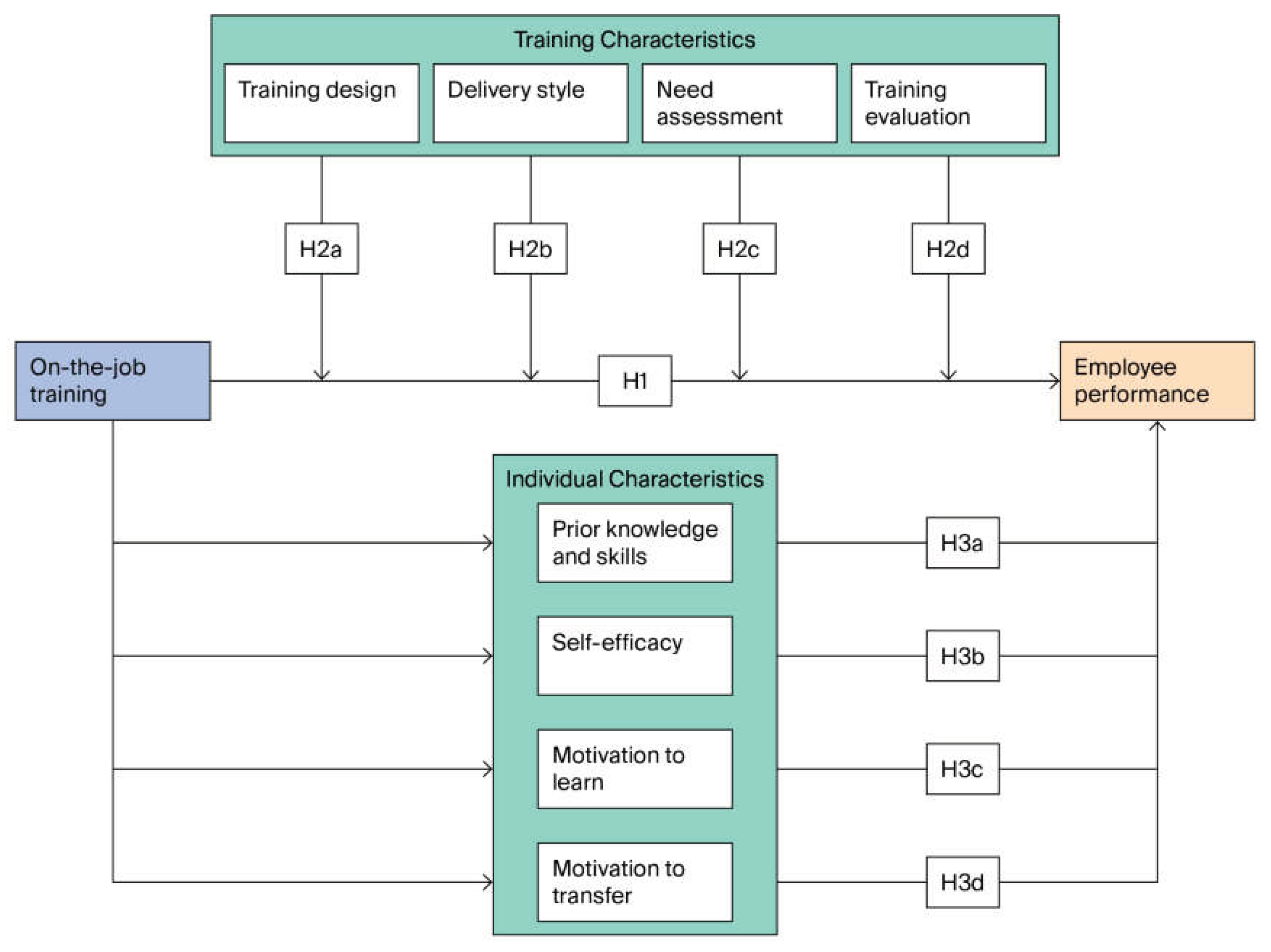
Further analysis revealed a clear gradient in training effects across skill-gap levels. The association between training duration and performance change strengthened with increasing skill gaps for position-oriented training, whereas no comparable pattern was observed for general training. This result suggests that targeted training is most effective when it directly addresses constraints that limit daily task execution. When a specific deficiency is reduced, employees can apply newly acquired skills immediately, leading to measurable performance changes. This interpretation is consistent with mechanism-based research on on-the-job training, which emphasizes the importance of task relevance, opportunities for application, and feedback in shaping performance outcomes [22]. Figure 2. Conceptual pathway from on-the-job training to employee performance through training design and individual factors.
3.4. Comparison with Existing Evidence and Implications for SME Practice
Compared with studies that treat training as a single aggregated input, these results highlight the value of distinguishing training by task relevance and conditioning expected returns on initial skill gaps. The stronger short-term gains associated with position-oriented training among high-gap employees are consistent with broader evidence showing that training effects depend on firm context, training design, and workforce composition. Prior research on small firms indicates that well-targeted training can yield higher efficiency when resources are limited and production demands are immediate [23]. At the same time, evidence linking training to productivity growth suggests that broader training may generate benefits over longer horizons, especially when firms adjust job design to make better use of expanded skill sets [24]. From a practical perspective, the findings point to a differentiated training strategy for technology-oriented SMEs: prioritize position-oriented training for employees with substantial skill gaps to achieve short-term performance gains, while allocating general training more selectively as a longer-term capability investment.
4. Conclusion
This study analyzes the relationship between employee skill gaps, training design, and performance outcomes in a technology-oriented small and medium-sized enterprise operating under resource constraints. Based on linked records of skill assessments, training participation, and performance evaluations, the results show that the effectiveness of training varies with task relevance and initial skill mismatch. Position-oriented training is associated with clear short-term performance improvement among employees with large skill gaps, whereas general training shows limited effects within the same evaluation period. By measuring skill gaps directly and separating training by purpose, the analysis avoids treating training as a uniform input and clarifies why performance responses differ across employees. These findings add to existing research on human capital and workplace training by showing that variation in training returns follows identifiable patterns related to job requirements. In practical terms, the results suggest that small and medium-sized enterprises can improve training efficiency by focusing resources on closing role-specific skill deficits while using general training mainly for longer-term capability development. The study has several limitations. The data are drawn from a single firm, which may restrict broader applicability, and performance outcomes are observed over a limited time span. Future work could apply the same framework to multiple organizations, longer observation periods, and alternative performance indicators to assess the durability and wider impact of skill-focused training strategies.
References
- Rahman, M. M. Data analytics for strategic business development: a systematic review analyzing its role in informing decisions, optimizing processes, and driving growth. Journal of Sustainable Development and Policy 2025, 1, 285–314. [Google Scholar] [CrossRef]
- Mao, Y.; Ma, X.; Li, J. Research on API Security Gateway and Data Access Control Model for Multi-Tenant Full-Stack Systems. 2025. [Google Scholar]
- Onifade, O.; Sharma, A.; Adekunle, B. I.; Ogeawuchi, J. C.; Abayomi, A. A. Digital Upskilling for the Future Workforce: Evaluating the Impact of AI and Automation on Employment Trends. Int. J. Multidiscip. Res. Growth Eval 2022, 3, 680–685. [Google Scholar] [CrossRef]
- Li, T.; Xia, J.; Liu, S.; Hong, E. Strategic Human Resource Leadership in Global Biopharmaceutical Enterprises: Integrating HR Analytics and Cross-Cultural. 2025. [Google Scholar] [CrossRef]
- Ilyina, A. Education as a driver of investment awareness: the role of ethical mission-oriented organizations in the transparent development of human capital. International Science Journal of Education & Linguistics 2025, 4, 1–15. [Google Scholar] [CrossRef]
- Gu, X.; Yang, J.; Tian, X.; Liu, M. Research on the Construction of a Human-Machine Collaborative Anti-Money Laundering System and Its Efficiency and Accuracy Enhancement in Suspicious Transaction Identification. 2025. [Google Scholar]
- Biala, M. I.; Aromasodun, O. M.; Shitu, A. M. Energy-Growth Nexus: A Systematic Review of Empirical Evidence and Policy Implications. African Journal of Environmental Sciences and Renewable Energy 2025, 18, 178–197. [Google Scholar] [CrossRef]
- Du, Y. Research on Digital Quality Traceability System for Temperature-Controlled Supply Chain of Foreign Trade Wine Driven by Blockchain and IoT. Business and Social Sciences Proceedings 2025, 4, 57–65. [Google Scholar]
- Konings, J.; Putseys, A. The impact of on-the-job training subsidies on firm-level outcomes: evidence from Flemish SMEs: J. Konings and A. Putseys. Small Business Economics 2025, 1–27. [Google Scholar] [CrossRef]
- Zhu, W.; Yang, J.; Yao, Y. How Compliance Maturity Translates to Risk Reduction: A Multi-Case Comparison of Global Operations Using fsQCA and Hierarchical Bayesian Methods. In Proceedings of the 2025 2nd International Conference on Digital Economy and Computer Science, 2025, October; pp. 672–676. [Google Scholar]
- Demirkan, I.; Srinivasan, R.; Nand, A. Innovation in SMEs: the role of employee training in German SMEs. Journal of Small Business and Enterprise Development 2022, 29, 421–440. [Google Scholar] [CrossRef]
- Wang, J.; Xiao, Y. Assessing the Spillover Effects of Marketing Promotions on Credit Risk in Consumer Finance: An Empirical Study Based on AB Testing and Causal Inference. 2025. [Google Scholar] [CrossRef]
- Pope, M. Navigating Compliance in Student Affairs: Leadership Strategies for Accountability in Higher Education. In Accountability in Higher Education: Navigating Current Issues and Trends; IGI Global Scientific Publishing, 2025; pp. 59–114. [Google Scholar]
- Gu, X.; Yang, J.; Liu, M. Research on a Green Money Laundering Identification Framework and Risk Monitoring Mechanism Integrating Artificial Intelligence and Environmental Governance Data. 2025. [Google Scholar] [CrossRef]
- Brick, C.; Schneider, D.; Harknett, K. The gender wage gap, between-firm inequality, and devaluation: Testing a new hypothesis in the service sector. Work and Occupations 2023, 50, 539–577. [Google Scholar] [CrossRef] [PubMed]
- Du, Y. Research on Deep Learning Models for Forecasting Cross-Border Trade Demand Driven by Multi-Source Time-Series Data. Journal of Science, Innovation & Social Impact 2025, 1, 63–70. [Google Scholar]
- Moshawrab, M.; Adda, M.; Bouzouane, A.; Ibrahim, H.; Raad, A. Reviewing federated learning aggregation algorithms; strategies, contributions, limitations and future perspectives. Electronics 2023, 12, 2287. [Google Scholar] [CrossRef]
- Liu, S.; Feng, H.; Liu, X. A Study on the Mechanism of Generative Design Tools' Impact on Visual Language Reconstruction: An Interactive Analysis of Semantic Mapping and User Cognition; Authorea Preprints, 2025. [Google Scholar]
- Abuhussein, T.; Barham, H.; Al-Jaghoub, S. The effects of COVID-19 on small and medium-sized enterprises: Empirical evidence from Jordan. Journal of Enterprising Communities: People and Places in the Global Economy 2023, 17, 334–357. [Google Scholar] [CrossRef]
- Sheu, J. B.; Gao, X. Q. Alliance or no alliance—Bargaining power in competing reverse supply chains. European Journal of Operational Research 2014, 233, 313–325. [Google Scholar] [CrossRef]
- Bergh, D. D.; D'Oria, L.; Crook, T. R.; Roccapriore, A. Is knowledge really the most important strategic resource? A meta-analytic review. Strategic Management Journal 2025, 46, 3–18. [Google Scholar] [CrossRef]
- Wang, J.; Xiao, Y. Research on Transfer Learning and Algorithm Fairness Calibration in Cross-Market Credit Scoring. 2025. [Google Scholar]
- Benardi, B. Bridging Financial Gaps: A Qualitative Literature Review on Government Loan Programs and Small Business Growth under Credit Constraints. International Journal of Business, Marketing, Economics & Leadership (IJBMEL) 2026, 3, 1–13. [Google Scholar]
- Zhu, W.; Yang, J.; Yao, Y. How Cross-Departmental Collaboration Structures Mitigate Cross-Border Compliance Risks: Network Causal Inference Based on ManpowerGroup's Staffing Projects. 2025. [Google Scholar]
Figure 1.
Distribution of training effects by firm size, illustrating differences in performance outcomes associated with training support in small and medium-sized enterprises.
Figure 1.
Distribution of training effects by firm size, illustrating differences in performance outcomes associated with training support in small and medium-sized enterprises.
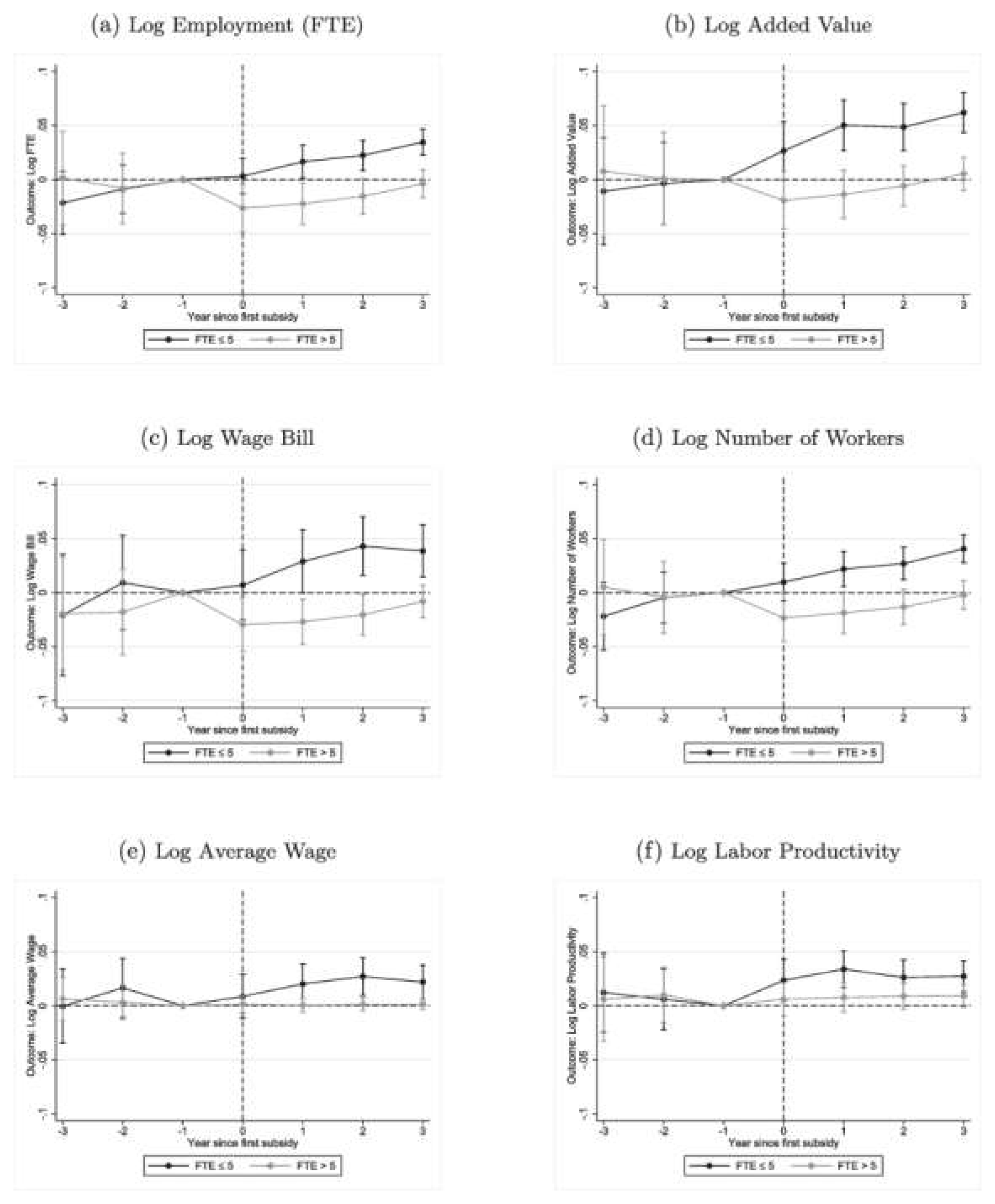
Figure 2.
Conceptual framework linking on-the-job training design to employee performance through skill alignment and application mechanisms.
Figure 2.
Conceptual framework linking on-the-job training design to employee performance through skill alignment and application mechanisms.
Disclaimer/Publisher’s Note: The statements, opinions and data contained in all publications are solely those of the individual author(s) and contributor(s) and not of MDPI and/or the editor(s). MDPI and/or the editor(s) disclaim responsibility for any injury to people or property resulting from any ideas, methods, instructions or products referred to in the content. |
© 2026 by the authors. Licensee MDPI, Basel, Switzerland. This article is an open access article distributed under the terms and conditions of the Creative Commons Attribution (CC BY) license (http://creativecommons.org/licenses/by/4.0/).
Copyright: This open access article is published under a Creative Commons CC BY 4.0 license, which permit the free download, distribution, and reuse, provided that the author and preprint are cited in any reuse.


