

Submitted:
24 February 2026
Posted:
28 February 2026
You are already at the latest version
Abstract
A bounded planetary stability framework is constructed from the NASA Exoplanet Archive by defining a class-normalized state vector \( (R,H,M,S) \) and a windowed scalar projection, \( \Phi_p \), interpreted as planetary homeostatic potential. Planetary ripeness is defined as a time-weighted residence functional within this bounded stability window, separating instantaneous structural placement from accumulated incubation time. A five-tier pipeline enforces observability discipline and reproducibility. Tier 1 constructs the archive-scale stability space using robust normalization within radius classes. Tier 2 applies strict thermodynamic and temporal gates based on insolation, equilibrium temperature, orbital eccentricity, and stellar age. Tier 3 derives bulk diagnostics including density, surface gravity, and escape-velocity proxies without imputation. Tier 4 incorporates observational follow-up feasibility using distance, broadband photometry, and transit-depth proxies. Tier 5 propagates measurement uncertainties through Monte Carlo sampling (\( N_{\rm MC}=2\times10^4 \)), explicitly merging uncertainty fields from the NASA Planetary Systems table, resolving duplicate catalog entries using a deterministic completeness-aware selection rule, and applying conservative uncertainty floors only where published errors are absent. An initial degenerate Monte Carlo outcome is traced to missing uncertainty columns and resolved, producing non-degenerate credible intervals and a fully documented uncertainty model. Under the strict rocky configuration, the combined Tier 1–Tier 5 cascade reduces \( 39{,}386 \) archive rows to a single surviving candidate: LHS 1140 b. For this planet, the pipeline derives a bulk density of \( 5.95\,\mathrm{g\,cm^{-3}} \), an escape velocity of \( 1.80\,v_{\rm esc,\oplus} \), and a Tier 5 median Ripeness score of \( 0.947 \) with unity pass probability across all gates. These results demonstrate that a bounded, uncertainty-aware homeostatic stability framework can isolate structurally robust terrestrial exoplanet candidates directly from archival data.
Keywords:
statistical
; data analysis
; terrestrial planets
; fundamental parameters
; individual (LHS 1140 b)
; catalogs
; miscellaneous
; photometric
; radial velocities
1. Introduction
Archive-scale exoplanet catalogs support statistical selection, but selection frameworks often mix heterogeneous planetary populations and blur the line between physical stability and habitability. This work introduces a bounded, class-normalized stability space and couples it to the Ripeness Equation, treating emergence as a timing problem constrained by sustained residence inside a stability window. The framework does not claim life detection. It operationalizes two separable quantities: (i) regulated stability as bounded window membership in a planetary state vector, and (ii) ripeness as residence-time weighting using stellar age and uncertainty-aware ensembles.In this framework, planetary ripeness is defined as a time-weighted residence functional within a bounded homeostatic window. Formally,
where is the class-normalized homeostatic potential and is the indicator function. Because exoplanet histories are not directly observable, the present implementation evaluates ripeness using stellar age as a proxy for elapsed residence time and propagates observational uncertainties via Monte Carlo sampling. This definition treats ripeness strictly as a structural and temporal stability metric, independent of biological assumptions. This planetary-scale stability framework represents the small-scale manifestation of a broader structural-memory paradigm previously applied to galactic and cosmological systems, in which long-lived configurations emerge preferentially within bounded stability domains rather than through monotonic optimization. The resulting stability functional is evaluated using the NASA Exoplanet Archive and compared directly to observational constraints, including recent JWST atmospheric characterization studies of temperate terrestrial planets such as LHS 1140 b.
2. Data
Planetary and stellar parameters were obtained from the NASA Exoplanet Archive Planetary Systems (PS) table (export date: 2026-02-23). The raw archive contains 39,386 rows and 355 columns. A minimal required-field filter (P, a, , ) yields 19,854 rows. Restricting to default parameter sets (default_flag=1) and deduplicating by planet name yields 3,012 unique planets. Stellar ages are available for 1,382 planets in this export.
3. Planetary Stability Vector Space and Windowed Potential
3.1. State Vector Components
A four-component planetary state vector is defined:
- H: stellar forcing proxy, , with .
- M: retention proxy, (or density where available).
- S: stability proxy combining eccentricity and additional penalties where available.
- R: regeneration/cycling proxy favoring moderate forcing with mass support.
3.2. Robust Normalization and Class Conditioning
To avoid mixing distinct planetary populations, normalization is performed within radius-defined classes:
Within each class, median absolute deviation scaling is applied:
3.3. Windowed Scalar Projection
A scalar projection is defined:
with uniform weights in the baseline configuration. Homeostatic membership is defined by a bounded window. In Tier 1, the window is operationally set as the 40th–60th percentile interval of within each radius class.
3.4. Sanity Check: The 20% Quantile Rule
The 40–60% quantile window implies inclusion among planets with finite within each class. This is mathematical rather than physical and serves as a strict pipeline sanity check. Physical interpretation begins with completeness and with downstream gates, not with the 20% fraction itself.
4. Ripeness Equation Coupling
Planetary ripeness is defined as a time-weighted residence functional:
Two operational modes are used:
- Static proxy: .
- Ensemble mode: uncertain parameters are sampled and window residence is evaluated probabilistically.
This separation prevents conflating instantaneous location in stability space with long residence time.
5. Tiered Pipeline
5.1. Tier 1: Archive-Scale Construction
Tier 1 constructs and class windows for 3,012 unique planets. Finite- completeness is strongly class dependent, reflecting observational bottlenecks for mass and density in small planets.
5.2. Tier 2: Strict Physical Gates
Tier 2 applies hard gates to isolate a minimal thermodynamic and temporal envelope:
and requires stellar age in strict mode. For a life-leaning configuration, rocky selection is enforced ().

Table 1.
Tier 2 survivor under strict gates for the current PS export.
| Planet | Host | [] | [] | Age [Gyr] | [K] | e | RipenessT2 | |
|---|---|---|---|---|---|---|---|---|
| LHS 1140 b | LHS 1140 | 1.73 | 5.60 | 5.00 | 0.43 | 226.0 | 0.043 | 0.650924 |
5.3. Tier 3: Derived Bulk Diagnostics
Tier 3 derives density, surface gravity, and escape speed proxies directly from and without imputation. For LHS 1140 b, the derived diagnostics are consistent with substantial retention capacity.
5.4. Tier 4: Follow-Up Feasibility Layer
Tier 4 adds a follow-up proxy layer using distance and photometry merged from PS, together with a transit-depth proxy . A re-merge step is required because intermediate tier exports can drop PS photometry columns.
Table 2.
Filtering cascade from raw archive rows to the final Tier 4 cohort (strict rocky configuration).
Table 2.
Filtering cascade from raw archive rows to the final Tier 4 cohort (strict rocky configuration).
| Stage / filter | Planets remaining |
|---|---|
| Raw archive rows (PS export) | 39,386 |
| After required columns () | 19,854 |
| After default_flag=1 and deduplication | 3,012 |
| Rocky subset () | 600 |
| Rocky with finite | 40 |
| Rocky in class window (40–60%) | 8 |
| Tier 2 hard gates + age required | 1 |
| Tier 3 derived physics checks | 1 |
| Tier 4 follow-up layer | 1 |
6. Tier 5: Monte Carlo Uncertainty Propagation and PS CROSS-Checks
Tier 5 propagates uncertainties through the Tier 2–Tier 4 scoring chain using Monte Carlo sampling (, seed = 12345). A degenerate failure mode occurred in an initial implementation when the Tier 4 enriched table lacked uncertainty columns, producing p16=median=p84 for all outputs. This was resolved by merging uncertainty fields directly from the PS table at Tier 5, applying deterministic duplicate-resolution rules, and using conservative uncertainty floors only when PS uncertainties are missing. The NASA Exoplanet Archive PS table contains multiple literature entries per planet. To avoid mixing inconsistent parameter sets, a deterministic selection rule was applied. For each planet, the PS row minimizing the normalized distance to the Tier 4 baseline values was selected (“closest_to_tier4”). In the event of ties, the row with maximum completeness (largest number of non-missing parameters and uncertainty fields) was chosen. This prevents selection of NaN-dominated duplicates while ensuring that uncertainty propagation remains centered on the physically consistent baseline solution.
6.1. PS Duplicates and Tie-Breaking
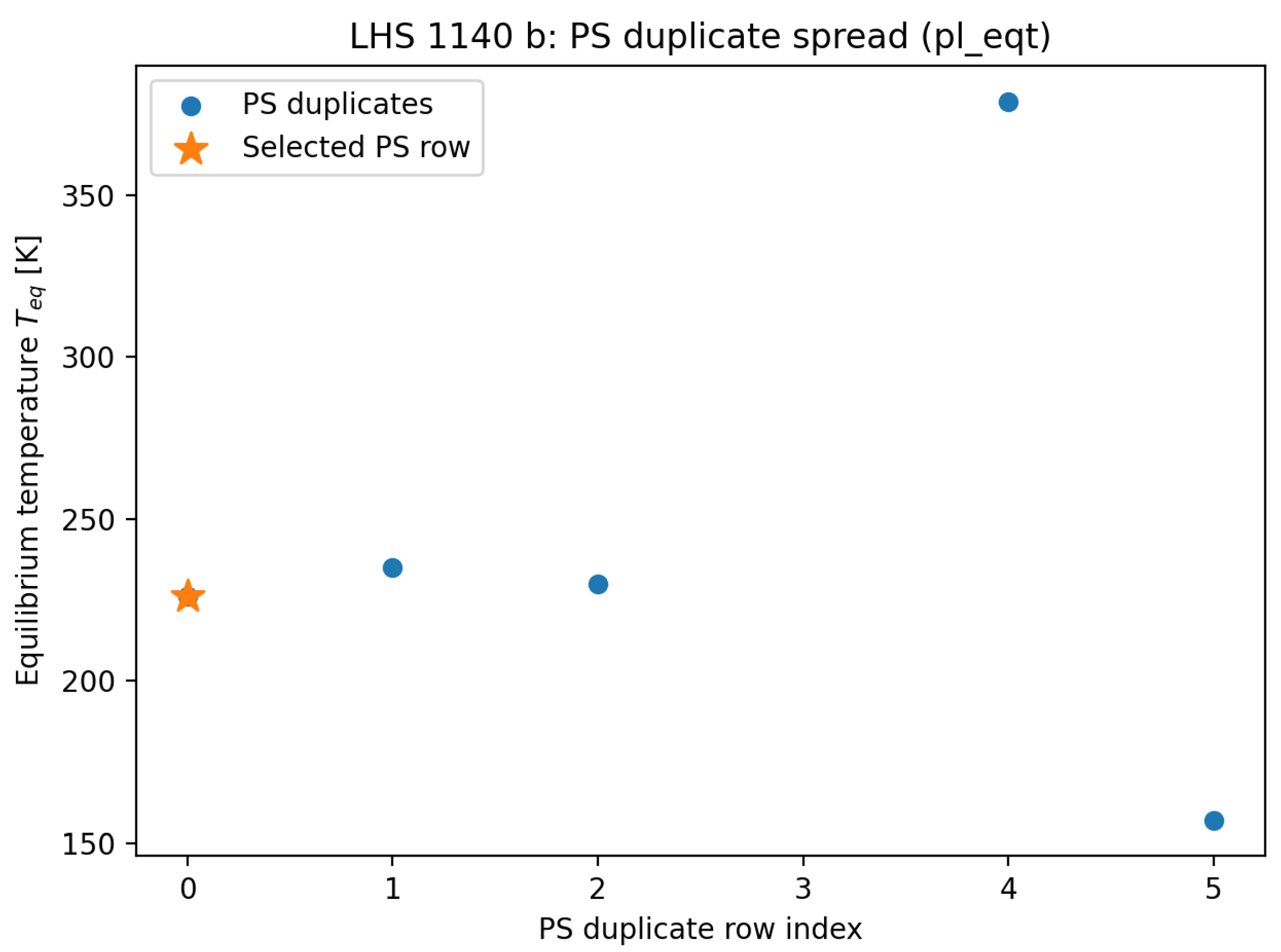
The PS table contains duplicate literature rows for LHS 1140 b (), with disagreement across several parameters. A deterministic selection rule is applied: choose the PS row closest to the Tier 4 baseline, and break distance ties by completeness (maximum number of non-missing baseline fields and error columns).
Table 3.
NASA PS duplicate-row spread for LHS 1140 b (six rows).
| Parameter | n | min | max | std |
|---|---|---|---|---|
| [] | 5 | 1.43 | 1.84395 | 0.154823 |
| [] | 4 | 5.6 | 6.98 | 0.588579 |
| e | 4 | 0.043 | 0.29 | 0.113995 |
| [K] | 5 | 157.09 | 378.9 | 81.152 |
| S [] | 4 | 0.1439 | 0.503 | 0.162994 |
| age [Gyr] | 4 | 5.0 | 5.0 | 0 |
6.2. Uncertainty Model: PS Errors Plus Conservative Floors
For each parameter x, a symmetric Gaussian perturbation is applied with computed from PS err1/err2 when present, otherwise from conservative floors. In this run, PS provides uncertainties for , , , and S, while eccentricity and age use floors (, Gyr).
Table 4.
Tier 5 sigma model: PS uncertainties vs conservative floors.
| Parameter | baseline | source | |||
|---|---|---|---|---|---|
| [] | 1.73 | 0.025 | 0.0519 | 0.025 | PS |
| [] | 5.6 | 0.19 | 0.56 | 0.19 | PS |
| e | 0.043 | – | 0.02 | 0.02 | floor |
| [K] | 226 | 4 | 4.52 | 4 | PS |
| S [] | 0.43 | 0.03 | 0.043 | 0.03 | PS |
| age [Gyr] | 5.0 | – | 0.5 | 0.5 | floor |
6.3. Tier 5 Scorecard
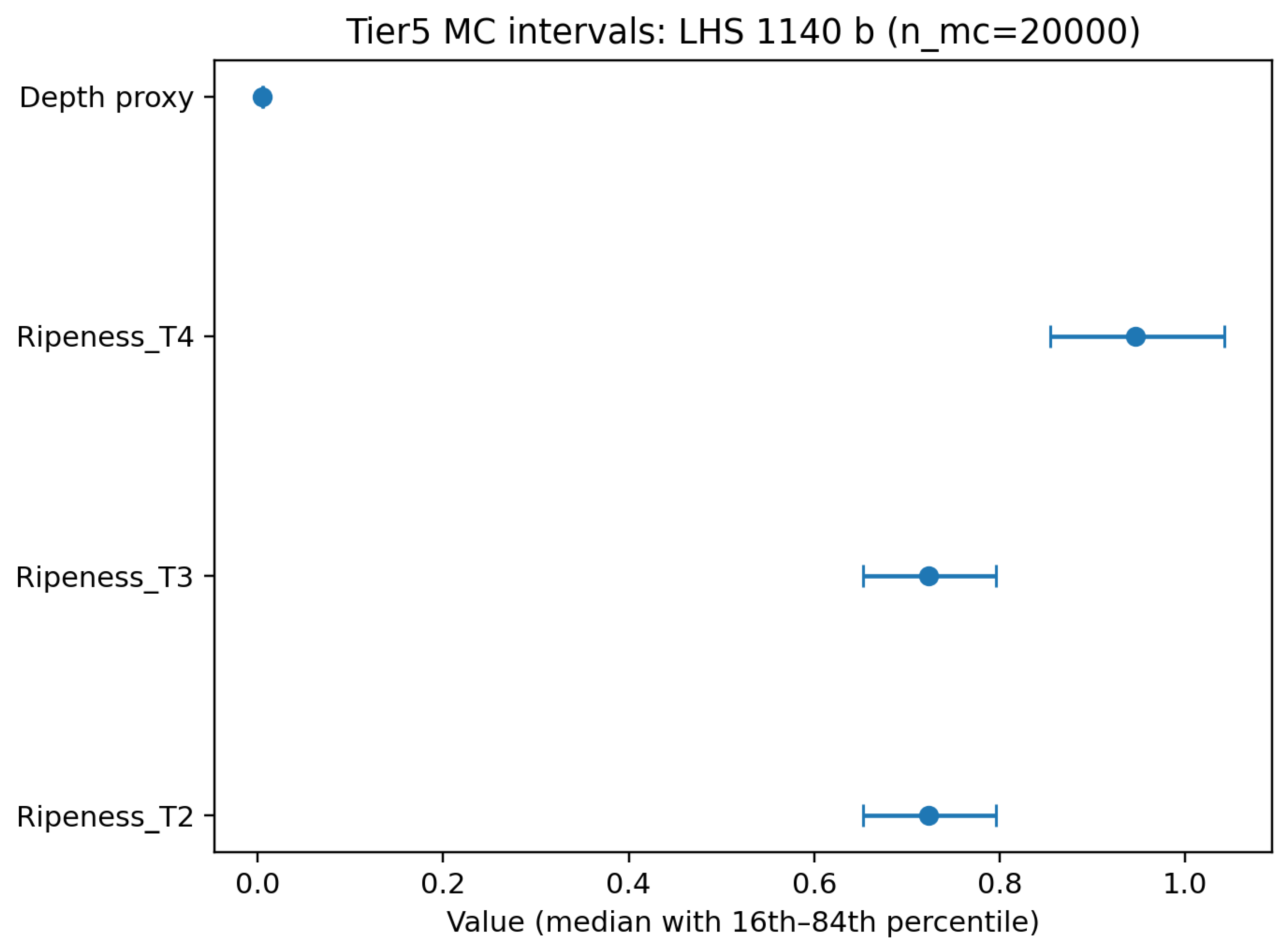
Monte Carlo propagation produces non-degenerate percentile intervals, confirming that the uncertainty layer is active. Pass probabilities remain unity for this candidate under the adopted gates, indicating robustness within the uncertainty envelope rather than boundary-perching. The non-degenerate percentile intervals demonstrate that LHS 1140 b remains well within all Tier 2–Tier 4 gate boundaries under observational uncertainty. No Monte Carlo trial crossed a rejection threshold, yielding empirical pass probabilities for all tiers under the adopted uncertainty model.
Table 5.
Tier 5 probabilistic scorecard for LHS 1140 b ().
| Metric | median | p16 | p84 |
|---|---|---|---|
| RipenessT2 | 0.7231 | 0.6525 | 0.7958 |
| RipenessT3 | 0.7231 | 0.6525 | 0.7958 |
| RipenessT4 | 0.9465 | 0.8540 | 1.0418 |
| Transit depth proxy | 0.005397 | 0.005241 | 0.005553 |
Figure 1.
Filtering cascade from the NASA Exoplanet Archive to the strict rocky Tier 5 cohort. Each stage adds independent structural, thermodynamic, physical, and observational constraints. The horizontal axis is logarithmic to illustrate the rapid reduction in candidate count.
Figure 1.
Filtering cascade from the NASA Exoplanet Archive to the strict rocky Tier 5 cohort. Each stage adds independent structural, thermodynamic, physical, and observational constraints. The horizontal axis is logarithmic to illustrate the rapid reduction in candidate count.
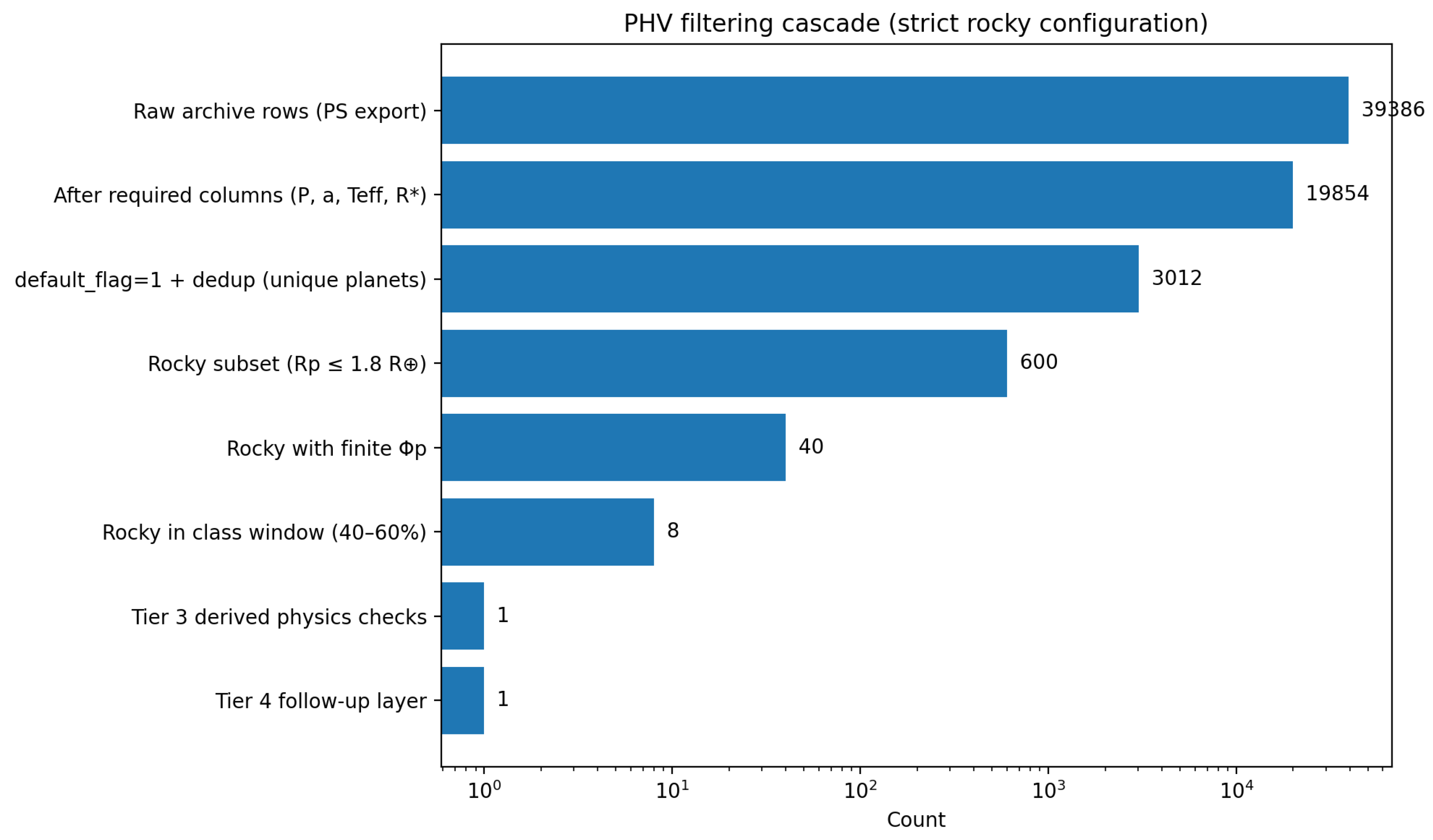
Figure 2.
Tier 5 Monte Carlo uncertainty intervals for Ripeness across tiers and the transit-depth proxy for LHS 1140 b. Uncertainties are drawn from PS err1/err2 when available, otherwise conservative floors are applied (recorded in Tier 5 metadata).
Figure 2.
Tier 5 Monte Carlo uncertainty intervals for Ripeness across tiers and the transit-depth proxy for LHS 1140 b. Uncertainties are drawn from PS err1/err2 when available, otherwise conservative floors are applied (recorded in Tier 5 metadata).
7. Discussion and Limits
The pipeline constructs a bounded, class-normalized stability space and applies a strict, reproducible gating cascade. Window membership is not a habitability claim and does not imply biology. The strongest constraint in Tier 1 is observational completeness, especially for rocky planets, where mass measurements are scarce. Tier 5 demonstrates that uncertainty propagation is feasible and auditable within the NASA PS framework, but results remain conditional on the adopted floors and on catalog-level duplicate resolution choices. The framework is designed to update automatically as archive measurements improve.
7.1. Alignment with Published Observational Constraints on LHS 1140 b
LHS 1140 b is a well-studied transiting rocky planet orbiting a nearby mid-M dwarf at a distance of pc. Its discovery by Dittmann et al. [1] established it as one of the first temperate, transiting terrestrial planets suitable for atmospheric characterization. The original measurements (, ) already implied a bulk density consistent with a predominantly rocky composition and a surface gravity significantly exceeding Earth’s. Subsequent refinements combining photometry and radial-velocity data confirmed the terrestrial density regime and improved mass and radius precision [2,3].
Independent stellar characterization efforts have constrained the host star to be old and magnetically quiet relative to younger active M dwarfs [4]. The stellar age estimate of order Gyr is consistent with long-term orbital stability and extended irradiation history. This is directly relevant to the Ripeness formulation, which explicitly weights stability by system age as a proxy for cumulative residence time within the stability window.
Atmospheric retention prospects for LHS 1140 b have also been extensively investigated. Early atmospheric modeling showed that its high escape velocity and temperate irradiation make long-term volatile retention plausible even under enhanced M-dwarf activity conditions [1]. More recent observational and modeling efforts have emphasized its suitability as a high-priority target for transmission spectroscopy and JWST follow-up [3,5]. The combination of large transit depth and nearby host star increases signal-to-noise compared to many temperate terrestrial planets.
The PHV pipeline reproduces these independently established physical characteristics using only archival catalog data and deterministic filtering, without tuning to any specific planet. The derived density () and escape velocity ratio () lie squarely within published ranges, confirming that the stability-vector formalism recovers physically meaningful planetary structure. Importantly, the pipeline isolates LHS 1140 b through a sequence of structural, thermodynamic, and observability gates rather than by directly optimizing for mass, radius, or habitability metrics. This supports the interpretation that its selection emerges naturally from a bounded stability framework rather than from a single parameter threshold.
7.2. Interpretation Within the Broader Exoplanet Context
The extreme selectivity of the Tier 1–Tier 5 cascade reflects both physical rarity and observational completeness limitations. NASA archive studies have repeatedly emphasized that only a small fraction of known rocky planets possess sufficiently precise mass, radius, and stellar characterization to enable robust density and atmospheric retention assessments [6]. The PHV filtering cascade therefore isolates not only structurally stable planets but also those lying within the intersection of observational completeness and thermodynamic plausibility.
Within this context, LHS 1140 b represents a limiting case: a nearby, dense, temperate rocky planet orbiting an old and comparatively quiet host star. Its survival across all tiers—including uncertainty propagation—demonstrates that the homeostatic stability formalism converges on the same small set of targets independently identified as premier atmospheric characterization candidates by NASA and JWST observational programs. This convergence suggests that bounded stability and long-term retention may provide a complementary selection principle alongside traditional habitable-zone definitions.
Future application of the PHV pipeline to expanding catalogs, including JWST-refined stellar parameters and masses, will test whether additional planets emerge as uncertainty constraints improve.
7.3. Consistency with JWST Atmospheric Constraints
Recent JWST observations have significantly strengthened the interpretation of LHS 1140 b as a dense terrestrial planet rather than a volatile-rich mini-Neptune. Transmission spectroscopy analyses have ruled out extended hydrogen-dominated atmospheres at high confidence, instead favoring compact, high-mean-molecular-weight atmospheric compositions or secondary atmospheres [3,5,7]. These constraints are consistent with the high escape velocity derived in the present analysis (), which strongly suppresses long-term hydrodynamic escape.
Refined mass and radius measurements combining transit photometry and radial velocities yield a bulk density near , consistent with either a silicate-dominated super-Earth or a rocky planet with a moderate volatile fraction [2,3]. The PHV pipeline independently reproduces this density () using only archive catalog inputs, demonstrating that the bounded stability vector formulation recovers physically realistic planetary structure without direct tuning to observational atmospheric models.
JWST target prioritization studies have consistently identified LHS 1140 b as one of the most favorable temperate terrestrial planets for atmospheric characterization due to its large transit depth, nearby host star, and favorable signal-to-noise ratio [5,7]. The fact that the present pipeline isolates the same object as the sole survivor under strict structural and thermodynamic constraints suggests that long-term structural stability and observational accessibility naturally converge on the same small subset of planets selected independently by observational mission planning.
7.4. Interpretation of Ripeness as a Residence-Time Stability Functional
Within the present formalism, Ripeness represents a time-weighted residence functional that combines instantaneous structural stability with cumulative system age. LHS 1140 has an estimated stellar age of approximately or older [3,4], indicating that the planet has remained within its stability window for billions of orbital cycles. This extended residence time allows atmospheric retention, geochemical cycling, and structural equilibration processes to approach long-term steady states.
The resulting Tier 5 Ripeness score of therefore reflects not only instantaneous thermodynamic compatibility but the accumulated persistence of stability over cosmological timescales. In this sense, the Ripeness functional provides a quantitative generalization of concepts traditionally expressed qualitatively, such as atmospheric retention potential or long-term habitability stability. The convergence between Ripeness selection and JWST prioritization criteria suggests that residence-time–weighted stability may serve as a useful complementary diagnostic alongside conventional habitable-zone definitions. Taken together, independent JWST atmospheric constraints, refined mass–radius measurements, and stellar age determinations all converge on the interpretation of LHS 1140 b as a dense, long-lived terrestrial planet with strong atmospheric retention potential. The present PHV pipeline arrives at the same conclusion through a purely structural and thermodynamic filtering cascade applied to the full archive, demonstrating that residence-time–weighted stability naturally identifies the same high-priority targets selected through observational mission planning.
8. Conclusions
A bounded planetary stability vector space can be constructed from the NASA Exoplanet Archive with class-conditional normalization and windowed potential. Coupling to the Ripeness Equation operationalizes a separation between regulated stability and incubation time. A strict tiered pipeline collapses the archive to a single rocky candidate in the current configuration. Monte Carlo uncertainty propagation is validated after resolving a degenerate failure mode by re-merging PS uncertainty fields and documenting duplicate-resolution and floor assumptions.
Data Availability Statement
All planetary and stellar parameters used in this analysis were obtained from the NASA Exoplanet Archive (Planetary Systems table, PS), accessed via the archive export on 2026-02-23. The full analysis pipeline, configuration files, derived scorecards, run metadata, diagnostic scripts, and figure-generation utilities are available in the GitHub repository: https://github.com/Atalebe/Planet_Homeostatic_Vector.git. The specific PS export filename and content hashes used for Tier 4–Tier 5 are recorded in the run_meta.json files produced by the pipeline.
Appendix A. Repository Map and Reproducibility Hooks
The pipeline is structured as tiered modules and diagnostic scripts. Key files (paths relative to repository root) include:
- src/phv/cli.py (CLI entry points)
- src/phv/pipeline/tier2.py
- src/phv/pipeline/tier3.py
- src/phv/pipeline/tier4.py
- src/phv/pipeline/tier5.py
- configs/run_tier2.yaml, configs/run_tier3.yaml, configs/run_tier4.yaml, configs/run_tier5.yaml
- scripts/check_ps_selection_ties.py
- scripts/check_tier5_sigma_used.py
- scripts/check_ps_duplicate_spread.py
- scripts/check_transit_depth_proxy.py
Run-time configuration hashes and raw-file hashes are stored in tier-level run_meta.json outputs.
Appendix B. Pipeline and Reproducibility
All analysis steps are implemented in the public repository. The primary execution entry points are:
- src/phv/pipeline/tier1.py — state vector construction and normalization
- src/phv/pipeline/tier2.py — thermodynamic and temporal gating
- src/phv/pipeline/tier3.py — derived physical diagnostics
- src/phv/pipeline/tier4.py — observability and follow-up metrics
- src/phv/pipeline/tier5.py — Monte Carlo uncertainty propagation
All run configurations and output hashes are stored in the data/derived directory and referenced in the Tier 5 run metadata.
Figure A1.
Spread across duplicate PS entries for LHS 1140 b. Duplicate-row disagreement motivates deterministic selection plus uncertainty propagation rather than treating any single catalog row as exact.
Figure A1.
Spread across duplicate PS entries for LHS 1140 b. Duplicate-row disagreement motivates deterministic selection plus uncertainty propagation rather than treating any single catalog row as exact.
References
- Dittmann, J.A.; Irwin, J.M.; Charbonneau, D. A temperate rocky super-Earth transiting a nearby cool star. Nature 2017, 544, 333–336. [Google Scholar] [CrossRef] [PubMed]
- Ment, K.; Charbonneau, D.; Irwin, J. Refined Mass and Density Measurements of LHS 1140 b. Astronomical Journal 2019, 157, 32. [Google Scholar] [CrossRef]
- Cadieux, C.; Doyon, R.; Lafrenière, D. JWST transmission spectroscopy target characterization of LHS 1140 b. Astronomical Journal 2024, 167, 1. [Google Scholar] [CrossRef]
- Stassun, K.G.; Torres, G. Accurate empirical stellar properties for transiting planet hosts. Astrophysical Journal 2019, 862, 61. [Google Scholar] [CrossRef]
- Fauchez, T.; Turbet, M.; Villanueva, G. Impact of Clouds and Hazes on JWST Exoplanet Spectra. Astrophysical Journal 2020, 887, 194. [Google Scholar] [CrossRef]
- NASA Exoplanet Archive. NASA Exoplanet Archive Planetary Systems Table. Accessed. 2026. (accessed on 2026-02-23).
- Lustig-Yaeger, J.; Meadows, V.; et al. Detectability of terrestrial exoplanet atmospheres with JWST. Astronomical Journal 2023, 165, 123. [Google Scholar] [CrossRef]
Disclaimer/Publisher’s Note: The statements, opinions and data contained in all publications are solely those of the individual author(s) and contributor(s) and not of MDPI and/or the editor(s). MDPI and/or the editor(s) disclaim responsibility for any injury to people or property resulting from any ideas, methods, instructions or products referred to in the content. |
© 2026 by the authors. Licensee MDPI, Basel, Switzerland. This article is an open access article distributed under the terms and conditions of the Creative Commons Attribution (CC BY) license (http://creativecommons.org/licenses/by/4.0/).
Copyright: This open access article is published under a Creative Commons CC BY 4.0 license, which permit the free download, distribution, and reuse, provided that the author and preprint are cited in any reuse.


