
Submitted:
26 February 2026
Posted:
27 February 2026
Read the latest preprint version here
Abstract
Microfluidic electrokinetic flows play a central role in applications such as lab-on-a-chip diagnostics, microelectronics cooling, and biomedical sample manipulation. These systems involve intricate heat transfer processes, including Joule heating from ionic currents, temperature-driven flow instabilities, and strongly coupled thermal–fluid interactions, that crucially affect device performance, reliability, and scalability. Current challenges include non-equilibrium charge dynamics, incomplete thermophysical property data for complex fluids, and thermal crosstalk in integrated platforms. This review summarizes the fundamental mechanisms of heat generation and dissipation in electrokinetic micro-flows, describes analytical, numerical, and experimental approaches for characterizing thermal effects, and discusses application-driven opportunities and limitations. It also highlights open questions and future research directions and offers a comprehensive view of the unified principles and practical design guidelines for developing robust, thermally optimized electrokinetic microfluidic technologies.
Keywords:
microfluidics
; electrokinetic flows
; thermal effects
; Joule heating
; electrothermal flows
; conjugate heat transfer
1. Introduction
Heat transfer in microfluidic electrokinetic flows plays a key role in determining the performance, reliability, and integrability of miniaturized systems, including lab-on-chip diagnostics, electrokinetic pumps, microreactors, and emerging microscale cooling concepts. In these systems, electric fields are used for transporting fluids and particles, and manipulating species, interfaces, and reactions with high precision. Such geometries are characterized by sub-millimeter dimensions and large surface-to-volume ratios. Under these conditions, the coupling between electric fields, charge transport, and temperature fields becomes non-trivial: even modest voltages can generate significant Joule heating, alter electrolyte properties, and drive complex electrothermal flows that feed back into the electrokinetic transport. As these devices move from proof-of-concept demonstrations to robust, high-throughput, and field-deployable platforms, understanding and controlling heat transfer in electrokinetic microflows has become a key scientific and engineering challenge. There have been numerous studies on heat transfer in microfluidic electrokinetic flows in the past two decades with a monotonic rise in the number of published articles, as summarized in Figure 1a. The most significant area of application includes engineering and chemistry, followed by materials science, biochemistry, instruments and instrumentation, and polymer science, (Figure 1b) among others. This growing literature pool indicates the significance of studying the thermal effects in microfluidic electrokinetic flows.
In conventional pressure-driven microchannel flows, heat transfer is analyzed in terms of classical forced convection with well-established correlations for Nusselt number and thermal entrance effects, modified to account for the high surface-area-to-volume ratio and possible rarefaction. By contrast, electrokinetically driven flows are inherently linked to the structure and dynamics of the electric double layer (EDL), ionic conduction, and field-induced body forces within the flow domain. In order to account for these additional effects, the energy equation is solved in conjunction with the Poisson–Nernst–Planck or related electrostatic and species-transport equations, with internal volumetric heat generation due to Joule heating and, in some cases, viscous dissipation. Temperature, in turn, affects local viscosity, permittivity, conductivity, and even EDL thickness, making the problem strongly coupled and nonlinear. As a result, thermal effects, that fundamentally reshape the flow, transport, and device response in many electrokinetic microfluidic applications, demand appropriate attention.
The consequences of this coupling are particularly important in bioanalytical and biomedical microfluidic applications, where electrokinetic phenomena facilitate manipulation of biomolecules and cells. In capillary electrophoresis, isotachophoresis, electroosmotic pumping, and electrokinetic preconcentration, temperature gradients influence electrophoretic mobilities, buffer pH, band broadening, and resolution. Local overheating can degrade or denature proteins, nucleic acids, and cells, compromising assay integrity and reproducibility. On the other hand, deliberate exploitation of controlled electrothermal flows and nonuniform Joule heating can be used to enhance mixing, accelerate reactions, or achieve rapid, localized heating for lysis or amplification. The balance between unwanted thermal effects and engineered thermal functionality underscores the need for a rigorous understanding that connects electrokinetic driving conditions, geometry, and materials to the resulting heat generation and removal pathways.
Microfluidic electrokinetic flows are also of growing interest in thermal management and energy applications. Electroosmotic and electrokinetic pumps offer compact, valveless, and scalable pumping solutions for microchannel heat sinks and high–heat-flux electronics cooling, where control of flow at small scales is advantageous. However, the same electric fields used to generate flow inevitably produce Joule heating within the fluid, altering temperature distributions and fluid properties, and imposing additional heat loads that must be dissipated. In non-linearly shaped microchannels, interplay of electrokinetic and thermofluidic phenomena become even more complex, with Coriolis and centrifugal effects interacting with electrokinetic body forces and thermal gradients. Future generations of microscale coolers, lab-on-chip power management units, and electrokinetic energy-conversion devices must therefore be designed with a deeper understanding of these coupled thermofluidic phenomena.
The technological context motivates a focused review of this area. The rapid expansion of lab-on-chip and point-of-care diagnostic devices has led to increasingly integrated platforms that combine electrokinetic separation, preconcentration, reaction, and detection modules on a single chip. In such integrated systems, thermal crosstalk between modules, substrate heat spreading, and nonuniform power dissipation become critical design considerations. Electrified lab-on-disc platforms, electrokinetically actuated droplet systems, and electrically driven particle and cell manipulation devices similarly rely on controlled thermal environments to maintain biocompatibility and functional performance. At the same time, the aim for higher throughput and faster processing demands stronger electric fields and higher currents, which exacerbate Joule heating and electrothermal effects. Without a comprehensive understanding of heat transfer in these contexts, scaling up such technologies risk unforeseen thermal bottlenecks and reliability issues.
Based on these facts, a dedicated review on heat transfer in microfluidic electrokinetic flows is pertinent to current and future technologies. The aim of this review article is to summarize the underlying physical mechanisms, modeling approaches, and experimental techniques that describe the interplay of electric fields, ionic transport, and micro-scale geometry to produce and dissipate heat. By organizing the literature across fundamental theory, thermal phenomena (Joule heating, electrothermal flows, conjugate heat transfer), and application domains (bioanalytical systems, microelectronic cooling, and particle manipulation), this review aims to outline relevant design principles and highlight rational design strategies. Furthermore, tis article identifies the key challenges and research opportunities, such as better characterization of temperature-dependent properties, improved multiphysics models for non-Newtonian fluids, and integrated thermal management schemes tailored to electrokinetic devices. The resulting perspective can guide researchers and engineers in developing more robust, and thermally efficient electrokinetic microfluidic technologies that meet the demands of modern diagnostics, electronics, and energy systems.
2. Fundamentals of Electrokinetic Microflows and Heat Transfer
Electrokinetic microflows arise from the interaction between applied electric fields and the charged interfaces that develop at solid–liquid boundaries, most prominently in the form of the electric double layer (EDL) at microchannel walls (Figure 2a). When an electric field is applied tangential to a charged surface, the excess counterions in the EDL experience an electrical body force and drag the surrounding fluid, giving rise to electroosmotic flow (EOF, schematically shown in Figure 2b), while charged particles or molecules in the bulk migrate via electrophoresis under the same field (Figure 2c). These mechanisms become significant in geometries with large surface-to-volume ratios, so that interfacial phenomena, rather than pressure gradients alone, can dominate the overall flow behavior and strongly influence transport processes in microfluidic systems.
At the continuum scale, electrokinetic microflows are often modelled by coupling the Navier–Stokes equations for incompressible flow with Poisson’s equation for the electrostatic potential and Nernst–Planck-type equations for ionic species, forming the Poisson–Nernst–Planck–Navier–Stokes (PNP–NS) framework [1]. The electrostatic potential satisfies Poisson’s equation
where is the net charge density and is the permittivity. For ionic species , the Nernst–Planck equation gives the conservation of species as
where is concentration, the diffusion coefficient, the valence, the ionic mobility, Faraday’s constant, and the fluid velocity. The incompressible Navier–Stokes equations with an electrical body force then read
where is the density, the pressure, and the dynamic viscosity. For many microfluidic conditions with thin EDL, the fully resolved PNP system near the wall is replaced by the Helmholtz–Smoluchowski slip condition
where is the zeta potential and is the tangential electric field, providing an effective electroosmotic slip velocity at the wall.
Heat transfer in electrokinetic microflows is governed by an energy equation that must be solved in conjunction with the electrostatic and hydrodynamic equations because electric fields and ionic currents introduce volumetric heat generation through Joule heating.[2] In a typical form, the energy equation for the fluid region is
where is the temperature, the specific heat, the thermal conductivity, the Joule heating, and the viscous dissipation. For ohmic conduction, Joule heating is expressed as
with the electrical conductivity and the electric field. Viscous dissipation can be written as
where is the rate-of-strain tensor; in many aqueous microflows is smaller than , but it can be significant in high-shear or non-Newtonian regimes.
Temperature, in turn, feeds back on electrokinetic and flow behavior by modifying thermophysical and electrochemical properties, including viscosity, density, permittivity, ionic mobility, and electrical conductivity. This dependence is often represented through empirical relations such as , , and , which enter the momentum, Poisson, and energy equations and thereby couple temperature to both flow and electric field distributions. In aqueous electrolytes, the Debye length , given by where is the gas constant and the ionic strength, increases with temperature, affecting EDL thickness, electroosmotic slip, and screening in narrow channels. This bidirectional coupling between temperature and electrokinetics makes the combined problem inherently nonlinear and can give rise to complex phenomena such as thermally induced electroosmotic instabilities and electrothermal vortices.
A neutral polarizable particle can be manipulated using a spatially non-uniform electric field by dielectrophoresis (DEP). The polarizable particles experience a net force based on the spatial electric field distribution, and electrical properties (permittivity and conductivity) of the particle and the medium [1]. The basic concept is explained in Figure 2d. When the particle is subjected to a spatially non-uniform DC electric field, the net force acting on the particle is expressed as:
where and are the permittivity of the medium and the particle respectively. The DEP force, therefore, is proportional to the volume (i.e., R3) of the particle. When the particle is exposed to a spatially non-uniform AC electric field, the net force on the particle is expressed as:
where , and is the corresponding conductivity. An AC electric field can be used to apply a net force on the particle, because of the quadratic dependence on the electric field.
Another microfluidic flow that involves an AC electric field and thermal effects is the AC electrothermal (ACET) flow, that are driven by Joule-heating-induced gradients in conductivity and permittivity. ACET is especially important when AC fields are applied at frequencies from tens of kilohertz to megahertz. Modeling these phenomena requires capturing frequency-dependent behavior of the electric field and the interplay between Coulomb and dielectric components of the electrothermal body force.
ACET models typically combine:
- A quasi-electrostatic description of the AC electric field to obtain time-averaged field magnitudes.
- An energy equation with Joule heating term to compute temperature fields.
- The Stokes or Navier–Stokes equations with an electrothermal body-force density expressed in terms of gradients of conductivity and permittivity, as:
Dimensionless analysis provides a useful framework for organizing regimes in which different physical effects dominate heat transfer in electrokinetic microflows. A common heat-transfer group is the Péclet number, which compares convective to conductive heat transport, where is a characteristic velocity, a length scale, and the thermal diffusivity. The Brinkman number, assesses the role of viscous dissipation relative to conductive transport. Joule-heating or electric heating number is defined as measuring the importance of internal electrical heating. Ratios involving channel height to Debye length, , known as the Debye-Hückel parameter help distinguish between thin- and thick-EDL limits and electric Reynolds numbers, , the ratio of charge-relaxation to convection time, help distinguish between quasi-steady and dynamically evolving charge distributions. Mapping operating conditions in terms of these dimensionless parameters enables identification of regimes where thermal effects can be treated as perturbations versus those where fully coupled electro–thermo–hydrodynamic modeling is required.
3. Thermal Phenomena in Electrokinetic Flows
Thermal phenomena in electrokinetic microflows are dominated by internally generated heat due to electric fields and by the strong coupling of temperature with fluid and ionic transport properties. Even in simple straight microchannels, these effects can significantly modify flow patterns, species transport, and device reliability, making thermal management a key design consideration.
3.1. Joule Heating and Temperature Fields
When an electric potential is applied across an electrolyte-filled microchannel, ionic currents generate volumetric Joule heating [4,5,6]. Because microchannel dimensions are small and thermal resistances in substrates can be large, even moderate voltages can lead to substantial temperature rises and nonuniform temperature fields. These temperature gradients alter local conductivity, permittivity, and viscosity, thereby feeding back on the electric field distribution and electrolyte flow. In electrophoretic and electroosmotic separation systems, Joule heating can broaden bands, change migration times, and degrade separation efficiency, especially at high field strengths used to increase throughput [7]. However, beyond being a parasitic effect, Joule heating has also been deliberately harnessed as a functional advantage in electrokinetic microfluidic systems, enabling localized, rapid, and energy-efficient temperature control. By exploiting electrically induced heating, researchers have achieved precise thermal regulation for applications such as in situ temperature sensing, biochemical reaction control, and microscale thermal cycling, without the need for embedded heaters or temperature sensors.
3.2. Electrothermal and Thermally Induced Electrokinetic Flows
Spatially nonuniform temperature fields create gradients in conductivity and permittivity, which, in the presence of an electric field, generate body forces that drive electrothermal flows. Under AC field, this electrothermal (AC electrothermal, ACET) effect produces characteristic recirculating vortices that can enhance mixing, pumping, or particle manipulation at the microscale [8,9]. The time-averaged electrothermal body force density can be written in terms of conductivity and permittivity gradients, showing its dependence on both electric field strength and temperature sensitivity of material properties. These electrothermal flows can either be parasitic, disturbing nominal electroosmotic or electrophoretic transport, or deliberately exploited to improve mixing and reduce diffusion limitations in lab-on-chip systems.
3.3. Conjugate Heat Transfer and Boundary Effects
Heat transfer in electrokinetic microflows is inherently conjugate, involving simultaneous conduction in the solid substrate and convection–conduction in the fluid. The effective temperature distribution depends strongly on wall thermal properties, channel aspect ratio, and external cooling conditions, which together determine how Joule heat is removed from the system.
Thermal boundary conditions, such as constant wall temperature, constant heat flux, or mixed conditions, can substantially change local and average Nusselt numbers in electrokinetic flows, compared to purely pressure-driven cases [2]. In some configurations, hydrodynamic and thermal slip (e.g., due to hydrophobic coatings or low-conductivity substrates) further modify near-wall temperature gradients and entropy generation, influencing both efficiency and stability of the device [10].
4. Characterization of Thermal Effects
Modeling and characterization of heat transfer in electrokinetic microflows rely on coupled multiphysics descriptions and increasingly sophisticated experimental diagnostics. Together, they provide the basis for predictive design of microdevices where electric fields, flow, and temperature interact in complex ways [12,33]. From a theoretical and computational standpoint, the study of heat transfer in electrokinetic microflows has evolved from simplified one-dimensional models to fully coupled, three-dimensional multiphysics simulations that resolve EDL structure, ionic transport, and conjugate heat transfer in the fluid and solid substrates. Early work assumed isothermal conditions or treated Joule heating as a minor correction; however, more recent research recognizes that strong temperature gradients can cause significant variations in conductivity and permittivity, leading to nonlinear feedback and, in some cases, stabilization of flow instabilities [4,6,13]. Advanced models now include non-Newtonian rheology, such as viscoelastic or Jeffery fluids, which are relevant to biological samples and complex working fluids used in microreactors and energy devices [14,15]. These studies highlight the importance of dimensionless parameters, listed in section 2, in organizing regimes of behavior and guiding design. The analytical, numerical and experimental works on the characterization of thermal effects in electrokinetic flows are listed and summarized in Table 1.
4.1. Analytical and Reduced-Order Models
Analytical and semi-analytical models remain essential for building physical intuition and for rapid exploration of parameter space in electrokinetic heat-transfer problems. Analytical models are particularly useful for:
- Identifying dominant dimensionless groups (e.g., Joule-heating number, Brinkman number, electrokinetic Peclet number) and associated regimes.
- Clarifying scaling relations for temperature rise, thermal entrance length, and heat-transfer enhancement or degradation under electrokinetic forcing. However, they are limited when geometries involve roughness, constrictions, complex electrode patterns, or strong property variations with temperature, where numerical approaches become indispensable.
In many cases, these models start from the Poisson–Nernst–Planck–Navier–Stokes–energy (PNP–NS–E) system, and invoke thin-EDL, low-Reynolds-number, and Debye–Hückel linearization assumptions to derive tractable solutions for velocity, potential, and temperature fields. For Newtonian electrolytes in simple geometries (e.g., parallel-plate or circular microchannels), closed-form or series solutions have been derived for electroosmotic velocity profiles and temperature fields with volumetric Joule heating, under various thermal boundary conditions such as constant wall temperature or heat flux. These formulations often yield expressions for local and average Nusselt numbers as functions of the electric field strength, Joule heating, and electroosmotic slip, highlighting how electrokinetic driving modifies classical forced-convection behavior [18].
Sadeghi et al. [11] performed a theoretical analysis of combined electroosmotic and pressure-driven flow in rectangular microchannels for hydrodynamically and thermally fully developed conditions, using Debye–Hückel–based analytical series solutions. The key parameters that influenced the Nusselt number trends were the Debye–Hückel parameter, velocity scale ratio, Joule heating parameter, and aspect ratio of the channel (Figure 3). Their results indicate that the Nusselt number increases with channel aspect ratio and decreases with the velocity scale ratio. A higher Debye–Hückel parameter increases Nusselt number for surface cooling, but for surface heating it eventually lowers Nusselt number at sufficiently large aspect ratio. Higher Joule heating generally decreases Nusselt number, though under high opposed pressure it can instead increase.
More recent analytical work has extended these ideas to non-Newtonian and complex fluids relevant to bio- and energy applications. Electroosmotic and electro-osmotic/pressure-driven heat transfer in Jeffery-type fluids has been studied using perturbation-based schemes, allowing examination of how fluid rheology, porosity, and channel shape affect temperature distributions and Nusselt numbers.[14,15] For instance, electroosmosis-driven heat transfer in a tapering duct filled with Jeffrey fluid and porous medium was analyzed using low-Reynolds-number and long-wavelength approximations, with exact or semi-analytical solutions providing insight into temperature and pressure-gradient fluctuations under different electroosmotic and geometric parameters. Similar multi-membrane electroosmotic pumping models with Jeffery fluids show how rhythmic wall motion, buoyancy, and electroosmosis jointly control flow, heat transfer, and skin friction in vertical microchannels. The analytical works on the electrohydrodynamic flows and associated heat transfer was summarized recently by Kundu and Saha [10].
4.2. Numerical Simulation of Coupled Electro-Thermo-Hydrodynamics
High-fidelity numerical simulations form the backbone of contemporary research on heat transfer in electrokinetic microflows, because they can accommodate realistic geometries, conjugate heat transfer, and strong nonlinearity in material properties. Finite volume and finite element methods are typically used to solve coupled equations for fluid flow, electric potential, ionic species, and temperature, subject to appropriate interface and boundary conditions [12,19,20]. Prabhakaran et al. [16] reported the generation of electrothermal fluid circulations at the junctions of the inlet/outlet reservoirs and the microchannel, arising from the interaction of locally amplified electric fields with Joule heating–induced gradients in fluid properties (Figure 4a,b). The intensity of the recirculation increases with increasing AC voltage while the DC voltage is held fixed. Their model accounted for heat dissipation and electroosmotic slip at the top and bottom channel walls.
For electrokinetic microchannel heat sinks and mixed electroosmotic/pressure-driven cooling devices, three-dimensional simulations have been used to optimize channel design and operating conditions [21]. Studies of electrokinetic microchannel heat sinks show that superimposing electroosmotic flow on pressure-driven flow can reduce thermal resistance and flatten temperature distributions that introduces additional Joule heating and must be reduced for increasing pumping efficiency. Optimization work in these systems often treats geometric parameters (channel width/height, aspect ratio, and electrode placement) and electrical parameters (field strength, zeta potential) as design variables, with objectives such as minimum maximum temperature, minimum thermal resistance, or maximum heat-transfer coefficient for a given pressure drop.
Beyond straight channels, numerical frameworks have been developed to study electrokinetic transport and heat transfer in microchannels with random roughness and complex surface microstructure [22,34]. These models reveal that surface roughness can induce local field intensification, recirculation zones, and nonuniform Joule heating, which in turn affect both average and local Nusselt numbers and may promote hotspots or thermal instabilities in practical devices. In rotating or curved electrokinetic microchannels, numerical studies incorporating Coriolis and centrifugal effects show rich thermofluidic behavior, with secondary flows and Dean-like vortices interacting with electroosmotic and Joule-heating-driven convection.
A few comprehensive review on AC electrothermal effect in microfluidics synthesizes these theoretical formulations and compares results from a wide range of micromixers, pumps, and particle-manipulation devices [8,9]. These reviews emphasize how geometry, electrode configuration, frequency, and voltage determine flow topology, mixing efficiency, and thermal load, and provide practical guidelines for choosing operating conditions that maximize performance while minimizing detrimental heating.
ACET and electrothermal micropumps represent an active area of research for multiphysics simulation. Detailed numerical work has examined ACET microflows under various electrode configurations and phase actuations, solving the coupled electric field, Joule heating, and Navier–Stokes equations to predict flow rates and temperature distributions. For example, a recent study of multiphase AC electrothermal micropumps compared single-, two-, three-, and four-phase driving, showing that multiphase actuation can substantially increase flow rates while maintaining temperature rises within biocompatible limits (<311 K) for biofluids.[23] Similar numerical studies [24,25,26,27] highlight the trade-offs between electrode geometry, actuation frequency, and thermal safety, and guide experimental designs that achieve robust pumping without overheating. These models also demonstrate the importance of realistic material properties and conjugate heat transfer in predicting safe operating regimes for organ-on-chip and wearable microfluidic devices.
In addition, numerical analyses of microchannels designed for heat sinks, while not always explicitly electrokinetic, provide valuable conjugate-heat-transfer methodologies and performance metrics (e.g., base-temperature reduction, thermal resistance) that can be adapted to electrokinetically driven microcoolers. Three-dimensional CFD models with conjugate heat transfer in complex-channel geometries define best practices for mesh refinement, residual monitoring, and performance evaluation that are directly applicable to electrokinetic contexts.
4.3. Experimental Diagnostics for Temperature and Flow Fields
Experimentally, probing temperature and velocity fields in electrokinetic microflows presents unique challenges due to small length scales, fast time scales, and the presence of electric fields that can interfere with traditional measurement techniques. Noninvasive temperature diagnostics such as fluorescence-based thermometry [28,35] thermochromic liquid crystals [36,37] and infrared thermography [29] have been adapted to microfluidic platforms to map temperature rises due to Joule heating and to quantify heat transfer coefficients. Micro–particle image velocimetry (micro-PIV) and related flow visualization tools allow characterization of electroosmotic and electrothermal flow structures, including recirculation, vortices, and slip-flow effects at microchannel walls [30]. The combination of high-resolution experimental measurements with detailed simulations offers a path toward validated models and predictive design frameworks for thermally robust electrokinetic devices.
Experimental characterization of heat transfer in electrokinetic microflows hinges on the ability to measure temperature and velocity fields with high spatial and temporal resolution, without perturbing the electric field or flow. Traditional macroscale techniques are often inadequate, so specialized optical and microfabricated sensors are widely employed. For temperature measurements, fluorescence-based thermometry using temperature-sensitive dyes is one of the most common approaches. These dyes exhibit intensity or lifetime changes with temperature, enabling mapping of temperature fields within microchannels under Joule heating or ACET actuation. Infrared (IR) thermography has been used to measure surface temperatures of microchips, particularly in glass or polymer devices where IR transparency allows approximate reconstruction of fluid temperatures. Williams et al. [17] investigated thermal effects originating from the interaction of ac electric fields and water at various electrical conductivities. They employed normalized laser-induced fluorescence thermomentry (N-LIFT) to measure the changes in temperature, where Rhodamine B (RhB) was used as the temperature-sensitive dye (Figure 4c,d). Thermochromic liquid crystals and ionic liquids have also been applied in some configurations, especially for calibration and for monitoring average temperature rises [36,37,38].
On the flow side, micro–particle image velocimetry (micro-PIV) and related techniques are standard for visualizing electroosmotic, electrophoretic, and electrothermal flow structures. Seed particles are chosen to minimize electrophoretic mobility or to match the fluid’s electrokinetic behavior, reducing bias in velocity measurements, while illumination and imaging are adapted for confined geometries and strong electric fields. Micro-PIV has been crucial in revealing recirculation patterns, vortex formation, and slip-flow-induced modifications to velocity profiles in electrokinetic microchannels and ACET micromixers.
Several studies combine temperature and velocity diagnostics to fully characterize coupled electro–thermo–hydrodynamics. In ACET micropumps, simultaneous mapping of flow and temperature has confirmed that multiphase actuation can increase flow without exceeding safe temperature thresholds, validating predictions from numerical models. In electrokinetic separation systems, spatially resolved temperature measurements have quantified Joule heating effects on separation efficiency and confirmed the need for careful control of buffer conductivity and channel cooling.
5. Application-Driven Perspectives
Electrokinetic microflows with coupled heat transfer find diverse applications across biomedical diagnostics, thermal management, and advanced manipulation platforms for cells and particles, where electric fields enable precise control at microscales but introduce thermal challenges that must be managed for practical deployment. This section summarizes key application areas, highlighting how thermal phenomena influence performance and design strategies that leverage or mitigate them. The relevant works on the application of thermal effects in electrokinetic microflows are listed and summarized in Table 2.
5.1. Bioanalytical and Lab-on-Chip Systems
Electrokinetic techniques such as capillary electrophoresis (CE), isotachophoresis (ITP), electroosmotic pumping (EOP), and field-amplified sample stacking are cornerstones of microfluidic bioanalysis, offering high resolution, minimal sample volumes, and integration potential. However, Joule heating from high electric fields required for fast separations can cause temperature gradients that alter ionic mobilities, buffer conductivity, and sample integrity, leading to band broadening and reduced efficiency [31,32,47,48].
In CE and ITP microchips, temperature control is achieved through low-conductivity buffers, tapered channels to reduce field strength, and active cooling via substrate integration or external heat sinks. Studies show that even modest temperature rises (<5–10 °C) can significantly affect resolution in protein and DNA separations, underscoring the need for conjugate heat-transfer models to predict and optimize chip designs [47]. Electrokinetic preconcentration exploits nonlinear charge transport to achieve >10^4-fold enrichment, but temperature gradients from local heating can induce vortex flows that limit stacking stability [49]. A detailed discussion can be found in the review article by Cetin and Li [47] where the dispersion in electroosmotic flow due to Joule heating (Figure 5a) is addressed.
On the other hand, previous studies demonstrate that Joule heating can be exploited as a precise and efficient thermal control mechanism in electrokinetically driven microfluidic devices. Kunti et al. [40] demonstrated an AC electrokinetic technique based on non-uniform Joule heating for particle aggregation and pattern formation of particle groups (Figure 5b). The aggregation originated from the coupling between electric and thermal fields, which generates toroidal vortex motion. As a result, the surrounding fluid approaches a targeted hotspot with the particles to form a cluster. De Mello et al.[38] showed that AC-induced Joule heating of ionic liquids enables accurate, contactless temperature control and measurement via conductivity–temperature relationships, achieving stability within ±0.27 °C. Building on this concept, Hu et al.[41] applied Joule heating to microfluidic PCR, electronically controlling denaturation and annealing temperatures through programmed current modulation, enabling DNA amplification with low power consumption (~1.3 W).
Pan et al. [39] performed a combined experimental and numerical study of the effect of electrokinetic phenomena on nano and micro-electroporation at a single cell level (Figure 5c). Their results indicated the existence of a threshold voltage for bubble formation which reduced cargo delivery efficiency due to Joule heating and subsequent bubble formation. With increased voltage, both bubble formation and intense bulk flow reduced the cargo transport efficiency.
Electroosmotic pumping (EOP) provides valveless, pulsation-free flow control in lab-on-chip systems for sample handling, mixing, and gradient generation. Thermal management in EOP is critical because the power dissipation scales with flow rate, potentially leading to thermal runaway or bubble formation in high-pressure applications like micro-HPLC.[39,50] Designs incorporating multiple parallel channels or hybrid pressure–electroosmotic pumping have been shown to reduce thermal loads while maintaining flow uniformity [7].
Lab-on-disc (LOD) platforms use centrifugal forces for pumping, often augmented by electrokinetics for precise valving, metering, and manipulation. Electroosmotic flow in rotating microchannels introduces thermofluidic characteristics influenced by Coriolis, centrifugal, and electrokinetic body forces, with Joule heating adding radial and azimuthal temperature gradients that affect assay kinetics and biomolecule stability. A comprehensive review of electrified lab-on-disc systems [51] highlights how integrated electrodes enable electrokinetic preconcentration, lysis, and hybridization on spinning discs, but thermal crosstalk between zones necessitates careful electrode placement and low-conductivity buffers. Numerical models incorporating conjugate heat transfer predict that substrate materials with high thermal diffusivity (e.g., glass or ceramic) are preferable to polymers for LOD applications involving electrokinetics. Recent reviews on electrokinetics in microfluidics emphasize the role of temperature-aware design in scaling bioanalytical platforms for point-of-care diagnostics, where portability limits active cooling options. For instance, polymer microchips with high thermal conductivity fillers mitigate Joule heating, enabling field-deployable CE systems for pathogen detection and biomarker analysis [42,43].
5.2. Microelectronics Cooling and Thermal Management
Electrokinetic microchannel heat sinks leverage EOF’s plug-like velocity profile and low hydraulic diameter to enhance convective cooling in high-heat-flux electronics, such as CPUs, LEDs, and power devices. Unlike pressure-driven flows, electroosmotic pumping avoids large pressure drops and moving parts, but introduces Joule heating that adds to the electronic heat load and alters fluid properties [44,52]. In another work, traveling-wave dielectrophoresis-based microfluidic pumping was used for thermal management, with extension to nanofluids, where nanoparticles enhanced heat transfer while enabling controlled flow in high-viscosity microfluidic cooling systems [45].
Numerical and experimental studies of electrokinetic microchannel heat sinks demonstrate that optimal performance requires balancing electroosmotic enhancement of convection against Joule heating penalties. For example, analysis and optimization of electrokinetic microchannel heat sinks show that a hybrid electroosmotic–pressure-driven configuration can achieve up to 20–30% reduction in thermal resistance compared to pure pressure-driven flows, provided the applied field is tuned to minimize net heating [21]. Key design parameters include channel aspect ratio, zeta potential, electrolyte conductivity, and substrate thermal conductivity, with simulations revealing flattened temperature profiles and higher Nusselt numbers under optimal electrokinetic operation.
In transient pressure-driven electrokinetic slip flows with heat transfer, analytical models predict that thermal entrance effects and Joule heating significantly modify both flow development and temperature profiles, informing dynamic control strategies for transient electronic loads [2]. Rotating electrokinetic microchannels for centrifugal microfluidics further complicate thermofluidics, with Coriolis forces interacting with EOF and thermal gradients to produce secondary flows that can either enhance or degrade cooling uniformity [22].
Emerging applications include electrokinetic cooling for high-power-density microelectronics and photonics, where nanofluid electrolytes with tailored thermal and electrical properties promise further performance gains. Experimental validation using IR thermography and micro-PIV confirms that electrokinetic enhancement is viable for heat fluxes >100 W/cm², provided thermal management accounts for coupled Joule and electronic heating [53,54,55].
5.3. Particle and Cell Manipulation
Electrically driven particle manipulation in microfluidics relies on electrophoresis, dielectrophoresis (DEP), and ACET for sorting, trapping, and assembly, where temperature control is vital for preserving cell viability and functionality. Recent work on microfluidic-based electrically driven particle manipulation reviews how ACET and DEP vortices can achieve rapid focusing and separation, but excessive heating (>42 °C) can damage cells or alter particle surface properties.[56]
In ACET-enhanced micromixers and separators, experimental studies using micro-PIV and fluorescence thermometry validate that optimal frequencies (100 kHz–1 MHz) maximize flow while keeping ΔT <5 °C, enabling label-free cell sorting and nanoparticle assembly. For bioelectrical manipulation like electroporation, localized Joule heating must be confined to avoid nonspecific effects, with simulations guiding electrode geometries for uniform fields and minimal thermal spread.[9]
5.4. Wearable Diagnostics and Emerging Platforms
Portable and wearable diagnostics increasingly incorporate electrokinetic elements for sweat analysis,[57,58] continuous glucose monitoring,[59] and biomarker level detection.[60] Thermal management here is constrained by size and power, so passive strategies like low-conductivity electrolytes and high-κ substrates dominate. Electrokinetic preconcentration in wearable patches enhances sensitivity, but ambient temperature variations and body heat add to Joule heating, requiring robust models for reliable performance. However, in some situations, Joule heating was used for enhanced sweat extraction, thereby negating the need for strenuous exercise, or administration of stimulating agonists [46].
Emerging platforms like electrokinetic energy harvesters and microreactors also benefit from thermal insights. In streaming potential-based generators, temperature gradients affect zeta potential and output power, while in electrokinetic microreactors, controlled heating accelerates reactions without hotspots.[61,62]
5.5. Cross-Cutting Design Considerations
Across applications, common thermal management strategies include:
- Buffer and electrolyte optimization: Low ionic strength to reduce Joule heating, with temperature-stable properties.
- Geometry and electrode design: Tapered channels, interdigitated electrodes, and multiphase ACET to redistribute heating and flows.
- Materials selection: High thermal conductivity substrates (e.g., silicon, diamond-like carbon) and coatings for thermal slip.
- Hybrid actuation: Combining electrokinetics with pressure, acoustics, or magnetohydrodynamics to offload pumping while minimizing electrical heating.
Performance metrics such as thermal resistance, coefficient of performance (cooling power per Joule heat input), and biocompatibility temperature limits guide optimization, with recent studies showing electrokinetic systems can outperform conventional microfluidics when thermally optimized. Future integration with ML-based design and real-time thermal feedback promises even greater advances.
6. Open Questions and Future Directions
Despite considerable progress, several gaps and open questions are still existing, that makes this topic timely for a critical review. Many existing models still rely on simplified assumptions of EDL equilibrium, linear property variations with temperature, and idealized boundary conditions, which may not hold true under strong fields, large temperature gradients, or nano-confinement where Debye length approaches channel dimensions. Non-equilibrium EDL dynamics, including finite ionic relaxation times and ion crowding, further complicates charge transport and Joule heating predictions, particularly in transient or high-frequency AC electrothermal flows. Thermophysical properties of complex biofluids, viscoelastic media, and nanoparticle-laden suspensions are often poorly characterized over relevant temperature and field ranges, limiting predictive capability. Surface effects, including zeta potential heterogeneity, roughness-induced field distortions, and thermal slip at coated walls, introduce additional uncertainties that numerical models struggle to capture without high-resolution experimental data. Moreover, most studies focus either on fundamental fluid-physics aspects or on application-specific demonstrations, with comparatively fewer works attempting to bridge these scales and propose unified design guidelines that explicitly account for heat transfer under electrokinetic operation. Emerging approaches using machine learning and data-driven modeling to correlate operating conditions, geometry, and thermal performance in complex electrokinetic microflows are just beginning to appear and remain underexplored.
Experimental challenges compound these issues. Resolving temperature and charge-density fields in sub-micron channels demands further advances in noninvasive diagnostics, such as Raman thermometry, quantum-dot-based sensing, or interferometric techniques that overcome limitations of fluorescence and IR methods. Validating models across a wide parameter space, spanning Newtonian to non-Newtonian fluids, DC to MHz AC fields, and micro-to nano-scale channels, require standardized benchmark datasets and inter-laboratory comparisons, which are currently scarce. Moreover, scaling from single-channel studies to integrated multi-module lab-on-a-chip systems introduces thermal crosstalk and power-management bottlenecks that few studies address holistically.
Validation of models against experiments is a critical step, especially since electrokinetic and thermal effects are highly sensitive to surface properties, channel fabrication, and fluid composition. Benchmark problems, such as electroosmotic flow with uniform Joule heating in straight channels under well-characterized boundary conditions, serve as testbeds for comparing analytical solutions, numerical simulations, and experimental data, and have been reported in several electrokinetic and ACET studies.
Key challenges in modeling and validation include:
- Accurate, temperature-dependent property data for real biofluids, buffers, and nanofluids over the relevant temperature and frequency ranges.
- Capturing surface heterogeneity, random roughness, and dynamic zeta potential in microfabricated channels, which can locally distort fields and heat generation.
- Handling strong coupling and potential instabilities when Joule heating significantly alters conductivity and permittivity, especially at high electric fields.
- Incorporating non-Newtonian and multiphase effects, as in Jeffery fluids, hybrid nanofluids, and blood-like suspensions, which modify both hydrodynamics and thermal transport.
Emerging work is beginning to integrate data-driven approaches and optimization frameworks with high-fidelity simulations, aiming to explore large design spaces and identify electrokinetic microchannel configurations that achieve target thermal and hydraulic performance. As models and measurements become more closely coupled, there is an increasing opportunity to establish standardized datasets and benchmark cases that can accelerate progress toward reliable, thermally aware electrokinetic microfluidic technologies.
Looking forward, several research opportunities promise to overcome these hurdles. Multiphysics models incorporating non-equilibrium EDLs, machine learning-accelerated property estimation, and hybrid continuum–molecular descriptions will enable accurate predictions in extreme regimes, such as high-voltage (>100 V/cm) operation or extreme aspect-ratio channels. Data-driven approaches, trained on coupled experimental–simulation datasets, can surrogate complex nonlinearities to rapidly explore design spaces for thermally optimized devices. Advanced fabrication techniques—3D-printed electrodes, nanocomposite substrates with tailored thermal-electrical properties, and adaptive coatings—offer pathways to engineer thermal gradients for enhanced mixing, pumping, or separation without external controls.
Integration with emerging technologies will further expand impact. In biomedical applications, closed-loop thermal feedback using on-chip sensors and AI controllers can maintain biocompatibility during electroporation or cell sorting, enabling personalized diagnostics. For electronics cooling, hybrid electrokinetic–magnetohydrodynamic or electrokinetic–phase-change systems could handle >500 W/cm² fluxes, supporting next-generation 3D ICs and photonics. Electrified lab-on-disc and wearable platforms stand to benefit from low-power ACET micropumps with multiphase actuation, minimizing battery drain while achieving robust fluid handling. Finally, electrokinetic energy harvesters that exploit temperature–zeta potential coupling could power self-sustaining sensors in IoT and remote diagnostics.
To accelerate progress, the community should prioritize:
- Benchmark suites: Standardized test cases for electroosmotic Poiseuille–Couette flows with Joule heating, ACET vortex formation, and conjugate heat transfer across materials.
- Open datasets: Shared high-resolution temperature, velocity, and current measurements for model training and validation.
- Design guidelines: Dimensionless maps correlating operating conditions, geometry, and performance metrics (e.g., Nusselt number, thermal resistance, coefficient of performance) for electrokinetic microdevices.
- Interdisciplinary collaboration: Merging microfluidics expertise with materials science, ML, and systems engineering to tackle multiscale thermal challenges.
By resolving these challenges, heat transfer-aware electrokinetic microfluidics can fully realize its transformative potential in precision medicine, sustainable cooling, and autonomous platforms, driving innovations aligned with 2030 technology roadmaps.
7. Conclusions
This review underscores that thermal effects in microfluidic electrokinetic flow systems are not minor perturbations but a fundamental design consideration that governs flow dynamics, species transport, device reliability, and, ultimately, practical applicability. Because electric-field-driven transport intrinsically couples fluid mechanics, charge transport, and thermal effects, any realistic description of electrokinetic phenomena must explicitly account for internal heat generation, conjugate heat transfer through the surrounding solids, and the pronounced temperature dependence of fluid and interfacial properties. Across canonical electroosmotic flows, AC electrothermal actuation, and systems involving non-Newtonian or nanoparticle-laden fluids, a unifying theme emerges: Joule heating and electrothermal effects can either undermine performance or be deliberately exploited as functional mechanisms, depending on the level of thermal control embedded in the design.
The body of literature surveyed here reflects substantial advances in analytical theory, high-resolution numerical modeling, and experimental diagnostics, collectively establishing a robust foundation for analyzing coupled electro–thermo–hydrodynamic transport in increasingly complex fluids and geometries. Application-driven studies spanning bioanalytical microchips, electrokinetic microchannel heat sinks, electrified lab-on-disc platforms, and wearable diagnostic systems demonstrate that thermally informed electrokinetic design can yield marked improvements in throughput, resolution, and heat dissipation while maintaining biocompatible and materials-safe temperature limits. Nevertheless, key challenges remain, including non-equilibrium electric double-layer behavior under strong electric fields, limited thermophysical property data for realistic biofluids and nanofluids, and the difficulty of predicting thermal crosstalk in densely integrated microsystems.
Future progress is likely to be driven by the integration of first-principles modeling with data-driven methods and systematic optimization, supported by standardized benchmark problems and high-quality open datasets. Such approaches will facilitate efficient exploration of expansive design spaces encompassing multiphase AC electrothermal pumping, hybrid electroosmotic–pressure-driven cooling strategies, and devices employing advanced substrate and coating materials engineered for concurrent electrical and thermal performance. By elevating heat transfer from a secondary consideration to a central organizing principle, the electrokinetics and microfluidics communities can advance toward robust, scalable, and energy-efficient platforms for precision diagnostics, high-heat-flux thermal management, and autonomous microsystems.
Funding
This research received no external funding.
Institutional Review Board Statement
Not applicable.
Informed Consent Statement
Not applicable.
Data Availability Statement
No new data were created in this research.
Acknowledgments
In this section, you can acknowledge any support given which is not covered by the author contribution or funding sections. This may include administrative and technical support, or donations in kind (e.g., materials used for experiments). Where GenAI has been used for purposes such as generating text, data, or graphics, or for study design, data collection, analysis, or interpretation of data, please add “During the preparation of this manuscript/study, the author(s) used [tool name, version information] for the purposes of [description of use]. The authors have reviewed and edited the output and take full responsibility for the content of this publication.”.
Conflicts of Interest
The author declares no conflicts of interest.
Abbreviations
The following abbreviations are used in this manuscript:
| ACET | AC Electrothermal |
| CFD | Computational Fluid Dynamics |
| EDL | Electric double layer |
| EOF | Electroosmotic flow |
| NS | Navier-Stokes |
| PNP | Poisson–Nernst–Planck |
References
- Kirby, B. J. Micro- and Nanoscale Fluid Mechanics: Transport in Microfluidic Devices; Cambridge University Press: Cambridge, 2010. [Google Scholar] [CrossRef]
- Zhan, Q.; Deng, S. Transient pressure-driven electrokinetic slip flow and heat transfer through a microannulus. AIP Adv. 2023, vol. 13(no. 4), 045224. [Google Scholar] [CrossRef]
- Abdelghany, A.; Ichikawa, Y.; Motosuke, M. AC electrothermal trapping for efficient nanoparticles enrichment in a microchannel. Int. J. Thermofluids 2024, vol. 23, 100736. [Google Scholar] [CrossRef]
- Song, L.; Yu, L.; Brumme, C.; Shaw, R.; Zhang, C.; Xuan, X. Joule heating effects on electrokinetic flows with conductivity gradients. ELECTROPHORESIS 2021, vol. 42(no. 7–8), 967–974. [Google Scholar] [CrossRef]
- Horiuchi, K.; Dutta, P. Joule heating effects in electroosmotically driven microchannel flows. Int. J. Heat Mass Transf. 2004, vol. 47(no. 14), 3085–3095. [Google Scholar] [CrossRef]
- Xuan, X. Joule heating in electrokinetic flow. ELECTROPHORESIS 2008, vol. 29(no. 1), 33–43. [Google Scholar] [CrossRef]
- Alizadeh, A.; Hsu, W.-L.; Wang, M.; Daiguji, H. Electroosmotic flow: From microfluidics to nanofluidics. ELECTROPHORESIS 2021, vol. 42(no. 7–8), 834–868. [Google Scholar] [CrossRef] [PubMed]
- Bouchaar, Z.; Set, Y. T.; Lagae, L.; Campos, C. D. M. Study of AC Electrothermal Effect in Microfluidics. IEEE Sens. Lett. 2024, vol. 8(no. 7), 1–4. [Google Scholar] [CrossRef]
- Salari, A.; Navi, M.; Lijnse, T.; Dalton, C. AC Electrothermal Effect in Microfluidics: A Review. Micromachines 2019, vol. 10(no. 11), 762. [Google Scholar] [CrossRef] [PubMed]
- Kundu, B.; Saha, S. Review and Analysis of Electro-Magnetohydrodynamic Flow and Heat Transport in Microchannels. Energies 2022, vol. 15(no. 19), 7017. [Google Scholar] [CrossRef]
- Sadeghi, Y. Kazemi; Saidi, M. H. Joule Heating Effects In Electrokinetically Driven Flow Through Rectangular Microchannels: An Analytical Approach. Nanoscale Microscale Thermophys. Eng. 2013, vol. 17(no. 3), 173–193. [Google Scholar] [CrossRef]
- Glockner, P. S.; Naterer, G. F. Numerical Simulation of Electrokinetic Flow and Heat Transfer in Microchannels with a Finite-Volume Method. Numer. Heat Transf. Part Appl. 2006, vol. 49(no. 5), 451–470. [Google Scholar] [CrossRef]
- Chang, M.-H.; Homsy, G. M. Effects of Joule heating on the stability of time-modulated electro-osmotic flow. Phys. Fluids 2005, vol. 17(no. 7), 074107. [Google Scholar] [CrossRef]
- Noreen, S.; Fatima, K.; Tripathi, D. Electroosmosis-driven heat transfer in Jeffrey fluid flow through tapered porous channel. Numer. Heat Transf. Part Appl. 2024, vol. 85(no. 15), 2473–2497. [Google Scholar] [CrossRef]
- Vaidya, H.; Choudhari, R. V.; Prasad, K. V.; Naganur, M. Electro-osmotic flow and heat transfer in Jeffery fluid: A multi-membrane microchannel model. Phys. Fluids 2024, vol. 36(no. 11), 111904. [Google Scholar] [CrossRef]
- Prabhakaran, R. A. Joule heating effects on electroosmotic entry flow. ELECTROPHORESIS 2017, vol. 38(no. 5), 572–579. [Google Scholar] [CrossRef]
- Williams, S. J.; Chamarthy, P.; Wereley, S. T. Comparison of Experiments and Simulation of Joule Heating in ac Electrokinetic Chips. J. Fluids Eng. 2010, vol. 132(no. 021103). [Google Scholar] [CrossRef]
- Zade, A. Q.; Manzari, M. T.; Hannani, S. K. An analytical solution for thermally fully developed combined pressure – electroosmotically driven flow in microchannels. Int. J. Heat Mass Transf. 2007, vol. 50(no. 5), 1087–1096. [Google Scholar] [CrossRef]
- Azari, M.; Sadeghi, A.; Chakraborty, S. Electroosmotic flow and heat transfer in a heterogeneous circular microchannel. Appl. Math. Model. 2020, vol. 87, 640–654. [Google Scholar] [CrossRef]
- Tang, G. Y.; Yang, C.; Gong, H. Q.; Chai, J. C.; Lam, Y. C. Numerical simulation of Joule heating effect on sample band transport in capillary electrophoresis. Anal. Chim. Acta 2006, vol. 561(no. 1), 138–149. [Google Scholar] [CrossRef]
- Husain, A.; Kim, K.-Y. Analysis and optimization of electrokinetic microchannel heat sink. Int. J. Heat Mass Transf. 2009, vol. 52(no. 21), 5271–5275. [Google Scholar] [CrossRef]
- Mallick, B. Thermofluidic characteristics of electrokinetic flow in a rotating microchannel in presence of ion slip and Hall currents. Int. Commun. Heat Mass Transf. 2021, vol. 126, 105350. [Google Scholar] [CrossRef]
- Cenaiko, S.; Lijnse, T.; Dalton, C. Multiphase Actuation of AC Electrothermal Micropump. Micromachines 2023, vol. 14(no. 4), 758. [Google Scholar] [CrossRef]
- Salari, A.; Navi, M.; Dalton, C. A novel alternating current multiple array electrothermal micropump for lab-on-a-chip applications. Biomicrofluidics 2015, vol. 9(no. 1), 014113. [Google Scholar] [CrossRef]
- Moradi, R.; Ramiar, A.; Ghasemi, A. Numerical and Experimental Investigation of AC Electrothermal Flow Pumping in Microfluidic Devices: Influence of Electrode Pair Count on Velocity. Sens. Actuators Phys. 2025, vol. 382, 116155. [Google Scholar] [CrossRef]
- Hong, F. J.; Bai, F.; Cheng, P. Numerical simulation of AC electrothermal micropump using a fully coupled model. Microfluid. Nanofluidics 2012, vol. 13(no. 3), 411–420. [Google Scholar] [CrossRef]
- Echouchene, F.; Al-shahrani, T.; Belmabrouk, H. Simulation of the Slip Velocity Effect in an AC Electrothermal Micropump. Micromachines 2020, vol. 11(no. 9), 825. [Google Scholar] [CrossRef] [PubMed]
- Tang, G.; Yan, D.; Yang, C.; Gong, H.; Chai, C.; Lam, Y. Joule heating and its effects on electrokinetic transport of solutes in rectangular microchannels. Sens. Actuators Phys. 2007, vol. 139(no. 1), 221–232. [Google Scholar] [CrossRef]
- Sikanen, T. Temperature modeling and measurement of an electrokinetic separation chip. Microfluid. Nanofluidics 2008, vol. 5(no. 4), 479–491. [Google Scholar] [CrossRef]
- Time-resolved particle image velocimetry analysis and computational modeling of transient optically induced electrothermal micro vortex - Gupta - 2021 - ELECTROPHORESIS - Wiley Online Library. Available online: https://analyticalsciencejournals.onlinelibrary.wiley.com/doi/full/10.1002/elps.202100104?casa_token=7J0M4tRhdeUAAAAA%3AwsDBxLdlXsg4atvtCrgPXG-HsAv7zE5Kc_zLYytqzj5eAi5iHlLYnAZ73i1e4nR4ktkrZKrDsD_s4FbO (accessed on Feb. 05, 2026).
- Xuan, X.; Li, D. Analytical study of Joule heating effects on electrokinetic transportation in capillary electrophoresis. J. Chromatogr. A 2005, vol. 1064(no. 2), 227–237. [Google Scholar] [CrossRef]
- Petersen, N. J.; Nikolajsen, R. P. H.; Mogensen, K. B.; Kutter, J. P. Effect of Joule heating on efficiency and performance for microchip-based and capillary-based electrophoretic separation systems: A closer look. ELECTROPHORESIS 2004, vol. 25(no. 2), 253–269. [Google Scholar] [CrossRef]
- McCormack, M.; Fang, F.; Zhang, J. Numerical Analysis of Microchannels Designed for Heat Sinks. Nanomanufacturing Metrol. 2022, vol. 5(no. 4), 354–369. [Google Scholar] [CrossRef]
- Wang, M.; Kang, Q. Electrokinetic Transport in Microchannels with Random Roughness. Anal. Chem. 2009, vol. 81(no. 8), 2953–2961. [Google Scholar] [CrossRef]
- Temperature Measurement in Microfluidic Systems Using a Temperature-Dependent Fluorescent Dye | Analytical Chemistry. Available online: https://pubs.acs.org/doi/full/10.1021/ac010370l?casa_token=GTIJKR8wquoAAAAA%3Ac-piWMFJklUO_OO0LTcDI8BfRa3YSyRVY8eij6uc-rrFnFEcUq-6rTpyAmde0Fj4TJ7-RMdrF-wztmL1 (accessed on Feb. 05, 2026).
- Basson, M.; Pottebaum, T. S. Measuring the temperature of fluid in a micro-channel using thermochromic liquid crystals. Exp. Fluids 2012, vol. 53(no. 3), 803–814. [Google Scholar] [CrossRef]
- Smith, R.; Sabatino, D. R.; Praisner, T. J. Temperature sensing with thermochromic liquid crystals. Exp. Fluids 2001, vol. 30(no. 2), 190–201. [Google Scholar] [CrossRef]
- de Mello, A. J.; Habgood, M.; Lancaster, N. L.; Welton, T.; Wootton, R. C. R. Precise temperature control in microfluidic devices using Joule heating of ionic liquids. Lab. Chip 2004, vol. 4(no. 5), 417–419. [Google Scholar] [CrossRef]
- Pan, J. Joule heating and electroosmotic flow in cellular micro/nano electroporation. Lab. Chip 2024, vol. 24(no. 4), 819–831. [Google Scholar] [CrossRef]
- Kunti, G.; Dhar, J.; Bhattacharya, A.; Chakraborty, S. Joule heating-induced particle manipulation on a microfluidic chip. Biomicrofluidics 2019, vol. 13(no. 1), 014113. [Google Scholar] [CrossRef] [PubMed]
- Hu, G.; Xiang, Q.; Fu, R.; Xu, B.; Venditti, R.; Li, D. Electrokinetically controlled real-time polymerase chain reaction in microchannel using Joule heating effect. Anal. Chim. Acta 2006, vol. 557(no. 1), 146–151. [Google Scholar] [CrossRef]
- Berg, A. B.; Ferreira Santos, M. S.; Bautista, A.; Mora, M. F.; Pauken, M. T.; Noell, A. C. Development of a capillary temperature control system for capillary electrophoresis instruments designed for spaceflight applications. ELECTROPHORESIS 2024, vol. 45(no. 17–18), 1495–1504. [Google Scholar] [CrossRef]
- Francisco, K. J. M.; do Lago, C. L. Improving thermal control of capillary electrophoresis with mass spectrometry and capacitively coupled contactless conductivity detection by using 3D printed cartridges. Talanta 2018, vol. 185, 37–41. [Google Scholar] [CrossRef] [PubMed]
- Al-Rjoub, M. F.; Roy, A. K.; Ganguli, S.; Banerjee, R. K. Assessment of an active-cooling micro-channel heat sink device, using electro-osmotic flow. Int. J. Heat Mass Transf. 2011, vol. 54(no. 21), 4560–4569. [Google Scholar] [CrossRef]
- Liu; Garimella, S. V. Microfluidic pumping based on dielectrophoresis for thermal management of microelectronics. in 2008 11th Intersociety Conference on Thermal and Thermomechanical Phenomena in Electronic Systems, May 2008; pp. 545–554. [Google Scholar] [CrossRef]
- Li, X.; He, X.; Yang, X.; Tian, G.; Liu, C.; Xu, T. A wearable sensor patch for joule-heating sweating and comfortable biofluid monitoring. Sens. Actuators B Chem. 2024, vol. 419, 136399. [Google Scholar] [CrossRef]
- Cetin, B.; Li, D. Effect of Joule heating on electrokinetic transport. ELECTROPHORESIS 2008, vol. 29(no. 5), 994–1005. [Google Scholar] [CrossRef]
- Swinney, K.; Bornhop, D. J. Quantification and evaluation of Joule heating in on-chip capillary electrophoresis. ELECTROPHORESIS 2002, vol. 23(no. 4), 613–620. [Google Scholar] [CrossRef]
- Isotachophoresis: Theory and Microfluidic Applications | Chemical Reviews. Available online: https://pubs.acs.org/doi/full/10.1021/acs.chemrev.1c00640 (accessed on Feb. 05, 2026).
- Cao, J.; Cheng, P.; Hong, F. Applications of electrohydrodynamics and Joule heating effects in microfluidic chips: A review. Sci. China Ser. E Technol. Sci. 2009, vol. 52(no. 12), 3477–3490. [Google Scholar] [CrossRef]
- Kordzadeh-Kermani, V.; Madadelahi, M.; Ashrafizadeh, S. N.; Kulinsky, L.; Martinez-Chapa, S. O.; Madou, M. J. Electrified lab on disc systems: A comprehensive review on electrokinetic applications. Biosens. Bioelectron. 2022, vol. 214, 114381. [Google Scholar] [CrossRef]
- Pramod, K.; Sen, A. K. Flow and Heat Transfer Analysis of an Electro-Osmotic Flow Micropump for Chip Cooling. J. Electron. Packag. 2014, vol. 136(no. 031012). [Google Scholar] [CrossRef]
- Ramesh, K.; Prakash, J. Thermal analysis for heat transfer enhancement in electroosmosis-modulated peristaltic transport of Sutterby nanofluids in a microfluidic vessel. J. Therm. Anal. Calorim. 2019, vol. 138(no. 2), 1311–1326. [Google Scholar] [CrossRef]
- Al-Rjoub, M. F.; Roy, A. K.; Ganguli, S.; Banerjee, R. K. Enhanced heat transfer in a micro-scale heat exchanger using nano-particle laden electro-osmotic flow. Int. Commun. Heat Mass Transf. 2015, vol. 68, 228–235. [Google Scholar] [CrossRef]
- Bilal, M. Dissipated electroosmotic EMHD hybrid nanofluid flow through the micro-channel. Sci. Rep. 2022, vol. 12(no. 1), 4771. [Google Scholar] [CrossRef]
- Wang, J. Microfluidic-based electrically driven particle manipulation techniques for biomedical applications. RSC Adv. vol. 15(no. 1), 167–198, 2025. [CrossRef]
- Tabasum, H.; Gill, N.; Mishra, R.; Lone, S. Wearable microfluidic-based e-skin sweat sensors. RSC Adv. 2022, vol. 12(no. 14), 8691–8707. [Google Scholar] [CrossRef]
- Ma, C.-B. Emerging Multifunctional Wearable Sensors: Integrating Multimodal Sweat Analysis and Advanced Material Technologies for Next-Generation Health Monitoring. ACS Sens. 2025, vol. 10(no. 4), 2388–2408. [Google Scholar] [CrossRef]
- Wang, M.; Zheng, J.; Zhang, G.; Lu, S.; Zhou, J. Wearable Electrochemical Glucose Sensors for Fluid Monitoring: Advances and Challenges in Non-Invasive and Minimally Invasive Technologies. Biosensors 2025, vol. 15(no. 5), 309. [Google Scholar] [CrossRef] [PubMed]
- Fande, S.; Pavar, S. K.; Goel, S. Recent trends in electro-microfluidic devices for wireless monitoring of biomarker levels. Appl. Phys. Lett. 2025, vol. 126(no. 4), 040502. [Google Scholar] [CrossRef]
- Xu; Yan, M.; Xie, Y. Energy harvesting from water streaming at charged surface. ELECTROPHORESIS 2024, vol. 45(no. 3–4), 244–265. [Google Scholar] [CrossRef]
- Chakraborty, S.; Bakli, C.; Roy, D.; Chaudhuri, A.; Guha, A.; Patwari, A. Electrokinetic energy harvesting over nanometer and sub-nanometer scales. Appl. Phys. Rev. 2025, vol. 12(no. 1), 011305. [Google Scholar] [CrossRef]
Figure 1.
Publication trends on heat transfer in microfluidic electrokinetic flows over the past two decades. (a) Bibliographic data from Web of Science depicting yearly publication trends. The search was made using keywords ` (electrokinetic or electroosmotic or dielectrophoretic) and (heat transfer or thermal).’ (b) Number of published articles on the most significant research areas during the period 2005-2026.
Figure 1.
Publication trends on heat transfer in microfluidic electrokinetic flows over the past two decades. (a) Bibliographic data from Web of Science depicting yearly publication trends. The search was made using keywords ` (electrokinetic or electroosmotic or dielectrophoretic) and (heat transfer or thermal).’ (b) Number of published articles on the most significant research areas during the period 2005-2026.
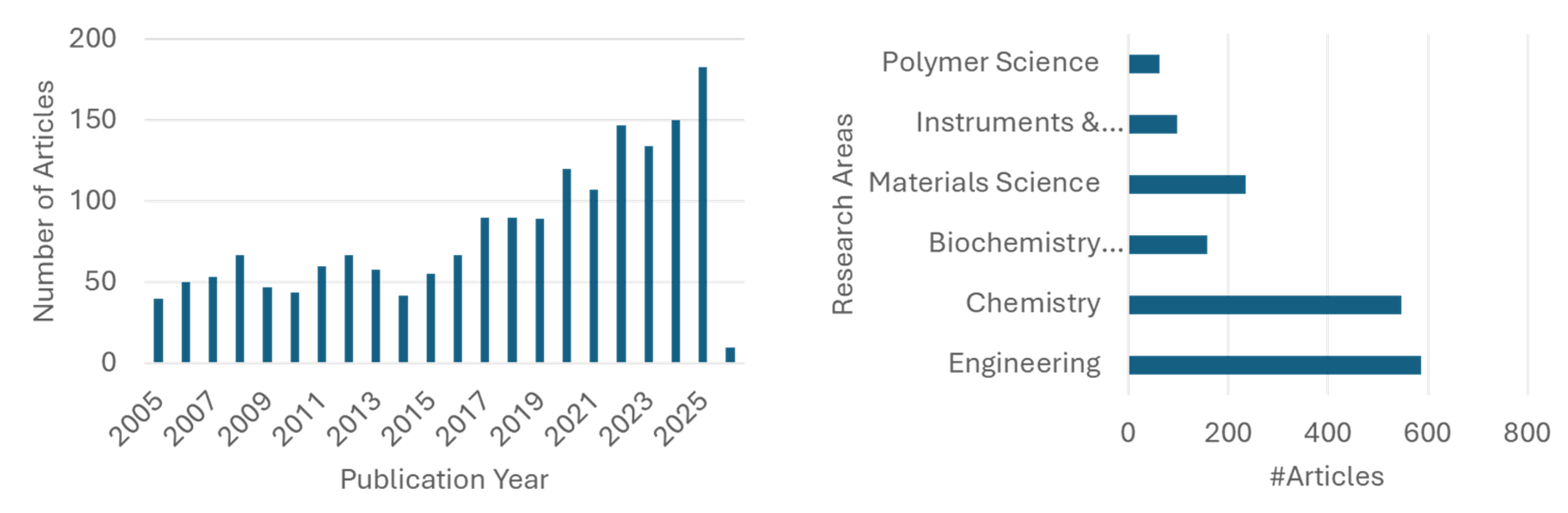
Figure 2.
Schematics of fundamental electrokinetic phenomena in a microfluidic environment. (a) Concentration of ions near a charged surface, and the definition of the zeta-potential. (b) Electroosmotic flow. (c) Electrophoresis of a charged particle in an electric field, E. (d) Dielectrophoresis of a neutral polarizable particle. (e) AC electrothermal flow and particle trapping.
Figure 2.
Schematics of fundamental electrokinetic phenomena in a microfluidic environment. (a) Concentration of ions near a charged surface, and the definition of the zeta-potential. (b) Electroosmotic flow. (c) Electrophoresis of a charged particle in an electric field, E. (d) Dielectrophoresis of a neutral polarizable particle. (e) AC electrothermal flow and particle trapping.
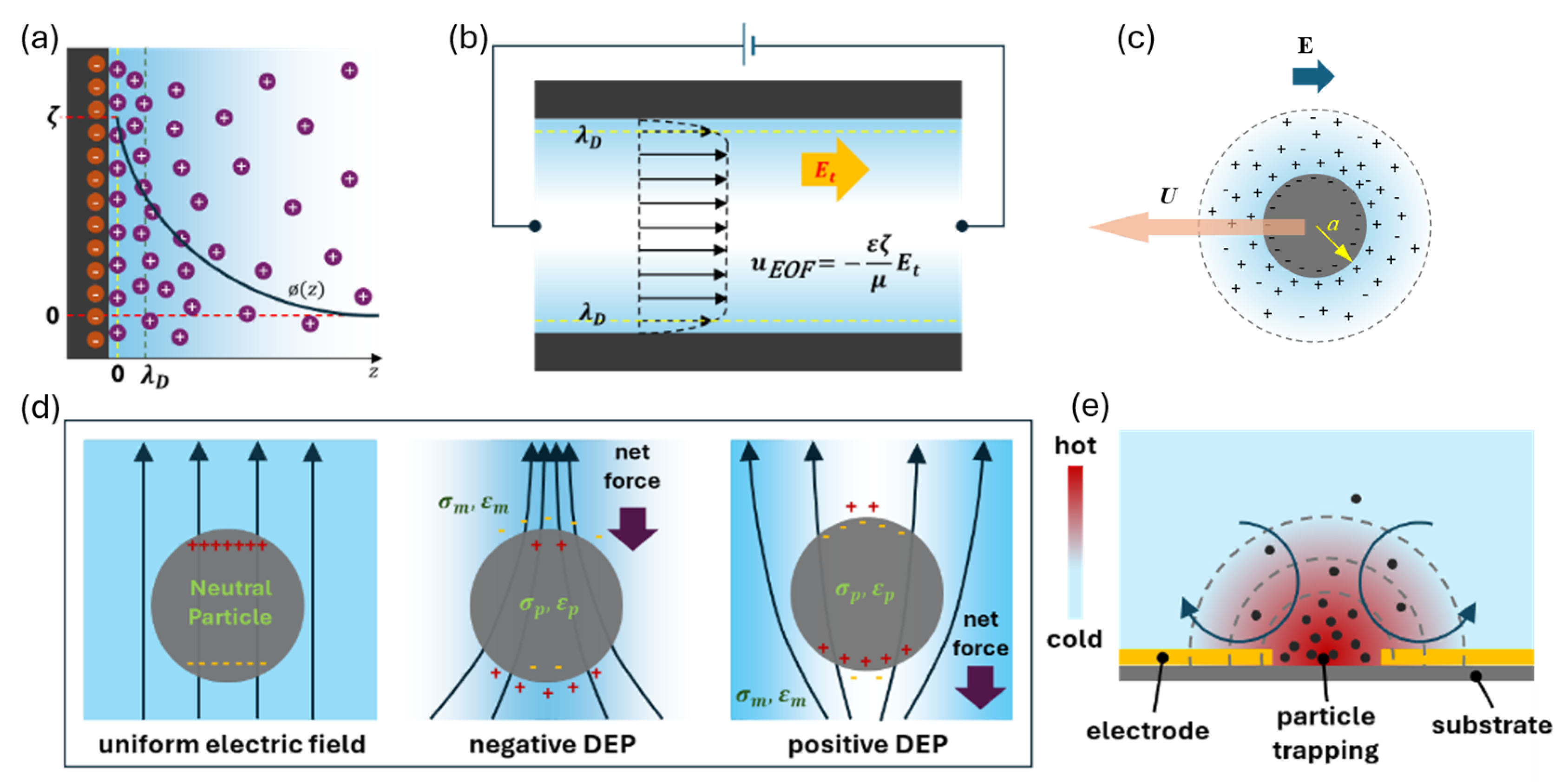
Figure 3.
Variation of thermal performance, in terms of Nu with varying aspect ratio (α) of the channel for (a) different Joule heating numbers, and (b) pressure-opposed flow. Reprinted with permission from [11].
Figure 3.
Variation of thermal performance, in terms of Nu with varying aspect ratio (α) of the channel for (a) different Joule heating numbers, and (b) pressure-opposed flow. Reprinted with permission from [11].
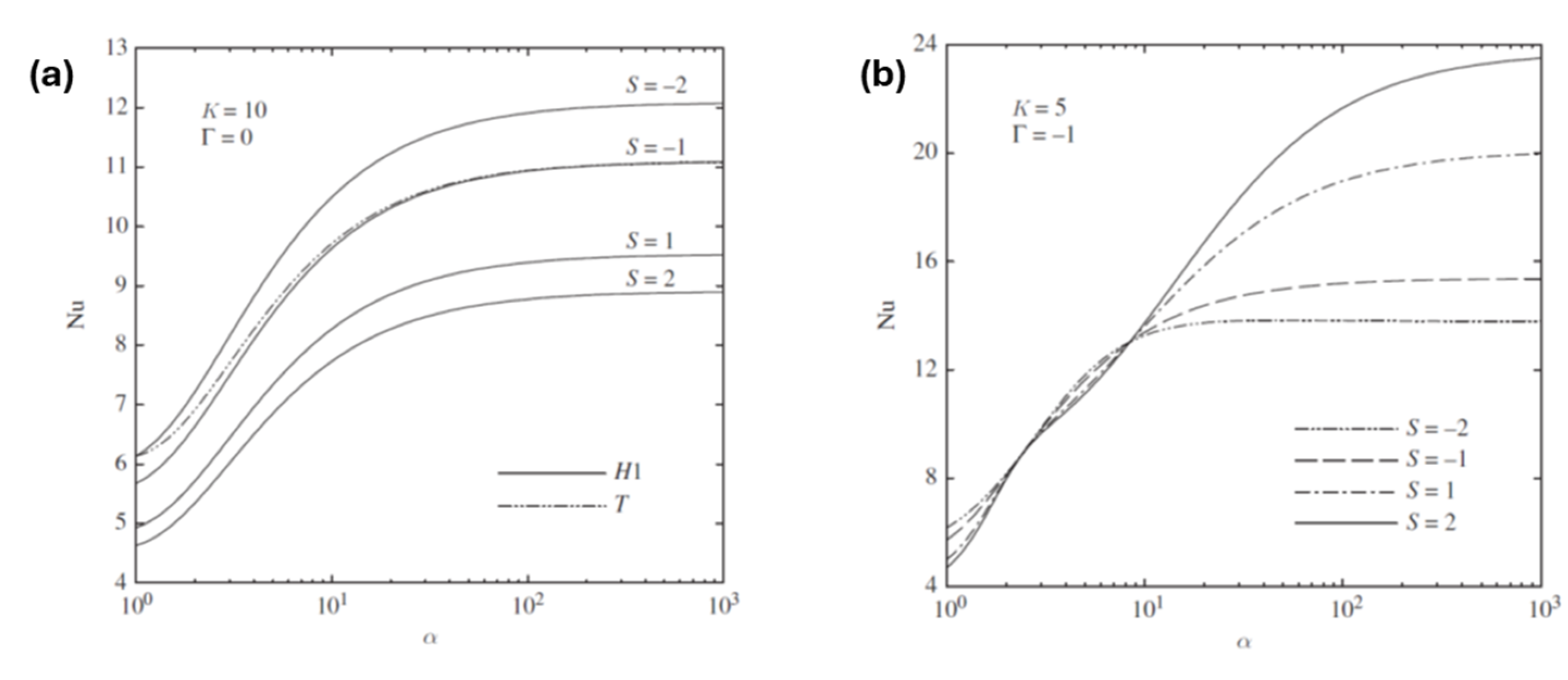
Figure 4.
Comparison of experimental and numerically predicted results at the (a) inlet and (b) outlet of a microchannel. Reprinted with permission from [16]. (c) Normalized Laser-Induced Fluorescence Thermometry (N-LIFT) image showing the temperature increase in the medium with conductivity σ = 200 mS/m; and (d) variation of maximum temperature change with the applied electric potential squared. Reprinted with permission from [17].
Figure 4.
Comparison of experimental and numerically predicted results at the (a) inlet and (b) outlet of a microchannel. Reprinted with permission from [16]. (c) Normalized Laser-Induced Fluorescence Thermometry (N-LIFT) image showing the temperature increase in the medium with conductivity σ = 200 mS/m; and (d) variation of maximum temperature change with the applied electric potential squared. Reprinted with permission from [17].
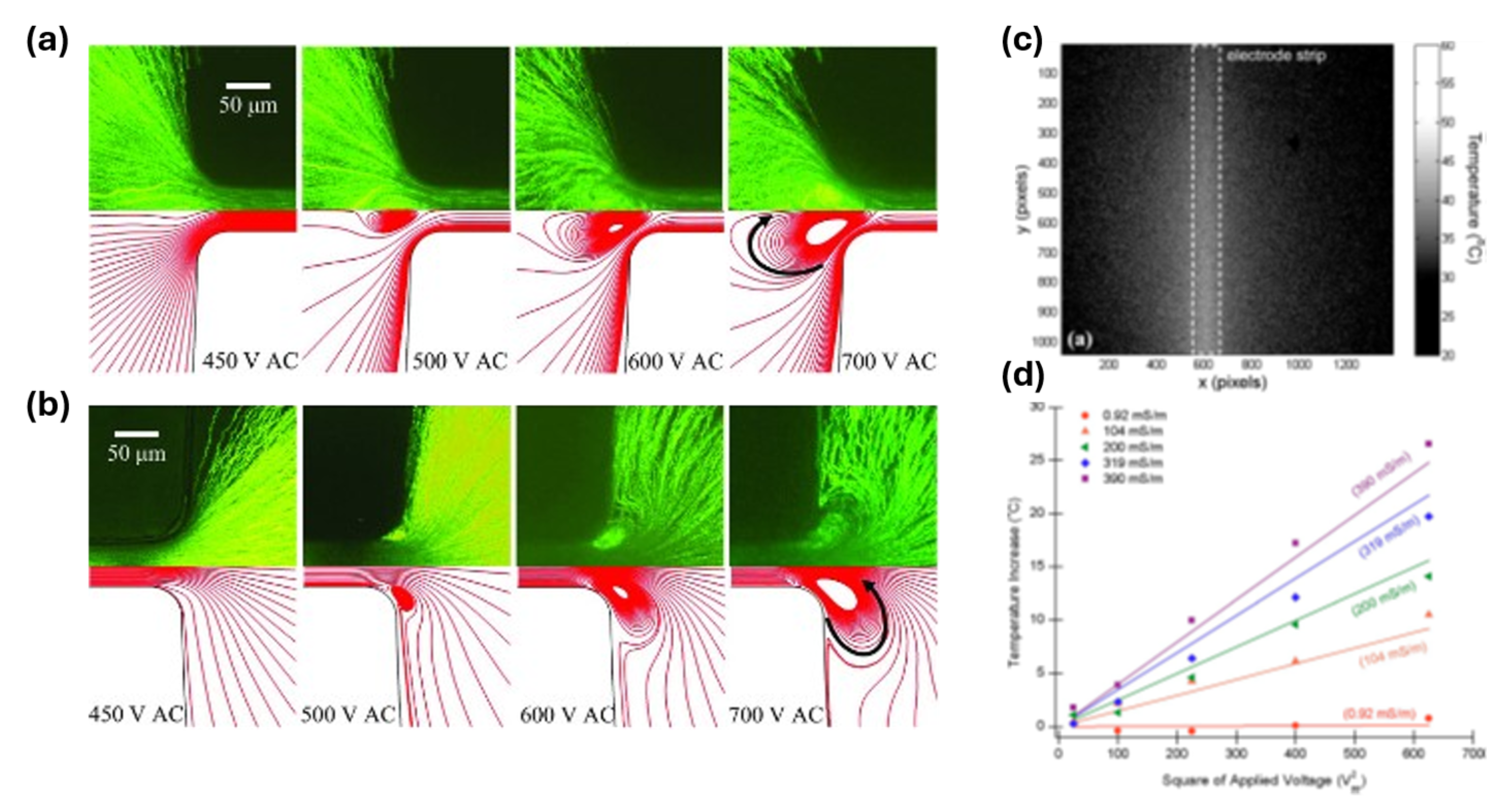
Figure 5.
(a) Joule heating effect on electroosmotic flows. Reprinted with permission from [47]. (b) Experimentally observed particle aggregation induced by Joule heating. Reprinted with permission from [40]. (c) Effect of Joule heating in cellular micro and nano-electroporation. Reprinted with permission from [39].
Figure 5.
(a) Joule heating effect on electroosmotic flows. Reprinted with permission from [47]. (b) Experimentally observed particle aggregation induced by Joule heating. Reprinted with permission from [40]. (c) Effect of Joule heating in cellular micro and nano-electroporation. Reprinted with permission from [39].
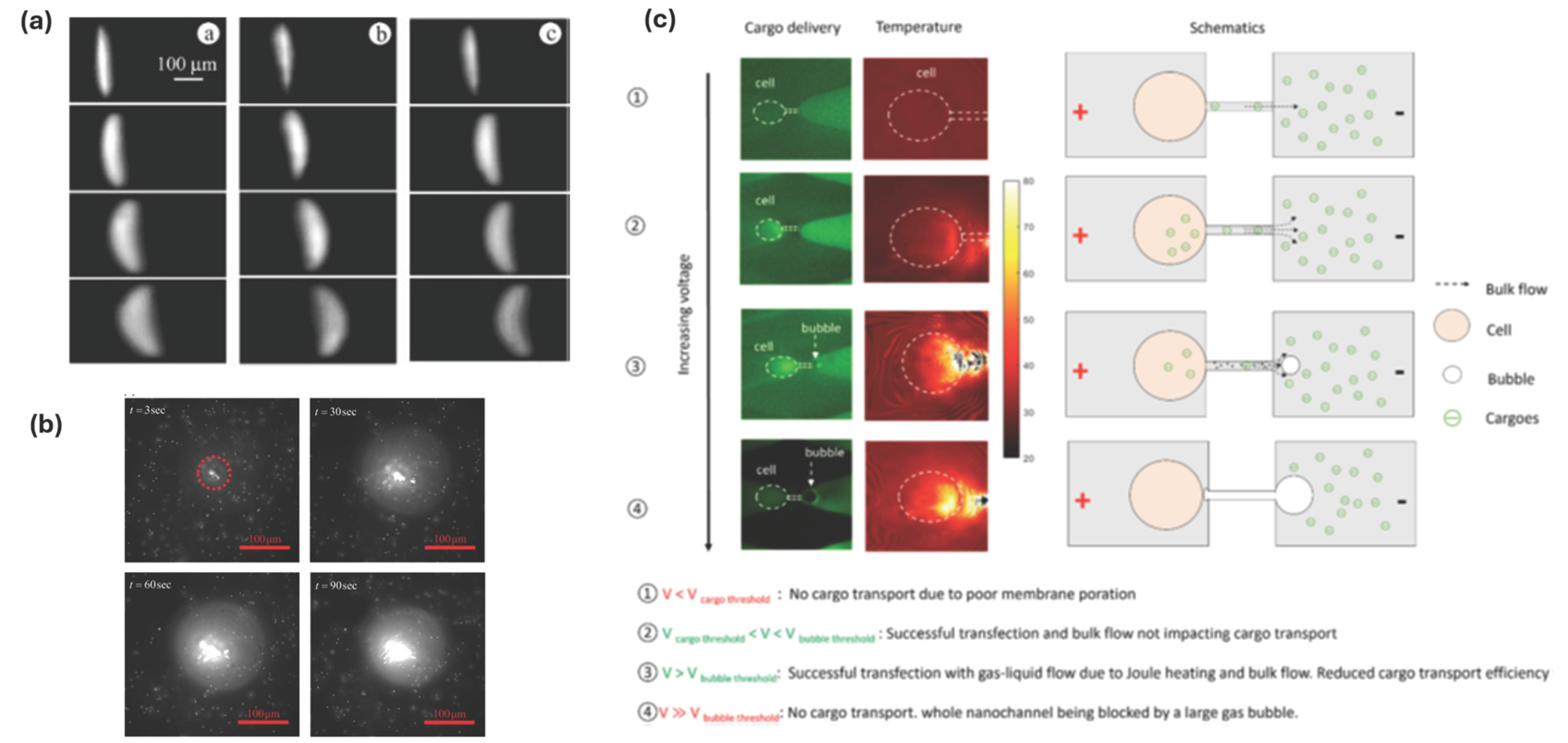

Table 1.
Summary of analytical, numerical and experimental works done on the characterization of thermal effects in electrokinetic flows.
Table 1.
Summary of analytical, numerical and experimental works done on the characterization of thermal effects in electrokinetic flows.
| Ref. | Flow/Actuation Type | Geometry | Working Medium | Thermal effects considered | Methodology |
|---|---|---|---|---|---|
| [2] | EOF, pressure-driven flow | Cylindrical microannulus |
General |
Viscous dissipation, Joule heating |
Analytical, numerical |
| [3] | ACET flow | PDMS-glass microchannel with coplanar symmetric electrode | Polystyrene nanoparticles, dispersed in deionized water | ACET | Experimental |
| [4] | Electrokinetic flows with conductivity gradients | Symmetric T-shaped microchannel | Ferrofluid and water | Joule heating | Experimental, numerical |
| [5] | Steady EOF | Two-dimensional straight microchannels | General | Joule heating | Analytical |
| [11] | EOF, pressure-driven flow | Rectangular microchannel | Newtonian liquid | Joule heating | Analytical |
| [8] | ACET flow | PDMS-glass device with coplanar electrodes | Water | ACET | Experimental, numerical |
| [12] | Steady electrokinetic flow | Two-dimensional straight microchannels | Water | Joule heating | Numerical |
| [13] | EOF with time-modulated electric field | Two-dimensional microchannel confined between two infinitely parallel plates | General | Joule heating | Analytical |
| [14] | EOF | Tapered porous microchannel | Jeffrey fluid | Vicous dissipation | Analytical |
| [15] | EOF | Miltimembrane microchannel | Jeffrey fluid | General heat source/sink | Analytical, numerical |
| [16] | Electroosmotic entry flow | Straight microchannel with end reservoirs | 5 mM phosphate buffer solution | Joule heating | Experimental, numerical |
| [17] | AC electrokinetic flow | Straight microchannel | water at various electrical conductivities | Joule heating | Experimental, numerical |
| [18] | EOF, pressure-driven flow | Two-dimensional microchannel confined between two infinitely parallel plates | General | Joule heating | Analytical |
| [19] | EOF, pressure-driven flow | Circular microchannel with circumferentially heterogeneous surface properties | General | Joule heating | Analytical, numerical |
| [20] | Capillary electrophoresis | Circular capillary | NaCl electrolyte with fluorescein dye as the sample species | Joule heating | Numerical |
| [21] | EOF, pressure-driven flow | Rectangular microchannel heat sink | Water | Joule heating | Numerical |
| [22] | Electrokinetic flow with logitudinal electric field and transverse magnetic field | Rotating microchannel | General | Viscous dissipation, Joule heating | Analytical, numerical |
| [23] | ACET flow with multi-phase actuation | Rectangular microchannel with planar electrodes | Phosphate buffered saline | ACET | Numerical |
| [24] | AC multiple array electrothermal micropump | Microchannels with square, circular, and triangular cross sections | Phosphate buffered saline | ACET | Experimental, numerical |
| [25] | ACET flow | 2D rectangular microchannel with electrodes at the bottom | 1 μm particles in phosphate buffered saline | ACET | Experimental, numerical |
| [26] | ACET flow | ACET micropump with asymmetric electrodes | KCl solution | ACET | Numerical |
| [27] | ACET flow with slip velocity on wall | 2D rectangular microchannel with electrodes at the bottom | Water | ACET | |
| [28] | EOF, Electrophoresis | Rectangular PDMS microchannels | Sodium bicarbonate buffer solution | Joule heating | Experimental, numerical |
| [29] | EOF | Electrokinetic separation chip | 20 mM phosphate buffer (pH 7.0) solution | Joule heating, conjugate heat transfer | Experimental, numerical |
| [30] | ACET microvortex | Parallel plate electrodes with double-sided tape as spacer | 1 μm polystyrene bead suspended in KCl-Tween20 solution | ACET | Experimental, numerical |
| [31] | EOF, Electrophoresis | Cylindrical capillary | General | Joule heating | Analytical |
| [32] | EOF, Electrophoresis | Cylindrical capillary | Tetraborate buffer solutions (pH 9.2) | Joule heating | Experimental |
Table 2.
Summary of the works on application of thermal effects in electrokinetic microflows.
| Ref. | Application | Materials and Microfluidic Device | Mechanism | Methodology |
|---|---|---|---|---|
| [39] | Localized micro/nano-electroporation | FAM-labeled oligonucleotides and GFP plasmids as cargos, in 1× PBS buffer. Nano- and microchannel array. | Joule heating | Experimental, numerical |
| [40] | Particle manipulation with ACET flow | Polystyrene particles dispersed in KCl. Parallel plate electrodes with double-sided tape as spacer | ACET | Experimental, numerical |
| [38] | General microfluidic flow with parallel heating channels carrying ionic liquids for in-situ temperature monitoring | Ionic liquids BMIM Imide and BMIM PF6. Meandering PDMS microfluidic channel with co-running heating channel | Joule heating | Experimental |
| [41] | controlling polymerase chain reaction (PCR) thermal cycling in a microchannel using Joule heating | PCR mixture of DNA template, GeneAmp® 1 × PCR Gold Buffer, 3.0 mM MgCl2, 200 μM dGTP, dCTP, dTTP, and dATP (each), 0.25 μM each primer and 0.1 μM probe. Rectangular microfluidic PCR chip |
Joule heating | Experimental, numerical |
| [42] | Temperature control during capillary electrophoresis (CE) separations for spaceflight applications | Mixture of inorganic cations and amino acids using 5 M acetic acid as background electrolytes. Capillary wrapped in a “figure-of-eight” profile |
Joule heating | Experimental, numerical |
| [43] | cascade EOF micropump for chip cooling | Infinite parallel plates | forced convection by EOF | Analytical, numerical |
| [44] | active cooling micro-channel heat sink device using EOF | 0.4 mM borax buffer. Straight rectangular microchannels etched in silicon |
forced convection by EOF | Experimental, numerical |
| [45] | DEP-based micropump for electronics thermal management | 2.9 μm polystyrene particles dispersed in water. Three-phase planer microelectrode array, for generating travelling-wave DEP. |
Forced convection by travelling wave DEP | Experimental, numerical |
| [46] | wearable sensor patch for biofluid monitoring | Microfluidic sweat collection in textile, spray-coated with M-Xene. Laser-engraved PDMS-based microfluidic device. |
Joule heating for inducing sweat, and subsequent rapid sweat uptake by graphene-based sensors for biomarker analysis | Experimental |
Disclaimer/Publisher’s Note: The statements, opinions and data contained in all publications are solely those of the individual author(s) and contributor(s) and not of MDPI and/or the editor(s). MDPI and/or the editor(s) disclaim responsibility for any injury to people or property resulting from any ideas, methods, instructions or products referred to in the content. |
© 2026 by the author. Licensee MDPI, Basel, Switzerland. This article is an open access article distributed under the terms and conditions of the Creative Commons Attribution (CC BY) license.
Copyright: This open access article is published under a Creative Commons CC BY 4.0 license, which permit the free download, distribution, and reuse, provided that the author and preprint are cited in any reuse.


