
Submitted:
18 February 2026
Posted:
26 February 2026
You are already at the latest version
Abstract
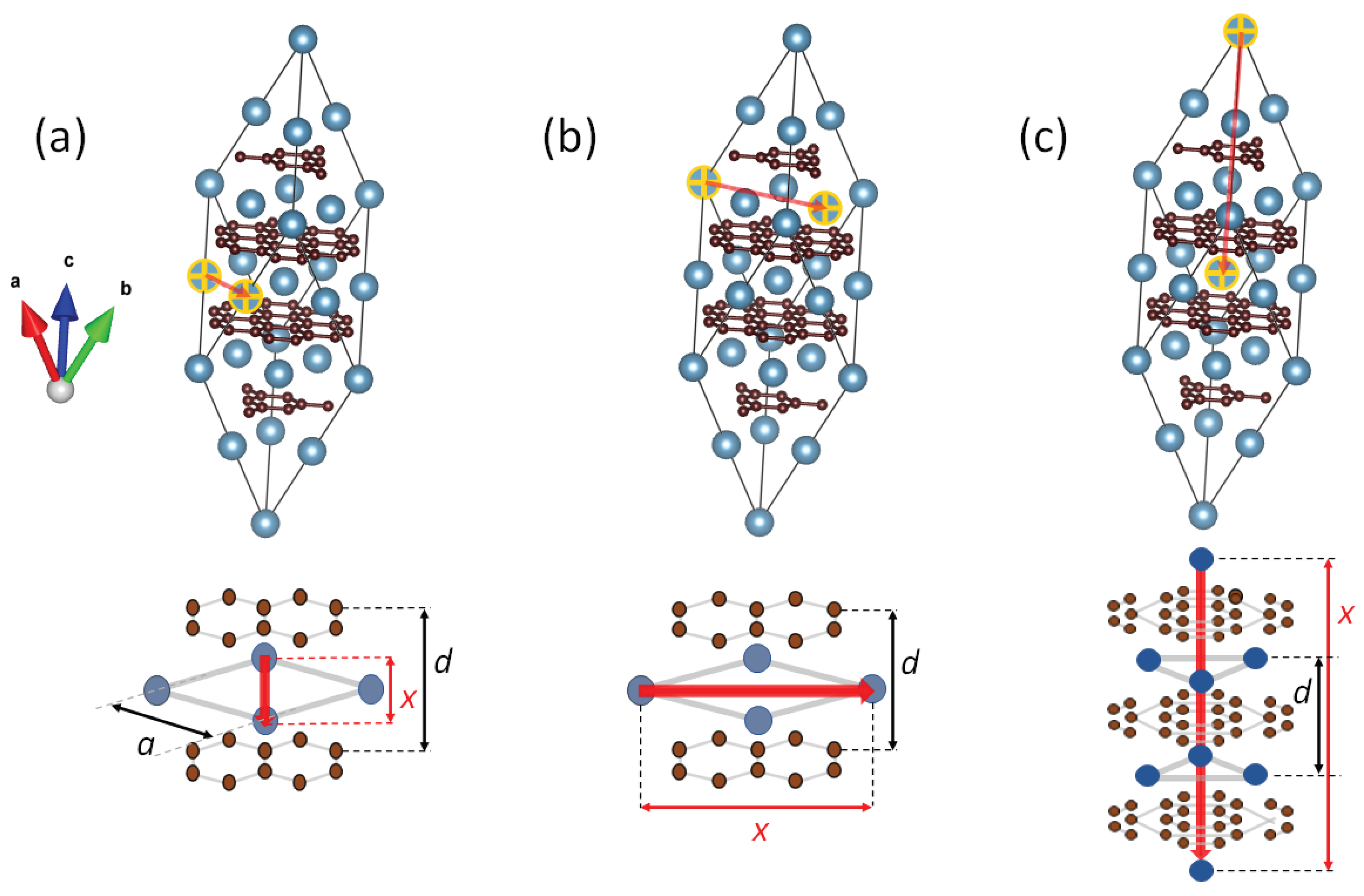
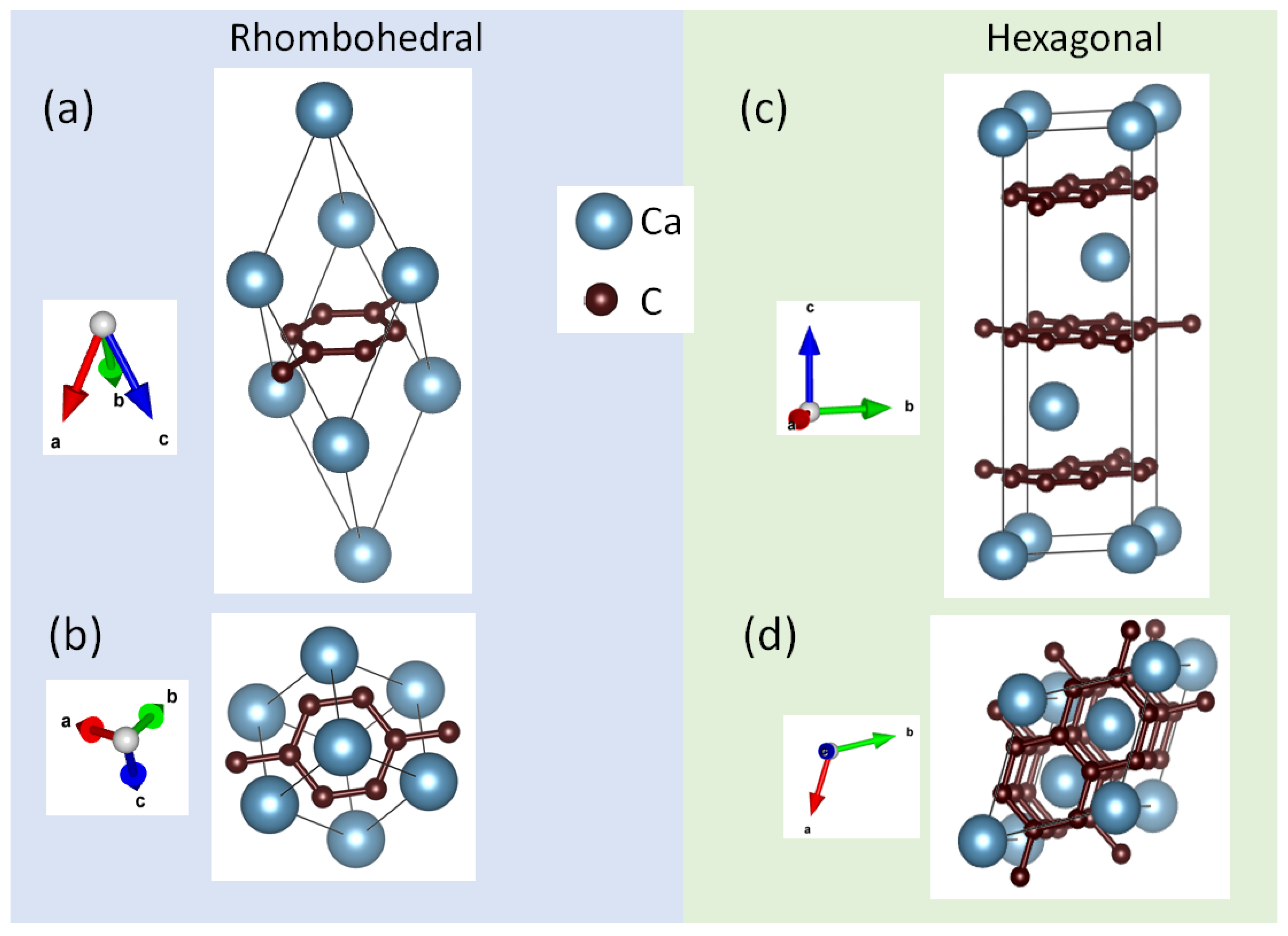
The superconducting transition temperature of CaC6 is investigated within the Roeser–Huber (RH) formalism using both rhombohedral and hexagonal crystallographic representations. While these two descriptions are crystallographically equivalent, they differ in their geometric construction of superconducting paths and near-atom environments. In the rhombohedral representation, only translationally closed Ca–Ca vectors consistent with the primitive lattice are considered, yielding three symmetry-distinct RH paths. In the hexagonal representation, the same superconducting channels are expressed in an expanded conventional cell, where some paths appear as unfolded or symmetry-related sublattice connections. For each representation, the RH path lengths and effective near-atom counts are evaluated and used to compute the superconducting transition temperature. The rhombohedral description yields $T_c^{\rm(calc)} = 10.35$ K, while the hexagonal representation gives $T_c^{\rm(calc)} = 10.91$ K, both in good agreement with the experimental value $T_c^{\rm(exp)} = 11.5$ K. The difference between the calculat\( {The superconducting transition temperature of CaC$_6$ is investigated within the Roeser–Huber (RH) formalism using both rhombohedral and hexagonal crystallographic representations. While these two descriptions are crystallographically equivalent, they differ in their geometric construction of superconducting paths and near-atom environments. In the rhombohedral representation, only translationally closed Ca–Ca vectors consistent with the primitive lattice are considered, yielding three symmetry-distinct RH paths. In the hexagonal representation, the same superconducting channels are expressed in an expanded conventional cell, where some paths appear as unfolded or symmetry-related sublattice connections. For each representation, the RH path lengths and effective near-atom counts are evaluated and used to compute the superconducting transition temperature. The rhombohedral description yields $T_c^{\rm(calc)} = 10.35$ K, while the hexagonal representation gives $T_c^{\rm(calc)} = 10.91$ K, both in good agreement with the experimental value $T_c^{\rm(exp)} = 11.5$ K. The difference between the calculated values amounts to approximately 5.4\%. These results show that the underlying RH superconducting channels and their near-atom environments are representation independent, while minor quantitative differences in $T_c^{\rm(calc)}$ arise from metric redistribution of equivalent paths. This directly confirms that the RH formalism captures intrinsic structural features of superconductivity rather than artifacts of unit-cell representation. \)d values amounts to approximately 5.4\%. These results show that the underlying RH superconducting channels and their near-atom environments are representation independent, while minor quantitative differences in $T_c^{\rm(calc)}$ arise from metric redistribution of equivalent paths. This directly confirms that the RH formalism captures intrinsic structural features of superconductivity rather than artifacts of unit-cell representation.
Keywords:
1. Introduction
- (1)
- connects symmetry-equivalent calcium atoms,
- (2)
- is not blocked by atoms lying directly on the path,
- (3)
- exists as a symmetry-equivalent set throughout the crystal.
2. Roeser–Huber Resonance Condition
3. Crystallographic Background of CaC6
3.1. Superconducting Paths in Rhombohedral CaC6
3.2. Rhombohedral Edge Path
3.3. Rhombohedral Face-Diagonal Path
3.4. Rhombohedral Body-Diagonal Path
3.5. Summary of Rhombohedral RH Paths
4. Superconducting Paths in Hexagonal
4.1. In-plane Edge Paths (Hexagonal)
4.2. In-plane Diagonal Path (Hexagonal)
4.3. Out-of-plane (c-axis) Path (Hexagonal)
4.4. Summary of Hexagonal RH Paths
5. Mapping Between Rhombohedral and Hexagonal Superconducting Paths
5.1. Rhombohedral Edge Path
5.2. Rhombohedral Face-Diagonal Path
5.3. Rhombohedral Body-Diagonal Path
5.4. Summary of the Mapping
6. Discussion
6.1. Metric dependence of RH path counting
7. Conclusions
Author Contributions
Funding
Institutional Review Board Statement
Informed Consent Statement
Data Availability Statement
Conflicts of Interest
References
- Weller, T.E.; Ellerby, M.; Saxena, S.S.; Smith, R.P.; Skipper, N.T. Superconductivity in the intercalated graphite compounds C6Yb and C6Ca. Nat. Phys. 2005, 1, 39–41. [Google Scholar] [CrossRef]
- Emery, N.; Hérold, C.; Lagrange, P. Structural study and crystal chemistry of the first stage calcium graphite intercalation compound. J. Solid State Chem. 2005, 178, 2947–2952. [Google Scholar] [CrossRef]
- Emery, N.; Hérold, C.; d’Astuto, M.; Garcia, V.; Bellin, C.; Marêché, J.F.; Lagrange, P.; Loupias, G. Superconductivity of Bulk CaC6. Phys. Rev. Lett. 2005, 95, 087003. [Google Scholar] [CrossRef]
- Emery, N.; Hérold, C.; Marêché, J.-F.; Lagrange, P. Synthesis and superconducting properties of CaC6. Sci. Technol. Adv. Mater. 2008, 9, 044102. [Google Scholar] [CrossRef]
- Smith, R.P.; Weller, T.E.; Howard, C.A.; Dean, M.P.M.; Rahnejat, K.C.; Saxena, S.S.; Ellerby, M. Superconductivity in graphite intercalation compounds. Phys. C 2015, 514, 50–58. [Google Scholar] [CrossRef]
- Calandra, M.; Mauri, F. Theoretical Explanation of Superconductivity in C6Ca. Phys. Rev. Lett. 2005, 95, 237002. [Google Scholar] [CrossRef]
- Csányi, G.; Littlewood, P.B.; Nevidomskyy, A.H.; Pikard, C.P.; Simons, B.D. The role of the interlayer state in the electronic structure of superconducting graphite intercalated compounds. Nat. Phys. 2005, 1, 42–45. [Google Scholar] [CrossRef]
- Lamura, G.; Aurino, M.; Cifariello, G.; Gennaro, E.D.; Andreone, A.; Emery, N.; Hérold, C.; Marêché, J.-F.; Lagrange, P. Experimental Evidence of s-Wave Superconductivity in Bulk CaC6. Phys. Rev. Lett. 2006, 96, 107008. [Google Scholar] [CrossRef] [PubMed]
- Gauzzi, A.; Takashima, S.; Takeshita, N.; Terakura, C.; Takagi, H.; Emery, N.; Hérold, C.; Lagrange, P.; Loupias, G. Enhancement of Superconductivity and Evidence of Structural Instability in Intercalated Graphite CaC6 under High Pressure. Phys. Rev. Lett. 2007, 98, 067002. [Google Scholar] [CrossRef] [PubMed]
- Kawaguchi, N.; Shibata, K.; Mizoguchi, T. Possible New Graphite Intercalation Compounds for Superconductors and Charge Density Wave Materials: Systematic Simulations with Various Intercalants Using a van der Waals Density Functional Method. J. Phys. Chem. C 2023, 127, 9833–9843. [Google Scholar] [CrossRef]
- d’Astuto, M.; Calandra, M.; Bendiab, N.; Loupias, G.; Mauri, F.; Zhou, S.; Graf, J.; Lanzara, A.; Emery, N.; Hérold, C.; Lagrange, P.; Petitgrand, D.; Hoesch, M. Phonon dispersion and low-energy anomaly in CaC6 from inelastic neutron and x-ray scattering experiments. Phys. Rev. B 2010, 81, 104519. [Google Scholar] [CrossRef]
- Wang, B.; Bianconi, A.; Mackinnon, I.D.R.; Alarco, J.A. Superlattice delineated Fermi surface nesting and electron-phonon coupling in CaC6. Crystals 2024, 14, 499. [Google Scholar] [CrossRef]
- Wang, B.; Bianconi, A.; Mackinnon, I.D.R.; Alarco, J.A. Superlattice Symmetries Reveal Electronic Topological Transition in CaC6 with Pressure. Crystals 2024, 14, 554. [Google Scholar] [CrossRef]
- Roeser, H.P.; Haslam, D.T.; Lopez, J.S.; Stepper, M.; von Schoenermark, M.F.; Huber, F.M.; Nikoghosyan, A.S. Correlation between transition temperature and crystal structure of niobium, vanadium, tantalum and mercury superconductors. Acta Astronaut. 2010, 67, 1333–1336. [Google Scholar] [CrossRef]
- Koblischka, M.R.; Roth, S.; Koblischka-Veneva, A.; Karwoth, T.; Wiederhold, A.; Zeng, X.L.; Fasoulas, S.; Murakami, M. Relation between Crystal Structure and Transition Temperature of Superconducting Metals and Alloys. Metals 2020, 10, 158. [Google Scholar] [CrossRef]
- Koblischka, M.R.; Koblischka-Veneva, A. Calculation of Tc of Superconducting Elements with the Roeser–Huber Formalism. Metals 2022, 12, 337. [Google Scholar] [CrossRef]
- Rohlf, J.W. Modern Physics from α to Z0; Wiley: New York, NY, USA, 1994. [Google Scholar]
- Koblischka, M.R.; Koblischka-Veneva, A. Superconductivity in the Intercalated Graphite Compound CaC6 and the Roeser–Huber Formalism. Metals 2025, 15, 1367. [Google Scholar] [CrossRef]
- Buckel, W.; Kleiner, R. Supraleitung. Grundlagen und Anwendungen, 7th ed.; Wiley-VCH: Weinheim, Germany, 2013. (In German) [Google Scholar]
- Stewart, G.R. Superconductivity in the A15 structure. Physica C 2015, 514, 28–35. [Google Scholar] [CrossRef]
- ICDD. ICDD PDF Data Base; ICDD: 12 Campus Blvd, Newtown Square, PA 19073, USA; (accessed on 10.02.2026).
- Materials Project Database V2019.05. Available online: https://materialsproject.org/ (accessed on 10.02.2026).
- Crystallography Open Database (COD). Available online: https://www.crystallography.net/cod/index.php (accessed on 10.02.2026).
- Merchant, A.; Batzner, S.; Schoenholz, S.S.; Aykol, M.; Cheon, G.; Cubuk, E.D. Scaling deep learning for materials discovery. Nature 2023, 624, 80–85. [Google Scholar] [CrossRef]
- Gashmard, H.; Shakeripour, H.; Alaei, M. Predicting superconducting transition temperature through advanced machine learning and innovative feature engineering. Sci. Rep. 2024, 14, 3965. [Google Scholar] [CrossRef] [PubMed]
- Zeni, C.; Pinsler, R.; Zügner, D.; Fowler, A.; Horton, M.; Fu, X.; Wang, Z.; Shysheya, A.; Crabbé, J.; Ueda, S.; Sordillo, R.; Sun, L.; Smith, J.; Nguyen, B.; Schulz, H.; Lewis, S.; Huang, C-W.; Lu, Z.; Zhou, Y.; Yang, H.; Hao, H.; Li, J.; Yang, C.; Li, W.; Tomioka, R.; Xie, T. A generative model for inorganic materials design. Nature 2025, 639, 624–632. [Google Scholar] [CrossRef] [PubMed]
- Adiga, S.; Waghmare, U.V. Accelerating the Search for Superconductors Using Machine Learning. Comput. Mater. Sci. 2026, 263, 114453. [Google Scholar] [CrossRef]
- CrystalMaker Software Ltd. Begbroke; Oxfordshire, OX5 1PF, U.K. Available online: https://crystalmaker.com/.
- Momma, K.; Izumi, F. VESTA 3 for three-dimensional visualization of crystal, volumetric and morphology data. J. Appl. Crystallogr. 2011, 44, 1272–1276. [Google Scholar] [CrossRef]
- ITA: International Tables for Crystallography, Volume A: Space-Group Symmetry, 5th, revised edition; Springer, 2005.
- QuantumATK manual and homepage. Available online: https://docs.quantumatk.com/tutorials/rhombo_hex_trigonal/rhombo_hex_trigonal.html (accessed on 10.02.2026).
- Koblischka, M.R.; Koblischka-Veneva, A. Calculating the Transition Temperature of Metal-Hydrogen Systems Using the Roeser-Huber Formalism. Physics of Metals and Metallography 2025, 126, 1138–1143. [Google Scholar] [CrossRef]

| Path | Description | x (nm) | P | |
|---|---|---|---|---|
| rhombohedral edge | 0.517 | 3 | 1 | |
| face diagonal | 0.750 | 3 | 14 | |
| body diagonal | 1.357 | 1 | 52 |
| Direction | x | |||||
|---|---|---|---|---|---|---|
| [nm] | [meV] | [K] | ||||
| (1), (a,b) | 0.517 | 2 | 1 | 2 | 0.383 | 1.42 |
| (2), (a,b) | 0.750 | 2 | 14 | 0.1429 | 2.549 | 9.41 |
| (3), (c) | 1.357 | 2 | 52 | 0.0385 | 2.891 | 10.68 |
| Hexagonal path | Direction | x (nm) | P | Rhombohedral origin | |
|---|---|---|---|---|---|
| in-plane edge | 0.433 | unfolded | 1 | ||
| in-plane diagonal | 0.750 | identical | 14 | ||
| c axis | 1.357 | unfolded | 52 |
| Direction | x | |||||
|---|---|---|---|---|---|---|
| [nm] | [meV] | [K] | ||||
| (1), (a,b) | 0.433 | 2 | 1 | 2 | 0.546 | 2.02 |
| (2), (a,b) | 0.750 | 2 | 14 | 0.1429 | 2.549 | 9.41 |
| (3), (c) | 1.357 | 2 | 52 | 0.0385 | 2.891 | 10.68 |
| Rhombohedral | Hexagonal | x | P | Channel | |
|---|---|---|---|---|---|
| path | counterpart | (nm) | |||
| (edge) | unfolded in-plane edges | 0.517 | 3 | 1 | weak in-plane |
| (face diag.) | in-plane diagonal | 0.750 | 3 | 14 | dominant in-plane |
| (body diag.) | c-axis path | 1.357 | 1 | 52 | dominant out-of-plane |
Disclaimer/Publisher’s Note: The statements, opinions and data contained in all publications are solely those of the individual author(s) and contributor(s) and not of MDPI and/or the editor(s). MDPI and/or the editor(s) disclaim responsibility for any injury to people or property resulting from any ideas, methods, instructions or products referred to in the content. |
© 2026 by the authors. Licensee MDPI, Basel, Switzerland. This article is an open access article distributed under the terms and conditions of the Creative Commons Attribution (CC BY) license (http://creativecommons.org/licenses/by/4.0/).


