

Submitted:
19 February 2026
Posted:
27 February 2026
You are already at the latest version
Abstract
This study presents the development and experimental evaluation of HygroCatch, a portable hybrid fog water harvesting prototype that integrates active and passive col-lection mechanisms. The device operates by combining fog droplet ionization in a high-voltage direct-current (HV DC) electrostatic field, thermoelectric cooling based on the Peltier effect, and mechanical deposition of droplets on electrode grids. This hybrid approach enables adaptive operation across a wide range of fog liquid water content (LWC) conditions. The work establishes operating parameters for stable electrostatic ionization and evaluates the contribution of thermoelectric cooling to additional water collection. The results indicate that an operating voltage of 13–14 kV provides a stable ionization over a broad LWC range. The average fog water harvesting rate reached 3.15 kg/m²/h, with a maximum observed value of 4.44 kg/m²/h. On average, 56% of the collected water was obtained through HV DC ionization, 25% through Peltier-based thermoelectric cooling, and 19% through mechanical deposition on electrode grids under high LWC conditions. The total electrical power consumption of the device did not exceed 38.3 Wh/kg. The results demonstrate that a hybrid fog water harvesting strategy enables stable and efficient water collection under environmental conditions in which individual passive or active methods become ineffective.
Keywords:
fog water harvesting
; hybrid methods
; electrostatic ionization
; thermoelectric cooling
; Peltier effect
; HygroCatch
1. Introduction
Active fog water harvesting methods, including electrostatic ionization and the associated electrohydrodynamic processes, have been explored as a possible extension of passive collection techniques. However, prior studies reveal pronounced sensitivity to ambient conditions, limited experimental reproducibility, and persistent methodological challenges in the rigorous comparison of energy input versus collected water yield. As a consequence, active approaches have not yet converged into a unified and quantitatively formalized research domain with clearly delineated operational regimes.
Since the publication of a review article [1] in the Nature journal portfolio in 2025, which surveys electrostatic fog water harvesting approaches and emphasizes their practical implementation challenges, no new methodologically coherent framework for the experimental comparative evaluation of active fog water harvesting methods has emerged in the scientific literature. This reflects not a deficiency of research interest, but the structural complexity of the field, where isolated positive results are difficult to reproduce or transfer across operating regimes. As a result, experimentally validated studies linking electrical operating parameters to actual water harvesting efficiency under well-defined conditions remain scarce.
Water present in air occurs in two forms: as vapor (gas) or as fog (fine liquid water droplets). Water is extracted from vapor by condensing it on cooled surfaces with a temperature equal to or lower than the dew point. Condensers are stationery and energy-inefficient devices. Fog water droplets can be collected either mechanically (passive methods) or via electrostatic-field-induced ionization (active methods).
When air cools to the dew point, water vapor begins to condense on microscopic airborne particles, such as dust, spores, salt crystals, and soil particles, known as condensation nuclei. This process leads to the formation of fog droplets, whose typical diameters are reported to be on the order of 4–22 μm [2], while in practice droplet sizes may span a broader range of approximately 2–50 μm or more, depending on fog type [3].
Passive fog water harvesting methods do not require external energy input. A typical configuration consists of a mesh collector with a surface area ranging from 1–4 m² up to 40–54 m². The mesh is mounted on a supporting frame at a height of approximately 2–4 m. Design improvements and the use of moisture-retaining materials can enhance fog water collection efficiency. Reported collection rates can reach up to 1.5 kg/m²/h [1].
Passive systems are simple and resource-efficient. However, they are ineffective under windless conditions and in weak fog characterized by low liquid water content (LWC). Following Ginters and Ginters [4], low LWC is hereafter considered to be approximately 0.02–0.05 g/m³, while high LWC exceeds 0.5 g/m³. Passive fog collectors are visually prominent in the environment and are not easily portable. This limits their applicability for hiking and mission-oriented use.
Active fog harvesting methods are based on the forced ionization of fog water droplets in a high-voltage electrostatic field. In air, the electrostatic field governs the motion of free electrons. Electrons acquire sufficient kinetic energy to ionize neutral atoms along their path toward the positively biased discharge electrode by ejecting electrons from them. The newly released free electrons then continue to propagate toward the discharge electrode, ionizing additional neutral atoms and generating an avalanche process. Positively ionized gas molecules and water droplets are subsequently driven along the electric field lines toward the collector. Naturally ionized fog droplets are transported in the same direction.
Active fog water harvesting rates can reach 3.2–5.6 kg/m²/h under laboratory conditions [1]. However, these estimates have not been validated under real environmental conditions. Active methods perform effectively in fog with low LWC, while their effectiveness decreases at higher levels.
The electric field strength between electrodes is determined by the applied potential difference, ambient air conditions, and the electrode architecture, including their geometry and spatial arrangement. The electrode architecture must prevent the formation of electrical arcs or sparking between electrodes of opposite polarity. Such discharges produce high currents, can damage the electrodes, and increase the operational hazard of the device.
Based on the analysis presented by Ginters and Ginters [4], three main types of electrode configurations can be identified:
- A vertical cylindrical mesh collector with a centrally positioned vertical rod-type discharge electrode;
- A collector composed of two or more vertical rows of rods, with a vertical row of discharge electrodes positioned between the collector rows;
- A horizontal mesh collector in the form of a longitudinally split tube, with a horizontal rod-type discharge electrode positioned above it.
In a previous study [4], mathematical modeling of the electrode space was performed by solving the Laplace equation and analyzing the structure of electrostatic field lines in order to conceptually identify promising electrode space configurations for active fog water harvesting. This approach was used as a theoretical screening tool for comparing different geometric arrangements of the electrode space without involving complex droplet dynamics or aerodynamic models. It served as the basis for selecting the architecture of the experimental prototype.
It can be concluded that the efficiency of fog water droplet collection is strongly influenced by the density and orientation of electrostatic field lines determined by the electrode configuration, as well as by the number and design of electrodes that define the active fog water harvesting area.
The results of electrostatic field modeling [4] demonstrated that, for a collector composed of multiple vertical rows of rods with a vertical row of discharge electrodes positioned between the collector rows, the electric field lines are well focused toward the collector. In this configuration, the electrostatic field is used efficiently, and no constructive obstacles are introduced to the fog flow. From a theoretical perspective, this electrode configuration should provide comparatively higher fog water collection efficiency.
As the ambient temperature decreases toward the dew point, condensation of water present in the air begins. It is therefore possible that hybrid approaches combining electrostatic field induced ionization with thermoelectric cooling could enable the collection of additional fog water. Such an approach could support the development of a device capable of operating under low LWC conditions where other active and passive fog water harvesting methods become less effective.
The motivation of this work is to extend the previously described research direction by moving from mathematical analysis of the electrode space to a practical and robust prototype, and to experimentally evaluate the behavior of the selected configuration under quasi-real operating conditions rather than under highly specific laboratory settings. The study presents experimental data on the operation of a portable electrostatic fog water harvesting prototype, HygroCatch. The analysis examines the relationships between applied voltage, current, and electrical power consumption, the device configuration, and the amount of collected water. Passive, active, and hybrid operating modes are also compared. In this way, the objective of the work is to provide a quantitative and operation-mode-structured basis for the evaluation of active fog water harvesting methods.
The first section of the paper describes the experimental setup and the applied methodology. This includes the electrode space configuration, the evaluation of electrical parameters, and the fog water collection procedures. The second section presents experimental results obtained under different operating modes and analyzes the relationships between the amount of collected water and the applied methods. The paper concludes with a summary of the main observations and an outline of directions for further research.
The paper is relevant to researchers and engineers working on atmospheric fog water harvesting technologies, applications of electrostatic processes, and experimentally oriented analysis of energy and environmental systems. It may also be of interest to audiences focused on the practical evaluation of active and hybrid systems under conditions where passive water collection methods are limited.
2. Materials and Methods
2.1. Determination of Electrostatic Field and Thermoelectric Cooling Parameters
Fog water harvesting can be achieved using different approaches, including passive or mechanical methods based on meshes, nets, or grid structures made of various materials, as well as active methods that rely on electrostatic ionization of fog water droplets. Fog density is characterized by its LWC. In turn, the applicability of a specific fog water harvesting method depends on the LWC.
The hybrid fog collector HygroCatch is capable of operating in different modes over a wide range of fog liquid water content, approximately 0.02–0.5 g/m³ and above.
To enable ionization of air molecules as well as water droplets, a necessary condition is overcoming the dielectric strength of air so that the medium becomes electrically conductive. However, fog water harvesting requires sufficiently strong droplet ionization, meaning that the droplets must acquire enough electric charge to be driven or attracted along electrostatic field lines toward electrodes of opposite polarity. Naturally ionized fog droplets also migrate in the same direction.
In the HygroCatch system, positive ionization was employed. Sufficient ionization was indicated by the formation of corona discharge and the appearance of a bluish or violet glow around the discharge electrode.
The electric field strength between the electrodes is determined by the voltage, environmental parameters, and the electrode materials and architecture, that is, their shape and spatial arrangement. In the HygroCatch system, vertical rod-type electrode structures were employed, the effectiveness of which was substantiated by Ginters and Ginters [4].
The electric field strength at the surface of a rod electrode for a configuration with two parallel cylindrical electrodes can be calculated using a modified expression derived from Kuffel et al. [5]:
where is the electric field strength at the surface of the rod electrode (kV/mm), is the voltage applied between the electrodes (V), is the distance between the inner surfaces of the electrodes (mm), and is the radius of the discharge electrode (mm).
According to Equation (1), assuming an air dielectric strength of 3 kV/mm, the minimum voltage required at the discharge electrode surface for the formation of a stable current-conducting medium in the interelectrode air gap can be calculated. For = 1 mm and = 25 mm, the resulting value is = 11.6 kV. Variations in atmospheric pressure and temperature affect within a few percent.
As relative air humidity () increases, air conductivity is enhanced and the current path between the electrodes improves. However, under high-humidity conditions the process may become stochastic. According to Nouri et al. [6], an increase in can be assumed to reduce by approximately 8%. Wu et al. [7] report that the humidity-induced reduction of may reach 9%. This implies that under fog conditions and at S = 25 mm, the minimum voltage required for stable air-gap breakdown may be approximately 10.6 kV.
According to experimental measurements and simulations reported by Zeng et al. [8], the ionization current can reach at least 30 µA. However, different results have also been reported. For a configuration with a single electrode pair operating at comparable discharge voltages, Damak and Varanasi [9] observed an approximately threefold lower discharge current, that is, about 10 µA.
If it is taken into account that the HygroCatch system comprises at least ten electrode pairs, the total ionization current, even under idealized assumptions, cannot exceed 0.3 mA. In practice, this value is substantially reduced by electrode shielding effects. Safety considerations further require that the current should not exceed the perceptible touch current of 1 mA [10], which is consistent with the 0.5 mA current limit of the HygroCatch high-voltage power supply.
Condensation of atmospheric water begins when the air temperature reaches the dew point . This implies that under weak fog conditions, and even under clear atmospheric conditions, lowering the collector temperature to the dew point makes it possible to obtain additional water through condensation of atmospheric moisture.
According to a simplified approximation with an accuracy of ±2 °C [11], the dew point temperature can be estimated as:
where is the ambient temperature (°C) and is the relative humidity (%).
For = 24 °C and = 90%, the dew point temperature is 22 °C. This means that, to initiate condensation, the surface temperature needs to be reduced by only 2 °C.
Thermoelectric coolers (TECs), commonly referred to as Peltier modules, operate based on the combined action of the Peltier, Seebeck, and Thomson effects [12]. In TEC modules, p-type and n-type semiconductor elements are arranged between two external ceramic plates and electrically interconnected in various configurations to form a thermal current path between the two surfaces. A direct current flowing through the module drives heat transfer from one ceramic plate to the other. As a result, one plate is cooled, while the other heats up by at least the same amount.
The heat flux transported by the Peltier effect is proportional to the electric current and depends on the properties of the materials used. TEC operation is critically influenced by the Joule effect, which governs heat generation when an electric current flows through a closed circuit. The heat produced by the Joule effect counteracts the cooling process and must be dissipated into the surrounding environment to prevent module overheating. The contributions of the Seebeck and Thomson effects are minimal and can be neglected in practical implementations.
The amount of heat (J) stored by a material object at a given ambient temperature (K) can be calculated using the expression given by Giancoli [13]:
where is the mass of the aluminum (kg), is the specific heat capacity of the material (900 J/(kg·K)), and (K) = (°C) + 273.15.
To transfer a heat amount across the TEC module within a given time interval , a minimum electrical power is required. This power can be calculated as:
Taking into account nonlinear effects and variations in the temperature regime over time, it is advisable to increase the margin. Accordingly, for the HygroCatch configuration, transferring the calculated heat amount over a duration of 180 s corresponds to a power consumption of = 1.61 W.
Electrical energy is used to transfer heat within a TEC module. It can be assumed that the required power is approximately compensated by the electrical power generated by the current:
where is the minimum electric current required to ensure the transfer of the heat amount within the Peltier module from the cold side to the hot side (A), is the internal electrical resistance of the Peltier module (Ω), and is the amount of heat (J) that must be transferred from the electrode in contact with the cooled side of the module to the hot side of the module while the electrode temperature decreases by .
Each TEC module specification defines the electrical power required for the module to transfer the maximum possible amount of heat at the maximum allowable current under the condition = 0. The maximum permissible supply voltage is also specified.
It can be assumed that, within a small temperature variation range, the relationship between the transferred heat amount and the electric current is approximately linear:
The criteria for selecting a suitable TEC module, taking into account module dimensions and based on published characteristic curves, are as follows:
- The electrical power dissipated by Joule heating, , where ≈ 2 W, which can be dissipated by the metal heat sink;
- The TEC module current must be sufficient to transfer the required heat amount within 180 s. Specifically, the minimum power corresponding to must exceed 1.61 W, which corresponds to the HygroCatch collector electrode configuration.
For the cooling of the portable fog water harvesting device HygroCatch, a TEC1-12701 K28 Peltier module [14] was used. Based on the algorithm described above and the manufacturer’s specifications, the minimum operating current was determined as ≈ 0.3 A, corresponding to a module supply voltage of ≈ 2.5 V. The calculations presented above are conservative and do not account for TEC nonlinearities, manufacturing tolerances, or energy losses at electrical and thermal contacts.
This subsection defines the electrostatic field parameters required for fog droplet ionization in the HygroCatch electrode configuration and outlines the role of Peltier-based thermoelectric cooling. The following section reports experimental fog water harvesting results obtained at different LWC levels.
2.2. Hybrid Fog Water Harvesting Device Design
Based on previously reported results of electrostatic field mathematical modeling [4], an electrode configuration was implemented consisting of 280 mm long aluminum rods arranged vertically in three parallel rows, with ten rods in each row. The central row formed the discharge electrode assembly, where each rod had a diameter of 2 mm. The two outer rows formed the collector electrodes and consisted of rods with a diameter of 5 mm. The spacing between adjacent rods within each row was 15 mm. The air gap between the collector and discharge electrode rods was 25 mm.
Aluminum was used for the construction of the HygroCatch prototype due to its favorable thermal conductivity of 235 W/m/K and electrical conductivity of 36 MS/m. Its density of 2700 kg/m³ also enables convenient material processing. Material properties reported here and throughout the study were taken from the CRC Handbook of Chemistry and Physics [15].
The collector electrodes were screwed into an L-shaped aluminum base profile with a length of 250 mm and profile dimensions of 40 mm x 20 mm x 2 mm. Threaded rivet nuts were used for fastening. To reduce oxidation of the collector electrodes and to ensure reliable electrical conductivity, ENSTO SR1 lithium paste was applied.
The row of discharge electrodes was bonded into threaded sleeves screwed into the aluminum base plate, as the rod diameter was too small to cut a mechanically stable thread. The discharge electrode base plate had a thickness of 5 mm, a length of 250 mm, and a width of 15 mm. MG Chemicals 8330S adhesive [16] was used to secure the discharge electrodes. The adhesive has an electrical resistivity of 7×10⁻⁴ Ω·cm.
The discharge electrode base plate was aligned and mechanically supported from both sides by metal structural elements. These elements were electrically isolated from the discharge electrode using cylindrical polyamide insulating rods.
According to the findings reported by Ginters and Ginters [4], promoting uniform ionization of the electrode configuration and maintaining electrostatic field stability required ensuring electrode symmetry. This was achieved by arranging the electrodes in straight lines along both the X and Y axes.
A frame with overall dimensions of 600 mm × 600 mm × 1000 mm was used for electrode positioning. The frame was constructed from aluminum 20 mm × 20 mm T-slot profiles. At the top of the frame, two beams with a length of 1000 mm were integrated for mounting the electrodes. These beams were made of aluminum profiles with cross-sectional dimensions of 10 mm × 20 mm.
Cylindrical dielectric polyamide (PA6) rods were used to secure the collector electrode base plates. The material has a dielectric strength of approximately 15–30 kV/mm and a moisture absorption of 1.3% after 24 h. To electrically insulate the discharge electrode base plate and to increase the dielectric strength of the air gap, a multilayer dielectric assembly was used. This assembly consisted of polycarbonate plates combined with multiple layers of Kapton and polytetrafluoroethylene (PTFE) tape.
Isopropyl alcohol was used to degrease the electrode surfaces. To enhance surface hydrophilicity, a 20% C12–C15 alcohol ethoxylate was applied. The hydrophilic coating smoothed surface irregularities of the electrodes and reduced corona noise to 30 dB. However, the treatment simultaneously increased surface tension forces, which enhanced the influence of the dielectrophoretic force. As a result of the influence of the dielectrophoretic force, the symmetry of the electrode arrangement was distorted. Consequently, the electrode suspension was reinforced using mechanical clamps.
Fog flow generation was achieved using a prototype CLH-182 G1 device [17]. Its operation was based on the vibration of ten piezoceramic resonators in the ultrasonic frequency range. This induced microcavitation of the water layer above the resonator heads and led to the formation of fog droplets with diameters of approximately 2–50 µm and above.
The generated fog was non-uniform, and its LWC depended on the amount of water present above the resonators. Higher water levels resulted in drier fog, that is, lower LWC. Because the water consumption of the generator was excessively high, which reduced experimental stability, the generator was modified by reducing the adjustable 34–46 V resonator array to six elements. This modification allowed the fog to remain approximately uniform for at least 2–3 min.
The fog inflow velocity was controlled using a personal computer power supply unit fan integrated into the generator and maintained at approximately 2.1–2.3 m/s. Fog flow velocity was measured using a UT363 UNI-T handheld anemometer [18]. The vane geometry of the instrument is designed for detecting low wind speeds down to 0.3 m/s with an accuracy of ±5% and a resolution of 0.1 m/s.
Ambient temperature and relative humidity were measured using a portable digital thermometer–hygrometer Incomax [19] with a stated accuracy of ±5%. Atmospheric pressure was measured using a Weather Station 5107 (868 MHz) [20], which has a stated accuracy of ±5%.
To ensure comparability of measurements, two wireless infrared digital thermometers were used for remote measurement of electrode surface temperature. These included a HYTAIS TS600 device [21] operating at a measurement distance of 1–2 m, and a Microlife NC200 device [22] with a measurement distance of 50 mm. Both instruments were found to be equally unsuitable for accurate surface temperature measurements, as the reflective metal surface, variable emissivity, and strong local temperature gradients render non-contact infrared measurements non-quantitative under these conditions.
Overall view of the HygroCatch active fog water harvesting device is shown in Figure 1.
Ionization currents were measured using a NJTY TRMS T58B digital multimeter [23], capable of operating in the microampere range with an accuracy of ±1.2% and a resolution of 0.1 µA.
To initiate ionization of air molecules and or fog water droplets, it was necessary to overcome the dielectric strength of air and electrically break down the interelectrode air gap using high direct voltage. HV DC generator AHVAC15KVR5MABT [24] was used, providing an adjustable output voltage in the range of 0–15 kV and a current limit of 0.5 mA.
Neutral RTV silicone with a dielectric strength of approximately 15–30 kV/mm was used to insulate the high-voltage cable connections. The silicone was cured within a cylindrical PET tube with dimensions of 100 mm × 30 mm.
A portable direct current power supply KUAIQU SPS-E305 [25] was used to supply the Peltier elements. The unit provided digitally displayed output ranges of 0–30 V for voltage and 0–5 A for current.
Collector cooling was implemented using six TEC Peltier modules TEC1-12701 K28 [14] with dimensions of 40 mm × 40 mm. Three modules were attached to each collector base plate using electrically insulating but thermally conductive adhesive interface sheets.
In an analogous manner, aluminum heat sinks with dimensions of 40 mm × 40 mm × 20 mm and a thermal dissipation capacity of 1–2 W were bonded to the Peltier modules to dissipate the transferred thermal energy into the surrounding air. The total electrical power consumption associated with fog water droplet condensation did not exceed 8 W.
The prototype was designed not for high-precision laboratory measurements, but for evaluating operational performance under realistic usage conditions. Consequently, the construction prioritized mechanical robustness, functional stability, and tolerance to environmental variability over fine geometric or thermal optimization.
The configuration described above was used in a series of experiments to evaluate a hybrid approach to fog water harvesting. The setup simultaneously employed passive and mechanical collection mechanisms together with active methods based on electrostatic ionization of fog droplets and thermoelectric cooling of the collector. The following subsection provides details on the calculation of parameters for the electrostatic field and the thermoelectric cooling modules.
3. Results and Discussion
3.1. Ionization of Fog Water Droplets in a High-Voltage DC Electrostatic Field
Fog ionization using HV DC electrostatics is one of the primary operating modes of the hybrid and active fog water harvesting device HygroCatch (see Figure 2).
Ionization of fog water droplets, evidenced by an increase in ionization current and the presence of corona discharge, was achieved at an applied field voltage of U = 8.5 kV. However, the current–voltage characteristic was unstable. So-called dead zones were observed, in which oxygen () molecules in the air captured weakly charged electrons, forming ion shields around the discharge electrodes and thereby preventing the electron flow from reaching the electrodes. Under these conditions, the ionization current dropped to zero and ionization ceased.
The process was stochastic, and the formation of dead zones depended on both the fog LWC and the RH of the air. Several such dead zones were observed during ionization. Increasing the applied field voltage re-initiated ionization, while stable operation was consistently achieved only at voltages exceeding U = 10 kV. In contrast, at voltages above U = 15 kV, the risk of uncontrolled sparking increased.
As the ionization current increased, water droplets began to form on the collector electrodes. The influence of the electric field on the fog flow intensified, and ion wind rendered the electrohydrodynamic (EHD) processes stochastic. The ion wind dispersed positively charged fog water droplets throughout the electrode space and deposited them also on the discharge electrodes. Water droplets on the electrodes reduced the air gap between electrodes of opposite polarity and increased the risk of uncontrolled discharges.
To promote spreading of water droplets over the electrode surfaces, the electrodes were treated with a hydrophilic solution. With increasing ionization current, the influence of the dielectrophoretic force intensified, redistributing and positioning electric charges within the water droplets on the collector electrodes. As a result, wetted collector rods were physically attracted toward the discharge electrodes, reducing the air gap and triggering spark-type discharges. As the interelectrode distance decreased, parasitic currents developed.
To mitigate these effects, additional mechanical reinforcement of the electrodes was implemented. A nominal ionization voltage of 13–14 kV was identified, beyond which no significant further increase in the collected fog water was observed.
More than 50 experiments were conducted, and an 18-experiment series was performed under comparable environmental conditions [26]. The HygroCatch device operated in the HV DC field ionization mode at an applied voltage of 13 kV under varying LWC conditions. The fog water droplet size ranged from 2 to 50+ µm. The active electrode area was 0.053 m². The ambient temperature was approximately 24 °C, air pressure approximately 988 hPa, relative humidity approximately 90%, ionization current ranged from 14 to 22 µA, and the fog flow velocity was approximately 2.2 m/s.
The average active fog water harvesting rate using the HV DC field was 2.37 kg/m²/h, with a maximum value of 3.17 kg/m²/h. The reliability of the results was verified using the Shapiro–Wilk test, yielding W(18) = 0.92 and p = 0.11.
Subsequent experiments confirmed that the most effective ionization-mode performance was achieved under weakly saturated fog conditions, where the LWC is low (see Figure 3a), accounting for 68% of the total collected fog water volume. As LWC increases, the electric field becomes less effective at transporting heavier water droplets and even splashing droplets. Under such conditions, the contribution of HV DC ionization decreases. However, the relative contribution of this mode still accounts for approximately half of the collected fog water volume.
3.2. Application of the Peltier Effect for Fog Water Condensation
For implementing thermoelectric cooling of the HygroCatch collector, TEC1-12701-K28 modules were used. Test results showed that a module supply voltage of = 2.6 V provided a current of = 0.2 A, which allowed the surface temperature to be reduced by at least 3–4 °C within approximately 3 min. The corresponding electrical power consumption, = 0.52 W, did not exceed the cooling capacity of the heat sink.
Although the electrical resistance of the TEC module is not constant during operation, the power associated with the heat dissipated at the heat sink did not exceed 1.5 W.
To assess the effect of thermoelectric cooling on the performance of the active HygroCatch device, experiments were conducted under different LWC levels and RH values (see Figure 3b).
The Peltier effect resulted in a variation in the total amount of fog water collected, which was determined by the LWC. As the quantity of water on the electrodes increased, the TEC modules were required to cool not only the metal electrodes but also the water accumulated on the electrodes. As LWC increased, the amount of fog water collected under the influence of the Peltier effect decreased. The average amount of fog water collected under the influence of thermoelectric cooling was 3.15 kg/m2/h, although the highest recorded result was 4.44 kg/m2/h. The average contribution of the Peltier effect was approximately 25% of the total amount of fog water collected.
3.3. Passive and Mechanical Fog Water Harvesting Mode
The effectiveness of passive methods is negligible under dry fog conditions, where droplet sizes are small, as evidenced by the performance of passive fog water collection meshes. As observed in the operation of the HygroCatch prototype, increasing LWC and droplet size led to a greater role of the passive fog water collection mode, since heavier fog droplets mechanically deposited on the electrode grid. Under high LWC conditions, the passive mode reached 23% of the total collected fog water volume (see Figure 4a).
3.4. Summary of Operating Modes
The hybrid HygroCatch device operated in three fog water harvesting modes, the effectiveness of which depended on the LWC level (Low, Medium, High) (see Table 1):
- Passive and mechanical fog water collection using electrode grids (Passive H₂O);
- Ionization of fog water droplets in a high-voltage DC electrostatic field (HV DC H₂O);
- Fog water condensation based on the Peltier effect (Peltier H₂O).
The dominance of each mode depends on fog saturation and the size of fog water droplets. An overview of the relative roles of the fog water harvesting modes is shown in Figure 4b.
The hybrid HygroCatch device can operate both under dry fog conditions, where passive fog collection meshes are ineffective, and under highly saturated fog conditions. The use of Peltier-based thermoelectric cooling increases the amount of collected fog water. When evaluating the average influence of each HygroCatch operating mode, the HV DC H₂O mode corresponds to 56%, the Peltier H₂O mode to 25%, and the Passive H₂O mode to 19% of the total collected fog water volume.
The hybrid fog water harvesting method employed in the HygroCatch system was filed for patent protection under application No. 63/940,151 with the United States Patent and Trademark Office [27].
In this section, the experimental results obtained with the HygroCatch device were analyzed and interpreted. It was found that, due to the application of a hybrid approach, HygroCatch can operate effectively under different LWC conditions in which the use of other fog water harvesting devices becomes problematic.
4. Conclusions
Access to clean drinking water remains limited in many regions, particularly in areas where conventional water infrastructure is unavailable or unreliable.
Atmospheric air contains water vapor that can be condensed by lowering the gas temperature to the dew point. Such technologies are energy intensive, and condensation-based systems are typically stationary installations.
When air temperature naturally decreases to the dew point, water droplets form around condensation nuclei, resulting in fog. Fog density and/or water saturation can vary significantly. Fog is a regularly occurring phenomenon in mountainous regions as well as along sea and ocean coastlines and can be utilized as a source of drinking water.
Both passive and active methods are used to harvest water from fog. Passive methods are not suitable for developing a mobile, portable, and energy-efficient fog water harvesting device, as mechanical fog collection meshes typically require relatively large surface areas. Active methods are based on the ionization of fog droplets in a high-voltage DC electrostatic field and the subsequent transport of charged droplets along electric field lines. However, the collected water volume can be increased by additionally cooling the collector electrodes, which induces condensation. The use of electrode grids makes it possible to mimic the operation of passive systems and to ensure mechanical fog water collection even when both of the aforementioned active methods become less effective under dense fog conditions.
As a result of this study, a theoretical rationale was developed and an experimental prototype of a hybrid and active portable fog water harvesting device, HygroCatch, was designed. The prototype can operate simultaneously in three different modes. First, it accumulates water present in fog through droplet ionization in a HV DC under low fog water saturation conditions, providing on average 56% of the total collected fog water volume. Second, additional condensate is obtained through collector cooling based on the Peltier effect under medium fog water saturation conditions, contributing on average 25% of the total collected volume. Third, HygroCatch enables mechanical water collection on electrode grids under high fog water saturation conditions, accounting on average for 19% of the total collected fog water volume. The fog water harvesting rate achieved with HygroCatch ranged from 3.15 to 4.44 kg/m²/h, which is comparable to typical values reported for active systems. The distinctive feature of HygroCatch is its hybrid adaptability, which enables fog water harvesting under conditions where other methods are not applicable.
An approximate assessment of the device’s energy efficiency indicates that the electrical power consumption during HygroCatch operation did not exceed 8–10 W or 38.3 Wh/kg, taking into account a voltage conversion efficiency in the range of 40–70%.
The study was conducted in accordance with fundamental open science principles. A research diary #HygroCatch covering more than 200 days was published on X and LinkedIn, and intermediate as well as final results were deposited in multiple releases in the Zenodo data and software repository.
The results of this study may be useful for researchers in applied physics investigating fog ionization processes, as well as for companies interested in developing the first commercial hybrid portable fog water harvesting device. Such a device could be used at coastal and mountainous regions by travelers, participants in hiking and missions.
Further development will address the fog flow inlet mechanism and the portability enhancements.
Supplementary Materials
The following supporting information can be downloaded at the website of this paper posted on Preprints.org and https://doi.org/10.5281/zenodo.18648031, Video: Hybrid active fog-water harvesting device HygroCatch.
Author Contributions
Conceptualization, E.G. and P.V.G.; methodology, E.G.; validation, P.V.G.; investigation, P.V.G.; writing—original draft preparation, E.G. and P.V.G.; writing—review and editing, E.G.; supervision, E.G.; project administration and funding, E.G. All authors have read and agreed to the published version of the manuscript.
Funding
Please add: This research received no external funding.
Data Availability Statement
The datasets used and/or analyzed during the current study are available at https://doi.org/10.5281/zenodo.17989000 and from the corresponding author on reasonable request.
Acknowledgments
During the preparation of this work the author(s) used ChatGPT in order to translate, enhance style, check grammar, spelling and references. After using this tool/service, the author(s) reviewed and edited the content as needed and take(s) full responsibility for the content of the published article.
Conflicts of Interest
The authors declare no conflicts of interest.
Abbreviations
The following abbreviations are used in this manuscript:
| HV DC | High-voltage direct-current |
| LWC | Liquid water content |
| RH | Relative humidity |
| TEC | Thermoelectric cooler |
| PA6 | Polyamide |
| PTFE | Polytetrafluoroethylene |
| EHD | Electrohydrodynamic |
References
- Li, D.; Li, C.; Xiao, M.; Zhang, M.; Li, J.; Yang, Z.; Fu, Q.; Yu, K.; Yang, Y.; Pan, Y.; Du, Y.; Zhao, X. Sustainable solutions for water scarcity: A review of electrostatic fog harvesting technology. Commun. Eng. 2025, 4, 34. [CrossRef]
- Niu, S.; Lu, C.; Yu, H.; et al. Fog research in China: An overview. Adv. Atmos. Sci. 2010, 27, 639–662. [CrossRef]
- Toth, G.; Gultepe, I.; Hansen, B.; Milbrandt, J.; Pearson, G.; Fogarty, C.; Burrows, W. The Environment Canada Handbook on Fog and Fog Forecasting; Technical Report No. En56-231/2010E; Environment Canada, Meteorological Service of Canada: Ottawa, ON, Canada, 2010. Available online: https://publications.gc.ca/collections/collection_2011/ec/En56-231-2010-eng.pdf (accessed on 18 February 2026).
- Ginters, E.; Ginters, P.V. Mathematical modelling of electrode geometries in electrostatic fog harvesters. Symmetry 2025, 17, 1578. [CrossRef]
- Kuffel, E.; Zaengl, W.S.; Kuffel, J. High Voltage Engineering: Fundamentals, 2nd ed.; Butterworth-Heinemann: Oxford, UK, 2000.
- Nouri, H.; Zouzou, N.; Moreau, E.; Dascalescu, L.; Zebboudj, Y. Effect of relative humidity on current–voltage characteristics of an electrostatic precipitator. J. Electrostat. 2012, 70, 20–24. [CrossRef]
- Wu, D.; Asplund, G.; Jacobson, B.; Li, M.; Sahlen, F. Humidity influence on switching-impulse breakdown voltage of air gaps for indoor high-voltage installations. In Proceedings of the 14th International Symposium on High Voltage Engineering (ISH), Beijing, China, 25–29 August 2005; Tsinghua University: Beijing, China, 2005. Available online: https://www.researchgate.net/profile/Bjorn-Jacobson/publication/228659342_Humidity_influence_on_switching-impulse_breakdown_voltage_of_air_gaps_for_indoor_high-voltage_installations/links/0deec52ef51f623d24000000/Humidity-influence-on-switching-impulse-breakdown-voltage-of-air-gaps-for-indoor-high-voltage-installations.pdf (accessed on 18 February 2026).
- Zeng, M.J.; Qu, J.G.; Zhang, J.F. Design and optimization of an electrostatic fog collection system for water harvesting: Modeling and experimental investigation. Sep. Purif. Technol. 2023, 323, 124422. [CrossRef]
- Damak, M.; Varanasi, K.K. Electrostatically driven fog collection using space charge injection. Sci. Adv. 2018, 4, eaao5323. [CrossRef]
- TÜV Rheinland. Effects of electrical current in human body. Available online: https://www.tuv.com/content-media-files/usa/pdfs/1020-field-evaluation-service-%28fes%29-for-u.s.-and-canada/tuv_rheinland_02_effects_of_electrical_current_in_human_body.pdf (accessed on 18 February 2026).
- Lawrence, M.G. The relationship between relative humidity and the dewpoint temperature in moist air: A simple conversion and applications. Bull. Am. Meteorol. Soc. 2005, 86, 225–233. [CrossRef]
- In Thermoelectrics Handbook: Macro to Nano, 1st ed.; Rowe, D.M., Ed. Thermoelectrics Handbook: Macro to Nano, 1st ed.; CRC Press: Boca Raton, FL, USA, 2006. [CrossRef]
- Giancoli, D.C. Physics: Principles with Applications, Global ed.; Pearson: Harlow, UK, 2016.
- Wellen Technology Co., Ltd. TEC 127 Series Modules. Available online: https://www.wellentech.com/tec-127-series-modules/ (accessed on 18 February 2026).
- In CRC Handbook of Chemistry and Physics, 97th ed.; Haynes, W.M., Ed. CRC Handbook of Chemistry and Physics, 97th ed.; CRC Press: Boca Raton, FL, USA, 2016. Available online: https://archive.org/details/CRCHandbookOfChemistryAndPhysics97thEdition2016 (accessed on 18 February 2026).
- MG Chemicals. 8330S electrically conductive adhesive. Available online: https://mgchemicals.com/products/adhesives/electrically-conductive-adhesives/silver-glue/ (accessed on 18 February 2026).
- Youwei Technology (Zhengzhou) Co., Ltd. Portable plastic 5 kg/h tobacco vegetable fresh-keeping mist maker industrial ultrasonic humidifier. Alibaba. Available online: https://www.alibaba.com/product-detail/Portable-Plastic-5KG-H-Tobacco-Vegetable_1600849540597.html (accessed on 18 February 2026).
- UNI-T. UT363/UT363BT mini anemometers. Available online: https://meters.uni-trend.com/product/ut363-ut363bt/ (accessed on 18 February 2026).
- Incomax. Digital thermo-hygrometer Terracheck. Available online: https://incomax.pt/lojaonline/gb/thermometers-and-hygrometers/730-digital-thermo-hygrometer-terracheck.html (accessed on 18 February 2026).
- Xiamen. 5107WIFI weather station: User manual. Device Report. Available online: https://device.report/manual/14579186 (accessed on 18 February 2026).
- Shenzhen Hytais Technology Co., Ltd. TS600 high quality professional digital non-contact infrared electronic handheld thermometer for industry. Available online: http://www.szhytais.com/TS600-High-Quality-Professional-Digital-Non-contact-Infrared-Electronic-Smart-Handheld-Thermometer-F (accessed on 18 February 2026).
- Microlife AG. NC 200 non-contact infrared thermometer. Available online: https://www.microlife.es/consumer-products/fever/infrared-thermometer/nc-200 (accessed on 18 February 2026).
- NJTY. T58B/T58C digital multimeter. Miravia. Available online: https://www.miravia.es/p/i1366564087451628.html (accessed on 18 February 2026).
- Analog Technologies, Inc. AHVAC15KVR5MABT: High Voltage Power Supply [Technical datasheet]. Available online: https://www.analogtechnologies.com/ac-dc_high_voltage_power_supply.html (accessed on 18 February 2026).
- Kuaiqu Instrument Co., Ltd. NICE-POWER SPS-F305 30 V 5 A mini regulated power supply with digital display. Available online: https://kuaiquinstrument.com/products/nice-power-sps-f305 (accessed on 18 February 2026).
- Ginters, P.V.; Ginters, E. Results of experimental testing of the hybrid active fog-water harvesting device HygroCatch operated in the HV DC field ionization mode [Data set]. Zenodo 2025. [CrossRef]
- Ginters, E. Adaptive hybrid method for fog water harvesting using regime-based operation (U.S. Provisional Patent Application No. 63/940,151). U.S. Patent and Trademark Office, 2025.
Figure 1.
Experimental setup of the HygroCatch active fog water harvesting prototype.
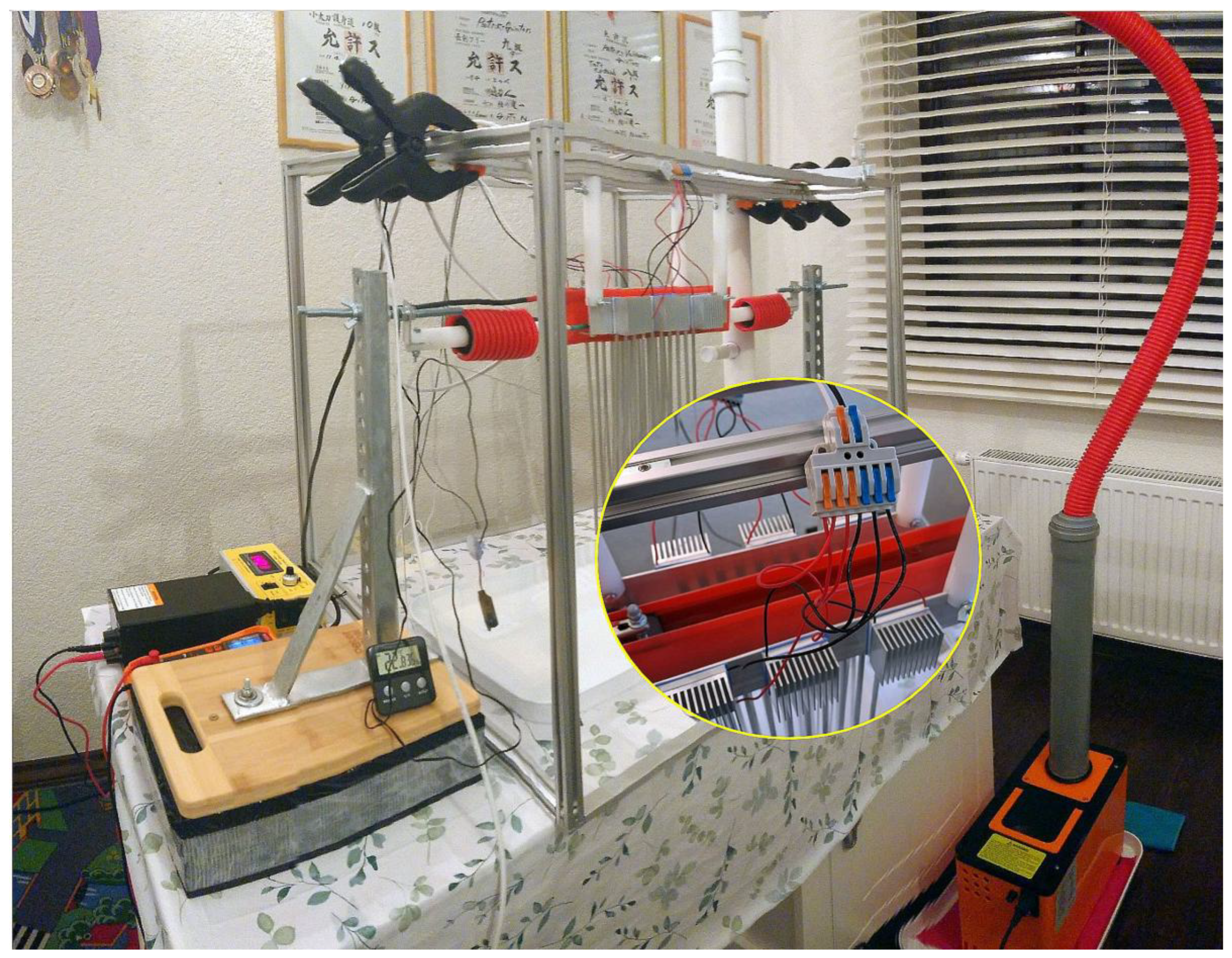
Figure 2.
Current–voltage characteristic of the HygroCatch device in the HV DC ionization mode.
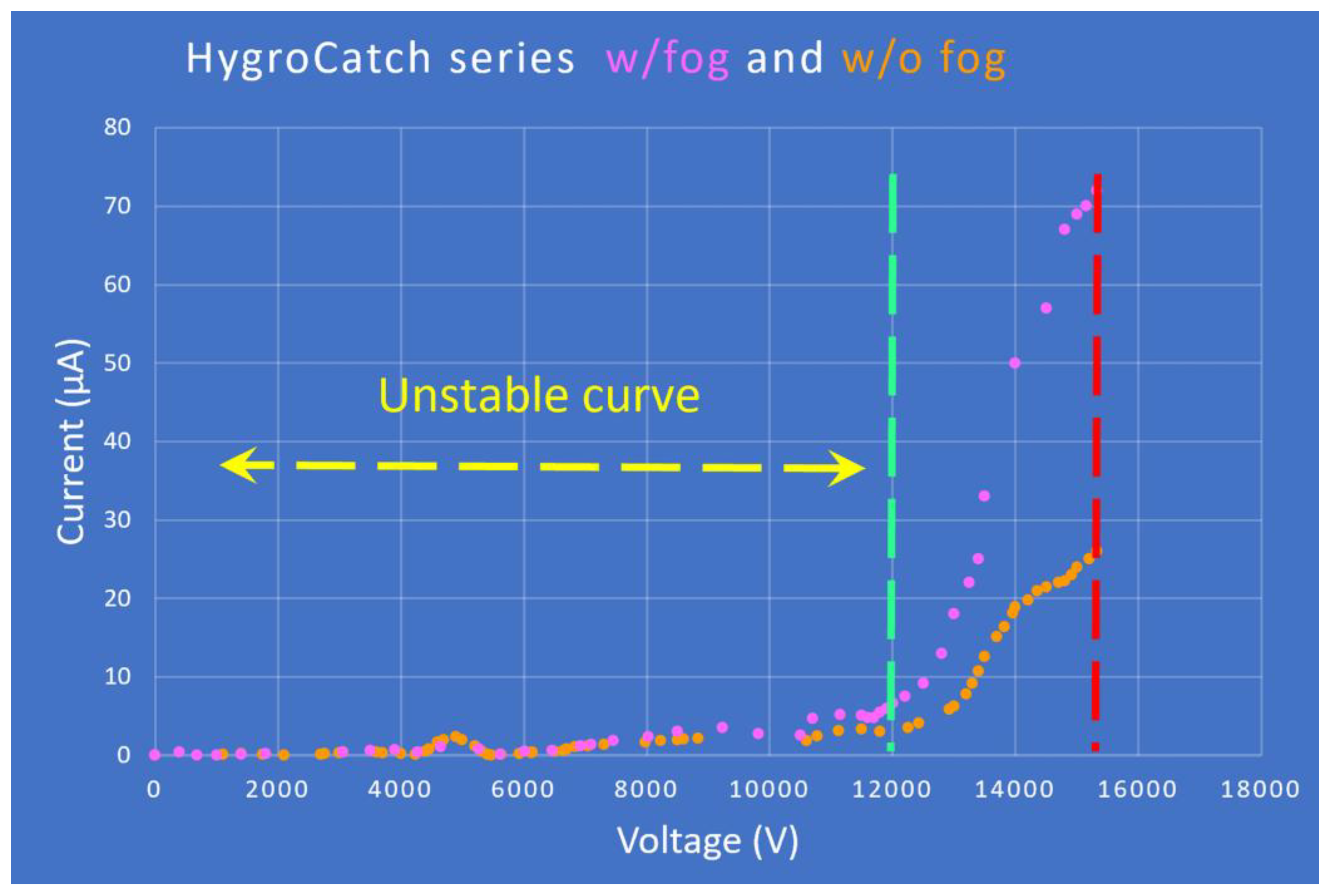
Figure 3.
The proportion of ionization and Peltier effect in the total amount of fog water collected: (a) Share of HV DC ionization in the total collected fog water volume; (b) Impact of the Peltier effect on total fog water collection.
Figure 3.
The proportion of ionization and Peltier effect in the total amount of fog water collected: (a) Share of HV DC ionization in the total collected fog water volume; (b) Impact of the Peltier effect on total fog water collection.
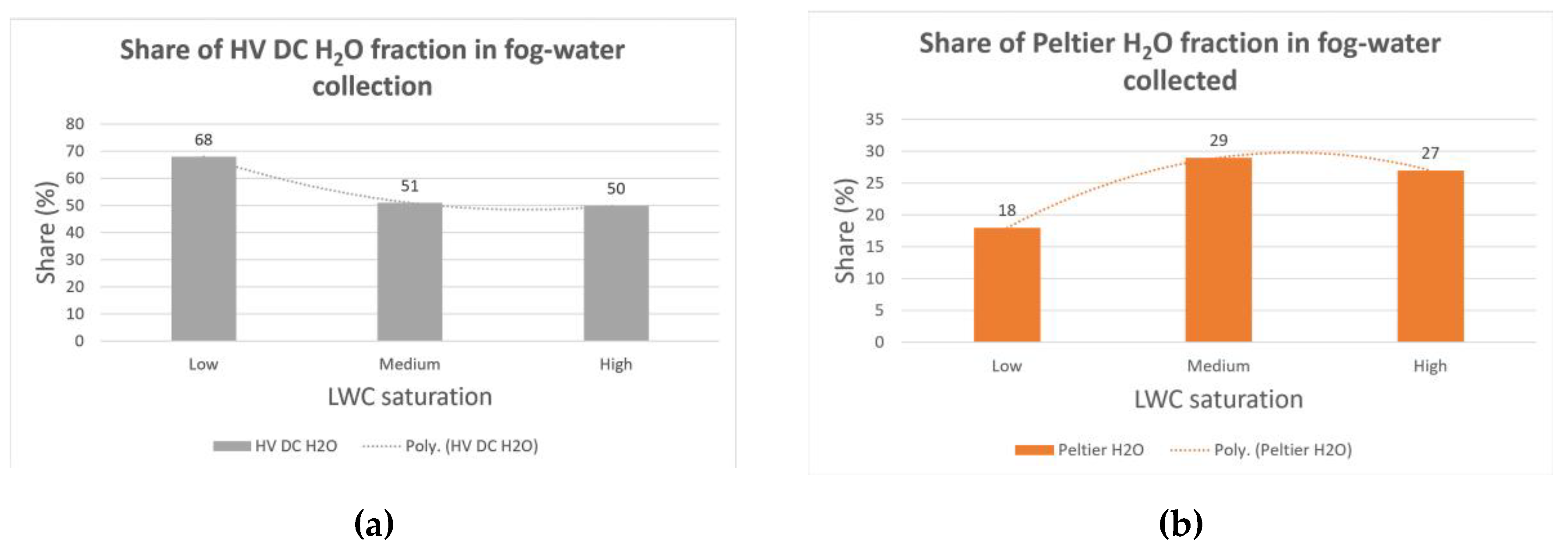
Figure 4.
The proportion of mechanical deposition in the total amount of fog water collected and summary of the results: (a) Fraction of the passive method in the total collected fog water volume; (b) Outline of HygroCatch operating modes.
Figure 4.
The proportion of mechanical deposition in the total amount of fog water collected and summary of the results: (a) Fraction of the passive method in the total collected fog water volume; (b) Outline of HygroCatch operating modes.
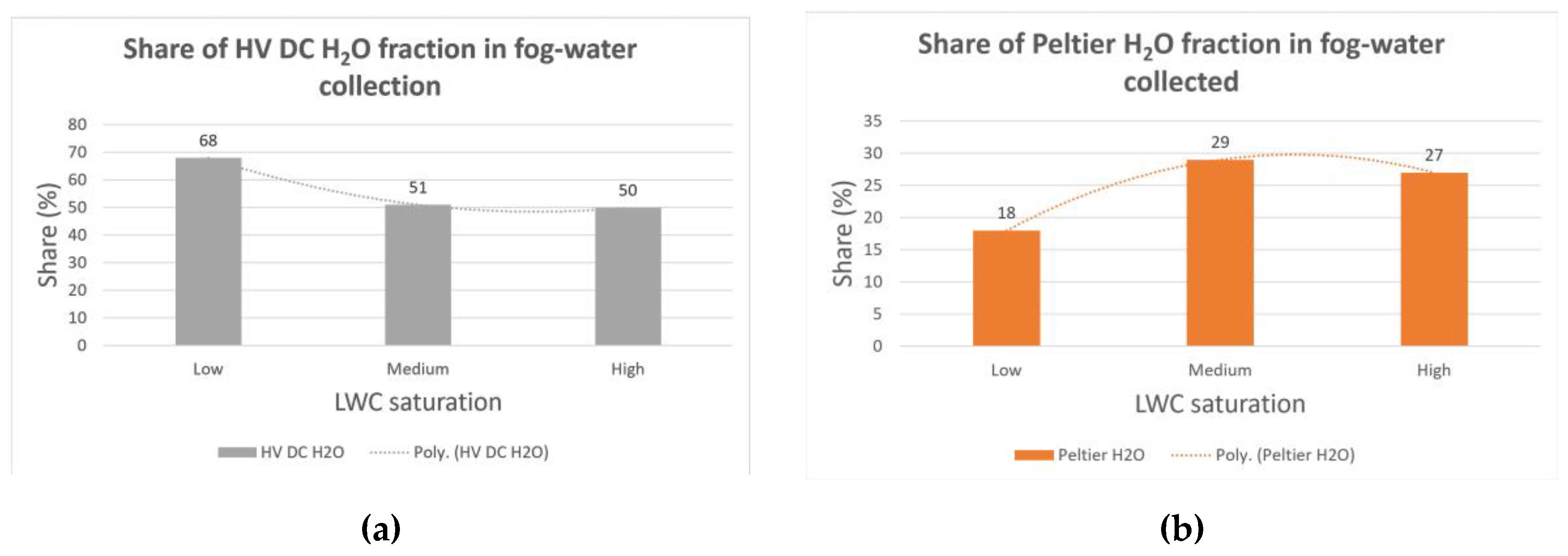

Table 1.
HygroCatch fog-water collection regimes as a function of LWC saturation.
| LWC regime | Dominant collection mechanism | Characteristic features of the regime |
|---|---|---|
| Low | HV DC electrostatic ionization | Fine droplets with low inertia are efficiently charged and directed by the electric field. Passive deposition and condensation effects are limited. |
| Medium | Hybrid (HV DC + Peltier cooling) | Increased droplet mass enhances both electrostatic ionization effect and surface condensation. Peltier-assisted cooling reaches its highest relative contribution. |
| High | Passive-assisted with HV + Peltier support | Larger droplets increase inertial and gravitational deposition. Electrostatic ionization and Peltier remain active but no longer dominates as convincingly the overall water yield. |
Disclaimer/Publisher’s Note: The statements, opinions and data contained in all publications are solely those of the individual author(s) and contributor(s) and not of MDPI and/or the editor(s). MDPI and/or the editor(s) disclaim responsibility for any injury to people or property resulting from any ideas, methods, instructions or products referred to in the content. |
© 2026 by the authors. Licensee MDPI, Basel, Switzerland. This article is an open access article distributed under the terms and conditions of the Creative Commons Attribution (CC BY) license (http://creativecommons.org/licenses/by/4.0/).
Copyright: This open access article is published under a Creative Commons CC BY 4.0 license, which permit the free download, distribution, and reuse, provided that the author and preprint are cited in any reuse.


