

Submitted:
30 March 2026
Posted:
01 April 2026
You are already at the latest version
Abstract
We propose that quantum measurement can be analyzed as an operational irreversibility transition, or boundary event in the limited operational sense used here: the protocol stage at which a reversible system/pointer correlation is driven across a practical irreversibility threshold into an operationally stable record-bearing channel. We formulate a three-stage taxonomy separating reversible premeasurement (Stage 1), irreversible record stabilization (Stage 2), and memory reset (Stage 3), and identify the stage at which known information-thermodynamic bounds become experimentally testable. Under explicit operational conditions (C1 to C6) in the uncontrolled-decoherence regime, known information-thermodynamic second-law bookkeeping specializes to a conditional prediction: the record-formation channel must dissipate at least kBT ln 2 of heat per bit of classical mutual information I(X;Y).We propose a circuit-QED differential microcalorimetry experiment with matched ON/OFF branches that share identical premeasurement pulses and routing losses, differing only in whether the irreversible Stage 2 channel is opened. The measurand is the differential deposited energy ΔQ ≡ QON − QOFF, which isolates the branch-differential dissipative load associated with opening the Stage 2 channel from common-mode backgrounds. In the deep-quantum regime this signal is expected to be dominated by pointer-energy thermalization rather than by an isolated Landauer floor. The primary deep-quantum demonstration targets the temporal coincidence of heat onset and reversibility loss via a reversal-delay sweep (Control 3), providing a timing diagnostic of irreversibility onset even when ΔQ ≫ kBT ln 2. This timing test is not, by itself, a device-independent proof of objective classicality. Near-floor residual tests (r ≡ ΔQ − kBT ln 2 · I(X;Y)) require lower-energy pointer implementations or elevated operating temperatures and are presented as a roadmap. The bound is falsified if r is negative at high statistical significance under verified conditions.
Keywords:
quantum measurement
; Landauer principle
; thermodynamics of information
; objective classical record
; record formation
; mutual information
; decoherence
; quantum Darwinism
; circuit QED
; superconducting qubits
; differential microcalorimetry
; nanocalorimetry
1. Introduction
The quantum measurement problem concerns how definite outcomes emerge from quantum superpositions. The standard formalism treats measurement as instantaneous and thermodynamically neutral; we instead treat it as a physical process with temporal structure and a dissipative signature. We propose an operational thermodynamic diagnostic: the emergence of a stable record-bearing channel can be treated as an operational irreversibility transition (a boundary event in the limited sense defined below) with a thermodynamic resource cost that becomes a dissipative floor under explicit operational conditions. Operationally, however, the proposed experiment is formulated in terms of prepared classical labels X and calibrated classical outcome statistics Y; it does not directly adjudicate interpretational questions about single-shot collapse.
Definition (Measurement as an Operational Boundary Crossing). A measurement is a boundary event in the operational sense used here: the first time in a protocol run when the system/pointer correlation is forced across a practical irreversibility boundary into an uncontrolled decoherence channel that (i) is well-described by a stable classical register Y and (ii) prevents practical reversal without microscopic control of bath degrees of freedom. The boundary crossing is certified by loss of reversibility (), not by the calorimetric signal; the heat bound is a predicted consequence. The architecture moves the experiment across (ON) or keeps it before (OFF) this boundary while holding Stage 1 control work common-mode.
This cost is not merely conceptual. Landauer’s principle establishes that any logically irreversible operation erasing one bit of information must dissipate at least of heat. [1] We hypothesize that irreversible record formation in quantum measurement is such an operation: stabilizing a classical record irreversibly distinguishes quantum alternatives into a stable classical register and exports entropy to the environment. This paper formulates the hypothesis as a conditional, falsifiable bound and designs an experiment to test it.
However, applying Landauer’s principle to quantum measurement has generated controversy. Critics argue that: (i) the principle applies to erasure, not measurement; [3] (ii) measurement can be performed reversibly with no heat cost; [2] and (iii) any “Landauer cost” can be deferred indefinitely to memory reset. [2]
We resolve these tensions by providing a precise taxonomy of measurement stages and identifying exactly where the Landauer bound applies. Our claim is not that “measurement” in general costs per bit. Rather, the bound is a conditional statement about record formation in a thermal environment with a classical register and a cyclic apparatus.
Recent theoretical work supports this connection and provides substantial precedent for thermodynamic stage decompositions. Latune and Elouard independently developed a three-stage decomposition of measurement (premeasurement, objectification, reset) with quantitative thermodynamic bounds for each stage, [8] showing that the thermodynamic cost allocation between premeasurement, objectification, and reset is protocol-dependent and can approach reversible limits when subsequent record-handling is engineered accordingly. Mohammady and Buscemi identified a “thermodynamic trilemma” constraining efficient measurements. [9] Touil et al. formalized objective record formation through quantum Darwinism, where classical objectivity emerges via redundant environmental encoding. [7] Related recent adjacent proposals include Santos’s toy-model calorimetric hidden-variables suggestion and Pirovano’s Landauer-cost analysis for continuous binary measurement records with circuit-QED parameter estimates. [15,23]
Our contribution operationalizes and extends prior stage decompositions (in particular the Latune-Elouard framework [8]) into a falsifiable experimental package:
- 1.
- A three-stage taxonomy cleanly separating reversible correlation, record formation (the operational irreversibility transition), and reset, with six explicit operational conditions (C1 to C6) specifying when the Landauer bound applies and when it does not
- 2.
- An experimentally testable specialization of known information-thermodynamic second-law inequalities and Landauer-type bookkeeping (Sagawa-Ueda, [5] Deffner-Jarzynski [25]) to the record-stabilization channel, identifying the operational conditions under which they yield a conditional record-formation heat bound expressed in terms of measurable classical mutual information . We derive no new thermodynamic inequality; the contribution is the conditions framework (C1 to C6) and the matched experimental architecture to test the resulting prediction
- 3.
- A matched ON/OFF differential microcalorimetry experiment designed to isolate the branch-differential dissipative signature associated with opening the record-stabilization channel, with quantitative sensitivity analysis and a complete calibration/systematics program
Figure 1.
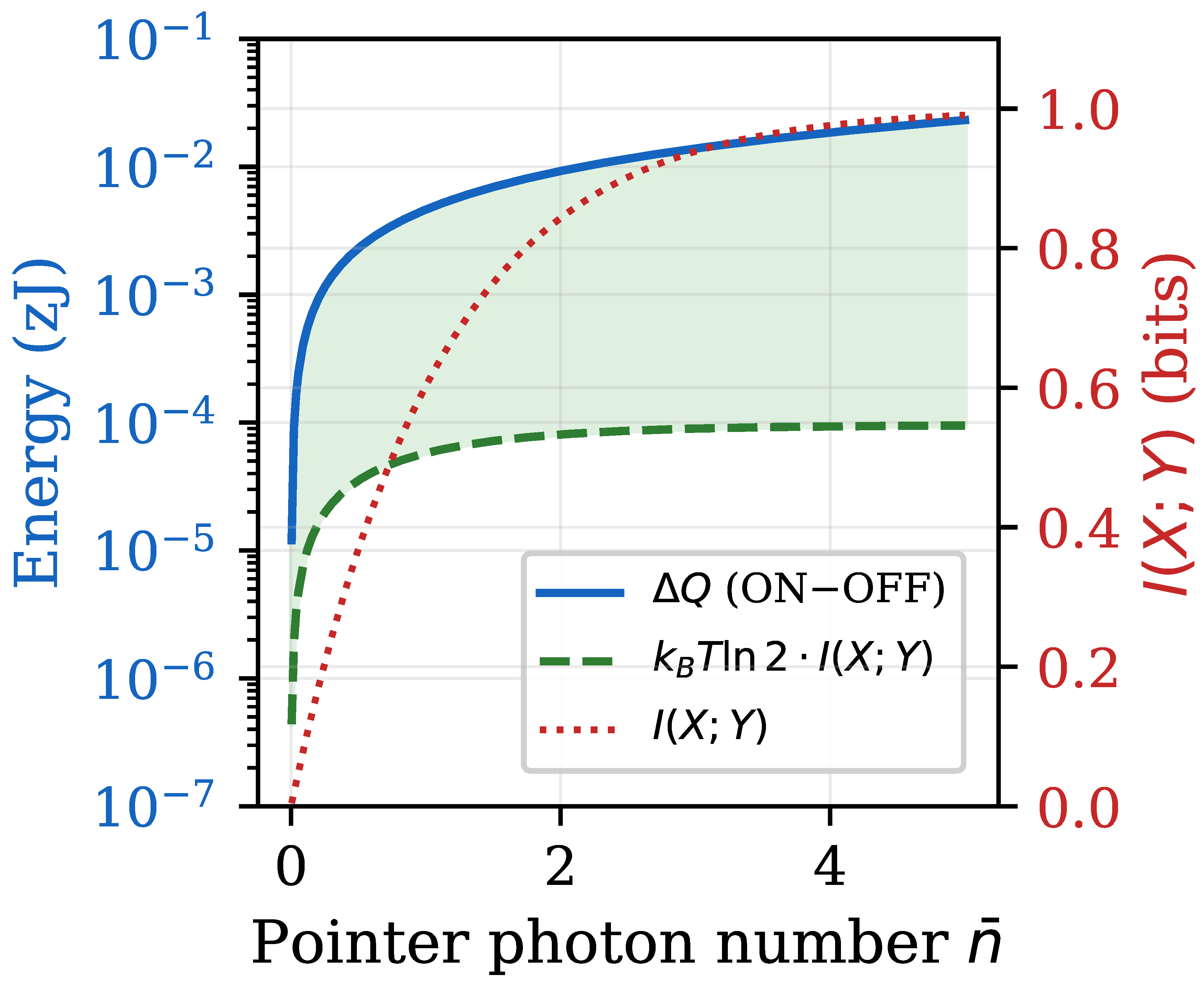
Predicted differential heat (solid blue, left axis) and Landauer bound (dashed green, left axis) versus pointer photon number , at mK with uniform prior . The shaded region shows the positive residual at all tested measurement strengths. The dotted red curve (right axis) shows the classical mutual information rising from 0 to 1 bit as increases. In the deep-quantum regime (), exceeds the bound by ; near-saturation tests require pointer energies closer to .
Figure 1.
Predicted differential heat (solid blue, left axis) and Landauer bound (dashed green, left axis) versus pointer photon number , at mK with uniform prior . The shaded region shows the positive residual at all tested measurement strengths. The dotted red curve (right axis) shows the classical mutual information rising from 0 to 1 bit as increases. In the deep-quantum regime (), exceeds the bound by ; near-saturation tests require pointer energies closer to .
2. Three-Stage Taxonomy and Operational Definitions
2.1. Stages: Premeasurement, Record Formation, Reset
We decompose quantum measurement into three analytically distinct stages. This is a conceptual framework for identifying where the Landauer cost is paid; the measurement event itself is Stage 2.
- 1.
-
Stage 1: Reversible premeasurement (unitary correlation). The system S becomes correlated/entangled with a pointer P via a unitary . No entropy production occurs. No Landauer cost. The pointer states are distinguishable but the process can be unitarily reversed.Thermodynamic status: Thermodynamically reversible in principle; no Landauer cost in the ideal limit. (Real hardware produces residual dissipation from control pulses, but this is common-mode and cancels in the differential measurement.)Information status: Quantum correlations between S and P increase (the reduced states become mixed), but no classical record Y exists yet. The classical mutual information is not defined at this stage because no decohered outcome register has been created.
- 2.
-
Stage 2: Operational irreversibility transition, record stabilization. The pointer couples to a thermal bath, producing stable record-bearing environmental degrees of freedom in the channel-level description ( environmental modes). In the present architecture this need not be an experimentally resolved absorber macrostate; rather, the relevant information is modeled as residing in bath degrees of freedom that render reversal impractical. This stage is logically irreversible and is where any Landauer-scale informational floor enters the bookkeeping.Thermodynamic status: Entropy flows to the bath. The bound applies here when conditions C1 to C6 hold. In the deep-quantum implementation, the measured dissipation is expected to be dominated by pointer-energy thermalization; the Landauer-scale informational floor is isolated only in the near-floor residual regime.Information status: Classical mutual information is created in the effective channel description. The outcome Y is treated as a definite classical variable for purposes of the tested bound, but in the phase-symmetric implementation it is not a shot-resolved calorimetric macro-observable.
- 3.
-
Stage 3: Reset (optional reusability). Erasing the record to reuse the apparatus. Standard Landauer erasure cost. Reset can occur long after the measurement; it is conceptually distinct from record formation.Thermodynamic status: Entropy flows to the bath during reset.Information status: Classical information is destroyed.
This taxonomy resolves apparent contradictions: “reversible measurements” address Stage 1 (and possibly engineered avoidance of Stage 2), while Landauer bounds constrain Stage 2 when a stable classical record is actually created in the operational channel description. The “cost can be deferred to reset” objection addresses Stage 3 rather than Stage 2.
2.2. Operational definition: objective record formation
Let X be a classical random variable labeling the prepared input and Y be the classical outcome stored in a record register. We call Y an objective record, in the operational sense used here, if:
- 1.
- Stability: Y persists for time , where is the reversibility time beyond which a coherent reversal operation fails to recover the initial state fidelity (defined precisely in Section 12).
- 2.
- Classical definiteness: The record is well-approximated by a classical register with negligible coherence between distinct outcomes in the record basis.
- 3.
- Redundancy (strengthening criterion): Following quantum Darwinism, [6,7] the outcome information is redundantly encoded in environmental degrees of freedom. Quantitatively, the accessible information between the system variable X and an environmental fragment F satisfieswhere is the accessible information between X and fragment F, is the Shannon entropy of the prepared input, is the fragment fraction (ratio of fragment size to total environment), is the smallest fragment fraction achieving near-complete information, and is a small tolerance (e.g., ), giving redundancy . (This criterion provides theoretical grounding from quantum Darwinism; [6,7] the proposed experiment does not directly measure the fragment-information curve or certify Darwinist redundancy. Instead, we use the reversibility witness and record persistence as operational proxies for an objective-record-compatible regime, and test the predicted thermodynamic consequence. Fragment-information probing is a natural future-work extension.)
Separating definition from prediction. Stage 2 record formation (the operational boundary crossing) is defined independently of the calorimetric signal: it is certified by the failure of the OFF-branch reversibility witness () and the persistence of the record beyond the reversibility time (Section 12). The heat bound is the predicted thermodynamic consequence of that boundary crossing under conditions C1 to C6, not part of its definition. The experiment tests this prediction: it asks whether the onset of irreversible heat in the ON/OFF differential coincides with, and exceeds the Landauer floor for, the independently certified onset of irreversibility. This separation prevents circularity: a system that crosses the irreversibility boundary without producing the predicted heat would falsify the bound, not be reclassified as “not having formed a record.”
Because the fragment-information (redundancy) plateau is not directly measured in the proposed experiment, we do not claim to certify Darwinist redundancy itself. Rather, an objective-record-compatible regime is inferred operationally when the record is stable () and the reversibility witness confirms that reversal fails, with null protocols excluding reversible premeasurement-only explanations. Operationally, this means the Phase 1 program establishes loss of practical reversibility and persistent bath-coupled record dynamics, not Darwinist redundancy in the strong fragment-information sense. A device can therefore cross the irreversibility boundary without our experiment uniquely certifying a redundantly accessible classical record. Near-floor tests and fragment-information probes would be needed to sharpen that distinction.
3. Record-Formation Heat Bound
3.1. General Inequality
We model record formation as a completely positive trace-preserving (CPTP) map that (i) produces a classical register Y with statistics and (ii) couples irreversibly to a thermal bath at temperature T. From the generalized second law for information processing, [5,25] the entropy production satisfies
where is the entropy change of the measured system S, is the entropy change of reusable apparatus degrees of freedom kept inside the Stage 2 system boundary (pointer/control modes reset between trials), and is the mutual information gained between S and the memory M. Here denotes heat flowing from the system to the bath (exothermic with respect to the measured system). In this bookkeeping, the stabilized macroscopic record in the absorber/environment is treated on the bath side of the channel, so its irreversible entropy production contributes to rather than to . In the experiment, the measured classical quantity is used as a conservative lower bound on this gain. We take an initially thermal bath so that the bath-entropy term is . Throughout, entropy terms ( and ) are dimensionless (nats, i.e., in units of ), and information quantities () are in bits. The factor converts between them: . In natural units,
with . This is a channel-level inequality for the Stage 2 map under the stated bookkeeping boundary, not a universal standalone theorem for arbitrary measurement implementations. For coherent microwave pointers, the incoming field can be work-like at injection while still producing bath heat after thermalization. Accordingly, in the deep-quantum regime is expected to be dominated by pointer-energy dissipation; the near-floor residual tests are the regime in which a Landauer-scale informational floor is most cleanly isolated. Related finite-size Landauer refinements such as Reeb-Wolf [21] are therefore background context, not the load-bearing step in our Stage 2 derivation.
3.2. Conditional Bound (Corollary)
If, during Stage 2, a classical record is created via irreversible entropy export to the bath (redundancy generation), and if the reusable apparatus degrees included in are cycled back to a reference state over each ON/OFF trial (so net ), with and for the record-formation channel, then: Note. These are design constraints on the protocol, not universal physical facts. The condition holds only for the strong-measurement operating points and preparations for which Stage 1 premeasurement has already brought the system’s reduced state close to maximal entropy; for the nominal equal-weight preparation at , the Lindblad simulation confirms bit throughout Stage 2 (Section 5.5). This does not hold uniformly across arbitrary priors or weak-measurement points. Likewise, C3 is verified operationally by periodic null checks and leakage budgeting, so in practice is treated as bounded rather than exactly zero:
where summarizes any reusable-mode mismatch inferred from the null protocols. If either entropy term is non-negligible, the full bound including , , and W [Eq. below] must be used.
where
For an ideal binary projective measurement with uniform prior , this gives bit. Here Y denotes the effective classical output variable used in the Stage 2 channel model: the stabilized information attributed to the environmental degrees of freedom of the absorber/bath node after irreversible pointer thermalization. Because the pointer states in dispersive readout ( vs. ) carry identical mean photon number, the calorimeter does not directly read out an energy-discriminating absorber macrostate. In the present model, the relevant record information is instead assigned to bath microstate correlations, in the spirit of the environmental-encoding discussion of Section 2.2. This is an operational modeling assumption, not a direct experimental certification of Darwinist redundancy. The absorber is the monitored bath node whose total entropy export is calorimetrically measured; it need not resolve individual outcomes shot-by-shot for the channel-level bound to apply. Consequently, the deep-quantum experiment does not independently certify that is stored in an outcome-resolving absorber macrostate; it tests the calorimetric consequence of the modeled channel-level information export.
In production calorimetry we do not perform shot-resolved outcome readout of Y; instead is obtained from separate dispersive calibration blocks (not interleaved with calorimetric acquisition) using identical premeasurement pulses to infer and . We denote this calibration-derived quantity and use it as the operational estimator of entering the bound. The identification rests on three explicit assumptions: (i) the dispersive calibration and the absorber thermalization both respond to the same pointer displacement (same physical degree of freedom, different readout method); (ii) the absorber, modeled as a near-unit-efficiency detector with internal degrees of freedom (design-target capture efficiency ), is assumed to retain at least as much information about X in its environmental microstate as the noise-limited dispersive chain extracts (). This assumption is physically motivated (the absorber receives the full pointer field with near-unit efficiency in the intended design, while the dispersive chain adds amplifier noise), but it is not derived from first principles for the phase-symmetric pointer states used here; it is verified operationally via acceptance criterion 3 below; and (iii) acceptance criteria 1 to 4 below verify that calibration and calorimetric operating points are matched within stated uncertainty. The tested inequality is therefore conservative within this operational surrogate model: the manuscript’s general bound (Section 3) is written in terms of the information gain , so any shortfall in relative to the actual Stage 2 environmental information only strengthens the inequality. This substitution is accepted only after the following acceptance criteria are met; otherwise the run is rejected for bound testing:
- 1.
- Branch-matching injections yield as defined in Section 11.4.
- 2.
- OFF-branch reversibility satisfies the design target (and the data-quality gate ), without state-dependent acceptance bias.
- 3.
- State-conditioned calorimeter energy-deposition distributions (conditioned on the prepared label x, not on a shot-resolved outcome y) are consistent with the calibrated confusion matrix within stated uncertainty. Concretely, for each preparation x we collect the histogram of per-shot calorimeter energy depositions and compare its moments to the predictions derived from the dispersive calibration using a goodness-of-fit test (with Yates correction only when the comparison is reduced to a coarse-grained binary table with small expected cell counts; otherwise the uncorrected statistic or an exact test is used), requiring after Holm-Bonferroni correction over the tested x values. (For symmetric dispersive readout, the pointer states and deposit identical mean energy, so these distributions should be statistically indistinguishable across preparations; any observed state-dependence flags asymmetric absorption or routing imbalance.) Runs failing this criterion are rejected for bound testing. This establishes that the calorimetric channel and the dispersive calibration probe the same effective pointer distinguishability within uncertainty.
- 4.
- Null protocols (toggle-only and pointer-disabled; Section 13) yield consistent with zero within on the modulation timescale.
The dispersive calibration blocks may themselves generate classical records in the calibration readout chain; this does not enter the Stage 2 calorimetric channel accounting being tested, but is used only to estimate for the chosen operating point. If or is non-negligible, or if external work W is supplied, the full bound reads
where is work supplied to the apparatus by an external agent during Stage 2 (if any). External work supplied to the Stage 2 channel can offset the dissipative cost, reducing the heat floor; subtracting W reflects this thermodynamic trade-off. We design the protocol to minimize these correction terms (cyclic apparatus, no external work). The quantity is a conservative (lower-bound) estimator of the thermodynamic information created because the actual record may contain additional correlations with unmonitored environmental degrees of freedom, so the true information gain .
Formal justification of . Before Stage 2, the absorber/environment M has not yet interacted with the pointer and is uncorrelated with the system S, so and therefore . After Stage 2, decoherence in the pointer basis produces a classical-quantum post-channel state of the form , for which the quantum mutual information equals the Holevo quantity: . The Holevo bound then gives . Including the conservative experimental estimator: , which is the substitution chain used throughout. This step relies on the effective classical-quantum approximation for the post-Stage 2 channel; the manuscript does not claim a first-principles microscopic derivation of the full absorber state space. Equation (5) is therefore a conditional operational statement for the Stage 2 channel under C1 to C6, not a universal claim for arbitrary measurement decompositions. Protocols that keep the pointer coherent and defer entropy export fall into the cost-shifting classes of Section 4, where dissipation can move to later readout/reset.
Interpretation of Stage 2 versus Stage 3 bookkeeping. The generalized second law bounds entropy production for each irreversible channel. Equation (5) is written for the Stage 2 channel under our boundary choice: reusable pointer/control modes are internal and cycled ( under C3), while the stabilized macroscopic record is bath-side. Under that bookkeeping, entropy exported to the bath during record stabilization contributes to in Stage 2. If Stage 3 later erases a stored record, it typically incurs further dissipation; however, the exact Stage 2/Stage 3 split in a full-cycle budget is protocol-dependent and must be evaluated with explicit state accounting. This is also why we do not present Equation (5) as a literal restatement of the full measurement-plus-erasure cycle analyzed by Sagawa and Ueda. [5] Rather, it is a Stage 2 channel specialization under an explicit system boundary in which later reset costs are tracked separately.
Why this bookkeeping matches the proposed ON/OFF experiment. In the ON branch, the absorber node is simultaneously (i) the physical medium that stabilizes the macroscopic record via rapid thermalization into many degrees of freedom and (ii) the calorimetric node whose deposited energy is measured. Once the pointer excitation has thermalized into the absorber’s microscopic degrees of freedom, recovering it as usable work would require microscopic control of those degrees of freedom and their correlations, which is operationally excluded (C4). In the OFF branch, the protocol is engineered to keep the pointer in a protected mode and to apply an explicit inverse operation before uncontrolled bath coupling occurs. Under these conditions, the ON/OFF differential isolates the Stage 2 entropy-export event rather than a later reset cost.
The temperature T is the effective temperature of the dissipative degrees of freedom that stabilize the record (Stage 2), calibrated in situ on the absorber/bath node.
3.3. Operational Conditions (C1 to C6)
The bound is asserted as a conditional statement:
- C1
- A thermal bath at temperature T is present during Stage 2.
- C2
- An effective classical register Y is created in the channel-level description (with redundant environmental encoding as a strengthening criterion, not something directly certified here).
- C3
- The apparatus begins in a standard state and is cyclic over Stage 2, or its entropy change is explicitly accounted.
- C4
- Irreversibility arises from bath coupling: no reversal operation that includes the bath degrees of freedom is performed on the experiment timescale. This is the operational definition of “objective”: the record persists because reversing it would require controlling the bath.
- C5
- No unaccounted work reservoir supplies free energy; if work is supplied, the inequality includes the work term.
- C6
- is the actual classical mutual information for the chosen measurement strength.
What the bound does not imply:
- Measurement in general always costs per bit.
- Heat dissipation alone proves objectivity.
- All entropy production in a measurement protocol is due to Landauer cost.
Condition verification. Table 1 maps each condition to its experimental diagnostic and the failure signature that would invalidate the bound.
Relation to coherence-based and feedback-control bounds. Independent results in quantum thermodynamics quantify the free-energy cost of destroying coherence in a specified basis via the relative entropy of coherence , where is dephased in the relevant measurement/energy basis. In uncontrolled dephasing, this implies a minimal dissipation scale of order for the coherence that is irreversibly discarded to the bath. For pure-state projective measurements in the measurement basis, reduces to the Shannon outcome entropy and reproduces the familiar Landauer scale. Our experiment instead targets the record-formation channel and uses the directly calibratable classical mutual information of the stabilized record as the operational metric; the coherence diagnostics shown in Figure 2 serve as witnesses of decoherence/stabilization rather than as the tested inequality. Related thermodynamic analyses of measurement in the context of Maxwell’s demon and quantum feedback control can be found in Jacobs. [19,20] Mohammady and Romito [22] analyze conditional work statistics of quantum measurements, providing complementary bookkeeping for the work/heat decomposition relevant to condition C5. These coherence- and work-based formulations are complementary to, but not identical with, the channel-level mutual-information bookkeeping used for the present Stage 2 test.
4. When the Bound Does not Apply (or Is Shifted)
We distinguish four non-applicability and cost-shifting classes:
- A.
- Premeasurement only. If the pointer is captured before environmental coupling (Stage 1 only), no record is formed and no Landauer cost is incurred. This is the regime of reversible measurement protocols. [10] Coherence can be recovered by applying the inverse unitary.
- B.
- Deferred record in quantum memory. If the pointer state is stored coherently without thermalization, no classical record exists and the cost is deferred until readout or reset. This is not free: maintaining coherence over time is a resource cost that scales with storage duration.
- C.
- Fresh memory or work-assisted recording. If a low-entropy memory is consumed or external work supplies free energy, the heat released to the bath can be reduced. The cost is shifted into memory entropy or work, not eliminated.
- D.
- Weak or zero-information regimes. When , the bound scales proportionally. For constant preparation with , the predicted heat is zero within experimental noise.
4.1. Reconciliation with Reversible Measurement Protocols
Latune and Elouard [8] analyze thermodynamically optimal measurement protocols and show that the thermodynamic cost assigned to premeasurement, objectification, and reset is protocol-dependent and can approach reversible limits for carefully engineered schemes. This is compatible with our framework:
- 1.
- Their “reversible” limit does not map one-to-one onto our present deep-quantum ON branch; rather, it illustrates that cost can be shifted or suppressed by protocol design.
- 2.
- Our Stage 2 inequality is a conditional bookkeeping statement for a specific bath-coupled record-stabilization channel.
- 3.
- If a later protocol step exports entropy irreversibly to stabilize or erase a record, that step must be accounted explicitly in the thermodynamic budget.
The key distinction: correlation (Stage 1) is reversible; record formation (Stage 2) is not.
This mapping is also consistent with Bennett’s reversible computation arguments: [2] premeasurement is analogous to reversible computation; record formation is analogous to writing output to a permanent register. The Landauer cost is paid when you commit to a permanent record.
4.2. Addressing Norton’s “Waiting for Landauer”
Norton [3] argues that Landauer’s principle is not universally applicable. We agree with Norton’s caution, and respond (following the defense by Ladyman and Robertson [4]) by specifying the operational conditions under which it applies:
- Does apply: Record formation with entropy flow to the bath (Stage 2), when conditions C1 to C6 hold.
- Does not apply: Reversible premeasurement (Stage 1).
- Does not apply: Quantum correlations that are never stabilized as classical records.
4.3. Work vs. Heat Classification of Pointer Absorption
A natural objection is that the pointer photon arrives as a coherent microwave pulse, directed energy that might be classified as work rather than heat, trivially satisfying the bound. We address this as follows.
The work term W in condition C5 refers to free energy supplied by an external agent to drive the record-formation process (e.g., a work reservoir that lowers the thermodynamic barrier to stabilization). In our protocol, no such external work is supplied: the pointer-absorber coupling is passive, and thermalization occurs spontaneously. The pointer photon’s energy is the input to Stage 2, the physical carrier of information, not work done on the record-formation channel.
Upon absorption, the photon’s energy is distributed among electron-phonon degrees of freedom in the absorber at temperature T. After thermalization, the energy cannot be extracted as work without additional information about the absorber’s microstate. This irreversible thermalization is the record-formation process: it converts a low-entropy coherent state (the pointer) into a high-entropy thermal state (the absorber macrostate), creating the classical record. The deposited energy therefore satisfies the thermodynamic definition of heat: stochastic energy transfer from the system to a thermal reservoir, increasing the reservoir’s entropy.
Operational criterion used in this work. In the accounting of Section 3, energy transfer is treated as “heat” for the Stage 2 channel once the pointer excitation has irreversibly thermalized into many uncontrolled absorber degrees of freedom at temperature T, producing an entropy increase that cannot be reversed on the experimental timescale without microscopic bath control (C4). The bound is asserted for the irreversible absorber-coupling map (Stage 2), not for the coherent control work used to prepare Stage 1 correlations.
The experimental controls provide an independent check: the toggle-only and pointer-disabled null protocols (Section 13) bound any residual work-like contributions from control lines and switching operations. Any ON/OFF asymmetry from these sources enters the systematic budget (Table 3) and is subtracted before residual analysis.
5. Explicit Model: Where the Landauer Cost Is Paid
Having specified the operational regime and its boundaries, we now construct a explicit system/pointer/bath model to identify the microscopic origin of the heat flow.
5.1. The Model: System + Pointer + Bath
Consider a spin-1/2 system in superposition:
The apparatus consists of a pointer degree of freedom P (initially in state , e.g., a resonator mode) and a thermal environment at temperature T with many degrees of freedom E, initially in . For compactness, the ket notation below uses as a representative purification/microstate of this thermal ensemble.
5.2. Stage 1: Premeasurement (Reversible)
Unitary system/pointer coupling:
This process is thermodynamically reversible in principle. The pointer states are correlated but no entropy has been exported to the environment. This is not record formation.
5.3. Stage 2: Record Formation (Irreversible; Landauer Cost Paid)
The pointer couples to the thermal bath, thermalizing irreversibly into environmental degrees of freedom. (We use the language of redundant environmental encoding to motivate the irreversibility structure; however, the formal bound [Equation (5)] follows from the generalized second law applied to any CPTP channel with bath coupling and does not require verifying quantum-Darwinist redundancy in the strict fragment-information sense. The experiment tests the thermodynamic consequence of irreversible record stabilization, not the redundancy structure itself.) Schematically:
where represents environmental degrees of freedom encoding outcome . The environmental states satisfy:
In the operational regime C1 to C6, we hypothesize that this environmental coupling is where a Landauer-scale thermodynamic cost is incurred. The physical basis: the redundant environmental encoding is an irreversible entropy export; reversing it would require controlled access to all N bath degrees of freedom, which is operationally excluded by C4. Under the generalized second law (Section 3), this irreversible entropy production implies per bit of classical information stabilized. The proposed experiment tests whether this cost is detectable as a calorimetric signature.
Equation (5) is therefore a lower bound for the first logical bit in this open-system regime; in this model family, additional redundancy generally increases total entropy export to the environment, though exact scaling is protocol-dependent.
5.4. Identification of the Record-Formation Information
After Stage 2, tracing over the environment gives the reduced state:
The record-outcome entropy of this binary mixture is (in bits):
For equal superposition (), bit. This single-state expression is the record-outcome entropy. It equals the experimental bound variable only in the noiseless, perfect-correlation limit with the specified input prior. The bound tested in the experiment always uses , where X is the prepared classical label (Section 2.2), rather than by itself.
The quantitative heat bound follows from the generalized second law (Section 3), applied to this model with . The model identifies the physical mechanism: record formation occurs when the pointer-environment overlap drops below the reversal criterion, and the resulting entropy flow to the environment carries the Landauer cost. For 1 bit: .
5.5. Lindblad Master Equation Support
To bridge the gap between the analytical model and the proposed experiment, we solve the Lindblad master equation for a qubit-resonator system with parameters matching the experimental architecture. [18]
Model. A transmon qubit (two-level, s) dispersively coupled ( MHz) to a resonator ( GHz). The post-premeasurement state is
with , representing Stage 1 completion. Two Stage 2 branches are simulated independently:
- ON branch: the resonator decays into the absorber with MHz (fast thermalization).
- OFF branch: the pointer is held in a storage cavity with ( Hz), and an ideal reversal (controlled displacement) is applied after delay .
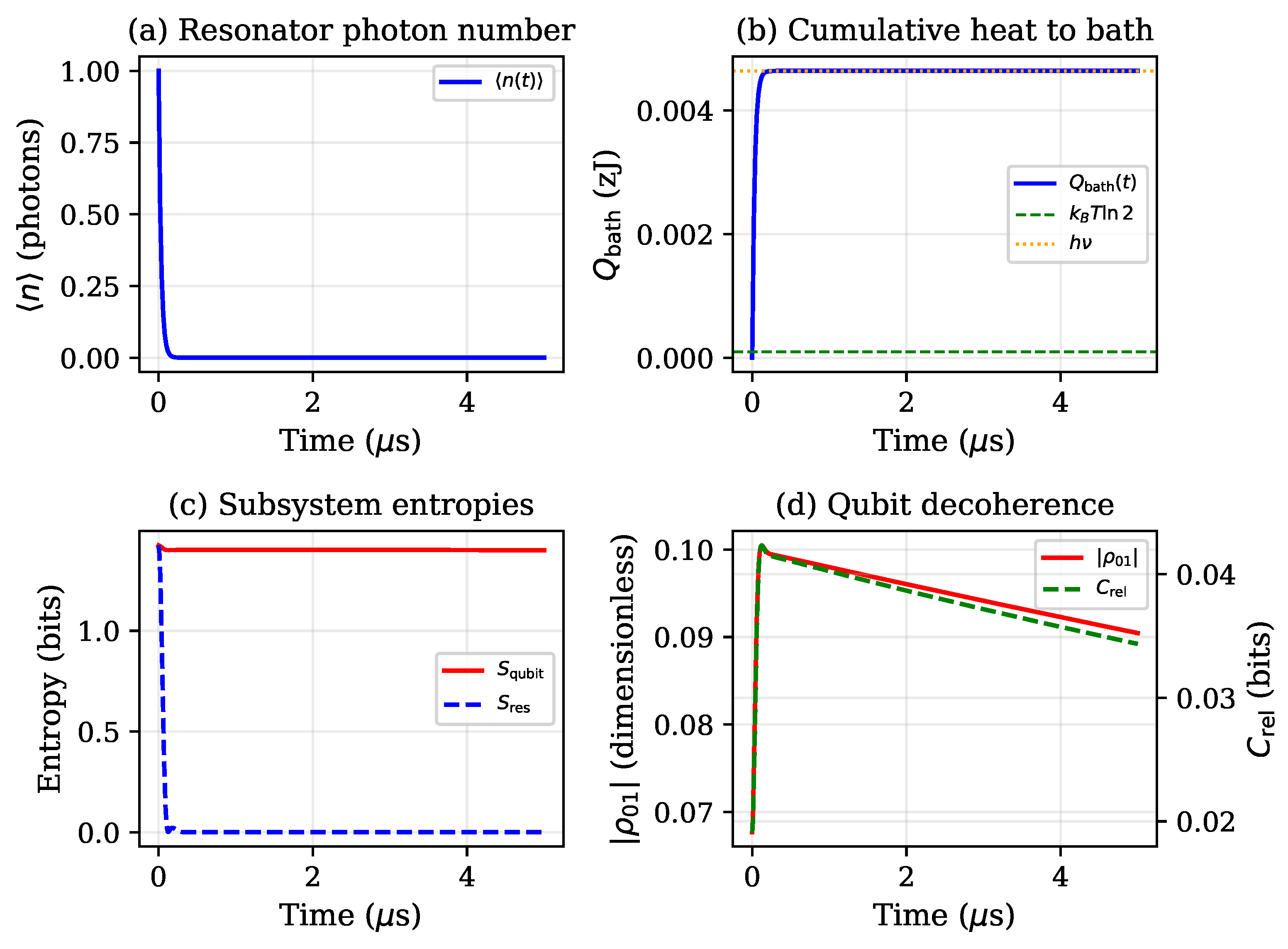
ON branch results (Figure 2). The resonator photon number decays from to zero within s. The cumulative heat deposited in the bath reaches zJ, equal to the pointer photon energy and exceeding by a factor of . Because the simulation begins from the post-premeasurement entangled state , the reduced qubit state is already nearly maximally mixed at (for , bit in our QuTiP model) and remains bit as resonator decay transfers which-path information irreversibly to the bath. The qubit off-diagonal element simultaneously decays, reflecting the loss of quantum coherence during record stabilization. Here is computed for the reduced qubit state in the measurement basis and is included as a coherence witness rather than as the tested inequality. These dynamics are consistent with the Landauer bound (with large positive residual) in the deep-quantum operating regime, though the large margin reflects rather than a sharp test of the information-theoretic floor.
Figure 2.
Lindblad simulation of the ON branch (record formation). (a) Resonator photon number decaying into the absorber ( MHz). (b) Cumulative heat reaching zJ, far above the Landauer floor zJ. (c) Subsystem entropies: the qubit entropy is already bit after premeasurement and remains near that value; resonator entropy peaks during decay and returns to zero. (d) Qubit off-diagonal and relative entropy of coherence during decoherence (left axis: ; right axis: in bits). The qubit-marginal can increase transiently because the qubit starts nearly maximally mixed after premeasurement; non-monotonicity in the reduced-state coherence does not contradict the channel-level entropy production and is expected for entangled bipartite states. Parameters: , MHz, mK, s.
Figure 2.
Lindblad simulation of the ON branch (record formation). (a) Resonator photon number decaying into the absorber ( MHz). (b) Cumulative heat reaching zJ, far above the Landauer floor zJ. (c) Subsystem entropies: the qubit entropy is already bit after premeasurement and remains near that value; resonator entropy peaks during decay and returns to zero. (d) Qubit off-diagonal and relative entropy of coherence during decoherence (left axis: ; right axis: in bits). The qubit-marginal can increase transiently because the qubit starts nearly maximally mixed after premeasurement; non-monotonicity in the reduced-state coherence does not contradict the channel-level entropy production and is expected for entangled bipartite states. Parameters: , MHz, mK, s.
OFF branch and extraction (Figure 3). A reversal delay sweep determines the reversibility time . At each delay , the premeasurement state evolves with the storage-cavity decay rate, then a time-dependent controlled displacement (accounting for the dispersive phase rotation) returns the resonator to vacuum. The recovery fidelity is computed against the initial (pre-premeasurement) state.
The fidelity remains above 0.99 for ns, providing margin over the catch-and-release reversal window. Fidelity drops below 0.9 at s, driven primarily by qubit decoherence and slow photon leakage from the storage cavity. This is consistent with the order-of-magnitude estimate to s in Section 12; varying the fidelity threshold from 0.85 to 0.95 shifts by , confirming robustness of the extraction.
Model limitations. The heat formula assumes , which holds at 10 mK () but must be generalized for elevated-temperature or lower-frequency operation where thermal photon occupation becomes non-negligible. The simulation uses a Markovian bath (Lindblad), finite Fock-space truncation (), and an idealized controlled-displacement reversal. The premeasurement state is prepared directly rather than simulated through an explicit drive pulse. Crucially, the simulated reversal applies an instantaneous unitary rather than modeling the Hamiltonian dynamics of the microwave drive lines. Consequently, the simulation validates qualitative system dynamics and establishes an upper bound on , but it does not track physical heat dissipated by the control electronics. In the proposed experiment, any asymmetric drive heat is bounded empirically by the uncompute-only null protocol, not by the simulation.
6. Experimental Architecture
6.1. Platform and Setup
- System: Superconducting transmon qubit ( GHz)
- Readout: Dispersive measurement via coupled resonator
- Calorimeter: On-chip nanocalorimeter (TES or SNS nanobolometer class) in thermal contact with the record-formation channel (not the amplifier chain)
- Environment: Dilution refrigerator; mK is the measured effective temperature of the record-formation absorber, calibrated in situ
Thermal-detector qubit readout has been demonstrated with single-shot fidelity and microsecond durations, [11] establishing platform feasibility for calorimetric detection of readout-photon power. That demonstration does not directly detect Landauer heat from measurement; here it is used only as evidence that the detector class and circuit-QED integration are realistic.
6.2. The ON/OFF Toggle Architecture
The core design element is a hardware toggle that routes the pointer mode to different fates while keeping all other dissipation channels identical.
6.2.1. Common Path (Both Branches)
- 1.
- A classical random number generator selects a preparation label according to the prior . The qubit is then prepared in the corresponding eigenstate (e.g., , for readout). The label x is the classical variable X that enters .
- 2.
- Apply dispersive readout pulse (identical timing, amplitude, frequency).
- 3.
- Qubit-resonator entanglement creates pointer state (premeasurement).
6.2.2. Branch Point: Tunable Coupler Network
A flux-biased tunable coupler network (for example, catch-and-release hardware in the spirit of Yin et al. [16] and flux-controlled rf-SQUID-mediated resonator coupling as in Wulschner et al. [17]) routes the pointer mode to different fates while keeping upstream conditions identical. The coupler must satisfy:
- Amplitude/phase matching: identical transfer function in both states
- Isolation: dB between ON and OFF paths to limit leakage
- Low added dissipation: routing loss per shot; switching within a few ns. The switch is thermally anchored to the bath and spatially isolated from the calorimeter to ensure control-pulse dissipation does not couple to the sensor.
- Characterization: verified by injected calibration pulses upstream
6.2.3. ON Branch: Record Formation
The on-chip absorber (AuPd thin-film resistor or SNS junction) has a dual role: it is both the record-bearing bath node (where the pointer photon is thermalized into electron and phonon degrees of freedom, stabilizing the information-carrying environment in the operational model) and the calorimetric sensor (whose temperature rise is the measured signal). The calorimeter therefore directly couples to the bath node where Stage 2 irreversibility is modeled to occur, not to a downstream amplifier chain.
- 1.
- Pointer mode absorbed by the on-chip absorber.
- 2.
- Thermalization stabilizes the record-bearing environment in the absorber’s internal degrees of freedom ( environmental DOF).
- 3.
- Heat deposited in calorimeter: . In the deep-quantum regime, includes the thermalized pointer-energy contribution and should not be read as a pure Landauer-only term.
6.2.4. OFF Branch: Coherent Reversal
The coupler must route the pointer into the storage cavity before the pointer has time to couple to uncontrolled environmental modes (stray radiation, substrate phonons). The routing delay must satisfy , where is the record-formation timescale. For typical dispersive readout, the pointer is a coherent state in a well-isolated resonator mode, and the routing can complete in a few ns, well before environmental coupling becomes significant.
- 1.
- The pointer mode is adiabatically captured in a high- storage cavity (, with minimum acceptable ) via the tunable coupler. Transfer leakage must satisfy , i.e., zJ at 10 mK. For a single-photon pointer ( zJ at 7 GHz), this requires capture efficiency , which is an aggressive design target comparable to the best demonstrated catch-and-release protocols rather than a number already established for the exact architecture analyzed here. [16]
- 2.
- A measurement reversal pulse sequence is applied: [10] by reversing the dispersive interaction (through qubit echo or opposite-phase drive), the qubit-pointer entanglement is erased. This uncomputation must complete within the pointer’s coherence time. For transmon qubits with s, a ns echo sequence is consistent with demonstrated weak-measurement reversal timescales. [10]
- 3.
- The qubit’s coherence is fully restored with high fidelity (), and the storage cavity returns to vacuum.
- 4.
- No classical outcome is recorded; ideally no net heat is generated: , with .
6.3. Measurand and Differential Estimator
The primary observable is the differential heat:
A minimal branch decomposition gives:
where is common-mode energy deposited in the absorber/calorimeter node (control pulses, routing losses, switch-drive dissipation) shared by both branches; room-temperature amplifier-chain dissipation is outside the Stage 2 system boundary and does not enter this accounting. is parasitic heat in the OFF branch (Section 8). Under successful matching and low leakage, . Operationally, is therefore the measured branch-differential dissipative observable, while is the idealized Stage 2 bookkeeping term; in the deep-quantum regime the measured is baseline-dominated by pointer-energy thermalization and only approximates a clean Landauer residual after all leakage and common-mode corrections are applied.
Switch-drive dissipation (flux-pulse heating in bias lines, termination losses) is common-mode because both branches are toggled with identical control pulses. The toggle-only null (Section 13) verifies that any residual ON/OFF asymmetry from the switch drive is below the detection criterion.
This design suppresses common-mode backgrounds (drive dissipation, routing losses) that are identical in both branches. The OFF branch is not merely a different input state but an explicit no-bath-stabilization / practical-reversibility implementation, isolating the dissipative consequences of opening the Stage 2 channel from premeasurement correlation alone.
6.4. Shot Timing and Experimental Sequence
- 1.
- Initialize: Reset qubit and resonator to ground state.
- 2.
- Premeasurement: Apply dispersive readout pulse to create pointer.
- 3.
- Route: Switch pointer to ON (absorber) or OFF (catch-and-release).
- 4.
- Absorb/Capture: ON branch thermalizes; OFF branch stores coherently.
- 5.
- Reversal check (OFF): Uncompute and verify recovered-state fidelity.
- 6.
- Thermal wait: Allow calorimeter to relax or deconvolve overlapping pulses.
To avoid pile-up, choose or validate deconvolution for partially overlapping responses. Here denotes the ON/OFF pair repetition rate (pairs per second).
7. Thermal Circuit Model
7.1. Single-Node Model
We model the calorimeter as a single thermal node with heat capacity C and thermal conductance G to the bath. The thermal time constant is . For an impulse energy deposition Q at , the temperature response is
with impulse response . (A single-node model is used as a first-order description; electron-phonon two-temperature dynamics may modify the impulse response shape at early times but do not change the integrated energy , which is the thermodynamic quantity entering the bound.)
Using representative parameters at 10 mK:
giving s (design target; demonstrated SNS devices achieve s at comparable NEP [12]). The single-shot temperature rise for zJ is
To avoid attenuation of the lock-in response, choose .
7.2. Per-Shot Energy Estimator
Define a linear estimator using a weight function matched to the impulse response:
where is the matched filter (optimal for stationary Gaussian noise) and is the calorimeter voltage trace for shot i.
8. OFF-Branch Leakage Budget
Even in the OFF branch (no intentional dissipation), parasitic heat flows can occur. We enumerate all known sources and bound the total leakage .
- Cavity photon decay.
The storage cavity has finite Q, so pointer photons leak as heat during storage. For a 7 GHz photon ( zJ) in a cavity with , the photon lifetime is ms. During a 100 ns reversal window, the fractional loss is , giving zJ per photon. This is the dominant leakage source but remains zJ.
- Coupler isolation leakage.
The tunable coupler provides dB isolation ( power transmission). For a single-photon pointer ( zJ), the leakage is zJ.
- Transfer leakage.
Imperfect capture into the storage cavity contributes . The requirement from Section 6 is zJ, corresponding to capture efficiency.
- Quasiparticle generation.
Fast flux pulses can break Cooper pairs. Without mitigation, quasiparticle heating could reach zJ per cycle. With well-shaped pulses and filtered bias lines (standard practice at 10 to 20 mK), quasiparticle generation is suppressed to zJ per cycle.
- Total leakage budget.
Summing the mitigated contributions:
satisfying the requirement for zJ. This budget assumes for the storage cavity (minimum acceptable ), dB coupler isolation, reversal completion within ns, and filtered bias lines for quasiparticle suppression. If coupler isolation degrades to 30 dB, the coupler leakage rises by , reducing the safety margin. In-situ verification of isolation is therefore a go/no-go gate: the experiment should not proceed until the blocked-branch test (Section 11) confirms the required isolation. Transfer leakage () dominates the budget at of total leakage; capture efficiency degradation below would breach the margin, making this the most fragile link in the leakage chain.
To keep OFF leakage below the Landauer scale, we require . For a single-photon pointer ( zJ), this requires . For photons ( zJ), the requirement tightens to . Imperfect reversal () contributes an systematic at the Landauer scale, calibrated experimentally via Control 3 (Section 13).
9. Sensitivity Analysis
9.1. Energy Scales and the Quantum-Thermal Hierarchy
At mK,
For comparison, a single 7 GHz readout photon carries J .
This separation of scales () is advantageous for detection but requires careful interpretation. We distinguish
In the deep-quantum operating point used here (typically at GHz frequencies), is expected to be dominated by pointer absorption () and therefore to lie well above . The primary falsification statistic is the residual after full leakage/systematics propagation; negative r at high significance would falsify the bound. Near-saturation tests (where r is not a priori large) require different operating points that reduce pointer-energy scale toward the Landauer scale (e.g., lower-frequency pointers or other low-energy platforms). In numerical validation, finite-sample Monte Carlo estimates of r can fluctuate below zero when per-shot noise dominates at low effective SNR; this does not constitute falsification. The experimental falsification criterion is a statistically significant negative residual after full uncertainty propagation (Section 13).
Control 4 (prior variation) is interpreted as a mechanism check at fixed pulse energy. In the symmetric fixed-energy implementation described in Section 13, is expected to be approximately prior-independent; any observed dependence on the preparation prior provides a sensitive diagnostic of state-dependent absorption, routing imbalance, or drift in the effective confusion matrix. By itself this control does not isolate the Landauer floor; it constrains the systematics model used in the residual analysis.
9.2. Detector Anchor
We anchor the feasibility estimate in the SNS nanobolometer of Kokkoniemi et al. [12] That platform has response times down to s at NEP zW and a predicted calorimetric energy resolution zJ when integrating up to the thermal cutoff frequency. Related calorimetric qubit-readout demonstrations motivate using this detector class as a realistic baseline. [11,13] The same device family also reported a best NEP near 20 zW at a much longer thermal time constant (of order 1 ms); for the present application we anchor to the faster s operating point because bandwidth, not ultimate steady-state sensitivity, is the relevant Phase 1 constraint.
9.3. Per-Shot Energy Uncertainty
For a calorimetric readout with effective bandwidth limited by , a conservative per-shot energy uncertainty may be taken as the reported calorimetric resolution:
A more conservative estimate uses with a shorter integration window , giving zJ. The per-shot resolution assumes non-overlapping shots (); for partially overlapping pulses, matched-filter deconvolution is required and the effective increases. The accompanying simulation models the readout-error probability via a simplified homodyne discrimination (); a near-floor test would require modeling finite measurement time, qubit relaxation during readout ( errors), and state-dependent readout fidelity. We use zJ for the primary shot-count estimate below; Table 2 presents the zJ scenario to bound feasibility under less favorable conditions. These values are 10 mK anchor estimates for the speed-optimized detector point; elevated-temperature operation requires re-estimating , NEP, and rather than porting the 10 mK numbers unchanged.
9.4. Required Shot Count
Each differential measurement has per-shot variance
which reduces to when ON and OFF noise are independent and have equal variance. In practice, lock-in demodulation and a shared thermal environment can introduce nonzero covariance. We therefore estimate empirically from interleaved calibration blocks and propagate the measured covariance as part of the systematic/uncertainty budget. For N independent ON/OFF pairs, the standard error of the mean is . Targeting gives
which reduces to when (independent equal-variance ON/OFF noise). With zJ (using the actual signal scale in the quantum regime, which is larger than the Landauer floor). At mK and zJ:
This is drastically more feasible than detecting the bare Landauer limit. However, to rigorously test the pointwise inequality near the much smaller floor (at 10 mK, zJ), the required averaging is much larger: for zJ at SNR, or for zJ (Table 2).
9.5. Integration Time Estimates
For s (a design target not yet demonstrated), a repetition rate of pairs/s gives two distinct regimes: (i) for the full quantum-scale signal (), integrates in s; and (ii) for Landauer-scale resolution ( zJ), integration is to 6 hours for SNR to 10 with zJ, or hours for zJ at SNR. Demonstrated SNS nanobolometers operate at s. [12] In the lock-in regime with to 5 kHz, the effective independent rate is typically a few kHz, stretching Landauer-scale integration to days to weeks. Faster bolometers or detector parallelization can recover hour-scale operation.
9.6. Temperature Regimes
Higher temperatures increase signal but also increase thermal noise; 10 mK represents the optimal trade-off for current detector technology. Two routes can reduce the required averaging: (i) operating at elevated effective temperature (increasing linearly), and (ii) increasing per cycle via multi-bit record creation.
Figure 4.
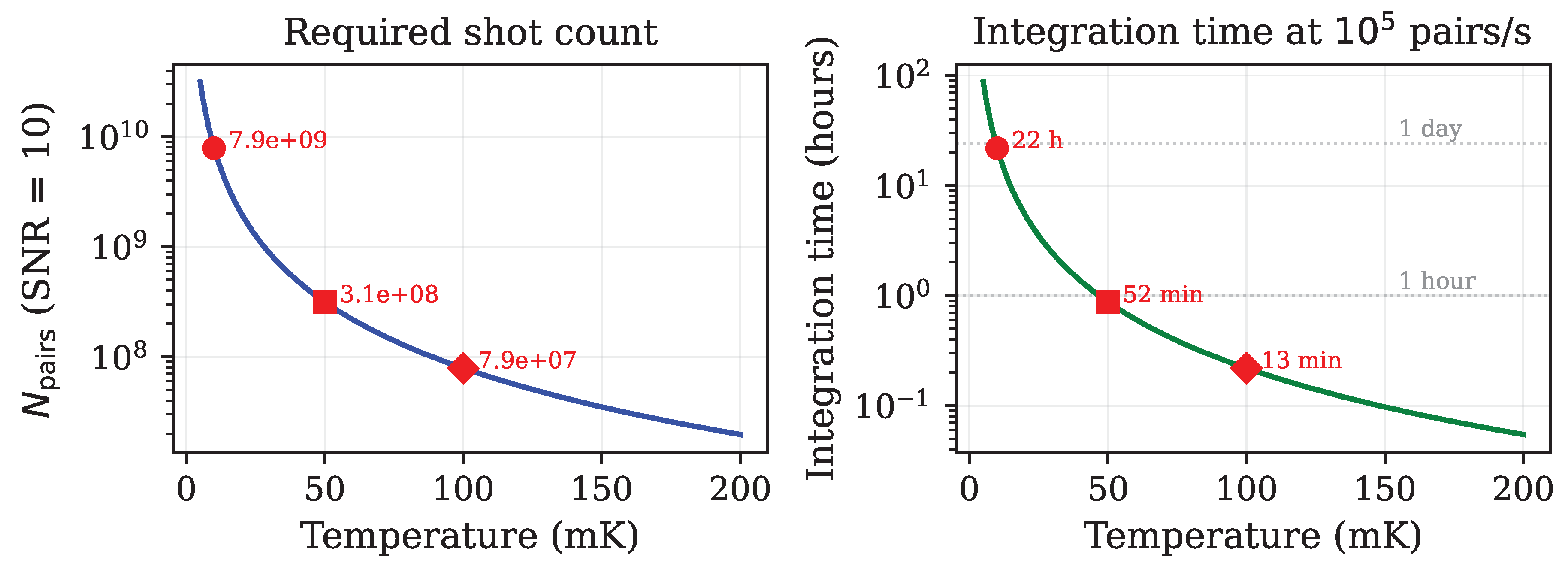
Temperature scaling of the Landauer-scale residual test ( zJ, SNR , pairs/s). Left: required ON/OFF pairs N. Right: integration time. Markers show the three operating points from Table 2. At 10 mK, integration requires hours with s bolometers; at 50 mK, minutes. With demonstrated s detectors, multiply times by .
Figure 4.
Temperature scaling of the Landauer-scale residual test ( zJ, SNR , pairs/s). Left: required ON/OFF pairs N. Right: integration time. Markers show the three operating points from Table 2. At 10 mK, integration requires hours with s bolometers; at 50 mK, minutes. With demonstrated s detectors, multiply times by .
10. Lock-In Modulation Protocol
10.1. Modulation Scheme
Alternate ON/OFF branches at frequency chosen to lie above the noise corner ( Hz) and below the thermal cutoff . For the design target s, the cutoff is kHz and up to 5 kHz is comfortable. For demonstrated detectors with s, the cutoff is kHz, so kHz is appropriate.
The calorimeter voltage output is:
where is the calorimeter responsivity (V/J) and is the common-mode baseline. Lock-in demodulation extracts while rejecting:
- Common-mode (premeasurement + routing losses)
- Low-frequency drift
- Out-of-band noise
10.2. Power Modulation
For ON/OFF pair repetition rate (pairs/s) and square-wave alternation, the fundamental power modulation amplitude is
linking the lock-in output directly to .
10.3. Drift and Stability Control
To suppress low-frequency drift, we employ:
- Lock-in modulation as above, extracting from the demodulated response.
- Mixing chamber temperature stabilized via PID feedback to K fluctuations at the modulation timescale.
- Periodic hardware null checks every 2 hours using the toggle-only and pointer-disabled protocols (Section 13).
- Allan deviation analysis of calibration pulse sequences to identify drift timescales.
Data segments are accepted only if: (1) calibration pulse drift remains , (2) null checks yield consistent with zero within , and (3) no thermal excursions exceed K at the absorber.
11. Calibration Strategy
11.1. Photon-Number Calibration
Inject calibrated microwave pulses with known photon number :
For GHz and : zJ. This provides an absolute energy scale.
11.2. Heater-Pulse Calibration
Use an on-chip resistive heater to inject known Joule energy . Fit the resulting waveform to extract and validate the linear impulse response . This sets the maximum and determines whether deconvolution is required.
11.3. Linearity Verification
Sweep from 0.1 to 100 photons and verify . The nonlinearity residual must be characterized at the scale ( zJ), not merely at the zJ scale.
11.4. Branch Matching and Common-Mode Rejection
Inject identical calibration pulses upstream of the routing element and verify that the inferred energy is independent of ON/OFF state. Define a balance parameter:
Residual common-mode bias is then , which must be propagated into the systematic error budget. We require to keep systematic bias below the signal.
This corresponds to a common-mode rejection ratio (CMRR) of dB, distinct from the dB isolation between ON/OFF paths (which prevents thermal crosstalk). We reach in two steps:
Step 1 (VNA pre-calibration). Match amplitude to dB ( fractional), phase to , and path-length to mm ( ps timing skew). This brings .
Step 2 (calorimetric closure). Inject identical calibration pulses through both branches and measure via the lock-in chain. Trim with precision attenuators and phase shifters, iterate until the calorimetric differential satisfies , corresponding to . This second step compensates residual mismatch that VNA calibration alone cannot resolve.
Drift and stability budget. Sustaining over multi-hour Landauer-scale integration is the most demanding engineering requirement. We require that drift remains below over 2-hour windows; periodic null checks (every 2 hours, Section 13) monitor and flag drift. If degrades by a factor of , the systematic bias grows proportionally and may exceed ; such runs are rejected. Branch-balance stability is the hardest experimental gate in the proposed architecture.
11.5. Thermal Crosstalk Measurement
With the OFF branch blocked (forcing the pointer to always dissipate), measure any apparent heat in the OFF channel:
We require (). For the absolute bias budget, the crosstalk-induced systematic is . With zJ (single 7 GHz photon) and , this gives zJ, which is below zJ. For multi-photon pointers (), a tighter crosstalk bound is needed, verified by the same blocked-branch test.
12. Reversibility Witness
Heat alone does not certify objectivity. We implement two complementary metrics.
12.1. Fidelity Metric
Reconstruct the qubit state after an OFF operation and compute
Unless otherwise noted, the witness ensemble consists of the six cardinal Bloch-sphere states , measured in separate interleaved witness blocks with the same premeasurement, routing, and reversal timing as the calorimetry runs. We report both the ensemble-averaged fidelity and the worst-case member; the data-quality gate is applied uniformly across this ensemble to avoid state-selection bias. We distinguish two fidelity criteria. The hardware design target is (Section 8), which keeps per-shot leakage below the Landauer scale. The data-quality gate is a looser , applied to catch catastrophic reversal failures (e.g., quasiparticle events, flux jumps). Shots passing the 0.9 gate but falling below 0.99 contribute a small, characterized systematic (calibrated via Control 3). Shots below 0.9 are discarded. To control for acceptance bias, we (i) verify that the acceptance rate does not depend on the preparation label X or outcome Y, (ii) apply the same fractional random drop to ON shots to confirm is unaffected, and (iii) report both with and without the fidelity gate to check consistency. Any systematic shift is propagated as a gating-bias uncertainty.
12.2. Operational Metric
As a real-time check, monitor the residual heat in the OFF calorimeter and qubit coherence via echo contrast. A successful uncomputation should yield calorimeter signal consistent with zero (per-shot residual zJ after averaging).
12.3. Reversibility Time
Define as the smallest delay for which drops below 0.9. Define the corresponding calorimetric timing marker as
where is the short-delay baseline obtained from delays well below . Equivalently, since is held approximately fixed in the sweep, is the earliest delay at which the OFF-branch residual heat rises more than above its null baseline. This calorimetric timing marker is a separate, independent observable used to cross-validate the fidelity criterion, not part of the definition. If fidelity loss and calorimetric degradation occur at different delays, that discrepancy is itself a diagnostic. empirically marks the temporal boundary of practical reversibility.
Order-of-magnitude estimate. The reversal protocol requires qubit coherence (for the echo sequence) and pointer coherence (in the storage cavity). The limiting timescale is typically the qubit : for current transmon qubits, s. [24] The storage cavity lifetime is ms (Section 8), which does not limit the protocol. Uncontrolled environmental coupling (substrate phonons, stray radiation, quasiparticle tunneling) degrades the pointer on timescales set by the internal quality factor, typically s for well-isolated superconducting resonators at 10 mK. We therefore estimate to s for the baseline parameters, comfortably above the ns reversal window required by the catch-and-release protocol. (Improved qubit coherence (s, demonstrated in tantalum transmons [24]) could extend to s.) The Lindblad simulation (Section 5.5) yields s (via log-linear interpolation between bracketing fidelity points) with s and . The ratio provides substantial margin for the OFF-branch uncomputation to complete before environmental decoherence compromises the reversal. Control 3 (Section 13) measures experimentally by sweeping the reversal delay.
13. Controls, Null Tests, and Falsification Criteria
We propose four primary discriminators. In the deep-quantum regime (), the absolute magnitude of is dominated by pointer-energy thermalization and does not, by itself, discriminate record-formation thermodynamics from generic photon absorption. The most informative Phase 1 observable is therefore Control 3: the temporal coincidence of irreversible heat onset and the independently certified loss of reversibility at timescale . Within the present operational framework, this timing correlation is a predicted consequence of Stage 2 irreversibility and is the primary timing diagnostic of the Phase 1 program. By itself it is not a device-independent proof of objective classicality, and mundane device-level mechanisms (cavity loss, control-line heating) can in principle produce similar timing structure (see confound analysis in Section 13). Controls 1, 2, and 4 establish the baseline, scaling, and systematic stability required to interpret Control 3 cleanly. We emphasize that Control 3 in the deep-quantum regime is a necessary but not sufficient demonstration: it validates the ON/OFF infrastructure and confirms the timing prediction, but does not by itself discriminate the record-formation hypothesis from the null hypothesis that “photon absorption by a cold metal is exothermic on the cavity-decay timescale.” A sharper discrimination requires near-floor operation where (Section 14.5).
13.1. Control 1: Ground-State Baseline
Prepare the qubit in the ground state across all runs. Here and .
Prediction: with fixed readout strength, is nonzero and set by ON-branch pointer absorption, (up to calibrated branch imbalance). Ground-state preparation sets but does not remove pointer-energy flow to the ON absorber. This control therefore establishes the nonzero photon-absorption baseline used in residual analysis.
13.2. Control 2: Measurement-Strength Scaling
Prepare a mixed ensemble (e.g., 50% , 50% ) so that . Vary the measurement strength (pointer mean photon number ) from to 1. This sweeps the realized mutual information from 0 to 1 bit.
Prediction: scales linearly with , and thus monotonically with . Because is generally nonlinear, the relation between and need not be globally linear; the required test is the pointwise inequality . In the deep quantum regime, typically lies far above the Landauer floor, confirming only that the measured dissipative load scales with the pointer setting and calibrated information-bearing strength of the channel (Figure 1).
Validity of the simplified bound across the sweep. The corollary bound [Equation (5)] assumes during Stage 2. This is justified at for the nominal equal-prior strong-measurement preparation because the post-premeasurement qubit reduced state is already near-maximally mixed ( bit). At small , the pointer states and become nearly indistinguishable, the premeasurement entanglement is weak, and the qubit reduced state remains close to pure; consequently need not be negligible. The Lindblad simulation (Table in the supplementary QuTiP report) shows that remains above bit throughout Stage 2 only for ; below that value, is no longer negligible and the full bound including the correction must be used. The simplified corollary [Equation (5)] is therefore restricted to for the equal-prior strong-measurement operating points analyzed here.
13.3. Control 3: Reversal-Delay Timing Sweep (Timing Diagnostic of Irreversibility Onset)
Vary the delay between premeasurement and the uncompute operation in the OFF branch. This control is the main timing diagnostic of the experimental program: it probes when the OFF branch ceases to be practically reversible.
Define the boundary time
with (the data-quality gate). This definition uses the irreversibility witness alone. We compare it to the independent calorimetric timing marker
equivalently the earliest delay at which the OFF-branch residual heat exceeds its null baseline by . The prediction of the operational irreversibility framework is that tracks within uncertainty: for , the OFF branch successfully reverses (high fidelity, low heat), maintaining the full differential signal (); as exceeds , reversal fails, the OFF branch begins to dissipate, and degrades toward zero. Observing this temporal correlation between the independently measured fidelity drop and the calorimetric onset supports the claim that irreversible heat onset is linked to loss of reversibility in this device, even in the deep-quantum regime where ; it does not by itself establish a general criterion for objective classicality.
Confound analysis. A skeptical referee may ask whether the same timing correlation could arise from mundane OFF-branch failure mechanisms: storage-cavity photon loss, imperfect uncompute pulses, control-line heating, or state-independent routing asymmetry that becomes visible only after some delay . The auxiliary null protocols (toggle-only, pointer-disabled, uncompute-only; Section 13) bound each of these sources independently and require consistent with zero within . An additional device-level confound is absorber-internal two-temperature dynamics: hot-electron or electron-phonon relaxation bottlenecks can shift the apparent calorimetric timing marker even when the underlying record physics is unchanged. We therefore treat heater-pulse impulse response measurements and absorber-response calibration as part of the Control 3 systematics program, and interpret only after this detector response is deconvolved or bounded. Nevertheless, we note that Control 3 in the deep-quantum regime establishes an operational irreversibility boundary in this specific device; it does not by itself constitute a general criterion for objective classicality. A device-independent conclusion requires corroboration from near-floor tests and, ideally, from qualitatively different pointer implementations.
13.4. Control 4: Prior-Variation at Fixed Strength (Systematic Diagnostic)
Fix (strong measurement) but vary the preparation prior from 0 to 1.
Prediction: At fixed measurement strength (fixed pointer energy), the ON/OFF differential is approximately prior-independent, , while varies with the prior through the realized confusion matrix. The inequality must hold for all priors. Control 4 is primarily a systematic diagnostic: because is predicted to be prior-independent at fixed for symmetric dispersive readout, any observed dependence on the preparation prior provides a sensitive diagnostic of state-dependent absorption, routing imbalance, or drift in the effective confusion matrix. It constrains the systematics model used in the residual analysis rather than independently testing the Landauer bound.
13.5. Auxiliary Null Protocols
Three additional nulls verify hardware systematics and bound asymmetric heat:
Toggle-only null. Alternate the routing element between ON and OFF positions while disabling the dispersive readout pulse (no pointer created). Any residual bounds the heat injected by the switching operation itself.
Pointer-disabled null. Run the full pulse sequence but detune the qubit so that no system-pointer entanglement occurs (pointer in vacuum). Any residual bounds routing-path asymmetry at the actual operating frequency.
Uncompute-only null. With the qubit detuned and the pointer in vacuum, apply the full OFF-branch uncomputation microwave pulse sequence. Because the ON branch does not receive these specific coherent reversal pulses, this null explicitly quantifies any asymmetric heat leaked from the uncomputation drive lines into the calorimetric channel.
All nulls must yield consistent with zero within before production data is collected, ensuring drive-induced dissipation is fully characterized and subtracted.
13.6. Falsification Criteria
The record-formation heat bound is falsified if, under verified conditions, the pointwise inequality fails at any tested operating point j (measurement strength, prior, or temperature), after full uncertainty propagation:
- 1.
- For at least one verified point j, the residual is negative with significance, where includes both statistical uncertainty () and systematic contributions from Table 3.
- 2.
- A global weighted test over all points gives a negative mean residual at .
- 3.
- Record formation is independently verified while fails to exceed the calibrated leakage-corrected baseline expected for the chosen pointer-energy setting.
When testing multiple operating points, we treat one operating point (or a small pre-registered set of primary points) as the primary falsification test and report additional sweeps as secondary diagnostics; if multiple-comparison control is desired, a Holm-Bonferroni correction may be applied to the family of pointwise tests.
Conversely, the bound is not falsified (i.e., is consistent with the data) if all tested points satisfy within , across measurement-strength sweeps, prior variation, and temperature scans. In the deep quantum regime (), large positive residuals are expected and indicate additional irreversible dissipation in the ON branch not present in the OFF branch (e.g., routing asymmetry, additional thermalization channels). In that regime, non-falsification by itself is only weak evidence about a Landauer mechanism because pointer-energy thermalization alone already drives r strongly positive; the more informative test is whether the residual can be driven near the thermodynamic floor without turning negative. As a secondary diagnostic (not the primary falsification statistic), a fit of can be reported after Control 1 establishes the baseline .
13.7. Systematics Summary
Table 3 and Table 4 summarize the requirement-driven systematics budget and go/no-go technical targets, respectively.

Table 3.
Requirement-driven systematics for .
| Mechanism | Bias term | Mitigation | Verified by |
| Branch imbalance | S-parameter matching + calorimetric closure | Upstream pulse test | |
| OFF leakage | Coherent catch-release | Fidelity gating | |
| Switch-only offset | Toggle-only null | Pointer-disabled null | |
| Uncompute asymmetry | Spatial decoupling of drive lines | Uncompute-only null | |
| Nonlinearity | Heater/pulse calibration | Linearity sweep | |
| Drift | Lock-in + PID | Baseline tracking |
The term captures any differential heat coupled into the calorimetric channel by the OFF-branch uncomputation drive sequence, which is not applied in the ON branch. In practice these coherent reversal pulses are short and strongly attenuated, so their expected dissipation at the absorber is small compared to pointer absorption in the deep-quantum regime. Regardless of expectation, the uncompute-only null measures this contribution directly and its uncertainty is propagated (and, if needed, subtracted) in the final budget.
Table 4.
Go/no-go technical targets for the Phase 1 demonstration and near-floor residual tests.
| Target | Requirement | Verified by |
| Branch balance | Upstream injection + calorimetric closure | |
| OFF reversibility | Tomography/echo contrast in OFF branch | |
| Coupler isolation | dB (design) | Blocked-branch leakage test |
| OFF leakage | OFF-branch calorimetric baseline + leakage budget | |
| Detector bandwidth | Heater-pulse impulse response fit |
14. Discussion
14.1. Relation to Prior Work
Bérut et al. [14] verified Landauer’s principle for classical bit erasure. Our proposal extends this to quantum measurement, where the relevant irreversibility is the decoherence and stabilization of a classical record. The key distinction is operational: in classical systems, a pre-existing bit is erased; in record-forming quantum measurements, classical information is created by irreversibly distinguishing quantum alternatives into a stable record register. For pure-state binary outcomes these scales coincide numerically at per bit; for mixed or partially decohered states they need not, and the bookkeeping differs from classical reset.
Latune and Elouard [8] show that the thermodynamic allocation among premeasurement, objectification, and reset is protocol-dependent, and that reversible limits can be approached for carefully engineered measurement schemes; we therefore use their work as stage-decomposition precedent rather than as proof that reversibility requires the absence of any record. Mohammady and Buscemi [9] prove that efficient projective measurements are incompatible with the second and third laws, consistent with the irreversible dissipation we locate at Stage 2. Neither work proposes an experimental test or provides a concise operational-conditions checklist for Landauer applicability to measurement. Our contribution fills these gaps: a matched ON/OFF architecture that operationally isolates record stabilization from reversible premeasurement, explicit conditions (C1 to C6), and calorimetric falsification criteria. More modestly, our proposal is a a differential-calorimetry implementation of this broader research direction, with an explicit operational-conditions framework and a matched ON/OFF architecture.
14.2. Applicability Summary
For a compact stage-by-stage applicability matrix, see Table 5.
14.3. What the Deep-Quantum Test Does and Does not Demonstrate
The absolute magnitude of in the deep-quantum regime () does not by itself discriminate record-formation thermodynamics from generic photon absorption: a skeptic could argue that routing a photon to an absorber trivially satisfies the heat bound because the pointer energy is large. The discriminating content is the temporal correlation between heat onset and reversibility loss (Control 3). A positive Phase 1 result therefore establishes that (i) the ON/OFF architecture achieves common-mode rejection at the design level, (ii) the onset of irreversible heat is temporally locked to the independently certified loss of reversibility (), and (iii) the null-test program closes all identified systematic channels. It does not by itself establish Darwinist redundancy or prove that the absorber hosts a shot-resolved classical register in the strong sense of condition C2.
14.4. Scope and Limitations
We do not claim to resolve the quantum measurement problem in the interpretational sense (e.g., wave-function collapse versus many-worlds). Our contribution is an experimentally testable operational criterion: stable record formation, or at minimum an objective-record-compatible regime, under C1 to C6 produces a measurable dissipative signature. This complements interpretational frameworks with a physical observable but does not adjudicate between them.
14.5. Roadmap: High-SNR Demonstration Versus Near-Floor Tests
We distinguish two experimentally relevant regimes. In a deep-quantum operating point (), the differential calorimetric signal is expected to be dominated by pointer-energy thermalization in the ON branch, so the inequality is satisfied with a large positive residual. This regime enables a high-SNR demonstration of (i) common-mode rejection in the ON/OFF architecture, (ii) the temporal link between reversibility loss and heat onset via the reversal-delay sweep, and (iii) closure of the leakage and null-test program. A near-floor residual test, in which is small in magnitude, requires substantially increased averaging and/or operating points in which the net irreversible dissipation associated with record stabilization approaches . Concrete routes include: (i) lower-frequency pointer modes ( to 1 GHz), reducing toward ; (ii) elevated operating temperatures ( to 100 mK), increasing the Landauer floor while retaining superconducting operation; a temperature sweep would independently confirm that the residual floor scales as T, distinguishing thermodynamic content from hardware crosstalk; (iii) energy-encoded (“bright/dark”) pointer implementations in which the deposited energy is itself outcome-conditioned, making the calorimetric record variable directly interpretable as a shot-resolved outcome register; (iv) detector parallelization and improved bolometer bandwidth relative to the currently demonstrated s fast-operating point; sub-microsecond would require new detector development rather than the present SNS benchmark. Such improvements would reduce integration times from days to hours at the Landauer scale. These extensions do not require changes to the ON/OFF differential architecture or the C1 to C6 framework.
Temperature-dependent effects at elevated operation. At mK with GHz, the thermal photon number is , which is no longer negligible: dispersive readout contrast degrades and the heat formula must be corrected for thermal photon exchange. At mK, , which is marginal but manageable. Qubit coherence (, ) may also degrade at elevated temperatures due to increased quasiparticle density; for aluminum-based transmons, degradation becomes measurable above to 100 mK and must be characterized in situ before committing to elevated-temperature operation. The absorber heat capacity C and thermal conductance G both scale with temperature in the sub-kelvin regime (typically for electronic and with –5 for electron-phonon coupling), affecting and the single-shot temperature rise. Accordingly, the effective per-shot resolution and detector NEP are also temperature dependent; the 10 mK shot-count estimates used earlier are not portable unchanged to a 50–100 mK sweep.
15. Conclusions
We have provided a unified operational theory-experiment package that frames quantum measurement as an operational irreversibility transition from reversible correlation to stable record formation:
- 1.
- A three-stage taxonomy separating reversible premeasurement (Stage 1), irreversible record stabilization (Stage 2, the operational boundary crossing), and memory reset (Stage 3), with six explicit operational conditions (C1 to C6) specifying when the Landauer bound applies, operationalizing and extending prior stage decompositions. [8]
- 2.
- A conditional record-formation heat bound , which follows from the generalized second law and is anchored by an explicit system/pointer/bath model plus an explicit surrogate-information bridge to experiment. The model locates dissipation at record formation (Stage 2, environmental coupling), not at premeasurement (Stage 1, unitary correlation), with a protocol-dependent heat/work split made explicit by C1 to C6.
- 3.
- A matched ON/OFF differential microcalorimetry experiment designed to isolate the branch-differential dissipative signature of opening the record-stabilization channel, with the temporal coincidence of reversibility loss and heat onset (Control 3) as the primary timing diagnostic of irreversibility onset in the deep-quantum regime rather than a standalone proof of objective classicality.
Table 5 summarizes which stage carries irreversibility and when is created/erased under conditions C1 to C6.
Table 5.
Landauer bound applicability (assumes C1 to C6).
| Stage | Rev.? | ? | Landauer? |
| 1 (Premeas.) | Yes | No | No |
| 2 (Record) | No | Yes | Yes |
| 3 (Reset) | No | Erased | Yes |
The protocol uses demonstrated thermal-detector qubit readout in the photodetection/readout-power sense and is compatible with existing circuit-QED infrastructure. Four primary controls discriminate the predicted signal from backgrounds. Sensitivity analysis using nanobolometer performance shows SNR is achievable at 10 mK; integration time depends on detector bandwidth and modulation rate. Landauer-scale residual tests at 10 mK remain experimentally demanding (hours to weeks, depending on detector thermal time and effective modulation rate), while deep-quantum operation with is already comfortably accessible. All computable numerical values in this manuscript are generated or cross-validated by the accompanying scripts Simulations/simulation.py, Simulations/qutip_simulation.py, and Simulations/run_full_audit.py. The Monte Carlo simulation validates the statistical inference pipeline (detection SNR, shot-count requirements, averaging convergence); the QuTiP Lindblad simulation validates the physical dynamics (photon decay, coherence loss, fidelity evolution, and heat deposition).
A positive result would establish an experimentally anchored thermodynamic criterion for operational irreversibility, that is, for the operational boundary event in a record-forming measurement channel.
Data Availability Statement
The numerical data and figures analyzed in this study are generated by the accompanying simulation and audit scripts in the Simulations/ directory. Derived outputs (including audit summaries and QuTiP reports) are reproducible by running simulation.py, qutip_simulation.py, and run_full_audit.py with the repository defaults. The public repository is available at https://github.com/MosesRahnama/Calorimetric-Measurement-Bound.
References
- Landauer, R. Irreversibility and Heat Generation in the Computing Process. IBM J. Res. Dev. 1961, 5, 183. [Google Scholar] [CrossRef]
- Bennett, C. H. Notes on Landauer’s principle, reversible computation, and Maxwell’s Demon. Stud. Hist. Phil. Mod. Phys. 2003, 34, 501. [Google Scholar] [CrossRef]
- Norton, J. D. Waiting for Landauer. Stud. Hist. Phil. Mod. Phys. 2011, 42, 184. [Google Scholar] [CrossRef]
- Ladyman, J.; Robertson, K. Landauer defended: Reply to Norton. Stud. Hist. Phil. Mod. Phys. 2013, 44, 263. [Google Scholar] [CrossRef]
- Sagawa, T.; Ueda, M. Minimal Energy Cost for Thermodynamic Information Processing: Measurement and Information Erasure. Phys. Rev. Lett. 2009, 102, 250602. [Google Scholar] [CrossRef]
- Zurek, W. H. Quantum Darwinism. Nature Phys. 2009, 5, 181. [Google Scholar] [CrossRef]
- Touil, A.; Yan, B.; Girolami, D.; Deffner, S.; Zurek, W. H. Eavesdropping on the Decohering Environment: Quantum Darwinism, Amplification, and the Origin of Objective Classical Reality. Phys. Rev. Lett. 2022, 128, 010401. [Google Scholar] [CrossRef]
- Latune, C. L.; Elouard, C. A thermodynamically consistent approach to the energy costs of quantum measurements. Quantum 2025, 9, 1614. [Google Scholar] [CrossRef]
- Mohammady, M. H.; Buscemi, F. The thermodynamic trilemma of efficient measurements. arXiv 2025, arXiv:2502.14136. [Google Scholar] [CrossRef]
- Katz, N. Reversal of the weak measurement of a quantum state in a superconducting phase qubit. Phys. Rev. Lett. 2008, 101, 200401. [Google Scholar] [CrossRef]
- Gunyhó, A. M. , Single-shot readout of a superconducting qubit using a thermal detector. Nat. Electron. 2024, 7, 288. [Google Scholar] [CrossRef]
- Kokkoniemi, R. , Nanobolometer with ultralow noise equivalent power. Commun. Phys. 2019, 2, 124. [Google Scholar] [CrossRef]
- Pekola, J. P. Ultrasensitive Calorimetric Detection of Single Photons from Qubit Decay. Phys. Rev. X 2022, 12, 011026. [Google Scholar] [CrossRef]
- Bérut, A. Experimental verification of Landauer’s principle linking information and thermodynamics. Nature 2012, 483, 187. [Google Scholar] [CrossRef] [PubMed]
- Santos, A. A Toy Model of Quantum Measurement with Experimentally Falsifiable Predictions. arXiv 2023, arXiv:2312.07545. [Google Scholar] [CrossRef]
- Yin, Y. , Catch and Release of Microwave Photon States. Phys. Rev. Lett. 2013, 110, 107001. [Google Scholar] [CrossRef]
- Wulschner, F. Tunable coupling of transmission-line microwave resonators mediated by an rf SQUID. EPJ Quantum Technol. 2016, 3, 10. [Google Scholar] [CrossRef]
- Johansson, J. R.; Nation, P. D.; Nori, F. QuTiP 2: A Python framework for the dynamics of open quantum systems. Comp. Phys. Commun. 2013, 184, 1234. [Google Scholar] [CrossRef]
- Jacobs, K. The second law of thermodynamics and quantum feedback control: Maxwell’s demon with weak measurements. Phys. Rev. A 2009, 80, 012322. [Google Scholar] [CrossRef]
- Jacobs, K. Quantum measurement and the first law of thermodynamics: The energy cost of measurement is the work value of the acquired information. Phys. Rev. E 2012, 86, 040106(R). [Google Scholar] [CrossRef]
- Reeb, D.; Wolf, M. M. An improved Landauer principle with finite-size corrections. New J. Phys. 2014, 16, 103011. [Google Scholar] [CrossRef]
- Mohammady, M. H.; Romito, A. Conditional work statistics of quantum measurements. Quantum 2019, 3, 175. [Google Scholar] [CrossRef]
- Pirovano, L. Landauer cost in a continuous vacuum/no-vacuum measurement. arXiv 2025, arXiv:2512.23751. [Google Scholar]
- Place, A. P. M. New material platform for superconducting transmon qubits with coherence times exceeding 0.3 milliseconds. Nat. Commun. 2021, 12, 1779. [Google Scholar] [CrossRef]
- Deffner, S.; Jarzynski, C. Information Processing and the Second Law of Thermodynamics: An Inclusive, Hamiltonian Approach. Phys. Rev. X 2013, 3, 041003. [Google Scholar] [CrossRef]
Figure 3.
OFF-branch reversal fidelity versus delay . The fidelity remains near unity for s and drops below 0.9 at s (green dashed line), providing margin over the 100 ns reversal window (gray dotted line). Storage cavity ; qubit s.
Figure 3.
OFF-branch reversal fidelity versus delay . The fidelity remains near unity for s and drops below 0.9 at s (green dashed line), providing margin over the 100 ns reversal window (gray dotted line). Storage cavity ; qubit s.
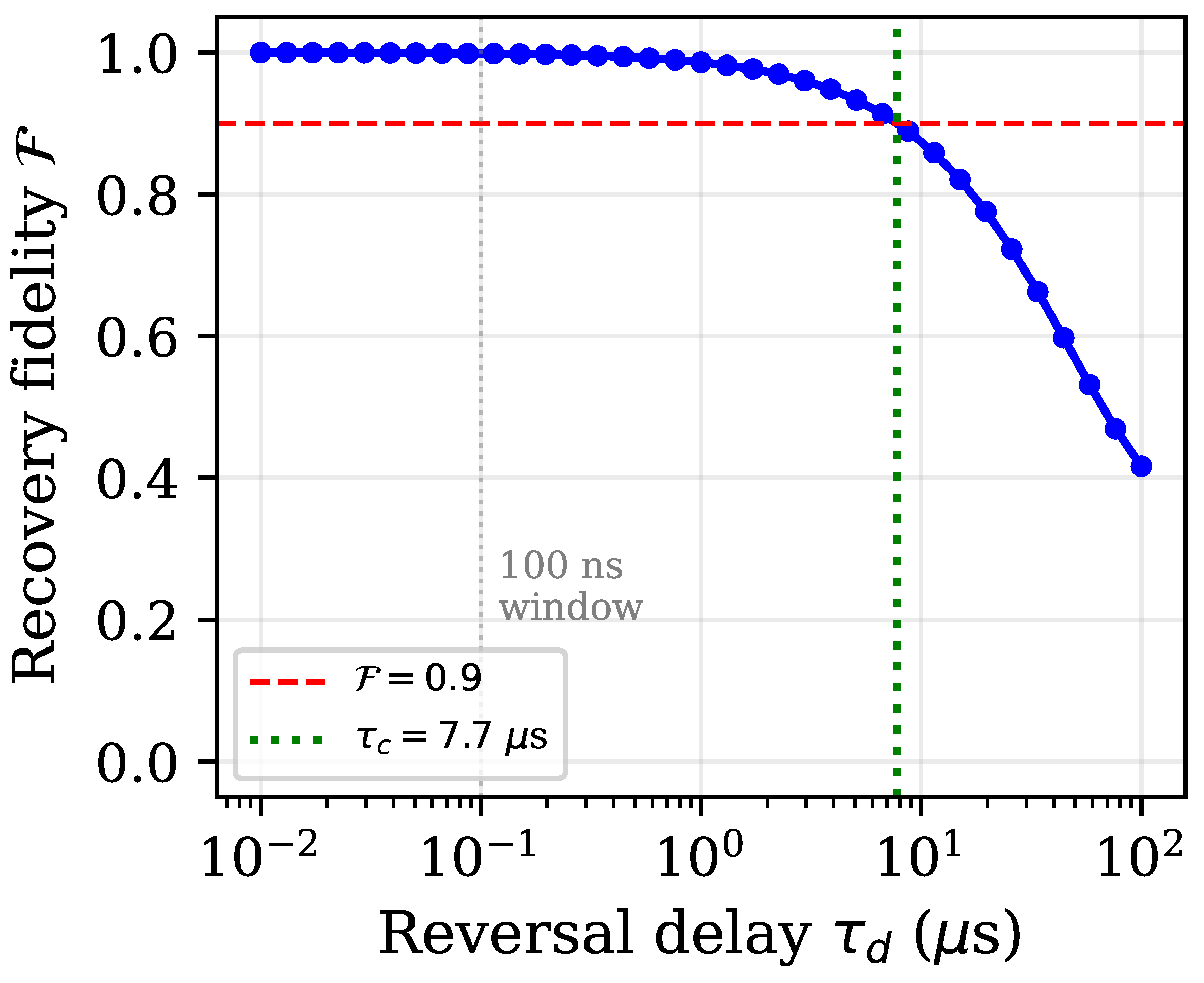
Table 1.
Experimental diagnostics for conditions C1 to C6.
| Cond. | Diagnostic | Failure signature |
| C1 | In-situ thermometry on absorber | T undefined or drifting |
| C2 | OFF-branch + stability (objective-record-compatible proxy) | Reversal succeeds at all delays |
| C3 | Periodic null checks (toggle/pointer-disabled) | Net |
| C4 | Control 3 sweep | Record reversible on expt. timescale |
| C5 | Uncompute-only null | Asymmetric drive heat detected |
| C6 | Dispersive calibration + acceptance criteria | inconsistent with |
Table 2.
Predicted signal and feasibility at SNR with zJ (conservative, NEP-derived). assumes pairs/s (requires s); with demonstrated s bolometers, multiply by .
Table 2.
Predicted signal and feasibility at SNR with zJ (conservative, NEP-derived). assumes pairs/s (requires s); with demonstrated s bolometers, multiply by .
| T (mK) | (zJ) | ||
| 10 | 22 hours* | ||
| 50 | 52 minutes* | ||
| 100 | 13 minutes* |
Disclaimer/Publisher’s Note: The statements, opinions and data contained in all publications are solely those of the individual author(s) and contributor(s) and not of MDPI and/or the editor(s). MDPI and/or the editor(s) disclaim responsibility for any injury to people or property resulting from any ideas, methods, instructions or products referred to in the content. |
© 2026 by the authors. Licensee MDPI, Basel, Switzerland. This article is an open access article distributed under the terms and conditions of the Creative Commons Attribution (CC BY) license (http://creativecommons.org/licenses/by/4.0/).
Copyright: This open access article is published under a Creative Commons CC BY 4.0 license, which permit the free download, distribution, and reuse, provided that the author and preprint are cited in any reuse.


